Theses
Thesis/Dissertation Collections
4-1-1980
Transfer function of the human visual system under
red safelight conditions with average luminance as a
parameter
Virginia Flook
Follow this and additional works at:
http://scholarworks.rit.edu/theses
This Thesis is brought to you for free and open access by the Thesis/Dissertation Collections at RIT Scholar Works. It has been accepted for inclusion in Theses by an authorized administrator of RIT Scholar Works. For more information, please [email protected].
Recommended Citation
AVERAGE LUIvTINANCS AS A
PARAHE'T'ER
by
Virginia A. Flook
A
thesis submitted in partial fulfillment
of the requirements for the degree of
Bachelor
of
Science
in the School of
Photographic Arts and Sciences in the
College of Graphic Arts and
Photography
of the
Rochester
Institute of Technology
Signature of the
April, 1980
Virginia A. Flook
Author . . . .
Photographic Science
and Instrumentation
Certified
by ••••••••••••••••••••••••••••••••••••••••••.•••
Edward M. Granger
Thesis Advisor
John Conner
by
Virginia A. Flook
Submitted to the
Photographic
Science and Instrumentation Divisionin partial fulfillment of the requirements for the Bachelor of Science degree
at the Rochester Institute of
Technology
ABSTRACT
This project was designed to investigate the spatial
frequency
response of the human visual system in low luminance red safelight conditions. The problem arose in
film
finishing
areas where visual defect inspection oforthochromatic films required red safelight illumination
at
typically
low levels.By determining
threshold contrastsfor a series of different spatial
frquency
targets over arange of average luminance levels within the mesopic re
gion, it was hoped that the limitations of thr visual sys
tem in these conditions could be determined.
In order to do
this,
judges were asked to view thetargets at low modulation levels which would be varied in
sponded 'yes' or 'no' to the perception of contrast on
the screen and from this
information,
the threshold contrast or 50^o detection was determined. The transfer func
tion is a plot of threshold contrasts vs. spatial fre
quency.
It was found that luminance level affected threshold
contrast in an inverse relationship with exceptions in the
low
frequency
region.A feature of the
testing
system revealed a furtherdependence of the threshold contrasts on viewing distance.
This was interpreted in terms of the visual field angle
and the number of cycles present in the field.
The many parameters which can affect the visual re
sponse system shoul
ideally
be filterd out to determine anI would like to thank the Central Intelligence
Agency
for their support of this project and my thesisadvisor, Dr. E.M.
Granger,
for his advice.page
Introduction 1
Background 2
Methods
and Procedures 8Projection System
9
Verification of the System 16
Target
Making
17Experimental 21
Judges 21
Target Slides
23
Apparatus
24
Modulation Control 26
Luminance and Color.
27
Analysis of Data 28
Variability
betv/een Judges35
System Artifacts 36
Summary
of Results 41Conclusion
43
List of References 44
Appendix
(figures)
45
Appendix
(tables
)
64
The aim of this project was to determine the transfer
characteristics of the human visual system under red
safe-light conditions. Some photographic film manufacturers use
red safelights in
inspecting
their film for defects. Inthe
typically
low luminance levels that are requireda-round these light sensitive materials, the question arose
as to what the limitations of the visual system are. This
paper presents a method of
determining
these limitationsin a simulated safelight environment, over a range of low
luminance levels. Before
discussing
the details in the proThe many stages within the human visual system are
best categorized under two main sub-systems.
First,
thereis the image formation system which consists of the eye
lens and the ocular media through which the image passes
onto the retina. The image at this stage is passed through
the sub-system of neural processing, which adds its own
distortion to the perception of the image. Each sub-sys
tem has its own transfer characteristics and it is the cas
cading of these two that make up the transfer function of
the visual system.
One way of
describing
the transfer characteristics ofthe visual system is in terms of its spatial
frequency
response. This method is
becoming
increasingly
popularin categorizing
imaging
systems, replacing the limitedmethod of measuring a system's resolution. In
finding
thetransfer function of the human visual system, a subjective
response from a viewer is necessary. In general, the view
er is asked to give his perception of a
target,
be it anedge or a bar target.
Two distinct procedures that obtain the viewer's re
sponse, are the methods of threshold contrast '^'^'^ and 1 5
acteristics are found
by determining
the level of contrastfor a series of various spatial
frequency
targets which isat the viewer's threshold. This method, since it deals
with very small luminance
differences,
is working over anessentially
linear portion of the system's logarithmicluminousity
response, thus the visual system can be considered a linear one.1
The second method can be used at any contrast level.
The viewer matches a blank field to both the minimum and
maximum luminances of the target and the subjective mod
ulation is calculated. The transfer function is the ratio
of subjective modulation to objective, or actual, mod
ulation plotted as a function of spatial
frequency.
Although this method may be operating in a non-linear lum
inousity
region of response, it uses contrast levels whichare more common in our everyday environment.
Chosen for this experiment was the threshold method
since it was,
indeed,
the threshold region of operationof the visual system which was of interest. Typical trans
fer functions obtained with each of these methods are
shown in figure 1 on the next page.
They
appear as theinverse of each other since contrast
sensitivities,
asre-100 :l 2 10 o c o
0.1 _l_ _l_
0.1 1 10
Spatial frequency(cycles/cleg)
100
la. Transfer function of the visual
system obtained
by
measuring thethreshold contrasts for a range
of spatial frequencies. Dashed
curve is for a lens under the
same conditions, ref. 1.
"5 2 " "3 -3 c Si. a .o _ 1 C."3 4.0 3.0 2.0 1.0 0.8 0.6 0.4
~i ' r T
J_ L. t . I
A=1
.86units contrast
*=5.84units contrast
O=7.73units contrast
Q=9.61 units contrast
. 1 . 1 . . t 1 i_
Extrapolated
-a * A
A
O'
09
I I '
0.30 0.42 0.60 1.20 1.80 3.00 4.20 6.00
Frequency(cytles/deg)
12.00
Figure 1b. Results from a contrast matching
experiment using different
Objective Distribution
\
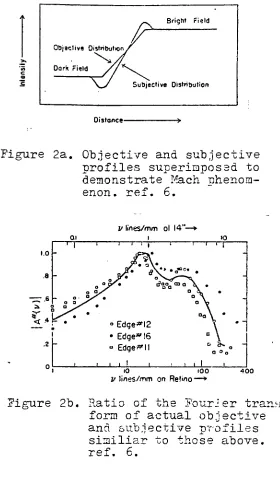
Dark Field Bright Field Subjective DistributionDistance-Figure 2a. Objective and subjective profiles superimposed to demonstrate Mach phenom enon, ref.
6.
vlines/mm Ol 14"?
01 i 10
1.0
-1 1 ' ' ' ' I
JT'A
1 1 1 I
I
a
-ojr* o o"='
.
o O^X a \
6 O
-Q^r m 0 \
o a o V
*
S a^* "
.1/^ \
*
<4r 0Edge*l2 \ * ~
Edge*16 a
\
.2
'
- Edge*!!
i i r 1 t
** -i . , , 1
10 100
V lines/mm on Retina *
400
Figure 2b. Ratio of the Fourier trans form of actual objective and subjective profiles
[image:11.538.125.405.51.537.2]quencies.
This
rather peculiar occurrence is a direct result of the phenomenon of Mach Bands.
Mach
bands,
so named after Ernst Mach who first discovered them over one hundred years ago, are a result of
the neural processing sub-system mentioned before. Mach
Bands are the perception of the minimum
density
area atan edge appearing lighter than its equal
density
surround,and the maximum area
density
at the edge appearing darkerthan its equal
density
surround. These bright and darkbands produce the sensation of enhanced contrast. A
typ
ical edge profile, superimoosed with the profile of the
perceived edge is in. figure 2a on the previous page.
Lowry
and Depalma showed thatby transforming
eachprofile into the spatial
frequency
domain andtaking
theratio of the subjective, or perceived, profile transform
with the objective profile
transform,
the result is acurve with the characteristic low spatial
frequency
dip,
figure 2b.
The physiological explanation behind the phenomenon
of Mach Bands has to do with the interactions of adjacent
elements in the matrix of visual receptors.
Any
singlereceptor, when excited
by
light,
has been found to sendde-receptor is proportional to the total excitation of the
surrounding receptors. For the
imaging
of an edgeby
theeye, low excitation receptors lie adjacent to high ex
citation receptors. At the low level there is increased inhibition due to the adjacent high excitation level.
But,
the receptors that receive high excitation and lie adja
cent to the low excitation receptors receive less inhi bition than the other high excitation receptors. The re
sult is enhancement of the perceived signal
difference,
orcontrast.
Much work was done in the sixties
investigating
therelatively new concept of spatial
frequency
response as a method ofdescribing
the performance of the human vissystem.
Among
the many parameters which wereinves-3 tigated was sine-wave vs. square-wave response
, average
2 4-57 47 7
field luminance
*^*^''9
viewing distance ', viewing time , 2
and monochromatic field response .
Although Bryngdahl's work investigated the response
in the mesopic region, the region which is of interest in
this experiment, he employed a technique of contrast match
ing
similiar to the one described earlier. His resultswere dependent not only on average field
luminance,
but onthe object contrast as well. The behavior of the curves
ex-less erratic results. Bryngdahl's contrast ratio vs. spa
tial
frequency
curves are shown in figure 3.Since it is red light that is of interest in this ex-2
periment, Van Nes and Bouman's work, which investigated
the spatial
frequency
response at450,
525
and 650 nm, wasconsulted. In their work, a 2 mm artificial pupil was used and the response of only one eye recorded.
They,
however,
did use the threshold contrast method and their results are
less erratic than those of Bryngdahl. It was from Van Nes and Bouman's work that the spatial frequencies to be tested and the expected range of modulations necessary were pre
dicted. Their results appear in the appendix,figure A3. The project presented here
is,
in a sense, a combination of Bryngdahl's work in the mesopic region and Van Nes and Bouman's work with color, conducted in a real life
environment. The viewers used both eyes to respond to the
targets,
without artificial pupils, and in an attempt tosimulate safelight conditions, broad band rather than mo
nochromatic light was used. Threshold contrasts apply to the real life environment as well, since in most cases film
defects differ minimally from the surround.
perform-anoe in the mesopic region. The
following
sections describethe approach taken in gathering the necessary data.
0.005 0.01 o.os o.i as
spatiJ fre^u.ney (5re9/mif ofarc)
pigure 3. Bryngdahl's results in the mesopic
region showing erratic dependence
on object contrast. Each curve re
presents a different object con
METHODS AND PROCEDURES
It was desired to have a method of obtaining thresh
old modulation as a function of spatial
frequency
for thehuman visual system.
Thus,
it was necessary that modulation be controlled
by
this method without significantlychanging the average screen luminance. The screen
lumin-is an important parameter upon which spatial
frequency
response is dependent. >^'^>'
^i/hile,
in this experiment,data was gathered at three different screen
luminances,
the average luminace at -any given level changed minimally
during
testing.For this experiment, two slide projectors were used to
obtain this result. The first projector contained
35
mmslides of bar
targets,
while the second projector contained only a blank field. Projected coincidently, the in
tensity
of one or both of the projectors could be controlledto vary the modulation of the projected bar target.
Since modulation was dependent on the intensities of
the two
beams,
varying these beams in increments - aswith
neutral
density
filters - meant that modulation wouldvary
in increments as well. While tne consequences of this in
terms of the judges ' responses are discussed in a later sec
Projection System
Mathematically
modeling the projection system requiredthat certain regions of operation be defined. These regions
are based on the relationship of the average luminances of
each projector. Projector one contained the targets and
its average luminance L is defined below.
o
L =
*(L
+ L .)
(i)
o ' v
max mm
where: L = maximum luminance at the screen from the target projector alone.
L . = minimum luminance at the screen
m:Ln
from the target projector alone.
Projector two provided only a veiling glare and its
average luminance is simply V . Note that while each pro-si
jector has an average luminance which may be varied
by
filtration,
there is a final average screen luminanceLg
which is the sum of both of the projectors' average lum
inances.
L = V + L
(ii)
s g o
It is the value of L which must vary minimally as
filtration is added to the system.
In general, modulation for a two beam system such as
this one is driven
below.
L - L
.
. max mm / . . . \
M=
(m)
s L
n + L . + 2V
max mm g
where: M = the modulation at the screen.
L n and L .
= the maximum and minimum
lum-max mm . , . , ~
mances at the screen from
the target projector alone.
V = the veiling glare luminance from
pro-jector two alone.
The three regions of operation of this system
-when
the veiling glare equals the average luminance of the tar
get
beam,
when it is less than the average luminance of thetarget
beam,
and when it is greater than the average luminance of the target beam
-will each have different rela
tionships between screen modulation M and filter
trans-mittance t.
Region One
In this region the veiling glare is set equal to the
average luminance of the target projector. The screen's
average luminance that we want to maintain is exactly that
L = L
(iv)
soThus,
attenuating
the target beam with a filter oftransmittance
t,
will necessitate the addition of a veiling
glare at the screen equal to(l-t)L
such that thefollowing
is true.tIQ
+(l-t)LQ
=Lo
(v)
By
setting the open gate veiling glareinitially
so that it is equal to the average luminance of projector one,a compensating relationship will exist wnereby neutral den
sity addee at projector one will require neutral
density
to be removed from projector two. The expression for modulation
becomes,
t(L - L .
)
M =max
Ei_
(vi)
s
t(lv + L .
)
+ 2(l-t)i(L + L .)
max
mm' v '
max mm'
t(L - L .
)
M = -SSS
SiaT
(vii)
s(t
+ 1 - t)(L + L .)
v ' v
max
' mm'
M = t(M.
)
(viii)
s 1
where: M = the modulation at the screen. s
"
t = the transmittance of the
filtration
Mi= the initial target modulation.
Since
neutraldensity
filters were to be used for attenuation,
there was a limitation imposed on the demodula tion capabilities of the system. The least amount of attenuation
available is a N.D. 0.1 whose transmittance isapproximately
80%. V/ith a transmittance of80%
on the veiling
glare projector, a transmittance of 20% is required onthe target projector. This arrangement provides the lower
limit of demodulation
(.20
M.)
without violating the requirement that the screen luminance remain a constant.
The second region of operation of this system, when
the veiling glare is less than the average luminance from
the target projector, will be shown to have similiar limi
tations.
Region Two
When the veiling glare is made less than the average luminance of the target
beam,
it is supplying the smallerpercentage of the total screen luminance.
Thus,
any changes made at the veiling glare projector will not significantly affect average luminance at the screen. Since we are striving
for minimal changes in average screenluminance,
it apat the veiling glare projector to control modulation, while
leaving
the target beam unfiltered. This system allows average luminance to vary,
but,
if controlled, the luminance will vary over only a small range.
Suppose the veiling glare is some fraction R of the
average luminance L . The average screen luminance L , in
this case, will equal
(R
+ 1)L
. The effect on modulationas neutral
density
is introduced to projector two is shownbelow.
M =
^x
jEiS(ix)
s
L + L . + 2tR(L + L .
)
max mm max mm'
M =
!
M.(x)
3
1 + tR 1
where: M = the modulation at the screen. s
t= the transmittance of filtration at pro
jector two.
R= the ratio of the veiling glare V to
average luminance of projector one L ,
and is always less than 1.0.
M.= the initial target modulation.
In this case, if R is kept very small, the average
luminance will vary minimally as the attenuation is added
to the system, but the minimum modulation attainable be
limit to the modulations possible. The remaining region of
operation,
however,
allows unlimited demodulation below acertain
level.
Region Three
This third region of operation, where veiling glare
is greater than the average luminance of the target
beam,
was the one chosen for this experiment. As will be shown,
its chief advantage is in its ability to obtain very low
modulation levels such as were needed for this experiment.
As in the previous region of operation, filtration oc
curs where it will have the least effect on the average
screen
luminance.
In this case, that is the target projector.
By
setting the veiling glare to be some factor Rtimes greater than the average luminance of projector one,
the average screen luminance becomes
(R
+ 1)L
and theo
modulation is affected as follows.
t(L - L .
)
M- -322
^
(xi)
S
^Lmax
+W
+2R*(Imax
+W
M = M.
(xii)
s
t + R x
where: M = the modulation at the screen.
tss the transmittance of the filtration
at projector one.
R= the ratio of veiling glare V to the
average luminance of projector one L ,
and is always greater than 1.0.
M.= the initial target modulation.
With this system, as R
increases,
the average screenluminance will remain within tighter limits when the at
tenuation at projector one is varied. The maximum modula
tion level attainable,
though,
decreases. It is possibleto reach extremely low modulation levels regardless of
the value of R
by
simplyincreasing
the attenuation at projector one.
It should be noted that the above expression for mod
ulation
(equation
(xii))
is a general one that would apply to any two projector system where the veiling glare is
kept constant. The stipulation that R must greater than 1.0
is stated so that the average screen luminance will vary
minimally.
In order to point out the characteristics of each
system, table 1 shows how modulation varies with trans
mittance for the three systems. The value of R is
0.5
forsystem two and 2.0 for system three.
Characteristic of system one is a broad range of modu
N.D. t Region 1 Region 2 Region
3
0.0 1.00 M.
l
0.67Mi
0.33M
0.1
0.79
0.79M.0.71Mi
0.29Mi
0.2
0.63
0.63M. 0.76M.0.24M
0.3
0.50 0.50M.l
0.80M. l
0.20M.
0.5
0.320.32Mi
0.86M. 0.13M
0.7
0.200.20Mi
0.911^
0.092^
1.0 0.10
0.95Mi
0.05Mi
1.5
0.03
0.99M
0.011^
2.0 0.01 0.99M.
0.005Mi
Table 1. Screen modulation in terms of the in itial target modulation for the three
regions of operation as neutral den
Inherent in this system is a constant average luminance.
The other two systems allow a small range of variability
in average
luminance.
System three can decrease the target modulation
by
the greatest amount, therebeing
essentially
no limit to the minimum modulation on the screen.This system is best used when fine increments of low mod
ulation are desired. For these reasons and the added con
venience of controlling neutral
density
at just one projector,
this third region of operation was used for thisexperiment. The next section discusses details in the test
ing
of this model.Verification of the System
In order to test the system, the maximum and mini
mum luminances of each target were measured using a
\
degree Spectra Spot Meter. From this
information,
both theinitial modulation and average luminance of each target
could be determined. These readings were made
directly
from the target projections onto the rear projection
screen that was used in the experiment with the magnifi
cation and geometry the same as would be presented to the
judges. The average luminance and initial modulation of
each target is listed in the appendix, table A1 .
order to obtain the
extremely
low threshold modulationsnecessary
in this experiment. The value ofR,
the ratio ofthe veiling glare to the average luminance of the
target,
was on the order of
2.0,
but varieddepending
on the average
luminance
of each target. The screen modulation foreach target is tabulated as afunction of filtration in ta
ble A2 of the appendix.
To determine if the model was adequately
describing
the demodulation due to
filtration,
the maximum and minimum luminances were read for various ajuounts of filtration
and the modulations calculated. These modulation levels
verified the predictions made from using equation
(xii).
To get an idea of how much variation in average screen
luminance could be expected using this system, the two
extreme cases are taken. When the transmittance of filtra
tion at the target projector approaches zero, the average
screen luminance approaches 2L . When the
transmittance,
on the other
hand,
approaches one, the average screen luminance approaches 3L .
Thus,
the average luminance canchange, in the worst case,
by
a factor of0,667
or approximately
i
stop.Target
Making
p
fre-quency response of the visual system under similiar con
ditions was consulted in order to determine the
appropri-aterange of spatial frequecies to be tested.
0.5
- 9.0cycles/degree were desired since this included the low
frequency
region which was expected to be non-linear,as well as higher
frequencies
in a region where the curvewas expected to become linear.
Thus,
it was hoped that sufficient information would be obtained to determine the di
rection that the curve would take in the higher frequencies.
Since high
frequency
targets are difficult to make, fivelower
fequency
targets were made and the veiwing distanceof the judges increased
by
a factor of3
to increase theangular frequency.
Targets corresponding to
0.5,
1.0,
1*5.
2.0,
and 3.0cycles/degree were desired at the chosen viewing distance
of 508 mm
(20
in). TableA3
in the appendix expressesthe angular frequencies
(cycles/degree;
in terms of absolute spatial
frequency
in cycles/mm.In order to make the
targets,
the magnification ofthe projection system had to be taken into account.
Using
a Kodak Carousel 600 Projector with an
f/3.5
zoomlens,
102-152 mm, the minimum magnification at the rear projec
tion screen was 5.45x. The required spatial frequencies
of the targets with the magnification taken into consider
At the far viewing
distance,
tha angular subtense ofeach target would be 3x
less,
thus the spatial frequenciesof the same targets would be
1=5,
3.0,
4.5,
6.0,
and 9.0cycles/degree. There is an overlap in the spatial frequen
cies tested at each distance in order to determine a cor
relation between the two sets of results.
A high contrast contact print of a 4 cycle/mm chrome
on glass Ronchi
Ruling
was used in the enlarger to makethese
targets.
The necessary enlargements were made onto35
mmPanatomic-X
film.Since very low contrast level were going to be neces
sary
during
the experiment, target modulations were made toapproximately 20%
rather than a higher value which wouldonly require more demodulation upon projection.
Low contrasts were obtained
by
first grayflashing
each strip of film and then proceeding with the target
exposure. Based upon the characteristic curve of the
film,
expressed in terms of transmission vs. exposure, the ne
cessary gray flash exposure and bar target exposure could
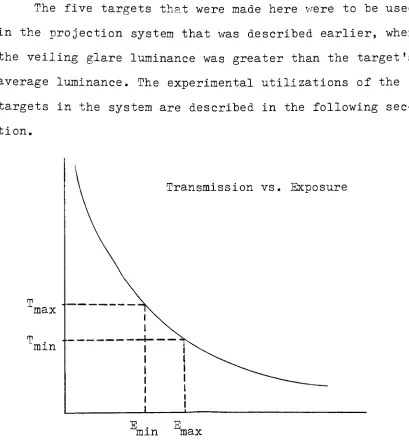
be calculated. Figure
4,
on the next page, shows the characteristic curve and the desired maximum and minimum
trans-mittances to yield a contrast of 20%. Notice that the gray
flash exposure determines the minimum
density
on thefilm,
while the target exposure is an additional increment which
The five targets that were made here were to be used
in the projection system that was described earlier, where
the veiling glare luminance was greater than the target's
average
luminance.
The experimental utilizations of thetargets in the system are described in the
following
section.
Transmission vs. Exposure
T
max
T
'mm
E . E mm max
Figure 4. Transmission vs. exposure
indicating
maximum and minimum transmission required togive a modulation of 20% and their corresponding
exposures. Emin= gray flash exposure.
E - E
. = bar target exposure.
[image:29.538.56.465.77.522.2]EXPERIMENTAL
In this
experiment,
it was desired to simulate theconditions of film inspection in order to determine the
threshold contrasts of the human visual system in this
environment.
Thus,
binocular viewing of low contrast projected bar targets on a red low luminance field v/as to oc
cur. Two different viewing distances were chosen to in
crease the range of spatial frequencies in cycles/degree
that would be tested.
Judges
There were 8-10 judges at each luminance level tested
whom were asked to respond to the projected targets. For
the near veiwing
distance,
each judge was asked to resthis head against a padded post set in front of the screen
so that the average observer's eye would be 508 mm from the
veiwing screen. When the veiwing distance was to be in
creased, the judges were asked to lean their head back
a-gainst the corner made
by
the door and door jamb in therear of the laboratory. In the average observer, this put
their eyes approximately 1524 mm or
5
ft. from the proEach judge was given a dark adaption period of 20
min-utes based on Cornsweet's data. When the veiwer's eyes
were
fully
dark adapted, the tv.ro slide projectors, well
-baffled,
were turned on and the veiwer was presented withan elliptical field on a dark surround. The horizontal
width of the ellipse was 148 mm, while the height was 107
mm. The elliptical
target,
with its rounded edges reducesthe perceived contrast enhancement alonga
boundary,
whileallowing
the greatest number of cycles to be present within the
field.
The
testing
began with presenting a blank slide tothe judge so as not to mistake the various irregularities
across the field for a target. Data collection was then
started as the five targets were presented at various modu
lation levels to the judge. As mentioned previously, neu
tral
density
filters were used to vary the screen modulation. Since this was a non-analog system, only certain mod
ulation levels were allowable on the screen.
Thus,
thejudges had no control over what modulations were presented
to them. This method of forced choice required that the
judges respond either 'yes' or 'no' to the perception of
contrast on the screen.
The total
testing time,
including
darkadaptation,
wasaproximately one hour per judge. To reduce the total ex
over-lapped so that the second judge dark adapted
(or
'field'adapted)
during
the last 20 minutes of the firstjudge,
and so on.
Target Slides
There were six slides to which the judges were to re
spond, five of which were the target slides. The sixth
slide was a blank with an average transmittance similiar
to the other
five.,
which was entered into the group todetermine the ability of a judge to discern a blank field
in the midst of the low contrast targets.
Furthermore,
blank slides separated each of the target slides. The ad
vantage to this was in allowing the judge to adapt to a
blank field between
targets,
negating the possibility ofan erroneous response due to an after image effect. The
blank fields between targets were used, in addition, to
change the filtration at the target
projector-^hese target slides were arranged in a carousel and
their order undisturbed throughout the entire experiment.
The experimental set up and apparatus are described in the
Apparatus
Recall that a tv/o projector system, consisting of a
veiling glare projector and a target projector, was chosen
for this experiment so that modulation of the targets could
be varied while average luminance remained nearly constant.
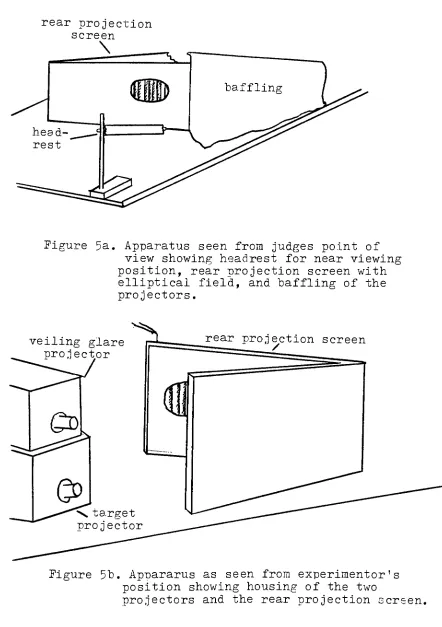
This system is shown in figure 5a and 5b on the next page.
The veiling glare projector and the target projector were
covered with black boxes and placed one on
top
of the other. The coincident beams appeared on the rear projection
screen through an elliptical window which defined the
field. The surround was completely opaque in ordej? to re
duce stray reflections and glare.
The rear projection screen,- a 18 in.
by
24 in. screen,had a folded optical axis such that the projectors were
aimed at a rear mylar surface and the beams reflected on
to the latex screen.
The projectors, Kodak Carousel 600
's,
were well baffled so that
they
were completely blocked from the fieldof view of the judges and so that no stray light would
fall on the projection screen to reduce the screen modula
tion.
The neutral
density
filters to be used in this experiment were placed in cardboerd mounts so that
they
couldrear projection
screen
\
Figure 5a. Apparatus seen from judges point of
view showing headrest for near viewing
position, rear projection screen with elliptical
field,
andbaffling
of theprojectors.
veiling
glare projectorprojection screen
;arget
projector
Figure 5b. Appararus as seen from experimentor' s
position showing
housing
of the two [image:34.538.42.484.69.696.2]The filters were used to control the modulation on the
screen.
Modulation Control
Five different modulation levels were chosen for each
target based upon a range it was hoped would include
threshold.
Although t he order of presentation of the targetslides remained constant, the order of the different mod
ulation levels was randomly generated.
Modulation levels were changed
by
adding ortaking
away neutral
density
filters from the target projector.Filtration changes always occurred
during
projection of ablank slide inserted between each of the target slides.
After the judge had responded to all of the slides in
the carousel, each at a different modulation
level,
thetray
was reset to the first slide and thetesting
continued.After all of the modulation levels for'each of the slides
had been presented, the entire procedure was repeated,
giving two replicates of each per judge. The judge was
then asked to move to the far viewing distance and a
howneu-tral
density
filters affected the screen modulation foreach
target.
With P-10 judges at each luminance level thatwas tested and 2 replicates per
judge,
a total of 16-20data points for each modulation were gathered for each tar
get.
Luminance
and ColorThree different low luminance
levels,
all within themesopic region of visual response, were tested:
0.754,
0.238,
and0.0754
millilamberts. The mesopic region covers a range from 10 down to 10"2 millilamberts.8
As be
fore,
luminances were measured with ai
degree SpectraSpot
Meter.
These low luminance levels were obtained
by filtering
both projectors with the same neutral density. Included in
the filtration of each projector was a Wratten 25 used to
simulate the red safelight conditions. Its spectral trans
ANALYSIS OF DATA
This experiment was designed to simulate the low lum
inance red safelight conditions of film inspection areas,
so that the limitations of the human visual system in this
environment could be determined. A series of bar targets
were made which, upon projection, v/ere viewed
by
judges.Using
a two projector system and neutraldensity filters,
the contrasts of the bar targets were varied in increments
while minimally changing the average screen luminance.
The technique of presenting to the judges modulation levels
which varied in increments is known as the method of forced
choice.
Thus,
the judges only response to the target wasa 'yes' or a 'no' to the perception .of contrast on
the"
screen. In order to increase the range of spatial frequen
cies presented, each judge viewed the targets from two
different viewing distances. Three different average
lum-inace levels within the region of mesopic response were
tested under these conditions, with 8-10 judges at each le
vel. The analysis of the response data that was gathered
is given below.
The 'yes' and 'no' responses to the perception of con
trast were tallied for each of the targets different mod
100%
'yes'response down to 0C' 'yes'
response
depending
onthe amount of demodulation due to neutral
density
enteredinto the system. The tallied data is presented in the ap
pendix,
tables A5-A10.For each
target,
the percent 'yes' response was plotted as a function of modulation. From these curves, the
threshold contrast, or
50%
point, could be extrapolated. :These nine graphs, one for each spatial
frequency
whichyielded a
50%
response point,are in the appendix, figuresA3-A11. Note that the highest
frequency
target at the farviewing distance was observed even at its highest modula
tion less than 50p'
of the time therefore is not included in
the results.
Immeadiately
apparent from both the tallied data andthe response curves is
that,
in many cases, there are only2 or
3
points between 1C0% andG%
response. Since it isthis range which determines the shape of the curve, it
would have been far more desirable to have more data with
in this range.
Unfortunately,
beforetesting
it was unknown what range of modulations would prove to be critical.
With finer
tuning
of the modulations, the response curvescould have been made with more confidence.
There
is,
however,
a limit to the shape that the present curves can take.
Manipulating
the curve shape whenthere
is,
in the worst case, just one point between0%
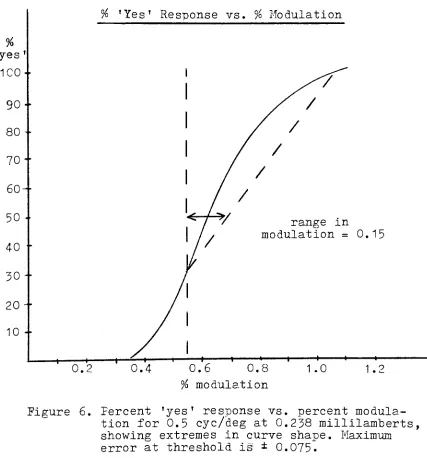
andtake. In figure 6 on the next page, the response curve for
the
0.5
cycles/degree target at the middle luminance level is reproduced.
Here,
theonly known point between 100%
and
0%
is a30%
response at a modulation of 0,54%. The extremes that the curve can
take,
a vertical line throughthe 30% point and a line connecting the
30%
to the 100%point, mark the extreme range that the 50% point can take.
Going
from a minimum modulation of0.54%
to a maximum modulation of
0.69%
corresponding to these extremes, gives a
maximum error of
0.075%.
Theseextremes are,
indeed,
unrealistic since some assumptions can be made about the ex
pected distribution around the threshold value. A normal
distribution might be expected, thus the response curve
would take on the characteristic S-shape and the actual er
ror in the 50% point would be less. As is obvious from the
response curves in the appendix, a.- normal distribution was
assumed.
To check this assumption, the few distributions which
did contain greater than 2 points between the
0%
and 100%response were plotted on normal probability paper. These
appear in the appendix, figure A12-A18. Recall that a
straight line through the points on normal probability pa
per indicates that the distribution is normal. Upon visual
inspection,
all of the plots seem to tend toward a straight%
'yes'
1C0-
90--
80--70"
60--50
40
-
30-
20--10
--%
'Yes'Response vs.
%
Modulation0.2
i
/
range inmodulation =
0.15
0.6 0.8
%
modulation1.2
Figure
6.
Percent 'yes'response vs. percent modula
tion for
0.5
cyc/deg at 0.238 millilamberts, [image:40.538.57.484.186.644.2]points were transferred to linear graph paper and a linsar
regression run. mhe narrow dispersion of points about the
line of best fit along with the high correlation coeffi
cient indicate that the distributions in question can, in
deed,
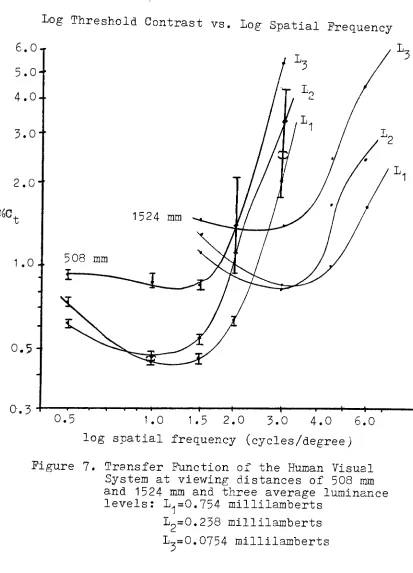
be considered normal.The threshold contrasts corresponding to the 50% re
sponse points were slotted as a function of spatial fre
quency. These curves, the transfer functions of the hu
man visual system under red safelight conditions, appear
on the next page, figure 7. The two families of curves
corresponding to the two viewing distances contain three
curves each, which correspond to the three luminance levels
at which data, was taken. The characteristic low
frequency
increase in threshold is evident, with an overall increase
in threshold contrast as the luminance level falls off.
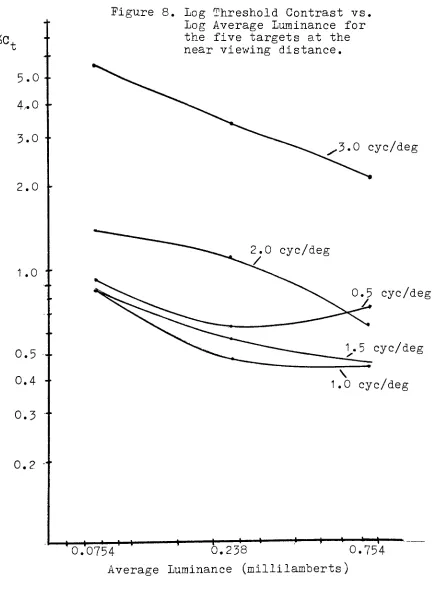
The relationship between average luminance and thresh
old modulation for the
5
targets at the near viewing distance is made clearer
by
the graph in figure 8. Here the relationship is plotted and it can be seen that there isan overall decrease in threshold as average luminance is
increased. The lower
frequency
targets(except
forC.5
cycles/degree, whose behavior is discussed
later)
show a tendency
toward reaching a minimum threshold andleveling
off as average luminance is increased. The higherfrequency
relog
Threshold Contrast
vs.Log
Spatial
Freq
uency6.0-r
5.0--4.0-.
3.0
2.0'
%C,
1.0-.
0.5-0.3
i i i1.0
0.5
1.0 1.5 2.0 3.0 4.0 6.0log
spatialfrequency
(cycles/degree)
Figure
7.Transfer
Function of the Human VisualSystem at viewing distances of 508 mm
and
1524
mm and three average luminance levels:1^=0.754
millilambertsL2=0.238 millilamberts
[image:42.538.57.470.106.679.2]
5.0--4.0
-Figure 8.
Log
Threshold Contrast vs.Log
Average Luminance forthe five targets at the
near viewing distance.
3.0
y3.0 cyc/deg
2.0
1.0 "
0.5
0.4
cyc/deg
cyc/deg
1.0 cyc/deg
0.3
"0.2
--> _ i
*- t
t-0.'0754
0.2380.754
[image:43.538.56.488.113.719.2]o
by
Rose-" that the threshold contrast would fall off as theinverse of the square root of the scene luminance.
Variability
Between JudgesThe error bars at each data point on the curves are
based on an estimate of variability among the judges at
the threshold
level.
Since only two replicates at each modulation level were presented to each
judge,
individualre-spnse curves would be meaningless since the only allowed
percent responses are
100?'),
50%,
and 0%.Thus,
the variability
among judges at threshold cannot be foundby
determining
the threshold contrasts of each judge.An alternative method of obtaining the variability
among judges at threhold utilizes the variability at
100%
and at
0%
response.Finding
the minimum modulation whereeach judge saw the target
100%
of thetime,
gives a distribution of responses at the 100% point.
Similiarly,
adistribution around the maximum 0% point, or 100% 'no' re
sponse point,. can be determined.
Taking
the variances ofeach of these distributions and averaging them will give
an estimate of the variability at the
50%
threshold point.This data is tabulated in the appendix, tables A 1 1-A1 6.
Placed on the transfer function curves in figure
7
are oneIn refering to figure
7,
notice that the variabilityamong
judges is greatest in the hirherfrequency
regionsand there is considerable overlap in the error bars among
the different luminance levels. In the lower
frequencies,
distributions
are narrower around each point and there isno overlap except at points where the high luminance curve
and the middle luminance curve cross over. This unexpect
ed phenomenon appears to be due to an artifact in the sys
tem.
System Artifacts
A possible explanation for the fact that threshold
contrasts were unexpectedly higher under brighter viewing
conditions is the presence of a. hot soot in the veiwing
screen. This hot spot, which appeared in the center of the
field,
caused modulation at the edges to be slightly greaterthan at the center.
Thus,
as threshold contrasts were approached, the perception of modulation at the center was
lost at the center before it was at the edges. The size
of the hotspot in the field was dependent on the lumin
ance
level,
thus at the brightest level the hot spot was atits largest and conceivably took up so much of the ellip
tical field that only the ends of the ellipse were unaf
cause any severe problems since the narrow bars and spaces
could be seen within .the end regions. At the lov/est fre
quency,
however,
it is possible that the width of a baror space was as great as or -greater than the end regions of
the elliptical
field.
Thus,
as the contrastdecreased,
onlya uniform field would perceived. If this was indeed
hap
pening, the unexpected crossover of the high and middle lum
inance curves, which occurred at both viewing
distances,
would make sense. In future work, it would be
highly
advisable to use a projection screen which had a more un
iform field than the rear projection screen used for this
experiment.
Another unexpected phenomenon, which can be explained
by
the system, is the apparent shift of the three curveswhen viewing distance was increased. Recall that the
viewing distance was tripled to obtain higher spatial fre
quency targets. It was expected that the threshold levels
from this data would simply add more points to the near
distance curves, extending them into the higher
freqency
region.
However,
it is obvious that an entirely new setof curves were generated with characteristics very
simi-liar to the corresponding near curves, see figure 7.
For example, the crossover of the high luminance and middle
luminance curves occurs at both viewing distances.
Also,
to level off in each case.
The degree of shift varies somewhat for each luminance
level,
ranging in the horizontal direction from a factorof
3
for the highluminances
down to approximate! 2 for thelow. The vertical shift is more consistent among luminance
levels,
ranging from a factor of1.75
down to 1.65. Theseshifts v/ere based on the minimum thresh olds at each dis
tance. Although the shift in these three curves was unex
pected, similiar results have subsequently been found in
the
literature.
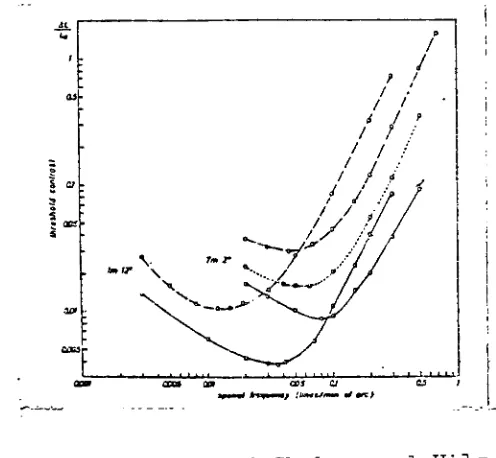
Schrober and Hilz in
1965,
measured threshold contrasts of the human visual system and varied the viewing
distance as a parameter. Their results, shown on the next
page, figure
9,
indicate a horizontal and vertical shiftin the same direction as shown here. There is no correla
tion,
in comparing their results with the oneshere,
between the degree of shift and the increase in viewing dis
tance.
3
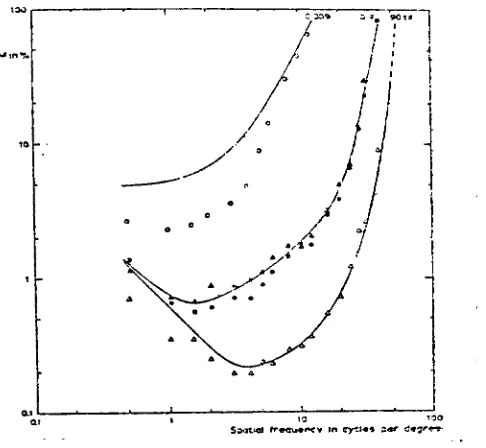
Interestingly,
Lowry
and DePalma also varied viewing
distance in their work with the visual system, but nosignificant shift in the curves due to viewing distance
is indicated. Their curves appear in figure 10. The es
sential difference in experimental
technique,
is thatLory
and Depalma chose tokeep
the visual angle of theFigure 9. Results of Shober and Hilz show
ing
the vertical and horizontalshift of the curves as viewing
distance and visual angle in
crease from 1 meter and
12
to
7
meters and 2 . ref. 4.CONTRAST SerOtTMT ft / SOUSS-MVE TEST CftjECT
C^wio*'*rt*vwr* 20 fM_
**1 I
* SpaMfr**ey (Lm/rr-manm retr^j)
Figure 10.
Lowry
and De^alma's curves do notshift as a function of viewing dis
tance as above since visual angle
[image:48.538.105.421.77.668.2] [image:48.538.126.374.93.322.2]Schrober and Hilz and myself chose to
keep
the field sizea
constant^
asviewing
distance was increased. In our cases,the angular subtence of the field changed, thus targets of
the same angular
frequency
(cycles/degree)
would contain adifferent number of cycles at each of the viewing distances,
For this
experiment,
visual angle of the subtended fielddecreased from 8.3
x 6.0 to 2.8
x
2.0
when viewing dis
tance was
increased.
Savoy
and McCann show that thereis,
indeed,
a dependence on the number of cycles present in the field.
They
show that the shift in the transfer curves due to achange in viewing distance or visual angle can be described
in terms of the number of cycles in the field. Although
they
go as far as to suggest that the lowfrequency
falloff in sensitivity is due to a decrease in the number of
cycles present, suffice it to say here that the number of
cycles affects the position of the curves with no apparent
change in the shape of the curves.
This leads to the question of how to define an ab
solute transfer function which can be obtained under any
conditions, as
long
as allinfluencing
factors can betaken into account.
Thus,
knowledge of what variationsin curve position and shape that will-, occur as a function
of each
influencing
parameter would be necessary.From Savoy and McCann '
para-meter can be accounted for. With the many parameters that
influence
the visual system's performance, there is muchroom for future work.
Summary
of ResultsThe transfer function of the human visual system
was determined for a range of low luminance red safelight
conditions. It was found
that,
in general, there was a falloff in contrast
sensitivity
as average luminance withinthe mesopic region
decreased,
with the absolute peak region of the curves
being
dependent on the viewing distanceand,
thus,
on the number of cycles in the field.From the results
here,
the near viewing distance peakoccured around 1.0 cycles/degree with a small variation
depending
on field luminance. For the far viewingdistance,
the peak occurred at approximately 3.0 cycles/degree.
The near viewing distance results agree closely with
Van Nes and Bouman's results with a similiar visual an
gle.
Van.
Nes and Bouman's results are in the appendix,figure A1 .
Eryngdahl's field angle is also similiar ,
however,
recall that Bryngdahl's work, also done in the mesopic
region, had erratic results
(figure
3)
due mostlikely
tothe measurement technique. The contrast threshold method
re-'.!.-suits, as was
hoped,
and it is unlikely that Bryngdahl'sresults bear any meaningful comparisons due to similiar
CONCLUSION
On the basis of these results, it can be concluded
that under low luminance red safelight conditions, thresh
old contrasts are
inversely
proportional to average luminance. The exception to this is in the low spatial frequen
cies where threshold contrasts tend toward, a. constant
with
increasing
average luminance.It was found that threshold contrasts as a function
of spatial
frequency
are dependent on viewing distanceand,
hence,
visual angle or number of bars in the field.Limitations of the visual system can not be determined
effectively without
having
a means of quantitatively analyzing the effects of each of the parameters upon which
the visual system is dependent.
By filtering
out theeffects of these parameters, it may be possible to deter
mine an absolute transfer function. This type of analysis
LIST OF REFERENCES
1. T.N.
Cornsweet,
VisualPerception,
AcademicPress,
New
York,
1970.2.
F.L.
VanNes
and M.A.Bouman,
'Spatial ModulationTransfer
in the HumanEye',
JOSA57,
p. 4-06(1967).
3. J.J. DePalma and E.M.
Lowry,
'Sine-Wave Response ofthe Visual System.
II.
Sine-Wave and Square-Wave ContrastSensitivity*,
JOSA52,
p.328(1962)
4. H.A.W. Schober and R. .iHilz, "Contrast
Sensitivity
of the Human Eye for Square-Wave
Gratings',
JOSA55,
p. 1086
(1965).
5. 0.
Bryngdahl,
'Characteristics of the Visual System:Psychophysical Measurements of the Response to Spatial
Sine-Wave Stimuli in the Mesopic
Region',
JOSA54,
p. 1152
(1964).
6.
E.M.Lowry
and J.J.DePalma,
'Sine-Wave Response ofthe Visual System. I. The Mach
Phenomenon',
JOSA51,
p.740
(1961).
7. A.
Wantanabe,
T.Mori,
S.Nagata,
K.Hiwatashi,
'Spatial Sine-Wave Responses of the Human Visual
System',
Vision Research8,
p. 1245(1968)
8. Rubin and
Walls,
Fundamentals of VisualScience,
Charles
C. Thomas publisher,Springfield,
1969.9. Kodak Filters for Scientific and Technical
Uses,
Publication No.B-3,
Eastman KodakCompany,
Rochester,
1973.10. R.L.
Savoy
and J. J.McCann,
'Visibility
oflow-spatial-frequency
sine-waves: Dependence on number of cycles',Saaffl* rrvui*<V eyt)*a**-
<J3'"-*-Figure A1 Van Nes and Bouman's results
for monochromatic radiation.
The values of interest for
this experiment are the
closed triangles which in
dicate data at 650 nm at
0,9
[image:55.538.109.352.125.349.2].hi
IX-10X-,
100"
200 300 3
?2
400 500 6G0 700 800 S00
1
j 'r
1
> '1
11
! tL
itn:
il
X-i
1
I- !i 1 1
~~ 1 ;
It
"j
i TT"i I i 1
-X-HX _
!
! 1 1i
1 1 ! _U_
1
11 ' '
, ', i
'
I i 1
I 1
1 1 i ! I t1
1
r If"^"H"
i i--i t j
-| i i ; 1 1
!
!! 1 i 1 1 ! i 1 1
! | '
; 1 1
f
'J
;A
^ 11 i - i
1
-1 ^ 1 !
1 1
1 '
If-1
N
! 1 j1 !
i
1
!
r i1
' r>-^-4.ill'
ml
200 300 4C0 SCO 600 700WAVELENGTH(fanenwiws)
S00 SOOi
"i^ure A2. Scectrophotometric curve for
0.5
1.0%
modulationFigure
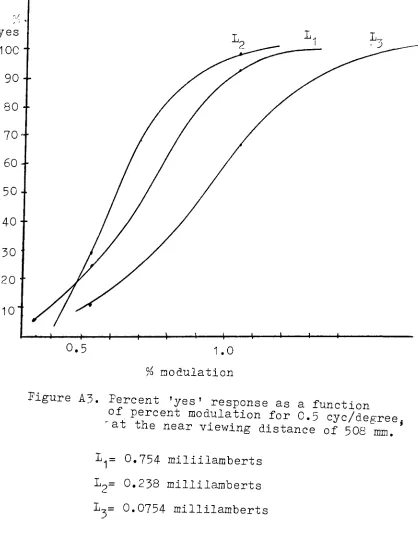
A3.Percent
'yes'response as a
function
of percent modulation
for
0.5
cyc/deg
ree, at the near
viewing distance
of 508 mm.^.p
0.754
miliilamberts L2= 0.238millilamberts
[image:57.538.64.482.104.642.2]%
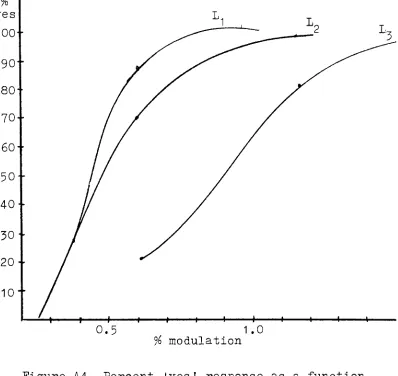
modulationFigure A4. Percent 'yes'
response as a function
of percent modulation for 1.0 cyc/degree,
at the near viewing distance of 508 mm.
L1=
0.754
millilambertsLp= 0.238 millilamberts
0-'
%
yes100"
90-
80--70
60-'
50--40
30
20
10
0.5
1.0 [image:59.538.59.471.139.646.2]modulation
Figure A5.
Percent 'yes' response as a function of percent modulation for1.5
cyc/degree,at the near viewing distance of 508 mm.
L.=
0.754
millilambertsL2= 0.238 millilamberts
1.5
i
% modulation
Figure
A6. Percent 'yes response as afunction
of percent modulation for 2.0
cyc/degree,
at the near viewing distance of 508 mm.
Ip
0.754
millilambertsL2= 0.238 millilamberts
[image:60.538.70.474.119.548.2]3.6 4.4
%
modulationFigure A7. Percent 'yes' response asa function
of percent modulation for 3.0 cyc/degree,
at the near viewing distance of 508 mm.
L1=
0.754
millilambertsL9= 0.238 millilamberts
L,= 0.0754 millilamberts
[image:61.538.55.468.125.522.2]1.0 1.8 2.6
%
modulation3.4
Figure A8. Percent "yes'
response as a function
of percent modulation for U5 cyc/degree,
at the far viewing distance of 1524 mm.
L1= 0.754 millilamberts
L= 0.238 millilamberts
!-.= 0.0754 millilamberts
[image:62.538.53.457.122.630.2]1.0 1.4 1.8
%
modulation [image:63.538.59.460.137.654.2]2.2
Figure A9. Percent 'yes'
response as a function of percent modulation for 3.0 cyc/degree,
at the far viewing distance of 1524 mm.
L.=
0.754
millilambertsL0= 0.238 millilamberts
5.0
%
modulationFigure A10. Percent 'yes'
response as a function
of percent modulation for
4.5
cyc/degree,at the far viewing distance of 1524 mm.
L.=
0.754
millilambertsL= 0.238 millilamberts
[image:64.538.57.446.126.586.2]2.6
3.4
4.2 [image:65.538.52.472.121.650.2]%
modulationFigure A11. Percent 'yes'
response as a function
of percent modulation for 6.0 cyc/degree,
at the far viewing distance of 1524 mm.
L.= 0.754 millilamberts
L2= 0.238 millilamberts
98
Figure A12. Normal
probability
plot of %'yes'response vs. modulation for
0.5
cyc/deg and near viewing distance.
95
90
80
4
70
60
50
40
30
20
10
-0.754
millilamberts0.0754
millilamberts2
1
.2
.1
[image:66.538.51.473.98.700.2]Figure A13. Normal probability plot of %'yes'
response vs. modulation for 1.5
cyc/deg and near viewing distance.
90
+
80-
70-
60-
50-
40-
30-
20-
10-5
2-1
.2
. 1
\
0.0754 millilamberts
[image:67.538.56.458.145.663.2]
90-Figure AU. Normal
probability
plot of %'yes'response vs. modulation for 2.0
cyc/deg
and near viewingdistance.
80-
7C-
60-50.
40-
30-
20-X
0.238 millilamberts
10
5-2
1
-
.2-.1
[image:68.538.45.475.114.671.2]
.2-. 1
-Figure
A15.Normal
probability
plot of %'yes'response vs. modulation for 3.0
cyc/deg
and nearviewing
distance.
2
1
.5
0.238 millilamberts
[image:69.538.43.480.123.695.2]90
Figure A16. Normal
probability
plot of %'yes'response vs. modulation for 3.0
cyc/deg
and farviewing
distance.
80
70
60
50
40
30
20
.754 millilamberts
10
5
2
1
.2
.1
[image:70.538.62.469.105.670.2]93-.
95-
90-
80-
70-
60-
50-
4-0-
30-
20-
10-
5-Figure A17. Normal
probability
plot of %'yes'response vs. modulation for
4.5
cyc/deg and far viewing distance.
0.238 millilamberts
0.0754
millilamberts2
1
*i
m.
[image:71.538.52.470.88.714.2]95
90-
80-70^
60-50
40-30
20
+
10
5
Figure
A18. Normal probability plot of %'yes1response vs. modulation for
6*1
0cyc/deg and far viewing distance.
llilamberts
llilamberts
2
1
.2
. 1
[image:72.538.68.455.93.664.2]Target Target Target Target Target
12
3
4
5
*
L
o
M.
l
2.49 2.55 2.74 2.9