Proposal for a CGL""N C IL :OI:r?T.ii C T:.L!E
----~----=-~~ .... ~~-
--COM(7 4) 2180 final
Brussels, 20 Deceffiber 1974
on the approximation of the la~·JS of the J'v:ember States r8liiting to safety bolts and rostraint
s-sstems of motor vehioles
Proposal for a COUJCIL DIRECTIVE
"-"'-~~--~.r>-... --~~
on t~1e appro:x:in..ation of the lmvs of the Member
f·~aies rel"1ting to head restr;;dnts of seats of motor vehicles
(submitted -'eo the Council by the Co·mnission)
•, ·,
Act~ng on a proposal from the Commission the Council included in the General
Programme of
28
Ma¥1969
for the elinunation of technical obstacles to tradethe Community the type approval of motor vehicles • .Among the matters to be dealt with under that procedure by Special Directives are safety belts and other restraint systems, and head restraints. Moreover, the Council
under-took in the Community Action Programme for industrial policy o£
21
December1973
to adopt directives relating to these devices~· before 1 January1976,
' '
together with the Directive on seat-belt anchorages 'Which the c'ommission
sent to it in August this
yearl).
As part of their endeavours to enhance the safety of persons using motor
vehicles, most of the Member states have brougnt in laws and administre.ti ve . provisions on seat belts and head restraints. These national provisions:
generally differ from each other, however. Mor~over, they do not take.
sufficient account of recent technical advances in the field. These dis-, ' ' ~
advantages make it urgently necessary to adopt Community requirements which
could not only eliminate techn~cal obstacles to the free mo~ement of the
abovementioned.vehicles and accessories but also provide motorists with maximum protection combined with comfort, having regard to the present state
of the.~ •
. The propos~d Directives l~ down technical requirements for the manufacture,
chec~g . and fitting of
.
sea~ belts and other restraint systems and of headrestraints. They are moreover·int~1ded to complete to the s~ries of
direc-tives relating to the internal appointments of motor vehicles. The proposal for a Directive on seat belts and restraint systems are based more
particu-.;.
larly on the proposal for .a Directive on seat-belt anchorages which lays down
essential requirements
fo~·
..:.'tft~ ~tt~ctive
ihftliallation of such devices in oars.The technical requirements in these proposals for Directives ~ere formulated
in close collaboration with the M'ember· states'
experts,
representatives ··of thetrade associations ooncemed and of conS'Umers' ·orgamza.tiions, from a.ll of whom they have recei'ited a ·wtd.e."mee.aure of 'agreement·.
· ..
' .
n.gOMMJ!iNT§ ON 'l1iE flPPOS@ !)lR
pbgzl'm§
.·,
.' ;
;;,· .,., I :
Despite the sustained efforts by :atrope•s carmakers to.
ine~ase.
the·· a.oti ve safety lewl of ·their vehicles .:.. whioh ·have Undoubtedly 'attained and. 'WU'iValled .level in that respect ·-·road tra.ffio' st·ati'stids ·have
.· b~come iric:teasingly'disqUieting in recent· years. Tod83 ..
it:
ii~"·"meiii.surescgncerned. with passive safety, ·pa.rticul:.arly those' deS:I:gned to restrain car occupants, which pr<rrlde the most' effective' means of redilo'i.ng the
ti.Urtlbers ki lad and injured. • '; . I: • r:
.. ,- ,_ft
.~T~e. ~oat
important of .such~straint d.~rtoe~,
'and~~~ ~Moh.is·:,lin
'·atrl-fici~tiy
wide use to enable ita effects~~
'th.est.atisti~a
'.tci
be- 't··,·; .. ~ ~·' '·. t! ·~ . • • ' . : ·• ' . .. ' ·i .. •' ~ .. . t ~·,1~~: .. ~:.-.:r··
'
assessed, is the safety belii. All publications on the subject ·~e
~~ \ . _", I ' ~
tha.t sui table and properly-worn aa.fety belts can reduce the risk of
• • :. • ' ., '
1
: • phySioBl injuries in the' event of
-an
accident by lat'least
·one· h~f.' ., ·' · · Thus, 'g1 ven 1~ use by mot'o:cl sts, aboUt·
l3-
000 · deaths cOuld 'be·' ·.~ ... ' ' 't
Eivei-ted annuSlly in the Communi'ty. '
..
.
' 1 I 'o ...
.
·, '. . .. ~' .' '
.
' ..
.. . ' .. ~ : ,.,
..
~··.
...,..
..•
;
.
'. ' \ . '. -... -.. '.
{"\
: , \Y~
•I . •' .t
' .·
' , I ,'•J,,
-• • • • 1
,· )
.·., ..
' \ ."~~
•
"
-3-Moreovel-1 Australian statistics - which are still provisional and
there-. fore to be treated With g:t-eat caution - confirm that such expectations
are well founded; and Australia is the only country so far with tr.ree
years' experience of compulsocy wearing of sell:t belts (and even, in the
state of Victoria, fOUl' ~ars).
A study which the Commission recently had made under contract1) showed,
however, that the various ty,fles of belt are not equal in respect of the
degree ef protection and user comfort proVided. Only three-point (1tlap
and diRgOnal") belts afford the greatest degr~e of protection in a.ll
accident conditions. Di~t70nal belts are lea.St good and lap belts pl"'vide
an acceptable degree of protection only for the occupants of the rear
seats of a vehicle. Wearer comfort is a key problem with safety belts,
indeed, the cause of·their only drawback: too often seatz belts if
fitted are wrongly worn - generally with too much slack - or not used
~t all. :The solution lies in the fitting of retractors, i.e., means of
rewinding the straps,
. !.~is propo~al for· a Directive takes account of these st~.tements. It is
b~ed··~~
the .finding that the aim must be ·to achieve the highest·possible rate of seat-belt use, irr~spective of the matter o.f: compulsory
wearing. df seat belte, one that C8ll!lOt· be settled within_ the scope of
Community typ~ appi:ov.'sl~-l{o~over, the same philosophy wformed the
preparatiOn of the proposal tor a.Directive on seat-belt anchorages,
with particular regard to the zones where these anchorages are installed.
1.2. C_ompu;I.so,ry installat~on reSJlirementJ!_
The proposed Directive provides that all seats in cars shall be fitted
with safety belts or other restraint systems whose functioning, e.g.1
buckle opening, will be standardized as far as possible.
.;.
l) G.M .. MACKAY "A review of car restraint systems ""' report to the Commission
-4-l1'r£I!t,
.1eat,s shall .'b!il -f}:t-ied· with. ~~ea-point 'b~tt~ ~r ~pther ~straintsystems embodYing. lJ110h. beJ.,ts~. . The -~evioes fitted. to the ~ (ront seats
' . . .'' .
shall also be 'proyid:ed .w:i.~h retra.otox:s apd shall. be· suo4 tha.~ the belt
' .. · ' . '•' '
ean be.
put-
on and: the. 'b\lQ~e looked and unlocked with one hand. These• ·~ ' • ~ ' \1' ' ' • ' •
requirements, which are ohara.otqristic; ... ot:'-'~hos~ s~tei!U!I having, according
. . . .
to the literature, the highest ra.te of use, are of p~ioular importance
for
.the~~ ~eats ~hio~·
the statisticssh~
as having the hignest currentooo~panoy
factor, The fact that retractors a.utomatioSll.y adjust belts .. . . I
to their wearers eliminates :the danger of tQ.eir being worn ioo slack,
:-which normally ~eimlts in the risk of the oooup~.n:t ·- espeoia.ily the
.
dri~er ~
despitewe~ilg
his or her 'belt, oo.lliding~t~
rtg:i.d
partsof the vehiple in_the event of
an
accident. The fitting or'retraotors' •' .._.> i
'at theee seats also provides a.
~~ltttion ~0
the problem.of .
a.ce~ssi
bill ty• . f'
to ~he controls, one which will also oome under consideration as pa:rt
' . . . ' . . . , ~ ! ·. . ...
of COlJl!IlUrl.ity type_ apprO\Tal, and will be yery difficult to solve 'wi'th
t -, • • •• ( . • • • ' •
statio belts. ·' ' .. ·
.·'
. The. m.atter of J"e.tra.otor relia.bili ty - which is sometimes questioned ...
\- . ' .. !' ~ :" ,.~" . • ·, . . ., . . • -~ ~/: • . . ·. ···,~ ... "": •. · :;f r·_:~~ .
• .i.ll settl-ed by the very stringent requirements in the proposBJ.·.
; * . \ \ ' V t .. I ' • ' • t7 ';f.J f{:.J'If'~, \:
: 1.r:~:··. ~ o~er to ensure that all fropt-se~~ occupants ,;n o~;~. given
0 ! " . . ., I '
... ·. ·· '·-: ,: ..
·:Ovt:~ -and eqtli$a.ble protection, ;Provis,io~ is ma<l~ ~or; t~ .oompulsocy•• ··1 i. :~ ·.fritt.t.llg -of three.point belts. on oeptu
h:gnj
seatJh. ~though _this· ····: ::-. ·.-post tioh does not figure significantly in aooiden:t statistics ... in &.:rope
fewer than l
fo
of those killed or tnjureQ. had,. o~~p~pft:_,_th~ee ... seats and.only a very small number ·of the oars produced have theLl. In this case
I ! ~. . . ,
'
..
; :. •.'
retractors will be optional·.· ·• · · ; · ·. •· • ·
. .TJl.e . re,a.r sejts of oars shall be . fi tt_ed with la.p ·belts ..
~t l~Mt.
Three-, point belts and
retraot~rs
will _be optionalitt'c~
with
.~P·~~pri~:~.te
.
.
' }- ' :. ,' . ,. '; " ~ . ' ' .anchorages. Thi• requirement is considered essentl;.a.l although present
statistics reveal tha.t the cost/benefit ratio of such a step is not high
owing to the low oooupa.noy rate of these seats. Those statistics, howE:Wer, ·
. " '~, ... /· ... :-.
.
,' .. :....
J• ~ I
.. ' t~
• I ) { ' ' . . . . • • • ' ._ ~C.i5· :~ ·: ·.) ..
.;.
''
I ,r
•, ' ·l j• <;f"~ '··\~
,,\ :'·
I ,,;.f:
·-~.
' ~' '
• >
" ''· . ..t ''( \ ~!
' ·~ /\
...
·~,
.,. l
\~ '-·[··~ I 11 , )
~.z, ;
. -:~
, I ' ·
•·.
·'
,', 5
,.
•
take no account of the· fact that restraining d~vices on the rear seats
.are not of benefit solely to_ their occupants but also to tbose of the
front seats. Recent e.ccident studies show that under certain conditions
'
unrestrained rear-seat oqcupants may cause ser~ous even fatal
-injuries to those in the front seats who had belted up.
Moreover, it is c~rtainly not mistaken, in view of the current
develop-ment in the economic situation in Europe, to forecast increasing ,!
occupancy rates for the rear seats of cars.
1.3.
Res~r5&nt s~temsAll car manufacturers of any size are currently developing restraint
systems more advanced than seat belts. They generally have as a common
feature: the_ principle of protecting car occupants without their having
to take.anY. action, e.g., putting on and buckling a'belt. Owing to the
ireat variety of these systems (passive syster:m, as thei
are
termed),which at present exist only in prototype form, it i~ very difficult
at the pre:aent time to formulate manufacturing and test requirements
which are both specific enough to ensure that the users are given··
greater safety than with seat belts and broad· enough not to hamper the
future development of these 'systems.
Sys~ems· are e~rcady on the market, however, c~nsistingtor example. of
., ' ). .. . •.
seats with attached safety belts which are offered as' optional
equip-ment 'for· the front seats of certain oars. Like the proposal for a
Directive on anchorages, thcrefort~, this proposal des'cribes test
li'e-quir~me~ts 'for su~h ·systems. These proVisions can: then be extended
-in ·step wfth technical progress -in the field - to cover mo:re advanced
·syStems as soon' as they have attained production stattllh '·
.. 6
-1.4.
Te8t reg~iremen!!Safety belts and restraint systems as defined in this proposal for a
Direc'tive ·must unclergo. a dynamic test ,.du-ri·ng whi'ch thet must:_~ithstand
'the. forces due' to a dummy. we·igh·ing abou~ 1.?5 kg;;'eubjec.ted· to an
acceleration of'up to~
s•
Before this, test belts-~nd rest;aint. - .
'
systems - including th~ir meQhanical c~ponents - will be c~nditioned
by
e~e>sure
to the most severe,. condi t:ions. -·that they 'are likely to· experie~ce · in service~- e. g •. , -ext~emes of temperature i!l~J.d hutn~di ty,
dust-lad.en and corrosive atmosph-eres, etc ....
1 • .5.
Conclusions• •' #! .- .... .,-. J<·
Altogether, its requirements put the proposed Directive well. ahead
of ·national provisions
on
the subject. Up to now none o{ t~e Member. St~tes_.has rettuirements in force making it_compulsory, for example,
-t~.
·t:i.t safety belts o'r other forms of. restraint~-y~te_m -a~ -ail,~
seatsand.
~etra.ct~_rs
at s.ide· frontseats~
Give·n·th~· t~chni~~l tnfo~ation
; .. : '' ,, . . : -' . : ·. . ' ' ; ; . . . - ·. · .... ~ ~
~~~.a~ailab~e, :the proposed.requirements ensure optimum pfO~ection
' ' ' I • ' • \ ' I
f9t- .the· ueex-s of the types of equipment defined. in the Dir.ective. ' ' . . ' ' . . '·· J.. ~ .
The· !Commission
~hereto
re hopes ·that' their .~l!lplementa:t~.on :w1~:L-
result. . ,
,. tdm&S"l i,mm~diately in a major reduotiop ~n· the number-~~ ,!1Joto:rists
' , I ~~ ·~;
killed or injut-ed in road traffic ~ccidents. .. . . .
<·
.
.~rt~ermore, i,t. should be noted tha:t the propOsf:td measures. are l&kely
• ' ~. • t • •
:t~
have: a. favoura'Qie effect on research, atC~nm~ni
ty:
~~ve,l ~--.designed
to
pfOdt?-·~~ ration~l ,.sQ;t~tions
to other-p~o~iem~ co~pe~ted·:~i.~h
passive• , ' ! ~ ' ' ~ • ' ' ' I • l •' '
sat.ett, i·n· mot~r vehicles,· e.g.'. control layouts and safetr_.w:Lndscreen$.
' • • • • >' • ' • ' ' I
In the latte~ ~ase, in P~:t:ticular, the provisions in t~e·. a:t-t;ached
_DiJtedtive . s~ould make .it eve~ &asier tor a ,decision. to ~e· .,reached in
' • ' • I ' ' ~ !
favour of .~the proposal (1) sent to the CouJUJ'il by the Commission in
·~ • • • 7 .
1972
1 the aim of which is to make the fitting of laminated glass thegeneral practice.
.
..
/
...
(l)
COM(72)98l
final of1.5
September1972
.. '
:_id
•
-
7-2. ~~,..re~12£~ ~d oth,elj!.ise
2 .1. Gc::1cr .::1
=
T~is proposal for a Directive l~ down requirements.for the manufacture
and strength-testing of the said i tom. Taking into account the inft9:rma.tion
which is available the Commission does not consider it possible, at this time, to _introduce prescriptions concerning the compulsory fitting of head
restraints in all vehicles.
In point of fact the results of the studies published so far do not warrant
:the conclusion that head restraints are certain to prevent the characteristic
toms of injury that public opinion attributes to the lack $f them, particu-larly in the. event .af accidents causing an impact from the rear. These studies generally assign a· cost/benefit ratio. to head restraints which is not
sufficiently high.
On these grounds., the Coqunissi<:m plans to take action to improve the;. available
knowledge - which has already enabled it to establish the present proposal -. ..
both in the analysis of the consequence .o£ accidents for occupants of vehicles
with and without head restrai~ts and_ in the tests to be specified for the
control of the efficiency. of head restraints • It will ta.J::~i' these new factors
into accow1t at a suitable date fo~ the adaptation of the present directive.
t·iith regard to vehicle ~eats, .the Comi;lission will propose, if neoessaryt that
they are equipped with deVices enabling the fim attachment of head restraints ' ' - , : I
\'thich are specially design~d for :the. tJPO of seat in question. This could be
carried out either by the adaptation to ~he technical progress of the Council
directive
74/408/EEC
on the strength of seats and their anchorag~s, or in thetramwork of later directives dealing with the whole system seat-occupant restraint •
Hitherto none of the Member states has brought provisions into force making
it compulsory to fit head restraints in motor vehic~es, nor even informed
the Commission of its intention of doing so. On t~e oth~r hand, several Mecbor
States have brought in different provisions on the testing of head restraints.
Not only are these provisi~ns li~ble to create obstacles to trade, but they
have also failed. to prevent the marketing bY accessory manufacturers of head
restraints which are ineffective ~1d even dangerous.
On these grounds it is essential that harmonized and stringent requ.irements
for the checking of head restraints be brought into force as soon as possible •
..
'.,. • ~ '!" .. ,
...
Head restraints integral with seats or attached to thoo. shall
unt:.cr~-• ' ' I
e •. f.-~~·tatic. test during which they must withstand' a, force· corresponding
to the weight of the
lnunan
head' sub·jeoted toan
a.ooelcration' of theorder·of 20 g • .
. '
The adv~tages of this test are its 'Sintplioity and reprodu.otibility
and. - above all - in the fast that it ntakes ·absolutely certain that
head restraint~ which are not sutfioier.Ltly well attached to the seat
back will be eliminated. In .. this c.ase. e~ d;ynamic test will be
meaninS'-f'u.f
only Whel'l. anthroPQ!llOrphic d'WD!IlieS .'become available Whichare·
l'e•pres~ntat·i~
. of the behaviour of the oe:rvical verteb:rae. in' thee17~t
of an impa.ot. 1hi.s problem, too, will 'be subject of· the a.bovG.
men-tioneQ. studies.
' ..
~ic;e l ·ts 6 institute EEC type a.pp~a.l proeedure tor saf$ty bolts ~d
.re~t;t-~nt s;yste~1 and head restraints· f'or the ·adult oooupants of tnotor
• ; !
_vehicle·s• Through this procedure, the Directives are designed to pe~t
the free movement of the items in qu.estion ·Within the Collll'llUlli ty by
for-biddihg the Member States'
to
object to their marketing wh~ they CO!!'lplywith the requ.irements in reapoot of manUfacture and testing set out i~ the
·.Ann~es and when they beat' the EEC t;ype-.a,p'p,ro~al ma.rk, the model of whioh
is shown il_l .Annexes
In
and V respectivelY• The procedure provides t'or a· s;rstem of reciprocal notification of arlY' issue, refUsal,, wi thd.ra.wa.l ·or
•.'
Directives mazy- be' operated in those states.
...
;
...
, .. :
' '
,J_pt,~ J '' "''' •• ~::
I•~
..
.. 9
-Article 10 of the Directive on seat belts (and !!:,ll.£!e 9 of the Di.r&ctive-
--on head restraints) defines the scope of these Directives.
By
analogywith the Directive on anchorages their scope is confined to vehicles
of category M
1 having a maximum design speed exceeding
25
km/h~ i.e.,private cars and vehicles de:r-ived from them.
Article 11 of the Directive on seat belts (and Article 10 of the
Directive on head restraints) provides for the procedure for adjusting
the requirements of the Annexes to technical progress, which procedure
is laid down in Article
13
of the Council Directive of6
February1970
on the type approval of motor vehicles and their trailers.
Article 12 of the Directive on seat belts (and Article 11 of the
Directive on head restraints) provides for two time limits; before
the first1 namely, l April
1976,
the Member States shall adopt andpublish the provisions needed in order to comply with the Directives.
They may do this at any time before that date. The second time limit
- 1
July1976 -
is the date from which all the :Hember States mustapply the common rules (Paragraph
1).
Also, the Commission must be informed within a reasonable time of any
draft provisions formulated by the Member States and relating to the
field covered by the Directive; the purpose of this is to enable the
Commission to make its comments, if any, on the said draft provisions
(Paragraph
2).
IV.
CONSULTATION OF THE EUROPEAN PARLIAMENT AND THE ECONOMIC AND SOCIAL __.,....s.-COMMITTEE
The opinion of both these bodies must be obtained, pursuant to Article
•I
...
'
...
• !'
..
··~ : .. ,,
.
...
'.,
';.,'·,/-.;
' : {)
'~
.. ,
~';-"
PROPOSAL FDR A COUNCIL DIRECTIVE
on the ~proJ:imation of the laws of the Hember States
relating to
I ~~ I ~1
\ I "'h
);
'-..~
\ • .~ I
'li
:
'~:~, , r t
\ f .. ~
' ~
',":.'
/,'1' .'I•:
·1
' <
''.}'
,l
THE COUNCIL OF THE EUROPEAN COM!tiUNITIES,
Having regard to the Treaty. establishing the.European Economic Community
and in particular Article lOO thereof;
. :' .
Havin~ ~eg~rd .t? the p~oposal from the Commiss~on;
Having regard to the opinion of the European Parliament;
Having regard to the opinion of the Economic and Social Committee;'
Whereas the technical requirements which motor v~hicle.,s must satisfy
pursuant to national laws relate, inter li~, to seat belts and restraint
eys'tems;
Whereas these requirements. differ -fro~ one Member State to ano_ther-1
and whereas there is a consequent need for the_ same. requirements_· to be
adopted by all th~ Member ~tate~, either in addition to·or·-inst.e~d of
. ·, 'tnei~ present regulations, i~ ,partrieular .wi_th a view to permitting·,_ the
·operati9n, in respect-of each type of vehie~e, of. tbe EEC type-approval
procedure instituted by Directive :70/156/EEC of· the Council,. of· 6 ·February
1970 on the approximation of the laws of the Member States relating
to the type approval of. mot6r vehicles' and' their traiiers (l); . .
Whe1~eas :·th:e common. requirements :f.or the .. inter).o~ o:(': the pas£$enger ...
compartment, the layout Gf tlle controls, .'the roof an4, ·backrest .and _;,
rear part of the seats were determined by Directive 74/60/EEC of the
Cduneil of-'17 December 1973 (2); ·and.· wlierea··those
for
:the internal'• ' • ··l ' • • - t . ' ' , • • ' ,, . . . ,, ...
fittings 'relating to 'the protection
of
'·the dri'ler from the steering· me'ehanism in the eYent of a:n impact were determined by Dir~ctive '?4/29? /EEC
· ·ot
the- Council of 4 June 1974 (.:]) ;· and whereas those relating to· thestrength of the seats and their 'anchorages were dete:rmined by Di·rect1ve
..
~/-~~(1)
o •.
J .... no L 42 of 23 February 1970,P•
1.. - • • _ ... 11 ~
(2) o.J. no L
38
of 11 February 1974 ' ; ..... '· .. , ...
.- 2-
..
74/408/EEO
of the Council o~ 2~h1ul.r1974
(1}.,; '~''-' : ~ere~s t~ose .relati~g to anchorages for safety belts were determined b' Dire~tive
/EEC· of tho Council
ot
· ·' ··
19 (2') 1 whereas ·the othe.r ·requirements relating to internal fittings, :fn·part'icular. those relating
to head restraint~ a~d
..
the identification of the con~rol~i will be determined subsequently;Wbereas rules governing seat belts and restraint system shall comprise
~t only requirements relating to their design. but also to their fitting in vehicles;
·. .
Whereas a harmonize.d tne-approva:l .procedure· tor seat belts.and ~~straint
.. j • •
systems will enable each Member State to establish compliance with the common requirements tor manufacture and testing and to inform the other.
.. • • ~ .. ~ • ~ o- ~ • ' :
Member States acoordinglJ by sending a copy·or the type-approval document
. : dre:wn
up in respect of 'each 'equipment:ot
this kind; 'where'as. the placing~
of
·a.n
EEC
type-app~oval
m'ark ·on ·all ·equipments manufactured in ''conformity.. with th.e apprci~ed ·typ~ ob~ia'te the need' 'rdr: technical checking 'in this
respect
ih
the othe'r Member States; ..
' ' . / ' ":Wher.eas. the- ohief· .. aim
ot
the: harmonized requ:t.J"eme:q.t&. is to promoteroad aaf~.ty· an,d: whrere:a,__ to. this e-nd, as regards the •:V~hicll\9 to ~ef~rred
to by this Directive, there is reason
to
make it compulsory to fito ' f o • ~ 0 I ~· ' o > o ' ' '
them with·satety betts or·restraint systems; : . ,. ~ ..
.
,,
...
,:,..
·Wh .. er.eas.- th~f .app~o.xima..tic.n· o~. nati,on.al· laws rel~ting to: motor vehicles
emb-races .mutual". l"ecoghition. -'of· the M.:ember· S~atee of checks carri~d .. out
~7,. :each
ot
them ·on· :the' basi·s of tlte 'COmmon requirements;· wherea.-.. su~h... -. lil' $ys.t·em if. it is toe operate properly presuppo.s~ta· that· th-ese r~qu:ir.ements
.be: applie'dr by ·.all· the ·Member State,J.
t,rom
·the ·sa:me date;. :.HAS ADOPTED THIS DIRECTIVE ;
,
... .
(l)
o.J.
no L 22lt 12,8.197~(2) 00~(74)1121,
22.8.1974
.. •:
.. .
.
... ,,.~··/~... .
~ : "'1'' r •• , •" ·., ,.
.. ,•,
,"!:'· }.
'
' '
. ' ' ~
·it
' ' '
~ , ,t I
''!•
\ ,,• ...
i \ r;
' ~~
;oiJ ' ' ~~·
. ·'
' "
1.· f
..
·.
','' .. '\
l
,~ ·"·,
'" ,·, ~
-~
; \
',·r.
·,,.,
.: j
' ' \ ·~ .·.
-., ·' ,..
'·· . '· '' ' ~Article 1
1. Each Member State shall approva any type o£ safety belt and restraint
system which satis£aes the construction and testing requirements laid
down in point 2 of Annex I, and in the Annexes IV to XII.
2. The ~!ember State 1-rhich has granted the EEC component type approval shall
take the meaS".1res required in order to verity, in so far as is
necessa.-·ry and if need be in co-operation with the competent authorities in
the other Member States that production models conform' to the approved
type• Such verification shall be effected ~ mean at spot checks.
Article 2
Member States shall issue to the manufacturer, or to his authorized
re-present·ative, an EEC component type..,approval mark which shall conform to the
model shown 'in Annex III £or each type of safety belt and restraint system
which they approve pursuant to Article 1.
Member States shall take appropriate measures to prevent the use of
marks liable to create confUsion between safety Qelts and restraint systems
which have-been type-approved pursuant to Article 1 and other devices •
•
Article 3
1. No Member State mBJ" prohibit the placing on the market of safety belts
and restraint systems on grounds relating to their construction or
me-·. ' . ,
thod of :functioning if they. bear the EEC component type-approval mark •
• j.
\
\ •' •·
·'
':-,Jf
',';#
- 2- . h
2. Nevertheless, a. Member sta.te mav prohibit the placing on the market of
safety belt and restraint 15Ystems bearing the EEC component type-approval ,.
mark whioh, by their
d.esigt~.,
do
not conform to the approvedpro~ot~e.
That State shall inform ·the,. other Member statetf arid the Commission
furthw:Lth of 'the measures taken, specityang the re'asons for its deci-sion.· · ·
Article ~
The cpmpetent ap.thorities of ea.ch .. Member State shall within "ne month send
I ~ ' ' •
to. th~ compet_ent a.1,1thorities of the .other 1-!ember S~a.t&s a. qopy of' the
com-,, ' t l ' J
....
·'
' ' ',•, ·~
pon~nt. type-a.pp_roval certificates completed for each type pf safety belt a.nd . , . ~;
..
·'.
. 'restraint system which they approve or refuse to approve.
· A;rticle
5
1. If the Member Sta.te which ha.s grante~. EEC component. ·type-approval· finds
,th~t a. number of sa.:f'ety. ~lts
a.ne.
rel$treJ.,ni; systems bearing the sameEEC component type-approv~ mark do not. co2;'l,fonn to the. type which it
has approved, it oha.ll take the necessary measures to enS!lre tha.t
pro-duction .m~dE:Ils conform to the a.ppr'ova.l typee· '-''The compot'ent 'a.uthori ties
. .
of tha.t State shall advise :those of the other Meinbe:r States of' the
mea.-. -sures· taken; which "matr,' where necessary,
extend
to' withd.liawal~r'
·:Ero
component type-approval. The said authorities shall take the same mea.su•
res if they are informed.b,1 the competent authorities of another Member
' "
. ~ ...
States of such failure t? conform •...
• • " : • , , · . , • • f
·· · 2.·
The
:coritP·et.ent. a.tithorities of Member Statessh~l
.. inform ea.eh. other:within .. one month.
~:t
a.n.ywithdra~al
ofEE.'C,
component type-approval, andof the reasons for such measure.
.;.
•, \''
. /?
• i
(,
-3-Article
6
All decisions taken pursuant to the provisions adopted in implementation of
... · '
this Directive which refU.se or withdraw component type-approval for safety
·belts and restraint system or prohibit their use shall set out in detail the
reasons 6n v.rhich they are br.sed. A decision shall be notified to the party
concerned, who shall at the snme time be informed of the remedies available ,;
to him under the law in force in the :r.Iember States and of the time limits
allowed for the exercise of such remedies.
Article 7
Every vehicle conforming to article 10 shall be equipped with safety belts
or restraint s,ystems complying with the prescriptions of Annex I, in
parti-cular of point 3.1 and Annexes IV and XIII.
Article 8
No Hember States may refuse to grant EEC type approval or national type
appro-val of a vehicle on grounds· relating to the safety belts or restraint systems
with which it is equipped, if these bear the EEC component type approval mark
and are fitted in accordance ldth the requirements laid down in point 3 of
Annex I.
Article 9
No r.1ember States may refuse or prohibit the sale, registration, entry into
servioli arusc ora vehicle on the grounds relating to the safety belts or
re-straint systems with which it is equipped if these bear the ~1GC component
type approvn.l mark and are fitted in accordance with the requirements laid
down in point 3 of Annex I.
.Article 10
Fbr the purpose of this Directive "vehicle" means any motor vehicle of
cate-gory ~.n (as defined in Annex I of the Directive 70/156/EEC of the Council)
intended for use on the road., having at least four wheels and a. maximum
de-sign speed exceeding 25 Km/h.
Article 11
The amendrr.ents necessary for adjusting the provisions of this Directive, so
as to take account of the technical progress shall be adopted in accordance
with the procedure laid down in Article 13 of the Council Directive 70/156/EEC
of 6 February 1970 on the approximation of the laws of Member States relating
to the type-approval of motor vehicl<ls and their trailers.
... ~. ; J ( : .-~ ~ .1.
....
-4-'<· 1) .: , • I ~~
'\ ~ ,. .
.
.
...
,..
. '..
. ,•,_ ., '
.
'-• ...Tl;le }.{~mber States shal_l .adopt:·. and' publish :the provisions· .needed in
or-d~r t_o. .~,omply with this _Di~ct~ye,.b&fore l April 1976 and ·shall
fo::.·th-witb. iJlf~
..
the Commission the~of'. They.:Shall apply these ·provisions' .
f)-om .l. ~uly ~?76•
·.
.
'2. As soon as this Directive has been notified, the Member States shall
take c~e to inform tha .. Commission, in sufficient time to enable it to
submit its comments, Q-f any dra.tt la.ws,. ~gula.tions or administrative
provisions whioh they intend to a.dopt :in .the field covered 'by the
Di-rective.
·Article 13
':.'
. Tl\is Directive i.s- addressed to. the 1.fernber States.
, .. -
....
· :.. .. •' •, '...
... , .. "' ,., ...
..
,..
_... ... ' ! .~ ' ' ' ' ,• . '..
. · '..
... . . ' . ~• I ' '~ .~ '• ,.·
' I ' '
. ~ ' .
11 ',' ' .·., ''l:f
j
·-·. ''1!;
' I•
'' ti
.
..
~:,.J '; .};;, . ·.,..
'-~ ' '; '.
' I " \
, I
•. J
','.1
r
..
' .. ~-'j
LIST OF ANliJ'EXES
I. Scope, definitions, EEC type approval ond installation.
II. Communication concerning the a.pprovlll. or refusal or withdrawal of
approval of a. type
ot
safety bel.III, EEC type-approval mark.
IV • An exanple of apparatus to test durability of retractor mechanism.
VI. An example of apparatus for dust resistance test.
VII. Description of trolley, seat and anchorages.
VIII. Description of manikin.
IX. Description of curve of trolley's deceleration as a f'unetion of time •
X. Instructions.
XI. Dual buckle test.
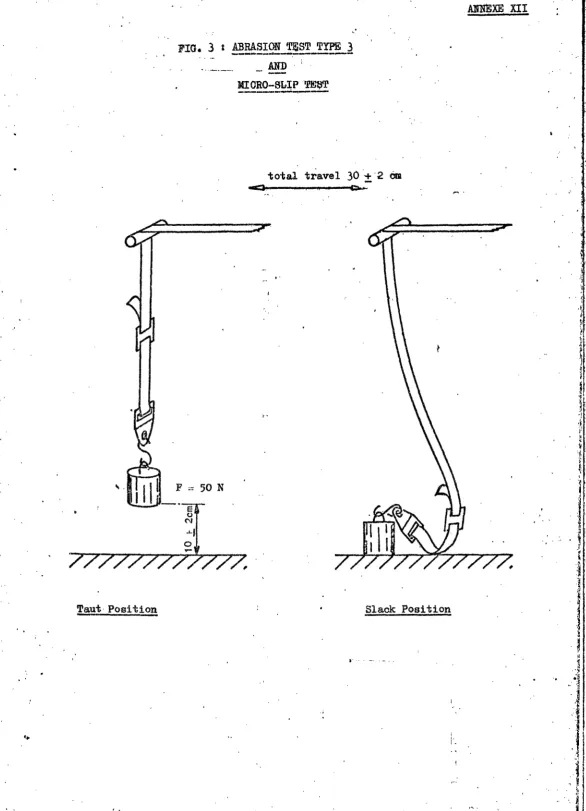
XII. Abrasion and microslip tests.
XIII. Corrosion test.
::;·: ... ~.M~(-~.,~~::.-.... s~~r~-;~=-..--.f .~-~--'.;;:~-c:~~·~~*;*~ ~:,., -~·::.-::~_';·_
-- -- 1 -·'
o.
1
-'-•
,J
SCOI'm, DEFINITIONS, EEC-APPROVAL AND INSTALLATION
... _...
___
-{ ______ ~---.... -~---·--
--~-... ~..-- .----~-_.._---·
The present directive requirem~mts applies to safety belts ·
and restraint systems which are designed for installation in
vehicles def~ied in article 10 and are intended. for separate
use, i.e. as individual equipment~ by adults occupying se~t~
facing fonvard.
P~IA!JTIQJf~
For the purpose of this Directive :
1.1. "saJety b_ru.t (~eat belt, bel"fi)" means an arrangement of s~raps
with a Beouring buckle1 adjusting devices and attachments which
is capable of bei~ anct:.ored to a power-driven vehicle and is
designed to diuinish the risk oi injury to its wearer, in the
event of collision or of abl"'npt doccleration of the vehicle, by
limiting t:re mobility of the wearer's body. Such an arrangemeut
is generally referred to as a. n"'l::ol t assembly" 1 which term also
e~braces any device ~or absorbing energy or for retracting the
belt;
"iaR- J:>Mt" moans a belt wh;i.ch passes across the front of the
Trrearer's pelvic region;
"diagonal belt' means a bolt lihich passes diagonally across the
front of tr.e chest from the hip to the oppo~ite shoulder;
"tt2:_ee-po~,Et belt" means any belt assembly anchored at three'
points and comprising a·combination of a lap belt and a diagonal
"l.'!st~ss belt" means a belt asse!!lbly comprising a lap belt and
shoulder straps;
'
1.8.
- 2-'
Annex I
"pelt trn" means ~lts di·ffering substantially from one
another;;the differences may relate in particular toa
' .,
" ' '•
riSid parts (buckle, attachments,· retractor, etc.),
the material, weave, dimensions, and colour of the straps, or
the
·geocetry· of the belt assembly;"!'t-rap" ~a.ns a. flexible component designed to hold the boey
a.nd to -t:r.a,nsmit stresses to the belt a.nch:oragos;
"Jbuokle" means a quiok-rclee.se device enabling the wearer to be
held by the belt. The buckle may incorporate the adj~eting deviceJ
' '
''belt a.djustioo devi..Q!" means a device enabling the belt to be
adjusted according to the . requirements of tha individual wearer
a,nd to the position of the seat. The adjusting device may be part
, of the buckle or be a. retractor;
"!l.t.~!!Ohffients" means parts of th~ belt. assembly, including the
necessary securing compor..ent·s, whioh enable it to be attached to
. .
the belt a.nchora.ps.f
_·,·~11ersr absorber" means a. devioe designed to disperse enargy
indepentently of or jointly with the strap and forming part of
-a. belt assembly; . ·'.
I
••nrtraotor" means a. device to a.coomoda.te part or tha whole
of the st~p of a. safety belt;
"non-lockipg retract'?£" means a. retractor from which tha strap
is ertra.oted to its full length by .a. small erterna.l force and
which provides no adjustment for assembly length.,
..
,'.', . ,, "'~ '
. ,.,. ~~
I I ',~ '•
!t #'' ~
·.
,,,
;, ';' \: ·.) ,· ::·' ,' *' ' I ·\'::' . ~' ,fi
\'!V ', .. ·;~ ,_I ··~: ,\.·.·\ \ ,·
' ' ;l ,.~t-: ,.~ ' ... .~, ,., ' ,' ~~ :~,t. ' ' ._,~ \f, II
', l:tJ
~ .. )$~
Ai '.7.
~(.·~
\i~
~'~
1.8.3.
-
3-Annex I
"~ua.l~11.!!.J. ... ocl::illit, retractor" mea.ns a retractor requiring the
manual. operation of a device by the user :to unlock the retractor
in order to obtain the desired strap e~raction and which locks
autom~tically when the said operation ceases,
"automatic~!z.. locking re~.12!" means a retractor allowing
extraction of the strap to the desired length and which, when the buckle is fastened, automatically adjusts the strap to the wearer. Fu.rther extroction of the strap is prevent/3d without voluntary intervention by the wearer;
11,9_toorgenc;y:)o..£!s.ing rotract.2!" Deans a retractor which during
nor-~1 driving conditions does not restrict the freedom
of
move-ment by the wearer of the safety belt. Such a device has lenght adjusting cohlponents which automatically adjust the strap to the wearer and a locking oechanism actuated in an emergency by :
1.8.4.1. deceleration of the vehicle or extraction of the strap relative
to the retractor or other automatic means (single sensitivity}•' or
.1 ..
,8
1•4•2..
a. corabina.tion of ~Y of these factors (multiple sensitivity);1.9.
"pelt anE.h.<?~s" means the parts of the vehicle structure orseat structure or any other part of the vehicle to which th~
safety belt assemblies are to be secured;
1.1o.
"~icle~e as r:.e2.;:~~~~ety...E_e1tv~ .;:estra:.int systems" 'maans a category of powerdriven vehicles which do not diff~r
in such essential respects as the dimensions, lines and
. '
-4~ • '"l'
.. '\nnex I
"~st:ra.in't_&st.e!" ("system") means a system combining
a
sea.tia~;fixed to •'the. st~otU:re of the ~hidle .
b·i
appropriate oea.ns ..and a sa.fety'bClt for'~hioh
at
least one anchorage is looatod,• ~
on· the seat structure;
' .. _ ...
"~" mea.ns a. structure which ma.y or may not be integral ,ui th
the vehicle structure oooplete with trim, intended to sea.t· o~ ·
adult person •. The term oowrs both on individual seat or part
of a. bench seat intended to sea.t one person; :
. : ' . i
"gzy:?p
of ·seatstt means- ·either• a. benoh ... type seat. or seats whichare separate but side by side (i.e. fixed so that front seat a.
anchorages of one of
the~e
seatsare
in :line with the front.~
.. · .rea~ a.noho:ra.ges of the other o-r 'between the anchorages. of the
. .
othe~ seat)
and.'
·ao~omoda.te one or more seated a.dul t porson;1.14. : · ·
"bench seat" ·means a. structure complete with triJn,. intendedto seat more than one adult person;
.~ ' . ' , •. ,. t . . .
1._15-~
· · :
"adjustmentsYf!.t.!..z:"· means.
the' completa device by which .the. . .. : se~t or· its parts can be adjusted to a position su~ted to the
' , ' .· morphology of the· seated occupant;
this
device. ~y·,.
in part'iWl"ail',permit
C?f: :,
1.15.1~·: ·longitudinal displacement,
1.15.2.
lel5.3e I '
vertical displacement, angular displacement;
. .
..
"~~ -~qhomge.'' maa.ns the S3'sten by whioh tho seat a.ssombly is
scoured to the ·vehicle structure,. including the affected parts
of the vehicle stru~tul~J
"sea.t typeu means a. catego,ry of seats which do no~ differ in euoh
essential respects as :
the s~:-o, dimonsionP a.nd materials of. the seat structure,
the types a.nd dimensions of the seat look adjustnent a.nd locking
systems,
the type and dimensions of tho belt anchorage on the seat, of
I
the seat anchorage and of the affected parts of tha vehicle
struc-ture;
: < :'
', l l ,I\:
I , H . ' . ' ,. '
..
.. r~ "ft
~. , I
,-,
....
. ,',I
\',,J
1.18.
...
5-t
Annex I
"displacement sslstem" means a. device enabling the sea.t or one of its parts to b'e displaced a.ngularly or longitudinally, without a. fixed intermediate p0$ition, to facilitate access by passengers;
1.19 "lookipg sy;stem'' means a. device ensuring tha.t the seat a.nd its
parts a.re maintained in the position of use.
2. EEC TYPE APPROVAL·
2.1. APPLICATION FOR
APPROVAL
2.1.1,. The application for approval of a. type of safety belt shall be
submitted by the holder of the trade ma.rk or by his representative. In the case of restraint systems, the application for approval of
a. type of restraint system shall be submitted by the holder of the
,trade ma.rk or by his representative or by the manufacturer of the vehicl'e in which it is to be installed or by his representative.
2.1.2.
It shall be accompanied by :2.1.2.1 a. technical description in triplicate of the belt type, specifying
the straps and other materials used a.nd accompanied by drawings of these items and in the case of retractors, installation instructions for the sensing device; the drawings must show the ._position intended
for the approval nu~ber a.nd the additional symbol(s) in relation
to the rectangle of the approval mark. The description shall mention
- - I . , ,' . . - , •·
the colour of the model'submitted for approval, and specify the
vehicle type(s) for which this belt type is intended.
Annex I
In the case of a restraint system the description shall include :
dra~i~
ofth~ V~hic.le
stru.ctUre a,nd·Of
theSeat-'
st~~~.
J • • ., .r ' t ' • :. ~ • '
adJustment system, 8,Jld ·a.ttachinents ·on an appropriate· soa.le showing
the
site~
of
these~t a:nohorige~
ard
·belt~cho~~es
·a,nd
rein-forcements in sufficient de~a.il; together with a specification of
the
ma.teri~s
used which ma.v~feot
thest~:tigth
_of
'th~··~ea.t
anchorag~s and belt anchorages; and a technical description of
the seat anchorages and the belt anchorages •
five samples of the type of the belt
w, ·
in the oa.se of safety belts with re-tra.otors, an . ) . . ~di;tional .. ,, bel:t
assembly, a.nd :. ·. ,-.,. ·:"' .
' ~ .:, : ., , • _, • : ' • • \ • ' , . , • ' , t' , ~ : 1 ' L"" .,- .' ' "J '• -: 1
2.1.2.4.~ . a. ten-metre length of each type of strap us.ed in the 'type of
--~' . ! , • ' • ' .o • ' , ' • ~·.; • I~' ~.',,,,•.'~j
belt •
., ·; ·.'<t4
T • • \ ' ' : -,.. t-t.,
'~ \'• ·, \"; 4'1,,:1 I , • • , ' I 'l-":, .,_
2 •.
~
1
.. 3·~··
In the oa.se of restraint systemst two sampleswhl~h m~
).ncluda•"" "'T \. ' • • , ~' ' ~ ' , • ,• • , ·.j '' ~ I , •,; I
.. ~wo
of
the samplesot
belts requi~d at ~er point 2.1.2.2. and.I •' .",: * • 1 , • !. , , , ,: , , • ' ,• :·. ,1·,•.
at the option of the manufacturer,.· a. vehiole representative of
the vehicle type to be approved, or the part or parts o( th~
• ' • . ' .. '' ~ r' ' '" . !> ' • • ' .I
vehicle considered essential by the technical service conducting
.. · .~pprov.al ~e~ts fo~ testi.~ .the .rest;rain1; s1stem sh,a,l~ pe submitted
'::..-' -... : '• - .. -~ ' ' ' ' ' ... ·- . ~ "' .: :
, ,, . . , :!i.o t~e. s.ervioe ..
.
.
'•' .. '.. '
...
-· ' MARKINGS
4 ... \ 'I ' • • • : ~
~he sample~ ~f a belt type or ·type. of .restl,'aint .. systept ·submi. tted
- • ' • I lt' •
fo~ a.ppr!)val. in conformity with the provisions of_ point 2.1.2.2.·
' ' ' '• •' '• I 1•r ' ;- • 1
above shaJ.l be clearly a.nd indelibly marked with the ma.nutacturer's
• ' • • • ·' •• • 1• )
name, ini tia.ls or trade name or mark.
.;
.
,,
: ~t\
lo "• :'!
., ' .~~
. ; 1,·1~
• • ,·l·~J.
', ;i:
. '
. ,,
' ' :u
.•j
/1 ' '
l i1
2.4.1.
2.4.1.1.
-7-
1 -'· .. ~ . 7Anne-x I
GENERAL SPECIJiiiCATIONS
Each eample submitted in conformity with point 2.1.2.2. above shall meet the specifications set forth i~ points 2.3. to 2.7.
'•
.
The belt or the restraint system shall be so designed and
con-. '
structed that, when correctly installed and properly used by an occupant, its satisfactor.y operation is assured and it reduces the risk of bodily injur.y in the event of an accident.
RIGID PARTS
General
The ~i,gid. parts of the safety belt, such as buckles, adjusting
devices, ~ttachments and the like shall not have. sharp edges liD.ble to oa.use wear or breakage of t~ straps by' oha.f'ing.
'· .. All .parts of. a belt assembly liable to be affected by corrosion shall be ~uitahly protected against it- After undergoing the co:rro.sion test·presented in point 2.7.2. below, they shall not e:x:hibi t any deterioration likely to imp~r the. proper
functioning.of the device nor any significant .corrosion visible to the unaided eye of a qualified observer.
Rigid parts' intended to absorb energy or to be subjected to or to transmit a load shall not be fragile.
,•
All rigid i t'ems and plastic parts, except those which are not liable to become trapped under a seat or in a door of a motor vehicle, shall be subjected to the cold impact test specified in point 2.7.5.4. below. After test, if any visible cracks are , present in any plastic cover or retainer of rigid item the
com-plete plastic part shall then be removed and the remaining assembly shall then be assessed against its continued security. If the remaining assembly is still secure, or if no visible
•..
-8-Annex I
·' '
Buckle
,.· ,·'.\?· .
~.(-.•.:.~\.:.'.·.'.
. " The buckle shall be so designed. as., to preclude a.n:1 poosibili t;y ...
of incorrect use.
'rus
means. inter. al:ia, tha.t'it
must not be ".possible 'for the buckle. to be left ·in· .a partially-closed
condi-tion. The procedure for opening the buckle .. !fl'lst be clearly
\ .. ,,.. I ' l
evident. Whenever the buckle is likely be in contact 1d tb .
.
.
. i ' : ' .
the wearer the width of the contact 'surface of the buckle
shall· not be le.ss than
46
mm.' ... ~·
The buckle, even when not under tension, shall_ ~main closed
whatever its position. It must not be postttble
:.to
release itwith a force less than l d.a.N. ....
·.'
:" ,,·. ,.,1.:
, . The buckle ·shall be easy to usa and· to''g.rasp;·. it $hal~ be
· .: · capable of· being released when uhder' tho tonsi()n l:specifi~d
. '
l
...
.,
·· · · · '.· ··· The· buckle shall" be Nlea.Sed
by
pressing .eith$r
a
button or_. · :· ... ;· · . ·
·· a
sirtd.lar deviee. 'l'ke surf Me toWMOh
thi·s ·pressure must be.; .. >· .: :. .. .: . ~plied' shall have for devices wbich .. arc in the· depressed
.. ·position·t · ' · · ,: ; ·· ·
;..; . ehclosed; an area
ot
not less than '4· 5-cril2and
a
width of..
,• .not less than l5mmf ;. ·
- non enclosed an area of not . than 2.5om2 and a. width of not .
, . ' . : ' ' ' ': '
.
..•loss than 10 ~ .
'
The buckle release' area shall 'be coloured
l'G~.
No
other partof the buokle shall be of this colour.
' . ( f, ,~ , •• • • If I
. I
' ..
... ;
..
' . '. ; ., ,.';.t· •
,
....
...
',,•. ' ~- ·: ~ . . ,. .
, .. • .. ~. . ~ .' , ·, ~"" . . r ,
-'t,
. :
.
. ; ~. '.
' -~•. ..t- ' ,
"'
"·~;~;~
I''"' '· ., ·.~
' .:.~~
: .'}
I tl•)j
'•,J..,
\ •(
.
"
•',, ".(;
I,
·I
,, n
,,~, ~ ) .? ~ :, 'b~; 'J.· (111
/ ' ~ ··:~ ;!,
1
,!', ·:,.'.~1;;
I
•,f
,, '
\ \ ' .~r-· I 'l\1',
,,
' : ~
~l
;'J . ~
I ~~~
I!'
,,
.I ' j
, -.-~ r. '·
'
I
·r ,>
'"•
.,
.
. - 9.-
.... ---• .'Lj-J. :,..
~ _,,.., f •:-" '.Annex I
2.4.2.3.
The buckle shall be capable of withstanding repeated operationand shall before the dynamic test in point
2.7.7.
undergo500
opening and closing cycles. The springs of closing buckles shall,
in addition, be actuated
4,500
times in conditions of normal use.2.4.2.4. The buclde uhen tested in accordance with point 2.
7 .5.3.
belowshall operate normally.
2.4.2.5.
The force required to open the buckle in the test as prescribedin point
2.7.8.
below shall not exceed 6 daN.2.4.2.6.
The buckle shall be tested for strength as prescribed in point2.7.5.1.
and2.7.5.5.
as appropriate. It must not bre~c, be seriously distorted or become detached under the tension set up by the prescribed load.2.4.2.7.
In the case of buckles which incorporate a component common t6two assemblies, the strength and release tests of points
2.7•7•
and
2.7.8.
shall be compli~d with 1-rhen the part of the buckle per-taining to one assembly is engaged in the mating part perper-taining . to the o·ther, if it is possible for the buckle to be so assembledin
usv.
Belt oojusting devj_ce
2.4.3.1. Two
..
sam~les of each belt adj~sting device shall be tested inacoordru1ce to the requirements of
2.7.3.7.
The strap slip sha11 notexceed
25
mm
for each sample of adjusting device t~.nd the sum ofshifts for all the adjusting devices shall not exceed 40 mm.
2.4.3.2.
~1 of the ad~ustment devices shall be tested for strength as prescribed in point 2.7.5.1. They must not break or becomedeta-ched under the tension set
up
by the prescribed load.- 10.·-
. iAnnex
!
2.4.3.3.
When testedirl'a.oco~ahce
With point2.·7.5.6 •.
:th~ ro'~ce~~~ired
to operate any ·manual·;
ae~16~
· slia.ll not exceed·5
d~r.
The
·attachments 'shall be tested tor strength a.s prescribe<i·in·
points 2.7.5.1. and 2.7.5.2. They IJDJ.st not b~eak or become
detached ~der the tension set up by the prescribed load.
, '( ' tJ.• ,, ' r
Rnrswtori · ·
Retractors· shall tu.ltil the requirements specified .belo'~r~·
,, . .
,.
2.4.5.1.1.
The strap or a sa.tety belt assembly equipped with· a manuallylocking positions or the retractor.
2.4·5·1;2.
Thestrap
ora
sa.tety belt assembly shall ext~ct' trom a manually'·· :s unlocking ~etractor within
6
mm of its maxi~ length'when a.tension Of not less than
14
N and not more than22 N is applied
to the stra.::;> in the normal direction of the pull •
.... ~ ....,_ ... ' ... ... . ....
2.4.5.1.3. The strap shall be withdrawn from the retractor, and allowed
·to. retra.o·t: repeatedly by the method described
i~ poi~1t
·2.
7
:6.1~
' ' I
.
-·
'until 5000 cycles have been·dompleted. The retractor shall then
be subjected to the corrosion test giv~·ih point
2.7.2.
followed· by the dlist tes't given in p6int 2·. 7. 6. 3. It sha.li ·then sat is-faotori.ly complete a further 5000 cycles of withdrawal and
'retraction~ at t'h.e end of which it ~~all stiil meet. the'
require-. ~ent~ of 'points 2.4.5~ 1.1. and· 2~·4.5.1.2." Af't~r the ·above tests
tne retractor. shall' operate oorre'otly
and
still stow the strapefficiently.
.;.
,,
' < f . ' !,
-~
·,I I
,' ·: i r,,,•
, I· 1'
I ' '•,~
'·:
,. ~
. ,,
.-~~;1
1,, ~
·.~ t::L!
.';I
.,
I '' ·~-;_
1 ~~· \4
'•' . I
.. '
y .
,:\ • I
•• . .,.·J
,; /··, ~ ' ) ·/,'r -'i . ' ..
,
. <'
r ' t '
' ' I
'
;:~
I '~~
,r•,..• . ,,
,. ~·
- i;
l 1;i. ' ';.J.
I ';
I ' • 1
-11-Au~oma:icalll locking r~~ractors
2.4.5.2.1. The strap of a safety belt assembly equippen Hith an automatically
locking retractor shall not move more than.30 mm between locking
posit ions of the retractor. After a reart-rard mov ·.ment of the v'eaer,
the belt must either ren.ain at its initial position or return to that position automatically on subsequent fort-:ard movements of the
'!lltearer. ·
2.4.5.2.2. If the retractor is part.o.f a lap belt, the retracting force
of the strap shall be not less than 7 N l·rhen measured in the
free length betv1een the manikin and the retractor in accordance
vrith point 2~7.6.4. If the retractor is part of an upper torso
restraint, the retraotin5 force of the strap shall be not less
than 2 N and. not mom:than 7 N when similarly measured. If the
strap pass~s through a guide or pulley• the retracting.force shall
be measured in the free length between mankin and the guide or
pulley. If the assembly incorporates
a
device that, upon manual orautomatic 'operation, prevents the strap. from being completely
retro.cted, such a device shall not be operated \~hen these
requirements are assessed,
2.4.5.2.3. The strep shall be withdra.tm from the retractor and allolved to
retract repeatedly by the method described in point 2.7.6.1.
u:1.til 5000 cycles have be-en completed. The retractor shall then .
be subjected to the corrosion test given in point 2.7.2. followed
by the,clust test given in point 2.7.6.3. It shall.then satisfactorily
· complet·e a further 5000 cycles of Withdrawal and retraction at the
end. of v1hich it shall still meet the requi:t-ements of points
2.4•5.2.1. and 2.4.5.2.2. above. After'the above test the retractor
shall still function correctly and stow the strap efficiently.
2.4.5.3.1.
An
emergency locking. retractor shall satisfy the conditions givenbelov.- when tested in accordance l·:rith point 2. 7 .6.2:
l .
I '
. ·.··
' ', " . ' ~
12
-Jmnex·I
2,4.:.3.1.1. It
s21.~11
have· locked "t-rhen 'the'~ehioie
o.eoelera.tion reaches.a value of 0.4Sg; .
2.4.5.3•1.2.
It sha.~l not lock a.t strap a.coa,lerat~.ons me~sured in thedirection of the extraction of loss than
o.Bg,
2.4.5.3.1.3.
It shall not lock when its actuating deVice is tilted to anglesof
12°
or less in any direction from the installation positionspecified by its. manufacture~;
2.4.5.3.1.4.
!t shall look when its actuating device ~s tilted to angles• I ' '
~f 27° more ·in any direction from the installation position
SJeOified by its manufacturer.
2.4.5.3,2.
~ emergency looking retractor with multiple sensitivity, oneof whioh is strap sensitivity,· shall 1·1hen tes1;ed in accordance
'
with. point 2~
7
.6.2., in addition ~o .meeting the aboverequire-ments,. lock when the strap a.qcelera.tion is greater than
1.2g
1me~sured.in the. d~rection of the extraption.
2.4.5.3.3.
In each of the tests mentioned in points2.4.5.3.1.
and2.4.5.3.2.
above., the amo:unt of strap movement l'thioh,ma(Y' occurbefore the retractor locks, shall not exceed 50mm starting a.t
the length given in point 2~7.~.2.1 •
2.4.5.3.4.
If the retractor is part of a. l~p belt, the retracting forceof the strap shall be not less than 7 N 't'i"hen measured in the
free length between the manikin. ap.d the retrs.otcr in a.ooordanoe
with point 2.
7 .6.4.
If the retractor is part. of an upper torso.· · -sl\all. .
restraint, the retra.eting. foroe of. the strapfbe not less than
2 N and not more ·than 7 N .;,.~hen similarly measured. If the strap
passes through a. guide or pulleyt the retre.oting foro~ '-hall be
measured in the free. length.
bet-t~een
themrmik~
and the guideor pulley. If the assembly ~tloorporates a. .devio.e ·tha.t .. UJ>On.
in~ua:i
... or.~toma.tic
.operationpre~n~s
:the strap from beingcompletelY retracted, such a device sha.ll not be operated when
these requirements are assessed.
.;.
. " .
. I
.:J
;lr
- 13-
:.:
;._ Annex I...
2.4.5.3 .. 5._ The strap shall be withdrawn from the retractor and allowed to
-retract repeate.dly b1 the method des~ribed ~n point 2. 7 .6'.1.
until 40,000 cycles. have- been completed. The retractor shall
then be subjected to the corrosion test given in point 2.7.2.
followed by the dust test prescribed in point 2.7.6.3. It shall
then satisfactorily complete a further 5,000 cycles after which it shall still meet the requirements of points 2.4.5.3.1.,
2.4.5.3.2, 2.4.5.3.3. and 2.·4·5•3·4 above.· After the above tests the retractor shall still function correctly and stow the strap efficiently.
STRAPS FOR BW,y_TS OR RESTRAINT SYSTEMS
Rf I ~ I d b
General
The characteristics of the straps shall be such as to ensure that their pressure on the·wearer•s body is distributed as· even-ly as pessi ble over their width and that they do not twist even under tension. They shall nave energy-absorbing and energy-dis-persing capacities.
The width of the strap under ·a load of
980
daN shall be not lessthan 46 mm.·This·dimension shali be measured during the breaking -strength test prescribed in point·2.7.4, and without stopping the· machine.
In the case of the two strap samples conditioned in conformity
With point 2.7.3.1. the breaking load of .the strap, determined
as prescribed in poi~t 2.7.4. b~low, shall be not less than
1,470 daN. The difference between the breaking loads of the two samples shall not exceed 10 per cent of the greater of the breaking loads measured.