RESEARCH NOTE
Overactive bladder induces transient
hypertension
Kazumasa Torimoto
1*, Yoshihiro Matsumoto
2, Daisuke Gotoh
1, Yosuke Morizawa
1, Makito Miyake
1,
Shoji Samma
3, Nobumichi Tanaka
1, Akihide Hirayama
4and Kiyohide Fujimoto
1Abstract
Objectives: Several studies have shown the relationship between lower urinary tract symptoms and autonomic imbalance. We investigated the relationship between detrusor overactivity (DO) or urgency, and transient increase in blood pressure as a type of hypertension related to sympathetic hyperactivity. Study 1: we enrolled 14 male patients with DO and 10 without DO. We measured the overactive bladder symptom score (OABSS) and blood pressure during cystometry. Study 2: we enrolled 14 men patients with overactive bladder (OAB) and 8 without OAB. We measured OABSS and blood pressure using a 24-h ambulatory device.
Results: Study 1: the mean systolic pressure was significantly higher at urgency or SDV than at the other measure-ment points in the DO group (161.3 ± 23.2 vs. 134.5 ± 16.3, 137.8 ± 15.3, or 139.5 ± 14.8 mmHg). Study 2: the mean systolic pressure was significantly higher at the measurement points before micturition than at the points unrelated to micturition in the OAB group (159.7 ± 24.9 vs. 124.9 ± 13.8 mmHg). In conclusion, DO or urgency induces a tran-sient increase of blood pressure, suggesting that OAB induces a type of hypertension before micturition.
Keywords: Hypertension, Overactive bladder, Transurethral resection of prostate, Micturition
© The Author(s) 2018. This article is distributed under the terms of the Creative Commons Attribution 4.0 International License (http://creativecommons.org/licenses/by/4.0/), which permits unrestricted use, distribution, and reproduction in any medium, provided you give appropriate credit to the original author(s) and the source, provide a link to the Creative Commons license, and indicate if changes were made. The Creative Commons Public Domain Dedication waiver (http://creativecommons.org/ publicdomain/zero/1.0/) applies to the data made available in this article, unless otherwise stated.
Introduction
Metabolic syndrome, in particular, diabetes and hyper-tension, are related to the clinical progression of benign prostatic hyperplasia [1]. Hypertension is related to higher international prostate symptom scores and larger prostate volumes [2]. A previous cohort study found that the prevalence of hypertension was higher in sub-jects with overactive bladder (OAB) than those without OAB [3]. Male patients with hypertension had more severe lower urinary symptoms (LUTS) than those without hypertension [4]. These findings suggest that hypertension results in more mechanical or functional LUTS. Moreover, sympathetic hyperactivity leads to hypertension.
In female patients, several studies on the relationship between OAB and sympathetic hyperactivity have been reported [5, 6]. Takami reported that anticholinergic
(imidafenacin 0.2 mg/day) treatment for female nocturia due to OAB resulted in improvement in nocturnal hyper-tension and morning hyperhyper-tension; he concluded that the treatment also inhibited sympathetic hyperactivity [7]. This suggests that OAB may induce autonomic imbal-ance, especially sympathetic hyperactivity. In this study, we investigated the relationship between detrusor over-activity (DO) or urgency and transient increase in blood pressure as a type of hypertension related to sympathetic hyperactivity in male patients.
Main text Methods
Study design
We conducted an exploratory study at two hospitals in Japan from July 2009 to March 2011. All patients pro-vided written informed consent prior to enrollment. The study was performed in accordance with the Declaration of Helsinki, and approval was obtained from the institu-tional review board at Nara Medical University hospital.
Open Access
*Correspondence: [email protected]
1 Department of Urology, Nara Medical University, 840 Shijo-cho, Kashihara, Nara 634-8522, Japan
Study 1 We enrolled male patients with any LUTS. Exclusion criteria were histories of lower urinary tract neoplasms, vesical stones, symptomatic urinary tract infection, and neurogenic bladder. We evaluated their storage symptoms using the overactive bladder symp-tom score (OABSS) and measured blood pressure with a sphygmomanometer during cystometry at first desire to void (FDV), normal desire to void (NDV), strong desire to void (SDV) or urgency, and after micturi-tion. We performed cystometry with patients in sitting position and sphygmomanometry with a manchette placed on the left upper arm. We calculated the blad-der outlet obstruction index (BOOI) using the formura: BOOI = Pdet at Qmax − 2 (Qmax) [8], and the bladder contractility index (BCI) using the formula: BCI = Pdet at Qmax + 5 (Qmax) [9]. We did not calculate the study size before the enrollment because this is an explora-tory study and no information was available to set the size according to previous studies.
Study 2 We enrolled male patients with any LUTS. Exclusion criteria were histories of lower urinary tract neoplasms, vesical stones, symptomatic urinary tract infection, and neurogenic bladder. We evaluated their storage symptoms using OABSS and measured blood pressure with a 24-hour ambulatory blood pressure monitoring device (FB-270®, Fukuda Denshi, Tokyo, Japan). Diagnosis of OAB was made using OABSS, which evaluates daytime frequency (score, 0–2), noc-turia (score, 0–3), urgency (score, 0–5), and urgency urinary incontinence (score, 0–5) over a 1-week recall period. Patients were diagnosed as having OAB if the score for Question 3 regarding urgency yielded was ≥ 2 points and if the total score was ≥ 3 points [10]. We set the device to measure blood pressure every 30 min in the daytime from 6:00 to 22:00 and every 60 min in the nighttime from 22:00 to 6:00 in order to decrease the influence on sleep. We also asked the patients to measure blood pressure before micturition and record micturition time charts. We did not calculate the study size before the enrollment because this is an explora-tory study and no information was available to set the size according to previous studies.
Statistical methods
The data were checked for Gaussian distribution and appropriate two-sided tests were chosen. Specific tistical tests are listed on corresponding tables. All sta-tistical analyses were performed using Prism version 7.03. A p value of < 0.05 was considered statistically significant.
Results Study 1
Patient characteristics
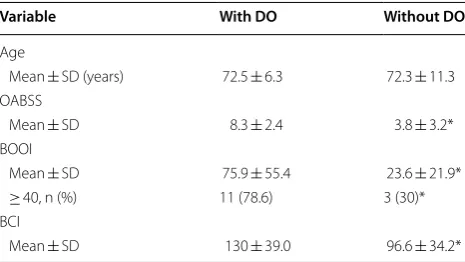
We enrolled 14 patients with DO and 10 patients with-out DO. The mean OABSS, BOOI, and BCI were signif-icantly higher in the group with DO than in the group without DO. Bladder outlet obstruction was considered to exist in 11 patients (78.6%) in the group with DO and 3 patients (30.0%) in the group without DO (Table 1).
Blood pressure and pulse
The mean systolic and diastolic pressure were signifi-cantly higher at urgency or SDV than before infusion, FDV, or NDV, and after micturition in the group with DO. The mean pulse did not change during cystometry. Meanwhile, the mean systolic and diastolic pressure, and the mean pulse did not change through cystometry in the group without DO (Table 2).
Study 2
Patient characteristic
We enrolled 14 patients with OAB and 8 patients with-out OAB. The mean age of the patients with OAB and those without OAB were 72.9 ± 4.5 and 69.4 ± 6.4 years, respectively. The mean OABSS was significantly higher in the group with OAB than in the group without OAB (8.9 ± 2.2 vs. 2.1 ± 0.4, p < 0.05). The number of patients with hypertension, who all received hypertensive drugs, was 6 (43%) in the group with OAB and 4 (50%) in the group without OAB. Nobody had central nerve disease which may influence storage function (Table 3).
Table 1 Patient characteristics in study 1
The Mann–Whitney U test was used to compare age, OABSS, BOOI, and BCI The Fisher’s exact test was used to compare the proportion of patients with BOOI ≥ 40
DO detrusor overactivity, OABSS overactive bladder symptom score, BOOI bladder outlet obstruction index, BCI bladder contractility index * p < 0.05 versus “with DO”
Variable With DO Without DO
Age
Mean ± SD (years) 72.5 ± 6.3 72.3 ± 11.3 OABSS
Mean ± SD 8.3 ± 2.4 3.8 ± 3.2*
BOOI
Mean ± SD 75.9 ± 55.4 23.6 ± 21.9* ≥ 40, n (%) 11 (78.6) 3 (30)* BCI
[image:2.595.305.538.518.649.2]Blood pressure and pulse
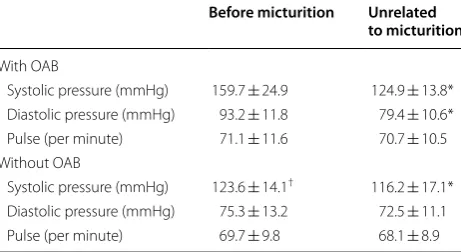
The mean systolic and diastolic pressure were signifi-cantly higher at the measurement points before mictu-rition than at the points unrelated to mictumictu-rition in the group with OAB. The mean pulse did not differ signifi-cantly over time. Meanwhile, the mean systolic pressure was also significantly higher at the measurement points before micturition than at the measurement points unre-lated to micturition in the group without OAB. The mean diastolic pressure and pulse were not significantly differ-ent. The mean systolic pressure was significantly higher in the group with OAB than in the group without OAB. Mean systolic and diastolic pressure at the measure-ment points unrelated to micturition was not signifi-cantly different for the group with OAB and the group without OAB (Table 4). Four of the patients with OAB, who were enrolled in the study 2, suffered from LUTS and hoped to receive transurethral resection of the pros-tate (TURP). The mean OABSS and systolic pressure before micturition decreased significantly 6 months after
TURP compared to before TURP (1.3 ± 2.5 vs. 10.3 ± 1.9, p < 0.05; 129.4 ± 15.7 vs. 170.4 ± 31.8 mmHg, p < 0.05) (Wilcoxon signed rank test).
Discussion
Several studies on the relationship between OAB and autonomic imbalance (sympathetic hyperactivity) have been reported. These studies measured heart rate vari-ability using electrocardiogram, which noninvasively detects autonomic imbalances [11, 12]. These studies showed that OAB is related to an imbalance of the auto-nomic nervous system in female patients [5] and that urgency, urgency urinary incontinence, and detrusor overactivity are related to sympathetic hyperactivity in female patients [6]. In neurogenic OAB, neurogenerative Table 2 Blood pressure and pulse during cystometry in Study 1
The Friedman test with a post hoc test (Dunn’s multiple comparison test) to compare blood pressure and pulse during cystometry The values are expressed as mean ± SD
DO detrusor overactivity, FDV first desire to void, NDV normal desire to void, SDV strong desire to void * p < 0.05 versus Before infusion, FDV or NDV and After micturition
Before infusion FDV or NDV Urgency or SDV After micturition
With DO
Systolic pressure (mmHg) 134.5 ± 16.3 137.8 ± 15.3 161.3 ± 23.2* 139.5 ± 14.8 Diastolic pressure (mmHg) 80.9 ± 11.0 84.3 ± 12.5 92.1 ± 13.7* 84.1 ± 12.5 Pulse (per minute) 78.8 ± 15.6 81.4 ± 16.2 82.8 ± 16.7 81.5 ± 13.4 Without DO
Systolic pressure (mmHg) 131.5 ± 18.3 135.5 ± 16.9 135.9 ± 11.7* 131.9 ± 18.6 Diastolic pressure (mmHg) 79.0 ± 14.6 80.9 ± 13.7 83.4 ± 11.9* 80.0 ± 11.1 Pulse (per minute) 71.6 ± 7.9 71.9 ± 8.6 72.6 ± 7.1 73.2 ± 12.7
Table 3 Patient characteristics in Study 2
The Mann–Whitney U test was used to compare age and OABSS
The Fisher’s exact test was used to compare the proportion of patients with hypertension
OABSS overactive bladder symptom score * p < 0.05 versus OAB
Characteristic OAB
(n = 14) Non OAB(n = 8)
Age
Mean ± SD (years) 72.9 ± 4.5 69.4 ± 6.4 OABSS
Mean ± SD 8.9 ± 2.2 2.1 ± 0.4*
Hypertension
n (%) 6 (43%) 4 (50%)
Table 4 Blood pressure and pulse measured using a 24-h ambulatory blood pressure monitoring device in Study 2
The Mann–Whitney U test was used to compare blood pressure at the measurement points before micturition and at the points unrelated to micturition
The values are expressed as mean ± SD OAB overactive bladder
* p < 0.05 versus before micturition
† p < 0.05 versus “with OAB”
Before micturition Unrelated to micturition
With OAB
Systolic pressure (mmHg) 159.7 ± 24.9 124.9 ± 13.8* Diastolic pressure (mmHg) 93.2 ± 11.8 79.4 ± 10.6* Pulse (per minute) 71.1 ± 11.6 70.7 ± 10.5 Without OAB
[image:3.595.56.540.101.220.2] [image:3.595.56.288.302.406.2] [image:3.595.306.537.314.440.2]diseases such as Parkinson’s disease, multiple system atrophy, and multiple sclerosis impair the autonomic nerve system and cause LUTS, including OAB [13–15]. Accordingly, it has been proposed that the autonomic imbalances may induce OAB, even in patients with idio-pathic OAB, which is most frequently encountered in the clinic. We have an opposing view regarding this hypoth-esis, in that OAB itself may induce sympathetic hyper-activity. As previously stated, Takami reported that an anticholinergic agent, imidafenacin, treatment for OAB inhibited sympathetic hyperactivity [7].
We demonstrated that DO or urgency, which usually coexists with DO, induces a transient steep increase in blood pressure in male patients. In general, sympathetic stimuli contract the arteries, and blood pressure and pulse increases. Thus, DO or urgency induces transient sympathetic hyperactivity. The reason for selecting male patients was that we needed to perform pressure flow study to check BOO before TURP. However, we believe that the same phenomenon would occur in female patients with OAB. Although “hypertension” is tran-sient, the increase in blood pressure and the frequency of “hypertension” should be higher in patients with more severe OAB. The systolic pressure actually increases to more than 200 mmHg when a patient with severe BOO shows DO during a cystometrogram. Frequent occur-rence of strong urgency and transient hypertension may cause patients stress and impair autonomic balance. Therefore, OAB is not just a local urinary continence and frequency issue, but sometimes it affects the global car-diovascular system.
The mechanisms which increases blood pressure dur-ing DO or urgency remain unknown. We believe that autonomic dysreflexia (AD) in patients with spinal cord injury is a similar phenomenon. AD is an acute syn-drome of excessive, uncontrolled, sympathetic output with potentially serious consequences that can occur in patients who have had an injury to the spinal cord (gener-ally at or above the sixth thoracic neurologic level) [16]. From a urology viewpoint, bladder distention, especially DO occurrence, produces an afferent impulse that gen-erates a generalized sympathetic response, which in turn results in vasoconstriction below the neurologic lesion. The activation of the C-fiber afferent nerve is believed to be related to lower urinary tract dysfunction, such as DO in the chronic phase of spinal cord injury [17]. If the spinal cord is intact, descending central inhibitory pathways respond to the increase in blood pressure and modulate the sympathetic activity. However, if the spinal cord is injured, inhibitory signals do not reach the sym-pathetic chain [16]. One clinical study demonstrated that the C-fiber afferent nerve is activated in patients with non-neurogenic OAB [18]. Even in OAB patients without
spinal cord injury, urgency afferent signals via the C-fiber might directly stimulate the sympathetic chain and cause widespread vasoconstriction, which cannot be sup-pressed due to some OAB-specific pathology.
In conclusion, DO or urgency induces a transient increase in blood pressure, suggesting that OAB induces a type of hypertension. Hypertension can be relieved after patients undergo transurethral resection of the prostate.
Limitations
The goal of this study was to estimate the influence of fre-quent transient hypertension due to OAB on the whole body. However, we did not measure autonomic imbal-ance directly or secretion of catecholamine. We did not check the symptoms of the hypertension, such as head-ache, sweating, and uneasiness. We also investigate whether DO or urgency- related hypertension could be relieved if OAB is treated well. We showed that a small number of patients (n = 4) for which TURP relieved OAB and hypertension. We do not think the numbers are suf-ficient. We need to perform further well-designed pro-spective studies based on the present study to confirm this phenomenon and global influence.
For Table 4, those parameters were “within-subject”. However, the two events (“Before micturition” and “Unrelated to micturition”) randomly occurred for 24 h and did not line up with time unlike typical repeated measures. The parameters were not normally distrib-uted. That is why we chose the Mann–Whitney U-test as unpaired nonparametric test. We acknowledge that a two-way ANOVA with the factors OAB and timepoint could also have been used.
Abbreviations
OAB: overactive bladder; LUTS: lower urinary tract symptom; DO: detrusor overactivity; OABSS: overactive bladder symptom score; FDV: first desire to void; NDV: normal desire to void; SDV: strong desire to void; BOOI: bladder outlet obstruction index; BCI: bladder contractility index; BOO: bladder outlet obstruction; TURP: transurethral resection of the prostate; AD: autonomic dysreflexia.
Authors’ contributions
KT, SS, AH, and KF designed and prepared the study. KT, YM2, and DG enrolled the patients and performed the examinations. YM1, MM, and NT generated and analyzed the data. KT wrote the manuscript and AH and KF reviewed the paper. All authors read and approved the final manuscript.
Author details
1 Department of Urology, Nara Medical University, 840 Shijo-cho, Kashihara, Nara 634-8522, Japan. 2 Department of Urology, Hoshigaoka Medical Center, 4-8-1 Hoshigaoka, Hirakata, Osaka 573-8511, Japan. 3 Department of Urol-ogy, Nara Prefecture General Medical Center, 1-30-1 Hiramatsu, Nara, Nara 631-0846, Japan. 4 Department of Urology, Kindai University Nara Hospital, 1248-1 Otoda-cho, Ikoma, Nara 630-0227, Japan.
Acknowledgements
• We accept pre-submission inquiries
• Our selector tool helps you to find the most relevant journal • We provide round the clock customer support
• Convenient online submission • Thorough peer review
• Inclusion in PubMed and all major indexing services • Maximum visibility for your research
Submit your manuscript at www.biomedcentral.com/submit
Submit your next manuscript to BioMed Central
and we will help you at every step:
Competing interests
The authors declare that they have no competing interests.
Availability of data and materials
All data generated or analysed during this study are included in this published article.
Consent for publication
Not applicable.
Ethics approval and consent to participate
The study was performed in accordance with the Declaration of Helsinki, and approval was obtained from the institutional review board at Nara Medical University Hospital. All patients provided written informed consent prior to enrollment.
Funding
We received no support from any other institute for this study.
Publisher’s Note
Springer Nature remains neutral with regard to jurisdictional claims in pub-lished maps and institutional affiliations.
Received: 3 October 2017 Accepted: 21 March 2018
References
1. Fu Y, Zhou Z, Yang B, Zhang K, He L, Zhang X. The relationship between the clinical progression of benign prostatic hyperplasia and metabolic syndrome: a prospective study. Urol Int. 2016;97:330–5.
2. Hwang EC, Kim SO, Nam DH, et al. Men with hypertension are more likely to have severe lower urinary tract symptoms and large prostate volume. Low Urin Tract Symptoms. 2015;7:32–6.
3. Hirayama A, Torimoto K, Mastusita C, et al. Risk factors for new-onset overactive bladder in older subjects: results of the Fujiwara-kyo study. Urology. 2012;80:71–6.
4. Sugaya K, Kadekawa K, Ikehara A, et al. Influence of hypertension on lower urinary tract symptoms in benign prostatic hyperplasia. Int J Urol. 2003;10:569–74 (discussion 75).
5. Choi JB, Kim YB, Kim BT, Kim YS. Analysis of heart rate variability in female patients with overactive bladder. Urology. 2005;65:1109–12 (discussion 13).
6. Kim JC, Joo KJ, Kim JT, Choi JB, Cho DS, Won YY. Alteration of autonomic function in female urinary incontinence. Int Neurourol J. 2010;14:232–7. 7. Takami T. Improvement of nocturnal hypertension and morning
hyper-tension caused by overactive bladder. Prog Med. 2009;29:2681–5. 8. Griffiths D, Hofner K, van Mastrigt R, Rollema HJ, Spangberg A, Gleason D.
Standardization of terminology of lower urinary tract function: pressure-flow studies of voiding, urethral resistance, and urethral obstruction. International continence society subcommittee on standardization of terminology of pressure-flow studies. Neurourol Urodyn. 1997;16:1–18. 9. Abrams P. Bladder outlet obstruction index, bladder contractility index and bladder voiding efficiency: three simple indices to define bladder voiding function. BJU Int. 1999;84:14–5.
10. Homma Y, Yoshida M, Seki N, et al. Symptom assessment tool for overac-tive bladder syndrome—overacoverac-tive bladder symptom score. Urology. 2006;68:318–23.
11. Akselrod S, Gordon D, Madwed JB, Snidman NC, Shannon DC, Cohen RJ. Hemodynamic regulation: investigation by spectral analysis. Am J Physiol. 1985;249:H867–75.
12. Koizumi K, Terui N, Kollai M. Effect of cardiac vagal and sympathetic nerve activity on heart rate in rhythmic fluctuations. J Auton Nerv Syst. 1985;12:251–9.
13. Sakakibara R, Tateno F, Kishi M, Tsuyuzaki Y, Uchiyama T, Yamamoto T. Pathophysiology of bladder dysfunction in Parkinson’s disease. Neurobiol Dis. 2012;46:565–71.
14. Tateno F, Sakakibara R, Kawai T, Kishi M, Murano T. Alpha-synuclein in the cerebrospinal fluid differentiates synucleinopathies (Parkinson disease, dementia with Lewy bodies, multiple system atrophy) from Alzheimer disease. Alzheimer Dis Assoc Disord. 2012;26:213–6.
15. Litwiller SE, Frohman EM, Zimmern PE. Multiple sclerosis and the urolo-gist. J Urol. 1999;161:743–57.
16. Blackmer J. Rehabilitation medicine: 1. Autonomic dysreflexia. CMAJ. 2003;169:931–5.
17. de Groat WC, Yoshimura N. Mechanisms underlying the recovery of lower urinary tract function following spinal cord injury. Prog Brain Res. 2006;152:59–84.