S H O R T R E P O R T
Open Access
Selection of reference genes for normalization of
quantitative real-time PCR in organ culture of the
rat and rabbit intervertebral disc
Dongrim Seol
1,2, Hyeonghun Choe
1,2, Hongjun Zheng
1, Keewoong Jang
1,2, Prem S Ramakrishnan
1*,
Tae-Hong Lim
2and James A Martin
1Abstract
Background:The accuracy of quantitative real-time RT-PCR (qRT-PCR) is often influenced by experimental artifacts, resulting in erroneous expression profiles of target genes. The practice of employing normalization using a reference gene significantly improves reliability and its applicability to molecular biology. However, selection of an ideal reference gene(s) is of critical importance to discern meaningful results. The aim of this study was to evaluate the stability of seven potential reference genes (Actb, GAPDH, 18S rRNA, CycA, Hprt1, Ywhaz, and Pgk1) and identify most stable gene(s) for application in tissue culture research using the rat and rabbit intervertebral disc (IVD).
Findings:In vitro, four genes (Hprt1, CycA, GAPDH, and 18S rRNA) in rat IVD tissue and five genes (CycA, Hprt1, Actb, Pgk1, and Ywhaz) in rabbit IVD tissue were determined as most stable for up to 14 days in culture. Pair-wise variation analysis indicated that combination of Hprt1 and CycA in rat and the combination of Hprt1, CycA, and Actb in rabbit may most stable reference gene candidates for IVD tissue culture.
Conclusions:Our results indicate that Hprt1 and CycA are the most stable reference gene candidates for rat and rabbit IVD culture studies. In rabbit IVD, Actb could be an additional gene employed in conjunction with Hprt1 and CycA. Selection of optimal reference gene candidate(s) should be a pertinent exercise before employment of PCR outcome measures for biomedical research.
Background
Quantitative real-time RT-PCR (qRT-PCR) is a powerful tool for detection and quantification of gene expression owing to its high sensitivity, specificity and reproducibil-ity [1]. However, the relevance and magnitude of abso-lute measures obtained from qRT-PCR are subject to inherent sample variations that usually lead to statistical uncertainty. Such outcomes may also lead to inferences that may be biologically obscure [2]. To this end, an appropriate normalization strategy is employed for reli-able data interpretation and the most common method is the use of an internal reference or housekeeping gene [3]. A reference gene is weakly regulated in experimental conditions of interest along with comparable expression
characteristics to target genes. Thus, selection process of an ideal reference gene is critical for applicability of PCR in research. However, commonly used reference genes for tissue and cell-based PCR normalization such as glyceraldehydes-3-phosphate dehydrogenase (GAPDH), b-actin (Actb) and 18S ribosomal RNA (18S rRNA) are frequently applied without appropriate vali-dation for their gene expression stability [4-6].
Gene expression analyses are used as one of the major contemporary research tools in understanding the pathology of intervertebral disc (IVD) degeneration. Clinically termed as“Degenerative Disc Disease (DDD)”, the condition is believed to be a significant source of low back pain [7,8]. The clinical significance of under-standing the onset and progress of DDD is well docu-mented and there is increasing need to establish relevant experimental models to study this disease. Numerous studies on molecular level changes in disc
* Correspondence: [email protected] 1
Department of Orthopedics and Rehabilitation, University of Iowa, 1182 ML, Iowa city, IA 52242, USA
Full list of author information is available at the end of the article
biology have been reported by normalization using GAPDH [9-12] and Actb [13-15] without validation for their stability. Although the assumption of certain genes being constitutively expressed may be valid in certain cases, this assumption cannot be taken for granted under rapidly changing conditions such as growth, remodeling and disease.
The aim of this research was to evaluate the stability of seven potential reference genes (Actb, GAPDH, 18S rRNA, CycA, Hprt1, Ywhaz, and Pgk1) and select the most stable genes or a combination of stable genes for the purpose of normalization in IVD gene expression studying of rat and rabbit organ culture. The stability of selected reference genes under different experimental culture periods and species was analyzed using geNorm [6], NormFinder [5] and BestKeeper [16].
Results
Quantitative real-time RT-PCR
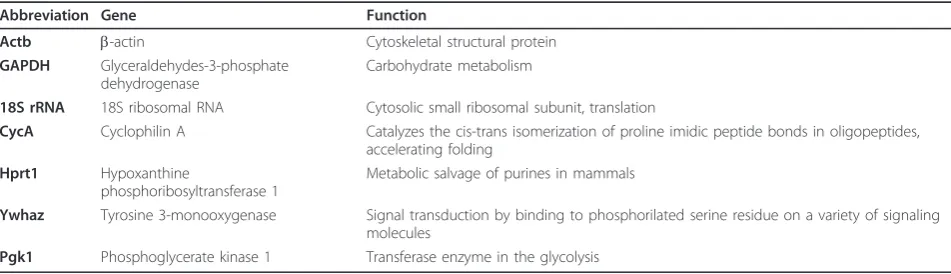
Seven candidate reference genes were selected from commonly used housekeeping genes which have differ-ent biologic function (Table 1). Their primer informa-tion was summarized in Table 2.
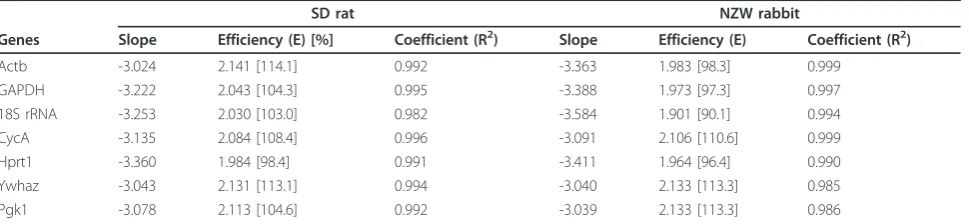
All RNA samples were examined for their purity. The absorbance ratio at A260/A280 nm of all samples was ranged from 1.86 to 2.09, indicating all the samples were pure during the RNA extraction procedure. For all the candidate reference genes, the melt curve analyses of PCR reactions were performed. The specificity and integrity of the products were confirmed by the pre-sence of a single peak in dissociation curve (additional file 1). The standard curves were made by serial dilu-tions to determine PCR efficiencies. The qRT-PCR effi-ciency (E) of each primer pair was ranged from 1.901 to 2.141 (90.1% to 114.1%) with linear correlation coeffi-cient (R2), making all assays suitable for quantitative analysis (Table 3). Figure 1 represents CTvalues of can-didate reference genes from IVD organ culture of SD rat and NZW rabbit. CT values of reference genes obtained by the rat IVD were more variable with higher
standard deviation than those of the rabbit IVD. To quantify the variation, CT range was calculated by maxi-mum and minimaxi-mum values through four harvesting time points. Hprt1 was shown the most invariable expression between all samples for both rat (1.09) and rabbit (0.67). In rat, CycA (1.61) and GAPDH (1.88) were ranked as second and third gene, respectively. In rabbit, on the other hand, Pgk1 (1.02) and CycA (1.04) were ranked as second and third genes, respectively. This implies that Hprt1, CycA, and GAPDH in rat and Hprt1, Pgk1, and CycA are more potential reference genes compared to the others.
geNorm analysis
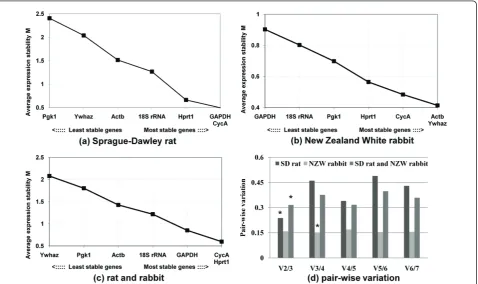
[image:2.595.57.533.594.731.2]The gene expression stability of seven candidate refer-ence genes over the organ culture of the rat and rabbit IVD was analyzed using the geNorm software applica-tions. The analysis by geNorm showed that only four genes (GAPDH, CycA, Hprt1, and 18S rRNA) in the rat IVD reached a high expression stability with low M values, below the default limit of M = 1.5 [6] (Figure 2a). GAPDH and CycA were identified as the best pair of reference genes. On the other hand, all reference genes showed stable M value (M < 1.5), and Actb and Ywhaz were ranked as the most stable reference genes in rabbit (Figure 2b). CycA and Hprt1 were ranked as third and fourth genes, respectively. Similarly, CycA and Hprt1 were identified to be suitable for normaliza-tion in the combined analysis obtained from rat and rabbit (Figure 2c). To determine the optimal number of reference genes necessary for accurate normaliza-tion, calculation of the pair-wise variation (Vn/n+1) was evaluated (Figure 2d). The combination of two refer-ence genes was suitable for normalizing gene expres-sion data in rat and combined species, V2/3 (0.238) and V2/3 (0.316) respectively, which is close to the cutoff value 0.15. On the other hand, in rabbit samples, all pair-wise variations were close to cutoff value and three reference genes would be sufficient to normalize the target genes.
Table 1 Description of candidate reference genes for qRT-PCR
Abbreviation Gene Function
Actb b-actin Cytoskeletal structural protein
GAPDH Glyceraldehydes-3-phosphate dehydrogenase
Carbohydrate metabolism
18S rRNA 18S ribosomal RNA Cytosolic small ribosomal subunit, translation
CycA Cyclophilin A Catalyzes the cis-trans isomerization of proline imidic peptide bonds in oligopeptides, accelerating folding
Hprt1 Hypoxanthine
phosphoribosyltransferase 1
Metabolic salvage of purines in mammals
Ywhaz Tyrosine 3-monooxygenase Signal transduction by binding to phosphorilated serine residue on a variety of signaling molecules
NormFinder and BestKeeper analysis
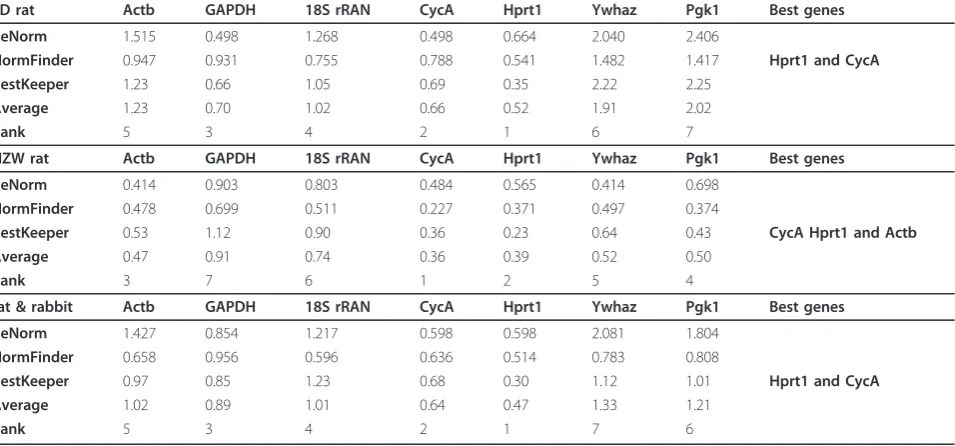
Analysis on the stability of the reference genes using NormFinder and BestKeeper showed different ranking order compared to geNorm analysis (Table 4). Norm-Finder indicated Hprt1 as the best stable gene in rat and combined species, followed by 18S rRNA, CycA, and GAPDH. All reference genes in rabbit showed better stability value compared to those of rat, and CycA ranked as best control gene with a stability value of 0.227. The BestKeeper calculated variations for all the reference genes based on geometric mean of the CT values. Genes with standard deviation (SD) higher than 1 were defined as unstable. Similar to NormFinder, Hprt1 showed the lowest CT value variation in rat and combined species, and GAPDH and CycA with lower than 1 (SD) were indicated as good candidate genes. In rabbit, all reference genes except GAPDH showed low SD values and Hprt1 which was second ranking order in NormFinder was calculated to be the most stable gene with a SD value of 0.23.
Overall ranking order and selection of the best genes All results obtained from three programs showed differ-ent ranking order according to their differdiffer-ent calculated
algorithm. To find the combination of stable reference genes, we summarized the output results which were M value (geNorm), stability (NormFinder), and standard deviation (BestKeeper) and calculated the average and ranking order in Table 5. Based on the pair-wise varia-tion analysis by geNorm, the number of stable reference genes was applied as two for rat and combined species and three for rabbit. The overall ranking order of SD rat was Hprt1, CycA, GAPDH, 18S rRNA, Actb, Ywhaz, and Pgk1 and the combination of Hprt1 and CycA was finally selected as best control genes. Similarly, the com-bination of Hprt1 and CycA were determined as the most stable housekeeping genes in analyzing of com-bined speices. In experiments with rabbit intervertebral disc, however, the most preferred reference genes were CycA, Hprt1, and Actb.
Discussion
[image:3.595.57.542.99.285.2]It has become increasingly clear in recent years that the accuracy of qRT-PCT analysis strongly depends on the choice of the normalization approach. Among current normalization approaches available, the use of housekeep-ing gene as an internal control is by far the most conve-nient to compute, provided the biological assumption of
Table 2 Primer information of reference genes for qRT-PCR
Sprague-Dawley rat New Zealand White Rabbit
Forward (5’-3’) Reverse (5’-3’)
Product size (bp) [Ref]
Forward (5’-3’) Reverse (5’-3’)
Product size (bp) [Ref]
Actb AGGCCAACCGTGAAAAGATG
ACCAGAGGCATACAGGGACAA
101 [33] CTGGAACGGTGAAGGTGACA
CGGCCACATTGCAGAACTTT
73 [D]
GAPDH GCAAGAGAGAGGCCCTCAG TGTGAGGGAGATGCTCAGTG
74 [18] GGGTGGTGGACCTCATGGT
CGGTGGTTTGAGGGCTCTTA
58 [D]
18S rRNA
ACGGACCAGAGCGAAAGCAT TGTCAATCCTGTCCGTGTCC
310 [19] TCGGCATTCGAACGTATGC
ACCCGTGGTCACCATGGTA
56 [D]
CycA TATCTGCACTGCCAAGACTGAGTG CTTCTTGCTGGTCTTGCCATTCC
126 [20] CCAACGGCTCCCAGTTCTT
ACGTGCTTGCCGTCCAA
61 [D]
Hprt1 TGTTTGTGTCATCAGCGAAAGTG ATTCAACTTGCCGCTGTCTTTTA
66 [D] GCAGACCTTGCTTTCCTTGGT
GCAGGCTTGCGACCTTGAC
63 [D]
Ywhaz TTGAGCAGAAGACGGAAGGT GAAGCATTGGGGATCAAGAA
136 [19] GGTCTGGCCCTTAACTTCTCTGTGTTCTA
GCGTGCTGTCTTTGTATGATTCTTCACTT
142 [28]
Pgk1 ATGCAAAGACTGGCCAAGCTAC AGCCACAGCCTCAGCATATTTC
104 [20] TGTTGGTCGGGCGAAGCAG
CAGTGTCTCCACCGCCGATG
149 [28]
[D] designed primer
Table 3 Standard curve parameters for candidate reference genes
SD rat NZW rabbit
Genes Slope Efficiency (E) [%] Coefficient (R2) Slope Efficiency (E) Coefficient (R2)
Actb -3.024 2.141 [114.1] 0.992 -3.363 1.983 [98.3] 0.999
GAPDH -3.222 2.043 [104.3] 0.995 -3.388 1.973 [97.3] 0.997
18S rRNA -3.253 2.030 [103.0] 0.982 -3.584 1.901 [90.1] 0.994
CycA -3.135 2.084 [108.4] 0.996 -3.091 2.106 [110.6] 0.999
Hprt1 -3.360 1.984 [98.4] 0.991 -3.411 1.964 [96.4] 0.990
Ywhaz -3.043 2.131 [113.1] 0.994 -3.040 2.133 [113.3] 0.985
[image:3.595.58.543.625.737.2]the reference gene is fulfilled. Several studies have demonstrated that commonly used reference genes are regulated under various experimental conditions, indicat-ing the requirement of reference gene validation as the first step before meaningful outcomes could be discerned. To further improve sensitivity, normalization with multi-ple reference genes is also proposed.
Rat and rabbit are preferred models for studying the pathogenesis of disc degeneration. Current knowledge suggests that mechanical stimulation may be a signifi-cant contributor to the biology of the IVD. To this end, our working hypotheses states that abnormal mechanical stimulation can induce pertinent biological cascades that may degenerate a healthy normal disc in
(a) Sprague-Dawley rat (b) New Zealand White rabbit
12 16 20 24 28 32
Day 0 Day 3 Day 7 Day 14
CT
valu
e
Actb (4.12)
GAPDH (1.88) 18S rRNA (3.31) CycA (1.61)
Hprt1 (1.09)
Ywhaz (4.54)
Pgk1 (4.27)
12 16 20 24 28 32
Day 0 Day 3 Day 7 Day 14
CT
valu
e
Actb (1.65)
GAPDH (3.05) 18S rRNA (2.48) CycA (1.04)
Hprt1 (0.67)
Ywhaz (1.84)
[image:4.595.60.541.89.248.2]Pgk1 (1.02)
Figure 1Cycle threshold (CT) values of candidate reference genes in intervertebral disc organ culture of Sprague-Dawley rat (a) and
New Zealand White rabbit (b). CTvalues represent mean ± S.D. from three biological replicates. CTrang calculated from maximum and minimum is shown between parentheses in each reference genes.
[image:4.595.61.540.402.686.2]a temporo-spatial manner. Althoughin vivomechanical stimulation is possible to a certain extent, understand-ing the effect of complex biomechanics would be achievable to a greater extent in vitro using a whole organ system. Successful realization of a mechanically-active culture system would require validation of the experimental model using well characterized outcome measures. Among several outcomes that need to be verified for the evaluation of ourin vitroexperimental model, expression profiles of genes of interest and
validation of reference gene(s) are considered signifi-cant requirements.
[image:5.595.56.290.122.324.2]To determine the most stable genes, data were ana-lyzed using three different applications (geNorm, Norm-Finder, and BestKeeper) with distinct algorithms for assessing and identifying gene stability. Briefly, GeNorm software identifies stable genes based on the principle that two ideal genes have same expression ratios in all samples. The expression ratio is reported as the stability value‘M’ that is essentially an average pair-wise varia-tion of each gene in comparison to other candidate genes. NormFinder utilizes expression variation between inter and intra groups for identifying the ideal reference genes. In other words, the program can calculate not only the overall variation of candidate reference genes but also the variation between subgroups of given sam-ple set. BestKeeper calculates reference gene’s standard deviation (SD) based on raw CT values regardless of sample’s efficiency. Gene with the lowest SD is consid-ered the most stable gene. We applied these three pro-grams for complementary analyses. As expected, ranking data reported by the programs differed considerably in terms of magnitude of the ranking parameter and order of ranking. Surprisingly (although with varying rank order), four genes (Hprt1, CycA, GAPDH, and 18S rRNA) in rat IVD tissue and five genes (CycA, Hprt1, Actb, Pgk1, and Ywhaz) in rabbit IVD tissue were pre-sented as available reference genes. To determine a con-solidated rank ordering of reference genes using data from all the output, we decided to average the outcome measures of the three programs for each reference gene since the three algorithms determined the gene ranking
Table 4 Ranking order of candidate reference genes in the intervertebral disc of Sprague-Dawley (SD) rat and New Zealand White (NZW) rabbit
NormFinder BestKeeper
Rank SD rat NZW rabbit
rat & rabbit
SD rat NZW rabbit rat & rabbit 1 Hprt1 (0.541) CycA (0.227) Hprt1 (0.514) Hprt1 0.35) Hprt1 (0.23) Hprt1 (0.30) 2 18S rRNA (0.755) Hprt1 (0.371) 18S rRNA (0.596) GAPDH (0.66) CycA (0.36) CycA (0.68) 3 CycA (0.788) Pgk1 (0.374) CycA (0.636) CycA (0.69) Pgk1 (0.43) GAPDH (0.85) 4 GAPDH (0.931) Actb (0.478) Actb (0.658) 18S rRNA (1.05) Actb (0.53) Actb (0.97) 5 Actb (0.947) Ywhaz (0.497) Ywhaz (0.783) Actb (1.23) Ywhaz (0.64) Pgk1 (1.01) 6 Pgk1 (1.417) 18S rRNA (0.511) Pgk1 (0.808) Ywhaz (2.22) 18S rRNA (0.90) Ywhaz (1.12) 7 Ywhaz (1.482) GAPDH (0.699) GAPDH (0.956) Pgk1 (2.25) GAPDH (1.12) 18S rRNA (1.23)
(value); stability in NormFinder and standard deviation in BestKeeper
Table 5 Overall ranking order of candidate reference genes based on the output values from three programs and selection of the best genes in the intervertebral disc of Sprague-Dawley (SD) rat and New Zealand White (NZW) rabbit
SD rat Actb GAPDH 18S rRAN CycA Hprt1 Ywhaz Pgk1 Best genes
geNorm 1.515 0.498 1.268 0.498 0.664 2.040 2.406
NormFinder 0.947 0.931 0.755 0.788 0.541 1.482 1.417 Hprt1 and CycA
BestKeeper 1.23 0.66 1.05 0.69 0.35 2.22 2.25
Average 1.23 0.70 1.02 0.66 0.52 1.91 2.02
Rank 5 3 4 2 1 6 7
NZW rat Actb GAPDH 18S rRAN CycA Hprt1 Ywhaz Pgk1 Best genes
geNorm 0.414 0.903 0.803 0.484 0.565 0.414 0.698
NormFinder 0.478 0.699 0.511 0.227 0.371 0.497 0.374
BestKeeper 0.53 1.12 0.90 0.36 0.23 0.64 0.43 CycA Hprt1 and Actb
Average 0.47 0.91 0.74 0.36 0.39 0.52 0.50
Rank 3 7 6 1 2 5 4
rat & rabbit Actb GAPDH 18S rRAN CycA Hprt1 Ywhaz Pgk1 Best genes
geNorm 1.427 0.854 1.217 0.598 0.598 2.081 1.804
NormFinder 0.658 0.956 0.596 0.636 0.514 0.783 0.808
BestKeeper 0.97 0.85 1.23 0.68 0.30 1.12 1.01 Hprt1 and CycA
Average 1.02 0.89 1.01 0.64 0.47 1.33 1.21
[image:5.595.61.539.508.731.2]based on the function of decreasing value of their out-come measures. Previously, Axtner et al. [17] identified the best combination of genes by mean rank derived from the three programs. We employed a different strat-egy by using the mean of three outcome measures and ranked the genes of interest as a function of their means with the lower means ranking better than their counter-parts. We found this strategy to be more appropriate for the purpose of mathematical clarity.
In conjunction with GAPDH, Actb and 18S rRNA, our selection of other potential reference genes were based on demonstrated results of stability in previous investigations Xing et al. [18] demonstrated Hprt1 to be the best reference gene in rat partial hepatectomy model, which is experimental model for the study of liver regeneration. On the other hand, Ywhaz and CycA were the most stable genes in the brain tissue and asphyxia cardiac arrest model, respectively [19,20]. In the current study, combination of Hprt1 and CycA were identified to be suitable for normalization for rat and rabbit IVD culture studies. Although expression stability of reference genes may be influenced by multiple fac-tors, our findings suggest that experimental conditions have a significant effect in thisin vitromodel.
GAPDH has been successfully employed as a reference gene in IVD organ culture studies [21,22] whereas our study indicates otherwise. The instability of GAPDH in our culture model could partly be the result of oxygen tension gradients in the IVD [23] that may result in reg-ulation of HIF-1a [24]. Actb and 18S rRNA were also observed to be regulated in our culture model despite successful application in previous studies [25-27]. We analyzed matrix metalloproteinase-3 (MMP-3) expres-sion which plays a major role in the disc degeneration process using Actb and combination of Hprt1 and CycA. MMP-3 expression normalized by Hprt1 and CycA showed 3.8-fold up-regulation at day 3, while Actb induced 73.7-fold up-regulation in the rat IVD tis-sue (additional file 2). Our comparative analysis empha-sizes the critical requirement of reliable reference gene (s) to avoid erroneous and misrepresented results.
The delta-delta CTalgorithm is a convenient and stan-dard method to analyze the relative changes in gene expression. This method requires the CT values for a reference gene(s) to be reliably lower of that of a target gene. However, CTvalues of rabbit Hprt1 were relatively higher than those of other optimal reference genes (CycA and Actb) in this study. Although the CTvalues can be reduced by using increased amount of PCR templates, we first need to confirm the range of CT values of target genes for accurate analysis of relative quantification.
Accurate normalization determines the sensitivity and reproducibility of a PCR measure making the selection process of a reference gene a very crucial step in
validating the gene expression tool. It is also suggested by previous investigations that single control normaliza-tion may still lead to erroneous results, urging the need to use two or more reference genes to improve sensitiv-ity and also maintain low expression variation [6]. It is also generally advised to maintain Ct values < 30 so that the initial abundance of the target gene is considered biologically consequential. We realized the significance of multiple reference genes and have reported two most stable genes for each individual small animal species. We believe the recommendations of this study are applicable for future investigations in IVD biology that use rat and rabbit disc tissues. Also, our inference is solely concerned with the experimental conditions stated in this investigation.
Conclusions
We evaluated the stability of seven potential reference genes (Actb, GAPDH, 18S rRNA, CycA, Hprt1, Ywhaz, and Pgk1) and attempted to identify the most stable control gene (s) for normalization of qRT-PCR data from rat and rabbit organ culture. Using geNorm, NormFinder, and BestKeeper, we determined that Hprt1 and CycA are ideal reference gene candidates in both the species of interest. Actb was also found suitable for normalization in the rabbit IVD whereas its stability is questionable in the rat model. GAPDH was found to be unsuitable for normalization in both rat and rabbit IVDs under our experimental constraints. Data presented in this work is the first of its kind focusing on the interver-tebral disc and may facilitate improvement in reliability and sensitivity of qRT-PCR for IVD organ culture studies.
Methods
Intervertebral disc (IVD) organ culture
RNA isolation
Samples were homogenized with TRIzol® reagent (Invi-trogen™ Life Technologies, Carlsbad, CA, USA) and total RNA was extracted by the homogenized tissues using the RNeasy Mini Kit (Qiagen, Valencia, CA, USA) according to the manufacture’s instructions. Total RNA was quantified using a NanoDrop® ND-1000 UV-Vis Spectrophotometer (Thermo Scientific, Waltham, MA, USA) at a 260 nm wavelength.
Candidate reference genes and primers for qRT-PCT Candidate reference genes selected were classical refer-ence genes which are most commonly used as internal control for gene expression studies (Actb, GAPDH, and 18S rRNA) and the others (CycA, Hprt1, Ywhaz, and Pgk1) based on previous reports [19,20,28]. Most primer information was obtained from previously published pri-mer sequences. One rat (Hprt1) and five rabbit pripri-mers (Actb, GAPDH, 18S rRNA, CycA, and Hprt1) were designed using the Primer Express® 3.0 software (Applied Biosystems, Foster City, CA, USA) based on the sequences in the database [29].
Quantitative real-time RT-PCR (qRT-PCR)
qRT-PCR was performed with the SuperScriptTM III Pla-tinum® SYBR® Green One-Step qRT-PCR kit (Invitro-gen™Life Technologies) following the instructions with slight modification. For each sample, 50 ng total RNA was used in the assay for all reference genes except rat GAPDH (25 ng), rat 18S (1 ng), and rabbit Actb (25 ng) and all samples were run in triplicate on a 96-well optical reaction plate with the ABI PRISM 7700 Sequence tion System (Applied Biosystems) with a Sequence Detec-tion System (SDS) software version 2.3. The PCR Reactions were prepared in a total volume of 25 ㎕ con-taining 1㎕diluted RNA, 0.5㎕forward and reverse pri-mer (10μM), 12.5 ㎕2X SYBR® Green Reaction Mix, and 10㎕RNase-free water. The conditions for the PCR were as follows: reverse transcription at 50°C for 3 min, DNA polymerase activation and RT enzyme inactivation at 95°C for 5 min, followed by 40 cycles of denaturation at 95°C for 15 sec, primer annealing at 60°C for 30 sec, elongation at 40°C for 1 min. The quantification values were obtained from the threshold cycle (CT) number at which the increase in signal associated with an exponen-tial growth of PCR products using SDS software. At the end of the PCR reactions, amplification specificity was confirmed by analyzing dissociation curve. To calculate PCR efficiency for each gene, six points of 2-fold serial dilution were used to build standard curve.
Data analysis
To calculate the CT values, the fluorescence threshold was manually set to 1 in SDS software and the results
were directly imported into Microsoft Excel for Best-Keeper (version 1.0) [30] data input. CTvalues above 30 were excluded in this study. PCR efficiencies (E) were calculated from the slope of each standard curve with the equation,
E = 10(−1/slope).
Relative quantities (Q) was then calculated from the CT values and efficiencies for geNorm (version 3.5) [31] and NormFinder (version 19.0) [32] data input with the equation,
Q = E(Minimum CT−Sample CT), (E = 2 for 100%efficiency).
The gene expression stability was ranked from each program and the most stable reference gene or combi-nation genes were calculated.
Additional material
Additional file 1: Melting curve analysis. Melting curve analysis of 7 candidate reference genes using ABI PRISM 7700 Sequence Detection System (Applied Biosystems) with a Sequence Detection System (SDS) software version 2.3.
Additional file 2: MMP-3 gene expression in the rat intervertebral disc. Relative expression level of MMP-3 in the rat intervertebral disc normalized by common used reference genes (Actb, GAPDH and 18S rRNA) and an optimal combination of reference genes (Hprt1 and CycA).
Acknowledgements
This study was supported by the Department of Orthopaedics and Rehabilitation, University of Iowa, Iowa city, Iowa.
Author details 1
Department of Orthopedics and Rehabilitation, University of Iowa, 1182 ML, Iowa city, IA 52242, USA.2Department of Biomedical Engineering, University of Iowa, 1402 SC, Iowa city, IA 52242, USA.
Authors’contributions
DS harvested the intervertebral disc, performed qRT-PCR experiments and wrote the paper. HC designed primers and performed qRT-PCR. KJ participated in the data analysis. HZ advised all qRT-PCR process. TL and JAM supervised the study design and PSR helped to draft the manuscript. All authors read and approved the final manuscript.
Competing interests
The authors declare that they have no competing interests.
Received: 20 December 2010 Accepted: 26 May 2011 Published: 26 May 2011
References
1. Bustin SA:Quantification of mRNA using real-time reverse transcription PCR (RT-PCR): trends and problems.J Mol Endocrinol2002,29(1):23-39. 2. Bustin SA:Absolute quantification of mRNA using real-time reverse
transcription polymerase chain reaction assays.J Mol Endocrinol2000,
25(2):169-193.
3. Huggett J, Dheda K, Bustin S, Zumla A:Real-time RT-PCR normalisation; strategies and considerations.Genes Immun2005,6(4):279-284. 4. Ahn K, Huh JW, Park SJ, Kim DS, Ha HS, Kim YJ, Lee JR, Chang KT, Kim HS:
5. Andersen CL, Jensen JL, Orntoft TF:Normalization of real-time quantitative reverse transcription-PCR data: a model-based variance estimation approach to identify genes suited for normalization, applied to bladder and colon cancer data sets.Cancer Res2004,64(15):5245-5250. 6. Vandesompele J, De Preter K, Pattyn F, Poppe B, Van Roy N, De Paepe A,
Speleman F:Accurate normalization of real-time quantitative RT-PCR data by geometric averaging of multiple internal control genes.Genome Biol2002,3(7):RESEARCH0034.
7. Cavanaugh JM, Ozaktay AC, Yamashita T, Avramov A, Getchell TV, King AI:
Mechanisms of low back pain: a neurophysiologic and neuroanatomic study.Clin Orthop Relat Res1997, ,335:166-180.
8. Sobajima S, Kim JS, Gilbertson LG, Kang JD:Gene therapy for degenerative disc disease.Gene Ther2004,11(4):390-401.
9. Guehring T, Omlor GW, Lorenz H, Bertram H, Steck E, Richter W, Carstens C, Kroeber M:Stimulation of gene expression and loss of anular
architecture caused by experimental disc degeneration–an in vivo animal study.Spine (Phila Pa 1976)2005,30(22):2510-2515.
10. Hutton WC, Elmer WA, Bryce LM, Kozlowska EE, Boden SD, Kozlowski M:Do the intervertebral disc cells respond to different levels of hydrostatic pressure?Clin Biomech (Bristol, Avon)2001,16(9):728-734.
11. Sobajima S, Shimer AL, Chadderdon RC, Kompel JF, Kim JS, Gilbertson LG, Kang JD:Quantitative analysis of gene expression in a rabbit model of intervertebral disc degeneration by real-time polymerase chain reaction.
Spine J2005,5(1):14-23.
12. Wang DL, Jiang SD, Dai LY:Biologic response of the intervertebral disc to static and dynamic compression in vitro.Spine (Phila Pa 1976)2007,
32(23):2521-2528.
13. Chen J, Yan W, Setton LA:Static compression induces zonal-specific changes in gene expression for extracellular matrix and cytoskeletal proteins in intervertebral disc cells in vitro.Matrix Biol2004,
22(7):573-583.
14. Maclean JJ, Lee CR, Alini M, Iatridis JC:Anabolic and catabolic mRNA levels of the intervertebral disc vary with the magnitude and frequency of in vivo dynamic compression.J Orthop Res2004,22(6):1193-1200. 15. MacLean JJ, Lee CR, Grad S, Ito K, Alini M, Iatridis JC:Effects of
immobilization and dynamic compression on intervertebral disc cell gene expression in vivo.Spine (Phila Pa 1976)2003,28(10):973-981. 16. Pfaffl MW, Tichopad A, Prgomet C, Neuvians TP:Determination of stable
housekeeping genes, differentially regulated target genes and sample integrity: BestKeeper–Excel-based tool using pair-wise correlations.
Biotechnol Lett2004,26(6):509-515.
17. Axtner J, Sommer S:Validation of internal reference genes for quantitative real-time PCR in a non-model organism, the yellow-necked mouse, Apodemus flavicollis.BMC Res Notes2009,2:264.
18. Xing W, Deng M, Zhang J, Huang H, Dirsch O, Dahmen U:Quantitative evaluation and selection of reference genes in a rat model of extended liver resection.J Biomol Tech2009,20(2):109-115.
19. Bonefeld BE, Elfving B, Wegener G:Reference genes for normalization: a study of rat brain tissue.Synapse2008,62(4):302-309.
20. Langnaese K, John R, Schweizer H, Ebmeyer U, Keilhoff G:Selection of reference genes for quantitative real-time PCR in a rat asphyxial cardiac arrest model.BMC Mol Biol2008,9:53.
21. Haschtmann D, Stoyanov JV, Ettinger L, Nolte LP, Ferguson SJ:
Establishment of a novel intervertebral disc/endplate culture model: analysis of an ex vivo in vitro whole-organ rabbit culture system.Spine (Phila Pa 1976)2006,31(25):2918-2925.
22. Risbud MV, Izzo MW, Adams CS, Arnold WW, Hillibrand AS, Vresilovic EJ, Vaccaro AR, Albert TJ, Shapiro IM:An organ culture system for the study of the nucleus pulposus: description of the system and evaluation of the cells.Spine (Phila Pa 1976)2003,28(24):2652-2658, discussion 2658-2659.
23. Bibby SR, Jones DA, Ripley RM, Urban JP:Metabolism of the intervertebral disc: effects of low levels of oxygen, glucose, and pH on rates of energy metabolism of bovine nucleus pulposus cells.Spine (Phila Pa 1976)2005,
30(5):487-496.
24. Ha KY, Koh IJ, Kirpalani PA, Kim YY, Cho YK, Khang GS, Han CW:The expression of hypoxia inducible factor-1alpha and apoptosis in herniated discs.Spine (Phila Pa 1976)2006,31(12):1309-1313.
25. Gantenbein B, Grunhagen T, Lee CR, van Donkelaar CC, Alini M, Ito K:An in vitro organ culturing system for intervertebral disc explants with
vertebral endplates: a feasibility study with ovine caudal discs.Spine (Phila Pa 1976)2006,31(23):2665-2673.
26. Junger S, Gantenbein-Ritter B, Lezuo P, Alini M, Ferguson SJ, Ito K:Effect of limited nutrition on in situ intervertebral disc cells under simulated-physiological loading.Spine (Phila Pa 1976)2009,34(12):1264-1271. 27. Korecki CL, MacLean JJ, Iatridis JC:Dynamic compression effects on
intervertebral disc mechanics and biology.Spine (Phila Pa 1976)2008,
33(13):1403-1409.
28. Mamo S, Gal AB, Polgar Z, Dinnyes A:Expression profiles of the pluripotency marker gene POU5F1 and validation of reference genes in rabbit oocytes and preimplantation stage embryos.BMC Mol Biol2008,
9:67.
29. GenBank.[http://www.ncbi.nlm.nih.gov/GenBank/].
30. BestKeeper Software.[http://www.gene-quantification.de/bestkeeper.html]. 31. geNorm Software.[http://medgen.ugent.be/~jvdesomp/genorm/]. 32. NormFinder Software.[http://www.mdl.dk/publicationsnormfinder.htm]. 33. Yang LP, Sun HL, Wu LM, Guo XJ, Dou HL, Tso MO, Zhao L, Li SM:Baicalein
reduces inflammatory process in a rodent model of diabetic retinopathy.Invest Ophthalmol Vis Sci2009,50(5):2319-2327.
doi:10.1186/1756-0500-4-162
Cite this article as:Seolet al.:Selection of reference genes for normalization of quantitative real-time PCR in organ culture of the rat and rabbit intervertebral disc.BMC Research Notes20114:162.
Submit your next manuscript to BioMed Central and take full advantage of:
• Convenient online submission
• Thorough peer review
• No space constraints or color figure charges
• Immediate publication on acceptance
• Inclusion in PubMed, CAS, Scopus and Google Scholar
• Research which is freely available for redistribution