R8
BCT = breast-conserving therapy; CI = confidence intervals; HR = hazard ratio; MSKCC = Memorial Sloan-Kettering Cancer Center; PCR = poly-merase chain reaction; SMBD-JGH = Sir Mortimer B. Davis-Jewish General Hospital.
Research article
A combined analysis of outcome following breast cancer:
differences in survival based on BRCA1/BRCA2 mutation status
and administration of adjuvant treatment
Mark E Robson
1†, Pierre O Chappuis
2*
†, Jaya Satagopan
3, Nora Wong
4, Jeff Boyd
5,
John R Goffin
6*, Clifford Hudis
1, David Roberge
6, Larry Norton
1, Louis R Bégin
7*, Kenneth Offit
1and William D Foulkes
2,4,81Department of Medicine, Memorial Sloan-Kettering Cancer Center, New York, New York, USA
2Research Institute of McGill University Health Centre, Cancer Prevention Centre, McGill University, Montreal, Quebec, Canada 3Department of Epidemiology/Biostatistics, Memorial Sloan-Kettering Cancer Center, New York, New York, USA
4Cancer Prevention Centre, Sir Mortimer B Davis-Jewish General Hospital, McGill University, Montreal, Quebec, Canada 5Department of Surgery, Memorial Sloan-Kettering Cancer Center, New York, NY, USA
6Department of Oncology, McGill University, Montreal, Quebec, Canada 7Department of Pathology, McGill University, Montreal, Quebec, Canada
8Program in Cancer Genetics, Departments of Oncology and Human Genetics, McGill University, Montreal, Quebec, Canada
*Current addresses: Divisions of Oncology and Medical Genetics, University Hospitals of Geneva, Geneva, Switzerland (POC); Hôpital du Sacré-Coeur de Montréal, Montreal, Quebec, Canada (LRB); and Division of Hematology/Oncology, Department of Medicine, Tufts University, Tufts University-New England Medical Center, Boston, Massachusetts, USA (JRG)
†MER and POC contributed equally to this manuscript
Corresponding author: William D Foulkes (e-mail: [email protected])
Received: 8 Jul 2003 Revisions requested: 19 Aug 2003 Revisions received: 6 Sep 2003 Accepted: 15 Sep 2003 Published: 24 Oct 2003 Breast Cancer Res 2004, 6:R8-R17 (DOI 10.1186/bcr658)
© 2004 Robson et al., licensee BioMed Central Ltd (Print ISSN 1465-5411; Online ISSN 1465-542X). This is an Open Access article: verbatim copying and redistribution of this article are permitted in all media for any purpose, provided this notice is preserved along with the article's original URL.
See related Commentary: http://breast-cancer-research.com/content/6/1/E7
Abstract
Background: The prognostic significance of germline mutations in BRCA1and BRCA2in women with breast cancer remains unclear. A combined analysis was performed to address this uncertainty.
Methods: Two retrospective cohorts of Ashkenazi Jewish women undergoing breast-conserving treatment for invasive cancer between 1980 and 1995 (n= 584) were established. Archived tissue blocks were used as the source of DNA for Ashkenazi Jewish BRCA1/BRCA2founder mutation analysis. Paraffin-embedded tissue and follow-up information was available for 505 women.
Results:Genotyping was successful in 496 women, of whom 56 (11.3%) were found to carry a BRCA1/BRCA2 founder mutation. After a median follow-up period of 116 months, breast cancer specific survival was worse in women with
BRCA1 mutations than in those without (62% at 10 years versus 86%; P< 0.0001), but not in women with the BRCA2
mutation (84% versus 86% at 10 years; P= 0.76). Germline
BRCA1 mutations were an independent predictor of breast cancer mortality in multivariate analysis (hazard ratio 2.4, 95% confidence interval 1.2–4.8; P= 0.01). BRCA1 status predicted breast cancer mortality only among women who did not receive chemotherapy (hazard ratio 4.8, 95% confidence interval 2.0–11.7; P= 0.001). The risk for metachronous ipsilateral cancer was not greater in women with germline
BRCA1/BRCA2 founder mutations than in those without mutations (P= 0.68).
Conclusion:BRCA1mutations, but not BRCA2mutations, are associated with reduced survival in Ashkenazi women undergoing breast-conserving treatment for invasive breast cancer, but the poor prognosis associated with germline
BRCA1mutations is mitigated by adjuvant chemotherapy. The risk for metachronous ipsilateral disease does not appear to be increased for either BRCA1 or BRCA2 mutation carriers, at least up to 10 years of follow up.
Keywords:adjuvant therapy, BRCA1, BRCA2, breast cancer, contralateral, ipsilateral, prognosis
R9
Introduction
The major breast cancer predisposing genes BRCA1and BRCA2 were identified in 1994 and 1995, respectively [1,2]. Unfortunately, the optimal clinical approach to women who develop hereditary breast cancer remains incompletely defined. Studies of the outcomes of women with BRCA1/BRCA2-related cancer have yielded conflict-ing results. Several reports suggested that women with germline mutations in BRCA1are more likely to die from their disease than are women with sporadic breast cancer [3–6]. However, other studies did not confirm these observations [7,8]. Fewer studies have focused on BRCA2-related breast cancer [9,10].
Certain unique barriers have impeded the analysis of germline BRCA1/BRCA2 status as a prognostic factor. Because informed consent is required for genetic testing, and individuals may decline such testing for a variety of reasons, it has been difficult to develop prospective cohorts for outcome studies. On the other hand, testing generally requires the provision of a blood sample, which may introduce a survival bias in the conduct of retrospec-tive studies. Both of these potential selection biases may be avoided through the use of a retrospective design in which BRCA1/BRCA2 mutations are sought in archival tissue from women who have undergone treatment for cancer, and in whom the clinical outcomes are known. Genetic testing is performed on anonymized tissue speci-mens, and comparisons are made between the women who do and those who do not have mutations. This design presupposes that the BRCA1/BRCA2mutation spectrum in the study group is limited and predefined. This is the case for women of Ashkenazi Jewish descent, because two specific mutations of BRCA1 (185delAG and 5382insC) and one mutation of BRCA2(6174delT) con-stitute the great majority of mutations identified in this pop-ulation, and these are easily detectable in paraffin-embedded material [11–14]. The present study employed this retrospective, anonymized design to examine the outcomes of Ashkenazi women with invasive breast cancer undergoing breast-conserving therapy (BCT) at two institutions in the USA and Canada.
Methods
Patients
Patients from Memorial Sloan-Kettering Cancer Center (MSKCC) were identified as previously described [15]. Briefly, clinical databases from the Departments of Pathol-ogy, Surgery, and Radiation Therapy were reviewed to identify women who underwent BCT (wide local excision and radiation, with or without axillary node dissection) between 1 January 1980 and 31 December 1990. Hospi-tal registration databases were then cross-referenced to identify women expressing Jewish religious preference. Of the 393 Jewish women undergoing BCT, paraffin-embed-ded tissue and follow-up information was available for
314 women. Information on tumor grade was not available. The combined impact of germline mutations in BRCA1/BRCA2 on prognosis in this group of women was reported in a previous publication [15]. For the present study the clinical database was extended and additional analyses were performed evaluating the prog-nostic impact of interactions between germline status, hormone receptor status, and adjuvant treatment with either tamoxifen or chemotherapy. The clinical impact of germline mutations in BRCA1and BRCA2were consid-ered separately.
Ashkenazi Jewish women diagnosed with invasive non-metastatic breast cancer at age 65 years or less, who were treated at Sir Mortimer B. Davis-Jewish General Hos-pital (SMBD-JGH) between 1 January 1980 and 1 Novem-ber 1995, were identified from the Medical Records Department. Of 292 women identified, 225 underwent breast-conserving surgery. Of these 225 women, 34 did not receive radiation and are excluded from further consid-eration. Paraffin-embedded tissue and follow-up informa-tion was available for the remaining 191 women, who were included in the analysis. Results relating to germline mutations in BRCA1for the entire dataset were recently reported [16]. The study was focused on those receiving BCT to harmonize the ascertainment criteria between the two centers and to focus on ipsilateral cancer recurrence. The two studies were combined to increase the sample size and thereby the power to observe the separate effects of mutations in BRCA1 and BRCA2, which was not previously possible with either dataset alone.
Data collection
R10
Genetic analysis
Analysis of the paraffin-embedded specimens was per-formed as previously described [3,15]. Briefly, paraffin sections were obtained from the retrieved tissue blocks and genomic DNA was isolated by standard protocols. At MSKCC normal lymph node was preferentially examined, whereas at SMBD-JGH tumor tissue was studied. All specimens were analyzed by PCR amplification of the regions surrounding the Ashkenazi founder mutations 185delAG and 5382insC in BRCA1 and 6174delT in BRCA2. Radiolabeled PCR products were visualized by denaturing PAGE followed by autoradiography. The detection of characteristic variant bands indicated the presence of the mutation being studied. Variant bands were confirmed by direct sequencing or by an indepen-dent PCR amplification of the corresponding DNA sample and repeat analysis. There were no discordant results upon repeat analysis.
DNA samples from nine patients failed to yield PCR prod-ucts despite repeat analysis. Therefore, the final study group consisted of 496 women. There were 24 women who underwent contralateral BCT for metachronous breast cancer during the period of the study. Thus, for the purposes of determining the rate of metachronous ipsilat-eral cancer, there were 520 breasts at risk in the dataset.
Statistical analyses
Clinical characteristics of women with and without germline BRCA1/BRCA2 founder mutations were com-pared using a χ2 test. For the survival analyses, breast cancer specific mortality was chosen as the main end-point for the study in order to avoid possible confounding by death due to other causes, such as malignancies of other anatomic sites. Overall survival, defined as the time from diagnosis to death from any cause, was evaluated as a secondary end-point. All ipsilateral breast cancer events were considered in the calculation of the cumulative inci-dence of metachronous ipsilateral breast cancer, because the retrospective design of this study did not allow reliable discrimination between true recurrences and separate metachronous primaries. All contralateral breast cancer diagnoses were considered new primary lesions for the purposes of calculating the cumulative incidence of tralateral breast cancer. Women who had undergone con-tralateral mastectomy before the breast cancer diagnosis for which they underwent breast conservation (n= 7) were excluded from the analysis of this end-point.
Patients were censored if they had not experienced the end-point of interest at the time of last follow up. Kaplan–Meier estimates of breast cancer specific survival time were compared using the log-rank test. A Cox pro-portional hazards model was used to estimate the hazard ratios (HRs) for breast cancer specific survival time under a multivariate model. All other end-points were analyzed
after accounting for death due to causes other than breast cancer as a competing risk. The cumulative incidences of the end-points in women with and without mutations were compared with a χ2test fit using the method of Gray [17]. Pvalues comparing the overall curves corresponding to the end-point of interest are provided for these univariate comparisons. The cumulative incidences of death due to breast cancer and due to causes other than breast cancer are both calculated in the same analysis, and shown in separate figures. Multivariate proportional hazards models accounting for non-breast-cancer death as a competing risk were fitted using the method of Fine and Gray [18]. All Pvalues were calculated using two-sided tests.
Results
Mutation analysis and clinical characteristics
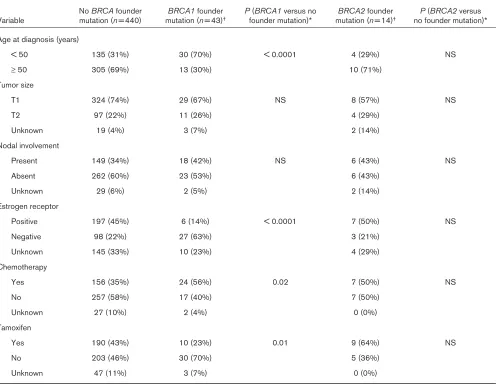
BRCA1/BRCA2mutations were identified in 56 (11.3%) of 496 patients (42BRCA1 [32 women carried the 185delAG and 10 carried the 5382insC mutation], 13BRCA2 [all 6174delT], and one both BRCA1 and BRCA2[185delAG and 6174delT]). The clinical charac-teristics of women with BRCA1, BRCA2, and no germline BRCA1/BRCA2 mutations are presented in Table 1. Women with germline BRCA1 mutations were signifi-cantly more likely than women without these specific mutations to be diagnosed before the age of 50 years, to be diagnosed with estrogen receptor negative tumors, and to have received adjuvant chemotherapy. BRCA1 mutation carriers were significantly less likely than noncar-riers to have received tamoxifen (Table 1). In women with BRCA1 mutations, neither tumor size nor axillary nodal involvement differed significantly from noncarriers. Among those for whom data were available, BRCA2mutation car-riers were more likely than BRCA1carriers to have estro-gen receptor positive tumours (odds ratio 10.5; P= 0.004) and to have received adjuvant tamoxifen (odds ratio 5.4; P= 0.02). For no other variable was the distribu-tion significantly different between BRCA2mutation carri-ers and either BRCA1carriers or noncarriers.
Breast cancer specific survival
because the probability of death due to breast cancer among BRCA1 mutation carriers was 38% at 10 years (P< 0.0001, versus noncarriers; Fig. 1 and Table 2) and 15.5% among women with the BRCA2founder mutation (P= 0.76 versus non-carriers; Table 2). There was no dif-ference between women with and those without BRCA1/BRCA2mutations with respect to the probability of death due to causes other than breast cancer (P= 0.38; Fig. 2).
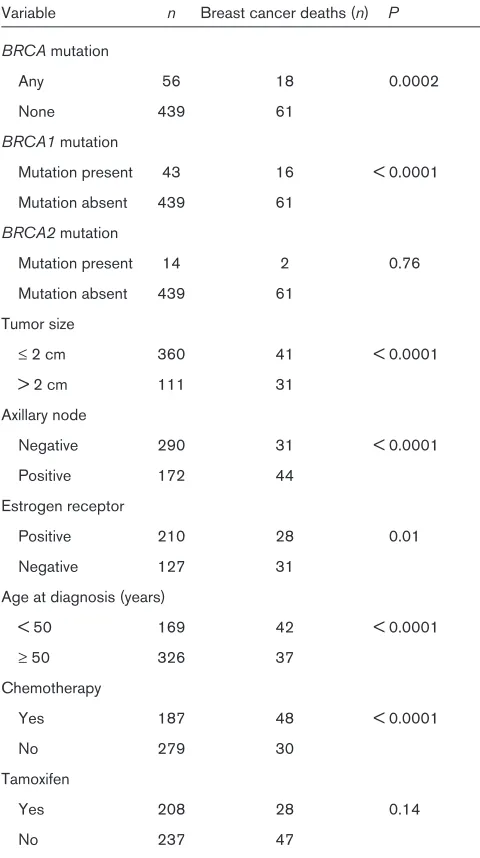
In univariate analyses, age under 50 years at initial diagno-sis, presence of a BRCA1 mutation, primary tumor size greater than 2 cm, estrogen receptor negativity, axillary nodal involvement, and receipt of adjuvant chemotherapy were all significantly associated with poorer breast cancer specific survival (Table 2). Adjuvant treatment was not ran-domly assigned, and therefore the association between
[image:4.612.60.556.119.503.2]administration of chemotherapy and a poor outcome (P< 0.0001) is probably accounted for by the fact that women who were given chemotherapy had a higher a priori probability of death than did those not receiving adjuvant chemotherapy. For this reason, use of chemotherapy was not included as a variable in the final multivariate model. In a multivariate competing risk analysis of breast cancer specific survival, we included only those variables that were significant in the univariate analysis. The final, most parsimonious model is shown in Table 3. BRCA1 mutation status retained independent prognostic significance (HR 2.39, 95% confidence interval [CI] 1.20–4.75; P= 0.01), along with tumor size greater than 2 cm (HR 2.19, 95% CI 1.30–3.67; P= 0.003) and axillary nodal involvement (HR 1.78, 95% CI 1.07–2.96; P= 0.03). Women diagnosed after the age of 50 years were less likely to die from breast cancer than were R11
Table 1
Clinical characteristics of women with and without BRCA founder mutations
No BRCAfounder BRCA1founder P(BRCA1versus no BRCA2founder P(BRCA2versus Variable mutation (n= 440) mutation (n= 43)† founder mutation)* mutation (n= 14)† no founder mutation)*
Age at diagnosis (years)
< 50 135 (31%) 30 (70%) < 0.0001 4 (29%) NS
≥50 305 (69%) 13 (30%) 10 (71%)
Tumor size
T1 324 (74%) 29 (67%) NS 8 (57%) NS
T2 97 (22%) 11 (26%) 4 (29%)
Unknown 19 (4%) 3 (7%) 2 (14%)
Nodal involvement
Present 149 (34%) 18 (42%) NS 6 (43%) NS
Absent 262 (60%) 23 (53%) 6 (43%)
Unknown 29 (6%) 2 (5%) 2 (14%)
Estrogen receptor
Positive 197 (45%) 6 (14%) < 0.0001 7 (50%) NS
Negative 98 (22%) 27 (63%) 3 (21%)
Unknown 145 (33%) 10 (23%) 4 (29%)
Chemotherapy
Yes 156 (35%) 24 (56%) 0.02 7 (50%) NS
No 257 (58%) 17 (40%) 7 (50%)
Unknown 27 (10%) 2 (4%) 0 (0%)
Tamoxifen
Yes 190 (43%) 10 (23%) 0.01 9 (64%) NS
No 203 (46%) 30 (70%) 5 (36%)
Unknown 47 (11%) 3 (7%) 0 (0%)
*Cases in which the characteristic of interest is unknown are not included in the comparisons. †Woman with both BRCA1and BRCA2founder
younger women (HR 0.55, 95% CI 0.33–0.92; P= 0.02; Table 3). The models were essentially unchanged when overall survival was the end-point. The presence of the BRCA2mutation was not a significant prognostic factor in either univariate (Table 2) or multivariate analysis (data not shown).
Effect of adjuvant treatment
[image:5.612.58.296.91.305.2]Of the 468 women in the study for whom information regarding adjuvant chemotherapy was available, 187 received chemotherapy and 281 did not. In univariate analysis the presence of a germline BRCA1mutation was significantly associated with a worse breast cancer spe-cific survival both among those women who received chemotherapy (10-year breast cancer mortality 41% in carriers versus 24% in noncarriers; P= 0.04) and among those who did not (10-year breast cancer mortality 24% in carriers versus 9.6% in noncarriers; P= 0.008). The pres-ence of a germline BRCA1 mutation remained an inde-pendent predictor of breast cancer mortality in multivariate R12
Figure 1
Cumulative incidence of death due to breast cancer among women with (····) and those without (––) germline BRCA1mutations (P< 0.0001).
N at risk
Year 1 Year 3 Year 5 Year 10 Year 12 Year 15
Mutation present 41 35 31 10 5 1
Mutation absent 435 416 382 182 101 19
Time (years)
Cumulative Incidence
0 5 10 15
0.0
0.2
0.4
0.6
0.8
1
.0
Table 2
Univariate analysis of factors influencing breast cancer specific survival
Variable n Breast cancer deaths (n) P BRCAmutation
Any 56 18 0.0002
None 439 61
BRCA1mutation
Mutation present 43 16 < 0.0001 Mutation absent 439 61
BRCA2mutation
Mutation present 14 2 0.76
Mutation absent 439 61 Tumor size
≤2 cm 360 41 < 0.0001
> 2 cm 111 31
Axillary node
Negative 290 31 < 0.0001
Positive 172 44
Estrogen receptor
Positive 210 28 0.01
Negative 127 31
Age at diagnosis (years)
< 50 169 42 < 0.0001
≥50 326 37
Chemotherapy
Yes 187 48 < 0.0001
No 279 30
Tamoxifen
Yes 208 28 0.14
[image:5.612.314.554.133.562.2]No 237 47
Figure 2
Cumulative incidence of death due to causes other than breast cancer in women with (– –) and in those without (– · –) germline BRCA mutations (P= 0.38).
N at risk
Year 1 Year 3 Year 5 Year 10 Year 12 Year 15
Mutation present 55 46 40 12 7 2
Mutation absent 435 416 382 182 101 19
Time (years)
Cumulative Incidence
0 5 10 15
0.0
0
.2
0.4
0.6
0.8
1
[image:5.612.55.297.353.600.2]analysis of the group of women who did not receive chemotherapy (HR 4.8, 95% CI 2.0–11.7; P= 0.001), but not in those women who did receive adjuvant chemother-apy (HR 1.5, 95% CI 0.66–3.49; P= 0.33). There were 208 women who received adjuvant tamoxifen and 237 who did not. Tamoxifen usage was not a significant predic-tor of outcome in univariate analysis. However, in multivari-ate analysis, among those not receiving tamoxifen, the presence of a germline BRCA1mutation was significantly associated with breast cancer specific survival (HR 3.5, 95% CI 1.7–7.2; P= 0.001). By contrast, BRCA1 muta-tions had no prognostic value in those who did receive tamoxifen (HR 0.5, 95% CI 0.05–5.0; P= 0.55).
Ipsilateral and contralateral breast cancer
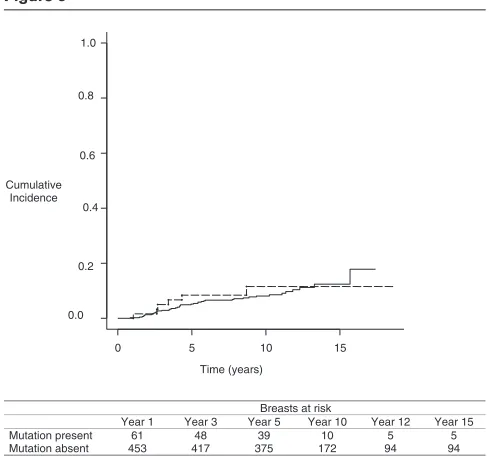
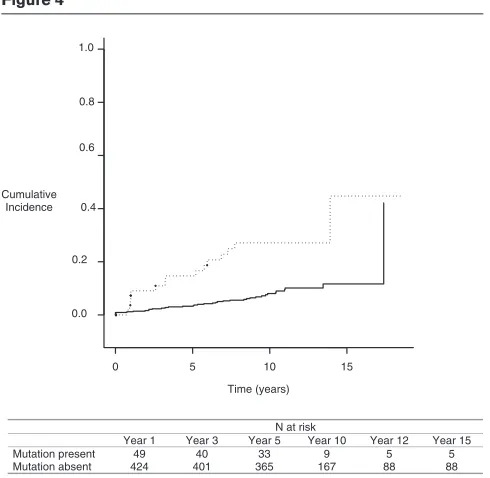
A total of 496 patients in the present study underwent BCT for 520 invasive breast cancers. There was no signifi-cant difference between women with and those without BRCA1/BRCA2 mutations in the risk for metachronous ipsilateral breast cancer at 10 years (12% in women with mutations versus 8% in women without; P= 0.68; Fig. 3). Age under 50 years at initial diagnosis was the only signifi-cant predictor of metachronous ipsilateral disease (P= 0.002). Women with mutations were significantly more likely to develop contralateral breast cancer at 10 years (27% in women with mutations versus 8% in women without; P< 0.0001, based on a competing cause analysis; Fig. 4). The risk for contralateral cancer was similar in women with BRCA1 mutations (27% at 10 years) and in those with the BRCA2mutation (32% at 10 years). In univariate analyses, which were adjusted for
death from competing causes, women not using tamoxifen experienced a higher incidence of ipsilateral breast cancer (HR 1.97, 95% CI 1.01–3.86; P= 0.05). Those not using tamoxifen also had a marginally, nonsignificantly higher incidence of contralateral breast cancer (HR 1.26, 95% CI 0.71–2.25; P= 0.48). Chemotherapy did not have a signif-icant effect on either ipsilateral (P= 0.16) or contralateral (P= 0.36) breast cancer incidence. In an analysis restricted to mutation carriers, the contralateral breast cancer risk was lower in BRCA1/BRCA2mutation carri-ers receiving tamoxifen than in those not receiving tamox-ifen, although this did not reach statistical significance (risk ratio 0.47, 95% CI 0.14–1.59; P= 0.23). The effect of tamoxifen on contralateral breast cancer risk was not significantly greater in women with a BRCA2 mutation than in women with BRCA1 mutations, although this analysis was limited by the small numbers of women in each group.
Discussion
Although BRCA1 and BRCA2 were identified in 1994 and 1995, the influence of germline BRCA1/BRCA2 mutations on the outcome of women with breast cancer has remained undefined. Several retrospective studies of affected mutation carriers identified by familial cancer risk clinics failed to demonstrate any differences in survival when women with mutations were compared with various control groups (for reviews [19,20]). However, because only women who survived their breast cancer were able to undergo genetic testing and be identified as mutation car- R13
Figure 3
Cumulative incidence of metachronous ipsilateral breast cancer in women with (– –) and in those without (––) germline BRCA mutations (P= 0.68).
Breasts at risk
Year 1 Year 3 Year 5 Year 10 Year 12 Year 15
Mutation present 61 48 39 10 5 5
Mutation absent 453 417 375 172 94 94
Time (years)
0 5 10 15
0.0 0.2
0.4 0.6 0.8 1.0
[image:6.612.313.559.94.324.2] [image:6.612.56.298.122.345.2]Cumulative Incidence Table 3
Final multivariate model of breast cancer specific survival
Deaths due
to breast Hazard ratio Variable n cancer (n) (95% CI) P BRCA1mutation
No mutation 397 52 1.00 0.01
BRCA1 37 14 2.39 (1.20–4.75)
Tumor size
< 2 cm 333 39 1.00 0.003
≥2 cm 101 27 2.19 (1.30–3.67) Axillary node
Negative 280 31 1.00 0.03
Positive 154 35 1.78 (1.07–2.96) Age (years)
< 50 146 34 1.00 0.02
≥50 288 32 0.55 (0.33–0.92)
riers in these prevalent series, a survival bias may have prevented the detection of a negative impact of BRCA1/BRCA2mutations on outcome. The anonymized design of the current retrospective study circumvented this potential bias by ensuring that all patients within the study group were genotyped, without regard for vital status.
In the present study, women undergoing BCT for early stage invasive breast cancer demonstrated significantly shorter breast cancer specific and overall survival if they carried a germline BRCA1 mutation but not a BRCA2 mutation. This suggests that the clinical outcome of women with germline mutations may vary depending on which gene is mutated, and even possibly on the position of the mutation within a particular gene. However, the present study, examining the consequences of an inten-tionally restricted set of mutations in a limited sample, cannot definitively resolve this question. Larger studies, preferably of prospectively ascertained incident cohorts, are necessary.
The adverse prognosis conferred by a BRCA1 mutation was not attributable to differences in tumor size or axillary nodal status, which indicates that the impact of germline status on clinical outcome is not the result of an associa-tion with advanced stage at diagnosis. Several studies have demonstrated that breast cancers arising in women with BRCA1/BRCA2 mutations, particularly those in
BRCA1, frequently manifest adverse pathologic and bio-logic features, such as high histobio-logic grade, hormone receptor negativity, p53 mutation, aneuploidy, and high S-phase fraction [19]. Studies conducted in sporadic breast cancer have previously demonstrated the negative prognostic significance of each of these factors. Whether the prognostic significance of BRCA1/BRCA2 status is completely independent of all of these other parameters cannot be resolved by the present study. BRCA1-related breast cancers in this series, as in others, were signifi-cantly more likely to be estrogen receptor negative than were cancers not associated with BRCA1mutations, and estrogen receptor status was associated with breast cancer mortality in univariate analysis. However, germline status remained a significant prognostic indicator in the multivariate model, indicating that the adverse effect of mutation status on outcome is independent of the associa-tion with estrogen receptor negative phenotype. The robustness of this observation is limited to some degree by the fact that receptor status was unknown for a signifi-cant proportion of patients, in part because some of these cases were diagnosed before routine receptor testing and in part because the small size of some tumors prevented receptor determination using the dextran-coated charcoal method in use at the time.
The design of the present study precluded a separate analysis of the role of grade in determining outcome in BRCA1carriers. However, it is known that the majority of BRCA1-related breast cancers are high grade, infiltrating ductal breast cancers [21]. It would not significantly change the conclusions of this study if it could be demon-strated that the independent negative impact observed is attributable to the ‘downstream’ phenotypic conse-quences of the presence of a BRCA1mutation.
[image:7.612.56.301.92.331.2]Some preclinical studies have demonstrated that mouse embryonic cells lacking functional Brca1 protein are sensi-tive to specific chemotherapeutic agents such as cisplat-inum and mitomycin C [22,23], and similar results have been seen in human breast cancer cells null for BRCA1 protein [24]. These observations have raised the possibil-ity that human BRCA1-associated breast cancers might also be differentially sensitive to chemotherapy. The current analysis is consistent with this hypothesis, because the negative prognostic influence of a germline BRCA1 mutation appeared to be reduced in women receiving adjuvant chemotherapy, and, in fact, lost inde-pendent statistical significance in this group. Furthermore, standard chemotherapy regimens do not include mito-mycin-C or cisplatinum, and it remains possible that BRCA1-associated breast cancers may be even more sensitive to these agents. However, the design of the present study is such that these observations must be considered hypothesis generating. Further exploration should take place within the context of prospective trials. R14
Figure 4
Cumulative incidence of metachronous contralateral breast cancer in women with (····) and in those without (––) germline BRCAmutations (P< 0.0001).
N at risk
Year 1 Year 3 Year 5 Year 10 Year 12 Year 15
Mutation present 49 40 33 9 5 5
Mutation absent 424 401 365 167 88 88
Time (years)
0 5 10 15
0.0 0.2 0.4 0.6 0.8 1.0
In the present study, women with germline mutations experienced a risk for metachronous ipsilateral breast cancer that was not significantly different from that in women without mutations. Several studies have described the incidence of subsequent ipsilateral disease in women with BRCA1/BRCA2 mutations undergoing BCT [7,8,15,25,26]. In these series, ipsilateral tumor recur-rence rates ranged from 1% to 20% at 5 years, which are in the range previously reported in series of young women undergoing BCT. A recent analysis of mutation carriers who had survived a mean of 14 years after their breast cancer diagnosis [27] indicated a 49% estimated risk for ipsilateral cancer after 10 years of follow up. However, studies such as this, which analyze prevalent groups of long-term survivors, may overestimate the risk that a newly diagnosed woman with a BRCA1/BRCA2 mutation will suffer an ipsilateral breast cancer, because a significant fraction of newly diagnosed women will unfortunately die from their breast cancer and thus will not have lived long enough to develop a second ipsilateral tumor. Thus, ipsi-lateral cancer estimates derived from such studies may be misleading for newly diagnosed women attempting to make the difficult choice between breast conservation and bilateral mastectomy.
Taken together, the results of the available series suggest, at least up to 10 years of follow up, that women with BRCA1/BRCA2germline mutations have a risk for ipsilat-eral recurrence that is similar to that of other young women. Studies based on series of prevalent cases [8,26,27] suggest, however, that women who are long-term survivors may have an increased risk of new second primary malignancies within the treated breast. This inter-pretation is supported by a further analysis of cases reported by Haffty and colleagues [28], in which all eight patients with deleterious BRCA1/BRCA2mutations had new primary ipsilateral breast cancer, whereas patients without deleterious mutations had both true recurrences and new primary breast cancers (P= 0.06). The cancers occurring in BRCA1/BRCA2carriers occurred at a mean time interval of 9.6 years following the initial diagnosis.
Women with BRCA1/BRCA2mutations are at substantial increased risk for metachronous contralateral breast cancer throughout the follow-up period. Although this increased contralateral risk could reflect an increased sen-sitivity to radiation-induced malignancies initiated by scatter from adjuvant radiotherapy, the contralateral inci-dence rate is similar to that observed in affected mutation carriers after mastectomy [29] and in prospectively fol-lowed cohorts of heterozygotes [30,31], which suggests that the observed contralateral breast cancers are most likely the direct result of the underlying genetic predisposi-tion. The apparent paradox of differential ipsilateral and contralateral risk, as well as differences in estimates of ipsilateral risk according to duration of follow up, may be
explained by a model that proposes that women present-ing with BRCA1/BRCA2-associated breast cancer have multiple foci within both breasts at various stages of evolu-tion toward malignancy. These foci may be eliminated or substantially retarded by adjuvant radiotherapy of the ini-tially affected breast, preventing or delaying their appear-ance as metachronous ipsilateral cappear-ancers. In the untreated contralateral breast, however, occult lesions existing at the time of initial diagnosis could proceed unimpeded in their progression to malignancy, resulting in an unaltered risk for contralateral cancer. Extending the hypothesis, the continued presence of the genetic predisposition may permit the process of carcinogenesis in the affected breast to begin anew once the radiation treatment was completed, and, after a delay, metachronous breast cancers would begin to appear in the treated and untreated breasts at similar rates. This hypothetical model could be tested by careful pathologic examination of breasts of women with BRCA1/BRCA2mutations under-going either therapeutic or prophylactic mastectomy to assess the prevalence of occult premalignant and malig-nant lesions. The results of early reports are conflicting, but there is some evidence for an excess of premalignant changes, particularly for BRCA2 mutation carriers [32–34].
Nonsurgical options for breast cancer risk reduction in women with BRCA1/BRCA2 mutations are limited. A pre-vious case–control study [35] suggested that tamoxifen reduced the risk for contralateral cancer by nearly 50% in mutation carriers, but this benefit was not observed in a prospective trial of primary prevention among unaffected women with BRCA1mutations [36]. In the present study, a trend toward a reduction in contralateral breast cancer was seen in mutation carriers who received the drug, although this did not achieve statistical significance. Because the number of women with mutations who received tamoxifen was small, the present series cannot satisfactorily address whether the benefit of tamoxifen in reducing contralateral risk varies between women with BRCA1and those with BRCA2mutations. It is of interest that the degree of contralateral risk reduction experienced by the mutation carriers taking tamoxifen in the study was similar to that reported in the previous case–control study, and there was no clear difference between the effects observed in BRCA1 and BRCA2 mutation carriers, but further studies of larger numbers of women are needed before these data can be used to guide clinical practice.
terious alteration. However, the number of such cases is likely to be small. In a recent report of 322 Ashkenazi indi-viduals who underwent full sequence analysis of BRCA1 and BRCA2after negative founder mutation testing, only six (1.9%) were found to carry a unique mutation [37]. Because women undergoing complete sequencing were probably encouraged to do so because of a family history of breast or ovarian cancer, the prevalence of unique mutations is likely to be even lower in an unselected popu-lation of breast cancer patients such as those reported in the present study. Thus, false-negative classification is unlikely to have significantly affected the results of this study. Nonetheless, the results of the study may not be applicable to all women with BRCA1/BRCA2mutations. The majority of mutation carriers in the study carried either BRCA1 185delAG (32 out of 42 [76%] of all BRCA1 mutation carriers) or BRCA26174delT. It is possible that other mutant alleles may confer different risks for recur-rence.
Conclusion
This combined study demonstrates that women with spe-cific BRCA1/BRCA2 mutations who develop breast cancer are at increased risk for death from their disease, particularly if the mutation is in BRCA1. For up to 10 years after diagnosis, the risk for metachronous ipsilateral cancer is similar to that in women without mutations, but the risk for contralateral disease is substantially higher. Taken together, these findings suggest that the possibility of BRCA1/BRCA2-associated breast cancer should be taken into account with other factors when making deci-sions regarding radiotherapy and adjuvant chemotherapy, but should not be used as a sole factor to determine the appropriateness of BCT. Adjuvant tamoxifen should be given when appropriate to BRCA1/BRCA2 mutation car-riers with hormone receptor positive breast cancer, but despite promising data, the true effectiveness of this agent in reducing contralateral breast cancer risk in this group of women remains uncertain.
Competing interests
None declaredAcknowledgements
This work was supported by US Army Medical Research and Materiel Command DAMD17-98-1-8112, Canadian Genetic Diseases Network and Susan G Komen Foundation (WDF), US Army Medical Research and Materiel Command DAMD 17-01-1-0325 and American Cancer Society PRTA-38 (MR), Fonds de perfectionnement des Hôpitaux Uni-versitaires de Genève, Geneva, Switzerland (POC), and Danziger Foundation and Breast Cancer Research Foundation (KO). WDF is a Senior Clinicien Chercheur Boursier of the Fonds de la Recherche en Santé du Québec. We wish to thank Nancy Hamel and Jean-Sébastien Brunet for technical and statistical assistance.
References
1. Miki Y, Swensen J, Shattuck-Eidens D, Futreal PA, Harshman K, Tavtigian S, Liu Q, Cochran C, Bennett LM, Ding W, Bell R, Rosenthal J, Hussey C, Tran T, McClure M, Frye C, Hattier T, Phelps R, Haugen-Strano A, Katcher H, Yakumo K, Gholami Z,
Shaffer D, Stone S, Bayer S, Wray C, Bogden R, Dayananth P, Ward J, Tonin P, Narod S, Bristow PK, Norris FH, Helvering L, Morrison P, Rostock P, Lai M, Barrett JC, Lewis C, Neuhausen S, Cannon-Albright L, Goldgar D, Wiseman R, Kamb A, Skolnick MH: A strong candidate for the breast and ovarian cancer sus-ceptibility gene BRCA1.Science1994, 266:66-71.
2. Wooster R, Bignell G, Lancaster J, Swift S, Seal S, Mangion J, Collins N, Gregory S, Gumbs C, Micklem G, Barfoot R, Hamoudi R, Patel S, Rice C, Biggs P, Hashim Y, Smith A, Connor F, Arason A, Gudmundsson J, Ficenec D, Kelsell D, Ford D, Tonin P, Bishop DT, Spurr NK, Ponder BAJ, Eeles R, Peto J, Devilee P, Cornelisse C,Lynch H, Narod S, Lenoir G, Egilsson V, Bjork Barkadottir R, Easton DF, Bentley DR, Futreal PA, Ashworth A, Stratton MR: Identification of the breast cancer susceptibility gene BRCA2. Nature1995, 378:789-792.
3. Foulkes WD, Wong N, Brunet JS, Bégin LR, Zhang JC, Martinez JJ, Rozen F, Tonin PN, Narod SA, Karp SE, Pollak MN:Germ-line BRCA1 mutation is an adverse prognostic factor in Ashkenazi Jewish women with breast cancer.Clin Cancer Res1997, 3: 2465-2469.
4. Stoppa-Lyonnet D, Ansquer Y, Dreyfus H, Gautier C, Gauthier-Villars M, Bourstyn E, Clough KB, Magdelenat H, Pouillart P, Vincent-Salomon A, Fourquet A, for the Institute Curie Breast Cancer Group, Asselain B: Familial invasive breast cancer: worse outcome related to BRCA1 mutations. J Clin Oncol 2000, 18:4053-4059.
5. Hamann U, Sinn HP: Survival and tumor characteristics of German hereditary breast cancer patients.Breast Cancer Res Treat2000, 59(2):185-192.
6. Møller P, Borg A, Evans DG, Haites N, Reis MM, Vasen H, Ander-son E, Steel CM, Apold J, Goudie D, Howell A, Lalloo F, Maehle L, Gregory H, Heimdal K: Survival in prospectively ascertained familial breast cancer: analysis of a series stratified by tumour characteristics, BRCA mutations and oophorectomy. Int J Cancer2002, 101:555-559.
7. Verhoog LC, Brekelmans CT, Seynaeve C, van den Bosch LM, Dahmen G, van Geel AN, Tilanus-Linthorst MM, Bartels CC, Wagner A, van den Ouweland A, Devilee P, Meijers-Heijboer EJ, Klijn JG: Survival and tumor characteristics of breast-cancer patients with germline mutations of BRCA1.Lancet1998, 351:316-321. 8. Pierce LJ, Strawderman M, Narod SA, Oliviotto I, Eisen A, Dawson
L, Gaffney D, Solin LJ, Nixon A, Garber J, Berg C, Isaacs C, Heimann R, Olopade OI, Haffty B, Weber BL: Effect of radio-therapy after breast-conserving treatment in women with breast cancer and germline BRCA1/2 mutations.J Clin Oncol 2000, 18:3360-3369.
9. Verhoog LC, Brekelmans CT, Seynaeve C, Dahmen G, van Geel AN, Bartels CC, Tilanus-Linthorst MM, Wagner A, Devilee P, Halley DJ, van den Ouweland AM, Meijers-Heijboer EJ, Klijn JG: Survival in hereditary breast cancer associated with germline mutations of BRCA2.J Clin Oncol1999, 17:3396-3402. 10. Loman N, Johannsson O, Bendahl PO, Dahl N, Einbeigi Z, Gerdes
A-M, Borg A, Olsson H: Prognosis and clinical presentation of BRCA2-associated breast cancer. Eur J Cancer 2000, 36: 1365-1373.
11. Struewing JP, Abeliovich D, Peretz T, Avishai N, Kaback MM, Collins FS, Brody LC: The carrier frequency of the BRCA1 185delAG mutation is approximately 1 percent in Ashkenazi Jewish individuals.Nature Genet1995, 11:198-200.
12. Oddoux C, Struewing JP, Clayton CM, Neuhausen S, Brody LC, Kaback M, Haas B, Norton L, Borgen P, Jhanwar S, Goldgar D, Ostrer H, Offit K:The carrier frequency of the BRCA2 6174delT mutation among Ashkenazi Jewish individuals is approxi-mately 1-percent.Nat Genet1996, 14:188-190.
13. Roa BB, Boyd AA, Volcik K, Richards CS:Ashkenazi Jewish population frequencies for common mutations in BRCA1and BRCA2.Nat Genet1996, 14:185-187.
14. Kauff ND, Perez-Segura P, Robson ME, Scheuer L, Siegel B, Schluger A, Rapaport B, Frank TS, Nafa K, Ellis NA, Parmigiani G, Offit K: Incidence of non-founder BRCA1 and BRCA2 muta-tions in high risk Ashkenazi breast and ovarian cancer fami-lies.J Med Genet2002, 39:611-614.
15. Robson M, Levin D, Federici M, Satagopan J, Bogolminy F, Heerdt A, Borgen P, McCormick B, Hudis C, Norton L, Boyd J, Offit K. Breast conservation therapy for invasive breast cancer in Ashkenazi women with BRCA gene founder mutations.J Natl Cancer Inst1999, 91:2112-2117.
R17 16. Goffin JR, Chappuis PO, Bégin LR, Wong N, Brunet JS, Hamel N,
Paradis AJ, Boyd J, Foulkes WD:Impact of germline BRCA1 mutations and overexpression of p53 on prognosis and response to treatment following breast carcinoma: 10-year follow up data.Cancer2003, 97:527-536.
17. Gray RJ:A class of K-sample tests for comparing the cumula-tive incidence of a competing risk.Ann Stat1988, 16: 1141-1154.
18. Fine JP, Gray RJ:A proportional hazards model for the subdis-tribution of a competing risk.J Am Stat Assoc1999, 94: 496-509.
19. Robson ME, Boyd J, Borgen PI, Cody HS III:Hereditary breast cancer.Curr Probl Surg2001, 38:387-480.
20. Foulkes WD, Rosenblatt J, Chappuis PO: The contribution of inherited factors to the clinicopathological features and behavior of breast cancer.J Mammary Gland Biol Neoplasia 2001, 6:453-465.
21. Lakhani SR, Jacquemier J, Sloane JP, Gusterson BA, Anderson TJ, van de Vijver MJ, Farid LM, Venter D, Antoniou A, Storfer-Isser A, Smyth E, Steel CM, Haites N, Scott RJ, Goldgar D, Neuhausen S, Daly PA, Ormiston W, McManus R, Scherneck S, Ponder BAJ, Ford D, Peto J, Stoppa-Lyonnet D, Bignon YJ, Struewing JP, Spurr NK, Bishop DT, Klijn JGM, Devilee P, Cornelisse CJ, Lasset C, Lenoir G, Barkardottir RB, Egilsson V, Hamann U, Chang-Claude J, Sobol H, Weber B, Stratton MR, Easton DF: Multifactorial analysis of differences between sporadic breast cancers and cancers involving BRCA1 and BRCA2 mutations.J Natl Cancer Inst1998, 90:1138-1145.
22. Bhattacharyya A, Ear US, Koller BH, Weichselbaum RR, Bishop DK:The breast cancer susceptibility gene BRCA1 is required for subnuclear assembly of Rad51 and survival following treatment with the DNA cross-linking agent cisplatin.J Biol Chem2000, 275:23899-23903.
23. Moynahan ME, Cui TY, Jasin M:Homology-directed dna repair, mitomycin-c resistance, and chromosome stability is restored with correction of a Brca1 mutation. Cancer Res 2001, 61: 4842-4850.
24. Tassone P, Tagliaferri P, Perricelli A, Blotta S, Quaresima B, Martelli ML, Goel A, Barbieri V, Costanzo F, Boland CR, Venuta S: BRCA1 expression modulates chemosensitivity of BRCA1-defective HCC1937 human breast cancer cells.Br J Cancer 2003, 88:1285-1291.
25. Chappuis PO, Kaputa L, Bégin LR, Wong N, Brunet JS, Narod SA, Slingerland J, Foulkes WD.Germ-line BRCA1/2 mutations and p27(Kip1) protein levels independently predict outcome after breast cancer.J Clin Oncol2000, 18:4045-4052. 26. Turner BC, Harrold E, Matloff E, Smith T, Gumbs AA, Beinfield M,
Ward B, Skolnick M, Glazer PM, Thomas A, Haffty BG: BRCA1/BRCA2 germline mutations in locally recurrent breast cancer patients after lumpectomy and radiation therapy: Implications for breast-conserving management in patients with BRCA1/BRCA2 mutations.J Clin Oncol1999, 17: 3017-3024.
27. Haffty BG, Harrold E, Khan AJ, Pathare P, Smith TE, Turner BC, Glazer PM, Ward B, Carter D, Matloff E, Bale AE, Alvarez-Franco M: Outcome of conservatively managed early-onset breast cancer by BRCA1/2 status.Lancet2002, 359:1471-1477. 28. Smith TE, Lee D, Turner BC, Carter D, Haffty BG: True
recur-rence vs. new primary ipsilateral breast tumor relapse: an analysis of clinical and pathologic differences and their impli-cations in natural history, prognoses, and therapeutic man-agement.Int J Radiat Oncol Biol Phys2000, 48:1281-1289. 29. Easton DF, Ford D, Bishop DT:Breast and ovarian cancer
inci-dence in BRCA1-mutation carriers. Breast Cancer Linkage Consortium.Am J Hum Genet1995, 56:265-271.
30. Brekelmans CT, Seynaeve C, Bartels CC, Tilanus-Linthorst MM, Meijers-Heijboer EJ, Crepin CM, van Geel AA, Menke M, Verhoog LC, van den OA, Obdeijn IM, Klijn JG:Effectiveness of breast cancer surveillance in BRCA1/2 gene mutation carriers and women with high familial risk.J Clin Oncol2001, 19:924-930. 31. Scheuer L, Kauff N, Robson M, Kelly B, Barakat R, Satagopan J,
Ellis N, Hensley M, Boyd J, Borgen P, Norton L, Offit K:Outcome of preventive surgery and screening for breast and ovarian cancer in BRCA mutation carriers.J Clin Oncol2002, 20: 1260-1268.
32. Hoogerbrugge N, Bult P, Widt-Levert LM, Beex LV, Kiemeney LA, Ligtenberg MJ, Massuger LF, Boetes C, Manders P, Brunner HG:
High prevalence of premalignant lesions in prophylactically removed breasts from women at hereditary risk for breast cancer.J Clin Oncol2003, 21:41-45.
33. Adem C, Reynolds C, Soderberg CL, Slezak JM, McDonnell SK, Sebo TJ, Schaid DJ, Myers JL, Sellers TA, Hartmann LC, Jenkins RB. Pathologic characteristics of breast parenchyma in patients with hereditary breast carcinoma, including BRCA1 and BRCA2 mutation carriers.Cancer2003, 97:1-11.
34. Kauff ND, Brogi E, Scheuer L, Pathak DR, Borgen PI, Hudis CA, Offit K, Robson ME:Epithelial lesions in prophylactic mastec-tomy specimens from women with BRCA mutations.Cancer 2003, 97:1601-1608.
35. Narod SA, Brunet JS, Ghadirian P, Robson M, Heimdal K, Neuhausen SL, Stoppa-Lyonnet D, Lerman C, Pasini B, de los Rios P, Weber B, Lynch H:Tamoxifen and risk of contralateral breast cancer in BRCA1 and BRCA2 mutation carriers: a case–control study. Hereditary Breast Cancer Clinical Study Group.Lancet2000, 356:1876-1881.
36. King MC, Wieand S, Hale K, Lee M, Walsh T, Owens K, Tait J, Ford L, Dunn BK, Costantino J, Wickerham L, Wolmark N, Fisher B: Tamoxifen and breast cancer incidence among women with inherited mutations in BRCA1 and BRCA2: National Sur-gical Adjuvant Breast and Bowel Project (NSABP-P1) Breast Cancer Prevention Trial.JAMA2001, 286:2251-2256. 37. Frank TS, Deffenbaugh AM, Reid JE, Hulick M, Ward BE,
Lingen-felter B, Gumpper KL, Scholl T, Tavtigian SV, Pruss DR, Critch-field GC:Clinical characteristics of individuals with germline mutations in BRCA1 and BRCA2: analysis of 10,000 individu-als.J Clin Oncol2002, 20:1480-1490.