R E S E A R C H A R T I C L E
Open Access
A speedup technique for (
l, d
)-motif finding
algorithms
Sanguthevar Rajasekaran
*, Hieu Dinh
Abstract
Background:The discovery of patterns in DNA, RNA, and protein sequences has led to the solution of many vital biological problems. For instance, the identification of patterns in nucleic acid sequences has resulted in the determination of open reading frames, identification of promoter elements of genes, identification of intron/exon splicing sites, identification of SH RNAs, location of RNA degradation signals, identification of alternative splicing sites, etc. In protein sequences, patterns have proven to be extremely helpful in domain identification, location of protease cleavage sites, identification of signal peptides, protein interactions, determination of protein degradation elements, identification of protein trafficking elements, etc. Motifs are important patterns that are helpful in finding transcriptional regulatory elements, transcription factor binding sites, functional genomics, drug design, etc. As a result, numerous papers have been written to solve the motif search problem.
Results:Three versions of the motif search problem have been proposed in the literature:Simple Motif Search
(SMS), (l, d)-motif search (or Planted Motif Search (PMS)), andEdit-distance-based Motif Search (EMS). In this paper we focus on PMS. Two kinds of algorithms can be found in the literature for solving the PMS problem:exactand
approximate. An exact algorithm identifies the motifs always and an approximate algorithm may fail to identify some or all of the motifs. The exact version of PMS problem has been shown to be NP-hard. Exact algorithms proposed in the literature for PMS take time that is exponential in some of the underlying parameters. In this paper we propose a generic technique that can be used to speedup PMS algorithms.
Conclusions:We present a speedup technique that can be used on any PMS algorithm. We have tested our speedup technique on a number of algorithms. These experimental results show that our speedup technique is indeed very effective. The implementation of algorithms is freely available on the web at http://www.engr.uconn. edu/rajasek/PMS4.zip.
Background
Pattern search in biological sequences has numerous applications and hence a large amount of research has been done to identify patterns. Motifs are fundamental functional elements in proteins vital for understanding gene function, human disease, and may serve as thera-peutic drug targets. Three versions of the motif search problem have been identified by researchers: Simple Motif Search (SMS),Planted Motif Search (PMS) -also known as(l, d)-motif search, and Edit-distance-based Motif Search (EMS)(see e.g., [1]).
PMS problem takes as input nsequences of lengthm each and two integersl andd. The problem is to iden-tify a stringMof length lsuch thatMoccurs in each of
the nsequences with a Hamming distance of at mostd. For example, if the input sequences are GCGCGAT,
CACGTGA, and CGGTGCC; l = 3 and d = 1, then
GGT is a motif of interest.
EMS is the same as PMS, except that edit distance is used instead of the Hamming distance. SMS takes as inputn sequences and an integerl. The problem is to identify all the patterns of length l(with up to l/2 wild card characters), together with a count of how many times each pattern occurs.
Two kinds of algorithms can be found in the literature for the solution of PMS. The first kind of algorithms identify all the motifs always. This kind of algorithms are calledexact algorithms. The second kind of algo-rithms may not always identify the motif(s). Numerous algorithms of each kind can be found in the literature.
* Correspondence: [email protected]
Department of CSE, University of Connecticut, Storrs, CT 06269, USA
The exact version of the PMS problem is known to be NP-complete.
Some example approximate algorithms are due to [2-5], and [6]. These algorithms employ local search techniques such as Gibbs sampling, expectation optimi-zation, etc. The WINNOWER algorithm in [5] is based on finding cliques in a graph. The PROJECTION algo-rithm of [3] employs random projections. Approximate algorithms tend to be very fast but there is no guarantee that we will get all the motifs of interest. Other exam-ples of approximate algorithms include: MULTIPROFI-LER [7], PatternBranching [8], CONSENSUS [9], GibbsDNA [4], MEME [2], and ProfileBranching [8].
Several exact algorithms are also known for solving the PMS problem: [10-16], and [17]. PMS algorithms are typically tested on random benchmark data gener-ated as follows: Twenty sequences each of length 600 are generated randomly from the alphabet of interest. The motifM is also generated randomly and planted in each of the input sequences within a Hamming distance of d. The motif instances are also generated randomly. Certain instances of the (l, d)-motif problem have been identified to bechallenging. An instance is challenging if the expected number of (l,d)-motifs that occur by ran-dom chance (in addition to the planted one) is one or more. For example, the following instances are challen-ging: (9, 2), (11, 3), (13, 4), (15, 5), (17, 6), (19, 7), etc. The performance of PMS algorithms are customarily shown only for challenging instances.
The exact algorithm MITRA of [8] can solve the chal-lenging instance (15, 4). It cannot solve (15, 5) or any larger instances. On these instances it takes either too much time or too much space. Three exact algorithms PMS1, PMS2, and PMS3 have been given in [18]. These algorithms are faster than MITRA. Other exact algo-rithms are: Voting of [19], RISOTTO of [20], and PMSprune of [21].
In this paper we present a speedup technique that can be used for any PMS algorithm. Before presenting details of our technique, we provide a brief summary of the following algorithms: PMS1, Voting, RISOTTO, and PMSprune. We have employed these algorithms to demonstrate the efficacy of our technique.
Methods
A Summary of Known Algorithms PMS0 and PMS1
PMS0 and PMS1 are two exact algorithms given in [18]. PMS0 works as follows. Let S1, S2, ..., Sn be the given input sequences and let mbe the length of each input sequence. For any two l-mers u and v let H.D.(u,v) stand for the Hamming distance betweenu andv. Letu be any l-mer. We define the d-neighborhood of u (denoted as Du) as the set of l-mers that are at a
distance of ≤ dfrom u. In other words, Du is nothing but {v:H.D.(u, v)≤d}. LetCbe the collection ofl-mers in S1. Note that C has (m - l + 1) l-mers. Let C’ =
∪uÎCDu. Note that |C|=O
(m−l+ 1)
l d
3d
. For each
elementvofC’ check if it is a valid (l, d)-motif or not. Given an l-mer v, we can check if it is a valid (l, d )-motif or not in O(mnl) time. Thus the run time of
PMS0 is O(m2nl
l d
3d).
PMS1 is an exact algorithm that works as follows. For each input sequenceSi(1 ≤i ≤ n) it generates a list of d-neighbors. In particular, for each l-meru inSi, it gen-erates Du. It merges all suchDu’s and eliminates dupli-cates to get Li. The output (l,d)-motifs will be ∩ni=1Li.
More details follow. AlgorithmPMS1
1. Generate all possiblel-mers from out of each of then input sequences. LetCi be the collection ofl -mers from out ofSifor 1≤i≤n.
2. For all 1≤i≤ndo: Ci=∪u∈CiDu; |Ci|=Om(l
d)||d
.
3. Sort all thel-mers in every Ci, 1≤i≤n, in lexico-graphic order, and eliminate duplicates in every Ci. An integer sorting algorithm can be used (see e.g., [22]). LetLibe the resultant sorted list correspond-ing to Ci.
4. Merge all theLi’s (1≤ i≤n) and output the gen-erated (in step 2)l-mers that occur in all theLi’s.
The following theorem results.
Theorem 0.1 PMS1 runs in time
O
mn
l d
||dl
w
where w is the word length of the
computer.
Voting
The Voting algorithm proposed in [19] is very similar to PMS1. In this algorithm also, the potential motifs con-sidered are the d-neighbors of each l-mer in the input sequences. In particular, they employ a hash table Vof d-neighbors. Each suchd-neighbor collects votes. Letv be ad-neighbor of somel-mer in the input. Then,vwill receive a vote from the input sequencei (for 1≤i ≤n) ifvis ad-neighbor of somel-mer in the input sequence Si. They ensure that v will not get multiple votes from any sequence using another hash tableR.
the algorithm outputs all thosed-neighbors that receive a vote ofn.
Clearly, the asymptotic run time of this algorithm is
O
mn
l d
||d
assuming that l is a constant. Ifl is
not of constant size, there could be a linear dependence onlas well in the run time.
RISOTTO
An exact algorithm for PMS has been given by [23] that has a run time of O(n2mld|Σ|d). This algorithm uses O (n2m/w) space wherewis the word length of the com-puter. This algorithm constructs a suffix tree on the input sequences in O(nm) time using O(nm) space. Some preprocessing is done on the suffix tree that takes O(n2m/w) time andO(n2m/w) space. Ifuis anyl-mer in any input sequence, then uhasO(ld(|Σ| - 1)d) possible d-neighbors. Any of these neighbors could potentially be a motif of interest. Since there are O(nm)l-mers in the input, the number of such neighbors isO(nmld(|Σ| - 1) d
. For each such neighborvthe algorithm of [23] walks through the suffix tree to check ifvis a valid motif (i.e., it has ad-neighbor in each input sequence). This walk-ing step is referred to as ‘spelling’. The spelling opera-tion takes a total of O(n2mld(|Σ| - 1)d) time using an additionalO(nm) space.
An improved version of the above algorithm, called RISOTTO, has been given by [20]. The algorithm of [23] makes use of a trie called the motif tree. The root of this tree corresponds to the empty string. The algo-rithm grows this string one symbol at a time and for each such string checks if it is a valid motif (i.e., the string is of the right length and it occurs in every sequence within a Hamming distance of d). A key observation that [20] make use of in their algorithm is the following. Let q be a string that occurs in all the input sequences (up to a Hamming distance of d). Let itsmaximum extensibilitybeMaxExt(q).
MaxExt(q) refers to the maximum number of symbols that can be appended to q so that the resultant string will occur in all the input sequences (within a Hamming distance ofd). Ifq’is another string such thatq is a suf-fix ofq’, thenMaxExt(q’) cannot be more than MaxExt (q). As a result, if MaxExt(q’) + |q’| <l, then we don’t have to consider augmentingq’further. In other words, we can prune the subtree rooted atq’in the motif tree [20]. show that the average performance of RISOTTO is better than that of [23].
PMSprune
PMSprune follows the same strategy as PMS0: for every l-mer y inS1 it generates the set of neighbors ofz and
for each one of them checks whether this is a valid (l, d)-motif or not. However it improves the performance of PMS0 in a significant way. Salient features of this
algorithm are:
1. It generates the neighborhood of everyl-meruin a branch and bound manner. In this method, these l-mers will correspond to nodes in a tree of height at most d. The root (which is at level zero) of this tree will beu. At leveliof this tree they generatel -mers that are at a distance of ifromu (for 1≤ i ≤ d).
2. Let S = {S1, S2, ..., Sn} be the input set of sequences. Ifxis any l-mer, the distance between x and any input sequenceSiis denoted asd(x, Si) and is defined as min {H.D.(x, y)|yis anl- mer inSi}. The distance betweenxandS is denoted as d¯(x,S)
and is defined asmaxn
i=1d(x,Si).
Letu be any l-mer in S1 and letx be any l-mer in
thed-neighborhood ofu(i.e.,Du). PMSprune checks if x is a valid (l, d)-motif or not by computing
¯
d(x,S). If d¯(x,S) ≤d thenxis output - it is a valid motif. More importantly, ifxis at levelhin the tree, PMSprune uses the value ofd(x, S) and hto prune the descendants ofx. In particular, if d¯(x,S) >(2d -h), then the subtree rooted at xis pruned - none of the l-mers in this subtree could be a valid (l, d )-motif.
3. It dynamically prunes thel-mers inSifor i= 2, ..., nthat are considered for the calculation of d¯(·,S). 4. It calculates the value of d¯(·,S)in an incremental way taking into account the way the neighborhood is generated.
The worst case run time of PMSprune is
O
nm2
l d
3d
and it uses O(nm2) space. Even though
its worst case run time is worse than that of PMS0, PMSprune has a better expected run time and it does better in practice [21].
Our Speedup Technique Summary
We refer to our speedup technique as PMS4 and it can be used in conjunction with any PMS algorithm. The idea of PMS4 is also based on PMS0. We can think of PMS0 as consisting of two stages. In the first stage, we generate all thel-mers of S1 and for each suchl-mer
generate its d-neighborhood. All of thesed -neighbor-hoods are then merged to get the list L1 of l-mers. In
the second stage, for each l-mer vinL1, check ifvis a
valid (l, d)-motif or not.
motif we check if it is a valid motif or not. For each candidate motif it takes O(mnl) time to check if it is a valid motif or not. This is rather a large amount of time. PMS0 does not perform well since there are a large number of candidate motifs and for each candidate motif it takes a long time to check its validity. We can speedup its performance if we can reduce the number of candidate motifs (and/or if we can speedup the valid-ity checking for each candidate motif).
PMS4 reduces the number of candidate motifs by first running the PMS algorithm on a small number of input sequences. It then verifies the validity of each candidate. Let A be the PMS algorithm under concern. A pseudo-code for PMS4 follows.
AlgorithmPMS4
1. Run the algorithm A on k input sequences (where k<n). An optimal value of kcan be deter-mined empirically. We could pick the ksequences in a number of ways. For example, they could be the first ksequences, random ksequences, and so on. Let C be the collection of (l, d)-motifs found in these ksequences.
2.foreachl-mervin Cdo
Check if vis a valid motif in O(mnl) time. If so, out-put v.
A probabilistic analysis
The problem of planted motif search is complicated by the fact that, for a given value of l, if the value of dis large enough, then the expected number of motifs that occur by random chance could be enormous. For instance, when n = 20, m = 600, l = 9, d = 2, the expected number of spurious motifs (that occur in each input sequence at a hamming distance ofd) is 1.6. On the other hand for n= 20,m = 600,l = 10,d = 2, the expected number of spurious motifs is only 6.1 × 10⁻⁸. A probabilistic analysis to this effect can be conducted as follows (as shown in [3]).
Let Sk be any input sequence 1≤ k≤ n and let ube anyl-mer. Probability that uoccurs inSkat a Hamming distance of d starting from a specific position is
p=
l d
3 4
d
1 4
l−d
Thus, probability thatu occurs
inSkstarting from at least one of the positions inSkis 1 - (1 - p)m-l+1. Here it is assumed that the occurrence of u is independent of the starting position (which is clearly not true). Buhler and Tompa argue that this assumption nearly holds in practice [3]. This means that the expected number ofl-mers that occur in each of the input sequences (at a hamming distance of d) is 4l [1 -(1 -p)m-l+1]n.
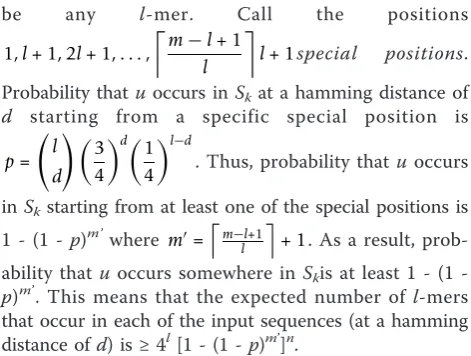
A slightly different valid analysis has been presented in [24]. Let Sk be any input sequence 1≤ k≤ nand let u
be any l-mer. Call the positions
1,l+ 1, 2l+ 1,. . ., m−l+ 1
l
l+ 1special positions.
Probability that uoccurs inSkat a hamming distance of
d starting from a specific special position is
p=
l d
3 4
d
1 4
l−d
. Thus, probability thatuoccurs
inSkstarting from at least one of the special positions is
1 - (1 - p)m’where m=m−ll+1+ 1. As a result,
[image:4.595.304.540.86.264.2]prob-ability that uoccurs somewhere in Skis at least 1 (1 -p)m’. This means that the expected number of l-mers that occur in each of the input sequences (at a hamming distance ofd) is≥4l[1 - (1 -p)m’]n.
Table 1 shows the expected number of motifs for dif-ferent values ofl, d, andk. In this table E.N.M. stands for the expected number of motifs. E.N.M. values in this table have been computed using the first (inaccurate) analysis.
The run times of many of the known PMS algorithms are linearly dependent on the number of input sequences. Examples include PMS0, PMS1, RISOTTO, Voting, and PMSprune. Any reduction in the number of input sequences will result in a corresponding reduction in the run time. If the number of resultant motifs is small then the overall run time will be reduced. We have to strike a balance between the time it takes for the first stage and the second stage. A good starting point for the value of kis ⌈n/2⌉. We could then work around this value to optimize the time.
Results and Discussion
[image:4.595.304.539.571.731.2]We have tested the performance of PMS1, PMSprune, and RISOTTO for various values of (l,d), and k. The improvements in performance are shown next. We have not included Voting in this comparison since the Voting
Table 1 Expected number of motifs for various values of
l,d, andk
E.N.M. stands for the expected number of motifs
l d k E.N.M. l d k E.N.M. l d k E.N.M.
9 2 8 1,383 11 3 8 9,297 13 4 8 42,337
9 2 9 718 11 3 9 4,331 13 4 9 16,855
9 2 10 373 11 3 10 2,018 13 4 10 6,710
9 2 11 194 11 3 11 940 13 4 11 2,672
9 2 12 101 11 3 12 438 13 4 12 1,064
15 5 8 145,959 17 6 8 407,602 19 7 8 968,241
15 5 9 47,962 17 6 9 107,681 19 7 9 201,530
15 5 10 15,761 17 6 10 28,448 19 7 10 41,947
15 5 11 5,179 17 6 11 7,516 19 7 11 8,731
program takes a very long time when we decrease the number of sequences. When we decrease the number of sequences the number of motifs increases. The Voting program sorts these motifs and outputs them. We sus-pect that the sorting program used could be the reason for the long run times. However, since the asymptotic run time of Voting is linear in the number of sequences, PMS4 is expected to result in a speedup of Voting simi-lar to that in PMS1 and RISOTTO. All the times reported in this section are averages over 10 random instances (fixing the values of k, l, andd). Each instance is a benchmark set of 20 random sequences of length 600 as mentioned in the Background Section
The case of (9, 2)
Results for the case of l = 9 and d = 2 are shown in Table 2. In this table, we display the time taken by each algorithm fork= 20 (denoted asT20) in column 2. Note
that these algorithms, by default, work with 20 sequences. The best times found using PMS4 (denoted as Tb) are shown in column 3. The ratioT20/Tb(called the speedup) is shown in column 4. It is clear from this table that each of these algorithms benefits from PMS4. In particular, RISOTTO benefits the most with a speedup of close to 2. Figure 1 shows the performance of these algorithms for various values ofkstarting from 5.
The case of (11, 3)
Results for the case of l= 11 and d = 3 are shown in Table 3. For this case also RISOTTO benefits the most with a speedup of more than 2. The speedup for PMSprune has decreased and that for PMS1 has also decreased but not by the same amount as PMSprune. Figure 2 shows the performance of these three algo-rithms for different values ofk.
The case of (13, 4)
Table 4 summarizes the performance of PMS1, PMSprune and RISOTTO. The speedup for RISOTTO has increased. In general, the performance of RISOTTO increases with an increasing value ofl. The performance of PMS1 also increases with an increasing value of l. However, the performance of PMSprune seems to be stable. Figure 3 displays the performance of all the three algorithms.
The case of (15, 5)
In Table 5 and Figure 4, we show the results for PMS1 and PMSprune. RISOTTO takes too much time for this case and hence we have not included it in this comparison. As has been observed before, the speedup of PMS1 increases with an increasing value of l and Table 2 The best speedups of PMS4 forl= 9,d= 2
Algorithm Time for
k= 20
(T20) in
seconds
Best time using PMS4
(Tb) in seconds
Speedup =T20
=Tb
PMS1 0.3234 0.2279 1.42
PMSprune 0.4436 0.2545 1.74
RISOTTO 3.647 1.9282 1.89
Figure 1Performance of PMS1, PMSprune, and RISOTTO forl=
9,d= 2, and various values ofk. Thex-axis corresponds to the
values ofkand they-axis corresponds to the run times in seconds.
Table 3 The best speedups of PMS4 forl= 11,d= 3
Algorithm Time fork= 20
(T20) in seconds
Best time using PMS4 (Tb) in seconds
Speedup =
T20=Tb
PMS1 5.9749 4.4469 1.34
PMSprune 2.7298 1.9218 1.42
RISOTTO 64.6362 27.8341 2.32
Figure 2Performance of PMS1, PMSprune, and RISOTTO forl=
11,d= 3, and various values ofk. Thex-axis corresponds to the
values ofkand they-axis corresponds to the run times in seconds.
Table 4 The best speedups of PMS4 forl= 13,d= 4
Algorithm Time fork= 20
(T20) in seconds
Best time using PMS4 (Tb) in seconds
Speedup =
T20=Tb
PMS1 83.7 49.2 1.70
PMSprune 44.6 31.6 1.41
the speedup for PMSprune stays nearly the same (at around 1.4).
Based on the experimental results, we suggest that the best value ofk should be chosen around 0.4nto have maximum speedup.
Conclusion
In this paper we have presented a speedup technique that can be used on any PMS algorithm. We have tested our speedup technique on a number of algorithms. These experimental results show that our speedup tech-nique is indeed very effective.
Acknowledgements
This work has been supported in part by the following grants: NSF 0829916 and NIH 1R01LM010101-01A1.
Authors’contributions
SR and HD designed and analyzed the algorithms. HD implemented the algorithms and carried out the empirical experiments. SR and HD analyzed the empirical results.
Both SR and HD read and approved this paper.
Competing interests
The authors declare that they have no competing interests.
Received: 21 December 2010 Accepted: 8 March 2011 Published: 8 March 2011
References
1. Rajasekaran S:Computational techniques for motif search.Frontiers in Bioscience2009,14:5052-5065.
2. Bailey T, Elkan C:Fitting a mixture model by expectation maximization to discover motifs in biopolymers.Proc. Second International Conference on Intelligent Systems for Molecular Biology1994, 28-36.
3. Buhler J, Tompa M:Finding motifs using random projections.Proc. Fifth Annual International Conference on Computational Molecular Biology (RECOMB)2001.
4. Lawrence CE, B MS, L JS, N AF, Altschul SF, Wootton JC:Detecting subtle sequence signals: a Gibbs sampling strategy for multiple alignment.
Science1993,262:208-214.
5. Pevzner P, Sze SH:Combinatorial approaches to finding subtle signals in DNA sequences.Proc. Eighth International Conference on Intelligent Systems for Molecular Biology2000, 269-278.
6. Rocke E, Tompa M:An algorithm for finding novel gapped motifs in DNA sequences.Proc. Second International Conference on Computational Molecular Biology (RECOMB)1998, 228-233.
7. Keich U, Pevzner P:Finding motifs in the twilight zone.Bioinformatics
2002,18:1374-1381.
8. Price A, R S, Pevzner PA:Finding subtle motifs by branching from sample strings.Bioinformatics2003,1:1-7.
9. Hertz G, Stormo G:Identifying DNA and protein patterns with statistically significant alignments of multiple sequences.Bioinformatics1999, 15:563-577.
10. Blanchette M, S B, Tompa M:An exact algorithm to identify motifs in orthologous sequences from multiple species.Proc. Eighth International Conference on Intelligent Systems for Molecular Biology2000, 37-45. 11. Eskin E, Pevzner P:Finding composite regulatory patterns in DNA
sequences.Bioinformatics2002,S1:354-363.
12. Brazma A, V J, Jonassen I, Ukkonen E:Predicting gene regulatory elements in silico on a genomic scale.Genome Research1998,15:1202-1215. 13. Galas DJ, E M, Waterman MS:Rigorous pattern-recognition methods for
DNA sequences: Analysis of promoter sequences from Escherichia coli.
Journal of Molecular Biology1985,186:117-128.
14. Sinha S, Tompa M:A statistical method for finding transcription factor binding sites.Proc. Eighth International Conference on Intelligent Systems for Molecular Biology2000, 344-354.
15. Staden R:Methods for discovering novel motifs in nucleic acid sequences.Computer Applications in the Biosciences1989,5(4):293-298. 16. Tompa M:An exact method for finding short motifs in sequences, with
application to the ribosome binding site problem.Proc. Seventh International Conference on Intelligent Systems for Molecular Biology1999, 262-271.
17. van Helden J, A B, Collado-Vides J:Extracting regulatory sites from the upstream region of yeast genes by computational analysis of oligonucleotide frequencies.Journal of Molecular Biology1998, 281(5):827-842.
18. S Rajasekaran SB, Huang CH:Exact algorithms for planted motif challenge problems.Journal of Computational Biology2005,12(8):1117-1128. 19. Chin F, Leung H:Algorithms for Discovering Long Motifs.Proceedings of
the Third Asia-Pacific Bioinformatics Conference (APBC2005), Singapore2005, 261-271.
20. Pisanti N, M L, Carvalho AM, Sagot MF:RISOTTO: Fast extraction of motifs with mismatches.Proceedings of the 7th Latin American Theoretical Informatics Symposium2006, 757-768.
[image:6.595.55.293.89.221.2]21. Davila J, B S, Rajasekaran S:Fast and practical algorithms for planted (l, d) motif search.IEEE/ACM Transactions on Computational Biology and Bioinformatics2007, 544-552.
Figure 3Performance of PMS1, PMSprune, and RISOTTO forl=
13,d= 4, and various values ofk. Thex-axis corresponds to the
values ofkand they-axis corresponds to the run times in seconds.
Figure 4Performance of PMS1 and PMSprune forl= 15,d= 5,
and various values ofk. Thex-axis corresponds to the values ofk
[image:6.595.303.541.205.729.2]and they-axis corresponds to the run times in seconds.
Table 5 The best speedups of PMS4 forl= 15,d= 5
Algorithm Time fork= 20
(T20) in seconds
Best time using PMS4 (Tb) in seconds
Speedup =T
20=Tb
PMS1 1906.7 990.7 1.92
[image:6.595.57.294.259.405.2]22. Horowitz E, S S, Rajasekaran S:Computer AlgorithmsW. H. Freeman Press; 1998.
23. Sagot M:Spelling approximate repeated or common motifs using a suffix tree.Springer-Verlag LNCS 13801998, 111-127.
24. Rajasekaran S:Motif Search Algorithms in Handbook of Computational Molecular BiologyCRC Press; 2006.
doi:10.1186/1756-0500-4-54
Cite this article as:Rajasekaran and Dinh:A speedup technique for (l, d
)-motif finding algorithms.BMC Research Notes20114:54.
Submit your next manuscript to BioMed Central and take full advantage of:
• Convenient online submission
• Thorough peer review
• No space constraints or color figure charges
• Immediate publication on acceptance
• Inclusion in PubMed, CAS, Scopus and Google Scholar
• Research which is freely available for redistribution