Title:
Exploring the Performance of Strategy in Two-way Interactions: An Analysis of Annual General Meetings from a Practice Perspective.
Summary:
Despite an increasing body of research focusing on two-way interactions in strategy events, more empirical insights are needed to fully understand the performative aspects of such interactions. Based on a video- ethnography drawing on recorded data of Annual General Meetings (AGMs) from seven companies across different industry contexts, we explore how these interactions are strategically performed through particular sets of discursive practices. As an answer to the study’s driving research question “How do top managers manage two-way interactions with the audience of an AGM?” we provide details on how an emergent model based on two types of interactions was developed from observed themes and aggregate dimensions. Using that emergent model, we build the argument that the performance of top managers in AGMs during two-way interactions follow certain distinct patterns, and these patterns are determined by how the audience members initiate the interactions.
Track number: 26 (Strategy as Practice)
Introduction:
Recent strategy research has increasingly investigated the interactions that practitioners have with both internal and external stakeholders (Vaara and Whittington, 2012; Whittington, Cailluet and Yakis-Douglas, 2011). We build on these studies to explore the phenomenon of two-way interactions in AGMs and to expand the debate on how strategy practitioners stage strategy events when interacting with individuals outside the boundaries of their organisations. We first identify a repertoire of themes, and construct three aggregate dimensions from those themes. We then identify two types of responses given by top managers during two-way interactions in AGMs. Our analysis also showed that each of these responses were made up of specific patterns created by the occurrence of the three aggregate dimensions observed in the study. In this paper, we firstly review the literature on two-way interaction in strategy events typified by AGMs. Then we provide a short overview of the methodology, followed by a summary of the analysis and findings. Finally, the paper finishes with some concluding remarks.
Theoretical background:
The importance of studying strategy events from a practice perspective
Recent research in the field of management has made increasing use of practice-based analyses of organisations because of their unique capacity to explore and illuminate how organisational actors are enabled and/or constrained by prevailing societal and organisational practices (Feldman and Orlikowski, 2011:1240 - 1250). Much of the recent research focused on strategic management activities and practices has been placed under the Strategy-as-Practice (SAP) umbrella (Jarzabkowski, Balogun and Seidl, 2007:5-27; Johnson, Melin and Whittington, 2003: 4-21; Whittington and Cailluet, 2008: 242-246). This perspective’s practice-focused orientation means that SAP research actively seeks to incisively investigate the world of practitioners and the sociological theories of practice, and that it provides key insight into how strategy work relies on various practices that significantly affect both the process and the outcome of resulting strategies.
Understanding AGMs as strategy interactions spanning across organisational boundaries
Annual general meetings (AGMs) are mandatory yearly gatherings organised by organizations as an opportunity to directly engage with their shareholders. AGMs generally feature events like the presentation of annual reports and the voting on strategically relevant issues important to both the organization and the shareholder community. AGMs are unique in the sense that they feature clearly defined interactions between strategy actors that work for/in the said organisations, and groups of individuals that exist outside the inner boundary of those organisations.
We define the inner boundary of an organisation as a boundary that excludes all organisational stakeholders that are neither salaried employees, nor allocated a hierarchy, line or staff role within that organisation’s structural and governance arrangements (Jarzabkowski and Spee, 2009:73). A key task for top managers during AGMs is to orchestrate a pattern of actions that manage the event as it unfolds. Since a pattern of action is known as strategy (Vaara and Whittington, 2012:313), it follows that, empirically, the very nature of the AGM, both as a social structure and a social system, lends itself to the chapter’s research purpose of exploring the practices that go into the performance of strategy.
Theoretically, this empirically viable nature of AGMs also readily connects to potential novel analyses based on the Practice theorists’ concern with wider fields (Bourdieu, 1990) or social systems (Giddens, 1984). Research in the field of management has made increasing use of practice-based analyses of organisations because of their unique capacity to explore and illuminate how organisational actors are enabled and/or constrained by prevailing societal and organisational practices (Feldman and Orlikowski, 2011:1240 – 1250; Jarzabkowski et al., 2016: 249-250). A significant majority of all the recent research focused around strategic management activities and practices have been placed under the Strategy-as-Practice (SAP) umbrella (Jarzabkowski, Balogun and Seidl, 2007:5-27; Johnson, Melin and Whittington, 2003: 4-21; Whittington and Cailluet, 2008: 242-246). This perspective’s practice-focused orientation means that SAP research actively seeks to incisively investigate the world of practitioners and the sociological theories of practice, and that it provides key insight into how strategy work relies on various practices that significantly affect both the process and the outcome of resulting strategies.
We suggest, however, that although SAP research has made many important advances, it can go further in realizing the potential that lies in the practice perspective, especially in the arena of acknowledging how strategy recipients (i.e. individuals that exist outside the inner boundaries of organisations) influence the development of micro-level strategy practices. An agent is an individual purposefully engaging with a social structure, and a social structure is a group of people that create patterns of action by interacting together on a consistent basis (Bourdieu, 1977; Giddens, 1984). It therefore follows that studying the interactions between strategy actors and strategy recipients within the social structure of strategy events like AGMs will further the research field’s understanding of the role that strategy recipients play in the development of strategy work.
at SAP studies which suggests that there is currently a dearth of research on how macro- structures are recursively interrelated with micro-practices (Carter, 2013; Vaara and Whittington, 2012).
Unlike the two previously discussed reasons, the practitioner-related considerations made for fixing on AGMs stem from their cultural/organisational relevance in today’s business environment. Though the phenomenon of AGMs has had a longstanding history as a major mechanism of corporate governance used in both private and public sectors of various economies (De Jongh, 2011; Hodges, Macniven and Mellett, 2004), recent years have seen an intensification in the study of their content and processes (Carrington and Johed, 2007; Li and Yermack, 2016). This increased research interest in AGMs is symptomatic of a growing global demand for transparency around aspects of corporate behaviour, which in turn mirrors an increase in accountability-pressures on corporations brought on by the financial crises experienced during the first decade of the 21st century (Catasus and Johed, 2007; DTI, 1999; Kolk, 2008; OECD, 2004).
A review on studies on AGMs identifies four streams of research relating to AGMs. Firstly, there are studies that examine diverse corporate governance issues like sustainability reporting (Kolk, 2008), corporate governance practices (Apostolides, 2010), institutional voting (Short and Keasey, 1997), and the validity of AGMs as fit vehicles for acceptable corporate governance practices (Stratling, 2003). A second research stream investigates the informational content of AGMs, and explores issues like how stewardship is constructed during AGMs (Carrington and Johed, 2007), the relationship between UK-based AGMs and investor behaviour in the US (Olibe, 2002), and the purposeful scheduling of AGMs (Li and Yermack, 2016). In contrast, the third stream is comprised of studies that execute critical analyses of specific events that have occurred at AGMs, like the 1882 -1890 conflict between European directors and Maori shareholders of the New Zealand Native Land Company (Hooper and Pratt, 1995), and the encounter between Australia’s Construction, Forestry, Mining and Energy union (CFMEU) and the multinational corporation, Rio Tinto (Sadler, 2004). Finally, the fourth stream of research relating to AGMs applies sociological theories to explore the interactions between a company’s shareholders and its management (Roberts, Sanderson, Barker and Hendry, 2006; Hodges et al., 2004).
There is, however, a dearth of research studies done specifically on two-way interactions in AGMs. Some studies have offered general analyses of components of AGMs that feature dynamic face-to-face interaction with the event’s audience (e.g. Biehl-Missal, 2011 and Nyqvist, 2015), but none has explored the fine details of how the featured interactions were actively created and guided by both the top managers and the AGM audience members. We define these types of interactions as rhetoric exchanges that have two defining characteristics: turn-taking and inter-party moves. The concept of turn-taking implies that a dynamic interaction is a series of interconnected exchanges characterised by a sequence of ‘turns’. In a dynamic interaction, each party’s turn in a conversation is simultaneously a response to a preceding turn given by other parties and an anticipation of the other parties’ next turn (Slembrouck, 2011:163). Each conversational turn is realised in the form of a ‘move’, with each move being a discursive strategy whose objective is to achieve a specific purpose, such as questioning, placating or apologising. As with turns, each move in a two-way interaction is delivered as a reaction to previous moves within that same interaction (Van Dijk, 1984:6).
of interactions (Collins, 2005). For example, Goffman’s theory of (dynamic) interaction rituals provides a viable sounding board for the investigation of performances during the management of interactions because the theory emphasises the role that individuals (as social actors) and socially-constructed concepts (e.g. image, institutionalised beliefs etc.) play in the unfolding of social situations (Collins, 2005:16-17). Understanding the inner-workings of two-way interactions in AGMs would provide valuable key insight into how these events are managed, and how the concept of AGMs execute the social function they were created for (DTI, 1999; Kolk, 2008; OECD, 2004).
Introducing the core concepts of audience member challenge and audience member inquiry
The responses given by the top managers during the interactions follow certain distinct patterns, and these patterns are determined by how the audience member initiates the interaction. The two starting points of the audience member-initiation are identified and labelled as A (audience member challenge) and B (audience member inquiry).
If an audience member begins an interaction by posing a challenge (for example, by laying a charge of wrongdoing), the ensuing two-way interaction would follow the path indicated as Type-A in the emergent model (see Figure x on page x). The first move is made by the audience member as a challenge, and a top manager always first responds with one (or more) of three discursive practices we have identified as re-orienting information, regulating conversation and contextualising actions. The top manager then invariably follows the first response with another discursive practice identified as deliberate self-disclosure. The entire response delivered by the top managers during a turn consists of a pattern that cycles between these two set of practices. If the audience member makes a second move by sustaining the challenge, the top manager then responds by repeating the same pattern of practices as he/she did in the previous turn. The dialogue between the parties continues in this fashion until the audience member yields the floor and concludes the interaction. A new audience member takes up the floor, and the entire cycle repeats itself.
Methodology:
Our analysis is drawing on grounded theory approaches as informed by Gioia’s methodology (Gioia, Corley and Hamilton, 2013). In particular, we make use of video-ethnography as a methodological approach to explore how AGMS unfold in real time (Rose, 2016). Based on a theoretical sampling strategy, our data set comprises 36 hours covering 12 AGMs of seven organizations with different industry backgrounds. To establish a solid base for any literal replication, six videos (from the years 2009, 2010, 2014, 2015, 2016 and 2017) from Google Inc. were initially used for a primary longitudinal study. Six additional videos from WEC Inc., Walmart Inc., Fundsmith Inc., BlackBerry Inc., Reliance Jio Inc. and TransLink Inc. were then also used for a cross-sectional analysis. The inclusion of a cross-sectional study ensured the potential of gaining insight via theoretical replication from the components of commonality and variation represented in the overall analysis since the analysed videos represented companies that differed in industry-type and size (Yin, 2003:61).
This phase creatively employed Grounded theory using a systemic approach closely akin to that set forth as the Gioia methodology (Gioia, Corley and Hamilton, 2013:20-22). The analysis of each video was sectioned into five stages, and each stage was performed several times to ensure the rigor, validity and quality of the analysis.
The analytical process began with our familiarization with the data. Each two-way interaction in the videos were transcribed verbatim and repeatedly read through to obtain a holistic sense of the whole transcript. The transcript was read and short phrases were used to sum up and describe what was said in text-segments of the transcript. These segments were the smallest stand-alone units that contained closely related components/aspects (Krippendorf, 2004), and the short phrases used to describe them were codes used to populate a first coding framework (Berg, 2001; Flick, 2002). As the analysis progressed, a color-coded coding list (complete with explanations of the codes) was developed to secure reliability by minimizing the chances of a cognitive change during the process of analysis (Berelson, 1971). Because interpretations of the codes could become obscure as the analysis progresses, the coding process was performed repeatedly while starting on different pages of the text each time in order to increase and maintain the study’s stability and reliability (Neuendorf, 2002; Silverman, 2014). These codes were collectively designated as 1st order codes (Gioia, Corley and Hamilton, 2013:20-22).
After the initial coding framework for a video had been developed, we then verified that all aspects of the transcribed content had been covered in relation to areas in the transcript that featured the workers of the analysed organizations (Krippendorf, 2004). The entire transcribe was then re-read alongside the developed initial coding framework, and the unmarked sections of the text were re-examined to see if they gave some answers to the chapter’s research questions. The sections of unmarked text in the entire transcribe that did not address the research questions were disregarded as ‘dross’ (Neuendorf, 2002). All the remaining coded material in the initial coding framework (with their associated text) were then arranged temporally in a separate document.
To facilitate comparative analysis, this process was then iteratively repeated for the other case videos under analysis while keeping previously analysed videos in mind. This constant comparison was continued until the 1st order codes began to repeat themselves (saturation), at which point a matrix these 1st order codes was arranged chronologically in a composite second coding framework (Corbin and Strauss, 2008: 143-157).
the potential thematic 2nd order codes, and the information delineated in the first coding frameworks. By asking the question “Why?” I was able to find certain deed-rooted points of relationship between the 1st order codes as they related to the larger narrative of the entire study (Gioia, Corey and Hamilton, 2013: 18; Strauss and Corbin, 1990:107). In generating the relevant 2nd order codes, we continually checked and verified that the emergent codes aptly encapsulated the observable facts (or phenomena) that their constitutive 1st order codes represented; and that was achieved by making rational ( if inherently subjective) and creative summations (Strauss and Corbin, 1990: 90 -107). The identified 2nd order codes were then designated as observed themes.
The achieved Data structure
The model’s data structure is depicted below, and it summarises the first-order categories, second- order themes and aggregate dimensions which emerged and were used to construct the paper’s theoretical framework.
2nd order themes Aggregate dimensions
Challenging premise
Declaring facts
Diverting conversation
Focusing conversation
Regulating conversation
Highlighting deviations
Justifying actions
Contextualising actions
Defining perspectives 1st order concepts
Re-orienting information
Stating ethos
Revealing intent Deliberate self-disclosure
Unveiling actions
Acknowledging viewpoints Active recognition
Noting concessions
Applying ingratiation Giving favours
Placating
Establishing internal connections
Boasting/showing off Noting allies
Signalling morality Self-ideation
Employing exemplification
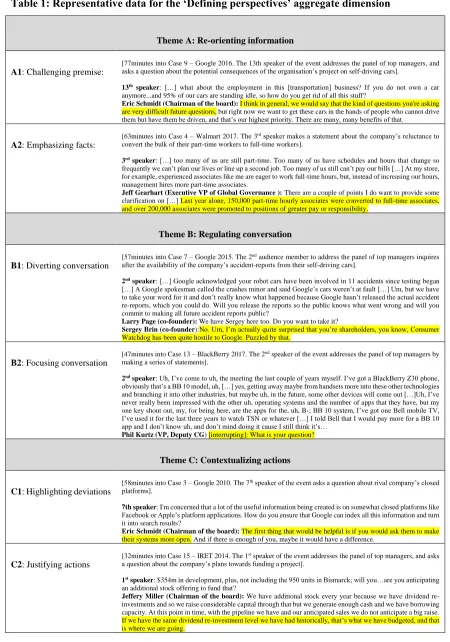
Table 1: Representative data for the ‘Defining perspectives’ aggregate dimension
Theme A: Re-orienting information
A1: Challenging premise:
[77minutes into Case 9 – Google 2016. The 13th speaker of the event addresses the panel of top managers, and asks a question about the potential consequences of the organisation’s project on self-driving cars].
13th speaker: […] what about the employment in this [transportation] business? If you do not own a car
anymore...and 95% of our cars are standing idle, so how do you get rid of all this stuff?
Eric Schmidt (Chairman of the board): I think in general, we would say that the kind of questions you're asking are very difficult future questions, but right now we want to get these cars in the hands of people who cannot drive them but have them be driven, and that’s our highest priority. There are many, many benefits of that.
A2: Emphasizing facts:
[63minutes into Case 4 – Walmart 2017. The 3rd speaker makes a statement about the company’s reluctance to
convert the bulk of their part-time workers to full-time workers].
3rd speaker: […] too many of us are still part-time. Too many of us have schedules and hours that change so
frequently we can’t plan our lives or line up a second job. Too many of us still can’t pay our bills […] At my store, for example, experienced associates like me are eager to work full-time hours, but, instead of increasing our hours, management hires more part-time associates.
Jeff Gearhart (Executive VP of Global Governance ): There are a couple of points I do want to provide some clarification on […] Last year alone, 150,000 part-time hourly associates were converted to full-time associates, and over 200,000 associates were promoted to positions of greater pay or responsibility.
Theme B: Regulating conversation
B1: Diverting conversation
[57minutes into Case 7 – Google 2015. The 2nd audience member to address the panel of top managers inquires
after the availability of the company’s accident-reports from their self-driving cars].
2nd speaker: […] Google acknowledged your robot cars have been involved in 11 accidents since testing began
[…] A Google spokesman called the crashes minor and said Google’s cars weren’t at fault […] Um, but we have to take your word for it and don’t really know what happened because Google hasn’t released the actual accident re-reports, which you could do. Will you release the reports so the public knows what went wrong and will you commit to making all future accident reports public?
Larry Page (co-founder): We have Sergey here too. Do you want to take it?
Sergey Brin (co-founder):No. Um, I’m actually quite surprised that you’re shareholders, you know, Consumer Watchdog has been quite hostile to Google. Puzzled by that.
B2: Focusing conversation
[47minutes into Case 13 – BlackBerry 2017. The 2nd speaker of the event addresses the panel of top managers by
making a series of statements].
2nd speaker: Uh, I’ve come to uh, the meeting the last couple of years myself. I’ve got a BlackBerry Z30 phone,
obviously that’s a BB 10 model, uh, […] yes, getting away maybe from handsets more into these other technologies and branching it into other industries, but maybe uh, in the future, some other devices will come out […]Uh, I’ve never really been impressed with the other uh, operating systems and the number of apps that they have, but my one key shout out, my, for being here, are the apps for the, uh, B-; BB 10 system, I’ve got one Bell mobile TV, I’ve used it for the last three years to watch TSN or whatever […] I told Bell that I would pay more for a BB 10 app and I don’t know uh, and don’t mind doing it cause I still think it’s…
Phil Kurtz (VP, Deputy CG) [interrupting]: What is your question?
Theme C: Contextualizing actions
C1: Highlighting deviations
[58minutes into Case 3 – Google 2010. The 7th speaker of the event asks a question about rival company’s closed
platforms].
7th speaker: I'm concerned that a lot of the useful information being created is on somewhat closed platforms like Facebook or Apple’s platform applications. How do you ensure that Google can index all this information and turn it into search results?
Eric Schmidt (Chairman of the board): The first thing that would be helpful is if you would ask them to make their systems more open.And if there is enough of you, maybe it would have a difference.
C2: Justifying actions
[32minutes into Case 15 – IRET 2014. The 1st speaker of the event addresses the panel of top managers, and asks
a question about the company’s plans towards funding a project].
1st speaker: $354m in development, plus, not including the 950 units in Bismarck; will you…are you anticipating
an additional stock offering to fund that?
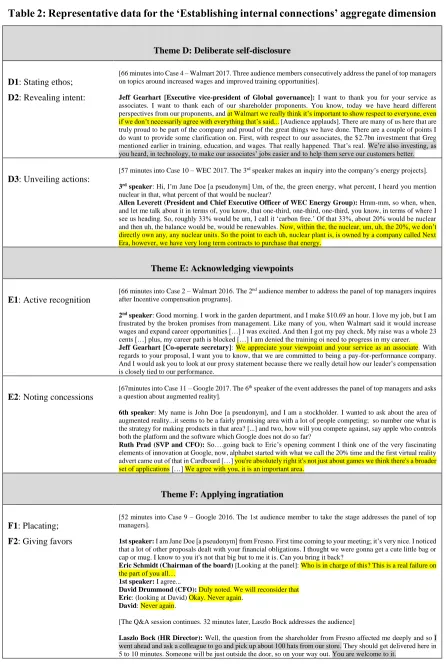
Table 2: Representative data for the ‘Establishing internal connections’ aggregate dimension
Theme D: Deliberate self-disclosure
D1: Stating ethos;
D2: Revealing intent:
[66 minutes into Case 4 – Walmart 2017. Three audience members consecutively address the panel of top managers on topics around increased wages and improved training opportunities].
Jeff Gearhart [Executive vice-president of Global governance]: I want to thank you for your service as associates. I want to thank each of our shareholder proponents. You know, today we have heard different perspectives from our proponents, and at Walmart we really think it’s important to show respect to everyone, even if we don’t necessarily agree with everything that’s said... [Audience applauds]. There are many of us here that are truly proud to be part of the company and proud of the great things we have done. There are a couple of points I do want to provide some clarification on. First, with respect to our associates, the $2.7bn investment that Greg mentioned earlier in training, education, and wages. That really happened. That’s real. We’re also investing, as you heard, in technology, to make our associates’ jobs easier and to help them serve our customers better.
D3: Unveiling actions:
[57 minutes into Case 10 – WEC 2017. The 3rd speaker makes an inquiry into the company’s energy projects].
3rd speaker: Hi, I’m Jane Doe [a pseudonym] Um, of the, the green energy, what percent, I heard you mention
nuclear in that, what percent of that would be nuclear?
Allen Leverett (President and Chief Executive Officer of WEC Energy Group): Hmm-mm, so when, when, and let me talk about it in terms of, you know, that one-third, one-third, one-third, you know, in terms of where I see us heading. So, roughly 33% would be um, I call it ‘carbon free.’ Of that 33%, about 20% would be nuclear and then uh, the balance would be, would be renewables. Now, within the, the nuclear, um, uh, the 20%, we don’t directly own any, any nuclear units. So the point to each uh, nuclear plant is, is owned by a company called Next Era, however, we have very long term contracts to purchase that energy.
Theme E: Acknowledging viewpoints
E1: Active recognition
[66 minutes into Case 2 – Walmart 2016. The 2nd audience member to address the panel of top managers inquires
after Incentive compensation programs].
2nd speaker: Good morning. I work in the garden department, and I make $10.69 an hour. I love my job, but I am
frustrated by the broken promises from management. Like many of you, when Walmart said it would increase wages and expand career opportunities […] I was excited. And then I got my pay check. My raise was a whole 23 cents […] plus, my career path is blocked […] I am denied the training oi need to progress in my career. Jeff Gearhart [Co-operate secretary]: We appreciate your viewpoint and your service as an associate. With regards to your proposal, I want you to know, that we are committed to being a pay-for-performance company. And I would ask you to look at our proxy statement because there we really detail how our leader’s compensation is closely tied to our performance.
E2: Noting concessions
[67minutes into Case 11 – Google 2017. The 6th speaker of the event addresses the panel of top managers and asks
a question about augmented reality].
6th speaker: My name is John Doe [a pseudonym], and I am a stockholder. I wanted to ask about the area of augmented reality...it seems to be a fairly promising area with a lot of people competing; so number one what is the strategy for making products in that area? [...] and two, how will you compete against, say apple who controls both the platform and the software which Google does not do so far?
Ruth Prad (SVP and CFO): So….going back to Eric’s opening comment I think one of the very fascinating elements of innovation at Google, now, alphabet started with what we call the 20% time and the first virtual reality advert came out of that in Cardboard […] you're absolutely right it's not just about games we think there's a broader set of applications […] We agree with you, it is an important area.
Theme F: Applying ingratiation
F1: Placating;
F2: Giving favors
[52 minutes into Case 9 – Google 2016. The 1st audience member to take the stage addresses the panel of top managers].
1st speaker: I am Jane Doe [a pseudonym] from Fresno. First time coming to your meeting; it’s very nice. I noticed that a lot of other proposals dealt with your financial obligations. I thought we were gonna get a cute little bag or cap or mug. I know to you it's not that big but to me it is. Can you bring it back?
Eric Schmidt (Chairman of the board) [Looking at the panel]: Who is in charge of this? This is a real failure on the part of you all…
1st speaker: I agree...
David Drummond (CFO): Duly noted. We will reconsider that Eric: (looking at David) Okay. Never again.
David: Never again.
[The Q&A session continues. 32 minutes later, Laszlo Bock addresses the audience]
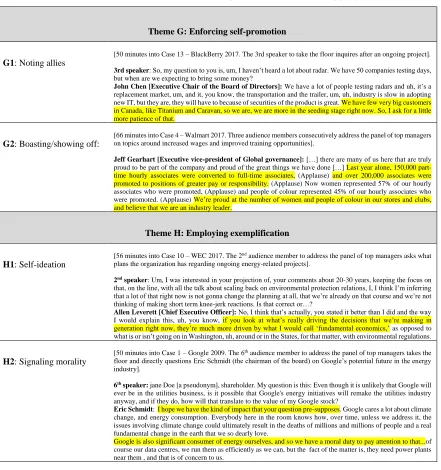
Table 3: Representative data for the ‘ Presenting external contrasts’ aggregate dimension
Theme G: Enforcing self-promotion
G1: Noting allies
[50 minutes into Case 13 – BlackBerry 2017. The 3rd speaker to take the floor inquires after an ongoing project].
3rd speaker: So, my question to you is, um, I haven’t heard a lot about radar. We have 50 companies testing days, but when are we expecting to bring some money?
John Chen [Executive Chair of the Board of Directors]: We have a lot of people testing radars and uh, it’s a replacement market, um, and it, you know, the transportation and the trailer, um, uh, industry is slow in adopting new IT, but they are, they will have to because of securities of the product is great. We have few very big customers in Canada, like Titanium and Caravan, so we are, we are more in the seeding stage right now. So, I ask for a little more patience of that.
G2: Boasting/showing off:
[66 minutes into Case 4 – Walmart 2017. Three audience members consecutively address the panel of top managers on topics around increased wages and improved training opportunities].
Jeff Gearhart [Executive vice-president of Global governance]: […] there are many of us here that are truly proud to be part of the company and proud of the great things we have done […] Last year alone, 150,000 part-time hourly associates were converted to full-part-time associates, (Applause) and over 200,000 associates were promoted to positions of greater pay or responsibility. (Applause) Now women represented 57% of our hourly associates who were promoted, (Applause) and people of colour represented 45% of our hourly associates who were promoted. (Applause) We’re proud at the number of women and people of colour in our stores and clubs, and believe that we are an industry leader.
Theme H: Employing exemplification
H1: Self-ideation
[56 minutes into Case 10 – WEC 2017. The 2nd audience member to address the panel of top managers asks what
plans the organization has regarding ongoing energy-related projects].
2nd speaker: Um, I was interested in your projection of, your comments about 20-30 years, keeping the focus on
that, on the line, with all the talk about scaling back on environmental protection relations, I, I think I’m inferring that a lot of that right now is not gonna change the planning at all, that we’re already on that course and we’re not thinking of making short term knee-jerk reactions. Is that correct or…?
Allen Leverett [Chief Executive Officer]: No, I think that’s actually, you stated it better than I did and the way I would explain this, uh, you know,if you look at what’s really driving the decisions that we’re making in generation right now, they’re much more driven by what I would call ‘fundamental economics,’ as opposed to what is or isn’t going on in Washington, uh, around or in the States, for that matter, with environmental regulations.
H2: Signaling morality
[50 minutes into Case 1 – Google 2009. The 6th audience member to address the panel of top managers takes the
floor and directly questions Eric Schmidt (the chairman of the board) on Google’s potential future in the energy industry].
6th speaker: jane Doe [a pseudonym], shareholder. My question is this: Even though it is unlikely that Google will
ever be in the utilities business, is it possible that Google's energy initiatives will remake the utilities industry anyway, and if they do, how will that translate to the value of my Google stock?
Eric Schmidt: I hope we have the kind of impact that your question pre-supposes. Google cares a lot about climate change, and energy consumption. Everybody here in the room knows how, over time, unless we address it, the issues involving climate change could ultimately result in the deaths of millions and millions of people and a real fundamental change in the earth that we so dearly love.
Findings:
The emergent model on two way- interactions in AGMs
Type B Interactions
Next question and/or interaction
Top managers’ response to inquiry
Presenting external contrasts Turns
between parties
Move 1: Inquiry made. Additional moves (a): Inquiry expanded. Audience member’s challenge Type A
Interactions Move 1: Challenge
made. Additional moves: Challenge sustained. Re-orienting information or Regulating conversation or Contextualising actions.
Additional moves: Same response pattern as above
Enforcing self-promotion or Employing exemplification. Additional moves: Same response pattern as above
Random response pattern
Deliberate self – disclosure or acknowledging viewpoints or applying
ingratiation.
Additional moves: Same response pattern
as above Re-orienting information
or Regulating conversation or Contextualising actions.
Additional moves: Same
Deliberate self – disclosure. Additional moves: Same response pattern as above Turns between parties
Defining perspectives Establishing internal connections
Top manager’s response to challenge
Type-A interactions: Instances and patterns from audience member challenges
When audience members asked questions (or made statements) that were effectively challenged, the top managers in the room invariably responded in a manner exemplified by vignette 1 below. The responses were also concluded by the most senior top manager present.
Vignette 1
[63 minutes into Case 9 – Google 2016: An interaction between the 6th audience member to speak and the panel of top managers].
6th speaker: Hi. John Doe [a pseudonym] with proxy impact. I just want to follow
up with the question I asked when discussing the proposal on gender pay gap. This issue has gotten a ton of press, particularly about the Tech industry... a lot of companies have started to move on it and make Commitments, they are doing this at different levels... as I said, Intel's looking at more elements than others... so we have leaders and laggards; where is alphabet? It's just not even up to the laggard stage.
Eric Schmidt (CEO): With respect, I actually disagree with your [hesitates] …the
framing of your question... we have our company meeting in this room and what we do is we call up unsuspecting executives and tell them to answer the question... that unsuspecting executive has been the leader in this area is I think the national leader in gender and equity pay gap...his name is Laszlo Bock, he is joining us on stage, come on up Lazlo.
[Laszlo Bock (HR director) takes the stage and talks about Google’s efforts in addressing the gender pay gap. He then vacates the stage]
6th speaker: I read that report; I like that report. But I have the same question then
as I do now: ‘Where is the Data to back it up?’ If you have all this information why not just put it up in a report...
Eric: (interrupting) I am going to turn that into ‘Laszlo, publish more’. I just told
him privately….since I disagree with the premise of your question I think it's a fair challenge to us to try to prove to you that we are not lying to you... since our job is management of the company and our job is to make sure that we have the absolute best Talent, and that they are fully and completely rewarded, we spend a lot of time on this and I'm... I'm happy to work... work to convince you that this is true but I actually know this is true... so (turning to Lazslo) same message as I said privately ‘Let's publish more…’
6th speaker: Can we get a commitment? Give us a date that we can expect this… Eric: Not to worry…
6th speaker: (with a raised voice) That’s not commitment, that’s the same
problem…
Eric: This is not a management meeting, but I can assure you, we take this
incredibly seriously.
6th speaker: When we have a commitment, I will believe that.
Eric: Well, since you are not an employee, I will not make you that commitment,
The audience member has issued a sustained challenge regarding the organisation’s commitment level regarding the gender pay gap. The most senior top manager present (Eric Schmidt) starts his response by re-orienting the information presented by the speaker {with respect, I actually
disagree with your...the framing of your question […]}. He then continues by deliberately
self-disclosing some inside information {we have our company meeting in this room and what we do
is we call up unsuspecting executives and tell them to answer the question}. The HR director is
then summoned to offer some explanations on stage.
The audience member is, however, not satisfied {I read that report; I like that report. But I have the same question then as I do now: ‘Where is the Data to back it up?’ If you have all this
information why not just put it up in a report?}. Eric cycles back to deploying a discursive practice
under defining perspectives: he attempts to regulate the conversation {I am going to turn that into
‘Laszlo, publish more’} and then self-discloses more information {I just told him
privately….since I disagree with the premise of your question I think it's a fair challenge to us to
try to prove to you that we are not lying to you […]}. When this fails to mollify the speaker {Can
we get a commitment? Give us a date that we can expect this}, the top manager (for the second
time) cycles back to regulating the conversation {This is not a management meeting}. He then ends the interaction by presenting yet more self-disclosed information {I can assure you, so we are very clear, we make this commitment to our employees, and we take it very seriously}.
This conversation follows the observed pattern for Type-A interactions: the top manager responds by first deploying practices categorised under the defining perspectives aggregate dimension. The response then cycles between discursive practices categorised under the deliberate self-disclosure
Type-A interactions (initiated by an audience member's challenge)
Audience member’s challenge
First, the stakeholder makes a challenge
[Move 1: Challenge] [Turn 1]
If the audience member sustains the challenge…
[Additional moves: Sustaining the challenge] [Additional Turns]
Box 1
The top manager responds with by either: Re-orienting information, regulating conversation or contextualizing actions. [Move 1: Response to challenge] [Turn 2]
Top manager’s response
Box 2
The top manager then responds with the discursive practice: deliberate self-disclosure.
[Move 1: Still responding to challenge] [Turn 2]
Box 3
The response continues by cycling back to Box 1. This alternating pattern continues until the top manager’s turn ends.
[Move 1: Still responding to challenge] [Turn 2]
Loops back to 1
The top manager responds by repeating the pattern shown above. This continues until the new turn ends. [Additional moves: Responds to sustained challenge] [Additional Turns]
If the audience member ends the interaction by yielding the floor: [Final move] [Final Turn]
Interaction ends. Aggregate dimensions
Box 1: Defining perspectives Box 2: Establishing internal connections
Box 3: Defining perspectives
Type-B interactions: Instances and patterns from audience member inquiries
In contrast to Type-A interactions, audience members also initiate two-way interactions by presenting inquiries to the presiding top managers. These type of interactions (Type-B) also exhibit a unique pattern as they unfold.
Vignette 2
[61 minutes into Case 10 – WEC 2017: An interaction between the 4th audience
member to speak and the panel of top managers].
4th speaker: Okay, so adding onto the hacker thing, um, are you guys adding onto
your system to prevent hackings?
Allen Leverett (Chief Executive Officer): Yeah, so we do quite a bit of work, uh,
as an industry, uh, and, and so I guess what I’ll, the, the word I’ll use instead of hacking, let me just call it cyber security, you know, because, so as an industry uh, that’s what, that’s what we would call, uh, cyber security. So, tremendous amount of work that goes on, on the electric side of the business, uh, I think the natural gas business probably a little behind where, where the electric side of the business is, uh, right now. Uh, but there’s tremendous amount of work as a company, uh, as well as in industry, uh, on cyber security, uh, but it’s something that candidly, it’s like you always kinda wish you could be done, you, you know, with, with addressing cyber security, but, but the nature of the threats, you know, it just continues to change, um, so, I, I really think for the foreseeable future, um, you know, this is an area we’re gonna spend a lot of time on and we are spending a lot of time on it, as a, as a company, as well as a country, really. So I thank you for the question.
4th speaker: Thank you.
The premise of the interaction is rooted in an inquiry {[…] are you guys adding onto your system
to prevent hackings?} and not a challenge. The top manager’s response is a mixture of discursive
practices from the three aggregate dimensions identified in this study. Practices like those that emphasise facts {[…] we do quite a bit of work, uh, as an industry}, reveal intent {I really think
for the foreseeable future, um, you know, this is an area we’re gonna spend a lot of time on} and
unveil actions {we are spending a lot of time on it, as a, as a company, as well as a country,
really} are all used in the construction of the top manager’s response. Essentially, the response is
Type-B interactions (initiated by an audience member's inquiry)
First, the audience member makes an inquiry.
[Move 1: Inquiry] [Turn 1]
Audience member’s inquiry
Top manager’s response
1
The top managers respond with either: Re- orienting information, regulating conversation or contextualizing actions practices…
[Move 1: Response to inquiry] [Turn 2]
2
…and/or the top managers respond with either: deliberate self-disclosure, acknowledged viewpoints or applying ingratiation practices… [Move 1: Still responding to inquiry] [Turn 2]
3
…and/or the top managers respond with either: enforcing self-promotion or employing exemplification.
[Move 1: Still responding to inquiry] [Turn 2]
Aggregate dimensions
Box 1: Defining perspectives Box 2: Establishing internal connections Box 3: Presenting external contrasts
The top managers’ response to an audience member’s inquiry follows this random response pattern until their turn ends.
Loops back to 1, 2 or 3
The top managers respond by repeating the random pattern shown above. This continues until the new turn ends. [Additional moves: Responds to expanded inquiry] [Additional Turns] If the audience member
expands the inquiry…
[Additional moves: Expanding the inquiry] [Additional Turns]
If the audience member ends the interaction by yielding the floor: [Final move] [Final Turn]
Discussion:
Examining Strategy work in the performance of Type-A two-way interactions
When audience members begin interactions by asking questions that posed a challenge (e.g. by laying a charge of wrong doing at the feet of the organisation), the ensuing two-way interaction would follow the path indicated as Type-A on page 16. The first move is made by the audience member as a challenge, and a top manager always first responds with one (or more) of three discursive practices (i.e. re-orienting information, regulating conversation and contextualising
actions). The top manager then invariably follows the first response with another discursive
practice, deliberate self-disclosure. The entire response to the challenge delivered by the top manager ultimately cycles between these two set of practices. This first response is designated as a conversational turn (Slembrouck, 2011:163-164; Van Dijk, 1984:5-6). If the audience member makes a second move by sustaining the challenge (i.e. if the audience member persists along the original line and manner of questioning), the most senior top manager present takes over from the first responder if the first responder was not the said senior top manager. This senior top manager then responds by repeating the same pattern of practices as the first responder did in the previous turn. The dialogue between the parties continues in this fashion until the audience member yields the floor and concludes the interaction. A new audience member takes up the floor, and the entire cycle repeats itself.
To insightfully explain this deliberate sequence of events, five questions have to be asked. First, what informs the challenge made by the audience member? Second, has the organisation taken a stance on issues around that challenge, and if they have what is it? Applying an understanding of Goffman’s interaction rituals to an interpretation of a taken stance will then help answer a third and fourth question: What informs the top manager’s use of those particular discursive practices? And what is the end goal (or strategy work) that is achieved by the use of those practices? A deeper examination of the vignette illustrating Type-A dialoguing interaction-patterns on page 14 can help guide an informed exploration of these questions.
So, how can we ascertain that the question presented by the audience member in the vignette is a challenge? And what informs this challenge? We know this is a challenge because it lays out a litany of complaints against the organisation {e.g. […].I just wanted to follow up with the
questions I asked when discussing the proposal on gender gap[…]a lot of companies have started to move on it and make commitments[…] where is alphabet? It is not even up to the laggard
stage}. The audience member suggests that the organisation is not willing to fully discuss the
organisation’s stance on gender pay. The organisation did have its own differing stance on the issue, though. This is evidenced by the statement made by the organisation’s HR director, Laszlo Bock:
“We, actually in April, I authored an editorial in the Washington Post disclosing publicly that we have no pay gap at Google among genders, whether you look at salary or bonus or equity. We went a step further and actually posted on our site, that’s called reWork, talking about how any company can actually set up a structure that guarantees that there is no wage equity gap. What we see at Google is that, absolutely in society there is a material gap, and in fact when we hire women at Google, on average they get a 30% grade in salary increase than the men do because, in the real world, women are paid less than men” {From 63:53 minutes into the AGM}.
14).
But what informs the top managers’ use of these particular discursive practices? If we connect our observations back to what Goffman says about interaction rituals, we get a better understanding of why this interaction unfolds the way it does. Goffman’s theory of interaction rituals states that the model of social interaction between two people (or two groups of people) is based on two things: everything one person or group says or does to express their perspective of situations discussed or performed during that interaction (called lines), and the positive social value that person or group effectively claims from the other person or group by those lines taken (called face) (Collins, 2005:15-16). This face is only effectively claimed by the person or group taking the lines if the interaction proceeds without any incident, and this only happens when the other person or group participating in the interaction considers the lines consistent with actions performed by the person or group that delivers the line (Goffman, 1963:83-111). As an example: imagine persons X and Y are engaged in an interaction. If X says or does things (either in past interactions or during that interaction) that communicates to Y that X likes parties, X claims the
face of liking parties during that particular interaction. However X can only claim that face if Y does not bring up instances (originating from past interactions or even that very interaction), that suggests that X does not in fact like parties. If Y does bring up such instances, an incident in the interaction arises, and this threatens X’s face.
An incisive examination of the interaction highlights these Goffmanian concepts. A top manager (speaking for the organisation) had presented the AGM audience with the line that the organisation wilfully discloses information on gender pay { […].We, actually in April, I authored an editorial in the Washington Post disclosing publicly that we have no pay gap at Google among
genders […]}. The audience member, however, had previously stated that the organisation does
not wilfully disclose information on gender pay gaps {[…]. Where is alphabet? It is not even at
the laggard stage}. This brings up an incident/challenge in the interaction, which threatens the
organisation’s face regarding its line on gender pay information.
Goffman’s theory of interaction rituals state that people in social interactions address threats to their claimed faces in four phases of a corrective ritual: challenge (where they call attention to the incident), offering (where they try to address the challenge by either redefining the act that brought the challenge on, or by demonstrating that they under the influence of something else when they gave the line that sparked the incident/challenge), acceptance (where the other party in the interaction accepts the offering made as a satisfactory means of re-establishing the flow of the interaction), and thanks (where the acknowledges the other party’s acceptance) (Goffman, 1967:19-23).
Armed with the knowledge of these four corrective phases, the actions and practices used by the top managers as depicted in the illustrative interaction become better explained. The top managers first acknowledge the challenge by responding to it. They present an offering to the audience speaker by attempting to re-orient the audience member’s interpretation of the organisation’s line {[…]. With respect, I actually disagree with your framing of the question}, and deliberately disclosing inside information {[…] we have our company meeting in this room
and what we do is we call up unsuspecting executives and tell them to answer the question […] that unsuspecting executive has been the leader in this area and is the national leader in gender
and equity pay gap […] his name is Laszlo Bock, he is joining us on stage […]}.
This offering, however, is not accepted by the audience member, because he continues his challenge with {I read that report. I like that report. But I have the same question then as I do
now: ‘Where is the data to back it up?’}. The top manager cycles back and makes another offering
the top manager cycles back for the second time to regulating the conversation {[…]This is not a
management meeting} before ending the interaction by presenting yet more self-disclosed
information {I can assure you, so we are very clear, we make this commitment to our employees,
and we take it very seriously}.
Contrary to what we would expect from the model on the corrective processes in interactions as proposed by Goffman’s theory, the top managers in the dialoguing interaction-patterns never attempt to offer challenged lines as being presented under the influence of something other than themselves (i.e. in AGMs, challenged lines are never walked back and excused). Also, the remaining two phases of the corrective process are only implicitly followed during dialoguing interaction-patterns: the audience members could either implicitly accept the top manager’s offering by asking a different question, yielding the floor or (as seen in this particular interaction) making a neutral exit statement; and the thanks given by the top managers implicitly manifests itself as a move to the next audience member they interact with. Concisely put: An application of interaction rituals to AGMs show that the strategy work executed by top managers in dialoguing interaction-patterns is essentially face-work done on challenged lines.
Examining Strategy work in the performance of Type-B two-way interactions
The discussion in the preceding sub-section gave a supported explanation of the end point of Type-A interactions in AGMs as the execution of face-work as strategy work. In other words, the end goal (or strategy work) that is achieved by the use of the practices identified in Type-A interactions is not to disclose all pertinent information as would be theoretically suggested by the legal expectations of AGMs (OECD, 2015:37-54), but to primarily save organisation’s face from audience-member challenges.
Type-B interactions, however, deal with demonstrably benign inquiries, and not challenges. If an audience member initiates an interaction by making an inquiry instead of posing a challenge, the entire pattern of interaction changes from what we observe in Type-A interactions to what is depicted on page 18. Here, one or more members of the top manager’s panel responds to the audience member by constructing a reply from a random mix of the eight practices categorised under the three observed aggregate dimensions. One of three things could then happen during the audience member’s rebuttal (i.e. the second move in the interaction): (a) the audience member could expand upon the original inquiry (e.g. by asking for more detail). The top managers then respond again with a random mix of the eight practices as mentioned previously; (b) the audience member could escalate the situation by turning the inquiry into a challenge. Here, the response follows the pattern of a Type-A interaction (i.e. one initiated by a challenge from an audience); (c) the audience member could yield the floor, and thus conclude the interaction.
The vignette represents a typical Type-B interaction observed in the dialoguing interaction-patterns of AGMs. A cursory look at the interaction shows that the audience member’s initiating comments are identified as an inquiry and not a challenge because they do not mention, or allude to, any kind of wrongdoing on the part of the organisation. The statement {[…].Okay adding unto
the hacker thing, um, are you guys adding onto the system to prevent hackings?} informs us that
a previously made statement by the organisation informs the speaker’s current inquiry; this means the organisation has taken a stance on the discussed topic (i.e. the issue of hacking). If we apply Goffman’s concept of interaction rituals to what we have gleaned so far, we would get a summation like this: The organisation produced a line on its position on hacking earlier on in the AGM; and the current speaker has recalled that line during this interaction. We have, however, established that the speaker’s recall of that line is an inquiry, and not a challenge. Here, the organisation’s face regarding the discussed topic has been maintained because the line is not contested by the audience member’s statements (Collins, 2005:18-20). This means that there is no incident in the interaction that threatens the organisation’s face regarding that particular line, which in turn means that Goffman’s corrective ritual does not come into effect.
So what happens in two-way interactions that have no observed incidents? According to Goffman, a person (or group of persons) that has a confirmed face gotten from a line in an interaction will try to maintain that face by considering how that line places in the social world outside that interaction. In other words, the person(s) would either sustain or build on that line with the knowledge that future interactions could recall and challenge the said line if it appears to become inconsistent between the current interaction, and those future interactions (Goffman, 1967:6-7). This explanation provides valuable context for explaining what informs the use of the practices observed in Type-B interactions. When top managers respond to the audience members in Type-B interactions, they construct their responses from a mix of the eight observed practices in manner that allows them to simultaneously justify the organisation’s current stance regarding the discussed topic (i.e. their line), and suggest that the line will still be consistent in the future.
In the vignette the top manager responds to the inquiry by first declaring facts that re-orients the presented information {[…]. We do quite a bit of work as an industry and so I guess the word
I’ll use instead of hacking […] is cyber security […]}, then by deliberately self-disclosing
information on the organisation’s actions regarding the raised inquiry {[…]. So tremendous amount of work that goes on, on the electric side of the business […] is probably a little behind
where the electric side of the business is […]}, and then by cycling back to contextualising the
organisation’s actions around the inquiry’s topic { […]but the nature of the threats, you know, it just continues to change, um, so I really think for the foreseeable future , um, you know, this is an
area we’re gonna spend a lot of time on […]}. By using these practices in the manner he does,
the top manager justifies why the organisation has consistently given a line of addressing hacking (or cyber security), and why the organisation takes its current stance on the issue. He then ends the interaction by cycling back to deliberately self-disclosing information about unveiled actions
{[…] this is an area we are gonna spend a lot of time on and we are spending a lot of time on it
as a company, as well as a country[…]} to indicate that the given line would still be consistent
in the future.
with face management. It also provides solid support for explaining how organisations utilise the performance of their top managers during AGMs to fulfil their legal expectations to openly disclose pertinent information on concerns raised by their stakeholders. It is also worth noting that, unlike Type-A interactions, the themes enforcing self-promotion and employing
exemplification featured here. This means that the strategy work of line/face maintenance also
feature exclusivity at its core (see section 5.3).
Concluding Remarks:
This paper sets out to address the thesis’ attendant research question “How do top managers manage two-way interactions with the audience of an AGM?” From the analysis and findings shown in the paper, we have seen that top managers employ seventeen 1st order practices grouped under eight themes to manage two-way interactions in AGMs. The paper identified two types of interactions named Type-A interactions and Type-B interactions that top managers used to address challenges and inquiries from the audience members.
The paper’s emergent model serves two important functions. First, prior research has shown that AGMs have specific functions around interactions (Carrington and Johed, 2007; De Jongh, 2011). Top managers are brought face to face with investors (in the same physical and temporal space) during AGMs; as a result, a crucial part of an AGM for top managers is the management of the interactions they have with the AGM audience. To date, however, there have been relatively few grounded explanations of what happens during these interactions (Hodges, MacNiven and Mellett, 2004; Li and Yermack, 2016).The model illuminates how identified sets of practices are used in that management, and provides an empirical base to further understand why interactive rituals are conceptually relevant. Goffman defined interactive rituals as:
“Activities that represent a way in which the individual must guard and design the symbolic implications of his acts while in the immediate presence of an object that has a special value for him” {Goffman, 1967: 57}
Essentially, theories of interaction focus on studying the traffic rules of interaction, and not necessarily the end point of an interaction, or why the participants want to get to said end point (Collins, 2005: 13-25).The development of the emergent model enables a thorough exploration of what those activities are, how they are expressed, and why they are contextually (and sociologically) important. It therefore means that, in addition to further extending the body of literature on AGMs and interaction theories, insight from the model also ultimately has the potential to provide practical contributions to the realm of real-world businesses.
References:
Apostolides, N., 2010. "Exercising corporate governance at the annual general meeting", Corporate Governance: The international journal of business in society, Vol. 10 Issue: 2, pp.140-149,
Baumeister, R., and Leary, M., 1995. 'The need to belong: desire for interpersonal attachments as a fundamental human motivation', Psychological Bulletin, Issue 3, pgs. 497-505,
Bell, C., 1997. Ritual: Perspectives And Dimensions [Electronic Resource] / Catherine Bell, n.p.: New York : Oxford University Press, 1997
Berelson,B., 1971. Content analysis in communications research. New York: Free press.
Berg, B., 2001. Qualitative research methods for the social sciences. Boston: Allyn and Bacon
Biehl-Missal, 2011. ‘Business is Show Business: Management Presentations as Performance’, Journal of Management Studies, Vol. 83, Issue 3, pgs. 619-645
Burgelman, R., Floyd, S., Laamanen, T., Mantere, S., Vaara, E., Whittington, R., 2018. ‘Strategy processes and practices: Dialogues and intersections’, Strategic management Journal, Issue 39, pgs. 531-558
Carrington and Johed, 2007. The construction of top management as a good steward :A study of Swedish annual general meetings. Accounting, Auditing & Accountability Journal, Vol. 20 No. 5, pgs. 702-728
Catasus and Johed, 2007. Annual general meetings—rituals of closure or ideal speech situations? A dual analysis. Scand. J. Mgmt. Vol 23 , pgs 168–190
Feldman, M.S., and Orlikowski W.J., 2011. 'Theorizing Practice and Practicing Theory', Organization Science, Vol 22, No 5, pgs. 1240 – 1253.
Flick, U, 2002. An introduction to qualitative research. London: Sage Publications
Gioia, D., Corley, K., and Hamilton, A., 2013. 'Seeking Qualitative Rigor in Inductive
Goffman, E., 1959.The presentation of self in everyday life. Garden City, NY: Doubleday Anchor.
Goffman, E., 1961. Asylums. Essays on the social situation of mental patients and other inmates. Garden City, NY: Doubleday Anchor.
Goffman, E., 1963. Behaviour in Public Places. New York: The Free Press.
Goffman, E., 1967. Interaction ritual. New York: Doubleday.
Jarzabkowski, P., Balogun, J., and Seidl, D., 2007. ‘Strategizing: The challenges of a practice perspective’, Human Relations, Vol. 60, No.1: pgs. 5-27.
Jarzabkowski, P., and Fenton, E., 2006. 'Strategizing and Organizing in Pluralistic Contexts', Long Range Planning, Vol. 39, No. 6, pgs. 631-648.
Jarzabkowski, P., Kaplan, S., Seidl, D., Whittington, R., 2016. ‘On the risk of studying practices in isolation: Linking what, who, and how in strategy research’, Strategic Organisation, Vol. 14, No. 3, pgs. 249-259
Hermanowicz, J. C., and Morgan, H. P., 1999. Ritualizing the Routine: Collective Identity Affirmation. Sociological Forum, Vol.14 (No2), pgs.197-214.
Hodges, R., MacNiven, L., and Mellet ,H., 2004. Governance of UK NHS Trusts: the Annual General Meeting. Governance of UK NHS trusts. Blackwell Publishing
Hodges, R., MacNiven, L., and Mellet ,H., 2004. Annual general meetings of NHS trusts: Devolving power or ritual accountability? Financial Accountability& Management, Vol 20, Issue 4 , pgs 0267-4424
Hooper and Pratt, 1995. "Discourse and rhetoric: the case of the New Zealand Native Land Company",
Accounting, Auditing & Accountability Journal, Vol. 8 Issue: 1, pp.10-37,
Jarzabkowski, P., and Spee, A., 2009, 'Strategy-as-practice : a review and future directions for the field', International Journal Of Management Reviews : IJMR, Vol.11, Issue 1, pgs.69-95.
Johnson, G., Prashantham, S., Floyd, S., and Bourque, N., 2010. ‘The ritualisation of Strategy Workshops’, Organisational Studies, Vol 31 pgs.1589 - 1619.
Johnson, G., Melin, L., and Whittington, R., 2003a. ‘Guest Editors’ Introduction’, Journal of Management Studies, Vol. 40, pgs. 3–22.
Johnson, G., Melin, L., and Whittington, R., 2003b. ‘Micro strategy and strategizing: towards an activity-based view’. Journal of Management Studies, Vol. 40, Issue 1,pgs. 3-22.
Jones, E. E., 1990. Interpersonal perception. New York: W.H. Freeman and Co.
Kolk, 2008. Sustainability, Accountability and Corporate Governance: Exploring
Multinationals’ Reporting Practices . Business Strategy and the Environment Bus. Strat. Env. 18, 1–15
Kornberger, M., and Clegg, S., 2011, 'Strategy as performative practice : the case of Sydney 2030', Strategic Organization, Vol.9, Issue 2, pgs. 136-162.
Krippendorff, K., 2004. Content analysis: an introduction to its methodology. Thousand Oaks, California: Sage Publications
Li and Yermack, 2016. Evasive shareholder meetings. Journal of corporate finance, Vol 38.
Marshall, D.A., 2002.‘Behaviour, Belonging and Belief: A theory of ritual practice’, Sociological theory, Vol 20, No 3, pgs.360 – 380.
Miles and Huberman, 1994. Qualitative data analysis. 2nd ed. Thousand Oaks: Sage Publications
Mintzberg, H., and Waters, J.A., 1985, 'Of Strategies, Deliberate and Emergent', Strategic Management Journal, Vol. 6, pgs. 257-272.
Neuendorf, K., 2002. The content analysis guidebook. Thousand Oaks, Califrnia: Sage publications Inc.
OECD, 2013. Supervision and Enforcement in Corporate Governance, Corporate
Governance, OECD Publishing. Available at: http://dx.doi.org/10.1787/9789264203334-en
OECD, 2015. G20/OECD Principles of Corporate Governance, OECD Publishing, Paris. Available at: http://dx.doi.org/10.1787/9789264236882-en
Olibe, 2002. The information content of annual general meetings:a price and trading volume analysis Journal of International Accounting, Auditing & Taxation, Vol 11, pgs 19–37.
Roberts, J., Sanderson, P., Baker, R., and Hendry, J., 2006. In the mirror of the market: The disciplinary effects of company/fund manager meetings. Accounting, Organizations and Society, Vol 31, pgs 277–294
Rossano, M. J. 2012. ‘The Essential Role of Ritual in the Transmission and Reinforcement of Social Norms’. Psychological Bulletin,
Rose, G., 2016. Visual Methodologies: An introduction to Researching with visual methodologies; 4th edition, Sage publications.
Sadler, 2004. Trade unions, coalitions and communities: Australia’s Construction, Forestry, Mining and Energy Union and the international stakeholder campaign against Rio Tinto, Geoforum Vol 35 , pgs 35–46
Short and Keasy, 1977. Institutional Voting in the UK: Is Mandatory Voting the Answer? Research papers, Vol 5, No 1, Blackwell Publishers Ltd.
Silverman, D., 2001. Interpreting qualitative data methods for analysing talk, text and interaction. Thousand Oaks, California: Sage publications Inc.
Stratling, 2003. General Meetings: a dispensable tool for corporate governance of listed companies? Corporate Governance, Vol 11, No. 1
Strauss, A., and Corbin, J., 1990. Basics Of Qualitative Research : Grounded Theory Procedures And Techniques . Newbury Park,(Calif.) ; London : SAGE Publications.
Turner, V., 1974. Dramas, Fields, And Metaphors : Symbolic Action In Human Society , London : Cornell University Press.
Vaara, E, and Whittington, R., 2012. 'Strategy-as-Practice: Taking Social Practices Seriously', Academy Of Management Annals, Vol. 6, Issue 1, pgs. 285-336.
Van Dijk, T.A. 1984. Dialogue and cognition. In L.Vaina AND j. Hintikka(Eds.),Cognitive Constraints on Communicatio(pp.1-17). Dordrecht: D.Reidel Publishing Company.
Whittington, R., and Cailluet, L., 2008. 'The Crafts of Strategy. Special Issue Introduction by the Guest Editors', Long Range Planning, Vol. 41, The Crafts of Strategy, pgs. 241-247.