City, University of London Institutional Repository
Citation:
Neate, T., Bourazeri, K., Roper, A. ORCID: 0000-0001-6950-6294, Stumpf, S.
ORCID: 0000-0001-6482-1973 and Wilson, S. ORCID: 0000-0001-6445-654X (2019).
Co-Created Personas: Engaging and Empowering Users with Diverse Needs Within the Design
Process. In: CHI '19 Proceedings of the 2019 CHI Conference on Human Factors in
Computing Systems. (650.). New York, USA: ACM. ISBN 978-1-4503-5970-2
This is the accepted version of the paper.
This version of the publication may differ from the final published
version.
Permanent repository link:
http://openaccess.city.ac.uk/21271/
Link to published version:
http://dx.doi.org/10.1145/3290605.3300880
Copyright and reuse: City Research Online aims to make research
outputs of City, University of London available to a wider audience.
Copyright and Moral Rights remain with the author(s) and/or copyright
holders. URLs from City Research Online may be freely distributed and
linked to.
City Research Online: http://openaccess.city.ac.uk/ [email protected]
Co-Created
Personas:
Engaging
and
Empowering
Users
with
Diverse
Needs
Within
the
Design
Process
TimothyNeate1,AikateriniBourazeri1,AbiRoper1,2,SimoneStumpf1,StephanieWilson1
1CentreforHCIDesign,City,UniversityofLondon,London,UK
2DivisionofLanguageandCommunicationScience,City,UniversityofLondon,London,UK
{timothy.neate,katerina.bourazeri,abi.roper.1,simone.stumpf.1,s.m.wilson}@city.ac.uk
ABSTRACT
Personasarepowerfultoolsfordesigningtechnologyand
envisioningitsusage.Theyarewidelyusedtoimagine
ar-chetypalusersaroundwhomtoorientdesignwork.Wehave
beenexploringco-createdpersonasasatechniquetouse
inco-designwithuserswhohavediverseneeds.Ourvision
wasthatthiswouldbroadenthedemographicandliberate
co-designersof theirpersonal relationship withahealth
condition.Thispaper reports three studieswhere we
in-vestigatedusingco-createdpersonaswithpeoplewhohad
Parkinson’sdisease,dementiaoraphasia.Observationaldata
ofco-designsessionswerecollectedandanalysed.Findings
revealedthattheco-createdpersonasencourageduserswith
diverseneedstoengagewithco-designing.Importantly,they
alsoafordedadditionalbeneftsincludingempoweringusers
withinamoreaccessibledesignprocess.Refectingonthe
outcomesfromthediferentusergroups,weconcludewith
adiscussionofthepotentialforco-createdpersonastobe
appliedmorebroadly.
KEYWORDS
Co-createdpersonas,co-design,aphasia,dementia,
Parkin-son’sdisease,vulnerableusers,healthcare,design.
1 INTRODUCTION
Thedesignofhealthandcaretechnologieshascomeinto
fo-cusintheHCIcommunityinrecentyears,especiallywiththe
dramaticriseofchronichealthconditionsinanincreasingly
Timothy Neate, Aikaterini Bourazeri, Abi Roper, Simone Stumpf, Stephanie Wilson. This is the accepted version of the paper, hosted by the authors. Definitive version published at CHI 2019 and available at:
doi.org/10.1145/3290605.3300880
ageingWesternpopulation[17].Forexample,thereare
cur-rentlyover46millionpeopleafectedbydementiaworldwide
[18],approximately10millionpeopleworldwideareliving
withParkinson’sdisease[19],andaroundathirdofallpeople
survivingastrokewillexperiencesomeformofaphasia[3].
Inparallel,therehavebeencallstoinvolvetargetuser
groupsdirectlyin participatorydesign [5]andco-design
[34] ofhealthservicesanddigital technologiesto ensure
theirsuccessandadoption[15,29,45].Co-designtechniques
havebeenadoptedforinvolvingvulnerableusergroups,such
aspeoplewithdementia[20,24,39]andaphasia[13,33,43].
Thisnoted,manyco-designtechniquesandmethodshave
limitationsforusein situationswherethephysical,
emo-tionalandsocialfactorsrelatedtoaspecifchealthcondition
anditssymptoms,andtheresultingrequirementsfor
tech-nology,needtobeconsidered.Forexample,manyco-design
techniquesweredevelopedwithaviewtomoreegalitarian
design,withoutaparticularfocusondiverseusergroups
[5].Thedesigntechniquesthemselves,then,arelikelynot
accessibletousers withcognitive,physicalandlanguage
impairments.Suchdesignparadigmsmaycreate
problem-aticpowerstructuresbetweentheprofessionalresearchers
andtheco-designers,leadingto end-productsthatmight
notmeettheirexpectationsorrequirements.Anumberof
recentprojectshavebroadenedthedesignconstituencyby
committingtoco-designwithuserswithdiverseneeds,such
aspeoplewithdementia[20,21,32],aphasia[13,33,43]and
olderindividuals[26].Inthispaper,weleverageaclassic
designtool–thepersona–andreconsideritsuseby
encour-agingco-designerstoco-createpersonas.Indoingthis,we
aimtobroadenthedemographicbeyondthosedirectly
partic-ipatingandobfuscatethepersonalrelationshipbetween
co-designersandtheirhealthconditions.Thispapercontributes
tothedesignprocessoftechnologiesforpeoplewithdiverse
healthconditions(Parkinson’s,dementiaandaphasia)by:
• Describingourexperienceofincorporatingco-created
personasintoco-designprojects;
• Presentingfndingsfromtheusageofco-created
per-sonaswithdiverseusergroups;and
• Detailingthesubstantiveafordancesofusingco-created
2 RELATEDWORK
Co-DesignandCo-DesignMethods
Engagingusersisanimportantaspectofdesignandthere
areanumberofwaystocreate empathywiththeirlived
experiences[46].Engagingusersinparticipatorydesign[5]
andco-design[34]intheearlystagesofaprojectare
well-adoptedapproaches,especiallywhendesigningtechnology
inhealthandsocialcarecontexts[15].Workingwiththose
whoengagewiththedesigndomainintheirlived
experi-encehasbeenshownto be ahighlyefectivestrategy of
engagement[25],outperformingnon-co-designedsolutions.
Co-designgoesbeyondsimplyconsultingausergroupfor
theirrequirements,insteadconsideringthemasdesigners
withintheprocesswhocontributecreativelytodesign
deci-sions.ProjectssuchastheworkofRobinsonetal.[32]are
exemplarsoftheefcacyofthisdesignapproach.Giventhe
successofco-designinengaginguserstowardsachieving
efectiveoutcomes,therehasbeenagrowingvoice
advocat-ingitsuseindesigningtechnologies[9,34],particularlyin
healthcontexts[15,43].
Anumberoftechniqueshavebeenconsideredfor
engag-ingusersinthedevelopmentoftechnologies,however,many
ofthesearenotaccessibletothosewiththehealth
condi-tionsfocusedoninthispaper(Parkinson’sdisease,dementia
andaphasia).Suchtechniquesaregenerallyabstract,
cog-nitivelydemandingandrequirehighlevelsofspeechand
languageprofciency.Recently,designtechniquestoengage
individualsfacingchallengestotheirspeech/language[43]
orcognitivefunction[21]havebeenreported.Adaptions
tocurrenttechniqueshavealsobeenshowntoofer
efec-tivesolutions[46].Forexample,onemightengageauser
groupinaworkshopbyutilisingdrawings,photographsand
varyinglevelsofprototypetodevelopsolutions[9],
employ-ingexpertsinengagingwiththeusergrouptofacilitatethe
session.BourazeriandStumpf[7]describeantypical
exam-pleofthisprocessindetail(theirPERCEPTapproach)from
scopingandethicsapproval,torecruitmentandthedesign
processitself.
Todeveloptechnologyforpeoplewithdementia,theKITE
project[32]employedworkshops,focusgroupsand
devel-opedprototypes.Engagementwasfacilitatedwithpeople
withdementiaandtheircarers.TheOASIS[21]methodused
video-promptstofacilitatediscussionaboutatechnology,
inspiredbyinvisibledesignconcepts[8].Althoughworking
withfctionalorlow-fdelityprototypeshasbeenshownto
besuccessfulwithanumberofgroups,sometimesa
strat-egyistousehigher-fdelityprototypes.Withcertainuser
groups–especiallypeoplewithaphasia–ithasbeen
demon-stratedthathigherfdelityprototypesreducetheamountof
abstractionrequired[13,13,33].Wilsonetal.[43]describe
theSWIM(SomeoneWhoIsnotMe)technique,which
en-couragesaco-designertoconsidersomeonetheyknowasa
‘stand-in’withinthedesignprocess,therebybroadeningthe
demographicoftheco-designerpopulation.
Anotherapproach,probes[14]–thedeploymentofsmall
packsofartefactstoelicitresponsestounderstandauser
group– has beenusedextensively in design [6].Probes
havedemonstratedsomedegreeofsuccesswithpopulations
withParkinson’sdiseaseanddementia[20,39,40].Finally,
anotherapproachistoundertakelonger-termengagement
withusersbyworkingintheirhomes[26],ofcourseatthe
expenseofresource.
Personas
Personashavebeenproposedasfctitiousrepresentations
ofusergroups–“hypotheticalarchetypes”oftargetusers
– andtheirgoals,needsandpreferences[1,11].Theyare
widelyusedinUXpracticeandsoftwaredevelopment,often
producedbyUXresearchersaspartofspecifyingthe
con-textofuseofaproductandthentakenforwardtocreate
andevaluatedesignsolutions,viaideation,expertreviews
orcognitivewalkthroughs,especiallywhenparticipatory
designmethodsarenotpossible[1,12,22].
Manyadvantagesofusingpersonashavebeenidentifed
[30].Firstly,Personascreateastrongfocusonuser-centred
design.Theyhelpdevelopmentteamsengageinuser-centred
activitiesthroughbroadapplicationofpersonasinfeature
specifcations,storyboards,designdiscussions,etc.Personas
canbeagoodwaytoensureusersarerepresentedwhen
de-signinganddevelopingtechnologyforhealthcare[28,41,42],
especiallywheninvolvingusers moredirectlyisdifcult
duetoeitherclinical,ethicalorpracticalreasons.Personas
allowus toextendindividualusercharacteristicsintofully realisedcharacterswhoseattributescan beconsideredasa wholeacrossavarietyofnovelsituations.Thus,theybring
coherencetoalargesetofpossibledesignfeatures.Personas
makeassumptionsaboutthetargetusersexplicit[30].They
allowdevelopmentteamstobasetheirdesigndecisionson
explicitinformationabouthowtheyassumetheproductwill
beusedandbywhom.Personasareaimedataspecifcuser
groupwhichisthefocusofdesign[30].Thishelpsto
distin-guishwhotheproductisbeingaimedatandwhoitisnot.
Finally,Personassupporttheteamtocommunicate
informa-tionquickly.Personasefectivelydistilcomplexdatasuchas
thatderivedfromethnographicstudyofusers[4],interviews
andobservationswithusers[35]andlarge-scaleonline
ques-tionnaires[23],usingnarrativeandstorytellingtoenhance
rememberingandorganisingdetaileddataaboutusers.
Anumberofefortshave introducedpersonas into
co-design,buthave notco-designedthem.Examplescanbe
foundinthedesignofdigitalpeersupportserviceswhere
servicesandhelp youngchildren diagnosed withcancer
totransitionfromintensivecaretoeverydaylife[41].The
HealthMapproject[42]introducedpatient-personasto
ex-plorehowmobileandInternet-basedtechnologiescan
sup-portpeoplelivingwithHIVintheself-managementofchronic
disease.Inanotherparticipatoryservicedesign,young
patient-personaswithtype1diabeteswereinvolvedinthedesign
ofinnovativehealthservices[37].However,thereislittle
workaroundco-creatingpersonaswithinthedesignprocess.
BourazeriandStumpf[7]reportusingco-createdpersonas
withpeoplewithdementiaandParkinson’sdisease,while
Cabreroetal.[10]considersco-createdpersonausein
design-ingforpeopleinruralNamibiaasacross-culturalresearch
probe.Thiswork,whileimportant,doesnotrefectonthe
us-ageorefcacyofthepersonawithinthedesignprocess.We
builduponthediscussionsoftheuseofco-createdpersonas
indesignandoferadetailedinvestigationofthecreation,
usageandoutcomesofco-designingpersonasinthreedesign
situationswithaviewtounderstandingtheoutcomesand
processesofco-creatingpersonaswithdiverseusergroups.
3 THESTUDIES
Workingwithco-designers,oneislimitedtotheexperience
intheroom.Thegoalofthethreeco-createdpersona
ac-tivitiesinvestigatedherewastobroadenthedemographic
ofthedesignteamsbycreatingandbringingnewfctional
peopleintotheprocess.Further,fromourprevious
experi-enceworkingwithpeoplewithchronichealthconditions,
wefoundthatitcanoftenbeachallengetodirectlyaddress
people’slivedexperienceofacondition,thereforewewished
toabstractfromthissomewhat.Duringeachofthethree
studies,wedesignedpersonaswiththeco-designer
partic-ipantsfromtheoutset.Thepersonaswerenotsetinstone
– theycouldfextofttheneedsofthedesign,andcould
bechangedastheremitofthedesignbecamemorefocused
andless‘fuzzy’[34].Wefrstdescribethethreeco-created
personaactivities(the"studies")andtheirusergroups,
fol-lowedbyourapproachforgeneratingthepersonas.Thenwe
describehowweanalysedtheco-designactivitiesandreport
thefndings.Allco-designerresearcherswereDBS-checked
toworkwithvulnerablepopulationsandethicalapproval
wasacquiredthroughCity,UniversityofLondon.
Study1:PeoplewithParkinson’sDisease
Study1involvedpeoplewithParkinson’sdisease.Thisisa
neurodegenerativedisorderthatleadstoprogressive
deteri-orationofmotorfunction,includingtremor,stifness,
slow-ness,impairedbalanceand,lateron,ashufinggait.The
co-designerparticipantswere5malesand1female:Paul,
Adam,Brian,Prabhu,GarethandSarah,withanaverageage
of65(range=58- 74),comingfromdiversebackgrounds,and
withaninterestinimprovingtheirdailylivingwiththeuse
oftechnology.(Allco-designerparticipantsarereferredtoby
pseudonymsinthispaper).Study1wasundertakenaspart
ofaprojecttoco-designanddevelopanintelligenttoolkit
ofsoftware,hardwareandsensorsthatwillsupportpeople
livingwithchronicconditions–theSCAMPI(Self-Care
Ad-vice,Monitoring,PlanningandIntervention)project.This
toolkitwillallowapersonlivingintheirownhome,together
withtheirinformalcarers,tocreate,changeandmonitora
qualityoflifeplan.Co-designerparticipantswererecruited
throughsupportorganisationstargetingthesegroups,such
asAlzheimer’sSociety,Parkinson’sUK,andlocaldementia
cafes.Fourco-designworkshopswereconductedoverthe
courseof sixmonths,eachlastingaboutthreehoursand
spacedaboutsixweeksapart.Forafulldescriptionofthe
co-designactivitiesandthePERCEPTapproachtoco-create
andapplypersonaswiththeusersduringtheexploration,
designandevaluationstepsofthetoolkit,see[7].
• Workshop1:createinitial personasby exploring
thebackground,technologyuse,activitiesandgoals
ofusersandco-designerparticipants.
• Workshop2:reviewandextendpersonas;exploring
theuseofsensorstoinformacomputationalmodel.
• Workshop3:applypersonasthroughdesigningthe
userinterfaceusinglow-fdelityprototyping.
• Workshop4:applypersonastoevaluatetheuser
in-terfacedesignusinganadaptedcognitivewalk-through.
PersonaswithParkinson’sDeveloped.Wecreatedtwo
per-sonastorepresentpeoplewithParkinson’sdisease,Steven
andPat.Inaddition,twomorepersonasrepresentingSteven’s
wifeanddaughterwereaddedinworkshop3.Thesecanbe
foundinfullinthesupplementarymaterial.Stevenisamale
64yearold,diagnosedwithParkinson’sdiseasewhenhe
startedhavingdifcultiesin buttoningupshirts.Patisa
female53yearoldwithParkinson’sdiseasewhoworksasa
chiefexecutiveforapublichealthservice,diagnosedwhen
shestartedhavingproblemswiththevoicerecognition
sys-tematwork.
Study2:PeoplewithDementia
Thisstudyinvolvedpeoplewithdementiawhichiscaused
whenthebrainisdamaged,oftenbyAlzheimer’sdiseaseor
astroke,andincludescognitivesymptomssuchasmemory
loss,difcultieswithproblem–solvingandlanguageissues.
The co-designer participants were twomales(Colin and
George)withdementiawithanaverageageof75,andtheir
twofemalecarers(PaulaandJune)withanaverageageof60.
Weconductedfourworkshopsoverthecourseof6months,
asinStudy1,toco-createthepersonas.Thefrstworkshop
wasattendedbyfouradditionalpeoplewithdementiaand
andPaulajoinedatthesecondworkshop,withaseparate
mini-workshopforthemtocatchup,replacingWorkshop1.
PersonaswithDementiaDeveloped.Threepersonaswere
createdintotal:oneprimarypersonawithdementia(Fred)
andtwopersonas(Vera,hiswife,andEnid,hisdaughter)
fromhiswidercarenetwork.Fredisamale67yearoldretired
traindriverfromEssexwithdementia.Veraisafemale62
yearoldwhoisFred’swife.Vera’smaingoalistolookafter
Fredandensurethathisdailyroutineismaintained.Enidisa
female38yearold,FredandVera’sdaughter.Thesepersonas
canbefoundinthesupplementarymaterial.
Study3:PeoplewithAphasia
Co-designerparticipantsinstudy3werefourpeoplewho
hadmild-moderateaphasiaasaresultofstroke;twowere
fe-maleandtwoweremale(Elizabeth,Angela,OscarandNeil)
withanagerangeof44-68years(averageage58).Theywere
recruitedthroughconnectionswithaUniversityspeechand
languagedepartmentandwerechosenonthebasisthatthey
hadexperienceofconsultingonprevioustechnologyprojects
attheuniversity(involvingco-design).Theywereemployed
asmembersoftheresearchteamduringthisprocess.All
co-designerparticipantswerenotinworksincetheirstroke.
Fourco-designworkshopswereconductedoverasixmonth
periodinaprofessionaluserexperiencelabatCity,
Univer-sityofLondon.Eachworkshoplasted2hrs30mins,witha
30minbreakinthemiddle.Study3wasundertakenaspart
ofaprojecttodesignatechnologythatwillenablepeople
withaphasiatocreateandcuratedigitalcontent–theINCA
Project.Throughouttheworkshopsweweredesigningan
iPadappwhichwouldenableuserswithaphasiatoengage
increativewriting(see[27]fordetails).
• Workshop1:generatinginitialdataforfour
per-sonas.Theworkshopalsoinvolvedanicebreaker
ac-tivitywhereeveryonebroughtartefactstogettoknow
eachotherandforthegenerationoftwopersonas.
• Workshop 2:reviewingandextendingpersonas;
exploringcreativewritingprocessesthrough
generat-ingredactedpoems.
• Workshops3and4:applyingthepersonasby
de-signingandevaluatinganapptoenablepeoplewith
aphasiatoengageincreativewriting.Prototypesof
theappwereevaluatedindividuallyandwithingroups
withtheco-designerparticipants,andthrough
discus-sionsinthecontextofthepersonas.
PersonaswithAphasiaDeveloped.Fourpersonaswere
cre-ated in total (full details in thesupplementary material).
Jimmyisamale67yearoldretiredbusdriverwith
apha-siawhostruggleswithspeakingandwriting.Charlotteis
a56yearoldfemalewithaphasiawhoworksincustomer
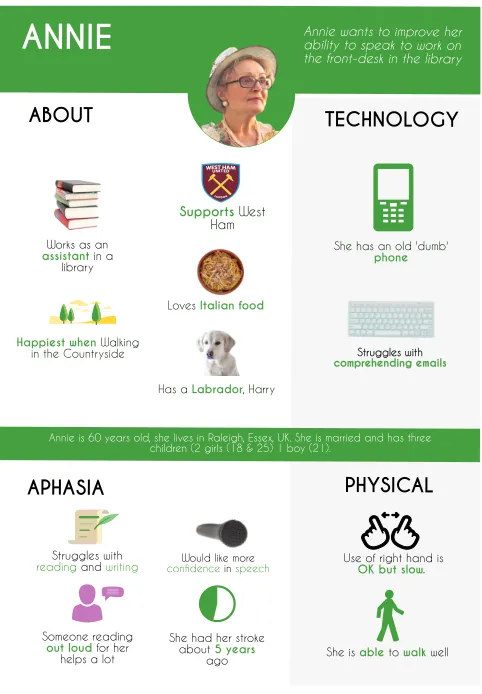
supportatabankandstruggleswithreading.Annieisa
60yearoldwithaphasia.Sheisindependent(livesalone),
struggleswithherreadingandwritingandwouldlikemore
confdenceinherspeech.Johnisayoungstrokesurvivor
(25) whoworksasacarerandlurksonsocialmedia,and
struggleswithspeakingduetohisaphasia.
ANNIE
Annie wants to improve herability to speak to work on the front-desk in the library
ABOUT
APHASIA
blurb
TECHNOLOGY
PHYSICAL
Works as an
assistantin a library
Happiest whenWalking in the Countryside
SupportsWest
Ham
LovesItalian food
She has an old 'dumb'
phone
Has aLabrador, Harry
Struggles with comprehending emails
Struggles with
readingandwriting
Someone reading
out loudfor her helps a lot
She had her stroke about5 years
ago
Would like more confidenceinspeech
Annie is 60 years old, she lives in Raleigh, Essex, UK. She is married and has three children (2 girls (18 & 25) 1 boy (21).
Use of right hand is
OK but slow.
She isabletowalkwell
Figure1:Co-CreatedPersona,Annie,whowasdesignedwith fourpeoplewithaphasia.Thepersonawasco-designedin termsofbothitsdetails,anditsaphasia-friendlyaesthetic.
ApproachtoPersonaGeneration
PersonaCreation.Inallthree studies,weasked the
co-designerstoco-createpersonasinworkshop1.Duringthese
activities,weaskedthemtoinventanotherperson,similar
tothemselvesinthattheyhadthesameimpairment,that
wemightuseintheworkshopsasanextravoiceinthe
de-signprocess.Atthebeginningofeachstudy,theco-designer
researcherscreatedscafoldsbylistingfeaturesthatare
com-moninpersonas,suchasname,age,location,family,and
hobbies,andotherbackgroundinformation.Features
[image:5.612.318.559.177.524.2]included.Theseincludeddigital contentcreationand
cu-ration,andhowpeoplewithaphasiamightengagewithit
inStudy3,ortheactivitiesthatpeoplewithdementiaand
Parkinson’sdiseasecarryoutintheireverydaylives,and
theirtechnologyuseinStudies1and2.
ployedinthestudies,duetothegoalsandtechnicalbackdrop
ofthedesigns,andtheusergroupsthemselves.Asmentioned
above,thefeaturesofthepersonaswerechosentoftthe
goalsofthedesignactivities.Studies1and2followedthe
PERCEPT(PERrsona-CEntredParticipatoryTechnology)
ap-proach[7].Personaswere constructediteratively,always
alternatingbetweenbringingoutco-designerparticipants’
livedexperiencesthroughaworkshopexercise,andthen
refectingonandintegratingthisinformationintothe
per-sonas.Thishadanefectonthenumberofpersonasinitially
created:participantswithParkinson’sdiseasecreatedtwo
primarypersonas,whereasparticipantswithdementia
cre-atedone,andtwosecondarypersonastorepresentawider
informalcarenetwork,mirroringthegroupcomposition.
theSWIMtechnique[43]toacquiredetailsaboutthe
impair-mentsofthepersonas.SWIMhasbeenshowntoworkwell
withpeoplewithaphasiaasitislessabstractandconcrete
discussionisusefulwiththispopulation.Eachco-designer
participantworkedwithaco-designerresearcherina
one-on-onesessioninwhich theywereasked tothink about
someonethattheyknowinreallife,capturingspecifc
de-tailsaboutthatperson’saphasiatobeusedinapersona.Due
tothewaythiswasorganised,fourpersonaswerecreated
(oneforeachco-designerparticipant).
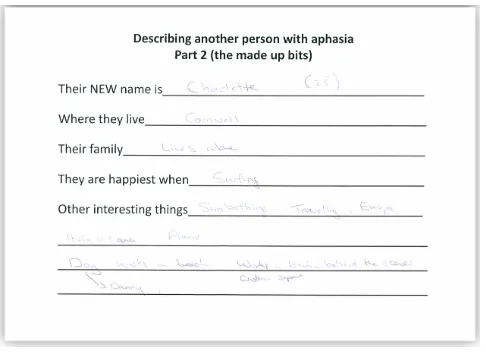
Co-designerresearchersfacilitateddiscussionsbetween
theco-designerparticipantstoinventdataforthepersonas–
generallyonpaperorawhiteboard(forexample,seeFigure
2).Thiswasachievedbytheco-designerresearchers
ask-ingforspecifcdetailsaboutthepersonasthatwedeemed
importantforthedesign(e.g.,“HowolddowethinkAnnie
is?”).Theco-designerparticipantsthendiscussedthese
fea-turesandwereencouragedtothinkoutsideofthespecifc
informationwerequested;theywerethusempoweredtoadd
newfeaturestothepersonas.Theco-designerresearchers
triedtoensurethateachmemberoftheco-designteamhad
equalweightinginthediscussions,whichwassometimes
facilitatedbyturn-takingwhenchoosingcharacteristicsofa
givenpersona.
inrelationtoothercharacteristicsofthepersonaandthe
otherpersonascreated.Ingeneral,wemadesurethatall
co-designerparticipantswerehappywithagivenfeatureand
itsdatabeforemovingon.Thenumberofpersonascreated
dependedontherequirementsoftheproject.Generally,the
There were some diferences between the approaches
em-Incontrast,theworkwithpeoplewithaphasiautilised
Consensus was reached through discussion of features
Figure2:Resultofasessionworkingwithpeoplewith apha-sia.Keyfeatures–name,age,hobbies–wererequested,but freedomwasextendedtotheco-designerparticipantsto con-tributeother‘interestingthings’.
aimwastocapturediversity,whilenothavingsomanyas
tobeexcessive,makingithardtoremembereachone.
RefiningandUsingthePersonas.Inallstudies,thepersonas
werethenactivelyprogressedoutsideoftheworkshops,
be-comingmorerefnedintheirdetailsandtheiraesthetic(see
supplementarymaterial).Afterworkshop1,allstudiesused
thepersonasactivelyintheworkshops,leadingto
refne-mentsduetoperceivedshortcomingsbytheco-designers.
Useofthepersonaswasencouragedbyrefectingonwhat
thepersonamightthinkafterdiscussingeachaspectof
de-signortechnologywiththeco-designerparticipants.
Inform,thepersonasbeganashand-writtentextonpaper
orwhiteboardinthefrstsession,thenprogressedthrough
variousversionsdevelopedinagraphicspackageandprinted
outfortheworkshops.Thepersonasweretheneditedas
andwhentheneedarose:werealisedthatsometimesthey
werenotftforpurpose(e.g.,theymightmissakeydetail
abouttheirtechnologyuse),soadaptionsweremadeasthe
sessionsprogressed,e.g.withamarkerpen.Thepersonas
werere-introducedbriefytotheco-designerparticipants
eachtimetheywereusedinallthreestudies,andthe
co-designerparticipantscouldmakeeditstothembeforeuse.
Numerousiterationsofvisualandtextdesignwereexplored
tomakethemasaccessibleaspossible.
DataCollectionandAnalysis
Allco-designworkshopswererecorded.Thisresultedin18
hoursofvideodataforstudy1(Parkinson’sdisease),15hours
ofvideodataforstudy2(dementia)and10hoursofaudio
andvideodata forstudy3(aphasia).Athematicanalysis
ofthesedatawasundertakentoinvestigatetheco-creation,
[image:6.612.318.561.90.266.2]Theanalysisbeganwithabottom-upinvestigationof
head-linedatafromtheco-designworkshops.Wecreatedaninitial
setof‘super-codes’toinvestigatethedataanddeveloped
emergentcodeswhenapplicable.Weappliedtheemergent
codesindetailtoasampleofthevideodatainorderto
re-fnethecodes.Thiscode-setwasthenre-appliedtothedata
iterativelytounderstanditsmainthemes,andwhomandto
whichpartoftheprocesseachcodereferredto.Datawere
codedbasedonconversationalturnandweconsidered
satu-rationtohaveoccurredwhennomorecodesemerged,which
Aldiabatetal.[2]describeas“codesaturation”.Codeswere
notmutuallyexclusive–thatis,super-codesandcodescould
overlap.Forexample,whileaco-designerwasevaluating
howwellaninteractiontechniqueworked(Evaluationinthe
DesignProcesssuper-code),apersonamightbebeingused
as‘shorthand’bysomeonewhohadtroubleremembering
(ShorthandintheAfordancesuper-code),whilstalsobeing
usedtocritiqueaspecifcaspectofadesign(Critiquingin
theAfordancesuper-code).Thetwofrstauthorsapplied
thecodes,creatinganddiscussingthemtoensure
consis-tency,andconsideringdiferencesandcommonalities.All
datawerecodedinNVivobythesetwomaincoders.
4 FINDINGS
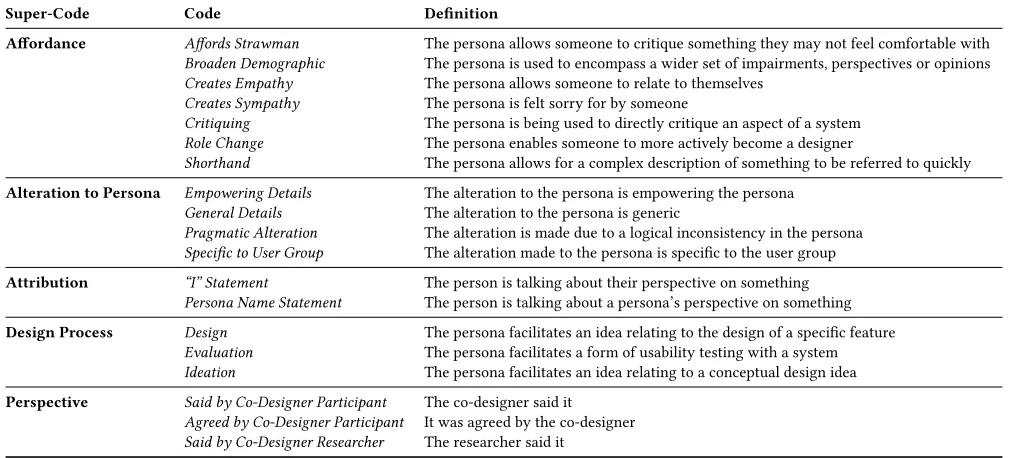
The
canbefoundinTable1.Thesedescribetheparticularthemes
thatwefoundaroundthepotentialafordancesofthe
per-sonas,thealterationsmadetothepersonas(andwhythey
weremade)alongwiththevariousattribution-baseddata
requiredtopinpointwhocontributedeachpieceof
infor-mation.Severalover-archingthemesemergedasaresultof
thisanalysis.Wewillnowreportanddescribethesethemes
andhowtheyrelatetoourdatainthecontextofourcodes
-supportedbyspecifcquotesfromthedata.
main set of codes which arose from analysis of the data
BroadeningofDemographic
A
graphic(code:BroadenDemographic),to beyondthose in
theworkshop–appearedtobesuccessfulinstudy3with
peoplewithaphasia.Personasweremostcommonlyusedto
broadenthedemographicduringactivitiesinwhichwewere
discussingelementsofthetechnology,withthepersonas
beingusedequallyindesignideationandevaluation.Thisis
unsurprisingbecausethiswastheirintendedpurpose.For
example,oneco-designerwithmilderaphasiafoundtheapp
beingdevelopedwasaimedatsomeonewithmoresevere
aphasiaandused‘Anne’toconsiderpeoplewithmoresevere
aphasia:“Shewouldfnditveryhelpful,becauseshe–ifshe
couldreadoutlouditwouldmeanthatshecouldrecognise
words.Itwouldmeanthatshecouldreadsomethingbutshe
couldnotretaininhermemory”(Neil).Discussionsaround
thepersonasalsoallowedotherco-designerstocontribute
stated aim of using the personas – broadening the
demo-potentialsolutions.WhendiscussingthepersonaCharlotte,
forexample,Oscarnotedthatifshefoundusingwordclouds
toocomplex,thenpicturescould beused: “Well. Youcan
putsomepicturein.Thatwouldhelp.Picturewillmakemany words.".
Oncethepersonaswereestablished,itwasclearthat
some-timestheco-designerresearchers,whenaskingabouta
par-ticularaspectofthesystem,didnotalwaysneedtoexplicitly
ask“Howwasthisforthepersona?”.Aftersomeuse,with
thepersonaonthetableinfrontofthem,co-designer
par-ticipantswouldmakeuseofitwithoutanycuing–clearly
becomingmorecognisantofthepersona,whichhadbecome
naturallyembeddedintothesession.Forexample,whenNeil
wasaskedhowhefoundarrangingthewordsintheapp,he
responded:“Idid,butifIcouldn’tIwouldfnditdifcult".
InStudy2,co-designer participantsmirroredthe
com-positionoftheirgroupofpeoplewithdementiaandtheir
informalcarersinthepersonas.Whatwasunexpectedwas
howtheycraftedawholefamily,developingatertiary
per-sonaofEnid.Thisbroadenedthedemographicconsiderably
bycreatingapersonaforausergroupthatwasnot
actu-allyincludedintheco-designactivities.Suggesting,perhaps,
thattheywerenotsimplyrespondingtotheworkshop,but
reactingtoandshapingtheprocess.Thiswassousefulthat
inStudy1,co-designerresearchersgaveco-designer
partici-pantsthepersonasofVeraandEnidtoadapttotheirneeds,
thuscreatingadditionalpersonasthatrefectedtheirwider
carenetworkandbroadeningtherangeofstakeholders.
EmpowermentofCo-Designer-Participant
Inallstudies,weintroducedthepersonageneration
activ-ityearlyto ensurethatwecouldusethepersonas when
makingkeydesigndecisions.Unknowingly,weallowedour
co-designerparticipantstobecomemorefamiliarwith‘being
designers’,beforetheywereevenmakingdesigndecisions
aboutthesystemtheywereco-designing.Allstudiesnoted
increasingconfdenceonthepartofco-designerparticipants
throughouttheintroductorycreationofthepersonas,
cap-turedinstatementscodedasAlterationtoPersona.
InStudy1,co-designerparticipantswereextremely
en-gagedwiththeco-creationofthepersonas,givenonly
min-imalinstructions.Theirengagementwasaccompaniedby
playfulnessandhumour,withtheco-designerparticipants
workingtogetheranddrawingontheirlivedexperienceto
createprimaryandsecondarypersonasandtofeshthemout.
Forexample,whenaskedhowtonameoneofthepersonas,
Prabhusaid–“Let’scallhimShakingSteven” referringto
1980sUKpopstarShakin’Stevens.Garethalsosuggested
includinga“beerfridge”inSteven’stechnologyashismain
activitywastobrewhisownbeer.
InStudy2,co-designerparticipantsweresoengagedwith
Super-Code Code Defnition
Afordance AfordsStrawman
BroadenDemographic
CreatesEmpathy
CreatesSympathy
Critiquing
RoleChange
Shorthand
The The The The The The The
persona persona persona persona persona persona persona
allowssomeonetocritiquesomethingtheymaynotfeelcomfortablewith isusedtoencompassawidersetofimpairments,perspectivesoropinions allowssomeonetorelatetothemselves
isfeltsorryforbysomeone
isbeingusedtodirectlycritiqueanaspectofasystem enablessomeonetomoreactivelybecomeadesigner
allowsforacomplexdescriptionofsomethingtobereferredtoquickly AlterationtoPersona EmpoweringDetails
GeneralDetails
PragmaticAlteration
SpecifctoUserGroup
The The The The
alteration alteration alteration alteration
tothepersonaisempoweringthepersona tothepersonaisgeneric
ismadeduetoalogicalinconsistencyinthepersona madetothepersonaisspecifctotheusergroup
Attribution “I”Statement
PersonaNameStatement
The
Thepersonpersonisistalkingtalkingaboutaboutatheirpersona’sperspectiveperspectiveonsomethingonsomething
DesignProcess Design
Evaluation Ideation
The The The
persona persona persona
facilitates facilitates facilitates
anidearelatingto aformofusability anidearelatingto
thedesignofaspecifcfeature testingwithasystem aconceptualdesignidea
Perspective Saidby
Agreed
Saidby
Co-DesignerParticipant
byCo-DesignerParticipant
Co-DesignerResearcher
Theco-designersaidit Itwasagreedbytheco-designer Theresearchersaidit
Table1:Codescreatedfrombottom-upinvestigationofdata.
werepleasantlysurprisedathowwelltheycouldremember
thepersonas’detailsandcharacteristics.June(George’s
in-formalcarerandpartner)said–“IcannotbelievethatGeorge
rememberseverythingaboutFred,youknowhiscondition de-terioratesandhecan’tevenrememberwhatheateyesterday [...]soIcannotbelievethatheremembersallthesethings”.
InStudy3therewasabriefreluctanceandasenseof
mi-norconfusionwhenmakingdecisionsaboutthepersonas.
Manyoftheresponsesinitiallydefningfeaturesofthe
per-sonaswereposedasquestions.Forexample,Elizabethwould
initiallybeginphrasingthedetailsaboutthepersonasas
questions.Forexample,whenchoosingCharlotte’sname:
“Charlotte?”.Thissuggestedthat–perhaps–theco-designer
participantswithaphasiawerenotparticularlyconfdentin
theirroleasdesigners.Thislackofconfdencefadedwithin
thefrstsession,andshe–andtherestoftheco-designer
participants–becamemoreassertiveinstatingand
debat-ingthedecisionsthattheymade.Aftertwosessions,the
co-designerparticipantsshowedafectiontotheprocessand
showednoreservationaboutrecommendingadjustmentsto
theapporthepersonas.Forexample,Elizabethshowedhow
shebegantoenjoytheprocessasitcontinued,andrefected
ontheprocesspositively:“It’slikefunny.Becausewechange
thenameintooldinsteadofyounger.Maybewechangemale
tofemale.[...]Wecreatethepersona.Tohelpthepeoplehave
stroke.Withaphasia.Andcanhelpthemtocommunicateby
usingtechnology”.
EnhancedEaseofCommunication
Utilisingthepersonasasameansforcommunication(code:
Shorthand)wasamajorthemethatemergedfromthe
anal-ysisofthedatainstudy3.Itwasapparentthat,throughout
theprocess,thepersonasallowedtheco-designer
partici-pantswithaphasiatooptimisetheiruseoflanguagerather
thanhavingtouseextensivelanguagetoarticulatea
partic-ularthought.TheShorthandcodeoftencoincidedwiththe
PersonaNameStatement code,indicatingthatthepersona
workedasausefulwayofsummarisinginformationquickly.
Thisalsoaidedco-designerparticipantsinmaking
recom-mendationsabouthowtheaestheticofthepersonascouldbe
changedtomakethemmoresuitableforusebypeoplewith
aphasia.Thepersonasweredesignedwithlotsofgraphics
andverysimpletextualdescriptions.
Theco-designerparticipantswould,forexample,
some-timesgesturetowardsaparticularpartofthephysical
per-sonato convey some information aboutwhat theywere
explaining.Thepersonawasmostcommonlyusedasaquick
methodtorefertoanimpairmenttoconsiderwhatcouldor
couldnotbedonebyaperson.Forexample,Annie’spersona
statesthatshestruggleswithreadingandwriting,butfnds
thatreadingoutloudhelpsheralot.Thisallowedoneof
theco-designerparticipants(Neil)toquicklyarticulatehow
othersmightutilisetheapplicationdiferentlybyreferring
tothevisualpersona–“ifshecouldreadoutloud[...]she
couldrecognisewords”.
InStudy2,co-designerparticipantsreferredtospecifc
[image:8.612.54.559.94.323.2]symptomsoftheirimpairment.Forexample,Georgetriedto
highlightthedifcultyofkeepingadiarywithhisthoughts
bysaying–“IthinkFredshouldusethedragonnatural
speak-ing,I thinkitwillhelphimto keepa diarywith hisgoals [...]andactivities.Iamusingit[...]Irecordmythoughtsand thenIlistenbacktothemsoIcanrememberthem”.Wenoted
thesameapproachinStudy1.Co-designerparticipants
sug-gestedthatintegratingvoicerecognitionintothesmarthome
toolkitwouldhelpthemtosetuptheirlifeplanmoreeasily.
Adamsaid–“Pathasavoicerecognitionsystembothatwork andhome,maybeitdoesreallyhelpher.Itwouldhelpustoo”.
Further,wenotedthatthepersonawasalsousedinthis
‘shorthand’waytogenerateideasadjacenttothemain
feed-backthatweweregettingontheappinstudy3,orindeed
tocreatecompletelynewdesignpossibilities(ideating).
Af-terusingthecreativewritingapp,oneco-designerquickly
referredtotheJimmypersonain orderto share theidea
ofcreatinganapplicationwhichisabletoassistwiththe
generationofmusic,insteadofcreativewriting- “Canuse...
butmaybewechangewithmusic?[insteadofwords]...Yeah?”
(Elizabeth).Thisallowedtheco-designertolowertheburden
ofexplainingthe–quitecomplex–conceptofhowthismay
beappliedtothemusicdomain,byreferringtotheappin
thecontextofJimmy’spassionformusicthroughtheshared
understandingthatwewerediscussingJimmy.
DiferentCritiquingStyles
InStudy1,co-designerparticipantsdidnotexplicitlyusethe
personastocritique(code:Critiquing)specifcfeaturesofthe
smarthometoolkit.Insteadtheyreferredtothemselvesand
theirpersonalopinionstoevaluatethenewtechnology.For
example,whenaskedtoevaluatethenewtechnology,Adam
said–“Icanseehowthissmarthometechnologycouldhelp peoplewithdementiabutitisnotforme,Idonothaveany
cognitiveimpairment,maybeinafewyearstime”,whereas
Sarahsaid–“Ilivebymyselfandmaybeonedayinthefuture
itwouldbeusefultohaveameansofsensing,ifIhavehad afall,Iknowtherearebuttonsyoucanpressbutifyouare
notconsciousandcannotpressthebuttonitwouldbegood
tohavesomethingthatmonitorsyouarenotmoving fora
while”.Essentially,insteadofreferringtothepersona(
Per-sonaNameStatementcode),thisusergroupmuchpreferred
todiscusstheirproblems–mostlyusingthe“I”Statement
(code).Wenotedthatco-designerparticipantswith
Parkin-son’sdisease wereuncertainabout thenew smarthome
toolkit:theybelievedthatitwouldbemoreusefultoa
per-sonwithacognitiveimpairment,astheywerethemselves
veryindependentandactive.
InStudy2,however,thiswasdiferent.Co-designer
par-ticipantscritiquedandevaluatedthesmart hometoolkit
throughthepersonas.Whenaskedtocommentonhoweasy
itwas tosetupanewlifeplanusingthetoolkit,George
said–“ThelifeplanshouldbejointlycreatedbyFredand Vera.IwouldexpectFredwouldneedVera’shelpforthat” and "Fredmighthavesomeproblemswithspelling,willthetoolkit recognisewordsthatarenotproperlywritten?".
InStudy3,aftertheco-designerparticipantswithaphasia
hadgiventheirownviewsaboutanaspectofaprototype,
theyalsousedthepersonasefectivelytocritiquethe
pro-totypefromthepersona’sperspective.TheCritiquingcode
wascommonlyusedintandemwithPersonaNameStatement
andwasgenerallySaidbyCo-DesignerParticipant.For
ex-ample,whenweaskedElizabethhowsomeonewithmore
severeissuesspeaking(Charlotte)wouldgetonwithusing
thecreativewritingapp,shewasoptimistic:“er...Shecan
readslow...Ifyouhavepatienceyoucanreaditagainand again.Yeah?”.Thepersonaswerealsousedtocritiquethe app:“IfJohnforexample,sayhehashadhisstrokerecently, hewouldbeverylimitedinwhathecouldsayorproduce.So, itwouldbeverygoodforhim"(Neil).Thepersonaswerealso
usedbytheco-designerparticipantstoengageinIdeation
aboutfeaturesthattheappmighthaveinthefuture.For
ex-ample,whenthinkingofJohn–apersonawithmoresevere
aphasia–usingtheappforcreatingcreativewriting,Neil
notedhissolutionforovercominghisbarriers:“Idoreading
inchurch.WhenIwanttoprepareit...IfIdon’tprepareitis notveryclear.WhenIreadit,Istartedputtinglinesbetween eachphrase.SothatIdon’trunthewordsintoeachother,but
alsotoslowmedown”.Theseideasandsolutionsoftencame
un-cuedduetotheco-designerparticipantsruminatingon
howthepersonawould‘getonwith’something.
Wealsosawamorenuanceduseofthepersonasinthe
data fromstudy 3:therewas evidencethatthepersonas
wereusedasstrawmen(code:AfordsStrawman).Asthe
co-designerparticipantswerediscussingtheapp,itbecame
evidentthatsomeaspectsofthedesignwerechallenging.For
example,likelyduetotiredness,oneco-designerparticipant
clearlyhadissueswiththenumberofwordshehadtoread
andittookhimseveralminutestocompleteafewactions.
HeexplainedthisusingtheJimmypersonaanditisevident
thatthisallowedhimtofeelmoreconfdentincritiquing
anaspectofsystemtothosewhowereresponsibleforits
implementation,withoutexplicitlystatingthathefoundit
challenging:“Soifyoucutitdown,haveJimmymakehislyrics
together...WhenIsawthething...Itistoomuch.Toomanywords for...".
Further,inStudy1,co-designerparticipantshadproblems
completingtheirprofleusinginteractivemock-upsdueto
theirtremor.Paultriedtoexplainwhyitwastakinghimso
longtowritehisname:–“Ithinkthatthetextboxisvery
AtachmenttothePersona
Co-designerparticipantsshowedadegreeofattachmentto
thepersonas.Commonly,theygenerated,orchanged,
fea-turesofthepersonaswhichprotectedthemor‘saved’them
fromtheircurrentsituations.Itwasthereforeoccasionally
challengingtoaddresssomeofthemoreemotionally
com-plexaspectsofacondition.Forexample,whenworkingin
Study3withpeoplewithaphasia,itwaschallengingto
gen-eratean‘independent’personawholivedalone.TheCreates
Sympathycodewascommonlylinkedtoco-designer
par-ticipantsaddingdetails topersona’sGeneralDetails.One
instanceofthiswaswhereaco-designerparticipantshowed
sympathyfortheCharlottepersona:hecouldnotbeartosee
Charlottelivealone,“onething,whenyoutalkabout
Char-lotte...Theysaidthatshewaslivingalone.Ican’tunderstand why...Howanyonewhohasgotastroke,youknow.Youalways needtohavesomeone.So,Idon’tunderstandthat"(Oscar).
Later,healsousedhislifeexperiencetocontextualisethis,
“Sheis74,myfriend.Shefellofthebedandshelivesalone.74. Andshewaslayingonthefoorandnobodycouldhelpher.”.
We alsoobserved that theco-designer participants in
Study3sometimeshowedempathytowardsthepersonas
(code:CreatesEmpathy),asthepersonasenabledthemto
refectontheirownsituation–orindeedthesituationthat
theywereinsoonaftertheirstroke,beforetheybegan
recu-perativetherapy.Neil,forexample,usedhisownexperience,
combinedwithpersonaJohn’sdescriptiontomakeadesign
assessment:“Ifhehadastroke2yearsagohewouldbeable
to...Letmegoback...Myspeechaftermystroke...Icouldn’t getthewordout.So,Isuspectthathewouldbethesame[using theapp].”
InbothStudies1and2,co-designerparticipants
empow-eredtheirpersonasanddecidedtoincludeonlysubtlecues
abouttheconditionsandtheirefects.Evenmoresothan
StevenandPat,Fredappearstobecarryingonasusualas
muchaspossible,tryingtomaintaintheactivitiesthathe
en-joys.However,duringdiscussionsintheworkshop,itcame
tolightthatinreallifethechallengesoflivingwithdementia
arenumerous,forexample:“Ifnditquitedifculttomanage
money–can’tbetrustednottospendallofit–soIcan’ttake acreditcardto[alocalDIY]shopanymore”(George).
Anotherfndingwasthatco-designerparticipantsinStudy
1addedevenmoretechnologytoPat’spersona,makingher
anextremepersona[16,44]relativelyuntypical,possiblyto
exploretheboundariesofthenewsmarthometoolkit.They
alsoextendedthepersonaswithunanticipatedfacets,
intro-ducingaspectsthatwedidnotinitiallyconsider.Forexample,
theypointedoutthatmentalattitudetowardslivingwith
thediseasehelpsalotinkeepingupwiththedailyactivities
–Prabhusaidthat“Yourpersonalityplaysanimportantrole
inhelpingyoucopewithyourcondition”.
CreationofAspirationalPersonas
Partiallyrelatedtotheattachmentnotedpreviously,and
in-deedforotherreasonsrelatingtothefunofhavingboundless
optionstoexplore,manyoftheco-createdpersonaswere
quiteaspirational.Theyoftenhadcharacteristicswhich
peo-plewithagivenimpairmentmightnothave.Forexample,
inStudy3,mostofthepersonashadjobs,andthecoding
suggeststhatalmostallofthesefeatureswerecontributedby
theco-designerparticipants(code:saidbytheco-designer).
Sadly,thisisnotthecurrentrealityforpeoplewithaphasia.
Forexample,Annie–whohasproblemswithreadingand
writing–worksatalibrary,whichisnotimpossible,but
makesforasomewhatatypicalpersona.
InStudy2,FredandVera,representingpeoplewith
demen-tiaandtheirinformalcarers,alsoappearedtobeaspirational
personas[31],withtheparticipantstrustingthattechnology
willbeabletofacilitatemoredesirableexperiencesinstead
ofday-to-daygoalsandactivities.Apleasantsurprisewas
thefacetstheco-designerparticipantschosetoincludein
thesepersonas.Idealisticfeaturesweregenerated,suchas
thoseforEnid,whoismarriedtoarichhusbandandlivesin
Miami,isverysocial,enjoysshopping,socialisingandhorse
riding.Thepersonawasalsoempoweredthroughherrole
organisinggalastofund-raiseandincreaseawarenessfor
Alzheimer’sdisease,makingheranadvocatetosomedegree.
EvenVera’sgoalsandactivitieshighlightwhatshewould
wanttodo,insteadofwhatsheactuallydoesday–to–day.
Forexample,duringdiscussionsintheworkshopitcameto
lightthatinreallifethechallengesoflivingwithdementia
arenumerous,forexample:“Iambadwithmoney,whichis
abitannoying.Mydaughtercomesdownandsheisbrilliant lookingaftermyfnanceafairs”(Colin).
InStudy3,wefoundthatlogicalconsistenciesinthe
per-sonaswereoftenwhittledoutwithinthedesignprocess.The
analysissuggeststhatmostoftheseamendments,codedas
PragmaticAlterations,camefromtheco-designerresearchers.
Forexample,whenconsideringJimmy’shobbiesitbecame
evidentthatitwouldbechallengingforhimtostillsingin
arhythmandbluesbandduetohislimitedverbaloutput.
Oneco-designerresearcherthereforeconcluded–“Maybe
heusedtosinginarhythmandbluesband...butnowhesings inachoirinstead...”. However,incontrast,inStudy1the
co-designerparticipantsdecidedtoaltertheirpersonasand
gavethemmore‘realistic’characteristics;Paulsuggested
that“Weshouldincludegroomingforprofessionalappearance toPat’sactivitiesassheisaChiefExecutiveforapublichealth sector”.Sarahalsosuggestedthattheyshouldinclude
shav-inganddressingtoSteven’sactivities–“Hewasdiagnosed
5 DISCUSSIONANDREFLECTIONS
Forthemostpart,wefound thepersonasto bepowerful
toolsforengaginguserswithdiverseneedsintheco-design
process.Theco-createdpersonas wereahighly efective
wayofbroadeningtheparticipantpool.Theco-designer
par-ticipantsinallthreestudiesengagedwiththepersonasin
diversebutefectiveways.Wefoundthatdoingtheinitial
scopingofthepersonaswiththeSWIMtechniqueallowed
forthecaptureofrealisticimpairmentsastheywerebased
onrealpeople,thentheadditionoffeaturesenabledthe
co-designerparticipantstobemoreinvestedandfocusedonthe
processastheyexhibitedownershipofthedesignmaterials.
Webelievethattheactofcreatingthepersonaswasavery
efectivetoolfor‘ramping’thedesignersintotheprocess
of‘beingadesigner’.Afundamentaltensioninthedesign
processisco-designerparticipants–whoarenotdesigners
ortechnologistsbyprofession–feelreservedmaking
deci-sionsaboutthedesignoftechnology.Ourapproachaddresses
thistensionofco-designbyusingpersonaco-creationasan
introductoryactivity,inwhichpeoplearedrawnintothe
designprocessgradually,thereforehavemoreconfdence
whenmakingdecisionsabouttechnology.Further,abeneft
ofco-creatingpersonasinthedesignprocess,asopposedto
simplyusingthem,mightbethatwebetterrememberthings
thatweareactivelyengagedin.Ourdataseemedtosuggest
afastlearningprocessandgoodmemoryretentionofthe
persona’sfeatures.Stefensetal.[36]describesthisconcept
inareviewoftheconceptof‘learningbydoing’,notingthat
(withsomeexceptions)enactment,asopposedtoobserving,
improvesonesabilitytorecognisespecifcactions.And
in-deed,leadstosuperiorfreerecallofitems.Theyprovidea
quotefrom[38],whoillustratethispointefectively:“Ineed
todrivetorememberaroute.Iwillremembernothingasa
passenger”.
Theminorvariationsinthemethodbetweenthestudies
weremostlyindicativeofthevariationsintheusergroups
andthetechnologies,however,somevariationshaveofered
insightintowhatworksandwhatdoesnot.InStudies1and
2,breakingupthepersonacreationintosmallerpartswhile
focusingonspecifcfacetsanddrawingontheco-designer
participants’livedexperiencesworkedparticularlywell.In
Study3,weutilisedtheSWIM[43]approachtogeneratethe
personasbyaskingspecifcquestionsaboutarealpersonthat
theco-designerparticipantknew.Thismeantthattheinitial
personashadmoreinformationabouttheirimpairmentsand
likelyresultedinlessidealisedfeaturesforthesepersonas
asthestartingpointwasa‘realperson’.
Oneoftheinitialexpectationsofutilisingco-created
per-sonaswasthat,byworkingdirectlywiththepeoplewiththe
impairments/conditionstocreatethepersonas,theywould
beinsomewaymorerealistic.Inspiredbythe–often
unre-alistic–personaswhichrepresentpeoplewithimpairments,
wefeltthatthepersonasthemselvescouldbeaviable
‘out-put’ofthework,andthattheycouldbeappropriatedby
others.However,wewouldsaythatwehadmixedresults
here.Whilesomeof thepersonasare realistic,others
ap-pearsomewhatidealised.Overthecourseoftheprojects,
thisaroseduetotheco-designerparticipants’sympathyand
empathywiththepersona’s situation.Onrefection,this
mightbeindicativeofthebondbetweentheco-designer
par-ticipantsandthepersonas.Asa‘copingstrategy’,someof
thesefeaturesweresteeredbyco-designerparticipants,and
weremostlykeptincheckbytheco-designerresearchers
andotherco-designerparticipantsalike.Althoughwenote
apotentialtensionhere,werefectontheearlydiscussions
ofpersonaby[30],whonote:thatitischallengingto“have
everystatementinourPersonasgeneratedfromorrelatedto userdataorobservation".Thisnoted,furtherworkmight
explorehowprocessesmightplayamoreformativerolein
guidingmorerealistic,usablepersonasinsuchco-design
processes.
6 CONCLUSION
Inthispaperwehaveconsideredtheco-creationofpersonas
withthreegroupsofuserswithdiverseneedsanddetailed
howwehave utilisedthemintoourco-designwork.We
believethatourworkontheco-creationofpersonaswith
usershas:
• broadenedthedemographicbeyondasmallteamof
co-designerstoincludepeoplewithdiversehealthneeds;
• fosteredempathy,sympathyandmemorabilitywithin
theco-designprocess;
• ofered‘ramping’intothedesignprocessofbeinga
designerfornon-designers;and
• enabledeaseofcommunicationthroughavisualprop,
andawaybywhichusersmightmoreefectively
criti-cisedesignsbyusingthepersonaasproxy.
Webelievetheuseofpersonasasdescribedinthispaper
mightofernewopportunitiestoengageunder-represented
anddiversegroupsofusersinthedesignprocess,with
pow-erfulscopeforexpansion.
7 ACKNOWLEDGEMENTS
Wewouldliketothankalltheco-designerparticipantsfor
theirinvolvement.TheINCAprojectwasfundedbyEPSRC
EP/P025587/1andtheSCAMPIprojectwasfundedbyEPSRC
EP/P010024/1.Finally,wethankanonymousreviewersfor
REFERENCES
[1] TamaraAdlinandJohnPruitt.2010. Theessentialpersonalifecycle:
Yourguidetobuildingandusingpersonas.MorganKaufmann.
[2] KhaldounMAldiabat,LeNavenec,etal.2018.Datasaturation:The mysteriousstepingroundedtheorymethod.TheQualitativeReport 23,1(2018),245–261.
[3] Aphasia.org.2018. NationalAphasiaOrganization. https://www. aphasia.org/
[4] BlomquistandMattiasArvola.2002.PersonasinAction:Ethnography inanInteractionDesignTeam.InProceedingsoftheSecondNordic
ConferenceonHuman-computerInteraction(NordiCHI’02).ACM,New
York,NY,USA,197–200. https://doi.org/10.1145/572020.572044 [5] SusanneBødkerandOleSejerIversen.2002.Stagingaprofessional
participatorydesignpractice:movingPDbeyondtheinitialfascination ofuserinvolvement.InProceedingsofthesecondNordicconferenceon
Human-computerinteraction.ACM,11–18. http://doi.acm.org/10.1145/
572020.572023
[6] KirstenBoehner,JanetVertesi,PhoebeSengers,andPaulDourish.2007. HowHCIInterpretstheProbes.InProceedingsoftheSIGCHIConference
onHumanFactorsinComputingSystems(CHI’07).ACM,NewYork,
NY,USA,1077–1086. https://doi.org/10.1145/1240624.1240789 [7] AikateriniBourazeriandSimoneStumpf.2018.Co-DesigningSmart
HomeTechnologywithPeoplewithDementiaorParkinson’sDisease.
InProceedingsofthe10thNordiCHIConference. https://doi.org/10.
1145/3240167.3240197
[8] PamelaBriggs,PatrickOlivier,andJimKitson.2009.FilmAsInvisible Design:TheExampleoftheBiometricDaemon.InCHI’09Extended
Ab-stractsonHumanFactorsinComputingSystems(CHIEA’09).ACM,New
York,NY,USA,3511–3512. https://doi.org/10.1145/1520340.1520517 [9] JacobBuurandSusanneBødker.2000.Fromusabilitylabto‘design collaboratorium’:reframingusabilitypractice.InProceedingsofthe
3rdconferenceonDesigninginteractivesystems:processes,practices,
methods,andtechniques.ACM,297–307. http://doi.acm.org/10.1145/
347642.347768
[10]DanielGCabrero,HeikeWinschiers-Theophilus,Jose Abdelnour-Nocera,andGereonKochKapuire.2016.Ahermeneuticinquiryinto user-createdpersonasindiferentNamibianlocales.InProceedingsof
the14thParticipatoryDesignConference:Fullpapers-Volume1.ACM,
101–110.
[11]AlanCooperetal.2004. Theinmatesarerunningtheasylum:[Why
high-techproductsdriveuscrazyandhowtorestorethesanity].Sams
Indianapolis.
[12]ErinFriess.2012.Personasanddecisionmakinginthedesignprocess: anethnographiccasestudy.InProceedingsoftheSIGCHIConference
onHumanFactorsinComputingSystems.ACM,1209–1218. http:
//doi.acm.org/10.1145/2207676.2208572
[13]JuliaGalliers,StephanieWilson,JaneMarshall,RichardTalbot, Ni-amhDevane,TraceyBooth,CeliaWoolf,andHelenGreenwood.2017. ExperiencingEVAPark,aMulti-UserVirtualWorldforPeoplewith Aphasia. ACMTrans.Access.Comput.10,4,Article15(Oct.2017), 24pages. https://doi.org/10.1145/3134227
[14]BillGaver,TonyDunne,andElenaPacenti.1999. Design:cultural probes. interactions6,1(1999),21–29. http://doi.acm.org/10.1145/ 291224.291235
[15]TrishaGreenhalgh,ClaireJackson,SaraShaw,andTinaJanamian.2016. Achievingresearchimpactthroughco-creationincommunity-based healthservices:literaturereviewandcasestudy.TheMilbankQuarterly 94,2(2016),392–429. https://doi.org/10.1111/1468-0009.12197 [16]ZahidHussain,MartinLechner,HaraldMilchrahm,SaraShahzad,
WolfgangSlany,MartinUmgeher,andPeterWolkerstorfer.2008.Agile user-centereddesignappliedtoamobilemultimediastreaming applica-tion.InSymposiumoftheAustrianHCIandUsabilityEngineeringGroup.
Springer,313–330. http://dx.doi.org/10.1007/978-3-540-89350-9_22 [17] AgeInternational.2018.GlobalAgeing. https://www.ageinternational.
org.uk/policy-research/statistics/global-ageing/
[18] Alzheimer’sDiseaseInternational.2018.Dementia:TheFacts. https: //www.alz.co.uk/world-alzheimers-month/dementia-facts
[19] Parkinsons International. 2018. Understanding Parkinsons: Statistics. http://parkinson.org/Understanding-Parkinsons/ Causes-and-Statistics/Statistics
[20] StephenLindsay,KatieBrittain,DanielJackson,CassimLadha,Karim Ladha,andPatrickOlivier.2012.Empathy,participatorydesignand peoplewithdementia.InProceedingsoftheSIGCHIConferenceon
HumanFactorsinComputingSystems.ACM,521–530. http://doi.acm.
org/10.1145/2207676.2207749
[21] StephenLindsay,DanielJackson,GuySchofeld,andPatrickOlivier. 2012.Engagingolderpeopleusingparticipatorydesign.InProceedings
oftheSIGCHIconferenceonhumanfactorsincomputingsystems.ACM,
1199–1208. http://doi.acm.org/10.1145/2207676.2208570
[22] TaraMatthews,TejinderJudge,andSteveWhittaker.2012.Howdo designersanduserexperienceprofessionalsactuallyperceiveanduse personas?.InProceedingsoftheSIGCHIconferenceonhumanfactors
incomputingsystems.ACM,1219–1228. http://doi.acm.org/10.1145/
2207676.2208573
[23] JenniferJenMcGinnandNaliniKotamraju.2008.Data-drivenpersona development.InProceedingsoftheSIGCHIConferenceonHumanFactors
inComputingSystems.ACM,1521–1524. http://doi.acm.org/10.1145/
1357054.1357292
[24] RoisinMcNaney,MadelineBalaam,AmeyHolden,GuySchofeld, DanielJackson,MaryWebster,BrookGalna,GillianBarry,Lynn Rochester,andPatrickOlivier.2015. Designingforandwith Peo-plewithParkinson’s:AFocusonExergaming.InProceedingsofthe
33rdannualACMconferenceonHumanFactorsinComputingSystems.
ACM,501–510. http://doi.acm.org/10.1145/2702123.2702310 [25] ValMitchell,TracyRoss,AndrewMay,RuthSims,andChristopher
Parker.2016.Empiricalinvestigationoftheimpactofusingco-design methodswhengeneratingproposalsforsustainabletravelsolutions.
CoDesign12,4(2016),205–220. https://doi.org/10.1080/15710882.2015.
1091894
[26] ClaudiaMüller,DominikHornung,TheodorHamm,andVolkerWulf. 2015.Practice-basedDesignofaNeighborhoodPortal:Focusingon ElderlyTenantsinaCityQuarterLivingLab.InProceedingsofthe33rd
AnnualACMConferenceonHumanFactorsinComputingSystems(CHI
’15).ACM,NewYork,NY,USA,2295–2304. https://doi.org/10.1145/ 2702123.2702449
[27] TimothyNeate,AbiRoper,StephanieWilson,andJaneMarshall.2019. EmpoweringExpressionforUserswithAphasiathroughConstrained Creativity.InProceedingsoftheSIGCHIConferenceonHumanFactors
inComputingSystems.ACM. https://doi.org/10.1145/3290605.3300615
[28] LeneNielsen.2011. Personasinco-creationandco-design.In
Pro-ceedingsofthe11thHuman-ComputerInteractionResearchSymposium.
38–40.
[29] VictoriaJanePalmer,WayneWeavell,RosemaryCallander,Donella Piper,LauralieRichard,LynneMaher,HilaryBoyd,HelenHerrman, JohnFurler,JaneGunn,RickIedema,andGlennRobert.2018.The Par-ticipatoryZeitgeist:anexplanatorytheoreticalmodelofchangeinan eraofcoproductionandcodesigninhealthcareimprovement.Medical
Humanities(2018). https://doi.org/10.1136/medhum-2017-011398
[30] JohnPruittandJonathanGrudin.2003.Personas:practiceandtheory. InProceedingsofthe2003conferenceonDesigningforuserexperiences. ACM,1–15. http://doi.acm.org/10.1145/997078.997089
CHIConferenceExtendedAbstractsonHumanFactorsinComputing
Systems.ACM,933–941. http://doi.acm.org/10.1145/3027063.3053355
[32]LouiseRobinson,KatieBrittain,StephenLindsay,DanJackson,and PatrickOlivier.2009. KeepingInTouchEveryday(KITE)project: developingassistivetechnologieswithpeoplewithdementiaandtheir carerstopromoteindependence.InternationalPsychogeriatrics21,3 (2009),494–502. https://doi.org/10.1017/S1041610209008448 [33]AbiRoper,JaneMarshall,andStephanieWilson.2016.Beneftsand
limitationsofcomputergesturetherapyfortherehabilitationofsevere aphasia.Frontiersinhumanneuroscience10(2016),595. https://www. ncbi.nlm.nih.gov/pmc/articles/PMC5126070/
[34]ElizabethB-NSandersandPieterJanStappers.2008.Co-creationand thenewlandscapesofdesign.Co-design4,1(2008),5–18.
[35]RashmiSinha.2003. PersonaDevelopmentfor Information-rich Domains.InCHI’03ExtendedAbstractsonHumanFactorsin
Com-putingSystems(CHIEA’03).ACM,NewYork,NY,USA,830–831.
https://doi.org/10.1145/765891.766017
[36]MelanieCStefens,RulvonStülpnagel,andJanetteCSchult.2015. Memory recall after“learning bydoing”and “learningby view-ing”:Boundaryconditionsofanenactmentbeneft.Frontiersin
psy-chology6(2015),1907. https://www.ncbi.nlm.nih.gov/pmc/articles/
PMC4681778/
[37]HelenaSustar,SimonBowen,AndyDearden,MarkFisher,andDan Wolstenholme.2013.Usingpopularculturetoenablehealthservice co-designwithyoungpeople.EAD(2013). http://shura.shu.ac.uk/6688/ [38]RulvonStülpnagelandMelanieCStefens.[n.d.]. Activeroute learninginvirtualenvironments:disentanglingmovementcontrol fromintention,instructionspecifcity,andnavigationcontrol.
Psy-chologicalresearch77,5([n.d.]),555–574. https://doi.org/10.1007/
s00426-012-0451-y
[39]JayneWallace,AnjaThieme,GavinWood,GuySchofeld,andPatrick Olivier.2012.Enablingself,intimacyandasenseofhomeindementia: anenquiryintodesigninahospitalsetting.InProceedingsoftheSIGCHI
ConferenceonHumanFactorsinComputingSystems.ACM,2629–2638.
https://doi.org/10.1145/2207676.2208654
[40] JayneWallace,PeterCWright,JohnMcCarthy,DavidPhilipGreen, JamesThomas,andPatrickOlivier.2013.Adesign-ledinquiryinto personhoodindementia.InProceedingsoftheSIGCHIConferenceon
HumanFactorsinComputingSystems.ACM,2617–2626. https://doi.
org/10.1145/2470654.2481363
[41] PontusWärnestål,PetraSvedberg,SusanneLindberg,andJensM Nygren.2017.Efectsofusingchildpersonasinthedevelopmentofa digitalpeersupportserviceforchildhoodcancersurvivors.Journalof medicalInternetresearch19,5(2017). https://doi.org/10.2196/jmir.7175 [42] IrithWilliams,MargotBrereton,JaredDonovan,Karalyn McDon-ald,TanyaMillard,AlexTam,andJulianHElliott.2014. A col-laborativerapidpersona-buildingworkshop:creatingdesign per-sonaswithhealthresearchers.InternationalJournalof
Sociotechnol-ogyandKnowledgeDevelopment(IJSKD)6,2(2014),17–35. https:
//doi.org/10.4018/ijskd.2014040102
[43] StephanieWilson,AbiRoper,JaneMarshall,JuliaGalliers,Niamh Devane,TraceyBooth,andCeliaWoolf.2015. Codesignforpeople withaphasiathroughtangibledesignlanguages.CoDesign11,1(2015), 21–34. https://doi.org/10.1080/15710882.2014.997744
[44] PeterWolkerstorfer,Manfred Tscheligi, Reinhard Sefelin,Harald Milchrahm,ZahidHussain,MartinLechner,andSaraShahzad.2008. Probinganagileusabilityprocess.InCHI’08ExtendedAbstractson
HumanFactorsinComputing Systems.ACM,2151–2158. https:
//doi.org/10.1145/1358628.1358648
[45] LWoods,ECummings,JDuf,andKWalker.2018.ConceptualDesign andIterativeDevelopmentofamHealthAppbyClinicians,Patients andTheirFamilies.Studiesinhealthtechnologyandinformatics252 (2018),170–175. https://www.ncbi.nlm.nih.gov/pubmed/30040701 [46] PeterWrightandJohnMcCarthy.2008.Empathyandexperiencein
HCI.InProceedingsoftheSIGCHIConferenceonHumanFactorsin
ComputingSystems.ACM,637–646. https://doi.org/10.1145/1357054.