City, University of London Institutional Repository
Citation
:
Bailey, A., Lang, T. and Schoen, V. (2016). Does the CAP still fit?. UK: Food
Research Collaboration.
This is the published version of the paper.
This version of the publication may differ from the final published
version.
Permanent repository link:
http://openaccess.city.ac.uk/15039/
Link to published version
:
Copyright and reuse:
City Research Online aims to make research
outputs of City, University of London available to a wider audience.
Copyright and Moral Rights remain with the author(s) and/or copyright
holders. URLs from City Research Online may be freely distributed and
linked to.
City Research Online:
http://openaccess.city.ac.uk/
[email protected]
Food R
esear
ch
Collaboration
Does the CAP still fit?
Alison Bailey
1, Tim Lang
2, Victoria Schoen
3, 4Executive Summary
The Common Agricultural Policy (CAP) has evolved through various reforms since its outline in 1958 and
formal inception in 1962. It has changed from a policy focused on farm production outputs to one focusing
more on social, rural and environmental support. UK policy interest in the CAP is being shaped by the
Referendum decision on whether or not to remain a part of the EU. To disentangle UK food and farm policy
from that of European neighbours and then to re-establish workable trading links is not a small task. We
argue that ideally the CAP would become a Common Sustainable Food Policy or Common Food Policy. This
framework would help integrate farm and fisheries policies with diverse measures that are needed to
reduce food’s impact on health, environment and social inequalities.
Policy-makers at EU and national levels must help shift the food system to meet the needs of the 21
stcentury. Some of CAP’s founding aims – for food security, affordability, health – remain appropriate today,
although what is meant by those goals has altered since the CAP was mooted in the late 1950s. Written
before the UK’s 2016 Referendum on EU membership, this paper argues that, whether the UK is in or out,
the drive to more sustainable consumption and production needs to be an essential characteristic of the
UK’s diet and supply chain. The UK like all EU member states needs to review its entire food system. At the
EU level, a Common Food Policy would translate existing commitments to Sustainable Consumption and
Production and help meet the new Sustainable Development Goals. The paper signals out some elements
where new broader thinking is already emerging or being debated: animal welfare, water, public health,
waste reduction and the commitment to the ‘circular economy’. Clearer political leadership and policy
leverage is required to enable the structural shifts required. Civil society and academics can play an
important role in creating the appropriate arguments, data and conditions for the transition that is sorely
needed.
Specifically, the paper explains how:
•
The CAP was first introduced over 50 years ago in response to post-war food insecurity and has
been constantly changing over time. The latest reforms of 2013 began to take effect in 2015.
•
The 2013 reforms introduced a new greening element into the CAP in an effort to encourage
sustainable production. Following from the 2000 reforms, payments under so-called Pillar 1 are
now made on a per hectare basis rather than per unit of output.
•
Although considerably less than the 70% seen in the 1980s, the CAP now absorbs 40% of the EU
budget.
•
The Directorate-General for Agriculture and Rural Development in Brussels has only 1,000 civil
servants, yet accounts for over a third of the total EU budget. Defra in the UK has 2,000 for England
alone.
1 Professor of Farm Management, Lincoln University, NZ (formerly Associate Professor, School
of Agriculture, Policy and Development, University of Reading): [email protected]
2 Professor of Food Policy, Centre for Food Policy, City University London: [email protected] 3
Research Fellow, Food Research Collaboration (FRC): [email protected]
4 We gratefully acknowledge the insights given on an earlier draft by Professor Alan
Food R
esear
ch
Collaboration
Does the CAP still fit?
•
In the UK, farmers receive only £10 billion of the £198 billion that UK consumers spend on food per
year. Many farmers rely on the additional income from subsidies to keep them in farming.
•
The CAP has social, economic, health and environmental impacts, not all of which are beneficial.
Perhaps most success in the UK has come in terms of environmental improvements, but there is
still much to be done in this area.
•
Although the CAP has not impacted animal welfare directly, it does have indirect effects as the
subsidies given to arable farming have allowed an increase in the intensive pig and poultry sectors.
•
Many problems are noted with the current CAP, which means it will need to radically change in the
future. Four broad options about CAP’s purpose and preparations for the next phase of reform are
explored in which CAP: (a) weakens significantly; (b) evolves pragmatically; (c) becomes a rural
development policy; or (d) becomes a Common (Sustainable) Food Policy. The paper favours a
Common Sustainable Food Policy that addresses current health crises and environmental costs.
•
Problems in the food and farming sectors remain whether the public votes to Brexit or Bremain on
23
rdJune. A Common Sustainable Food Policy will be relevant whatever the outcome.
1.
Introduction
The Common Agricultural Policy (CAP) has a long history and has seen many reforms since it was first mapped at the 1958 Stresa Conference and formalised in detail in 1962(1). It was established with ambitious goals to remedy post-war food shortages and prevent their recurrence. The CAP was to be a food and farming policy with social and health goals at its heart (2), (3). Over half a century later, the latest of many reforms to CAP have begun to take effect and have again led to debate between producer groups, environmentalists, nutritionists and academics as to whether and to what extent the new policies will be detrimental or beneficial. This debate is right, and echoes debates about the shape of the food system and the role of policies across the world. The UK’s Referendum has highlighted the symbolic, financial and public importance of farm policy. A country such as the UK, which is heavily reliant on food imports from the EU, and where indigenous food production is slowly declining – particularly worrying in horticulture - needs to take its food policy more seriously than it currently does.
Whether the UK remains in or leaves the EU, many questions arise as to what a good food and farm policy for the 21st century ought to be. UK farming receives a tiny proportion of the money consumers spend on food. Of the £198bn UK consumers spend on food, farming contributes about £10bn value-added (4). The public needs to be reminded that it squeezes primary growers at its peril. It might want cheap food but how much of that money actually gets down to the people who grow it? Not much! So how can we reward good farming? What is good land use? What kind of foods are needed for public health? Can a CAP, which came into existence to reinforce and pay for output, be turned into a Common Sustainable Food Policy fit for the 21st century? And how can countries in or near the EU meet these objectives? How can the UK, an island off the northwest coast of Europe, make best use of its land, encourage young people to become growers and keep our massive urban populations well and affordably fed? These are questions to which civil society and academics must contribute and provide sound answers, and which they must promote to elected representatives and the public alike.
Food R
esear
ch
Collaboration
Reports and analyses have consistently suggested that for a number of reasons – environmental, public health, economic and social – the model of food based on producing ever more food, ever more ‘cheaply’, has had serious negative impacts. Obesity is now more extensive than hunger. Biodiversity loss is shaped by farming. Food waste is endemic in rich and poor societies for different reasons. Food production is a major cause of climate change, and is by far the greatest user of potable water. Yet never has more food been produced, nor people fed. The problem is that trends in diet are unsustainable. The nutrition transition that follows as societies become more affluent has costly impacts unforeseen decades ago.
This complicated picture has so far received inadequate policy and societal response in relation to CAP. Politicians and policy-makers seem unable to grasp the enormity of what needs to change. Part of that problem is that policy-makers seem fearful of providing leadership. They remain locked into an inappropriate policy paradigm when the scientific evidence says this must change. We see this as requiring more honest engagement with the public. The consuming public needs to change and to help change the policy-makers. This realisation is a strong bond of agreement between many academics and civil society organisations working on aspects of the food system, although much remains to be done to weld disparate disciplines, sectors and interests into a coherent policy force that could encourage politicians into effective leadership and action.
In making this assessment, we do not imply that the CAP is moribund. It is too simple to say ‘the CAP needs radical reform’. In fact, the CAP has been in a constant process of change from almost as soon as it was created. And it has been endlessly the subject of heated debate almost since it started. Indeed, a recent analysis pointed out that today, CAP reforms are subject to fiercely competing analyses and framing assumptions (5).
The point of this present paper, however, is to ask where CAP and Member States’ food and farming policies might go – what is their end goal? - and to suggest that UK civil society, now so alive to the importance of food, could and should play an active part in pushing for CAP to become a Common Sustainable Food Policy. In one sentence, the 21st century needs Europeans – whatever the politics – to eat sustainable diets produced by sustainable food systems. We should not continue to eat diets which add to climate change, pile on costly burdens of disease, and maintain a fantasy that food systems can continue to be fossil-fuel based in an era of rapid climate change(6) (7) (8).
This realisation is particularly important to promote in Britain. The British public’s understanding of why and where CAP now ought to be directed has not been helped by myths about what the CAP is. Media stories have given the impression it featherbeds rich farmers driving Range Rovers, or imposes crazy regulations which require only straight bananas, or pays for fat-cats and Eurocrats in Brussels. These myths distort the seriousness of the real problems in CAP. Some landowners have done extremely well from public subsidies but vast numbers of farmers do not benefit that significantly or, indeed, are wholly dependent on the subsidy to make ends meet. And the bureaucracy in Brussels is actually small; about 1,000 civil servants work in DG Agriculture & Rural Affairs for the European Commission(9), half the number working in Defra for England (10).
To help public debate and to encourage stronger academic and NGO pressure for the UK to champion a shift to a coherent sustainable food policy, this paper presents a short account of the CAP to date and the impacts CAP has had for the
environment, for health and on the social fabric of the farming and extended community. It concludes by looking at some options for food and farm policy beyond 2016. Further thoughts and data are given in other Food Research Collaboration papers5.
5
Food R
esear
ch
Collaboration
Does the CAP still fit?
2.
Brief introduction to the CAP
The European Union’s Common Agricultural Policy (CAP) was first outlined in 1958, a few months after the six founding countries (Belgium, France, Germany, Italy, Luxembourg, Netherlands) had created the Treaty of Rome committing themselves to harmonise trade rather than conduct wars with each other. The CAP was motivated by a strategic need for food security in Europe. It began formally in 1962 (11), quickly playing a central role in the development of the European Union. Memories of severe hunger and famine throughout many parts of Europe,
particularly the Netherlands and Germany, immediately after the Second World War prompted one of the founding principles of the Union that Europe should not suffer such food shortages again. Before anything else, the goal was to create a single protected market for agriculture, a framework that would enable constant food supplies (12). This was enshrined in Article 39 of the (consolidated) Treaty of Rome in 1962. This had as its key objectives:
• To increase agricultural productivity by promoting technical progress and by ensuring the rational development of agricultural production and the optimum utilisation of the factors of production, particularly labour
• Thus to ensure a fair standard of living for the agricultural community, particularly by increasing the individual earnings of persons engaged in agriculture.
• To stabilise markets.
• To ensure the availability of supplies.
• To ensure that supplies reach consumers at reasonable prices.
The key method for achieving these objectives was to be market intervention: creating a single market with a guaranteed minimum price so that if the market price fell below this price, intervention buying for storage would be triggered. In this way, internal EU prices to producers could be maintained and predicted. The scheme provided a safety net for farmers, and softened the ‘booms’ and slumps in prices that farming had been infamous for, as well as trying to prevent a repetition of the harsh realities of the 1930s global farm recession. The new CAP also set out to protect Common Market farmers in the founding six Member States from competition from other parts of the world through tariffs (taxes at external borders) ensuring that imports into the Common Market could not undercut internal prices.
This market protection had a number of positive consequences including increased productivity, through increased land area under production and then increased yields, and stabilisation of farm prices. It met its goals. But it also had unintended consequences. There were negative outcomes such as the cost of dealing with production surpluses, the overall percentage of EU budget taken up by the CAP and the distortions it caused to world trade. These problems soon led to what became an almost constant process of CAP reform. The first, the so-called Mansholt Plan, was instigated by Sicco Mansholt, the Dutch Farmer and Commissioner who had been made responsible to create CAP in the first place. In the late 1960s he began a four-year process of reform (1968-72) to shed (note: not ‘feather-bed’!) farmers and improve efficiency (13). It encouraged small farmers to leave, but failed significantly to alter the problem of over-production.
Another, perhaps the most significant, round of reforms came in the 1992
Food R
esear
ch
Collaboration
commitments were made to lower tariffs and subsidies, and to set up the new World Trade Organisation to police trade matters. So the EU member states knew they would have to alter the CAP. The MacSharry reforms started the shift from market price support to direct income support and also introduced compulsory set-aside and other accompanying measures (agri-environment programmes,
afforestation, early retirement and diversification). This significantly opened up possibilities for environmental protection, and heralded rising influence of
conservation and environmental NGOs. They championed new motives for land use – biodiversity conservation, water protection, access – and questioned big farmer power. Consumer groups concurred with the latter, but promoted the pursuit of cheap food rather more. Health groups were worried about subsidised production of ‘bads’ for health such as sugar and fats. MacSharry and the broadening of the Treaty of Rome to include health and environmental commitments (in the so-called 1992 Maastricht and 1997 Amsterdam revisions) nodded in the direction of these pressure groups.
1999 saw further CAP reform, this time under Agenda 2000 which revised the original 1957 objectives to encourage:
• more market orientation and increased competitiveness,
• food safety and quality,
• stabilization of agricultural incomes,
• integration of environmental concerns into agricultural policy,
• developing the vitality of rural areas,
• simplification, and
• strengthened decentralization.
Agenda 2000 introduced the concept of CAP Pillars, with Pillar 1 comprising direct payments and market management measures and Pillar 2 introduced as a rural development strand. These reforms represented a significant shift from price support to direct payments and helped to reduce the economic distortions of the CAP: amongst other changes, it brought cereal, milk and beef prices closer to world levels. It also enabled the formulation of an integrated EU rural development policy shifting the emphasis from production support to environmental and rural economy measures. It led, following a mid-term review, to the introduction of a Single Payment Scheme (SPS), envisioned as a decoupled area-based payment.
What do we learn from this sequence of reforms? In its official history of the CAP, the EU sees itself as going through seven reform phases with four sequences of policy concern. The first concern (in the 1960s-80s) was to meet ‘food security’; the second (1992) was ‘competitiveness’; the third (2000) was what it calls
‘sustainability cohesion’; and the fourth (2003 to today) by ‘policy cohesion’(15). If this is accurate, the concern for sustainability was the shortest in duration (2000-03). Indeed, some analysts do detect if not a cooling off then a slowing down of concern for the externalities of EU food and farming policy. While the environment had become a significant force in EU politics in the 1980s and 90s and was recognised in the shift of subsidies to reward good environmental practices(16), the policy emphasis since the Great Recession (2007-10) has been heavily on jobs and conventional economic growth. This has marginalised policy attention on the wider sustainability pressures on CAP.
Food R
esear
ch
Collaboration
Does the CAP still fit?
They see sustainability as a distraction from the pursuit of jobs and wider economic growth, when it is actually a new direction for both. This faltering was symbolised by the dropping of a Sustainable Food Communiqué in 2014, prepared and negotiated over the previous two years, soon after President Jean-Claude Juncker’s new Commission was sworn in. This would have been ambitious but had industry, scientific and NGO backing. All was not lost, however. Very quickly, a powerful consensus built up around the ‘circular economy’ as a replacement policy
framework for food systems. Although this is currently mostly concerned with food waste reduction, it has the potential to reform lengthy, over-carbonised and poorly costed food supply chains (17). But it is weaker on the problem of food culture, on which pressure is building up, reinforced about the need to tackle Europe’s (and the UK’s) out of control obesity crisis, unsustainable consumer dietary patterns, and the marketing and production of ‘ultra-processed’ foods.
How might this all affect the latest round of CAP reforms? In our view, it is not likely to, if CAP is left in its policy protected box. But not to address these issues would be to stoke future policy dysfunction. In our view, it makes more sense to begin the process of making CAP become a multi-level policy on food, with actions and levers at the appropriate level, whether local, regional, national or EU-wide. This will take time to negotiate but the elements and the case for it are already emerging.
3.
The 2014-20 CAP reforms and their current implementation
The planning period 2014-2020 began with the European Union committed to further significant CAP reform. At the macro-economic level, the top considerations were jobs and restoring Europe’s economies to growth. As ever, EU policies are made through the triangular process of the European Parliament, which is directly elected by citizens, the Council of Ministers from each Member State, and the Commission (the civil service). The Commission(18) identifies three main objectives for the 2014-20 period in CAP history: viable food production, sustainable
management of natural resources and climate action, and balanced territorial development.
Under these new reforms, a Basic Payment Scheme (BPS) was introduced at the start of 2015 requiring a move to direct area based payments in all Member States and devolved administrations, with no payments made on the basis of historical allowances (although Northern Ireland has made use of the option to move only partially in this direction). These payments will move all Member States to a system where farmers receive a similar level of payment per hectare. Member States will allocate 70% of their Direct Payments to the new BPS plus various mandatory and voluntary options such as greater assistance for young farmers, small farms and coupled payments, as well as providing for a national reserve and a crisis reserve. The reforms also introduce a new Greening Payment where 30% of available national budgets are linked to the provision of certain sustainable farming practices. The three basic greening measures are: maintaining permanent grassland; crop diversification (a farmer must cultivate at least 2 crops when his arable land exceeds 10 hectares and at least 3 crops when the arable area exceeds 30 hectares); and, maintaining an “ecological focus area” of at least 5% (which may rise to 7% after 2017) of the arable area of the holding for farms with an area larger than 15 hectares(19). Payments to larger farms are capped with a sliding scale of deductions once payment reaches €150,000, and rules regarding eligibility for payment
including the requirement that the claimant must be an active farmer(20).
The priorities for the CAP, within this framework, now are to:
• Ensure food safety and quality (and meet wider public health goals)
• Protect the environment and animal welfare
Food R
esear
ch
Collaboration
• Preserve rural communities and boost their dynamism and sustainability
The 2013 reform was an exercise in legitimisation of the CAP to make it more politically acceptable and in response to the CAP’s vulnerability to the pressing need for EU budget cuts. Although CAP’s share of EU budgets has dropped from 70% decades ago to just under 40% today, it is still the largest single EU budget heading. The focus of the 2013 reforms was in three key areas: (i) greater equity, smoothing out differences in payment rates between and within Member States, limiting payments to the largest farmers; (ii) environmental protection and enhancement, with a ‘greening’ component and the introduction of ‘ecological focus areas’; and (iii) targeting aid towards specific farmer types including small and young farmers, producers in areas with natural restraints, and the continuation of some coupled aid. In reality it is very similar in practice to the previous SPS. The market support provisions, Pillar 1, are little changed, but with a limited budget direct payments have to be cut. In Pillar 2, the main programmes devised when rural development was first introduced are set to continue, but also with less funding available.
4.
Impacts of the CAP
What are the impacts of the CAP? There is a huge literature on this, ranging from ideological (for or against market interventions in principle) to the very specific (e.g. birdlife, sugar production, rural employment) and from the international (e.g. impact on developing countries) to the ultra local (e.g. watershed management). In this section we summarise some of the ‘big picture’ to convey why we think the CAP needs to continue to address farming and food production but to dovetail with wider concerns with the food system as a whole. The food system is now far more than the farming sector. As we noted earlier, farming produces merely £9.8bn value-added towards the final value of £198bn that UK consumers pay for their food. Farming may be ‘noisy’ in policy – it, rather than food, featured in the EU Referendum discourse - but is actually weak in economic value, employment or, indeed, consumer impact. We see this as a worrying ‘disconnect’ between the use of land and the purpose of food – something the UK’s 2002 Curry Commission began to consider (21), and which emerged as a powerful theme in the 2000s (22), but has been dropped in the 2010s replaced by an export and agri-tech focus (23).
In this section, we can do no more than sketch some of what are seen as the key impacts and tension points of the CAP. Our purpose is both to acknowledge these pressures, not least on production, and to note that many now see their better integration and liaison as an essential function of a new Common Food Policy. The evidence is unequivocal that there needs to be a more sustainable food and farming system for the 21st century. This is a challenge the UK cannot duck, whether in or out of the EU (see the Square Meal consortium’s paper published by the Food Research Collaboration in 2014) (24).
4.1
Economic Impact of the CAP
Three of the original objectives of the CAP were economically based, to increase production, stabilise markets and ensure availability of food supplies. The mechanisms employed to achieve these objectives did engender increased
agricultural production, bringing more intensive agricultural systems with increased mechanisation and use of chemicals, but with a consequent shedding of labour. The latter was also driven by the migration of the younger generation to higher paid jobs in manufacturing and service industries. The increased agricultural production also helped to stabilise markets and ensure availability of supplies, which led to excess produce in some commodities with the EU moving from a net importer to a net exporter. This was to the detriment of the world market and led to strained international relations as producers elsewhere in the world were denied access to the European market. This was offset slightly by the Lomé Convention, a
Food R
esear
ch
Collaboration
Does the CAP still fit?
such as those which existed between the EU and USA. The introduction of export subsidies compounded the situation, depressing world market prices, and
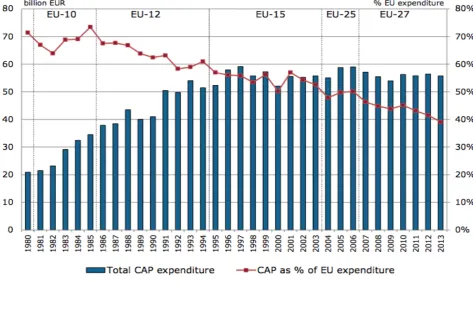
encouraging developing countries to increase their dependence on cheap imports. The ready access to market and relatively high prices also discouraged innovation in the developed countries of the EU. CAP reform, in part, has been driven by the continual pressure from the outside world to liberalise trade, and, internally, the consequences of the expensive administration. Despite the success of the CAP for food production, food security remains a concern, more so in light of an increasing, and increasingly affluent, global population, and it is perhaps why, even with numerous reforms, 40% of the EU budget continues to be absorbed by the CAP (see Figure 1) and it is still the most expensive policy. Looking ahead, the recently introduced BPS will continue to hinder, rather than drive, structural change and innovation, inhibit competitiveness, and market distortion internationally will remain.
We see farming as a continuing important source of work. We have argued
elsewhere that particular attention needs to be given to rebuilding decent work in a revitalised UK horticulture sector (27). In the UK, farm work is now well below half a million jobs, about the same as food manufacturing, with food retail providing 1.2 million and food service (catering) 1.7 million jobs. At the EU level, farming is still a huge employer. EU farming employs around 10 million people (with some estimates that 25 million have work of some sort in the sector) (28). And EU food
[image:9.595.93.567.383.697.2]manufacturing, for example, employs 4.2 million (29).
Figure 1:
CAP Expenditure in total EU Expenditure (2011 constant prices)
(30)
4.2
Social Impact of the CAP
Food R
esear
ch
Collaboration
were those who inherited the land from their forefathers as it was handed down through the generations, or a new super-rich urban élite (bankers or investment funds) buying land either for lifestyle or as secure investments. For consumers it meant paying a higher price for food with commodity prices maintained above world levels. It is argued that it is the poorest in society, where the majority of their income has to be spent on food, are subsidising the richest landowners. We see the evolution to a Common Sustainable Food Policy as a good way to link European social policies on food, currently dominated by a charitable welfare ethos (e.g. via the Free Food Scheme or support for Food Banks) (31). It picks up on the post 1992 commitments at EU and global levels to pursue sustainable consumption and production (SCP), and would revitalise the ‘social’ element of sustainability.
4.3
Health Impact of the CAP
In achieving food productivity, the CAP has also, it can be argued, had a positive impact on health through ensuring food security and the provision of quality food safely. Food security exists when the population has ready access to safe and sufficient food such that a normal healthy life can be maintained. The Food and Agriculture Organisation (32) highlights four dimensions in its definition of food security:
• Availability – of sufficient quantities of food
• Access – by individuals to adequate resources for acquiring appropriate foods
• Utilization – of food through adequate diet, clean water, sanitation
• Stability – access to adequate food at all times
It could be argued, however, that even in the EU security of supply has not necessarily equated to readily available and accessible food for everyone at reasonable cost, with increasing concerns regarding food poverty. The growth of food banks in Europe has been a shocking indictment of policy, and a reminder of the institutionalised nature of food waste on a massive scale. The European
Federation of Food Banks states they provided 2.9 million meals a day in 2015 (33).
Furthermore, the CAP, in influencing production and price, also influences consumption patterns not necessarily leading to the healthiest dietary choices. In the 1980s, a strong critique of CAP emerged as subsidising ‘bad’ ingredients for health: dairy fats, sugar, etc. Some studies actually showed that CAP kept prices high of such commodities, therefore implying a hidden tax – which was attacked by consumer organisations wanting cheaper food. But this debate faded as the 1992 CAP reforms began to shift subsidies away from primary production. Obesity concerns have resurrected health critiques, however. Birt (2007) (34) highlighted the mismatch between WHO /FAO guidelines on dietary intake by food group and CAP spending, showing that historical subsidies have encouraged the production of dairy products, red meat and sugar, while simultaneously destroying large quantities of fruit and vegetables to maintain domestic prices. The resultant overproduction and consumption of commodities high in saturated fats and sugar and low in fruit and vegetables has contributed to the increased global burden of obesity and non-communicable disease (NCD), including cardiovascular disease, cancer and diabetes mellitus. The policy attention now ought to be on how to overturn the failure to build a sustainable horticulture sector to provide the foundations of health - plants.
For forty years, one health issue has continued to be a concern – the role of nitrate and pesticide residues in food and water. These were to some extent the
unintended consequences of the original CAP’s commitment to increase food production and prevent food insecurity. The nascent environmental movement has consistently pushed the issues, and EU controls on water quality, leaching from soils and excessive farm use have been an important legacy.
Food R
esear
ch
Collaboration
Does the CAP still fit?
agree over the EC’s legal mandate to address nutrition beyond consumer education strategies within the CAP. They also felt there was currently a need for greater understanding of healthy diets and exploration as to whether international dietary guidelines could be enforced across cultural boundaries within Europe. How to integrate nutrition into policy remains a key challenge for the EU and the UK whether in or out of the EU, and is a reason we argue for CAP to evolve into a Common Sustainable Food Policy.
4.4
Environmental Impact of the CAP
Over the last forty years, the environmental movement’s critique of, and then input into, CAP reformation has been one of the most significant new presences in the European policy world(16). On a range of issues, from wildlife habitats to water and river quality, from soil to biodiversity protection, from agrochemical use to risk assessment procedures, the notion that environmental protection needs a high priority in CAP has rallied many actors within, let alone outside, the Brussels policy triangle of Commission, Parliament and Council. A 2016 review by IEEP concluded that on balance the EU has been good for the UK’s environment, in that the
problems raised by environmental science and movement have gained leverage and begun to be addressed (36). Over the years, there has been wider recognition that the environment provides the infrastructure not just for food systems but for life itself and that CAP’s productionist approach should not be allowed to undermine ecosystems. Part of the environmental critique’s power has been that its supporters range from political Left to Right, from ‘light’ to ‘dark’ Greens, from pragmatists to radicals. Arguments offered have ranged from financial to philosophical.
The increased productivity of agriculture in the EU has led to concerns about system intensification (37,38). An early concern was about the increased land area brought into food production as it became financially worthwhile for farmers to produce on marginal lands, with the consequent destruction of natural habitats leading to reduced biodiversity (39,40). This decline in biodiversity has been exacerbated by an increase in monoculture in both crop and livestock systems even on ‘better’ land. These losses have raised concerns for wildlife including farmland birds, pollinators and the presence of pests and their natural enemies (41-43). The concerns over soil erosion have also grown (44), both over the loss of soil and the pollution from sediment, nutrients and pesticides that results from agricultural systems (45).
Probably one of the most effective reforms by the EU has been to raise water quality. There remain concerns with regard to the demand and available supply of water particularly as agriculture in the UK uses most water in the regions which are least capable of supplying water for the irrigation of potatoes, field vegetables and protected and nursery crops, in what was, until recent reforms, an unsupported sector (46).
We see these environmental considerations growing rather than declining ahead. The challenge is for the CAP to take them seriously and not to consign them to policy history – as implied by the Commission’s history of the CAP which saw such issues as addressed in the early 2000s. Climate change means CAP will have to change dramatically, and the UK’s food system, too. Whether in or out of the EU, this is the priority. Even though technology and scientific input will be required in this transition, we are wary of an over-reliance on agri-tech strategies as theanswer to the complex issues raised by environmental critics. The nature of supply chains will have to change, as will consumer culture and dietary patterns, particularly in relation to meat and dairy consumption (47).
4.5
The CAP and animal welfare
This is an issue on which civil society has had considerable impact on the CAP. The opinion from Compassion in World Farming (CIWF)6 is that although it is not possible to show a direct causal link between the growth of “factory farming” and CAP arable subsidies, there is qualitative evidence that the two are connected. The general case from animal welfarists is that the drive for cheaper food has both legitimated
6
Food R
esear
ch
Collaboration
and institutionalized a ‘squeeze’ on animals’ lives, conditions and use for meat (48) (49) (50) . Subsidies provided to arable farming led to it becoming more profitable to produce and expand grain output, increasing the availability of affordable feed grain which in turn fuelled the growth of the intensive pig and poultry sectors which are highly dependent on grain as feed. Globalisation of agricultural commodity markets since the inclusion of agriculture and food under the General Agreement on Tariffs and Trade in 1994 has encouraged the mass production of both animals and feedstuffs. Rising incomes in developing countries has created further demand for meat and spread Western-style pressures on diet and ecosystems (51).
There appears to be an upwards spiraling relationship between grain production and pig/poultry production: pig and poultry producers benefit from an abundant supply of cheap feed and expand production, which in turn increases the market for grain and encourages grain producers to expand. Grain-based intensive pig and poultry production becomes a key market for the EU arable sector, even though animals are inefficient energy converters, if being fed to humans. This adds to land and water use pressure.
In its response to the UK government’s 2015 Manifesto commitment on CAP and animal welfare, CIWF lists four policy ‘asks’ to be incorporated into reform of the Common Agricultural Policy. These are:
1. That a much higher proportion of the CAP budget should be allocated to animal welfare: this receives currently 0.1% of the budget yet if 5-10% of the CAP budget was allocated for improving animal housing systems and management practices, much enhanced animal welfare outcomes could be achieved.
2. That animal welfare payments be targeted at substantial, well-defined welfare objectives such as increased use of farrowing systems rather than farrowing crates, reduction of stocking densities for broiler chickens and rewarding the presentation of pigs to slaughterhouses with intact tails. At present there is very little detailed evidence from the Commission on how CAP animal welfare payments are spent or from Member States on how payments are used.
3. That mechanisms are put in place to ensure that CAP payments do not have a detrimental impact on animal welfare: for example, where pig housing
modernization includes fully slatted floors making it difficult to provide effective enrichment material or to avoid routine tail docking.
4. That measures be taken to improve the effectiveness of cross-compliance when applied to animal welfare.
Like the environmental movement, the animal welfare movement has become a significant force in promoting CAP to be based on sustainability. More overtly than other sectoral interests, it has pushed for and encouraged consumer behaviour change – demanding better quality production methods and urging consumers to be prepared to pay more. This has worked in some food sectors, notably egg
Food R
esear
ch
Collaboration
Does the CAP still fit?
5.
Winners and losers from the CAP
The CAP is sometimes perceived as a rigid policy, changing little over time, yet even the colour scheme in Figure 2 shows this is not accurate. From this, the reduction in support via export subsidies and direct market support is evident, as is the rise of decoupled payments and the new greening payments in the CAP post-2013.
Figure 2:
The path of CAP expenditure by calendar year (in current prices)
(18)
As a result of this continual evolution, there have been changes in the beneficiaries over time, between taxpayers, consumers, the farming industry and other supply chain actors, as well as between Member States of the EU. Here we highlight just some.
5.1
Farmers vs. taxpayers/consumers
There have been various arguments in the past over the impact of CAP on food prices and food choices, and hence diets and social/health inequalities. It is true that the CAP has influenced these to an extent in the past, but it has been only one of many factors impinging on the British (and EU) diet. Probably more important in shaping UK diets than the CAP has been cultural change (such as foreign holidays), the food industry’s massive marketing budgets, and changes in demography and lifestyles. How, what, when and whence the British eat has gone through a radical transformation in the last half century. CAP has declined in primary policy influence in an era where food systems have become transformed by just-in-time
supermarket driven systems and by cultural change.
In the past, to the late 1980s, internal market prices were held high in order to protect farmers, with high border protection in the form of tariffs and dumping on world markets of excess production. The high internal prices encouraged
production and larger farmers benefitted the most from the subsidies, with the largest 20% of farms receiving 80% of the benefits in the 1980s. The high production led to wine ‘lakes’, butter ‘mountains’ and beef stores; these were Agricultural Brief on CAP 4
4.
EVOLUTION
OF
POLICY
AND
SPENDING
The radical change in the orientation of the
CAP is demonstrated by the evolution of
expenditure, echoing the policy shift since
1992
3, away from product based support
towards producer support and considerations
for the environment (chart 2).
In 1992 market management represented
over 90% of total CAP expenditure, driven
by
export
refunds
and
intervention
purchases. By the end of 2013 it dropped to
just 5% as market intervention has become
a safety net tool for times of crisis and direct
payments are the major source of support;
94% of which are decoupled from
production.
Source: DG Agriculture and Rural Development
3 Chart 2 shows CAP actual payments from 1990- 2012,
commitments for 2013 and the new MFF ceiling from 2014-2020.
From 2014 onwards, the allocation of direct
payments dedicated to coupled support,
young farmers, small farmers, etc. will
depend upon the choices made by Member
States.
Furthermore the share of expenditure
between pillars may change in 2014-2020,
with the possibility to transfer up to 15% of
their national envelopes between pillars (as
shown in the chart)
4, enabling Member
States to better target spending to their
specific priorities
Chart 2 The path of CAP expenditure by
calendar year (in current prices)
4 Member States below 90% average Pillar 1 payments/ha
may transfer up to 25% from Pillar 2 to Pillar 1. 0 10 20 30 40 50 60 70 19 90 19 91 19 92 19 93 19 94 19 95 19 96 19 97 19 98 19 99 20 00 20 01 20 02 20 03 20 04 20 05 20 06 20 07 20 08 20 09 20 10 20 11 20 12 20 13 20 14 20 15 20 16 20 17 20 18 20 19 20 20 in b ill io n EU R -cu rr e n t p ric e s
Export refunds Other market support Market support
Coupled direct payments Decoupled direct payments New direct payments Possible flexibility for RD Possible flexibility for direct payments Rural development (RD)
Food R
esear
ch
Collaboration
rightly pilloried in the press and still fuel anti CAP public sentiment today, even though the funding system has been changed and the outcomes have evaporated. Today, there are no stocks, only just-in-time supply change management, ready to source internationally (53). Paradoxically, despite the higher output, consumer prices remained high to protect farmers and consumption was restrained.
The various reforms to the CAP through the 1990s have led to a reduction in its significance in the overall EU budget – from 70% in the early 1980s to 40% today – and, because domestic support is paid directly to producers rather than via inflated prices, taxpayers rather than consumers are burdened with this expense. This does mean that food prices are no longer so affected by EU domestic support policies. Where the CAP kept market prices high in the past, this is now the case only for a handful of commodities including beef, poultry meat, potatoes and tomatoes (54) (55).
Regarding diets, where the CAP has influenced food prices, it has done so on healthy and less healthy foods: high prices discouraging consumption of both, low prices encouraging consumption of both. Up to the 1980s, the CAP kept livestock product prices higher relative to world prices than it did fruit and vegetables because the former were protected by both high intervention prices as well as high tariffs. Fruit and vegetables were protected by relatively low tariffs. Matthews (55) argues that removing all market support safety nets to fruit and vegetable production would lead ultimately to higher fruit and vegetable prices because without such guarantees, farmers would not be willing to make the necessary long term investments in fruit and vegetable production. This, of course, has implications for public health where high fruit and vegetable prices have the most impact on low-income households. If there is one sector which deserves more attention in the CAP debate it is horticulture, since there is good health evidence on the advantages of consumers eating more plant-based diets. The issue is how and where should this horticultural expansion be encouraged.
5.2
Member State vs. Member State
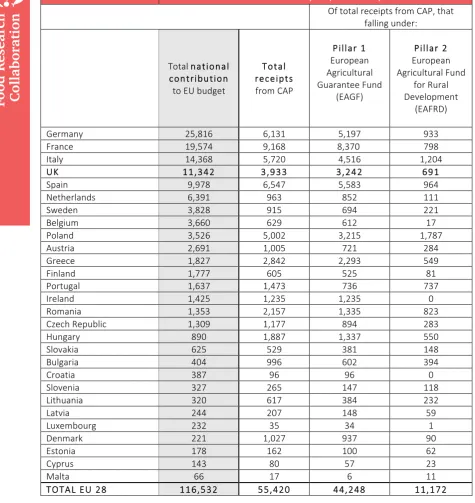
Over time, some countries have benefitted more from the CAP than others depending on their contributions to the EU budget relative to what they have received in CAP subsidies. Subsidies under Pillars 1 and 2 of the CAP are shown in Table 1. France received the greatest amount in 2014, 16% of the total EU spend on the CAP. It was also the second largest contributor to the EU budget in that year.
Matthews (57) shows the CAP budget allocations relative to each Member State’s contribution to the CAP in 2014. Although the total budget was €54 billion in that year, the total amount redistributed or reallocated was only €13.6 billion. Twelve Member States were net contributors but 43% of the net contribution came from Germany. Smaller amounts came from the Netherlands, the UK, France and Italy.
Net beneficiaries in 2014, i.e. those receiving more in CAP subsidies than they paid into the CAP budget, were Poland, Greece, Spain, Romania, Hungary and Bulgaria (the latter being the smallest net beneficiary).
Food R
esear
ch
Collaboration
[image:15.595.44.520.70.574.2]Does the CAP still fit?
Table 1: Expenditure on the CAP by Member States (56)
Member State 2014 financial year (EUR million)
Of total receipts from CAP, that falling under:
Total national contribution to EU budget
Total receipts from CAP
Pillar 1 European Agricultural Guarantee Fund
(EAGF)
Pillar 2 European Agricultural Fund
for Rural Development
(EAFRD)
Germany 25,816 6,131 5,197 933
France 19,574 9,168 8,370 798
Italy 14,368 5,720 4,516 1,204
UK 11,342 3,933 3,242 691
Spain 9,978 6,547 5,583 964
Netherlands 6,391 963 852 111
Sweden 3,828 915 694 221
Belgium 3,660 629 612 17
Poland 3,526 5,002 3,215 1,787
Austria 2,691 1,005 721 284
Greece 1,827 2,842 2,293 549
Finland 1,777 605 525 81
Portugal 1,637 1,473 736 737
Ireland 1,425 1,235 1,235 0
Romania 1,353 2,157 1,335 823
Czech Republic 1,309 1,177 894 283
Hungary 890 1,887 1,337 550
Slovakia 625 529 381 148
Bulgaria 404 996 602 394
Croatia 387 96 96 0
Slovenia 327 265 147 118
Lithuania 320 617 384 232
Latvia 244 207 148 59
Luxembourg 232 35 34 1
Denmark 221 1,027 937 90
Estonia 178 162 100 62
Cyprus 143 80 57 23
Malta 66 17 6 11
Food R
esear
ch
Collaboration
6.
Future directions
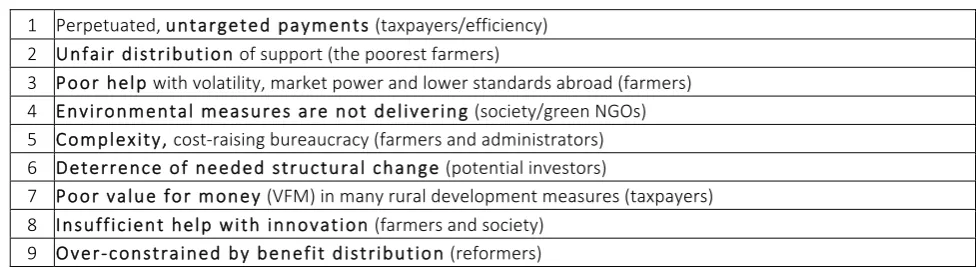
[image:16.595.79.568.134.269.2]Current problems with the CAP according to the different interest groups are neatly summarised by Prof Alan Buckwell, a long-term CAP analyst and now a Senior Fellow at the Institute of European Environmental Policy, as shown in Table 2:
Table 2: Principal problems of the current CAP (from the perspective of…) (59)
1 Perpetuated, untargeted payments (taxpayers/efficiency) 2 Unfair distribution of support (the poorest farmers)
3 Poor help with volatility, market power and lower standards abroad (farmers) 4 Environmental measures are not delivering (society/green NGOs) 5 Complexity, cost-raising bureaucracy (farmers and administrators) 6 Deterrence of needed structural change (potential investors)
7 Poor value for money (VFM) in many rural development measures (taxpayers) 8 Insufficient help with innovation (farmers and society)
9 Over-constrained by benefit distribution (reformers)
These problems with the current CAP combined with the challenges still facing agriculture in the EU such as the need for restructuring, the need for further environmental protection, issues of low incomes in farming, mitigating and adapting to climate change and bioenergy contribution, will lead to further changes in the CAP over time. A number of wider options exist for the future evolution of the CAP7.
One possibility, of course, is that the CAP is withdrawn or crumbles as the European project itself weakens. This is what a new ‘hard’ position favoured by neo-liberals and ‘purist’ free marketers, mostly on the political Right, would like. This sentiment is by no means restricted to the UK’s Brexit campaigners (although the replacement policy after a supposed Brexit is not clear (60)). Similar sentiments are visible today in many Member States and are strongly represented in the European Parliament. This position was being voiced throughout the butter mountain and wine lake 1980s (61). The New Zealand experience following the removal of subsidies in 1984 (under a Labour Government) provides some insight into what could happen (62). New Zealand’s meat and dairy exports had been hard hit by the UK joining the EU in 1973, and its entire colonially-derived trading functions had to be reassessed, when the UK effectively abandoned it. Removing subsidies in one ‘cold turkey’ moment led to a fall in commodity and food prices, farm incomes, farmland value, some input purchases, and the shedding of and move to part-time labour, with farm owners taking on other jobs including through diversified activity. The lesson from the New Zealand experience is that removal of support in one strike is not to be recommended, rather a gradual phasing out, particularly in certain sectors. In NZ, there was a loss of farm businesses and the livelihoods that these maintained: those businesses that remained increased in scale. Although the farmed area and livestock numbers may have declined, productivity and efficiency have improved. Labour productivity has also improved. The farmers who withstood the short-term adjustment costs, saw farm income and farmland value return to previous levels. For consumers there were some retail price reductions and also with a more liberalised trading system increased consumer choice.
It is unlikely, however, that the CAP will, in the near future, be withdrawn as a policy. We think CAP will evolve pragmatically in one form or another; the argument is about how and to do what? What is CAP for? With geo-political
uncertainties, some volatility in world food commodity prices since the banking crisis of 2007-08, and a general concern to maintain food security in an era of climate change, some kind of CAP is likely to remain. The most likely scenario is the continuation of the two pillars approach, with some Member States pushing for
7 See, for example,
Food R
esear
ch
Collaboration
Does the CAP still fit?
greater monies within the direct support and market management pillar, and other Member States wishing to redirect the monies more to the wider rural development pillar, going as far as to advocate a switch from an agricultural policy to one that is more all-encompassing of rural development. In this scenario it is suggested that there needs to be more cohesion between the more conventionally competitive agricultural regions such as East Anglia in the UK, the intermediate regions with unfavourable farming conditions or restricted farming practices, and those regions handicapped in some way by the climate and landscape topography or small-scale production, found within the southern and eastern areas of the EU.
Another possibility is that eventually, a rural development rather than agricultural policy will emerge, although this may take some time. Many farmers (particularly small ones) are dependent on subsidies partly because their returns from the food system are squeezed. Most money from what consumers spend on food is taken by forces off the land. In the near future, nevertheless, subsidies for farming will be lower, and most farmers are aware of this and starting to adapt their businesses. Without subsidy, some farming systems would become unviable, particularly in the grazing livestock sector, and the countryside and social structure could deteriorate in those areas unless supported in other ways.
Another possibility is that the CAP becomes a Common Sustainable Food Policy or Common Food Policy. There are already pressures building for this to be so and voices in support (63) (64). The costs of healthcare from poor diet and mal-consumption (e.g. from sweet, fatty, salty ‘ultra-processed’ foods) are already immense and likely to increase with rising rates of obesity and overweight. The environmental costs of intensive farming add to the burden. Rising social inequalities from unemployment and the squeeze on labour rates are likely to maintain pressure, too. Rather than restrict and whittle away at the CAP, this option proposes that CAP becomes what the evidence says is needed – a policy fit for climate change adaption, alive to urbanisation, achieving better returns to primary producers of dietary ingredients necessary for health, cutting back on the massive levels of food waste, and maintenance of cultural heritage. These concerns are by no means restricted to science or NGOs. The EU itself, having first rejected this direction by abandoning the Sustainable Food Communiqué in July 2014, then adopted the ‘circular economy’ approach, partly to keep the food industry on board but partly to enable the pursuit of sustainability to meet its proclaimed ‘efficiency’ and growth goals(17). The EU has long supported the Sustainable Consumption and Production (SCP) policy approach, taking the lead on this in food (and other
economic sectors) following the UN’s Conference on Environment and Development in 1992 (‘Rio’). Food was signalled as a key sector for the 2011 Roadmap for a ‘resource-efficient’ Europe (65). The problem has been that CAP has been to some extent immune from – or resistant to - these wider policy shifts. As we have argued above, the goal of a Common Sustainable Food Policy could be to become an umbrella sheltering many diverse strands of existing and emerging policy formulation.
In the short term, when considering possible future directions, some specific questions arise on which the public needs better input from academics and civil society:
• Does European agriculture still need financial support?
• If so, which sectors need most support?
• How much resource is available to provide support to these sectors?
• What policy instruments will deliver that support most efficiently?
Food R
esear
ch
Collaboration
• How can other food considerations be given a stronger voice in agricultural negotiations?
Alan Buckwell offers a useful summary of some options for the CAP post-2020 (59). Some are radical, others ‘evolutionary’.
Table 3: Options for a post-2020 Common Agricultural Policy (59)
A
Ra
d
ic
a
l
re
for
m
Policy for agricultural adjustment
No enduring annual payments, only transitional support for, say seven years, for restructuring and refocusing for life without subsidy, environmental performance within legislative standards, coping with natural and market volatility, managing the market power imbalance with the up and downstream sectors, and delivering locality and quality. Provide mostly investment, restructuring, advisory and training help.
B
Policy for the food chain
Stronger focus on integrating and rebalancing farming structures into local and/or national and
international food chains, with strong focus on waste reduction, improving diet and health (plus elements of option A?).
C
Policy for rural land and resource management
Focus on the environmental market failures/public goods and climate mitigation and adaptation, which explicitly embraces supporting and regulating, as well as provisioning cultural ecosystem services. Will therefore include energy, forestry, wetlands, cultural landscape and rural recreation.
D
Rural social policy
Direct payments only on social (including income if explicitly tested) or territorial solidarity grounds. Repatriate greening and Pillar II to Member States, much smaller budget, stronger enforcement of environmental regulations, enhanced state aid rules.
E
Ev
o
lut
io
nar
y
r
ef
o
rm
Major switch to rural development
Scale back direct payments to the minimum, retain and enlarge rural development to include proper greening and whichever measures in options A to D can be agreed. (This essentially builds on the Commission Communication 2011, third option.)
F
Redistribution and rebalancing
As now but insist on co-financing either all measures, or no measures (i.e. treat both pillars the same) more redistribution of direct payment funds – but based on objective criteria, more targeting of direct payment e.g. means-tested. Switch greening to Pillar II with its funding.
G
Further improvements on Commissioner Cioloş’ reform8 Elements of option F plus:
- innovation for sustainable farming, water, energy, waste
- reconsider risk management measures to substitute basic payments – more effective cross-compliance - more appropriate principles for ‘high nature value’ farming support finding ways to deliver landscape/ catchment scale management
- increased farmer self-administration via cooperatives - more emphasis on results-based payment schemes
The first four of these options focus on what the prime objective of the CAP could be in the coming period and would involve the removal of most or all direct payments. The last three options are progressively less ambitious and could be considered more as adjustments to current policy.
All of these should be considered in light of a difficult context for the next phase of CAP reform: an EU under internal pressure, partly facing outwards and partly inwards; continuing political uncertainty within Member States; slow economic
8
The 2013 CAP reforms are named after Commissioner Cioloş
Food R
esear
ch
Collaboration
Does the CAP still fit?
growth and even recession; tensions within the Eurozone; uncertainty and some volatility in agricultural markets; changes within the wider natural environmental specifically due to climate change, water stress and biodiversity loss; consumer behaviour and influence driving change in the food system; and practical difficulties in achieving country and institutional change. This is a formidable policy mix, but it was ever thus.
Whatever happens in the wider political economy, it is essential that public attention remain on the realities of the CAP, as it is not as it is depicted in out-of-date jibes. Sound policy judgements are not helped by mythologies about what CAP is and is not. Our view is that the public should now look forward and be aware of the strong evidence of the need for change. New frameworks are needed to deliver what is required, which we have here labelled as the pursuit of a Common
Sustainable Food Policy or Common Food Policy. This should deliver decent
Food R
esear
ch
Collaboration
References:
(1) Teasdale A. The Stresa Conference. In: Teasdale A., Bainbridge T, editors. The Penguin Companion to European Union. 4th ed. London: Penguin; 2012.
(2) Grant W. The Common Agricultural Policy. Basingstoke: Macmillan Press; 1997.
(3) Tracy M. Government and agriculture in Western Europe, 1880-1988. 3rd ed. New York; London: Harvester Wheatsheaf; 1989.
(4) DEFRA. Agriculture in the UK 2014 (May 28 2015 page 91, chart 13.2). 2015.
(5) Candel JJL, Breeman GE, Stiller SJ, Termeer TJAM. Disentangling the consensus frame of food security: The case of the EU Common Agricultural Policy reform debate. Food Policy 2014;44:47-54.
(6) Garnett T. What is a sustainable diet? A Discussion Paper. 2014.
(7) Gonzalez Fischer C, Garnett T. Plates, pyramids, planet: Developments in national healthy and sustainable dietary guidelines: a state of play assessment. 2016.
(8) Lang T. Sustainable Diets: Hairshirts or a better food future? Development 2014;57(4):240--256.
(9) European Commission. Directorate-General for Agriculture and Rural Development. 2016; Available at:
http://ec.europa.eu/dgs/agriculture/index_en.htm. Accessed 05/24, 2016.
(10) DEFRA. Department for Environment, Food and Rural Affairs, About Us. Available at:
https://www.gov.uk/government/organisations/department-for-environment-food-rural-affairs/about. Accessed 05/26,
2016.
(11) European Commission. The Common Agricultural Policy: a story to be continued. 2012.
(12) Pollard S. The International Economy since 1945: Making of the Contemporary World. First ed. London and New York: Routledge; 1997.
(13) DG Agriculture & Rural Development. The History of the CAP: the Crisis Years 1970s. 2016; Available at:
http://ec.europa.eu/agriculture/cap-history/crisis-years-1970s/index_en.htm. Accessed 05/21, 2016.
(14) European Commission. The 1992 Reform ("MacSharry Reform). 2015; Available at:
http://ec.europa.eu/agriculture/cap-history/1992-reform/index_en.htm. Accessed 11/25, 2015.
(15) DG Agriculture & Rural Development. The History of the CAP. 2016; Available at:
http://ec.europa.eu/agriculture/cap-history/index_en.htm. Accessed 05/22, 2016.
(16) Haigh N. EU Environmental Policy: Its journey to centre stage. Abingdon: Routledge; 2016.
(17) European Commission. The Circular Economy: Communication "Towards a circular economy: a zero waste programme for Europe". 2016; Available at: http://ec.europa.eu/environment/circular-economy/index_en.htm. Accessed 05/24, 2016.
(18) European Commission. Overview of CAP Reform 2014-2020. 2013;5.
(19) European Commission. CAP Reform - an explanation of the main elements. 2015; Available at:
http://europa.eu/rapid/press-release_MEMO-13-621_en.htm. Accessed 11/2, 2015.
(20) European Commission. Direct Payments. 2015; Available at:
Food R
esear
ch
Collaboration
Does the CAP still fit?
(21) Curry Commission. Report of the Policy Commission on the Future of Farming and Food. London: Cabinet Office. 2002.
(22) DEFRA. Food 2030 strategy. 2010.
(23) UK Government. Agricultural technologies (agri-tech) strategy. 2015; Available at:
https://www.gov.uk/government/collections/agricultural-technologies-agri-tech-strategy. Accessed 05/26, 2016.
(24) RSPB, the Wildlife Trusts, Friends of the Earth, Sustain, National Trust, Eating Better, Compassion in World Farming, Food Research Collaboration, Food Ethics Council, Soil Association. Square Meal, Food, Farming, Health, Nature, Why we need a new recipe for the future. 2014.
(25) European Commission. The Cotonou Agreement. 2005; Available at:
http://ec.europa.eu/development/body/cotonou/lome_history_en.htm. Accessed 05/26, 2016.
(26) European Commission. Everything But Arms (EBA) – Who benefits? 2014; Available at:
http://trade.ec.europa.eu/doclib/docs/2013/april/tradoc_150983.pdf. Accessed 05/26, 2016.
(27) Schoen V, Lang T. Horticulture in the UK: potential for meeting dietary guideline demands. London: Food Research Collaboration. 2016.
(28) European Commission. How many people work in agriculture in the European Union? 2013;8.
(29) FoodDrinkEurope. Data and Trends European Food and Drink Industry 2014-2015. 2015.
(30) European Commission. CAP post-2013: key graphs and figures. 2015; March 2015(11/25).
(31) Caraher M, Coveney J editors. Food Poverty and Insecurity: International Food Inequalities. 1st ed. Switzerland: Springer International Publishing; 2016.
(32) FAO. Food Security Indicators. 2015; Available at:
http://www.fao.org/economic/ess/ess-fs/ess-fadata/en/#.VlWmULSczdk. Accessed 11/25, 2015.
(33) FEBA. Untitled homepage. Available at: http://www.eurofoodbank.eu/. Accessed 05/23, 2016.
(34) Birt C. A CAP on Health? The Impact of the EU Common Agricultural Policy on Public Health. 2007.
(35) Walls, H., Cornelsen, L., Lock, K., Smith, R.D. How much priority is given to nutrition and health in the EU Common Agricultural Policy? Food Policy 2016;59:12-12-23.
(36) Baldock D, Buckwell A, Colsa-Perez A, Farmer A, Nesbit M, Pantzar M. The potential policy and environmental consequences of a UK departure from the European Union. Report by the Institute for European Environmental Policy in collaboration with the Wildlife Trusts, the Royal Society for Protection of Birds, and WWF UK. 2016.
(37) Krebs JR, Wilson J, Bradbury R, Siriwardena G. The second silent spring? Nature (London) 1999;400(6745):611; 611-612; 612.
(38) Pretty JN, Brett C, Gee D, Hine R, Mason C. An assessment of the total external costs of UK agriculture. Agricultural systems 2000;65(2):113; 113-136; 136.
(39) Henle K, Alard D, Clitherow J, Cobb P, Firbank L. Identifying and managing the conflicts between agriculture and biodiversity conservation in Europe–A review. Agric , Ecosyst Environ 2008;124(1-2):60; 60-71; 71.
(40) Reidsma P, Tekelenburg T, van den Berg M, Alkemade R. Impacts of land-use change on biodiversity: An assessment of agricultural biodiversity in the European Union. Agric , Ecosyst Environ 2006;114(1):86; 86-102; 102.