City, University of London Institutional Repository
Citation
:
Palmarini, R., Erkoyuncu, J. A., Roy, R. ORCID: 0000-0001-5491-7437 and
Torabmostaedi, H. (2018). A systematic review of augmented reality applications in
maintenance. Robotics and Computer-Integrated Manufacturing, 49, pp. 215-228. doi:
10.1016/j.rcim.2017.06.002
This is the accepted version of the paper.
This version of the publication may differ from the final published
version.
Permanent repository link:
http://openaccess.city.ac.uk/id/eprint/22127/
Link to published version
:
http://dx.doi.org/10.1016/j.rcim.2017.06.002
Copyright and reuse:
City Research Online aims to make research
outputs of City, University of London available to a wider audience.
Copyright and Moral Rights remain with the author(s) and/or copyright
holders. URLs from City Research Online may be freely distributed and
linked to.
A Systematic Review of Augmented Reality
applications in Maintenance
Riccardo Palmarini
a,*, John Ahmet Erkoyuncu
a, Rajkumar Roy
aand Hosein Torabmostaedi
baCranfield Manufacturing, School of Aerospace, Transport and Manufacturing, Cranfield University, UK bHSSMI a Manufacturing Innovation Institute, London, UK
Abstract. Augmented Reality (AR) technologies for supporting maintenance operations have been an academic research topic
for around 50 years now. In the last decade, major progresses have been made and the AR technology is getting closer to being implemented in industry. In this paper, the advantages and disadvantages of AR have been explored and quantified in terms of Key Performance Indicators (KPI) for industrial maintenance. Unfortunately, some technical issues still prevent AR from being suitable for industrial applications. This paper aims to show, through the results of a systematic literature review, the current state of the art of AR in maintenance and the most relevant technical limitations. The analysis included filtering from a large number of publications to 30 primary studies published between 1997 and 2017. The results indicate a high fragmentation among hardware, software and AR solutions which lead to a high complexity for selecting and developing AR systems. The results of the study show the areas where AR technology still lacks maturity. Future research directions are also proposed encompassing hardware, tracking and user-AR interaction in industrial maintenance is proposed.
Keywords: Augmented Reality, tracking, authoring, digital engineering, maintenance, systematic literature review
*Corresponding author. E-mail: [email protected]
Robotics and Computer-Integrated Manufacturing, Vol. 49, February 2018, pp. 215-228 DOI:10.1016/j.rcim.2017.06.002
Published by Elsevier. This is the Author Accepted Manuscript issued with: Creative Commons Attribution Non-Commercial No Derivatives License (CC:BY:NC:ND 4.0). The final published version (version of record) is available online at DOI:10.1016/j.rcim.2017.06.002
1. Introduction
Milgram and Kishino [1] define Augmented Reality as a way to “augment” the real-world with virtual ob-jects. More specifically Azuma [2] defined the AR Systems to have the following properties: to combine real and virtual objects in a real environment; run in-teractively and in real time; to geometrically align vir-tual objects and real ones in the real world. AR tech-nology has been applied to a wide range of fields: tour-ism, entertainments, marketing, surgery, logistics, manufacturing, maintenance and others [3], [4]. Its ap-plication in the maintenance field has shown several advantages at an academic level.
By maintenance is meant all the actions which aim to restore any functionality of a product within its lifecycle. When the product is an industrial production equipment, we usually refer to its maintenance as in-dustrial maintenance. The actions that can be per-formed to restore products functionalities can be tech-nical, administrative and managerial [5].
AR studies in maintenance show promising results in enhancing human performance in carrying out tech-nical maintenance tasks, improving the administration of maintenance operations and supporting mainte-nance managerial decision making.
Even though what mentioned above and AR tech-nology being around for more than 50 years, there are still limited examples of its concrete implementation in industry.
For this reason, the aim of this paper is to present the state of the art in AR in terms of technology used, applications, and limitations focusing on the mainte-nance context. In order to do so, the authors carried out a Systematic Literature Review (SLR). SLR refers to a rigorous literature review which ensures the re-producibility and scalability of the study as well as the objectivity of the results [6]. This approach is particu-larly relevant for researches currently experiencing a fast development.
This paper is organized in four sections. Section 1 introduces the project. Section 2 reports on the meth-odology utilised for this SLR. Section 3 reports on the main results of the SLR providing an overview of the state of the art of AR in maintenance and the main lim-itations of today’s AR technology. Finally section 4 reports conclusions and future works.
2. Methodology
In order to evaluate the state of the art for AR in maintenance, a SLR approach has been used. SLR
[image:3.595.316.523.295.511.2]aims to search, appraise, synthetise and analyse all the studies relevant for a specific field of research. The methodology utilised is described by Booth in “systematic approaches to a successful literature re-view” [7]. The main aim is to identify the gaps in lit-erature hence provide evidence of future fields of re-search. The seven steps utilised to carry out this SLR are: planning, defining the scope, searching, assessing, synthetising, analysing and writing. Each step follows a specific methodology which will be described in the following subsections. The SLR methodology steps (white rectangles) and the outcomes of each step (blue rectangles) are outlined in Figure 1.
Figure 1. SLR methodology utilised for this SLR [7]. In the white rectangles are reported the 7 steps of the methodology. In the blue
rectangles show the outcomes of each step.
2.1.Step 1 - Planning
The planning phase is the very initial step to carry out a SLR. As described in Figure 1, it includes: de-fining the timescale of the project, identifying the da-tabases that will be utilised and select the software for managing the references.
The database utilised for the SLR have been se-lected based on [8] and integrated with the resources available for the project:
• IEEE Xplore (www.ieeexplore.com) • ScienceDirect (www.sciencedirect.com) • Scopus (www.scopus.com)
Moreover, due to the rapid evolving nature of the topic, a manual search of Grey Documentation has been performed. It includes documentation available on Internet and published by non-academic institu-tions such as industries, government and communities [7].
The reference manager software utilised is Mendely (www.mendeley.com) due to its strong community and support, its integrated PDF viewer and the automatic citation add-in for Microsoft Word.
2.2.Step 2 - Defining the Scope
Defining the scope actualizes in properly formulate answerable research questions. These have been de-fined as a result of an iterative process among (i) initial brainstorming, (ii) literature search and the (iii) PICOC (Population, Intervention, Comparison, Out-comes and Context) framework application [7]. As a result of i and ii, different review and key papers on AR have been identified [9]–[14]. Then the PICOC framework has been utilised to define the key concepts of the research [7]. The elements of PICOC are: Pop-ulation, Intervention, Comparison, Outcomes and Context. For this study, the Population consists of the industrial maintenance task carried out by human op-erators. The Intervention considered is the utilization of the Augmented Reality technology. The Compari-son can be done with Virtual Reality technology for both training and operating environment, traditional training methods and remote maintenance support. The Outcomes of the application of these different methods, can be measured in terms of KPI related with the specific maintenance task. Common key perfor-mance indicators are time to complete the operation and the number of errors. The impact would affect the human performance in carrying out a maintenance task hence it is mainly economic and social dimen-sions. Finally, the Context includes industrial environ-ment and “consumer environenviron-ment” for both training and operating activities.
Finally, the research questions have been defined as:
Q1: What is the state of the art of AR application in industrial maintenance for supporting human opera-tors?
Q2: What are the potential future developments and implementation of AR in Maintenance?
2.3.Step 3 - Searching
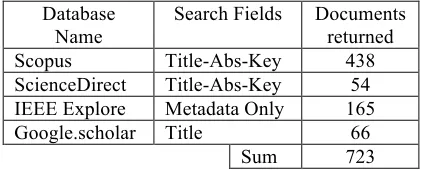
The Searching step consists of browsing separately the databases identified at step 1 and listed in Sec. 2.1 utilising the string: (“Augmented Reality”) AND (“Maintenance”). It has been selected based on the re-search questions and key concepts stated in Sec. 2.2. Boolean operator “AND” is utilised to provide a more detailed first screening. The results of this searching step updated at the 13th of February 2017 is the collec-tion of 723 documents.
Since this phase has been carried out for each data-base separately, the final number of 723 documents in-cludes duplicates. More details are shown in Table 2.
Database Name
Search Fields Documents returned Scopus Title-Abs-Key 438 ScienceDirect Title-Abs-Key 54 IEEE Explore Metadata Only 165 Google.scholar Title 66
[image:4.595.314.526.303.388.2]Sum 723
Table 1 Outcome of the searching phase. The first column reports the databases utilised. These have been identified in Step 1. The second column reports the “search fields” where the search string
has been applied. The third column reports the number of docu-ments returned by the databases.
It is worth to mention that this step does not involve reading the titles or the abstracts of the documents found.
2.4.Step 4 - Assessing
The Assessing step aims to narrow down the hun-dreds of documents found in the searching phase to a final number of documents which are relevant for an-swering the research questions.
Inclusion and Exclusion criteria have been utilized to make the first screening of the documents:
Inclusion Criteria:
IC1) primary study that represents the use of AR in maintenance
IC2) primary study that represents the AR tech-nology state of the art.
Exclusion Criteria: EC1) Not in English. EC2) Older than 1997.
The selection of the criteria is made based on the authors’ experience and takes inspiration from other successful literature studies [6]–[8];
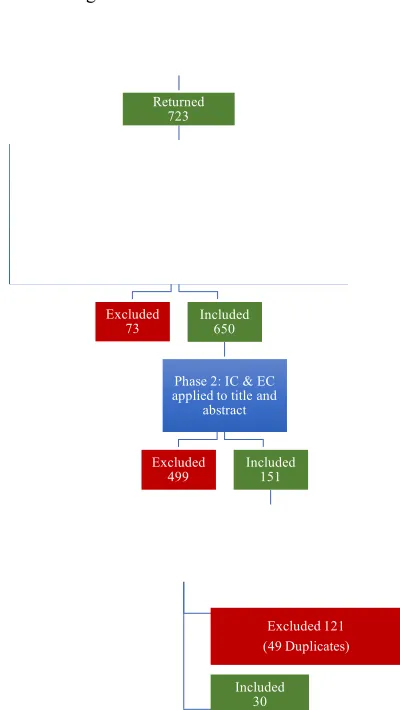
These criteria have been applied to the documents found in the four databases listed in Sec.2.1 separately and in three different phases: firstly, through the searching tools provided by each database selected have been used; secondly, through reviewing the title and the abstract and finally reviewing introduction and conclusion of the remaining documents. Only in the third phase, the documents derived from the four dif-ferent databases have been collated.
The results of the application of the IC and EC are outlined in Figure 2.
Figure 2. Selection Process of Primary studies. Starting from 723 documents collected in the searching step, the appliction of IC and
EC narrowed the documents to 30 primary studies. The result of the application of the Exclusion and Inclusion criteria is a list of 30 documents.
The next step has been to identify quality criteria in order to strengthen the extraction of quantitative and qualitative data for the synthesis and results analysis.
Quality criteria have been selected based on Santos [6].
Description QC1 The document is clear
QC2 The methodology is well exposed and detailed
QC3 The technology and case studies are not obsolete
QC4 The study results are applicable to maintenance cases
[image:5.595.79.279.287.642.2]QC5 Analytical results are provided
Table 2. Quality Criteria selected for this project. For each one of the 30 documents selected, a score from 0 to 5 has been calculated summing up the scores assigned for each QC. One point has been assigned for the full compliance with the QC; 0.5 points for the par-tial compliance. Table 3 reports the results of the ap-plication of the QC.
Study ref.
QC1 QC2 QC3 QC4 QC5 Sum [15] 1 1 1 1 1 5 [16] 1 1 1 1 1 5 [17] 1 1 1 1 1 5 [18] 1 1 1 1 1 5 [19] 1 1 1 1 1 5 [20] 1 1 1 1 1 5 [12] 1 1 1 1 1 5 [21] 1 1 1 1 1 5 [22] 1 1 1 1 1 5 [23] 1 0.5 1 1 1 4.5 [24] 1 0.5 1 1 1 4.5 [25] 1 1 1 0.5 1 4.5 [26] 1 1 0.5 1 1 4.5 [27] 1 1 0.5 1 1 4.5 [28] 1 0.5 1 1 1 4.5 [29] 1 1 1 1 0 4 [30] 1 1 0.5 1 0.5 4 [31] 1 1 0.5 1 0 3.5 [32] 1 0.5 1 0 1 3.5 [33] 1 0.5 1 1 0 3.5 [34] 1 1 0.5 1 0 3.5 [35] 1 0.5 1 1 0 3.5 [36] 1 0.5 1 1 0 3.5 [37] 0.5 1 1 0.5 0 3 [38] 1 0 1 1 0 3 [39] 1 1 0 1 0 3 [40] 0.5 0.5 1 0.5 0 2.5 [41] 1 0.5 0 1 0 2.5 [42] 0.5 0.5 0 1 0.5 2.5 [43] 1 0 1 0 0 2
Searching String: ("Augmented Reality") AND Maintenance
Returned 723
Phase 1: IC & EC through database searching tools: 1) Year: more recent than 1997
2)Document type: journal article, conference article or review article
3) Publucation Field: Computer Science & Engineering
Excluded
73 Included650 Phase 2: IC & EC applied to title and
abstract Excluded
499 Included151
Phase 3: IC & EC applied to introduction and conclusions
Excluded 121 (49 Duplicates) Included
Table 3. Quality criteria applied to the 30 articles selected for this SLR. Each column reports the score assigned to one of the five
quality criteria listed in Table 2.
Due to the subjectivity of the application of the quality criteria, these results are not used to exclude any study from this SLR. All the 30 articles identified provide valuable contribution to this SLR. Still, Table 3 was considered when referencing any study and re-porting quantitative and qualitative results. Moreover Table 3 provides the reader with a tool to assess the quality of the qualitative results exposed in sec. 3. Fi-nally, more considerations will be reported in the Con-clusion section.
2.5.Step 5 - Synthetising and Analysing
In order to answer the research questions Q1 and Q2, the author analysed and synthetised the 30 articles identified through the systematic research.
It is relevant to clarify that only the 30 articles se-lected influenced the results of this SLR reported in Sec. 3 (Figure 3,Figure 4,Figure 10, Figure 13,Figure 14,Figure 20, Figure 22). In some cases, other relevant studies will still be utilised to describe the results and provide the reader with a better understanding of the topic.
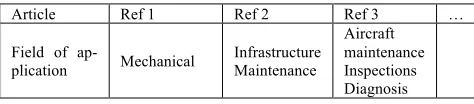
In this step, it has been found necessary to build a table, which could correlate the documents in order to find trends and common features of the different stud-ies. The author decided to build Table 4 which has as columns, the 30 articles and as rows, the main charac-teristic of an AR system: field of application, mainte-nance operation, hardware, development platform, tracking solution, interaction method and authoring solution. These main characteristics have been se-lected based on the papers and the authors expertise in the field. For instance is not uncommon to find sec-tions dedicated to the hardware, tracking and interac-tion methods across the AR studies [9], [44]. Moreo-ver, usually the authors of AR studies mention the field of application and the development process of the AR system they are testing or developing, the mainte-nance operation considered and how the AR proce-dures have been built. The definition of each charac-teristic will be provided in the following sub-sections.
For each column in Table 4, comments have been saved for improving the quality of the data extraction.
Article Ref 1 Ref 2 Ref 3 … Field of
ap-plication Mechanical Infrastructure Maintenance
Aircraft maintenance Inspections Diagnosis
Maintenance operation
Dis/Assembly Maintenance Metal
Diagnostics Inspection and diagno-sis
Hardware
Monocular Tablet HMD Mobile
HMD
Camera HMD (designed from sketches) Development
platform Open GL n/a Open GL Rinocheros
Tracking so-lution
Model based Edges-point based 3D particle filter
GPS Image Recognition
Markerless Feature ex-traction SIFT SURF
Visualisation Animation 3D CAD static
Digital con-tents animations Authoring
solution Automated by CAD Manual Manual Table 4. Example of data extraction from 30 articles selected for
the SLR.
Due to different terminologies and the high frag-mentation of devices and tools utilized by the authors of the paper analysed, an effort has been put to find more comprehensive categories for each characteristic recorded in the table. The categories are reported in the following subsections. The percentage of times these categories have been mentioned through the 30 articles of this SLR is reported in Sec.3.
2.5.1.Field of Application
By field of application is meant the industry and/or technological environment where the application of AR has been considered. The field of application char-acteristic of an AR system has been divided in six cat-egories:
1. Aviation industry 2. Plant maintenance 3. Mechanical maintenance 4. Consumer technology 5. Nuclear industry 6. Remote applications
These categories have been selected as outcome of the compilation of Table 4 hence the analysis of the 30 articles selected in this SLR.
It is not unexpected that the fields application iden-tified are not at the same level of detail and have dif-ferent granularities. The selection process, in fact, is based on the analysis of the papers selected for the SLR and the statements collected throughout them and stored in le Table 4.
but it is not completely true. If we think about the re-quirements in terms of reliability and availability of a mechanical system embedded on a train, and one em-bedded on an aircraft, we could easily imagine they are different.
These categories have different requirements re-garding the AR system and maintenance hence AR specifications are often justified by the field of appli-cation.
2.5.2.Maintenance Operation
The maintenance operation characteristic consists of the maintenance tasks that have been performed uti-lizing AR. It has been divided in 4 main categories:
1. Dis/Assembly 2. Repair 3. Diagnosis 4. Training
Please notice these were the categories that were most mentioned among the filtered list of papers iden-tified. In each paper that includes the development of an AR system, the author identified one or more maintenance operations that can be supported by the technology developed.
2.5.3.Hardware
The Hardware characteristic consists of the devices utilized in the AR system. It has been divided in 6 cat-egories:
1. Head Mounted Display (HMD) 2. Hand Held Display (HHD) 3. Desktop PC
4. Projector 5. Haptic 6. Sensors
In some articles, the author utilises more than one of these hardware or mentions the possibility of using a different hardware solution.
The category of HHD includes mobiles and tablets. Others includes mainly sensors utilized to capture data from the environment or other devices.
2.5.4.Development Platform
The Development platform characteristic consist of the software utilized to deveop the AR system. It has been divided in 5 categories:
1. Mid/Low-level languages 2. Libraries of functions
3. SDK (Software Development Kit)
4. Game Engine 5. 3D modelling
These are the main categories of development tool utilized. “Mid/Low-level language” refers to a com-mon term utilized in Computer Science for identifying a programming language which is close to the “ma-chine language”. For instance, a high programming language is closer to the human language.
2.5.5.Tracking
The Tracking characteristic consists of the tracking technology or principle utilized in the AR system de-veloped by the authors. It has been divided in 4 cate-gories:
1. Model-based 2. Features-based 3. Marker-based 4. Others
2.5.6.Interaction method
The Interaction method characteristic consists of the way the AR systems mentioned by the authors of the 30 articles interact with the users. It has been di-vided in 4 categories:
1. Text 2. Audio 3. Static 2D/3D 4. Dynamic 2D/3D
Also for these characteristic, some articles mention the possibility of using different interaction methods.
2.5.7.Authoring Solution
The authoring solution characteristic consists of the procedures and methods utilized by the authors to cre-ate the contents of their AR system. It has been divided in 4 categories:
1. Manual 2. By annotations 3. By “boxes” 4. Automated
3.Results and Discussion
In this section reports the results of the SLR and the synthesis of the paper analysed. The aim of the SLR was to answer the research questions:
Q1: What is the current state of the art of AR appli-cations in maintenance for supporting human opera-tors?
Q2: What are the AR future developments in Maintenance?
These questions are answered separately in the follow-ing subsections.
3.1. Answer to Q1: the state of the art of AR applications in maintenance for supporting human operators.
In order to describe the state of the art of AR appli-cations in maintenance, a summary of the 30 papers identified is provided and divided by the following characteristics: field of application, maintenance oper-ation, hardware, development platform, tracking solu-tion, interaction method and authoring solution.
3.1.1.Field of Application
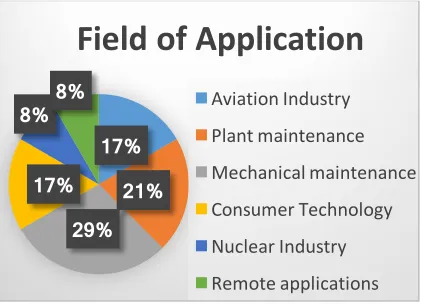
By field of application of AR in maintenance is meant the industry or technological environment which have been mentioned and considered in the 30 studies selected by this SLR. Figure 3 reports the main fields identified.
[image:8.595.71.284.495.649.2]
Figure 3. Field of application of AR for maintenance. Figure 3 has been built utilizing the methodology described in Sec. 2.5. It is a representative figure of the field of application described and utilized as case studies throughout the 30 papers. This result align with Dini [45] who also found the aviation, industrial plant and automotive as the biggest field of interest for AR
in maintenance. The biggest slice of the chart is taken by the mechanical field. It could be justified by the fact that it includes the automotive, train, military industry plus some general mechanical maintenance operations which have not been classified by the author. It is very common, in fact, that the AR application developed by a research team in an academic context, is tested uti-lizing the assemblies and objects available in their own lab. Alvarez [17], in his research into marker-less object recognition and AR for supporting disassembly operations, validated his tool utilizing five different mechanical assemblies, without specifying the field of application. In some cases, even if tested with a mock-up or in a laboratory, the author usually provides an insight of what the application has been thought for. For instance, Lakshmprabha [43] suggests to utilise his “camera&IMU based fast pose estimator” for en-hancing training in a real working environment with-out providing any test on the specific case.
The field of application is usually justified based on the maintenance requirements.
Reading clockwise the pie-chart in Figure 3, the first field of application is the aviation industry. The strong interest of the aviation industry in AR technol-ogies is justified by several motivations. De Crescen-zio, mentioned that for improving air-transportation safety, there is a need of reducing human errors’ im-pact on maintenance operations [16]. Haritos [34] be-lieved that traditional training methods are not appli-cable to the current technology available on aircrafts. The skills required for working with the current com-plex systems and avionics have to be supported by AR. Hincapie’ [38] reported that carrying out a complex assembly task following manuals or handbooks can lead the maintainer to frustration and a low quality performance. Moreover, it takes about 2000 hours to train an aviation maintenance inspector whose skills and knowledge are not easily transferable to another maintainer. More in general, there is a need for im-proving maintenance performance in aviation due to the constant need of ensuring safe operation at mini-mal cost [46].
Going clockwise, the second slice of the pie-chart in Figure 3, reports the percentage of applications in plant maintenance mentioned or shown across the 30 articles. This field includes the maintenance of facili-ties/buildings/infrastructure which provides a living or working environment.
It is evident that, since facilities are designed and built to last for many years, the longest period of its lifecycle will be the Operations and Maintenance (O&M) [15]. Its cost can be up to 85% of the total lifecycle cost.
17% 21% 29% 17% 8% 8%
Behzadan [40] believes AR could provide a solu-tion to damage prevensolu-tion and maintenance for under-ground infrastructure. The example considered in his research is an excavation operation which has a “high risk of inadvertently damaging the existing subsurface utilities”, mainly causing a financial loss, less com-monly accidental deaths. Goose [39], states that “ser-vice and maintenance are by necessity mobile activi-ties”, hence a mobile support is required. Moreover, his intent was to empower the industrial maintenance through allowing any maintenance technician to carry out the plant maintenance. Particularly relevant for the facility maintenance field, seems to be the localization of the target to be maintained. Both Neges and Lee [21], [46] considered it necessary in order to improve O&M efficiency. The first one based his research on natural markers for indoor navigation. The latter one developed an AR application which integrates the fa-cility management data available from the Computer-ized Maintenance Management System (CMMS) and the Building Automation System (BAS). In his tests, he saved on average 51% of the time to locate the tar-get.
The “mechanical field” is the third highest area of application, as highlighted in Figure 3. It includes the maintenance activities related with mechanical com-ponents in different sectors: automotive, train and mil-itary. It is worth to mention that, for the automotive industry, repair and maintenance accounts for 40% of the total lifetime costs of vehicle ownership [47].
Fiorentino [20] believes that “maintenance process is nowadays an important aspect of competitiveness and profitability”. In his study, he applied AR to a complex maintenance operation on a motorbike en-gine. His results show improvements in terms of both time (up to 79%) and reduced error rate (up to 92.4%).
Didier [31], on his side, aimed to resolve two issues of traditional maintenance related with the train indus-try:
1) transform manuals into electronic multimedia. 2) provide a tool for assisting and shortening the
training of new technicians.
The fact that hard manuals delay maintenance oper-ations is reported also in other studies [e.g. 23; 45]. Henderson [26] states that by utilizing HMD the oper-ator would not need to read the paper manual hence his/her concentration could be focused on the task. Reinhart [48] reports that AR could “reduce eye and head movements improving spatial perception and thus increase productivity”. Yuan [49] believed that alternating the attention between the object to main-tain and the instructions, would consume valuable
time. These concepts are valid also for the other fields of applications.
Moving now to the next slice of the pie-chart in Fig-ure 3, we can see that consumer technology has been mentioned 17% of the time across the 30 articles of this SLR. Many examples provided in literature demonstrate the application of maintenance task on “consumer technology” such as printers and note-books. The papers referenced in this SLR, do not state the necessity of using AR for maintaining consumer technology. It is the authors belief that AR applied to consumer technology mostly aims to demonstrate the capabilities of the AR systems, often reproducible in other maintenance fields. Havard [36] demonstrated how AR can help in disassembly operations utilizing the task of dismounting a pc blower. Sanna [23] aimed to gather data of non-expert maintainers using AR. For this reason, he considered a maintenance procedure of a notebook. His results show a reduction of both errors and time using AR-based instructions rather than pa-per-based instructions. Finally Lamberti [29], shows the capabilities of AR applying it on a notebook and printer maintenance operations even though he de-scribes the automotive and aviation maintenance in-dustry as the one needing for cost maintenance reduc-tions. His research partners predicted a reduction of about 40% in travels and 30% in cost for maintenance operations.
Continuing the clockwise reading on Figure 3, 8% of the studies mentioned nuclear power plants as an interesting field of application for AR in maintenance. Similarly to the relation between the aviation and the automotive field, nuclear facilities are more complex and require more reliability compared with other in-dustrial facilities. Nuclear power plants’ maintenance is expensive and complex [41], hence lot of procedural documentation is produced. Minimising their down time and safety is essential [22]. These concepts have been shown in the past by Nakagawa [42] who pre-dicted the increasing challenge of maintenance for the nuclear industry. He stated that due to the rigid mainte-nance schedule, even well-experienced crews could incur errors resulting in time and cost growth. Mar-tinez [50] claims that, not only because of their com-plexity, but also because of the presence of radioactive environments, nuclear power plants maintenance need to be optimized. In his case study, he faced the acces-sibility of the LHC (Large Hadron Collider) collima-tors which has changed after the design due to the in-stallation of new equipment.
the collaboration between an expert and a maintainer that are in two physically different locations. Authors sometimes refer to it as “collaborative maintenance” or “remote assistance”. The application of AR for en-hancing remote maintenance is mentioned in several papers [11], [19], [23], [28], [29], [36], [37], [39], [51]. Wang [37] reported that traditional remote assistance made “on-the-phone” cannot satisfy current technol-ogy complexity. He also mentioned that, even if VR can improve maintenance training while AR could provide a solution for transferring information from expert to technician real-time. Havard [36] reports from Bottecchia [52] that AR for collaborative mainte-nance is 10% faster than phone assistance. AR for re-mote maintenance is particularly relevant for machine tool makers. Lamberti [29] states that machine tool makers, represented in the EASE-R^3 project, find ex-pansive providing assistance to their customers. More-over, since every machine is different from the other, custom maintenance procedures are required. Improv-ing the remote assistance could lead to both increasImprov-ing customer satisfaction and reduce maintenance costs. Also the automotive industry is sensible to the remote collaboration topic [53]. Nowadays, in-vehicle sensors provide the capabilities for accessing diagnosis and maintenance information remotely [54]. Car manufac-turers, workshops, road assistance services and the customer could all benefit from a new collaborating system. It is worth to mention that remote AR finds also other applications in the life-cycle of a product. Wang [55], for instance, proposes a collaborative de-sign system which integrates AR and telepresence technologies. Liverani [51] believed that giving to op-erators and engineers the possibility to work on the same product, at the same time, even if located re-motely, could not only shorten the time-to-market, but also improve the manufacturing quality.
The main fields of application of AR in mainte-nance have been explained. In general, the complexity of the technology and the constant need for improve-ments in terms of time, errors, safety and costs are the drivers for justifying the utilisation of AR. Each field of application seems to have its specific needs and rea-sons for investing in AR.
3.1.2.Maintenance operations
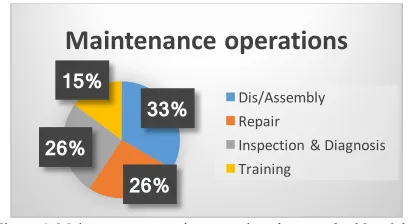
The second figure, relevant for understanding the state of the art of AR in maintenance, is shown Figure 4 .It shows the percentages of maintenance operations mentioned through the 30 articles analysed. Even in this case, some authors, developed demonstrators
based on one maintenance operation and then stated their replicability for other purposes.
[image:10.595.316.520.241.353.2]It can be noticed that the smallest slice is ‘training’. It can be justified by the fact that, when talking about AR, the aim is to avoid or reduce training and propose a solution which affects directly the maintenance op-eration [21;24;37]. Through the use of AR, maintain-ers could have the “immediate capability to accom-plish the task” on the job [56].
Figure 4. Maintenance operations mentioned across the 30 articles identified in this SLR.
Starting from the top right slice of the Maintenance operations pie-chart, assembly and disassembly seems to be the most common maintenance task taken in ac-count across the 30 articles.
Already in 1997 Azuma [13] stated that superim-posing 3-D animated drawing could ease the assembly processes compared to traditional user manuals. More recently Westerfield [3] considered AR as the “ideal tool for situations which require objects manipulation such as manual assembly”.. Yuan [49] described the assembly domain as one of the most promising appli-cations of AR.
Few examples from literature are reported below, in order to get a better understanding of the utilisation of AR for supporting assembly procedures.
[image:10.595.315.518.545.635.2](a) (b)
Figure 5. Example of assembly instruction on a train toy (a), com-puter (b), Yuan [49]. Virtual arrows and text are overlaid on the
real environment to provide guidance with the assembly proce-dure.
Figure 5, demonstrates a very simple AR approach which overlays virtual arrows and text to the real en-vironment [46]. It has to be mentioned that Yuan
fo-33%
26% 26%
15%
Maintenance operations
Dis/Assembly Repair
cused his research on the development of a virtual in-teractive tool for supporting AR, and not on the user experience.
Figure 6. Step by Step assembly procedure by Sanna [23]. Text de-scription of the task is provided on the bottom. Right and left
ar-rows to go forward and backward through the procedure steps. The example in Figure 6 is taken from Sanna [23]. He used HHD to carry out maintenance tasks on con-sumer devices. He decided to show the description of the task in the bottom of the display and provide few buttons to navigate through the procedure. Virtual an-imations are overplayed on the real environment at each step.
[image:11.595.73.279.162.280.2](a) (b)
Figure 7. Two types of visualization for the same step in a disas-sembly procedure. In Figure 8a, “strong guidance”, in Figure 8b
“soft guidance”, Webel [28].
[image:11.595.75.281.401.479.2]The third example (Figure 7) provided by Webel [28], shows an effort in providing different levels of instructions. In his research, he proposed two level of guidance: a strong one which support the user in every single step, and a soft one which gives more top level information and is thought for more experienced users.
Figure 8. Example of negative feedback message in performing as-sembly through AR by Westerfield [3]. The recognition and
track-ing of the components is made by mean of markers. Westerfield [3] incorporated in the AR procedure the ability to provide a real-time feedback of the oper-ation (Figure 8). Through the position and orientoper-ation of the components, he is able to show warning mes-sages to correct the assembly procedure.
Finally, a slightly different approach has been pro-posed by Wang [57]. He developed an AR application for simulating assembly procedure during the early de-sign phase of components. In his study, he also esti-mates the forces involved in the assembly considering the stiffness, shapes and contacting surfaces of both the real component and the virtual prototype. The forces calculated real-time and overlaid on the real scene.
Figure 9. Assembly planning through AR. The virtual component is overlaid on the real component. Forces are shown as arrows.
Their magnitude is reported numerically. Adapted from Wang [57].
[image:11.595.314.527.479.614.2]every assembly procedure in order to provide the best AR solution.
The other three slices of the chart in Figure 4 shows the percentage of times that repair (26%), inspection and diagnosis (26%) and training (15%) operations have been mentioned through the 30 articles analysed. Even though these are three different kinds of maintenance operations, the AR applications devel-oped by the authors of the 30 articles, always involve dis/assembly procedures.
• By repair operations is meant the actions aimed at restoring the functional proper-ties of a device [35]. Repair operations commonly involve the regeneration or re-placement of the failing component of the device.
• By inspections and diagnosis are meant maintenance task aiming to respectively assess the current status of the product and anlyse the causality of deterioration and functional degradation [58]. Nowadays complex systems are embedded with sen-sor which provide the information about the functionalities and an initial diagnosis. This information is usually accessible on a dedicated PC. AR could enhance this pro-cess by displaying the results of the diag-nosis closer to the object to be maintained [59].
• By training is meant the process that aims to transfer maintenance skills to techni-cians [28]. Depending on the industry, this process might be done on the job or offline. In the construction industry, hands-on training is well-accepted [60]. In this field, Wang utilized AR for complementing hu-man associative information processing and memory. He overlaid technical infor-mation on real construction vehicles such as loaders, excavators and bulldozers to help the operator carrying out the con-struction operation. As stated by Neumann [61], in fact, AR demonstrated to be an ef-ficient way for retrieving information from memory. This shows that AR training could offer the advantages of a VR train-ing addtrain-ing the value of performtrain-ing it in the real environment rather than in an immer-sive one [62].
Figure 3 and Figure 4 give an initial overview of what is the state of the art of AR in maintenance. The main fields of application and operations performed
have been described. In order to get a deeper under-standing of the current AR technology utilised, more technical information is required. In the development process of an AR application for maintenance, in fact, the developer usually has to make different choices. He/she has to select what device he/she wants to use to overlay the digital contents to the real world, what development platform he/she will be using, how the user interface will look like, what will be the tracking technology be and how the contents will be built. The following subsections will show an overview of what are the most common devices, development platform and solutions utilized by the authors throughout the 30 papers analysed.
3.1.3.Hardware
This subsection provides an overview of the most common devices utilized in the development of an AR application in maintenance.
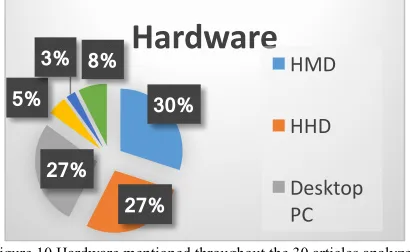
[image:12.595.317.522.349.475.2]Figure 10 Hardware mentioned throughout the 30 articles analyzed in this SLR.
Figure 10 is representative of the main devices men-tioned and utilized in the 30 articles selected and ana-lised for this SLR. The utilization of one device rather than another is often justified by the purpose of the AR application developed by the author. The progress of the technology needs to also be considered in analyz-ing this chart.
Starting from the top and reading clockwise, the first slice of the pie-chart reports the percentage of times HMDs have been mentioned in the articles. Since this SLR considers only articles more recent than 1997, the several attempts to develop HMD that were made in the early 90s [13] are not considered. The devices mentioned in the 30 articles of this SLR are usually commercial devices available on the mar-ket. Compared to the past, current technology is closer to the requirements in terms of weight and resolution asked by industrial customers, but not limited to this. Two types of HMD can be identified: see-through HMD and video display HMD [8; 9]. The technology of the first one is based on semi-transparent mirrors
30%
27% 27%
5%
3% 8%
Hardware
HMD
HHD
which allow the operator to “see-through” and, at the same time are able to reflect computer generated im-ages into the user’s eyes. Pupil forming and non-pupil forming are the two main optical architectures utilized in this kind of device. The latter is widely utilized by commercial HMDs. Kress [63] in his review of head-mounted displays, provides a detailed explanation of the optical approaches (for both pupil and non-pupil forming) concluding that there is “not yet any standard optical combiner architecture which prevail since there is a tradeoff between having a large eye-box, a large Field Of View (FOV), allowing relocation of the image, etc…”.
The video display HMD, on the other hand, cap-tures the real world, overlays the computer-generated information and shows the AR world through a small display placed in front of the eye [64]. Video display HMD have a higher latency (time gap between what is happening on the real world and what is perceived by the eye) compared to the see-through HMD due to the bigger amount of information that has to be processed. The main technical challenges for both types of HMD include latency of the system, resolution, FOV, scene distortion, eye-point matching, ergonomics and costs [10; 14; 26;30;59;62].
The main advantages of using HMDs are the porta-bility and the user experience in having the computer-generated information overlaying the real world straight in front of the eye [8; 46;63].
The second slice of the chart in Figure 10 reports the percentage of times HHDs have been mentioned in the articles. HHD includes mainly consumer devices such as mobiles and tablets. Their cost, capabilities and portability make them two very promising plat-forms for AR [67]. Kim [68] believes AR applications on smartphones have the potential to substitute paper-instructions in consumer cars. On the other side, the dimension of their screen and their need to be sup-ported (hand held or by a support designed ad-hoc), make them not suitable for all maintenance jobs [27].
The third slice of the pie-chart includes the applica-tions that utilise Desktop PCs. Their relatively high utilisation across the 30 articles is justified by the fact that this type of device is utilised for different reasons: remote maintenance applications (on the expert side), for static maintenance activities (work bench), for de-veloping a prototype, for modifying the AR proce-dures. When utilised for carrying out the maintenance task, such AR systems usually include the utilization of one or more cameras for capturing the environment and the operations.
The hardware described until now have their ad-vantages and drawbacks.
[image:13.595.317.521.570.724.2]Only a small percentage of the articles explored the use of other visualization systems. For instance Fiorentino [20] made an effort in demonstrating the capability of improving maintenance performance in a workshop simulated environment through the use of a large screen. The system also included three cameras: one pointing at the object, one at the tooling and one placed on the body of the operator. When the projec-tion is made on the physical object, the system is called Spatial AR [69].
Figure 11. Interactive AR instructions on a large screen. A motor-bike engine on the bottom is captured by the user camera end pro-jected on the screen. Fixed cameras enhance the tracking.
Fioren-tino [20].
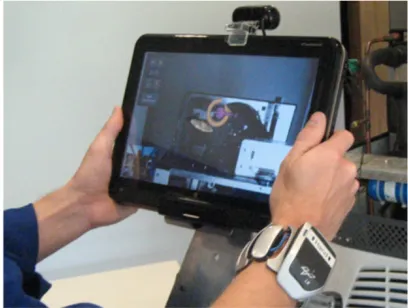
Figure 12. Example from Webel [28] of the utilization of vibrotac-tile bracelet (on the right arm) for supporting maintenance task. Tabled with external camera pointing and the object to maintain.
The AR animation is displayed on the tablet screen. The utilization of other sensors depends on the spe-cific application.
3.1.4.Development platforms
In the process of developing an AR system, the de-veloper has to choose one or more platforms to utilise for the development.
[image:14.595.68.285.309.438.2]below, in Figure 13, the pie-chart shows the per-centage of times that different development platforms of programming languages have been mentioned across the 30 articles of this SLR.
Figure 13. Development platform mentioned throughout the 30 ar-ticles of this SLR.
In Figure 13, it is evident that mid/low program-ming languages have been widely used to develop AR applications in maintenance. By mid/low level pro-gramming language, it is meant a propro-gramming lan-guage, which is closer to human language rather than the machine one. The authors of the 30 articles, not always specify the development process hence the most utilized programming languages have not been listed. Not considering the 30 articles, the most com-monly utilized are: c++, c#, java, HTML, CSS, Python, Visual Basic and PHP. Widely used are also libraries of functions such as OpenCV (Open Source Computer Vision), OpenGL (for rendering 2D and 3D graphics) and MatLab libraries. Both the solutions mentioned in the first two slices of the chart allow developing an application from scratches hence ensuring high flexi-bility. The drawback is that highly skilled people are required for developing such systems.
The utilization of SDK was mentioned only 14% of the time across the 30 articles. SDKs are becoming more common lately since they usually come along with new devices on the market (e.g. HMD, HHD). Often, in order to develop an AR application, SDKs
are not enough and have to be included in a wider soft-ware developed using mid/low level programming language or game engine.
Game Engines have been mentioned 10% of the time. The most common game engines utilized for de-veloping AR applications are Unity3D and Unreal. These are user friendly platforms which allow build-ing applications with a minimum knowledge of pro-gramming languages. Still, skilled AR people are re-quired to utilise them.
Finally, other development platforms have been mentioned through the articles. In creating the con-tents of an AR application, 3D modelling platforms are utilized such as Rhinoceros, SolidWorks, Catia and 3dsMAX.
3.1.5.Visualisation
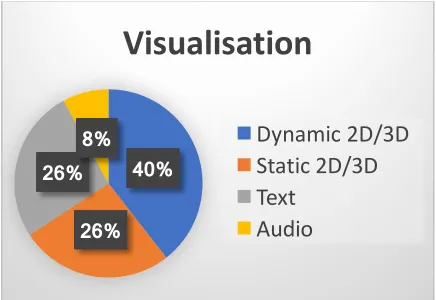
[image:14.595.311.529.392.542.2]Figure 14 reports the visualization methods utilized by the authors to overlay computer-generated infor-mation on the real environment. The devices through which the interaction user-AR is exploited are re-ported in Figure 10.
Figure 14. Visualisation approaches mentioned throughout the 30 articles analised in this SLR.
The most common method utilized and mentioned is through dynamic 2D/3D. It includes 2D and 3D an-imations which give more vivid instructions to techni-cians compared to other methods [37]. These anima-tions virtually show the task that has to be performed by the operator providing hints to perform it correctly, especially to unskilled operators [16]. These instruc-tions are considered more effective than paper-based instructions [20]. An example of this visualization sys-tem is provided in Figure 15.
44% 23% 14% 10% 9%
Development platform
Mid/Low-level languages Libraries of functions SDKGame Engine 3D modelling
40%
26% 26%
8%
Visualisation
Dynamic 2D/3D
Static 2D/3D
Text
Figure 15. Example of animation related with aviation industry from De Crescenzio [16].
Another effective way of overlaying information is through 2D/3D static models. In some cases, in fact, there might be no need to provide an animation of a maintenance task, but only a static model with infor-mation relevant to perform inspections or other opera-tions. Schall [65], for instance, proposed to superim-pose a 3D model of underground infrastructure on a construction site Figure 16 (a). Navab [62] shows CyliCon as promising application for visualizing 3D models in industrial environments Figure 16 (b).
[image:15.595.312.527.132.225.2](a) (b)
Figure 16. Example of 3D static superimposition on the real envi-ronment for underground infrastructure (a) adapted from Schall [65] and for industrial environments (b) adapted from Navab [62]. Another less intrusive way to provide information re-lated to a machinery or assembly task is through text. Overlaying text information does not obstruct the field of view and text contents are easier to create and up-date. Text information might be more suitable for im-proving maintenance performance of already skilled operators. Figure 17 provides two examples from lit-erature.
(a) (b)
Figure 17. (a) View though HMD of a helium flushing system (mockup) from Klinker [41].(b) View of an electrical cabinet
though HHD or HMD adapted from Wojcicki [35]. A small percentage of the studies mentioned the uti-lization of audio guidance for supporting maintenance. Please note that this percentage does not include the studies which mentioned the utilization of voice recognition systems to navigate in the AR application.
In general, it is worth mentioning that the contents and context requirements have to be considered in or-der to develop the best AR solution. Engelke [33], be-lieves that the operators should be allowed to visualize the instructions in the form of which is more suitable to them. In his research, he introduced the capability of switching from one visualization method to another (Figure 18).
Figure 18. Three visualization method proposed by Engelke [33]. On the left, the system to be maintained is overlaid on to the real environment. In the centre the full CAD model of the assembly is shown. On the right AR high-lights the area of interest for the maintenance task on the 2D drawing. All of them provide the manual in-structions on the bottom.
Having described the hardware, development plat-forms and visualisation methods commonly used for AR applications, the next paragraphs will describe the tracking techniques solutions and the authoring solu-tions.
3.1.6.Tracking
[image:15.595.76.284.450.539.2]us-ers and their movements in reference to their sur-roundings, is a crucial requirement for an AR applica-tion. Zhou [9] listed tracking as one of the main AR research topics.
Tracking techniques can be visual-based and sen-sor-based. We refer to hybrid-tracking when both the techniques are utilized at the same time [71]. Visual-based tracking techniques can be divided in two cate-gories: “a priori” methods and “had-oc” methods. The first one implies that the AR system has an “a priori” knowledge about the object that will be tracked. They can be divided in: model-based, feature-based and marker-based. It means that the information available a-priori are respectively: a model, a feature-map and a marker. The information can be created utilizing an “had-oc” visual tracking method hence providing the initialization of the a-priori visual tracking method [70]. Figure 19 schematically reports the tracking techniques described.
It is relevant to mention the difference between recognition and tracking. The first one does not rely on any previous information provided by the camera and aims to estimate the camera pose. Recognition is made at the initialisation of the AR system and when-ever there is a tracking failure. The latter aims to track the camera pose based on the previous frame provided by the camera [17].
Across the 30 articles analysed in this SLR, 90% made use of “a-priori” vision-based tracking tech-niques (Figure 20).
[image:16.595.318.520.243.367.2]Vision based methods are generally preferred due to the wide diffusion of RGB cameras across the dif-ferent hardware utilized for AR (Figure 10). The in-formation required to run the “a-priori” tracking is usually developed by the authors for the purpose of their project.
Figure 19, Scheme of the tracking approaches extracted from Sil-tanen [70] , Yu [71] and Hincapie [38].
[image:16.595.75.278.545.703.2]Sanna [23] utilized both a-priori model based and a-priori feature based (“by images”). The first one is considered more robust and reliable since it is inde-pendent from environmental conditions (lighting, ma-terials, etc.). The limitation resides on the availability of the CAD models. Same considerations are made by Platonov [30] who also stated that CAD based track-ing solves issues such as partial occlusions and rapid motion.
Figure 20. Tracking techniques mentioned throughout the 30 arti-cles of this SLR.
The marker-based approach, which is considered robust and accurate, might not be so in an industrial environment [20]. Marker based tracking consists of placing physical markers on the object that has to be maintained. The configuration of markers has to be properly designed. These markers, their position and orientation on the real object to be maintained, are reg-istered a-priori on the AR system. In this way, recog-nizing the marker means recogrecog-nizing the object. Marker based tracking limitation relies on the visibil-ity of the marker which might not always be in the frame of the camera. In an industrial environment, for instance, there are a lot of objects which could occlude the vision of the marker (people, tools, machineries, etc.). This would cause the tracking failure of the AR system [51]. Moreover, the markers have to be main-tained (clean and not damaged) in order to perform properly. For these reasons, marker-based approach is not suitable for harsh industrial environments [19].
The aviation industry also considers unacceptable the application of markers on the real environment [16]. For this reason both De Crescenzio [16] and Koch [15], for instance, proposed the utilization of natural markers. These are fiducial images which al-ready exist in the environment, hence there would be no need for placing markers in the facility or on the aircraft. Some examples of natural markers are shown in Figure 21.
Tracking
Vision Based Sensor Based
A priori:
• Model based
• Feature based
• Marker based
Sensore: GPS, magnetic compasses, depth cameras, inertial, infra-red, etc.
Had oc:
• Feature tracking methods
• Optical flow • Simultaneous Localisation
and Mapping (SLAM) • Parallel Tracking and
Mapping (PTAM) • Marker tracking methods
Had-oc methods can be utilised for creating the knowledge required by a-priori methods
Hybridmethods utilise both vision-based and sensor based approaches
19%
19% 52%
10%
Tracking
Figure 21. Examples of Natural Markers adapted from Koch [15] In construction, the hybrid tracking technology is well appreciated. In this field AR systems usually take advantage of GPS for improving the accuracy of the model-based or feature-based tracking [40]. This ap-proach belongs to the 10% of other tracking methods shown in Figure 20.
3.1.7.Authoring Solutions
The last chart in Figure 22 reports the percentages of time that different authoring solutions have been mentioned across the 30 articles of this SLR. By au-thoring is meant the process of creating digital con-tents for augmenting the reality [18]. The most com-mon contents are shown in Figure 14. Santos [72] mentioned “authoring tools” as one of the AR con-tents-related issues, together with instruction design and content management tools. Langlotz [73] stated that authoring tools as the AR solution to the widely known contents problem. Bae [74] lists it as one of the two key components of mobile AR along with pose estimation.
In the pie-chart in Figure 22, it is possible to see four chategories. These have been identified applying the methodology described in Sec.2.5.
[image:17.595.70.283.127.185.2]The first one includes manual authoring processes. This means that the contents are manually generated. It includes not only the creation of the 3D/2D dy-namic/static models, but also their implementation in the AR system (location, orientation, etc.). Manual au-thoring is expansive due to the amount of time and skills required in performing it. The professional skills involved are: programming, modeling and animation [18].
Figure 22. Authoring solutions mentioned throughout the 30 arti-cles of this SLR.
In order to provide a more practical solution to the authoring problem, several authors developed differ-ent methodologies which in this paper are categorized as: by annotations, boxes and automation.
The first one is the capability of adding virtual notations to a real environment. In this paper, by an-notations is meant what Klinker [41] identified as plant maintenance set of primitive tasks: highlight, la-bel, display information (text), clear information, edit information, set compass, hide/show. For instance, 3D dynamic and static contents cannot be generated through annotations. Alvarez [17] proposed to attach them manually to an image and utilized SLAM tech-niques (Figure 19) for the correct registration into the environment. Jung [75] developed a web-based anno-tating system for attaching notes to 3D models in order to improve designers collaborations. Similar applica-tions are discussed by Nee [44] who reports that anno-tations aim to improve design decision communica-tion in a collaborative system.
The second method aims to build AR processes (task by task procedures) without a deep computer programming knowledge. To ease the understanding of the utilization of this method, it is necessary to in-troduce the concept utilized by Havard [36]. In his re-search, he modeled maintenance operations for AR defining the following:
1. Entity: the smallest part of the system to maintain (eg. Nuts, plates)
2. External Entity: the smallest part external to the system to maintain (eg. Tools) 3. Actions: the activities to be performed (eg.
Push, pull)
4. Maintenance: a series of actions
5. Operation: list of maintenance operations. 64%
8% 24%
4%
Authoring solutions
Manual
Considering each one of these being in a box, switching the boxes or changing their order would lead to a different maintenance task or different oper-ation.
Another example is provided by Fiorentino [20]. Even though utilizing a different nomenclature, he de-signed an authoring tool which consisted of set of ac-tions that could be recalled to the AR application though an excel table. In this way, he provided an au-thoring solution that does not require any program-ming skill. Similarly Lamberti [29] proposed a recon-figurable framework where he defined nodes (simple procedure step) and edges (transition between nodes).
[image:18.595.69.280.440.533.2]A greater effort has been made by Zhu in his re-search about “A context-aware augmented reality sys-tem to assist the maintenance operators”[19]. He pro-vided technicians and operators the access to the au-thoring log (Figure 23), and the capability of modify-ing the contents provided by the AR developer in each box. Even though most of the information is in a text format, Zhu designed an interface to insert media files, modify visual properties and apply rendering rules. The modifications applied by a technician have to go through a review process made by the AR developer before being accepted and shared with other maintain-ers.
Figure 23. Technicians authoring log proposed by Zhu [19]. In the centre, the Authoring log. On the sides, the menu which are con-nected with different modules of the authoring log. This is visual-ized by the technician through a device and the interaction is made
by buttons.
In any case, the smallest entities or nodes of an au-thoring solution by boxes have to be available or man-ually created. The reconfiguration of a procedure is limited to the boxes available in the system.
The relevance of considering the context conditions and develop a context-aware system are emphasized also by Erkoyuncu [76]. In his research, he developed and tested an authoring solution which uses real-time data from sensor to help building new authoring pro-cedure through both a Context-Awareness Module (CAM) and a Context-Data Framework (CDF).
The last authoring solution and, the most ambitious one, is the automated authoring. This method has been
applied only to assembly and disassembly procedures. These procedures are created automatically based on the CAD models and dis/assembly planning theory. Starting from all the possible configurations of the CAD model, Alvarez [17] has been able to automati-cally extract the disassembly procedure by merging the information of the disassembly-planning module and the CAD model constrains.
3.2.Answer to Q2: What are the AR future developments in Maintenance?
The answer to this question has to be found in the discussions, conclusions and future works of the pa-pers analysed in this SLR. The question has been par-tially answered in Sec. 3.1. Even though the ad-vantages of the AR technology have been proven at an academic level, improvements are required in several fields in order to provide a robust, reliable and flexible solution for practical implementation [9], [10], [29], [70]. The main topics of research in terms of design and development in AR are:
1. Hardware (devices utilised for AR) 2. Recognition/Tracking (algorithms) 3. User-AR interaction
o Authoring solutions
o Contents management tools
o Visualisation and Ergonomics
These are described in detail in the following sub-sections.
3.2.1.Hardware future in AR for maintenance The main hardware utilized in AR have been listed and described (Figure 10). Each device has some ad-vantages and drawbacks. HMD are very promising for AR due to their mobility and the capability of overlay-ing the computer-generated information in front of the eye. Unfortunately they are still uncomfortable, have a limited FOV and may distort 3D images [9]. The limited peripheral visibility affects the safety of the operations, the virtual contents low-quality and distor-tion might cause sickness. HHD, even if portable, need a physical support system which does not affect the operations. Moreover, the dimension of their display only allows a restricted number of information to be overlaid. All the other devices lack mobility hence their application would not be suitable for all the op-erations performed by a maintainer [45].
consumption, processing power, telecommunication, memory and resolution of cameras must improve [70]. Future hardware in AR will see a strong implemtation of sensors and haptic devices. The first will en-hance AR capabilities solving current obstacles. The latter will boost mixed-reality technology providing tangible feedback to AR users.
In a not so close future, we might see the utilisation of virtual retinal displays, AR contact lenses [70] and 3D holograms projectors.
3.2.2.Registration and Tracking’ future in AR for
maintenance
Tracking has been previously defined as the heart of the AR systems. Tracking techniques have been listed in Figure 19. All the vision based techniques are affected by the environmental conditions such as light-ing, occlusions, materials. For instance, lighting has been partially solved through histogram equalisation, but the accumulation of errors due to it still make the tracking not robust and reliable [30]. Future trends in overcoming the lighting issue involve the utilisation of CAD models for extracting the features (edges) of the virtual object and compare them with the real object captured by the camera. This process can be applied only for the initialisation of the AR system. Once rec-ognized the object, the tracking have to work based on the image captured through the RGB camera.
Even though some tracking techniques can be more robust than others, in a specific application, their reli-ability is still not considered adequate to the industrial environment [9], [10],[24].
3.2.3.User-AR interaction future in maintenance Finally, the User-AR interaction needs to be im-proved. The skills required for developing and main-taining an AR system nowadays include: program-ming, modelling, animator, knowledge management. Moreover, the fragmentation of the development plat-form is an issue for AR developers [70], [77]. In order to implement AR in industry, the AR system has to be easy to maintain and modify. New authoring solutions and contents management tools are required [33]. Re-configurability of future AR system is a must, hence Authoring tools flexibility must improve [29].
An effort must be put in order to understand which is the best way of visualising the information based on the operation and the environment. Visualisation and vision-haptics visualisation should be explored [72]. The way information is brought to the maintainer has to be studied. Future trends include the utilisation of
haptics modality to transfer knowledge to the operator [28].
Future AR systems must be adaptive. They should be able to systematically capture the user’s intentions in performing a maintenance operation and collect the data of any maintenance procedure. The information collected could be used for improving the training pro-cess or the maintenance procedure itself [28].
4.Conclusions and future work
The results of this SLR aim is the answer to two re-search questions: Q1) What is the current state of the art of AR application in maintenance for supporting human operators? Q2) What are the AR future devel-opments in Maintenance? Based on the SLR the main fields of application and maintenance operations have been described. The current technology utilized has been outlined and a comparison among the 30 articles of this review has been provided. The main challenges for the implementation of AR in maintenance have been discussed answering the first question. Future AR directions and field of research have been reported and emphasized answering the second question. In general, the AR technology is still not mature for com-plying with industrial requirements of robustness and reliability. HMDs have to become more comfortable and powerful, tracking robustness has to be improved and contents-tools for AR have to be developed.
Regarding the threats to the validity and objectivity of the SLR, the author provided a fully reproducible methodology which is subjective only in the applica-tion of the quality criteria.
It is worth to clarify that, in this study, the authors applied the SLR methodology to each database sepa-rately and collated the documents selected just before the synthesis and analysis steps (see Sec. 2.4). A dif-ferent approach could be to collate the documents found in the different databases just before the appli-cation of the IC and EC. With the latter approach, in fact, duplicates would be identified earlier in the study and the workload would decrease. The final result will not be affected.
The data extraction process has been explained and applied systematically. When possible the results have been validated through a comparison with other stud-ies and/or reviews.
![Figure 1. SLR methodology utilised for this SLR [7]. In the white rectangles are reported the 7 steps of the methodology](https://thumb-us.123doks.com/thumbv2/123dok_us/1385847.91771/3.595.316.523.295.511/figure-methodology-utilised-white-rectangles-reported-steps-methodology.webp)
![Figure 7. Two types of visualization for the same step in a disas-sembly procedure. In Figure 8a, “strong guidance”, in Figure 8b “soft guidance”, Webel [28]](https://thumb-us.123doks.com/thumbv2/123dok_us/1385847.91771/11.595.73.279.162.280/figure-visualization-sembly-procedure-figure-guidance-figure-guidance.webp)