Rochester Institute of Technology
RIT Scholar Works
Theses Thesis/Dissertation Collections
3-17-2014
Hyperspectral Imaging System Model
Implementation and Analysis
Bo Ding
Follow this and additional works at:http://scholarworks.rit.edu/theses
Recommended Citation
Hyperspectral Imaging System Model Implementation and
Analysis
by
Bo Ding
B.S. Harbin Institute of Technology, China, 2008
M.S. Harbin Institute of Technology, China, 2010
A thesis submitted in partial fulfillment of the
requirements for the degree of Master of Science
in the Chester F. Carlson Center for Imaging Science
Rochester Institute of Technology
March 17th, 2014
Signature of the Author
Accepted by
CHESTER F. CARLSON CENTER FOR IMAGING SCIENCE
ROCHESTER INSTITUTE OF TECHNOLOGY
ROCHESTER, NEW YORK
CERTIFICATE OF APPROVAL
M.S. DEGREE THESIS
The M.S. Degree Thesis of Bo Ding has been examined and approved by the
thesis committee as satisfactory for the thesis required for the
M.S. degree in Imaging Science
Dr. John Kerekes, Thesis Advisor
Dr. David Messinger
Dr. Jeff Pelz
Acknowledgments
First, I need to express my most sincere gratitude to my advisor Dr.
John Kerekes. I certainly cannot reach this point without his continuous
support and consistant guidance on my research, thesis, and even career. Also
his help through my RIT life is unforgettable, and it’s my great pleasure to
have such a great advisor.
Second, I want to say thank you to Dr. David Messinger and Dr. Jeff
Pelz for their supporting and being my thesis committee. Their valuable advice
was also very important during my thesis research.
Then I want to thank Robert Krzaczek for his kind and nice help on
the implementation part of my project, and his time for reviewing my code
and having meetings with me to give me suggestions. I also want to thank
Kevin Bloechl, who helped a lot to generate target ground truth data and
also provided insightful information on doing the detection; Sue Chan for her
patiently help to get me through many obstacles; Fan Wang for his advice and
helpful discussion.
Last but not least, I want to say thank you to my family and friends
for their material and emotional support, including my mother Jianmin, father
Abstract
In support of hyperspectral imaging system design and parameter
trade-off research, an analytical end-to-end model to simulate the remote sensing
system pipeline and to forecast remote sensing system performance has been
implemented. It is also being made available to the remote sensing community
through a website. Users are able to forecast hyperspectral imaging system
performance by defining an observational scenario along with imaging system
parameters.
For system modeling, the implemented analytical model includes scene,
sensor and target characteristics as well as atmospheric features, background
spectral reflectance statistics, sensor specifications and target class reflectance
statistics. The sensor model has been extended to include the airborne
Prospec-TIR instrument. To validate the analytical model, experiments were designed
and conducted. The predictive system model has been verified by comparing
the forecast results to ones obtained using real world data collected during the
RIT SHARE 2012 collection.
Results include the use of large calibration panels to show the predicted
radiance consistent with the collected data. Grass radiance predicted from
ground truth reflectance data also compare well with the real world collected
Two examples of subpixel target detection scenario are presented. One is to
detect subpixel wood yellow painted planks in an asphalt playground, and the
other is to detect subpixel green painted wood planks in grass. To validate our
system performance, the detection performance are analyzed using receiver
op-erating characteristic (ROC) curves in a comprehensive scenario setting. The
predicted ROC result of the yellow planks matches well the ROC derived from
collected data. However, the predicted ROC curve of green planks differs
from collected data ROC curve. Additional experiments were conducted and
analyzed to discuss the possible reasons of the mismatch including scene
char-acterization inaccuracy. Several subpixel target detection parameter trade-off
analyses are given, including relative calibration error vs SNR, the relationship
among probability of detection, meteorological range, pixel fill factor, relative
calibration error and false alarm rate. These trade-off analyses explain the
Table of Contents
Acknowledgments iii
List of Tables viii
List of Figures ix
Chapter 1. Introduction and Objectives 1
1.1 Introduction . . . 1
1.2 Objectives . . . 5
Chapter 2. Background and Related Work 6 2.1 Hyperspectral Imaging System Modeling Framework . . . 6
2.2 Hyperspectral Imaging System Modeling Improvements . . . . 9
2.3 Summary . . . 13
Chapter 3. End-to-End Hyperspectral Imaging System Model-ing 14 3.1 Scene Model . . . 14
3.2 Sensor Model . . . 23
3.3 Processing Model . . . 30
3.4 Summary . . . 39
Chapter 4. Model Implementation 40 4.1 System Workflow . . . 40
4.2 Front End . . . 44
4.3 Back End . . . 48
Chapter 5. Model Validation Approach 52
5.1 SHARE 2012 Data Collection . . . 52
5.2 Experiment Design . . . 54
5.3 Summary . . . 60
Chapter 6. System Validation and Trade-off Research 62 6.1 Implementation Verification . . . 62
6.2 Initial Model Verification . . . 64
6.3 Subpixel Target Detection Model Validation . . . 70
6.4 Subpixel Target Detection Trade-off Analysis . . . 85
6.5 Summary . . . 91
Chapter 7. Conclusion and Future Work 93
Appendices 96
List of Tables
6.1 Large uniform target validation parameters . . . 67
6.2 Subpixel yellow planks detection parameters . . . 79
6.3 Subpixel green planks detection parameters . . . 82
List of Figures
1.1 Typical hyperspectral imaging system[1] . . . 3
1.2 Remote sensing process[24] . . . 4
2.1 The COBRA multispectral sensor model [35] . . . 8
2.2 FASSP model framework [16] . . . 9
3.1 Solar and atmospheric effects [24] . . . 15
3.2 Light reflection geometry [34] . . . 16
3.3 Sensor working model [24] . . . 25
3.4 SMF for a simplified 2-D scenario . . . 35
3.5 Concept of one background target detection by thresholding . 38 4.1 System working flow . . . 41
4.2 Scenario selection . . . 42
4.3 Sensor, background and target selection . . . 45
4.4 Parameter selection . . . 46
4.5 Security check example . . . 47
4.6 Radiance prediction result example . . . 49
5.1 Avon site and locations of individual experiments in SHARE2012 53 5.2 White and black calibration panels . . . 55
5.3 Two target samples . . . 57
5.4 Target deployment on asphalt court . . . 58
5.5 Yellow target reflectance spectrum . . . 58
5.6 Target deployment on grass . . . 59
5.7 Green target reflectance spectrum . . . 59
5.8 Image data collected by SpecTIR . . . 60
6.1 IDL version result . . . 63
6.2 New version result . . . 64
6.3 Measured reflectance of black uniform target . . . 65
6.4 Measured reflectance of white uniform target . . . 66
6.5 Validation on white uniform target . . . 68
6.6 Validation difference ratio on white uniform target . . . 69
6.7 Validation on black uniform target . . . 70
6.8 Validation difference ratio on black uniform target . . . 71
6.9 Grass selection . . . 72
6.10 Validation on grass radiance . . . 73
6.11 Grass covariance matrix eigen values . . . 74
6.12 High resolution WASP imagery after color mapping . . . 75
6.13 Subpixel yellow plank spectra . . . 76
6.14 Subpixel target detection scene . . . 77
6.15 Compensated reflectance ROIs . . . 78
6.16 Subpixel yellow planks detection ROC . . . 80
6.17 Subpixel green planks detection ROC . . . 81
6.18 Divided scene image . . . 83
6.19 Subpixel green planks detection ROC in designed scene . . . . 84
6.20 Sensitivity of signal-to-noise ratio to sensor calibration error . 87 6.21 Sensitivity of detection to meteorological range . . . 88
6.22 Sensitivity of detection to relative calibration error . . . 89
6.23 Sensitivity of detection to false alarm rate . . . 90
Chapter 1
Introduction and Objectives
1.1
Introduction
System modeling is a quite helpful technique in understanding and
analysing system behaviour. A system could be modeled by characterizing,
analysing and then expressed analytically and mathematically. This kind of
model is an abstract description of the system which is being analysed. It is a
method to represent a real world system or a process analytically by low cost
calculation or software simulation. This kind of technique could be used in
many aspects to help understand the functionality of system. For example,
when we need to do an experiment, it would be very useful to analyse the
ex-periment first by breaking it down into several steps, and then estimating some
possible result in each step, qualitatively or even quantitatively. When doing
the experiment, people could get a general idea of how well the experiment is
conducted and finally how reliable the result is by comparing simulated and
experimental results. Or before a real system is built, some analytical work
could be done to validate the whole system design by theoretically modeling
the system, which is also helpful in characterising the real system. It is also
not be possible to build practically, or it is not necessary to build the real
sys-tem. In this case, system modeling is a key to analyse and study the system
effectively and efficiently.
In this thesis, the primary focus is on hyperspectral imaging system
modeling. Hyperspectral imaging is an imaging method collecting and
pro-cessing spectral information from a wide range across the electromagnetic
spectrum. A typical hyperspectral imaging system is illustrated in Fig. 1.1.
Our work focuses on system’s operating in the reflective portion of the optical
spectrum, extending from the visible part (0.4 to 0.7 um) to the Short-wave
Infrared (SWIR)(around 2.5 um). Hyperspectral sensors are made to
col-lect spectral radiance information in hundreds of narrow contiguous channels
typically 10nm wide. Most hyperspectral systems cover the visible and
near-infrared (VNIR)/SWIR bands, gathering radiance from materials based on
their reflectance information and incident radiation, and have proven useful
in various applications such as environmental monitoring [11], ground-cover
classification[2], mineral exploration [26], target detection [22] and subpixel
objection detection [23]. Hyperspectral imaging has advantages over regular
imaging since it expands regular image information from gray scale or RGB
into hundreds of spectral channels, which means even a single pixel contains a
feature vector with over 100 dimensions with an entire spectrum of reflectance
information. There is no need to acquire the prior knowledge of the sample,
to be collected. Hyperspectral imaging can also benefit from spatial
relation-ships between nearby spectral bands, which allows more accurate
[image:14.612.154.474.207.444.2]spectral-spatial models for a better segmentation and classification of the image.
Figure 1.1: Typical hyperspectral imaging system[1]
A conceptual description of a hyperspectral remote sensing process is
shown in Fig 1.2, which shows an overall view of the whole system starting
from the power provided by the sun. The initial energy passes through the
atmosphere, getting partially absorbed and scattered in the atmosphere, and
then reflected by the corresponding landcover/target on the Earth’s surface.
After reflection, the light then passes through the atmosphere again before
be affected by atmospheric conditions such as solar angle, atmospheric model,
cloud, etc. At the instrument, light first passes through a set of lenses and
then reaches the detector. At the detector, the incoming energy is sampled
spatially and spectrally and then converted into an electrical signal. After
that, the signal is adjusted and digitized through the analog-digital converter
[image:15.612.156.461.275.506.2]in order to be stored, analyzed and transmitted to a processing facility.
Figure 1.2: Remote sensing process[24]
At the processing stage, geometric registration and calibration might
be performed to make it possible to compare this data set with other data
sets. Feature extraction may also be conducted to reduce the dimensionality
in the image. At last, the data go through an interpretation stage depending
on different applications, which means for different needs there are different
processing methods to make full use of the data.
1.2
Objectives
From the description of remote sensing systems, there are at least three
major parts of the system: scene features, sensor characterization and
process-ing method. As a result, the system modelprocess-ing will be based on these three
respectively. The objectives of this dissertation are as follows:
• extend an existing analytical model for hyperspectral imaging system to
include a new instrument and new analysis scenarios;
• implement the analytical model in a new form which could be made
avail-able to the remote sensing community through an RIT-hosted website
to support hyperspectral imaging system design and parameter trade-off
research;
• validate the model by comparing with real world data collected from
RIT SHARE 2012 project both in full pixel target detection and
sub-pixel target detection scenarios, and investigate hyperspectral system
Chapter 2
Background and Related Work
In this chapter, an overview of background and related work in
imag-ing system modelimag-ing and its application is given. Several different example
imaging system models are described and discussed, including statistical data
based models and models that directly produce hyperspectral images.
2.1
Hyperspectral Imaging System Modeling Framework
The first systematic approach to analysze hyperspectral imaging system
was introduced in [21]. This paper serves as a cornerstone in the remote sensing
system modeling research based on input statistical data. In this paper, the
author explained the remote sensing system and several typical instruments
which cover the optical spectrum ranging from 0.4um to 2.4um. Then the
sys-tem and its working processes were separated into different unit blocks. The
surface reflectance statistics were assumed to be spectrally multivariate
Gaus-sian with a spatial correlation. The scene was spatially modeled as having
cells of diffuse reflectance (Lambertian assumption) with spatial correlation
from cell to cell. The solar and atmospheric model transferred the scene
is received by the sensor. Then the received radiance was mapped into sensor
bands according to a sensor channel response model. After reaching the sensor,
sensor noise sources were modeled by adding shot noise, thermal noise, etc, to
signal, with the noise being modeled as a zero mean random process. Each
noise source was assumed to be independent from each other and uncorrelated
from spectral band to spectral band. After noise was added, feature extraction
or selection might be performed to reduce dimensionality or to choose typical
bands. After all classes have been processed by the above system, an estimate
of the probability of error was made using a Bhattacharyya distance between
different classes. The modelled system was verified by existing experimental
results and shows consistency with real data.
The application model in the above paper was built for ground cover
classification. For different applications, there were different approaches to
system modeling to better simulate the scenario and complete the task. In
[35], the author presented a model for multispectral mine target detection.
Since the application was quite different, the Coastal Battlefield and
Recon-naissance Analysis (COBRA) multispectral sensor model was given in a more
detailed form, which was shown in Fig. 2.1. This system broke the whole
system into 4 main models. For the atmospheric part it used MODerate
res-olution atmospheric TRANsmission (MODTRAN) [3] as the model, and for
the detection model there was a mine detection algorithm committed to find a
application of data post-processing with the help of multi-spectral imaging
[image:19.612.119.514.184.449.2]system modeling.
Figure 2.1: The COBRA multispectral sensor model [35]
Then in [15], the Forecasting and Analysis of Spectroradiometric
Sys-tem Performance (FASSP) model was first presented and then extended in [17]
to cover the full optical spectrum. A more clear and straightforward system
structure was introduced and the whole process was developed into separate
functional blocks, as shown in Fig. 2.2 . This updated version of system model
now could take multiple background classes, which were described by their first
these statistics become the scene model. It used MODTRAN for atmospheric
effects, which was similar with previous research. The sensor model was also
like the original modeling in [21] except it was extended to the HYDICE
in-strument [32] with a broader wavelength range. The FASSP model has been
validated in a number of scene types with real world data by comparing how
[image:20.612.127.498.282.498.2]different parameters affect the performance of detection.
Figure 2.2: FASSP model framework [16]
2.2
Hyperspectral Imaging System Modeling
Improve-ments
After the main skeleton for hyperspectral imaging system modeling was
In [19] the background model was simply a linear combination of different
background class spectral statistics, and [20] improved the linear model to
include elliptically contoured multivariate t-distributions to better depict
em-pirically observed backgrounds, which lead the system model to make more
realistic performance predictions without describing a complex scene.
For the atmospheric effect modeling, LOWTRAN or MODTRAN has
been used to convert reflectance statistics into radiance data based on
at-mospheric parameters, and this has been recognized as the most correct and
accurate way to simulate the process. As a result, improvement in this part
was rarely seen.
Improved versions of the FASSP model have kept the framework of the
sensor model similar, but took the mean and covariance of the input signal
and then applies sensor effects such as sensor spectral response, sensor noise
from different sources, etc. The improvement in the sensor modeling could be
extending the sensor type of different wavelength bands, different sensor
re-sponses and different noise models. [17] enhanced the sensor model to include
a dispersive spectrometer model and a Fourier transform spectrometer model.
There were sensors focusing on different wavelength bands. For example for a
certain type of LWIR sensor, excess low-frequency noise (ELFN) was
signifi-cant in forming the noise. As a result, the noise model needed to be improved
to better simulate the sensor.
the sensor to include polarimetric features. In [24], polarimetric features were
added into the sensor, which increased the information dimensionality. As a
result, the system performance could be increased by using the new
informa-tion, and also this polarimetric model has made the hyperspectral imaging
system modeling more complete.
Different applications have different algorithms, and another difference
in system modeling lies in the processing of the data. There were different
data processing algorithms implemented for different applications. For
sup-porting relatively small target detection and high sensor altitude imaging, [15]
extended the application into subpixel target detection, based on a subpixel
object model using the subpixel fraction to define the fractional area of the
pixel occupied by the object within direct sight of the sensor. In the subpixel
target detection scenario, several pairs of parameter trade-offs, and also in
different combination of backgrounds were discussed and analyzed to better
understanding the detection performance. [14] used the system model to
pre-dict unmixing performance, which included a different post-processing method
applied to the data. Then the data observed from real world was shown to
compare well with the predicted result, which validated another application of
the FASSP model.
For the above applications and modeling, an assumption that the data
collected have been perfectly geometricly corrected is made. In [9], the author
ge-ometric registration, and gave an in-depth simulation of EnMAP acquisition
geometry.
The models discussed above are all statistical data based, which means
the input and output are some statistics of the data, such as mean and
co-variance. This modeling method may not be very intuitive, but it reduces the
computational cost and sometimes reduces the unnecessary system complexity
for specific applications.
Besides the theoretical models discussed above, the Digital Imaging and
Remote Sensing Image Generation (DIRSIG) tool deserves mention as a
com-plex synthetic image generation application being used by the remote sensing
community. It is a popular system modeling tool being widely used among the
researchers in this field [37]. It produces simulated multispectral or
hyperspec-tral remote sensing images by calculating the sensor reaching radiance, and it
also produces predicted image pixel by pixel, not just some statistical data.
This feature encourages many algorithm developers to use DIRSIG to validate
their algorithms with the help of pixel level ground truth images. Compared
with the FASSP model mentioned above, DIRSIG is a more comprehensive
model to simulate the sensor reaching radiance at the pixel level, and since it
can do pixel level prediction, the computational cost is huge for hyperspectral
imaging systems. Also, it needs more complex scene definition, including the
3D model and BRDF for different objects in the scene. Second, since it does
simu-lated data first then apply further processing in another platform. However,
FASSP includes the post processing for the data and also the algorithm
evalu-ation metric to easily estimate the system performance under some proposed
conditions. Third, the DIRSIG tool has put some restrictions on users and
DIRSIG training is required before using, and it is better to have a model
open to public and ready to be used easily.
2.3
Summary
An overview of the background of imaging system modeling was
dis-cussed and the related works in this area were given. Different examples of
statistical data based imaging system models were provided and the
improv-ing from different system aspect was discussed. Then DIRSIG was introduced
as a more comprehensive model and a popular tool among researchers in the
remote sensing community. By comparing DIRSIG with the FASSP model,
the advantages and disadvantages were discussed, and we now see that an easy
to use and easy to access system modeling tool is in need by remote sensing
Chapter 3
End-to-End Hyperspectral Imaging System
Modeling
This chapter introduces hyperspectral imaging system modeling mostly
by reviewing literature [16] [34] and some extended discussion. The
end-to-end hyperspectral imaging system involves all the components in the scene,
including illumination, surface reflection, atmospheric effects, the sensor,
in-cluding spatial, spectral, thermal and radiometric effects, and the processing
algorithms, including calibration, feature selection, and application algorithm
to complete the whole process [17]. The main assumption this modeling
ap-proach is based on is that the various surface classes could be characterized
by their first and second order spectral statistics. Then all the effects could
be modeled as transforms and functions to these statistics. Based on this
fundamental assumption, these three major functional blocks – scene, sensor,
processing – will be discussed below respectively.
3.1
Scene Model
In a remote sensing system, the primary source of flux incident on a
sources, which are reflected, scattered, etc, then detected by sensing
instru-ment. Fig. 3.1 shows the main atmospheric effects on the flux and several
[image:26.612.132.505.216.491.2]major incoming flux paths to the sensor.
Figure 3.1: Solar and atmospheric effects [24]
There are three different radiances described in Fig. 3.1. Radiance A
passes through the atmosphere directly. It is then reflected by the reflector,
which may be defined as target or background in a target detection scenario,
and then bounces back to the atmosphere before finally reaching the sensor.
reflected back to sensor. This radiance is called downwelled radiance. Radiance
C is the solar irradiance scattered from the atmosphere then directly into
the sensor without arriving at the reflector on earth. This radiance is called
upwelled radiance or path radiance. Also, there are other kinds of radiance
reaching the sensor such as the adjacency effect which is sun light reflected
from an adjacent surface, background radiation, and then scattered by the
atmosphere into the sensor. The adjacency effect is captured in the model by
using the overall average surface scene reflectance in the whole scene.
Figure 3.2: Light reflection geometry [34]
To describe the radiance propagation process, the geometry of a basic
light reflectance scenario is presented in Fig. 3.2. The optical property of a
surface reflection is usually described by the bidirectional reflectance
directions [27]. It is defined as the ratio of the radiance scattered into the
direction described by the orientation angles (θr, φr) to incident irradiance
from (θi, φi), i.e.
f = L(θr, φr)
E(θi, φi)
[sr−1] (3.1)
This is the general form of BRDF, and the ratio varies for different reflecting
directions. However, in most cases the reflection surface is considered as a
perfect Lambertian radiator, which means the reflection has the same radiance
in all directions. Feng et al. in [6] show the reflectance factor (rrF) is related
to the bidirectional reflectance (rBRDF) by a simple factor ofπ steradians, i.e.,
rBRDF[sr−1] =
rrF
π[sr] (3.2)
Then the complicated directional related coefficient could be simplified into a
simple surface reflectance factor. Then the radiance A reaching the sensor is
expressed as:
Lr =
τ cosθiEsrrF(λ)
π [W m
−2
sr−1µm−1] (3.3)
whereLr is the direct solar reflected radiance, τ is the surface-to-sensor path
transmittance, θi is the incident angle, Es is the solar spectral irradiance on
the surface from its direct transmission through the atmosphere andrrF is the
reflectance of the surface according to different wavelength.
Radiance B is the downwelled radiance reflection. It comes from the
photons incident on the reflecting surface due to the solar scattering from the
is introduced, and it describes the spectrally related angular scattering
coef-ficient for the composite atmosphere, where λ is the wavelength, and σv is
the angle between the incident flux and the flux to the surface. The scenario
is modeled as the radiance is scattered by small volume elements of the
at-mosphere then reaching the target, which means to integrate all radiances
from ”small volume elements” onto the target. Then the radiance reaching
the target from direction zenith angleθd and the azimuthal angleφd could be
expressed as:
Ldi(θd, φd) =Esλ0 Z
τL1(λ)τL2(λ)βsca(λ, σv)dr (3.4)
whereEsλ0 is the exoatmospheric spectral irradiance, τL1(λ) τL2(λ) are the
L-path transmission values, and r is the length of volume-target path. Then
based on the Lambertian surface assumption, the surface reflected downwelled
radiance originated from direction zenith angleθd and the azimuthal angle φd
could be considered as:
Ld=
τR LdicosθdrrF(λ)dΩ
π (3.5)
wheredΩ = sinθddθddφd and τ is the surface-to-sensor path transmittance.
Radiance C is the upwelled radiance, which has not been reflected, just
scattered by the atmosphere before reaching the sensor. From the derivation
of the downwelled radiance case, this case can be considered similar to the
expressed as:
Lu(θd, φd) =Esλ0 Z
τL1(λ)τL2(λ)βsca(λ, σv)dr (3.6)
whereτL1(λ)τL2(λ) are the L-path transmission values from sun to scattering
atmosphere volume to sensor in this case.
In practical research and application, the solar irradiance, downwelled
and upwelled radiance are often estimated using an atmospheric scattering
model, like MODTRAN. Except for these three major energy paths, there are
also other energy paths like thermal radiance which could also be computed
by MODTRAN. In our model, MODTRAN is called several times to turn the
reflectance statistics into radiance statistics according to the atmospheric
con-ditions. The output data of MODTRAN includes different columns to describe
each path or source of the radiance varing among a range of wavenumber. For
example, the GRND RFLT column is the total ground reflected radiance,
which is the sum of Lr and Ld, SING SCAT column is the single-scattered
radiance term of the path radiance, and SOL SCAT column represents the
multiple-scattered radiance term of the path radiance. But actually the path
radiance includes not only these terms, and to make it more accurate, a
MOD-TRAN run that the target surface reflectance is set to 0 is included, and then
the GRND RFLT will be 0. As a result, TOTAL RAD becomes the rest part of
total radiance except for reflected radiance, which means it’s the path radiance
we are looking for, Lu, described by Eq. (3.7).1 In each call, the Lr, Ld, and
Lu are extracted from corresponding columns, and also the thermal radiance
from a specific column is extracted, then combined into corresponding totalL
in each scenario.
In our model, the scenario is for subpixel target detection in multiple
backgrounds [16]. For background class modeling, each background class m
calls MODTRAN respectively, and another MODTRAN call is made for the
average background scene. Then the total mean radianceLb for each class is:
Lbm =LS(ρm) +LP(ρave)
Lbave =LS(ρave) +LP(ρave)
(3.7)
where the LS is the total ground reflectance radiance corresponding to the
GRND RFLT column in MODTRAN output data for each background class,
LP is the average background path radiance term, ρm is the mean reflectance
statistics for classm, and ρave is the scene average reflectance, which is
calcu-lated by the scene fractions fm in Eq.(3.8):
ρave = M X
m=1
fmρm (3.8)
MODTRAN runs not only using the reflectance data, but many other
parameters, such as the solar angle, sensor altitude, atmospheric model, etc.
In our model, most of them can be specified by the user, which allows the user
to have a more flexible model to use, but also the system provides a set of
default values and detailed hints for each parameter to make it more friendly
and easy use.
Contrary to the atmospheric parameters, the mean and covariance
spec-tral reflectance statistical data for surface background and target classes are
obtained prior to the modeling. They may come from some database which
includes measurement samples for different surfaces or from direct
measure-ment for some specific surfaces or targets. The measuremeasure-ment is done by a
spectroradiometer, and after obtaining multiple samples of the hyper
dimen-sional reflectance vector, the reflectance mean of the surface is obtained and
the reflectance covariance matrix could be calculated.
For target class, the radiance propagation is similar, and the mean
spectral radiance for target in open is calculated as in Eq.(3.9)
˜
LT =LS( ˜ρT) +LP(ρave) (3.9)
Due to a subpixel scenario, the ˜ρT is actually a weighted sum of the target
mean reflectance and the background classm∗ it is in, as in Eq.(3.10):
˜
ρT =fTρT + (1−fT)ρm∗ (3.10)
where fT is the subpixel fraction of the target takes in a pixel, with a range
between 0 and 1. The rest of the pixel is the background class, which accounts
for the second term in the equation. This equation merges the target and
transforms this subpixel target detection problem into a regular target
detec-tion problem. This pixel could be considered as the new full pixel target and
then the total estimated target radiance is based on the weighted sum of the
pixel reflection statistics, which is the new pixel size target.
The radiance mean statistics calculation is discussed above, and the
radiance covariance transform from reflectance to radiance follows similar
lin-ear atmospheric model assumed in the above radiance mean calculations. The
main concept in the calculation is a linear interpolation of spectral radiances
calculated for surface albedos from zero to one according to the entries in the
reflectance covariance matrices. This calculation makes use of several diagonal
matrices: ΛLS1 is the total surface reflected radiance for surface reflectance 1,
ΛLP1 is the path scattered radiance for surface reflectance 1, and ΛLP0 is the
path scattered radiance for surface reflectance 0. Then the spectral radiance
covariance matrice for background class m, ΣLBm, and average, ΣLBave, are
expressed as:
ΣLBm = ΛLS1gBΣρBmΛLS1+ [ΛLP1−ΛLP0]gBΣρBave[ΛLP1−ΛLP0]
ΣLBave = ΛLS1gBΣρBaveΛLS1+ [ΛLP1−ΛLP0]gBΣρBave[ΛLP1−ΛLP0]
(3.11)
where ΣρBm, ΣρBave are the corresponding reflectance covariance matrices for
each background class, average background class, and gB is the background
class reflectance covariance gain factor specified by the user.
For the target class, the situation becomes a little more complicated. It
ΛLS1 , then the total target radiance covariance matrix is expressed as:
ΣLT =fT2ΛLS1gTΣρTΛLS1+ (1−fT)2ΛLS1gBΣρBm∗ΛLS1+
[ΛLP1−ΛLP0]gBΣρBave[ΛLP1−ΛLP0]
(3.12)
where gT, like gB, is the user specified scalar for the target reflectance
co-variance matrix and ΣρBm∗ is the reflectance covariance matrix for class m in
which the target resides in.
At this point, the transformation from reflectance mean and covariance
statistics into radiance mean and covariance based on the scene parameters is
finished, which means the radiance reaching the sensor is obtained.
3.2
Sensor Model
The sensor model takes in the spectral radiance mean and covariance
statistics of the backgrounds and target, applies sensor effects, such as noise
effects, channel response, caliberation, etc, to the radiance statistics and then
outputs the processed data to simulate the process that an image is taken by
the hyperspectral instrument for further processing.
There are different kinds of sensors having different working spectral
bands, channel responses, resolutions, noise features, etc, which requires our
model to be built in a generalized form and allow different specifications for
different sensors.
The input data (mean vector and covariance matrix) is usually
samplings at specific wavelengths with an equal margin or a distribution over
a section of spectral band. As a result, the spectral band and samples at
specific wavelengths of input data should be mapped into the set of spectral
bands and wavelengths specified in the sensor specification file to comply with
the sensor working condition. Actually, in order to speed up the calculations,
this mapping is done before the reflectance mean and covariance statistics are
used in the scene model. After the background and target classes as well as
the sensor are specified at the beginning of this model, the reflectance mean
vectors and covariance matrices are interpolated into the wavelengths
accord-ing to the sensor specification, and then the reflectances at these wavelengths
are recorded in the MODTRAN reflectance specification file for its running,
which provides a more accurate output from MODTRAN at and around these
wavelengths.
Usually, MODTRAN has a much finer spectral resolution output than
the resolution of sensor, and at this step, the modeling could be considered
as the sensor takes samplings at its descrete wavelengths from the much finer
MODTRAN sequence output. Each sensor wavelength needs a channel
re-sponse function to describe how the sampling works. In this model, the
chan-nel response function is modeled as Gaussian distributions with a center of
the specific wavelength and width of±3 times the standard deviation, which
is defined by the channel bandwidth. As a result, each response output for
around that wavelength.
After the channel response modeling, some major noise sources, such
as the detector noise, calibration noise, analog-to-digital converting noise, etc,
are modeled. The sensing instrument works like a hyperspectral camera, and
the whole working process is described in Fig.3.3. Generally speaking, there
Figure 3.3: Sensor working model [24]
are different types of noise at different stages of the sensor pipeline. For the
detector related noise, there is photon noise, which is related to the input
sig-nal level, and thermal noise and readout noise, which are non-related to the
input signal. After the detector during the calibration, there is percentage
calibration error. Then at the quantization and data link level, there is analog
to digital noise and the bit error in the communication link or recording
chan-nel. Then the noise process is modeled by adding variances onto the diagonal
entries of the input covariance matrix, which means the modeled noises are
all independent on their own channel, and assuming there is no inter-channel
noise correlation.
input radiance is transformed into electrons by Eq.(3.13) [18]. The number of
photons emitted and detected in a specific time span could be modeled with a
Poisson distribution. If a random variable follows such a distribution, then it
will have the same mathematical expected value and variance. As a result, if a
sensor is receiving 40000 photons per time interval, which could be considered
as the expected value, then the standard deviation error due to photon noise
would be √40000 = 200 photons.
σnp = p
L×Od×AΩ×τ×η×t×∆λ×CU ×λ/(h×c) (3.13)
where
L: input spectral radiance [mW cm−2srµm];
Od: radiance channel degradation coefficient;
AΩ: system throughput [cm2sr];
τ: optical transmittance;
η: quantum efficiency;
t: integration time [sec];
∆λ: spectral channel bandwidth [µm];
λ: spectral channel central wavelength [µm];
Except for the system throughput, the parameters above are included in
most sensor specifications. But the sensor aperture size d and instantaneous
field of view θif ov are provided to compute the system throughput by Eq.
(3.14).
A=π(d/2)2
Ω =4πsin2(θif ov/4)
(3.14)
The thermal noise and readout noise are always considered as a property of
sensor and given in the sensor specification file together as fixed noise. It
is also possible to obtain them by conducting an experiment specifically for
measuring them. The total noise at the detector is the squared sum of the
three according to the variance calculation method, and since the fixed noise
includes thermal noise and readout noise, then the total noise variance at the
detector could be expressed by Eq. (3.15), where σnf is the fixed noise in
electrons.
σnd2 =σ2np+σnf2 (3.15)
Then the obtained detector noise needs to be converted back into radiance
σLdn, and a user specified detector noise gain factor gdn is applied on it. After
this, the scaled detector noise is added onto the diagonal elements of the class
m covariance matrix, as shown in Eq.(3.16) for each channel i
Σdnm(i, i) = Σm(i, i) +gdn2 σ 2
Ldn(i) (3.16)
Second, another noise source is the relative calibration noise CR. For
channels with a percentage describing the relative fluctuation centering on the
mean input signal level Lm(i) like a standard deviation in each channel. For
channel i and class m, this noise modeled as a variance adding onto signal
covariance matrix is as shown in Eq.(3.17)
Σdnm+c(i, i) = Σdnm(i, i) + [Lm(i)×(CR/100)]2 (3.17)
Third, analog-to-digital quantization process in the pipeline results in
quantization noise, and the bit error noise is from the data communication
link or recording system. Both of these noises are functions of the sensor
radiometric resolution, and in our model the sensor resolution is the least
significant bit (LSB) in the sensor specification file. According to some basic
statistical knowledge on variance of a uniform distribution, the quantization
noiseσ2
nq can be expressed as:
σ2nq =LSB2/12 (3.18)
whereLSB has a units of electrons.
For the bit error noise in the data communication or recording process,
our model assumes that the bit errors are uniform in the whole data which
means for N bits data package, the bit error rate for each digit is the same
and there is no source or channel coding on the data which means the data is
modeled as binary data stream. If the error bit is at a higher digit, the error
usually quite low compared with other noises, multiple bit errors happening
at the sameN bits data package has a much lower probability and as a result
only one digit error is considered without taking the case of multiple bit errors
in one package into consideration. Then the bit error noise is considered as an
average data error of error bit on each digit, and expressed in Eq.(3.19):
σnB2 e = Be
N
N−1 X
n=0
(2nLSB)2 = LSB
2B
e
3N 2
2N −1
(3.19)
Then the σ2
nq and σnB2 e will be converted back to radiances to add onto the
signal matrix diagonal elements to complete the whole sensor noise model
process.
In the sensor process, another important parameter to characterize the
sensor performance is the signal-noise-ratio (SNR), which is independent for
each different class. The ”signal” is the input mean radiance vector for each
class and the ”noise” is the square root of the sum of several noise terms
calculated above in the form of standard deviation. For class m (target or
some background), the SNR is expressed as:
SNRm =
Sm q
σ2
nd+σC2R +σ 2
nq+σ2nBe
(3.20)
After the sensor model, the radiance mean and covariance statistic data
3.3
Processing Model
If the data processing module is considered as a black box, the
in-strument output radiance data obtained above will be the module input, the
internal control mechanism will be determined by the application required,
such as target detection, tracking, unmixing, etc, and then the output of the
black box should be some metric to characterize the performance of the
ap-plication based on some specific criterion designed for that apap-plication. Since
this paper is focusing on the scenario of subpixel target detection, then the
process and metrics for target detection will be used, such as the feature
se-lection/extraction as the data pre-processing method, and probability of
de-tection vs false alarm rate as the evaluation metric.
For target detection or even other applications, the data used in the
processing algorithm of a hyperspectral system is usually not the radiance
col-lected by the instrument directly, because the radiance data includes the effect
of the atmosphere which loses universality for the same target but in different
atmospheric conditions. And as a result, the collected radiance data needs to
be transformed into some atmospheric independent form which is usually the
surface reflectance, and this process is called atmospheric compensation.
There are different atmospheric compensation methods to retrieve the
surface reflectance. Generally there are two types of methods: one has the
ground truth data when it is possible to put some pre-known reflectance panels
in-scene method and just uses the in-scene radiance information collected when it is
difficult or impossible to obtain good ground truth information. The ground
truth method, a.k.a. empirical line method (ELM) [36] is widely used in
different conditions and it assumes the reflectance and the radiance collected
are linear with each other and they should fit in a line. Then the ground
truth information could be used to compensate for the atmospheric effects
and compute the target reflectance. For in-scene methods, the most common
and simple one is called darkest pixel (DP) atmospheric compensation method
[29]. Since the radiance reaching the sensor could be expressed asL=Crt+Lu,
whereC is a constant relevant to solar irradiance, atmosphere transmittance,
etc., rtis the target reflectance, and Lu is the upwelled radiance. This method
assumes that the minimum scene radiance is the upwelled radiance when the
target has a zero reflectance. The constant C could be obtained by the scene
color standard approach [30] and then the reflectance could be computed.
In this model, the ELM method is used for atmospheric compensation
by using low and high reflectance panels, in our case 0.1 and 0.6, to compute
the offsetb and slopek of the linear relationship between the radiance and the
reflectance. The choice of 0.1 and 0.6 rather than 0 or 1 is for excluding the
nonlinearity and noise present close to 0 and 1. Then the mean reflectance
is obtained by finding the corresponding mean radiance for each channel
ac-cording to the fitted ground truth line. For the radiance covariance matrix, to
matrix has been built to multiply its element with the corresponding element
in the same row and column from the covariance matrix, and the offset b is
not applied since covariance does not take offset in the calculation.
After the estimated reflectance mean and covariance data are obtained,
the next step is the feature extraction due to the high dimensionality of the
original data, which is always hundreds of channels for hyperspectral image.
There are many different ways to extract the features from the obtained
multi-dimensional reflectance data. One easy and simple way is just to choose the
reflectance data from preset bands in spectrum such as visible region, VNIR,
SWIR, etc, or a selection of channels from different spectral regions to avoid the
effects of atmosphere and water absorption. Besides this, principal component
analysis (PCA) is also a widely used to process the hyper-dimensional data to
reduce the dimensionality, and there are modified version of PCA according to
correlation between channels [39] or based on wavelet decomposition [8]. There
are also other methods to perform the dimensionality reduction according to
or designed for different applications, but the idea is also to apply a linear
transform, which is described by a transform matrix Ψ, on the mean vector
and covariance matrix, like what is showed in Eq. (3.21):
Fm =ΨXm
ΣF m =ΨΣXmΨT
(3.21)
whereXm means the input mean reflectance vector of class m(target or
have similar meaning but they are matrices. The transform matrix Ψ is a m
byn matrix, where m is the dimension of feature space and n is the original
mean vector length. This transform matrix reduces the data dimension fromn
tom. In our model, the feature selection implemented is the channel selection
method, which allows the users to select multiple or all channels from the band
range of the sensor they have chosen.
After the feature extraction, the projected data could be used to
per-form the application in a given scenario: subpixel target detection in our case,
and then a designed performance metric will be adopted to evaluate the system
performance.
There are different cases for target detection: one is the target is
un-known, which means the target spectral feature is unknown and the other is
that the target spectral character is known. In our case, since the target mean
reflectance vector and covariance matrix are already known, so the latter case
will be discussed. The most common target detection algorithm for a set of
sampling based data is the spectral matched filter (SMF) when the target
is known. The concept of matched filter was first introduced by the radar
signal detection community when they were looking for an optimal filter to
detect the signal by maximizing the signal to noise ratio (SNR) in additive
white Gaussian noise [28]. In the case of remote sensing, the method has been
expanded to deal with a multi-dimensional signal, the hyperspectral image,
However, in remote sensing, the ”noise” is not additive stochastic noise any
more but the scene variation. The scene variation is included into the system
by the surface reflectance measurement, and the data measurement process
could be considered as a sampling process. According to the central limit
theorem the sampled surface reflectance data follows a Gaussian distribution
when the number of samples is considered large enough. The scene variation
has similar feature as the ”noise” in the radar signal detection matched filter,
and the SMF should be also work for hyperspectral target detection [33].
The SMF is considered as a two-step process: the first step is to project
the background average and target reflectance mean vector into a normalized
space using the background covariance matrix, which makes the sample points
distribute uniformly around the origin in the ”multi-dimensional sphere”; the
second step is to project the normalized background average vector onto the
normalized target vector. After the two-step process, a threshold will be
ap-plied to make a decision to balance the false alarm rate and detection rate.
This whole process could be expressed as:
SM F(ρbF T) =[Σ −1
2
ρF Bave(ρbF T −ρbF Bave)] TΣ
−1
2
ρF Bave(ρF T −ρbF Bave)
=(ρbF T −ρbF Bave) T
Σ−ρF Bave1 (ρF T −ρbF Bave)
≥η→target
<η →non−target
Figure 3.4: SMF for a simplified 2-D scenario
Fig. 3.4. shows a general idea of how this two-step method works
when the multi-dimensional target detection problem is simplified into a 2-D
problem.
In many cases, it is helpful to scale the result of matched filter to one in
the direction of target feature vector, and it could be completed by normalizing
is called constrained energy minimization (CEM) [5], and it uses the target
feature vector and estimated background information to minimize the energy
from the background and at the same time normalize the result to one if the
sample feature vector matches the target feature vector, which is expressed in
Eq. (3.23)
CEM(ρbF T) =
(ρF T −ρbF Bave) TΣ−1
ρF Bave(ρbF T −ρbF Bave)
(ρF T −ρbF Bave) TΣ−1
ρF Bave(ρF T −ρbF Bave)
(3.23)
From Eq. (3.23) we can see, if ρbF T = ρF T, the result will be normalized to
1. In order to simplify the calculation, operator w has been introduced into
our expression, and it is the projection vector to be applied on the translated
sample vector. In fact, this operator is just a part of the whole expression of
CEM equation and it is expressed as follows:
w= (ρF T −ρbF Bave)
TΣ−1 ρF Bave
(ρF T −ρbF Bave) TΣ−1
ρF Bave(ρF T −ρbF Bave)
(3.24)
ThenCEM(ρbF T) becomes:
CEM(ρbF T) = w(ρbF T −ρbF Bave) (3.25)
In our model, the operator w is used to transform the estimated reflectance
vectors into theCEM projected space with meanθ and varianceσ2in order to
calculate the false alarm rate and detection probability to evaluate the target
detection performance. In the calculation of σ2
T and σBm2 , since w and ρbF Bave
are fixed, and then wρbF Bave is considered as a constant scalar to be ignored
cov(wρbF T). According to the properties of covariance calculation, cov(wρbF T)
equals towcov(ρbF T)wT Then the following equations show the results:
θT =w(ρbF T −ρbF Bave) (3.26)
θBm =w(ρbF Bm−ρbF Bave) (3.27)
σT2 =wΣbρF TwT (3.28)
σBm2 =wΣbρBmwT (3.29)
where m is the background class index for all backgrounds, ΣbρF T and ΣbρF Bm
are the estimated target and background class reflectance covariance matrices
using ELM based on corresponding radiance matrices [18].
After these parameters are obtained, the probability of detection PD
and false alarm rate PF A can be calculated. According to the central limit
theorem, the mean and variance parameters of feature space background and
target statistics obtained by operator w generally follow a Gaussian
distribu-tion, and based on this assumpdistribu-tion, Fig. 3.5 shows a simplified description of
relationship among PD,PF A, and threshold variable x.
In our model, there are not only one background class, which means
the situation is more complicated for PF A and PD than the one background
scenario. PD should be a combination of PDm which is computed for each
different background class m based on PF A values. Since finally receiver
op-erating characteristic curve will be used to evaluate the system performance
Figure 3.5: Concept of one background target detection by thresholding
threhold array to calculate differentPF A and PD will have large error in small
PF A region. As a result, a PF A array is used to calculate threshold x, then
calculating the actual PD and PF A based on the fraction of background and
their corresponding PDm.
Since the Gaussian distribution assumption is adopted, then the
thresh-oldxmfor achievingPF Ain classm, and correspondingPDmshould be obtained
by:
xm =θBm+σBmΦ−1(PF A) (3.30)
PDm =
1 √ 2π Z ∞ xm exp
−(x−θT)
2
2σ2 T
dx= 1 2
1−erf(x√m−θT
2σT
)
(3.31)
where Φ−1() is the inverse of cumulative distribution function (CDF) and erf
is the error function. There is aPDm for each of different background classm,
and according to the barrel theory, the minimum PDm is the system PD and
the updated PF A as a weight combination of PF Am for different background
classes according to their fraction in scene [18]. These could be expressed as:
PD =minPDm (3.32)
PF A = M X
m=1
fmPF Am(x∗m) (3.33)
Then after all PD and updated PF A are obtained according to each element
in preset PF A array, the ROC curve can be plotted, and the subpixel target
detection system performance finally can be evaluated.
3.4
Summary
In this chapter, the detailed system modeling approach is introduced.
The whole imaging system model has been separated into three major parts:
scene model, sensor model and processing model. The scene model mainly
deals with the solar illumination, atmospheric transmittance and surface
re-flection, and the transform between radiance and reflectance during the
pro-cess; the sensor model includes the sensor response function simulation and
the sensor noise modeling to add onto the radiance signal obtained from the
scene model; the processing model has two parts: one is the feature selection
as the pre-processing, and the other is the processing algorithm and algorithm
evaluation metric depending on the specific application in the process, which
is subpixel target detection in this case. In this stage, the target detection
per-formance is evaluated by the traditional PD, PF a method for the ROC curve
Chapter 4
Model Implementation
Based on the analytical model described above, the end-to-end model
is implemented and made available to the hyperspectral imaging research
com-munity through an RIT-CIS website working as a web application. It allows
the user to select different sensors, targets and backgrounds for system
model-ing or choose some pre-defined scenarios with fixed settmodel-ings. Also, for different
parts in the model, the user can also adjust some parameters to meet their
specific needs, including the scene, sensor, and target parameters. The
end-to-end modeling system is divided into two parts in the implementation: the
front end, which is the user interface providing an interaction with the
sys-tem parameters; and the back end, which is the algorithm computational core
doing all the calculation and data recording.
4.1
System Workflow
The system depends on a Python website framework, one kernel
ex-ecutable file and corresponding configuration files. Before the system runs,
the configuration file ”pathconfig.ini” should be set up first. It defines the
H
yp
er
sp
ec
tr
al
Im
ag
ing
S
y
st
em
P
re
d
ic
ti
on
M
od
el
/s ta rt p age /c u st o m ize /e rr or /p ar a se le ct ion /r es u lt C la ss s ta rt p a ge C la ss p ara C la ss c u st o m ize C la ss r es u lt e x ec u ta b le f il e “ m a in ” P u ll p ar a me te rs fro m c or re spon d ing d es c ri p ti on f ile M o d T ran p at h conf ig .i ni u ser C u st o m iz ing? “ m a in ” g o e s w rong? Us e rs s el ec t se n sor , ta rg e t, b a ckgr o und Us e rs m ak e c h a n g e s to p ar a m e te rs U se rs r edr aw p lo ts pr e-f il l te x t b lo c ks In it ia li ze s e le ct ab les W e b p y f ra m e w ork F R O N T E ND B AC K E ND H T ML J ava S c ri pt C SS P yt h on C ++ Y N N Y R ad ia n ceSNR ROC
data file folders and other configuration parameters. The path to this file is
pre-defined in the C++ code. The item sequence should not be altered in this
file to ensure successful access. The pfile includes most system parameters and
there are different pfiles for different predefined scenarios and user specified
conditions. C++ code will use current pfile corresponding paths to proceed.
The executable program requires pathconfig.ini file to run and outputs 4 data
files as result for plotting and user downloading.
From the startpage, pfile selection choices are predefined in the form
configuration. Each choice is corresponding to a specific pfile (.fcm file), which
specifies most parameters of the scene, target, background and sensor. Fig.4.2
shows the predefined scenarios and user customized scenario for choosing on
the startpage.
Figure 4.2: Scenario selection
page will be rendered and parameters will be filled into the parameter
adjust-ment page according to the selected pfile.
If the user customize option is selected, a customization page will be
initialized and rendered. This customization page includes different sensor,
target and background choices for user to choose. If the user submits without
choosing any background, an alert will popup. Users can use ”ctrl” or ”shift” to
do multiple background choices. If the submit is successful, the parameters and
corresponding wavelength choices will be passed over to the render parameter
adjustment page, with default prefilled values.
Then the paraselection HTML page is reached. Users can specify those
parameters by adjusting them or just run with default values. Then the
pa-rameters from the form will be used to generate a file, and this parameter file
will be passed to the C++ executable file for main calculation. If the
param-eters are legal inputs, and the user has selected some of the wavelengths to
proceed, the result will be obtained after ”submit”.
If nothing is wrong, the result page could be reached and a folder named
by the user’s cookie is created to store the output data. The output data is
stored as text files on the server for further investigation such as plotting
different curves. They also can be downloaded by users. Also, the parameter
file used for the executable file is stored for user review. If a user runs the
model for multiple times in the same session, the new results will overwrite
retrieval. Fig.4.1 shows the workflow of the system. However, if there were
some internal errors occurred during the running, the error page is returned
and the user will be redirected to the startpage to start over.
During the whole website visiting and working process, there is only
one file between the front end and back end as described in the flowchart of
Fig. 4.1: code.py. In this code, one part provides support for url mapping and
the other part for form generation. For each different class, the web page will
call corresponding class to complete its own task.
4.2
Front End
Here the ”front end” mainly means the user interface, including the
forms, interactive web pages and displayed feedback. The whole website
struc-ture is based on the Python Webpy framework, and the web pages are mostly
written in HTML, JavaScript and some CSS.
Webpy is a very simple and straightforward website solution using a
Python framework. There is only one Python source code file controlling
the whole website including the appearance and content, and also interacting
with the back end data retrieval and functions. Fig.4.3 shows the sensor,
background and target selection user interface. According to the selection of
this page, the corresponding background, target and sensor information will
be recorded to initialize the prefilled values in the forms of the next page. It is
Figure 4.3: Sensor, background and target selection
forms which are defined as form blocks, and the details of these form blocks
could be initialized with prefilled values by generating the required HTML
code in corresponding Python functions. Fig.4.4 shows the parameter selection
interface. The prefilled values in parameter selection forms are dynamically
generated based on the sensor, background and target selections.
Each different web page in this framework matches a class (or function)
in the main code file, and each page contains a form submit system. In each
Figure 4.5: Security check example
on that page and there also is a security check. The one to one match between
Referring to the security check, not all work is done by Python at the
server side. Following the general design process of web pages, the security
checks are mostly accomplished by Javascript at the user’s end to give instant
feedback and reduce the unnecessary server cost. In our model, the security
check is performed to ensure that the data format and value upper and lower
bounds chosen are valid and to provide warning and suggestions when they
are not. For example, if the user forgot to choose wavelengths for the feature
selection, then a warning will pop up and the corresponding area will change
background color to notify user, as shown in Fig.4.5. Then the user needs to
do corresponding corrections to make the system run. Fig.4.6 shows part of
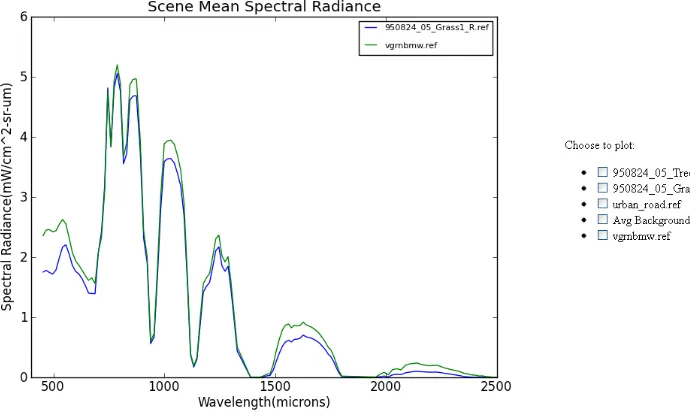
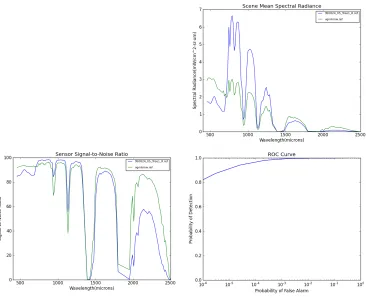
the prediction results. Users can choose the classes on the right to replot the
curve, or download the corresponding data file to plot or analyze using other
software.
4.3
Back End
At the server side, Python plays the role of interacting between the
user and the server, also passing the parameters the user submitted to the
ex-ecutable file. The exex-ecutable is written in C++ for efficiency concern, because
many high dimensional matrices calculations need to be done in the modeling
algorithm, which means high level languages like Python would slow down the
system performance. To speed up the process and simplify the structure, a
Figure 4.6: Radiance prediction result example
related calculations effectively and safely. In the scene model, MODTRAN is
called in the C++ code to simulate the atmospheric effects.
The C++ executable file is the kernel of the system. The input is the
specified or modified pfile, and the output is the radiance, SNR and ROC data.
Since C++ is not a very ”safe” language as compared to Java or C#, which is a
trade off between safety and performance, the log system is designed carefully
to simplify the debug process by providing a clear trace back for errors. Also
the exception handling system is also used to increase the robustness of the
expandability of the system.
This program needs the configuration file to initialize the target,
back-ground, scene and sensor objects according to the specified parameters and
files. Then the input mean and covariance library will be interpolated
accord-ing to the wavelengths of the chosen sensor. Also the mean parameters will
be used to generate tape5 files for different MODTRAN runs. The process
of generating tape5 should strictly obey the tape5 file format specified in the
MODTRAN manual, or a single space could result in unexpected results.
Af-ter each MODTRAN run, the output tape7 file will be parsed and read from
different columns into different vectors. Since MODTRAN has a different unit
and usually a higher resolution than the sensor, the tape7 unit results in units
of wavenumber need to be converted back to wavelength. Also according to
the sensor wavelength and bandwidth, channel response functions will be
ap-plied on the output data to generate Gaussian shape centered on the sensor
wavelengths. For other calculations as discussed in Chapter 3, the
implementa-tion is straight forward. At last, the predicted radiance and SNR for different
classes are obtained, and the ROC curve is calculated and saved.
4.4
Summary
First the working diagram of the end-to-end implemented model is given
and the whole modeling process is discussed. Then the system is separated into
CSS are used to provide an interface with minor data selection functionality
and forms dynamically generated by Python according to previous selections.
Javascript takes most of the responsibility for security checks. The server
end relies on Python, and Python will gener
![Figure 1.1: Typical hyperspectral imaging system[1]](https://thumb-us.123doks.com/thumbv2/123dok_us/42044.3635/14.612.154.474.207.444/figure-typical-hyperspectral-imaging-system.webp)
![Figure 1.2: Remote sensing process[24]](https://thumb-us.123doks.com/thumbv2/123dok_us/42044.3635/15.612.156.461.275.506/figure-remote-sensing-process.webp)
![Figure 2.1: The COBRA multispectral sensor model [35]](https://thumb-us.123doks.com/thumbv2/123dok_us/42044.3635/19.612.119.514.184.449/figure-the-cobra-multispectral-sensor-model.webp)
![Figure 2.2: FASSP model framework [16]](https://thumb-us.123doks.com/thumbv2/123dok_us/42044.3635/20.612.127.498.282.498/figure-fassp-model-framework.webp)
![Figure 3.1: Solar and atmospheric effects [24]](https://thumb-us.123doks.com/thumbv2/123dok_us/42044.3635/26.612.132.505.216.491/figure-solar-and-atmospheric-eects.webp)