SUPA and Department of Physics, University of Strathclyde, Glasgow G4 0NG, United Kingdon
E-mail:[email protected]
Keywords:Born’s rule, foundations of quantum physics, quantum mechanics
Abstract
In most experiments which search for violations of Born’s rule using light the diffractive elements are
formed from material slits, or waveguides, which are treated classically. In this article we propose an
alternative approach where the internal energy levels of particles are used instead of slits to test the
superposition principle, thus removing the effect of the
finite width of the slits. By quantising both the
light
field and the diffraction elements we propose a new way to probe Born’s rule for light in a fully
quantum mechanical way.
1. Introduction
Non-relativistic quantum theory uses the Schrödinger equation,
¶Y
¶ = Y
( ) ˆ
( ) ( )
i r t
t H r t
,
, , 1
to describe the dynamics of quantum systems. Here,ÿis the reduced Planck constant,ris a position vector,tis time, andHˆandΨare the Hamiltonian and the wavefunction of the system concerned. Despite its prevalence in modern physics the philosophical interpretation of the wavefunction is something still debated[1,2]. During the early days of quantum theory, while considering the scattering of electrons, Born realised that the modulus-squared value of solutions to the Schrödinger equation must always be a positive, real and normalisable quantity. He asserted thatΨrepresents the probability amplitude to measure a quantum particle to be at a given potision
[3], assigning physical meaning toΨ, such that the probability density for an event to occur is described by the relation,
= Y
( ) ∣ ( )∣ ( )
P r t, r t, 2. 2
Commonly referred to as Born’s rule, equation(2)is nowfirmly embedded within the modern formalism of quantum mechanics, and it can be shown to arise quite naturally from the unitary, linear structure of the dynamics of the Schrödinger equation[4–6]. Despite this fundamental role within quantum theory, there are relatively few experiments which seek to directly verify this relation[7–13]. This in itself is reason enough to stimulate further experimental investigations. Additionally, the difficulty in reconciling quantum mechanics and general relativity raises the question of whether our dynamical description of quantum particles is incomplete.
A direct consequence of Born’s rule, equation(2), is that the probability of an event occurring can always be decomposed into a linear combination of terms which contain information only relating to at most two-paths —the super position principle. One can therefore probe the validity of Born’s rule by looking for higher-order interference terms, or contributions to the interference pattern beyond Born’s predictions and conventional quantum theory. A relativly simple way to search for multi-path interference is to look for deviations from the classical additivity of probabilities for mutually exclusive events where only three paths are available[14]. Experiments using light have already looked at the diffraction of laser beams and single-photons at a material mask[7]or using optical waveguides[12]. These methods rely on the classical diffraction of light—although the light itself is quantised the diffractive elements are not. This can have subtle consequences which can effect the interpretation of experiments[15–17].
REVISED
4 April 2019
ACCEPTED FOR PUBLICATION
8 April 2019
PUBLISHED
23 April 2019
Original content from this work may be used under the terms of theCreative Commons Attribution 3.0 licence.
Any further distribution of this work must maintain attribution to the author(s)and the title of the work, journal citation and DOI.
Phenomenological attempts to include gravity within a quantum theory typically introduce non-linearities
[18]and alternatives to the Schrödinger equation can result in modifications to Born’s rule[19,20]. It therefore seems natural that experiments sensitive to violations of Born’s rule can be used to search for physics beyond existing quantum theory. Non-linear extensions to quantum mechanics can be physically unrealistic,
introducing problems ranging from entanglement from nothing and super luminal signaling[21]to the cloning of quantum states and polynomial-in-time operations for exponentially hard tasks[22]. However, as no established model for quantum gravity currently exists, and given the problems associated with many of the existing extensions, it remains interesting to consider how to probe quantum dynamics beyond those of the Schrödinger equation without assuming a particular functional form. Recently, tests of multi-path interference have been extended to massive particles[10]. The effects of gravity are more pronounced for massive particles, compared with photons, and therefore any gravitational modification to quantum dynamics may be
significantly larger—although how to make a quantised grating for massive particles remains a challenge. An experiment using microwave photons[23], in a classical regime, has recently application of the superposition principle breaks down in a way consistent with classical electrodynamics when boundary conditions are included.
In this article we consider what happens when the internal states of spatially separated single particles are used instead of slits in an interference experiment. By quantising both thefield and the diffraction element we propose a way to probe multi-path interference and therefore test Born’s rule in a fully quantum mechanical framework.
2. Detecting photons after absorption and re-emission by a quantised particle
2.1. A single quantum absorber-emitter
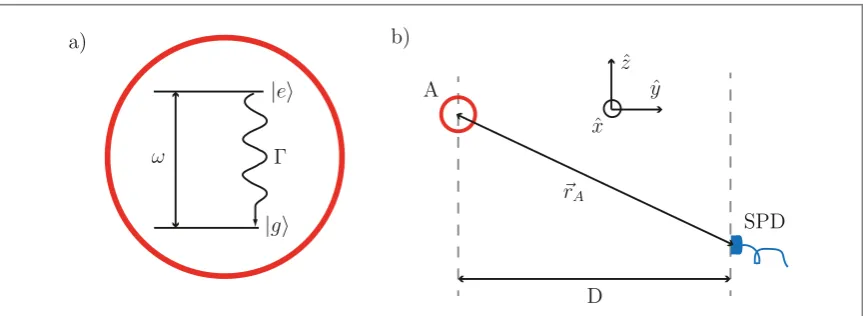
Consider a single particle,A, with two internal energy levels∣gñand∣eñwhich represent the ground and excited states, respectively. This is shown schematically infigure1(a). In practice this particle could be a trapped ion[24]
or neutral atom[25–27], a molecule[28,29]or quantum dot[30]on the surface of a substrate or an NV-centre in a diamond matrix[31].
Let us assume that particleAis initially prepared in∣gñ. Illumination with a single photon∣g0ñresults in the state,
fñ =a ñ ñ +b ñ gñ
∣ ∣e ∣0 ∣g ∣ 0 , ( )3
where∣ ∣a2and∣ ∣b2are the probabilities for the particle to absorb and not to absorb the photon respectively and
ñ
∣0 represents the vacuum state. Once excitedAcan spontaneously decay to the ground state at a rateΓ, emitting a photon as it does so. The re-emitted photon can be described by the state vector,
å
å
gw w
ñ =
- + G ñ
= ñ
g
∣
( ) ∣
∣ ( )
g e i
E e
2 1
1 . 4
k
k ik r
eg k
k ik r
k .
0 .
[image:2.595.121.553.60.218.2]Here,gkis the particle-photon coupling constant,ωegis the frequency separation between the states∣eñand∣gñ, and∣1kñis the state vector representing a single mode of electromagnetic radiation with wavenumberk. For
Figure 1.(a)A particle consisting of two internal energy levels∣gñand∣eñseparated in energy byE=ÿω. The excited state∣eñdecays to the ground state∣gñthrough spontaneous emission at a rate ofΓ.(b)A single, two-level particle is positioned a distancerAfrom a
simplicity, the prefactors in∣gñcan be gathered into a single coefficientE0, which represents the electricfield
amplitude of the photon. We will also assume that the repetition rate of single photons is low compared with the decay lifetime of the excited state such that stimulated emission can be neglected.
Figure1(b)shows an ideal single-photon-detector(SPD)positioned a distanceDaway from particleAsuch that it can only detect photons which have been absorbed and then re-emitted through spontaneous emission. By translating the SPD and recording the number of detection events at different positions, thefirst order correlation function,
y y
¢ ¢ = á ¥ - + ¥ ñ
( ) ( )∣ ( ) ( )∣ ( ) ( )
( ) ( ) ( )
G1 r t r t, ; t E r t E, r t, t , 5
can be measured. For brevity we shall writeG( )1(r t r t, ; ¢ ¢ =) G( )1 from here on.
Let us assign∣ (y t ¥ ñ) as the state of our particle after it has decayed and write the electricfield of the photon in terms of its positive and negativefield operators,
å
å
=
=
w
w
+
-- -
-g
g
( ) ˆ
( ) ˆ ( )
( ) ( )
( ) † ( )
E r t a e
E r t a e
, ,
, . 6
k
k k i k r t
k
k k i k r t .
.
Here,kis the polarisation vector of ourfield andaˆkis the annihilation operator, wherebyaˆ ∣k1kñ = ñ∣0. Let us
also assume the same linear polarisation throughout and reduce =1
k . At timet=0 we have
y = ñ = ñ ñ
∣ (t 0) ∣e ∣0. After a timet?Γ, the particle has decayed to∣ (y t ¥ ñ = ñ ñ) ∣g ∣g and the correlation function becomes,
= á á ñ ñ
=
∣ ∣∣ ∣ ∣ ∣
∣ ∣ ( )
( )
G g E g
E
0 0
. 7
A1 02 02
Recalling that the probability of the particle absorbing the initial photon∣g0ñis∣ ∣a2, then wefind that the
probabillity of detecting a photon is,
a
=
( ) ∣ ∣ ∣ ∣ ( )
P zA 2E02, 8
which is independent of the detector position. Here, we have assumedDto be large compared with the size of the detection region, such that the solid angle subtended by the screen relative to the particle is small.
2.2. Young’s double slit experiment with single photons and quantised particles
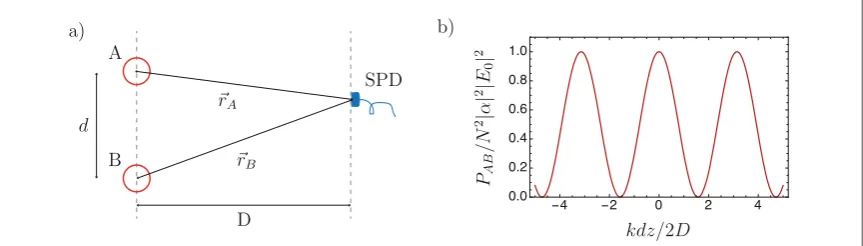
Let us now consider the case of two identical particles, labelledAandB, separated by a distancedalongz, illuminated by a single photon∣g0ñof wavelengthλ=2π/k. This system is shown infigure2(a)and is
analogous to a Young’s double slit experiment where each narrow slit has been replaced by a two-level quantum system[32]. The positions of each particle relative to the SPD are described by the vectorsrAandrB. The
absorption of∣g0ñby one of eitherAorBproduces the superposition state,
y = ñ = ñ + ñ ñ
∣ (t 0) 1 (∣g e ∣g e )∣ ( )
2 A, B B, A 0 . 9
[image:3.595.121.553.63.186.2]If it is unknown which of the particles absorbed and then re-emitted the photon—i.e. there is no which-path information available—then a superposition of single modes of the electromagnetic spectrum are populated,
y ¥ ñ = ñ g ñ + gñ
∣ (t ) 1 ∣g g (∣ ∣ ) ( )
2 A, B A B , 10
and the total state vector can be written as,
å
å
y ¥ ñ = ñ ñ + ñ
⎡ ⎣ ⎢ ⎢ ⎤ ⎦ ⎥ ⎥
∣ (t ) E ∣g g e ∣ e ∣ ( )
2 A, B k 1 1 . 11
ik r k
k ik r
k
0 . .
A A A A B B B B
Throughout this article we shall consider the case where emission by one particle and absorption by another before re-emission and then detection can be neglected.
By combining the state vector from equations(11)with(5)wefind thefirst order correlation function to be
=∣ ∣ ( + [ ( - )])
( )
GAB1 E02 1 cos k rA rB . However, one must also account for the increased probability that one of the
particles,AorB, absorb∣g0ñafter illumination—two particles are twice as likely to absorb than one. This increased probability of absorption is2∣ ∣a2and results in a probability for the SPD detecting a scattered photon
of,
a
= +
-( ) ∣ ∣ ∣ ∣ ( [ ( )]) ( )
PAB z 2 2E02 1 cos k rA rB . 12
figure2b)shows how the number of scattered photons varies as the detector is translated laterally with respect to the particlesAandB. As one might expect, this result takes the same form as the classical description of two interfering plane waves after propagating through a Young’s double slit apparatus where the single slit contribution to the diffraction pattern can be ignored.
2.3. Three path interference using single photons
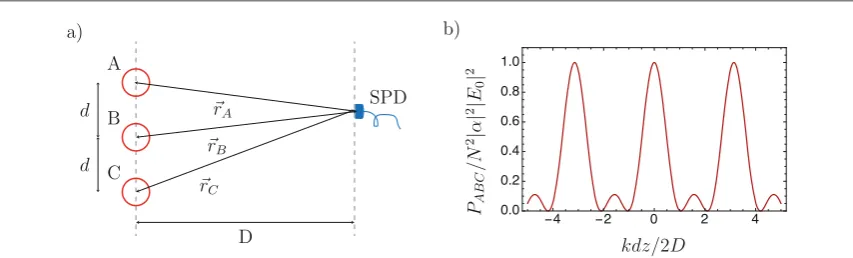
Let us now extend our system from two particles to three. Following on from the previous section onefinds that if a single photon is absorbed by one of three particlesA,B, orC, as shown infigure3, the system initially resides in the state,
y = ñ = ñ + ñ + ñ ñ
∣ (t 0) 1 (∣g g e ∣g e g ∣e g g )∣ ( )
2 A, B, C A, B, C A, B, C 0 . 13
After a timet?1/Γthis decays to,
å
å
å
y ¥ ñ = ñ ñ + ñ + ñ
⎡ ⎣ ⎢ ⎢ ⎤ ⎦ ⎥ ⎥
∣ (t ) E ∣g g g e ∣ e ∣ e ∣ ( )
3 A, B, C k 1 1 1 , 14
ik r k k ik r k k ik r k
0 . . .
A A A A B B B B C C C C and therefore, = ∣ ∣ [ + ( - )+ ( - )+ ( - )] ( ) ( )
G E k r r k r r k r r
3 3 2 cos 2 cos 2 cos 15
ABC1 0 A B A C B C
2
Once the factor of3∣ ∣a2is included in order to account for the increased probability of one particle absorbing,
the total probability of detecting a photon at a given position reduces to
a
= + - +
-+
-( ) ∣ ∣ ∣ ∣ [ ( ) ( )
( )] ( )
P z E k r r k r r
k r r
3 2 cos 2 cos
2 cos . 16
ABC A B A C
B C 2
02
2.4. N-path interference using single photons
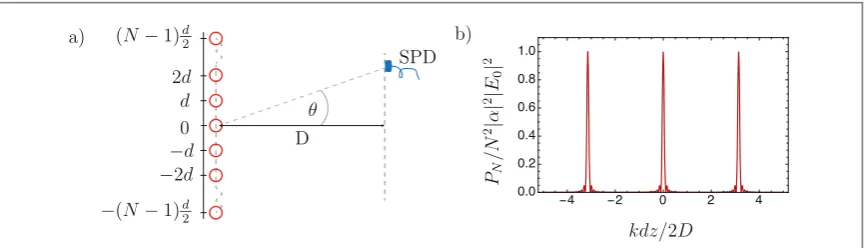
[image:4.595.122.549.62.191.2]Recently tests of multi-path interference using more than three slits have been demonstrated[13]. Let us therefore now extend our chain of particles from 3 to N, each separated from their nearest neighbour by a
distanced. This is shown schematically infigure4. Following the same reasoning as in section2wefind the probability of detecting a photon at positionzforNdifferent emitters can be written as,
a
= + - + - +
-+ - + - +
-+ - + - + - +
∣ ∣ ∣ ∣ [ ( ) ( ) ( )
( ) ( ) ( )
( ) ( ) ( ) ] ( )
P E N k r r k r r k r r
k r r k r r k r r
k r r k r r k r r
2 cos 2 cos 2 cos ...
2 cos 2 cos ... 2 cos
2 cos 2 cos ... 2 cos ... 17
N A B A C A N
B C B D B N
C D C E C N
2 02
WhenD?dthis equation can be simplified. In this limit, the separation between two particles is well approximated by the relationrj n+ -rj=n r(j+1-rj)=n rd , wheredr=dsinq.
This enables equation(17)to be expressed in terms of thefinite series,
å
a q
= -
-=
∣ ∣ ∣ ∣ ( ) ( ) ( )
PN E 2 N j cos jkdsin N, 18
j N 2
02 0
which after some trigonometry reduces to,
a q
q
a q
q
=
-=
∣ ∣ ∣ ∣ ( )
( )
∣ ∣ ∣ ∣ ( )
( ) ( )
P E Nkd
kd
E Nkd
kd
cos sin 1
cos sin 1
sin sin 2
sin sin 2 . 19
N 2 02
2 02
2 2
Reassuringly, this resembles the familiar formula for a linear array of in phase dipole emitters[33].
3. In search of multi-path interference
Born’s rule dictates that the probability of detecting any event can always be decomposed into a series of terms which contain at most information relating to two paths. Let us consider the simplest scenario where higher order contributions to the interference pattern may become apparent, namely a three slit type experiment. Using equations(8),(12)and(16)from the previous section one arrives at the following equality,
= + + - - - ( )
PABC PAB PAC PBC PA PB PC, 20
which can be used to define the parameter
=PABC-(PAB+PAC+PBC)+(PA+PB+PC), (21) first introduced by Sorkin[14]. According to conventional quantum theoryò=0, withfinite values
corresponding to some degree of multi-path interference—illustrative of dynamics beyond the Schrödinger equation, or in experiments using material slits it can arise from the change of boundary conditions.
One can seek to bound any multi-path contribution by measuringò. In order to do this one must compare the interference pattern for three scattering paths with those of all linear combinations of two and one paths as described in equation(21). In experiments where physical slits are used to define the paths, the interference patterns corresponding to all different permutations ofA,BandCare controlled by selectively covering individual slits[7]. An appealing alternative, when using particles containing two-internal states to scatter incoming single-photons, is to selectively detune the particles from resonance with∣g0ñ—for example by making
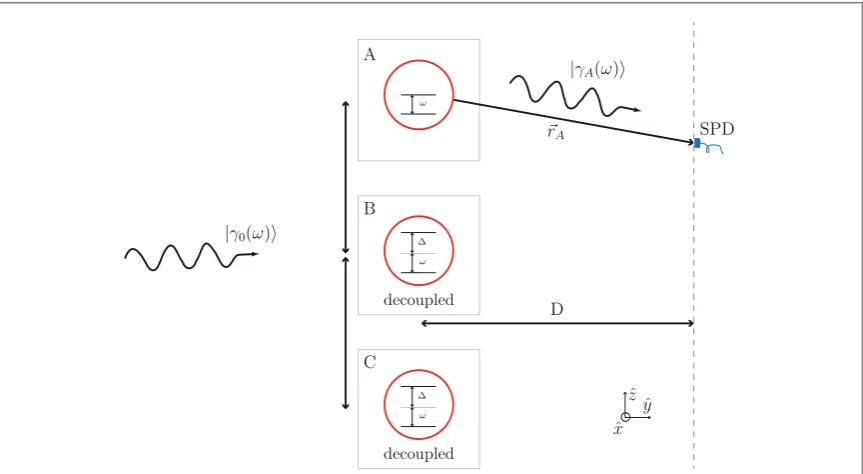
[image:5.595.121.554.61.185.2](ωeg−ωγ)in equation(4)very large. Figure5illustrates a way this can be achieved. By applying a local potential to only some of the particles in the chain, for example by Stark-shifting the internal states using an electricfield, then the absorption of∣g0ñcan be controlled and under appropriate condition switched on and off. This removes
Figure 4.(a)Nparticles each separated by a distancedfrom their nearest neighbour. Each particle can scatter single photons which can be detected by SPD. Here we have shown an array containing an odd number of particles. Wefind identical results when using an even number.(b)The probability of detecting scattered photons as a function of the detector position alongzfor a linear array ofN=30 particles. Wefind the probability of detecting a scattered photon peaks sharply at values constant with the Bragg relation
pm=kd q
the need to physically mask the individual scattering sites which could distort the trajectories of scattered photons and thereby introduce erroneous,finite vales ofò. By manipulating the internal energy levels of each scattering particle in this way a non-invasive measurement ofòcan be performed, where each effective slit remains near-identical.
4. Discussion
We have derived the probability density of detecting single photons scattered by linear arrays of particles each containing two internal states. The case of one, two, three andNparticle scattering is derived and we show how these can be used to place bounds on the multi-path contribution to the resulting interference pattern.
During the preparation of this manuscript a complementary perspective was published[34], which highlights the importance of the photon detector used when interpreting multi-path interference experiments, although it retains the the use of material slits. Here, we propose a method using particles to scatter single-photons which avoids the complex diffraction processes that occur for light at material slits[7,8,15], or
waveguides[12], which complicate experimental realisations of optical tests of Born’s rule. For particles with a scattering probability which can be sufficiently controlled without affecting their neighbours we have shown how they can be used to probe Born’s rule and the underlying dynamics of the Schrödinger equation. Namely, how to perform a multi-path photon interference experiment where the effective slits can be treated in a fully quantum mechanical fashion.
Acknowledgments
JPC is grateful to Wonmin Son, Kean Silvester and Tom Kibble for useful discussions whenfirst thinking about this topic. RPC is supported by the Leverhulme trust(RPG-2017-048).
ORCID iDs
J P Cotter https://orcid.org/0000-0002-7055-0206
[image:6.595.121.553.61.298.2]R P Cameron https://orcid.org/0000-0002-8809-5459
Figure 5.A local potential applied to particles individually—in this caseBandC—modifies their internal energy levels, shifting them out of resonance with the incoming photon. Subsequently, the probability of these particles absorbing∣gñcan be made vanishingly small,∣aB∣∣aC∣0. Here, switching off the scattering probabilities is analogous to the covering of material slits, without the
[12]Söllner I, Gschösser B, Mai P, Pressl B, Vörös Z and Weihs G 2012Found. Phys.42742–51
[13]Kauten T, Keil R, Kaufmann T, Pressl B, Brukner C and Weihs G 2017New J. Phys.19033017
[14]Sorkin R D 1994Mod. Phys. Letts.A93119
[15]Raedt H D, Michielsen K and Hess K 2012Phys. Rev.A85012101
[16]Khrennikov A 2012J. Mod. Opt.59667–78
[17]Sawant R, Samuel J, Sinha A, Sinha S and Sinha U 2014Phys. Rev. Lett.113120406
[18]Kibble T W B and Randjbar-Daemi S 1980J. Phys. A: Math. Gen.13141–8
[19]Mielnik B 1974Commun. Math. Phys.37221–56
[20]DakićB, Paterek T and Brukner C 2014New J. Phys.16023028
[21]Gisin N 1990Phys. Letts.A143242
[22]Abrams D S and Lloyd S 1998Phys. Rev. Lett.813992–5
[23]Rengaraj G, Prathwiraj U, Sahoo S N, Somashekhar R and Sinha U 2018New J. Phys.20063049
[24]Leibfried D, Blatt R, Monroe C and Wineland D 2003Rev. Mod. Phys.75281–324
[25]Grimm R, Weidemüller M and Ovchinnikov Y B 2000 Optical dipole traps for neutral atomsAdvances In Atomic, Molecular, and Optical Physics42 ed B Bederson and H Walther(New York: Academic)pp 95–170
[26]Schlosser N, Reymond G, Protsenko I and Grangier P 2001Nature4111024–7
[27]Nogrette F, Labuhn H, Ravets S, Barredo D, Béguin L, Vernier A, Lahaye T and Browaeys A 2014Phys. Rev.X4021034
[28]Hofmann C, Nicolet A, Kol’chenko M A and Orrit M 2005Chem. Phys. Lett.3181–6 molecular NanoscienceIn honour of Daniel S Chemla on his 65th birthday
[29]Major K D, Lien Y, Polisseni C, Grandi S, Kho K W, Clark A S, Hwang J and Hinds E A 2015Rev. Sci. Instrum.86083106
[30]Shields A J 2007Nat. Phot.1215–23
[31]Doherty M W, Manson N B, Delaney P, Jelezko F, Wrachtrup J and Hollenberg L C L 2013Phys. Rep.5281–45the nitrogen-vacancy colour centre in diamond
[32]Scully M O and Drühl K 1982Phys. Rev.A252208–13
[33]Feynman R, Leighton R and Sands M 1962The Feynman Lectures on Physics(Massachusetts: Addison Wesley)30–1