City, University of London Institutional Repository
Citation
:
Soylu, A., Giese, M., Jimenez-Ruiz, E. ORCID: 0000-0002-9083-4599,
Kharlamov, E., Zheleznyakov, D. and Horrocks, I. (2017). Ontology-based end-user visual
query formulation: Why, what, who, how, and which?. Universal Access in the Information
Society, 16(2), pp. 435-467. doi: 10.1007/s10209-016-0465-0
This is the accepted version of the paper.
This version of the publication may differ from the final published
version.
Permanent repository link:
http://openaccess.city.ac.uk/id/eprint/22963/
Link to published version
:
http://dx.doi.org/10.1007/s10209-016-0465-0
Copyright and reuse:
City Research Online aims to make research
outputs of City, University of London available to a wider audience.
Copyright and Moral Rights remain with the author(s) and/or copyright
holders. URLs from City Research Online may be freely distributed and
linked to.
City Research Online:
http://openaccess.city.ac.uk/
[email protected]
(will be inserted by the editor)
Ontology-based End-user Visual Query Formulation: Why,
what, who, how, and which?
Ahmet Soylu · Martin Giese · Ernesto Jimenez-Ruiz · Evgeny Kharlamov · Dmitriy Zheleznyakov · Ian Horrocks
Received: date / Accepted: date
Abstract Value creation in an organisation is a time-sensitive and data-intensive process, yet it is often de-layed and bounded by the reliance on IT experts ex-tracting data for domain experts. Hence, there is a need for providing people who are not professional developers with the flexibility to pose relatively complex and ad hoc queries in an easy and intuitive way. In this respect, visual methods for query formulation undertake the chal-lenge of making querying independent of users’ technical skills and the knowledge of the underlying textual query language and the structure of data. An ontology is more promising than the logical schema of the underlying data for guiding users in formulating queries, since it provides a richer vocabulary closer to the users’ understanding. However, on the one hand, today the most of world’s enterprise data reside in relational databases rather than triple stores, and on the other, visual query formulation has become more compelling due to ever-increasing data size and complexity – known as Big Data. This article presents and argues for ontology-based visual query for-mulation for end users; discusses its feasibility in terms
This research is funded by the Seventh Framework Program (FP7) of the European Commission under Grant Agreement 318338, “Optique”.
Ahmet Soylu
Faculty of Computer Science and Media Technology, Norwegian University of Science and Technology E-mail: [email protected]
Martin Giese
Department of Informatics, University of Oslo E-mail: [email protected]
Ernesto Jimenez-Ruiz · Evgeny Kharlamov · Dmitriy Zheleznyakov·Ian Horrocks
Department of Computer Science, University of Oxford E-mail: {ernesto.jimenez-ruiz, evgeny.kharlamov, dmitriy.zheleznyakov, ian.horrocks}@cs.ox.ac.uk
of ontology-based data access, which virtualises legacy relational databases as RDF, and the dimensions of Big Data; presents key conceptual aspects and dimensions, challenges, and requirements; and reviews, categorises, and discusses notable approaches and systems.
Keywords Visual query formulation·usability ·data retrieval· ontology-based data access·big data
1 Introduction
using the higher level of abstractions, instead of trying to articulate and explain their information needs to IT experts.
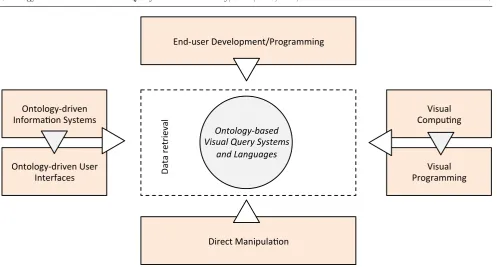
In this respect,direct manipulation[150], as a human-computer interaction style, has a profound impact on the successor query systems and languages. Direct ma-nipulation employsrecognition, rather than recall, and direct manipulation objects, rather than a command language syntax, to lead to easy to use and intuitive interactive systems. In this pursuit, in database domain, visual query formulation approaches (cf. [37, 61]) exploit the high bandwidth of visual interfaces through the visual representations of domain of interest and informa-tion needs. The matter is largely one ofusability(cf. [89, 36]), albeit the underlying formal semantics have a role to play. A good deal of research that adopts various visual representations as well as interaction styles has been carried out (cf. [37]). The literature reports vary-ing degrees of success includvary-ing different factors such as user type and the level of expressiveness. However, existing approaches suffer from the gap between the low-level domain models, such as database schemas, and end users’ understanding of reality. In this respect, on-tologies stand out as a natural communication medium between end users and databases (cf. [154, 145]).
Nevertheless, there are still issues standing against the proliferation of ontology-based visual query formu-lation. First, today, most of the world’s enterprise data reside in relational databases, and migrating data to triple stores is not an option mainly due to legacy ap-plications built on top of existing relational databases. Ontology-based data access (OBDA) to relational data
sources (cf. [101, 164]) has emerged as a promising re-sponse, as data stays where it is byvirtualisingrelational databases as RDF. Secondly, with the emergence of theBig Data phenomenon (cf. [107, 117]), the challenge has already been exacerbated dramatically in terms of scalability. The scalability is considered in terms of human-computer dialog (i.e., query formulation) and performance (i.e.,query evaluation). This is because Big Data does not only concern the performance, but also the usability of database systems, as larger and complex schemas with the current visual query formulation ap-proaches force the limits of human visual channel and cognitive capacity.
This article aims to offer a comprehensive look into ontology-based visual query formulation and reveal in-sights for the development of successor systems. Specifi-cally, the article answers and elaborates ona)why vi-sual query formulation and ontologies (Sect. 2);b)what visual query formulation is and its core aspects and dimensions (Sect. 3); c)who benefits most from such systems (Sect. 3);d)howfeasible it is given a landscape
dominated by relational databases (Sect. 4);e)which specific challenges and requirements there are (Sect. 5); f)which approaches exist along with their pros and cons (Sect. 6); and, g)which research directions should be considered by practitioners and researchers (Sect. 6).
2 Motivation
The primary aim of an organisation is creating value such as financial, social, cognitive, and political. The role of information technology is indispensable partic-ularly in the success of data intensive value creation processes such asdecision-making, sense-making, and intelligence analysis (cf. [132, 134, 68]). However, there is often a large gap between the people who interpret and use data and IT systems where data is stored and processed. This is mostly becausea) although domain experts are provided with data analysis tools, they often lack end-user tools for extracting data from databases, andb) there is often no high level conceptual vocabu-lary for end-users to formulate their information needs – database schemas are rather low level artefacts pertain-ing to implementation of the actual systems.
2.1 Data access bottleneck
Nunamaker et al. [132] break value creation efforts into a tripartite model that capitalises on information tech-nology tools. The model consists ofinformation assim-ilation, group dynamics, and methodology. Each part builds on and contributes to each other. Information assimilation addresses concerns regarding finding and understanding information (i.e., data and communica-tion infrastructure), while group dynamics concern the collaborationof group members. The information assimi-lation and group dynamics together form anintellectual bandwidth that bounds the value creation potential of an organisation. The third part, methodology, addresses the steps and guidelines required to leverage the intel-lectual bandwidth for value creation (i.e., reason and action). Apparently, data access (i.e., information as-similation) is a part of a larger process [81], yet it is a principal component of intellectual bandwidth and can easily turn into a bottleneck. In data intensive industries (e.g., [85, 121]), end users, who are domain experts who need to extract data from databases in their expertise domain [10], spend up to 80% of their time on data access problems (cf. [69]).
Simple Case Complex
Case
Applica'on
End user
End user
predefined queries
informa'on need specialized query
uniform sources
disparate sources IT expert
informal
limited
possible mismatch
Fig. 1 Traditional data access scenarios.
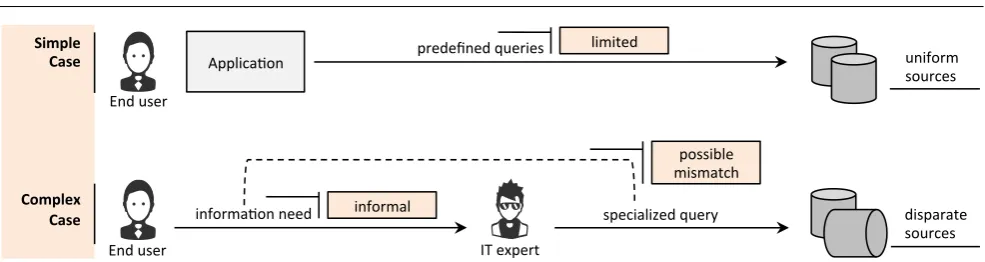
experts, skilled users) and those who have domain knowl-edge and know how to interpret and use data (i.e., do-main experts). End users cannot interact with databases directly and are unable to pose complex queries against data sources on their own, since they usually do not possess necessary skills and knowledge on the database structure and query language. End users are dependent on IT experts, who either provide a set of predefined queries built into applications and/or collaborate with the end users to develop ad-hoc queries – see Figure 1. In both cases, decision support activities are hampered by data access problems. This is because, on the one hand, the use of predefined queries is inflexible, since it is not possible to anticipate every information need in advance. On the other hand, collaboration between end users and IT experts is mostly based on the vague descriptions of information needs; hence, it is generally time-consuming and often results in repetitive query reformulations. In many cases, the cost of query refor-mulation is high, since a query forrefor-mulation phase is often followed by a potentially lengthyquery evaluation phase [89].
The lack of possibility to directly reach reliable data in a timely fashion indeed points to anaccessibility chal-lenge. Though the term “accessibility” is often linked to situations involving physical disabilities, there are more factors that inhibit people from full access to technology, and in the present context relates to knowledge and skill barriers (cf. [178]). Direct manipulation is paramount in visual query formulation and promising to remove this accessibility barrier due to the closeness of the so-lution domain to the reality, ability to handle large and complex information, low memory load (i.e., recall vs. recognition), and low comprehension demand/immedi-ate grasping. These benefits potentially lead to ease in learning, high efficiency rate, reduced error rate, and satisfactory experiences (cf. [150, 37]).
The visual query formulation approach eliminates theman-in-the-middle and allows end users to extract and use data on their own. This first moves organisations
and individuals closer to fulfil their intellectual band-width, that is a considerable time and resources could be freed-up and could be redeployed so as to contribute value creation. Secondly, end users could augment their intellectual bandwidth as they can extract, combine, and interpret data in previously unforeseen ways.
2.2 Impedance mismatch and reasoning
Gruber [74] and Borst [25] define an ontology as aformal, explicit specification of a shared conceptualisation, which is an abstract representation of a phenomenon in the world based on identification of relevantconcepts (aka classes),attributes (akadata type properties), relation-ships (akaroles, associations and object properties), and constraints(cf. [169]). In a more precise language, a con-sensual (i.e., shared) conceptualisation, constituted by a specific vocabulary and assumptions on the intended meaning (cf. [75]), becomes an ontology only when it is explicitly formulated with an artificial machine-readable language (i.e., formal). Ontologies are fundemental for the construction ofknowledge bases, which do not only containterminological knowledge such as concepts and properties but also theirinstances (akaindividuals) as assertional knowledge (cf. [72]). The purpose is to ex-press and capture the domain structure and knowledge, and to applyreasoningover it (i.e., to derive conclusions that are implicitly available in the knowledge base).
[image:4.595.43.536.77.208.2]to a particular concept). This applies to representation formalisms based on artificial intelligence (AI), where approaches based onsoftware engineering (e.g., UML), database engineering (e.g., ER, EER) and other models are very weak both in terms of reasoning and expres-siveness (cf. [72]).
Expressiveness and reasoning, for ontologies, are two sides of a coin, for which a trade-off exists. This is due to the fact that, while increasing the expressiveness, it has to be guaranteed that all conclusions are still com-putable (i.e.,completeness) and finish in finite time (i.e., decidability) (cf. [111]). The combination of rules with ontologies is a well-known way to increase the reasoning power of ontologies (cf. [125, 157]). There are two possi-ble ways: one is to build rules on top of ontologies, where rules follow the vocabulary specified in the ontology; the other way is to build rules on top of ontologies, where ontological definitions are supplemented by rules (cf. [58, 166]). These originate from the fundamental differences that exist between ontologies and rules: ontologies, un-der theknowledge representation (KR) paradigm, focus on content to describe knowledge, while rules, under thelogic programming (LP) paradigm, focus on form to arrive logical conclusions (i.e., reasoning). Therefore, the selection of representation formalism is strictly depen-dent on the level of support required for expressiveness and reasoning [157].
The very same angle that crosses knowledge repre-sentation and logic reveals the role that ontologies have to play not only for end-user data access, but also in usability at large. Herein, from the knowledge repre-sentation perspective, one first needs to consider the existential differences between ontologies and models to reach a profound understanding of the context. Amodel is defined as an abstraction representing some view of a reality, by necessarily omitting details, intended for a definite purpose [83], such as UML and EER mod-els for software and database design respectively. Ruiz and Hilera [145] argue that, although there is a confu-sion between ontologies and models due to examples where they are represented with the same language, ontologies are descriptive, that is they describe what already exists, while models are prescriptive, that is they prescribe systems, which do not exist, and pertain to implementation of them (cf. [6, 64, 157, 83]). In other words, models are forward looking solution/implemen-tation domain artefacts, while ontologies are backward lookingproblem domain artefacts. Hence, ontologies are essentially meant to be richer and closer to end-user vocabulary and understanding thandatabase schemas (cf. [38, 154]). For instance, an ontology naturally con-nects domain concepts, while a database schema relies on unnatural flattening and scattering approach built
onnormalization/join notion (cf. [89]), leading to an impedance mismatch. Consequently, a visual query tool built on ontologies provides a closer representation of the problem domain, hence enabling users to under-stand and communicate better. This is not limited with the human-machine interaction, since ontologies have the potential to act as an unambiguous communication medium for human-human dialogs, i.e., collaboration (cf. group dynamics), and machine-machine dialogs, i.e., interoperability.
Finally, the reasoning capability brings in the power of expressing more with less both in the query formula-tion stage and during the answering stage by relating the whole set of implied information instead of what is explicitly stated. For instance, imagine a system where different types of users exist, such as students, lectur-ers, and administrative employees. A user query, “give me all the persons who live in Oslo”, is at a sufficient specificity in an ontology-based system, as it can infer any student, lecturer, and employee is also a person. This includes both the form of reasoning attached to ontologies and various types of logic rules, such as the followings proposed by Boley et al. [24]:deduction, nor-mative, and reactive rules to derive new information, to check the consistency and integrity of data, and to define automatic actions triggered by the occurrence of data of interest respectively. Moreover, ontologies carry a notable potential to providecausal explanations (cf. [157, 19]), which can be used for various purposes such as for explaining the source of inferred data and inconsistencies in data and user queries.
3 Visual query formulation
The purpose of a visual query formulation tool is to facili-tate retrieval of data that makes a value for an individual or organisation. Visual query formulation approaches exploit the bi-directional and themulti-sensory char-acteristics of visual representations. Collectively, they inform users about schema concepts, system affordances, and data, through a number of sensory variables such as texture,colour, size, andshape; and allow users to com-municate their information needs by interacting with them (cf. [37, 36]). The concern is essentially about the productivity and the quality of human-machine interac-tion, rather than the functionality or the technology of software (cf. [89, 36]).
this type of knowledge is arbitrary and proprietary (e.g., command to capitalise a letter in a text editor). The latter is not system or language dependent; rather, it re-lates to the knowledge of meanings in terms of high-level concepts and functionality (e.g., the process of moving a sentence from one paragraph to another).
The syntactic/semantic model underpins the direct manipulation approach and aims to realise user experi-ences in which interactive systems are naturally embed-ded into the reality. This becomes possible by harvest-ing non-volatile semantic knowledge, which is acquired through general explanation, analogy and example, and common skills for manipulating physical objects, which are acquired at the concrete operational stage (7 -11 years) of human growth (cf. [150]).
3.1 Characteristics and categorisation
A visual query formulation tool is adata retrieval (DR) paradigm, which differs frominformation retrieval (IR) andquestion answering (QA) (cf. [139, 8, 102]). In DR, an information need has to be exact and complete, and is defined over a deterministic model with the aim of retrieving all and only those objects that exactly match the criteria. However, in IR and QA (for most of the question types), an information need is typically incom-plete and loosely defined over a probabilistic model with the aim of retrieving relevant objects. In other words, DR systems have no tolerance for missing or irrelevant results and a single erroneous object implies a total fail-ure; while IR and QA systems are variably insensitive to inaccuracies and errors, since they often interpret the original user query and the matching is assumed to indicate the likelihood of the relevance.
As far as visual DR methods are considered, Epstein [61] distinguishes between avisual query language(VQL) and a visual query system (VQS). A VQL is a visual programming language (cf. [32, 31]), and is based on a well-defined formal semantics with a visual notation and syntax; there is an underlying textual language for which mostly a one-to-one correspondence exists. The latter is avisual programming environment (cf. [32, 31]), and is mainly based on a system of interactions, rather than a visual formalism, which generates queries in target formal textual form. A VQS may or may not use a VQL [61]; if it does not, the system is likely to express only a subset of the underlying language.
The success of a visual query formulation tool varies with respect to the visual representation and the inter-action paradigms employed in relation to thefrequency of interaction (i.e., how often the tool is used), the vari-ance of query tasks (i.e., whether tasks have a repetitive nature), andquery complexity (i.e., various dimensions
such as size, semantic complexity etc.) (cf. [37, 36, 12, 110]). However, in general, the realisation of certain tasks over a visual query system or a language can still be complex (i.e., with a compromise in usability), such as, for example, queries with cycles.
In any case, certain data access efforts have to be supported, that areunderstanding the reality of inter-est (i.e., exploration), which relates to the activities for understanding and finding schema concepts and relation-ships relevant to information need at hand; andquery construction, which concerns the compilation of relevant concepts and constraints into formal information needs (i.e., queries) [37]. On these grounds, the choice of vi-sual representation and interaction paradigms, along with underlyingmetaphors,analogies etc., is of primary importance.
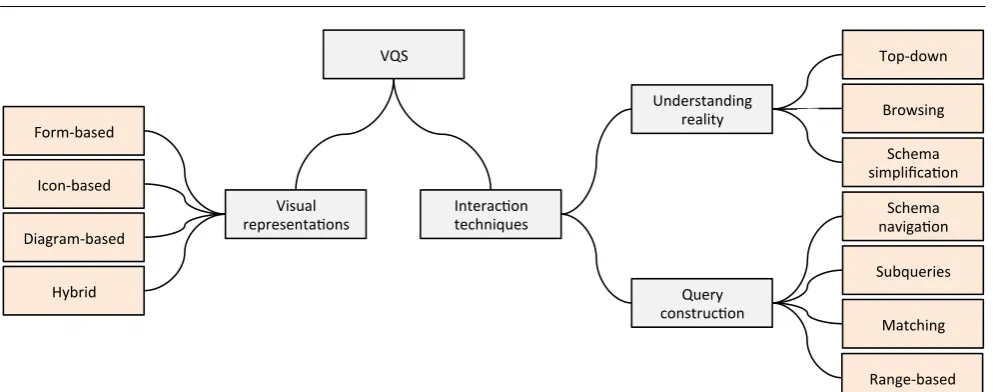
Catarci et al. [37] classify VQSs with respect tovisual representation andinteraction paradigms in use – see Figure 2. This categorisation is not exhaustive and is only a fragment of a classification derived by Lohse et al. [114] for visual representations. The selected categories mostly concern visual query tools that are used to access alphanumeric data. Visual representation paradigms are categorised into:
– Form-based representations, including menus and tables as specialisations of forms (e.g., [171, 172]), adopt conventional paper forms as a metaphor.
– Icon-based representations employ images or sym-bols, representing abstract and real objects by ex-ploiting analogy, convention, etc., to serve domain knowledge and application functionality.
– Diagram-based representations utilise geometric sym-bols and a spatial layout to depict relationships among schema concepts.
– Hybrid representations are based on combination of several visual paradigms.
Regarding the interaction paradigm, it is viewed in twofold with respect to understanding the reality of interest and query construction. For the former, three categories are considered:
– The top-down technique breaks the concepts in a schema into a set of layers, with respect to a certain criteria (e.g., level of importance - selective zoom, hierarchy -hierarchical zoom); each layer provides access to preceding and following layers.
– The browsing technique allows traversing the con-cepts of a schema and/or data (i.e.,intension and extension), by exploiting the relationships between concepts.
VQS
Interac,on techniques
Understanding reality
Query construc,on
Top-‐down
Browsing
Schema simplifica,on
Schema naviga,on
Subqueries
Matching
Range-‐based Visual
representa,ons Form-‐based
Icon-‐based
Diagram-‐based
Hybrid
Fig. 2 The classification of VQSs with respect to representation and interaction paradigms.
For the query construction, the following categories are suggested:
– The schema navigation technique lets users to con-struct a query by starting from a central concept and following the paths between concepts for including other concepts of interest.
– The subqueries techniqueallows composing concepts or partial results provided by subqueries to realise query construction.
– The matching technique lets users to provide the structure of a possible answer through an example or pattern to be checked against data.
– The range-based techniqueallows users to manipulate a set ofinput widgets, such as sliders and button to instantly filter data.
Finally, note that query formulation is aniterative process, that is, a user explores the conceptual space, formulates a query, inspects the results, and reformulates the query until she/he reaches to the desired query, and each iteration could be considered an attempt.
3.2 On user types
The potential users of a visual query formulation tool could come from different backgrounds and have varying levels of expertise. Domain expertise (i.e., knowledge on a specific subject matter such as medicine, fishery, and oil exploration) and technical expertise (i.e., technical knowledge and skills on design, programming, and mod-elling software artefacts) could be used to differentiate between different types of users.
Catarci et al. [37] distinguish betweenprofessional users andnon-professional users. The former refers to
users who possess a wide spectrum of skills on pro-gramming languages, database management systems, etc. The latter refers to users who cannot invest time in computer training and usually learn query languages by doing and are further classified into familiar and unfamiliar users with respect to familiarity with the database semantic domain.
Dadzie et al. [51] considers two main types of users, which arelay/mainstream users, andtech users. Users of the first category are computer literate and can find information online, and generally do not have in-depth domain knowledge. Users in the second category un-derstand the Semantic Web and other advanced tech-nologies, can use RDF, and understand an ontology. A third sub-category is proposed, namelydomain experts who have in-depth domain knowledge to interpret and understand relevant data, and might have knowledge on the Semantic Web technologies.
The categorisation provided by Dadzie et al. [51] could be problematic, since a programmer without ex-pertise in the Semantic Web technologies could be con-sidered as a lay user, since the definition exclusively focuses on expertise in Semantic Web. However, users with substantial technical background, regardless of their expertise in the subject textual language, ontology lan-guage, and technology, possess semantic knowledge on programming languages, systems, frameworks, and tools, which is non-volatile and easily transferable while using a new one (cf. syntactic/semantic model [150]).
[image:7.595.42.539.77.273.2]do-main of interest. They have low tolerance on formal languages and are unfamiliar with the technical details of an information system (cf. [50]). Domain experts have an in-depth knowledge and an understanding of the se-mantics of their expertise domain, while IT experts have technical knowledge and skills on a wide spectrum of topics, such as programming and databases. This cat-egorisation is neither complete nor mutually exclusive e.g., a domain expert could be also an IT expert.
Casual users and domain experts with no technical background could benefit the most from visual query for-mulation and the ultimate benefit of it questionable for IT experts, since in many cases they might find working on a textual language more efficient and non-limiting (cf. [37, 150]). Therefore, casual users and domain ex-perts (without technical expertise) are the focus of this article, and are further classified into a parent category, end users. End users cannot/do not desire to use textual languages to retrieve data due to the lack of technical knowledge and skills and might have domain knowledge on the subject matter. Visual query formulation is an end-user development paradigm, which is defined as a set of methods, techniques, and tools that allow users of software systems, who are acting as non-professional software developers, to create, modify, or extend soft-ware artefacts [112]. This very paradigm underlies the definition of end user in this context.
3.3 Evaluation: usability and expressiveness
Usability and expressiveness are the two interplaying dimensions of visual query formulation. The usability (cf. [21]) of a tool reflects whether it is competent of meeting its identified aim, while expressiveness (cf. [37, 61]) defines the ability and breadth of a tool to charac-terise the domain knowledge and information needs.
Usability is characterised in terms ofeffectiveness, efficiency, anduser satisfaction. Effectiveness (cf. [36, 21]) measures theaccuracy andcompleteness that users can achieve (i.e., “doing the right things”). Efficiency (cf. [36, 21]) reflects the cost associated with the level of effectiveness achieved, and is mostly measured in terms of the time spent to complete a query (i.e., “doing the things right”). User satisfaction (cf. [113]) refers to the perceived quality of dialog and user interface and plays a determining role in the attitudes of users, such astrust, engagement,acceptance, andcomfort, against the tool. It usually has considerable potential to cause failure, if not taken seriously. User satisfaction is usually measured by questioning the attitude of users after experiencing with the subject system or language through surveys, interviews etc. (e.g., [113, 42])
Note that, typically, in IR systems effectiveness is measured in terms of precision, recall, and f-measure (harmonic mean of precision and recall) over the result set; however, as stated earlier, for a DR system, a single missing or irrelevant object implies failure. Therefore, for a VQS and VQL, effectiveness is rather measured in terms of a binary measure of success (i.e., correc-t/incorrect query), which could be accompanied with a fuzzy measure (i.e., the rate of accuracy and com-pleteness) weighting and combining different types of query errors (cf. [185, 94]). As far as SPARQL is con-cerned, the measure of correctness could be built on the semantic similarity between the user query and correct query (cf. [55]). Since query formulation is an iterative process, allowing and incorporating multiple attempts into account is also a sensible approach.
User studies are typically realised by means ofquery writingandquery readingtasks (cf. [37, 168]) to evaluate the tool itself alone or to compare it with others either with asummativeorformativeperspective; various other studies and measures (e.g., learnability [128]) can be defined as well. However, consulting users only at the end (i.e., summative evaluation) does not help much (cf. [89, 36]). The active participation of users at every cycle of development, grounded on auser-centred design [130] approach with intermediary reflective assessments (i.e., formative evaluation), is the true contributor.
Wilson et al. [182] employ evaluation as a part of the overall design process to inform the design refinements and argue that, particularity in comparative evalua-tion, taking user interface as a sole independent variable would reveal very little about why one outperforms another. In this respect, the authors propose a forma-tive evaluation framework by using three established information-seeking models, namelystratified,episodic, and strategic models, among others in the literature (cf. [182]). The first model forms the basis of evaluation framework in the form of abstraction levels used to eval-uate the design, while the latter two correspond to these abstraction levels. The episodic model defines a set of information-seeking scenarios and the strategic model defines differenttactics for interacting with the informa-tion, which are then mapped into the episodic model. The evaluation framework includes the identification offeatures (e.g., filtering, grouping, keyword search) in each subject interface with the number ofmoves (e.g., scroll and select) required to realise each tactic with each feature. The results are used to find and compare the amount of user effort required to realise each tactic, feature, and search scenario with each interface.
VQL. A VQL has clear formal semantics that allow a rig-orous computational evaluation (cf. [155, 66]), while on the contrary, a VQS is built on an arbitrary set of user actions that effectively capture a set of syntactic rules specifying a (query) language. Thus, the formal evalua-tion of a VQS is a considerably harder problem. Indeed, for didactic purposes, one could establish an analogy with Prot´eg´e [99], which is an interactive system for ontology editing. The assessment of Prot´eg´e’s ability to cover all ontology constructs remains ad-hoc, while the expressiveness of the underlying ontology language, such asWeb Ontology Language (OWL)(cf. [166]), has a clear formal grounding. A formal framework for evaluating the expressiveness of VQSs could borrow techniques and approaches from formal software verification domain. Particularly static approaches for interactive systems (e.g., [53, 35]) could allow the construction of
mathemat-ical models for user actions and system behaviour. In most cases, a VQS is intentionally kept less pressive than the underlying language due to the ex-pressiveness and usability trade-off (cf. [168]). Complex semantics expressed with visual constructs and oper-ations may result in inefficiency for IT experts and difficulty in use forend users (cf. [150, 37]). Therefore, expressiveness is quite often sacrificed for the sake of usability.
4 Ontology-based data access
The fact that today relational databases hold a signifi-cant amount of the world’s enterprise data is a strong barrier against the adoption of ontology-based visual query formulation approaches. However, the emergence of OBDA technologies (cf. [164, 101]) raised ontology-based visual query formulation as a viable and promis-ing approach for querypromis-ing a variety of structured data sources.
OBDA built ondata virtualisationenables in-place querying of legacy relational data sources over ontolo-gies. That is data stays where it is and in its original structure, and an ontology comes in as an additional layer with appropriate mechanisms to virtualise under-lying data into RDF. As stressed by Kogalovsky [101], with the OBDA approach, a traditional database system is transformed into a knowledge base, with a multilayer architecture coherent with the data independence prin-ciple (cf. [59]). The database system is employed for the assertional knowledge (called Abox in DL) and query evaluation (i.e., retrieval of stored facts), and ontology is employed for the terminological knowledge (calledTbox in DL) andquery answering (i.e., retrieval of implicit and explicit facts). There already exist various OBDA
frameworks and systems such asOntoQF [126],Mastro [44],Ontop [143],Ultrawrap [149] andMorph[138].
OBDA systems fall into the category of ontology-driven information systems (cf. [75, 145]), under which ontologies are used as external run-time artefacts. How-ever, the marriage of ontologies and database systems is built on the long-standing legacy of a plethora of interre-lated approaches aiming at improving the semantic level of databases (cf. [101, 120]) grounded on therelational model[46]. On the one hand,object-orientedapproaches for database systems, such asobject-oriented databases, object-relational databases and object-relational map-pings(cf. [59, 133]), emerged to bring the representation capabilities of databases closer to the richer object-oriented applications (e.g., type system, class hierarchy). On the other hand, approaches dealing with the integra-tion of LP and database systems (cf. [48]), for the sake of combining formal reasoning with the capability of han-dling large amounts of data, led todeductive databases; a prominent example isDatolog language [123] and its extensions (e.g., [33]). This has been followed by a hy-brid approach, referred to asobject-deductive databases, which combines the representation capabilities of object-oriented databases and the reasoning power of deductive databases;F-logic [98] is a well-known example.
Despite the relative success of deductive and object-deductive databases, approaches based ondescription logic (DL) hold a leading and active role in OBDA (cf. [101]). DL is a family of knowledge representation languages and aims to reach a profitable compromise between expressiveness and reasoning by weaving logic-based semantics over structured knowledge. The activ-ities and standards of theSemantic Web, particularly with the OWL and its profiles that are built on DL, foster this line of research (cf. [17, 22]). Notably,OWL 2 QL, which is based onDL-Lite, is particularly meant for applications for query answering with a large amount of instance data and in this profile query answering can be implemented by rewriting queries into a standard relational query language [124, 73].
4.1 Techniques and practice
ontol-ogy and their representations in the data sources (i.e., data and database schema).
The approach is analogous to the object-relational mappings, where two common techniques exist. In the first technique, a mapping between domain concepts and database schema is provided (e.g.,Relational Per-sistence for Java and .NET - Hibernate1); it provides
high transparency, though is difficult to realise for com-plex cases. In the second technique, the domain concepts are linked to the parameters and results of SQL queries (e.g.,iBatis2); it is easier but requires more effort and a good understanding of database schema and system. The second technique is employed by many OBDA so-lutions (e.g., [144, 142]), while recent examples for the first technique are also available (e.g., [126]).
In any case, queries are formulated with ontological terms (e.g., in SPARQL); and, once submitted, they are transformed. Two rewrites take place in this con-text (cf. [143]); in the first one, the query is rewritten by taking ontology constraints into account. That is it uses Tbox axioms and unification to generate more spe-cific queries from the original, most general query [142]. This is because automated reasoning could be compu-tationally very expensive and most standard reasoning techniques would need to interleave operations on the ontology and the data, which may not be practically feasible if the data is stored in a relational database [69]. In the second rewrite, the query is transformed into the language of the underlying relational database system (e.g., SQL) by the OBDA framework through available mappings. At this stage the query could be further optimised in order to improve execution perfor-mance (cf., [141]). A highly simplified example is given in Figure 3; for more technical information on existing technologies, interested readers are referred to [101, 164, 126, 144, 142, 141].
A key benefit of the mapping and rewriting approach is avoiding the representation controversy (cf. [120]) be-tween ontologies and relational databases (i.e.,impedance mismatch), centred on their semantic and syntactic dif-ferences (cf. [157]), by separating transactional and do-main perspectives. That is, while exploiting ontologies for data access and reasoning, one could also enjoy the benefits of well-established query optimisation and evalu-ation support available for traditional database systems without migrating or duplicating any data (i.e., mate-rialisation [164]). Another benefit isfederation, that is the ability to integrate distributed data sources with differing schemas by relating each to a common ontol-ogy. Also, the use of the Semantic Web technologies and standards makes it possible to apply and integrate
1 http://www.hibernate.org
2 http://www.mybatis.org
the approach into a broader context, such as for public data available on the Web (e.g.,linked data[22]) and for semantic interoperability(e.g., semanticservice mashups anddata mashups[174, 163]). From a wider perspective, the approach also opens up the possibility of automati-cally deriving database schemas and mappings, even the portion of application code, from the subject ontologies (e.g., [157]). This relates to the design time use of on-tologies, namelyontology-driven design of information systems (cf. [75, 145]).
5 Challenges and Requirements
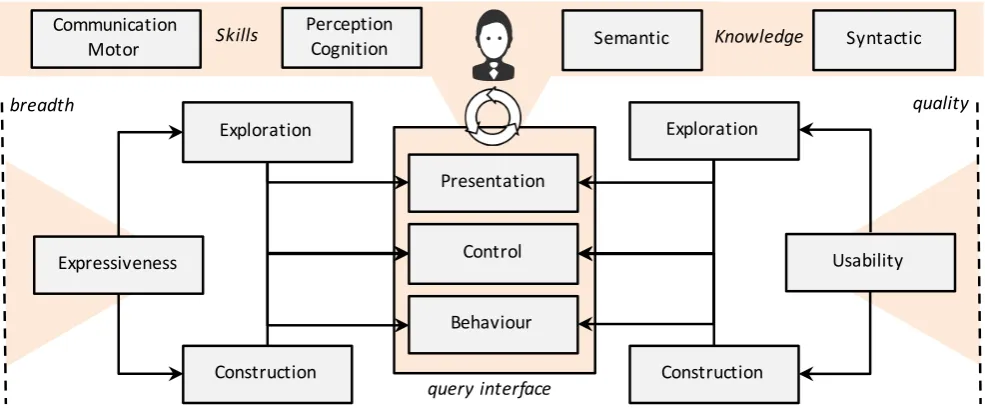
Expressiveness and usability span the challenges and re-quirements for a visual query formulation tool. One can reach a reified sphere of analysis by projecting main data access activities, exploration and construction (cf. [37]), into this frame – see Figure 4. For each activity, the qual-ities ofpresentation andinteraction are of focus as em-ployed visual representation and interaction paradigms and how they are put together, where alternatives are widely available, are of importance. Here, the notion of presentation not only concerns the representation of domain knowledge, but rather every possible graphical aspect of a user interface; and, interaction refers to a two-way effect (i.e., control-feedback loop) between a user and an application, which could be addressed in terms of control (i.e., of user) and behaviour (i.e., of application). In the following, general requirements are discussed in terms of graphic and interaction design perspectives, and in subsections more specific challenges and requirements are discussed.
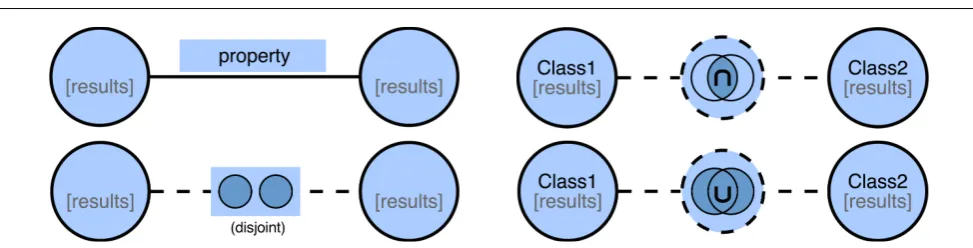
Likewise, in this context, the expressiveness and us-ability are bi-directional in nature. One is from a system or language to user point of view, pertaining to the ability, extent andquality of a language or system for representing domain knowledge and elicited information needs. For instance, one might be concerned whether a system or language is able to visually represent sub-sumption and disjointness between domain concepts and at what level of quality. The second one is from a user to system or language point of view, pertaining to the ability, extent, and quality of a language or system for enabling users to articulate their information needs. For example, one might be concerned whether a system or language allows users to visually expressconjunctive anddisjunctive queries and at what level of quality.
REWRITE REWRITE
Ontology
(OWL) mappings
Q QI
disparate sources Visual Query System
End user
QII
query transforma0on
(GBs/day)
(GBs/day)
Gas Turbines
Petroleum ExploraDon
Expressivity Usability
User
System
Explore Construct
IT expert RDBMS
(TBs)
wlb_dev(name, . . . ) wlb_exp(name, purpose, . . . )
Wellbore
DevWellbore ExpWellbore
Wildcat
Ontology Database
DevWellbore(name) à SELECT name FROM wlb_dev
ExpWellbore(name) à SELECT name FROM wlb_exp
Wildcat(name) à SELECT name FROM wlb_exp WHERE purpose = 'WILDCAT'
Q
original user query
Wellbore(x)
Wellbore(x) U DevWellbore(x) U ExpWellbore(x) U Wildcat(x)
SELECT name FROM wlb_dev UNION
SELECT name FROM wlb_exp UNION
SELECT name FROM wlb_exp WHERE purpose ='WILDCAT'
SELECT name FROM wlb_dev UNION
SELECT name FROM wlb_exp
QI
rewrite w.r.t. ontology Q
II
rewrite to SQL
QIII
op0mise
Mappings
SPARQL SPARQL SQL
Fig. 3 Visual query formulation and ontology-based data access.
Expressiveness
Presentation
Control
Behaviour
Usability Exploration
Construction
query interface
Perception Cognition Communication
Motor Skills Semantic Knowledge Syntactic
quality breadth
Construction Exploration
[image:11.595.45.537.73.432.2] [image:11.595.43.536.468.672.2]on interaction. A query interface should provide neces-sary affordances and means to explore domain and to construct and manipulate queries, under user direction, over time (cf.potential expressiveness [18]). Yet, user control commands and application behaviour have to be restricted to the constraints of domain, for instance, no user action or application behaviour should lead to a state that overlaps two disjoint concepts. Generally, the need and the borders of user skills and knowledge define the confines of expressivity, whilst the latter being a highly determining factor.
The usability of an interface concerns the way it utilises human natural capabilities, particularly commu-nication,motor,perception, andcognitiveskills (cf. [176]), and knowledge (cf. syntactic and semantic knowledge [150]). The first two relate to user control, while the last two pertain to the visual and semantic aspects of presen-tation and application behaviour. The ground challenge is to provide familiar metaphors and interaction styles so as to increase the magnitude of preconscious processing (e.g., recognition vs. recall) and to foster innate user reactions (e.g., clicking vs. typing). These are built on natural visual elements and cues and are spanned by common human skills and knowledge, for representing domain knowledge, application behaviour, and construc-tive and manipulaconstruc-tive functionalities.
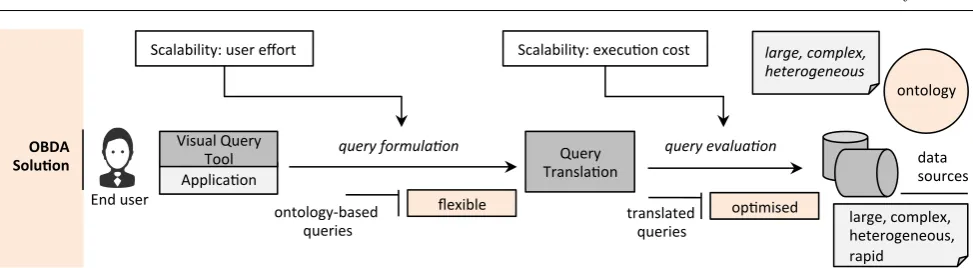
Apart from traditional design considerations, one needs to deal with scalability problems that come with Big Data. Big Data refers to the collection of data sets characterised by highvolume,velocity,variety, and com-plexity (cf. [107, 69]). These four dimensions do not only concern data but also schemata; therefore, one should consider scalability both in terms of query evaluation and query formulation – see Figure 5). The former con-cerns the cost of executing queries against data sources (cf. [117]), while the latter refers to the user effort for finding and using relevant elements of ontology to form the desired query. In this article, the query formulation is of concern and the scalability issues could be better described in relation with the dimensions of Big Data:
– Complexity: ontologies with varied and sophisticated relationships and constraints (e.g., a deep and large class hierarchy) are harder to represent, comprehend, and construct queries from (cf. [93, 69]).
– Volume: large ontologies are hard to visualise and explore on a finite display, and a large data size makes it difficult to spontaneously interact with the underlying data (cf. [68, 118, 93]).
– Variety: ontologies spanning varying types of data and data sources are harder to represent and in-teract with generic representation and inin-teraction paradigms (cf. [173, 57]).
– Velocity: rapidly changing data sources (e.g., stream) are difficult to exploit with passive visual query for-mulation tools (i.e., non-proactive and non-reactive) (cf. [183, 69]).
5.1 Expressiveness
An ontology construct, feature, or functionality provided by a VQS or VQL makes value only if users need, under-stand, and use it. Hence, it is appropriate to approach expressiveness from a user perspective (cf. [36]). That is, a) a visual query formulation tool should primarily span the types of information needs and ontology constructs needed by users in their context; andb) the inclusion criteria should be the user perceived complexity (i.e., the accessibility of a construct, feature, or functional-ity) rather than the formal aspects of the underlying formality.
The user perceived complexity is a crucial factor in determining the confines of expressiveness. Therefore, one should be aware that a visual query formulation tool aimed for end users is not expected to have one-to-one correspondence with the underlying textual language (i.e., full expressivity) or be rigidly formal and compre-hensive like ontology editors and visualisation tools used forontology design and management (e.g., [106, 93]).
5.1.1 Exploration
Exploration is indeed acontinuous activity, since query formulation demands users to actively engage with the domain knowledge and semantics; an inadequate supply of such information leaves users confused or in vacuum. A user may either purely explore to gain some insights with/without a concrete formulation task in mind or to seek for more knowledge for the next step at any point of an active task.
Katifori et al. [93], in their survey, provide a com-parative analysis of ontology visualisation methods with respect to their ability, efficiency, and effectiveness to represent class taxonomy (i.e., class/subclass hierar-chy),multiple inheritance,instances,attributes, and re-lationships. However, among others in OWL,enumerated classes, disjointness, subproperties, inverse properties, andmultiple ranges are also important to aid users. Re-maining constructs are not deemed to be essential (i.e., of OWL 2 [166]), such as role chains andtransitivity, since they are mostly valuable at query answering stage in terms of classification, inference, and consistency checking.
OBDA Solu*on
End user Applica/on Visual Query
Tool
ontology-‐based queries
Query Transla/on
translated queries
flexible op/mised
Scalability: user effort Scalability: execu/on cost
ontology
query formula,on query evalua,on
large, complex, heterogeneous
large, complex, heterogeneous, rapid
data sources
Fig. 5 Visual query formulation, OBDA, and scalability issues.
relationships between geographical regions. Knowing about the transitivity of this property is not of any help for users in constructing queries for retrieving the subre-gions of a city, since users are interested in the intended meaning, not in how it is realised. On the other hand, consider two disjoint classes or an enumerated class. The information on the nature of these classes aids users in selecting the class types and values effectively, by not allowing the selection of two disjoint classes or of an inappropriate value respectively. Nonetheless, multiple inheritance, disjointness, subproperties, inverse proper-ties, and multiple ranges are comparatively harder to communicate, while others are mostly well established in many ontology visualisation methods and tools (cf. [93]).
Ontologies have apropagative effect on the amount of information to be presented. This case is considered in two forms, namely thetop-down andbottom-up prop-agation of property restrictions. The first form emerges from the fact that, in an ontology, explicit restrictions attached to a concept are inherited by its subconcepts. For instance, consider an ontology that includes a su-perconcept “Person”, its subconcepts “Lecturer” and “Student”, and a data type property “hasID” with do-main “Person”. It may be of use to explicitly present “hasID” property, while viewing the subconcepts of “Per-son”, although the connection is not explicit. The second form is rooted from the fact that the interpretation of an OWL concept also includes the interpretations of all its subconcepts. Therefore, for a given concept, it may also make sense to suggest the (potential) restrictions of its subconcepts. For instance, for the same ontology, assume an object type property “teaches” whose do-main is “Lecturer”. It may be of use to present “teaches” property, while viewing the superconcepts of “Lecturer”. Yet, largely due to the lack of provenance and the de-struction of hierarchical view, such information, albeit useful, is harder to represent.
An often employed mechanism for exploring ontolo-gies is navigation approach. An ontology could be con-sidered as agraph, whosenodes are mainly hierarchically
organised concepts and edges are relationships. How-ever, in many cases, an ontology is more than a network of hierarchies and it is not always straightforward to represent an ontology in terms of a graph. For instance, OWL 2 axioms are not well-suited for a graph-based navigation. Indeed, note that OWL 2 axioms do not have a natural correspondence to a graph. In this re-spect, a technique for extracting graph-like structures from OWL 2 ontologies is employed by Soylu et al. [161]. To realise the idea of ontology guided navigation, the visual query formulation tool needs to conform to the navigation graph in the sense that the presence of every element on the interface is supported by a graph edge. In this way, it is ensured that the tool mimics the struc-ture of (and implicit information in) the ontology and data and that the interface does not contain irrelevant (combinations of) elements.
5.1.2 Construction
A query basically describes a subgraph of an ontology. Such descriptions are typically composed throughselect, join andprojection functions (cf. [59]). The select op-eration is meant for specifying conditions on concepts and on their mergers for filtering down the result set (e.g.,where clause in SQL), while the project operation determines attributes that are to be displayed (i.e., se-lect clause in SQL). The join operation represents the traversal of adjacent elements through binary relation-ships to relate two or more concepts. The select and projection operations are comparatively easier, while the join operation is problematic for many users (cf. [89]). Although ontology-based approaches introduce a more natural way of joining concepts, there are still issues, which are discussed below.
[image:13.595.48.535.75.209.2]latter are formed with logical “OR” connectives (cf. [45]). Queries can be seen in several topological categories, such aslinear queries,queries with branching andcyclic queries. The first refers to queries that are basically serial joins of concepts, while the second category of queries are composed ofpath expressionswithbranching (cf. [7]). The latter refers to queries that have at least a path (undirected) in the query graph whose first node corresponds to the last. An example cyclic query would be “find all persons who work in the city that they were born” (“bornIn” and “worksIn” are relationships, while “person” and “city” are concepts). Queries including disjunction and cycles are more problematic compared to linear andtree-shaped conjunctive queries and cycles are usually addressed throughnode duplicationapproach (cf. [36, 93]) – i.e., by duplicating the city node in the
previous example.
There are query types that cannot purely fit into the aforementioned topological forms, such as queries with quantification,negation, andaggregation. Two fundamen-tal forms of quantification areexistential quantification anduniversal quantification (cf. [126, 95]). Existential quantification is interpreted as “there exists”, “there exists at least one”, “for some”, and in OWL “some values from” (cf. [10, 166]); an example query would be “find all lecturers who teach at least one math course”.
Universal quantification is interpreted as “for all”, “for every”, “only” and, in OWL “all values from” (cf. [166]); an example query would be “find all lecturers who only teach Introduction to Computing course”. Negation is an operation that may be applied on aproposition, truth-valueetc., and in the simplest terms, is used to reverse a condition; an example query would be “find all students who do not take Introduction to Computing course” (e.g., [10]). Aggregation functions such as count, sum
andmax are used to group values of multiple attributes to form a single value. While the use of existential quan-tification remains implicit, queries that include universal quantification, negation, and aggregation are quite es-oteric for end users; this even applies to skilled users, particularly for universal quantifiers (cf. [95]).
Finally,query manipulationandquery reformulation are often expected situations. However, query manipu-lation, as opposed to query reformulation from scratch, needs special attention. This is due to the fact that while revising a part of an existing query, the overall semantic consistency has to be maintained (cf. [7]). For instance, assume that a user wants to specialise a relationship; this change does not have any global effect. However, on the contrary, assume that the user wants to alter a relationship to one of its siblings, where its sibling and the current relationship range on two disjoint classes respectively or the user wants to specialise one of the
classes. Such cases require the remaining of the query to be altered as well. Another example could be the deletion of a node from the middle of a path expression; in such a situation, the rest of the path could be deleted automatically. For the convenience of the user, however, a better approach would be suggesting new connections, which is not always straight forward, and a delete option. The consequences of the query manipulation have to be taken care of by the query formulation tool rather than the user, yet the semantics and reasoning behind the subsequent changes done by the interface could be hard to communicate and explain to the user.
5.1.3 Discussion
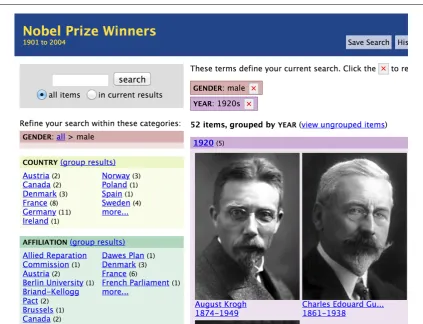
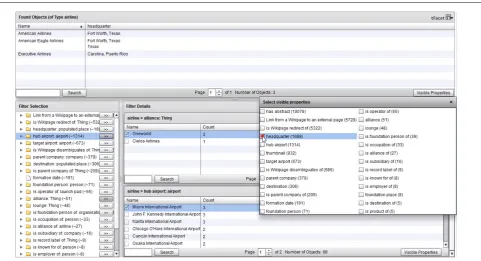
The user perceived complexity of above-mentioned on-tology constructs and query types ranges with respect to representation and interaction paradigms, for instance, while list/menu-based approaches are good for repre-senting class taxonomies, they are not well suited for representing relationships (cf. [37, 93]). One should also see that, a system-based approach (i.e., VQS) could provide more possibilities in terms of expressivity than a language-based approach (i.e. VQL), since there are no rigid formal boundaries for a VQS. For instance, in a VQS, aggregation functions could be handled with tabular data view, which is actually meant for result display.
The amount of information a paradigm can com-municate, the amount of information a user is able to discern from it (i.e.,perceptual level), and the amount of load a paradigm places over the user (i.e.,cognitive level) are among the selection criteria. Therefore, one could rightly assert that expressivity should be considered at perceptual and cognitive levels. Nonetheless, one should also realise that ontology and the query that is reflected back, in many cases, need to be oversimplified for end users. Database/IT experts, given the complexity of an ontology, might consider this ambiguous; however, the reference point should be the end users.
min-imal functionality and unlock complex functionalities as his/her competence progresses (cf. [150]).
Indeed, there is no infinite usability; therefore, the main goal should be to address frequently occurring query formulation tasks that are reasonably complex. Therefore, a visual query formulation tool is often lim-ited in expressiveness with respect to the underlying formality; however, the expressiveness of the underly-ing language is important (e.g.,relational completeness [37, 61, 47, 5]), since queries that cannot be addressed at the end-user level are likely to be delegated to users who directly work with the target textual language. A complex query construct should either be completely discarded and delegated to users with IT skills, if it is found to be very complex for end users. Alternatively, its simple/restricted forms should be supported and complex forms should be delegated to skilled users – e.g., a purely disjunctive or conjunctive set of path ex-pressions vs. a nested set of path exex-pressions connected with disjunctions and conjunctions.
It is important to gather a catalogue of example queries categorised into a set of prototypical classes. This is of help for finding an appropriate compromise between the need and complexity, while selecting the representation and interaction paradigms. In this article, queries are categorised into three levels according to the need and complexity. Thefirst level,ground queries [168], refers to simple linear and tree-shaped conjunctive queries, while the second level refers to queries with disjunctions, aggregation and cycles. The third level refers to queries with universal quantifiers, negation, and query manipulation support. It is postulated that, in many cases, the majority of end-user queries are to be centred around the first level. This categorisation largely relies on personal experience and insights gained from the literature; a rigid classification could be performed through end-user studies.
The complexity does not purely originate from the inherent difficulty of ontology and query constructs; it is also bound to the size. For instance, Catarci [36] cat-egorises queries intoclose-acyclic,far-acyclic,far-cyclic, very far-acyclicqueries, in which not only the structural form, but also the lengths of queries matter. Yet, at this point, the matter becomes largely a usability issue, presented in what follows, for which the representation and interaction paradigms should be tailored to provide gradual access and construction mechanisms for large ontologies and queries.
5.2 Usability
The usability of a visual query formulation tool con-cerns the selection and intertwining of representation
metaphors, visual attributes, and interaction styles that require less knowledge, skills and learning effort, and allow users todiscern,comprehend, andcommunicate a maximum amount of information effortlessly (cf. [140]). In general, in order to meet these goals, the tool should beintelligible,intuitive,succinct, andstimulating, while providinginstant,gradual,iterative, andreversible ex-periences. It should also be integrated and adapted tocontext (cf. [156, 49]), such aspersonal, data-related, task-related,organisational, andenvironmental.
A visual query formulation tool needs to provide a wide support ranging from situating and orienting users in the conceptual space to helping users in understanding and using data. However,the Big Data effect impedes the use of any visual query tool. Primarily, volume and complexity hinder human perception and cognition respectively, while variety and velocity require going beyond generic representation and interaction paradigms and on-demand querying approaches.
5.2.1 Exploration
Exploration is not only a continuous but also an om-nipresent activity. At any phase of a user experience, the display medium presents a portion of the domain, which basically means either anactive orpassive explo-ration, where the user intention is mainly explorative or constructive respectively. For this reason, ontology visualisation is an integral part of query formulation.
placed on a plane as colour-coded and size-coded 3D objects (cf. diagram-based approaches).
As both Katifori [93] and Catarci [37] suggest each representation paradigm has its advantages and disad-vantages, for instance, while indented lists are better at representing hierarchies, node–link trees are better at representing relationships between concepts. How-ever, with any interface, there are technical limits on what can be presented on a finite display space and perceptual limits on how much the user can take from the visual representation (cf. [177, 93]). Here, the first challenge is to diminish the effect of increasing volume and complexity of domain knowledge to prevent users being lost in the conceptual space.
Exploration with large numbers of concepts, rela-tionships, and attributes in a highly complex domain is a hard problem, since the presentation could easily become overcrowded and cluttered and prevent users to reach an overall understanding or to find particu-lar information (cf. [171, 93, 137]). In query formulation, the volume and complexity largely matter in terms of schemata rather than the data, since users interact with the system primarily at a conceptual level. The challenge is to mitigate generating large and incomprehensible vi-sualisations (cf. [137]). The very first approach to scale against the complexity and volume is to provide intuitive interaction styles that allow users to gradually explore and access domain knowledge.
Shneiderman [152] defines seven tasks for visual infor-mation access, namely,overview,zoom,filter, details-on-demand, relate,history, andextract. This categorisation is of help for classifying required interaction types. The overview and zoom tasks are of use for forming a global understanding and changing vertical focus within the conceptual space respectively (cf. top-down). The zoom-ing task is not meant to be a geometrical rescalzoom-ing, rather it allows focusing on a specific part of the presen-tation, while increasing the depth and the magnitude of detail (cf. semantic zooming [135]). A complemen-tary task could beviewpoint movement, which changes the focus horizontally to another part of presentation (cf. [93]). Filter and details-on-demand tasks are meant to isolate a fragment of knowledge that is of interest. The relate task enables users to roam the conceptual space by pursuing the relationships among nodes (cf. browsing). This could be realised through expansion and retraction of nodes, which results in an orderly change in the viewpoint. The history task supports users to control and reflect on their previous actions (e.g., undo, replay, develop experience), while extract task corre-sponds to query construction actions and is discussed in the following subsection.
Schema clustering andsummarisation are two con-crete means to increase comprehensibility and communi-cability. Schema clustering approaches aim at automati-cally adding abstraction layers to conceptual schemas (e.g., [34]), after which users are not first confronted with hundreds or thousands of concepts, rather with high-level clusters that they could drill down. Schema summarisation is meant to provide a visual overview of the entire domain to aid user understanding (e.g., [110, 186]). A simple meta-level visualisation, for instance, could reflect the number of instances associated with each concept and the number of relationships between concepts by using variable size thickness for shapes and lines representing concepts and relationships re-spectively. More advanced visualisations are possible throughnetwork visualisation techniques that can han-dle high numbers of concepts and use different pattern identification approaches (cf. [108]).
Another promising direction is to employadaptivity andcustomisation (i.e., adaptability) techniques (cf. [29, 146]). Adaptivity allows a system to automatically al-ter/adapt itscontent,behaviour, andpresentation with respect to changing context dimensions, where customi-sation is a user managed process of altering software to his/her particular context such as needs and pref-erences. Context is a broad notion that encompasses any information that characterises the computing con-text including entities involved (e.g., user, devices, time, location) and relationships among them (cf. [54, 20]). Al-though the potential of adaptivity and customisation for enriching the usability of visual query formulation tools is already apparent, it is not yet truly exploited (cf. [36, 89]). An example could be the physical environment, if a user is working on two or more screens, the part of the visualisation can be delegated to other display units (cf. [78]). Another example could be the device, if the user is on the field and accessing the tool from a mobile device, the tool could alter its presentation to the screen characteristics of the device and provide a more natu-ral interaction mechanism, such ashaptic control [109], which complements the direct manipulation approach.
The presentation elements used in such scenarios are mostly analogous to real-life, such as maps, which lead to immediate grasping by increasing the magnitude of preconscious processing (cf. [65]).
5.2.2 Construction
The transition between exploration and construction is mostly obscure and needs special attention due to their adverse, though complementary roles. The goal of a user at the query construction stage is to travel all the paths that form the intended query as quickly as possible, unlike the exploration stage where the aim is to discover the conceptual space to a large extent. Hence, for the sake of exploration, visual query formulation tools need to bring in a range of concepts and relationships to the attention of users, while on the contrary, at the construction stage, they need to keep users focused and raise only concepts and relationships that are relevant for the query task.
The challenge for query construction is to guide users to their targets with a minimum amount of devia-tions and backtracks. Large domain knowledge, together with top-down and bottom-up propagation of property restrictions, increases the number of possibilities enor-mously. At any step of query construction, users are confronted with a high number of concepts and proper-ties to choose from. This reduces the ability of users to quickly decide on the next action.
As a solution, adaptivity and customisation are of substantial help in pruning the irrelevant concepts, paths, and properties by taking contextual factors into account (cf. [88, 119]). It goes without saying that, every user is unique, yet common traits weave through them. These differences and commonalities could be addressed in a way to fit data access systems to the context of each user and user group. For instance, in an oil com-pany, there could be different groups of users such as chemists and geologists; therefore, depending on the role of the user in an organisation, a user could only be interested in one part of the domain. An example would be the analysis of query logs on individual and group basis to derive points of interest in the conceptual space for each user and user group and to present the most relevant concepts, attributes and relationships at every stage. The approach could be improved through recommendations (cf. [104]), that is rather than forcing users towards one system defined direction, users could be guided through suggestions, while still being able to reach out other possibilities.
A notable example is calledreachability in the con-text of this article. The navigation of conceptual space might turn into a tedious process, particularly when the
source concept and thetarget concept(s)of an intended path are considerably distant from each other, leading to an exponential increase in the number of choices. Barzdins et al. [10, 11] and Popov et al. [137] address this matter by suggesting possible paths for given source and target concepts, i.e., shortest path, which is called non-local navigation in this article. A better approach would be taking previous query logs into account and ranking paths accordingly, since the shortest path ap-proach does not guarantee relevance. Soylu et al. [159] propose an approach, which exploits a query history to rank and suggest ontology elements with respect to an incomplete query that a user has constructed so far.
Various heuristic approaches should be considered to prevent any confusion that users might encounter during the navigation of a conceptual space. Ontology-based navigation might not be always intuitive for the end users, if it is not tailored adequately. For example, Soylu et al. [162], in their work regarding ontology-based Web navigation, show that navigational chains could be shortened with the help of a set of heuristics derived from the available data, such as skipping the range concept if there is only one instance available for the selected relationship (i.e., pseudo cardinality). From a generic perspective, observing what concepts and properties really occur at the data level is of help to eliminate the irrelevant elements at the presentation level. One could also use sanctions at the ontology level as suggested by Bechhofer and Horrocks [13], which are annotations that are semantically separate from the ontology and indicate for which concepts showing certain relationships or subconcepts is reasonable, valid and natural.