City, University of London Institutional Repository
Citation
:
Solimando, A., Jimenez-Ruiz, E. and Guerrini, G. (2017). Minimizing
conservativity violations in ontology alignments: algorithms and evaluation. Knowledge and
Information Systems, 51(3), pp. 775-819. doi: 10.1007/s10115-016-0983-3
This is the accepted version of the paper.
This version of the publication may differ from the final published
version.
Permanent repository link:
http://openaccess.city.ac.uk/id/eprint/22961/
Link to published version
:
http://dx.doi.org/10.1007/s10115-016-0983-3
Copyright and reuse:
City Research Online aims to make research
outputs of City, University of London available to a wider audience.
Copyright and Moral Rights remain with the author(s) and/or copyright
holders. URLs from City Research Online may be freely distributed and
linked to.
Minimizing Conservativity Violations in
Ontology Alignments: Algorithms and
Evaluation
Alessandro Solimando1, Ernesto Jim´enez-Ruiz2, Giovanna Guerrini1
1DIBRIS, Informatica, Bioingegneria, Robotica e Ingegneria dei Sistemi; University of Genova; Italy
2Department of Computer Science; University of Oxford; United Kingdom
Abstract. In order to enable interoperability between ontology-based systems, ontology match-ing techniques have been proposed. However, when the generated mappmatch-ings lead to undesired logical consequences, their usefulness may be diminished. In this paper, we present an approach to detect and minimize the violations of the so-called conservativity principle where novel sub-sumption entailments between named concepts in one of the input ontologies are considered as unwanted. The practical applicability of the proposed approach is experimentally demonstrated on the datasets from the Ontology Alignment Evaluation Initiative.
1. Introduction
Ontologies play a key role in the development of the Semantic Web and are being used in many diverse application domains, ranging from biomedicine to energy industry. An application domain may have been modeled with different points of view and purposes. This situation usually leads to the development of different ontologies that intuitively overlap, but they use different naming and modeling conventions.
The problem of (semi-)automatically computing mappings between independently developed ontologies is usually referred to as theontology matching problem. A num-ber of sophisticated ontology matching systems have been developed in the last years [16, 71]. Ontology matching systems, however, rely on lexical and structural heuristics and the integration of the input ontologies and the mappings may lead to many undesired logical consequences. In [36] three principles were proposed to minimize the number of potentially unintended consequences, namely: (i) consistency principle, the mappings should not lead to unsatisfiable concepts in the integrated ontology,(ii) conservativity
principle, the mappings should not introduce new semantic relationships between con-cepts from one of the input ontologies,(iii) locality principle, the mappings should link entities that have similarneighbourhoods.
These alignment principles have been actively investigated in the last years (e.g., [32, 33, 36, 54, 56, 57, 66]). Violations to these principles are frequent, even in the reference mapping sets and the alignments generated by the best performing match-ers of the Ontology Alignment Evaluation Initiative1 (OAEI). Also manually curated alignments, such as theUMLS Metathesaurus[5] (UMLS),2a comprehensive effort for
integrating biomedical knowledge bases, suffer from these violations [36]. The occur-rence of these violations may hinder the usefulness of ontology mappings. The practical effect of these violations is clearly evident when ontology alignments are involved in complex tasks such as query answering [54, 78]. The undesired logical consequences caused by violations can either prevent query answering, or cause incorrect results. In order to reduce existing violations, alignment repair methods typically remove a subset of the alignment, given that input ontologies are considered as immutable, a common setting in ontology alignment repair scenarios.
It should be noted, however, the different nature of the alignment principles. Vio-lations of the consistency principle, unlike vioVio-lations of the conservativity and locality principles, always lead to an undesired logical consequence (i.e., unsatisfiability of a concept) and they should always be avoided. Conservativity and locality violations may also lead to undesired logical consequences; however they may also represent false pos-itives and reveal incompleteness in one of the input ontologies. In Section 8 we discuss alternative approaches that suggest to fix the input ontologies instead of repairing the alignment (e.g., [7, 48]).
In this paper we focus on the conservativity violations and we follow a “better safe than sorry” approach (i.e., we treat violations as undesired consequences led by the mappings). Conservativity violations are presented in two flavours, namelysubsumption violationsandequivalence violations. The (potential) challenging number of conserva-tivity violations requires to exploit the intrinsic characteristics of these two flavours, that result in the development of different approaches for their repair. The detection and correction of subsumption violations relies on theassumption of disjointness[67] and it is reduced to a consistency principle violation problem; while equivalence vi-olations are addressed using a combination of graph theory and logic programming. These two methods are combined into amulti-strategyapproach addressing both types of violations. Our extensive evaluation supports the effectiveness of the individual and combined approaches in the detection and correction of conservativity violations.
The present paper extends [74, 75] under the following aspects: all the experimental evaluations provided here cover both reference alignments and alignments computed by participating systems of theOAEI 2012–2014 campaigns, where previous papers covered only the reference alignments of theOAEI. Compared to [75], the present article fully details the proposed method, including a correctness proof of the technique for adding disjointness clauses to Horn Propositional formulas, on which our technique heavily relies. Furthermore, [75] only dealt with the subsumption violations flavour, while in this paper we also cover in detail the equivalence violations flavour. Concerning [74],3 all the technical details and proofs are now provided. In addition, the results of
the evaluation of the two possible variants of our combined repair approach are now
1 http://oaei.ontologymatching.org/
analyzed, as well as the results for the independent techniques in isolation, that can be used as baseline results. Finally, an empirical assessment of the impact of our repair methods on the alignment quality (in terms of precision, recall and f-measure) is now provided.
The remainder of the paper is organised as follows. Section 2 summarises the basic concepts and definitions we will rely on along the paper. In Section 3 we introduce our motivating scenario. Section 4 formally states the problem of computing repairs for equivalence violations and presents an algorithm to solve such violations. Section 5 describes the method and algorithm to solve subsumption violations. Section 6 details additional properties of the proposed methods. In Section 7 we present the conducted evaluation. A comparison with relevant related work is provided in Section 8. Finally, Section 9 gives some conclusions and future work lines.
2. Preliminaries
In this section, we provide the necessary definitions and notions that will be used in the subsequent sections. Section 2.1 briefly introduces OWL 2 and the main elements in an ontology. In Section 2.2 we give a formal definition of ontology mapping and on-tology alignment (adapted from [17]) with their semantics. In Section 2.3 we precisely define the semantic consequences imposed by ontology alignments, and we formalize theconsistencyandconservativityprinciples. Finally, Section 2.4 covers the necessary preliminaries about graph theory.
2.1. Ontologies and OWL 2
Ontologies play a key role in the development of the Semantic Web and are being used in many diverse application domains, ranging from biomedicine to energy industry. The most widely used ontology modelling language is the OWL 2 Web Ontology Lan-guage [11], which is a World Wide Web Consortium (W3C) recommendation [84]. Description Logics (DL) are the formal underpinning of OWL 2 [3, 30].
An OWL 2 ontologyOis equipped with a signatureSig(O), that is a vocabulary of legal names for theentitiesappearing in the ontology.Sig(O)is composed by the disjoint union of four finite sets: (i)NC, a set of unary symbols callednamed concepts, (ii)NR, a set of binary symbols callednamed object properties,(iii)ND, a set of
bi-nary symbols calleddata properties,(iv)NI, a set of constant symbols callednamed individuals.
OWL 2 ontologies can be seen as a set of axioms that are conformant to the syn-tactic rules and constraints imposed by their underlying DL language [30], and built using the elements of the signature. TheclassificationofO, denoted asCl(O), corre-sponds to the result of the computation, performed using an OWL 2 reasoner, of the full subsumption/subconcept relation between its named concepts (i.e., elements ofNC).
Classification is therefore the subset of the logical closure of an ontologyOs.t. each axiom is of the formAvB, whereA, B∈NC(O)andO |=AvB.
2.2. Ontology Mappings and Alignments
Ontology Mappings. In Definition 2.1 we provide the definition of ontologymapping
Definition 2.1. Consider two input ontologiesO1,O2, and their respective signature
Sig(O1)andSig(O2). Amappingbetween entities ofO1,O2is a 4-tuplehe, e0, r, ci
such thate∈ Sig(O1)ande0 ∈Sig(O2),r ∈ {v,w,≡}4is a semantic relation, and
cis a confidence value. Usually, the real number unit interval(0. . .1]is employed for representing confidence values. Mapping confidence intuitively reflects how reliable a mapping is (i.e., 1 = very reliable, 0 = not reliable).
Ontology Alignment. Definition 2.2 introduces the notion ofalignment.
Definition 2.2. AnalignmentMbetween two ontologies, namelyO1,O2, is a set of
mappings betweenO1andO2.
The main format to represent mappings have been proposed in the context of the
Alignment API, and it is called RDF Alignment [12]. This format is the standard for the well-known OAEI campaign. In addition, mappings are also represented as standard subclass and equivalence DL axioms. When mappings are expressed through OWL 2 axioms, confidence values are represented as OWL 2 axiom annotations [35]. The rep-resentation through standard OWL 2 axioms enables the reuse of the extensive range of OWL 2 reasoning infrastructure that is currently available. We adopt this representation, and in the remainder of the paper we consider alignments as set of OWL 2 axioms.
Definition 2.3 introduces the notion ofaligned ontology, resulting from the integra-tion of two input ontologies, through an alignment between them.
Definition 2.3. LetO1,O2be two (input) ontologies, and letMbe an alignment
be-tween them. The ontologyOM
O1,O2 =O1∪ O2∪ Mis called thealigned ontologyw.r.t.
O1,O2, andM.
OM
O1,O2 is simply called the aligned ontology when no confusion arises. Note that
we assume that the signature of the aligned ontology is always the union of the signa-tures of the input ontologies. When the input ontologies are clear from the context we employ the abbreviated notationOM.
Given that each mapping is translated into an OWL 2 axiom, the aligned ontology is again an OWL 2 ontology. Note that alternative formal semantics for ontology mappings have been proposed in the literature, such as those proposed by Zimmermannet al.
in [87], and the semantics associated to the so-called bridge rules, in the context of distributed description logics [6, 55].
2.3. Semantics of the Integration and Principles for Ontology Alignments
This section introduces the semantics of the integration, and provides a formal charac-terization of the consistency and conservativity principles in ontology alignment.
Semantic Consequences of the Integration. The ontology resulting from the integra-tion of two ontologiesO1andO2 via an alignmentMmay entail axioms that do not
follow fromO1,O2, orMalone. These new semantic consequences can be captured
by the notion ofdeductive difference[46, 47].
Intuitively, the deductive difference betweenOandO0, w.r.t. a signatureΣ, is the set
of entailments constructed overΣthat do not hold inO, but do hold inO0. The notion
4 We exclude disjointness from the semantic relations given that most of the available systems do not compute
of deductive difference, however, has several drawbacks in practice. First, there is no algorithm available for computing it for DLs more expressive thanEL, for which the problem is alreadyEXPTIME-complete [52]. In addition, the problem is undecidable for DLs as expressive asALCQIO5[51]. Second, the huge (possibly infinite) number
of entailments in the difference is likely to overwhelm users.
In order to avoid the drawbacks of the deductive difference, we rely on the approxi-mation of the deductive difference, specified in Definition 2.4.
Definition 2.4. LetA, B be named concepts (including >,⊥), Σ be a signature, O andO0 be two ontologies. We define theapproximationof theΣ-deductive difference
betweenOandO0 (denoteddiff≈
Σ(O,O0)) as the set of axioms of the formA v B
satisfying: (i)A, B ∈Σ,(ii)O 6|=AvB, and(iii)O0 |=AvB.
The proposed approximation only requires to compare the classification hierarchies of ontologiesOandO0(i.e.,Cl(O)andCl(O0)). In this paper we rely on this
approxima-tion, which has successfully been used in the past in the context of ontology integration to help users understanding the semantic consequences of this operation [35].
Consistency Principle Violations. Consistency violations evidence either a problem in the mappings or an incompatibility between the input ontologies, because they always result in incoherent and/or inconsistent (aligned) ontologies (i.e., an ontology contain-ing unsatisfiable concepts). The consistency principle is the most widely investigated in the literature, where tools for detecting and automatically repair mappings leading to logical inconsistencies in the aligned ontology have been proposed (e.g., [33, 54]). Vio-lations of the consistency principle are (typically) easy to detect with standard reasoning services. However, repairing such violations through standard reasoning services leads to intractability for medium size ontologies and alignments [34, 76, 77].
The consistency principle requires all the (named) concepts of the aligned ontology OM
O1,O2to be satisfiable, assuming the union of the input ontologiesO ∅
O1,O2=O1∪O2
(without the alignmentM) does not contain unsatisfiable concepts. In Definition 2.5 we formally define (violations of) the consistency principle.
Definition 2.5. An alignmentMviolates theconsistency principle(i.e., it is incoher-ent) w.r.t.O1 andO2ifdiffΣ≈(OO∅1,O2,O
M
O1,O2)contains axioms of the formA v ⊥,
for allA∈Σ =Sig(O1)∪Sig(O2). Violations of the consistency principle result in
an incoherent aligned ontologyOM O1,O2.
Conservativity Principle Violations. The conservativity principle in ontology align-ment aims at capturing the differences in the ontology classification between the input ontologies and the aligned ontology [36] (i.e., new subsumptions and/or new equiva-lences among concepts). The conservativity principle despite considering only ontol-ogy classification, and not the unrestricted problem addressed by conservative exten-sions [51], is of high interest because classification is one of the most used features in semantic-enabled applications [27, 49].
Conservativity violations may evidence, like consistency violations, erroneous map-pings or disagreements in the input ontologies; however they may also reveal incom-pleteness in one of the ontologies. Although in the literature there are other approaches that consider these violations as false positives and suggest to fix the input ontologies
(see Section 8), in this paper we treat them as undesired consequences led by the map-pings.
The conservativity principle (general notion) states that the aligned ontologyOM O1,O2
should not induce any change in the concept hierarchies of the input ontologiesO1and
O2. That is, the sets diff≈Σ1(O1,O M
O1,O2)anddiff ≈
Σ2(O2,O M
O1,O2)must be empty for
signaturesΣ1=Sig(O1)andΣ2=Sig(O2), respectively.
In this paper we present two less restrictive variants of this principle:subsumption
andequivalenceconservativity violations. Thesubsumptionvariant of the conservativ-ity principle requiresOM
O1,O2not to introduce new subsumption relationships between
concepts from one of the input ontologies, unless they were already involved in a sub-sumption relationship or they shared a common descendant. In addition, we also define violations between concepts that may have been already involved in a subsumption relationship (i.e., resulting in an equivalence between them), denoted as equivalence conservativity principle violations, or simplyequivalence violations. Both variants are formally introduced in Definition 2.6.
Definition 2.6. LetOi be one of the input ontologies and Σ = Sig(Oi)\ {⊥,>}
be its signature, letMbe acoherentalignment betweenO1andO2,OOM1,O2 be the
integrated ontology,6and letA, Bbe concepts inΣ. We define two sets of violations of
OM
O1,O2w.r.t. Oi:
– subsumption violations, denoted assubViol(Oi,OOM1,O2), as the set ofAvBaxioms
satisfying: (i)AvB ∈diff≈Σ(Oi,OMO1,O2),(ii)Oi 6|=B vA, and(iii)there is no
CinΣsuch thatOi|=CvA, andOi |=CvB;
– equivalence violations, denoted aseqViol(Oi,OOM1,O2), as the set ofA≡Baxioms
satisfying: (i)OM
O1,O2 |= A ≡ B,(ii)A v B ∈ diff ≈
Σ(Oi,OMO1,O2)and/orB v
A∈diff≈Σ(Oi,OMO1,O2).
Thus, in our setting, an alignmentMviolates the conservativity principle if the sets subViol(Oi,OMO1,O2)oreqViol(Oi,O
M
O1,O2)are not empty. Example 2.1 provides an
example of mappings leading tosubsumptionandequivalenceconservativity violations.
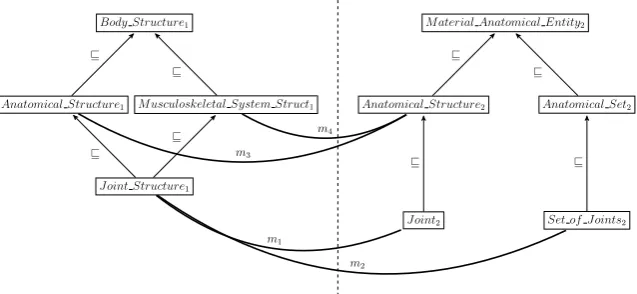
Example 2.1. Consider the alignmentM ={m1, m2, m3, m4}provided in Figure 1.
We distinguish the following cases depending on the semantic relation of the mappings:
(i) Both types of violation.If bothm1 andm2 are equivalence mappings (i.e.,≡)
thenm1andm2lead to twosubsumptionviolations and oneequivalenceviolation
since they will make J oint2 andSet of J oints2to become equivalent, which
did not hold any relationship in the original ontology.
(ii) Only subsumption violation.In the casem1is an equivalence mapping (i.e.,≡) but
m2is a subsumption mapping (i.e.,J oint Structure1 vSet of J oints2),m1
andm2only lead to asubsumptionviolation (i.e.,J oint2vSet of J oints2).
(iii) Only equivalence violation.If bothm3andm4are equivalence mappings (i.e.,≡)
then these mappings lead to the equivalence of Anatomical Structure1 and
M usculoskeletal System Struct1, which represents anequivalenceviolation;
however it does not represent asubsumptionviolation, according to condition(iii)
in Definition 2.6, sinceJ oint Structure1 is a common descendant of the
con-cepts involved in the novel subsumptions.
6 We assume thatdiff≈
Body Structure1
Anatomical Structure1 M usculoskeletal System Struct1
J oint Structure1
M aterial Anatomical Entity2
Anatomical Structure2 Anatomical Set2
J oint2 Set of J oints2
v
v v
v
v
v
v v
m1
m2 m3
[image:8.595.109.428.133.280.2]m4
Fig. 1. Example of mappings leading to subsumption and equivalence conserva-tivity violations. The ontology in the left-hand side represents a fragment of the
SNOMED CT[69] ontology, while the one in the right-hand side represents a fragment ofFMA[65] ontology.
(iv) No violations. If m3 is a equivalence mapping (i.e., ≡) but m4 is a
subsump-tion mapping (i.e.,v), thenm3andm4 will only lead to the novel subsumption
M usculoskeletal System Struct1 v Anatomical Structure1, which does
not represent a subsumptionviolations for the same reason as described in the previous case.
The (potential) complexity of detecting and solving conservativity violations re-quires to exploit the intrinsic characteristics of the above two flavours, that will result in the development of different methods for their repair. For example, the notion of sub-sumption violations relies on the assub-sumption of disjointness [67] and it can be reduced to a consistency principle problem (see Section 5). Equivalence violations, however, rely on the notion of (unsafe) cycle in the ontology graph and require a different treatment based on graph theory (Section 4).
Alignment Repair. An alignmentMthat violates the consistency and/or the conser-vativity principles can be fixed by removing correspondences fromM.7This process is
referred to asmapping repair(or repair for short), and is formally introduced in Defini-tions 2.7 and 2.8.
Definition 2.7. LetMbe an incoherent alignment (i.e., violates the consistency prin-ciple) w.r.t.O1andO2. A set of mappingsR ⊆ Mis amapping repair for the
consis-tency violationsforMw.r.t. O1andO2iffM \ Ris coherent w.r.t. O1andO2, that
is,OOM\R
1,O26|=Av ⊥, for allA∈Sig(O1)∪Sig(O2).
The definition of violation of the conservativity principle, as in Definition 2.6, ass-sumes that the alignmentMdoes not violates the consistency principle w.r.t. the input ontologiesO1andO2. The main reason for requiring as input a coherent alignment is
7 Note that in this paper we only target the mappings in the repair process and we consider the input
that unsatisfiable concepts would be subsumed by any other concept, and thus leading to a very large number of (misleading) violations of the conservativity principle.
Definition 2.8. LetMbe a coherent alignment that violates the conservativity principle w.r.t.O1andO2. A set of mappingsR ⊆ Mis amapping repair for the conservativity
violations for Mw.r.t. O1 and O2 iff for alli ∈ {1,2} subViol(Oi,OM\RO1,O2)and
eqViol(Oi,O M\R
O1,O2)are empty.
The repair of an alignment usually has several alternatives. Nevertheless, the objec-tive is to remove as few mappings as possible. The notion of minimal repairs, originally introduced by Reiter [63] under the name ofdiagnoses, have been introduced to the field of ontology debugging in [68]. In the ontology debugging literature, they are typ-ically referred to asmapping diagnoses[54]. A repair or diagnosis for an alignment can be computed by extracting the justifications for the unsatisfiable concepts (e.g., [29, 42, 67, 80]), and selecting a hitting set of mappings to be removed, following a minimality criteria (e.g., the number of removed mappings, or their combined confi-dence). However, justification-based techniques do not scale when the number of un-satisfiabilities is large (a typical scenario in mapping repair problems [34, 76, 77]). To address this scalability issue, mapping repair systems usually compute anapproximated repairusing incomplete reasoning techniques (e.g., [33, 54, 66]). An approximated re-pairR≈does not guarantee thatM \ R≈does not lead to violations of the consistency
and conservativity principle, but it will (in general) significantly reduce the number of violations caused by the original set of mappingsM.
2.4. Graph Theory Notation
This section provides the necessary preliminaries about graph theory, given that graphs will be used to provide a convenient representation of ontologies for reasoning about the detection and repair of conservativity violations.
Graph Notions. A directed graph(digraph) G is a set of vertices V together with a relation Aon V.8 Aweighted digraph Gis a digraph where each arc has a third component, calledweightof the arc, assuming values in an appropriate structure (e.g.,
N,R, etc.). Given an arca= (u, v, c), we denote its weight asw(a) =c. The function
w, when applied to a set of arcs, returns the sum of the weights of the single arcs. An
arc-labeled digraphG= (V, A, L)is a digraph with an additional componentLcalled the set of labels. Given an arca= (u, v, l),lis called the label ofa, wherel∈L.
If not differently stated, in the remainder we always refer to weighted digraphs, and the placeholder “ ” might replace any of the components of an arc, representing an unspecified legal value that the considered component can assume.
Given a digraphG = (V, A), asubgraphG0 = (V0, A0)of Gis a digraph such thatV0 ⊆V, andA0 ⊆A, and for all arca= (u, v, )∈A0, we have thatu, v ∈V0. Asubgraphof Gis said to beinducedbyV0, and denoted asG|V0, if, for all pair of
verticesu, v∈V0,(u, v, )∈A0iff(u, v, )∈A.
Paths and Cycles. We now formally introduce the notion of path and cycles, that will be used to model subsumption and equivalence between concepts.
Given a digraph G, a (directed) pathπ = [v1, . . . , vn] of G, with n > 1, is a
sequence of vertices where each pair of verticesvi andvi+1, withi ∈ 1. . . n−1, is
connected by an arc(vi, vi+1, )∈A. Thelengthof such a pathπisn−1. Given two
verticesu, v ∈V,visreachablefromuiff a pathπof lengthm−1exists such that, for somem >2,v1=uandvm=v.
Given a digraphG and a directed pathπ = [v1, . . . , vn] of G, we define π as a
directed cyclic path (cyclein what follows) iff the first and last vertices coincide,i.e., v1=vn. We say that a cycleκisbrokenby the removal of any of its arcs (resp. vertices).
We also say that a set of arcs (resp. vertices) breaks a set of cycles iff any of the cycles contains at least one element of the set. Note that we do not consider self-arcs, and therefore cycles with length equal to 1are not allowed. Given a digraph G and two cyclesκ1 andκ2ofG, we defineκ1 andκ2asdistinct cyclesif they are not a cyclic
permutation one of the other.
Using the notion of cycle, we introduce the notion ofdirected acyclic graph(DAG). Given an arca= (u, v, ), we refer toV(a) ={u, v}as the set containing its source and target vertices.Vnaturally extends to sets (resp. sequences) of arcs, as the union of its application on each element of the set (resp. sequence).
Given a pathπ= [v1. . . vn], we refer toA(π) ={(vi, vi+1, )|i∈[1. . . n−1]}as
the set containing all of the arcs ofπ. Similarly, given a set of verticesV0and a digraph G= (V, A)such thatV0⊆V, we refer toA(V0) ={(u, v, )∈A|u, v∈V0}as the set containing all the arcs ofGbetween vertices ofV0.
Graph Connectivity. Given that paths and cycles are used to encode subsumption and equivalence relations between concepts, graph connectivity represents a natural option for reasoning about transitivity of such relations. The notion ofstrongly connected com-ponent(SCC), for instance, splits the graph into equivalence concepts, thus identifying sets of equivalent concepts.
More formally, given a digraphG= (V, A), a SCC ofGis a maximal set of vertices C⊆V such that for allu, v∈C, bothuis reachable fromvand viceversa. Notice that at least a cycle containing all the elements of the SCC exists, so cycle detection in a digraphGcan be reduced to the identification of the SCCs ofG. The set of SCCs of a digraphG = (V, A)is denoted asSCC(G). IfSCC(G) = {V}thenGis astrongly connected digraph.
Tarjan’s Algorithm[81] (Tarjan) finds the SCCs of a digraphG= (V, A)using a single depth-first search with a time complexity inO(|V|+|A|).
Given a digraphG= (V, A), theFeedback Edge Set(FES) problem aims at select-ing a subset ofA, calledfeedback (edge) set, with minimum cardinality, whose removal makesGacyclic. This problem is known to beNP-hard [18], as well as its weighted variant,Weighted Feedback Edge Set(WFES).WFESdiffers from FESfor what con-cerns the minimization objective for the feedback set, that is required to be minimal w.r.t. the sum of the weights of its elements.FESis also equivalent to the Feedback Vertex Set(FVS) problem [18], where a subset ofV that makesGacyclic is sought.
3. Motivating Example
In this section, we show the problems caused by the violation of the conservativity prin-ciple when integrating ontologies via mappings in a real-world scenario. To this end, we consider, as motivating example, a use case based on theOptiqueproject applica-tion domain [24, 44].9Optique aims at facilitating scalable end-user access to big data
OntologyO1 OntologyO2
α1 W ellBorev ∃belongsT o.W ell β1 Exploration wellvW ell
α2 W ellBorev ∃hasOperator.Operator β2 Explor boreholevBorehole
α3 W ellBorev ∃locatedIn.F ield β3 Appraisal exp boreholevExplor borehole
α4 AppraisalW ellBorevW ellBore β4 Appraisal wellvW ell
α5 ExplorationW ellBorevW ellBore β5 F ieldv ∃hasF ieldOperator.F ield operator
α6 OperatorvOwner β6 F ield operatoruOwnervF ield owner
α7 OperatorvCompany β7 CompanyvF ield operator
α8 F ieldv ∃hasOperator.Company β8 F ield ownervOwner
[image:11.595.95.447.123.222.2]α9 F ieldv ∃hasOwner.Owner β9 BoreholevContinuanttOccurrent
Table 1. Simplified fragments of two ontologies in the oil and gas domain.
MappingsM
e1 e2 n ρ
m1 O1:W ell O2:W ell 0.9 ≡
m2 O1:W ellBore O2:Borehole 0.7 ≡
m3 O1:ExplorationW ellBore O2:Exploration well 0.6 v
m4 O1:ExplorationW ellBore O2:Explor borehole 0.8 ≡
m5 O1:AppraisalW ellBore O2:Appraisal exp borehole 0.7 ≡
m6 O1:F ield O2:F ield 0.9 ≡
m7 O1:Operator O2:F ield operator 0.7 w
m8 O1:Company O2:Company 0.9 ≡
m9 O1:hasOperator O2:hasF ieldOperator 0.6 ≡
m10 O1:Owner O2:Owner 0.9 ≡
Table 2. Ontology mappings for the vocabulary inO1andO2.
in the oil and gas industry. The project is focused around two demanding use cases pro-vided bySiemens[45] andStatoil[44]. Optique advocates for an Ontology Based Data Access (OBDA) approach so that end-users formulate queries using the vocabulary of a domain ontology instead of composing queries directly against the database. Ontology-based queries (e.g., SPARQL queries) are then automatically rewritten to SQL and exe-cuted over the database (e.g., [64]). Ontology entities are linked to the database through
ontology-to-schemamappings. Ontology-to-schema mappings are, however, out of the scope of the present study, and we therefore only focus on ontology-to-ontology map-pings, or simply mappings (see Section 2.2).
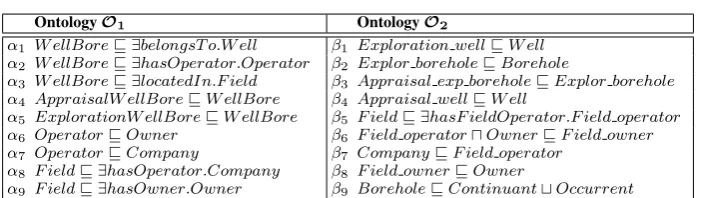
Table 1 shows two simplified fragments of ontologies that are currently being used in the context of Optique. The ontologyO1has been directly bootstrapped from a
re-lational database (e.g., [38]), and it is linked to the data through (direct) ontology-to-schema mappings. The ontologyO2, instead, is a domain ontology based on the
Norwe-gian Petroleum Directorate (NPD) FactPages10[72], preferred by the Optique end-users
to feed the Optique’s visual query formulation interface [79].11
The integration via ontology alignment ofO1andO2is required since the
vocabu-lary inO2is used to formulate queries (i.e., QF-Ontology), but only the vocabulary of
O1is connected to the database (i.e., DB-Ontology), as depicted in Figure 2. Consider
the set of mappingsMin Table 2 betweenO1andO2 generated by an off-the-shelf
ontology alignment system. Mappings are represented as4-tuples (see Definition 2.1); for example the mappingm2suggests an equivalence relationship between the entities
O1:W ellBoreandO2:Boreholewith confidence0.7.
10 http://factpages.npd.no/factpages/
11 Optique uses OWL 2 QL ontologies for query rewriting, while the query formulation may be based on
[image:11.595.139.393.250.363.2]Fig. 2. Ontology Alignment in an OBDA Scenario
σ Entailment: follows from: subViol?eqViol?
σ1O2:Explor boreholev O2:Exploration well m3, m4 YES NO
σ2O1:AppraisalW ellBorev O1:ExplorationW ellBore β3, m4, m5 YES NO
σ3O2:F ield operatorv O2:F ield owner α6, β6, m7, m10 YES NO
σ4O1:Company≡ O1:Operator α
7, β7, m7, m8 NO YES
σ5O2:F ield operator≡ O2:Company
σ6O1:Companyv O1:Owner σ4, α6 YES NO
σ7O2:Companyv O2:F ield owner σ3, σ5 YES NO
Table 3. Example of conservativity violations.
The integrated ontologyOM
O1,O2 =O1∪ O2∪ M, however, violates the
conser-vativity principle (see Table 3). According to Definition 2.6, entailmentsσ1-σ3,σ6and
σ7 represent subsumption violations, while entailmentsσ4andσ5are equivalence
vi-olations. Note thatσ4andσ5do not belong to the set of subsumption violations since
O1:Company andO1:Operator (resp.O2:F ield operator and O2:Company) are
involved in a subsumption relationship inO1(resp.O2).
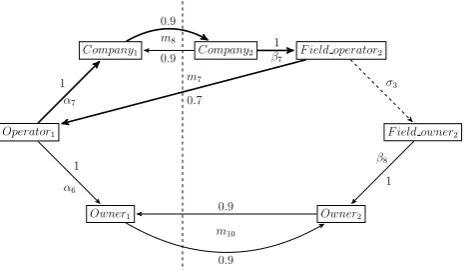
In Figure 3 the portion of the graph representation ofOM
O1,O2 involved in
conser-vativity violations is shown. Dashed arcs represent inferred axioms, while bold arcs are those involved in equivalence violations. Each non-inferred arc is labeled with its confidence value.
Example 3.1 provides an instance of query over the vocabulary ofO2.
Example 3.1. Consider the following simple conjunctive query expressed in datalog notation,CQ(x) ← O2:W ell(x). The query asks for wells and has been formulated
using the vocabulary ofO2. The query is rewritten, according to the ontology axioms
and mappingsβ1, β4, m1, m3, m4inOOM1,O2, into the following union of conjunctive
Company1
Operator1
Owner1
Company2 F ield operator2
F ield owner2
Owner2
0.9
0.9
m8 1
β7
m10
0.9 0.7
m7 σ
3
1 β8
1 α7
1 α6
0.9
[image:12.595.152.386.520.655.2]queries:
U CQ(x)← O2:W ell(x)∪ O1:W ell(x)∪ O2:Exploration well(x)∪
O2:Appraisal well(x)∪ O1:ExplorationW ellBore(x)∪
O2:Explor borehole(x)
Since only the vocabulary of O1 is linked to the data, the union of conjunctive
queries could be simplified asU CQ(x) ← W ell(x)∪ExplorationW ellBore(x), which will clearly lead to non desired results. The original query was only asking for wells, while the rewritten query will also return data about exploration wellbores.
Example 3.1 shows that the quality of the mappings in terms of conservativity viola-tions may directly affect the quality of the query results in an OBDA context. Therefore, the detection and repair of these violations arise as an important quality assessment step in Optique. Conservativity violations, however, may representfalse positives, that is, entailments that bring new and valid knowledge. In these cases, the detection and (sug-gested) repair of conservativity violations can be seen as an input of a subsequent man-ual revision where the bootstrapped and the domain ontologies may be updated with novel subsumption and/or equivalence axioms. Note that changes in the bootstrapped ontology will necessarily imply a revision of the ontology-to-schema mappings. Con-servativity violations, however, must always be avoided in the case the bootstrapped and the domain ontologies are considered as immutable by Optique end-users.
4. Detecting and Repairing Equivalence Violations
This section introduces the relevant properties of our aligned ontology graph represen-tation as well as the formal definition and analysis of the problem of computing a min-imal diagnosis to repair equivalence violations. Finally we present our repair algorithm EqRepair which relies on logic programming.
As stated in Definitions 2.6 and 2.8, we expect as input an alignment Mthat is coherent w.r.t. the input ontologiesO1andO2.
4.1. Aligned Ontology and Graph Representation
Definition 4.1 formalizes a variant of the aligned ontology given in Definition 2.3. This variant enables a more efficient detection phase for equivalence violations. Differently from Definition 2.3, here we perform a classification step on the input ontologies before computing the aligned ontology, in order to obtain a graph representation that allows the detection of equivalence violations by simply analysing the graph, without further use of an OWL 2 reasoner.
Definition 4.1. Given two (input) ontologies, namely O1, O2, and an alignment M
between them, consider an ontology OMO1,O2 such that Sig(OOM1,O2) = Sig(O1)∪
Sig(O2), andOMO1,O2 =Cl(O1)∪ Cl(O2)∪ M, whereClrepresents the classification
of the given ontology as introduced in Section 2.1. We defineOM
O1,O2 as thealigned ontology w.r.t. O1, O2, and M, or simply the aligned ontology, when no confusion
arises.
Note that we do not compute the closure ofO1∪ O2∪ Msince this will prevent our
Cl(O1) Cl(O2) M
LaptopvP C
U ltrabookvLaptopuLightObject U ltrabookvLaptop∗ U ltrabookvLightObject∗
U ltrabookvP C∗
U ltrabookvN otebook N otebookvComputer U ltrabookvComputer∗
hLaptop1, N otebook2,w,0.7i hU ltrabook1, U ltrabook2,≡,1i
[image:14.595.97.441.121.186.2]hP C1, Computer2,v,0.9i
Table 4. Ontologies and alignment for Example 4.1. Inferred axioms are marked with an asterisk.
Example 4.1. Let O1 andO2 be two input ontologies and Mbe an alignment
be-tween them. Table 4 shows the classification of the input ontologies (inferred axioms are marked with an asterisk), and the mappings. The aligned ontologyOM
O1,O2, is therefore
equal to{Laptop1vP C1,U ltrabook1 vLaptop1uLightObject1,U ltrabook1v
Laptop1, U ltrabook1 v LightObject1, U ltrabook1 v P C1,
U ltrabook2 vN otebook2,N otebook2 vComputer2,U ltrabook2 vComputer2,
N otebook2vLaptop1,U ltrabook1 ≡U ltrabook2,P C1vComputer2}. Note that
subscripts are only used to emphasize the “provenance” of named concepts.
Note that our repair algorithm does not directly compute a diagnosis using the aligned ontology, it rather works on a graph representation12of this ontology, presented
in Definition 4.2.
Definition 4.2. Given an ontologyO, its graph representation, denoted asG(O) = (V, A), is a digraph characterized by the following properties:
– each conceptC∈NC(O)has an associated vertexvC ∈V,
– each axiom of the formD vE ∈ O(resp.D wE), withD, E ∈ NC(O)distinct
concepts, has an associated arc(vD, vE, c)(resp.(vE, vD, c)) inA,
– each axiom of the formD≡E ∈ O, withD, E ∈NC(O)distinct concepts, has an
associated pair of arcs{(vD, vE, c),(vE, vD, c)}inA.
The third component of each arc (denoted ascabove) is always equal to1ifOis not an aligned ontology, otherwise it is equal to1for the axioms of the input ontologies, while it is equal to the confidence of the considered mapping for the corresponding arcs.
When no confusion arises we interchangeably refer to an ontological concept and its associated vertex, and to an ontology and its associated graph representation. Note that subsumption/equivalence axioms between a concept and itself are not allowed in the graph representation, because the set of arcs is defined using an antireflexive relation. Similarly, we will interchangeably refer to axioms/mappings and their corresponding elements in the graph representation.
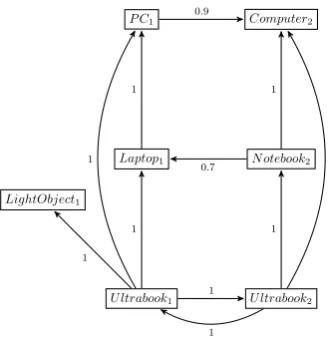
An example of graph representation, associated with the aligned ontology of Exam-ple 4.1, is shown in Figure 4.
4.2. Paths and Cycles
Given the semantics of the arcs in the graph representation, a path from a vertexuto a vertexv implies thatO entails that the concept associated withuis subsumed by
12 Despite several proposals for graph formalisms for representing DL ontologies exists in literature (e.g.,
P C1
Laptop1
U ltrabook1
LightObject1
Computer2
N otebook2
U ltrabook2
0.9
1
1 1 1
1
1 1
1 1
[image:15.595.182.347.128.297.2]0.7
Fig. 4. Graph representation for the aligned ontology of Example 4.1.
the concept associated withv, as expressed by Proposition 4.1. Analogously, Proposi-tion 4.2 states that a cycle in the graph representaProposi-tion implies thatOentails that all the concepts associated with the vertices of the cycle are equivalent. Note that the other direction of the following propositions holds only if the graph representation is built on top of an ontology closed w.r.t. classification, but this is not the case for our technique. Therefore, we do not require that the graph representation of the aligned ontology re-flects all its subsumption entailments (equivalently, it suffices that testing subsumption on the graph representation is sound, even if not complete).
Proposition 4.1. LetObe an ontology and letG(O) = (V, A)be its graph represen-tation. If a pathπ= [vA1, . . . , vAn]withn >1exists inG(O), thenO |=A1 vAn,
withA1, Andistinct concepts.
Proof. The proof directly follows from the semantics of the arcs in the graph represen-tation and by transitivity of the subsumption relation.
Proposition 4.2. LetObe an ontology and letG(O) = (V, A)be its graph represen-tation. If a cycleκ= [vA1, . . . , vAn, vA1]withn≥1exists inG(O), thenO |=Ai≡
Aj, withi, j∈[1. . . n]andAi,Ajdistinct concepts.
Proof. Given a pair of verticesvAi,vAj, we define two pathsπij = [vAi, . . . , vAj]and
πji= [vAj, . . . , vAi]such that verticesvAp, vAq are consecutive inπij, πji, only if the
same holds inκ, withi, j, p, q ∈ [1. . . n]. Given that all theπij andπjiare paths, we
can apply Proposition 4.1.
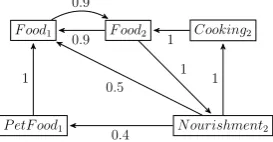
(condi-P etF ood1
F ood1 F ood2 Cooking2
N ourishment2
0.9
0.9
1 1 0.5
0.4 1
[image:16.595.199.336.133.204.2]1
Fig. 5. A graph representation including both safe and unsafe cycles.
tion (i)), a projection consists of a single vertex (condition (ii)), a cycle traversing all the vertices of a projection exists (condition (iii)). For instance, a (safe) cycle is local to the input ontologyOiif its projection onOisatisfies condition (iii), while the other
projec-tion is empty (condiprojec-tion (i) holds). This implies an equivalence entailment (involving all the concepts of the cycle) already in the input ontologyOi, that clearly prevents the
existence of an equivalence violation among such concepts.
Definition 4.3. Letκ= [u1, . . . , un, u1]be one of the cycles of a graph representation
G(OM
O1,O2), withn > 1. We defineκas asafe cycleiff for somei ∈ {1,2}we have
that: either (i) |V(κ)∩VOi| = 0, or(ii) |V(κ)∩VOi| = 1, or(iii) a cycle κ 0 i in
G(OM
O1,O2)|VOi exists, such thatV(κ)∩VOi ⊆ V(κ 0
i). We further differentiate between local((i) and (iii) hold),trivial(only (ii) holds),partially trivial((ii) and (iii) hold) and
nontrivial safe cycles(only (iii) holds). We generically refer to safe cycles, except local safe cycles, asglobal safe cycles. A cycle that is not safe is defined as anunsafe cycle.
In Example 4.2 an example is provided for each different kind of cycles.
Example 4.2. Consider the graph representation of Figure 5. We first present the (dif-ferent kind of) safe cycles.[F ood2,N ourishment2,Cooking2,F ood2]is a local safe
cycle,[F ood1,F ood2,N ourishment2,F ood1]is partially trivial,[F ood1,F ood2,F ood1]
is trivial. Instead,[F ood2,N ourishment2,P etF ood1,F ood1,F ood2]is an unsafe
cy-cle, but adding the axiomF ood1 v P etF ood1 toO1 would turn it into a nontrivial
safe cycle.
Starting from the results of Proposition 4.2, we can characterize a restricted ver-sion of the conservativity principle using graph-theoretical concepts only, applied on the graph representation, without the need to refer to the aligned ontology. Despite the aforementioned approximations, our repair technique for equivalence violations is ef-fective in practice, as experimentally verified in Section 7.2.
Theorem 4.1. LetO1,O2 be two (input) ontologies, and letMbe an alignment
be-tween them. Let also G(OM
O1,O2) = (V, A), G(O1) = (VO1, AO1) andG(O2) = (VO2, AO2)be the graph representations associated withO
M
O1,O2,O1andO2,
respec-tively. If there exists an unsafe cycleκuinG(OM
O1,O2)and the vertices associated with
concepts C, D(namely VC, VD) belong to κu, then a violation of the conservativity
principle w.r.t. equivalence, involving conceptsCandD, exists inOM O1,O2.
Proof. For all the vC,vD ∈ c, if we have an (unsafe) cycle κu inG(OMO1,O2), then
OM
O1,O2 |=C≡Dholds. For alli∈ {1,2}, if an unsafe cycleκ
uexists, then no cycle
κ0exists inG(Oi)such thatV(κu)∩V
Oi⊆ V(κ
0). This requires that at least one vertex
vE ∈ κuexists such that it does not belong toκ0; which corresponds to having that,
F. This represents an equivalence violation, thus proving the soundness of the detected violations using the graph representation.
Proposition 4.2 relates cycles in the graph representation to equivalence axioms in the aligned ontology. We have only soundness guarantee, given that without classifying the aligned ontology equivalences that are not reflected in the graph representation may exist.
Theorem 4.1 guarantees that a method detecting and correctingallthe unsafe cycles on the graph representation is sound w.r.t. violations of the conservativity principle w.r.t. equivalence in the aligned ontology. This is proved by verifying that detected unsafe cycles effectively encode equivalence violations.
We remark also that, once the graph representation is built, we do not need the sup-port of a standard reasoner. This feature is at the basis of the scalability of our approach.
4.3. Diagnoses for Equivalence Conservativity Violations
The goal of our repair algorithm is, starting from an aligned ontology, to detect viola-tions to the conservativity principle w.r.t. equivalence and to compute a diagnosis. In order to obey to the well-knownprinciple of minimal change, the diagnosis is required to have a minimal weight, w.r.t. a metric capturing the amount of lost information. In our context, a standard minimality criterion for defining diagnosis weight (the quantity to minimize) is the sum of the weights of the arcs associated with the (removed) mappings. In Definition 4.4 we formalize a diagnosis as the set of arcs of the graph representation of an aligned ontology that, once removed, breaks all the unsafe cycles.
Definition 4.4. LetMbe an alignment such thatG(OM)has unsafe cycles{κu
1, . . . , κun}.
Let also ∆ ⊆ Mbe an alignment. ∆ is adiagnosisfor M iff for alli ∈ [1. . . n],
∆∩ A(κui)=6 ∅, that is, the graph representationG(OM\∆)has no unsafe cycles.
Alternatively, we refer to a diagnosis forMas the diagnosis for the aligned ontol-ogyOMor its graph representationG(OM). In Definition 4.5 we formalize
diagno-sis minimality (required by the principle of minimal change), where given a diagnodiagno-sis
∆ ={a0, . . . , an}, its weight, denoted asw(∆), is equal toPni=1w(ai).
Definition 4.5. Let∆be a diagnosis for an alignmentM.∆is aminimal diagnosisfor Miff there is no diagnosis∆0forMsuch thatw(∆0)< w(∆).
Before introducing the notion of problematic SCC in Definition 4.6, key for the definition of an efficient detection method for unsafe cycles, we need to define the pro-jection of a SCCS∈SCC(G(OM
O1,O2))on an input ontologyOi, denoted asΠOi(S),
asS∩VOi, whereGOi= (VOi, AOi)is the graph representation ofOi. We denote with
SCClocal(G(OMO1,O2))the set of SCCs ofG(O ∅ O1,O2).
Definition 4.6. A SCC S ∈ SCC(G(OM
O1,O2)) is problematic iff ΠO1(S) 6∈ SCClocal(G(O
M
O1,O2))∨ΠO2(S) 6∈ SCClocal(G(O M
O1,O2)). The set of problematic SCCsofG(OM
O1,O2)is denoted aspSCC(G(O M O1,O2)).
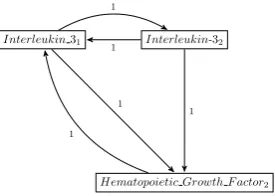
Example 4.3. Consider the graph represented in Figure 6. It is a subgraph of the aligned ontologyOU MLS representing theUMLS2012alignment, namelyU MLS, between
ontologiesO1,O2, corresponding to theFMA[65] andNCI[26] The graph represents a
Interleukin31 Interleukin-32
Hematopoietic Growth F actor2
1
1
1 1
[image:18.595.199.337.130.228.2]1
Fig. 6. Example of cycle defined by theUMLS2012alignment betweenFMAandNCI
ontologies. The equivalence of the three vertices is entailed by the aligned ontology.
since no cycle between its two vertices exists. It cannot traverse another SCC, because otherwise the two SCCs would be a single one.
Example 4.4. Consider two input ontologiesO1 = {M olarT ooth1 vT ooth1}and
O2 = {T ooth192 v M olarT ooth2} and their obvious associated signatures.
Con-sider also the alignment{hM olarT ooth1, M olarT ooth2,≡,1i,hT ooth1, T ooth192,
≡,0.7i}. The resulting digraph contains a SCC including all the four vertices, but none of the two projections on the input ontologies are SCCs. As a consequence, all these vertices are equivalent in the aligned ontology. From the domain knowledge, however, we know thatT ooth1vM olarT ooth1andT ooth2vT ooth192do not hold.
The set ofproblematic mappingsis the set of mappings between vertices of a problem-atic SCC, the only arcs that can appear in diagnoses.
The notion of problematic SCCs enables an alternative diagnosis definition. Using the notion of problematic SCC, Definition 4.7 and Definition 4.8 propose an alternative definition for diagnosis, w.r.t. that given in Definition 4.4.
Definition 4.7. Let∆be an alignment such that∆⊆ M, and letG(OM\∆) = (V, A0)
be a graph representation such thatA0=A\∆.∆is adiagnosisforMw.r.t.G(OM)
iffpSCC(G(OM\∆)) =∅.
Definition 4.8. Let∆be a diagnosis forM, letS∈pSCC(G(OM))be a problematic
SCC, and let∆0be a nonempty subset of∆.∆0is adiagnosis for a SCCSiff for allSi
inSCC(G(OM\∆0))such thatS
i⊆S, we have thatSi6∈pSCC(G(OM\∆ 0
)).
Clearly, the reformulation does not affect any of the properties of diagnosis illustrated in this section. Example 4.5 shows a minimal diagnosis for a problematic SCC.
Example 4.5. Consider the scenario of Example 4.3 and the subgraph of Figure 6, rep-resenting a problematic SCC. A minimal diagnosis for the problematic SCC is {(Interleukin31, Hematopoietic Growth F actor2,1)}.
4.4. Problem Statement for Diagnosis Computation
This section introduces theMAP-WFESproblems as an extension of the well-known
WFESproblem, which removes unsafe cycles only for solving the equivalence viola-tions, while preserving local cycles. The computational complexity of theMAP-WFES
MAP-WFESDefinition. LetG = (V, A)be a digraph such thatV =V1∪V2, with
V1∩V2=∅. We denoteM, the set ofmappings, the subset ofAwhose arcs are of the
form(u, v, ), such that for alli, j∈ {1,2}andi6=jwe have thatu∈Vi, v∈Vj. MAP-WFESaims at computing, given as input the digraphG, a minimum weight feedback edge set∆⊆ Msuch that no unsafe cycles exist inG0 = (V, A\∆).
Proposition 4.3 relates diagnosis computation to the MAP-WFES problem intro-duced in this section. Specifically, it states that computing a diagnosis for a graph rep-resentation reduces to solvingMAP-WFESon it.
Proposition 4.3. Computing a minimal diagnosis for an aligned ontologyOOM1,O2, that is, solving all the violations to the conservativity principle w.r.t. equivalence, can be reduced to solving an instance ofMAP-WFES.
Proof. From Theorem 4.1 we know that all the violations of the conservativity principle w.r.t. equivalence in the aligned ontology result in unsafe cycles in its graph representa-tion. Therefore breaking all unsafe cycles is equivalent to computing a diagnosis. From the definition ofMAP-WFES, we have that no unsafe cycles can exist in the graph re-sulting from the application of the computed diagnosis. Given that, with the exception of computing a minimal diagnosis,MAP-WFEShas no other constraints, it computes such a diagnosis, and this concludes the proof.
Since MAP-WFESis aNP-hard problem (as shown in Appendix A.1), and given the average size of an aligned ontology, computing a diagnosis would be, in practice, intractable. For this reason, our approach decomposes the problem into independent subproblems (i.e., computing a local diagnosis for each problematic SCC), following a
divide et imperastrategy. A (minimal) global diagnosis is then computed from the (min-imal) local diagnoses of the single problematic SCCs. The optimality and correctness of this decomposition are investigated in Appendix A.2.
4.5. Solving Equivalence Violations using Logic Programming
This section introduces the method for computing minimal diagnoses using logic pro-gramming, and a detailed description of the EqRepair algorithm.
Minimal Diagnosis UsingASP. We now describe how a minimal diagnosis can be computed using Answer Set Programming (ASP) programs.13 14The facts input to the
ASPproblems are of the following kinds: (i)Vertices are represented using a binary predicatevtx(X, O), whereXis a string representing the vertex label andO ∈ {1,2} encodes the index of the input ontology the represented concept belongs to,(ii) arcs are represented using a quaternary predicateedge(X, Y, C, M), whereX,Y are ver-tices (that is, for someO, P ∈ {1,2},vtx(X, O)andvtx(Y, P)hold),Cis an integer encoding the arc weight in a range[0. . .100], whileM is a Boolean flag for differen-tiating arcs that correspond to axioms (M = 0) from those corresponding to mappings (M = 1).
When we refer to the execution of anASPprogram on a graph representation (resp.
13 We use the syntax ofLparse 1.0, a parser for logic programs used as a front-end by different logic
pro-gramming solvers, more details athttp://www.tcs.hut.fi/Software/smodels/
14 Despite alternative frameworks could have been employed (e.g., Constraint Logic Programming), we have
Listing 1:ASPfacts encoding the problematic SCC of Figure 3.
v t x ( Company1 , 1 ) . v t x ( O p e r a t o r 1 , 1 ) . v t x ( Company2 , 2 ) . v t x ( F i e l d o p e r a t o r 2 , 2 ) . e d g e ( Company1 , Company2 , 9 0 , 1 ) . e d g e ( Company2 , Company1 , 9 0 , 1 ) .
e d g e ( Company2 , F i e l d o p e r a t o r 2 , 1 0 0 , 0 ) . e d g e ( F i e l d o p e r a t o r 2 , O p e r a t o r 1 , 7 0 , 1 ) .
Listing 2:ASPprogram computing a minimal diagnosis for theMAP-WFESproblem.
r 0 : # domain v t x ( X , O) . # domain v t x ( Y , P ) . # domain v t x ( Z , Q) .
r 1 : r e a c h e s ( X , Y) :− e d g e ( X , Y , C ,M) , n o t r e m o v e d ( e d g e ( X , Y , C ,M) ) , X! =Y .
r 2 : r e a c h e s ( X , Z ) :− r e a c h e s ( X , Y) , e d g e ( Y , Z , C ,M) , n o t r e m o v e d ( e d g e ( Y , Z , C ,M) ) , X! =Y , Y! = Z , X! = Z .
r 3 : r e a c h e s S a f e ( X , Y) :− e d g e ( X , Y , C , 0 ) , O=P , X! =Y .
r 4 : r e a c h e s S a f e ( X , Z ) :− r e a c h e s S a f e ( X , Y) , e d g e ( Y , Z , C , 0 ) , O=P , X! =Y , Y! = Z , X! = Z . r 5 : n o t r e m o v e d ( e d g e ( X , Y , C ,M) ) | removed ( e d g e ( X , Y , C ,M) ) :− e d g e ( X , Y , C ,M) , X! =Y . r 6 : n o t r e m o v e d ( e d g e ( X , Y , C , 0 ) ) :− e d g e ( X , Y , C , 0 ) , X! =Y , O=P .
r 7 : u n s a f e C y c l e (Y) :− n o t r e a c h e s S a f e ( Y , X) , r e a c h e s ( Y , X) , r e a c h e s ( X , Y) , O=P , X! =Y . r 8 : :− u n s a f e C y c l e (Y) .
r 9 : # m i n i m i z e [ removed ( e d g e ( X , Y , C , 1 ) ) = C ] . r 1 0 : # h i d e . # show removed / 1 .
an aligned ontology), we always implicitly refer to its execution on a set of facts encod-ing the graph representation (resp. aligned ontology).
Example 4.6. In the following, we provide an example of encoding of a graph into a set of facts that can be used in conjunction with theASPprograms for solving the MAP-WFESproblems. To this end, we rely on our motivating example presented in Section 3. The encoding of the problematic SCC of Figure 3 corresponds to the set of facts pre-sented in Listing 1. The execution of theASPprogram of Listing 2, in conjunction with the aforementioned facts, is equal to the mappingm7from Table 2 (i.e., the candidate
mapping(s) to be removed to solve the violation(s)).
A minimal diagnosis can be computed using theASPprogram shown in Listing 2. Rule r0 “types” variablesX,Y orZ as vertex id (into thevtxpredicate they appear). Rules r1 states that if an unremoved arc(X, Y, )exists, then vertexX reachesvertex Y, rule r2 states thatreachesis a transitive predicate. Similarly, rule r3 that if an arc
(X, Y, )exists, that is neither a mapping nor removed, then vertexX reachesSaf e vertexY, and rule r4 makesreachesSaf ea transitive predicate.
In order to obtain a valid solution, each arc has to be either removed or not removed (rule r5), and that only mappings can be removed (rule r6). Additionally, rule r8 forbids the existence of unsafe cycles, identified by rule r7 (if a vertex unsafely reaches itself, then we have at least an unsafe cycle). Among the valid solutions, rule r9 minimizes diagnosis’ weight, and the output model is restricted to removedpredicate only by means of rule r10, that corresponds to the computed diagnosis.
EqRepair Algorithm. The EqRepair algorithm15(Algorithm 1) takes as input two
on-tologiesO1andO2, and a (coherent) alignmentMbetween them. The graph
represen-tationGof the aligned ontology w.r.t.O1,O2andM, is built by means ofcreateDigraph
function (line 1 of Algorithm 1). The function builds a digraph G representing the aligned ontology associated with the input ontologiesO1,O2 and alignmentM. In
Algorithm 1EqRepairAlgorithm forequivalenceconservativity violations Input:O1,O2: input ontologies;M: input (coherent) mappings
Output:∆: diagnosis
1: G←createDigraph(O1,O2,M)
2: SCCSi←tarjan(G,Oi) 3: globalSCCs←tarjan(G)
4: mappings← ∅ .Map of SCCs’ mappings
5: ∆← ∅ .Diagnosis forM
6: for eachS inglobalSCCsdo
7: if¬V2
i=1ΠOi(S)∈SCCsithen
8: mappings(S)←extractMappings(S)
9: ∆←∆∪solver(S)
10: end if
11:end for
12:return∆
accordance with Definition 4.2, the vertices of this graph are the named concepts of the two ontologies, and its arcs are the axioms/mappings involving them.16
After the creation of the digraph, the SCCs of the input ontologies (line 2) and that of the aligned ontology (line 3) are computed, by means of theTarjan’salgorithm (intro-duced in Section 2.4). The algorithm then detects which SCCs of the aligned ontology are problematic. By Definition 4.6, it suffices to test if at least one of the two projections on the input ontologies of each considered SCC is not a local SCC (line 7).
The minimal diagnosis for the current SCC, namelyS, is computed by thesolver function, that runs anASPsolver over a program representing an instance of the MAP-WFESproblem associated withS (line 9 of Algorithm 1). The diagnosis forS is then obtained, using a translation, from the solution of the aforementioned problem. Theo-rem 4.1 and Proposition 4.3 detail, respectively, the correctness of the detection and the solution computation, as described above. The global diagnosis results from the union of the local diagnoses, that is, the diagnoses of the single SCCs (the correctness proof is given in Proposition A.5, Appendix A.2).
5. Detecting and Repairing Subsumption Violations
Our technique for coping with subsumption violations is based on the reduction of the conservativity principle repair problem to a consistency principle repair problem (i.e., a mapping incoherence repair problem) through the assumption of disjointness [67]. Cur-rently, our method reuses and adapts the structural indexing and reasoning techniques implemented inLogMap(an ontology matching and mapping repair system [33, 37, 39]). However, alternative mapping repair systems could be used, such asALCOMO[54] or
AML[19]. Note that, to the best of our knowledge, these mapping repair systems have only focused on solving violations of the consistency principle.
Algorithm 2 showsSubRepair algorithm, the proposed method for detecting and correcting subsumption violations. SubRepair algorithm expects as input an alignment Mthat is coherent w.r.t. the input ontologiesO1andO2, according to Defintions 2.6
and 2.8. SubRepair algorithm outputs the number of added disjointness during the pro-cessdisjand an (approximate) repairR≈. The following paragraphs describe the
tech-niques used at each step.
16 For sake of space the algorithm, which directly follows from Definition 4.2, is omitted. The interested
Algorithm 2SubRepairalgorithm forsubsumptionconservativity violations Input:O1,O2: input ontologies;M: input (coherent) mappings
Output:R≈: approximate repair;disj: number of disjointness rules 1: hP1,P2i ←propositionalEncoding(O1,O2)
2: SI1←structuralIndex(O1)
3: SI2←structuralIndex(O2)
4: OM
O1,O2← O1∪ O2∪ M .The aligned ontology is computed
5: SIU←structuralIndex(O1∪ O2∪ M)
6: hPd
1, disj1i ←disjointAxiomsExtension(P1, SI1, SIU,OMO1,O2) .See Algorithm 3 7: hPd
2, disj2i ←disjointAxiomsExtension(P2, SI2, SIU,OMO1,O2) 8: hM0,R≈i ←mappingRepair(Pd
1,Pd2,M) .See Algorithm2in [39]
9: disj←disj1+disj2
10:returnhR≈, disji
Propositional Horn Encoding. The ontologiesO1 andO2 are encoded as the Horn
propositional formulas,P1 andP2 (line 1 in Algorithm 2). For example, the concept
hierarchy provided by an OWL 2 reasoner (e.g., [25, 43]) are encoded as A → B rules, while the explicit disjointness relationships between concepts are represented as Ai∧Aj → ⊥. Note that the input mappingsMcan already be seen as propositional
implications. This encoding is key to the mapping repair process.
Example 5.1. Consider the ontologies and mappings in Tables 1 and 2. The axiomβ6is
encoded asF ield operator∧Owner→F ield owner, while the mappingm2is
trans-lated into rulesO1:W ellBore→ O2:Borehole, andO2:Borehole→ O1:W ellBore.
Structural Indexing. Given that queries over the structural relationships of ontologies are heavily employed in our approach, we rely on the optimized structural index of
LogMap[33, 39], based on the interval labelling schema techniques presented in [1]. Specifically, the structural index exploits an optimized data structure for storing directed acyclic graphs (DAGs), and it allows us to answer many entailment queries over the concept hierarchy as an index lookup operation, and hence without the need of an OWL 2 reasoner (after the initial classification of the ontology). This kind of index has demonstrated to significantly reduce the cost of answering taxonomic queries [8, 59] and disjointness relationships queries [33, 37]. A formal definition of the structural index is provided in [73], Definition 6.4, Section 6.3.2.
Hence, the concept hierarchies provided by an OWL 2 reasoner and the explicit disjointness axioms ofO1andO2are efficiently indexed into the structural index (lines
2 and 3 in Algorithm 2).
Disjointness Addition. In order to reduce the conservativity problem to a mapping incoherence repair problem, following the notion ofassumption of disjointness, we need to automatically add sufficient disjointness axioms into each ontology Oi. However,
the insertion of additional disjointness axiomsδmay lead to unsatisfiable concepts in Oi∪ {δ}, as shown in Example 5.2.
Example 5.2. Consider the axiomβ9from Table 1. Following theassumption of
dis-jointness a very na¨ıve algorithm would add disjointness axioms betweenBorehole, ContinuantandOccurrent, which would makeBoreholeunsatisfiable.
In order to detect if each candidate disjointness axiom leads to an unsatisfiability, a non na¨ıve algorithm requires to make an extensive use of an OWL 2 reasoner to check if there are new unsatisfiable concepts inOi∪ {δ}. In large ontologies, however, this
Algorithm 3disjointAxiomsExtensionfunction for disjointness axioms extension Input:P: propositional theory;SI: structural index;SIU: structural index of the aligned ontology
Output:Pd: extended propositional theory;disj: number of disjointness rules 1: disj←0
2: Pd← P
3: for eachA→B insubsumptionViolations(SI, SIU)do .As in Definition 2.6 4: if not(SI.areDisj(A, B))then
5: Pd← Pd∪ {A∧B→false} 6: SI←SI.updateIndex(AuB→ ⊥)
7: disj←disj+ 1
8: end if
9: end for
10:returnhPd, disji
Our method, instead, exploits the propositional encoding and structural indexing of the input ontologies. Thus, checking ifOi∪ {δ}contains unsatisfiable concepts is
restricted to the Horn propositional case. The safety conditions for disjointess clauses addition to a (satisfiable) Horn propositional formula is given in Proposition 5.1, while the proof can be found in [73], Proposition 6.2, Section 6.3.2. These conditions can easily be tested with the structural index.
Proposition 5.1. Given a satisfiable Horn propositional formulaP, the addition of a (j-th) disjointess clauseA∧B → ⊥will not cause any (potential) unsatisfiability of the propositions inP iff: (i)neitherP |= A → B norP |= B → Aholds,(ii)no propositionCexists such thatP |=C→AandP |=C→B.
Algorithm 2 extends the propositional formulasP1andP2with disjointness rules of
the formA∧B→ ⊥(lines 6-7). The disjointness addition follows Proposition 5.1 and guarantees that, for every propositionAin the extended propositional formulaPd
i (with
i∈ {1,2}), the formulaPd
i ∪ {> → A}is satisfiable. This does not necessarily hold
if the disjointness axioms are added to the OWL 2 ontologiesO1andO2, as discussed
above.
Note that the addition of all possible disjointness rules may be prohibitive for large ontologies and unnecessary (see [75]). Thus, one should only add disjointness where a subsumption violation occurs,i.e., adding a disjointness axiom between each pair of conceptsA, B ∈ Oi (withi ∈ {1,2}) such that A v B ∈ subViol(Oi,OOM1,O2), as
in Definition 2.6. Algorithm 3 implements this idea for the Horn propositional case and extensively exploits the structural index to identify the subsumption violations (line 3 of Algorithm 3). This algorithm requires as input the structural index of the integrated ontology, and thus its classification with an OWL 2 reasoner (line 5 in Algorithm 2). The classification time of the integrated ontology is known to be typically much higher than that of the input ontologies individually [34]. However, this was not a bottleneck in our experiments, as shown in Section 7.2.
Mapping Repair. The step 8 of Algorithm 2 uses the mapping (incoherence) repair algorithm ofLogMap, for the extended Horn propositional formulasPd
1 andP
d
2, and the
input mappingsM. The mapping repair process exploits the Dowling-Gallier (D&G) algorithm [14, 23] for propositional Horn satisfiability (refer to [73], Section 6.3, for more details) and checks, for every propositionAof a given formulaP, the satisfiability of the propositional formulaPA = P ∪ {> →A}. Satisfiability ofPA is checked in
worst-case linear time in the size ofPA, and the number of D&G calls is also linear in
implemented inLogMap also allows us to recordconflictingmappings involved in the unsatisfiability, which will be considered for the subsequent repair process.17
The repair is performed by removing some of the identified conflicting mappings. To this aim, the algorithm selects an (approximation) of the minimal hitting set (w.r.t. total mapping confidence) between the set of conflicting mappings, for the different unsatisfiabilities that are detected. In case of multiple options, the mapping confidence will be used as a differentiating factor.18 Example 5.3 provides an example of mapping
repair for solving a subsumption violation.
Example 5.3. Consider the propositional encoding P1 and P2 of the axioms of
Ta-ble 1 and the mappingsM in Table 2, seen as propositional rules.Pd
1 andP2d have
been created by adding disjointness rules toP1andP2, according to Algorithm 3. For
example, Pd
2 includes the rule ψ = O2:W ell∧ O2:Borehole → false. The
map-ping repair algorithm identifies the propositional theory Pd
1 ∪ P2d∪ M ∪ {true →
O1:ExplorationW ellbore}as unsatisfiable. This is due to the combination of the
map-pingsm3andm4, the propositional projection of axiomsβ1andβ2, and the ruleψ. The
mapping repair algorithm also identifiesm3andm4as the cause of the unsatisfiability,
and discardsm3, since its confidence is smaller than that ofm4(see Table 2).
6. Properties of the Repair Methods and Combined Approach
We have presented two methods for the detection and correction of violations of the conservativity principle. The repair of subsumption conservativity violations (which are reduced to a consistency violations) is based on the Dowling-Gallier algorithm for propositional Horn satisfiability; whereas equivalence conservativity violations are ad-dressed using a combination of graph theory and logic programming.
Soundness and (In)completeness. Both methods are sound (the violations that are detected are indeed violations if considering the full expressiveness of the input on-tologies), but incomplete, since the used approximate projections of the input ontolo-gies (i.e., Horn propositional and graph encodings) may lead to some violations being missed.
Algorithm 2 computes a repairR≈such thatM0=M\R≈is coherent with respect
toPd
1 andP2d(according to the propositional case of Definition 2.5). Furthermore, the
propositional theoryP1∪ P2∪ M0 does not contain any subsumption violation with
respect toP1andP2(according to the propositional case of Definition 2.6). However,
our encoding is incomplete, and we cannot guarantee thatO1 ∪ O2∪ M0 does not
contain any subsumption conservativity violations w.r.t.O1andO2.
Analogously, Algorithm 1 computes a diagnosis (i.e., minimal mapping repair)∆
such thatM0=M \∆does not lead to equivalence violations with respect to the graph
encoding of the aligned ontology presented in Definition 4.1. However, the considered encoding is incomplete since only the classification of the input ontologies in isolation is considered. Thus, as for the subsumption violations, we cannot guarantee thatO1∪
O2∪ M0does not contain any equivalence violation.
17 Note that, as for the case of EqRepair, we do not compute the classification ofO
1∪ O2∪ Msince this will prevent our extension of D&G to identify and record the mappings involved in an unsatisfiability (i.e., a subsumption violation).
18 In scenarios where the confidence of the mapping is missing (e.g., in reference or manually created