City, University of London Institutional Repository
Citation
:
Caprara, G. V., Vecchione, M., Schwartz, S. H., Schoen, H., Bain, P., Silvester, J., Cieciuch, J., Pavlopoulos, V. and Bianchi, C. (2017). Basic values, ideological self-placement, and voting: A cross-cultural study. Cross-Cultural Research, doi:10.1177/1069397117712194
This is the accepted version of the paper.
This version of the publication may differ from the final published
version.
Permanent repository link:
http://openaccess.city.ac.uk/16997/Link to published version
:
http://dx.doi.org/10.1177/1069397117712194Copyright and reuse:
City Research Online aims to make research
outputs of City, University of London available to a wider audience.
Copyright and Moral Rights remain with the author(s) and/or copyright
holders. URLs from City Research Online may be freely distributed and
linked to.
City Research Online: http://openaccess.city.ac.uk/ [email protected]
Paper accepted December 2016 for Cross Cultural Research
Basic values, ideological self-placement, and voting: A cross-cultural study
Gian Vittorio Caprara and Michele Vecchione “Sapienza” University of Rome
Shalom H. Schwartz
The Hebrew University of Jerusalem
and the National Research University - Higher School of Economics
Harald Schoen
University of Bamberg, Germany
Paul G. Bain
University of Queensland, Australia
Jo Silvester
City University London, United Kingdom
Jan Cieciuch
University of Finance and Management, Warsaw, Poland
Vassilis Pavlopoulos University of Athens, Greece
Gabriel Bianchi
Slovak Academy of Sciences, Slovak Republic
Maria Giovanna Caprara
Universidad a Distancia de Madrid, Spain
Hasan Kirmanoglu and Cem Baslevent Istanbul Bilgi University, Turkey
Catalin Mamali
University of Wisconsin, Platteville, United States
Jorge Manzi
Pontificia Universidad Católica de Chile
Miyuki Katayama Toyo University, Japan
Tetyana Posnova
Yuriy Fedkovich Chernivtsi national University, Ukraine
Carmen Tabernero University of Cordoba, Spain
Claudio Torres University of Brasilia, Brazil
Markku Verkasalo and Jan-Erik Lönnqvist
Institute of Behavioral Sciences, University of Helsinki, Finland
Eva Vondráková
Abstract
The current study examines the contribution of right-left (or conservative- liberal) ideology
to voting, as well as the extent to which basic values account for ideological orientation. Analyses
were conducted in 16 countries from 5 continents (Europe, North-America, South-America, Asia,
and Oceania), most of which have been neglected by previous studies. Results showed that left-right
(or liberal-conservative) ideology predicted voting in all countries except Ukraine. Basic values
exerted a considerable effect in predicting ideology in most countries, especially in established
democracies like Australia, Finland, Italy, UK, and Germany. Pattern of relations with the whole set
of ten values revealed that the critical trade-off underlying ideology is between values concerned
with tolerance and protection for the welfare of all people (universalism) versus values concerned
with preserving the social order and status quo (security). A noteworthy exception was found in
European post-communist countries, where relations of values with ideology were small (Poland) or
near to zero (Ukraine, Slovakia).
Basic values, ideological self-placement, and voting: A cross-cultural study
The long-term decline of socio-structural factors as shapers of political preference has been
a striking change for contemporary democracies (Jost, 2006; van der Brug 2010). The appeal of
party identification has weakened (Dalton 2000). Social class, income, and education account for
political preference less than in the past. Traditional ideological divisions between right and left (or
conservative and liberal) appear less marked than in the past as political parties form coalitions and
endorse political programs that are barely distinctive (Caprara, 2007). At the same time, ideological
preferences are becoming more dependent upon voter’s personality characteristics, such as traits
(e.g., Gerber, Huber, Doherty, Dowling & Ha, 2010; Jost, 2006; Schoen & Schumann, 2007;
Vecchione et al., 2011), and values (e.g., Barnea & Schwartz, 1998; Caprara, Schwartz, Vecchione
& Barbaranelli, 2008; Thorisdottir, Jost, Liviatan & Shrout, 2007; Vecchione, Caprara, Dentale &
Schwartz, 2013).
The above description applies to established Western democracies like United States, United
Kingdom and Italy. One may wonder whether left-right and liberal-conservative ideological
self-placement hold the same meanings in re-established democracies, like Spain and Chile, and in
post-communist countries, where socialism has recalibrated the ideals of traditional left (Piurko,
Schwartz & Davidov, 2011). Likewise, one may wonder about the extent to which basic values
operate as major organizers of ideological self-placement across different countries. The more one
considers the diversity of people’s living conditions, traditions, habits, ways of thinking and styles
of relating to each other across the world, the more we are forced to revise the traditional western
understanding of what really matters in political choices.
In this spirit, the present contribution aims to examine the extent to which left-right (or
liberal-conservative) self-placement account for a major portion of voting behavior across 16
countries from 5 continents (Europe, North-America, South-America, Asia, and Oceania).
self-placement across countries that differ significantly in size, economics, religion, political history,
and culture.
Ideology
In political science, ideology has been viewed as an interrelated set of attitudes and beliefs
about the proper order of society and how it can be achieved (Erikson & Tedin, 2003). Hence,
ideology includes shared assumptions and beliefs about human nature and society and about ideals
and priorities to be pursued. Different ideologies may contain competing views about how life
should be lived and about how society should be governed. When shared by groups of individuals,
these ideologies provide both an interpretation of the environment and a prescription for how the
environment should be structured (Jost, Federico & Napier, 2009). They can serve as organizing
devices to structure political knowledge and expertise, or as broad postures that more or less
consciously explain and justify different states of social and political affairs (Jost et al., 2009).
It is still a matter of debate whether a single right- left ideological dimension is sufficient to
organize citizens’ political knowledge and thought (e.g., Jost et al., 2009).
Since the time of the French revolution, ideological opinions have been classified most often
in terms of a single right-left dimension. This dimension largely reflected the divide between
preferences for stability (the status quo of the ancient regime) vs. change in early usage (Revelli,
2007). Much of the ideological conflict over change vs. status quo pertained to age-old disputes
concerning the role of hierarchy, authority and tradition (Kitschelt, 2003). Over time and across
countries, however, distinctions between right and left have changed. They have come to reflect a
variety of combinations of ideals that pertain both to the private and public sphere of politics and to
the social and economic spheres of life.
Currently, different conceptions of right and left apply in different polities. In established
democracies like Australia, U.K., and U.S., right and left are often equated with conservative and
liberal ideologies, respectively. The right is mostly associated with political movements that
with political movements that endorse egalitarian ideals (Bobbio, 1996). Various forms of right and
left, however, have also included movements that oppose authoritarian regimes and democracy and
political programs that oppose free market economy and social welfare in various degrees (Giddens,
1994; Revelli, 2007). As Freeden (2010) noted, ideologies shade off into each other and cut through
one another. Although most modern democracies have become more egalitarian in terms of civil
rights and access to health services, education and work opportunities, achieving the optimal
combination of individual freedom and social justice is an arduous challenge for the left and right in
most countries. Thus it is sometimes difficult to discern what is common among parties and
movements that claim to endorse the same ideology.
Several researchers still wonder whether one dimension is sufficient to illuminate the
structure of political choices (e.g., Ashton et al., 2005; Heath, Evans, & Martin, 1994; Ricolfi,
2002). Others have suggested decomposing the left-right distinction into economic and social
dimensions (Feldman & Johnston, 2014). Conceptions of freedom in politics and in economics are
in fact difficult to reconcile under one left-right dimension in modern democracies. The left is often
been identified with political programs that limit individuals’ economic freedom but advocate
maximum freedom in the sphere of civil rights. The right is often identified with political programs
that curtail citizens’ freedom in the sphere of civil rights but advocate maximum freedom in the
sphere of economics.
Nonetheless, the left-right and liberal-conservative distinctions have survived over the
centuries to map a political space made of ideas and people that occupy opposing positions. These
distinctions still hold even where opposing political coalitions have adopted more pragmatic
platforms intended to attract a wide swath of the electorate, platforms that are much less distinctive.
Likely, the more party coalitions lead to bipolar polities and pose a choice between two major
options, the more the traditional ideological divide can serve as a knowledge and communication
Moreover, one should consider that self-placing on the left-right or liberal-conservative
continuum may have an affective value in itself, as it enables people to make choices that accord
with their basic dispositions and to sort the political world into “us” and “them” (Jacoby, 2009;
Sears & Funk, 1999). Self identifying along a unique ideological dimension may satisfy people’s
needs of social inclusion and belonging, despite the diversity of contents that can be traced to the
opposite poles of that dimension across polities (Nozick, 1989).
Based on this reasoning, we posited that the single ideological dimension continues to be an
important organizer of political thought. We expected that left-right and conservative- liberal
ideologies are major predictors of political choices across democracies that differ widely in their
history and degree of establishment.
Basic Values
A number of scholars have assigned a central role to values as organizers of political
preferences and judgments (Knutsen, 1995; Rokeach, 1973, 1979; Schwartz, 1994; Schwartz,
Caprara & Vecchione, 2010). Values are cognitive representations of desirable, abstract,
trans-situational goals that serve as guiding principles in people’s lives. They refer to what people
consider important, and vary in their relative importance as standards for judging behavior, events,
and people (Schwartz, 1992).
Although the relationship between values and political orientation has been addressed from
different perspectives (Braithwaite, 1997; Knutsen, 1995; Rokeach, 1973), most recent studies
adopt Schwartz’s ten basic personal values (Schwartz, 1992, 1994). This theory proposes ten broad,
motivationally distinct values derived from universal requirements of the human condition: Security,
power, achievement, hedonism, stimulation, self-direction, universalism, benevolence, tradition,
and conformity. The type of goal or motivation a value expresses distinguishes one value from
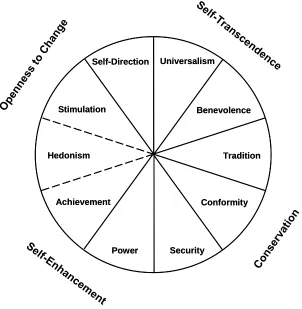
another. As shown in Figure 1, the ten values can be located around a motivational circle. Within
this circular structure, values that are adjacent (e.g., benevolence and universalism) share similar
the circle (e.g. power and universalism) express conflicting motives and are negatively related
(Schwartz, 1992, 2005). This structure implies that adjacent values have similar correlations with
other variables. These correlations should decline in both directions, reaching the most negative
value in correspondence of opposing values in the circle (see Schwartz, 2006).
Based on this pattern of conflicts and compatibilities, the ten values can be grouped under
four broader dimensions: (1) values that emphasize self-enhancement (power and achievement); (2)
values that emphasize transcending personal interests and promoting the welfare of others
(universalism and benevolence); (3) values that emphasize conservation of the status quo (security,
tradition, and conformity); (4) values that emphasize openness to change (self-direction, stimulation,
and hedonism).
Using the Schwartz’s taxonomy, several studies have shown that citizens tend to vote for
parties or coalitions whose policies they perceive as likely to promote or protect their important
values. A study of the 1988 Israeli elections showed that basic values discriminated significantly
between voters of different political parties (Barnea & Schwartz, 1998). In Italy, voters for the
centre-right coalition gave higher priority to the self-enhancement and conservation values, whereas
voters for the centre-left coalition gave higher priority to the self-transcendence values (e.g.,
Caprara, Schwartz, Capanna, Vecchione & Barbaranelli, 2006; Schwartz et al., 2010).
Other studies have focused on the relation between values and ideological self-placement.
Using data from the ESS third (2006-2007) round of the European Social Survey (ESS), Piurko et al.
(2011) found that self-enhancement and conservation values explained a right orientation, whereas
self-transcendence and openness to change values explained a left orientation. They also found that
values had greater explanatory power in countries with a long tradition of liberal democracy, like
Germany and the UK, than in post-communist countries.
Aspelund et al. (2013) analyzed data from 28 European countries using data from the third
(2006-2007) and fourth (2008-2009) rounds of the ESS. They found that conservation vs. openness
Relationships in Central and Eastern European countries, by contrast, were much less consistent.
Self-enhancement vs. self-transcendence was significantly related to right-wing orientation in the
vast majority of Western European countries, although more weakly than conservation values. Few
correlations were found to be significant among Central and Eastern European countries.
The present research
The current study examines the extent to which personal values account for left-right (or
liberal-conservative) ideological self-placement in 16 countries from 5 continents (Europe,
North-America, South-North-America, Asia, and Oceania). It extends prior research on links between values and
ideology in Europe (Aspelund et al., 2013; Piurko et al., 2011; Thorisdottir et al., 2007) by
considering non-European countries that previous works have often neglected. We include
established democracies (Australia, Finland, Germany, Israel, Italy, Japan, United Kingdom, and
the United States), countries in which democracy has been re-established after a more or less
prolonged interval of authoritarian regimes (Brazil, Chile, Greece, Spain, Turkey), and
post-communist countries (Poland, Slovakia, and Ukraine).
Moreover, the present study measures values with the full 40-item PVQ, which allows
assessing the ten basic personal values with adequate reliability, and examining their relations with
ideological self-placement. It complements and extends earlier cross-cultural studies, which relied
on the PVQ-21.
We examined the pattern of relations of the whole set of values with ideological
self-placement. Right and conservative ideologies of most countries emphasize security, limited
government, and traditional family and national values. Such policy is compatible with and may
express the motivational goals of security and tradition values. Left and liberal ideologies, in
contrast, emphasize the merits of the welfare state, express strong concern for social justice,
tolerance of diverse groups (even those that might disturb the conventional social order), and
emphasize pluralism and equality (Bobbio, 1996). The expected consequences of such a policy are
We therefore expect that ideological self-placement on the left/right and the
liberal-conservative scales correlate most positively with universalism values and most negatively with
security and tradition values. The circular motivational structure of the ten values implies that
correlations would decline from universalism to security and tradition in both directions around the
circle.
While this is the expected pattern, a certain degree of variability in the strength of the
relationships is to be expected. As argued by Barnea and Schwartz (1998) the predictive validity of
particular values may vary as a function of the ideological content of the political discourse.
Moreover, in keeping with previous results (Aspelund et al, 2013; Piurko et al., 2011), we expect
that the contribution of basic values to ideological self-placement is stronger in established
democracies than in post-communist societies.
Methods
Participants and Procedures
This study involved 16 countries. Data from 15 countries (Australia, Brazil, Chile, Finland,
Germany, Greece, Israel, Italy, Poland, Slovakia, Spain, Turkey, Ukraine, the United Kingdom, the
United States) were available from a cross-cultural project aimed at investigating the role of values
in shaping political preferences (Schwartz et al., 2013; Vecchione et al., 2015). We performed
secondary analysis of data in these countries. Additional data have been collected in Japan. This
allowed us to extend the generalizability of results to an Asiatic country.
As described in Schwartz et al. (2013), a representative national sample was obtained in
Germany and Turkey. Researchers from other countries enlisted university students to gather the
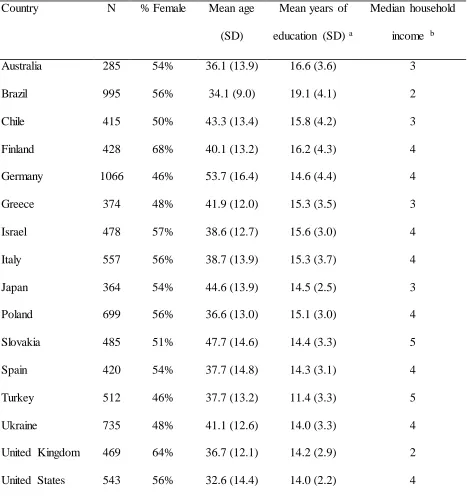
data. The same instructions for administering the instruments were used in all countries. Table 1
presents the characteristics of the samples.
Measures
Ideology.Ideology was measured in each country through two distinct indicators. The first
talk about conservatives and liberals. How would you place your views on this scale, generally
speaking?”. Alternatives ranged from 1 (Extremely liberal) to 7 (Extremely conservative). The
second was a self-placement item on the left-right scale: “In political matters, people sometimes
talk about and “the left” and "the right" How would you place your views on this scale, generally
speaking?” Alternatives ranged from 1 (Left) to 10 (Right). We used the liberal-conservative scale
in the U.K. and the U.S., and the left-right scale in all other countries. This decision was based on
input from the country collaborators about the common usage in their country. The left-right item
was rescaled to a 7-point scale, have the same range of the liberal-conservative scale.
Voting. We measured political choice directly by asking participants which party they had
voted for in the most recent national election. We included parties with at least 25 voters in the
analysis. To maximize the number of cases in the analysis, researchers in nine out of sixteen
countries combined small parties (n < 25) with larger parties or with one another, based on the
similarity of their ideological orientations. Voting was coded as an ordered categorical variable, by
positioning political parties along the left-right continuum. The number of categories varied across
nations, from two (U.S.) to six (Israel), depending on the number of political parties that were
considered.
Values. The PVQ (Schwartz, 2005) measured basic values. It includes 40 short verbal
portraits of different people matched to the respondents’ gender, each describing a person’s goals,
aspirations, or wishes that point implicitly to the importance of a value. For example, “Thinking up
new ideas and being creative is important to him. He likes to do things in his own original way”
describes a person who holds self-direction values important. Three to six items measure each value.
For each portrait, respondents indicate how similar the person is to themselves on a scale ranging
from “not like me at all” to “very much like me.” We infer respondents’ own values from the
implicit values of the people they consider similar to themselves. In the current study, Cronbach’s
alpha reliabilities averaged across the sixteen samples ranged from .62 (Tradition) to .89
Results
Ideological self-placement and voting
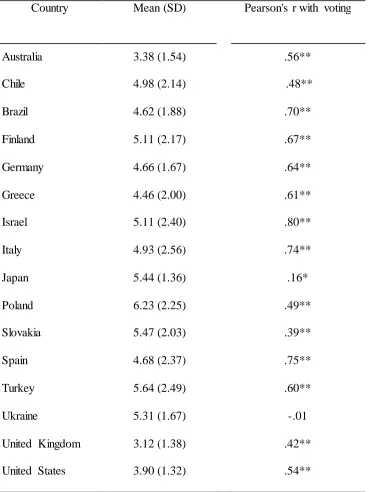
The left panel of Table 2 reports country means and standard deviations for the left-right and
the liberal-conservative scales. Participants with missing data on ideological self-placement (3.6%
of the total sample) were excluded from the analysis.1 The mean of left-right ideology ranged across
countries from 3.38 (Australia) to 6.23 (Poland). The mean score of liberal-conservative
self-placement was 3.12 in the UK, and 3.90 in the US. The right panel of Table 2 reports Spearman's
correlations of ideological self-placement with voting. Correlations were significant in all countries
except Ukraine. The preference for a left-wing (or liberal) ideology was consistently associated with
voting for left-wing parties. According to Cohen's (1988) standards, correlations were large in
Australia, Brazil, Finland, Germany, Greece, Israel, Italy, Spain, Turkey, and the United States,
moderate in Chile, Poland, Slovakia, and United Kingdom, and small in Japan.
The contribution of basic values to ideological self-placement
We used a multilevel regression analysis to investigate the unique contribution of the ten
values to ideology in the overall sample, controlling for basic socio-demographic variables (gender,
age, income, and education). This approach, often referred to as random coefficient model (Kreft &
De Leeuw, 1998), takes into account the nested nature of the data (individuals are nested within
countries). It permits examining the effect of individual-level variables on ideological
self-placement, without incurring problems typically associated with the use of ordinary least squares
regression with nested data. It also allows examining whether these effects vary significantly across
countries.
In a first step we estimated an emptymodel, which only includes the intercept. This model
was estimated to calculate the Intraclass Correlation Coefficient (ICC) of ideological self-placement.
1 The percentage of missing cases for each country were: 0.0% in Australia, 1.7% in Brazil, 3.6% in Chile,
The ICC was .08, indicating that 8% of the total variance in ideology was accounted for by
differences between countries.
We then estimated a random-intercept model, which adds level-1 explanatory variables (i.e.,
basic personal values and socio-demographic variables). We centered the ten values and the
continuous demographic variables on their group mean. Gender was coded as 0 (female) and 1
(male). Results showed that the three conservation values (security, b = .16, p<.001, tradition b
= .10, p<.001, and conformity b = .10, p<.001), predicted a preference for right/conservative
ideology (a higher score on the scale). Power (b = .05, p<.01) and stimulation (b = .05, p<.01) were
also related to a preference for right/conservative ideology, although to a lesser extent.
Universalism (b = -.31, p<.001) and hedonism (b = -.07, p<.01) predicted a preference for
left/liberal ideology (a lower score on the scale). Among the demographics, education (b = -.01,
p.<05), and income (b = -.06, p<.01) predicted a preference for left/liberal ideology.
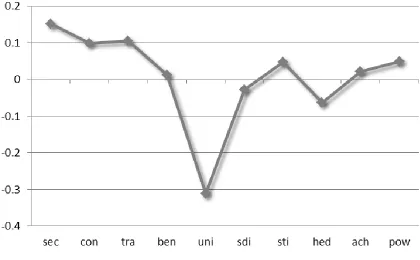
Figure 2 reports full set of unstandardized regression coefficients for personal values. As can
be observed, the coefficients followed the motivational circle of values, declining from security to
universalism in both directions. All these relationships, except for in the case of universalism, were
quite weak. This figure, however, reflects the overall effects on ideology across the sixteen samples.
Allowing the relationship between ideology and values to vary across countries we found that the
effects of five values (conformity, security, tradition, universalism, and power) varied significantly
(p<.01). This suggests that the same pattern cannot be generalized to all countries. We therefore
performed separate analyses for each sample, using OLS multiple regression.
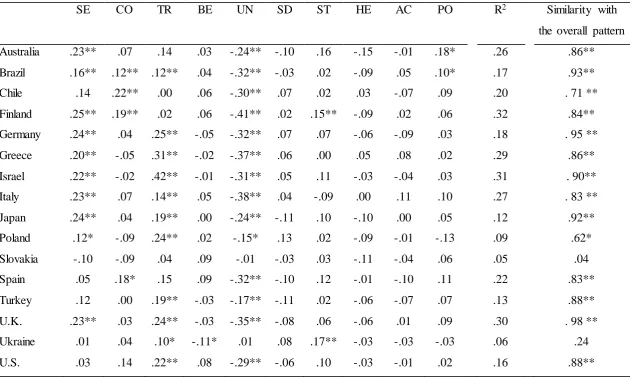
Table 3 presents the unique contribution of values to ideological self-placement in each
country, controlling for the effect of the demographic variables. Given the high number of tests
being performed, we applied a Bonferroni correction to determine whether each of the ten
regression coefficient was significant in each country (i.e., the critical level of significance was set
at .01). We found that universalism values predicted a preference for left/liberal ideology in all
preference for right/conservative ideology in most countries. The effects of the other values were
weaker and much less consistent across countries.
To evaluate the degree of deviation from the overall pattern, we calculated the Pearson’s
correlation between the ten regression coefficients derived from aggregated data and the regression
coefficients estimated in each country.2 Pearson’s r was higher than .80 (p<.05) in 13 of 16
countries, revealing a substantial homogeneity in the effect that values exerted on ideology ( Table 3,
last column). In the post-communist countries, by contrast, Pearson’s r was considerably lower and
not significant.3
The incremental contribution of basic values, after controlling for the effect of the
demographics, was substantial in most samples. In Western and Southern European countries, the
R-squared ranged from .18 (Germany) to .32 (Finland). A similar effect was found in non-European
countries, where the R-squared varied between .12 (Japan) and .26 (Australia). The smallest
contribution was observed in the three Post-communist countries, where the R-squared ranged
from .05 (Slovakia) to .09 (Poland).
Discussion
The aim of this study was to examine the association between ideological self-placement
and voting, as well as pattern of relations between Schwartz’s basic personal values and ideological
self-placement across 16 countries that differ widely in their traditions, cultural and historical roots.
Ideology is the strongest predictor of voting in all countries, except for Ukraine. The highest
correlations (.70 or higher) were observed in Chile, East Germany, Israel, Italy, and Spain, where
ideological self-placement serves as a virtual proxy for voting choice. This pattern of results
suggests that claims of the end of ideology and the decline of the right and left divide have been
prematurely announced, as already noted by Jost (2006). Although the underlying principles are
2To avoid inflated coefficients, Pearson's correlations for each country were based on aggregate data from
which the examined country was excluded. We thank an anonymous reviewer for suggesting this procedure.
3 Preliminary analysis showed that multicollinearity diagnostics were in the acceptable range (VIF values
complex and difficult to grasp, the traditional left-right distinction still serves as useful heuristic
device that helps voters to organize political knowledge, to assess political programs, to structure
their judgments and to make their choices (Sears, Lau, Tyler, & Allen, 1980). Likely right and left
are ideological labels that have an intrinsic value, even if they do not always share the same
meanings and carry the same priorities across different polities. Yet, they may act as attractors that,
at collective level, enable people to take position with others and to strengthen consensus.
This occurs in established democracies where citizens are accustomed to voting as an act
that is both symbolic and expressive and that goes beyond contingent interests. People vote despite
being aware their single vote is almost irrelevant with respect to the final outcome of an election.
People vote regardless of their position in society as voting attest to the personal and social identity
they cherish, to their being persons worthy of respect, to the equal dignity of their views as citizens,
and to their belongingness and inclusiveness (Caprara, 2008). In this regard, ideology is the device
that allows people to cope with complexity and that meet the two fundamental needs of human
existence, agency and communion, namely the needs to exert one’s own will and to feel part of a
community.
The power of ideology in accounting for voting holds also in post-communist societies, like
Poland and Slovakia, although to a lesser extent. In these countries, the demise of socialist ideals
has carried tremendous changes in the political landscape. Ukraine constituted the only country that
showed no relation between ideology and voting. One may speculate about the different historical
vicissitudes and political traditions of this country, which may account for its being an outlier, even
with regard to Poland and Slovakia.
The pattern of relationship of ideological self-placement with basic values revealed that the
critical trade-off underlying ideology is between values concerned with tolerance and protection for
the welfare of all people (universalism) versus values concerned with preserving the social order
and status quo (security).
(Schwartz, 1992), as they express conflicting motivations, that seems to correspond closely to
liberalism and social welfare vs. social conservatism. Universalism values call for promoting the
welfare of others even at cost to the self. Moreover, they express concern for the weak, those most
likely to suffer from market-driven policies. Security values emphasize preserving the social order.
The trade-off between these two values seems to capture particularly well the ideological divide in
most countries (e.g., Braithwaite, 1997; Jost, Glaser, Kruglanski & Sulloway, 2003).
It is remarkable that similar results hold across countries, despite the different trajectories to
democracy and the diversities of contents that can be traced under the same ideological labels. A
notable exception was found in post-communist countries, especially in Ukraine and Slovakia,
where relations of values with ideology were near to zero. In this regard, one may speculate about
the different historical vicissitudes and political traditions of these countries, even with regard to
other post-communist countries, like Poland. It is possible that the experience of communism in
these countries has erased memories of past democratic regimes, and that the profound changes
following its collapse resulted in confusion about the definition of left and right. Future studies
should further investigate the extent to which past and contingent ideological forces impinge on
voting among post-communist countries whose transition to democratic institutions is still far from
being fully achieved.
When interpreting the results of this study, potential limitations should be considered,
attributable to sampling or methodological artifacts. A first limitation is that participants were from
convenience samples, except for in Germany and Turkey. Thus one can’t generalize our findings to
the entire countries population. For example, participants included in our samples of convenience
were more educated, wealthier, and urban than the general population. Yet, the patterns of findings
in national samples were largely consistent with those from samples of convenience. Moreover, we
cannot exclude that differences across countries in the strength of the effects was due, at least in
part, by differences in the reliability of the measures. A further limitation is the limited number of
strength of the relations between values and ideology. Future studies, using a higher number of
representative samples from over the world, are needed to investigate the role of different
country-level variables, such as economic development of the country, country-level of democratization, type and
importance of religion (for a similar approach, see for instance, Bond et al., 2004).
Despite the above limitations, we believe that this study is informative regarding the
relationship among basic values, ideological orientation, and voting in a variety of representative
democracies. The relatively consistent pattern of covariation between these variables suggests that
political ideology has a common core of meaning, despite the diversity of left/liberal and
References
Ashton, M.C., Danso, H.A., Maio, G.R., Esses, V.M., Bond, M.H., Keung, D.K.Y. (2005). Two
dimensions of political attitudes and their individual difference correlates: A cross-cultural
perspective. In R.M. Sorrentino, D. Cohen, J.M. Olsen, & M.P. Zanna (Eds.), Culture and
social behavior (pp. 1-29). New Jersey: Lawrence Erlbaum Associates.
Aspelund, A., Lindeman, M., & Verkasalo, M. (2013). Political conservatism and left–right
orientation in 28 eastern and western European countries. Political Psychology, 34, 409-417.
Barnea, M., & Schwartz, S.H. (1998). Values and voting. Political Psychology, 19, 17-40.
Bobbio, N. (1996). Left and right: The significance of a political distinction. Cambridge, UK: Polity
Press.
Bond, M. H., Leung, K., Au, A., Tong, K. K., de Carrasquel, S. R., Murakami, F., et al. (2004).
Culture-level dimensions of social axioms and their correlates across 41 cultures. Journal of
Cross-Cultural Psychology, 35, 548-570
Braithwaite, V.A. (1997). Harmony and security value orientations in political evaluation.
Personality and Social Psychology Bulletin, 23, 401-414.
Caprara, G.V. (2007). The personalization of modern politics. European Review, 15,151–164.
Caprara, G.V. (2008). Will democracy win? Journal of Social Issues, 64, 639-659.
Caprara, G.V., Schwartz, S.H., Capanna, C., Vecchione, M., & Barbaranelli, C. (2006). Personality
and politics: Values, traits, and political choice. Political Psychology, 27, 1-28.
Caprara, G.V., Schwartz, S.H., Vecchione, M., Barbaranelli, C. (2008). The personalization of
politics: Lessons from the Italian case. European Psychologist., 13, 157-172.
Cohen, J. (1988). Statistical power analysis for the behavioral sciences (2nd ed.). Hillsdale, NJ:
Lawrence Earlbaum Associates.
Cohen, J., Cohen, P., West, S.G., & Aiken, L.S. (2003). Applied multiple regression/correlation
Converse, P.E. (1964). The nature of belief systems in mass publics. In D.E. Apter (Ed.), Ideology
and discontent (pp. 206–261). New York: Free Press.
Dalton, R.J. (2000). The decline of party identification. In R.J. Dalton and M.P. Wattenberg (Eds.)
Parties without partisans (pp. 19-36). Oxford: Oxford University Press.
Erikson, R.S., & Tedin, K.L. (2003). American Public Opinion. New York: Longman. 6th ed.
Feldman, S., & Johnston, C. (2014). Understanding the determinant of political ideology:
Implications of structural complexity. Political Psychology, in press.
Freeden, M. (2010). Ideology: A very short introduction. Oxford University Press.
Gerber, A.S, Huber, G., Doherty, D., Dowling, C., & Ha, S. (2010). Personality and political
attitudes: Relationships across issue domains and political contexts. American Political
Science Review, 104, 111-133.
Giddens, A. (1994). Beyond left and right: The future of radical politics. Cambridge: Polity Press.
Heath, A., Evans, G., & Martin, J. (1994). The measurement of core beliefs and values: The
development of balanced socialist/laissez faire and libertarian/authoritarian scales. British
Journal of Political Science, 24, 115-133.
Jacoby, W.G. (2009). Ideology and vote choice in the 2004 election. Electoral Studies, 28, 584-594.
Jost, J.T. (2006). The end of the end of ideology. American Psychologist, 61, 651-670.
Jost, J.T., Federico, C.M., & Napier, J.L. (2009). Political ideology: Its structure, functions, and
elective affinities. Annual Review of Psychology, 60, 307-337.
Jost, J.T., Glaser, J., Kruglanski, A.W., & Sulloway, F.J. (2003). Political conservatism as
motivated social cognition. Psychological Bulletin, 129, 339-375.
Kitschelt, H, (2003). Diversification and Reconfiguration of Party Systems in Postindustrial
Democracies, Friedrich-Ebert-Stiftung, Bonn.
Knutsen, O. (1995). Party choice. In J.W. van Deth & E. Scarbrough (Eds.), The impact of values.
New York: Oxford University Press.
Nozick, R. (1989). The examined life: Philosophical meditations. New York: Simon & Schuster.
Piurko, Y., Schwartz, S.H., Davidov, E. (2011). Basic personal values and the meaning of left-right
political orientations in 20 countries. Political Psychology, 32, 537-561.
Revelli, M. (2007). Sinistra Destra. L’identità smarrita. Bari, Laterza.
Ricolfi, L. (2002). La frattura Etica. La ragionevole sconfitta della sinistra [The ethical rift. The
reasonable defeat of the left]. Naples, Italy: L’Ancora del Mediterraneo.
Rokeach, M. (1973). The nature of human values. New York: Free Press.
Rokeach, M. (1979). The two-value model of political ideology and British politics. British Journal
of Social and Clinical Psychology, 18, 169–172.
Schoen, H., & Schumann, S. (2007). Personality traits, partisan attitudes, and voting behavior.
Evidence from Germany. Political Psychology, 28, 471–498.
Schwartz, S.H. (1992). Universals in the content and structure of values: Theoretical advances and
empirical tests in 20 countries. In M.P. Zanna (Ed.), Advances in Experimental Social
Psychology, 25 (pp. 1-65). New York: Academic Press.
Schwartz, S.H. (1994). Are there universal aspects in the structure and contents of human values?
Journal of Social Issues, 50, 19-45.
Schwartz, S.H. (2005). Robustness and fruitfulness of a Theory of Universals in Individual Values.
In A. Tamayo & Porto (Eds.), valores e trabalho [Values and work]. Brasilia: Editora
Universidade de Brasilia.
Schwartz, S.H. (2006). Les valeurs de base de la personne: Théorie, mesures et applications [Basic
human values: Theory, measurement, and applications]. Revue Francaise de Sociologie, 42,
249-288.
Schwartz, S.H., Caprara, G.V., & Vecchione, M. (2010). Basic personal values, core political
Schwartz, S.H., Caprara, G.V., Vecchione, M., Bain, P., Baslevent, C., Bianchi, G., … & Verkasalo,
M. (2013). Basic personal values constrain and give coherence to political values: A cross
national study in 15 countries. Political Behavior, 36, 899-930.
Sears, D.O., & Funk, C.L. (1999). Evidence of the long-term persistence of adults' political
predispositions. Journal of Politics, 61, 1-28.
Sears, D.O., Lau, R.R., Tyler, T.R., & Allen, H.M. (1980). Self-interest vs. symbolic politics in
policy attitudes and presidential voting. American Political Science Review, 74, 670-684.
Thorisdottir, H., Jost, J.T., Liviatan, I., & Shrout, P.E. (2007). Psychological needs and values
underlying the left-right political orientation: Cross-national evidence from Eastern and Western
Europe. Public Opinion Quarterly, 71, 175-203.
Van der Brug, W. (2010). Structural and ideological voting in age cohorts. West European Politics,
33, 586-607.
Vecchione, M., Caprara, G.V., Dentale, F., & Schwartz, S.H. (2013). Voting and values: Reciprocal
effects over time. Political Psychology, 34, 465-485.
Vecchione, M., Schoen, H., González Castro, J.L., Cieciuch, J., Pavlopoulos, V., & Caprara, G.V.
(2011). Personality correlates of party preference: the Big Five in five big European countries.
Personality and Individual Differences, 51, 737-742.
Vecchione, M., Schwartz, S.H., Caprara, G.V., Schoen, H., Cieciuch, J., Silvester, J., … &
Alessandri, G. (2015). Personal values and political activism: A cross-national study. British
Table 1. Description of the samples.
Country N % Female Mean age
(SD)
Mean years of
education (SD) a
Median household
income b
Australia 285 54% 36.1 (13.9) 16.6 (3.6) 3
Brazil 995 56% 34.1 (9.0) 19.1 (4.1) 2
Chile 415 50% 43.3 (13.4) 15.8 (4.2) 3
Finland 428 68% 40.1 (13.2) 16.2 (4.3) 4
Germany 1066 46% 53.7 (16.4) 14.6 (4.4) 4
Greece 374 48% 41.9 (12.0) 15.3 (3.5) 3
Israel 478 57% 38.6 (12.7) 15.6 (3.0) 4
Italy 557 56% 38.7 (13.9) 15.3 (3.7) 4
Japan 364 54% 44.6 (13.9) 14.5 (2.5) 3
Poland 699 56% 36.6 (13.0) 15.1 (3.0) 4
Slovakia 485 51% 47.7 (14.6) 14.4 (3.3) 5
Spain 420 54% 37.7 (14.8) 14.3 (3.1) 4
Turkey 512 46% 37.7 (13.2) 11.4 (3.3) 5
Ukraine 735 48% 41.1 (12.6) 14.0 (3.3) 4
United Kingdom 469 64% 36.7 (12.1) 14.2 (2.9) 2
United States 543 56% 32.6 (14.4) 14.0 (2.2) 4
Notes. a Include compulsory years of schooling; b Income was measured with the following
scale: 1=very much above the average of your country, 2=above the average, 3=a little above
average, 4=about average, 5=a little below the average, 6=below the average, 7=very much
[image:22.596.48.515.84.582.2]Table 2. Ideological self-placement: Means and standard deviations, and
correlations with voting.
Country Mean (SD) Pearson's r with voting
Australia 3.38 (1.54) .56**
Chile 4.98 (2.14) .48**
Brazil 4.62 (1.88) .70**
Finland 5.11 (2.17) .67**
Germany 4.66 (1.67) .64**
Greece 4.46 (2.00) .61**
Israel 5.11 (2.40) .80**
Italy 4.93 (2.56) .74**
Japan 5.44 (1.36) .16*
Poland 6.23 (2.25) .49**
Slovakia 5.47 (2.03) .39**
Spain 4.68 (2.37) .75**
Turkey 5.64 (2.49) .60**
Ukraine 5.31 (1.67) -.01
United Kingdom 3.12 (1.38) .42**
United States 3.90 (1.32) .54**
Notes.* p < .01; ** p < .001. We used the liberal-conservative scale in the
U.K. and the U.S., and the left-right scale in the other countries. Higher
means indicate self-placement further to the right and to the conservative
[image:23.596.61.430.112.604.2]Table 3. Standardized OLS regression coefficients relating basic values to ideological self-placement.
SE CO TR BE UN SD ST HE AC PO R2 Similarity with
the overall pattern
Australia .23** .07 .14 .03 -.24** -.10 .16 -.15 -.01 .18* .26 .86**
Brazil .16** .12** .12** .04 -.32** -.03 .02 -.09 .05 .10* .17 .93**
Chile .14 .22** .00 .06 -.30** .07 .02 .03 -.07 .09 .20 . 71 **
Finland .25** .19** .02 .06 -.41** .02 .15** -.09 .02 .06 .32 .84**
Germany .24** .04 .25** -.05 -.32** .07 .07 -.06 -.09 .03 .18 . 95 **
Greece .20** -.05 .31** -.02 -.37** .06 .00 .05 .08 .02 .29 .86**
Israel .22** -.02 .42** -.01 -.31** .05 .11 -.03 -.04 .03 .31 . 90**
Italy .23** .07 .14** .05 -.38** .04 -.09 .00 .11 .10 .27 . 83 **
Japan .24** .04 .19** .00 -.24** -.11 .10 -.10 .00 .05 .12 .92**
Poland .12* -.09 .24** .02 -.15* .13 .02 -.09 -.01 -.13 .09 .62*
Slovakia -.10 -.09 .04 .09 -.01 -.03 .03 -.11 -.04 .06 .05 .04
Spain .05 .18* .15 .09 -.32** -.10 .12 -.01 -.10 .11 .22 .83**
Turkey .12 .00 .19** -.03 -.17** -.11 .02 -.06 -.07 .07 .13 .88**
U.K. .23** .03 .24** -.03 -.35** -.08 .06 -.06 .01 .09 .30 . 98 **
Ukraine .01 .04 .10* -.11* .01 .08 .17** -.03 -.03 -.03 .06 .24
U.S. .03 .14 .22** .08 -.29** -.06 .10 -.03 -.01 .02 .16 .88**
Notes. *p<.01; **p<.001; SE = Security; CO = Conformity; TR = Tradition; BE = Benevolence; UN = Universalism; SD =
[image:24.842.43.674.88.465.2]Security Power
Achievement Conformity
Tradition Hedonism
Benevolence Stimulation
Self-Direction Universalism
Security Power
Achievement Conformity
Tradition Hedonism
Benevolence Stimulation
Self-Direction Universalism
[image:25.596.144.446.108.417.2]Figure 2. Unstandardized regression coefficients relating basic values to ideology in a
multilevel analysis (positive coefficients signify that a value is related to a preference for a
right/conservative ideology, and vice versa).
Sec= security; con = conformity; tra = tradition; ben = benevolence; uni = universalism; sdi =
self-direction; sti = stimulation; hed = hedonism; ach = achievement; pow = power.
[image:26.596.79.499.65.325.2]Appendix. Political parties, ordered from left to right, andnumber of voters for each.
Country N Parties
Australia 252 Greens (n=67); Labor Party (n=115); Liberal and Nationals combined (n=70).
Brazil 693 Partito dos Trabalhadores (PT) and Partido Trabalhista Brasileiro (PTB) combined (n=447); Partido Democràtico Trabalhista (PDT) (n=44); Partido da
Social Democracia Brasileira (PSDB) (n=174); Partido do Movimento Democràtico Brasileiro (PMDB) and Partido Progressista (PP) combined (n=28).
Finland 368 Left Alliance, Green League, and Social Democratic Party combined (n=226); Centre party (n=45); Christian Democrats, Swedish Peoples party, National
Coalition party, and Basic Finnish party combined (n=97).
Chile 266 Partido Por la Democracia (PPD) (n=45); Partido Socialista (PS) (n=30); Partido Demócrata Cristiano (PDC) (n=55); Renovación Nacional (RN)
(n=103); Unión Demócrata Independiente (UDI) (n=33).
Germany 795 Die Linke (n=43); Alliance '90/The Greens (n=130); Social Democratic Party (SPD) (n=255); CDU/CSU (n=306); Free Democratic Party (FDP) (n=61).
Greece 263 K.K.E. (n=29); SYRIZA (n=40); Greens (n=25); PASOK (n=124); New Democracy (n=45).
Israel 362 Meretz – the new movement (n=56); Avoda-Meimad (n=73); Kadima (n=93); Likud (n=81); HaBa'it Hayehudi - Ichud Leumi, Shas, and Yahadut Ha’Torah
combined (Religious-Mafdal, n=32); Israel Bei'tenu (n=27).
Italy 479 The Italian Marxist and Leninist Party, Workers’ Communist Party, the Italian Communist Party, Rainbow Left and the Greens combined (n=32); Democratic
Party (n=226); Italy of Values (n=40); UdC, UDEUR, and La Rosa Bianca combined (n=25); People of Freedom Party (n=136), the Movement for the
Autonomy, and Northeast League combined (n=156).
Japan 227 The Democratic Party, Japan Restoration Party, and Social Democratic Party combined (n=49); The Liberal Democratic Party, New Komeiro, and Your Party
combined (n=178).
Poland 548 Democratic Left Alliance (SLD) (n=59); Samoobrona and Polish People's Party (PSL) combined (n=27); Civic Platform (PO)(n=318); Law and Justice (Pis)
(n=144).
Slovakia 407 KSS, SMER, S.O.S., SDL, and ZRS combined (The Left, n=171); SLS, SNS, and National/Ethnic combined (n=82); HZD, KDH, LS-HZDS, OKS, and SKDÚ-DS
combined (Conservative Right, n=154).
(continued)
Turkey 312 Republican People's Party (CHP) (n=99); Justice and Development Party (AKP) (n=184); Motherland Party (ANAP), Democratic Party (DP), Young Party (GP), Nationalist Movement Party (MHP), and Felicity Party (SP) combined (Other
right-wing, n=29).
Ukraine 541 Party of Regions (n=89); Yulia Tymoshenko Bloc (n=225); Lytvyn's Bloc (n=27); Our Ukraine–People's Self-Defense Bloc (n=200).
U.K. 284 Liberal Democrats (n=72); Labour (n=154); Conservatives (n=58).
U.S. 317 Democratic (n=210); Republican (n=107).