Vol. 62, No. 11 JOURNALOF VIROLOGY, Nov. 1988, p. 3958-3964
0022-538X/88/113958-07$02.00/0
Copyright© 1988, American Society for Microbiology
Analysis of Mutant Moloney Murine Leukemia
Viruses
Containing
Linker Insertion
Mutations in the 3' Region of pol
LAWRENCE A. DONEHOWER
Department ofVirology and Epidemiology, Baylor College of Medicine, Houston, Texas 77030 Received 6 June 1988/Accepted 26 July 1988
Twelve linker insertion mutations havebeen constructed in the3'part of the polgeneof Moloney murine leukemia virus. This region ofthe Moloney murine leukemia virus genome encodes IN or p46P"', which is required for integration of the retroviral DNA into the host cell chromosome. Viral proteins synthesized by these mutantswereusedtopseudotypeaneo-containing retroviralvector.Ten of twelvelinker insertionmutant pseudotypes wereunabletogeneratestable provirusesininfected mousecells, asmeasured by the formation ofG418-resistant colonies. Twomutantsmappingatthe 3' terminus of theIN-encoding regionwerecompetent forthe formation of stable vector proviruses (hundreds of G418-resistant colonies per mutant pseudotype-infected plate). Representative linker insertion mutants were also tested for the ability to synthesize viral unintegratedDNA innewly infected cells. Allassayedmutantswerecapableof synthesizingall normal forms of viral unintegrated DNA. The structure of integrated vector proviruses generated by defective and nondefective linker insertionmutantswasalso analyzed. Allreplication-competentmutantsgenerated normal proviruses, while the few obtainable proviruses generated by replication-defective mutantswere sometimes aberrantinstructure.These resultsarguestrongly (and confirm previous data) that the IN-encoding region of poldoes notplaya significantrole in DNA synthesis, but isabsolutely requiredfor theformation ofnormal proviral DNA.
Thepol geneof replication-competent murineretroviruses encodes several enzymatic activitiescrucial to theviral life cycle. The 5'region ofpolencodes theviralprotease, p14Po or PR(24), which cleaves the gag and gag-polpolyprotein precursors into theirprocessed matureproteins (7, 40). The viral reverse transcriptase,
p80IP°
or RT (24),containsRNA-dependent andDNA-dependentDNA polymerase activities
and enables the virus to synthesize in the infected cell a
full-length viral DNAwith long terminal repeats (LTRs) (6,
12, 21, 36, 37, 39). In addition, RT contains an RNase H
activity, which allows formationof thedouble-stranded viral
DNA by degradation of the viral RNA when it is in an
RNA-DNAduplex(12, 36, 39). The 3'region ofpol codes for
p46POl
orIN(8, 23, 28,32).Thisregion ofpolisrequired fortheefficient integration ofthe viralDNA into the host cell
chromosome (8, 29, 32).
There is biochemical and genetic evidence that IN
enzy-matically mediates retroviral integration. Purified
polypep-tides encoded by the 3' region of pol in avian and murine
retroviruseshaveexhibited DNA-binding and DNA
endonu-clease activity in vitro (14, 23, 27). Recent studies on the avian virus endonuclease activity indicate that it
preferen-tiallynicks single-anddouble-stranded viralcircularDNAs
at thejunction between the two viral LTRs to potentially form a precursor DNA molecule for integration (5, 9, 15). The viral IN may also be responsible for staggered cleavage of the chromosomal target DNAto generate short
duplica-tions of 4, 5, or 6 base pairs (bp) that flank the provirus
(although thereis no direct evidence for thisactivity).
Site-directed mutagenesisof the 3' part of pol in Moloney
murine leukemia virus (Mo-MLV) has resulted in mutant viruses that are incapable of integrating their DNA (8, 16, 32). These mutants can synthesize all three forms of viral
unintegrated DNA (full-length linear molecules and circles
with one or two LTRs). The replication block in these mutantsoccurs at some point between viral DNA synthesis
and the formation of the intactprovirus, presumably at the
integrationstepitself. Inprevious studies, Ihavegenerated
twomutationsin theIN-coding regionof Mo-MLV. The first
mutant, MLV-SF1, contains a missense mutation that changes a highly conserved arginine to cysteine at amino acid114ofIN(8).MLV-SF2containsaframeshiftmutation in IN which also begins at amino acid 114 (16). Viruses derivedfrom both mutationsaredefective for the formation of normal proviruses, although MLV-SF1 is slightly leaky
(16). Schwartzberg et al. (32) have generated a series of
deletion mutations in theIN-coding region,and theresulting mutantvirusesarealsodefectiveforaproductiveinfection.
Invitromutagenesis of the 3' polregionof avian retroviral
genomes has generally resulted in viral mutants with a
replication-deficient phenotype (18, 29).
One goal ofthis
laboratory
is to define the functionaldomainsof the Mo-MLV IN protein. It maybepossibleto
map these domainsby theintroduction ofshort oligonucle-otides(linkers) into variousregions of theIN-codingregion
(preservingtheprotein
reading
frameanddeleting
littleornooriginal coding sequences). Characterization of the
replica-tion phenotypeof the resulting viralmutants maybe
infor-mative in determiningthefunctionally important regions of
IN.
By using this approach, I have shown that 10 of 12
in-frame linker insertion mutations introduced into the
cod-ing region ofIN result in viralmutant pseudotypescapable
of synthesizing all forms of viral unintegrated DNA, but
incapableofefficiently formingstableproviruses.Thesedata
confirmprevious studies which indicate that INplays little
or no role in DNA synthesis, but is required for normal
provirus formation. Inaddition, the data suggest that
muta-tions within all but the carboxyterminal 10% ofthe INwill
severely affect the ability oftheresulting virustointegrate
its DNA. However, two of the linker insertion mutations,
which maptothe C-terminalregion of IN, have no apparent 3958
on November 10, 2019 by guest
http://jvi.asm.org/
effect on viral replication and integration. All proviruses generated by the tworeplication-competent mutants appear to be structurally normal. These results suggest that the
carboxyterminus of Mo-MLV IN maynot play a functional
role in viral DNA integration.
MATERIALS ANDMETHODS
Cloned DNAs. The plasmid pZAP contains an integrated
infectious provirus ofMo-MLV alongwithflanking cellular
ratDNA sequences (20). pMOVpsi- contains an integrated provirus of Mo-MLV which has a deletion in its packaging sequence so that its own genomecannot be packaged into virions (26). pMX262neo was obtained from Mike Scott,
University of California, San Francisco, and contains an
Mo-MLV-derived retroviral vector missing pol and env
sequenceswithaneo genederived fromTn5fused in-frame with gag. pMPE isa pXf3-based plasmid (17) containing the poland env genesof Mo-MLVfromSaiIatnucleotide 3705
to Clal at nucleotide 7674 of the Mo-MLV sequence (34).
pUC4-KIXXwaspurchasedfrom Pharmacia (Uppsala,
Swe-den) and contains a kanamycin-resistance gene cartridge
flanked by polylinkers (2).
Cells and viruses. NIH 3T3 and rat-1 cells were grown in
Dulbecco modified Eagle medium containing 10%fetalcalf
serum. Cells that produced wild-type and mutant MLVs
were obtained by cotransfection of theplasmids pZAP and
pMOVpsi-ortheirmutagenizedderivatives, alongwith the
vector plasmid pMX262neo, onto NIH 3T3 and rat-1 cells by
thetransfection protocol ofGraham and van der Eb (13) or
Chen and Okayama (4). G418-resistant colonies were se-lected inmedium containing 400 to 500
jig
of G418(GIBCOLaboratories, Grand Island, N.Y.) per ml. Mutant and
wild-type viruseswere harvestedfrom confluent
G418-resis-tantcells and used toinfectNIH3T3cellsinthe presenceof 8 ,ugofpolybrene(Sigma Chemical Co.,St. Louis, Mo.) per ml.
Generation of Mo-MLV IN mutations. Theplasmid pMPE,
which contains the IN-coding region of Mo-MLV, was the
target plasmid for the generation of linker insertion
muta-tions. pMPE waspartially cleavedwithAluI, SmaI,PvuII,
XbaI, BglIl,andKpnI.pMPE wascompletelydigestedwith
SphI
and XmnI (since these enzymes cleave only once in pMPE). Those plasmids cleaved with restriction enzymes which leaveoverhanging ends were filled in or removed (in the case of 3' overhanging ends) with T4 DNApolymeraseand deoxynucleotide triphosphates to generate blunt ends.
The cleavedplasmids were thenligatedtoXhoIlinkers of 8, 10, or 12bp (NewEnglandBioLabs, Inc., Beverly, Mass.),
dependingonthe number ofbasepairs filledin orremoved.
Those plasmids partially orfully cleaved with a restriction
endonuclease whichgenerated blunt ends (e.g.,
AluI,
SmaI,PvuII,
andXmnI)
were ligated to 12-bp linkers so that theintegrase
reading frame would be maintained. Plasmidscleaved withSphI and KpnI (leaving 3' overhangs of 4bp)
had 4 bpremoved by treatment with T4 DNA polymerase and werethusligatedto 10-bpXhoI linkers to maintain the
readingframe.Finally, plasmids cut with
BgII
andXbaI
andtreated with T4 DNA polymerase (generatinga 4-bp
dupli-cation)were ligatedto 8-bp XhoI linkers.
After ligation with XhoI linkers, the plasmids were cleaved with XhoI and religated to a purified kanamycin resistance gene cassette derived frompUC4-KIXXdigested with
XhoI.
These ligations were used to transform Esche-richiacoli C600 in the presence ofkanamycin. Kanamycin-resistant colonies werepicked, and plasmids were purifiedby the method of Birnboim and Doly (3) and analyzed by restriction endonuclease mapping for the location of the
inserted XhoI linker and kanamycin resistance cassette.
Plasmids with the desired mutation were cleaved withXhoI andreligated to remove the kanamycin cassettes.Fragments
containing the mutation were purified from agarose gels
following digestion with restriction enzymes, and these were ligated into pZAP and pMOVpsi- to generate full-length viral DNAs with a single linkerinsertion mutation.
Analysis of linker insertionmutations. DNAsequencing to confirm thesequence in thevicinityof each linker insertion mutation was performed usingthe dideoxy chain termination method (31). pZAP and pMOVpsi- linker insertion mutant DNAs were directly sequenced by denaturation and rean-nealing with one of four 15- to 17-base oligonucleotide
primers (OCS Laboratories, Denton, Tex.) identical to
se-quences in the Mo-MLV IN-encoding gene. The mutant
template primer mixes were extended with a modified T7
polymerase (35) provided in the Sequenase sequencing kit (U.S. Biochemical Corp., Cleveland, Ohio).
Purification of mutant viral DNAs in infected cells was performed by the Hirt fractionation protocol (19). Hirt supernatant DNAs (primarily extrachromosomal) and Hirt
pellet DNAs (chromosomal) were purified, cleaved with
restriction endonucleases, and subjected to agarose gel electrophoresis. The gels were then alkaline blotted to Zeta-Probe membranes (Bio-Rad Laboratories, Richmond,
Calif.) and hybridized to Mo-MLV or neo DNA probes by
the method of Reed and Mann (30). 32P-labeled probes of
high specific activityweregenerated with anoligolabelingkit
(Pharmacia) bythemethod ofFeinbergandVogelstein(11).
RESULTS
Generation of Mo-MLV IN linker insertion mutations. Twelve linker insertion mutations were constructed
span-ningtheregion ofMo-MLV encodingthe viral IN
(p46POl).
Each linkerinsertionresulted in aninsertion of3 or 4amino acidcodons. Theidentityof the inserted amino acid codons
varied dependingontheoriginal cleavage site ofthe
restric-tion endonuclease and the size of the linker inserted. In
liS137and1iS576,asingle amino acidcodonwaslostfrom the
original sequence as a result of the T4 DNA polymerase
removal of four nucleotides in the construction of these mutants. All mutants maintained the original pol reading
frame, which was confirmed by DNA sequencing in the
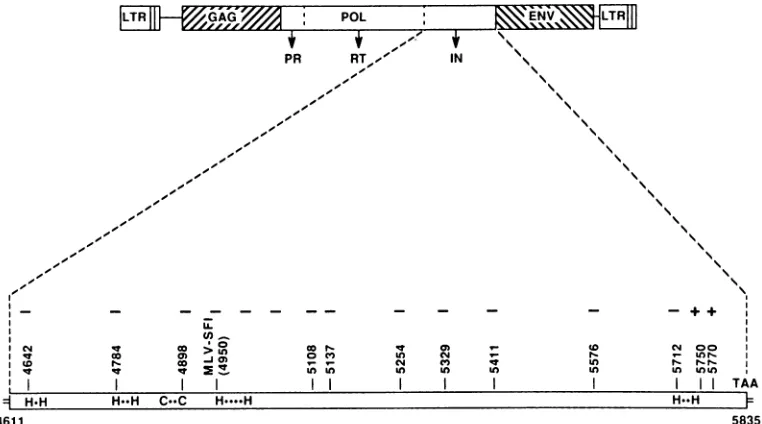
vicinity ofeachmutation. Thelocation ofeachofthelinker
insertion mutations is showngraphically in Fig. 1. Table 1
indicateshow each ofthe mutationswas constructed.
Ability of the mutants to form stable proviruses. Eachofthe mutated viral DNAs (derived from either pZAP or
pMOVpsi-) or wild-type Mo-MLV DNA were
cotrans-fected onto NIH 3T3 cells or rat-1 cells alongwith the neo
retroviralvectorDNA,pMX262neo. G418-resistantcolonies
fromeach mutant andwild-type cotransfected celllinewere
pooled and amplified. Virus-containing medium was
har-vestedfromeachlineand used toinfectNIH3T3cells.Ifthe cotransfectedhelperDNA wasderivedfrompZAP, the virus in the medium was a mixed population ofhelper virus and neo retroviral vector. Otherwise, cells cotransfected with
pMOVpsi--derived constructs generated virus particles
with only pseudotyped neo vectors. The ability of each
mutant-pseudotyped neo vector to generate G418-resistant
colonies in an infected group of cells wascompared to the number ofcoloniesproduced bythe wild-typepseudotyped neo vector.
on November 10, 2019 by guest
http://jvi.asm.org/
3960 DONEHOWER
+ + ,,
-,'~~~~~~~~~~~~~~o
"
IN
IL.
l1 lw Go l
to r o 0 CO)
in Ln
I
H.H H..H C..C H....H0ro _
in N
-in In un
_ + +
to 04 oo
-H t
in un inin
II II TAA
H..H
5835
FIG. 1. Location of linker insertion mutations in Mo-MLV. The diagram shows an Mo-MLV provirus with LTRsflankingthe three
retroviral codingregions. The threemature polypeptidesencodedby polareshown belowthepol codingarea. The IN regionis expanded
inthe boxed regionbelow.Thenucleotidepositionofeach linkerinsertion mutationand theMLV-SF1 mutation(8)inthe Mo-MLVsequence
(34)is indicated abovetheIN-codingregion. Thereplication phenotype ofmutantvirusesderived fromeachmutation isshownabove each mutation position.Nucleotides 4611 and 5835representthe putative 5'and 3'ends,respectively,of theIN-codingregion. The INtermini have
notbeenexperimentallydeterminedbutareinferred from previous data (6, 21, 23, 36). Within the boxareshownthe relativepositions of the
histidineandcysteinecodon pairs.Thedotsbetweeneachmemberofthe pairrepresentanamino acid codon. Such histidine and cysteine
pairsarecharacteristic offinger-bindingproteins (10).
The results of these pseudotyping experiments for the linker insertion mutants are summarized in Table 1. neo
vectors pseudotyped by wild-type Mo-MLV (pZAP) or packaging-deficient Mo-MLV (pMOVpsi-) usually gener-ated from several hundredto 1,000 colonies perplate after infection with 1 ml of virus-containing medium. Medium from cells transfected with only the neo retroviral vector generated no colonies after infection of NIH 3T3 cells. Mediumfrom cellscotransfected withneovectorDNAand 10 of 12 linker insertion mutants (derived from both pZAP andpMOVpsi-) usually resulted innocolonies after
infec-tion of NIH 3T3 cells (infrequently, one or two colonies could be observed on a plate). However, virus-containing
medium derived fromtwo mutants, li5750 andli5770, could formlarge numbers of G418-resistant colonies onNIH 3T3
cells, a finding similar to the results seen with wild-type Mo-MLV pseudotyped neo vectors. Thus, only 2 of 12 Mo-MLV linker insertion mutants were apparently nonde-fective forreplication by this particularassay.
[image:3.612.111.492.70.282.2]Ability ofthemutantstosynthesize viral unintegrated DNA. Previous experiments have shown that viral DNA synthesis isrelatively unimpaired inmutants defective in IN function
TABLE 1. Structureandproperties ofMo-MLV IN mutants
Structure Properties
Parent Insertion XhoI .
.f.
Formationof Synthesis ofMutant'a virusb site linker (bp) Ste modficaton rproviruses unintegratedDNA
li4642 M XmnI 12 - NDc
li4784 Z/M PvuII 12 - +
li4898 Z/M AluI 12 - +
MLV-SF1 (4950) Z SstIl - +
MLV-SF2(4951) Z SstII T4pol (-2 bp) - +
1i5108 Z/M AluI 12 - +
li5137 M SphI 10 T4pol (-4 bp) - ND
li5254 Z/M AluI 12 - +
li5329 Z/M XbaI 8 T4pol (+4 bp) - +
li5411 M BgII 8 T4pol (+4 bp) - ND
li5576 Z/M KpnI 10 T4pol (-4 bp) - +
li5712 Z/M AluI 12 - +
li5750 Z/M SmaI 12 + +
1i5770 M Xbal 8 T4pol (+4 bp) + +
aThenumberindicatesthe nucleotideofthe Mo-MLV sequence(34) after whichthelinkeris inserted. MLV-SF1containsaC-to-Ttransitionatbase 4950of
Mo-MLVthatchangesahighlyconservedArgcodon to aCyscodon(8). MLV-SF2 isaframeshiftmutantmissingbases4951 and 4952(16).
bPseudotypingparentvirus. MutationswereplacedinpZAP(Z),inpMOVpsi- (M),orin both(Z/M).
cND,Not done.
4611
J. VIROL.
K\X\
i..lk x,""I
,NON.
LTRIII
'o. e .110 e .1 10 .0 .1 10 ol
on November 10, 2019 by guest
http://jvi.asm.org/
[image:3.612.50.554.520.688.2]4)
>% ano u
C cse
-,- u
e%
t-= o
*:
==l
=10 4)
SD 't co co r ,
._,-_t _t _ a
--HMW DNA LNEAR
-2 LTRCIRCLE -.
1 LTRCIRCLE
[image:4.612.339.550.72.347.2]FIG. 2. All linker insertion mutants can synthesize the three forms ofviral unintegrated DNA in infected cells. Extrachromo-somal DNA was purified from NIH 3T3 cells 24 h after infection with mutant-virus-containing medium. The purified DNAs were electrophoresed ina 0.8% agarose gel, transferred to nylon, and hybridized to a 32P-labeled probe derived from cloned Mo-MLV DNA. The positions of each of the threeforms of unintegrated viral DNA are indicated at the left. High-molecular-weight (HMW) chromosomal DNA from infected and uninfected DNA samples hybridizes to the probe because NIH 3T3 cells contain large numbersofendogenous MLV-relatedproviruses in their genomes. (8, 32). To confirm this observation for the linker insertion mutants, NIH 3T3 cells were infected with representative mutantviruses and assayed fortheability to synthesize all three forms ofviral unintegrated DNA. As summarized in Table 1 and shown in Figure 2, every tnutant tested
synthe-sizedlinearandboth circular forms(one andtwo LTRs) of
viralDNAwithin24hafter initial infection, a finding similar
to that
observed
in a wild-type Mo-MLV infection. The variation in intensity of viral bands in Fig. 2 is probably afunction ofthe infecting viral titer, which fluctuates
exten-sively in the cotransfected cells. On thebasis of the above
results, I
conclude
thatviral DNA synthesis is notqualita-tively impaired by mutations in the IN-encoding region.
(However,I cannotrule outslight quantitative impairments
in RT efficiency, sincethe amounts ofinfecting virions for
eachmutantwere notdirectlymeasured.) Thus, the block in
replication ofthe defectivelinkerinsertionmutantsislikely
to be at some point between viral DNA synthesis and
formation of theintegrated viral DNA.
Confirmation of replication-competent phenotype of mu-tants Ui5750 and li5770. As noted above, two ofthe linker
insertionmutants were notreplicationdefective. One
possi-ble
explanation
forsuchaphenotype isthat thetransfectedlinker insertion mutant genomes have recombined with
endogenous retroviral sequences, to generate a wild-type
recombinant virus.Schwartzbergetal. (33) have shown that
mutantMLVDNAstransfected intomurine cells can
recom-bine with endogenous MLV-related genomes by a
mecha-nismcalledpatchrepair. I have also occasionally noted this
phenomenon when linker insertion mutant DNAs were
transfected into NIH 3T3 cells. Consequently, all of the
linker insertion mutant DNAs have also been transfected
into
rat-i
cells, inwhich recombination should be much lessfrequent (due to the absence of endogenous MLVs in rat
genomes). Infact, Ihave yettoobserve a reversion to wild
-0
O
-o ~~~~~~~~in
0t
e._
4)4)~~~~~~~~~~~
--.* 04.2kb----2kb
I
4)0 0~C 0.
4) 0
_
3
-=_ Ul) If)
:3 =
--,WIWI
8.9 kb- 41 _
a -S
- 7.2 kb
_.-. . 4.2 kb
FIG. 3. Replication-competent linker insertionmutantli5750has retained the original mutation in its viral genome. Extrachromo-somal DNA wasprepared from cells infectedwith wild-type Mo-MLV and with the replication-competent linker insertion mutant
1i5750.AllDNAs wereanalyzedasdescribed in thelegendtoFig. 2,
except that some purified DNAs were cleaved with XhoI (three lanesatright) beforeloadingontheagarosegel. Thediagramatthe top shows theexpectedfragmentpatternforXhoI-cleaved wild-type Mo-MLV and Ui5750 linear unintegrated DNA. The hatched box indicates theorigin of the cloned Mo-MLV DNAfragment (nucle-otides 1906 to3229) usedas alabeledprobeinthese experiments. TheuncleavedlinearMo-MLV DNAis8.9kblong.
typeby areplication-defectivelinkerinsertionmutantDNA
after transfection into rat cells. In several independent
cotransfections into rat and mouse cells, the two mutants
1iS750
and li5770 have consistently exhibited a replication-competentphenotype.Nevertheless, the replication-competent linker insertion
mutant 1i5750 wastested byrestriction endonuclease
map-pingofnewly synthesizedDNA ininfected cells. Wild-type
Mo-MLV (and patch-repaired mutants) should contain a
singleXhoI siteatposition 1560. Mutant li5750 containsan
additional XhoI site approximately 4.2 kilobases (kb) 3' to
position 1560. Figure 3 shows that XhoI-cleaved viral
unin-tegrated DNA in infected NIH 3T3 cells results in the
expected fragment pattern after hybridization to a labeled
Mo-MLVfragmentextending fromnucleotide 1906to
nucle-otide 3229. Wild-type viral DNA exhibits a characteristic
7.2-kb bandaftercleavage with XhoI,whereas Ui5750DNA shows the expected 4.2-kb bandafter XhoI digestion,
indi-catingthat themutanthas maintained its linkerinsertion and
notundergone detectablerecombination. Some of the same
li5750-containing medium used to generate these results
simultaneouslyexhibitedareplication-competent phenotype
in theG418-resistantcolonyassay. Furthermore,Ui5750 had
fullviabilitywhenassayedfor theability toform a
produc-tive infection. Thiswasdetermined byproduction of
G418--i's
"i ;.,
fZ.l..R9x.
v
on November 10, 2019 by guest
http://jvi.asm.org/
[image:4.612.67.304.73.264.2]3962 DONEHOWER
TABLE 2. pMX262provirusesformed by wild-type and replication-competentmutantpseudotypesUi5750 and
Ui5770appear tobestructurally normala
r No.of coloniescontaining Virus stock No.ofG418 potentially normal neo
colonies/plate
proviruses/total
pMX262neo (Mo-MLV) 102_103 7/
pMX262neo (1iS750) 102"103 6/6
pMX262neo(1iS770) 102_103 5/5
pMX262neo(Ui4642) 0-2 3/4
pMX262neo (Ui4898) 0-1 1/2
pMX262neo(1iS329) 0-1 2/2
All othermutants 0
a Virus-containing medium was harvested from cells cotransfected with wild-type Mo-MLVDNA or a Mo-MLV linker insertion mutant DNA and the neoretroviral vectorDNA pMX262neo. Harvested virus medium (1 ml) was used to infectsubconfluent NIH 3T3 cells on a 60-mm dish. The infected cells were placed in 500 ,ugofG418 per ml 24 h after infection. Ten days later, G418 colonies were counted on each infected plate. Individual colonies were isolated and amplified, and high-molecular-weight DNA was purified as previously described.The DNAs were cleaved with XbaI, electrophoresed, blotted, andhybridizedtoneo probe. DNAsproducing3.2-kb, neo-specific fragments wereassumed to containpotentially normal proviruses. Fragments of other sizes wereassumed to be abnormal proviruses.
resistantcoloniesafter secondaryinfection of rat and mouse
cells with
medium
from pooled colonies derived frompri-mary infection with an li5750 (pZAP) pseudotype of
pMX262neo.
The otherreplication-competent
mutant,li5770,
was constructed in a pMOVpsi- backgroundand
therefore could not be tested by this restriction mapping
assay(sincethehelper viral genome would not be present in
newlyinfected cells), butthelikelihood ofrecombination of
thismutantgenomein each of several independent
cotrans-fections intorat-1 cells isexceedingly remote.
Analysis of proviruses formed by the linker insertion mu-tants. Theformation of G418-resistant colonies by wild-type and
mutant-pseudotyped
neoretroviral vectors is dependenton stableintegration ofthe vectorprovirus. Asindicatedin
Table 1, colony formation by 10 ofthe 12 linker insertion
mutantsdoes not occur or occurs at avery lowfrequency. However, the occasional colony that is generated by these
replication-defective virusescanbeamplified, andthe
struc-ture ofits vector provirus can be analyzed by restriction mappingtechniques. The structure of proviruses generated
by the tworeplication-competent mutantscan also be
ana-lyzed. Pastexperiments have shown that
replication-defec-tiveintegrase mutantsgeneratefew proviruses and that the
majorityofthosethatareformedarestructurallyaberrantby
restriction mapping (8, 16).
High-molecular-weightDNAwas purified fromanumber
ofG418-resistant colonies formedbythe
replication-compe-tent mutant pseudotypes
1i5750
andli5770.
Afew colonies derived from replication-defective pseudotypes were alsoobtained, and their high-molecular-weight DNA was
puri-fied. The DNAswerecleaved withXbaI,whichonlycleaves
oncewithineachLTRof the retroviralvectorpMX262neoto generate a 3.2-kb fragment if the vector provirus is
inte-grated in a normal fashion. The observation of afragment
sizeother than 3.2kb is evidence that thevectorprovirusis
integrated
abnormally.
Each of the high-molecular-weightDNAs derived from individual G418-resistantcolonies was
cleavedwith
XbaI,
subjectedtoagarosegel electrophoresis,blotted to nylon, and hybridized to a labeled neo DNA
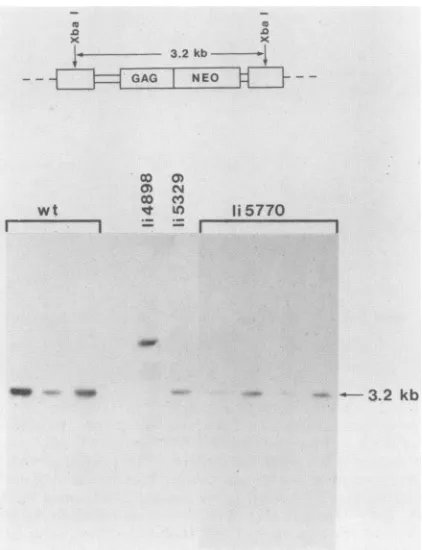
probe. The resultsare summarized in Table2and shown in
Fig. 4. All of the proviruses pseudotyped by wild-type
x x
l*--- 3.2kb
-GA E f-Im
..LhZ...1]
wt
I
OD 0)
C)O
Cyq LO
0_
_~
li5770I .. .. ..
a-. - 3.2 kb
FIG. 4. Replication-competent linker insertionmutantsgenerate
structurally normal pseudotyped proviruses while the few
pseu-dotyped proviruses generated by replication-defective mutantsare
sometimes abnormal. Individual G418-resistant colonies derived from infection with wild-type and mutant-pseudotyped retroviral vectorpMX262neowereamplified,andhigh-molecular-weightDNA
was purified. These DNAs were digested withXbaI, electropho-resedon a0.8%agarosegel, blottedtonylon, and hybridizedto a
1.1-kb, 32P-labeled neo fragment. A schematic map of normally integrated pMX262neo is shownat thetop. Digestion ofanormal pMX262neo provirus will yield a 3.2-kb neo-specific band after cleavage with XbaI.
Mo-MLV andthetworeplication-competentlinker insertion mutantsappeared tobestructurally normalbyXbaI
restric-tion mapping. It was impossible to assess the structure of
proviruses generated by seven of the replication-defective
mutants because of their inability to form G418-resistant colonies.However, threemutantsdidproduceafew isolated colonies. Twoofthesemutantsgeneratedoneclearly
abnor-mal provirus. The third generated two apparently normal
proviruses. The results confirm that the
replication-compe-tent mutants are integrating their viral DNA in a normal manner. The failure of some of the replication-deficient mutants to consistently form normal proviruses correlates
withtheirinability togenerate significantnumbers of
G418-resistant colonies.
DISCUSSION
The results of the experiments described here are an
extension ofprevious studies (8, 16)and support the
argu-mentthatthe 3' partof pol encodesaprotein (p46PoIorIN) which is absolutely required for normal retroviral DNA
integration. None of the tested mutants were significantly
deficient in the formation of any
unintegrated
forms of viralDNA, confirmingthat IN haslittle or norole in viral DNA
synthesis. Itwas hoped that small in-frame linkerinsertion
J. VIROL.
on November 10, 2019 by guest
http://jvi.asm.org/
[image:5.612.54.295.103.202.2]mutations spanning the IN-codingregionwouldallow more precise delineation of functionally important IN domains. Previous site-directed mutagenesis studies of this region of
pol
performed by myselfand othershave notsystematically examined the entire Mo-MLV IN-coding region and care-fully analyzed the resulting virus replication phenotype (8, 16, 32). The results of this attempt to provide a more comprehensive battery of IN mutants suggested that se-quences throughout the protein, with the possible exception of the carboxy terminal 10%, are functionally involved in integration.Tenofthetwelve linkerinsertion mutants appeared to be defective for integration. Only the two mutations located
closestto the carboxy terminus of the IN(15750 and
li5770)
resulted inreplication-competent mutant viruses. Lobel and Goff (25) have previously shown that a 12-bp EcoRI linker insertion at position 5750 generates a mutant with wild-type replication activity. These results are somewhat analogous to that reported by Katz and Skalka (22), who engineered two mutations into the terminal 37-amino-acid codons ofpol in avian sarcoma-leukosis virus and found that the resulting mutant viruses were not defective for replication. However, these 37 carboxy-terminal amino acids of pol in avian sarcoma-leukosis virus are removed duringposttranslational processing and are not present in the mature pp32 endonu-clease or the beta subunit of reverse transcriptase (1).There is no evidence that C-terminal processing of Mo-MLV pol precursors occurs (21, 36), and it is likely that 1i5750 and
1i5770
contain the inserted amino acids in their mature IN. The1i5750
and1i5770
mutations are located immediately 5' of the overlapping region between the 3' codons ofpoland the amino terminal codons of the env leader segment. This pol-env overlapping region present in many retroviruses appears to undergo rapid sequence change and has noknown function (22). Therefore, this region and adjacent domains may be capable of significant alteration without impairment oftheviral replication function.One interesting feature of the IN-coding sequence is the presence of sequence elements characteristic of metal-binding domains found in proteins from a variety of eucary-otic organisms associated with nucleic acidbinding(10). The zinc-binding finger proteins have characteristic amino acid sequence motifs which are present to a limited extent in the amino acid sequence of IN.Theprimarycharacteristic ofthe finger proteins isthe presence ofcloselylinked cysteine and histidine residue pairs (C2 and
H2)
which interact to coor-dinate with a zinc atom. The IN protein has four histidine pairs and 1 cysteine pair (Fig. 1). However, the relative spacing of these pairs does not conform to the finger protein consensus sequence which specifies 12 to 14 amino acid residues between adjacent cysteine and histidine pairs (10). Moreover, only the cysteine pair and one of the histidine pairs appears to be conserved among all retroviruses (38). Since the IN protein does have demonstrated DNA-binding activity (14, 27), it may be of interest to determine whether mutations within these C2 and H2 segments affect integra-tion. Fortuitously, linker insertion mutations have been introduced either within or immediately adjacent to all but one of the C2 and H2 pairs. All of thesemutations result in replication-deficient viruses.The competent mutants and the replication-defective mutants differ quantitatively and qualitatively in provirus formation. The replication-competent mutants
li5750
and1i5770
generate large numbers of proviruses, all of which appear to be normal in structure. In contrast, the other mutants produce at least 102 to 103 fewer provirusesthan do
wild-type
viruses (andreplication-competent
mutants). Many mutantsgenerated no G418-resistant colo-nies in any of the experiments, making it impossible to assess proviral structure in these cases. A few mutants generateda small number of colonies (there isprobably nodifference betweenthesemutantsand
those
mutantsthatdidnot generate colonies). Two out of three of these
colony-producingmutantsgenerated atleastoneaberrant
provirus,
indicating both qualitative deficiencies andquantitative
de-ficiencies in the ability to form proviruses. The
apparently
normal
proviruses generated by replication-deficient
linkerinsertionmutantsmaybe duetoleakinessofthe mutation, as
previously observed forthe missense IN mutant, MLV-SF1
(16), or it may be due to the formation of head-to-tail
concatemers of viral DNA before recombination with the
genomic DNA, as
observed
withsomeprovirusesgenerated
by the frameshift IN mutant, MLV-SF2 (16). When these
twopossibilitieswere investigated byfurthermapping ofthe
apparently normal proviruses, only one of the six
(li4642)
showedapattern indicatingaconcatemer structure(datanot
shown). Thus, it is possible that most ofthe mutant
provi-ruses arecorrectly integrated, although otherinterpretations
are plausible.
Collectively, this battery of linker insertion mutants
pro-videsameansfor furthergenetic and biochemical studies of the Mo-MLV integrase. Expression, purification, and bio-chemical characterization of mutant and wild-type IN will help define regions of the protein that are important for various biochemical and enzymatic activities. Attempts to
test for intramolecular complementation between different
mutants introduced into the same cell may determine whether the IN has multiple functional domains.
ACKNOWLEDGMENTS
I thank Molly Pettit forskilled technical assistance; Mike Scott and Steve Chang for reagents; Bob Bohannon for help with sequenc-ing; and Joyce Evans for help with the manuscript. I also thank David Steffen foracritical reading of the manuscript.
Thiswork was supported by Public Health Service grant CA41476 from the National Cancer Institute.
LITERATURECITED
1. Alexander, F., J. Leis, D. A. Soltis, R. M. Crowl, W. Danho, M.S. Poonian, Y.-C. E. Pan, and A. M. Skalka. 1987. Proteo-lytic processing of avian sarcoma and leukosis viruses pol-endo recombinant proteins reveals another pol gene domain.J. Virol. 61:534-542.
2. Barany, F. 1985. Single-stranded hexameric linkers: a system for in-phase insertion mutagenesis and protein engineering. Gene 37:111-123.
3. Birnboim, H. C., and J. Doly. 1979. Arapid alkaline extraction procedure for screening recombinant plasmid DNA. Nucleic Acids Res. 7:1513-1523.
4. Chen, C., and H. Okayama. 1987. High-efficiency transforma-tion of mammalian cells by plasmid DNA. Mol. Cell. Biol. 7: 2745-2752.
5. Cobrinik, D., R. Katz, R. Terry, A. M.Skalka, and J. Leis.1987. Avian sarcoma and leukosis virus pol-endonuclease recognition of the tandem long terminal repeat junction: minimum site requiredfor cleavage is also required for viralgrowth. J. Virol. 61:1999-2008.
6. Copeland, T.D., G. F. Gerard, C. W. Hixson, andS. Oroszlan. 1985. Amino- and carboxyl-terminal sequenceofMoloney mu-rine leukemia virus reverse transcriptase. Virology 143:676-679. 7. Crawford, S., and S. P. Goff. 1985. Adeletion mutation in the 5' part of the pol gene of Moloney murine leukemiavirus blocks proteolytic processing of the gag and pol polyproteins. J.Virol. 53:899-907.
8. Donehower, L. A., and H. E. Varmus. 1984. A mutant murine
on November 10, 2019 by guest
http://jvi.asm.org/
3964 DONEHOWER
leukemia virus with a singlemissense codon in pol is defective in afunction affecting integration. Proc. Natl. Acad. Sci. USA 81:6461-6465.
9. Duyk, G., M. Longiaru, D. Cobrinik, R. Kowal, P. deHaseth, A. M. Skalka, and J. Leis. 1985. Circles with two tandem long terminal repeats are specifically cleaved by polgene-associated endonuclease from avian sarcoma and leukosis viruses: nucle-otide sequences required forsite-specificcleavage.J.Virol.56: 589-599.
10. Evans, R. M., and S. M.Hollenberg. 1988. Zinc fingers: gilt by association. Cell 52:1-3.
11. Feinberg, A., and B. Vogelstein. 1983.Atechnique for radiola-beling DNA restriction endonuclease fragmentstohighspecific activity. Anal. Biochem. 132:6-13.
12. Gerard, G. F., and D. P. Grandgenett. 1975. Purification and characterization of the DNA polymerase andRNase Hactivities in Moloney murine sarcoma-leukemia virus. J. Virol. 15:785-797.
13. Graham, F. L., and A. J. van der Eb. 1973. A new technique for the assay of infectivity of human adenovirus5DNA. Virology 52:456-467.
14. Grandgenett, D. P., A. C. Vora, and R. D. Schiff. 1978. A 32,000-dalton nucleic acid-binding protein from avian retrovirus cores possessesDNAendonuclease activity. Virology 89:119-132.
15. Grandgenett, D. P., A. C. Vora, R. Swanstrom, and J. C. Olsen. 1986. Nuclease mechanism of the avian retrovirus pp32 endo-nuclease. J. Virol. 58:970-974.
16. Hagino-Yamagishi, K., L. A. Donehower, and H. E. Varmus. 1987.Retroviral DNA integratedduring infection byan integra-tion-deficient mutant of murineleukemiavirus isoligomeric. J. Virol. 61:1964-1971.
17. Hanahan, D. 1983. Studies on transformation of E. coli with plasmids.J. Mol.Biol. 166:557-580.
18. Hippenmeyer,P.J., and D. P.Grandgenett. 1985. Mutants of the Roussarcomavirus reversetranscriptase genearenondefective in early replication events. J. Biol. Chem. 260:8250-8256. 19. Hirt, B. 1967. Selective extraction of polyoma DNA from
infected mouse cell culture. J. Mol. Biol. 26:365-369. 20. Hoffman, J. W., D. Steffen, J. Gusella, C. Tabin, S. Bird, D.
Cowing,and R. A.Weinberg. 1982. DNAmethylationaffecting theexpression ofmurine leukemia viruses. J. Virol.4:144-157. 21. Hu, S. C., D. L. Court, M. Zweig, and J. G. Levin. 1986. Murine leukemiavirus pol gene products: analysiswithantisera gener-ated against reverse transcriptase and endonuclease fusion proteins expressed in Escherichia coli.J. Virol. 60:267-274. 22. Katz,R.A., and A. M. Skalka.1988. AC-terminaldomain in the
avian sarcoma-leukosis virus pol gene product isnotessential forviralreplication. J. Virol. 62:528-533.
23. Kopchick, J. J., J. Harless, B. S. Geisser, R. Killam, R. R. Hewitt, and R. B. Arlinghaus. 1981. Endodeoxyribonuclease activity associated with Rauscher murine leukemia virus. J. Virol.37:274-283.
24. Leis, J.,D.Baltimore, J.M. Bishop, J. Coffin,E.Fleissner,S. P. Goff, S. Oroszlan, H. Robinson, A. M. Skalka, H. M. Temin, and V. Vogt. 1988. Standardized andsimplified nomenclature
forproteinscommon toall retroviruses.J. Virol. 62:1808-1809. 25. Lobel,L. I.,andS. P.Goff. 1984. Construction ofmutants of Moloney murine leukemia virusby suppressor-linker insertional mutagenesis:positions of viable insertion mutations. Proc. Natl. Acad. Sci. USA 81:4149-4153.
26. Mann,R.C.,R.C.Mulligan,and D.Baltimore.1983. Construc-tion ofaretrovirus packaging mutant and its use to produce helper-free defective retrovirus. Cell 33:153-159.
27. Misra,T.K.,D.P.Grandgenett,andJ.T. Parsons.1982. Avian retroviruspp32 DNA-binding protein. I. Recognition ofspecific sequences on retrovirusDNA terminal repeats. J. Virol. 44:330-343.
28. Nissen-Meyer, J.,andI.F.Nes.1980.Purification andproperties of DNA endonuclease associated with Friend leukemia virus. Nucleic Acids Res. 8:5043-5055.
29. Panganiban,A.T., andH.M. Temin. 1984. The retroviruspol gene encodesaproductrequired for DNA integration: identifi-cation ofaretrovirus int locus. Proc. Natl. Acad. Sci. USA 81: 7885-7889.
30. Reed, K. C., and D. A. Mann. 1985. Rapid transfer of DNA from agarosegelstonylon membranes. Nucleic Acids Res. 13:7207-7221.
31. Sanger, F. S., S. Nicklen, and A. R. Coulson. 1977. DNA sequencing with chain terminating inhibitors.Proc.Natl.Acad. Sci. USA 74:5463-5467.
32. Schwartzberg, P., J. Colicelli,and S. P.Goff.1984. Construction andanalysis of deletion mutations in the pol gene ofMoloney murine leukemia virus: anew viralfunctionrequired for pro-ductive infection. Cell 37:1043-1052.
33. Schwartzberg, P., J. Colicelli,and S. P.Goff. 1985. Recombina-tionbetweenadefective retrovirus andhomologous sequences in host DNA: reversion by patch repair. J. Virol.53:719-726. 34. Shinnick, T. M., R. A. Lerner, and J. G. Sutcliffe. 1981.
Nucleotide sequence ofMoloney murine leukemia virus. Nature (London) 293:543-548.
35. Tabor, S., and C. C.Richardson.1987.DNA sequenceanalysis with amodified T7 DNA polymerase. Proc. Natl. Acad. Sci. USA84:4767-4771.
36. Tanese, N., and S. P. Goff. 1988. Domain structure of the Moloney murine leukemia virus reverse transcriptase: muta-tionalanalysis and separate expression of theDNApolymerase and RNAse H activities. Proc. Natl. Acad. Sci. USA 85:1777-1781.
37. Tanese, N., M. J. Roth, and S. P. Goff. 1986. Analysis of retroviralpol geneproducts with antisera raised against fusion proteins producedinEscherichiacoli. J. Virol. 59:328-340. 38. Toh,H.,R.Kikuno,H.Hayashida,T.Miyata, W. Kugimiya, S.
Inouye, S. Yuki, and K. Saigo. 1985. Close structural resem-blance betweenputative polymerase ofaDrosophila transpos-able genetic element 17.6 andpol gene product of Moloney murine leukemia virus.EMBO J. 4:1267-1272.
39. Verma, I. M. 1975. Studies on reverse transcriptase of RNA tumorviruses. III.Properties of purified Moloney murine leu-kemia virusDNApolymerase and associatedRNase H. J.Virol. 15:843-854.
40. Yoshinaka, T., and R. B.Luftig. 1977. Propertiesofa proteo-lytic factor of murine leukemia virus. Cell12:709-719.
J. VIROL.