Z. Zhang and J. Siekmann (Eds.): KSEM 2007, LNAI 4798, pp. 587–592, 2007. © Springer-Verlag Berlin Heidelberg 2007
and Customer Databases
Yan Li1, Peng Wen2, Hu Wang3, and Chunqiang Gong3
1 The Department of Mathematics and Computing, 2 Faculty of Engineering and Surveying,
The University of Southern Queensland, QLD 4350, Australia
{liyan, pengwen}@usq.edu.au
3
School of Information System, Wuhan University of Technology, Wuhan, P.R. China
{wangh, gcq}@263.net
Abstract. This paper addresses a service-mining technique and applies this technique to improve the services of vehicle service centers. We propose a service-mining system and its data structure to discover the most important services required through analyzing service records, feedback records and the available products. The system can improve the quality of mining automatically by updating mining strategies regularly.
Keywords: Service-mining, Behavior prediction, Vehicle service, Customer Relationship Management.
1 Introduction
Currently, many application systems, such as enterprises resource planning (ERP), customer relationship management (CRM), run in large companies are lack of the capabilities to mine from their database with some special service guidelines to find out the best service opportunity and the best item of service for their customers. Although technologies of data mining provide us ways to find the relevant knowledge from massive data, it is not suitable to those companies who must provide their services regularly and the required services totally depend on the conditions of their products. What we want to achieve in this research is to find a method to predict the best time and the best item of service for customers according to their driving behaviors and the service provided previously [1].
This paper proposes a system framework that discovers the most important services required by analyzing and combining specific products and an expert system with service records and feedback records. Moreover, the system can improve its mining quality by updating strategies regularly.
2 System Structure and Database
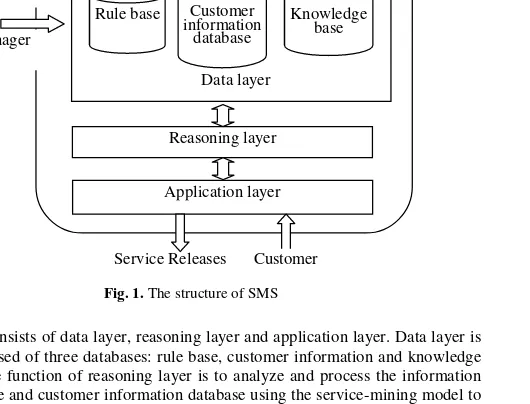
An SMS is a system that predicts a suitable time and an item of service through the driving behaviour of a customer. The predicting comes from the data processed based on customer database. This can be adjusted by the system itself as the new service records are added into customer database. Figure 1 shows the system structure.
Service Releases Reasoning layer
Application layer Set rules
Customer Manager
Knowledge base Customer
information database Rule base
[image:2.430.85.350.144.346.2]Data layer
Fig. 1. The structure of SMS
An SMS consists of data layer, reasoning layer and application layer. Data layer is mainly composed of three databases: rule base, customer information and knowledge databases. The function of reasoning layer is to analyze and process the information in the rule base and customer information database using the service-mining model to discover potential service patterns [2], for example, when a part of a customer’s vehicle needs to be replaced or checked. The system can inform a customer about a upcoming service within three days to one week in advance. In the meantime, the reasoning layer needs to analyze the service feedback from customers, to update the predicting model and the knowledge in the database with a particular structure [3]. An accurate customer's classification will help the system to predict a customer’s driving behavior. Application layer provides user interfaces for different functions, collects customer’s feedback, and releases services by means of some digital communications [4], such as e-mail, SMS, telephone, fax, etc.
3 The Service Mining Method
3.1 Prediction Model
The prediction model is used to find out what is the most possible time and the most suitable service a service provider can provide to their customers. The time and the service vary depending upon the information of the customers and their vehicles. If two customers own different vehicles, or if they purchase their vehicles at different time, or they have different driving behaviors and road conditions, the service and the time are also totally different. As a service provider has normally more than tens of thousand customers, it is no doubt that they must work on having automatic solutions for their customers if they want to provide them a suitable service in time. Their solutions should be able to update over time. Therefore, a prediction model is essential to determine the two important pieces of information: the service time and the service type.
Customer Feedback Customer
Investigation Assessment Expert
Data From
Investigation Factor Set and Guidelines History Data
Prediction Model
Part’s life span
of individuals BehaviourDriving
I
Integrate Service Release
[image:3.430.52.377.216.438.2]Service
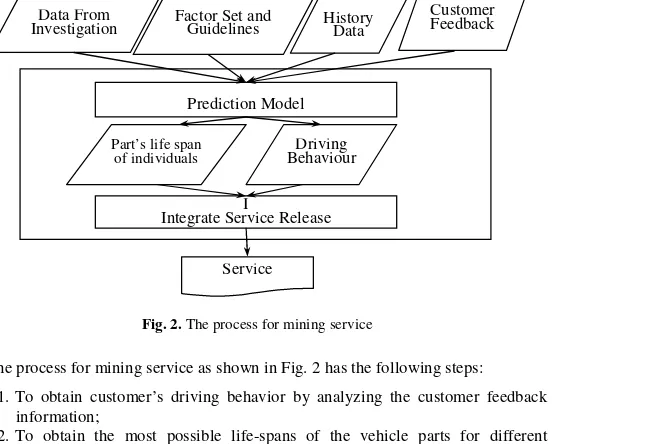
Fig. 2. The process for mining service
The process for mining service as shown in Fig. 2 has the following steps:
1.To obtain customer’s driving behavior by analyzing the customer feedback information;
2.To obtain the most possible life-spans of the vehicle parts for different customers by referring the standard life-spans of the parts and the driving behavior of individual customers.
3.To obtain the most possible time a particular part of a vehicle requests to be maintained or replaced according to the result in Step 2 and the vehicle’s maintenance history.
3.2 The Customer Driving Mileage Function
There are many ways to estimate the values of the mileage per day for customers. The simplest way is to use a one-variable linear regression [5]. In the customer service database, a series of service history records for a particular customer can be easily filtered for regression. Every time when a customer sends his vehicle for service, the mileage and the time are recorded. As the relationship of mileage and time represents as a linear function, it is easily to predict that what time a particular part of the customer’s vehicle reaches its maintaining or replacing time. Because the function is different from customer to customer, the function for a particular customer needs to be saved in the database for late prediction.
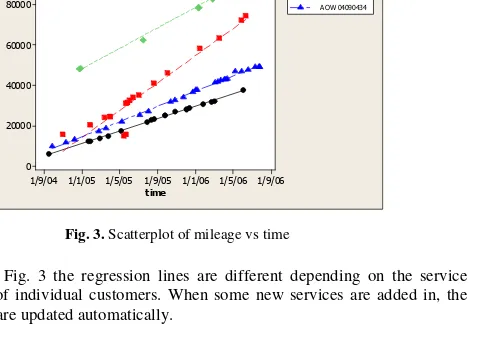
Fig. 3 shows the relationship between mileage and time for four customers whose history records are randomly picked up in our database. The one-variable linear regression algorithm is then applied to the data. The simulation is carried out in Minitab R14.
time
m
ile
a
g
e
1/9/06 1/5/06 1/1/06 1/9/05 1/5/05 1/1/05 1/9/04 100000
80000
60000
40000
20000
0
customer_ID
[image:4.430.92.340.239.413.2]AOH04001237 AOW04090434 AOH04000072 AOH04000703 Scatterplot of mileage vs time
Fig. 3. Scatterplot of mileage vs time
As shown in Fig. 3 the regression lines are different depending on the service history records of individual customers. When some new services are added in, the regression lines are updated automatically.
3.3 To Discover the Comprehensive Factor for All Customers
As mentioned before, all drivers have their special driving experiences. Some of them always drive on the rough surfaces of roads, some like sudden braking. Those driving experiences have the great influences on the part’s life span of a vehicle. This is why some drivers have to replace their tyres earlier than others.
factors are suitable for those new customers because there are no maintenance records in our database available to mining for the purpose of the factor updates. As the new maintenance records are added into database, we can analyze them using our model to adjust the values of the factors for a particular customer.
If i, j, k represent the number of parts, factors, and customers. The comprehensive
factor CFki can be determined by the following equation:
∑
∑
= =
= n
j ij ij n
j ij kj
ki
w p
w c CF
1
1 . (1)
Where, ckj is a parameter based on customer’s driving behavior through customer’s
feedback. wij is the initial weight value of part i under factor j. pij is an index related to
the standard life-span of part i. n is the total parts a service provider is able to serve. 3.4 Integrated Service Release
Integrated service releases use production specifications, sometimes called if-then
rules. The rules can take various forms, for example, if <condition>, then <action>.
The 'if clause' consists of a set of conditions. These conditions are much more
complex than a symbol or a simple statement. There may be many conditions, all of which must be established as "true" in the current state of the machine. And, the 'then
clause' is a sequence of action schema whose variables are bound by the values that
are passed from the bindings that have been established in the process of matching the variables that occurred in the 'if clause.' A typical rule in SMS is as follows:
If i
i i
L
T t
r
= + , then the service for a customer’s vehicle: part i needs to be checked or replaced at the time Ti according to our prediction model. Here, Ti is the date of the next time part i will be checked or replaced.
L
i means the most possible life-span of part i which is predicted by the prediction model.r
stands for the value of average mileage per day for a particular customer. So, Lir represents part’s life-span measured by time.
t
i is the date of the last time that part i is checked or replaced. By using this approach, it is not difficult to predict which part needs to be checked or replaced and at what time depending on the detailed history service records about a particular vehicle. The service provider has a capability to inform their customers in advance in order to reduce the driving risks of a driver who drives the vehicle but is unaware of his vehicle is under a bad condition.During this period of time, if there are some new service records being inputted into the database, and if those new records will influence the driving behavior or average mileage/day estimation, SMS will adjust the knowledge database over time, update the service schedule again.
4 Conclusion
In this paper, we proposed and developed an SMS system. By analyzing customer driving history records, we can get the customer’s driving behavior first, then, to analyse the life-spans of the parts which are highly affected by customer’s driving behaviors. By using the rule-matching, we discover the relationship of the mileage and time for a customer. We discover a more accurate view of service mining for an individual customer. The SMS, therefore, can make decision about: whose vehicle is at what time to have what kind of service. As the model being modified again and again, a more accurate model can be established.
In this system, we identify customer’s driving behaviors by analyzing customer feedback records and service records. These behaviors help us to find out the life-spans of vehicle components.
Based on the above method, mining services and self-learning can be achieved. The service mining system, which is based on knowledge and customer databases, can be also applied to CRM. From the service mining to self-improving of service quality, the system implements intellectual services through the whole process automatically. The modeling and prediction of customer behaviors are key factors in the system. It requires continuing efforts to improve the accuracy of models and algorithms.
References
1. Song, H., Wang, H.: Digitalization Strategy of Automobile Maintenance Service Enterprises. Journal of Wuhan Technologies (information & management engineering) 26(6), 9–11 (2004) (Chinese)
2. Yang, H., Lin, Y., Zeng, T.: Data Analysis of corporate After-Service in Business Selling. Mathematics in Practice and Theory 35(7), 74–83 (2005)
3. Michon, J.A.: A critical review of driver behavior models: What do we know, what should we do? In: Schwingr, Evans, L.A. (eds.) Human behavior and Traffic Safety, pp. 487–525. Plenum Press, New York (1985)
4. Lian, Y., Fassino, M., Baldasare, P.: Predicting Customer Behavior via Calling Links. In: Proceedings of International Joint Conference on Neural Networks, Motreal, Canada, vol. 4, pp. 2555–2560 (2005)
5. Fang, P.: Comment On “Application of After-service Data”. Mathematics in Practice and Theory 35(7), 98–105 (2005)