Improving the Performance of SCTP Transport Protocol
over Wireless Networks
Zhongwei Zhang and Lu Jin
Department of Mathematics and Computing
University of Southern Queensland
{
zhongwei,jin
}
@usq.edu.au
Abstract
Stream Control Transmission Protocol(SCTP) is a re-liable transport protocol combining the advantages of TCP and UDP. SCTP has many desirable features in-cluding multihoming, multistreaming, and partial data reliability. These features have made SCTP perform much more effectively in multimedia networking appli-cations. They have also worked better in wireless envi-ronment which traditional transport protocols are inef-fective and cumbersome.
Before the transmission, an application using SCTP needs to establish an association between the client and the server. The establishment of association requires a number which will be used to create multiple streams. However, SCTP has not specified a method or suggested any ideas of determine the number.
In our paper, we focus on the performance of SCTP protocol over the wireless networks. The ideas is to ex-tend the SCTP with a process of determining an optimal number prior to the association establishing. We ex-amine the modified SCTP on a simulated wireless net-works, and the experiment results of simulation using NS2 have shown the modified SCTP is feasible and also demonstrated the modified SCTP’s superiority of per-formance over TCP and UDP over the wireless net-works.
1. Introduction
The Stream Control Transmission Protocol (SCTP) has many attractive features such as multi-streaming and multi-homing. These features enable many mul-timedia network applications on the wireless networks [8], on which traditional transport protocols such as TCP and UDP perform unsatisfactorily.
One problem which severely impacts on TCP
per-formance over wireless network is so-called line blocking. SCTP solves the problem of head-of-line blocking by using multiple streams. However, The problem associated with using multiple streams is that if too many streams are used over a network with low traffic, it wastes our resources. If the network traffic is high, but we start with just few streams, we will experi-ence a bad delay performance. This problem motivates us to find a way of finding out an optimal number which just makes SCTP work as efficient as possible [3].
There are many trial-and-error approaches to find such an optimal number for SCTP to exploit in the as-sociation establishment [6]. Our approach is to modify the SCTP protocol by integrating one more step prior to the four-way handshake procedure to collect parameters for determining a stream number.
In this paper, we present the modification neces-sary to improve the performance of SCTP over the wire-less networks, and then test this modified protocol on the simulated network. The rest of paper is organized as follows. In Section 2, we provide an overview of SCTP routing protocols. In Section 3, we describe the modification and improvement to current SCTP proto-col. The implementation of modified SCTP protocol is illustrated in Section 4. Results and discussions are pre-sented in Section 5. Conclusions are given in Section 6.
2. SCTP protocol
SCTP was initially developed for telephony sig-nalling for the purpose of transmitting voice data and control signal at separate streams. But today it can be adopted to transmit Internet data using more than one stream for the robustness and efficiency purpose.
contain control or data information.
2.1. SCTP association
Different than TCP which provides a byte-stream data service, SCTP provides a message-oriented data delivery service. SCTP uses a new concept of four way handshake association to perform three way handshake in TCP to establish a connection and UDP needs no con-nection.
[image:2.595.342.498.394.578.2]This four way handshake and oriented message mechanism provide resilience against the Denial of Ser-vice attacks to which TCP is prone.[7]. Similar to TCP, an SCTP association is terminated with the sending of three messages. Note that graceful shutdown is the pre-ferred method of terminating an association.
Figure 1. A Network with multihomed ad-dresses
2.2. SCTP features
SCTP has some novel features to improve perfor-mance in wireless and mobile environment. Like the most popular TCP algorithms — TCP Reno and TCP Reno with Eifel, SCTP also suffers from spurious time-outs when delay spikes occurs in wireless mobile en-vironment. However, when an end point uses mobile IP, SCTP performance better than TCP Reno and TCP SACK during hand-offs.
In detailed, SCTP provides the following services and features [3]:
• Multi-homing, or the ability for a single SCTP endpoint to support multiple IP addresses. Using multi-homed SCTP, redundant LANs can be used to reinforce the local access, while various options are possible in the core network to reduce the de-pendency of failures for different addresses.
• Multi-streaming function provided by SCTP al-lows data to be partitioned into multiple streams that have the property of being delivered indepen-dently, so that message loss in any of the streams will only affect delivery within that stream, and not in other streams.
• SCTP provides reliable transmission, detecting when data is discarded, reordered, duplicated or
corrupted, and retransmitting damaged data as nec-essary.
• SCTP is message oriented and supports framing of individual message boundaries. In comparison, TCP is stream oriented and does not preserve any implicit structure within a transmitted byte stream.
• SCTP is rate adaptive similar to TCP, and will scale back data transfer to the prevailing load con-ditions in the network. It is designed to behave cooperatively with TCP sessions attempting to use the same bandwidth.
Some of these features are very useful for the wire-less networks where the link error rates are much larger than that on the traditional wired networks. For ex-ample, SCTP uses the similar congestion control algo-rithms, but the packet lose is not the only indicator of the congestion.
3. Modification to SCTP Protocol
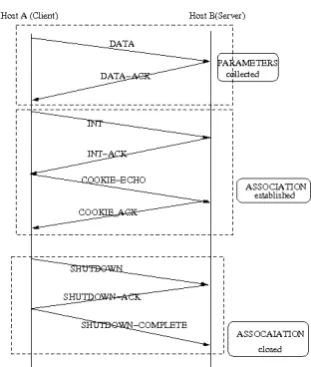
The original association establishment of SCTP can be viewed in [2]. Here we show the modified as-sociation establishment in Figure 2.
Figure 2. Modified SCTP: Parameter collecting, association establishment and shutdown
• Host A sends an DATA chuck with time-stamp to host B.
• When host B receives DATA chuck, it generates a DATA-ACK chuck which consists of original time-stamp from DATA chuck and buffer size of host B, then sends the DATA-ACK chuck to host A.
• Host A uses the data in DATA-ACK chuck to eval-uate parameters (such as RTT, propagation delay, etc.) and determine the optimal number of streams. Then host A generates INT packet and send it to host B.
• Follow SCTP protocol to establish an association.
Only at this point does SCTP establish the association and allocate resources at host B.
3.1. Determining the Stream Number of
Asso-ciation in SCTP
We have seen that the number of streams in a SCTP association can affect on the performance of a network. It is obvious that the best selection of stream number may save the precious network resource without affect-ing the performance of data transmission. As stated in [1], the number of streams is determined when the asso-ciation is made. Once the number of streams is negoti-ated, it is impossible to change stream number without reestablishing another association. It should be noted that network traffic can be variable as time goes on [9]. As analyzed in [1], the stream number of an associ-ation relies on many factors. In other words, the stream number of an association is a function of multiple vari-ables or the optimal stream number is affected by many conditions. Note that these conditions and factors likely interact with each other rather than being independent with each other, while the impact of an individual fac-tor is diverse in different circumstances. we first inves-tigate three factors which are irrespective and indepen-dent with each other though, as follows:
1. receiver buffer size (b). Bigger the receiver buffer size is, less streams we need to establish.
2. round trip time (r). If the RTT value is consider-able long, more streams should be established for quick transmission.
3. link error rate (e). Higher link error rate will result in the increase of stream number.
Apparently, the optimal stream number of an asso-ciation has a relation with these three factors as follows: S∝b×er
From this relationship, we can see that the optimal stream number of an association is in direct proportion to the link error rate (e), but in inverse proportion to the receiver buffer size (b) and round trip time (r). This relation is certainly not simple or straight forward.
4. Implementation of Modified SCTP
In the past, Fuzzy logic theory has been applied in many problems like this where the relationship between the ultimate results is determined by a few factors with uncertainty. The application of fuzzy logic theory in modelling those complex systems has been very suc-cessful [5]. In this section, we attempt to take advantage of fuzzy logic theory in the modelling of optimal stream number in SCTP.
4.1. Structure of Fuzzy logic system
This relation can be modelled using fuzzy logic as follows. First we define the receiver buffer sizeb, round trip timer, and link error rateeas the antecedent sets of fuzzy logic system, which has been associated with optimal stream numberS as consequent set. Then we define the fuzzy membership functions for both of an-tecedent sets and consequent set as below [3]:
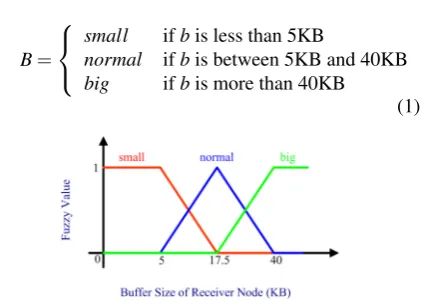
1. Fuzzy membership function (B) of receiver buffer size (b). Three fuzzy sets,small,normalandbig are defined in Equation 1 and shown in Figure 3.
B=
small ifbis less than 5KB
normal ifbis between 5KB and 40KB big ifbis more than 40KB
[image:3.595.321.534.437.587.2](1)
Figure 3. Fuzzy membership function (B) of re-ceiver buffer size (b)
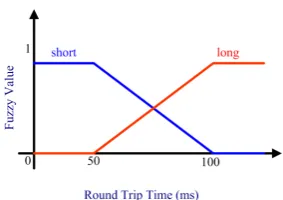
2. Fuzzy membership function (R) of round trip time (r). Two fuzzy sets,shortandlong, are defined in Equation 2 and shown in Figure 4.
R=
short ifris less than 50ms
Figure 4. Fuzzy membership function (R) of round trip time (r)
3. Fuzzy membership function (E) of link error rate (e). Two fuzzy sets,lowandhigh, are defined in Equation 3 and shown in Figure 5.
E=
low ifeis less than 0.1% high ifeis more than 5% (3)
Figure 5. Fuzzy membership function (E) of link error rate (e)
4. Fuzzy membership function (S) of optimal stream number (n). Five fuzzy sets,least,less,normal, more, and most are defined in Equation 4 and shown in Figure 6.
S=
least ifnis less than 2 less ifnfrom 2 to 4 normal ifnfrom 4 to 6 more ifnfrom 6 to 8 most ifngreater than 8
(4)
After an investigation and deliberation, we identified the relation betweenSand factors that can be described using fuzzy rules and illustrated in Table 1.
4.2. Fuzzy Logic Based Stream Number
Deter-mination
For given input variablesb,e, r, there must be a unique membership function associated with each in-put parameter. Based on the membership function, the
[image:4.595.102.244.72.172.2]Figure 6. Fuzzy membership function (S) of op-timal stream number(n)
Table 1. Fuzzy logic system rules
Input Output
B E R S
small low short more small low long less small high short most small high long more normal low short normal normal low long less normal high short more normal high long normal
big low short less
big low long least
big high short more
big high long less
membership degree values F(B), F(E), F(R) can be determined. In our implementation of stream number rules, the membership degree values should be:
1. for member functionB
Fi(B) =FL−rulei(B),i∈ {1,2, . . . ,12} (5)
2. for member functionR
Fi(R) =FF−rulei(R),i∈ {1,2, . . . ,12} (6)
3. for member functionE
Fi(E) =FN−rulei(E),i∈ {1,2, . . . ,12} (7)
Moreover, the membership functions associate a weighting factor,Wi, with values of each input and the
effective rules. These weighting factors determine the degree of influence or degree of membership (DOM) each active rule has. The weighting factor,Wi, for each
[image:4.595.71.279.257.400.2]Wi=min{Fi(B),Fi(R),Fi(E)},i∈ {1,2, . . . ,12} (8)
By computing the logical product of the member-ship weights for each active rule, a set of fuzzy output, Si, response magnitudes are produced by using
Equa-tion 9.
Si=FS−rulei(Wi),i∈ {1,2, . . . ,12} (9)
Finally, all that remains is to combine and defuzzify these output responses. The optimal stream number can be computed by:
S=∑
12
i=1WiSi
∑12i=1Wi
=W1S1+W2S2+. . .+W12S12 W1+W2+. . .+W12
(10)
5. Experiment Results
[image:5.595.314.537.377.496.2]In this section, we test the modified SCTP proto-col on a simulated network using NS2 [4]. We used the simplest network to investigate the multi-streaming features. Our approach has been tested on a network as illustrated in Figure 7. The detailed parameters are shown in Table 2.
Figure 7. Network used in simulation
Table 2. Parameters used in experiment sce-nario
Parameter Value
Application traffic FTP/CBR Initial RTT 100 ms Packet Size 512 bytes Simulation time 5 minutes Number of nodes 2
Available bandwidth 8 Mb/s
The objective of this experiment is to:
• demonstrate the feasibility of the modified SCTP protocol.
• prove the fuzzy logic can be deployed in the net-work.
• show the goodput which have been generated by using the modified SCTP is always the best among other the situations.
• demonstrate the effects of different parameters to the optimal number of streams.
The SCTP protocol and modified SCTP protocol were tested on the network for three different scenarios. In each scenario, we carried experiments for the number of stream are 1, 2, 3 and 4 and a number which is deter-mined by the fuzzy system before the SCTP association is established. Especially, if there is one stream used in SCTP, it is actually the TCP/UDP connection.
5.1. Different Buffer Sizes
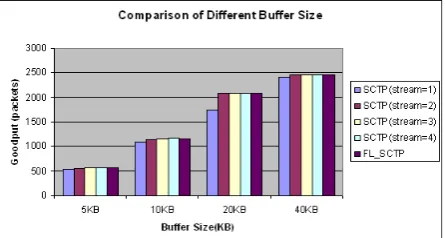
In scenario 1, the buffer size on the receiver is dif-ferent. We can image that the bigger the buffer size, the better the goodputs for the reason that the receiver has enough buffer size to store many packets while waiting on a lost packet.
[image:5.595.64.290.543.635.2]Figure 8. The comparison of SCTP and modi-fied SCTP with different buffer size (b)
Figure 8 shows that the modified SCTP in which the fuzzy system determines an optimal number always perform the best for all buffer sizes.
5.2. Different Link Error Rates
to heof-line blocking more frequently; therefore, ad-ditional streams may be helpful to reduce this problem. In all five comparisons, the modified SCTP exactly op-timized the number of streams, as shown in Figure 9.
Figure 9. The comparison of SCTP and modi-fied SCTP with different link error rate (e)
5.3. Different RTTs
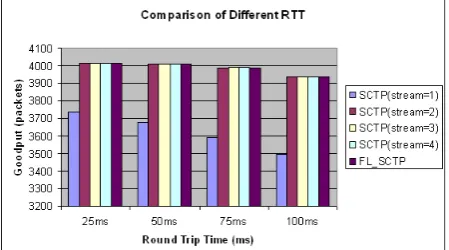
Round Trip Time (RTT) is an indicator that the total propagation delay of a transmission. For a satellite com-munication, it might take a few seconds, it will have a huge impact on the goodput. For each RTT value, more streams are helpful to increase goodputs because more packets cause increased amounts of link error and the possibility of the head-of-line blocking is higher than other cases. In this scenario, the fuzzy system also determine the optimal number of stream for all given round trip times, as shown in Figure 10.
Figure 10. The comparison of SCTP and modi-fied SCTP with different round trip time (r)
6. Conclusion
In this paper we proposed a modified SCTP pro-tocol that can be used in wireless networks in which
many TCP algorithms such as TCP-Reno can not be used. The modified SCTP protocol allows the sender to collect and analyze the real-time data from network and receiver before an association establishment so that the sender may evaluate the optimal number of streams. We also demonstrated our implementation of modified SCTP protocol in NS-2 platform. Simulation demon-strated the feasibility and the performance of modified SCTP protocol is affordable and comparable but more intelligent than other original SCTP protocol in which the number of streams is not determined, but left to peo-ple to guess.
There are, however, many issues and problem for further study in this area for the future. For instance, we can
• take into consideration more factors which may af-fect the optimal number of streams while design-ing the fuzzy logic system;
• explore more opportunities using the modified SCTP in the multimedia applications such as tele-conference, video/audio streaming, etc.
References
[1] Sukwoo Kang, Matthew Fields. ”Experimental Study of the SCTP compared to TCP”. Electrical Engineering Department, Texas A&M University, USA.
[2] R. Stewart, Q. Xie, K. Morneault, and C. Sharp et. al.
”Stream control transmission protocol”. RFC 2960, Oct 2000.
[3] Mohammed Atiquzzaman and William Ivancic. ”Eval-uation of SCTP Multistreaming over Satellite Links”. School of Computer Science, University of Oklahoma. [4] S. McCanne and S. Floyd. ”ns network simulator”.
http://www.isi.edu/nsnam/ns/.
[5] Stephen T. Welstead.”Neural network and fuzzy logic applications in C/C++”. John Wiley & Sons, Inc., New York, NY, USA, 1994.
[6] S. Fu and M. Atiquzzaman. ”Improving End-to-End Throughput of Mobile IP using SCTP” Proc. 2003 Workshop High Performance Switching and Routing, IEEE Press, 2003.
[7] A.Jungmaier, M.Schopp, et al. ”Performance Evalua-tion of the Stream Control Transmission Protocol”. In Proceedings of the IEEE Conference on High Perfor-mance Switching and Routing, June 2000.
[8] Ashwini Kumar, Lillykutty Jacob and A. L. Ananda.
”SCTP vs TCP : Performance Comparison in MANETs”. IIT Kanpur, India. NIT Calicut, India. and NUS, Singapore.
[image:6.595.65.290.465.590.2]