Explaining Negotiation Outcomes: Process
or Context?
Cynthia Irmer1and Daniel Druckman2
1 Office of the Coordinator for Reconstruction and Stabilization, U.S. Department of State, Washington, DC, USA
2 Department of Public and International Affairs, George Mason University, Fairfax, VA, USA and Australian Centre for Peace and Conflict Studies, University of Queensland, Brisbane, Australia
Two substantial traditions of negotiation scholarship provide different perspectives on the factors that generate outcomes. One of these traditions is found in the work of con-flict resolution (CR) theorists. They place their bets on the role played by the negotia-tion process. Another is found in the work of many internanegotia-tional relanegotia-tions (IR) researchers. They prefer studying the role played by the larger contexts surrounding negotiation. This clash of perspectives is due, at least in part, to a prevailing focus on either micro (CR) or macro (IR) level variables. We confront these perspectives in this Keywords
negotiation processes, outcomes, plausibility probe, process tracing, structured focused comparisons, trust.
Correspondence
Daniel Druckman, Department of Public and International Affairs, George Mason University, Fairfax, VA 22030, USA; e-mail: [email protected].
Abstract
This study evaluates a set of hypotheses about the relative influence of negotiating processes and contexts on out-comes. The investigation proceeds in a sequence of steps. First, a number of process and outcome variables are coded from documented cases of 26 settled violent con-flicts that have occurred since the end of World War II. These cases are used also to evaluate the impact of four contextual variables. High partial correlations indicate a strong relationship between process and outcome control-ling for context. Second, a set of structured focused comparisons was conducted with four matched and mis-matched cases. By tracing the process in each of these cases through phases of the talks, we showed that there is a causal relationship between process and outcome. Third, a plausibility probe was designed to identify a mechanism responsible for the causal relationship. The probe discovered that the development of trust is a plau-sible explanation for the relationship between process and outcome. This mode of inquiry, referred to as ACE (association, causation, and explanation), is regarded as a model for research on negotiation and peace processes.
article by pitting them against each other as competing hypotheses. The central question of the research is whether process or context has a stronger impact on the outcomes of negotiations intended to end violence.
We provide background on the competing arguments along with hypotheses. Three sets of hypotheses are presented in an attempt to capture the issue; they emphasize either process or context. The hypotheses are evaluated in sequence, with both a large and small number of cases, proceeding from statistical analyses that demonstrate asso-ciation (A) to qualitative investigations that ascertain causation (C) to plausibility probes that identify explanatory mechanisms (E). The ACE methodology is a contribu-tion to the analysis of comparative case studies. By employing the logic of experimenta-tion, we go beyond the discovery of statistical relationships. The methodology allows us to probe both for causation and explanation. This is an innovation for case-based research, which has been primarily descriptive or correlational.
Conflict Resolution: Process
A fundamental question asked by many CR researchers is: to what extent are outcomes the result of negotiating processes? A number of the early conceptual frameworks posit that outcomes derive directly from negotiating processes (Sawyer & Guetzkow, 1965 Randolph, 1966; Druckman, 1973). Walton and McKersie (1965) introduced the distinc-tion between two types of processes, distributive and integrative bargaining. Better, more lasting outcomes were thought to derive from integrative than from distributive processes. Support for this hypothesis has come from a variety of laboratory studies (see Pruitt, 1981, and Pruitt & Carnevale, 1993, for reviews), computer simulations (Bartos, 1995), and field studies (Kressel, Fontera, Forlenza, Butler, & Fish, 1994). These studies have identified the factors that increase the chances of discovering an integrative solution: They include logrolling skills, attractiveness of alternatives, information exchange processes, low time pressure, and privacy (see Druckman & Robinson, 1998, for a review of the factors). Emphasized in particular is the importance of problem solving—as contrasted to bargaining—processes. An attempt is made in this study to investigate the role of problem solving in negotiations intended to achieve peace agreements between countries in conflict or at war.
of concessions that occur in bargaining. At the heart of this argument is the assumption that different kinds of negotiation processes produce different outcomes. This assump-tion takes the form of a hypothesis to be explored in this study.
With regard to international negotiation, Hopmann (1995) connects the distinction between bargaining and problem solving to the prevailing perspectives on IR. The customary competitive bargaining engaged in by diplomats reflects a realist approach to foreign policy. The emphasis is placed on achieving relative gains—correlated to relative power—both inside and outside of negotiating venues. This approach has produced inflexibility on the part of negotiators and impasses as the outcome of many inter-governmental talks. The less-often used problem-solving approach corresponds to a liberal approach to foreign policy. The emphasis is placed on attaining absolute gains that refer to joint (rather than relative) benefits. This approach should produce negotia-tor flexibility and more satisfacnegotia-tory negotiation outcomes. Indeed, evidence for these relationships was obtained by Wagner (2008). Her content analyses of 13 historical cases of bilateral and multilateral negotiations showed that problem-solving behaviors corre-lated significantly with the extent to which outcomes were integrative or comprehensive. Processes that are more likely to lead to integrative agreements included frequent prob-lem-solving behaviors, a sustained use of these behaviors through the middle phases of negotiation, a framing of the issues in terms of shared values, and the creation of formu-lae. These processes were found to occur less often in negotiations over security issues.
Similar findings were obtained from the Druckman and Lyons (2005) comparative study of peace processes. They found that frequent problem-solving behaviors with an emphasis on joint gains led to more integrative outcomes than frequent distributive behaviors with an emphasis on relative gains. The former were displayed by parties negotiating the 1992 Rome agreement that resolved the conflict in Mozambique; the latter were displayed by the parties negotiating the 1994 cease fire between Armenia and Azerbaijan over Negorno-Karabakh. The authors note that problem-solving behaviors are more likely to occur when parties enter talks with cooperative orientations. Liberal approaches to foreign policy are more likely to encourage these orientations, which, in turn, set into motion a process sequence that results in sustained political agreements. Those agreements are closer to a resolution (as in Mozambique) than to a settlement (as in Nagorno-Karabakh) of the conflict.
These distinctions resemble the aggregated categories of hard versus soft bargaining derived from the categories of the bargaining process analysis coding system (Walcott & Hopmann, 1978). The other process variables include the difference between concealing and sharing information (Groom, 1986; Kressel et al., 1994), threatening or advising/ques-tioning (Fisher, 1997), ambiguous or clear language (Walton & McKersie, 1965; Kelman, 1965), and the distinction among types of conflict behaviors (competing, avoiding, accommodating, cooperating, collaborating) (Fisher, 1997; Groom, 1986).
An attempt was also made to unpack the concept of negotiating outcomes, particu-larly the distinction between comprehensive and partial or unresolved outcomes. The earlier studies emphasize contrasting outcomes: those that consider implementation and those that do not (Groom, 1986; Kressel et al., 1994; Druckman, Martin, Allen Nan, & Yagcioglu, 1999); those that include joint projects versus those that only reflect the par-ties’ claims (Fisher, 1997); and those that resolve underlying issues versus those that do not (Fisher, 1997; Azar & Burton, 1986). In addition, outcomes of peace negotiations address the extent to which demobilization of troops or demilitarization has occurred (Lyons, 2002) and the extent to which constitutional reform was instituted (Groom, 1986; Hume, 1994).1
The review suggests that processes and outcomes are correlated. Many of the earlier studies also suggest that processes cause outcomes. Thus, two general hypotheses are offered:
Hypothesis 1a: Cooperative or problem-solving (competitive/distributive) negotiation processes co-vary with more (less) comprehensive negotiating outcomes.
Hypothesis 1b: Cooperative or problem-solving (competitive/distributive) negotiation processes lead to more (less) comprehensive negotiation outcomes.
These hypotheses do not, however, suggest reasons why the relationship between pro-cesses and outcomes occur. Questions that arise are: what accounts for the relationship between negotiating processes and outcomes and why do cooperative (competitive) pro-cesses result in comprehensive (partial) outcomes? The experimental literature offers some clues. Trust has been shown to be key to negotiation strategies and outcomes as both an antecedent and consequence (Lewicki & Bunker, 1996). High and low trusts distinguish between integrative and distributive strategies (Rotter, 1971; Kramer, 1994; Lewicki, Litterer, Minton, & Sanders, 1994). Trusting negotiators have been shown to use more integrative or cooperative strategies than those who do not trust their oppo-nents (see also Parks & Rumble, 2001). In these experiments, trust was assessed prior to negotiation. This is difficult to do with historical case studies. The cases can however be analyzed for the way trust develops during the course of a negotiation. Moving from initial low levels to higher levels of trust should coincide with more cooperative pro-cesses leading to better joint outcomes. This stage-like concept progresses from mistrust
1Other aspects of processes (e.g., tactics and issues) and outcomes (e.g., durability) may also be relevant.
to calculus-based, knowledge-based, and identity-based trust (Lewicki & Stevenson, 1997). An attempt is made in this study to assess the progression of trust in several cases. The relationship posited is that the development of trust and cooperative (prob-lem-solving) behavior are mutually reinforcing processes that lead to more comprehen-sive outcomes. Two hypotheses are suggested:
Hypothesis 2a:Cooperative (competitive) negotiation processes co-vary with increased (decreased) trust between the parties.
Hypothesis 2b: Increased (decreased) levels of trust—going from calculus (identity) to identity (calculus)-based trust—lead to more (less) comprehensive negotiating outcomes.
International Relations: Context
An emphasis on context rather than process is found in the work of many IR researchers. Results obtained in several negotiation studies suggest that context may be important. In a study of base-rights negotiations, Druckman (1986) showed that the final agreement was primarily the result of an external event, in that case the death of a head of state. Similar findings were obtained from an analysis of 23 cases of bilateral and multilateral international negotiations. Outcomes did not derive from processes. They were influenced more by outside influences, political relations, and features of the negotiating situation (Druckman, 1997). Those analyses also found that the set of cases could be distinguished in terms of conference size and issue complexity. One difference is that treaties were the more likely outcome of bilateral than multilateral talks. These studies call attention to the importance of factors outside of the process, in the negotiating situation. The factors are aspects of the proximal situation confronting negotiators.
While calling attention to the importance of these factors, the studies do not probe the broader contexts in which the negotiations occurred. That context includes the more distal features of regional and international structures including geography. Those are the types of factors emphasized more generally by macro-level perspectives on negotia-tion in IR (e.g., Simmons, 2002; Werner, 1999).
Regional stability has also been shown to contribute to peaceful relations among states. Referred to as ‘‘spillover effects,’’ conflict in one country can destabilize another country in the same region (Singer & Wildavsky, 1996). The settlements of violent conflicts are more difficult to negotiate in less stable regions. These variables are aspects of the broad context thought to account for negotiating outcomes. The discussion above suggests a third set of hypotheses:
Hypothesis 3a:More (less) comprehensive outcomes result from negotiations between similar (different) regimes, particularly if the similar regimes are democracies.
Hypothesis 3b:More (less) comprehensive outcomes result from negotiations between distant (neighboring) states.
Hypothesis 3c: More (less) comprehensive outcomes result from negotiations between members of the same (different) relatively small international alliance.
Hypothesis 3d:More (less) comprehensive outcomes result from negotiations between members of stable (unstable) regions.
The three sets of hypotheses confront competing explanations for negotiation out-comes. Are outcomes accounted for primarily by negotiating processes or more by the context within which negotiation occurs? Conceivably, both process and context may influence outcomes, as noted by Druckman (1983, 2007). The issue addressed by this study concerns the relative strength of these types of factors. This issue addresses independent influences. But, more complex interactions between process and context may also occur, as when trust develops more easily between parties who are members of the same alliance or have similar regimes. Thus, contextual factors may have indirect influences on outcomes through processes. Processes may intervene between contextual factors and outcomes. We return to this issue in the discussion section.
This study is significant in several ways. It contributes a systematic approach for comparative research with cases. The hypotheses are evaluated by a sequence of analyses referred to as association, causation, and explanation (ACE). It provides insights into an important theoretical issue that divides those conflict researchers who focus their atten-tion on process and the IR scholars who study context. Going beyond statistical rela-tionships, the analyses suggest a possible mechanism for the findings. Further, the diverse set of cases analyzed strengthens the argument for external validity. In the sections to follow, we discuss the logic of this sequence, the methods used for analysis, the results, implications for the issues that are addressed, and ideas for further research.
The Approach
results are also shown in the table. The first question addresses hypothesis 1a: What is the relationship between negotiating processes and outcomes? This hypothesis is addressed with 26 cases of negotiations to end violent international conflicts.2Spearman rank-order correlations were computed among the various process and outcome variables as well as between an aggregated process and outcome index.
The second question addresses hypotheses 3a–d. It asks whether the obtained co-vari-ance between process and outcome is genuine or a reflection of several aspects of the larger context surrounding the negotiations. Partial rank-order correlations were computed to ascertain the relationship between process and outcome controlling for the influences of the four context variables. As well, the relationship between context and outcome was assessed controlling for the influence of the process variables.
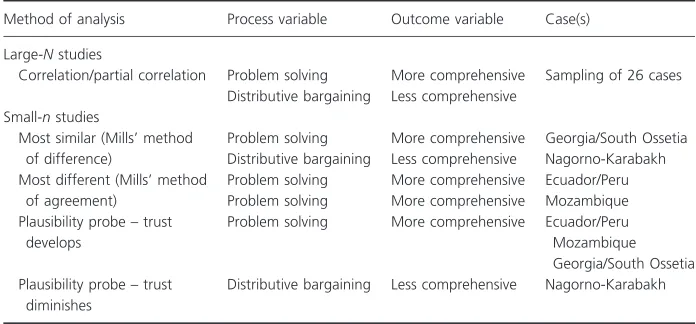
Next, we address hypothesis 1b by probing the direction of the relationship between processes and outcomes. This probe consists of a structured focused-comparison that matches cases for similarities and differences.The logic was developed originally by John Stuart Mill and is referred to as the method of difference and the method of agreement (see Faure, 1994). His ‘‘method of difference’’ consists of examining the most similar cases for differences on the independent and dependent variables. His ‘‘method of agree-ment’’ consists of examining the least similar cases for similarities on the independent and dependent variables. These experimental-like comparisons bolster an interpretation that the independent variables caused the dependent variable because other variables were ‘‘held constant’’ (most similar cases) or differed in ways that only the similar independent variable under study—namely, the negotiation process—would have been responsible for the values on the dependent variable (least similar cases).
[image:7.432.38.386.78.240.2]The conflicts between Armenia and Azerbaijan over Nagorno-Karabakh and between Georgia and South Ossetia were selected for the most similar comparisons. These cases Table 1
Methods, Hypothesized Relationships, and Cases
Method of analysis Process variable Outcome variable Case(s)
Large-Nstudies
Correlation/partial correlation Problem solving More comprehensive Sampling of 26 cases Distributive bargaining Less comprehensive
Small-nstudies
Most similar (Mills’ method of difference)
Problem solving More comprehensive Georgia/South Ossetia Distributive bargaining Less comprehensive Nagorno-Karabakh Most different (Mills’ method
of agreement)
Problem solving More comprehensive Ecuador/Peru Problem solving More comprehensive Mozambique Plausibility probe – trust
develops
Problem solving More comprehensive Ecuador/Peru Mozambique Georgia/South Ossetia Plausibility probe – trust
diminishes
Distributive bargaining Less comprehensive Nagorno-Karabakh
were similar in terms of geographic location, population size, variety and distribution of ethnic groups, religion, literacy rate, type of government, and labor force demographics. They differed however on the process variables. The question asked is whether they differed also on the dependent outcome variables. The conflicts within Mozambique and between Ecuador and Peru were selected for the least similar comparisons. These cases differed on the nonprocess variables but were similar on the process variables. The ques-tion asked is whether similar outcomes occurred. For both analyses, we asked—following hypothesis 1b—whether problem-solving (distributive) processes lead to comprehensive (partial or impasse) outcomes (see Table 1). These four cases were not included in the larger set used for the statistical analyses.
Further evidence that bears on causality was provided by the results of a process-tracing analysis of the four cases used in the focused comparison. Referred to by George and Bennett (2005) as process verification, we asked whether the observed relationships between process and outcome correspond to theoretical predictions. Affirmative evidence is provided by an unbroken chain of events from processes to outcomes. This is indicated by a continuously high or increasing level of problem-solving behaviors exhibited during the process culminating in comprehensive outcomes. It is also indicated by a continuing low or decreasing level of problem-solving behaviors exhibited during the process culminating in less comprehensive outcomes.3
The fourth question addresses hypotheses 2a and 2b on the mechanism that explains the process-outcome relationship. This question was addressed by performing a plausibility probe on each of the four cases selected for the focused comparisons. Referred to by George and Bennett (2005) as process induction, we asked whether the relationship between process and outcome is mediated by trust. This is indicated by movement during the process from lower (mistrust or calculus-based trust) to higher levels (knowledge or identity-based trust) of trust for the problem-solving cases, as suggested by hypothesis 2b. It is also indicated by decreasing levels of trust for cases with distributive processes, also suggested by hypothesis 2b.4Trust levels were monitored throughout the process following Trochim’s pattern matching technique.5 The result is a chronological path that shows variation as well as central tendencies. The paths for problem-solving and distributive cases are compared. A chain of expected changes (variation) or of expected average levels of trust would support the hypothesis that this variable moderates the process-outcome relationship.
In the next section we describe the criteria used for case selection. This is followed by a discussion of the way that the various process, outcome, and context variables were measured.
3
All the cases chosen for analysis resulted in settlements. Although the settlements varied in degree of com-prehensiveness (the dependent variable), there were no stalemates. Thus, we did not consider cases where problem-solving behaviors did not culminate in agreements.
4Continuous high (low) levels of trust for the problem-solving (distributive) cases also suggest that trust is a
plausible explanation for the process-outcome relationship.
Cases
The criteria used to select cases for the large-Nanalyses were: (a) a settled violent inter-national conflict, (b) a violent conflict between a governing regime and an insurgency that was settled, or (c) the settlement process consisted primarily of negotiation. An extensive search resulted in 55 cases of post-World War II negotiated settlements of conflicts widely dispersed around the world from the 1940s to the 1990s. However, many of these cases were not sufficiently documented to permit coding on many of our variables. Using documentation as another criterion for selection, 26 cases were chosen for analysis. Most cases were located through the Pew Case Studies on International Affairs at Georgetown’s Institute for the Study of Diplomacy, the Harvard Law School Program on Negotiation, books of case studies (e.g., Greenberg et al., 2000) and some internet sources. The cases ranged between 20 and 75 pages in length.
Additional cases were selected for the qualitative analyses. Since these cases were to be used for more detailed process tracing, book length documentation was desired. With the assistance of knowledgeable scholars, we selected four cases not used in the large-N analyses. As shown in Table 1, the two most similar cases were the conflicts in Georgia/ South Ossetia (Gluskin, 1997) and in Nagorno-Karabakh (Mooradian, 1996). The two most different cases were the conflict between Ecuador and Peru (Marcella & Downes, 1999) and within Mozambique (Hume, 1994). These cases were used also for the plausi-bility probes designed to identify a mechanism responsible for the relationship between negotiating process and outcome.
Measuring Processes, Outcomes, and Context
The variables consisted of eight indicators of negotiating process, five outcome variables, four context indicators, and a trust scale for the plausibility probe. Sources for each variable were discussed above. The process and outcome variables were scaled in terms of four steps, ranging from most competitive (least comprehensive) to most cooperative (most comprehensive). The decision to use four steps was made in conjunction with our reading of the case documentation. A key decision was the distinction between the two mixed categories: It was possible to distinguish between a moderate amount of competition (some agreements) and a moderate amount of cooperation (a larger number of agreements). These steps seemed to capture the range of variation found in the case documentation. An example of a process scale is as follows:
(1) Commitment to positions: A party has ‘‘dug in its heels’’ and become unwilling to change a negotiating position, especially due to a belief in perceived power or superiority over the other party.
(2) Mixed: A party is attempting to strengthen its position, wanting to stick with it, but recognizing that it may not have capabilities to stand firm.
(4) Identify interests: A party has begun to discard some of its inaccurate preconceptions of the other and to develop an understanding of the parties’ interests underlying the conflict.
The other process variables include the extent to which parties exchanged informa-tion, a focus on maximizing own versus joint interests, relative or absolute (joint) gains, threatening or empathizing with the other party, demanding or brainstorming, using ambiguous or clear language, and being competitive or cooperative. Each of these variables captured the distinction among being competitive (1), accommodative (2), cooperative (3), or collaborative (4).
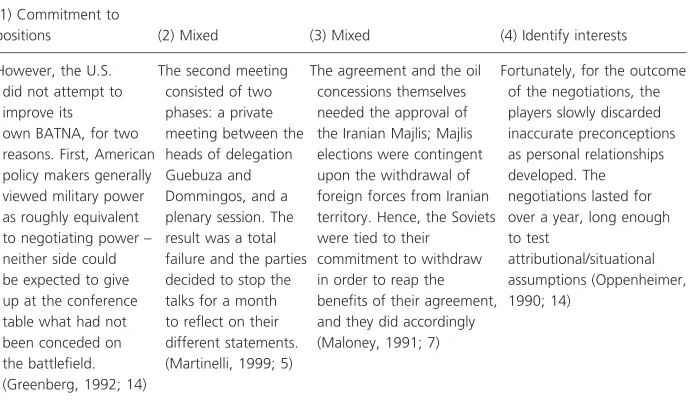
A negotiation was an incident within which codeable events occurred. Events con-sisted of the actions or behaviors shown by parties (or representatives) as documented during the course of negotiations. An event occurred during formal sessions as well as during more informal meetings around the negotiation. An example of an event coded in each of the categories of the continuum shown above follows.
(1) Commitment to
positions (2) Mixed (3) Mixed (4) Identify interests
[image:10.432.49.394.234.434.2]However, the U.S. did not attempt to improve its own BATNA, for two reasons. First, American policy makers generally viewed military power as roughly equivalent to negotiating power – neither side could be expected to give up at the conference table what had not been conceded on the battlefield. (Greenberg, 1992; 14)
The second meeting consisted of two phases: a private meeting between the heads of delegation Guebuza and Dommingos, and a plenary session. The result was a total failure and the parties decided to stop the talks for a month to reflect on their different statements. (Martinelli, 1999; 5)
The agreement and the oil concessions themselves needed the approval of the Iranian Majlis; Majlis elections were contingent upon the withdrawal of foreign forces from Iranian territory. Hence, the Soviets were tied to their commitment to withdraw in order to reap the benefits of their agreement, and they did accordingly (Maloney, 1991; 7)
Fortunately, for the outcome of the negotiations, the players slowly discarded inaccurate preconceptions as personal relationships developed. The negotiations lasted for over a year, long enough to test
attributional/situational assumptions (Oppenheimer, 1990; 14)
The five outcome variables consisted of a consideration of implementation issues, extent to which joint projects were considered, the extent to which underlying issues were addressed, the extent of demilitarization, and the extent to which constitutional reforms were undertaken. An aggregated outcome variable combines these criteria, resulting in vary-ing degrees of comprehensive outcomes. The implementation variable scale is as follows:
(2) Mixed: Parties acknowledge possible difficulties implementing the agreement but do not mention them in the agreement.
(3) Mixed: Parties may have considered difficulties with or options for implementing the agreement but have not addressed this in the agreement.
(4) Outcomes consider implementation: Parties have identified potential difficulties with implementing the agreement and made some provision for or statement about address-ing such difficulties in the agreement. For example, ‘‘Even with a substantive compro-mise in place, there was still a perceived need to develop independent institutions in order to guide the transition process. One useful precedent in the South African context was the Commission of Inquiry into Public Violence’’ (Bouckaert, 2000; 254).
The four context variables were regime type, geographic proximity, alliances, and regional stability. Categories for regime type were derived from Mousseau’s (1998) modification of the Polity IV data set. Each negotiating case was categorized as ‘‘all parties have autocratic regimes,’’ ‘‘mixed’’ (autocratic parties negotiating with democratic parties), and ‘‘all parties are democratic.’’ The 1994 National Geographic World Political Map6was used to define the geographic proximity variable. Each case was judged as ‘‘the parties were within the boundaries of the same sovereign state’’ (an example of intra-state conflict), ‘‘at least two parties shared a common border’’ (contiguous states), and ‘‘none of the parties shared a common border’’ (noncontiguous states). Oren’s (1990) data set was used to define alliances: the parties in each case were judged as ‘‘not aligned,’’ ‘‘members of the same mul-tilateral alliance,’’ or ‘‘members of the same small alliance.’’ Singer and Wildavsky’s (1996) distinction between zones of turmoil and zones of peace was used to define the regional sta-bility variable. Each case was categorized in terms of the locus of conflict: ‘‘within a zone of turmoil’’ (instability), ‘‘neither type of zone’’ (somewhat stable), or ‘‘within a zone of peace’’ (stability). These distinctions apply both to the Cold War and post-Cold War periods. Definitions of each category of the regime type variable with examples are the following:
(1) Autocracy: At the time of the conflict, no party had a democratic form of govern-ment. An example is the Beagle Channel conflict between Argentina and Chile.
(2) Mixed: At the time of the conflict, fewer than all parties had democratic forms of government. An example is the 1972 Simla Agreement between India and Pakistan.
(3) Democracy:At the time of the conflict, all parties to the conflict had a democratic form of government. An example is the 1993 negotiation about the islands dispute between Japan and Russia.
The development of trust among the parties is hypothesized as an intervening variable that explains process–outcome relationships. Several stages of trust development have been proposed including calculus, knowledge, and identity-based trust. These categories can be arranged on a scale that preserves an ordering from less to more trusting relationships: Calculus-based trust is a more conditional form than identity-based trust. The order is as follows:
(1) No trust: The text indicates that parties did not trust each other. For example, ‘‘When the Chairman refused their advice, the Karabakh leadership perceived that he was making a political statement in support of Azerbaijan’’ (Mooradian, 1996; 398).
(2) Calculus-based trust: The text indicates that parties perceived the others as being consistent in their behavior, acting as though they believed the other would do what it said it would, or witnessed that the other kept its promises. For example, ‘‘One participant attributed this to the fact that the South Ossetian issue was very low priority in high Georgian political circles at the time’’ (Gluskin, 1997; 35)
(3) Knowledge-based trust: The text indicates that there was increased interaction among the parties, increased information sharing among parties, or that parties could accurately predict the other’s behavior. For example: ‘‘At the next round of negotiations, the parties agreed that they would begin discussing the impasses, that neither would veto the proposals of the other, and that all problems would be discussed in summarized accounts. This meant that Peru and Ecuador would at least listen to each others’ positions’’ (Marcella & Downes, 1999; 77–78).
(4) Identity-based trust: The text indicates that the parties began recognizing they had shared interests and similar motivations, goals, and objectives, that they had shared reactions in a common situation, or that they stood for the same values and prin-ciples. For example, ‘‘Just before the start of the second brainstorming session in Norway, the sides took an important step towards a resolution of the conflict... the parties signed a Memorandum outlining confidence building measures to be enacted to ensure security in the region’’ (Gluskin, 1997; 36).
These categories were used to code each of the events. Sequential events were organized by time of occurrence, enabling us to perform a time series analysis.
Steps were taken during the coding process to avoid possible biases. First, the set of cases was placed in two random orders. Second, the process coding, on the eight variables, was performed on the first random order. Third, the outcome coding, on the five variables, was done on the second random order. And finally, process and outcome scores were aggregated for each case in preparation for the statistical analyses.
Reliabilities
Two additional coders, working independently, were given randomly selected case studies and asked to: (a) identify codeable process events, (b) place each on the most relevant pro-cess scale, and (c) assign the event a score of 1–4 on the continuum selected. Two analyses of these data were performed. One compared the decisions made by each coder with those made by the first author. With regard to identification of codeable events, average agree-ment for one rater was 88%, for the other rater, 85%. With regard to selection of the spe-cific scaled continuum for each event, one rater agreed on 73% of the events while the other showed agreement on only 50% of the events. For placement on the scale selected, agreements of 88% and 100% were obtained. Only one of these agreement percentages is problematic. A possible explanation is that, unlike the first rater, the second was not in the field of conflict analysis. The discrepancy (73% vs. 50%) may have reflected a difference between them in content-relevant knowledge. However, when asked to assign a level to the event on the selected continuum, these raters agreed all of the time.
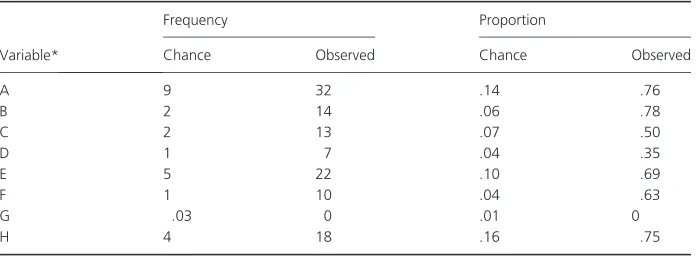
method (see Robson, 2002; see also Vanbelle and Albert, 2009, on the averaging method). It should be noted that this statistic is sensitive to any deviation from complete agree-ment. Thus, the estimates are conservative. With regard to scale choice, the unweighted kappa coefficient is 0.71 (SE = .04). The frequencies and proportions of agreement are shown in Table 2. The observed agreements deviate substantially from those expected by chance with only one exception. Coders disagreed on scale G (ambiguous or clear lan-guage): three of the six disagreements were between the G and H (type of conflict) scales. With regard to choices on the scales, the unweighted kappa coefficient is also 0.71 (SE= .07). The 40 of 47 possible agreements on the problem-solving choices deviates substantially from the 22 agreements expected by chance. The proportion of agreement is 0.73 (maximum possible is 0.97) which also deviates substantially from the proportion expected by chance, which is 0.30. Similarly, the 47 agreements on distributive categories deviate substantially from the 29 expected by chance. The proportion of agreement is 0.76 (maximum possible is 0.98), which also deviates substantially from the chance pro-portion of 0.37. From these results, we conclude that the process scales are reliable.
[image:13.432.40.388.76.204.2]The first author’s outcome judgments were then compared with those generated by another independent coder. With regard to outcomes, the unweighted kappa coefficient is 0.66 (maximum possible is 0.77). The observed agreements between these two independent coders on each of the five outcome scales deviated substantially from chance: 0.47 (observed; maximum possible is 0.67) versus 0.13 (chance expected); 0.55 (maximum possible is 0.67) versus 0.13; 0.53 (maximum possible is 0.93) versus 0.16; 0.78 (maximum possible is 1) versus 0.08, and 0.08 (maximum possible is 0.8) versus 0.04, respectively. These results indicate that the outcome scales are reliable.7
Table 2
Frequencies and Proportions of Agreement on the Process Variables
Variable*
Frequency Proportion
Chance Observed Chance Observed
A 9 32 .14 .76
B 2 14 .06 .78
C 2 13 .07 .50
D 1 7 .04 .35
E 5 22 .10 .69
F 1 10 .04 .63
G .03 0 .01 0
H 4 18 .16 .75
Note.*Process scales: A, maintain positions/discuss interests; B, conceal information/free exchange of
infor-mation; C, maximize individual interests/jointly explore common problems; D, seek relative gains/seek abso-lute gains; E, violence, threatening/questioning, reassuring; F, concession-making, retracting/brainstorming; G, ambiguous language/clear language; H, competitive/accommodative/co-operative/collaborative.
7Blind coding of outcomes—as was done here—may in fact underestimate agreement. It is likely that proper
Reliability statistics for the trust scale were calculated on comparable negotiation data reported in three recent studies. In one study, we assessed trust on the statements made by leaders surrounding the talks at Oslo I (Donohue & Druckman, 2009). Independent judgments made by two coders were aggregated across the types of trust. The kappa coefficient was 0.82. In another study, we assessed reliability for each scale based on reports from negotiators in a simulated international negotiation (Druckman, Olekalns, & Smith, 2009). The Cronbach alphas were 0.49 (calculus-based trust), 0.62 (knowledge-based trust), and 0.79 (identity-based trust). In a third study, we assessed reliability for each scale based on reports from negotiators in a simulated business negotiation (Druckman et al., 2009). The alphas were 0.45 (calculus-based trust), 0.64 (knowledge-based trust), and 0.72 (identity-based trust). These results indicate that the trust ratings are generally reliable. Less agreement on calculus-based trust suggests that this is a more challenging category to code.
Results
The results are presented in four parts following the order described above in the section ‘‘The Approach.’’ First, the findings obtained from the statistical analyses of 26 cases are shown. These include both the process-outcome and context variable correla-tions. Second, the focused-comparison findings are described for both the most and least similar comparisons. Third, the process-tracing results are presented for each of the four cases used in the focused-comparisons. A final section displays the time-series tracings, referred to as plausibility probes, for each case.
Statistical Findings
Average scores on each process and outcome variable were calculated for each case. These averages were then aggregated across the eight process and five outcome variables for summary indices. The aggregated scores are shown in the Appendix by case. Overall, the mean process score across the cases is 2.15, with a range from 1.09 to 3.21. On average, negotiators in these cases used a distributive more than a problem-solving approach. The mean outcome score is 2.06, with a range from 1.33 to 3.30. Thus, many of the cases concluded with less comprehensive or more partial outcomes.
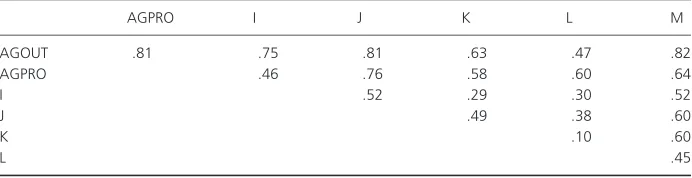
Correlations between the process and outcome variables are shown in Tables 3 and 4. The Spearman correlation between the aggregated process and outcome indices is 0.81 (p< .001).8This correlation indicates that type of negotiation process is strongly related to type of outcome, with 64% of the variation in one variable explained by the other. The more distributive the process, the less comprehensive the outcome. Further, the correla-tions between each of the process variables and aggregated outcome is substantial, ranging from a low of 0.39 (ambiguous vs. clear language) to 0.79 (concession-making/retracting
8The correlation increases to 0.86 when the four cases used in the small-nanalyses are added to the data
vs. brainstorming). Similarly, the outcome variables are highly correlated with aggregated process with correlations ranging from 0.46 (consideration of implementation) to 0.76 (individual vs. joint claims). These results support hypothesis 1a.
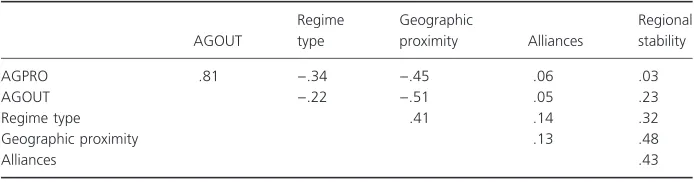
[image:15.432.40.391.76.199.2]The process-outcome correlations do not take context into account. Correlations between each of the context variables and the aggregated process variable is generally low:).37 (regime type), ).45 (geographic proximity), .06 (alliances), and .03 (regional stability) (see Table 5). Similarly, correlations with the aggregated outcome variable are quite modest)0.22, )0.51, 0.05, and 0.23, respectively. Only the geographic proximity variable is significant. Closer parties, such as those engaged in civil wars, are more likely to engage in distributive bargaining resulting in less comprehensive outcomes. But, these Table 3
Correlations Among Process Variables*
AGPRO A B C D E F G H
AGOUT .81 .67 .78 .65 .75 .49 .79 .39 .66
AGPRO .92 .72 .88 .86 .83 .90 .44 .87
A .56 .85 .78 .84 .78 .30 .79
B .55 .65 .52 .68 .36 .60
C .80 .74 .86 .39 .82
D .64 .85 .31 .74
E .69 .30 .71
F .39 .80
G .59
Note.*AGOUT, aggregate outcome; AGPRO, aggregate process; A, maintain positions/discuss interests; B,
conceal information/free exchange of information; C, maximize individual interests/jointly explore common problems; D, seek relative gains/seek absolute gains; E, violence, threatening/questioning, reassuring; F, concession-making, retracting/brainstorming; G, ambiguous language/clear language; H, competitive/ accommodative/co-operative/collaborative.
Table 4
Correlations Among Outcome Variables*
AGPRO I J K L M
AGOUT .81 .75 .81 .63 .47 .82
AGPRO .46 .76 .58 .60 .64
I .52 .29 .30 .52
J .49 .38 .60
K .10 .60
L .45
Note.*I, outcome does/does not consider implementation; J, outcome restates original claims/undertakes
[image:15.432.40.386.300.389.2]findings do not confront the possibility of a spurious relationship between process and outcome. That issue is addressed with partial correlations.
Correlations between process and outcome remain high when each context variable is controlled: 0.79 (controlling for regime type); 0.75 (for geographic proximity); 0.80 (for alliances); and 0.81 (for regional stability). Thus, the outcomes obtained in this set of cases are strongly associated with the type of process used. This result applies as well to disputing parties in close proximity. If these parties can be encouraged to engage in a problem-solving process, their talks are likely to conclude with more comprehensive agreements. These results do not support hypotheses 3a–d.
Structured Focused Comparisons
The correlation analyses reported in the previous section do not establish a causal relationship between process and outcome, as suggested by hypothesis 1b. A different kind of analysis is needed to assess the direction of the relationship between these variables. As described in the section ‘‘The Approach,’’ structured focused comparisons were used to compare processes and outcomes in sets of both matched and mismatched cases. As shown in Table 1, the matched cases are Georgia/South Ossetia and Nagorno-Karabakh. As noted above, these cases are similar on most of categories used for comparison: geographic location, population size, distribution of ethnic groups (one dominant group), distribution of religions (one dominant religion), official language, literacy, date of independence, type of government, and distribution of labor force. The mismatched cases are Mozambique and Ecuador/Peru. These cases are dissimilar on most of the nine categories used for comparison. The procedure consisted of comparing each pair of cases on the aggregated process and outcome scores.
[image:16.432.46.393.76.167.2]With regard to the matched cases, the aggregated process scores were 3.5 (Georgia/ South Ossetia) and 1.5 (Nagorno-Karabakh). The aggregated outcomes were 3.5 and 1.2, respectively. The problem-solving process used by negotiators to settle the Georgia/ South Ossetia conflict resulted in comprehensive outcomes. The distributive process used in the cease fire negotiations between Armenia and Azerbaijan resulted in a much less comprehensive agreement. The similarity of these cases on a variety of other variables bolsters the inference that outcomes are caused by the approach taken to negotiate the parties’ differences.
Table 5
Correlations Among Context Variables
AGOUT
Regime type
Geographic
proximity Alliances
Regional stability
AGPRO .81 ).34 ).45 .06 .03
AGOUT ).22 ).51 .05 .23
Regime type .41 .14 .32
Geographic proximity .13 .48
On the mismatched cases, the process scores were 2.6 (Mozambique) and 2.8 (Ecuador/Peru). The outcomes were identical, 3.5 for each case. In both cases, a process that was more like problem solving than distributive led to a comprehensive outcome. This finding of very similar processes and identical outcomes for cases that differ on a variety of other variables further reinforces the likelihood of a causal relationship between process and outcome, as posited by hypothesis 1b. Indeed, this finding for mismatched cases provides evidence for a robust relationship. A next step is to probe the negotiating process in more detail with process-tracing techniques.
Process Tracing
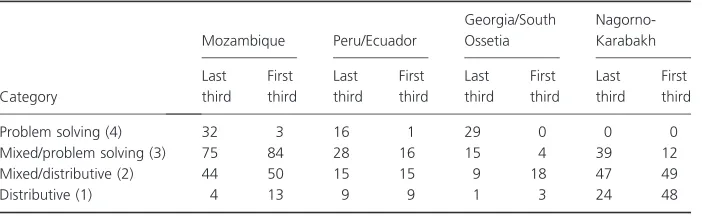
The aggregate measures described do not capture the way the negotiation process unfolds through time. These are summary measures of problem-solving and distributive codes across the phases of negotiation. It is necessary also to know whether these behav-iors increased or decreased from earlier to later phases. This is assessed by comparing the aggregated process measure for the first and last third of the negotiation conducted in each of the four cases. The comparisons are made for the number of codes assigned in each of the four categories, including distributive (1), mixed/distributive (2), mixed/ problem-solving (3), and problem-solving (4) behaviors. The results are reported for each case in Table 6.
[image:17.432.40.391.469.577.2]Considerably more problem-solving behaviors were coded during the last third of the talks than during the earlier phase of the negotiations about the conflict in Mozambique (32 vs. 3 problem-solving codes). There were fewer mixed and distributive codes during the later phases. Similarly, for the Ecuador/Peru and Georgia/South Ossetia cases, more problem-solving (and fewer distributive) codes were assigned during the last than first third of the negotiation. The Nagorno-Karabakh case presents a different picture. Although there is a trend toward more problem-solving behaviors from the first to the last phase, the bulk of the codes occur in the distributive categories: 89% in the first and 65% in the third phase. Further, no category four problem-solving behaviors were recorded in either the early or late phases. These data show clear trends toward increased problem-solving behavior for the three cases that concluded with comprehen-sive outcomes. They also show less distributive behavior from the beginning to the end
Table 6
Early and Late Processes by Coding Categories and Cases
Category
Mozambique Peru/Ecuador
Georgia/South Ossetia
Nagorno-Karabakh
Last third
First third
Last third
First third
Last third
First third
Last third
First third
Problem solving (4) 32 3 16 1 29 0 0 0
Mixed/problem solving (3) 75 84 28 16 15 4 39 12
Mixed/distributive (2) 44 50 15 15 9 18 47 49
of the Nagorno-Karabakh talks, a case that resulted in a less comprehensive outcome. The shift from distributive to problem-solving was not sufficient to produce a compre-hensive agreement. Overall, the process tracings buttress support for the causal relation-ship between negotiating processes and outcomes suggested by hypothesis 1b.
Plausibility Probe
The second set of hypotheses suggests that the relationship between process and outcome can be explained by trust. These hypotheses are addressed with a time-series analysis or plausibility probe described in ‘‘The Approach’’ section. The analysis is performed in steps. First, we advanced a concept—trust—that is hypothesized to explain the relationship between process and outcome. Second, we developed a scale designed to measure the concept. Third, events were coded for each case on the scale. And fourth, the events were arranged in a time series to discern patterns in the way the measure varies through the course of the negotiation process. This probe generates a plausible explanation for why different processes lead to different outcomes.
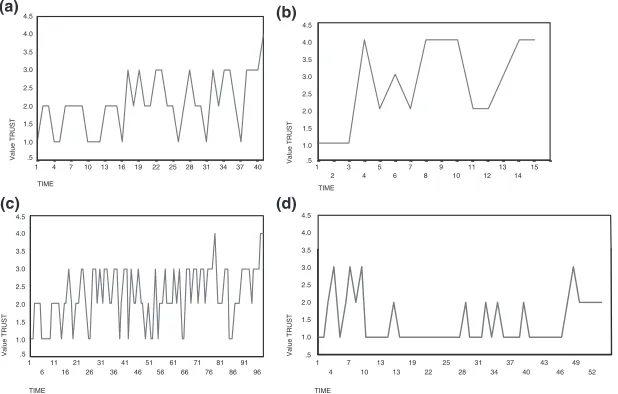
Hypothesis 2a suggests that trust co-varies with process: trust encourages problem-solv-ing behavior, which, in turn, enhances trust between the parties. The mutually reinforcproblem-solv-ing effects of trust and problem solving increase the chances for a more comprehensive agreement. The scale, drawn from Lewicki and Stevenson (1997) and shown above in the section on ‘‘Cases,’’ captures the idea of levels of trust. Starting with no trust, the scale pro-gresses from less (calculus-based) to more (knowledge and identity-based) trust. The coded levels are plotted against time for each of the four cases used in the focused-compar-ison analysis. A different number of events were coded for each case: 98 codes for Mozam-bique, 40 for Peru/Ecuador, 15 for Georgia/South Ossetia, and 53 for Nagorno-Karabakh. The results are shown in Figure 1a–d.
The patterns displayed in the figures demonstrate that trust is an important variable. For three of the four cases, low levels of trust are evident at the beginning, increasing through the course of the negotiations, and concluding at relatively high levels. Evidently, the parties moved back and forth between higher and lower levels but gravi-tated toward identity-based trust (level 4) at the end. It is as though they were tentative in their expression of trust or hesitant to be fully trusting until later in the talks. The key here is that they came around before settling on an agreement. Not so for the case of Nagorno-Karabakh. Although these negotiating delegations got off to a good start, showing knowledge-based trust in early time periods, they did not sustain this optimis-tic appraisal. At the end, they evinced a calculus-based trust (level 2). This low level of trust is coincident with the large number of distributive behaviors shown by these negotiators.
a verdict on hypothesis 2b awaits the results of research that examines the time lag between these variables. These and other issues are discussed in the section to follow.
Discussion
The literature reviewed in the opening section of this article suggests that relationships between negotiating processes and outcomes should not be taken for granted. Results obtained from earlier studies are mixed, with some calling attention to the role played by external factors as influences on outcomes. These then became contending explana-tions that correspond generally to the different perspectives of CR and IR theorists: Do outcomes result primarily from the way the process unfolds (CR) or are they influenced more strongly by the broader context surrounding the negotiation (IR)? Our results are clear. Outcomes correlate with process, not with context, as these variables were defined in the analysis. Further analyses lend support to a causal relationship between process and outcome. Thus, hypotheses 1a and 1b are supported; hypotheses 3a–d are not supported. Confidence in these findings is bolstered by the robust sampling of cases analyzed, the step-by-step probes of causation and explanation, and the multiple indicators of both processes and outcomes. Thus, the CR perspective garners more support from these findings than the IR perspective.
The plausibility probe highlights the role played by trust in these talks. This demonstra-tion shows that trust co-varies with process as specified by hypothesis 2a. An evaluademonstra-tion of causal influence entails separating trust from negotiating behavior. Although this is difficult to do with case studies, it is not beyond the realm of possibility. For example, cases can be selected for the four combinations of high/low trust and high/low problem-solving
[image:19.432.60.369.56.253.2]TIME 40 37 34 31 28 25 22 19 16 13 10 7 4 1 Value TRUST 4.5 4.0 3.5 3.0 2.5 2.0 1.5 1.0 .5 TIME 15 14 13 12 11 10 9 8 7 6 5 4 3 2 1 Value TRUST 4.5 4.0 3.5 3.0 2.5 2.0 1.5 1.0 .5 4.5 4.0 3.5 3.0 2.5 2.0 1.5 1.0 .5 TIME 96 91 86 81 76 71 66 61 56 51 46 41 36 31 26 21 16 11 6 1 Value TRUST 4.5 4.0 3.5 3.0 2.5 2.0 1.5 1.0 .5 TIME 52 49 46 43 40 37 34 31 28 25 22 19 13 13 10 7 4 1 Value TRUST (a) (d) (c) (b)
Figure 1.(a) Trust Development—Ecuador/Peru. (b) Trust Development—Georgia/South Ossetia. (c) Trust
behavior. Using outcome as the dependent variable, this focused comparison would isolate the relative effects of the two independent variables. The other issue concerning trust, raised in the introduction, is about complex interactions. Levels of trust may be influenced by such contextual variables as alliances or regional stability. These levels may then encourage or discourage cooperative behaviors leading to more or less comprehensive outcomes. This suggests a path model where contextual factors set in motion processes that lead to certain outcomes. It can be investigated with such tools as structural equation modeling (Byrne, 2001).
The results of this study are important both for theory and practice. With regard to theory, the findings support those CR frameworks that emphasize the importance of process. Particularly notable are the early frameworks of Sawyer and Guetzkow (1965) and Walton and McKersie (1965). The former highlighted a causal relationship between process and outcome. The latter offered the distinction between distributive and integra-tive (problem-solving) models of negotiation. These conceptual contributions are linked by our findings. Distributive processes led to less comprehensive outcomes. Integrative (problem-solving) processes produced more comprehensive outcomes. The findings also address the long-standing debate between the macro-level theorists of IR and the pro-cess-oriented researchers in the field of CR. The former tend to black-box the negotia-tion process in favor of explananegotia-tions that rely on policy or systemic variables (examples are found in the work of Simmons, 2002; Walter, 2002; and Werner, 1999). The latter focuses on the interactions and conversations held among the negotiators themselves (see also Donohue & Hoobler, 2002, and Donohue, 2003, for further empirical examples of interaction analysis).
Although the results lend support to the process-oriented approach, it is conceivable that other contextual variables may prove to be stronger influences on outcomes than those included in our analyses. While the variables chosen for analysis in this study were derived from earlier empirical work, they do not exhaust the list of potentially relevant contextual factors. For example, such aspects of the conflict environment as intervention by regional neighbors, border permeability, or disposable natural resources may come into play. These variables have been shown to influence the implementation of peace agreements (Downs & Stedman, 2002). Further, as noted earlier, process and context may interact. Impacts of context on process are likely when conflicts between other nations escalate during the negotiations, when changes occur in related (or linked) negotiations, or when policy changes within either or both parties’ governments occur (see Druckman et al., 2009, for an experimental example of impacts from the social climate). These relationships remain to be investigated.
presumed to lead to more amiable relationships between their groups (Rouhana, 2000). By showing that problem-solving processes produce better outcomes, our findings bolster these claims. They reinforce the value of interventions—whether Track I or II—intended to encourage problem-solving processes or to discourage distributive approaches to the resolution of conflict. They also offer the optimistic appraisal that opportunities for change are provided by tampering with a more malleable process than with a less malleable context surrounding negotiation.
Another important contribution of this study is to methodology. A multi-method approach to investigation is rare in case studies of negotiation and peace processes. This is not surprising given the demands on data collection and analysis. Both a large number of cases for statistical analysis and sufficient documentation of details for qualitative inquiry are needed. These challenges were met in this study. A sufficiently large data set was complemented by rich descriptions of processes in the cases selected for the microscopic probes.
Further, the logical progression of analyses performed may be a model for future research. It is an inductive progression guided by hypotheses. The next step depends on findings obtained from the previous analysis. Nonspurious association (A) between variables must be demonstrated before causality (C) can be assessed. Evidence for cau-sality precedes the search for a plausible explanation (E). This sequence, referred to by the acronym ACE, corresponds to the way that laboratory experiments are conducted. It captures the control, time-lagged, and intervening variable features of experimental design with retrospective case-based material. The control feature is addressed with partial correlations; an analog to the time-lagged feature is structured focused compari-sons, and the intervening variable search is set in motion with a plausibility probe. The result is a real-world demonstration of negotiation processes causing outcomes through the development of trust.
A number of ideas are suggested for further research. These include exploring the effects of other variables and sampling other types of cases, including those assisted by third parties. As noted above, the four contextual variables chosen for analysis in this study do not exhaust the domain. Although the plausibility probe highlights trust development as an explanation for the causal relationship between process and outcome, the analysis did not compare trust with other possible explanations. Other hypothesized mechanisms include the development of affiliative perceptions, trends toward symmetry in perceived power, and an increased (decreased) number of forward (backward)-look-ing statements through the course of the talks. However, these variables have been shown to correlate with trust (Donohue & Druckman, 2009). Thus, it will be necessary to evaluate their independent effects either by using statistical controls or by conducting experiments.
available for a variety of bilateral, trilateral, and multilateral trade talks (such as NAFTA), multilateral regime negotiations (such as those intended to establish cooperative relations among regional neighbors), and conference diplomacy in the areas of environmental regulation (such as the Rio and Kyoto agreements) and security (such as the United Nations conference on disarmament). Extending the sampling further, we could code process and context variables for cases of assisted, third-party negotiations such as those included in the Bercovitch and Trappl (2006) data set. The question of interest is whether the causal relationship between negotiation processes and outcomes, obtained in this study with a broad sampling of violent conflicts, is found also with other types of negotiated conflicts. This question, along with the others mentioned above, provides an interesting agenda for further research.
References
Azar, E., & Burton, J. W. (Eds.) (1986).International conflict resolution: Theory and practice. Boulder, CO: Lynne Rienner.
Bartos, O. J. (1995). Modeling distributive and integrative negotiations.Annals of the American Academy of Political and Social Science,542, 48–60.
Bercovitch, J., & Trappl, R. (2006). The Confman.2002 data set. In R. Trappl (Ed.), Program-ming for peace: Computer-aided methods for international conflict resolution and prevention. Advances in group decision and negotiation(Vol. 2, pp. 115–144). Dordrecht, The Netherlands: Springer.
Bouckaert, P. (2000). South Africa: The negotiated transition from apartheid to nonracial democracy. In M. Greenberg, J. H. Barton, & M. E. McGuinness (Eds.),Words over war: Mediation and arbitration to prevent deadly conflict(pp. 237–260). Lanham, MD: Rowman & Littlefield.
Byrne, B. (2001).Structural equation modeling with AMOS: Basic concepts, applications, and programming. Hillsdale, NJ: Lawrence Erlbaum.
Donohue, W. A. (2003). The promise of an interaction-based approach to negotiation.The International Journal of Conflict Management,3-4, 167–176.
Donohue, W. A., & Druckman, D. (2009). Message framing surrounding the Oslo I accords. Journal of Conflict Resolution,53, 119–145.
Donohue, W. A., & Hoobler, G. D. (2002). Relational frames and their ethical implications in international negotiation: An analysis based on the Oslo II negotiations.International Negoti-ation,7, 143–167.
Downs, G., & Stedman, S. J. (2002). Evaluation issues in peace implementation. In S. Stedman, D. Rothchild, & E. Cousens (Eds.),Ending civil wars: The implementation of peace agreements (pp. 43–69). Boulder, CO: Lynne Rienner.
Druckman, D. (1973).Human factors in international negotiations: Social-psychological aspects of international conflict. Sage Professional Papers in International Studies, Number 02–020. Beverly Hills, CA: Sage.
Druckman, D. (1986). Stages, turning points, and crises: Negotiating military base rights, Spain and the United States.Journal of Conflict Resolution,30, 327–360.
Druckman, D. (1997). Dimensions of international negotiations: Structures, processes, and outcomes.Group Decision and Negotiation,6, 395–420.
Druckman, D. (2002). Settlements and resolutions: Consequences of negotiation processes in the laboratory and in the field.International Negotiation,7, 313–338.
Druckman, D. (2007). Negotiating in the international context. In I. W. Zartman (Ed.), Peacemaking in international conflict: Methods & techniques(pp. 111–162). Washington, DC: United States Institute of Peace.
Druckman, D., & Lyons, T. (2005). Negotiation processes and postsettlement relationships: Comparing Nagorno-Karabakh with Mozambique. In I. W. Zartman & V. Kremenyuk (Eds.), Peace versus justice: Negotiating forward- and backward-looking outcomes (pp. 265–286). Lanham, MD: Rowman & Littlefield.
Druckman, D., Martin, J., Allen Nan, S., & Yagcioglu, D. (1999). Dimensions of international negotiation: A test of Ikle´’s typology.Group Decision and Negotiation,8, 89–108.
Druckman, D., Olekalns, M., & Smith, P. L. (2009). Interpretive filters: Social cognition and the impact of turning points in negotiation.Negotiation Journal,25, 13–40.
Druckman, D., & Robinson, V. (1998). From research to application: Utilizing research findings in negotiation training programs.International Negotiation,3, 7–38.
Faure, A. M. (1994). Some methodological problems in comparative politics.Journal of Theoret-ical Politics,6, 307–322.
Fisher, R. J. (1997).Interactive conflict resolution. Syracuse, NY: Syracuse University Press. Fisher, R., & Ury, W. (1981).Getting to yes. Boston: Houghton Mifflin.
George, A. L., & Bennett, A. (2005).Case studies and theory development in the social sciences. Cambridge, MA: MIT Press.
Gluskin, M. (1997).Facilitated joint brainstorming in the Georgia-South Ossetia conflict: A preliminary evaluation. Working paper. Cambridge, MA: Conflict Management Group. Greenberg, D. (1992).The American use of force in Vietnam: An unconventional approach to
negotiation. Cambridge, MA: Harvard Law School.
Greenberg, M., Barton, J. H., & McGuinness, M. E. (2000).Words over war: Mediation and arbi-tration to prevent deadly conflict. Lanham, MD: Rowman & Littlefield.
Groom, A. J. R. (1986). Problem solving in international relations. In E. Azar & J. W. Burton (Eds.), International conflict resolution: Theory and practice(pp. 85–116). Boulder CO: Lynne Rienner. Harbour, F. (2003). Collective moral agency and the political process. In T. Erskine (Ed.),Can
institutions have responsibilities? Collective moral agency and international relations (pp. 69– 83). London: Palgrave.
Hopmann, P. T. (1995). Two paradigms of negotiation; Bargaining and problem solving.Annals of the American Academy of Political and Social Science,542, 24–47.
Hume, C. (1994).Ending Mozambique’s war: The role of mediation and good offices. Washington, DC: United States Institute of Peace Press.
Kelman, H. C. (Ed.) (1965).International behavior: A social-psychological analysis. New York: Holt. Kramer, R. M. (1994). The sinister attribution error: Paranoid cognition and collective distrust
in organizations.Motivation & Emotion,18, 9–22.
Lewicki, R. J., & Bunker, B. B. (1996). Developing and maintaining trust in work relationships. In R. M. Kramer & T. R. Tyler (Eds.),Trust in organizations: Frontiers of theory and research (pp. 114–139). Thousand Oaks, CA: Sage.
Lewicki, R. J., Litterer, J. A., Minton, J. W., & Sanders, D. M. (1994).Negotiations(2nd ed.) Burr Ridge, IL: Irwin.
Lewicki, R., & Stevenson, M. A. (1997).Trust development in negotiation: Proposed actions and a research agenda. Paper presented at a conference on Trust and Business: Barriers and Bridges. Chicago, IL: DePaul University.
Lyons, T. (2002).Post-conflict elections: War termination, democratization, and demilitarizing politics. Working Paper No. 20, Institute for Conflict Analysis and Resolution. Fairfax, VA: George Mason University.
Magstadt, T. (1994).Nations and governments: Comparative politics in regional perspectives. New York: St. Martin’s Press.
Maloney, S. (1991).Outwitting a superpower: Iranian-Soviet negotiations, 1945. Working Paper Series 91–94. Cambridge, MA: Program on Negotiation at the Harvard Law School. Maoz, Z., & Russett, B. (1993). Normative and structural causes of democratic peace: 1946–
1986.American Political Science Review,87, 624–638.
Marcella, G., & Downes, R. (1999).Security cooperation in the western hemisphere: Resolving the Ecuador-Peru conflict. Miami, FL: North-South Center Press (University of Miami).
Martinelli, M. (1999).Mediation activities by non-State actors: An account of St. Egidio’s initia-tives. Copenhagen, Denmark: Copenhagen Peace Institute. Retrieved June 1, 2009, through Columbia International Affairs Online (www.ciaonet.org/abs/wps/mamol.html).
Mooradian, M. (1996).Third party mediation and missed opportunities in Nagorno-Karabakh: A design for a possible solution. Unpublished doctoral dissertation. Fairfax, VA: George Mason University. Mousseau, M. (1998). Democracy and compromise in militarized interstate conflicts, 1916–
1992.Journal of Conflict Resolution,42, 210–230.
Oppenheimer, P. (1990).A process analysis of the 1971 Quadripartite agreement on Berlin. Working Paper Series 90–5. Cambridge, MA: Program on Negotiation at the Harvard Law School.
Oren, I. (1990). The war proneness of alliances.Journal of Conflict Resolution,34, 203–233. Parks, C. D., & Rumble, A. C. (2001). Elements of reciprocity and social value orientation.
Personality and Social Psychology Bulletin,27, 1301–1309.
Pruitt, D. G. (1981).Negotiation behavior. New York: Academic Press.
Pruitt, D. G., & Carnevale, P. J. (1993).Negotiation in social conflict. Pacific Grove, CA: Brooks/Cole. Randolph, L. (1966). A suggested model of international negotiation.Journal of Conflict
Resolution,10, 344–353.
Robson, C. (2002).Real world research(2nd ed.). Oxford, England: Blackwell.
Rotter, J. B. (1971). Generalized expectancies for interpersonal trust.American Psychologist,26, 443–452.
Rouhana, N. N. (2000). Interactive conflict resolution: Issues in theory, methodology, and evaluation. In P. C. Stern & D. Druckman (Eds.),International conflict resolution after the Cold War(pp. 294–337). Washington, DC: National Academy Press.
Simmons, B. A. (2002). Capacity, commitment, and compliance: International institutions and territorial disputes.Journal of Conflict Resolution,46, 829–856.
Singer, M., & Wildavsky, A. (1996).The real world order: Zones of peace, zones of turmoil. Chatham, NJ: Chatham House Publishers.
Vanbelle, S., & Albert, A. (2009). A note on the linearly weighted Kappa coefficient for ordinal scales.Statistical Methodology,6, 157–163.
Wagner, L. M. (2008).Problem-solving and bargaining in international negotiations. Leiden, The Netherlands: Martinus Nijhoff.
Walcott, C., & Hopmann, P. T. (1978). Interaction process analysis and bargaining behavior. In R. T. Golembiewski (Ed.),The small group in political science: The last two decades of discovery (pp. 251–261). Athens, GA: University of Georgia Press.
Walter, B. F. (2002). Re-conceptualizing conflict resolution as a three-stage process. Interna-tional Negotiation,7, 299–311.
Walton, R. E., & McKersie, R. B. (1965).A behavioral theory of labor negotiations: An analysis of a social interaction system. New York: McGraw-Hill.
Werner, S. (1999). The precarious nature of peace: Resolving the issues, enforcing the settlement, and renegotiating the terms.American Journal of Political Science, 43, 912–934.
Appendix
Cases, Parties, and Indices
Title of case study Parties
Scores
Process Outcome
‘‘The Geneva Accords on Afghanistan: A Case Study of the United Nations as a Third Party Mediator’’ (1988)
Afghanistan Soviet Union
2.11 1.33
‘‘A Process Analysis of the 1971 Quadripartite Agreement on Berlin’’
Federal Republic of Germany France
German Democratic Republic Great Britain
Soviet Union United States
2.22 2.00
‘‘The Vatican Mediation of the Beagle Channel Dispute: Crisis Intervention and Forum Building’’ (1984)
Argentina Chile
2.50 2.75
‘‘From Lisbon to Dayton: International Mediation and the Bosnia Crisis’’ (1995)
Bosnia Croatia Serbia
1.53 1.77
‘‘Settlement for Cambodia: The Khmer Rouge Dilemma’’ (1990)
Democratic Kampuchea Khmer Rouge China Vietnam
(Continued)
Title of case study Parties
Scores
Process Outcome
‘‘The Camp David Accords: A Case of International Bargaining’’ (1978)
Egypt Israel
2.31 2.00
‘‘Outwitting a Superpower: Iranian-Soviet Negotiations, 1945’’
Iran Soviet Union
2.38 1.60
‘‘Israel’s Armistice Agreements: Analysis of Negotiation Processes Leading up to and Concluding in Armistice Accords with Egypt, Lebanon, Syria, and Transjordan in 1949’’
Egypt Israel Jordan Lebanon Syria 2.15 1.43
‘‘Negotiation on the Periphery: The Islands Dispute Between Japan and Russia’’ (1993)
Japan Russia
2.63 2.60
‘‘Kilometer 101: Oasis or Mirage? An Analysis of Third-Party Self-Interest in International Mediation’’ (1973)
Egypt Israel
1.04 1.40
‘‘The Madrid Conference: Baker’s Enticing Diplomacy’’ (1996)
Egypt Israel Jordan Palestine Saudi Arabia Syria 1.52 1.60
‘‘One Step Towards Peace: The ‘Final Peace Agreement’ in Mindanao’’ (1996)
Moro National Liberation Front Republic of the Philippines
2.90 2.88
‘‘Striking a Balance: The Northern Ireland Peace Process’’ (1998)
Democratic Unions Party Great Britain
Irish Republican Army Sinn Fe´in
Ulster Unionist Party
United Kingdom Unionist Party
2.48 2.79
‘‘The Oslo Channel’’ Israel
Palestine Liberation Organization
2.54 2.52
‘‘The Panama Canal Negotiations’’ (1978) Panama United States
1.81 2.20
‘‘The Partition of Poland’’ (1772) Austria Poland Prussia Russia
2.46 2.00
‘‘Paying the Price: The Sierra Leone Peace Process’’ (1996)
National Provincial Ruling Council (NPRC) Revolutionary United Front (RUF)
2.40 2.00
‘‘The 1972 Simla Agreement: An Asymmetrical Negotiation’’
India Pakistan
2.01 1.63
‘‘Report on Peacemaking Initiative in Somaliland’’ (1997)
Garhajis
Republic of Somaliland
(Continued)
Title of case study Parties
Scores
Process Outcome
‘‘South Africa: The Negotiated Transition from Apartheid to Nonracial Democracy’’ (1994)
African National Congress
Congress of South African Trade Unions South Africa
United Democratic Front
2.89 3.30
‘‘The Tamil-Sinhalese Ethnic Conflict in Sri Lanka: A Case
Study in Efforts to Negotiate A Settlement, 1983–1988’’
India
Sinhalese people Tamil people Sri Lanka
1.65 1.64
‘‘The Suez Crisis, 1956’’ Egypt Israel
1.70 1.20
‘‘Politics of Compromise: the Tajikistan Peace Process’’ (1994)
Tajikistan
United Tajik Opposition
2.94 3.06
‘‘The American Use of Force in Vietnam: An Unconventional Approach to Negotiation’’ (1973)
North Vietnam U.S.
1.09 1.00
Zarko Affair (1970) ‘‘Releasing the Hostages at
Revolutionary Airstrip: The Failure of Negotiation by Design’’
Israel Jordan Germany Palestine Switzerland
1.51 1.40
‘‘The May 1983 Agreement over Lebanon’’
Israel Lebanon
Palestine Liberation Organization
1.80 1.40
Daniel Druckman is Professor of Public and International Affairs at George Mason University and scholar-in-residence at the Australian Centre for Peace and Conflict Studies at the University of Queensland (Australia). He has held a number of visiting appointments at universities around the world and is an adjunct professor at Sabanci University (Istanbul). He has published widely on such topics as international negotia-tion, nationalism, peacekeeping, nonverbal communicanegotia-tion, human performance, and research methodology. He received a lifetime achievement award from the International Association for Conflict Management in 2003.