
Wavelet based feature extraction methods for the discrimination and regression of spectral data
29
0
0
Full text
(2) WAVELET BASED. FEATURE EXTRACTIO'N METHODS FOR THE DISCRIMINATION AND REGRESSION. OF SPECTRAL DATA. Thesis submitted by. Yvette Lelia MALLET ·Bsc(Hons) Qld in October 1997. for the degree of Doctor of Philbsophy. in the School of Computer Science, Mathematics and Physics James Cook University of North Queensland.
(3) IN MEMORY OF" TES EVERIN9HAM".
(4) STATEMENT OF ACCESS. I, the undersigned, the author of this thesis, understand that James Cook University of North Queensland will make it available for use within the University Library and, by microfilm or other means, allow access to users in other approved libraries. All users consulting this thesis. wil~. have to sign the following statement:. In cunsulting this thesis I agree not to copy or closely paraphrase it in whole or in part without the written consent of the author; and to make prope~ public written acknowledgement for any assistance which I have obtained from it. Beyond this, I do not. vvish to place any restriction on access to thIs thesis.. ?. /z /0\. . ;"";;~.~.~./~. k I. III. I. (Date). ..
(5) STATEMENT ON SOURCES. DECLARATION. I declare that this thesis is my own work and has not been submitted in any form for. another degree or diploma at any unIversity or other institution of tertiary. educ~tion.. Information derived from the pu.blished or unpublished work of others has been acknowledged in the text and a list of references is given .. ;'-.~;; ~ ~~::',f{~. ··~/···;···i·"·V·······"············. (Date). iv.
(6) ACKN OvVLED G EMENTS. Foremostly, I thank my supervisors A/Prof Danny Coomans and A/Prof Olivier de Vel, for their professionalism and encouragement in the development of this thesis. I am also grateful for the many hours that they have spent revising this and other manuscripts throughout the course of my research work. I extend my appreciation to Professor Massart for allowing me to visit his laboratory at the Free University of Brussels and providing me with the opportunity to become more familiar with NIR data. Also from the Free University, I thank Delphine Jouan-Rimbaud, Paula Fernandez, Eric Bouveresse, Wu. Wen~. Beate Walczak and Wim Penninckx, for their. assistance. Sincere thanks is expressed to Dr. J~roslav Kautsky. at Flinders University in Adelaide,. who gave up his valuable time to introduce me to wavelets. I would also like to thank Dr Bill Moran, Radka Turcajova and Pavel Turcaj for their assistance and cooperation whilst. I was visiting Flinders University. I extend my appreciation, to Professor Trevor Hastie for supplying his S-plus code and providing valuable input. Many people have provided data which I have used as part of my thesis, these people are acknowledged in Sections 7.2 and 8.2 of this thesis. Thanks to my colleagues in the School of Computer Science, Mathematics and Physics at James Cook University for their encouragement during the final stages of this thesis. In particular to Dr Wayne Read for revising parts of this thesis. The encouragement provided by A/Prof Bob Staudte was also much appreciated.. Whilst pursuing the research summarized in this thesis, I was primarily supported by the Australian Government in the form of an Australian Postgraduate Research Avvard.. I wisll to thank my fiance, Andrew Everingham for his continual support and encouragement. I would also like to thank my team-mates for their patience and understanding. Finally, I thank my mother for alV\Tays thinking of the little things that mean so much.. v.
(7) ABSTRACT. This thesis is concerned with the application of statistical methods to spectral data. A major concern which arises from spectral data is that the number of variables or dimensionality usually exceeds the number of available spectra. This leads to a degradation in performance of traditional statistical methods. There are basically two strategies which can be implemented for overcoming such situations. It is common practice to first reduce. the dimensionality of the data by some feature extraction preprocessing method, and then use an appropriate low dimensional statistical procedure. An alternative procedure is to use a high dimensional statistical procedure which is capable of handling a large number of variables. This thesis considers both approaches, and investigates the applicability of wavelets as features for statistical analyses, as well as other feature extraction procedures.. The particular statistical analyses investigated are discriminant and regression analysis. It is shown that, the wavelet based methods, particularly wavelets which have been designed to suit a particular task, perform quite adequately when compared to traditional approaches.. VI.
(8) Contents. 1. 2. Thesis. 1.1. Overview. 1.2. Thesis Structure and Contribution. 1. .. '.. 9. Discriminant Analysis. 12. 2.1. Introduction.. 12. 2.2. Notation . . .. .......... 16. 2.. 3. Fisher's linear Discriminant Analysis (FLDA). 17. 2.4. Flexible Discriminant Analysis (FDA) . .. 19. 2.5. Penalized Discriminant Analysis (PDA) .. 26. 2.6. Bayesian Classifiers . . . . . . . . . . . . .. 27. 2.6.1. Bayesian Linear Discriminant Analysis (BLDA) ... 28. 2.6.2. Bayesian Quadratic Discriminant Analysis (BQDA). 2.7 2.8. 3. 1. SUillll1ary. Regulari 7:8d Discriminant Analysis (RDA). ....... 29 29. Assessment of Model Performance. 31. 2.8.1. Assessment Criteria . . . . .. 31. 2.. 8.2. Choosing the Evaluation Set. 33. Regression Analysis. 37. 3.1. Introduction.. 37. 3.2. Notation ..... 38. 3.. 3 Multiple Linear Regression (MLR). 39. 3.. 4. 40. Principal Component Regression ... vii.
(9) 4. 3~5. Partial Least Squares Regression . e. 40. 3e6. Assessment of Model Performance. 42. 3~6el. Assessment Criteria . . . . e. 42. 3e6e2. Choosing the Evaluation Set. 44. 4el. 4e2. 5. 47. Feature Extraction. 48. Feature Selection 4.1.1. Feature Selection Strategies for Discriminant Analysis. 48. 4ele2. Feature Selection Strategies for Regression Analysis. 50. 4~le3. Classification and Regression Trees (CART) .. 53. Feature Transformation e. ~. ee.. ~. . . . . . . . ... .. 55. 4.2.1. Preprocessing Methods and Transformations. 55. 4.2.2. Principal Component Analysis (peA). 63. 4e2e3. Fourier Transform (FT) . . . e . . .. 4.2.. 4. Discrete Wavelet Transform (DWT). ..... ,.. . 66 67. Wavelets. 70. 5.1 Introduction.. 72 ...... 74. 5.2. Fourier Transform. 5.3. Windowed Fourier Transform. 74. 5e4. Continuous Wavelet Transform. 7.5. 5.5. Discrete Wavelet Transform. 76. 5.6. Multiresolution Analysis . e. 77. 5.7. Fast Wavelet Transform. 81. 5.8. Higher Multiplicity Wavelets. 5.9. The Discrete \iVavelet Transform of Discrete Data ... 84. 5.10 The m-band Discrete Wavelet Transform of Discrete Data. 96. 5ell The m-Band Discrete Wavelet Transform of a Discrete Data Set. 98. 5.12 Filter Coefficient Conditions. 82. ......... 4. •. •. •. • • • • •. viii. ~. • • •. e. • • • • ,.. e. ••. .. 100.
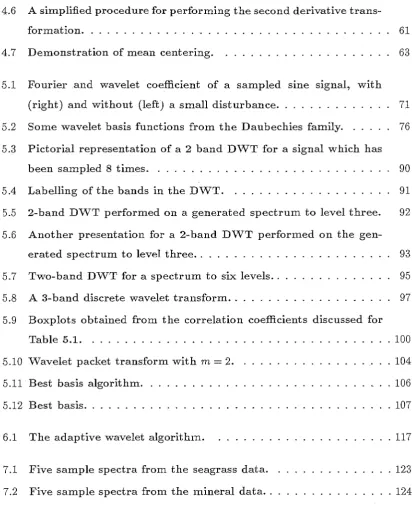
(10) 5.13 Boundary Related Issues . . . . . . . . . . . . . .. ... 102. 5.14 The Wavelet Packet Transform of Discrete Data. · . 103. 5.14.1 The Best Basis Algorithm. .. 5.14.2 The Local Discriminant Basis Algorithm 6. 7. Adaptive Wavelets. . . 105 · . 107 109. 6.1. Introduction.............. ... . . 109. 6.2. Factorization of Wavelet Matrices . . .. · . 110. 6.3. Criteria Measures for Optimization .. . .. 113. 6.3.1. Discriminant Criterion Functions .. . . 113. 6.3.2. Regression Criterion Functions. · . 115. 6.4. The Adaptive Wavelet Algorithm .. 6.5. Example. . 116 . ... 118. .. Classification Applications 7.1. Overview. 7.2. The Data Sets. 121. .... 121. ...... · .122. 7.2.1. Seagrass Data.. . .. 122. 7.2.2. Mineral Data .. · . 123. 7.2.3. Paraxylene Data. · .124. 7.2.4. Butanol Data. . . .. . ....... 7.3. Discriminant Analysis Based on.the Original Variables. 7.4. Discriminant Analysis Based on Wavelet Coefficients. · .125. · . 126 · .. 131. 7.4.1. Exploring. the DWT. 7.4.2. Banded Discriminant Analysis. 7.4.3. Stepwise Feature Extraction from the DWT. · .. 139. 7.4.4. Local Discriminant Bases . .. .... 143. 7.. 4.5. Adaptive \iVavelet Algorithm. 7.4.6. Summary of the vVavelet Feature Extraction Strategies.. .. ix. · . 132 · . 133. . . . . .. · .. 145 . . 151.
(11) 7.5. 7.6 8. · . 153. 7.5.1. Performance Based Measures. · .154. 7.5.2. l2ualitative Assessment. · . 156. Summary. .. · .168. Regression Applicatio.ns. 170. 8.1. Overview. 8.2. The Data Sets. · . '171. 8.2.1. Sugar Data. · .171. 8.2.2. Wheat Data. .. ..... · . 170. . 172. 8.3. Common Approaches for the Regression of Spectral Data. . 173. 8.4. Regression Analysis Using Features From the DWT. . 176. 8.5. 8.6 9. Which Classification Strategy? . . .. .. .178. 8.4.1. Exploring the DWT. 8.4.2. Banded ¥ultiple Linear Regression (BMLR). .178.. 8.4.3. Stepwise Feature Extraction.. .181. 8.4.4. Adaptive Wavelet Algorithm. 8.4.5. Summary of Wavelet Based Feature Extraction Strategies . . . . . . 187. ... 184. .188. Which Regr,ession Strategy? . . . . . 8.5.1. Performance Based Measures. 8.5.2. Qualitative Assessment. .... 189. .. . 196. Summary . . . . . . . . . . . . . . . . . .. .. 211 213. Concluding Reluarks. . . . 213. 9.1. Original Contribution. 9.2. Summary of Results .. .214. 9.3. Future Work and General Remarks About the AvVA. .217. A. 219. x.
(12) List of Figures spectrun~. obtained from a sample of paraxylene... 2. 1.1. A. 1.2. The electromagnetic spectrum.. 2. 1.3. A discriminant analysis problem.. 3. 1.4 -Feature extraction model. . . .. .5. 1.5. Some wavelet basis functions.. 7. 1.6. Integrated feature extraction model.. 8. 1.7. Thesis outline. .. 9. 2.1. Percentage of correctly classified objects obtained by three dis-. .. criminant techniques (Dl,D2 and D3) for eight combinations of dilnensionality and class sample sizes. . . . . . . . . . ~f. SOlne discriminant analysis methods.. 13. 2. 2. Summary. 2.3. A scatterplot of the discrimi~ant scores produced by FLDA.. 19. 2.4. The FDA algorithm.. 20. 3.1. Partial least squares algorithm.. 4.1. A CART lTIodel. . . . . . . . . . . . . . . . . . . .. 53. 4.2. DelTIOnstration of the SNV transformation. . .. 56. 4. 3. Demonstration of detrending cOlnbined with the SNV transfor-. n1.ation. . . . . . . . . . . . . . . . . . . .. 15. .. . . . . . . . . . .. . ...... 42. 58. DelTIOnstration of the hull quotient .... .59. Demonstration of the second derivative transformation. . .. 60. Xl.
(13) 4.6. A simplified procedure for performing the second derivative trans-. formation. . . . . . . . . . . . . .. . . .. 61. 4.7. Demonstration of mean centering.. 63. 5.1. Fourier -.and wavelet coefficient of a sampled SIne signal, with (right) an.d without (left) a small disturbance. . . . . . . . .. 71. 5.2. SOlne wavelet basis functions from the Daubechies family.. 76. 5.3. Pictorial representation of a 2 band DWT for a signal which has been sampled 8 times. . . . . . . . . .. 90. 5.4. Labelling of the bands in the DWT.. 91. 5.5. 2-bal~d. 92. 5.6. Another presentation for a 2-band DWT perforlned on the gen-. DWT performed on a generated spectrUlTI to level three.. erated spectrum to level three.. . . . . . . . . . .. 93. 5.. 7. Two-band DWT for a spectrum to six levels. .. 95. 5.8. A 3-band discrete wavelet transform. . . . . . .. 97. 5.9. Boxplots obtained from the correlation coefficients discussed for Table 5.1.. . . 100. . . . .. 5.10 Wavelet packet transform with m. = 2.. . .. ~. . . .. . . 104. 5.11 ' Best basis algorithm'. 5.12 Best basis ... ~. . 106. . . . . .. . 107. 6.1. The adaptive wavelet algorithln.. 7.1. Five sample spectra froin the seagrass data.. . . 123. 7.2. Five sample spectra fron'! the Inineral data. . .. . . 124. 7.3. Five sample spectra from the paraxylene data.. . .. 125. 7.4. Five salnple spectra froin the butanol data. . . . . .. . .. 126. 7.5. Correct classification rates (CCR) and quadratic probability mea-. 117. .. sures (QPM) for the seagrass (5), mineral (m), paraxylene (p) and butanol (b) data... . . . . . . . . . . . . . . . . . . . . . . . . . . . . . . . 131 7.6. The DWT and inverse DWT p_erformed on the seagrass ,data. . . . 134. xii.
(14) 7.7. The DWT and inverse DWT performed on the mineral data. . . . 135. 7.8· The DWT and inverse pWT performed on the paraxylene data. . 136 7.9. The DWT and inverse DWT performed on the butanol data. . .. 137. 7.10 Coefficients selected from theDWT by SWBLDA. . . . . . . . 7.11 Selected wavelet coefficients (asterisks) from the best bases.. . 142 . . . 144. 7.12 Discriminant measure versus iteration for the adaptive wavelet. l49. algorithm. 7.13 Correct classification rates (CCR) and quadratic probability measures (QPM) for thp "Wavelet based Inethods applied to the sea-. grass (s), mineral em), paraxylene (p) and butanol (b) data. . . . . 152 7.14 Correct classification rates for each of the discrilninant strategies. 155 7.15. Wavel~ngths. selected by SBLDA, SBQDA and FDA.. . . 158. 7.16 Discriminant plots produced by FDA. . . . . . . . . . . .. . .. 160. 7.17 Coefficients from the DWT which were selected by SWBLDA (asterisk) and SWBQDA (circle). 162. 7.18 Reconstructed spectra produced from the coefficients selected by SWBLDA and SWBQDA. . . . ....... ~. . . . . . . . . . . . . . . . . . .. 163. 7.19 The wavelet coefficients and reconstructed spectra pro.duced from ~. the AWA. .. 165. 7.20 Discriminant plots produced by from the coefficients produced by the AWA. . . . . . . . . . . . . . . . . . .. . .166. 7.21 Discrilninant plots produced by PDA.. . . 167 . .17. 8.. 1. Five salnple spectra frOlTI the sugar data. . ........ 8.2. Five sample spectra from the wheat data... 8.3. Test r-squared values corresponding to the brix, fibre and .proteil~. . 172. responses. . '" . . . . . . . . . . . . . . . . . . . . . . . . . . . . 8.4. The DWT and inverse DWT performed on the sugar data.. 8.5. The DWT and inverse DWT performed on the wheat. 8. 6. Coefficients selected. frOlTI. d~ta.. 175 .. 179 . . 180. the DWT by SMLRW. . . . . . . . . . .. 183. xiii.
(15) 8.7. Regression criterion measure versus iteration for the adaptive. wavelet algorithm.. . . . . . . . 187. 8.8. Test r-squared ,values for the wavelet based regression Inethods. . 189. 8.9. Test 'r-squared values each of the regression strategies.. 189. .. 8.10 Test r-squared values each of the regression strategies (SMLRW and SPCRW not shown). .. . . . . . . . . . . . . . . . . . . ... .. 190. 8.11 Residuals versus fitted values for the brix response models.. . . 194. 8.12 Residuals versus fitted values for the fibre response models.. . . 195. 8.13 Residuals versus fitted values for the protein. respOl~se. models. . . 196. 8.. 14 Histograms of the residuals from the brix response models.. . . 197. 8.15 Histograms of the residuals from the fibre response models.. . . 198,. 8.16 Histograms of the residuals from the protein response models. .. 199 8.17 Plots of the residuals versus the fitted values for each of the lTIod-. els for brix. . . . . . . . .'. . . . . . . . . . . . . . . . . . . .. . . . . . . . 200 8.18 Plots of the resiquals versus the fitted values for each of the mod-. els for fibre. . . . .. '. . . . . . . . . . . . . . . . . . . . . . . . . . . . . . 201 8.19 Plots of the residuals versus the fitted values for each of the lTIod-. els for protein. . . . . . . . . . . . . . . . . . . . . . . .. . . 202. 8.20 Wavelengths selected --by SMLR-Sl and SMLR-S2.. . . 203. 8.22 Regression coefficients obtained froln PLS, when the data" has been standardized.. . . . . . . . . . . . . . . . . . . . . . . . . . . . . 203. 8.21 Absolute correlations between each wavelength and the principal components selected by SPCR.. "~ . . .. .. 204. 8.24 Reconstructed spectra produced from the coefficients selected by SMRLW. ~. ~. 8.23 Coefficients frOln the DWT which were selected by SMLRW. 205. 206. 8.25 Reconstructed spectra produced frall1. the coefficients selected by SMRLW that pertain to the same band.. . . . . . . . . . . . . . . . . 208. xiv.
(16) 8.26 The wavelet coefficients and reconstructed spectra produced from. the AWA. 210. xv.
(17) List of Tables 5.1. Summary statistics for the correlation coefficients of the scalin.g. .. and wavelet coefficients of a spectral data set. 6.1. 100. The percentage of correctly classified spectra, uSIng the coefficients {X [3] ( T)} for T == 0, ... , 3 at initialization and at termina-. tion of the adaptive wavelet algorithm. The discriminant criterion functions were Wilk's Lambda, symmetric entropy and the CVQPM. 6.2. . 119. The percentage of correctly classified spectra, using the coeffi-. cients {X[3](r)} for r == 0, ... ,3 at initia.lization and- at termination of the adaptive wavelet algorithm. Optimization was based on {X[3](O)} and the discriminant criterion functions were Wilk's. 120. Lambda, symmetric entropy and the CVQPM.. 7.1. Description of the spectral data sets used for classification.. . 122. 7.2. Correct classification rates (%) for the stepwise procedures.. . 128. 7.3. Original variables selected by SBLDA and SBQDA.. . 129. 7.4. Correct classification· rates (%) .. 7.5-. Quadratic probability measures. . 130. 7.6. Classification results for BBLDA.. .138. 7.7. Classification results for BBQDA. . .. 7.8. Correct classification rates for SWBLDA and SWBQDA.. . .. 130. . .139. .140. 7..9· Coefficients selected by the forward schemes for SWBLDA and. .. SWBQDA.. xvi. 140.
(18) 7.10 Classification performance of the LDB algorithm.. ...... 7.11 Classification results for the adaptive wavelet algorithm.. . 145. . . 148. 7.12 Classification results for the adaptive wavelet algorithm where optimization was over a· scaling and wavelet band for the (4,3,2) setting. . . . . . . . . . . . . . . _" . . . . . . . . . . . . . . . . . . . . . . . 150 7.13 Correct classification rates for the wavelet based feature extrac-. tion strategies. . . . . . . . . . . . . . . . . . . . . . . . . . . . . . . . . . 151 7.14 Quadratic probability measures for the wavelet based feature ex-. 152. traction strategies. 8.1. Description of the spectral data sets used for regression.. 8.2. Training and test R-squared values.. . . 171. .. . .175. 8.3 . Wavelengths selected by the SMLR routines, and the priIlcipal cOlnponents selected by SPCR.. ........ . . 177. 8.4. Classification results for banded BLDA.. . .. 181. 8.5. R-squared values for SMLRW-Sl and SMLRW-S2.. 8.6. Coefficients selected from the DWT by SMLRW-Sl and SMLRW-. 82.. .. . . 182. . . 182. ,........ 8.7. R-squared values for SPCRW-Sl and SPCRW-S2.. 8.8. COlnponents selected from the DWT by SPCRW-Sl and SPCRW82.. 8.9. .o.o.. . ... 184. . • 185. o.......... Regression results for the adaptive wavelet algorithm. .. 8.10 Train.ing and test r-squared values for the.wavelet based approaches. . . . . . . . . . . . . . . . . . . . . . . .. 8.11 Summary of p-values for the regression mOdels. .. XVII. . . 186. regressiol~. . .. 188 . . 192.
(19) List of Symbols Non-bold Lower" Case Letters " a(x) appreciation score of x CD. accr(x) appreciation score equal to 1. if P(r. • aA(x) appreciation score equivalent to P(r. I Xi(r)) 2: P(r I xi)and zero otherwise I Xi(r)). • aQ(x) quadratic appreciation score of x •. ail. CD. a parameter used in RDA which weights· the pooled covariance matrix. Ith element in the ith principal COffiDonent vector. • b parameter used in RDA which controls shrinkage of the weighted pooled covariance matrix • bi ith element in the vector of estimated regression coefficients b " band(j, t) 7th band 7 E {a, 1, ... , m - I} at the jth level j E {J, J - 1, ... , J -. maxlev + I} of the DWT •. Cj,k. scaling coefficients. " dj,k. wavelet coefficients. •. orthogonal projection of'f(t) onto. fVj. Vi. • 9 (x, r) classification score •. gblda(X,. • 9bqda(X,. r) BLDA classification score r) BQDA classification score. • hk high pass filter coefficients o. nii. is the element along the ith diagonal of the hat matrix 1-l. • j* cOlnplex number. A. xviii.
(20) • j parameter controlling the dilation of the wavelet basis functions. • k parameter controlling the translation of the wavelet basis functions • /!,k. low pass· filter coefficients. .. m number of bands in the DWT; downsampling rate • maxlev maximum number of levels in the DWT.. • n number of observational units in the training data set • n' number of observational units in the testing data set. • n r number of observational units from class r; rth element in the vector n number of objects in node 1 of CART model. • n[~. number of levels that an object has been transformed, in the DWT. •. nlevel s. CD. P dimensionality of the data set. • P* dimensionality of the reduced data set P* ~ P. • Po number of parameters to be estimated (including the intercept) in a MLR model. • p(x) is the class probability density of x • q the number of sub-matrices in the filter coefficient matrix A is q + 1 • r index for class categories •. So. minimum of one less than the total number of classes (R-l), or the dimensionality. (p). • s* number of discriminant variables used for assigning an object to a class; s* ::;; •. Xi. •. xi[l]. ith element in the data vector x ith object in node l of CART model. .. Yi ith element in the response vector y • Y~ ith element in the test response vector y'. xix. So.
(21) • YiP] response value of ith ,object in node I of CART model. • Y-i predicted value of Xi, obtained when Xi is deleted from the model building process • Yi. predicted response value· for object. Xi. .. Vi. predicted response value for object. xi. .. Yij. element in row i and column j of Y. • Yij. estimate of Yij. • z index for wavelet filter z == 1, ... , m - 1. Non-bold Upper Case Letters • AlC Akaike's information criterion • CCR correct classification rate • eCR' correct classification rate of test set. • C p Mallows C p <I. CVCeR cross-validated correct classification rate. • DF degrees of freedom. • DEV deviation. • V(x, r) distance betvveen x and x r in the discriminant coordinate system •. Ecross. cross entropy measure. • E sym symmetric entropy measure • E tot total symmetric entropy measure • FCWT. continuous wavelet transform. •. discrete wavelet transform. FDWT. • FFT. Fourier transform. xx.
(22) .. FWFT. windowed Fourier transform. •. J highest level in the DWT ; J == ceiling (log p/ log m). • J criterion function applied in the adaptive wavelet or LD.B.algorithm • JA Wilk's lambda discriminatory criterion function .. Ji entropy discriminatory criterion function •. Jcvqpm. discriminatory criterion function based on the cross-validated quadratic prob-. ability measu"re •. Jcvrsq. regression criterion function based on the cross-yalidated r-squared measure. • L 2 (R) space of square integrable functions •. Mij. i, jthelement in the Lav.lton matrix.. • MeR misclassfication rate • MSE mean square error. • Ni node identity in CART model • N f number of filter coefficients with nonnegative indices fit. P A average probability that an object is assigned to the correct class. • P QPM quadratic probability measure • PeoR probability of correctly classifying objects. .. P(r) prior probability for class r • 'P(r I x) posterior probability that given some vector x it is from class r (&. P(r I Xi(r») posterior probability for the true class of Xi. • P(x I r) class probability d.ensity function • P(r jI) proportion of objects in node Nz of a CART model which are from class r. xxi.
(23) • P_i(r. I. Xi). posterior probability for. Xi. when the covariance matrices and mean. vectors in the probability density function have been· calculated in the absence of Xi • PRESS predicted residual- sum of squares. • RSS- residual. SUill-. of squares. • RSS po residual sum of squares of a MLR model with complexity.po • R 2 coefficient of variation (r-squared) • R total number of class categories in a set of data • R* integer value less than or equal to R - 1 • TSS total sum of squares • V number of testing groups used in a cross-validation routine •. ,Ij. subspace containing all the possible approximations of functions in L 2 (R) at. resolution 2j. • Wj orthogonal complement ot. Vj. Bold Lower Case Letters •. ai. ith vector of principal component coefficients with dimension p x 1. • b estimated vector of regression coefficients •. bros. rth column of the matrix of regression coefficients for the' optimal. sco~ing. prob-. lem, Bos •. bpl s. •. Cj. estimated vector of regression coefficients from a PLS model. scaling coefficients at resolution (or level) j. • d j wavelet coefficients at resolution (or level) j. • d)z) wavelet coefficients at resolution (or level) j produced from the filter matrix (z) n j+l. XXll.
(24) • er:)(T) class energy vector of wavelet (or wavelet packet) coefficients CD. G. e vector of low pass filter coefficients R x 1 vector of class sample sizes. n. • p n X 1 vector containing principal component scores •. T. vector of residuals in the PLS algorithm. • s output from low pass fi.lterlng operation. • t latent variables from PLS model • Ui. normalized vectors which are used to construct the wavelet matrix A. • v normalized vector which is used to construct the wavelet ·matrix A • v p. x 1 vector of discriminant coefficients. •. sums of squares and cross product between X and y. WI. • w output from high pass filtering operation • x p. 1 training data vector. X. • xp x •. Xl. P. 1 mean vector of the training data set. X. 1 testing data vector. • x* p x 1 column object vector from X* • x[j](r) column vector containing the coefficients in band(j, .. Xi(r). P X 1 data vector from class r. • xi(r). ith data object from X* which belongs to class r. •. x~. r) of the DWT. mean class vector from X*. • °x[j] (T). wavelet packet coefficients which occur at the jth level in the rth band of. the wavelet packet transform. xxiii.
(25) • y n x 1 vector of training response values (regression) or class labels (discriminant. analysis). • yn. X. I'predicted vector of response values (regression) or class labels (discriminant. analysis). • .y' n' x,l vector of test response values (regression) or class labels {discriminant analysis). • y' n' X 1 predicted vector of test response values. (regression) or class labels (discrim-. inant analysis). • z n. X. 1 discriminant variable. Bold Upper Case Letters • A wavelet matrix • Ai sub-matrix of the wavelet matrix A. • B matrix of multivariate regression coefficients • Bos optimal scoring matrix of regression coefficients • Cj low pass filtering matrix at level 'j in the DWT. • D j high pass filtering matrix at level j in the DWT. • D}z) high pass filtering matrix at level j in the DWT which contains the zth set of highpass filter coefficients. • D diagonal matrix whose ith diagonal element is equal to. • F i ith factor in the wavelet matrix A -. L low pass convolution matrix. • 1-l hat matrix. 1{. == X T (XXT ) -1 X. • H high pass convolution matrix. xxiv. Dii. = 1/ ..jAtfda (1 - AtfdJ.
(26) • P matrix whose ith column contains the principal component scores vector Pi. • PI is a matrix which augments In to the first column of P • p. x, P x* linear projector matrices. • Q orthogonal matrix used in contruction of the wavelet matrix A· • R projection matrix used in contruction of the wavelet matrix A • S B between covariance matrix. • Sw within covariance matri~ •. Spooled. pooled covariance matrix. • Sr covariance matrix of class r. • T matrix whose ith column contains the it.h latent vector from PLS • V So matrix whose ith column is. • X p. X n. Vi. for i. ==. 1, ..... , SO". training data matrix. • Xl training data matrix whose first row is equal to • Xc p. X n. • X' p. X. • X* p. 1;. centered training data matrix. n' testing data matrix X n. data. ~atrix. which results from some feature selection/transformation. procedure based on X.. • XU] (T) Inatrix containing the coefficients for the objects which would lie in band(j, T) • Y n. X. R class indicator matrix. • Zso matrix whose ith column is. Zi. for i. == 1, ... , So. xxv.
(27) Greel( Letters .. f3i ith component in the vector of regression coefficients f3. • b(t) delta function •. bij. •. ti. indicator variable;. Oij. == 1 if i == j, zero otherwise. ith component in the vector of regression residuals. E. • Ii eigenvalue corresponding to the ith principal CQlnponent • A is a measure of the discriminant criterion A ==. • Aifda ith element of. VTSBV. Afda. • A vVilk's Lambda • A(i) Wilk's Lambda at the ith iteration of a stepwise routine. • 7J(j, r) discriminatory measure of band(j, r) in the wavelet packet transform •. Vi. ith element in v. .. w freq\lency. • <p(t) scaling function • <Pj,k(t) scaling basis function; <pj,k(i) == 'T7~j/2<p(mjt - k) • 'lj;(t) mother wavelet function. • 1/Jj,k(t) wavelet basis function; children wavelets; 7Pj,k(t) == m j / 2 7jJ(mi t - k) •. Pij. •. o-Xi. •. T. correlation between the ith principal component and the jth variable sample standard deviation of Xi. band label for the DWT; TEO, 1, ... , m - 1. • fl rank of a matrix fit. f3 vector of regression coefficients. XXVI.
(28) •. {3pcr. vector of regression coefficients from a peR model. • (3pls. vector of regression coefficients from a PLS model. •. Afda. vector whose elements are the eigenvalues 'of W*T'lt* In. •. L\..fda. diagonal matrix whose ith element is equal to Ai fda. • 7](x*). vector of fitted values for x*. • fir fitted centroid of all x* objects belonging to class r. • v vector at wavelengths. • 'I'* class indicator matrix used in FDA and PDA. • ~ * estimate of the class indicator matrix '1'*. • e. matrix whose columns are the eigenvectors of 'IF*T 'l'* / n. Miscellaneous Characters • li i x 1 column vector whose elements are all equal to 1. • tm. downsample by a factor of m. xxvii.
(29) List of Algorithms Flexible Discriminant Algorithm. 20. Partial Least Squares Algorithm. 42. Second Derivative Algorithlu. 61. Best Basis Algorithm. 106. A·daptive Wavelet Algorithm. u. xxviii. 117.
(30)
Figure
Related documents