UNDERSTANDING THE PROCESS OF TRANSFER OF TRAINING IN THE WORKPLACE.
Michael Anthony Machin, BSc, BA (Hons), MA.
This thesis is submitted as a requirement for the award of Doctor of Philosophy at the University of Southern Queensland
CERTIFICATION OF THESIS
I certify that the work contained in this thesis is original and that it contains no material written by another person, except where otherwise acknowledged. I also certify that the material has not been previously published, except where otherwise acknowledged, or submitted for any other award at any other higher education institution.
_______________________ _______________
Michael A. Machin Date
ENDORSEMENT
_______________________ _______________
LIST OF PUBLICATIONS AND CONFERENCE PRESENTATIONS
Machin, T. (1994, July). Training effectiveness and transfer of training: New approaches. Paper presented at the annual Training Research in University and TAFE sponsored by the NCVER. Townsville, Australia.
Machin, M. A., & Fogarty, G. J. (1997). The effects of self-efficacy, motivation to transfer, and situational constraints on transfer intentions and transfer of training [Special Issue on Transfer of Training & Transfer of Learning]. Performance Improvement Quarterly, 10(2), 98-115.
Machin, M. A., & Fogarty, G. J. (1997, June). The effects of self-efficacy, motivation to transfer, and situational constraints on transfer intentions and transfer of training. Paper presented at the Second Australian Industrial and Organisational Psychology Conference, Melbourne, Australia.
Machin, M. A., & Fogarty, G. J. (1998, August). The role of transfer climate and implementation activities in the transfer of training to the workplace. Poster paper
ABSTRACT
Post-training self-efficacy is a strong determinant of transfer implementation intentions, which in turn were a strong determinant of implementation activities. Implementation activities were positively related to transfer success. Separate structural models were developed to assess the impact of in-training transfer enhancing activities on learning, post-training self-efficacy, transfer implementation intentions, and implementation activities. Self-control cues, relapse prevention activities, and goal setting (when assessed separately) were found to positively influence post-training self-efficacy and implementation
intentions. Relapse prevention activities and goal setting (when assessed separately) were also found to positively influence implementation activities. The results strongly
TABLE OF CONTENTS
CERTIFICATION OF THESIS... ii
LIST OF PUBLICATIONS AND CONFERENCE PRESENTATIONS ... iii
ABSTRACT... iv
TABLE OF CONTENTS... vi
LIST OF TABLES... viii
LIST OF FIGURES ... ix
ACKNOWLEDGEMENTS... xi
CHAPTER ONE: INTRODUCTION... 1
Overview of the Field ... 1
Models of Transfer of Training ... 5
Training Design Factors Related to the Transfer of Training ... 11
The Influence of Individual Characteristics on Transfer of Training... 23
Contextual Influences on Trainees’ Motivation and Self-efficacy... 32
Aspects of the Environment Related to Transfer of Training ... 36
Interventions Designed to Improve Transfer of Training... 43
Measurement of Training and Transfer Outcomes... 48
Summary of the Literature... 53
General Research Questions... 54
Overview of the First Study... 55
Overview of the Second Study ... 56
CHAPTER TWO: STUDY ONE... 59
Rationale for Study 1 ... 59
The Influence of Goal Setting on Transfer of Training ... 63
Specific Aims of Study 1... 65
Hypotheses Relating to Demographic Variables ... 69
Hypotheses Relating to the First a priori Structural Model... 69
Hypotheses Relating to the Second a priori Structural Model ... 70
Method... 71
Participants ... 71
Procedure... 72
Questionnaire Measures ... 72
First Questionnaire ... 72
Second Questionnaire... 74
Third Questionnaire... 77
Analyses ... 77
Results ... 81
Correlational analyses ... 84
Structural equations modeling... 86
Discussion... 98
Contribution of Study 1... 105
Limitations of Study 1... 106
Conclusions ... 107
Rationale for Study 2 ... 108
The Role of Transfer Intentions ... 112
Determinants of Transfer and Implementation Intentions ... 114
Hypotheses related to the climate for transfer variables ... 120
Hypotheses relating to the influence of self-efficacy and motivation... 121
Hypotheses related to the transfer enhancing activities ... 121
Hypotheses relating to Implementation Intentions, Implementation Activities, and Transfer Success... 122
Method... 124
Participants ... 124
Procedure... 125
First Questionnaire ... 125
Second Questionnaire... 128
Third Questionnaire... 132
Strategy for Analysing Longitudinal Data ... 133
Results ... 137
Data Screening ... 137
Exploratory Factor Analyses... 137
Reliability Analyses ... 141
Descriptive Statistics ... 145
Hypotheses related to the climate for transfer variables ... 149
Hypotheses relating to the influence of self-efficacy and motivation... 166
Hypotheses related to the transfer enhancing activities ... 173
Hypotheses relating to Implementation Intentions, Implementation Activities, and Transfer Success... 189
Discussion... 190
Contribution of Study 2... 200
Limitations of Study 2... 201
Conclusions ... 201
CHAPTER FOUR: CONCLUSIONS... 203
Summary of the Research Questions... 203
Models of Factors Influencing the Transfer of Training ... 204
Results of Study 1... 206
Results from Study 2 ... 208
Limitations of Studies 1 and 2... 212
Areas Requiring Further Research ... 213
REFERENCES ... 220
APPENDIX A... 238
APPENDIX B ... 245
LIST OF TABLES
2.1 Number of cases, means, standard deviations & cronbach alphas for all variables in study 1 ... 81 2.2 Intercorrelations for all variables in study 1 ... 82 3.1 Exploratory factor analyses of new scales in Study 2... 139 3.2 Number of items, cronbach alphas, number of cases, means, and standard deviations
LIST OF FIGURES
1.1. Transfer Training Model from Thayer and Teachout (1995). ... 8
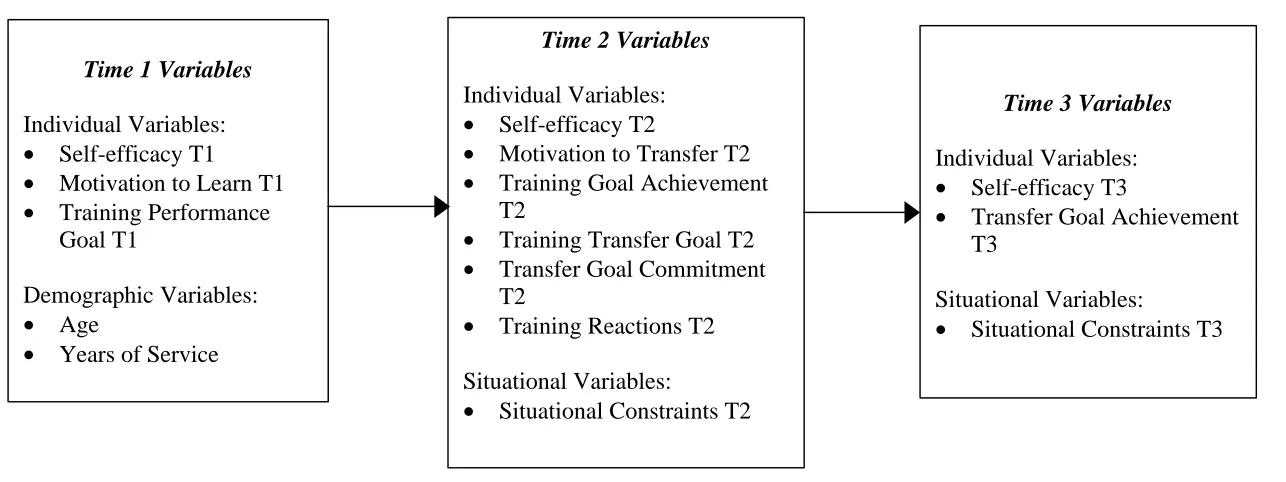
2.1. Sequential model of the variables measured at times 1, 2, and 3. ... 66
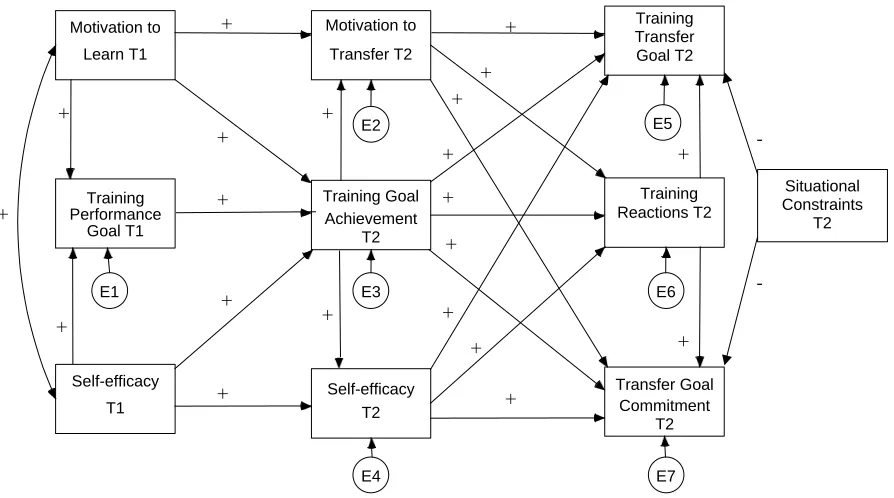
2.2. First a priori structural model of time 1 and time 2 variables... 67
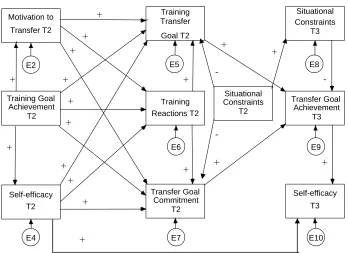
2.3. Second a priori structural model of Time 2 and Time 3 variables... 68
2.4. Standardised regression coefficients for a priori structural model of Time 1 and Time 2 variables. ... 89
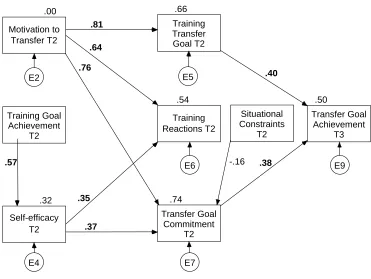
2.5. Standardised regression coefficients for a priori structural model of Time 2 and Time 3 variables. ... 93
2.6. Revised structural model of Time 2 variables impacting on Transfer Goal Achievement T3. ... 95
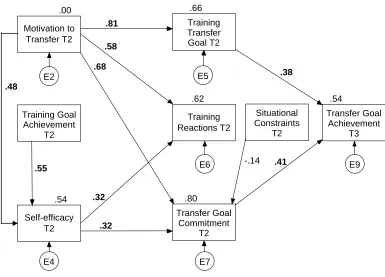
2.7. Final structural model of Time 2 variables impacting on Transfer Goal Achievement T3. ... 97
3.1. Sequential model of the variables measured at times 1, 2, and 3 in Study 2. ... 118
3.2. Modified Model of Training Transfer (based on Thayer & Teachout, 1995). ... 119
3.3. Initial measurement model specified for all climate for transfer variables. ... 152
3.4. Standardised regression coefficients for the initial measurement model of climate for transfer variables. ... 154
3.5. Standardised regression coefficients for the respecified measurement model of all climate for transfer variables... 156
3.6. Structural model of climate for transfer variables, PA, NA, and Pre-training Self-efficacy and Motivation. ... 159
3.7. Results of initial structural model of climate for transfer variables, PA, NA, and Pre-training Self-efficacy and Motivation. ... 162
3.8. Final structural model of climate for transfer variables, PA, NA, Pre-training Self-efficacy, and Pre-training Motivation. ... 164
3.9. Structural model of the determinants of Implementation Activities... 168
3.10. Standardised regression coefficients for the structural model of the determinants of Implementation Activities. ... 170
3.11. Standardised regression coefficients for the revised structural model of the determinants of Implementation Activities. ... 172
3.12. Standardised regression coefficients for the structural model of Overlearning and the determinants of Implementation Activities. ... 175
3.13. Standardised regression coefficients for the revised structural model of Fidelity and the determinants of Implementation Activities. ... 177
3.14. Standardised regression coefficients for the revised structural model of Stimulus Variability and the determinants of Implementation Activities. ... 179
3.15. Standardised regression coefficients for the revised structural model of Principles-Meaningfulness and the determinants of Implementation Activities... 181
3.16. Standardised regression coefficients for the revised structural model of Self-control Cues and the determinants of Implementation Activities. ... 183
3.18. Standardised regression coefficients for the revised structural model of Goal
ACKNOWLEDGEMENTS
I wish to acknowledge a large number of people who have assisted me in completing this project. I am extremely grateful for the supervision provided by Professor Gerry Fogarty. He chose to let me follow my instincts and has provided invaluable advice and
encouragement. I have also been assisted by many of my colleagues who are a great bunch of people to work with.
I sincerely thank Paul Thayer and Mark Teachout for allowing me to use the two questionnaires that they developed in my second study.
I have received support from a number of individuals in the Queensland Police Service, but my thanks go especially to the staff in the Information Services Branch and the trainees who completed my questionnaires.
I would like to thank my parents who have always encouraged me to “finish the PhD” as my first priority.
I dedicate this thesis to my wife, Tanya, and my children, Joshua, Jessica, and Sarah. They have seen what effort it has taken and I know that there have been times when they have missed out.
CHAPTER ONE: INTRODUCTION
Overview of the Field
The field of training research has recently undergone a major paradigm shift with the development of several integrative models designed to explain when, why, and for whom training is most effective (Ford, Kozlowski, Kraiger, Salas & Teachout, 1997; Quiñones & Ehrenstein, 1997; Tannenbaum & Yukl, 1992). The combination of a number of factors has been instrumental in bringing about this shift and contributing to the rapid development of both the quantity and quality of training research. These include: systematic research into the contextual factors that influence training
effectiveness (Holton, 1996; Kozlowski & Salas, 1997; Quiñones, 1997); the application of theories of learning which incorporate cognitive, skill-based, and affective outcomes to the evaluation of training (Ford & Kraiger, 1995; Kraiger, Ford & Salas, 1993; Smith, Ford, & Kozlowski, 1997); advances in the development and the use of high-technology training methods (Carroll, 1997; Steele-Johnson & Hyde, 1997); and the development of closer linkages between training-related theories and techniques (Cannon-Bowers, Tannenbaum, Salas & Converse, 1991; Salas, Cannon-Bowers & Blickensderfer, 1997). While the field of training has previously been characterised as largely atheoretical by a number of reviewers (Campbell, 1971; Goldstein, 1980; Wexley, 1984), it now appears that the integration of research and practice is well advanced (Ford, et al., 1997; Ford & Kraiger, 1995; Quiñones & Ehrenstein, 1997; Salas & Cannon-Bowers, 1997).
effects of technological changes on the cognitive demands made on workers and concluded that the cognitive complexity of work tasks is increasing with the result that greater demands are placed on the workforce. Workers are increasingly valued for their ability to learn new skills and rapidly adapt to changes in the nature of their work
(Howard, 1995; Thayer, 1997). Therefore, training should aim to facilitate the acquisition of skills that are crucial to the attainment of individual and organisational objectives and thus ensure that workers are able to meet the challenges they are facing.
For training to be regarded as being effective, it must be possible to demonstrate that the objectives of the training have been achieved. This is accomplished in the “evaluation” phase of the instructional design process and is explicitly incorporated in models such as the Instructional Systems Design (ISD) model (Goldstein, 1993).
Although evaluation occurs during and after training, it should be planned before training actually begins. Evaluation should first of all attempt to determine whether the trainees have improved, that is, whether they have acquired new knowledge, skills or attitudes. The second and third aims of evaluation are to determine whether the training programme was responsible for any improvements and, if so, whether the training programme proves to be effective for other trainees (Goldstein, 1993; Kraiger & Jung, 1997). In order to assess changes in the trainees, it is necessary to specify the criteria that will be used. These typically fall into two categories: “learning outcomes” and “performance outcomes”. The processes by which the learning outcomes are translated into performance outcomes are the main areas of interest in the current research project.
and providing feedback to the trainer or curriculum designer (Kraiger, 1995/96). However, the research undertaken from the Industrial/Organisational (I/O) psychology perspective gives equal emphasis to the learning outcomes and the performance outcomes achieved. This reflects the focus of I/O psychology on the difference that training makes to trainees’ actual job performance.
The transfer of training to the workplace is also one of the areas identified by Goldstein (1993) as a guide for evaluating the validity of training. Transfer validity involves assessing whether what was learned during training is transferred on-the-job as enhanced performance. The goal of assessing the determinants of transfer of training in the workplace was chosen as the major topic for research in the current series of studies.
Positive transfer of training has been defined as “the degree to which trainees effectively apply their knowledge, skills and attitudes gained in a training context to their job” (Baldwin & Ford, 1988, p. 63). This definition differs from the more traditional view in the field of instructional and cognitive psychology which has defined transfer as the extent to which previous learning will influence new learning in a different context (Patrick, 1992). In the traditional view, positive transfer refers to where new learning is made easier by previous learning while negative transfer refers to where previous learning interferes or hinders new learning (Misko, 1995). Where there is no influence exerted, then zero transfer occurs.
relationship between learning outcomes and subsequent performance, rather than as a negative influence of learning outcomes on performance.
Various authors (Kraiger, 1995/96; Quiñones & Ehrenstein, 1997) have also described other fundamental differences between the I/O psychology and
cognitive/instructional psychology transfer paradigms. In particular, Kraiger highlighted the different research designs that are typically used, the different measures of transfer used, and the different environments in which transfer occurs. The I/O psychology paradigm has typically used correlational research designs, which assess the impact of training outcomes on a measure of performance or proficiency in a non-training environment at a much later time. This is substantially different from the
cognitive/instructional psychology paradigm which used experimental designs which varied only the quality or type of initial instruction and assessed the impact of transfer on indices of learning which differed from the original learning tasks only in terms of similarity or time. There have been a number of recent attempts to combine these
different paradigms (e.g., Ivancic & Hesketh, 1995/96; Kraiger, 1995/96; Smith, Ford, & Kozlowski, 1997). However, there remains considerable confusion in the research literature about the conditions under which training provides trainees with skills and knowledge that transfer successfully to other settings, and the processes that allow these skills and this knowledge to transfer to other settings.
describe research that has examined the influence of training design factors, trainee characteristics, and contextual influences on transfer of training. It will also examine some of the processes associated with the way in which skills and knowledge are transferred by examining interventions that have been used to enhance the transfer of training, as well as some of the difficulties associated with the measurement of training and transfer outcomes. Finally, a set of specific propositions relating to the transfer of training in the workplace will be outlined. The next section will review the development of existing models of transfer of training.
Models of Transfer of Training
Noe (1986) proposed one of the first models that identified individual
Baldwin and Ford (1988) proposed a framework for understanding the transfer process by suggesting that training transfer depended on training-input factors, training outcomes, and conditions of transfer. Training-input factors included the design of training, characteristics of the trainee, and work-environment characteristics. Training outcomes were defined as the amount of original learning that occurred during the training programme and the amount retained after the training programme was complete. Finally, the conditions of transfer included both the generalisation of what was learnt during training to the job context, as well as the maintenance of the new learning over time while on the job. All three training input factors were viewed as directly affecting the training outputs of learning and retention, which in turn influenced the conditions of transfer. The model also proposed a direct effect of trainee characteristics and work-environment characteristics on the conditions of transfer, regardless of how much was learned during training or retained after training.
training were cognitive ability, self-efficacy, locus of control, attitudes towards the organisation, and the expectations about the utility of the training.
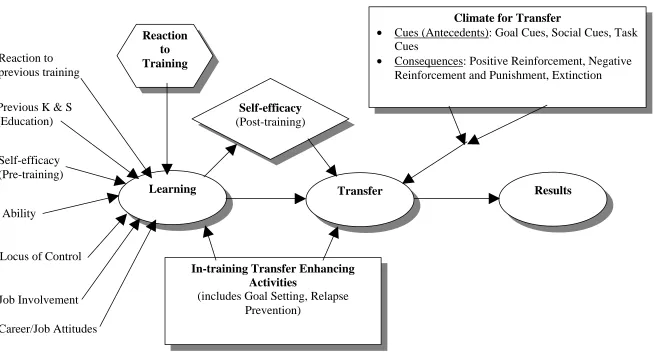
Thayer and Teachout (1995) presented a simplified model that focused on two aspects of the training process that might impact on transfer: the climate for transfer of training, and the transfer-enhancing activities that occur during the training program. The climate for transfer construct has been the focus of recent research by Rouiller and
Goldstein (1993), Tracey, Tannenbaum and Kavanagh (1995), and Quiñones (1995). Two types of transfer climate constructs were proposed: antecedents, such as goal cues, social cues, and task cues, and consequences, such as positive and negative reinforcement, punishment, and extinction. The in-training, transfer-enhancing activities included: overlearning, fidelity, varied practice, principles-meaningfulness-learning points, cues to monitor one's own performance, relapse prevention training, goal setting, and the support of top management.
Thayer and Teachout (1995) recognised that there were a number of other variables that also impacted on the effectiveness and outcomes of a training program. These included individually oriented variables such as trainee ability, trainee self-efficacy, previous knowledge and skill, reactions to training, and the level of
Figure 1.1. Transfer Training Model from Thayer and Teachout (1995).
Learning Transfer Results
Self-efficacy (Post-training)
In-training Transfer Enhancing Activities
(includes Goal Setting, Relapse Prevention)
Climate for Transfer
• Cues (Antecedents): Goal Cues, Social Cues, Task Cues
• Consequences: Positive Reinforcement, Negative Reinforcement and Punishment, Extinction Reaction
to Training Reaction to
previous training
Previous K & S (Education)
Self-efficacy (Pre-training)
Ability
Locus of Control
Job Involvement
Holton (1996) also proposed a comprehensive model of transfer of training that included three primary outcomes: individual learning, individual performance, and organisational results. The model also specified the influence of intervening variables on the outcomes and indicated the direction of causal effects. Holton suggested that the intervening variables be separated into primary influences on the outcomes and secondary influences that are mediated by the primary intervening variables. The intervening variables are grouped into three major types of influences: motivational influences, environmental influences, and trainees’ abilities or enabling influences. Each of the primary influences is related to each of the three outcomes. For example, for the outcome of individual learning, the primary motivational influence is motivation to learn, the primary environmental influence is reactions to the training climate, and the primary enabling influence is the trainees’ experience and ability. For the outcome of individual performance, the primary motivational influence is motivation to transfer, the primary environmental influence is the transfer climate, and the primary enabling influence is the design of the training. Finally, for the outcome of organisational results, the primary influences are: the expected utility of training or return on investment of time and resources, the external events that constrain or amplify productivity, and the linkage between training and the strategic objectives of the organisation.
Other models of the determinants of training transfer include Foxon (1993), Yelon (1992) and Milheim (1994). Foxon conceptualised transfer of training as a multi-stage process beginning with intention to transfer and moving through initiation, partial transfer and conscious maintenance to unconscious maintenance. Foxon also developed a
framework that examined the effects of inhibiting and supporting factors on intentions to transfer. For the transfer process to proceed through the various stages until transfer is complete, the supporting factors must outweigh the inhibiting factors. Yelon proposed that four factors are primarily responsible for successful transfer: trainee motivation, the trainees’ awareness of when to use their new skills, the actual level of skill developed, and the support provided to trainees in their workplace. Milheim emphasised the need to develop pre-training training and post-training strategies that would foster transfer, similar to the prescriptions offered by Broad and Newstrom (1992).
The comprehensive models of transfer of training that have been developed by Cannon-Bowers et al. (1995), Thayer and Teachout (1995), and Holton (1996) have only been partially tested and therefore lack extensive empirical support. Essential elements that the existing models of training effectiveness share include: specification of the relevant training design factors, individual characteristics, and organisational and situational variables that influence individual learning during training, individual
The following section will describe research that has examined the influence of training design factors on training outcomes and transfer of training. This will be followed by further sections describing the influence of individual characteristics on training outcomes and transfer of training, the organisational and situational variables that impact on training outcomes and transfer of training, interventions that have been
designed to improve the transfer of training, and issues associated with the measurement of training and transfer outcomes.
Training Design Factors Related to the Transfer of Training
There has been an extensive amount of empirical research into the characteristics of the training design which impact on the transfer of training. However, the
overwhelming majority of these studies have been laboratory studies that have focused on the effects of learning a specific task on subsequent acquisition of another task. In these studies, the “learning” task and the “transfer” task are usually of the same type, for example, recall tasks (Kraiger, 1995/96).
It is usually assumed that the training design principles that have been discovered using the above approach will generalise to other settings, such as where the learning task is actually a training programme with multiple tasks delivered outside of a laboratory setting. Also, the transfer task may involve a measure of performance across a range of criterion tasks in a totally different setting such as the trainee’s workplace, at a much later time. Therefore, there may be substantive differences between the “learning”
This section will aim to review the research that has assessed how the degree of transfer is affected when the “learning” task and the “transfer” task are complex, cognitive tasks, and when the “transfer” environment differs substantially from the “learning” environment. This perspective is more closely aligned to the traditional I/O psychology view of transfer than with the cognitive-instructional psychological view.
Baldwin and Ford (1988) reviewed the organisational training literature to
determine basic learning principles that had been found to impact on training outcomes or transfer of training. They cited the work of McGehee and Thayer (1961), who found that the majority of the empirical research linking learning principles to the design of training could be summarised into four basic principles. These were (1) the use of identical elements, (2) the teaching of general principles, (3) the provision of stimulus variability, and (4) the conditions of practice. While these principles have been extensively
researched from a behaviourist perspective, recent research from a cognitive, information processing perspective has highlighted a number of areas in which the impact on transfer of learning is markedly different from that predicted from earlier research (Druckman & Bjork, 1991, 1994). This research will be reviewed for each of the above principles, and then training design issues associated with the development of adaptive expertise will be considered.
ability to judge the area of new figures that included rectangles, triangles, and circles. The subjects also failed to improve their ability to estimate the area of successively larger rectangles during the practice trials, indicating that they were attending to specific stimuli that did not allow the transfer of training to occur. Singley and Anderson (1989)
concluded that all of the studies that have demonstrated transfer have found that it occurs most often between highly similar situations, and that little positive evidence exists of more general transfer. However, it is not yet clear in what crucial ways the tasks or situations must be similar for transfer to occur. Cognitive theorists such as Anderson (1983, 1987) hold that the development of procedural knowledge underlies the transfer of declarative knowledge across different tasks.
One aspect of task similarity that has been investigated is the concept of fidelity. When the physical characteristics of the transfer environment match the learning
theoretical perspective that accounted for the diverse transfer effects. He advocated further research into the aspects of similarity that can be utilised during instruction to enhance transfer of training.
Alessi (1988) reviewed the necessity for fidelity in the design of instructional simulations, and also concluded that reducing the amount of information can enhance transfer, provided that all of the crucial information is made available. Gick and Holyoak (1987) also concluded that the level of perceived similarity between the training and transfer tasks is more important than the actual similarity. Therefore, it is likely that a greater level of physical fidelity would not enhance the overall transfer of the trainees’ skills, provided that the appropriate level of psychological or functional fidelity is achieved in the training setting.
Salomon and Perkins (1989) have differentiated between “high-road” and “low-road” transfer. Essentially, high-road transfer focuses on assisting learners to develop abstract schemas that can be applied across a number of different types of situations. Low-road transfer involves the development of context-specific skills that, after a great deal of practice, become fairly automatic. While the development of abstract schemas is thought to have benefits for transferring learning in a general sense, it may also make it harder for the learner in the early stages of learning new material. Therefore, the benefits of transfer must be weighed against the possible losses incurred during training (Hesketh, 1997a). This type of training has been described as being high on “effect”, and low on “affect” (Tannenbaum, 1997).
Ivancic and Hesketh (1995/96) also identified a number of other ways in which general transfer may be enhanced by the teaching of general principles. They suggested that training that captures the learner’s attention, provides feedback about the accuracy of the learner’s knowledge structures, and directs the learner’s attention to similar examples from their own experiences may all contribute to the development of a “mindful
abstraction” (Salomon & Perkins, 1989).
A great deal of research has focused on the mental models that learners create during the learning process. Holding (1991) suggested that these models could contain both (a) procedural knowledge, that is, knowledge relating to methods, and (b)
Kraiger, Salas and Cannon-Bowers (1995) used structural assessment techniques to measure the cognitive knowledge structures of trainees before and after their training programs. In their first study, the measure of structural assessment indicated that trainees had improved their understanding of the material during training, but the post-training knowledge structures failed to predict their performance on a transfer task 12 weeks later. In their second study, one group of trainees received information on the goals and
objectives before training, while the other group received the same information after training. The measure of structural assessment administered after training showed that the group which received the advance organiser containing information about the goals and objectives prior to training performed significantly better than the other group. Subjects were also required to complete a transfer task that involved a computer-based simulation of the task that was the focus of the training. While the trainees’ post-training knowledge structures did not predict performance on the transfer task for the entire group, the measures were highly predictive for the treatment group. Therefore, the use of the advance organisers moderated the relationship between the post-training knowledge structures and the scores on the transfer task.
The development of accurate mental models is one important way in which training may be able to assist in enhancing general transfer. The teaching of abstract schemas may assist learners to develop the necessary mental models, but this may have a negative effect on the initial performance of the learners. Hesketh (1997a) highlighted this problem as one of the major dilemmas facing researchers in the field of transfer of training. Hesketh (1997b) proposed that the resolution of this dilemma involved
Hesketh (1997b) also proposed that a Transfer of Training Needs Analysis (TTNA) would assist trainers in achieving this outcome.
Stimulus variability. The use of a variety of examples during training is a strategy which may assist trainees to develop an understanding of general rules that could be transferred to other situations by allowing the trainee to abstract the features which are shared by the examples (Gick & Holyoak, 1987). Gick and Holyoak have also identified the need to differentiate between the structural and surface components of situations. While the surface components may be varied to assist trainees to develop general rules, the structural components need to be consistent for transfer of learning to occur.
Baldwin and Ford (1988) also recognised that operationalising stimulus variability can be problematic, particularly in training that emphasises behavioural modeling approaches. With many behavioural skills, the ultimate aim of training is to assist trainees to develop an understanding of a general principle that can be used to generate behaviours which are different from those which were modeled. Baldwin (1992) reported that the inclusion of both positive and negative models in a behavioural
modeling program had a significant negative effect on initial learning, but a significant positive effect on transfer to a different task.
outcomes. Therefore, the use of multiple examples in training could, under some conditions, enhance the effectiveness of transfer of training.
Recent research from a cognitive perspective has also confirmed that the use of a variety of examples has benefits for the transfer of skills, but that it may have a negative effect on initial skill acquisition (Schmidt & Bjork, 1992). This could lead to conclusions about the effectiveness of training based on the evaluation of immediate training
outcomes that could differ from the conclusions based on longer-term evaluation (Hesketh, 1997a).
Conditions of practice. Areas that Baldwin and Ford (1988) included under conditions of practice were issues such as the degree of overlearning, the types of
reinforcement schedules, the frequency and type of feedback, the distribution of practice, and whole- versus part-task training.
Overlearning is related to the likelihood that material learned during training will be retained after training. By continuing practice well beyond the point at which trainees are able to successfully perform a task, the proportion of material retained is increased (McGehee & Thayer, 1961). However, the benefits of overlearning appear to weaken with time (Driskell, Willis, & Cooper, 1992). Other researchers have highlighted the need to develop automatic processing only on the components of tasks that are consistent across a range of conditions (Proctor & Dutta, 1995; Shriffin & Schneider, 1977).
Feedback has traditionally been regarded as one of the most important elements by which learning is achieved and performance altered (McGehee & Thayer, 1961). Hesketh (1997a) noted that a distinguishing feature of experts is the accuracy of their own self-assessments. When feedback is gradually reduced during skill acquisition, the individual learner is encouraged to develop self-regulatory skills that enhance their ability to generalise their learning beyond the original task. Kluger and DeNisi (1996) have developed a preliminary Feedback Intervention (FI) theory that proposed that feedback effectiveness decreased as the individual’s locus of attention moved away from the task towards more general processes. Kluger and DeNisi warned that an FI may create shallow task learning, and have a negative effect on transfer. Therefore, the provision of feedback cues does not automatically enhance learning and transfer.
Training that is grouped is referred to as massed training, while distributed training is spaced out over a number of sessions. Spacing of practice has been found to benefit the long-term retention of learning (Schmidt & Bjork, 1992). However, despite the large amount of evidence to support the use of spaced practice, there is still a strong tendency for training to favour massed practice. Druckman and Bjork (1991) point out that using massed practice may appear to have better learning outcomes when only short-term results are examined. This issue is thoroughly examined by Hesketh (1997a, 1997b) who recommended that several strategies should be adopted to overcome these
benefits of the TTNA would flow from a focus on the barriers to transfer that trainees might face following their training. This may enhance trainee self-efficacy and motivation to transfer their training.
Whole- versus part-task training refers to the situation where components of a task are trained separately before being transferred to the whole situation requiring integration of the components. Druckman and Bjork (1991) highlighted the apparent contradiction between part-task training and the importance of ensuring fidelity in the training setting. While some authors have suggested that part-task training can be effective, particularly where the task is easily decomposed into unrelated subtasks, other authors have questioned these findings (Schmidt & Young, 1987). Another factor that impacts on the effectiveness of part-task training are the strategies that are employed to decompose the task during training, and then reconstruct the whole task at transfer. Druckman and Bjork outlined a number of difficulties that are encountered in
recombining part-tasks, especially the need to integrate task components and generate new responses to the same stimuli. Therefore, it is unclear whether the research on part-task training will enable trainers to improve the learning and transfer outcomes for many of the complex, highly integrated tasks that are the focus of workplace training.
developing expertise that can be applied across a range of complex tasks, that is, “adaptive expertise”, may require some radical changes in design and a focus on the evaluation of different types of learning outcomes (Smith, et al., 1997).
A number of researchers have suggested that the range of learning outcomes of training should be broadened to include a variety of cognitive, skill-based and affective outcomes (Jonassen & Tessmer, 1996/97; Kraiger et al., 1993). Two outcomes in particular are regarded as important in the development of adaptive expertise. These are the construction of detailed well-organised knowledge structures, and metacognitive skills in the areas of planning, monitoring, and evaluation (Hesketh, 1997a; Smith, et al., 1997).
Ford and Weissbein (1997) identified three training design features that have the potential to improve adaptability and effectiveness of training transfer. These were discovery learning, error-based learning, and developing metacognitive skills. Discovery learning involved allowing trainees the opportunity to explore and experiment with aspects of the training material and thereby infer general rules and strategies. Guidance is provided in the way of answers to questions, asking leading questions, or providing prompts without giving answers (Kamouri, Kamouri & Smith, 1986). A number of explanations have been offered to explain the benefits of discovery learning. Singer and Pease (1976) suggested that the individual learners are more involved and actively engaged during discovery learning. McDaniel and Schlager (1990) proposed that several learning strategies are acquired, and that these strategies involve greater levels of
Frese and Zapf (1994) pointed out that self-generated knowledge is more easily integrated into existing knowledge, and also able to be applied more flexibly, across different situations.
The second approach to enhancing adaptability has focused on error-based learning (Ivancic & Hesketh, 1995/96). Error-based learning differs from guided discovery learning in that learners develop specific error management strategies that assist them to improve their learning and deal with the motivational consequences of errors. Hesketh (1997a) emphasised the important role that errors play in testing
hypotheses about underlying knowledge structures. Frese and Altman (1989) also linked the active processing of errors to the refinement of a trainee’s mental model.
The third approach focused on the development of metacognitive skills.
Metacognitive skills are the skills that enable the learner to be consciously aware of, and in control of their cognitive processes (Butterfield & Nelson, 1989). Hesketh (1997a) suggested that metacognitive skills promote adaptability of expertise by allowing the strategic use of the various components of expertise. Smith et al. (1997) outlined two avenues by which metacognitive skills may be developed. These are by increasing the degree of control which learners exert over the learning process, and by cultivating a mastery orientation towards the learning task. Volet (1991) has shown that students who received metacognitive skills training received better grades in their course, and were better able to apply their knowledge to solving new problems.
skills such as planning, monitoring, and evaluation. These outcomes will be described further in the section covering issues associated with the measurement of training and transfer outcomes.
The Influence of Individual Characteristics on Transfer of Training
Baldwin and Ford (1988) identified three types of individual characteristics that could influence training and transfer outcomes. These characteristics were the trainee’s level of ability, personality attributes, and motivation. Tannenbaum and Yukl (1992) recommended that research investigating the impact of trainee characteristics on training transfer concentrate on those characteristics that can be most easily influenced before, during, or after the training program as these offer the greatest potential for improving the effectiveness of training. Trainee motivation has received the most attention in the
literature and is regarded as one of the key variables influencing the transfer of training (Gist, 1997; Mathieu & Martineau, 1997). Noe (1986) predicted that maximum behaviour change is likely to result when trainees have mastered the program content and are highly motivated to use their newly acquired skills in their work places.
The VIE approach proposed that motivation is a function of three separate processes: the outcomes available, the valence or value the individual places on those outcomes, the degree of association in the individual’s mind between performance and the attainment of valued outcomes (instrumentality), and the individual’s perceived association between the effort they invest and their performance (expectancy) (Muchinsky, 1997).
Mathieu and Martineau (1997) also outlined several different categories of individual variables that impact on training motivation and/or outcomes. These were (a) demographic variables such as age, education, and gender; (b) knowledge, skills, abilities (KSAs), and previous experiences; (c) personality attributes and goal orientation; and finally (d) work-related attitudes, such as career planning and exploration, and job
involvement. Each of these areas will be discussed in turn and then research pertaining to the influence of self-efficacy on training outcomes will be discussed.
Demographic variables. A range of demographic variables has been used in studies examining trainee characteristics. These have included age (Baumgartel & Jean-pierre, 1972; Cannon-Bowers et al., 1995; Fleishman, 1953; Warr & Bunce, 1995), education (Baumgartel & Jean-pierre, 1972; Fleishman, 1953; Tudiana & Ben-Shakhar, 1982), gender (Cannon-Bowers et al., 1995), job tenure (Fleishman, 1953; Warr & Bunce, 1995), job level (Baumgartel & Jean-pierre, 1972; Baumgartel, Reynolds & Pathan, 1984) and number of subordinates (Fleishman, 1953; Miles, 1965). Many of these variables (e.g., age and job tenure, or education and job level) will be highly correlated and are probably interchangeable.
they still found that age accounted for a small but significant amount of unique variance in a number of training outcome variables such as training reactions, and two indices of training performance. However, age was not related to training or performance
expectations, training desires, or pretraining motivation. Gender also accounted for a small amount of unique variance in training performance, with older trainees and women performing better on both academic results and self-ratings of physical performance. No conclusions were drawn regarding the importance of these results. Mathieu and
Martineau (1997) proposed that demographic characteristics are not likely to demonstrate consistent effects on pretraining motivation, but that they may interact with the nature of the specific training program with some types of training being more salient to certain demographic groups. For example, sexual harassment training may be more
enthusiastically endorsed by woman, or by younger age groups.
Thayer (1997) highlighted the aging and growing diversity of the workforce as two influences that may impact on the effectiveness of training. As the proportion of the workforce over 50 continues to increase, it is expected training programs may need to be adapted to suit the different age distribution. Older trainees may not perform as well on certain speed-related tasks and tasks requiring the formation of elaborate, new knowledge structures (Park & Lee, 1992). Goldstein and Gilliam (1990) have examined the training needs of various subgroups and reported that many of the specialised training programs that are being provided may not be effective, and consequently may be a waste of time and resources.
(USAF). Ree, Caretta and Teachout (1995) assessed the cognitive ability and job knowledge of 3,428 USAF officers prior to the commencement of their 53-week pilot training course between the years 1981 and 1993. Ree et al. developed and tested a causal model of the impact of g and prior job performance on job knowledge acquired during training and work-sample performance during training.
Ree et al. (1995) found that ability had a strong impact on the acquisition of job knowledge. Job knowledge, measured early in training, was a strong influence on measures of subsequent job knowledge and work-sample performance. Prior job knowledge was weakly related to job knowledge acquired during training, and only slightly more strongly related to early work-sample performance. The series of studies that Ree et al. have conducted showed conclusively that trainees who have higher scores on g and better job knowledge will perform better during training and on the job, with g
demonstrating a much greater influence relative to prior job knowledge. More recently, Ree and Caretta (1998) have concluded that g predicts not only training and job
performance, but also lifetime productivity, and early mortality.
experience may influence post-training performance by increasing trainees’ motivation to learn (Warr & Bunce, 1995).
Mathieu and Martineau (1997) proposed that trainee’s perceptions of their abilities and their experience will influence their levels of pretraining motivation. To the extent that trainees perceive that they are able to acquire skills which they do not possess but are able to learn if they invest enough effort, they will experience higher levels of motivation. Training motivation was proposed as the primary mechanism by which other variables impacted on training and transfer outcomes.
Personality and goal orientation. Personality factors have been found to be related to contextual aspects of training performance. Driskell et al. (1994) found that personality variables (measured by the Hogan Personality Inventory) were related to academic performance criteria, but did not add unique variance in addition to the ability variables (measured by the Armed Services Vocational Aptitude Battery, ASVAB). However, the personality variables were related to nonacademic training criteria such as number of infractions, and the ASVAB scores did not contribute any unique variance to the
prediction of the performance delinquency composite criterion. Driskell et al. concluded that personality variables impact on training outcomes through their influence on trainees' attitudes towards training and motivation to learn.
The learning strategies used by trainees have also been suggested as a possible determinant of training and transfer outcomes. There is a growing body of research that has focused on the goal orientation of the learner (Button, Mathieu & Zajac, 1996; Farr, Hofmann & Ringenbach, 1993). Dweck (1989) proposed that there are two distinct types of goals that individuals pursue. These are performance goals, which emphasise the demonstration of competence via task performance, and learning goals, which emphasise acquiring new learning and increasing competence on a given task.
Ford, Smith, Weissbein, Gully and Salas (1998) examined the effects of goal orientation on metacognitive activity and learning outcomes. Again, a learning goal orientation was positively related to knowledge and skill acquisition when learners exerted control over their speed of learning. Kozlowski, Gully, Smith, Nason and Brown (1995) also found that learning goals positively influenced metacognitive learning outcomes during training, and also enhanced trainees’ self-efficacy. Therefore, there is growing support for the beneficial effects of a learning goal orientation on metacognitive processing and subsequent transfer of training.
Work-related attitudes. There have been several studies that have examined the relationships between work-related attitudes and pretraining motivation. Noe (1986) developed a model which included career and job related attitudes such as career explorations and job involvement as important influences on pretraining motivation. However, Noe and Schmitt (1986) did not find any evidence to support the proposed relationships.
Mathieu et al. (1992) examined the impact of career exploration on pretraining motivation and found that there was a non-significant relationship. Facteau, Dobbins, Russell, Ladd, and Kudisch (1995) also found that career exploration and career planning did not significantly impact on pretraining motivation.
all three were positively related to pretraining motivation. Therefore, organisational commitment may exert a direct influence on pretraining motivation as well as on indirect influence through pretraining performance expectations and training desires.
Mathieu and Martineau (1997) suggested that other attitudinal variables may also exert an influence on training motivation, depending on the purpose and design of the training program. For example, job involvement may become a salient factor when the training is designed to improve performance in critical areas of the trainees' work, whereas training which relates to non-essential job tasks may not be affected by trainees' level of job involvement. Mathieu and Martineau also suggested that changes in work-related attitudes could be used as important criteria for assessing the effectiveness of training.
Self-efficacy. A great deal of research has been devoted to understanding the role of self-efficacy in the learning and transfer process (Gist, 1997). Bandura (1997)
described a vast array of research that supported the central role that self-efficacy has in behaviour change. Self-efficacy is a strong determinant of both the level of initial learning and the degree of transfer of training (Frayne & Latham, 1987; Gist, Stevens & Bavetta, 1991; Haccoun & Saks, 1998; Locke & Latham, 1990).
Saks (1995) examined both the moderating and mediating effects of self-efficacy on the relationship between training and adjustment of newcomers during their first year of employment. Initial level of self-efficacy was found to moderate the relationship between training and several outcomes variables such as post training self-efficacy, ability to cope, job performance, and intention to quit the profession. Stronger relationships were found for trainees reporting lower initial levels of self-efficacy suggesting that training was most beneficial for those newcomers with lower initial self-efficacy. Posttraining self-efficacy was found to partially mediate the relationship between training and ability to cope, job satisfaction, commitment and intention to quit. Therefore, the study by Saks highlighted the differential impact of training on personal and organisational outcomes depending on the employees’ level of self-efficacy prior to and following training.
Martocchio (1994) used an experimental design in an introductory microcomputer skills course to examine the effect of inducing different conceptions of ability on
computer anxiety and computer self-efficacy. Trainees who were led to believe that their performance was influenced by their pre-existing skill levels reported lower levels of computer self-efficacy at the end of training. The manipulation which led trainees to believe that their performance would improve if they practiced the skills and accepted mistakes as a normal part of the learning process resulted in higher levels of computer self-efficacy and lower levels of anxiety. Further analyses failed to demonstrate that computer anxiety and self-efficacy were mediators of the relationship between
outcome, confirming that computer self-efficacy can account for significant unique variance in learning outcomes for microcomputer skills training.
Gist (1997) and her colleagues (Gist, Bavetta & Stevens, 1990; Gist, Stevens & Bavetta, 1991; Silver, Mitchell & Gist, 1995; Stevens & Gist, 1997) discovered that the influence of self-efficacy on skill maintenance was moderated by post-training
interventions. They concluded that a contingency approach to training based on the trainees’ level of self-efficacy might yield a greater return on training investment and increase training effectiveness.
In the section on interventions that have been designed to improve transfer of training, strategies for enhancing self-efficacy will be discussed, as these are regarded as the most effective means of ensuring that trainees can successfully transfer their training. Self-efficacy can be viewed as a predictor of training outcomes, as a process variable in training, and an important outcome of training in itself.
Contextual Influences on Trainees’ Motivation and Self-efficacy
final group of factors concerns the transfer climate. Baldwin and Magjuka proposed that factors such as the degree of management support and organisation support will influence trainees’ self- and outcome expectancies for the transfer of their training. This is
discussed in greater depth in the section dealing with aspects of the environment that influence transfer of training. The first two categories will be discussed in this section.
Trainees’ participation in decision making regarding training initiatives is regarded as an important part of increasing the trainees’ commitment to training. One specific issue involves the level of choice which trainees have regarding their attendance at training courses in general, and at a specific training program. Baldwin, Magjuka and Loher (1991) found that participation was able to exert a positive impact on trainees’ motivation only when the trainees’ input was reflected in the actual training that was received. Where the participative input was not subsequently realised in the type of training received, the level of pretraining motivation decreased as well as the trainees’ performance during training.
Hicks and Klimoski (1987) manipulated trainees’ choice of whether to attend training and found that trainees who were given a choice reported greater satisfaction, higher motivation to learn, more positive reactions, and performed better on an achievement test.
Mathieu et al. (1992) studied a group of university employees who were attending a proof reading course, and asked them whether they were volunteers or had been
Mathieu et al. (1993) examined the relationship between choice and trainees’ level of self-efficacy. Mathieu et al. found that trainees who reported a greater preference for enrolling in an introductory ten-pin bowling class were more likely to report higher levels of self-efficacy and subsequently received better grades. The measure of choice used in this study was two items asking the trainees whether they would have taken the physical education course even if it wasn’t a requirement for a course. This seems to be framing the choice construct as similar to a desire to attend training which is a
motivational variable, rather than simply a matter of choice.
Quiñones (1997) concluded that allowing trainees to participate in decision-making regarding training attendance generally results in a positive impact on trainees’ motivation and self-efficacy. However, Baldwin and Magjuka (1997) emphasised that researchers must examine training from an episodic perspective that systematically examines the context within which training takes place. Participation in decision-making regarding training may signal different messages to individuals within one organisation or across several organisations. The choice to attend training is part of a sequence of decisions regarding training attendance.
The framing of reasons for attendance at training is also recognised as an important contextual influence. Martocchio (1992) studied the effects of labeling
Martocchio found that trainees reported an increase in computer efficacy and a reduction in computer anxiety as compared to a control group.
Tannenbaum et al. (1991) and Cannon-Bowers et al. (1995) illustrated the impact that fulfillment of trainees’ expectations may have on training outcomes. One of the key conclusions that Cannon-Bowers et al. made is that trainees should be helped to develop realistic expectations regarding training. Fulfillment of one’s expectations was related to higher levels of motivation, self-efficacy, and organisational commitment. Therefore, organisations should ensure that trainees receive positive cues regarding the benefits of each training program in a particular organisational setting, as long as the expected benefits are relevant to the trainee and are likely to be realised.
The second group of contextual factors that may influence trainees’ perceptions and expectations are the training cohort variables. The variables included here concerned the composition of the training group and norms for the degree of cooperative learning required. Baldwin and Magjuka (1997) proposed that trainees do take careful note of who else attends training and the degree of cooperation that is expected from trainees, or for which trainees are rewarded. Depending on the type and purpose of the training, there are arguments that can be made for having relatively homogenous or heterogeneous training groups. However, the trainees would not necessarily share the same understanding of these reasons as those in management responsible for making them. Baldwin and Magjuka concluded that there is very little evidence to support the notion that small, relatively homogenous groups will result in better training outcomes.
promoting cooperative learning is the development of supportive group norms. When group success depends on all group members improving their performance, it is expected that group members will encourage each other and support cooperative learning (Slavin, 1983).
The final group of contextual factors identified by Baldwin and Magjuka (1997) included components of the organisational climate that relate to the use of trained skills. This has also been described as the organisation’s transfer climate (Quiñones, 1997). The variables that are included in this group may have an important influence on trainee motivation and self-perceptions, and may also impact directly on the transfer of training in the workplace. Therefore, they will be discussed in the next section.
Aspects of the Environment Related to Transfer of Training
The model proposed by Baldwin and Ford (1988) included characteristics of the work environment as a direct influence on the two conditions of transfer: generalisation and maintenance of knowledge and skills learned during training. Examples of aspects of the work environment that may impact on transfer included: support from one’s
supervisor and peers, situational constraints, and opportunity to use one’s knowledge and skills on the job. These factors have been incorporated into the more generic construct known as “transfer climate” (Rouiller & Goldstein, 1993).
motivation, while Mathieu et al. (1993) found that situational constraints had a negative impact on the development of self-efficacy during training. Where trainees reported greater constraints in their work setting, they also reported more negative reactions to their training.
Peters, O’Connor and Eulberg (1985) identified specific groups of situational constraints that may affect work performance. They suggested that there are 11 basic categories of constraints, and these are: job-related information, tools and equipment, materials and supplies, budgetary support, required services and help from others, task preparation, time available, work environment, scheduling of activities, transportation, and job-relevant authority. While not all of these constraints are relevant to the transfer of knowledge and skills acquired during training, some factors are relevant to the design of training. For example, “Are tools and equipment used in training similar to tools and equipment used on the job?” Other constraints may affect the actual transfer of training, for example, the work environment and scheduling of activities (similar to opportunity to perform). Therefore, it is possible to conceptualise constraints as operating in areas other than the work environment and therefore it is more accurate to refer to them as barriers to transfer.
Foxon (1993, 1994) concluded that forces in the environment, notably the perception of management support, are crucial determinants of training transfer. Foxon suggested that the crucial elements that trainees need to experience are encouragement and positive reinforcement from managers for learning and using their new skills.
Another line of research has focused on factors that influence trainees'
Quiñones, Sego, Ford & Smith, 1995/96). In these studies which involved graduates from United States Air Force (USAF) training courses, supervisor attitudes and workgroup support were both found to have a direct impact on opportunity to perform trained tasks. Other determinants of opportunity to perform included individual characteristics such as trainee self-efficacy and career motivation, even after organisational and work context factors were taken into account. The operationalisation of opportunity to perform was particularly important as the researchers sought a more comprehensive definition that included three dimensions of opportunity: (a) breadth of opportunity (i.e., the number of trainee tasks performed on the job), (b) activity level (i.e., the number of times each trained task is performed on the job), and (c) task type (i.e., the level of complexity or difficulty of the trained tasks).
Building on the earlier work on situational constraints, Rouiller and Goldstein (1993) developed a model of the transfer climate based on social learning theory (see Luthans & Kreitner, 1985). Rouiller and Goldstein used a panel of six subject-matter experts (SMEs) to initially sort 298 critical incidents into two clusters composed of situational cues (e.g., goal, social, task, and self-control cues), and several types of consequences (e.g., positive feedback, negative feedback, punishment, and no feedback). Situational cues served to remind trainees of their training or provided them with
the four separate categories of situational cues or the four categories of consequences. Only 112 items were retained after this second clustering procedure. Finally, focus-group interviews were used to determine which items were relevant to the organisation
involved, leaving 63 items, 41 pertaining to the situational cues categories, and 22 considered to be consequences. Given that the subscales in each category were highly correlated and the small number of items constituting the various subscales, Rouiller and Goldstein decided to collapse the subscales into the two broader categories of situational cues and consequences. In Rouiller and Goldstein’s study, both types of components were found to account for significant unique variance in predicting transfer of training. Where a more positive transfer climate existed, trainees demonstrated significantly more trained behaviours, even after controlling for learning and unit performance.
Tracey et al. (1995) attempted to replicate and expand on the work of Rouiller and Goldstein (1993) by evaluating transfer of training among supermarket managers using separate measures of transfer climate and continuous-learning culture. Both transfer climate and continuous-learning culture were directly related to post-training behaviours, even after accounting for pre-training performance and knowledge learned during
training. Tracey et al. found that the social support components in both the climate and culture measured had the strongest relationships with the underlying constructs being measured. This indicated that the extent to which supervisors and coworkers encouraged the learning and use of trained skills on the job might be the crucial elements in the transfer environment.
application orientation, a matching of skills with work design, reward practices, supervision, and peer relationships, would determine whether trainees’ potential
capacities were transformed into actual behaviours on the job. Among the organisational characteristics, the level of support from supervisors for transferring one’s training appeared to be the most influential determinant of transfer, closely followed by the matching of trainees’ skills with work design. This last variable was a complex variable in that it incorporated some items that overlapped with the opportunity to perform
construct and several situational constraints. The items that were used to measure transfer behaviour were six self-report items that incorporated several different ideas relating to the impact of training such as performing one’s job tasks faster and better, improving the quality of one’s work, and making fewer mistakes in production. While these are useful outcomes, they are not actually related to use of knowledge and skills acquired during training, rather, they are related to the effect this may have on work outcomes. Therefore, there are few conclusions that can be drawn from this study about the impact of the work environment on transfer of training.
factors: supervisor support, transfer design, peer/task support, personal outcomes (positive) and personal outcomes (negative). These factors were not consistent with Rouiller and Goldstein’s two broad categories or eight specific scales. However, as noted above, of the 66 items used in their study, only 49 were taken directly from the transfer climate instrument developed by Rouiller and Goldstein. Therefore, the lack of support for the constructs used in Rouiller and Goldstein’s study does not mean that these constructs should be discarded. Although the actual structure of the transfer climate is still uncertain, Holton et al. suggested that trainees might perceive transfer climate according to organisational referents (e.g., supervisor, peer/task, or self). This is an area in which further research is required.
included the congruence of content areas within each level and the congruence within content domains across levels of analysis. This framework sought to identify the salient features in the work environment that are necessary for transfer of training to take place. It proposed that transfer of training was dependent on organisational factors that were at a higher level of analysis and therefore researchers needed to be aware of the limitations of adopting a strictly individual-level perspective.
Tesluk, Farr, Mathieu and Vance (1995) examined the extent to which variables at the individual, unit and suborganisational levels influenced the generalisation of
employee involvement (EI) training beyond specific EI activities. They collected data from 252 employees and supervisors drawn from 88 work units across 11
suborganisational units. This design allowed Tesluk et al. to analyse the separate influence of individual characteristics such as the number of EI activities and training sessions attended, level of organisational commitment, level of organisational cynicism, and belief in improvability; and situational characteristics such as the manager’s attitudes and behaviour towards EI and the degree to which the climate supported participation, both of which were assessed at the unit level and the suborganisational level. Tesluk et al. found that the individual characteristics as well as the characteristics at the unit and suborganisational levels were able to significantly predict the generalisation of EI knowledge, skills and attitudes. While this study had some excellent features, Tesluk et al. omitted to assess work-group level influences, such as supervisor and coworker support, that other studies have found to have a major impact on transfer of training.
already discussed in this section, that is, the lack of opportunities to perform and adequate support and encouragement from supervisors and coworkers. The second was an indirect influence on training and transfer outcomes by influencing the trainee’s level of
pretraining motivation and expectations. Therefore, environmental constraints were seen as exerting both a direct and an indirect influence on transfer success. This is a question that further research studies need to address. In particular, the question as to whether the direct influence of transfer climate on transfer behaviour is stronger that the indirect influences through trainee motivation and self-efficacy. Quiñones (1997) supported the idea that transfer climate affects training outcomes and transfer through its effect on individual variables such as trainees’ motivation and self-efficacy. The next section will focus on studies that have attempted to enhance the transfer of training, mainly through the enhancement of self-efficacy and motivation.
Interventions Designed to Improve Transfer of Training