Theses Thesis/Dissertation Collections
12-2017
Integration of Daylighting into Educational
(School) Building Design for Energy Efficiency,
Health Benefit, and Mercury Emissions Reduction
Using Heliodon for Physical Modeling
Angela Read
Follow this and additional works at:https://scholarworks.rit.edu/theses
This Thesis is brought to you for free and open access by the Thesis/Dissertation Collections at RIT Scholar Works. It has been accepted for inclusion in Theses by an authorized administrator of RIT Scholar Works. For more information, please [email protected].
Recommended Citation
Energy Efficiency, Health Benefit, and Mercury Emissions Reduction Using
Heliodon for Physical Modeling
by
Angela Read
A Thesis Submitted in Partial Fulfillment of the Requirements for the Degree of Master of
Architecture
Department of Architecture
Golisano Institute for Sustainability
Rochester Institute of Technology
Rochester, NY
December 2017
Giovanna Potesta, PhD, Committee Member Chair Department of Architecture, Rochester Institute of Technology
Dennis A. Andrejko, FAIA, Committee Member
Department of Architecture, Rochester Institute of Technology
Enid Cardinal, Committee Member
Senior Sustainability Advisor, Rochester Institute of Technology
Position Committee Member Approvals Department Signature
Chair Giovanna Potesta, PhD Architecture
Member Dennis Andrejko, FAIA Architecture
Abstract
This thesis examines the concept of incorporating daylight into a school using a heliodon device and Illuminance Rendering in Cloud for Revit software to create a physical and computer model of how the building will function in its given location as a tool to improve the institution’s economy, society, and environment. To properly design the inclusion of natural light in a school building, the climate and weather of the location and the unique timing of occupant use must be considered as daylighting design practices often include concepts that could increase glare or cooling loads. By carefully examining the impacts of the building’s orientation in its location, issues such as increased solar heat can be mitigated using shading devices and appropriate window glazing. This proposal also examines how integrating daylighting into design benefits students, faculty, and staff as it can counter negative health impacts linked to over-illumination by artificial light. Daylighting in school building design can increase productivity levels and improve learning outcomes. Designing school buildings that allow in more natural light also decreases utility bills. However, the structure design must integrate the proper amount of daylight appropriate to the building’s location (meaning: climate and orientation to the Sun). Therefore, prior to embarking on a design that includes daylighting, the school building must be analyzed with a focus on minimizing electricity consumption. Other factors to be considered are the physical models of light admitting design (e.g., clerestory windows, skylights in corridors, light shelves, saw-tooth roofs). Finally, it is equally important that the chosen physical model involve the best possible combination of daylighting and artificial lighting for the given school.
TABLE OF CONTENTS
ABSTRACT ... ii
LIST OF FIGURES ... iv
LIST OF TABLES ... vi
INTRODUCTION ...1
Statement of Problem ...3
Literature Review...3
History...3
Importance of Fenestration ...5
Cost-Saving Impacts ...6
Human Performance ...11
Productivity ...12
Improvement to Learning Ability ...13
Prevention of Eye Damage ...1
Health Benefits...15
Effects of Orientation ...17
Solutions to the Problems ...18
Glare ...18
Solar Heat...19
Energy Efficiency ...22
METHODOLOGY ...24
Types of Fenestration ...28
Clerestory Windows...28
Skylights ...28
Saw-Tooth Roof ...30
Monitor Roof ...30
Shading Devices...31
Light Shelves ...31
Louvers and Egg Crates ...32
Awnings ...33
RESEARCH METHOD...35
Qualitative Research ...47
Quantitative Research ...54
RESULTS ...80
Hypothetical School Design ...98
CONCLUSION ...123
LIST OF FIGURES
Figure 1: U.S. Energy Consumption by Source, 1776-2012 ...8
Figure 2: U.S. Electricity Generation for 2016 ...9
Figure 3: Utility-Scale Facilities in 2016 ...9
Figure 4: Example of Solartube or Lighttube ...22
Figure 5: Example of Hybrid Solar Lighting ...23
Figure 6: Clerestory Windows in Austin, TX Designed by Amitzi Architects ...28
Figure 7: Skylights in Eastview Mall in Rochester, NY ...28
Figure 8: Sackler Building by Haworth Tompkins ...29
Figure 9: Monitor on Whitehouse Crawford Planing Mill in Walla Walla, WA ...30
Figure 10: Light Shelf in Classroom at Thurston Elementary School, Designed by Mahlum ...31
Figure 11: Silver Alucobond Louvers in Gaimersheim Germany...32
Figure 12: Awnings in Tuscan Patio, Austin, TX Designed by Hugh Jefferson Randolph Architects...33
Figure 13: #2 Skylight in a Corridor ...36
Figure 14: #1 Saw-tooth in a Corridor ...37
Figure 15: #4 Clerestory in a Corridor ...38
Figure 16: #3 Roof Monitor in a Corridor ...39
Figure 17: #1 Sloped Roof with Clerestory Windows in a Classroom ...40
Figure 18: #2 Sloped Roof with Light Shelf in a Classrooms ...41
Figure 19: #3 Egg Crates in a Classroom ...42
Figure 20: #4 Louvers in a Classroom ...43
Figure 21: #5 Light Shelf with Louvers in a Classroom ...44
Figure 22: #6 Light Shelf in a Classroom ...45
Figure 23: #7 Awnings in a Classroom ...46
Figure 24: #8 Original Window in a Classroom ...47
Figure 25: Sun Emulator Heliodon...48
Figure 26: How Lighting is Measured...54
Figure 27: The Seasons ...80
Figure 28: East Facade - June 22 -- Classroom - Linear Graph ...82
Figure 29: East Facade - December 22 -- Classroom -- Linear Graph ...82
Figure 30: East Facade – March 22/September 22 – Classroom – Linear Graph ...83
Figure 31: South Facade - June 22 -- Classroom - Linear Graph ...84
Figure 32: South Facade - December 22 -- Classroom - Linear Graph ...84
Figure 33: South Facade – March 22/September 22 – Classroom – Linear Graph ...85
Figure 34: West Facade -- June 22 -- Classroom - Linear Graph ...86
Figure 35: West Facade -- December 22 -- Classroom - Linear Graph ...86
Figure 36: West Facade – March 22/September 22 – Classroom – Linear Graph ...87
Figure 37: North Facade -- June 22 -- Classroom -- Linear Graph ...88
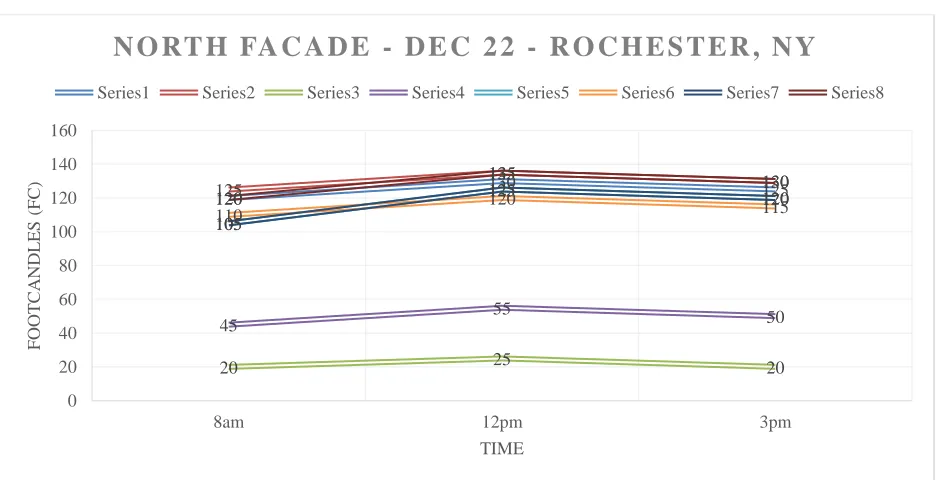
Figure 38: North Facade -- December 22 -- Classroom -- Linear Graph ...88
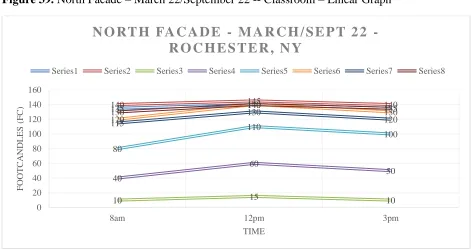
Figure 39: North Facade – March 22/September 22 – Classroom – Linear Graph ...89
Figure 40: West Facade - June 22 -- Corridor -- Linear Graph ...90
Figure 41: West Facade - December 22 -- Corridor - Linear Graph ...90
Figure 42: West Facade – March 22/September 22 – Corridor – Linear Graph ...91
Figure 44: North Facade - December 22 -- Corridor -- Linear Graph ...92
Figure 45: North Facade – March 22/September 22 – Corridor – Linear Graph ...93
Figure 46: East Facade - June 22 -- Corridor -- Linear Graph ...94
Figure 47: East Facade -- December 22 -- Corridor -- Linear Graph ...94
Figure 48: East Facade – March 22/September 22 – Linear Graph ...95
Figure 49: South Facade -- June 22 -- Corridor -- Linear Graph ...96
Figure 50: South Facade -- December 22 -- Corridor - Linear Graph ...96
Figure 51: South Facade – March 22/September 22 – Linear Graph ...97
Figure 52: Materials Selection ...98
Figure 53: Path of Sun – June 22...101
Figure 54: Path of Sun – December 22 ...102
Figure 55: Path of Sun – September 22/March 22 ...103
Figure 56: First Floor Plan – Furniture...104
Figure 57: Second Floor Plan – Furniture ...105
Figure 58: Daylighting Plan with FC Level 0-200 – 1st Floor - December 22 at 12 p.m. ...106
Figure 59: Daylighting Plan with FC Level 0-200 – 2nd Floor - December 22 at 12 p.m. ...106
Figure 60: Daylighting Plan with FC Level 0-200 - 1st Floor - June 22 at 12 p.m...106
Figure 61: Daylighting Plan with FC Level 0-200 - 2nd Floor - June 22 at 12 p.m. ...107
Figure 62: Daylighting Plan with FC Level 0-200 - 1st Floor – September 22/March 22 ...107
Figure 63: Daylighting Plan with FC Level 0-200 - 2nd Floor – September 22/March 22 ...107
Figure 64: First Floor Plan – Explanation ...108
Figure 65: Building Section - Monitor Roof ...109
Figure 66: Corridor Design - First Floor with Artificial Lighting...110
Figure 67: Corridor Design - First Floor with No Artificial Lighting ...110
Figure 68: Corridor Design - Second Floor with Artificial Lighting ...111
Figure 69: Corridor Design - Second Floor with No Artificial Lighting ...111
Figure 70: Light Shelf Section ...112
Figure 71: Secondary Classroom – Light Shelf with Artificial Lighting ...113
Figure 72: Secondary Classroom – Light Shelf with No Artificial Lighting ...113
Figure 73: Upper Classroom – Light Shelf with Artificial Lighting ...114
Figure 74: Upper Classroom – Light Shelf with No Artificial Lighting ...114
Figure 75: Clerestory Section ...115
Figure 76: Auditorium – Clerestory with Artificial Lighting ...116
Figure 77: Auditorium - Clerestory with No Artificial Lighting ...116
Figure 78: Louvers Section ...117
Figure 79: Cafeteria – Louvers with Artificial Lighting ...118
Figure 80: Cafeteria – Louvers with No Artificial Lighting ...118
Figure 81: Gym – Louvers with Artificial Lighting ...119
Figure 82: Gym – Louvers with No Artificial Lighting ...119
Figure 83: Library – Louvers with Artificial Lighting ...120
Figure 84: Library – Louvers with No Artificial Lighting ...121
Figure 85: East Elevation ...122
Figure 86: West Elevation ...122
Figure 87: North Elevation ...122
Figure 88: South Elevation ...122
LIST OF TABLES
Table 1: Fenestration Recommendation for Each Room Type ...27
Table 2: Classrooms Results in a Heliodon Device – December/June ...50
Table 3: Corridor Results in a Heliodon Device – March/September ...51
Table 4: Corridor Results in a Heliodon Device – December/June ...52
Table 5: Corridor Results in a Heliodon Device – March/September ...53
Table 6: East – Classroom -- June 22 -- Rochester, NY ...56
Table 7: East -- Classroom – December 22 – Rochester, NY ...57
Table 8: East – Classroom – September/March – Rochester, NY ...58
Table 9: South – Classroom – June 22 – Rochester, NY ...59
Table 10: South -- Classroom – December 22 – Rochester, NY ...60
Table 11: South – Classroom – September 22/March 22 – Rochester, NY ...61
Table 12: West – Classroom – June 22 – Rochester, NY ...62
Table 13: West -- Classroom – December 22 – Rochester, NY ...63
Table 14: West – Classroom – September 22/March 22 – Rochester, NY ...64
Table 15: North – Classroom – June 22 – Rochester, NY ...65
Table 16: North -- Classroom – December 22 – Rochester, NY ...66
Table 17: North – Classroom – September 22/March 22 – Rochester, NY ...67
Table 18: West – Corridor – June 22 – Rochester, NY ...68
Table 19: West -- Corridor – December 22 – Rochester, NY ...69
Table 20: West – Corridor – September 22/March 22 – Rochester, NY ...70
Table 21: North -- Corridor – June 22 – Rochester, NY ...71
Table 22: North -- Corridor – December 22 – Rochester, NY ...72
Table 23: North – Corridor – September 22/March 22 – Rochester, NY ...73
Table 24: East -- Corridor – June 22 – Rochester, NY ...74
Table 25: East -- Corridor – December 22 – Rochester, NY ...75
Table 26: East – Corridor – September 22/March 22 – Rochester, NY ...76
Table 27: South – Corridor – June 22 – Rochester, NY ...77
Table 28: South -- Corridor – December 22 – Rochester, NY ...78
INTRODUCTION
Appropriately incorporating daylighting into the building design can improve the economics of a resident school, positively impact utility costs -- and by extension the
environment -- as well as result in improvements to the health, productivity, and mood of those working and learning in the structure. Specifically, integrating daylighting into school building design has potentially great benefit to students, faculty, and staff. The use of natural lighting was standard in most architecture for much of human history until the early 19th century when the use of electricity became a common and integral aspect of the lighting in most buildings. After World War II, schools were encouraged to use more fluorescent lighting and as a result, builders reduced the use of windows in design. Windowless schools did help reduce the intrusion of outside glare from the Sun, but decreased utility efficiency as solar heat gain caused cooling loads to increase. During the 1973 oil crisis, when the price of oil skyrocketed worldwide, such factors as heating and cooling costs became far more of an issue. Since these costs never
returned to pre-1970s levels, it was again necessary to examine design and daylighting (Corbet, 2013).
Exposure to natural light from the Sun has been found to have a number of positive health effects. Sunlight is necessary to the creation of vitamin D by the body; it has also been shown to improve mood affect. Given that the average American spends 90% of the time indoors (EPA, 2017), adding daylighting to buildings could improve comfort and productivity.
Researchers have found that students in classrooms with natural lighting showed improvement to learning ability.
There are a variety of ways by which to best incorporate daylighting into building design; the most effective of these in terms of energy efficiency is to expand southern exposure to the Sun. This orientation can increase natural light and create the option for passive solar heating during the winter months. Additionally, reducing western exposure in turn reduces annual cooling costs. Unfortunately, integrating daylighting is not always easy as it can sometimes create problems related to poor window type selection, such as: glare, an increase in solar heat inside the structure; and, increased energy use because more electricity is needed to counter the increase in cooling and heating loads.
There are numerous solutions well-suited to addressing these problems, including the use of such shading devices as: light shelves, louvers, awnings, panels of glazing, and LED lighting fixtures (that reduce the output of mercury and electricity costs). In the presentation, eight types of shading devices and four design strategies will be examined in order to determine which are the best suited for incorporation into education spaces, activity rooms, and corridors. The
Statement of Problem
Having established that integrating more daylight into school buildings has proven benefit; it is necessary to define the obstacles that specifically school buildings present to the utilization and incorporation of natural light. First, schools traditionally utilize window types that impair the success of daylighting by creating problems inside the structure such as
significant glare and the admission of too much solar heat into the interior space. An increase in solar heat means a related increase in cooling load/electricity use in the building. Similarly, in order to reduce glare, school buildings are often oriented away from (or are windowless on) the direction where the greatest amount of sunlight shines, on the south side of building, which in turn prevents the structure from admitting and using the location’s available daylight. A lack of exposure to natural light can create numerous health problems for building occupants and has also been shown to negatively impact student learning outcomes.
Literature Review History
Daylight is the combination of the diffused light from the sky and sunlight (Baker & Steemers, 2002). Daylighting is the practice of designing openings that allow lots of daylight penetration into interior spaces (IEA, 2000). As noted, daylighting was a common tool in
climates, people preferred to spend more time in the cooler indoors, which meant that the amount of natural lighting had to be increased without impacting comfort. In the 1700s, cities in most western civilizations became more densely populated leading to the rise of crowded and unsanitary ghettos. When streets became narrower and buildings higher, little to no daylight could penetrate to the interior living spaces (Boubekri, 2014).
Until the 19th century, schools were very often incorporated into houses or were part of rows of houses rather than in stand-alone buildings. Schools then also went from one-story to multi-story buildings that could have wide windows that allowed in natural light. Before the 1950s, architects believed daylighting was an integral element of school building design. In 1874, school architect Robson proposed that classroom design should consider health and comfort in order to deliver effective teaching to children. He also stated that the use of
daylighting was important in classrooms; and, that windows in schools should never be located on the south or southwest sides of a building as these orientations create more glare, which would bother and distract students (Robson, 1874/1972). He suggested the best window positions and coolest, steadiest light were to be found through placement on the north side. Robson also emphasized that designers must consider that the stronger sunlight present during summers generally increases glare to teachers and pupils (Robson, 1874/1972).
enough daylight from the northern side of buildings, and this led to the increased use of
fluorescent lights – particularly when this technology became more available in the 1920s. By the 1930s, when fluorescent lighting technology was in wide use, it constituted a significant obstacle to the movement to incorporate daylighting into school building design (Boubekri, 2014). Due to its relative lower cost, fluorescent lighting was encouraged to an even greater degree following World War II and so even more windowless buildings were built. “With the advent of inexpensive electricity and widespread use of fluorescent lighting in the 1950s and 1960s, states began to abandon requirements of minimum daylight illumination in their building codes” (Heschong, 2002).
Importance of Fenestration
Of course, schools with very few windows mean little to no glare from sunlight is experienced inside; however, the decreased energy efficiency due to solar heat gain also meant an increase in cooling loads. For example, the state of Florida passed a bill in the 1970s that all school buildings must be windowless and air-conditioned. The short-sighted nature of such legislation was rather quickly apparent when the oil crisis began in 1973. Following this time period, there arose renewed interest in the incorporation of natural lighting into school building design that would reduce the electricity requirements generated by such items as fluorescent lighting (Hobday, 2015).
as the 1980s and 1990s began, there was a reexamination of the use of daylighting in design specifically to improve lighting control in school buildings (Lechner, 2014); and, architects began to consider the use of shading devices, LED bulbs, daylight harvesting, lighting pipes, tubulars, and hybrid lighting. Interest in daylight harvesting for commercial buildings has been growing in the U.S. due to an increase in desire for sustainable design and the impact of current strains on the nation’s power grid (Leslie, 2005). Daylight is an essential aspect to commercial
buildings because these sites house more than 66 billion square feet of lit floor space; between 30% and 50% of interior building space can be lit by daylight through windows or skylights (Leslie, 2005).
Cost-Saving Impacts
The most obvious benefit of natural lighting is the economic one -- that it is free and unlimited in supply. A 1952 report on office lighting in Great Britain found that offices with sufficient daylighting were significantly less costly to maintain (Phillips, 1964). Since U.S. public education is funded primarily by local property taxes, improving energy efficiency in school buildings should be a priority. In addition, the U.S. population continues to increase meaning more schools will be built and those schools should be designed with energy efficiency in mind. According to the Energy Information Administration (EIA) (2003), the world
population experienced an 11.87% increase between 1992 to 2001, which is an annual average increase of 1.3%. Rising population figures create a greater burden on limited and finite natural energy resources (Atre, 2003).
In many school districts, energy costs are second only to those funds budgeted for
annually on energy (Coalition for Adequate School Housing, 2009). Improved operations and maintenance practices could save up to 20% of these expenses in existing facilities, such savings could be applied to new building design and father modernization of older buildings (Gelfand & Freed, 2010).
Augmenting the use of natural light not only helps achieve sustainable solutions, it
reduces energy costs. Caution must be exercised, though, when expanding the use of natural light in buildings and architects must make sure not to create too much solar heat by improperly placing windows or using inappropriate glass types (single pane or glazing without low-e) as greater solar heat means greater cooling costs (Mohsenin, 2015).
Although compact fluorescent light (CFLs) and LED bulbs are low cost, highly energy efficient, provide good color, and have low noise; CFLs contain mercury and LEDs other dangerous materials (e.g., arsenic and lead) (Lim, Kang, Ogunseitan, & Schoenung, 2011). Despite this fact, it could be argued that the benefits of CFLs and LEDs outweigh their drawbacks (as compared to those of, for example, coal-burning power plants), though these environmental issues do need to be considered (Energy Information Administration, 2017). Therefore, the case is again made for the incorporation of daylighting that, when properly done, does not introduce or increase toxins in the environment while also saving energy.
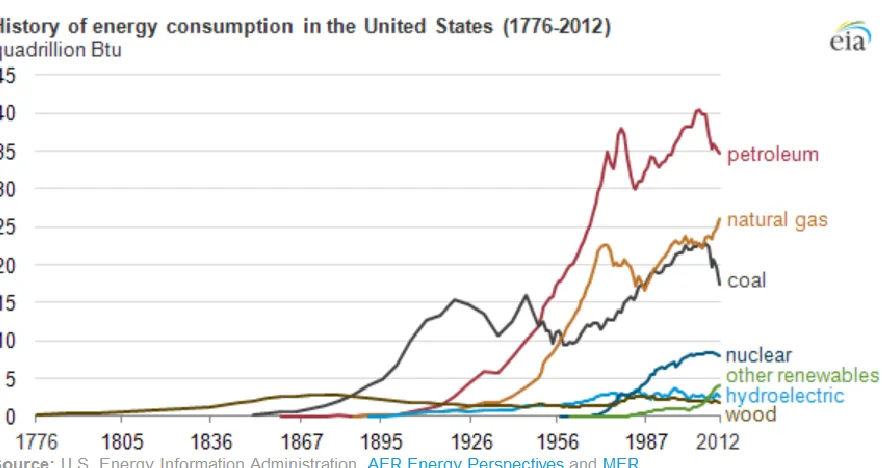
energy consumption and 74% of total U.S. electricity consumption (Mohsenin, 2015; U.S. Department of Energy, 2011).
Figure 1. U.S. Energy Consumption by Source, 1776-2012
Figure 1. From U.S. Energy Information Administration, 2009.
https://www.eia.gov/todayinenergy/detail.php?id=10. Note: Vertical axis is in quadrillion BTU.
Figure 2. U.S. Electricity Generation for 2016
Figure 2. From U.S. Energy Information Administration (U.S. Department of Energy, 2017).
Figure 3. Utility-Scale Facilities in 2016
The energy used by artificial lighting in buildings is a major part of the energy used in buildings. It would make a big difference if the use of artificial lighting were reduced and the use of natural lighting were increased (Phillips, 2004). According to the International Energy
Agency (2012), primary energy (i.e. energy that has been subjected to any transformation process) has grown by 49%; carbon dioxide emissions increased by 43% during the period between 1984 and 2011. Energy dedicated to building consumption utilizes 40% of the energy produced each year in the United States. Furthermore, U.S. electricity’s share of primary energy use in buildings increased from 56% in 1980 to 72% in 2005; and, U.S. electricity use in 2011 was more than 13 times greater than in 1950 (Boubekri, 2014).
Reducing the amount of energy used for building illumination reduces the amount of heat produced by electricity-powered light sources as well and dramatically decreases a building’s cooling load (Boubekri, 2014). According to the U.S. Department of Energy (DOE) and the EIA, electric lighting in buildings consumes more than 15% of all the electricity generated in the country (2014); making use of natural light instead would lead to significant energy savings.
The Energy Policy Act of 2005, extended Daylight Savings Time (DST) by three weeks in the spring and one week in the fall to increase energy conservation gains by taking advantage of the greater availability of natural light created by DST (Murray, 2011). Schools can take advantage of this change by utilizing design aspects that make better use of the greater daylight available during the school day. Buildings utilized a startling 38% of the total energy used in the U.S. in 2010; this is greater than the energy used by industry (33%) and the transportation sector (28%).
buildings, about 70% of the energy used for lighting could be saved through daylighting; it could also reduce heating and cooling energy consumption since it creates less heat during the summer and more heat in the winter than electric lighting (Lechner, 2014). The incorporation of
daylighting into design could cut the lifetime energy expenses of a building by 30%- 70% by introducing diffuse light by the use of such tools as baffles, roof monitors, skylights, and clerestories (Taylor, 2009).
According to the Leadership for Energy and Environmental Design (LEED) system, lighting can sometimes be the biggest contributor to a building’s energy use. Since electricity is used to both power lights as well as to offset the increased cooling load that results from the heat produced by the lights, LEED recommends daylighting strategy to save energy.
In the United States alone, buildings accounted for 72% of electricity consumption, 39% of energy use, and 38% of all carbon dioxide emissions American Chemical Society, 2015). Lighting and cooling comprise more than half the average electricity consumption in the average building. Additionally, office and school equipment, such as computers and copiers, can increase energy consumption even more (Gelfand & Freed, 2010). Worldwide, energy consumption by both residential and commercial buildings in developed countries accounts for 20 - 40% of the total energy used (Hee et al., 2015).
Human Performance
conditions that can impact students’ ability to learn. Research has found that students in classrooms with natural lighting showed improved learning ability (Atre, 2003).
Productivity. Increasing the size of windows does not just make a room feel bigger and more comfortable, the increase in exposure to natural light has been found to improve outcomes. Conversely, a lack of exposure to natural light has been found to have a negative impact on productivity. Heerwagen and Heerwagen (1984) conducted studies at the University of
Washington involving occupant responses to heat reflective glass, windowless spaces, and the presence of uncomfortable glare. The academic performance of more than 8,000 students in 450 classrooms was analyzed. A detailed analysis was also made of the effect of such factors as indoor lighting, windows, and views on student performance. Pleasant, window-provided views positively affected students; glare, direct sun penetration, and negligence regarding window control and shading was found to negatively affect student performance (Atre, 2003). The subjects rated the presence of windows as being more pleasant, but responses to other room embellishments indicated that windowless spaces created a negative feeling and mental discomfort (Atre, 2003).
Improvement to learning ability. The body’s internal clock depends on awareness of the daylight cycle in order to function properly. Without the exposure to daylight, the human body clock can get confused, this can lead to lack of memory and concentration (White, 2009). Therefore, it is not surprising that this research found that classrooms with skylights saw student performance improve at a rate of 20% faster than the performance of students in classrooms without skylights (White, 2009). A separate study of 12,000 elementary school students found a 14% improvement in student performance for those in classrooms with operable windows (Dudek, 2007).
Researchers who studied students in the Capistrano Unified School District in California demonstrated that classrooms with daylighting were associated with standardized test score improvements of 15% - 23% over a one-year period when compared to the scores of those being tested in windowless classrooms (Taylor, 2009). Studies in Colorado and Washington indicated that students in daylit classrooms had test scores 7% - 18% higher than those of students in classrooms with the least incorporation of daylighting (Gelfand & Freed, 2010).
Students in classrooms with the largest window areas were found to progress 15% faster in math and 23% faster in reading than students in classrooms with smaller window areas. Furthermore, students in classrooms with well-designed skylights that diffused the daylight into the room and enabled teachers to control the level of light in the room showed improved learning abilities compared to those of students in rooms without such skylights (Heschong, 2002).
Prevention of eye damage. Some studies have found a connection between artificial lighting and vision issues, including those related to glare (Hobday, 2015). Adding daylighting to interior spaces through the use of proper windows and shading devices can reduce or prevent eye damage. Daylight is solar radiation visible to the human eye (Hobday, 2015). Over the last 50 years, myopia, or shortsightedness, has increased among children, to the point where it must be considered a global health problem. Studies estimate that a lack of exposure to daylight may cause short-sightedness or myopia (Hobday, 2015). Researchers have also found that 80% - 90% of children graduating from secondary school are short-sighted – including some 10% - 20% with high myopia – and that this figure has increased in people from 12- to 54-years-old by more than 60% since the 1970s (Hobday, 2015). Hobday (2015) stated, “Differences in the
protective effect, and animal studies suggest that low light levels indoors may be a risk factor for developing myopia" (p. 51).
Light intensity can vary from 8 to 1,000 footcandles in a single room (Gifford, 2007). Generally, the eye can adjust to light changes quickly. Given enough transition time, students could read just as quickly with a very dim 3 footcandles of light as with 53 footcandles (570 lux), which is the standard classroom light intensity (White, 2009). However, Gifford (2007) asserted that light placement within the classroom as well as the availability of natural lighting also impact reading ease.
Visual comfort data is usually based on occupant surveys and feedback; similarly, “glare” is also a rather subjective determination. It is related to the physical discomfort a given
individual experiences in reaction to excessive light (Reinhard, 2010). The overall sensation of glare is then subdivided into two major types: disability glare and discomfort glare. The former is “the effect of stray light in the eye whereby visibility and visual performance are reduced” (Rea,
2000, p. 13) the latter is glare that, although it creates discomfort, does not interfere with a person’s actual ability to see (Motevalian, 2014).
distracted affect leading to increased likelihood of causing traffic accidents, and workplace errors from mundane, trivial errors to mistakes in industrial settings that could seriously injure or even kill (Boubekri, 2014).
The relationship between access to daylight and health was noted from very early on in human civilization. Hobday (2015) cited the famous work of Vitruvius, the Roman architect and engineer of the first century B.C., whose classic principles stated that architects should select healthy sites that receive plenty of sunlight for buildings, and that careful design of buildings prevented illness. He was the first person to study the qualitative and quantitative aspects of daylight (Phillips, 2004). Seasonal affective disorder (SAD) and depression are triggered by a lack of daylight. Children in windowless classrooms were found to display symptoms of SAD including those of restlessness and irritability; SAD is also believed to be a major contributor to absenteeism (Dudek, 2007, p. 35). Research has found that SAD affects 20% of Americans each winter, suffering from fatigue and more serious depression due to the lack of sunlight. As the days get shorter in the fall and winter, reports of depression increase whether students have been diagnosed with SAD or not (Mercola, 2016).
Furthermore, a multitude of symptoms have been ascribed to “Sick Building Syndrome,” including: dry or itchy eyes, migraines, aches, pain, and other symptoms. Some research has indicated that this syndrome can be caused by poor or improper lighting installation (Phillips, 2004). According to the Green School Initiative (Global Green USA, 2005) daylight provides biological stimulation that regulates the body’s systems and mood, reduces health costs, and contributes to productivity, and offers the benefits of natural ventilation that helps reduce cooling and heating loads (Taylor, 2009). Exposure to sunlight can increase the brain’s release of the hormone serotonin, which has been shown to boost mood, aid in relaxation, and improve concentration. Exposure to sunlight can relieve symptoms associated with non-seasonal depression, premenstrual dysphoric disorder, and pregnancy-related depression (Nall, 2015).
Effects of Orientation
Solutions to the Problems
Since the Energy Crisis, there has been a greater emphasis on the need to make buildings in general and school buildings in particular more energy efficient in order to preserve the environment and help the economy. A key aspect to these efforts is the incorporation of
daylighting; however, integrating daylighting into an existing school building is not always easy. Furthermore, daylighting can create certain problems that must be considered in order for its use to be appropriate and successful. As noted, these include the potential for an increase in glare, greater solar heat gain, and higher energy use to address increased cooling and heating loads. However, the fact is that each of these issues can be addressed.
Glare. Bright and hot direct sunlight can cause visual and thermal discomfort although it is difficult to evaluate glare in a concrete fashion because it cannot be measured in lux or
footcandles (Benya, 2010). For this reason, schools often do not want to expand south-facing windows as this can increase the glare on students. Therefore, placing or expanding windows on the north-facing side generally addresses this issue.
Today, there are strategies for reducing glare experienced when windows are placed on the south side of buildings. These methods include: sun shading devices; light shelves; high-reflectance interior surfaces; light-colored window surrounds and mullions; and,
For instance, shades used on the south, east, and west faces can be used to control glare while shades on the north side of buildings can be expanded to bring in more light. Window glazing choices can also be used to reduce glare and new types of glazing have been developed specifically to control glare by reducing light transmission (Phillips, 2004). Light shelves are the best option for glare because the concept uses internal and external light shelves placed high on walls that lower internal glare without obstructing view by using large exterior glass and interior partition openings (Taylor, 2009). This study will utilize this glare solution as one of the methods for integrating daylight into a school.
Solar heat. Installing improper windows or improperly orientating the building creates more solar heat inside. Windows are the thermally weakest link in the building skin, called thermal holes (Aydin, 2006). However, for obvious reasons, increasing solar heat in buildings in cold climates to reduce heating loads is desired. This can be achieved with south-facing window placement and can be of great benefit. Conversely, the opposite effect is desired in hot climates and during the heat of summer so increasing solar heat without any way to mitigate it based on need creates major problem (Aydin, 2006). According to National Fenestration Rating Council (2017), poorly performing windows, doors, and skylights can create drafts in winter by cycling at different temperatures through the building. In summer, such issues can make cooling more difficult by allowing the Sun to influence temperature in the building. In hot climates, all
windows should have a denser glazing with low e, use shading devices, and exterior partitions to decrease cooling loads. In mild or cold climates, the windows that face south must be installed with shading devices such as louvers, light shelves, overhangs, awnings, fins, screens, or
of fading in fabrics or carpets; high-performance products can reflect up to 74% of the damage caused by UV rays (NFRC, 2017). There are many types of glazing that can prevent solar heat gain, including glass that is: heat reflective, heat absorptive, low-e, XUV fading resistance, heat mirroring, photochromic, and electrochromic (Sekhar & Toon, 1998).
Double and triple glazed windows have become more popular while single pane is falling out of favor as it creates more problems with thermal control. A double pane of glazing window is more energy-efficient since the layer of air between the panes has a very low heat conduction coefficient that means that most heat or air-conditioning energy loss through the windows can be prevented (Aydin, 2006). Studies have found that if windows are poorly insulated as much as 30% of heat will be lost since they are the thinnest element that transmits cold, heat, noise, and harmful ultraviolet rays into any building. The thermal resistance of windows is much lower than that of exterior walls, but window improvements can now control thermal effect almost as
successfully as exterior walls. Such improvements can increase thermal insulation by 20% (Kaklauskas et al., 2006).
Double or triple glazed windows help prevent the majority of solar heat gain but also the denser the window, the lower the solar gain. Triple glazing is best used in hot or tropical climates as it lowers solar heat gain even more importantly prevents the admittance of moisture due to the thickness of the windows. Triple glazing of windows has achieved cooling electricity savings of 6.3% compared to that of single-paned clear glass (Hee et al., 2015). Hee et al. (2015) stated that increasing window area and/or transmittance to increase daylighting savings frequently reaches a point, depending on climate and orientation, at which total energy consumption increases due to greater cooling loads. Not all buildings need the exact same density of windows. In cold
need to gain more solar heat in order to decrease heating load. In mild climates, buildings may use both double- and triple-paned glazing to better respond to the winter and summer seasons. In mild climates, south-facing windows should be triple-paned while windows that face north should be double-paned. Awareness of climate background is key to the selection of appropriate glazing (Hee et al., 2015).
Modern windows also typically include a reflective coating and low-emissivity (low-e) coating glass – these are known as smart windows, which are able to reduce the amount of heat entering a building to save energy and reduce cost. A smart window includes two pieces of glass separated by a spacer that contains a strong absorbent to keep the air barrier as dry as possible, which allows for better thermal control. The surrounding edges of the window are sealed with a strong elastic glue. The use of smart or low-e windows is strongly recommended to reduce cooling and heating loads as such models can reduce lighting electricity costs up to 70% - 80% (Sekhar & Toon, 1998). The saving in annual cooling load may be as much as 24% when low emissivity double-glazing windows are used versus clear double-glazing windows (Freire,
Mazuroski, Abadie, & Mendes, 2011). Low-e windows control thermal during both summer and the winter since their low-e coating prevents heat from moving through the windows (to the outside in winter and to the inside in summer) (Benya, 2010).
Energy efficiency. Progress has also been made in locating solutions to avoid glare and reduce solar heat gain. Shading devices and denser glazing windows save energy while also allowing in light. According to the U.S. Green Building Council, for many buildings, lighting is the biggest component of building energy use. Reducing the need for electrical lighting by incorporating more daylighting saves a great deal of energy (Wilber, 2014). This is also
important because electrical lighting produces heat that may increase cooling loads (Shin, Yun, & Kim, 2012). Options for reducing the need for electrical lighting and lowering its costs include harvesting daylight using lighting controls, photo sensors, timers or occupancy sensors, and light pipes or solar tubes.
Today, more architects are using “mirror sunlight reflection theory,” which refers to the use of mirrors or reflective material to allow sunlight into
a pipe that is lined with reflective materials to bring more light into darker rooms. This technique saves energy and reduces the need for artificial lighting. This can be used in basements or rooms without exterior walls, where it is not possible to utilize windows to bring in daylight.
Example of Solartube or Lighttube
Figure 4. Example of Solartube or
There are two different types of mirror sunlight reflection: lighttubes and hybrid solar lighting. Lighttubes are a type of tubular daylighting device that harvests daylight through a dome in the roof and transfers it down a reflective tube through a diffuser in the ceiling. This is a type of daylighting commonly used in sustainable green building design. Furthermore, this technique can collect and reflect large amounts of natural light, including moonlight; it is primarily used in residential buildings currently, but could be easily adapted for use with school buildings. Such high-performance lighting is a key element of healthy learning environments, contributing to improved test scores, reduced off-task behavior, and higher achievement among students (Petty, 2007).
Hybrid solar lighting or solar point lighting systems, such as the Point Solar System®, are roof-mounted platforms that contain a 45-foot long plastic fiber optic bundle comprised of a number of "hybrid luminaires," lighting that is a combination
Example of Hybrid Solar Lighting
of solar and artificial. This technology
draws natural sunlight into a small bundle of optical fibers in order to bring the light directly into the building. Hybrid luminaires can blend natural light with existing artificial lighting to provide controllable interior lighting, create a healthier environment (Lapsa, 2007). This lighting method does not give off much if any heat, so it does not impact the cooling load.
METHODOLOGY
As has been shown here, there are numerous ways to incorporate daylight into a school building that avoid creating problematic glare, reduce or eliminate solar heat gain, save energy, save money by reducing utility bills, and do not negatively impact the environment, while also improving human performance, comfort, and health. To best determine how to proceed with incorporating daylighting into a school building, it is necessary to first study the climate and orientation of the structure.
The hypothetical school in this study is located in Rochester, New York, in the humid continental climate zone, which experiences a great range in temperature and all four specific seasons; the city also tends to receive a lot of snow during the winter months (Ritter, 2006). In colder climates such as Rochester, research has found that placing more windows on the south side of buildings will increase solar heat gain; with this design choice, the south-facing windows will be shaded with standard or egg crate louvers, awnings, or light shelves to reduce solar heat gain during the summer months.
The windows utilized will include double-pane glazing to prevent solar heat gain from the outside environment. The west, east, and south sides of the building receive more sunlight than the north side. It is also important to keep in mind that not every room in a school is a classroom; and, it will not be possible to achieve the same daylight standard for these “other use” rooms. Additionally, some rooms are public, but others must be private (e.g., offices, guidance counselor spaces).
every day, regardless of season. The cafeteria is best located in the middle of the building with a curtain wall that includes shading devices that face south to receive substantial sunlight during the middle of the day as this is the time period when the space will be at the highest time of occupancy. During the middle of the day, the Sun will be directly to the middle of the south façade or exactly between west and east.
The gymnasium and activity rooms will be located on the west side since the high-traffic times for these spaces are during the later part of the day, for after school activities, and this side receives more sunlight in the late afternoon. Administrative offices will be located on the southeast side of the building. Bathrooms could be located on the south side where they can receive sunlight through clerestory windows; or, they could be located on the north side and be windowless, as they do not really need sunlight; this latter design plan gives more space to other rooms that need more sunlight because they are utilized for much longer periods. Each of these location design choices creates energy saving and greater natural light exposure.
Administration offices require greater privacy than classrooms; each room will include one side with a large window or curtain wall that incorporates special glass to prevent glare from the sun. Classrooms that have exterior walls will have a large window with a smaller one above that has an external awning to protect from glare that could reflect off the classroom’s white board. Rooms in the middle of building, that do not possess exterior walls, will have a curtain wall that faces a corridor or atrium; they will also include skylights, monitor roofs, or clerestory windows close to the ceiling to admit daylight into the space. The window glass here will be entirely textured in order to avoid causing distractions for students as people walk by through the hallways. Bathrooms do not need curtain walls, but will have small windows along the top of the wall. The glass in these windows will not be clear, it will be textured to maintain privacy.
Table 1
Fenestration Recommendation for Each Room Type
Room Type
Fenestration
Choice Advantages
Large Area Room Types:
Cafeteria, Gym, and Library
Low-e curtain walls with louvers and double glazing
• Low-e glass will reduce the heat and more effective than single glazing or standard glazing
• Curtain wall will able to bring the light to the entire area of space instead of the half space of room. The floor from the window to the wall must be the same size or near as the height of the curtain wall.
• Louvers will only help to shade the curtain walls instead of casement windows to avoid the glare from the natural light. The louvers won’t able to shade through the casement window while bring enough the light.
Regular/Standard Room Types: Classrooms, Offices, Activity Rooms Low-e casement windows with closed sealed steel frames, light shelves, and double glazing.
• Low-e glass will reduce the heat and more effective than single glazing or standard glazing.
• The light shelves with the casement windows will able to bring the light to the ceiling that will reflect to the interior space while avoiding from getting the glare from the natural light.
Privacy Area Rooms: Bathrooms, Locker Rooms, Dressing Rooms
Low-e clerestory windows with closed sealed steel frames and double glazing.
• Low-e glass will reduce the heat and more effective than single glazing or standard glazing.
• This type of window will bring the light to interior space while reducing glare and improving privacy.
Corridors Monitor roof with low-e double glazing clerestory windows.
• Low-e glass will reduce the heat and more effective than single glazing or standard glazing.
Types of Fenestration
Clerestory window. Clerestory windows can be used in bathrooms and locker rooms either for privacy or simply because they are typically not long occupied spaces. These types of windows are located high on walls so that they are above eye level while still bringing natural light into the interior space. These windows
are part of passive solar strategy that support energy efficiency in buildings; however, they must be properly located in the sunny side of the building while also protected from the summer sun by rooflines, overhangs, recessed thick walls, or other architectural features so as to prevent overheating during the warmer seasons. They also can reduce the use of air conditioning since the airflow is more indirect than an ordinary window to prevent rising of hot air.
Skylights. Skylights will be used in corridors and atriums. Skylights have been an architectural design tool for centuries. Similarly, atriums with skylights were widely used in grand palaces, palazzos, museums, and masonry. School buildings should incorporate atriums or skylights in corridors since most schools tend to be
constructed with corridors that include no windows, which can create a claustrophobic atmosphere in the
Figure 7. Skylights in Eastview Mall in Rochester, NY http://www.labelscar.com/new-york/eastview-mall
Figure 6. Clerestory Windows in Austin, TX Designed by Amitzi Architects
hallways. The incorporation of skylights into hallways opens up these spaces and creates a connection to the exterior environment. Skylights also reduce the need for artificial light thereby using less energy and lowering electricity costs. Research has found that daylight from skylights can cut lighting energy use by up to 80% (Lawrence & Roth, 2008). There are a few different skylight types available such as those that include sloped glazing and custom features in order to control the amount of light that enters the space. Skylights can also be used to provide
ventilation, passive cooling, and fresh air exchange. Both glass and plastic infill systems for skylights increase thermal performance. Skylights can also be designed to enhance strength, durability, and fire resistance. Since these elements create an entry for the direct rays of the Sun at the hottest time of the day, it is necessary to be extremely careful in their design and
implementation (Gelfand & Freed, 2010). Low-E coatings should always be included in skylight systems to reduce U-factor and prevent radiant heat flow. Another strategy for reducing heat and glare is to add two surfaces of reflection to increase light redirection by oblique surface-solar azimuth angles (Beltran, Lee, Papamichael, & Selkwoitz, 1994). Daylight levels on the vertical atrium surfaces are more critical since they refer to daylight performance at the border between two different daylit spaces (Du &
Sharples, 2012). The walls in the atrium will be painted with white or light colors to increase surface reflectance, in other words, to increase the daylight levels on the atrium walls (Du & Sharples, 2012).
Saw-tooth roof. Saw-tooth roofs are similar to skylights but face the interior
Figure 8. Sackler Building by Haworth Tompkins https://www.architectsjournal.co.uk/rcas-sackler-
space at different angles. They can be a better choice than skylights as they reduce solar heat more; skylights create bigger spaces that allow sunlight through to the floor and create more heat, which increases the cooling load. Saw-tooth roofs are best used in mild or hot climates; skylights are the best option in cold climates where the building can achieve more solar heat, which reduces the heating load. Such roofs can be in spaces devoted to indoor activities, such as indoor swimming pools, basketball or volleyball courts, cafeterias, and private rooms (e.g., locker rooms and bathrooms). The saw-tooth roof is comprised of a series of ridges with the side of glasses that directly facing to the south that allow natural light deep into the building. These elements have glass panels that face away from the ground in order to prevent the light and heat of direct sunlight to impact the interior; and instead allow steady, natural light to cover a large interior area. This helps avoid and reduce glare from reflective floors such as reflective
hardwood floors used for basketball courts. If windows/skylights face directly downward, the solar radiance can penetrate through glass panels and damage or warp the surface of the wood or other vulnerable flooring types.
Monitor roof. A monitor roof is a raised structure by the double-pitched roof, with its own roof running parallel the main roof. The
two long sides of a monitor contain clerestory windows or louvers to brighten the light into the interior space under the roof (Ching, 2012). A monitor roof is the most appropriate structure for the corridors and atrium where they can bring the light into the room where they cannot receive any natural light without windows. The
Figure 9. Monitor on Whitehouse Crawford Planing Mill in Walla Walla, WA
https://en.wikipedia.org/wiki/ Monitor_(architecture)#/me dia/
monitor roof will able to bring the natural light from the second floor to the first floor only if the first floor of the corridor has an open ceiling to receive the daylight from the clerestory windows under the roof.
Shading Devices
Light shelves. Some rooms need to be able to control how much daylight enters interior spaces so as to avoid glare; this is especially true in classrooms and computer labs. Daylight redirection window film, or DRF, and light reflectors or shelves can help control natural light. Daylight redirection window film was designed to
redirect sunlight from windows to deeper into interior spaces to boost natural light. This will decrease glare and discomfort. Light shelves can reflect natural light 40 feet or more. Such a design choice could save up to 52% in electrical lighting costs while increasing student and staff productivity, and decreasing rates of absenteeism. DRF is made of micro-structured prisms, which redirects over 80% of daylight. (3M, 2017).
Light reflectors and shelves are horizontal surfaces that reflect natural light deep into a building. When the natural light hits the shelves, it is bounced to the ceiling. A light shelf is fitted some way up on a window and divides the glazing into two parts: a view window below the shelf and a clerestory window above it. The shelf is divided into two windows, a window below a shelf is a view window or closed seal casement window while a window above a shelf is a clerestory window. A window above the shelf must be shorter than a window below the shelf.
A window above should be filled in one-quarter of the exterior wall while a window below should be filled in the three-fourths of the exterior wall. Light shelves are located above eye-level and have high-reflectance upper surfaces. They are also more effective shading devices than interior shelves and even help reduce window glare. This reduces the building’s need for artificial lighting. Unfortunately, light shelves are not suitable for every climate; instead, they are most suitable in mild climates because in hot climates they increase the solar heat gain into the building. Light shelves are a better option than other shading devices because an exterior light shelf shades the outside of the window to reduce the solar gain to the room; an interior shelf provides better visual protection from sun glare at intermediate depths within the room
(Littlefair, 1995). Studies have found that under overcast skies, light shelves reduce illuminances by 5% - 30%; the least reduction occurs at the back of the room (Littlefair, 1995). For best effect, an internal light shelf must not be too deep, and be roughly equal to the height of the clerestory window above the light shelf (Littlefair, 1995). The main reflector contains a curved, segmented surface to better redirect the sunlight based on changing solar altitudes (Beltran et al., 1994).
Louvers and egg crates. Louvers and egg crates are a shading device that covers more of the area of the window and creates more shade than light shelves. The louvers and egg crates are like a curtain or blinds except they are only for interior shading devices that usually cover most of the space of the window. Egg crates use rectangular cells that direct and diffuse daylight into the interior space, but louvers
Figure 11. Silver Alucobond Louvers in Gaimersheim Germany Designed by Kandler-Bunje Architects + Engineers
use fixed or movable horizontal slats for allowing daylight inside of the building. Louvers and egg crates are like shutters and overhang blinds but are constructed of different material, and made of aluminum or plastic painted a bright color for protection and durability. Studies have demonstrated that a reflective louver system can provide up to 70% additional illuminance in a work area when clear sky conditions are present (Leung, Rajagopalan, & Fuller, 2013). These elements redirect and diffuse sunlight into the building to mitigate solar heat gain and glare. Louvers can be installed in horizontal, vertical, or slop slats, which make some use of highly sophisticated shapes and surface finishes such as egg crate louvers (Leung et al., 2013). They can be located on the exterior or interior of a window, between two panes of glass, or two exterior curtain walls. Such louvers can be installed with solar panels but can only be located on the exterior of east, west, or south facing windows so they can absorb more sunlight. A louver system also can be installed with a device that automatically adjusts them to best take advantage of natural light guiding (Leung et al., 2013). The light shelf can be combine with louvers to shade more interior space while avoiding getting glare and gaining solar heat.
Awnings. An awning is another covering that is attached to the exterior wall of a building above
windows, doors, or over a patio or balcony. These can be constructed of aluminum understructure with aluminum sheeting in cold climates so as to be suitable for holding up under wind and/or snow loads. Awnings can provide shade to exterior wall windows and reduce cooling loads, thereby lowering utility bills. Another function of such structures is to create slope from
RESEARCH METHOD
Before starting the design of the hypothetical Rochester school, it is necessary to observe and study classrooms and corridors, applying different types of design strategies for each
orientation. Eight different types of design strategies will be used to create physical models for two classrooms. Each of the two classrooms will be facing south and north and then to the west and the east. To study the different level of natural light from each orientation where the Sun will come from the east in the morning to the west in the evening. When the building is facing to the south will receive more natural light than facing to the north but will able to receive the daylight all day. When the building is facing to the east will gain natural light only in the morning but when it’s facing to the west will gain daylight only in the evening. After studying each through
different shading devices and design strategies, the author selected the most appropriate type of room for each orientation of the buildings. According to earlier research, it will be most
Figure 13. #2 Skylight in a Corridor1
Skylights are roof fenestration that allow natural light into interior spaces. Skylights were found to bring in the most daylight of any shading device, but are not always the best option for every structure as they can create glare and increase solar heat and cooling loads.
Figure 14. #1 Saw-tooth in a Corridor
Figure 15. #4 Clerestory in a Corridor
Figure 16. #3 Roof Monitor in a Corridor
17’- 0” x 17’ - 0”
10’ - 0” A.F.F. /Sloped 10’ - 10 ¾” Below Sill - 2’- 0”
Up to Header - 7’ - 6” Below Clerestory Sill - 9’ - 0”
Up to Clerestory Header - 10’ - 10 ¾”
Figure 18. #2 Sloped Roof with Light Shelf in a Classroom
17’- 0” x 17’ - 0”
10’ - 0” A.F.F. /Sloped 10’ - 10 ¾” Below Sill - 2’- 0”
Figure 19. #3 Egg Crates in a Classroom
17’- 0” x 17’ - 0” 10’ - 0” A.F.F. Below Sill - 2’- 0”
Figure 20. #4 Louvers in a Classroom
17’- 0” x 17’ - 0” 10’ - 0” A.F.F. Below Sill - 2’- 0”
Figure 21. #5 Light Shelf with Louvers in a Classroom
17’- 0” x 17’ - 0” 10’ - 0” A.F.F. Below Sill - 2’- 0”
Figure 22. #6 Light Shelf in a Classroom
Figure 23. #7 Awnings in a Classroom
17’- 0” x 17’ - 0” 10’ - 0” A.F.F. Below Sill - 1’- 6”
Figure 24. #8 Original Window in a Classroom
17’- 0” x 17’ - 0” 10’ - 0” A.F.F. Below Sill - 1’- 6” Up to Header - 9’ - 0”
Qualitative Research
three-dimensional solar beam at various times of the day and year. Each orientation of the building will be studied through two seasons -- winter and summer – by taking pictures at the different times of year and then comparing them to other types of design strategies. The data will be collected to demonstrate the level of lux and daylight is present at different times of the day and month. This will allow us to compare the types of design strategies. After the results for each of the design strategies are collected, the one with the best potential for each of the classrooms at each orientation of the building and corridor will be determined.
Each corridor in the hypothetical school is 8 feet wide, 12 feet long, and 12 feet high; each classroom is a 17-foot per side square with 10-foot
ceilings. According to K-12 Figure 25. Sun Emulator Heliodon. http://www.heliodons.org school standards, most classrooms are built to accommodate 15 to 25 students; this number is easily housed in a 17-foot x 17-foot room. The window sizes of the classrooms vary, but most will be curtain walls or single casements. The physical models will not design the specific glazing for the windows since researchers strongly recommended using double to triple glazing with low-e windows in a proper orientation of the building. The physical models will
brightest and darkest rooms will be avoided as the former will have too much glare and the latter will be to dim to visualize anything. Awnings and light shelves are indicated as the chosen classroom exhibited a constant level of daylight; the rest of the rooms had varied levels of daylight. After studying them, the results had shown that awning and light shelves exhibited a constant level of daylight all day while other had varied levels of daylight. Monitors also demonstrated that the corridors received a constant level of daylight throughout the standard school day (from 8 a.m. to 3 p.m.), while the rest of the corridors showed varied levels of
Table 2
Classroom Results in a Heliodon Device – December/June
Types North - Dec – 12 pm North - June – 12 pm South - Dec 12 pm South - June 12 pm
Egg Crates
Sloped w/ Clerestory
Awnings
Light Shelf
Light Shelf w/Louvers
Louvers
Sloped w/ Light Shelf
Table 3
Classroom Results in a Heliodon Device – March/September
Types North - March/September – 12 pm South - March/September – 12 pm
Egg Crates
Sloped w/Clerestory
Awnings
Light Shelf
Light Shelf w/Louvers
Louvers
Sloped w/ Light Shelf
Table 4
Corridor Results in a Heliodon Device – December/June at 12pm
North - December North - June South - December South - June
Clerestory
Monitor
Skylight
Table 5
Corridor Results in a Heliodon Device – March/September at 12pm
North - March/September South - March/September
Clerestory
Monitor
Skylight
Quantitative Research
Observing the physical models in the heliodon device may be not enough to determine which shading device or design strategy is the best for a given school building. Therefore, software that shows the level of footcandles in each model should be referenced. The footcandle is a unit of illuminance, equivalent to the illumination
produced by a source of one candle at a distance of one foot and equal to one lumen incident per square foot. Revit software demonstrates the level of footcandles in a specific location with exact dates when the sky is clear. Using Revit, each design will be analyzed in the Render In Cloud
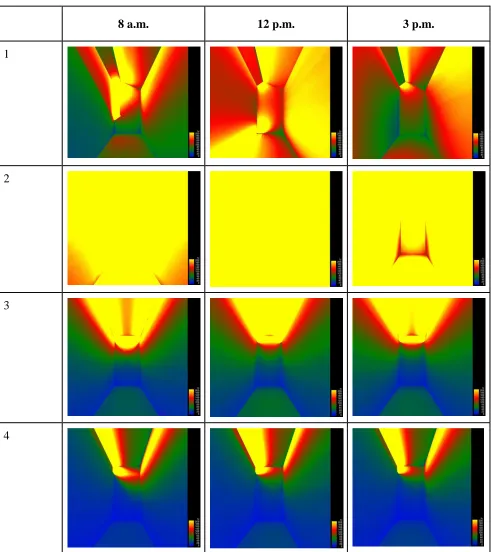
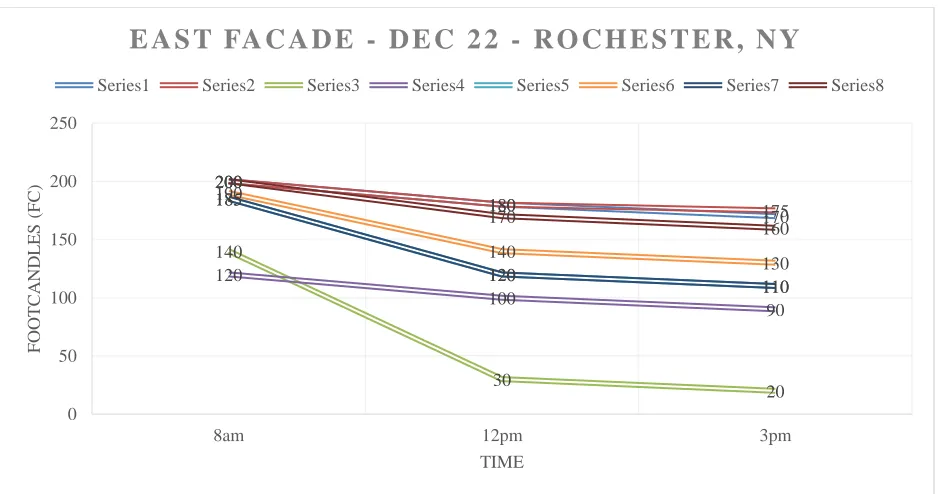
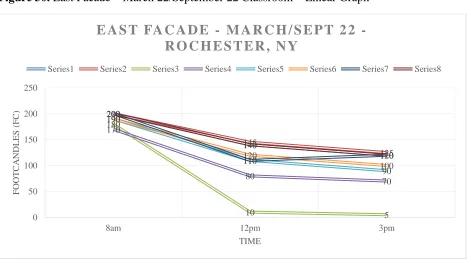
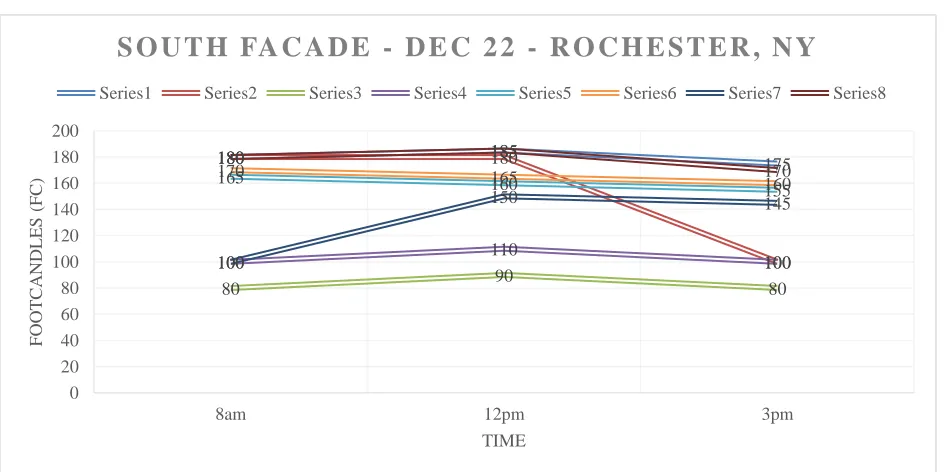
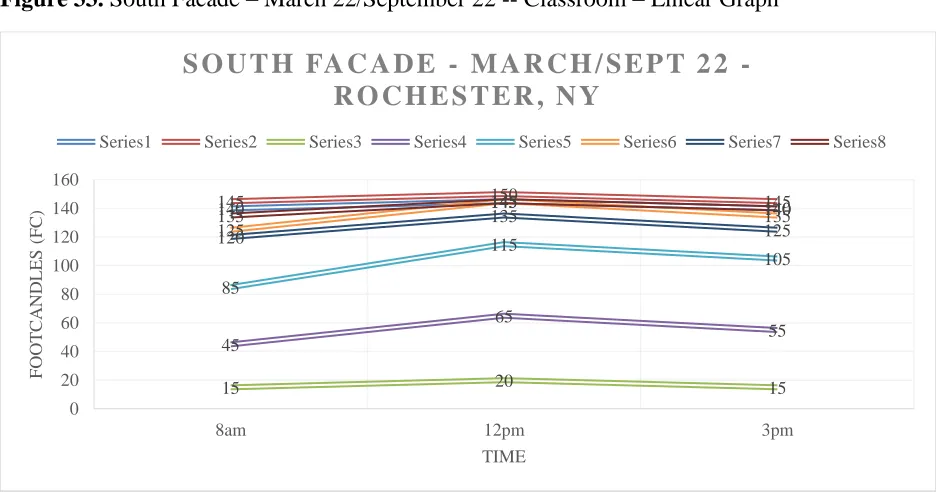
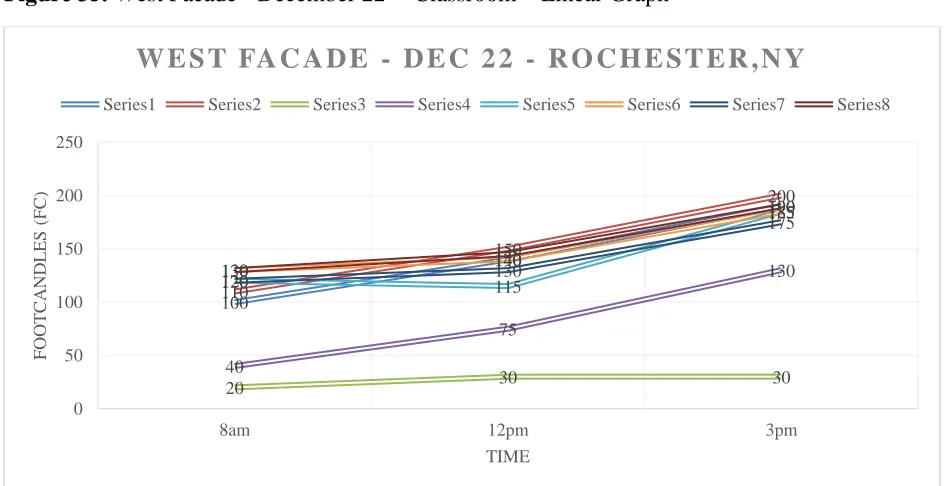
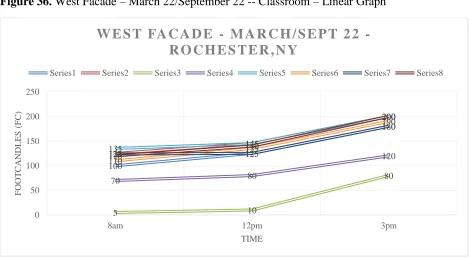
program, which generates illuminance photos with levels of the footcandles. For this research, the physical models will be studied for Rochester, New York on June 22 and December 22, for each orientation. The levels of footcandles will be from 0 to 200 footcandles. Blue will be 0 fc, green will be around 100 fc, and yellow will be 200 fc, which is the brightest and will cause glare. The preferred levels are 70 to 100 fc in classrooms and 20 fc to 40 fc in the corridors, the standards established by the Illuminating Engineering Society of North America (IESNA). After the data is collected, it is analyzed using graphs that show the estimated footcandles at each time of day for the month and year. The results found a huge difference for each of the models. This
Figure 26. How Lighting is Measured.
Table 6
East – Classroom - June 22 - Rochester, NY
8 a.m. 12 p.m. 3 p.m.
1
2
3
4
5
6
7
8
Table 7
East - Classroom – December 22 - Rochester, NY
8 a.m. 12 p.m. 3 p.m.
1
2
3
4
5
6
7
8
Table 8
East - Classroom - September/March 22 - Rochester, NY
8 a.m. 12 p.m. 3 p.m.
1
2
3
4
5
6
7
8
Table 9
South – Classroom - June 22 - Rochester, NY
8 a.m. 12 p.m. 3 p.m.
1
2
3
4
5
6
7
8
Table 10
South - Classroom - December 22 - Rochester, NY
8 a.m. 12 p.m. 3 p.m.
1
2
3
4
5
6
7
8
Table 11
South - Classroom – September 22/March 22 - Rochester, NY
8 a.m. 12 p.m. 3 p.m.
1
2
3
4
5
6
7
8
Table 12
West - Classroom - June 22 - Rochester, NY
8 a.m. 12 p.m. 3 p.m.
1
2
3
4
5
6
7
8
Table 13
West - Classroom - December 22 - Rochester, NY
8 a.m. 12 p.m. 3 p.m.
1
2
3
4
5
6
7
8
Table 14
West - Classroom – September 22/March 22 - Rochester, NY
8 a.m. 12 p.m. 3 p.m.
1
2
3
4
5
6
7
8
Table 15
North - Classroom - June 22 - Rochester, NY
8 a.m. 12 p.m. 3 p.m.
1
2
3
4
5
6
7
8
Table 16
North - Classroom - December 22 - Rochester, NY
8 a.m. 12 p.m. 3 p.m.
1
2
3
4
5
6
7
8