Higher Education Research and Development Society of Australasia, Inc
Enhancing Higher Education,
Theory and Scholarship
Proceedings of the
30
thHERDSA Annual Conference
8-11 July 2007
Adelaide, Australia
Tynan, B. & Smyth, R. (2007) Evaluating the work of Academic Developers: A Case study from the University of New England, in Enhancing Higher Education, Theory and Scholarship, Proceedings of the 30th HERDSA Annual Conference, Adelaide, 8-11 July 2007: pp 594.
Published 2007 by the
Higher Education Research and Development Society of Australasia, Inc PO Box 27, Milperra, NSW 2214, Australia
www.herdsa.org.au
ISSN: 0155 6223 ISBN: 0 908557 71 X
This research paper was reviewed using a double blind peer review process that meets DEEWR requirements. Two reviewers were appointed on the basis of their independence, expertise and experience and received the full paper devoid of the authors’ names and institutions in order to ensure objectivity and anonymity. Where substantial differences existed between the two reviewers, a third reviewer was appointed. Papers were evaluated on the basis of originality, quality of academic merit, relevance to the conference theme and the standard of writing/presentation. Following review, this full paper was presented at the international conference.
Evaluating the work of Academic Developers: A Case study
from the University of New England
Belinda Tynan
University of New England, Armidale, Australia [email protected]
Robyn Smyth
University of New England, Armidale, Australia [email protected]
This paper explores issues about defining of the work of academic developers. It arose from discussions between the authors at the University of New England and colleagues elsewhere who were struggling to find suitable performance measures for their work. The diversity of roles and activities required of academic
developers in the various contexts of their work is a critical factor making the job of definition more difficult. Therefore, the intent of the paper is to site the issues in current theory and to propose an instrument to our colleagues, who we
encourage to use it and provide us with feedback.
Keywords: Academic development, evaluation
Introduction
In attempting to devise a credible and realistic framework from which to evaluate the work of academic developers, it is apparent from a scan of the sector and conversations with colleagues that there are few ‘models’ defined to utilise easily (Frielick and McLachlan-Smith 1999; Stanley 2001; Wright, and Miller 2000). This is also due in part to the difficulty and complexity in generalising what academic developers do. Thus, the onus is on us to define or describe a model which we believe will work in our context for the work that we do. While we would like to be able to generalise for all academic developers we have arrived at the conclusion that it is not possible as the scope of work is intricately embedded within individual contexts. Our context is one however, which others may find congruency. We work in a small central unit within a regional distance education
university in NSW Australia. The work is consistent with what we know about other academic developers (for example see UK, Gosling, 2001; USA, Cox, 2002; Australia and New Zealand, Fraser, 2001). The kind of work an academic staff developer undertakes, as Fraser has defined it, is work which places the staff developer in the position of assisting academic staff to reflect on “their role in relation to teaching, research, scholarship, leadership, funding applications and supervision of students” (p.55).
How work is undertaken is varied. There is no ideal approach and Reid (2002) suggests that ideally academic development “should be situated within existing academic cultures and focus on conceptual change” (p.3). Our task then, was to identify the primary
norms which we have found to ring true and from which our professional skills and knowledge can be framed (Butler, 1996; Inglis 1996; Smyth 2003; Stanley 2001) Some prioritising will be needed as will some justification of the approach both from the literature and our context.
Situating Academic Developers’ work
Generally, centralised Academic developers work across faculties or institutions and are often privileged to have a ‘bird’s eye’ view of activity within the organisation (Angelo 1999). Their role encompasses more than discipline specific practice, although this is a core part of their personal and professional knowledge. It appears that there is some synergy to be had between Butler’s model of human action (1996 p. 270), Stanley’s definition of the work done by academic developers (2001, p. 26) and Land’s discussion of orientations to academic development (2001, p. 19) which are helpful. All three author’s views are derived from the notion that expert performance comes from deeply within the self and therefore that the constructs used by academic developers are based on a mixture of personal beliefs, professional knowledge, practice and social context.
In our uncovering of these ideas we are reminded that our own value systems require
considerable thought. This is necessary as we try to understand what it is we wish to evaluate, why and for what purpose. For example, we were reminded that our work described here in asking our colleagues to ‘judge’ us in their use of the tool could be viewed as violent and that the uncomfortable distance between the researcher/s and the researched emerging in our approach and consequent analysis worthy of deeper critical reflection.
The underlying driver for our work is change. Our approach to that aspect of our work will enable us to identify how we are perceived by others and therefore, what influences might come into play when we ask others to evaluate aspects of our practice (Land 2001; Smyth 2003). We should be wary not to neglect the interplay of beliefs, knowledge and practice within the institutional and personal contexts in which we practice (Fraser 2001). It is also worth remembering that our work is most often shared work occurring within a dialogic where we are giving voice to or enabling the work of others (Frielick and McLachlan-Smith 1999).
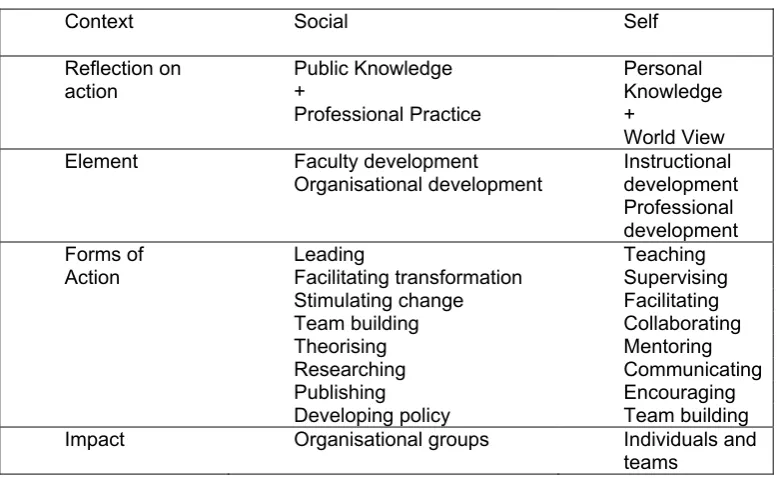
Using Butler’s model (1996) as the overarching construct, we see that public knowledge and professional practice are elements of the ‘social context’ of our work which lie alongside personal knowledge and world view, the ‘self context’. Bridging these is reflection. Public knowledge is the disciplinary knowledge upon which our professional practice is based and upon which we reflect as we interact in the social context of that practice. Personal knowledge is that store of experiential knowledge developed from practice and reflection. It is guided by our personal belief or world view and as Land (2001) discusses, it is that view which
underpins our approach to practice within the organisational culture that we work (Fraser 2001; Land 2001, p. 6; Smyth 2003, p. 3). Beneath this overarching construct, we can place Stanley’s (2001) faculty and organisational development categories of academic developers’ work within the ‘social context’ and her instructional and professional development
Describing the multifaceted work that academic developers’ undertake in a two dimensional manner, such as in the Table 1 below, is problematic not in the least because it could become a never-ending list as roles expand. Some could also argue that the representation is dualistic, simplistic or binary and that the space between the contexts may be worth exploring.
However, our intention here is a snapshot to serve as an organising and summarising device from which to begin our analysis of what we do in our institutional and personal contexts.
Identifying aspects of Academic developers’ practice for evaluation
By brainstorming and documenting actions regularly featuring in our current practice, we have identified and prioritised those actions that we see as the prevailing ‘social context’ of our work. We are using a ‘reflecting on reflecting–in–action’ approach (Schon 1995, p. 30) to critique and test our assumptions about what we do, how we do it and why. Using these reflections as a point for comparison with disciplinary literature (Fraser 2001; Frielick and McLachlan-Smith 1999; Prpic 2005) we see that we work within accepted norms but that the emphasis of our work varies, like it will for other academic developers because of the
[image:4.595.98.487.392.631.2]changing organisational climate within institutions. In reflecting upon this too, and as a starting point, we have isolated certain common aspects of practice for feedback. To do this we have drawn on the ‘self context’ to identify particular approaches to the dialogic of our work, which we wish to evaluate.
Table 1: Summarising academic developers work
Context Social Self
Reflection on
action Public Knowledge + Professional Practice
Personal Knowledge +
World View Element Faculty development
Organisational development Instructional development Professional development
Forms of Leading Teaching
Action Facilitating transformation Supervising Stimulating change Facilitating
Team building Collaborating
Theorising Mentoring
Researching Communicating
Publishing Encouraging
Developing policy Team building
Impact Organisational groups Individuals and
teams
Aspects of practice to be evaluated
and school change literature (Cooksey 2000; Hargreaves 1993; Hicks 2005; Prpic 2005) as well as being situated in the broader context of leading in higher education . The third draws on much of the literature that is our discipline and with which we undertake our professional practice (Biggs 1999; Bowden and Marton 2004; Prosser and Trigwell 1999; Ramsden 1992). It focuses on how personal conceptions of teaching and learning are displayed or modelled in our practice and how these might be perceived by others.
Evaluation strategy
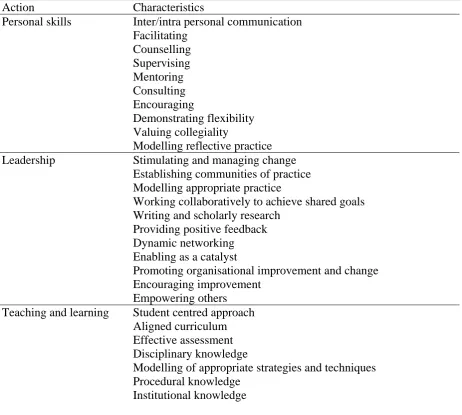
A survey tool was developed based on an analysis of the literature, anecdotal evidence of others and in consultation with other academic developers. We are aware that the instrument we devised is a simple portrayal as the work of academic developers is so individualised and context driven (see Appendix A). Three categories were identified Personal skills, Leadership and Teaching and Learning (see Appendix B). Using a reflection on reflecting-in-action methodology, we drew ideas from established evaluation practices, transformative genre, parallel universes such as adult education and training practice, and tentative models proffered in recent literature. From this analysis, we decided upon multiple approaches to be certain that the multiplicity of actions we undertake were adequately represented. We also hoped to improve the trustworthiness of our evaluation by triangulating from multiple sources across various audiences with whom we work. So, our framework includes: surveying (Likert scale questions and open ended questions: See Appendix C), focus groups (3 questions: what do we do well, what should we discontinue and what would delight you), and anecdotal evidence. Ethics clearance was approved and the institutional evaluation officer sent out surveys and collated responses. A facilitator was sought to conduct a focus group and those who completed the survey were invited to attend. Notes were taken at the focus group by a note taker in order to eliminate our bias in taking notes. We drew principally from three audiences namely, colleagues who have undertaken formal study in the Graduate certificate in Education in which we teach, colleagues who have attended workshops or other training sessions and colleagues with whom we have collaborated. 39 staff were invited to complete the survey for Robyn and the response rate was 79%. 72 staff were invited to complete the survey for Belinda and the response rate was 49%.
Discussing the evaluation
This section will aim to capture the usefulness of the approach we took to evaluating our practice. From our review of the literature and time spent devising items, we hoped the data we sought would provide insight into our practice but we were aware that collecting such data has some inherent problems. Firstly, the population from which to draw respondents was limited making the sample size statistically insignificant, secondly, the likelihood that results could not be generalised or combined was high and finally, there were no norms for
comparison. This caused us some frustration as the data did not provide as much critique as we had hoped for. This also raised the question of the suitability of the methods we chose to evaluate what we do. Nevertheless, we decided to trial measures of trustworthiness and coherency in an effort to demonstrate rigour.
teaching instruments, it was also possible to look at the percentage agreement for items in each of the three categories.
High agreement was evident in both Robyn’s and Belinda’s case, falling within the range 96-100%. Although their initial reaction to this data was positive they found more useful pointers for improvement within the qualitative data. The surveys provided little critical feedback which could have been a better source for improvement. This result points to another
difficulty we faced when gathering data from colleagues, the inability to be overtly critical. It also highlights our frustration in seeking critical feedback and scope to reconsider the
approach we took in order to uncover deeper interpretations from our colleagues.
However, there were comments in the data which Robyn regarded as useful indicators for continued development because they reflected the clients’ conceptions of practice. For example, in relation to leadership “She is able to facilitate open communication between group members and recognises when intervention is required” and for personal skills “She has handled several situations of high conflict with a calm, yet firm manner”. In terms of teaching and learning, a similar window into the clients’ perceptions provided grist for reflection in addition to the many comments in the leadership and personal skills categories which related to teaching practice. For example, “Learners feel valued…a very student-centred facilitator provided insight into the conception portrayed to students”. Whereas for Belinda qualitative data indicated that staff felt her leadership in “generating of ideas and networking” to be useful and that her personal skills in being “enthusiastic and supportive about improvement and change” something to continue. These comments, amongst many, provided examples of what staff highlighted in their interactions with her and areas where continued development, like Robyn, would be appropriate.
It appears that data derived from the survey tool and the focus groups were complementary and triangulation was in part achieved. However, given the varying roles of Robyn and Belinda the tool itself did not always reflect what they individually do even though the construction of the survey aimed to find the similarities. In the end, the differences were not adequately allowed for and comparison between the work of both academic developers was possible only on a conceptual scale rather than at the item level. Not surprisingly the
qualitative comments were more useful in how valuable staff found their interactions with both academic developers. The decision to evaluate the actions of the academic developers also poses some difficulty in understanding impact on teaching and learning within
classrooms. It was only through the qualitative answers that staff completing the survey noted impact in the work that they do. However, this is not substantiated with student feedback and remains an individuals’ claim. The scale used on the survey tool also requires additional work and explanation. The values that underpin the individual items are not detailed here given the limitation in space. However, they have been devised from the theoretical frameworks referred to in the opening of the paper. Subsequent research will allow us to explore these further as they go to the core of how we define our work and particularly our relationship with others.
experiences. This on the one hand validates their responses both on the survey in the focus group but does not allow for those colleagues who were unable to attend the focus group to detail further their experiences which may have been less positive. This is of course true of any data collection approach. It may be that the focus group was not the best approach for collecting data. What did emerge was that these colleagues hold diverse views of the role which did not always reflect the actions that Belinda and Robyn undertook. It became apparent that the role is not well understood and that may go in part to explain the lack of understanding about what makes up the role of academic developer.
Conclusion
The impetus for beginning a process of evaluating the work of academic developers arose out a need to provide evidence of the impact of the work that constitutes academic development. An reflecting on reflecting–in–action approach was chosen as one way in which to undertake this preliminary exploration. We have found the process a difficult one on a number of levels. The literature is tangled and epistemological foundations diverse. Contexts themselves require unravelling in their value orientations. Academic developer roles are diverse and expansive even within the same institution. The methods we have chosen to undertake this work also need expanding. As noted earlier we need to consider more critically our own silent assumptions, values and ethics in carrying out this kind of research. By choosing this
particular approach we may not have fully considered the dynamics of our roles nor the nature of our relationships with others. The evaluation tool was problematic, not least that it was derived from our own conceptions of the work that we do-albeit drawn from the literature. This points to our requiring a deeper understanding of our own values. It also draws attention to our need to consider a contrasting methodology that can assist us in answering the
questions we raise about our work. While the tool was partially developed to sit alongside the tools that academics use to evaluate their teaching to make assessments of our work easier it has probably done little to open up the differences and provide adequate evidence. The work reported here, and the resulting analysis, has not been overly successful on one level. On another however, the evaluation we attempted has drawn out the complexity and need for further investigation.
We do believe that it is worth exploring the complexity of how to evaluate the academic developer role. Our future aspirations are to continue this work and learn from what we have done so far. We need to rethink our tools and consider the context more fully. Alternative approaches such as interview-based research could provide that window. Finally, we need to find a shared place of knowing between us and draw upon what our colleagues within the academic developers’ community of practice also can provide.
References
Angelo, T. (1999). Doing academic staff development as though we valued learning most: transformative guidelines from research and practice. HERDSA Annual International Conference, 2003, from http://www.herdsa.org.au/branches/vic/Cornerstones/authorframeset.html
Biggs, J. (1999). Teaching for Quality Learning at University: What the Student Does. Buckingham: Society for Research into Higher Education and Open University Press.
Bowden, J., & Marton, F. (2004). The University of Learning: Beyond Quality and Competence. New York: RoutledgeFalmer.
Butler, J. (1996). Professional development: Practice as text, reflection as process, and self as locus. Australian Journal of Education, 40(3), 265-283.
Cooksey, R. (2000). Leading Through Change. Armidale: University of New England.
development. Retrieved 23rd February 2003, from http://www.uwa.edu.au
Fraser, K. (2001). Australasian Academic Developers' Conceptions of the Profession. The International Journal of Academic Development, 6(1), 54-64.
Frielick, S., & McLachlan-Smith, C. (1999). The value (added?) of academic development. HERDSA Annual International Conference, 2003
Gibbs, G., & Brew, A. (1995). Changing Lecturers; Conceptions of Teaching and Learning through Action Research. Directions in Staff Development.
Gosling, D. (2001). Educational development units in the UK-what are they doing five years on? International Journal of Academic Development, 6(1), 74-90.
Hargreaves, A. (1993). Collaboration: A Key to Leadership for Quality Education. Practising Administrator, 15(3), 14-18.
Hicks, M. (2005, 3-6 July). Academic Developers as Change Agents: Caught in the Middle. Paper presented at the HERDSA Conference: Higher Education in a Changing World, Sydney.
Inglis, A. (1996). Teaching-learning specialists' conception of their role in the design of distance learning packages. Distance Education, 17(2), 267-288.
Karabatsos, G. (2000). A Critique of Rasch Residual Fit Statistics. Journal of Applied Measurement, 1(2), 152-176.
Land, R. (2001). Agency, Context and Change in Academic Development. The International Journal of Academic Development, 6(1), 4-20.
Prosser, M., & Trigwell, K. (1999). Understanding Learning and Teaching: The Experience in Higher Education. Buckingham: Society for Research into Higher Education and Open University Press. Prpic, K. (2005, 3-6 July). Managing Academic Change through Reflexive Practice: A Quest for New Views.
Paper presented at the Higher Education in a Changing World, Sydney. Ramsden, P. (1992). Learning to Teach in Higher Education. London: Routledge.
Schon, D. A. (1995). The New Scholarship Requires a New Epistemology. Change, November/December. Smyth, R. (2003). Concepts of Change: Enhancing the practice of academic staff development in higher
education. The International Journal of Academic Development, March-November.
Stanley, C. A. (2001). The Faculty Development Portfolio: A Framework for Documenting the Professional Development of Faculty Developers. Innovative Higher Education, 26(1), 23-36.
Wright, B. D., & Masters, G. N. (1982). Rating Scale Analysis. Chicago: Mesa Press.
Wright, W., & Miller, J. (2000). The educational developer's portfolio. International Journal for Academic Development, 5, 20-29.
Appendix A
Action Characteristics Personal skills Inter/intra personal communication
Facilitating Counselling Supervising Mentoring Consulting Encouraging
Demonstrating flexibility Valuing collegiality
Modelling reflective practice Leadership Stimulating and managing change
Establishing communities of practice Modelling appropriate practice
Working collaboratively to achieve shared goals Writing and scholarly research
Providing positive feedback Dynamic networking Enabling as a catalyst
Promoting organisational improvement and change Encouraging improvement
Empowering others Teaching and learning Student centred approach
Aligned curriculum Effective assessment Disciplinary knowledge
Modelling of appropriate strategies and techniques Procedural knowledge
[image:9.595.69.532.100.515.2]Institutional knowledge
Appendix B: Evaluating Academic developers’ performance
Element Audience
Graduate Certificate in Higher Education
Workshops/ seminars/ training
Projects/reviews/ facilitation /consultations Personal Skills
Inter/intra personal
communication 9 9 9
Facilitating 9 9 9
Counselling 9 9
Supervising 9 9
Mentoring 9 9
Consulting 9 9
Encouraging 9 9 9
Valuing collegiality 9 9 9
Demonstrating flexibility 9 9
Modelling reflective
practice 9 9 9
Leadership
Stimulating and managing
change 9 9
Establishing communities of
practice 9 9
Modelling appropriate
practice 9 9 9
Working collaboratively to
achieve shared goals 9 9
Writing and scholarly
research 9 9
Providing positive feedback 9 9 9
Dynamic networking 9 9 9
Enabling as a catalyst 9 9
Promoting organisational
improvement and change 9 9 9
Encouraging improvement 9 9 9
Empowering others 9 9
Teaching and Learning
Student centred approach 9 9
Aligned curriculum 9 9
Effective assessment 9
Disciplinary knowledge 9 9 9
Modelling of appropriate
strategies and techniques 9 9 9
Procedural knowledge 9 9 9
Institutional knowledge 9 9 9
Appendix C
Survey Instrument
Name of staff member being evaluated: ___________________________________________ Date of evaluation: ________________________
Name of person completing evaluation (optional): ___________________________________ Please indicate your opinion about the statements below by
selecting one option for each item:
Strongly agree Strongly disagree No comment Academic Developer’s Evaluation 6 5 4 3 2 1 NC Personal Skills
The academic developer exhibited a positive attitude towards participants
6 5 4 3 2 1 NC
The academic developer was available for consultations and individual assistance
6 5 4 3 2 1 NC
The academic developer influences and motivates others to achieve positive outcomes
6 5 4 3 2 1 NC
The academic developer encourages the contribution of others
6 5 4 3 2 1 NC
The academic developer displays enthusiasm,
determination and persistence to achieve collaborative outcomes
6 5 4 3 2 1 NC
The academic developer shows initiative and vision 6 5 4 3 2 1 NC The academic developer takes responsibility for own
actions
6 5 4 3 2 1 NC
The academic developer adopts a flexible approach using intuition, creativity and positive reinforcement
6 5 4 3 2 1 NC
The academic developer is a catalyst transforming ideas into appropriate practice
6 5 4 3 2 1 NC
The academic developer collaborates effectively 6 5 4 3 2 1 NC The academic developer considers others and is
conciliatory when needed
6 5 4 3 2 1 NC
The academic developer acknowledges the expertise of others
6 5 4 3 2 1 NC
The academic developer uses appropriate language and non-verbal communication
6 5 4 3 2 1 NC
The academic developer is able to positively manage or resolve conflict situations
6 5 4 3 2 1 NC
The academic developer can negotiate consensus even amongst opposing viewpoints
6 5 4 3 2 1 NC
The academic developer communicates information and reports promptly to all parties
6 5 4 3 2 1 NC
The academic developer positively promotes TLC in all forums
6 5 4 3 2 1 NC
The academic developer values and accommodates individual differences, cultures and opinions
6 5 4 3 2 1 NC
The academic developer is a skilled communicator 6 5 4 3 2 1 NC The academic developer models reflective practice 6 5 4 3 2 1 NC Please comment positively or indicate areas for improvement in personal skills:
Leadership
The academic developer is able to provide specialist advice
6 5 4 3 2 1 NC
The academic developer is knowledgeable in his/her discipline
6 5 4 3 2 1 NC
The academic developer builds and maintains strong professional networks
6 5 4 3 2 1 NC
The academic developer builds and strengthens strategic alliances
6 5 4 3 2 1 NC
The academic developer models appropriate professional practice
The academic developer embraces continuous improvement in practice
6 5 4 3 2 1 NC
The academic developer can provide a range of advice of both a practical and theoretical nature
6 5 4 3 2 1 NC
The academic developer exercises common sense to balance constraints, results and contexts
6 5 4 3 2 1 NC
The academic developer takes prompt, appropriate action 6 5 4 3 2 1 NC The academic developer exercises appropriate judgement 6 5 4 3 2 1 NC The academic developer anticipates problems and provides
suggestions for resolution
6 5 4 3 2 1 NC
The academic developer displays appropriate scholarship 6 5 4 3 2 1 NC The academic developer’s work is research-based 6 5 4 3 2 1 NC The academic developer’s work is practice-based 6 5 4 3 2 1 NC The academic developer’s work is based on research and
practice
6 5 4 3 2 1 NC
Please comment positively or indicate areas for improvement in leadership:
Teaching and Learning
The academic developer has a student centred approach 6 5 4 3 2 1 NC The academic developer organised content in ways which
facilitated learning
6 5 4 3 2 1 NC
The academic developer demonstrated thorough knowledge of the subject area
6 5 4 3 2 1 NC
The academic developer made expectations and responsibilities for learning clear
6 5 4 3 2 1 NC
The academic developer made the outcomes of learning clear
6 5 4 3 2 1 NC
The academic developer selected resources that aided learning
6 5 4 3 2 1 NC
The academic developer provided timely and constructive feedback during learning
6 5 4 3 2 1 NC
The academic developer provided clear and appropriate responses to questions
6 5 4 3 2 1 NC
The academic developer assessed learning effectively 6 5 4 3 2 1 NC The academic developer encouraged participation and
feedback by all
6 5 4 3 2 1 NC
The academic developer demonstrated or modelled appropriate techniques
6 5 4 3 2 1 NC
The academic developer demonstrated or modelled appropriate values and attitudes about teaching and learning
6 5 4 3 2 1 NC
The academic developer used questions effectively to encourage participation and promote learning
6 5 4 3 2 1 NC
Please comment positively or indicate areas for improvement in relation to teaching and learning:
General Appraisal
What have been the outcomes of your learning in workshops, the GCHE, projects or collaborations with the academic developer?
Have you changed your practice because of learning instigated by the academic developer?
Any other comments: