Theses Thesis/Dissertation Collections
8-1-2018
Compelling
Fatmah Bamashmous
Follow this and additional works at:https://scholarworks.rit.edu/theses
This Thesis is brought to you for free and open access by the Thesis/Dissertation Collections at RIT Scholar Works. It has been accepted for inclusion in Theses by an authorized administrator of RIT Scholar Works. For more information, please [email protected].
Recommended Citation
ROCHESTER INSTITUTE OF TECHNOLOGY
A Thesis Submitted to the Faculty of The College of Imaging Arts and Sciences
School of American Crafts In Candidacy for the Degree of
MASTER OF FINE ARTS in Furniture Design
COMPELLING
By
Thesis Title: Compelling
Thesis Author: Fatmah Bamashmous
Thesis Committee Final Approvals
Chief Advisor: Andy Buck
Signature: ____________________________ Date: _____________
Associate Advisor: Adam Rogers
Signature: ____________________________ Date: _____________
Associate Advisor: Rich Tannen
Signature: ____________________________ Date: _____________
Abstract
As a woman from Saudi Arabia learning the craft of woodworking in America, I intend to embrace the opportunity to blend Arabic art and design with my knowledge of making furniture to create a body of work that is uniquely mine.
In my thesis, I created a body of work that helped me define my voice as an Arabic designer and maker. I have seen and researched Islamic art and graphic details such
as Arabesque (ﻲﻜﺴﺑﺮﻋ), which is an ornamental design consisting of intertwined flowing lines, and architectural details found in Mashrabiya (ﺔﺑﯿﺮﺸﻣ) arches, doors,..etc., and incorporated these aspects into my design language. The goal of each unique piece within this body of work is to address the design aspects above while allowing me to define my interpretation of the historical forms. Using the power of the line, incorporating contrast, rhythm, and repetition, and assigning traditional woodworking techniques in different ways, offer me an appropriate balance of aesthetics and function for each piece.
During my journey to become a furniture designer and maker, I have enjoyed each step of the process, from the development of my design, to learning woodworking techniques, to
building each piece with a high level of craftsmanship. I faced a lot of challenges with each piece I designed; however, each piece in the body of work has taught me something. I found myself learning from my own mistakes which allowed me to overcome whatever came next. Each piece has its own beauty and its own attraction. Each piece pushed me forward to make larger, more complex, work with increased confidence. All of these pieces helped me not only to define my voice as a designer and maker, but also to decide what I want to be.
Table of Contents
Introduction ………...…………. 5
Body Of Document.………..……….. 7
● Context ………... 7
● Evolution ……….. 10
● The Body of Work ……….……….…. 13
I. Calligraphy ………...…….... 13
▪ And-Wow Bench ……….………… 13
▪ Halala Relic ………... 15
▪ A-Chair ………...…….… 17
II. Geometric Patterns ………... 19
▪ Twin Table ………...……….…….. 19
▪ C-Low Poufs ………..……. 21
▪ Oudh The Incense Burner ………..………. 23
▪ Midst Table ………... 24
▪ Mashra Room Divider ………. 26
Conclusion ………..……… 29
Installation Images ……….………. 30
List Of Illustrations ……….……….……..…. 33
INTRODUCTION
Creating artistic crafts and handmade objects is not a common profession in Saudi
Arabia, making artistic woodworking and handmade furniture hard to find. Being a woman from Saudi Arabia and learning the craft of woodworking in America, I intend to embrace the
opportunity to blend Arabic identity and my knowledge of making furniture to create a body of work that is uniquely mine. I seek to create functional artistic furniture that helps me define my voice as an Arabic designer, which is inspired by historical forms, powerful lines, and the use of contrast, rhythm, and repetition. Because of the lack of representation of hand crafted pieces in Saudi Arabia, I want to develop and define my voice as an Arabic designer. Having lived in the United States of America for a few years, I have a unique opportunity to express my identity as an Arab designer in a contemporary way.
In this study, I intend to research oriental ornaments that are aesthetic attributes or
vernacular of Jeddah, a city in Saudi Arabia, which has a huge historical area called “Al-Balad.” These artistic details in Arabic are represented in the wavy lines in calligraphy and naturally occurring geometric patterns. I asked myself, “What drew peoples’ eyes to these shapes; what is unique about them? Do they have a meaning? What are their origins? Where do these unique shapes and lines come from? Why these specific shapes? Back before modern technology, how were these perfect patterns designed to last so long?”
Figure 1 Jeddah city, Saudi Arabia The wood has been left natural and gives a
pleasing appearance. Nevertheless, these architectural details provide an extraordinary view from the inside and the outside, as a way of being aesthetically functional. From the light and shade, to the combinations of wood, to the minimal use of furniture inside the space, it all combines to create an environment that can easily be lived in. It shows how these humble craftsmen, working with minimalistic tools and techniques, created shapes and spaces that continue to be admired today. For this reason, the aim of my research is to incorporate these Islamic
elements of art and design into my design language. The goal of each unique piece within the body of work is to interpret graphical Islamic forms, the power of the line, the use of contrast, rhythm, and repetition. Assigning traditional woodworking techniques in a way I feel appropriate based on my intended balance of aesthetics and function will further define my voice.
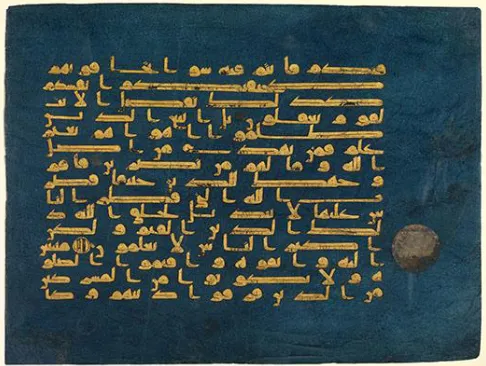
Figure 2 Folio from the "Blue Qur'an",9th Century
CONTEXT
During my furniture design and woodworking studies in the US, I saw how cultures vary, not only with language differences but also in regard to everyday activities. Living these
experiences influenced my way of designing and thinking. For me, it is so interesting to see and experience how these cultural differences between the West and East effect the way people live. For example, in Saudi Arabia there exists a cultural difference involving how and where people sit. Thus, furniture made for these specific populations needs to accommodate these differences.
Handmade and crafted objects have existed for thousands of years, well before any machines were available. However, styles or movements that were established in any period have a direct impact on the shape of these objects and the material choices. Islamic art is one of those styles that has enormous scope and has developed under different circumstances while keeping its quality and unique identity.
Islamic art does not use figures as decoration. The non-figural types of decoration include calligraphy and geometric patterns are the basic
components of Islamic art. Calligraphy is the fundamental element of Islamic art and is based on the Arabic script as its
above or below part of the letter. For example, the letters ب (b) and ت (t) have the same basic shape, but (b) has one dot below and (t) has two dots above. Each historical period and geographical region has a variety of calligraphy in arts, design, paper work, architecture, and even in decorative elements on surfaces. What always catches my attention is the intersection that the calligraphers create by using their hand to write. These writing scripts started with simple forms and have evolved over time into more complex forms.
In addition to the art of calligraphy, geometric patterns are a dominant element in this form of art. Belief in Islam dictates that representations of human beings are prohibited in art and therefore artists substituted them with geometric patterns. This is in line with the monotheistic aspect of Islam. This type of art is found in mosques, and these patterns exist not to copy nature, but to reflect what nature represents. According to Loai M. Dabbour in Geometric Proportions: The Underlying Structure of Design Process for Islamic Geometric Patterns, geometry
“represents an expression of the order of the universe as a visual representation of the truth” (2012). Geometric art has its own fundamental principles that are all underlying the order of nature. Two elements, the circle (representing “the sun”) and the straight line (representing “the sky”) are fundamental for the practices of geometric arts and crafts. Incorporating these two components repetitively has contributed to the complexity of these geometric shapes. My potential goal is to make use of these two elements as design details and find ways to connect them to create forms and shapes within the functionality of the pieces themselves.
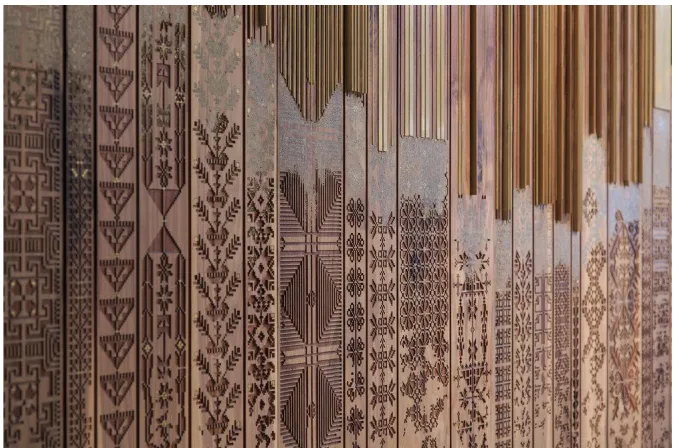
Figure 3 Naqsh a wall piece
however, they design for the one common goal of self-expression. I admire their works and their ways of using these graphic motifs to create work that shows their regional identity. I am
Fatmah Bamashmous 1. Hand joinery table, Walnut, Cherry 2015, (24″x12″x12″)
EVOLUTION
For the first piece designed, I started with simple forms and used simple joinery. I tried to understand the material (wood) as a natural species that leads to and informs its own process. With every day spent in the wood shop, my knowledge and understanding of this material was extended. Wood is naturally an unforgettable and unforgiving material. If you move forward, you cannot go backward, and you have to start over. Some minor mistakes can be corrected but could detract from the intended craftsmanship.
After learning and understanding the basic woodworking rules and understanding the nature of wood, I started designing my first table. For me as an interior designer, function was my first priority. However, during my journey as a craftsperson, I’ve developed a greater understanding of the role of beauty in the objects I designed.
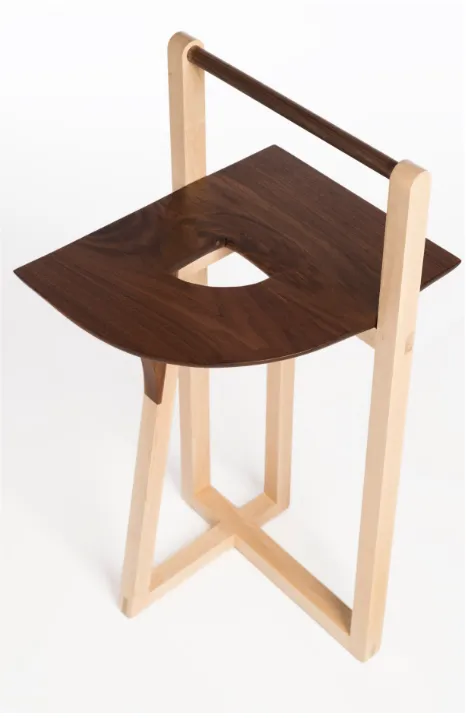
For the reading table, I used two different wood species to show the contrast between leaner forms of the legs and organic shapes of the table top. The idea started by having Arabic letters in the pieces. I searched for a letter or a part of the Arabic alphabet that
Fatmah Bamashmous 2. K'of-ish table, Walnut, Maple,2015 (32″x15″x15″)
circle, suits my aesthetic decisions. These two design components create some dynamic linear rails that create the under structure which is four legs that cross with each other. The continuous lines going to the top create another function, the handle, which is used to hold a book and/or to help carry it. Smooth, linear rounded edges create a holistic perspective with the hollow detail on the top that connects the cross-sections of the legs with the top.
[image:12.612.300.533.210.569.2]One day a woodworker told me that if you are 100% happy with the result of your pieces, you should quit being a woodworker; but if you have something you want to incorporate or if you wish you had done it in a different way, that means you are on the right track. Even though I’m happy with the combinations of the wood and the shape, I learned that the color of the wood will change with time. Cherry will darken, and Walnut will lighten. As a reaction to the first table, I designed another table “K'of-ish” that has the same idea but with a different use of wood species, Walnut is the dark wood, maple is the light one, and it is more abstract
Fatmah Bamashmous 3. K'of-ish table, Walnut, Maple,2015 (32″x15″x15″)
Fatmah Bamashmous 4. And-Wow Bench, Walnut, Cherry, Maple 2016 (53″x17″x17″)
THE BODY OF WORK
_______________________________
Calligraphy
And-Wow Bench
||Walnut, Cherry, Maple 2016. ||Diminutions 53″x17″x17″
Fatmah Bamashmous 5. And-Wow Bench, Walnut, Cherry, Maple 2016. (53″x17″x17″)
I found it more interesting to use different wood species. Walnut, cherry, and maple emphasize the idea of having non-repetitive rhythm, create visual movement for the seating surface, and establish a dynamic repetition of the light and shade. The hollow part of the bench which is the front of the alphabet "و" is a functional part which could be for storage.
Fatmah Bamashmous 6. Halala Relic, Walnut, 2016 (24″x 12″x 5 ″)
Halala Relic
||Walnut, Brass 2016 ||Diminutions 24″x 12″x 5″
The “ﮫﻠﻠھ” Halala Relic is a decorative wall piece that is meant to hold and display my childhood collections of coins which have meaning to me. The form is inspired by the contents and the curvature of Arabic
calligraphy, primarily the Arabic word “Halala" which means "Coin”. “Halala” in Arabic starts with the letter “ه”. The half circle presents the “ه” when the cabinet is closed; when the door is open it shows a full circle that represents the coin itself. Placing finger joints on the side of the carcass was an aesthetic decision to
emphasize the linear components with the circle in front. The circle at the middle part of
the piece is a secret drawer that mimics the round part of the letter “ه”.
Fatmah Bamashmous 7. Halala Relic, Walnut, 2016 (24″x 12″x 5 ″)
Fatmah Bamashmous 9. A-Chair, Walnut, upholstered with Blue cowhide 2017. (24″x 24″x 36″)
A-Chair
||Walnut, upholstered with Blue cowhide 2017 ||Diminutions 24″x24″x36″
After making the And-wow bench and the Halala Relic, I found myself focusing on where my connections are, the “joints.” One day one of my professors, Adam
Rogers, told me “this is the opportunity; this is the moment for a nice detail”. I found myself focusing more on that connection and how I can make this connection aesthetically pleasing within the function. The form of this piece, as I mentioned earlier, reflects the way of writing with Arabic script. It is different from the more common way of writing; it starts from right to lift instead of from left to write.
Fatmah Bamashmous 10. A-Chair, Walnut, upholstered with Blue cowhide 2017.
(24″x 24″x 36″)
Fatmah Bamashmous 11. A-Chair, Walnut, upholstered with Blue cowhide 2017. (24″x 24″x 36″)
Fatmah Bamashmous 12. Twin Table, Walnut, Maple 2017. (24″x 24″x 11″)
THE BODY OF WORK
_______________________________ Geometric Patterns
Twin Table
||Walnut, Maple, 2017 ||Diminutions 24″x24″x11″
The Islamic star always fascinated me as a small pattern that exists in my hometown. This star is made up of many different angles and the geometric shapes that result vary. Pentagonal, hexagonal, or square are all shapes often employed to make the star pattern. As a first thought, I transferred these stars to a three-dimensional piece of furniture that has a function. I wanted to make the pattern the main focus of the piece. With simple, linear, thin members, light is my goal.
The twin table is made of seven individual frames that are combined to create one form. The frames that are made of the dark walnut present the shape of the star, while the light wood which is maple is the two frames that create the functional surfaces. The rhythm that was created by changing the location of the dark wood made the feeling of movement on the piece. To keep the frame consistent and the flow of lines without any end grain distraction, I chose the miter-joints with mortise and tenon for more strength as my design decisions for this piece.
Fatmah Bamashmous 13. Twin Table, Walnut, Maple 2017. (24″x 24″x 11″)
Fatmah Bamashmous 14. C-low Poufs, Walnut, Upholstered Milk Color Fabric, Brass, 2017
(70″x 70″x 4″)
C-low poufs
||Walnut, Upholstered Milk Color Fabric, Brass, 2017 ||Diminutions 70″x70″x4″
It is an Arabic tradition that family and friends gather inside the home each week. There are different rooms for different celebrations and different genders; however, the living room is the room where family and friends gather. Usually, everyone is the same gender if they are friends. As furniture to be used inside the living room, there are sofas;
however, in the Arabic traditional way of seating, sitting on the floor is preferable to sofas.
C-low poufs are six low seats with wooden frames. These frames are constructed with miter-joints with simple laser engraving on the sides of the frame to create visual continuous lines, and these lines create hollow parts which also serve as handles to carry the pieces when they are stacked. These seats are designed to be stacked when not used, and they are suitable for small spaces. Simple, cozy, and easy to move, were my goals.
Fatmah Bamashmous 15. C-low Poufs, Walnut, Upholstered Milk Color Fabric, Brass, 2017
(70″x 70″x 4″)
shape (in this case, a star pattern) and how I could make a functional object from that shape. Normally the star has a center, and when I looked at it from the top view, as a flat pattern, it reminded me of the word “gathering”. For me, gathering means sitting together. I decided to design a piece that presents the idea of gathering, with the function of seating. Because of the repetitive shapes in the star itself, the idea of stacking them when they are not being used is given.
Fatmah Bamashmous 16. Oudh the Incense burner, Walnut, Brass, 2017 (5″x 5″x 3″)
Fatmah Bamashmous 17. Oudh the Incense burner, Walnut, Brass, 2017 (5″x 5″x 3″)
Oudh the Incense burner
||Walnut, Brass, 2017 ||Diminutions 5″x5″x3″
Nothing revives the past as completely as a smell. Oudh is an incense burner that I designed as a reaction to the nostalgia that I felt for the smell of my home. It is a tradition in Arabic households to ignite embers and use oudh, a small piece of wood that reacts and produces scented resin, for a good smell in the house. Oudh has a distinctive aroma that recalls the
memories I have from when I was a child. It reminds me of when my family gathered and of times of celebration such as Eid Al-Feter, Eid Al-Adha, weddings, or on a Friday afternoon. This smell evokes moments of happiness, family, and memories
I was inspired by the shape of the Oudh itself. It is a non-symmetrical shape with a carved texture on the top. I used a dark wood, walnut, as a material choice. For the construction, I used coopering techniques and hand-shaped the curves for the appearance of flow and smooth edges. In the front and back, I used hand tools, gauges, to create the texture and the feeling of the rough texture that the Oudh has.
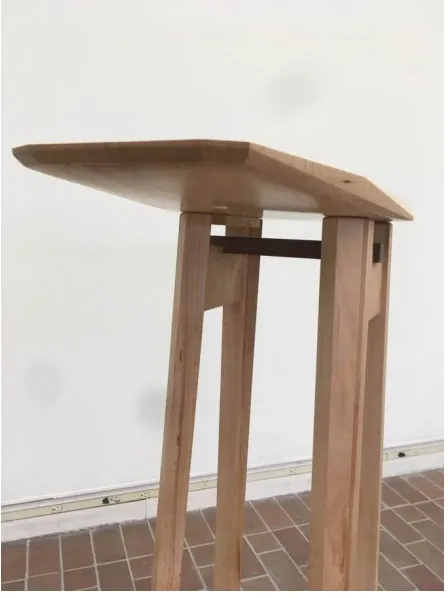
Fatmah Bamashmous 18. Midst Table, Maple, Walnut, 2018. (10″x 24″x 40″)
[image:25.612.324.548.143.442.2]Midst Table
||Walnut, Maple, 2018 ||Diminutions 10″x24″x40″
The Midst table is a tall table with a wide table top. I used the coopering techniques with a coved line from the top to the bottom at the connection between the two parts of each leg. The legs of this table are tapered and tilted towards inside in the top which direct the eye to something special on the top, and the legs are connected with walnut dovetails joints going crosses. The top is flat and thin in the middle and wider towards both ends. This table designed to complement the object that is placed on the top.
Making decisions was a dilemma for me with this piece. I found it very hard to design a
Fatmah Bamashmous 19. Midst Table, Maple, Walnut, 2018. (10″x 24″x 40″)
Figure 4 Mahrabiya, Old Jeddah, Saudi Arabia
[image:27.612.345.536.162.450.2]Mashra Room Divider
||Walnut, Cherry, Maple 2018 ||Diminutions 70″x70″x2″
For hundreds of years, Mashrabiya (ﮫﺑﯿﺮﺸﻣ) Figure 4 has offered an effective protection against sunlight. Mashrabiya is a window that has an oriental ornament that characterized the local identity and sun-shading device for cooling the cover of the building. I’m strongly influenced not only by the technical aspects of the window, which allows the cool air to pass through to the inside of the building, but I am also fascinated by the light and shade that can be created by this window. This simple technique changes the
environment of the space. It promotes a nice constant flow of air and shade during the day time. I wanted to transfer this feeling to a piece of furniture.
CONCLUSION
After finishing this body of work and being ready for my thesis show, I wanted to show these pieces to the world and learn other people’s opinions. I wanted to show how hard and fun the process is, but how the result will make you happier. I enjoyed listening to other people’s reactions during my show “Compelling” at Bevier Gallery at Rochester Institute of Technology on May 27, 2018, and how the show fascinated them not only because I am a woman, but also a craftswoman from Saudi Arabia.
During my journey to be a craftswoman, I enjoyed the process of making furniture starting from designing to the final result. I faced a lot of challenges on each piece I designed; however, each piece of the body of work taught me something. I found myself learning from my own mistakes which allowed me to overcome whatever was next. Each piece has its own beauty and its own attraction. Each piece pushed me forward to make bigger pieces with increased confidence. All of these pieces allowed me not only to define my voice as a designer and maker, but also made me decide what I want to be.
1 Pictures of the thesis show April 27, 2018 take by Elizabeth Lamark
making furniture and I can teach people the right ways of making furniture in the American traditional way of woodworking. Now, I can consider myself an interior and furniture maker with a humble knowledge of woodworking yet desperate to know more and work more with wood for a better living environment.
2 Pictures of the thesis show April 27, 2018 take by Elizabeth Lamark
4 Pictures of the thesis show April 27, 2018 take by Elizabeth Lamark
Illustrations
Figure 1 Jeddah city, Saudi Arabia
Figure 2 Folio from the "Blue Qur'an",9th Century Figure 3 Naqsh a wall piece
Figure 4 Mahrabiya, Old Jeddah, Saudi Arabia
Personal Images
Fatmah Bamashmous 1. Hand joinery table, Walnut, Cherry 2015, (24″x12″x12″)
Fatmah Bamashmous 2. K'of-ish table, Walnut, Maple, 2015. (32″x15″x15″)
Fatmah Bamashmous 3. K'of-ish table, Walnut, Maple, 2015. (32″x15″x15″)
Fatmah Bamashmous 4. And-Wow Bench, Walnut, Cherry, Maple 2016. (53″x17″x17″)
Fatmah Bamashmous 5. And-Wow Bench, Walnut, Cherry, Maple 2016. (53″x17″x17″)
Fatmah Bamashmous 6. Halala Relic, Walnut, 2016. (24″x 12″x 5 ″)
Fatmah Bamashmous 7. Halala Relic, Walnut, 2016. (24″x 12″x 5 ″)
Fatmah Bamashmous 8. Halala Relic, Walnut, 2016. (24″x 12″x 5 ″)
Fatmah Bamashmous 9. A-Chair, Walnut, upholstered with Blue cowhide 2017.
(24″x 24″x 36″)
Fatmah Bamashmous 10. A-Chair, Walnut, upholstered with Blue cowhide 2017.
(24″x 24″x 36″)
Fatmah Bamashmous 11. A-Chair, Walnut, upholstered with Blue cowhide 2017.
(24″x 24″x 36″)
Fatmah Bamashmous 12. Twin Table, Walnut, Maple 2017. (24″x 24″x 11″)
Fatmah Bamashmous 13. Twin Table, Walnut, Maple 2017. (24″x 24″x 11″)
Fatmah Bamashmous 14. C-low Poufs, Walnut, Upholstered Milk Color Fabric, Brass,
2017. (70″x 70″x 4″)
Fatmah Bamashmous 15. C-low Poufs, Walnut, Upholstered Milk Color Fabric, Brass,
2017. (70″x 70″x 4″)
Fatmah Bamashmous 17. Oudh the Incense burner, Walnut, Brass, 2017. (5″x 5″x 3″)
Fatmah Bamashmous 18. Midst Table, Maple, Walnut, 2018. (10″x 24″x 40″)
Fatmah Bamashmous 19. Midst Table, Maple, Walnut, 2018. (10″x 24″x 40″)
Fatmah Bamashmous 20. Mashra The Room Divider, Walnut, Cherry, Maple, 2018.
(70″x 70″x 2″)
Fatmah Bamashmous 21. Mashra The Room Divider, Walnut, Cherry, Maple, 2018.
(70″x 70″x 2″)
Thesis Show Pictures
1 Pictures of the thesis show April 27, 2018 take by Elizabeth Lamark
2 Pictures of the thesis show April 27, 2018 take by Elizabeth Lamark
3 Pictures of the thesis show April 27, 2018 take by Elizabeth Lamark
4 Pictures of the thesis show April 27, 2018 take by Elizabeth Lamark
Bibliography
"Arts & Crafts of the Islamic Lands: Principles, Materials, Practice." Choice Reviews Online51,
no. 05 (2013). doi:10.5860/choice.51-2395.
Dabbour, Loai M. "Geometric Proportions: The Underlying Structure of Design Process for
Islamic Geometric Patterns." Frontiers of Architectural Research1, no. 4 (2012): 380-91.
doi:10.1016/j.foar.2012.08.005.
"Department of Islamic Art. “Calligraphy in Islamic Art.” In Heilbrunn Timeline of Art
History"." The Metropolitan Museum of Art, I.e. The Met Museum. October 2001. Accessed April 18, 2018. http://www.metmuseum.org/.
Catalani, Anna. Cities Identity through Architecture and Arts: Proceedings of the 1st
International Conference on Cities Identity through Architecture & Arts, Cairo, Egypt, 11-13
May 2017. Leiden, The Netherlands: CRC Press/Balkema, 2018.
"Naqsh Design Home Page." Naqsh Design Home Page. Accessed July 18, 2018. http://naqshcollective.com/.
Ishteeaque, Ellahi M., and Fahad A. Al-Said. The Native Architecture of Saudi Arabia: