City, University of London Institutional Repository
Citation
:
Quinsee, S. (2011). How can we create the university of the future?. Learning at
City Journal, 1(1), pp. 8-22.
This is the unspecified version of the paper.
This version of the publication may differ from the final published
version.
Permanent repository link: http://openaccess.city.ac.uk/578/
Link to published version
:
Copyright and reuse:
City Research Online aims to make research
outputs of City, University of London available to a wider audience.
Copyright and Moral Rights remain with the author(s) and/or copyright
holders. URLs from City Research Online may be freely distributed and
linked to.
City Research Online: http://openaccess.city.ac.uk/ [email protected]
How can we Create the University of the Future?
Professor Susannah Quinsee, Director of Learning Development and Chair of Learning and Teaching Development
Higher education is facing change across the world, but nowhere more so than in the UK with the impact of changing funding structures, a changing student body and diminishing resources. It is not just the Browne Review though that heralds these changes, UK HE has already been subject to new circumstances over the past ten or more years but it has not always responded as a sector with agility and speed. What is clear, though, now is that we need to radically rethink our current models and consider what the University of the future should look like. This paper will outline the key note lecture I presented which considers the changes that HE has faced over the past fifteen years, describes some of the challenges we are facing now and looks to some models of the future in response to those current challenges. It includes feedback provided by hose present at the lecture in terms of their views for the past, present and future.
Key words (five)
higher education, futures, educational technology, curriculum design, student experience
Ivory Towers and Hallowed Halls
„Higher education is and has been in a constant struggle over its definition and purpose‟ (Denman, 2005 p.10). The tension between encouraging independent thought and scholarship but with a commitment to perpetuating a greater societal good through such study creates an inextricable bind for higher education institutions. On the one hand, many institutions aspire to facilitate autonomous research and learning free from governmental constraints yet on the other, in order to achieve such aspirations they frequently rely on that government to provide the resources to enable such autonomy. And to further complicate that double bind, demonstration of social “impact” or benefit of scholarly activity may require greater accountability or compliance, yet in order to achieve such outputs, greater freedom is desired.
Although Universities may have existed for hundreds of years there are those that still question, what a University is, and its purpose. Newman in 1852 described a University thus:
“A University seems to be in its essence, a place for the communication and circulation of thought, by means of personal intercourse, through a wide extent of country” (p.1)
Central to the notion of a University is the gathering of diverse people in one place for a common pursuit: the pursuit of knowledge and scholarly discourse. Newman refers to this later in his essay as a means of summary:
“A University is a place of concourse, whither students come from every quarter for every kind of knowledge. You cannot have the best of every kind everywhere; you must go to some great city or emporium for it. There you have all the choicest productions of nature and art all together, which you find each in its own separate place elsewhere” (p.11)
The compelling argument here is that the concentration of scholarly activity in one place, drawing people in from far and wide, is central to the role of a University, and by implication learning. You must have a common purpose and meet together, under the umbrella of a University in order to explore that and learn. But how true is this of Universities today? How important is the notion of campus learning in a digital age? Do our students in the twenty-first century feel a compulsion to learn in a particular place or is it more that that is the only model available to them? Does the advent of new technologies and possibilities for learning strengthen or undermine this notion of a University as a centre for learning? Can place in relation to the effectiveness of learning be as persuasive when we are talking about virtual place, not just physical?
1. that academics, both inside and outside the classroom, have unrestricted liberty to question and test received wisdom and to put forward controversial and unpopular opinions, whether or not these are deemed offensive, and
2. that academic institutions have no right to curb the exercise of this freedom by members of their staff, or to use it as grounds for disciplinary action or dismissal. (2010)
Academic freedom can be a thorny issue, as the broad nature of these definitions implies. Although in principle academic freedom gives academics and students the ability to pursue scholarly inquiry unrestricted by wider political issues and control, in practice it can be much more controversial. Technically enshrined by law in the United States, academic freedom has been tested in the courts, when Universities as institutions are put at loggerheads with their academic staff. Debates over where the location of academic freedom resides – either in the individual or institution – are endemic of a broader debate about what the role of a University is in relation to the individuals that work in it. Nevertheless, the principles of academic freedom as unfettered pursuit of knowledge are at the very heart of the notion of a University. And make it distinct from other places of learning.
Like Universities themselves, the concept of academic freedom dates back 100s of years and is inextricably linked with religious activity. In the Middle Ages, academic freedom enabled travellers in the pursuit of
knowledge unrestricted and safe passage. The fact that Universities at that time were autonomous collections of scholars who were unrestricted by law was enshrined in the doctrine around academic freedom and pursuit of knowledge (Fuchs, 1963). Again, this notion of travel and place, as described above by Newman, comes into play in relation to academic freedom.
Referring back to those questions asked earlier, in summary, it can be proposed that a University is a safe environment for the sharing of ideas and knowledge by people from different backgrounds and environments who have journeyed to a particular place, i.e. the University, in order to do this.
Mass lectures and shopping malls?
How resonant is this definition today? In an era of mass higher education and the contested, but common notion, of students at customers, what are our universities and student bodies really like? Granted, campus-based learning is still the major mode of learning, but things are changing. Changes to the application of technology, which has occurred for a number of reasons, some economic, some logistic, some for pedagogic reasons, are indicative of this transformation. The New York Times reported in November 2010 that even for campus based students in the US, more and more of them are undertaking online courses primarily due to logistical reasons – there are not rooms big enough to hold 1500 students taking one module at the same time (Gabriel, 2010). Gabriel cites Allen and Seaman‟s Survey of Online Learning (2010) for the Sloan Consortium which found that over 60% of US colleges cited online learning as a crucial part of their strategy and this is not surprising when one sees the evidence of the numbers of students engaging. The Sloan Survey found that over 5.6 million students were taking at least one course online in the Autumn of 2009 (this is up by one million students from 2008); online learning grew by 21% compared to just a 2% rise in the overall enrolment in HE in the US and lastly that now almost a third of students take at least one course online. It is the rise in enrolments for on campus students that is particularly interesting. So, the sense of place is still important but it has a different meaning now. Students may be co-located to study but a significant proportion of that interaction is occurring virtually. Or one could argue that it is actually the less “valuable” dissemination method, i.e. the large scale lectures, that are occurring online and the meaningful interaction and discourse is still occurring face-to-face. Although in the US economic restraints have been a key driver in delivering more education online, the quality of delivery and outcomes were seen as at least equitable to face-to-face interaction - over 65% of faculty staff felt that learning outcomes for online were the same or superior to face-to-face (Allen and Seaman, 2010). This reinforces the notion of “no significant difference” which was founded in the (unjustified unfavourable) comparisons between distance and face-to-face learning but has gone on to encompass online learning too1.
Although in the UK we may not have as much curricula content at higher education level delivered online, there are trends that support the notion that more students are engaging with online resources which indicate a more general shift in the nature of our student body. Furthermore, Universities are changing as the HE environment becomes more market driven, demonstrated by the proposed increase in fees to £9000 from 2012. As our
student body is changing at the same time there is pressure on our institutions to adapt; not only to accommodate this more focused and economically driven student body who have much greater access to information and knowledge sources beyond those offered by universities, but also to meet new governmental policy objectives. Whilst from a government perspective the contribution of universities is unquestionable - „universities are the most important mechanism we have for generating and preserving, disseminating and transforming knowledge into wider social and economic benefits‟ (Higher Ambitions, 2009 p.7), the accountability of institutions in delivering this benefit to both the state and the student is under a much greater focus than hitherto experienced.
To understand the state of our student body and higher education (HE) in general, we should consider some significant statistics that illustrate the changing nature of UK HE:
60% of students come to University to improve their employability (NUS/HSBC, 2008)
1 in 3 students now study part time(Baker, 2010) and three quarters work during their studies, whether during term time or in the holidays (NUS/.HSBC, 2008)
96% of undergraduate students use the internet on a daily basis as an information source and a further 69% use it daily as part of their studies (NUS/HSBC, 2009). And over 90% of students feel that ICT has benefitted their studies (NUS, 2010).
1 in 6 students in the UK are overseas (Baker, 2010
1.1 million people went into HE in the UK in 2009 (compared to 921,000 in 1997) (Higher Ambitions, 2009)
In the autumn of 2010 over 190000 applicants were without a University place, an increase of over 30,000 students from the previous year (UCAS, 2010)
Although these figures support the traditional notion of a University as a place where people go to study (the overseas statistics and demand are both indicative of this), the way in which they study whilst they are there is different. Study is combined with employment as well as improved employment opportunities being a key driver for entry into HE, rather than the notion of study for studying‟s sake. Furthermore the use of technology to support learning and access information, which is a core component of a students‟ daily life has the potential to transform that on campus learning experience further. As Hamilton (2010) has argued, what is the purpose of students travelling to campus when they can get a quality experience online, and if they do see a reason for attending in person they want to make sure that they are clear of the value added benefit of making that journey. Yet the affordances offered in a more connected world need to be treated with caution, or at the very least, an appreciation of the challenges around student engagement. Merely increasing overseas student numbers or exposing students to “world knowledge” via the use of technology does not necessarily promulgate a quality learning experience: „in certain circumstances, the student has been viewed as another exploitable commodity on which many universities have relied heavily for the sake of expanding market share and diversifying financial portfolios‟. (Denman, 2005, pp.14-15)
These indicators above present a picture of a University as a place that is respected for delivering high quality learning and academically respected, yet that is coupled with a more focused and market driven student body that have clear expectations of why they are committing to study at higher education level and are also technologically connected. From an institutional perspective, increased demand whilst economically beneficial creates new challenges for the delivery of quality academic programmes. As Denman concludes, Universities are at risk of ‟losing sight of the larger purpose – that is to disseminate and advance knowledge for the sake of knowledge itself‟ if they are too bound by market and governmental forces (2005, p.24).
Flexible learning: A University without walls? Models for the future
“A scenario-based approach is not only the most common approach in the futures field, but is one that challenges the assumption of a single inevitable future and provides an accessible means of collating significant amounts of evidence and opinion” (p.77)
Therefore, as a means of reimaging the University and impact of the challenges that higher education is currently facing, this paper explores four scenarios, or opinion pieces, on the future of higher education. These models have been developed below as a means of shaping discussion about the future and are meant as extreme snapshots to provoke discussion and debate, as they allow for ambiguity and complexity and the imagining of multiple futures, as advocated by Facer and Sandford above. The four scenarios were termed as follows: ostrich – maintaining the status quo; credit – a fully flexible credit based system; virtual – fully online delivery and work based – education embedded within the work environment.
Scenario 1: Ostrich – maintaining the status quo
In the “ostrich” scenario, universities carry on with what they are doing at the moment. They do not respond to the changing circumstances. They keep offering traditional three year degrees to school leavers. This scenario was developed in a pre-Browne world and it now seems unimaginable that universities will be able to remain in the status quo. Merely the increase in fees alone means that students will be required to pay a substantial amount more to their university education which is likely to result in many of them working longer hours whilst they study. This means that many students are going to require more flexibility around their curriculum both in terms of design and delivery. That said however, whilst it may seem inevitable that universities will have to change because of the fee requirement alone, one could argue that this may be seen as purely a financial and
operational issue rather than a potential to change the way that courses are structured and delivered. There is a scenario then, based on a post-Browne world in which Universities do charge the full amount of fees, or at least over the £6,000 threshold, but do little to change their curriculum. They market to a student body that is predominately upper and middle class who still have the resources to continue their education post-18 straight out of school. These institutions choose not to cater for a broader spectrum of students but focus on the elite. This could be a risky strategy and it will inevitably mean that the institutions become more focused in terms of the courses they offer, undergoing a “slow death”. This kind of strategy or denial of change in relation to change is reminiscent of that described by Robert Quinn (1996). Although transformational change may be required, many organisations cannot face such change and therefore suffer a more incremental failure over time (Quinn, 1996). The organisation that cannot adapt to change slowly dies from the inside. It may take a long time for this to happen to certain institutions but some will chose a path such as this one as they cannot face up to the opportunities or risks posed by changing in a different way. It is possible that there could be a two-tier system whereby some of the more established institutions, for which the pace of change will come much more slowly, adopt this route in order to hold a view of the integrity of the traditional university and academic role. This could be a defined strategy to distinguish difference, credibility and permanence. But can the three-year campus based degree really survive? Will these institutions that choose this route be able to sustain it for the next 15 years? A lot can happen in 15 years. And indeed it could pay off, but what of the others who do not have the resources or reputation to adopt such a stance? Or those who wish to pursue a riskier or an alternative future, what other options are there?
The other scenarios presented represent a more significant change in terms of the development of institutions and their educational delivery.
Scenario 2: Credit -a fully flexible credit based system
It would also require a significant shift in the way we asses our students. We would need to be assessing them on what they have learnt in that particular module, rather than assessing them on an accumulation of knowledge and the way in which they have been taught. It also changes our relationship with the students by us being more focused on their learning in the potentially shorter periods of time in which they engage with the University. Instead of us assuming that they are getting pastoral support and other support as part of a nebulous and generic idea of a programme, the locus for that activity is at modular level. It has the potential to transform our
communication and engagement with our students and changes our focus. Furthermore, thinking about the discussions earlier on the purpose of a campus-based institution, moving to a credit led model also changes our relationship with the space in which we teach Implicit behind this model is that educational delivery and activities take place at times that suit the students, this has the potential to release learning spaces and our estates.
Lastly, this model could encourage more engagement with employers as the balance between work and study would have changed. There would be greater opportunity for students to engage with employers whilst they are learning and apply that learning in a more timely and realistic fashion within the workplace. By passing choice to the student they could also potentially fulfil a rounder curriculum with a personalised mix of study that related to employability and to their personal interests.
The biggest challenge to this model is that it completely undermines – demolishes – the principle of coherence that our higher education system is built on. That notion of accumulated knowledge developing over a three year period as a student becomes more and more specialised in their subject is gone. Instead they have a mishmash of learning experiences over a range of potentially unrelated subjects. But does this actually matter? How important is coherence really when universities are faced with students who have higher demands but are receiving less and paying more? Does coherence matter and does it actually exist? Transferring funding and choice to the students via a credit based system could be a very attractive way of demonstrating the value of a university education whilst at the same time delivering a truly student centred approach to learning, and one which staff could find more satisfying.
Scenario 3: Virtual - fully online delivery
What about moving to an entirely online system of delivery? Who needs campuses? The advent in technology means that students can potentially get everything they need online. As Facer and Sandford (2010) conclude from the scenarios they explore, “the rise in mobile and personal technologies and the lowering of barriers to data storage mean that individuals are increasingly likely to „wrap‟ their information landscape around themselves rather than managing it through institutions” (p.83). This changes an individual‟s relationship with formal education systems and creates a different type of knowledge economy. If learners can access expertise far superior than that contained on the average university campus, why should they come to campus at all? Expertise is available via the click of a mouse. Support of hundreds, maybe thousands of fellow online learners could be at your fingertips, twenty-four hours a day, seven days a week.
As in the model above, a fully online course gives students complete flexibility. Study could happen anytime and anywhere. You could even choose the structure for your programme – cramming in study over a shorter period of time or extending it over a period of weeks and months. To be truly flexible you might want to shift between different modes of delivery, attending in person for certain subjects or “lectures”, studying others remotely. Such flexibility in delivery sounds farfetched? It is already happening. BPP, a private university with degree awarding powers and now owned by the Apollo Group (who own Phoenix University the biggest online university in the US) give students a choice of three modes of delivery: face-to-face; asynchronous online; synchronous online and you can change between the different modes (Stockwell, 2010).
physical and virtual worlds, to demonstrate our commitment to quality learning and an improved student experience.
Scenario 4: Workplace - fully online delivery
The last model has characteristics of the other two and is centred on a private model for higher education. What if universities were focused entirely on employability and workplace educational requirements? Already private education providers are moving into the UK HE space, but what about closer link with employers. McDonalds have recently announced that they are sponsoring degree programmes (Coughlan, 2010). If the state can no longer support the demand for higher education and universities are struggling to remain relevant and deliver the skillsets employers want, why not make them work more closely together? Students could work whilst studying, as in the previous two models, and apply their learning directly to the workplace.
Although one model is to have employers fund and sponsor a particular degree programme, they could also sponsor individual modules and courses. Students could move between different employers through the course of their studies. Isn‟t this truly lifelong learning? Perhaps there could also be sponsorship by the public and voluntary sectors too and a requirement for all students to study in a variety of different sectors?
This model fits with the notion that students are increasingly seeking better employment opportunities as a tangible output of their studies. However, there is a danger with such a model that it is hugely restrictive. Would the only subjects that are sponsored or funded be those relating to business and direct employment such as health and law? What about humanities and arts subjects. Would a technology company wish to sponsor an English literature module? How could we retain the notion of academic freedom in such a market dominated education system? Universities would be driven purely by the often whimsical and short term demands of employers and could lose the notion of a greater good. How could employers act altruistically in relation to the potentially higher societal benefits that higher education offers and delivers? Perhaps not all education may go down this route, and there are serious reservations about it, but employers are more and more interested in determining and defining the UK HE environment. And how can universities respond to this positively rather than clinging to this as a mode of survival?
Thinking and imaging the future is complex and problematic, but an important exercise to do if we wish to shape and create that future. “We risk overlooking the needs of future generations if we do not explore the possibility that our decisions today might serve to create significant unintended consequences in the future – consequences that cannot be „researched‟ but can be imagined; and we risk disempowering educators, students and
communities from intervening to change their own and their society‟s futures.”(Facer and Sandford, 2010, p.89). The remainder of this paper, then considers the relevance of these current challenges and possible futures for staff working within higher education, through an activity undertaken with staff at City University London to explore the changing face of learning – both from their own experiences and within the institution itself.
Making it personal: remembering the past and imaging the future
As part of the keynote presentation at the Learning Development Conference in June 2010, 50 staff from across the institution, working in various roles, as academics, support staff and some research students, were asked to participate in a vision setting exercise. After presenting a version of the above in relation to the changing face of higher education, both within the UK and beyond, staff were asked to undertake three activities – one from the past, one for the present and one for the future:
1. Thinking back to 1995, 15 years ago – what were you doing? How were you taught? And what was your most memorable learning experience from that time?
2. In the present time – now what are you doing? What are you doing differently to what you were doing in 1995 in the way of educational delivery? What is your most memorable recent learning experience? 3. Finally, what is your vision for the future and which model do you think is most realistic? (based on the
models described above) this is confusing as you presented the models before the activity. I think the future models should go above where indicated and then the activity stuff
The thoughts and experiences that staff identified helped create a dialogue about the future of the institution and a sense of ownership and active engagement with those changes that are happening within the wider
explored in the literature on experimental learning (Kolb, 1984). Participants were also able to identify those activities that had remained the same and therefore put some of the more hyperbolic accolades around educational change in perspective.
Activity one: 1995
1995 was chosen as a suitable timeframe for the reflection as it was considered to be in most people‟s frame of reference given the demographics of the participants and the majority of the audience would either have been in higher education fifteen years ago as a learner or as an educator. This proved to be true with 34% of the audience as a student either in school or higher education fifteen years ago and a further 34% either working in higher education as a lecturer, researcher or other related profession. Interestingly nearly as much of the audience, 30%, were working in a different profession – mainly banking or health-related profession. This represents the professional nature of the institution which has many staff who have considerable professional experience before moving into higher education as a lecturer.
When asked to reflect on how they were teaching or being taught in 1995, most participants (59%) identified methods which can be described as “transmissive” or “didactic. Namely, using lectures or large groups to transmit information in a passive, non-interactive way. Example comments that describe this method were:
Strident and not looking for feedback Mainly transmissive, info dissemination Being taught in medical school traditionally
I was taught (Professional Training) Instructed (No interaction) Textbooks, endless talk no student discussion
Boring Training Courses
A more fortunate, perhaps, 33% identified what can be considered to be more active methods. In this category were small group tutorials pathologies - students presented and we discussed, activity based, practicals, group work using videos & demonstrations. Interesting a small number of the participants took a different stance and identified either a memorable place which indicated their teaching or a particular person. There was significant mention of methods too in the sense of technology or teaching aids. 7 participants specifically referred to OHPs or videos, and another mentioned the lack of a virtual learning environment which was replaced by “chalk and board”.
For the most memorable learning experience the responses were classified by a range of categories and their responses could fall under more than one category. The categories related to the key themes from the post, under the methods category then for example fell responses such as geography field trip; I remember linguistic lectures as the lecturer linked theory to practice effectively (this also was categorised under “lectures”); and although there were a number that mentioned transparencies and OHPs (4), two mentioned using video and one using a projector, only two referred to technology specifically and both in relation to its absence: teaching without technology and No web CT, Chalk & Board.
In response to the third question, although participants were asked to recall a specific lecture or learning experience, many did not identify a specific event. Table 1 shows the different types of responses, responses may have been categorised under more than one heading (there were 45 responses in total). Although “technology” can be seen as a method, it was useful to highlight the references to technology specifically, particularly in relation to comparisons to responses to later questions. For a number of participants the person or general area was more important, eliciting responses such as Mary [...], sociologist for her charisma; Lecturer teaching good teaching practices was so bad at it himself, (No Handouts) sat down whole time; James Joyce lecture - lecturer was slightly drunk but passionate; Film studies intro B4 film tutor used to be a stand-up comedian, was fantastic..
Table 1: Categorised responses to “describe a memorable learning experience from 1995”.
Lectures No memories Comedy People Events Technology School Methods
The comedy element was also instrumental in terms of memory. Some of this was related to a specific event, which wasn‟t anything to do with learning - Presentation by fellow student when I tried to sneak a funny slide into
his batch; Dead cat (cat died in classroom); I pulled the blackboard off the wall whilst demonstrating whereas
others did combine an element of comedy with learning: Teachers long hair stood on end whilst touching electricity current; Social Psychology lecture: stooge in audience screamed and ran down the stairs of lecture
hall; Two person comedy routine to teach statistics. Nevertheless the overriding memories involved a lecture of
some variety with over half the posts mentioning a lecture in one form or another. For those three responses who could not remember anything memorable, as one summed it up Nothing springs to mind - says it all.
Activity two: 15 years later – 2010
For this activity, participants were asked to answer three questions: in what way are their teaching methods the same as in 1995, what are they doing differently to fifteen years ago, and then to name one recent memorable teaching experience.
In terms of what had stayed the same, the balance between didactic and active methods was almost equally balanced compared to 1995. In the 50 responses to this question, 25 referred to what can be termed didactic styles, i.e. lecturing, and 24 referred to more active engagement. For example, some of the responses that were categorised as didactic were: Still using PowerPoint and delivery lectures in person and on paper;; Still doing some large lecture theatre didactic teaching; Highly structured classes forced on us by course regulator; Still
seeing boring long PowerPoint lectures. And examples of those responses that fall into the “active” category:
Encouraging students then and now; Teaching 1-1 and then it was group teaching; Teaching through discussion;
Teaching using technology (clickers & intelligent tutoring systems). The other response was one random example
– same fire alarms in exams! A note of caution here, although there might be an assumption that lectures always
imply didactic teaching and that use of technology implies more active teaching this is not always the case, as one didactic response denotes: Lots of transmission sometimes over many campuses via a video conference, as do those responses that refer negatively to the use of PowerPoint. 11 responses here specifically referred to technology, 5 falling under the didactic category and 6 active.
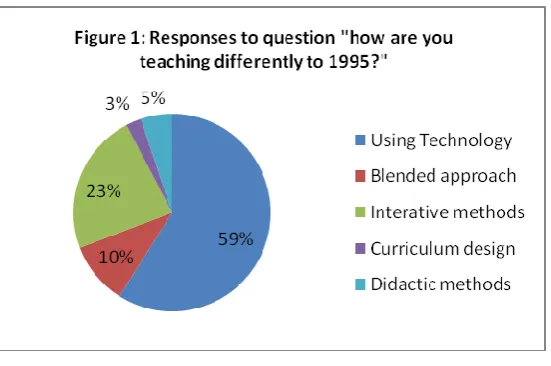
Moving on to what has changed between 1995 and 2010, figure one shows the distribution of responses. What was most striking was that in terms of difference was that 95% of responses mentioned that they were engaged in teaching activities that could be described as “active”, compared to the 59% fifteen years ago. Activities that fall into the “active” category have been subdivided into three groups – using technology, taking a blended approach, using interactive methods and thinking about curriculum design in a more student focused way.
Overall types of response that were termed “active” were; Teaching different subjects using webct and
assessments that are not with exams; Using technology effectively to meet/enhance student needs/learning;
Much more interactive use of digital resources. Perhaps unsurprisingly, was that over 50% of the responses
mentioned technology and compared to the above, “what stayed the same” responses, these all referred to the use of technology to encourage interactivity in some form or another. There were 39 responses to this question and 23 of them specifically referred to utilising technology in some way: We use more on-line resources to support student learning; Use of interactive tools online, lots more access to resources for students to read; Tech in classrooms, using internet for research and communication online learning environment, less money! Less
time!; Using the internet to inform much of my work. Of the other responses, a further four mentioned blended
learning and a further nine talked about interactive methods in other ways, e.g. More interaction and activities i.e. world cafes etc.; Reduce heavy content in small groups, to enable more time for students to consider process of
learning. There were only two responses that can be considered didactic or more traditional and these related to
Finally, participants were again asked to recall a memorable learning experience from the last six months. There were 35 responses and again responses fell under more than one category, as summarised in table 2.
Table 2: Categorised responses to “describe a memorable learning experience from the last six months”.
Lectures* No memories Comedy People Events Technology School Methods
21 1 1 15 27 13 0 21
*This time lectures also refers to presentations and workshops which were mentioned in 2010 but not in 1995
Given that this was related to current memory it is therefore unsurprising that there were no responses in the “school” category. What was noticeable about these responses were that people referred much more to specific presentations, often at conferences or workshops, again relating more to the employment focused nature of the audience, compared to 15 years ago. The types of responses categorised under the “lecture” heading were: Revision session by web conference to help students who were stranded at home by snow; Tomorrow today
presentation brilliant us of PowerPoint and video to engage and inspire the audience and Participatory Forensic
science presentation - reconstructed crime scene in a wood on campus. More respondents referred to a broader
range of formal learning experiences such as workshops and presentations, which have also fallen under the “lecture” heading: A workshop on writing because I realise It was easy to get people doing this with the right start; Flashy IT based presentation - idea for research project.
Figure 2 compares the responses from 1995 memories and those of learning experiences in 2010. Again the “people” is a significant category. From the 2010 responses, three people mentioned the same person: Sugata Mitra's presentation - inspiring, good use of video clips of children - case studies; Sugata Mitra "Hole in the wall"
presentation Moodlemoot - students/children teaching themselves to use internet; Moodlemoot Surgat Murji [sic]
"Hole in the Wall". Others talked about inspiring speakers and dynamic personalities.
Unsurprisingly given the responses in relation to the changing learning environment between 1995 and 2010, the technology category has risen significantly. Examples of those presentations that were memorable in relation to technology were described as: Student gave his first presentation on mobile phone use all over the world and was brilliant; Adults with learning disabilities teaching students about communication using their communication
devices, multimedia resources and signs; Watching the JISC Conference streamed live on the internet. The
[image:10.595.78.520.340.377.2]Noticeable in relation to “methods” was an increase in terms of student-centred learning, exemplified by such responses as: Giving control back 2 students; Lecture with video with students making points; All of the students
were actively participating in the session asking questions, + helping each other out. The comedy experiences
drop off rapidly between 1995 and 2010, probably because recent memories are more diverse. Perhaps if we were to work with the same audience in 2025 there would be much more identification of comic moments.
What the responses show us, is that although education is changing and has changed over the past fifteen years; some of the methods we are using are still “tried and tested”. Significantly, technology has had an undoubted impact, but not all of this is positive. There is the implication, from some of the responses, that all technology has succeeded in doing in some cases is reinforce poor teaching. What stands out are in the inspirational
presenters, who inspire and engage their students. What has changed is a more student focus to learning. A number of responses to what is different and what is memorable in 2010 referred to a more student centred and experiential approach with a shift from a more didactic manner of presenting information. Again what was referred to was the fact that students potentially have access to such a range of resources that academic staff need to be mindful of this and use these resources more sensitively in their teaching in order to engage students in greater dialogue. So the trends in terms of educational delivery styles and inspirational or memorable events are positive. From this evidence, as educators, we are attempting to use a wider range of delivery and
engagement techniques, we are changing the way we teach to encompass changing technologies and changing student needs and we are finding positive inspiration from other educators that can assist with our own learning and teaching activities.
By taking participants through these activities, they were encouraged to think about what was changing in relation to learning and how learning might change in the future. They were also reflecting on those elements of higher education that have remained the same, and why that has happened. Although there is a change between 1995 and 2010 in some cases it is not as marked as we might have expected. We are still relying significantly on lectures as a primary mode of delivery and, not always utilising new methods (namely technology, but also around our increased awareness of how students learn) effectively. Is the pace of change fast enough? How can we use these reflections, from our experiences as learners and educators between 1995 and 2010, to help shape the University of the future?
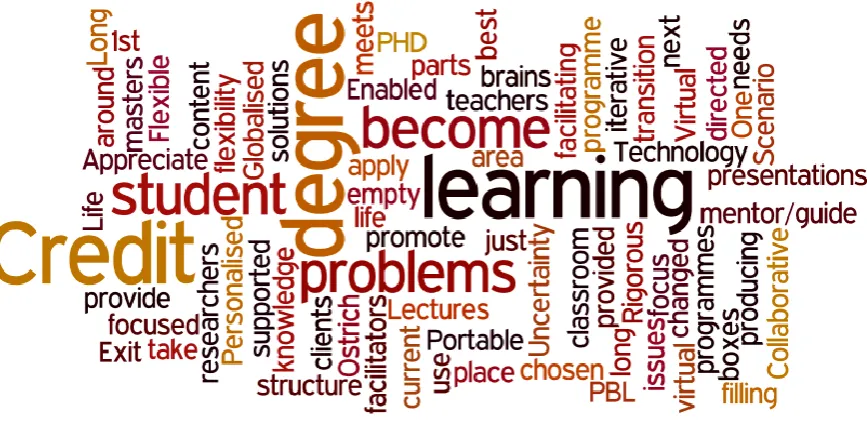
For the final activity, participants were presented with the four scenarios for the University of the future given above, which as can be seen, are based upon some of the trends that they had identified with their own reflections on education in 1995 and education in 2010 and some from relevant literature and data as already presented. Those trends being: application of technology; more flexible modes of learning; increased demand for connectivity and relevance between educational settings and the workplace; as well as one, shall we call it anti-trend – that is to retain the status quo.
Figure 3: Wordle summary of responses to the scenario activity
www.wordle.net
Many of the issues that have been explored in this paper come to the fore here, particularly those around a flexible credit framework and a focus on student learning.
Conclusion
This paper has presented an overview of current challenges facing the UK Higher Education sector and how these go to the heart of the identity of a University. These challenges are driving change in universities yet it is hard to conceptualise how these changes will impact on individuals and how much of this change is overstated, as well as appreciating the different models that such change could bring. Gaining some staff views has put challenges in perspective through reflections on the pace and impact of change over the past fifteen years, as well as exploring what memorable or effective learning looks like. These reflections have then helped shape exploration of four different scenarios for the future of higher education. Although explored with a limited group of staff, this paper and the activities it describes give these staff the ability to situate themselves within the changing landscape of higher education through their own experiences of change. They also have enabled these staff to explore how and why they are changing their practice which in turn gives them confidence to adapt in the future.
Some major themes have come from the analysis about the future of higher education, taken from the participants‟ experiences of the past. These are:
Drive for more student focused learning and teaching
Increase in more active modes of interaction to foster learning
Application of technology to learning, with both positive and negative effects
Reliance on lectures and “traditional” modes of delivery, some interactive, some less so
Willingness to try new methods particularly those that are more flexible and encourage collaboration
Whilst not all these themes are positive they do demonstrate an overall optimistic future for higher education, if these results can in any way be considered as demonstrative of the sector as a whole, in terms of the
References
Academics for Academic Freedom (2010). Available http://afaf.web.officelive.com/default.aspx (16th December 2010)
Allen, Elaine I and Jeff Seaman (2010) Class Differences: Online Education in the United States. Sloan Consortium. Available http://sloanconsortium.org/sites/default/files/class_differences.pdf (16th December 2010)
Baker, Mike (2010) „Universities look into the future‟. BBC News Online 20th March 2010. Available http://news.bbc.co.uk/1/hi/education/8577272.stm (16th December 2010)
Baume, David (2010) How can we do more with less? ‘Ideal University’. Unpublished paper
Coughlan, Sean (2010)
„
McDonald's to launch own degree‟. BBC News Online 25th November 2010. Available online: http://www.bbc.co.uk/news/education-11810930 (12th January 2011).Denman, Brian (2005) „What is a University in the 21st Century?‟,
Higher Education Management and Policy, vol
17, no 2, pp.9-24
Facer, K and Sandford, R (2010)'The next 25 years? Future scenarios and future directions for education and technology' JCAL26 (1) pp74-93
Fuchs, Ralph F (1963) „Academic Freedom. Its Basic Philosophy, Function, and History‟ Law and Contemporary
ProbleSandfordms Vol. 28, No. 3, Academic Freedom (Summer, 1963), pp. 431-446
Hamilton, Stuart (2010) „What next for Online Learning: the Australian Version‟. HEFCE Online Taskforce
Seminar. Available http://www.hefce.ac.uk/learning/enhance/taskforce/ (16th December 2010)
Higher Ambitions: Executive Summary (2009). HMSO. Available
http://webarchive.nationalarchives.gov.uk/tna/+/http://www.bis.gov.uk/wp-content/uploads/publications/Higher-Ambitions.pdf/ (12th January 2010)
Kolb, D. A. (1984) Experiential Learning: experience as the source of learning and development. New Jersey: Prentice-Hall
Gabriel, Trip (2010) „Learning in Dorm, Because Class Is on the Web‟. New York Times 4th November 2010. Available http://www.nytimes.com/2010/11/05/us/05college.html?pagewanted=1&_r=2 (16th December 2010)
Newman, John Harvey (1852) The Idea of the University. Available http://www.bartleby.com/28/2.html (16th December 2010)
NUS (2010) Student Perspectives on ICT. Available
http://www.hefce.ac.uk/pubs/rdreports/2010/rd18_10/rd18_10.pdf (16th December 2010)
NUS/HSBC (2009) Student Experience Report 2009. Available
http://resource.nusonline.co.uk/media/resource/NUS%20HSBC%20Teaching%20and%20Learning.pdf (16th December 2010)
NUS/HSBC (2008) Student Experience Report 2008. Available
http://www.nus.org.uk/PageFiles/4017/NUS_StudentExperienceReport.pdf (16th December 2010)
Quinn, Robert (1996) Deep change. San Francisco: Jossey-Bass
Stockwell, Roxanne (2010) Introduction to BPP, http://www.hefce.ac.uk/learning/enhance/taskforce/ (16th December 2010)
Wisdom, James (2010) „Politicians, civil servants, vice chancellors, lecturers and students: implications of 'boundary encounters' for educational developers‟. SEDA Spring Teaching Learning and Assessment
Conference. Keynote address
UCAS (2010) Provisional end of year figures for 2010. Available