‘If you desire only to possess a graceful accomplishment, to be able to converse in a luent manner about drawing, or to amuse yourself listlessly in listless hours, I cannot help you: but if you wish to learn drawing that you may be able to set down clearly, and usefully, records of such things as cannot be described in words, either to assist your own memory of them, or to convey distinct ideas of them to people; if you wish to obtain quicker perceptions of the beauty of the natural world, and to preserve something like a true image of beautiful things that pass away, or which you must yourself leave; if, also, you wish to understand the minds of great painters, and to be able to appreciate their work sincerely, seeing it for yourself, and loving it, not merely taking up the thoughts of other people about it; then I can help you, or, which is better, show you how to help yourself.’ (Ruskin, J. 1971:25)[1]
Introduction
This paper is drawn from the work of the Multimodal Representation of Urban Space research project for the UK’s AHRC and EPSRC under the Designing for the 21st Century stream of projects. The aim of the project is to understand the role of the
non-visual senses in our experience of urban spaces. We then intend to design tools to allow for crafting urban environments to re-spond to these other senses.
Understanding the role of the non-visual senses is dificult, as there is at present no recording medium for the olfactory, gustato-ry, tactile or even aural environment which is useful to the practice of urban design. In any case, recording has a different aim from drawing and notation. The reason for this rejection of recording technologies can be understood through the following observa-tion by Jorge Luis Borges:
‘The taste of the apple... lies in the contact of the fruit with the palate, not in the fruit itself; in a similar way... poetry lies in the meeting of poem and reader, not in the lines of symbols printed on the pages of a book. What is essential is the aesthetic act, the thrill, the almost physical emotion that comes with each reading.’ Borges, J. L. Foreword to Obra Poética cited in Pal-lasmaa, J. 1996:6 [2]
When using audio recording equipment, all one records is the sound that the micro-phone technology can pick up. Even when using equipment that mirrors the position-ing of human ears such as binaural micro-phones, it is clear that many of the effects of
Dr Raymond Lucas
aural perception are not replicated. These differences may include memory or atten-tion funcatten-tions of percepatten-tion, meaning that situations such as the ‘Cocktail Party’ effect where one picks up on your own name be-ing spoken across a noisy party are not fully replicated by recordings.
This all moves us away from a record-ing technology to a more prosaic solution: drawing and notation (although this still constitutes a technology, of course). This is also important methodologically, as it places our proposal irmly in the realms of creative practice rather than scientiic understand-ing. As such, we are not looking to collate the responses of a wide variety of respon-dents (although this is possible within the system developed) in order to ind a com-mon understanding of a place, but to rely upon the observations of a designer in mak-ing informed decisions. There is a crucial role for community engagement of course, but this comes at a different stage of the de-sign process.
1. What is Notation?
Dividing up the various forms of inscrip-tive practice is a dificult task, deining the difference between sketches, drawings, drafting, notation, diagramming and map-ping is an activity fraught with blind alleys, problems of deinition and intent. Rather than see each of these as a different subset of inscriptive practice, I have come to un-derstand each as a potential property of any inscription, so that an architectural draw-ing, for example, can be said to have the interplay of white space and line inherent to drawing, the instructional quality of nota-tion, the scale and ruled quality of drafting, and the pictorial representation of a sketch all within the same set of marks on paper. Many other qualities can be found within this drawing, and others can be said to be
factors by virtue of their denial or absence. Each of these qualities is nested within the artifact, coexistent with, and essential to each other [3].
‘Because a plan is a drawing, with lines and angles subject to continuous varia-tion, the irst guess would be that it is technically a sketch. But on the plan are measurements in words and igures. This suggests that we have here a com-bination of sketch and script. But I think this again is wrong. In the irst place, the drawing is used only to indicate the re-lataive location of elements and measure-ments. Careful drawing to scale is merely for convenience and elegance; a rough and distorted version with the same let-ters and numerals, qualiies as a true copy of the most precisely drafted blueprint, prescribes the constitutive properties as rigorously, and has the same buildings as compliants... Thus although a drawing often counts as a sketch, and a measure-ment in numerals as a script, the particu-lar selection of drawing and numerals in an architectural plan counts as a digital diagram and as a score.’ (Goodman, N. 1976:218-219)[4]
Nelson Goodman’s work on Languages of Art (a title that Goodman is somewhat em-barrassed by, given the connotations of lan-guage as a term) describes in great detail the distinction between scripts, sketches and scores as creative activities. These deini-tions are particularly useful in terms of ac-tivities and practices rather than completed, crystalline objects [5].
of the elements pictorially that are of prima-ry concern in a sketch, and, unlike a score, where some elements of the inscription are redundant, none of the pictorial elements of a sketch can be discarded as irrelevant. Fur-thermore, the sketch is a work rather than something that determines a later perfor-mance.
‘In short, the sketch–as a sketch–differs from the score not in functioning as a character in a language of a different kind but in not functioning as a character in a language at all. The notational language of musical scores has no parallel in a language (notational or not) of sketches.’ (Goodman 1976:193-194)
Score and notation are conlated by Good-man, who states that the score is a ‘character in a notational system’ (1976:177). Scores are understood to have performances com-pliant to them: scores are to be enacted and acted upon, suggesting that a notation is a set of instructions. This performance is un-derstood to be an artwork in its own right, as is the production of the score, as Goodman cites Sir George Thomson’s views on experi-mental science:
‘You see no experiment can be repeated exactly. There will always be something different.... What it comes to when you say you repeat an experiment is that you repeat all the features of an experiment which a theory determines are relevant. In other words you repeat the experiment as an example of the theory.’ (Sir George Thomson cited in Goodman 1976:177). This recalls Bergson’s statements in The Creative Mind [6] (1992:100) regarding the essential difference between specula-tive and creaspecula-tive problems, stating that the speculative problem such as a mathematical formula has its solution present as soon as the problem is correctly and properly stated. The creative problem, by contrast, has the time spent on the activity enfolded into the
solution: it cannot exist without the creative practice being engaged in, as decisions and modiications are so open and constantly in lux that the temporality is inherent in the result. The speculative problem is absolute and has a right and wrong answer deined as the possible rather than multiple poten-tial solutions, as is found in the creative pro-cess. In this context:
‘the possible is only the real with the ad-dition of an act of mind which throws its image back into the past, once it has been enacted.’ (Bergson 1992:100)
This project seeks to ind a notation for the sensory experience of urban environ-ments for these very reasons. Rather than to draw the senses, we aim to produce scores for the senses, scores that allow for creative replication through a common code or ru-dimentary language. This is to allow for the essential design activity of both understand-ing and recordunderstand-ing phenomenological expe-riences, and then to establish patterns from these recordings that can be used to form new design solutions.
2. Attention and a Taxonomy
for the Senses
man-ageable set of sensations to be selected. The alternative to this is the parable by Jorge Luis Borges, On Exactitude in Science [7] where a ruler sets his cartographers to make an exact map of his territory. The re-sulting map is so exact in fact that it covers that territory completely. Our task in nota-tion is not only to record informanota-tion, but also to edit it, allowing only what is relevant and useful.
Taxonomy, listing and categorisation is it-self a problematic activity, particularly as it speciies what, in many regards, cannot be speciied. It also divides the sensorium, which is experienced as a totality with cor -roboration and overlapping between sens-es. This artiiciality is not an insurmount-able problem, however. The task is, in itself, an artiice that should be recognised and understood rather than rejected or hidden. This artiice allows for a sytematisation of the senses, a functional and operationalis-ing system which facilitates further actions such as design.
One such writer is the essayist and novelist Junichiro Tanizaki in his classic work on Jap-anese aesthetics, In Praise of Shadows [8]. Tanizaki takes on the notion of the shadow, inding its qualities throughout architectural design, but also in terms of material quality, food, theatre and other arts. This approach unites the sensorium, and borrows concepts across modalities. As an essay on aesthetics, Tanizaki reminds us that the basis of an aes-thetic response (where it even exists as such) is a deeply encultured response to phenom-ena, and open to multiple approaches and variations in the concept of what is desir -able or beautiful.
‘Every time I am shown to an old, dimly lit, and, I would add, impeccably clean toilet in a Nara or Kyoto temple, I am im-pressed with the singular virtues of Japa-nese architecture. The parlor my have its charms, but the Japanese toilet truly is a
place of spiritual repose. It always stands apart from the main building, at the end of a corridor, in a grove fragrant with leaves and moss. No words can describe that sensation as one sits in the dim light , basking in the faint glow relected from the shoji, lost in meditation or gazing out at the garden. The novelist Natsume Sose-ki counted his morning trips to the toilet a great pleasure, ‘a physiological delight’ he called it. And surely there could be no better place to savor this pleasure than a Japanese toilet where, surrounded by tranquil walls and inely grained wood, one looks out upon blue skies and green leaves.
As I have said there are certain prereq-uisites: a degree of dimness, absolute cleanliness, and quiet so complete one can hear the hum of a mosquito. I love to listen from such a toilet to the sound of softly falling rain, especially if it is a toilet of the Kanto region, with its long, narrow windows at loor level; there one can listen with such a sense of intimacy to the raindrops falling from the eaves and the trees, seeping into the earth as they wash over the base of a stone lantern and freshen the moss about the stepping stones. And the toilet is the perfect place to listen to the chirping of insects or the song of the birds, to view the moon, or to enjoy any of those poignant moments that mark the change of the seasons. Here, I suspect, is where haiku poets over the ages have come by a great many of their ideas.’ (Tanizaki, J, 2001:9)
his work on perception, and is borne out by architects such as Peter Zumthor [10] in describing the manifesto for his architecture as the creation of atmospheres. In this ex-tended essay, a number of the challenges to our project at large are given form.
As well as these holistic approaches to com-plete sensoriality, a number of texts draw upon one sense, particularly an alternative to vision, which is given a place of priority, a place that is ripe to be usurped. The most likely candidate to overthrow vision is hear-ing. Sound is uniquely developed as a ield thanks largely to the pioneering work of R Murray Schafer on the Soundscape. Schafer is, of course, only the irst, and a ield of sound design and appreciation of the urban environment has developed across a variety of disciplines. Rather than give a survey of this work by the likes of Blesser [11], Augo-yard [12], DeNora [13] and Bull [14], I shall instead consider taking the aural as a start-ing point for the other senses.
This may at irst seem to be replacing the vi-sual bias with another, but is intended pure-ly as an exercise in thinking and perceiving. Were the other senses to be considered in terms of sound, a series of other qualities are revealed. Foremost amongst these is the im-permanent and leeting nature of sensation. Rather than ixed, total and permanent as vi-sion might suggest, the senses (and I include seeing in this) are contingent to a large num-ber of factors such as season, weather, time of day, social and cultural events, and many more temporal and rhythmical variables.
This focus on the temporal recalls the work of Bergson once again, where everything can be understood through duration. It also suggests a more useful theoretical text by Henri Lefebvre, Rhythmanalysis [15] in which Lefebvre posits rhythm as an alterna-tive concept to that of geometry. As a char-acter, the rhythmanalyst is described thus:
‘For him, nothing is invisible. He hears the wind, the rain, storms; but if he con-siders a stone, a wall, a trunk, he under-stands their slowness, their interminable rhythm. This object is not inert: time is not set aside for the subject. It is slow only in relation to our time, to our body, the measure of rhythm. An apparently immovable object, the forest, moves in multiple ways: the combined movements of the soil, the earth and the sun.’ (Lefeb-vre 2004:20)
Lefebvre’s method encourages a certain aloofness, like an early detached ethnogra-pher. The site of observation is suggested as a balcony, with a good view of the area in question. Our method would critique this part of Lefebvre’s rhythmanalysis, preferring to place the notator in the action of the ur-ban environment. I would even suggest that the action of memory in recalling an event soon after its happening would be prefer-able to the aloof method proposed by Lefe-bvre here. Despite this problem, there is a great deal to recommend Lefebvre’s theory of rhythm. The phenomenological basis of the work is clear, to the point of incorpo-rating one’s own bodily rhythms into the process: an awareness of the heart rate and pumping of blood around the body, the ac-tion of breathing.
There is a great deal more to say about Lefebvre than we have space for here, the concept of social dressage, for example, in-forms which gestures are encultured into a city. This can be particularly important as in examples such as subway and metro sys-tems where the spatial coniguration is very similar from London to Paris, New York, Moscow or Tokyo. The dressage of the par-ticipants in these quotidian events are how-ever, completely different from one city to another.
Apply Yourself. Take your time.
Note down the place: the terrace of a café near the junction of the Rue de Bac and the Boulevard Saint-Germain
the time: seven o’clock in the evening the date: 15 May 1973
the weather: set fair
Note down what you can see. Anything worthy of note going on. Do you know how to see what’s worthy of note? Is there anything that strikes you?
Nothing strikes you. You don’t know how to see.
You must write about out it more slowly, almost stupidly. Force yourself to write down what is of no interest, what is most obvious, most common, most colourless.’ (Perec, G. 1997:50)
A similar method is explored by the writer Georges Perec in his essay The Street [16]. As an exercise in perception, Perec asks us to ‘decipher a bit of the town’ (1997:52) and to concentrate on the quotidian and obvi-ous, in order to ind deeper observations, you must irst, ‘force yourself to see more latly’ (1997:51).
With these observational frameworks in
Name Mode of Attention Receptive Units Anatomy of the Organ
Activity of the Organ
Stimuli Available External Information Obtained The basic orienting system General orientation Mechano-receptors Vestibular organs Body equilibrium Forces of gravity and accelleration Direction of gravity, being pushed The auditory system Listening Mechano-receptors Cochlear organs with middle ear and auricle
Orienting to sounds
Vibration in the air Nature and location of vibratory events The haptic system Touching Mechano-receptors and possibly thermo-receptors Skin (including attachments and openings), joints (including ligaments), muscles (including tendons) Exploring of many kinds
Deformation of tissues, configuration of joints, stretching of muscle fibres Contact with the earth, mechanical encounters, object shapes, material states, solidity or viscosity The taste-smell system Smelling Chemo-receptors Nasal cavity (nose)
Sniffing Composition of the medium
Nature of volatile sources Tasting Chemo- and
mechano-receptors
Oral cavity (mouth)
Savouring Composition of ingested objects Nutritive and biochemical values The visual system
Looking Photo-receptors Ocular mechanism (eyes with intrinsic and extrinsic muscles, as related to the vestibular organs, the head, and the whole body) Accommodatio n, pupilary adjustment, fixation, convergence exploration
The variables of structures in ambient light
[image:6.595.69.521.331.735.2]Everything that can be specified by the variables of optical structre (information about objects, animals, motions, events, and places)
mind, I return to the various taxonomies of the senses, and in particular the work of James Gibson in The Senses Considered as Perceptual Systems. This work is widely cit-ed in Malnar & Vodvarka’s comprehensive work on Sensory Design and offers a model of the senses which considers them as ac-tive modes of attention. This rejects many of the assumptions of psychological studies of the senses, where experiments are con-ducted on passive subjects robbed of any context for the sensations experienced. This lack of context is essential for the scientiic method to operate, but it misses several of the fundamental features of perception: that it is attentive and active, and that it is always within a speciic context. We see in places and spaces, we perceive in the environment and are always a part of it.
These attentive systems of perception are arranged slightly different to the traditional notion of ive senses we have in the West: Sight, Hearing, Taste, Smell and Touch. In-stead, Gibson gives us the Basic Orienting System, Auditory System, Haptic System, Taste-Smell System and the Visual System. Each is given a mode of attention, receptive units, anatomical details of the organ, the activity of the organ, the stimuli available and an account of what external informa-tion is obtained.
3. Laban Notation, Deriva
-tions from Effort & Shape
Ma-trices
One system of notation of particular inter-est is Laban movement notation [18]. This notation is most commonly used in the no-tation of modern dance and ballet, but re-mains a contentious way of understanding movement amongst professional choreogra-phers, dancers and notators. This is due to the notation’s strength in imposing an
un-derstanding and theory of the movement of the human body onto how it is represented. This is no different to the way in which any form of inscriptive practice imprints some form of accepted understanding onto what it represents: no form of inscription is neu-tral.
One feature of Laban notation of particular interest is the effort and shape matrix. This is one small part of Laban[19] which is used to depict qualities of a movement, where the main notation scripts the direction and speciic parts of the body in motion, the ef-fort matrix tells the dancer more detail on a given instruction.
The matrix notation is particularly elegant and eficient as a means for giving this infor-mation, depicting a series of axes of opposed terms, the notator draws only the elements of the matrix required for that instruction.
The irst attempt I made to design a notation for the senses drew heavily upon this system, establishing a matrix for each sense and re-lating these phenomena to a plan drawing. The spatial extent of each sensation was de-picted through a variation of Kevin Lynch’s famous Imageability [20] symbols which describe urban spaces in terms of paths, nodes, landmarks, districs and edges (Lynch 1990:18)
in Allan Jacobs [21], the serial drawing of Gordon Cullen [22], the play of public and private space or even the Situationist Drift of Guy Debord [23].
4. Radar Notations, Routes
and Sites
The notation system itself is only one part of the process, of course. Ordering the per -ception itself is also necessary, in order for the best to be gained out of the diagram. The following is being tested with the collabora-tion of groups of senior undergraduate and Masters students in a variety of disciplines from architecture, urban design, product design, anthropology and sound design.
These workshops focus on the radar dia-gram method described above, but in a structured way. The notations were con-ducted in two main ways. First of these is to
record a route by taking a reading at either each trafic intersection or at speciic timed intervals. The second notations are static re-cordings of a ixed places such as a square. Several sites around this place are recorded and plotted on a plan.
The notation progresses in the following order:
Location: plot the site being recorded, whether a part of a route or a static po-sition. Details such as time, date and weather may also be included.
Priority: draw a line on the chart corre-sponding to the priority given to that per-ceptual system in this context.
Corroboration: indicate how the senses overlap.
Temporality: indicate the repetition, sin-gularity, etc. of the observations.
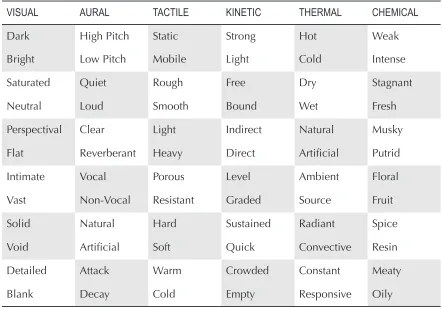
VISUAL AURAL TACTILE KINETIC THERMAL CHEMICAL
Dark High Pitch Static Strong Hot Weak
Bright Low Pitch Mobile Light Cold Intense
Saturated Quiet Rough Free Dry Stagnant
Neutral Loud Smooth Bound Wet Fresh
Perspectival Clear Light Indirect Natural Musky
Flat Reverberant Heavy Direct Artificial Putrid
Intimate Vocal Porous Level Ambient Floral
Vast Non-Vocal Resistant Graded Source Fruit
Solid Natural Hard Sustained Radiant Spice
Void Artificial Soft Quick Convective Resin
Detailed Attack Warm Crowded Constant Meaty
[image:8.595.71.513.423.732.2]Blank Decay Cold Empty Responsive Oily
Descriptor: use a word from the list given to characterise each of the six perceptual systems: visual, aural, olfactory/gustatory, tactile, thermal, kinaesthetic.
By locating the site on a traditional draw-ing such as a plan or section, the notation-al scheme can be understood as a layer or transparency added to traditional modes of depicting urban spaces. This is an important step, as it identiies the process as part of the traditional toolkit, rather than completely alien to it. Additional information such as time, date and weather conditions are nec-essary for the future usefulness of the record, as the sensory data vary widely depending upon the time of day or the season.
The next step is to place a descriptor word on each of the six perceptual systems em-ployed by the notation. These are chosen from a restricted and carefully selected list of words for each sense. The terms are cho-sen for their clarity and lack of metaphorical content. This precision of language inds its roots in Laban notation’s Effort and Shape matrices, where a very tight use of language helps to describe quite complex movements. Similarly, a lesser known system of move-ment notation, Saunders Notation (Hutchin-son-Guest 1989:xx). Additionally, names of things causing particular sensations such as trafic or wind may be added if the notator feels it necessary.
The third step in the notation is the main graphic step: priority. This step is subjec-tive by its very nature, but it offers a strong
picture of each environment as well as sug-gesting immediate ways in which the envi-ronment may be changed. This step consists of deciding which senses are strongest, most affective and prominent. The senses are then ranked in order of priority. This is drawn in an order of priority rather than introducing artiicial constructs such as the percentage of the sensorium devoted to that sense. The Radar chart is drawn with numbers from 1 to 6, outside to inside. The highest prior-ity is placed at one, the least at six. There is lexibility within this, of course, allowing some senses to be placed at the same rank as each other, or the gulf between two per-ceptual systems to be depicted as larger or lesser as appropriate.
The next, optional step, is to depict the corroboration between the senses by using curved, dotted lines between the different senses. These lines can contain a variety of data about this relationship, but the main thrust is to eficiently describe where these overlaps occur without overloading the dia-gram.
The inal step recognises the temporality of the senses, and adds indications to the main Radar diagram lines of the quality of time in-herent to that sense. This can be persistent, repetitive, singular, rhythmic or intermittent. This notation is not necessarily timed using chronological time, but rather recognises the phenomenological basis of the notation. The conceptualisation of time in this regard is experienced time rather than the clock time of the physical sciences.
The diagrams are collected and analysed in a number of different ways. The route no-tations can be layered, showing the progress along a path through transparency. This al-lows the route to be understood in terms of how the senses change from one position along the path to another. This can aid in identifying the prominent sensory stimuli on each route, where there are deicits, and
what makes this trail unique in character. Similarly, the static locations can be re-viewed and understood, particularly where a body of people have taken a record of the same place under similar conditions.
These observations are collated, so that patterns may emerge. These patterns are understood in the same way as Christopher Alexander’s Pattern Language with a differ-ent slant: the sensory experience of place. Of course, Alexander’s work has been de-ployed differently by a variety of academic disciplines over the years. One example is the adoption of his work by computing sci-ence as a model for how creativity and de-sign works. This is a false picture, however, and is attractive to that discipline precise-ly because it is easiprecise-ly understood through computational models. Other uses have included rather reactionary movements in urbanism which use Alexander’s patterns as a justiication for pursuing a purely histori-cist agenda, rejecting everything the 20th Century and Modernism had to offer. This is not to devalue Alexander’s approach of course, as it certainly has its place and is of intense interest. A new pattern book is being assembled using the Sensory Nota-tion method, not as absolute models, but as suggestions and examples to be played with and designed with freely, but in an informed way. Patterns will include public squares, fountains, gardens, thoroughfares, boule-vards, arcades, steps, subway entrances, and many more.
of the Sensory Notation system and Sensory Pattern Book [24] as well as detailed essays on the importance of the senses in urban de-sign.
End Notes
1. Ruskin, John. 1971. The Elements of Drawing. New York: Dover Publications. 2. Pallasmaa, Juhani. 1996. The Eyes of the Skin: Architecture and the Senses. London: Academy Editions.
3. I have argued this in far greater detail in my PhD thesis, Lucas, R. 2006. To-wards a Theory of Notation as a Thinking Tool. Aberdeen: Department of Social Anthropology, University of Aberdeen. 4. Goodman, Nelson. 1976. Languages of Art. Indianapolis: Hackett Publishing Company Inc.
5. Again, this is considered in greater depth with reference to the work on the temporality of creativity by philosopher Henri Bergson in my PhD thesis (Lucas 2006).
6. Bergson, H. 1992. The Creative Mind: An Introduction to Metaphysics. Andison, M. L. Trans. New York: Citadel Press. 7. Borges, J L. 1999. A Universal His-tory of Iniquity. Trans. A Hurley. London: Penguin.
8. Tanizaki, J. 2001. In Praise of Shad-ows. T J Harper & E G Seidensticker (Trans.). London: Vintage.
9. Ingold, T. 2000. Perception of the En-vironment. London: Routledge.
10. Zumthor, P. 2006. Atmospheres. Basel: Birkhäuser.
11. Blesser, Barry and Salter, Linda-Ruth. 2007. Spaces Speak, Are You Listening? Experiencing Aural Architecture. Cam-bridge Massachusetts: MIT Press.
12. Augoyard, Jean-François and Torgue, Henry (Eds). 2005. Sonic Experience: a Guide to Everyday Sounds. Montreal & Kingston: McGill-Queen’s University Press.
Augoyard, Jean-Françcois. 2007. Step by Step: Everyday Walks in a French Ur -ban Housing Project. David Ames Curtis Trans. Minneapolis: University of Minne-sota Press.
13. DeNora, Tia. 2000. Music in Every-day Life. Cambridge: Cambridge Univer -sity Press.
14. Bull, Michael. 2000. Sounding Out the City: Personal Stereos and the Man-agement of Everyday Life. Oxford: Berg. 15. Lefebvre, H. 2004. Rhythmanaly-sis: Space, Time and Everyday Life. New York: Continuum.
16. Perec, Georges. 1997. Species of Spaces and Other Pieces. London: Pen-quin Books.
17. Gibson, James J. 1996. The Senses Considered as Perceptual Systems. Bos-ton: Houghton Mifin Company, p.66 18. I deal with this form of notation as well as other movements in more detail in my PhD thesis (Lucas 2006). This includes examples of Laban notation of scenes from Kurosawa’s Seven Samurai, notation as a script for a drawing, and an extended project looking at the Tokyo Subway sys-tem, using Laban as a model for describ-ing the experience of urban space.
Supplementary Concepts. New York: Dance Notation Bureau Press.
20. Lynch, Kevin. 1990. The Image of the City. Cambridge, Massachusetts: MIT Press.
21. Jacobs, Allan B. 1995. Great Streets. Cambridge, Massachusetts: MIT Press. 22. Cullen, Gordon. 1971. The Concise Townscape. Oxford: Architectural Press. 23. See the wide literature on this, par-ticularly: Sadler, Simon. 1998. The Situ-ationist City. Cambridge, Massachusetts: MIT Press.
24. Lucas, R. 2008. Sensory Notation Handbook. Edinburgh: Flâneur Press.
Biography
Ray Lucas is Postdoctoral Research Fellow on the AHRC/EPSRC Designing for the 21st Century project ‘Multimodal Representa-tions of Urban Space’. This research is look-ing at developlook-ing new notational systems for urban design that respond to our whole experience of space. This includes notations for the different senses, movement through space, the feel of space and more. The proj-ect intends to test these notations and to publish a design guide to encourage multi-modality in urban design.
Lucas recently worked as Postdoctoral Fel-low at the University of Edinburgh on a col-laboration between Music and Architecture
entitled ‘Inlecting Space’. The project ex -amined the capacity and extent of the
hu-man voice to transform and deine public
spaces.
Lucas has a PhD research in Social Anthro-pology at the University of Aberdeen, and examined the role of notation and inscrip-tive practices such as drawing as cogniinscrip-tive processes. Prior to this, Lucas gained an MPhil by research at the Department of Ar-chitecture, University of Strathclyde in Filmic Architecture, examining the relationship be-tween cinematic montage and architecture.
![Table 1: Gibson’s perceptual systems chart [17].](https://thumb-us.123doks.com/thumbv2/123dok_us/1710623.124457/6.595.69.521.331.735/table-gibson-s-perceptual-systems-chart.webp)