Experimental Entanglement Activation from Discord
in a Programmable Quantum Measurement
Gerardo Adesso,1 Vincenzo D’Ambrosio,2 Eleonora Nagali,2 Marco Piani,3and Fabio Sciarrino2 1
School of Mathematical Sciences, University of Nottingham, University Park, Nottingham NG7 2RD, United Kingdom 2Dipartimento di Fisica, Sapienza Universitá di Roma, Roma 00185, Italy
3
Institute for Quantum Computing and Department of Physics and Astronomy, University of Waterloo, Waterloo N2L 3G1, Canada
(Received 12 December 2013; published 7 April 2014)
In quantum mechanics, observing is not a passive act. Consider a system of two quantum particlesAandB: if a measurement apparatusMis used to make an observation onB, the overall state of the systemABwill typically be altered. When this happens, no matter which local measurement is performed, the two objectsA
and B are revealed to possess peculiar correlations known as quantum discord. Here, we demonstrate experimentally that the very act of local observation gives rise to an activation protocol which converts discord into distillable entanglement, a stronger and more useful form of quantum correlations, between the apparatus
M and the composite systemAB. We adopt a flexible two-photon setup to realize a three-qubit system (A,B,M) with programmable degrees of initial correlations, measurement interaction, and characterization processes. Our experiment demonstrates the fundamental mechanism underpinning the ubiquitous act of observing the quantum world and establishes the potential of discord in entanglement generation.
DOI:10.1103/PhysRevLett.112.140501 PACS numbers: 03.67.Bg, 03.65.Ud, 03.67.Hk, 42.50.Ex
The revolution brought in by quantum mechanics has required a deep change in the way we think about physics and about nature itself. At the same time, it has led to the development of disruptive technologies and, in recent years, to the birth of quantum information processing[1]. Of the many ways in which quantum physics differs from classical one, two are especially striking: the measurement process leads almost always to some disturbance, and nonclassical correlations—including but not reducing to quantum entan-glement[2]—can exist between separate physical systems. These two key signatures of departure from classicality are deeply connected. To appreciate this, let us briefly review the model of measurement depicted by von Neumann[3]. A complete measurement on a quantum systemBin a ortho-normal basisjniBcan be realized by lettingBinteract with
a measurement apparatus M, initialized in a fiducial pure state j0iM, through a controlled unitary VBM such that VBMjniBj0iM¼ jniBjniM. The measurement would then
be accomplished by a readout ofM. Let us consider the more general situation where B is only a part of a composite system, its complement being denoted by A, and let us indicate with χAjB the initial state of theAB system. Just
before the readout, the premeasurement state
ρABjM¼ ðIA⊗VBMÞðχAjB⊗j0ih0jMÞðIA⊗V†BMÞ (1)
will typically display quantum entanglement[2]between the apparatusMand theABsystem. It is natural to wonder: when is the creation of entanglement between locally measured systems and apparatus (un)avoidable?
The answer is intertwined with the concept of quantum discord[4,5], a nonclassical signature in composite systems
which corresponds to the amount of correlations between two or more parties necessarily destroyed during a min-imally disturbing local measurement, and similarly quan-tifies the minimal informational disturbance induced on the system by such a measurement[4]. Quantum discord, as a representative of a general type of nonclassical correlations [6], has received widespread attention both for its funda-mental role in defining the border between the classical and quantum world[7–12], and for its possible resource power for information processing and quantum computation, even in absence of entanglement[13–24]. This power, however, has not been fully demonstrated to date[6,25,26].
In Refs. [8,9], a general result was proven: there exists only a special class of states ofAB for which one can measure B in some basis jniB without inducing
disturbance, and such that no entanglement is generated between M and AB in the premeasurement stage. These are the quantum-classical states with zero discord (from the perspective of B), taking the form ϖAjB¼ P
npnτnA⊗jnihnjB, wherepn is a probability distribution
and eachτn
Ais a density operator forA. For any other state
χAjB, its amount of quantum discord determines the
mini-mum entanglement which is activated, i.e., necessarily established with the apparatus M during a local probing ofB. This was theoretically established in[8,9], leading to the proposal to quantify discord exactly in terms of the minimum activable entanglement (see also [27,28] for alternative schemes). Depending on how the created entanglement is quantified, measuring discord via activa-tion may coincide with other approaches[6], e.g., related to distances from the set of quantum-classical states[29,30].
The observation of the predicted qualitative and quanti-tative correspondence between discord and generated entanglement is the main focus of this Letter. Besides the foundational relevance, the fact that entanglement is necessarily generated during a measurement renders dis-cord useful in schemes aimed at producing entanglement for quantum technological applications [8,31,32]. It is worth mentioning that, once system-apparatus entangle-ment is generated in the activation framework thanks to initial discord between subsystems A and B, such entan-glement can be used flexibly, and, in particular, be mapped into AjB entanglement via local operations and classical communication[31].
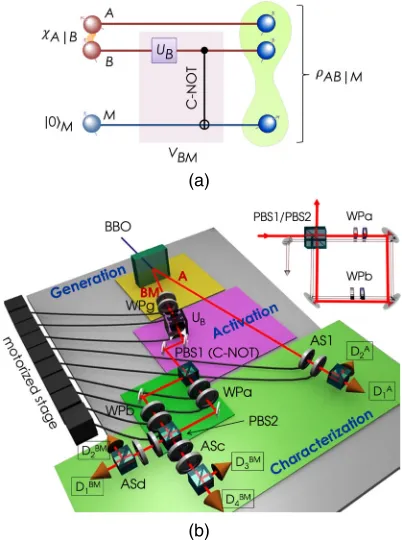
We demonstrate experimentally the entanglement acti-vation from discord by realizing a programmable quantum measurement process with bulk optics, see Fig. 1. We consider a family of initial states χAjB of two qubits AB
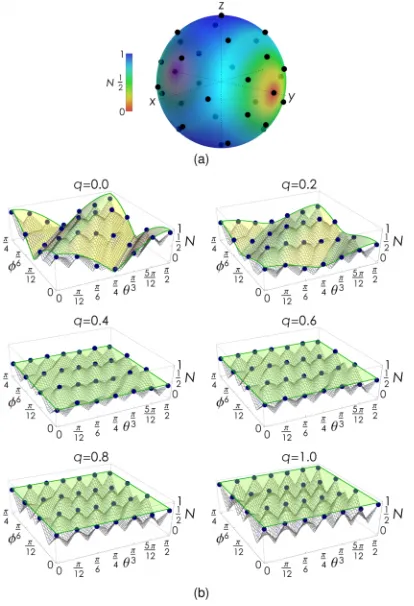
with variable degree of discord, and we use a third logical qubit M (as the apparatus) to perform a variety of local measurements onB. Takenprima facie, the verification of the results of[8,9]would require to implement a continu-ous set of measurements, which is impossible in practice. We develop a rigorous procedure to define a discrete net of settings which reliably approximates a continuous sam-pling over the Bloch sphere of B, see Fig. 2. This novel approach is reminiscent of the notion of ϵ-net for metric spaces [33,34] and tackles the problem of considering a worst case scenario over a continuous set, at variance with other experiments where only average values are cared for [35]or polynomial interpolation is invoked[36]. Based on a finite set of data, we conclude that as soon as the initial state χAjB is nonclassically correlated, entanglement is
activated for any possible measurement setting. The mini-mum amount of entanglement activated, over all possible local measurements, agrees quantitatively with the suitably quantified initial amount of discord, verifying the theoreti-cal predictions [8,9,31,37]. Furthermore, when the initial state χAjB is itself entangled, genuine tripartite entangle-ment is detected amongA,B, andMin the premeasurement stateρABjM [37]by means of a witness operator[38]. Our Letter puts quantum discord on the firm ground of an operational ingredient for entanglement generation.
Activation protocol: description and implementation.— The experimental implementation of the activation protocol is based on a two-qubit system AB encoded in the polarization states of two photons “A” and “BM”, and an ancillary qubit M corresponding to the two possible paths that photonBMcan take. The protocol is divided in three stages, see Fig.1.
Generation: By exploiting spontaneous parametric down conversion in a nonlinear crystal, we generate two polari-zation maximally entangled photons in the Bell singlet state jΨ−iAjB, withjΨiAjB¼p1ffiffi2ðjHi
AjViB jViAjHiBÞ,
where (H,V) are linear horizontal and vertical polarization, respectively [39]. In order to complete the Bell basis, the three other Bell states jΨþiAjB and jΦiAjB¼
1ffiffi 2
p ðjHi
AjHiB jViAjViBÞ are generated by applying to
jΨ−i
AjB a suitable combination of local unitary Pauli
operators fσig, implemented by exploiting the effect of birefringent wave plates on photonBM (WPg in Fig.1). Thus, a generic Bell diagonal mixed state χAjB can be
obtained by switching between different Bell states for an appropriate time depending on the weight of the corre-sponding state in the statistical mixture[45].
Activation: The activation procedure for the state χAjB
consists of two steps. The interaction VBM is realized by
first applying a variable unitary operationUB to systemB,
which plays the role of selecting the measurement basis jniB, i.e., the observable to be measured. Up to irrelevant
phases, the basisjniBis uniquely defined by a Bloch vector
~n[40]. ThenBinteracts with the apparatusMvia aC-NOT
gate, see Fig.1(a). After these local operations, the initial
(a)
(b)
FIG. 1 (color online). Activation protocol: design and exper-imental setup. (a) Circuit model for the activation protocol
[8,9,37]. The initial discord of the state χAjB is activated into distillable entanglement for the stateρABjM by a local variable operation (VBM) composed by a single qubit operation onB(UB) and a C-NOT between B and M. (b) Experimental setup. Two
[image:2.612.337.538.47.319.2]discord of the state χAjB is activated into distillable entanglement in the state ρABjM. Experimentally, the
operationUB on the polarization of photonBMis
imple-mented by the two wave plates UB in Fig. 1; the C-NOT
gate is achieved by exploiting a polarizing beam splitter (PBS1) which implements the following transformation: jHiBjaiM→jHiBjaiM and jViBjaiM→jViBjbiM, where
the path statesfjaiM;jbiMgdefine the computational basis
for the logical qubitM.
Characterization: To measure the activated entangle-ment, we fully reconstruct the output premeasurement
stateρABjM via quantum state tomography [46], requiring
projective measurements over polarization of both photons and the path of photonBM. While polarization measure-ment for photon A is easily performed with two wave plates and a PBS (AS1), photon BM requires a more complex setup based on an interferometer which is shown in Fig.1. In each arm of the interferometer, a quarter-wave plate and a half-wave plate are exploited to measure polarization of photon BM; depending on this measure-ment, the photon will leave PBS2 from exit c or exit d. Then the polarization state of photonBMdepends only on its path inside the interferometer; hence, a polarization analysis stage (ASc and ASd) is sufficient to perform a measurement of qubit M. Instead of the Mach-Zehnder interferometer of Fig.1, in the experiment, we adopted a more compact and stable displaced Sagnac interferometer [41–43], see inset of Fig. 1(b). Both photons are finally collected by single-mode fibers and sent to single-photon detectors; see also [44].
The activation protocol does not need destructive mea-surements; hence, the generated entanglement can be used for further processing. In our experimental setup, the entanglement is activated after PBS1 which implements aC-NOTgate between polarization and path of photonBM. As an alternative approach, one could encode qubitsA,B, andMin three different photons or other physical systems like trapped ions or superconducting qubits. The destruc-tive measurements are performed here only in order to verify the activation process.
Experimental state preparation and characterization.— Following the above procedure, we prepared the qubitsA
andBin a family of symmetric Bell diagonal states of the form
χðqÞ
AjB¼qjΨþihΨþjAjBþ
1−q
2 ðjΦþihΦþjAjBþjΨ−ihΨ−jAjBÞ:
(2)
Here, the parameterq∈½0;1regulates the quantumness of correlations in the initial stateχðAqjBÞ: forq¼0, the state is only classically correlated, for anyq >0, it has discord, while for q >1=2, the state is further entangled. The activation theorem predicts that for any q >0, the pre-measurement state ρðq;UBÞ
ABjM is entangled for all possible
choices of UB. The minimum entanglement in the
pre-measurement state over all choices ofUB, measured, e.g.,
by the negativityN [2,47], defines a measure of discord for the initial state known as negativity of quantumness [8,30,48], QNðχ
ðqÞ
AjBÞ ¼minUBNðρ ðq;UBÞ
ABjMÞ. When B is a
qubit, like in our case, the negativity of quantumness coincides with an independently defined geometric mea-sure of discordDðχAjBÞgiven by the trace distance between
χAjB and the closest quantum-classical state ϖAjB [30,49]
(see Appendix). In particular, for the class of states in
FIG. 2 (color online). Activation protocol: experimental results. (a) Measurement bases for qubit B defined by Bloch vectors
~nðθj;ϕkÞ (dots), where θ,ϕare wave plates angles [40]; the Bloch sphere is overlayed with a density plot of the expected negativity of the output premeasurement state NðρðABq;θjM;ϕÞÞ for
q¼0. (b) Comparative results of the activation protocol. Each plot corresponds to a different value ofq, and within each panel, 28 different settings are varied forUB. Each blue point amounts to the
entanglementNðρðq;θj;ϕkÞ
ABjM Þof the corresponding premeasurement state reconstructed by tomography; the errors, evaluated from the Poissonian statistics of photon events, are below10−2. In each plot, we include the lower boundNlowðρðABq;θjM;ϕÞÞon the negativity derived in Eq. (B.5) of[44](wireframe meshed surface), which remains positive forq >0confirming that we sampled enough settings for
[image:3.612.73.280.47.350.2]Eq.(2), the trace-distance discord readsDðχðAqjÞBÞ ¼qwhile their initial entanglement measured by the negativity[2,47] is NðχðAqjÞBÞ ¼maxð0;2q−1Þ.
In the experiment, we pick six evenly spaced represen-tative values forq. The operatorUBis implemented through
a combination of a quarter-wave plate and a half-wave plate whose optical axes are rotated, respectively, by θ and ϕ with respect to the direction of linear horizontal polariza-tion, which overall amounts to measuring B in a Bloch direction~nðθ;ϕÞ[40]. We define a discrete net of values (θj, ϕk), which provides an adequate sampling— reminis-cent of the notion ofϵ-net for metric spaces[33,34]—of the Bloch sphere for the purpose of entanglement activation, see[44]for the mathematical details. This procedure brings us down to measureNðρðq;θj;ϕkÞ
ABjM Þin 28 different settings (j, k) for any chosen value of q, defined by the wave plates angles (θj, ϕk) with θj¼jðπ=12Þ, ϕk¼kðπ=12Þ, j¼0;…;6,k¼0;…;3. The corresponding Bloch direc-tions~nðθj;ϕkÞare displayed in Fig.2(a) [40]. The wave
plates angles are programmed by a computer-controlled motorized stage as illustrated in Fig. 1(b). An example of tomographically reconstructed state is reported in[44].
Demonstration of entanglement activation.—The acti-vation results are shown in Fig. 2(b) together with the closely matching theoretical surface based on Eq. (A.1) of [44]which considers an ideal implementation of the state in Eq. (2). We observe a satisfactory agreement with the experimental acquisitions which confirms our high degree of control on all stages of the experiment. Notice how the caseq¼0, where the initial stateχAjB of Eq.(2)has zero discord, is the only case in which for certain values ofUB,
the apparatus M does not necessarily entangle with the observed system AB, in accordance with the theoretical formulation of the activation protocol[8,9].
We complete our plots with a grid of lower bounds to
NðρðABq;θ;ϕjMÞÞfor arbitrary θ,ϕ. The bounds, which originate
from purposely derived continuity limits for the negativity [44], allow us to infer—based on the finite net of exper-imental data—that forq >0, the premeasurement state will always display entanglement betweenMand theABfor all possible measurement choices on B, hence providing a sound verification of the activation theorem[8,9]. Only in the caseq¼0, when the initial stateχAjBof Eq.(2)has zero discord, we find that for certain measurement settings
Nðρð0;θj;ϕkÞ
ABjM Þis essentially vanishing within the
experimen-tal imperfections. The output entanglement was generally found to be minimized by θj¼π=4, ϕk ¼0; while for
q >1=3, any choice ofUB produces the same
entangle-ment in the premeasureentangle-ment state apart from experientangle-mental fluctuations, see Fig.2(b).
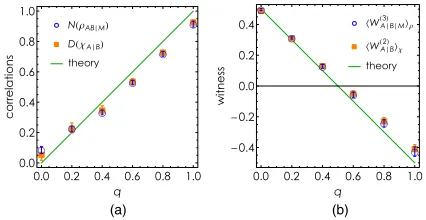
We can now exploit our data to verify the quantitative prediction of the activation theorem [8,9], as shown in Fig.3(a). We find experimentally that the minimum output
entanglement minj;kNðρðq;θj;ϕkÞ
ABjM Þ generated with the
appa-ratus, measured by negativity, precisely matches the amount of trace-distance discordDðχðAqjBÞÞinitially detected
betweenA andB[44]. This demonstrates the operational power of discord as“entanglement potential”[8,9,16]and proves successfully the activation of distillable bipartite entanglement from input discord. Small discrepancies (of at most 0.1 units) from the theoretical green line can be traced back to imperfections in the initial preparation of the four polarization Bell states of photonsAandBM, which in our implementation reach a mean purity of ð93.60.2Þ%, consistent, e.g., with the experimental value forDðχðAqj¼B1ÞÞ.
Finally, in case the initial stateχðAqjÞBis entangled as well, we observe that genuine tripartite entanglement is created in the premeasurement state amongA,B, andMas a result of the activation protocol[37]. This is verified by detecting suitable entanglement witnesses[2,38]for input and output states [44] as presented in Fig. 3(b). Theoretically, the expectation values for both witnesses on the corresponding states should coincide and be given by ð1=2Þ−q (solid green line); we find a satisfactory agreement between the two data sets and the theory, detecting, in particular, negative expectation values for the two witnesses in the relevant parameter rangeq >1=2.
Conclusions.—The experimental observation of the activation protocol, presented as an abstract theorem in [8,9], brings the notion of quantumness in composite systems to a more concrete level than ever before. Our demonstration establishes the usefulness of various forms of nonclassical correlations as resources for information
(a) (b)
FIG. 3 (color online). Activation protocol: quantitative verifi-cation. (a) The minimum output entanglement activated with the apparatus, measured by the negativity minðθ;ϕÞNðρ
ðq;θ;ϕÞ ABjM Þ, is verified to match the input discord DðχðAqjÞBÞ in the system, measured by the trace distance from the set of quantum-classical states. (b) Input bipartite entanglement activates into genuine tripartite entanglement[37]. Measured expectation values of two witness operators (negative values detect entanglement) [2,38]
are plotted;WðA2jÞB is a witness for bipartite entanglement in the
[image:4.612.331.544.451.561.2]processing: discord is necessarily activated into bipartite entanglement, and bipartite entanglement into genuine tripartite entanglement, by the act of performing a local measurement. We believe an approach based on an ϵ-net construction such as ours can effectively be adopted in future experiments aimed at substantiating mathematical predictions via sampling continuously distributed param-eters, in particular, in worst case scenarios. The imple-mentation of a von Neumann chain[3,37]may be further considered, exploiting recent advances in integrated quan-tum photonics [50–52]. We hope our Letter can stimulate further endeavours towards a deeper physical understand-ing and practical exploitation of quantumness, in its manifold manifestations, for information processing and communication.
G. A. acknowledges support from ESF, EPSRC, FQXi, and the Brazilian funding agency CAPES (Pesquisador Visitante Especial Grant No. 108/2012). M. P. acknowl-edges support from NSERC, CIFAR, and Ontario Centres of Excellence. V. D., E. N., and F. S. acknowledge support by FIRB-Futuro in Ricerca HYTEQ and ERC (European Research Council) Starting Grant 3D-QUEST (3D-Quantum Integrated Optical Simulation; Grant No. 307783): http://www.3dquest.eu. We thank J. Calsamiglia and A. Streltsov for useful feedback on the Letter. G. A. thanks F. G. S. L. Brandão, J. Eisert, and A. Winter for discussions, and D. O. Soares-Pinto at the Physics Institute of São Carlos for the kind hospitality during completion of this Letter.
Appendix: Measures of correlations.—The negativity, a measure of entanglement for a bipartite state χAjB, can be
defined as NðχAjBÞ ¼∥ϱΓAjB∥1−1, where the suffix Γ
denotes partial transposition [2], and ∥O∥1¼Tr
ffiffiffiffiffiffiffiffiffiffi
O†O
p
is the trace norm, i.e., the sum of the singular values ofO. The negativity of quantumness, a measure of discord, can be defined in terms of the activation framework of Fig.1(a) [8,9,30,31,37]asQNðχAjBÞ ¼minUBNðρ
ðUBÞ
ABjMÞ(notice that
the entanglement in the premeasurement states ρðUBÞ
ABjM
is always distillable [8,9]). The trace-distance discord
DðχAjBÞis defined as the minimum distance, in trace norm,
between χAjB and the set of quantum-classical states
ϖAjB¼
P
npnτnA ⊗jnihnjB, namely DðχAjBÞ ¼
minϖ
AjB∥χAjB−ϖAjB∥1 [30,49]. If B is a qubit, then QNðχAjBÞ ¼DðχAjBÞ as first proven in [30]. We observe
this equivalence experimentally in Fig.3(a).
[1] M. A. Nielsen and I. L. Chuang, Quantum Computation and Quantum Information (Cambridge University Press, Cambridge, 2010).
[2] R. Horodecki, P. Horodecki, M. Horodecki, and K. Horodecki,Rev. Mod. Phys.81, 865 (2009).
[3] J. von Neumann, Mathematical Foundation of Quantum Mechanics(Princeton University Press, Princeton, 1955).
[4] H. Ollivier and W. H. Zurek,Phys. Rev. Lett.88, 017901 (2001).
[5] L. Henderson and V. Vedral,J. Phys. A.34, 6899 (2001). [6] K. Modi, A. Brodutch, H. Cable, T. Paterek, and V. Vedral,
Rev. Mod. Phys.84, 1655 (2012).
[7] W. H. Zurek,Rev. Mod. Phys.75, 715 (2003).
[8] M. Piani, S. Gharibian, G. Adesso, J. Calsamiglia, P. Horodecki, and A. Winter, Phys. Rev. Lett.106, 220403 (2011).
[9] A. Streltsov, H. Kampermann, and D. Bruss, Phys. Rev. Lett.106, 160401 (2011).
[10] D. Girolami, T. Tufarelli, and G. Adesso,Phys. Rev. Lett. 110, 240402 (2013).
[11] A. Streltsov, and W. H. Zurek,Phys. Rev. Lett.111, 040401 (2013).
[12] F. G. S. L. Brandão, M. Piani, and P. Horodecki, ar-Xiv:1310.8640.
[13] A. Datta, A. Shaji, and C. M. Caves,Phys. Rev. Lett.100, 050502 (2008).
[14] B. P. Lanyon, M. Barbieri, M. P. Almeida, and A. G. White,
Phys. Rev. Lett.101, 200501 (2008). [15] B. Eastin,arXiv:1006.4402.
[16] R. Chaves and F. de Melo,Phys. Rev. A84, 022324 (2011). [17] D. Cavalcanti, L. Aolita, S. Boixo, K. Modi, M. Piani, and
A. Winter,Phys. Rev. A83, 032324 (2011).
[18] M. Gu, H. M. Chrzanowski, S. M. Assad, T. Symul, K. Modi, T. C. Ralph, V. Vedral, and P. Koy Lam,Nat. Phys.8, 671 (2012).
[19] B. Dakicet al.,Nat. Phys.8, 666 (2012).
[20] A. Streltsov, H. Kampermann, and D. Bruss, Phys. Rev. Lett.108, 250501 (2012).
[21] T. K. Chuan, J. Maillard, K. Modi, T. Paterek, M. Paternostro, and M. Piani,Phys. Rev. Lett.109, 070501 (2012). [22] A. Fedrizzi, M. Zuppardo, G. Gillett, M. Broome, M.
Almeida, M. Paternostro, A. White, and T. Paterek,Phys. Rev. Lett.111, 230504 (2013).
[23] D. Girolamiet al.,arXiv:1309.1472.
[24] Z. Merali,Nature (London)474, 24 (2011).
[25] P. Horodecki, J. Tuziemski, P. Mazurek, and R. Horodecki,
arXiv:1306.4938.
[26] G. L. Giorgi,Phys. Rev. A88, 022315 (2013).
[27] L. Mazzola and M. Paternostro,Sci. Rep.1, 199 (2011). [28] A. Farace, F. Ciccarello, R. Fazio, and V. Giovannetti,Phys.
Rev. A 89, 022335 (2014).
[29] K. Modi, T. Paterek, W. Son, V. Vedral, and M. Williamson,
Phys. Rev. Lett.104, 080501 (2010).
[30] T. Nakano, M. Piani, and G. Adesso, Phys. Rev. A 88, 012117 (2013).
[31] S. Gharibian, M. Piani, G. Adesso, J. Calsamiglia, and P. Horodecki,Int. J. Quantum. Inform. 09, 1701 (2011). [32] P. J. Coles,Phys. Rev. A86, 062334 (2012).
[33] W. A. Sutherland,Introduction to Metric and Topological Spaces(Oxford University Press, Oxford, 1975).
[34] P. Hayden, D. Leung, P. W. Shor, and A. Winter,Commun. Math. Phys.250, 371 (2004).
[35] J. Emerson, M. Silva, O. Moussa, C. Ryan, M. Laforest, J. Baugh, D. G. Cory, and R. Laflamme, Science317, 1893 (2007).
[38] O. Gühne and G. Toth,Phys. Rep.474, 1 (2009). [39] P. G. Kwiat, K. Mattle, H. Weinfurter, A. Zeilinger, A. V.
Sergienko, and Y. Shih,Phys. Rev. Lett.75, 4337 (1995). [40] The operator UB is decomposed as a sequence of two rotated wave plates, UB¼RTðϕÞUHBRðϕÞRTðθÞUQBRðθÞ, where UH
B ¼diagð1;−1Þ and UQB¼diagð1; iÞ correspond to a half- and a quarter-wave plate, respectively (with optical axes parallel to the horizontal polarization), and
RðαÞ ¼
cosα −sinα sinα cosα
is a rotation. The measurement interaction resulting from applying a C-NOTgate after UB is equivalent (up to local
unitaries) to the one achieving VBMjniBjaiM¼ jniBjniM, where jniB¼U†BjHiB is a state with Bloch vector
~nðθ;ϕÞ ¼ f−cos½2ðθ − 2ϕÞsinð2θÞ;−sin½2ðθ− 2ϕÞ;
cos½2ðθ − 2ϕÞcosð2θÞg. Correspondingly, U†BjViB has Bloch vector −~nðθ;ϕÞ. By periodicity, we can restrict to a parameter range θ∈½0;π=2, ϕ∈½0;π=4, so that the basis vectors ~nðθ;ϕÞ cover the whole Bloch sphere of qubitB.
[41] E. Nagali, S. Felicetti, P.-L. de Assis, V. D’Ambrosio, R. Filip, and F. Sciarrino,Sci. Rep.2, 443 (2012).
[42] S. P. Walborn, P. H. Souto Ribeiro, L. Davidovich, F. Mintert, and A. Buchleitner,Nature (London) 440, 1022 (2006).
[43] R. Okamoto, J. L. O’Brien, H. F. Hofmann, and S. Takeuchi,
Proc. Natl. Acad. Sci. U.S.A.108, 10067 (2011).
[44] See Supplemental Material at http://link.aps.org/ supplemental/10.1103/PhysRevLett.112.140501 for addi-tional details on the experimental and theoretical proce-dures; this includes Refs. [53–55].
[45] J. Lavoie, R. Kaltenbaek, M. Piani, and K. J. Resch,Phys. Rev. Lett.105, 130501 (2010).
[46] D. F. V. James, P. G. Kwiat, W. J. Munro, and A. G. White,
Phys. Rev. A64, 052312 (2001).
[47] G. Vidal and R. F. Werner, Phys. Rev. A 65, 032314 (2002).
[48] I. A. Silva, D. Girolami, R. Auccaise, R. Sarthour, I. Oliveira, T. Bonagamba, E. deAzevedo, D. Soares-Pinto, and G. Adesso,Phys. Rev. Lett.110, 140501 (2013). [49] F. M. Paula, T. R. de Oliveira, and M. S. Sarandy,Phys. Rev.
A87, 064101 (2013).
[50] A. Politi, M. J. Cryan, J. G. Rarity, S. Y. Yu, and J. L. O’Brien,Science320, 646 (2008).
[51] A. Crespi, R. Ramponi, R. Osellame, L. Sansoni, I. Bongioanni, F. Sciarrino, G. Vallone, and P. Mataloni,
Nat. Commun.2, 566 (2011).
[52] A. Crespi, R. Osellame, R. Ramponi, D. J. Brod, E. F. Galvão, N. Spagnolo, C. Vitelli, E. Maiorino, P. Mataloni, and F. Sciarrino,Nat. Photonics7, 545 (2013).
[53] V. Buzek, M. Hillery, and R. F. Werner,Phys. Rev. A60, R2626 (1999).
[54] F. De Martini, V. Buzek, F. Sciarrino, and C. Sias,Nature (London) 419, 815 (2002).