Theses Thesis/Dissertation Collections
12-13-2010
Gender Differences in Resilience in the Emerging
Adulthood Population
Erin Bezek
Follow this and additional works at:http://scholarworks.rit.edu/theses
This Thesis is brought to you for free and open access by the Thesis/Dissertation Collections at RIT Scholar Works. It has been accepted for inclusion in Theses by an authorized administrator of RIT Scholar Works. For more information, please [email protected].
Recommended Citation
Running head: GENDER DIFFERENCES IN RESILIENCE
Gender Differences in Resilience in the Emerging Adulthood Population Erin E. Bezek
Rochester Institute of Technology
Abstract Introduction Literature Review Method
Results Discussion References Tables
Table of Contents
GENDER DIFFERENCES IN RESILIENCE
Abstract
Risk factors and protective factors influence an individual's resilience. For this study archival data collected from Rochester Institute of Technology college students were used. Specifically the participants' responses on the 16PF- Adolescent Personality Questionnaire (APQ) Life Difficulties Scale (LDS) were analyzed. After reconfiguring the Life Difficulties Scale using the literature review to analyze the items, results indicated that specific items can be considered risk factors, whereas others can be considered protective factors. Results from this emerging adulthood population did not indicate gender differences in the risk and protective factors.
Keywords: resilience, gender differences, protective factors, risk factors, emerging adulthood
CHAPTER ONE Introduction
Contrary to popular belief resilience is an ordinary occurrence (Bonanno, 2008; Kelley, 2005). Resilience is defined differently by most researchers, but the fundamental descriptions are conceptually similar. When defining resilience researchers use terminology such as 'adaptation or development,' 'maintaining stability,' 'recovery or growth from adverse conditions,' and 'positive adjustment' (Bonnano, 2008; Leipold & Greve, 2009; Masten 2001; & Ong et al., 2006). Pathways to resilience vary, are sometimes surprising, and many factors influence the resilience trajectory (Bonnano, 2008).
Protective factors and risk factors affect the road to resilience. Personal attributes, environmental factors, and situational experiences influence the ability to successfully adapt during adverse circumstances (Ong et al., 2006). The meaning of protective factors and risk factors depend on the individual, as some risk factors are considered advantageous and build resilience.
Gender differences, which develop at an early age and continue into adolescence, influence the manner in which individuals attain resilience (Blatt-Eisengart et al., 2009; Bonanno et al., 2007; Cohen et al., 2003; Galambos, Barker, & Krahn, 2006; Hankin et al., 1998; Lopez, Campbell, & Watkins, 1986; Ong et al., 2006; Orth et al., 2008; & Sneed et al., 2006). Males and females use different resources as coping mechanisms. Males are prone to more individualistic means, whereas females rely on social support and communal means (Sneed et al.).
GENDER DIFFERENCES IN RESILIENCE 5
& Sneed et al., 2006). When faced with adversity men tend to rely on their independence, whereas women utilize their support systems (Sneed et al.). Therefore, when exposed to hardship, males and females vary in their way of coping and, thus their path towards resilience is different. Although protective and risk factors affect both genders, males and females adapt and use different resources.
Emerging adults experience transitions that range from attending high school to college or the work field, as well as living under their parents' care to independent life (Arnett, 2000). Whereas past research has evaluated resilience in children and adolescents, published studies examining the gender differences in the development of resilience in the emerging adulthood population are limited. Establishing a better understanding surrounding the gender differences in resilience in the emerging adulthood population can build a more comprehensive insight into resilience. The current study examines the different coping mechanisms used within a resilience framework by males and females in the emerging adulthood population. Unique protective and risk factors are hypothesized to be gender specific.
Definition of Terms
Resilience refers to a class of phenomena characterized by good outcomes in spite of serious threats to adaptation or development (Masten, 2001 ).
Protective Factors are factors that foster the development of positive outcomes and healthy personality characteristics among children exposed to unfavorable or aversive life circumstances (Bonanno, 2008).
GENDER DIFFERENCES IN RESILIENCE 7
CHAPTER TWO Literature Review
Resilience is an ongoing, changing process. Rutter (2007) stated that resilience needs to be conceptualized as a life span perspective. He explained that overcoming hardship may depend on the experiences following stress, trauma, and risk exposure. The gender differences involving resilience in childhood and adolescence that lead up to the emerging adulthood time period are important to examine and report. In this Literature Review, resilience is described and defined, protective factors and risk factors are discussed, the characteristics of the emerging adult population are explained, and the gender differences are evaluated. In addition, current and existing resilience scales are assessed and discussed, as well, in order to discover the numerous ways in which resilience is measured.
Resilience
normal characteristic that is innate to all individuals. In that resilience is attained differently depending on the individual, the problem event, and the environment, there are as many avenues to resilience as there are definitions of it.
Masten and Powell (2003) stated that there are two fundamental judgments with respect to resilience: the fact that the person is "doing okay" and that the individual overcame an adversity. These researchers also pointed out that referring to a person as resilient is improper. The appropriate way to use the term resilience is used when describing an individual's behavior or pattern (Masten & Powell). Similarly, Kaplan (2005) stated that resilience should be characterized by each instance and on an individual basis.
Resilience is also considered a fluid process that is in constant flux and affected by protective factors and risk factors. The concept of protective factors was first developed by Rutter ( 1985). Rutter argued that protective factors are more than the opposite of risk factors. That is, both protective and risk factors shape the path toward resilience and influence how an individual accomplishes resilience.
Protective and Risk Factors
GENDER DIFFERENCES IN RESILIENCE 9
depression, and behavioral disorders. However, some children who experience considerable risk factors and stressors still manage to "beat the odds" (Houshyar & Kaufman, 2005). Children with disruptive behavior disorders (DBD) which include attention deficit hyperactivity disorder (ADHD), oppositional defiant disorder (ODD), and conduct disorder (CD) are another example. When children are diagnosed with a single DBD they have an increased likelihood of negative life adjustment that may lead into young adulthood. A combination of DBDs makes the probability even higher for negative life adjustment. Nevertheless, there is a small percentage of children with DBDs that transition and adjust well into young adulthood (Goldstein & Rider, 2005).
Social support is a significant asset that has continually been linked to resilience. A lack of social support poses as a risk factor in times of stress. In addition, low level education, poor family background, prior psychiatric history, and maladaptive response to trauma can also be considered risk factors (Bonanno, 2008). When inverted (e.g., high level of education), these aspects are seen as protective factors.
traumatic experience depends on the interaction of these three factors. Therefore, there is an expectation that individuals should be able to overcome the obstacles they face when these individuals possess the proper personal and social resources (Leipold & Greve).
Community, Family, School, and Peer-individual Factors. Within a risk and protective factor framework Hawkins and Catalano (2004) presented four domains that are influential to resilience. The domains included community, family, school, and peer-individual factors (Hawkins & Catalano).
GENDER DIFFERENCES IN RESILIENCE 11
& Catalano). Nevertheless, resilience has found to be especially common among children growing up in disadvantaged conditions (Masten, 2001 ). These children may grow from the abundance of risk factors and learn from the adversity.
The family domain also plays an influential part in children's positive development which leads to resilience. Both Blatt-Eisengart et al. (2009) and Hawkins and Catalano (2004) explained that family conflict influences the familial processes. Blatt-Eisengart et al. researched family risk factors and the gender differences in childhood externalizing symptoms. In general, when parenting is harsh, insensitive, unsupportive, or inconsistent, children are at greater risk for behavioral problems compared to their peers. Blatt-Eisengart et al. referred to maternal depressive symptoms as it exacerbates familial-level conflict and thus child externalizing behavior. These researchers found evidence revealing that maternal depressive symptoms have an effect on both genders but at different ages. Boys' externalizing behaviors were more affected by their mothers' depressive symptoms at 24 months of age. Nevertheless, maternal depressive symptoms did predict externalizing symptoms for girls at 24 months as well. Boys' externalizing symptoms declined over time in relation to maternal depressive symptoms, whereas girls' symptoms become stronger. In fact, at first grade the relation between externalizing symptoms and maternal depressive symptoms was stronger among girls than among boys compared at 24 months. Therefore, the age of the child can affect his or her sensitivity to maternal depressive symptoms (Blatt-Eisengart et al.).
either heavy users themselves, are tolerant of the child's use, or are even involved in their child's use of drugs. Conversely, children who feel connected to their family are less likely to engage in substance use and more likely to be resilient. In the same respect, when children are exposed to more opportunities for prosocial involvement, they are less likely to engage in problem behaviors. Praise, encouragement, and attending to appropriate behavior are other ways for parents, siblings, and other family members to decrease the chance for children to engage in drug use (Hawkins & Catalano).
Risk factors pertaining to the school atmosphere include academic failure and low commitment (Hawkins & Catalano, 2004). Starting in late elementary grades, 4th to 6th grade, academic failure increases the risk of both drug abuse and delinquency. Enjoying school, spending time on homework, and perceiving the coursework as relevant are negatively related to drug use. When children participate in school activities and are recognized or rewarded for their contributions at school, they are less likely to be involved in substance use and other problem behaviors (Hawkins & Catalano). These constructive activities build children's social networks and in turn, increase the prospect of resilience.
GENDER DIFFERENCES IN RESILIENCE 13
substance abuse are much more likely to participate in the same behavior. Therefore, interacting with antisocial peers who use drugs greatly increases the risk of that problem developing. Similar results occur with young people who do not perceive drug use to be risky and receive rewards for their antisocial behavior from peers. Rebelliousness, sensation seeking, and gang involvement are additional characteristics that have been linked with problem behaviors (Hawkins & Catalano). Youth who feel estranged from and rebel against society, disregard rules, and don't believe in trying to be successful or responsible are at higher risk for abusing drugs. Seeking out opportunities for dangerous, risky behavior, including membership in gangs, is another factor that increases the chance for problem behavior (Hawkins & Catalano). Peer-individual protective factors include religiosity, social skills, and moral standards. Young people who regularly attend religious services, who are socially competent and engage in interpersonal relations with their peers, and have a belief in what is "right" or "wrong" are less likely to use drugs (Hawkins & Catalano).
Hardiness, Self-enhancement, Repressive Coping, and Positive Emotion and
Laughter. Individual characteristics also affect resiliency. Specifically, hardiness, self enhancement, repressive coping, and positive emotion and laughter are considered distinct dimensions that may help to buffer stress and lead to resilience. These factors are established and
developed at birth and continue to change throughout a person's life (Bonanno, 2008).
Hardiness shields individuals from exposure to extreme stress. Hardy individuals are
dedicated to finding a meaningful purpose to their lives, believe that they can influence their
environment and the outcome of events, and believe that they can learn and develop from both
positive and negative experiences. Individuals who possess hardy characteristics have a mindset
experience of distress. Hardy individuals are also more confident and more capable at utilizing active coping and support systems when they do experience stress (Bonanno, 2008).
Self-enhancement has its benefits and costs. Self-enhancement is associated with high self-esteem, but also with narcissism. Self-enhancers contain both of these characteristics which fosters resilience. Favoring oneself has proved to be advantageous for one's well-being. There are benefits to putting yourself first in certain circumstances not only for protection, but for happiness as well. This trait also promotes more active social networks and results in better adjustment (Bonanno, 2008). According to Sneed et al. (2006), men show higher levels of self enhancement than women because they are more likely to be independent rather than communal. Thus, men would have an advantage of already possessing self-enhancement, but it would be beneficial for women to acquire this trait since it leads toward resilience.
Repressive coping involves avoiding unpleasant thoughts, emotions, and memones. While hardiness and self-enhancement operate primarily using cognitive processes and mechanisms, repressive coping operates more on an emotion-focused level. Repressive capers may experience long-term health costs, but they also tend to adapt to hardship (Bonanno, 2008). Repressive coping has been known to be detrimental since it conceals maladaptive feelings, but in the case of resilience it has its advantages.
GENDER DIFFERENCES IN RESILIENCE 15
are more likely to evoke positive responses from others and take any help that is offered without
pushing loved ones away (Ong et al.). Ong et al. reported that positive emotions have noticeably valuable effects when present during stressful times. Positive emotions foster flexibility in thinking, counter the physiological effects of negative emotions, assist the coping process, help
to develop lasting social relationships, as well as enhance well-being (Ong et al.). The analyses revealed that the occurrence of positive emotions on a daily basis provides the ability to "moderate stress reactivity and mediate stress recovery" (Ong et al.). Therefore, experiencing daily positive outlooks and optimism proves to be a protective factor. Even though this research
studied resilience later in life, much of what these researchers discuss can pertain to young adults as well. Positive emotions are essential at any part of someone's life and can increase the chance
for resilience at any point. The manner in which individuals respond to, assess, and interpret adverse life experiences has an impact throughout their entire life.
Post-Traumatic Stress Disorder. Many resilience studies have examined individuals who experienced bereavement and Post Traumatic Stress Disorder (PTSD) to find any clear risk and protective factors. Unfortunately, most people are faced with the horrible reality that loved ones die. Surprisingly, however, only a small amount of individuals experiencing bereavement fall into the category of PTSD. Researchers are interested in discovering the details surrounding
this notion that allows for such resilience.
after the September 11, 2001 terrorist attack. The final sample consisted of 2,752 adults in New
York City and the surrounding areas. The phone interview included questions about
sociodemographics, exposure, and life stress, substance use, depression, PTSD symptoms, and
outcome categories. Bonanno et al. suggested that material, energy, interpersonal, and work
resources influence an individual's outcome when they are forced to cope from a traumatic life
circumstance. Material resources, for example, were income or income loss. Energy resources
included the availability or loss of health insurance. Interpersonal resources involved the absence
or presence of social support and work resources referred to employment versus unemployment.
Additional life stress was also considered a risk factor that may lead to a decrease prevalence of
resilience.
Bonanno et al. (2007) found that resilient individuals presented with less substance abuse
and less depression compared to the participants who experienced trauma or PTSD. Participants
with a healthier, more resilient profile reported less substance use and less depression. The
results also indicated that there was a gender difference. Women were less likely to be resilient
than men. Brewin, Andrews, and Valentine (2000) also discovered the same results in their study
on Post Traumatic Stress Disorder in trauma-exposed adults. These authors investigated the risk
factors for PTSD in trauma-exposed adults through meta-analyses of 77 articles conducted on 14
separate risk factors and the moderating effects of various sample and study characteristics.
Results indicated that women were more susceptible and vulnerable to developing PTSD, even
when the type of trauma was kept constant. Results were unclear as to whether female gender
was the risk factor, or whether characteristics such as willingness to report symptoms and the
GENDER DIFFERENCES IN RESILIENCE 17
Another finding was that participants who were 65 years or older were more than three
times more likely to be resilient than were people in the emerging adulthood population (Bonanno et al., 2007). Contrary to the belief that young people supposedly bounce back more easily from adverse situations, the years of wisdom and the hardship they have experienced desensitizes the older age group. One explanation for this finding may be that emerging adults do
not yet have a stable environment and are affected more by traumatic events as 9/11. In contrast, the older individuals have more security and resources to support them, whereas young adults are building their resources.
In another surprising finding, Bonanno et al. (2007) stated that people with a college degree were less likely to be resilient in comparison to those who did not finish high school. This
finding is contrary to the assumption that more education leads to better psychological well being. These researchers found that a lack of education decreased the prevalence of resilience in their sample. For example, individuals who do not finish high school must financially survive. In the process of finding a job and becoming financially stable, this population develops resilience
in the face of adversity (Bonanno et al.). Emerging Adulthood
Emerging adulthood is characterized as a time period characterized by frequent change
become more intimate and serious, the focus for work experiences turns into preparation for adult work responsibilities, and worldviews are evaluated.
Demographically, emerging adulthood is a time of huge variability. Many young Americans attend college, while others begin full-time jobs. This age group has the highest rate of residential change of any other age group (Arnett, 2000). Regardless of post-high school decisions, residential status is inconsistent and unpredictable. Residential status ranges from college dormitories, fraternities and sororities, to independent living in apartments and houses, to remaining at home under their parents' houses. Those in college move multiple times per year, thus creating more instability. Then, after graduating with a bachelor's degree there are opportunities for postgraduate education or finding a job. With each of these transitions the chance for residential change increases and exploration is widespread. In addition, emerging adulthood is a time of role confusion as well since this age group does not see themselves as adolescents any longer, yet they do not consider themselves adults either.
Emerging adults are still discovering their identity. For many, in order to become an
adult, one must establish a stable residence, finish school, settle into a career, and get married.
However, most emerging adults describe adulthood as developing a sense of character, being
responsible and decisive, and being "financially independent" (Arnett, 2000). Parenthood is often
times also considered a marker for adulthood because it requires taking on responsibilities for a
young child. Throughout all of these possibilities, there are countless opportunities for
exploration of identity, especially in love, work, and worldviews. In adolescence, the process of
identity discovery begins in these three areas. In emerging adulthood, the explorations become
•
GENDER DIFFERENCES IN RESILIENCE 19
Explorations in love develop into more serious and intimate relationships in emerging
adulthood. In adolescence, relationships are more recreational and couples spend a lot of time in
groups with their friends. During emerging adulthood, dating occurs more in a one-on-one basis
increasing the potential for emotional and physical intimacy. This is a time where many
individuals search for a lifelong partner. These relationships last longer and often lead to
cohabitation (Arnett, 2000).
In emerging adulthood, work experiences develop into preparation for the adult world. Emerging adults become more focused on how their current work experiences will guide them
for their long-term, future careers. During adolescence, teenagers attain part-time jobs for short
term expenses and spending money. Adolescents become employed in order to afford leisure
activities such as going to the movies, the mall, or out to dinner with friends. Emerging adults are
more concerned with occupational training (Arnett, 2000). However, emerging adults do not
have as many commitments as adults or rules to obey as adolescents. This freedom allows room
for experimentation and exploration. Parental surveillance has decreased and it is a time to
experience life before adult responsibilities emerge.
Worldviews change and solidify in emerging adulthood as well. College permits young
Americans an opportunity to broaden their ideas about the world. Emerging adults are no longer
forced to believe what their parents taught them as a child and adolescent, and are exposed to a
variety of other viewpoints. Discovering their own set of beliefs is not a direct result of attending
college, but occurs for those who do not go to school after high school too (Arnett, 2000).
Emerging adulthood is a time for reevaluation of belief sets and an opportunity to form
Gender Differences
Gender is a prominent feature that influences how individuals manage stressful life
events. Research reveals that males and females achieve resiliency differently. Developing
•I resilience is not a matter of one more than the other, but rather there are separate avenues to reach the final outcome of resilience. There are numerous and often surprising paths to
resilience, and males and females go about it with different mechanisms (Bonanno, 2008). Women experience more social support and less expressed anger which is predictive of less depressive symptoms and therefore a protective factor (Galambos, Barker, & Krahn, 2006). Whereas females experience higher levels of depressive symptoms compared to males in adolescence, these symptoms decline more rapidly for females during emerging adulthood. Similar results were evident for self-esteem (Galambos et al.).
Galambos et al. (2006) researched depression, self-esteem, and anger in the emerging
adulthood population. This longitudinal study examined 983 twelfth grade high school students
in a large western Canadian city at ages 18, 19, 20, 22, and 25. The researchers examined school
and work experiences, values, goals, relationships with family and friends, and personal well
being. Through the use of questionnaires Galambos et al. discovered that the average trajectories
of the three measures of psychological well-being generally improved from ages 18-25. Both
depressive symptoms and expressed anger decreased, while self-esteem increased.
Galambos et al. (2006) also found that when social support was higher, self-esteem was
also higher and depressive symptoms and expressed anger were lower. This outcome was
especially true for young women, thus revealing that social support is an important protective
factor for females. The association between social support and depressive symptoms was
GENDER DIFFERENCES IN RESILIENCE 21
support in the prediction of self-esteem. Changes toward more social support were associated with shifts toward less expressed anger. This association was stronger for women than men (Galambos et al.).
In addition, Galambos et al. (2006) discovered that levels of expressed anger were higher at age 18 among women than among men. However, gender was not related to the rate of change. Expressed anger is defined by the regulation of emotions by losing his or her temper, yelling, and fighting. A decrease in expressed anger is important during emerging adulthood for adaptive functioning purposes. Discussing differences without becoming physically and verbally violent is a significant part of maturity and becoming an adult. This ability begins to develop during emerging adulthood. Parent education was unrelated to both depression and expressed anger at age 18, but it positively affected emerging adults. Both depression and expressed anger declined the fastest among young adults with two parents with university educations (Galambos et al.). This decline is possible because affluent parents are more capable of providing financial assistance with the economic resources they possess. The emerging adults then have more freedom to pursue further academic opportunities without the extensive financial burdens.
Women presented with significantly higher levels of depressive symptoms and lower levels of self-esteem at age 18 than did men (Galambos et al., 2006). However, on both indicators, women improved at a faster rate than did men by age 25 (Galambos et al.). Social support may be the result of this since women tend to rely more on their family and friends in times of need.
Self-esteem was lower among women compared with men at age 18 but increased more
rapidly among women across emerging adulthood. In adolescence, girls experience increasing
increases as a result of a better understanding of individuality. Adolescence is a period in which
most teens are developing their identity, so by the time emerging adulthood occurs they have a
pretty good idea of their sense of self. These results may occur due to the fact that the transition
through early 20s may enhance the well-being of women because of an actual increase in power
and independence. Both of these traditionally masculine attributes are less likely to have been
part of their adolescent lives, and albeit in a small amount, power and independence increase.
Gender differences in employment, housework, child care, and economic hardship affect
men and women, but tend to impact women more negatively (Galambos et al., 2006). During this
period, marriage is more likely to occur, families are started, and children are born, changing the
entire dynamic drastically. Women become mothers who are expected to care for their children.
As mothers, they are no longer as free to explore and do whatever they wish, when they wish.
Both genders have responsibilities once adulthood is established. Emotionally and physically the
responsibilities are different (Galambos et al.).
The establishment of families increases the availability of social support. As social
support grows, research states that young people will more likely present with lower levels of
depression, higher levels of self-esteem, and less anger expression (Galambos et al., 2006).
Leaving the parental home, finding gainful employment, and getting married increases the social
network, and in tum are associated with a decrease in depression and anger and an increase in
self-esteem and psychological well-being (Galambos et al.). Even though emerging adulthood is
a time of instability and change, this age group's happiness and enjoyment increase.
Hankin et al. (1998) studied the gender differences in development of depression from
preadolescence to young adulthood in a ten-year longitudinal study. The participants in the study
GENDER DIFFERENCES IN RESILIENCE 23
Development Study in Dunedin, New Zealand. The data set included 653 participants. A
comparison of these participants to the 384 participants in the control group was conducted at
ages 11, 13, 15, 18, and 21 on rates of depression, depressive symptoms, social class, and IQ.
Small gender differences in depression emerged in mid-adolescence between ages 13 and 15,
where females' rates continue to rise. The most dramatic increase in this gender difference
occurred in late adolescence between the ages of 15 and 18, again with females experiencing a
steeper rise in depression. Females were more susceptible to a reoccurrence of depression, than
males, which is considered a risk factor for future depression. In emerging adulthood, depressive
symptoms decline. For both genders, the overall rates of depression do not increase from ages 18
to 21 and new cases of depression begin to decline (Hankin et al.).
Orth, Robins, and Roberts (2008) examined the prediction of low self-esteem leading to
depression in the adolescence and young adulthood age groups. The researchers used two large
longitudinal data sets, each with four repeated assessments between the ages 15 and 21 years for
Study One and 18 and 21 years for Study Two. Study One used data from the National
Longitudinal Survey of Youth and the sample consisted of 2,403 participants. Self-esteem was
assessed using the 10-item Rosenberg Self-Esteem Scale (RSE), which measures global self
esteem on a 4-point scale. Depression was assessed using the Center for Epidemiological Studies
Depression Scale (CES-D), which is a self-report measure for the assessment of depressive
symptoms in nonclinical, subclinical, and clinical populations and uses a 4-point scale as well.
Study Two used data from the Berkeley Longitudinal Study in Berkeley, California and the
sample consisted of 359 participants. The same assessments from Study One were used to assess
self-esteem and depression. Their results indicated that low self-esteem predicts depression, but
which considers low self-esteem a risk factor for future depression. These findings did not show
any gender differences. While males were inclined to have lower levels of depression and higher
levels of self-esteem, the structural relations between these concepts were unaffected by gender
(Orth et al.).
The individual's family context also affects his or her transitioning. Close relationships
between parents, family and adolescents are associated with increases in self-esteem (Balwin &
Hoffman, 2002; Greene & Way, 1995). These strong relationships continue into young
adulthood and consequently, positively influence their psychological well-being (Holahan,
Valentiner, & Moos, 1994; Roberts & Bengston, 1993). Resilience is more likely to result when
relationships are positive and self-esteem is high. This theory may be truer for females since
evidence suggests that females are more social during stressful events, but the relationship
between close relationships with parents and increases in self-esteem are still apparent for males
as well (Bonanno, 2008).
GENDER DIFFERENCES IN RESILIENCE 25
family contact decreases more rapidly among men than among women over emerging adulthood.
This assumption was accurate, with men separating more quickly from parents than women and
maintaining less contact with their families overall at age 27 (Sneed et al.). Family contact
decreased among both men and women across emerging adulthood, but tended to decrease more
rapidly in men than it did in women.
Women tend to maintain closer relationships with their parents during the transition to
adulthood, to be more strongly affected by their relationships with their parents, and to be more
ambivalent about separation from their parents (Sneed et al., 2006). Women remain connected
with their family, thus continuing to receive the support they need when coping with stressful
situations. However, for women, family contact negatively impacted the development of
instrumentality across both domains throughout emerging adulthood. Women rely on their
family more instead of acting independently. Men are characterized developmentally by
separation and individuality, whereas women may be characterized by connectedness and
relationships (Sneed et al.). These gender differences are evident in the results of finance and
romance instrumentality.
Both finance and romance instrumentality increased for men and women across emerging
adulthood. However, men tended to have higher instrumentality ratings than women.
Instrumentality has been traditionally associated with the masculine traits independence, agency,
and decision-making abilities. Women, on the other hand, are more relationally oriented and
communal (Sneed et al., 2006).
Men reported more finance instrumentality than women. This result ties into the fact that
males are more likely to separate more easily from family contact and depend on their own
pace. Nevertheless, men with higher family contact showed higher levels of finance instrumentality than did men with less family contact. Women with more family contact showed
less financial independence (Sneed et al., 2006). In other words, remaining in contact with their family proved to be beneficial and a good resource for men, but detrimental for financial instrumentality for women. Furthermore, women from high-socioeconomic status (SES) families showed better financial outcomes than women from low-SES families. Men were not as affected by their socioeconomic backgrounds (Cohen, Kasen, Chen, Hartmark, & Gordon, 2003). The
evidence for males' instrumentality is widespread. Even though males rely on their independence, staying connected with a support system is advantageous for resilience.
Both men and women increased in their level of romance instrumentality at a similar rate
over the emerging adulthood years. Family contact affected the development of romance
instrumentality in different ways for men and for women. Similar to finance instrumentality, the
more family contact a female experienced the less romance instrumentality. Cohen et al. (2003)
also found a correlation for females and romantic transition level and SES. These researchers
studied 240 members of the Children in the Community (CIC) cohort of 800 young adults in an
upstate New York county. Information was gathered using narrative interviews and assessing
monthly measures of domain-specific transition levels. The narrative interviews asked about
financial, residential, romantic, and family formation domains and explored the relationship of
trajectories in these domains with family socioeconomic status, parental divorce, gender, and
race. Women from low-SES families had higher romantic transition levels and commitment than
women from high-SES families. Women from high-SES families more likely value education
and therefore wait to commit and marry a partner. Correlations between romantic transition
GENDER DIFFERENCES IN RESILIENCE 27
revealed higher levels of romance instrumentality than men with lower levels of family contact
(Sneed et al., 2006). Again, this outcome showed that family contact and support systems are
useful for males despite their preference for independence.
Lopez, Campbell, and Watkins Jr. (1986) evaluated the gender differences between
depression, psychological separation and college adjustment. Fifty-six undergraduate college
students from intact families enrolled in a psychology course participated in a "study of the
relationship of family patterns to college adjustment" (Lopez et al.). A testing packet was
distributed including the self-report measures Personal Data Questionnaire (PDQ), Beck
Depression Inventory (BDI), Psychological Separation Inventory (PSI), and College Adjustment
Inventory (CAI). Akin to Sneed et al. (2006), these researchers found that men were
considerably more independent of parents than women. The hypothesis that men's separation
scores would be higher than women's was supported and significant. College represents
newfound freedom and autonomy and males report more independence, unlike females who
report more dependence on their support networks.
Major negative correlations between psychological separation and both depression and
college adjustment were present only for females. Hence, for women, as separation increases,
both depression and college adjustment decreases. Women need social support from their family
and friends to thrive. For females, separation may have a positive impact on emotional well
being, but it also has a negative effect on their college adjustment (Lopez et al., 1986). Although,
when college adjustment is positive it is likely that emotional health increases. In order for this to
occur, females need to remain connected with their family during the college years. Male
Contrary to this evidence, George (1993) found that women experience the transition of
leaving home at a younger age than men. This data is surprising since males separate more from
their parents when they enter college. Goldscheider, Thornton, and Young-DeMarco (1993),
explain this finding by stating that females get married at a younger age than males. Even with
this result in mind, unmarried females where still more likely to move out of their parents'
households at an earlier age than males. Cohen et al. (2003) discovered that men were more
likely than women to be living with their family at age 25 and were primarily supported by their
families as well. This data portrays women as more independent than formerly mentioned
studies, although they continue to remain reliant on their family members regardless of their
residential status.
However, psychological separation does not equate to positive college adjustment.
Staying connected with their family is helpful for young adults for the purpose of maintaining
parental contact, and thus their approval, and support (Lopez et al. 1986). Even though males
separate more, as Sneed et al. (2006) pointed out, they have better outcomes when their family
contact is higher.
The parent-young adult relationship is complex and significant for emerging adults.
Emerging adults are beginning to develop and maintain their individuality, so guidance is still
necessary. Conflict between parents and the emerging adult pushes males to become more
independent, whereas family conflict tends to hinder females' emotional well-being and further
complicates their separation issues (Lopez et al., 1986). There are obvious gender differences
among depression, separation, and adjustment for young adults. Yet, there are also many other
life circumstances that thwart progress in this population in addition to attending college and
GENDER DIFFERENCES IN RESILIENCE 29
Conclusion
Resilience is a process affected by numerous factors and its establishment begins in early
childhood. Family background, social skills, home and neighborhood environment, and personal
health are only a few characteristics that impact a child's capacity for resilience. These factors
continue to show significance in adolescence, but gender differences arise, thus changing the
dynamic. Once emerging adulthood begins, the playing field evens out, and overall
psychological well-being increases for males and females. Regardless of the end result, men and
women achieve and use resilience in separate ways.
Gender differences are obvious and prevalent when it comes to resilience. Males and
females experience hardship differently and use gender specific resources (Blatt-Eisengart et al.,
2009; Bonanno et al., 2007; Cohen et al., 2003; Galambos, Barker, & Krahn, 2006; Hankin et al.,
1998; Lopez, Campbell, & Watkins, 1986; Ong et al., 2006; Orth et al., 2008; & Sneed et al.,
2006). Women gravitate towards a social aspect and rely heavily on their support systems. Men
focus more on individuality and self-governing ways to overcome obstacles. These patterns may
have resulted due to the way in which boys and girls are raised. Women experience better
adjustment when they are more independent, which might mean that females overly rely on
others, when decisiveness would be advantageous. Likewise, men are better off when they have
higher levels of family contact, yet males have learned to manage conflict on their own.
Essentially, each gender should take advice from the opposite in order to flourish.
The emerging adulthood population contains an incredible amount of resilience. This
time period is full of new experiences and this age group deals with an enormous amount of
Measuring Resilience
Numerous rating scales are available to assess coping and resilience. There are
instruments designed to specifically measure resilience, however, most of the resilience research
studies do not report the use of the specific resilience scales. Rather, the researchers use
instruments that measure specific domains such as self-esteem, depression, coping and
adjustment that have been associated with resilience. In contrast, the resilience specific measures
may predominantly be used in the clinical settings.
As stated previously, resilience has an unlimited amount of definitions. In the same
respects, researchers measure resilience in an infinite amount of ways depending on the area of
focus. Therefore, the way in which resilience is measured depends on the way it was defined.
Lopez et al. (1986) used the Beck Depression Inventory (BDI), the Psychological
Separation Inventory (PSI), and the College Adjustment Inventory (CAI) in their study of
depression, separation and adjustment. Similarly, Orth et al. (2008) used scales that assessed
self-esteem and depression. However, these researchers used the Rosenberg Self-Esteem Scale
(RSE) and the Center for Epidemiological Studies Depression Scale (CES-D) with the adolescent
and young adulthood populations. For these two studies, their primary research was on self
esteem and depression, both of which play an integral role in resilience, so self-esteem and
depression scales were used.
On the other hand, resilience scales are abundant and continue to increase in number, but
their use has not grown in the same capacity in the research. Coping scales have also become
popular measurements that are used for these types of studies. The following resilience and
GENDER DIFFERENCES IN RESILIENCE 31
Ong et al. (2006) used a resilience scale called the Dispositional Resilience Scale in their
study on psychological resilience and adaptation. Ong et al. also used the Eysenck Personality
Inventory to assess neuroticism and the Mental Health Inventory to assess positive and negative
emotions in their research.
More recently, Prince-Embury and Courville (2008) developed the Resiliency Scales for
Children and Adolescents (RSCA) as a profile of personal strengths to identify resilience as a
characteristic of normal development. The RSCA was based on three theoretical constructs
which include self-report scales; sense of mastery, sense of relatedness, and emotional reactivity.
This scale assesses personal resource, risk, and vulnerability and their interactive effects (Prince
Embury & Courville).
Connor and Davidson (2003) developed the Connor-Davidson Resilience scale (CD
RISC) which is one measure with good psychometric properties and views resilience as a stress
coping ability. Unlike the other reviewed literature, these researchers used medication and
treatment effects to evaluate their instrument. The self-rated scale was administered to subjects in
the following samples: community sample, primary care outpatients, general psychiatric
outpatients, clinical trial of generalized anxiety disorder, and two clinical trials of PTSD.
Responses from the PTSD sample were collected for pre- and post-treatment of the short-term
pharmacotherapy. The results from the study concluded that the CD-RISC differentiates between
individuals with greater and lesser resilience and relates the concept of resilience as being
relevant to treatment outcome in anxiety, depression, and stress reactions. This scale is used to
quantify resilience, establish reference values, as well as assess the clinical effects of medication
on resilience. The CD-RISC also demonstrates that resilience is adjustable and can improve with
Other researchers have reframed their measurements to focus more on coping strategies
and stress-related issues in lieu of a resilience-centered approach. The Ways of Coping
Questionnaire (WOCQ) by Susan Folkman and Richard S. Lazarus (1984) is used for ages high
school and college to adult that measures coping processes, as opposed to coping dispositions or
styles. The questionnaire is used to identify and assess thoughts and actions that individuals use
to cope with stressful, everyday events. The responses are evaluated and used to develop
practical coping skills by evaluating the individual's processes, assessing strengths and
weaknesses, and presenting alternative models of coping. The scales include: Confrontive
Coping, Distancing, Self-Controlling, Seeking Social Support, Accepting Responsibility,
Escape-Avoidance, Planful Problem Solving, and Positive Reappraisal. Internal consistency
estimates of coefficient alpha range from moderate to moderately high. Similarly, the Coping
Self-Efficacy Scale (CSES) was developed based on stress and coping theory and the WOCQ.
The authors of the CSES include Margaret Chesney, Susan Folkman, and Jonelle Taylor with
consultation from Dr. Albert Bandura of Stanford University in 2006. This questionnaire
measures perceived self-efficacy for coping with challenges and threats. Three factors are
derived from the scale; use problem-focused coping, stop unpleasant emotions and thoughts, and
get support from friends and family. These two instruments focus on problem solving and the
processes that are involved in dealing with stress.
Both the Adolescent Coping Scale (ACS) (1993) and the Coping Scale for Adults (CSA)
(1997) were developed by Erica Frydenberg and Ramon Lewis in Australia. The ACS was a self
report instrument designed to measure the frequency and typicality of coping strategies by
adolescents. The questionnaire encourages adolescents to structurally think about how they have
GENDER DIFFERENCES IN RESILIENCE 33
alternatives to improve competence in coping with stressful situations. On the other hand, the
CSA is a self-report inventory developed for teachers, administrators, parents, and adults to assist
with coping resources. The CSA was developed for ages 18 and older to assess coping
strategies. This measure is useful for facilitating the development of coping processes. The
scales include seeking social support, work hard and achieve, investing in close friends, wishful
thinking, tension reduction, ignore the problem, keep to self, focus on the positive, seek relaxing
diversions, focus on solving the problem, worry, seek to belong, not coping, social action, self
blame, seek spiritual support, seek professional help, and physical recreation.
Regardless of the number of coping scales, resilience instruments seem to be more
popular in recent research. Bruce W. Smith, Jeanne Dalen, Kathryn Wiggins, Erin Tooley,
Paulette Christopher, and Jennifer Bernard (2008) developed the Brief Resilience Scale (BRS) or
the Brief Resilient Coping Scale (BRCS), another way to reliably evaluate resilience. This
instrument assesses the ability to bounce back or recover from stress and provides unique
information about people coping with health-related issues. The scale is composed of three
positively worded items and three negatively worded items and responses are rated on a five
point scale. Another related measurement, the Resilience Scale, was published in 1993 by Gail
M. Wagnild and Heather M. Young. This instrument established five characteristics of
psychological resilience that include: perseverance, equanimity, meaningfulness, self-reliant, and
existential aloneness. The Resilience Scale measures the ability to withstand, grow from, and
make meaning of life stressors and challenges.
Thus, there are a multitude of self-report assessment tools to measure and examme
resilience throughout childhood and into adulthood. However, none specifically analyze the
CHAPTER THREE
Method
For this study archival data collected from Rochester Institute of Technology deaf and
hearing college students were used. Specifically, the hearing participants' responses on the 16PF
Adolescent Personality Questionnaire (APQ) Life Difficulties Scale (LDS) were analyzed. First,
based on the literature, the LDS were reconfigured into two scales, which include risk and
protective factors. Then, gender differences on these scales were examined pertaining to the risk
and protective factors in this emerging adulthood population.
Participants
Undergraduate college students (79 women, 105 men, Mage= 19.6 years) were asked to
participate in this collection of data in two ways. Sixty of the participants were administered the
Life Difficulties Scale of the 16PF-APQ as part of their freshman orientation process at the
beginning of the 2005 academic year. The other 105 participants were enrolled in three different
freshman-oriented college classes (i.e., cognitive psychology, sociology, and communication
classes) and were invited to complete the questionnaire during class (Lukomski, 2007).
Instruments
The participants filled out the 43 items of the Life Difficulties Scale (LDS) of the 16PF
Adolescent Personality Questionnaire (APQ), a stand-alone section of the APQ (Schuerger,
2001 ). The questionnaire, which covers many areas known to be problematic to adolescents, was
developed for students who range from age 11 to 22 years. The Life Difficulties section of the
16PF-APQ consists of the following 11 scales: discouragement, worry, poor body image, overall
discomfort, problems with authority, anger or aggression, alcohol or drugs, overall trouble,
GENDER DIFFERENCES IN RESILIENCE 35
school context scale items is, "I have had a lot of stress lately at school." See the Appendix for
more examples of items for each of the 11 scales. The 43 items involve statements about the
individual's life struggles requiring a forced-choice response of "A" (true), "C" (false), or "B"
(?) if you are unsure or cannot decide (Schuerger).
The 16PF-APQ manual reports that the internal consistency reliabilities for a hearing
normative sample ranges from .42 for the school scale to . 78 for the overall trouble scale and is
considered moderate to high (Schuerger, 2001 ).
Procedure
The Institutional Review Board at the Rochester Institute of Technology approved the
study in 2005. Participants were recruited at freshman orientation and in three different
freshman-oriented college classes (i.e., cognitive psychology, sociology, and communication
classes). To ensure that there was no overlap or duplication of participants students were
requested not to complete the questionnaire again if they had filled it out during freshman
orientation. After a brief introduction to the study, students were given the option to participate
or not. Participants willing to participate were instructed to complete an informed consent form
explaining their freedom to withdraw at any time without penalty. Once consent was obtained,
the participants were asked to complete the questionnaire. The directions were read aloud and
also provided on the survey. The survey required approximately ten to thirty minutes for
completion. When students had any questions about items, these questions were answered
(Lukomski, 2007).
This studies' research question was to examine gender differences in resilience in the
emerging adulthood population. A risk and protective scale were developed from items on a Life
factor according to the literature review. The Two scales were developed and titled the Risk
Scale and the Protective Scale.
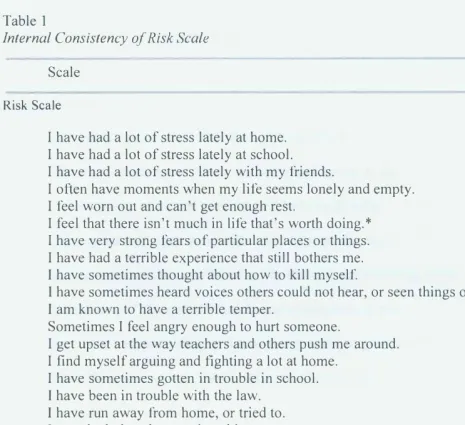
The Risk Scale was created due to the research stating that stress, depression, self-esteem,
anger, mental health, and alcohol, drug, and law related issues were considered risk factors for
not attaining resilience (Bonanno, 2008; Galambos et al, 2006; Hawkins & Catalano, 2004; Ong
et al. 2006; & Sneed et al, 2006). Item such as "I have had a lot of stress lately at home, at
school, and with my friends" were classified as a risk factor due to the presence of stress,
especially with the support systems (Schuerger, 2001). Other items that dealt with depression
and self-esteem questions, for instance "I often have moments when my life seems lonely and
empty," "I feel worn out and can't get enough rest," and "I feel that there isn't much in life that's
worth doing," were also categorized as a risk factor (Schuerger). Researchers including Lopez et
al. (1986) and Orth et al. (2008) discussed and evaluated these issues and the gender differences
concerning depression and self-esteem. According to Galambos et al. (2006), items that referred
to anger and temper issues were coded as risk factors as well. These questions included "I am
known to have a terrible temper," "Sometimes I feel angry enough to hurt someone badly," I get
upset at the way teachers and others push me around," "I find myself arguing and fighting a lot at
home" (Schuerger).
A person's mental health has also been linked to resilience (Bonanno, 2008). Therefore,
items such as "I have sometimes thought about how to kill myself," "I have very strong fears of
particular places or things," "I have had a terrible experience that still bothers me," "I have
sometimes heard voices others could not hear, or seen things others could not see," "I worry
about being overweight," and "I sometimes repeat an action, like washing or cleaning something,
GENDER DIFFERENCES IN RESILIENCE 37
Hawkins and Catalano discussed the fact that alcohol and drug use as well as being in
trouble in school and with the law are risk factors for resilience in the face of adversity. Thus, the
items "I have sometimes gotten in trouble in school," "I have been in trouble with the law," "I
have run away from home, or tried to," "I use alcohol or drugs quite a bit," "My use of alcohol or
drugs has sometimes been out of control," "My family and friends have been worried about my
use of alcohol or drugs," and "I go around with people who drink or use drugs" are classified as
risk factors (Schuerger).
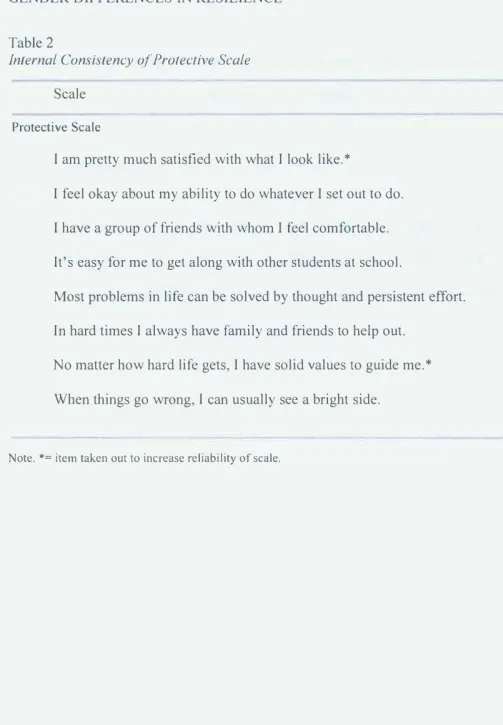
The protective factors scale was developed mainly based on the research that stated that
the presence of a support system, positive emotions, and self-esteem in an individual's life
strengthens resiliency (Bonanno, 2008; Galambos et al., 2006; Orth et al., 2008; & Sneed et al.,
2006). Consequently, items that asked about these domains were placed in this scale. The items
about support systems included "I have a group of friends with whom I feel comfortable," "It's
easy for me to get along with other students at school," and "In hard times I always have family
or friends to help out" (Schuerger). The items concerning positive emotions and self-esteem
included "I am pretty much satisfied with what I look like," "I feel okay about my ability to do
whatever I set out to do," "Most problems in life can be solved by thought and persistent effort,"
"No matter how hard life gets, I have solid values to guide me," and "When things go wrong, I
can usually see a bright side" (Schuerger).
Following this process, gender differences were examined pertaining to the risk and
protective factors in the emerging adulthood population. In order to address the research
question, data analyses consist of descriptive statistics, Cronbach's alpha reliability coefficient,
CHAPTER FOUR
Results
Cronbach's Alpha
Cronbach's alpha was conducted to determine the internal consistency or average
correlation of items of the Risk Scale and the Protective Scale to gauge each scale's reliability.
Originally the Risk Scale was composed of 23 items (See Table 1 ). However, after analyzing the
reliability coefficient two items were removed to establish a stronger reliability. The final Risk
Scale is comprised of 21 items (See Table 1) with a Cronbach' s alpha of. 73, which is a moderate
reliability coefficient. The initial Protective Scale was 8 items, but after assessing the
correlations of the items, two items were removed (See Table 2). The Cronbach's alpha for the
Protective Scale for the six items fell at .60, lower than that of the Risk Scale.
To analyze the data, the risk and protective responses were both reconfigured into two
groups (e.g. High-Risk, Low-Risk, High-Protective, and Low-Protective). For the Low-Risk
group, individuals who fell in the lower quartile at a total score of 3 or below are assigned to a
Low-Risk group (n=50). In comparison, respondents whose total Risk Scale score fell in the
upper quartile, at a score of 9 and above, were assigned to a High-Risk group (n=58). For the
High-Protective group, individuals who fell in the lower quartile had a score of O (n=127).
Whereas the individuals who fell in the upper quartile had a score of 1 and above, and were
assigned to a Low-Protective group (n=56).
One-way Analysis of Variance
One-way Analysis of Variance (AN OVA) is a statistical test that was used to tell us if the
independent variable produced an effect on the dependent variable, over and above chance or
GENDER DIFFERENCES IN RESILIENCE 39
of ANOVA: (a) normality, (b) homogeneity of variance, and (c) independence. The assumption
of normality refers to an even or normal sampling distribution of scores within the subgroups or
scales. The subscales were High-Risk, Low-Risk, High-Protective, and Low-Protective.
Homogeneity of variance assumes the variance within each of the populations is equal.
Independence is the assumption that ensures that the subjects' scores are not related to each other
both between and within groups.
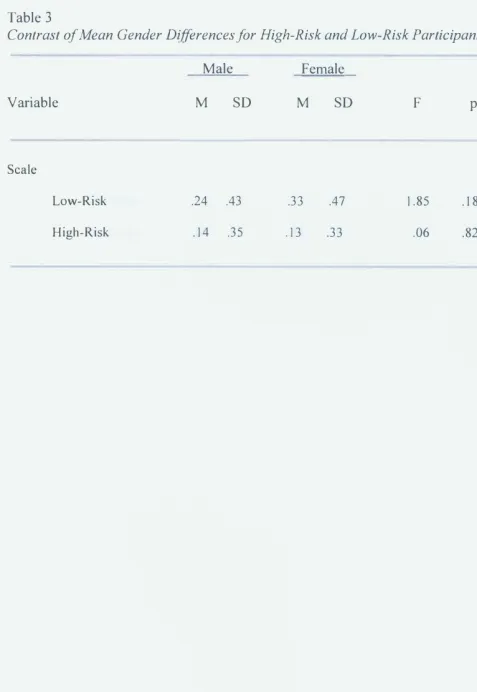
The ANOVA was conducted with gender as the independent variable and the High-Risk
group as the dependent variable. The same analyses were conducted with gender as the
independent variable and the Low-Risk group as the dependent variable. For both the High-Risk
and Low-Risk group the ANOVA results were not significant (Fc1,17s) = .055, p = .815 and Fc1,17s) = 1.848, p = .176, respectively). Thus, these results show that within the High-Risk and Low
Risk group, gender did not significantly impact the responses on the items. However, the test of
homogeneity of variances revealed a significant difference within the Low-Risk group. This may
be due to unequal sample sizes.
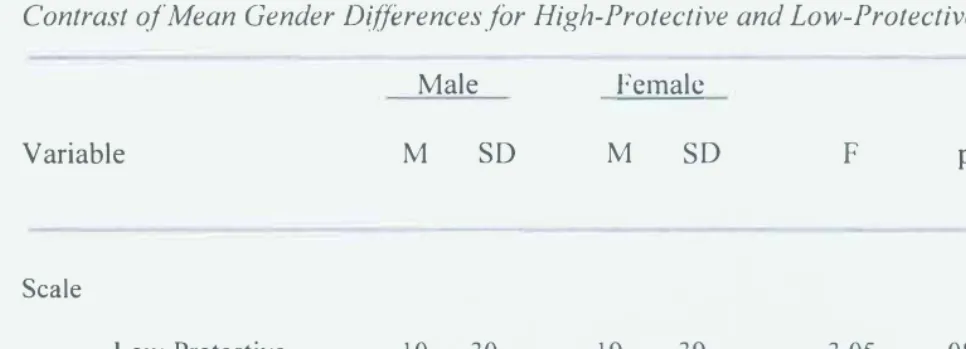
An ANOV A was also conducted with gender as the independent variable and the High
Protective group as the dependent variable. Another ANOV A was conducted with gender as the
independent variable and the Low-Protective group as the dependent variable. The ANOV A on
the High-Protective group and the Low-Protective group did not result in statistically significant
outcomes (Fc1,1so) = .145, p = .704 and Fc1,1so) = 3.046, p = .083, respectively). Therefore, within
the High-Protective and Low-Protective groups, gender did not significantly impact the
responses on the items. The test of homogeneity of variances revealed a significant difference
It was hypothesized that gender would significantly impact the scores on the Risk and
Protective Scales. Results from the ANOVA indicated that males (M=.139, n=lOl, SD=.347)
were not significantly different than females (M=.127, n=79, SD=.335) in the High-Risk group.
In the Low-Risk group males (M=.238, n=lOl, SD=.428) and females (M=.329, n=79, SD=.473)
did not significantly differ, as well. Descriptive results of the ANOV A revealed that males
(M=.098, n=l 02, SD=.299) were not significantly different than females (M=.188, n=80,
SD=.393) in the Low-Protective group. Similarly, in the High-Protective group, males (M=.686,
GENDER DIFFERENCES IN RESILIENCE
CHAPTER FIVE
Discussion
41
The purpose of this study was to examine gender differences in resilience in the emerging
adulthood population by reconfiguring items from the Life Difficulties Scale of the 16PF. The
reconfiguration resulted in a Risk Scale and a Protective Scale that was developed according to
the literature. Contrary to the formulated hypothesis, no gender differences were found on the
reconfigured scales. According to this data, neither gender attains resilience in one specific way,
dissimilar from the results of previous research (Bonanno, 2008 & Sneed et al., 2006). The
population, the scales, and the items are all factors that could have affected the data.
The population could have affected the results since the participants were from a
technology university that is predominantly male populated. Therefore, the females that
participated might not have been a representative sample of the general population of females in
this age bracket. These female participants may have more characteristics comparable to males
due to the university's appeal. Therefore, results might differ if the scale was administered to
emerging adults attending a liberal arts university.
The reconfigured scales may not have been specific enough and therefore, too global.
Consequently, a scale that contains items that explicitly ask about resilience might result in an
outcome that is closer to the hypothesis. Combining the research from resilience, gender, and
emerging adults studies to develop an instrument that analyzes this specific population would
give a better indication of the purpose of this study.
As the researched stated, women used their support systems and men used a more
instrumental means to reach resilience (Bonanno, 2008 & Sneed et al., 2006). More items that
the research. Support items could reveal whether or not an individual uses family and friends or
external avenues as resources in times of stress. Instrumental items would demonstrate if an
individual looks internally and relies on their self when dealing with hardship. Example items
might be, "When I am experiencing stress in my life, I look to family or friends for help," or
"When I am experiencing stress in my life, I rely on myself to get through." These potential
items reveal whether the participant uses their support systems in times of adversity or whether
they deal with the stress on their own and in an instrumental way. According to the literature,
females would answer the support item positively, while males would answer the instrumental
item positively (Bonanno & Sneed et al.).
Many of the studies that were used in the literature review were not specifically looking
at resilience. Instead, the researchers focused on elements commonly referred to when discussing
resilience (Lopez et al., 1986 & Orth et al., 2008). Some examples included depression, self
esteem, anger, and separation. Conducting a study solely on gender differences in resilience
using resilience instruments might alleviate some of the limitations. Performing this type of
research on the emerging adulthood population could give a better understanding of how to
thrive during a time period that is full of uncertainty and exploration. An instrument that
measures resilience could give the individual an idea of how they best cope and deal with
hardship and provide an informing tool or personal skills session.
Limitations
There were multiple limitations in this study. A small sample size limited the ability to
generalize the findings from this study (N= 185). With a larger sample, results might have shown
a gender difference and thus supported the hypothesis. In addition, since the High-Protective
GENDER DIFFERENCES IN RESILIENCE 43
The number of items in each scale was a limiting factor for the study, as well. The Risk
Scale was only composed of 21 items, and even more constraining was the Protective Scale
which contained only 6 items. Although these scales had moderate reliability, creating a scale
with more questions that pertain more specifically to the research might develop a more reliable
instrument.
Future Directions
A resilience measurement designed solely for the emerging adulthood population is still
in need. As Arnett (2000) discussed, the emerging adulthood population is in transition and
requires attention. With a larger sample size and more resilience-focused items added to the
scales, an instrument could be created. It would be important to utilize the evidence from
research on resilience, gender differences, and emerging adults in combination to develop a scale
that appropriately evaluates this population.
In order to distinguish the ways in which individuals cope with stressors and deal with
adversity, an emerging adulthood resilience scale would be helpful for future strategies, as well.
The transition into adulthood could be smooth with the availability of an instrument that informs
emerging adults of their strengths and weaknesses when coping in times of stress. An emerging
adult resilience scale could educate males and females about their personal style of coping and