City, University of London Institutional Repository
Citation
:
Messer, Alan (1999). A Market Model for Controlled Resource Allocation in Distributed Operating Systems. (Unpublished Doctoral thesis, City, University of London)This is the accepted version of the paper.
This version of the publication may differ from the final published
version.
Permanent repository link:
http://openaccess.city.ac.uk/id/eprint/20134/Link to published version
:
Copyright and reuse:
City Research Online aims to make research
outputs of City, University of London available to a wider audience.
Copyright and Moral Rights remain with the author(s) and/or copyright
holders. URLs from City Research Online may be freely distributed and
linked to.
A Market Model for Controlled Resource Allocation in
Distributed Operating Systems
Alan Messer
Submission for the Degree of Doctor of Philosophy
City University
Department of Computing
Contents
Dedication
Acknowledgement
Declaration
1 Introduction
1.1 Reasoning
1.2 Method .
1.3 Contributions
1.3.1
1.3.2
1.3.3
Framework for process-centric resource allocation
Scalable Distributed Marketplace
Resource policies
1.4 Report structure
1.5 Summary . . . .
2 Development of resource allocation techniques
2.1 Scheduling . . . .
2.1.1 Priority scheduling
2.1.2
2.1.3
Bounded consumption
Real-time scheduling .
2.2 Distributed resource allocation.
2.2.1 Process-based control ..
2.2.2 Operating system based control
2.3 Economic techniques
2.3.1 Auctions...
2.3.2 Money represents the importance of the process
2.3.3
2.3.4
2.3.5
Cooperative systems . . . .
Money represents the power of the resource
Summary . . .
2.4 Resource information
2.4.1 Measurement
2.4.2 Information dissemination
2.5 Contemporary work. . . . . . . .
2.5.1 Proportion-share scheduling
2.5.2 Continued exploration of economic computation
2.5.3 Beneficial use of resource information ..
2.6 Summary
3 Overview
3.1 Introduction.
3.2 Resource allocation needs
Fairness Liveness Uniform access 3.2.1 3.2.2 3.2.3 3.2.4 3.2.5
Responsiveness and application appropriateness
Scalability and Overhead .
3.3 The ERA solution.
3.3.1 Overview
3.3.2 Meeting the needs.
3.4 Summary . . . . .
4 Providing control 71
4.1
Introduction .. 714.2
The framework 724.2.1
Money, money, everywhere .73
4.2.2
Providing and controlling money75
4.2.3 Obtaining resources.
81
4.2.4
Money transfer...
83
4.2.5
Message queues and money transfer .84
4.2.6
Monetary protection86
4.2.7
Framework summary87
4.3
Ensuring the framework works .88
4.4
Server mechanisms89
4.5
Simulation .91
4.6
Analysis ..93
4.6.1
Proportion-sharing 944.6.2
Scalability of the ERA system .100
4.7
Summary.
.
. . . ...
102
5 Providing the marketplace 105
5.1
Motivation. . . .106
5.2
The Marketplace109
5.2.1
Dying Sandwich-board men109
5.2.2
Resource information . .110
5.2.3
Provision of information111
5.2.4
Distributing of information.112
5.2.5
Consumption of information117
5.3
Analysis .117
6 Process-centric resource allocation 6.1 Server pricing mechanisms . . .
6.1.1 Cost proportion-sharing 6.1.2 Serving CPU .. , 6.1.3 Serving memory .. 6.2 Process-centric client policies. 6.3 Performing location optimisation
6.3.1 An algorithm for self load balancing. 6.3.2 Analysis..
6.3.3 Conclusion.
6.4 Performing utilisation optimisation 6.5 Summary . . . . 1 Critique
7.1 ERA framework.
7.2 Information dissemination
7.2.1 Algorithmic considerations. 7.3 Process-centric resource allocation. 7.4 Modelling
7.5 Future work 7.5.1 Agent ERA 7.6 Summary
8 Conclusion
8.1 Process resource choice 8.2 Operating system control. 8.3 Empowerment.
8.4 Usefulness... 8.5 Concluding remarks.
References
168
A Simulating ERA 177
A.1
Introduction.177
A.2
The simulator . 179A.2.1
Execution support180
A.2.2
Memory sub-system ..187
A.2.3
Kernel memory and User memory.189
A.2.4
Memory allocation190
A.2.5
Timing support ..190
A.2.6
Processor coherence .191
A.3
Instrumenting the simulator193
A.3.1
Obtaining simulation information194
A.4
Problems . . .200
A.4.1
Reentrant code200
A.4.2
SetjmpO .201
A.5
Configuration..
202
A.5.1
Global parameters202
A.5.2
Node descriptions.204
A.5.3
Market links .205
List of Figures
2.1 A priority scheduler of CPU time-slices. Higher priority processes have absolute
priority over lower. . . . . 11
2.2 The centre node is overloaded by the node selection by three independent programs 16
2.3 A server initiating load balancing 17
2.4 A client initiating load balancing . 17
2.5 The resultant variations in equilibrium price given changes in supply or demand 21
2.6 Under Spawn, each task is sub-divided into a. manager subtask to handle the
market side of processing and a worker process. . . . . 25
2.7 A priced distributed system waiting for a task to decide which resources to con-sume to minimise its run-time . . . 26
2.8 The asynchronous market for a. good under the WALRAS algorithm 29
2.9 Monetary flow in Stoica's expense account work.. . . 30
2.10 One iteration for refining the allocation in the distribut.ed file allocation problem
by utility functions . . . . . 32
2.11 The price of the CPU commodity varies over the system, dependent on local demand 34
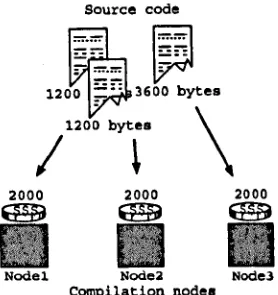
2.12 Multiple compilation nodes buy bytes of source code to compile. . . 35
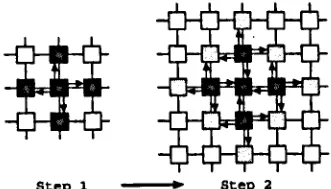
2.13 Simple iterated information transfer using nearest neighbour meshes
2.14 Proportion-sharing of 20 time-slices between 3 processes . . . .
2.15 Lottery scheduling: currencies being subdivided into new currencies.
2.16 Stride scheduling: using strides to allocate twice as many quanta to a process
with twice the tickets. . . .
39
41 42
2.17 Latency migration as a new user joins in the session . . . .
50
3.1 Two equal priority processes receiving equal shares of a time-sliced CPU . . . . 56
3.2 Two equal priority processes under instantaneous fairness. The non-blocking
process consumes more in the long-term . . .
56
3.3 Two equal priority processes under long-term fairness. Both processes receive equal shares, but suffer higher variance in short-term fairness . . . . . 57
3.4 Process 2 has a low importance and exhibits poor locality, yet receives three times
as many page fetches, evicting pages of Process 1 and thus slowing it down 58
3.5 A balanced workload of 4 sub-tasks across 4 nodes 60
3.6 Two tasks spread across the available resources . . 60
3.7 Two tasks allocated across two nodes each from the available resources 61
3.8 The interrelation of the three parts of the ERA architecture. . . 64
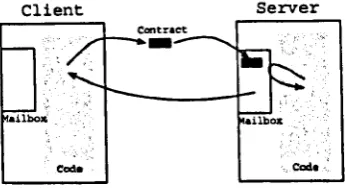
4.1 The subdivision of 'money' between users and thus processes, but not threads 74
4.2 The two stage process of using memory under ERA . . . • . . . . 76
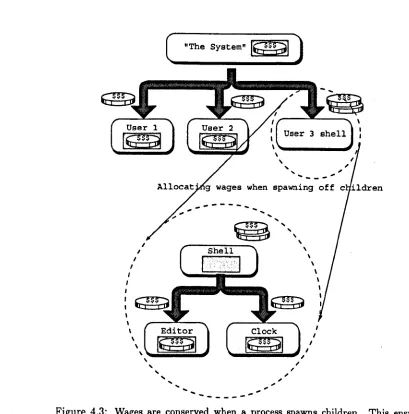
4.3 Wages are conserved when a process spawns children. This ensures money cannot be fabricated by processes . . . . 78
4.4 Basic money flow in a pay round. 79
4.5 Graph of wage level over time, of a process trying to continually spend more than
it has . . . 80
4.6 The use of a server's message box to provide the transfer of contracts 85
4.7 The structure of the ERA simulation . . . 91
4.8 The average time obtained over five pay rounds against time of an
application-homogeneous program mix using an equal wage allocation. . . . . 95
4.9 The average time obtained over five pay rounds against time of an
application-heterogeneous program mix using an equal wage allocation. . . . . 95
4.10 The average time obtained over five pay rounds against time of an
4.11 The average time obtained over five pay rounds against time of an
application-heterogeneous mix using a 4:3:2:1 (starting at the top) wage allocation . 96
4.12 Fairness, as the number of competing matrix multiplications was altered 98
4.13 Cost, as the number of competing matrix multiplications was altered . . 99
4.14 Percentage overhead per second produced by the ERA system when compared to
a traditional operating system, as both the length of pay rounds (in time-slices
=
lOOms) and the number of active processes are varied . . . . . 1015.1 The two different ways to access a resource: remote access and migration access 111
5.2 The market 'nearest-neighbour' interconnections can either match the physical
links or represent a virtual arrangement . . . . . 112
5.3 A cycle in the information flow due to the cyclic nature of the underlying
'nearest-neighbour' interconnections . . . 114
5.4 The operation of the atomic kernel pointer update primitive when used to update
lists. . . • . . . . . 116 5.5 The average number of hops per node for each loading of benchmark processes 118
5.6 The average prices for CPU at each loading of benchmark processes. . . . . . 119
5.7 The average number of hops for each node with six additional benchmark
pro-cesses running on node 5 . . . . . 120
5.8 The total normalised overhead of maintaining the ERA marketplace as the size
of the system is increased
...
1216.1 The sharing of real memory between clients paying 40, 20 and 20 respectively.
(Within each section a traditional page replacement policy is used.) . . . . . 131
6.2 The advertised price on each node (and thus their load) sampled once a second
as the processes determine a load balance from their local market information . 137
6.3 The price and thus utilisation, of a single CPU performing a matrix multiply
process as the degree of parallelism is increased. . . . . 140
6.4 The price and thus utilisation of a single CPU as a matrix multiply process actively
A.l c++ like pseudo-code for the virtual kernel's execution support. 182
A.2 The sequence of state changes when a thread is deleted 183
A.3 C++ like pseudo-code for the state for an ERA thread 184
AA
C++ like pseudo-code for the state of an ERA process 186A.5 The per node structure for the simulation's execution support. 187 A.6 The per process code executed by each node's kernel in order to process wage
updates. . . . . 188
A.7 The use of an 'itimer' to provide per node interrupt timer support for threads 191 A.S The set of interfaces provided for logging simulation data 193
A.9 An extract from the log file of a process . . . 194
A.lO Removing the PIC register from use by parameter passing and computation. 197
A.ll Instruction counting using the PIC register . . . 198
A.l2 setICountO and getlCountO provide the interface to the count kept in the PIC
Acknowledgements
This work was carried out in the Systems Architecture Research Centre in Department
of Computer Science at City University, beginning in late 1993 and finishing in early 1997,
during my time there as a postgraduate research student. This thesis was written in
1997 and early 1998, during my time as a Research and Development Engineer at SONY
Architectural Labs, Belgium and later with SONY Digital Networked Solutions, Belgium.
Many people have influenced my work over this time at these establishments whom I wish
to thank.
Tim Wilkinson, Java Virtual Machines to the gentry, who provided the encouragement
and technical discussions to bring this unusual work to light.
Peter Osmon, supervisor, who provided useful guidance throughout this time and helped
give me the will to finish this thesis in the months of writing up.
Julie McCann, the closet goth and illustrious leader that never was, for her support,
friendship and inspiration in those months of writing up.
Kim Harries, a bounder and a cad, fiat-mate, friend, cultured-type person and
philoso-pher.
Ludo Cuypers, the Belgian contingent, team leadership and encouragement while at
SONY.
And finally, my parents, for their support and encouragement in getting this thesis
finished.
Declaration
I grant powers of discretion to the University Librarian to allow this thesis to be copied,
in whole or in part, without further reference to me. This permission covers only single
copies made for study purposes, subject to normal conditions of acknowledgement.
Abstract
This thesis explores the potential for providing processes with control over their resource
allocation in a general-purpose distributed system. Rather than present processes with
blind explicit control or leave the decision to the operating system, a compromise, called
process-centric resource allocation is proposed whereby processes have informed control of
their resource allocation, while the operating system ensures fair consumption.
The motivations for this approach to resource allocation and its background are
re-viewed culminating in the description of a set of desired attributes for such a system. A
three layered architecture called ERA is then proposed and presented in detail. The lowest
layer, provides a unified framework for processes to choose resources, describe their priority
and describes the range of available resources. A resource information mechanism, used to
support choices of distributed resources then utilises this framework. Finally, experimental
demonstrations of process-centric resource allocation are used to illustrate the third layer.
This design and its algorithms together provide a resource allocation system wherein
distributed resources are shared fairly amongst competing processes which can choose
their resources. The system allows processes to mimic traditional resource allocations and
perform novel and beneficial resource optimisations. Experimental results are presented
Chapter
1
Introduction
General purpose distributed systems consist of a network of computing resources, such
as workstations, on which a variety of tasks may execute. Each task requires multiple
resources which must be provided from the available resources through sharing when
nec-essary. This thesis aims to answer the question: In general purpose distributed systems, is it
possible and useful to empower each task with informed control over its resource allocation
while preserving fairness?
Two approaches to resource allocation exist in such systems. In the first it is the
responsibility of the operating system, or a third party, to share resources between tasks.
By using its knowledge of other tasks, the OS is able to distribute and balance tasks.
However, good task performance is difficult to ensure, since the importance and locality
of each task's resources is not known by the operating system. In the second approach
allocation is the task's responsibility: each can blindly use whichever resources it chooses.
By choosing its own resources, a task can express the locality with which it intends to
use resources, enabling good performance when there is no competition. Yet, since the
selection is made blindly and with no expression of importance, this choice may be poor
when competition is present. Also, since it has full resource control, little prevents a task
using unreasonably large quantities of resources.
not consider the task's function and the task does not consider competition from others.
This thesis therefore advocates a new method of resource allocation in which tasks choose
all the resources they must consume and express an importance for all their requests. This
allows them to have influence over which resources to use and how important they are. To
make informed decisions tasks use information about the resources surrounding them (their
resource environment). This environment contains demand and utilisation information for
each resource in its distributed locale. To preserve fairness, under competition for resources,
the operating system controls the importance a task can express about the resources it
desires.
Therefore, tasks have a free informed choice of resources. A task chooses resources
appropriate for its functionality and expresses the importance of each resource in
accor-dance with this. But tasks can only impose a limited effect with their choices. We call this
approach 'process-centric' resource allocation, since all decisions are the process's.
1.1 Reasoning
Resource allocation is important for the execution of a task because it can greatly affect
performance. This is especially true in distributed systems where there is a greater choice of
resources. With choice comes increased complexity in determining the optimal resources
for each task. This in turn becomes even more complex when there is a diverse set of
applications executing across the system at the same time, as is common in general purpose
distributed systems.
For example: scientific computation tasks require a variety of resources over a long
period of time; while databases and graphical tasks require their resources concentrated
towards memory or disk access where the performance is critical. In general purpose
systems it is important to cater for a range of different types of resource requests.
This thesis proposes that a task should be able to select the right available resources
addition, to ensure fairness among tasks the operating system must retain control of the
rate of consumption of each resource.
This thesis proposes a three tiered architecture to achieve these aims. The lowest tier
provides a framework which gives processes full control over their resource requests, while
allowing the operating system to maintain fair consumption of resources. Above this, the
second tier provides a scalable distributed information system called a 'marketplace', to
provide resource demand and utilisation information to processes. The third tier consists
of resource aware processes which both lower tiers to make informed resource allocation
decisions in order to improve their performance in dynamic resource environments.
1.2 Method
The work described in this thesis investigates a novel form of resource allocation which
requires work on many areas of an operating system, including: operating system structure,
resource allocation algorithms and information dissemination techniques. To demonstrate
and analyse these changes example new algorithms to utilise the architecture also need to
be developed. As a result, a great amount of potential work in this field is possible. The
work undertaken for this thesis has tried to provide experimental evidence that the stated
aims of the thesis ate in fact feasible and useful.
As a result, a distributed operating system based on the proposed architecture has
been developed and implemented on a simulation of distributed hardware. Using
instru-mentation on this operating system, the overhead and resource/monetary operation of
the archit.ecture can be examined. Experiment.s using t.his implementation are performed
to analyse the fair distribution of resources to processes under competition from other
processes. Additional experiments measure the overhead to support the architecture, its
1.3 Contributions
This thesis makes original contributions centred on the three tiers of the architecture: the
framework for process-centric resource allocation, the scalable distributed marketplace and
process-centric policies for process performance self-improvement.
1.3.1 Framework for process-centric resource allocation
The process-centric framework is based on the concepts of money and simple market
op-erations and contributes:
Full process-centric resource allocation Processes have full control over the location
and importance of all the resources they ever need to consume. Processes even have
control over the resources in which they exist, such as the memory in which the
process resides.
Fair control over resource usage This thesis introduces several methods for sharing
resource usage fairly between competing processes.
Low overhead auction mechanism This thesis proposes a decoupled auctioned
tech-nique whereby processes are not guaranteed resource access but, instead, buy the
ability to consume a resource. This aims to reduce the overhead of using resources
compared to the direct auction systems used by previous money based systems.
1.3.2 Scalable Distributed Marketplace
The distributed marketplace provides a means for disseminating information and
con-tributes:
Resource information feedback The
ERA
architecture provides a uniform and scalablemeans for providing resource information to processes so that they are aware of their
Information distribution with dynamic locality The distributed marketplace provides
a dynamic degree of locality for each node, dependent on the current system load.
This is unlike previous systems which use fixed hop counts to limit the distance
information is transferred.
1.3.3 Resource policies
These process-centric abilities require, a process to be written in such a way as to exploit
them to be aware of its resource environment. To illustrate the benefits of the
process-centric approach two new algorithms have been developed, contributing:
Self load balancing Using a novel non-deterministic algorithm, a set of processes are
demonstrated load balancing themselves using only process-centric allocation and
the feedback presented by the marketplace. Each process chooses cheaper nodes so
as to increase the quantity of resources it receives for the money it pays. Results
of initial experimentation in a simple scenario indicate that local optimisation of
resource cost leads to a global cost optimisation and thus a load balance.
Dynamic parallelism This thesis advocates that a process can dynamically determine
a near optimal level of software or hardware parallelism so as to consume its unused
resources. This is made possible by a process using feedback from the marketplace
to monitor its resource utilisation. This process controlled technique is new to the
field of resource allocation. Initial experimental results are given that show a
pro-cess determining a near optimal level of software parallelism available for a simple
configuration.
1.4 Report structure
This chapter has introduced an overview of the content of this thesis. The next chapter
introduces and analyses work related. Including both mainstream solutions and
both these approaches for general purpose distributed systems. The chapter concludes with
an introduction to the proposed resource allocation architecture along with an explanation
of how it tackles these problems.
Chapter 4 describes the general framework for providing controlled process-centric
re-source allocation from both monetary and operating system points of view. Analysis of the
effectiveness of resource control and overhead of the framework is given under a variety of
configurations. Chapter 5 covers the design and implementation of a distributed
market-place and how prices are used in the system. This chapter also analyses the scalability and
overhead of the marketplace. Chapter 6 describes example uses of the ERA architecture
to allow a process to optimise its operation. Examples focusing on locality and utilisation
are presented. Each is analysed with respect to its operation and potential performance
improvement.
Clearly no solution is perfect, so a critique of the solution is presented in Chapter 7.
The thesis ends with a summary of the conclusions drawn from the work and introduces
future research opportunities pointed to by this work.
An appendix follows which describes the simulation used to inform the analysis
con-tained in this thesis. This appendix describes how the simulation was designed and
instru-mented in order to obtain the results.
1.5 Summary
This thesis, therefore, asserts that current resource allocation techniques are inadequate for
use in general purpose distributed systems. This is because processes are unaware of
com-petition for resources and they do not constrain their resource consumption in proportion
to their importance.
The thesis advocates a new method of resource allocation, called process centric resource
allocation. In this method, tasks choose all the resources they must consume and express
an importance for all the resources they need, allowing them to influence their consumption
resources by controlling resource consumption overall.
Ultimately, this thesis aims to answer the question: In general-purpose distributed
sys-tems, is it possible and useful to empower a task with informed control over its resource
Chapter 2
Development of resource allocation
techniques
Resource allocation has become a complex and challenging problem. Multiple processes
can make multiple requests for multiple resources in a given system. Each request can
exhibit differing importance, locality and timing constraints. Having access to, and then
considering this information presents many complexities for deriving even a single solution
in a single configuration. In situations where the configuration changes over time, the
problem becomes even more complex. It is infeasible to derive an optimum allocation in
anything but simple scenarios.
In earlier systems this was not a problem since computers were only used in simple
sce-narios. For example. single user workstations need not consider complex priorities, locality
or timing constraints, since each machine is dedicated to one user at a time.
General-purpose servers run computationally intensive tasks which only need to be differentiated
by abstract priorities. Dedicated systems, such as real-time, can be configured for
well-defined situations with well-well-defined allocations.
The arrival of complex, performance sensitive applications that are distributed and
demand more complex resource allocation. Progress in software technology allows more
graph-ical applications. \Vhen resource allocation is extended to the distributed case (such as
networks of workstations), the complexity increases again. Multiple instances of resources
introduce both choice and competition, while the requirement for scalability of distributed
systems introduces problems of access latency combined with out of date and incomplete
information about remote resources.
This chapter covers the prevailing resource allocation techniques for use in general
purpose systems. Techniques relating to resource allocation in single processor systems
are discussed first. Following this, the techniques and problems of the distributed resource
allocation ca.'le are discussed. Next, the chapter focuses on relevant previous systems which
have used economic and market concepts to solve resource allocation problems. Finally,
this chapter briefly covers some contemporary work in the area of this thesis.
2.1
Scheduling
2.1.1 Priority scheduling
Most conventional operating systems employ priorities for scheduling [19]. Each process is
assigned an absolute priority which is represented by a numerical value. Higher priority
values override lower values absolutely. A process with a higher priority always gets the
resource in preference to the lower priority process.
The most common use for priority scheduling is for CPU and disk access. In this
scenario, effectively multiple queues are used where resource requests from the highest
priority queue are handled first (see Figure 2.1). For example, the ready queue of a CPU
scheduler can be structured like this. Once a process completes its time-slice, or blocks, it
is returned to the queue for its run priority. The main benefit of this technique is its low
overhead (simply a priority queue insertion O(n)), where n is the number of priorities. It
is also a simple way of providing a few distinct and exclusive levels of priority, and this is
helpful for distinguishing between system level and user level work.
High priority
I I I I I Schedule
+
I I I I II I Timealicea
Figure 2.1: A priority scheduler of CPU time-slices. Higher priority processes have absolute priority over lower.
are exclusive. This is because, despite being runnable, a low priority process may have to
wait indefinitely on a higher priority process. Several solutions exist for this problem based
around the idea of dynamic priorities [2, 32]. In these solutions, the priority of processes
is adjusted over time to prevent starvation.
Prio1ity
aging lowers the priorities of higher priority processes as resources arecon-sumed. This enables lower priority processes to get scheduled, even in the presence of
prolonged resource usage by a higher priority process since, eventually, the higher priority
process will be demoted to a level lower than the lower priority one.
Decay-usage scheduling [2, 32] is similar, Averages are kept for the processor usage in
the recent past, giving higher priority to those processes with low usage. Thus, as the
highest priority process utilises the resource, its priority drops (decays) until it no longer
has the highest priority. This approach is taken by some popular operating systems such
as UNIX.
Dynamic priority scheduling has other problems. Firstly, the use of numerical priorities
provides little in the way of meaningful control. Assigning an abstract priority to a process
encapsulates little about the precise importance of a process over others. Because of this,
it is not possible to ascertain the resource access each process will receive. Secondly, the
functions used to calculate the dynamic priorities are ad-hoc. They are only controlled
through a few crude scheduling parameters, which are poorly understood. These problems
become mo~e acute when many levels of priority are used. A third problem is that priority
processes to consume more resources than their abstract priority dictates. For example,
a low priority process can consume large quantities of memory and page fault bandwidth,
with the consequence that higher priority processes may be suspended by page faults
allowing the lower priority process to increase its CPU consumption. These problems arise
because priority scheduling providing no control over the relative quantity of resources
consumed by a process.
2.1.2 Bounded consumption
Many operating systems (32, 18, 20] incorporate bounds on the consumption of certain
resources. These bounds represent the maximum allowed consumption of these resources
by a process over time. In this way, any process can (if the bounds are checked) be
prevented from consuming all the resources in the system. Once a bound has been hit the
operating system prevents further consumption of that particular resource, which is usually
terminal to the process. A count of the consumption of each resource can be kept for each
process by the operating system and checked on each allocation to ensure the bounds are
kept. This simple implementation imposes little overhead on system run-time.
'When the rUll-time requirements for a process are well-known bounded consumption is
very useful as a safe-guard against bugs. Bounds are also useful for limiting resources, such
as: the number of processes per user, stack size and open files. This enables reasonable
conservation of important resources such as internal operating system table entries.
The technique has two problems however. Firstly, exceeding the bounds is terminal to
the process concerned. This can be overcome to some extent by using hard and soft limits
to warn the process that it is nearing its bound. However, it is still possible for a process
to hit the hard limit and be terminated. A solution is to block/suspend the process when
the bounds are met, allowing the process to be restarted should it be needed. Consider,
for example, a database server process. It needs to exist for an indefinite amount of time and can consume an undefined quantity resources depending on demand for queries. With
be terminated. This has two detrimental affects: the server is terminated preventing any further queries and any current transactions will not be completed potentially causing inconsistencies.
The second problem is that the bounds refer to absolute quantities of resources rather than the rate of consumption over time which is often more relevant. Consider CPU time-slices. A process may need to be run in the background performing a long calculation. In this situation the amount of the resource over time needs to be restricted to keep it in the background rather than restricting it to 5 minutes of computation.
2.1.3 Real-time scheduling
In real-time scheduling the timeliness of the schedule is important, if not vital. Real-time comes in two forms depending on how rigid the timing guidelines (deadlines) are. Hard real-time deals with scenarios where missing a deadline is mission critical. Applications which fall into this category are nuclear reactor controllers and flight controllers. Soft real-time, by comparison, has much weaker deadlines, where missing a few is not disastrous, but merely undesirable. Areas such as multi-media traffic management use soft real-time. In order to provide the scheduler with some bounds for scheduling the various tasks, each task must have its resource needs - the amount of resources required and timeliness constraints (start time and deadline) - specified in detail. Thus all resource consumption can be known before the task is run. This provides a very rigorous framework, such that the execution time of all tasks must be safely predictable. This predictability also requires knowledge of the static interactions within the system and hence to know the overall timing constraints.
Given these constraints, the scheduler derives a schedule for which all the deadlines are met. In the case of hard real-time, deadlines must be met and the schedule is usually dry-run under all circumstances and guaranteed by providing safety margins on all resources used. This means that resources are typically very under utilised (around 50 percent).
scheduled are dynamic. One of the most popular techniques for scheduling such requests
is Rate Monotonic scheduling. Each task is assigned a static priority which is based on the
task's periodic execution rate. In this way, frequent tasks receive a higher priority than
occasional tasks. This means, however, that the importance of the task is not absolutely
reflected in the priority, since an infrequent task may be close to its deadline, yet still
have a low priority. Thus, to provide a reasonable level of assurance about meeting the
deadlines, resources are generally under-utilised.
To meet this need for priority as a function of timeliness, Earliest Deadline First
scheduling can be used. At each reschedule the current set of tasks and their deadlines
are considered in order to ensure the task with the earliest deadline is run. This
ap-proach provides a higher resource utilisation while also taking account of the importance
of the deadlines, but at the price of a higher overhead, since at each reschedule the earliest
deadline must be computed.
Real-time scheduling has been very successful in those application areas which fit into
its framework. It is not, however, feasible in a general purpose system. Firstly, real-time
scheduling requires detailed knowledge of the processes which is simply not available in
a general-purpose operating system. Typical general-purpose tasks, such as compiling
and editing, cannot fit into this structure, since it is impossible to predict the amount
of resources and time each task will use. The complexity due to the number of possible
interactions required by most applications. Also many of these interactions are through
the operating system to system resources, such as disks, for which the time constraints of
access are not known.
Secondly, since deadlines are absolute and the amount of resources each process obtains
depends 011 the interaction between each process' requests, deriving the relative rates of
computation of concurrent tasks, given the real-time requests of each is complex. Given
this complexity, it is difficult for the user or process to provide any active adjustment of
its requests ill response to its surroundings.
2.2
Distributed resource allocation
When extended to the distributed case, resource allocation gains three extra complexities.
Firstly, there is usually a choice of instances of each resource, which may be used
inter-changeably. Secondly, information about the state of the system is usually out of date due
to network latency. Lastly, scalability of the software must match that of the hardware.
In combination together these complexities make resource allocation a complex problem.
2.2.1 Process-based control
Process-based control is a simple form of distributed resource allocation. When a choice
of resources exist, the process simply specifies which instance of the resource it wants to
use. Each resource may be addressed by either an abstract resource identifier or the node's
address. The choice of resource to use is up to the programmer and may be fixed at
compile-time, as a parameter to the program, or determined at run-time given the input.
The advantage of this approach is that it requires little or no overhead and allows very
good resource utilisation when used in custom distributed systems where the configuration
is static and specialised for the purpose.
The approach does have its problems. Firstly, it does not take into account other
processes in the system. In a multi-user system it is quite possible that the nodes a process
uses are in heavy use by other programs. This can be seen in Figure 2.2. Secondly, the
processes are unable to cater for changes in the size or structure of the distributed system.
Should the distributed system change, the process must then be recompiled or suitably
parameterised to use or tolerate the changes. In combination, these factors make
process-based control suitable only for static, well-known workloads or single job scenarios.
Virtual
processorsVirtual processors or nodes improve the situation by providing a level of abstraction
be-tween the placement of the task and the physical layout on the system. This allows the
• Task 1
• Task 2
o
Task 3Figure 2.2: The centre node is overloaded by the node selection by three independent programs
the hardware. The task's virtual layout over the virtual processors can then be determined
by the programmer or the operating system (as we shall see in the next section). Virtual
processors are easy to implement and use, since the extra abstraction only requires the use
and administration of abstract addresses/identifiers.
Popular systems such as PVM [4, 24, 25] use this approach. There are several
advan-tages. Firstly, code does not need to be recompiled to respond to system changes, since all
the addresses are abstract. Secondly, as a result it simplifies the task of the programmer,
by reducing any need to consider the hardware structure when writing algorithms. Thirdly,
the choice of address to placement mapping can allow multiple tasks to be configured at
installation time so as to execute efficiently on the same hardware.
Problems remain with this approach when applied to a dynamic system. Since the
workload is not known prior to dynamic changes, the virtual mappings must then be
changed dynamically. This requires administration either by human intervention or
oper-ating system. Such administration is a compromise between process and operoper-ating system
based control.
2.2.2 Operating systeln based control
A key problem with process-based control is that resource competition from other processes
• Process
- . . Transfer initiated
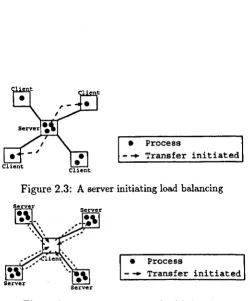
Figure 2.3: A server initiating load balancing
• Process
[image:32.539.133.383.66.366.2]- . . Transfer initiated
Figure 2.4: A client initiating load balancing
access to the resources. By using this information the operating system can perform load.
balancing or sharing to equalise the load among nodes.
\Vith operating system based control of the resource allocation, requests for resources
are made generically without specifying any location. The operating system determines
the location. When new jobs enter the system, a new allocation for the combined requests
can be made. With location and access transparency, processes can run without knowledge
of their initial placement or continuing migration. Operating system based control is ideal
for multiple user situations, since it can cater for competition among processes.
With the operating system making decisions on which resources to use, there is an
issue of where and when to make these decisions. Systems fall into three categories in this
respect: initial placement, server-initiated and client-initiated systems. Initial placement
systems only perform the decision making when new resources are requested, e.g. when a
new process is created. Server-initiated systems load balance by initiating a distribution
of the load when part of the system is overloaded. So, once a node becomes overloaded
it can offload some of its work onto other nodes (see Figure 2.3). Client-initiated systems
load balance by looking for additional work when a part of the system is under-loaded (see
Operating system based control does, however, have its problems. The biggest problem
is that the operating system does not know much about the processes it is running. E.g.
it does not know the importance or spatial locality of resource requests. It must therefore
make general assumptions about the type of applications in order to make an allocation.
For the operating system to make its allocation it must store information about the
distributed system's load. For good scalability this load information must be distributed
too, which increases the overhead of the operating system and poses problems of scalability.
Heuristic systems
It is not feasible to derive an optimal load-balance in general scenarios because information about the rest of the system is incomplete. Heuristic load balancing systems have therefore
been developed. Heuristic systems make assumptions about the process requests or the
nature of the system load. Using these heuristics, good load-balances can be quickly
calculated for situations when the assumptions apply. Since the assumptions are not usually
too specific and are commonly true, such heuristics are the basis of many load balancing
algorithms [29].
As an example, Bryant and Finkel [7] developed a simple cooperative heuristic
load-balancing algorithm, the Pairing algorithm. The heuristic used here is that, rather than
rely on spreading load to all nearest neighbours, it is only necessary to find a partner node
to exchange work with, since it is common to have local hot spots together with local cold
spots. Each node can send a pairing query to a neighbour, containing the processes it
wants to offload and load estimation of each. On receiving a query a node can choose to
reject it, since the list of processes would not benefit from running there, or form a pair so
that processes migrate to the lighter loaded node. The pairing is breaks when a process
in the pair decides it can no longer benefit. In this way the pairing heuristic balances hot
Learning systems
Learning systems take the use of implicit knowledge one step further by trying to learn from
past decisions. The heart of such systems is historical data about either process resource
requests or alternative decision probabilities. Thus, by using historical information about
each process (such as memory reference patterns) some functional information is available
for future decisions and probability vectors allow the algorithm to benefit from previous
inappropriate decisions, by reducing the probability of them being chosen in the future.
For example, Stankovic's Stochastic Learning Automata [38] use a probability vector
to store choice information about how loaded nodes are. Each node periodically checks its
own load and broadcasts its load value to all other nodes, which use this information to
form their probability vectors. These vectors allow nodes to probabilistically choose where
to balance an excess load. When a node receives a migrating process it can choose to
reward or penalise the sending node. For example, increasing the probability of migrations
to a sending node can penalise it for previously sending a high load.
Quality of service operating systems
Quality of service (QoS) operating systems [40, 33] retain the principle that the operating
system is in control of resource allocation, but adds an extra parameter to the resource
allocation requests: desired quality of service. This allows processes to specify more exactly
the resources they need. For example, rather than simply allocating a network connection,
a QoS OS allows the process to specify the bandwidth and possibly latency which it needs
for that connection. QoS operating systems can be used in CPU scheduling and virtual memory allocation as well as networking. This kind of operating system is designed for
resource intensive situations such as multimedia applications. In these situations, the
resource requirements are well-defined, high and mostly constant.
For several reasons a QoS operating system is not well sui ted to the general purpose
distributed systems considered in this thesis for several reasons. In such a system, it
example, what is the quality of service required for compilation? Unless quality of service
can be quantified such systems simply act as traditional operating systems. In general
purpose distributed systems resource requirements are highly dynamic. The quantity of
processing required for a compilation varies with the complexity of the source file and
stage of compilation. So any guarantees made to the compiler would have to be either
continually re-requested or else re-evaluated. In a QoS OS, this frequently means that
previous guarantees must be broken to ensure the new guarantees can be met.
Finally, in a QoS OS it is perfectly possible for a rogue or misprogrammed process to
request an unneighbourly high quality of service from the system, in turn affecting other
processes. But, in a general purpose distributed system as defined in this thesis, it is not
acceptable for a process to be able to affect adversely the execution of others beyond their
priority.
2.3 Economic techniques
Markets provide mechanisms for decision making and resource allocation in the real-world.
Producers produce products which are consumed by consumers. To consume a product a
consumer must first purchase it. Producers demand a certain price for the product, while
consumers offer a certain price. This is the model known as supply (the producer's product
price) and demand (the consumer's product price). The point at which the two meet is
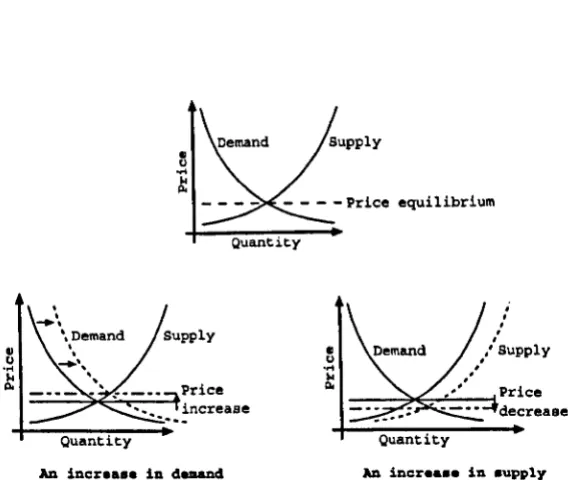
the price equilibrium and is the current market price. As supply increases the price drops,
while as demand increases the price increases as the resource becomes more scarce (see
Figure 2.5).
This simple view omits a lot of detail, but is a well studied model for the operation
of market forces. In a distributed marketplace the picture is complicated by multiple
producers and consumers. Since markets are not centralised, it is not possible for any
consllmer or producer to know the value placed on the product by all the others. In
this way, the market price is derived from incomplete information and so is not constant
u
o
...
~ Price
--~~.----tincrease
...
An increase in demand
_ _ ~~_-iPrice
decrease
[image:36.539.109.393.104.344.2]An increase in supply
Figure 2.5: The resultant variations in equilibrium price given changes in supply or demand
market non-deterministically makes purchasing decisions which result in demand varying
over time. The complexity of this market is increased further since the market can contain
a supply substitutable products, i.e. products which are compatible but not identical.
What is interesting about markets is their ability to promote scalable distributed
de-cision making about the allocation of resources in the presence of incomplete information.
Real-world markets do, however, have some problems. Firstly, they can be unstable. This
is especially true in fast markets such as stock-exchanges or other computer embodied
mar-kets, since the lack of deterministic behaviour can result in large price fluctuations.
Sec-ondly, the overhead for agreeing prices can be high, especially when competition/demand
for a single product is high.
The world of economics and real-world markets is thus a complex one. Yet, the
prob-lem they solve is very similar to resource allocation in distributed systems, including:
distributed decision making; use of incomplete information; and scalability. So, it is hardly
surprising that several researchers have, in the past, tried to formulate versions of real-world
markets for distributed resource allocation.
There are many similarities between the business world and a distributed system. A
land. Network links compared to roads or public transport systems. Many other analogies
can be pursued. Consider memory. Is it like rented land or purchased land or perhaps
leasehold? \Vhat happens when you run out? Perhaps the memory could buy data to be
stored in itself, rather than the process buying memory for data? The analogies are not
perfect. For instance, the aim of processes is to complete and then die. This means they
should die as soon as possible, a sentiment not usually shown in real life!
Some of these similarities have been noticed by other researchers. But given this
multi-tude of options, analogies and conflicts the systems developed from them have been diverse.
2.3.1
Auctions
Many market systems are based on the idea of auctions to determine which among
com-peting consumers gets access to the resource. Auctions can derive the market value for a
single item/quantity of a product (resource). There are many ways to arrange auctions,
but the general scheme is: each potential consumer is a bidder taking part in the centrally
managed auction (by the auctioneer). A bid depends on the value the bidder places on the
resource. There are two types of bidding: Open - where competing bidders can see one
and others' bid; Sealed - where the bid is only seen by the auctioneer.
The auctioneer closes the auction, either once all the bids are in or after a certain
amount of time has passed for competing bids, and decides the outcome. There are two
ways of deciding the winner. The most obvious is First price where the auctioneer accepts
the highest bid. The other is called Second price where the auctioneer accepts the highest
bidder, who pays only the second highest price. This is supposed to discourage bidders
from escalating prices deliberately to cause competitors to pay above the odds.
Sealed-bid auctions are a quicker means of agreeing a price, since the auctioneer only
waits until a bid is in from all the potential bidders. In an open-bid system, the auction
may last for some time while new bids are placed. The problem with sealed-bid auctions is,
however, that the price can vary dramatically over time, since the competition is not seen.
the usual sealed-bid auction is executed several times after feeding back the chosen price
to the bidders. This allows a more stable price level, and thus representation of demand,
to be derived.
The problem with all these kinds of auction is that, for each item to be allocated, an
auction must be held between all potential bidders. Since an auction must be held for
every decision, there is quite a high CPU and network overhead (if distributed). The need
to centralise the decision and wait for all bids to arrive also limits how many bidders can
take part. There is also an implicit need for some synchronisation between bidders and the
auctioneer as to when the bidding phase starts and stops. This imposes extra overhead,
especially in the distributed case.
2.3.2 Money represents the importance of the process
When making analogies between markets and distributed resource allocation, one of the
first concerns is money and the possession of money by processes rather than people. In
real-world markets people possess money to purchase goods. It is people making decisions
on the worth of goods which enables a market price to be found. In response, this market
price affects the decisions of those buying goods, limiting how much they can purchase.
A process is very similar. It is the entity requiring resources, but it should be allowed
only a finite amount. Decision making for a process using its money availability and current
resource market values, should determine which resources it buys. It is not surprising that
most economic distributed resource allocation systems have used the process as the unit of
responsibility for money, whether or not the process itself has access to the money. This
section covers the systems where money represents the resource acquisition power of the
process.
SPAWN
\Vith networks of workstations, programs can be executed remotely on neighbouring
ma-chines to be idle at anyone time. If these idle resources can be utilised then the network of
workstations can be used as a multicomputer [17]. The problem of using idle workstation
resources is a long standing one, several systems having been proposed [34,48]. Spawn [55]
applies market economics to the problem to investigate fairness in resource distribution and
system stability.
In the idle workstation scenario, the wasted CPU is the commodity of principal value
to other users in the system (although memory and network are also of value). The Spawn
work considers a market for CPU. Money reflects resource rights while price reflects supply
and demand, allowing processes to make use of remote idle CPU by buying cycles. In
this market purchasers aim to maximise the CPU obtained for the amount paid. As a
result, the load is balanced across the machine in accord with to the amount of money
each process has. This is Adam Smith's classic invisible hand argument [50].
Suppose, for example, a user wishes to run a large computation over a period of time.
Since the task is easily made parallel, the job can be split across the network of workstations
and executed on the idle machines. Users not using their workstations will sell their idle
CPU cycles so that the processing time for the large computation can be purchased across
many machines, depending on the amount of money available.
Each seller executes an auction process to sell the workstation's idle cycles to buyers.
The auction process continuously accepts bids from buyers for the next available time-slice
on that particular workstation. The auction is a sealed-bid, second-price auction.
Each ta.'lk is split into two subtasks: the worker and the manager. The worker is
the process which actually performs the computation, while the manager is responsible for
receiving money and performing resource usage decisions (see Figure 2.6). Thus, a manager
process buys idle CPU from sellers for its worker process. Since the network of workstations
is large it is not feasible for a manager to bid to all sellers so, instead, each manager has a
list of "neighbouring" sellers which supply price and availability information.
Each manager process needs money in order to bid. Money is supplied via a tree of
sponsors in which higher level sponsors divide their sponsorship between their
~ Flow of responsibilit
~ Worker process
Figure 2.6: Under Spawn, each task is sub-divided into a manager subtask to handle the market side of processing and a worker process.
water. As the water descends it splits into smaller sub-pipes. At the ends of each pipe are
the processes being funded to do work.
To buy idle CPU cycles from a seller, the manager process bids a price and the number
of cycles required, and a brief description of the task. This allows the seller to consider
each process' bid. The winning process is allocated the number of cycles and payment is
made. The seller then starts accepting bids for the next available cycle.
Once the purchased period is up, the process executing has first right of refusal for
continuing at the current market price, since under this implementation tasks cannot be
migrated. As long as it can continue paying the current market rate the process continues
to execute.
Simulations of Spawn have shown it to be effective for sharing resources fairly between
processes. They have also shown that, when the Spawn market is under constant
con-ditions, prices converge towards constant levels. Price levels also adapt as new tasks are
added and subtracted from the system.
Spawn has a number of problems however. Firstly, the sealed-bid auctions give rise to
significant variance in the market prices and thus shares received by processes. Secondly,
the scalability of the marketplace is poor, since the information about local neighbours is
only propagated in a 'nearest neighbour' fashion. This means spatial price fluctuations
Speed-O.3 at $
Speed-O.6 at $3
elay-O.3 at $3
[image:41.554.195.387.153.227.2]Speed-O.2 at $1
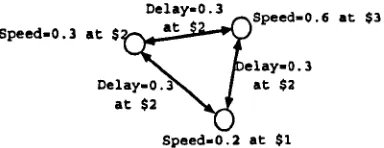
Figure 2.7: A priced distributed system waiting for a task to decide which resources to consume to minimise its run-time
the overhead of bidding to multiple sellers, in order to obtain resources, is high especially
when the granularity of work is small.
Ferguson's work
Ferguson et.al. [21] take a more detailed approach to the problem than SPAWN [55].
They consider that in a distributed system there are several resources: CPU, Memory
and Network which are scarce and competed for by tasks. Each task and each resource is
represented as an agent which has maximising its own function (utility) as its goal. Every
resource is parameterised. So a CPU has a speed, memory has a size and a network has
a delay. Every task has parameters for its CPU requirements, memory usage and thus
network transfer times. The agents representing the resources maximise their utility by
varying their prices, while agents representing the task minimise their costs and run-time.
It is therefore possible to view the distributed system as a set of resources with parameters (speed, etc.) and costs, which the task uses to minimise its run-time (its ultimate goal)
while the resources try to maximise their utilisation through pricing. An example of this
structure can be seen in Figure 2.7.
In this structure the process buys the resources it requires. This means that on entering
the system, if it requires Uj seconds of processing it must purchase
*
seconds on processorP; where rj is the speed of that processor. A task may migrate around the system, but it
must purchase the network links it uses and must return to the node by which it entered
the system.
complete its task. It then determines which resources to consume, based on its remaining
money and the current prices. To do this, it performs three steps: computes its budget
set; computes a preference for the budget set; and bids on the most preferred budget.
Computing its budget set involves choosing the processors where the task can afford to
run and get to and from over the links. Once determined, it chooses the cheapest budget
combined with the shortest service time. For its bid, the task uses the calculated cost plus
an element of its surplus cash. If it wins the auction the process reduces the amount of
surplus cash paid, meaning that under little competition prices will fall. If, however it loses, the fraction of the surplus used is increased and the process repeats. In this way,
while waiting, the level of the bid depends on the task's waiting time.
An auction process on each node receives the various bids. Ferguson implemented both
sealed-bid and dutch auctions on each node and found little noticeable affect on the price
level. The bids are converted into unit costs and the best price wins. This determines
the market price, which is the maximum a process is prepared to pay. In order to allow
the tasks to calculate their budget sets they need to know the prices of the local resources
in the system, so each node also runs a bulletin board service which contains the prices
from the nearest neighbour nodes. The bulletin board is updated whenever the local prices
change and broadcast to all neighbours.
This scheme has a few problems. Firstly, the quantity of resources required must be
known before any bids can be made. The assumption is that all processes are batch jobs
with well defined bounds like real-time tasks. This assumption does not hold for interactive
jobs or jobs where the computation time is non-deterministic. Secondly, as with SPAWN,
if the granularity of the computation is small, the overhead of calculating the budget sets
is unreasonably high. This is especially true when the Dutch auction, which is iterative,
is used. Thirdly, the use of nearest-neighbour information dissemination provides poor