12 Teaching mathematics
Self-knowledge, pupil knowledge
and content knowledge
Effie Maclellan
Introduction
Mathematical learning is significantly influenced by the quality of math-ematics teaching (Hiebert and Grouws 2007). In spite of the evidence for teachers seeking to do what they believe to be in the best interests of their learners (Schuck 2009; Gholami and Husu 2010), research and policy reports (within the UK and beyond) draw attention to insufficient mathematical attainment (Williams 2008; Eurydice 2011). Why is there this discrepancy? On the one hand, teachers are open to improving their professional practices (Escudero and S´anchez 2007), and on the other, the findings of mathematical education research make little or no impact on teachers’ practice (Wiliam 2003), even although teachers themselves think that they are enacting new or revised practices (Speer 2005).
with specific concepts and procedures, they identify inconsistencies in their collective knowledge and they consult authoritative sources. Further, they set goals, monitor collaborative effort, and negotiate future courses of action. In so doing, they steer and organize the construction of their cor-porate knowledge, through taking account of different contributions in the context of their own teaching (Hurme et al. 2006; Dams¸a et al. 2010). It is teachers’ lived professional experience that on a daily basis they will be met with learners who vary in their prior mathematical experience and their motivation to learn. Because classes are constructed according to chronological age, this variation can include learners who are advanced, who underachieve, who grapple with the language of instruction, who come from diverse cultural and/or economic backgrounds, and who have learning problems. Indeed some learners may fit into more than one of the categories. The variation of some learners performing at, some per-forming below and some capable of perper-forming well above, stage-level expectations is demanding in any curricular area, but teachers are par-ticularly challenged by the mathematics curriculum because of learners’ lack of expected progression and failure to achieve stage-level standards (Miller and Hudson 2007).
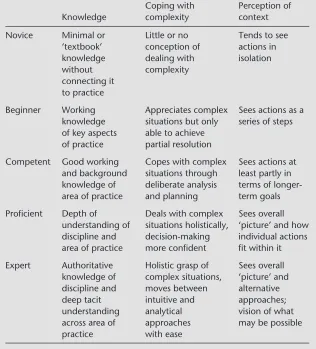
How teachers respond to this variation and capitalize on professional support to maximize their own learning can be understood in terms of teachers’ expertise. Some will be overwhelmed by the vast amount of mathematics research information that is ‘out there’. At the other end of the continuum will be teachers who will evaluate that information and se-lect from it in ways that are fit-for-purpose. When people work in any do-main they are constantly in the process of developing expertise. Through sensitizing ourselves to notice what was previously taken-for-granted or unnoticed, our observations can inform action in the future. By becom-ing aware of how our attention shifts, we can learn, intentionally, from experience. Dreyfus characterized this growth of expertise through five different stages (Dreyfus and Dreyfus 1980), which represent qualitatively different forms of learning behaviour (Berliner 1994; Flyvberg 2001).
Reflection
Consider the Novice-to-Expert Levels in Table 12.1 and also think of a math-ematical topic that you teach.
r
How expert do you consider yourself to be in teaching that topic?Table 12.1 Novice-to-expert levels Knowledge Coping with complexity Perception of context Novice Minimal or
‘textbook’ knowledge without connecting it to practice
Little or no conception of dealing with complexity
Tends to see actions in isolation
Beginner Working knowledge of key aspects of practice
Appreciates complex situations but only able to achieve partial resolution
Sees actions as a series of steps
Competent Good working and background knowledge of area of practice
Copes with complex situations through deliberate analysis and planning
Sees actions at least partly in terms of longer-term goals Proficient Depth of
understanding of discipline and area of practice
Deals with complex situations holistically, decision-making more confident
Sees overall ‘picture’ and how individual actions fit within it Expert Authoritative
knowledge of discipline and deep tacit understanding across area of practice
Holistic grasp of complex situations, moves between intuitive and analytical approaches with ease Sees overall ‘picture’ and alternative approaches; vision of what may be possible
Source: Adapted from Lester (2005)
This dynamic characteristic of expertise is consistent with the evidence that while teachers’ mathematical knowledge is an important aspect of effective teaching (Hill et al. 2005), it is not of itself sufficient (Shechtman et al. 2010). In addition to, and in interaction with, teachers’ mathemat-ical knowledge, proficient and expert teachers are both highly motivated and self-regulating.
Teachers’ self-knowledge
The professional status of teachers requires them to initiate, control and manage teaching episodes by themselves; in other words that they be self-regulating. Such autonomy is very necessary because the sheer complexity of the mathematics classroom means that there can be no algorithmic re-sponse available for every problem that presents itself. Not only do teach-ers need to be aware of/ monitor their own thinking, undteach-erstanding and knowledge about teaching but also they need to be sensitive to the differ-ent kinds of knowledge which they can draw upon to help develop their practice (Parsons and Stephenson 2005). Such self-regulation is defined as:
the self-conscious monitoring of one’s cognitive activities, the ele-ments used in those activities, and the results educed, particularly by applying skills in analysis and evaluation to one’s own infer-ential judgments with a view toward questioning, confirming, validating, or correcting either one’s reasoning or one’s results.
(Facione 1990: 10)
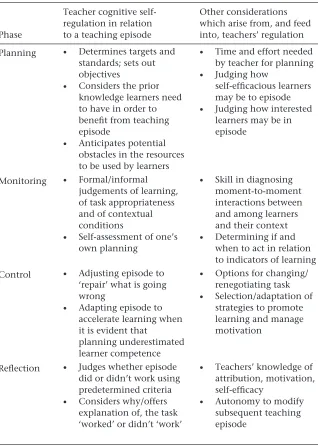
Self-regulation is commonly understood as being an iteratively phased activity. Teacher thinking in relation to teaching episodes can readily map on to the different phases (see Table 12.2).
Reflection
Table 12.2 Teachers’ cognitive self-regulation
Phase
Teacher cognitive self-regulation in relation to a teaching episode
Other considerations which arise from, and feed into, teachers’ regulation
Planning r Determines targets and standards; sets out objectives
r Considers the prior knowledge learners need to have in order to benefit from teaching episode
r Anticipates potential obstacles in the resources to be used by learners
r Time and effort needed
by teacher for planning
r Judging how
self-efficacious learners may be to episode
r Judging how interested
learners may be in episode
Monitoring r Formal/informal judgements of learning, of task appropriateness and of contextual conditions
r Self-assessment of one’s
own planning
r Skill in diagnosing moment-to-moment interactions between and among learners and their context
r Determining if and
when to act in relation to indicators of learning
Control r Adjusting episode to ‘repair’ what is going wrong
r Adapting episode to accelerate learning when it is evident that
planning underestimated learner competence
r Options for changing/ renegotiating task
r Selection/adaptation of
strategies to promote learning and manage motivation
Reflection r Judges whether episode did or didn’t work using predetermined criteria
r Considers why/offers explanation of, the task ‘worked’ or didn’t ‘work’
r Teachers’ knowledge of attribution, motivation, self-efficacy
In teaching, these phases of self-regulation need constant adaptation be-cause the dynamics of the environment and the social relationships of the classroom. Thus it is through the many cycles of planning, monitor-ing, controlling and reflecting that practice develops, and it is through deliberate practice that expertise develops, although the practice may be neither enjoyable nor easy.
The importance of teacher self-regulation is evidenced in learners who are self-regulating since their initiative, motivation and personal responsibility are mirrored in academic success (Nota et al. 2004). Space limitations here prevent adequate consideration of how self-regulation develops, but the more teachers are aware of both cognitive factors (developmental differences in learners’ working memory; the role of prior knowledge; self-awareness; awareness of task’s constituent demands; feel-ings of familiarity, difficulty, confidence, satisfaction) and motivational factors (judgements of learning; competence; interest and value; goal ori-entation; self-efficacy and volition) (Pintrich and Zusho 2002) the more autonomous teachers can be in using their adaptive expertise (Berliner 2001) to enable learners’ deeper understanding of the subject-matter. Expert teachers pay close attention not only to the factual accuracy of learners’ responses but also to the logical persuasiveness of the learners’ reasoning (Sato et al. 1993). If teachers are unaware of learners’ thinking, they are less likely to engage learners in self-regulating activities (Parsons and Stephenson 2005) thereby inhibiting the acceleration of learning which is available even to low-achievers when self-regulation is deployed (Zohar and Ben David 2008; Zohar and Peled 2008). The reality of self-regulation is in the strong linguistic component which characterizes many classrooms and which provides the mechanism for learners to negotiate how they make rules, draw conclusions, approach/solve a task, justify choices, and evaluate the advantages/disadvantages of different strategic behaviour. It is through consciously embedding these opportunities in all teaching episodes that teachers can support learners’ self-regulation (Carr et al. 2011).
Pupil knowledge
concepts, principles, procedures and phenomena which each individual stores in memory as a connection or network. This knowledge varies from person to person as do the unique ways in which each individual forms connections between pieces of knowledge. The different pieces of knowledge are representations which are (unique-to-the-individual) con-figurations of symbols, real objects or events and mental images (Janvier 1987). So, for example, one can ‘picture in one’s head’ what a cat is through a picture, or a verbal description, or a recent visit to the zoo. Thus individual understanding of 3 might be linked to a number of rep-resentations: such as the counting sequence 1, 2, 3; to the numeral 3; to three fingers; to 3 being 1 less than 4; and/or to other experiences that individuals have had. Constructing representations can be complex. To solve word problems learners must create different mental representa-tions: they need to understand the numerical values and the quantitative relations between them (mathematical understanding) and they need to understand what information is essential and what information is less im-portant (contextual/situational understanding). They then mathematize the situation: lock the two representations together in terms of previous mathematical knowledge, to determine how to proceed. Appropriate op-eration(s) can then be enacted and results interpreted in terms of both the mathematics and the situation described in the problem. But if learn-ers, instead, use a meaningless strategy (perhaps identifying salient words such as ‘more’ or ‘less’ with particular operations) without regard for the situation, they do not fully understand either what the problem asked or how good their solution is (Thevenot et al. 2007). Understanding is thus the process of constructing networks of meaning between existing bits of knowledge and integrating new representations. Although it is never complete, understanding is said to develop as representations are connected in progressively more elaborate networks.
closures. In other words, understanding of navigation is strengthened by having more than one representation. Because any single external rep-resentation cannot describe fully a mathematical construct, the limita-tions of any particular representation can be overtaken by using multiple representations (just as a map is another resource to support the trav-eller), which help learners to construct a better picture of a mathematical concept.
Learners are presented regularly with representations since these are what teachers and learners use as carriers of knowledge and as thinking tools to describe or explain a concept, a relationship, or a problem. Ex-ternal representations are important because they interact with learners’ internal representations and help the learner to make more sense (Greeno 1991). But learners tend to discount their common-sense knowledge of the real world and view mathematics as artificial and disconnected from reality (Greer et al. 2002). So the richness of available representations and the facility to ‘translate’ between them need to be an explicit focus of teaching if learners are to avoid confusing external representations of concepts with the concepts themselves (Janvier 1987; Greeno 1991). In other words external representations mustn’t be privileged to the point of being manipulated without reference to the internal representation that the learner is using. Neither is it helpful to impose external representa-tions or coerce learners to use particular external representarepresenta-tions. Teachers therefore have to elicit learner’s existing thinking and ideas so that new knowledge is not isolated from existing knowledge. The mechanism for this is discussion which allows:
r
Teachers to identify what strategies learners are using (and thereby decide how to respond and/or whether to build on that particular learner’s suggestion)r
Learners to share their thinking with the other members of the classr
Others to comment, question, elaborate on the suggestion.A prototypical sequence for such discussion might be:
r
Teacher poses a question or problem to the class (possibly making three or four answers available for consideration).r
Learners have time to think of answers or responses individually.r
Learners discuss possible responses (in groups of four or fewer).r
Individual learners ‘vote’ for an answer or a preferred solution.r
Teacher tallies and displays distribution of votes to the class.r
Class discussion ensues, with learners justifying their answers.Reflection
The following three aspects of the significant concept, place value, are ones that you might, at times, want to emphasize in a teaching episode. Consider how much emphasis you put on the different representations which together constitute a robust understanding of the concept.
1. The relationship between the oral name and the numeral. Perhaps the easiest of the representations is the connection between what we call ‘numbers’ and their written form. Tasks such as ‘Can you read these numbers: 17, 39, 50, 56, 71?’ and ‘Circle numbers on the chart as I read them: 14, 25, 42’ focus on this relationship. Our ‘twelve’ in some other cultures is ‘ten-two’, and our ‘forty-seven’ is ‘four-ten-seven’. We use ‘ty’ to mean ‘ten’, but ‘twen’, ‘thir’ and ‘fif’ don’t sound like ‘two’, ‘three’ and ‘five’. Finally, teen numbers are reversed. ‘Seventeen’ can be misunderstood as ‘71’.
2. The relationship between the oral name and the quantity. While counting in ones may be secure, learners need to appreciate that counting in groups – 2s, 5s, 10s – is more efficient. From a display of bundles of ten and a large collection of single counters, what are the learners doing when you pose tasks such as the following: ‘Show me thirty’, ‘Show me thirty-five’, ‘Look at this collection of thirty-five. If we count them by ones, how many will we get?’, ‘If we count them by tens, what answer do we get?’ and ‘Show me seventy. How many tens is that?’
3. The relationship between the numeral and the quantity. Here the task is to emphasize the relationship of the written symbol with the numerosity, so the same type of tasks as above can be used. Is it your practice to deal with these relationships explicitly and discretely? Do you give equal attention to each or put more emphasis on one? Although only an initial understanding of place value has been illustrated, analogous relationships have to be constructed for more advanced concepts to allow profound understanding of the relationship between a digit’s place and its value.
Content knowledge
activity. Furthermore the importance of understanding is irrefutable. Key mathematical understandings appear to coalesce round additive and mul-tiplicative reasoning (Nunes et al. 2009) which can be most economically illustrated through the range of mathematical problems that are used in primary school (Carpenter et al. 1999).
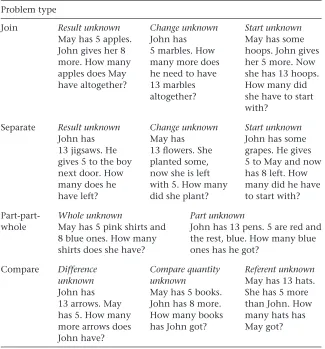
[image:10.612.164.489.296.645.2]Additive reasoning focuses on the sums of, and differences between, quantities and in part develops intuitively. Nevertheless, addition and subtraction as reflected in different types of problems are experienced variously by learners (see Table 12.3).
Table 12.3 Types of addition and subtraction problems
Problem type
Join Result unknown
May has 5 apples. John gives her 8 more. How many apples does May have altogether?
Change unknown
John has 5 marbles. How many more does he need to have 13 marbles altogether?
Start unknown
May has some hoops. John gives her 5 more. Now she has 13 hoops. How many did she have to start with?
Separate Result unknown
John has 13 jigsaws. He gives 5 to the boy next door. How many does he have left?
Change unknown
May has 13 flowers. She planted some, now she is left with 5. How many did she plant?
Start unknown
John has some grapes. He gives 5 to May and now has 8 left. How many did he have to start with?
Part-part-whole
Whole unknown
May has 5 pink shirts and 8 blue ones. How many shirts does she have?
Part unknown
John has 13 pens. 5 are red and the rest, blue. How many blue ones has he got?
Compare Difference unknown
John has 13 arrows. May has 5. How many more arrows does John have?
Compare quantity unknown
May has 5 books. John has 8 more. How many books has John got?
Referent unknown
May has 13 hats. She has 5 more than John. How many hats has May got?
These problems contain the same key words but the structure of each is unique and influences how easy or how difficult learners may find them. A major task for many learners is to appreciate that these are alternative representations of additive reasoning.
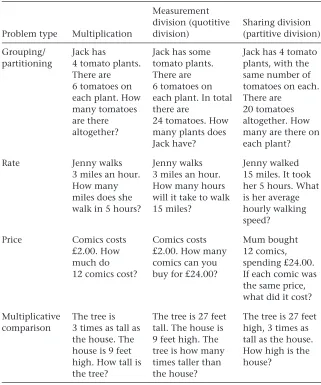
Multiplicative reasoning, on the other hand, does not develop intu-itively and requires formal instruction (Sowder et al. 1998). Multiplicative reasoning is what underpins understandings of common and decimal fractions, percentages, proportion and ratio, all critically important ideas for us to develop. While additive reasoning is a necessary first stage, it is important to enable learners to restructure their concept of number to understand the unit of quantification is not one but a set (such as a pair, a trio, or other composite unit) or a fractional quantity (such as one-quarter, one- third). There is now a new variable, the multiplier, which counts sets. Learners need to be able to understand a collection of items as a set (the multiplicand) which is operated on by the multiplier to result in product. Equally they need to understand the relationships of dividend, divisor and quotient (see Table 12.4).
Again, while these problems appear to be the same, their structural differences are mirrored, initially, in very different problem solutions by learners.
Reflection
Consider how much emphasis you put on these different representations of additive and multiplicative reasoning.
r
Do you expect that having taught one representation of an opera-tion that learners will automatically or easily generalize to others?r
Are there some problem types you shy away from?r
What changes to teaching the ‘four rules’ might you now consider, in the light of reading this chapter?Conclusion
Table 12.4 Types of multiplication and division problems
Problem type Multiplication
Measurement division (quotitive division) Sharing division (partitive division) Grouping/ partitioning Jack has
4 tomato plants. There are 6 tomatoes on each plant. How many tomatoes are there altogether?
Jack has some tomato plants. There are 6 tomatoes on each plant. In total there are
24 tomatoes. How many plants does Jack have?
Jack has 4 tomato plants, with the same number of tomatoes on each. There are
20 tomatoes altogether. How many are there on each plant?
Rate Jenny walks 3 miles an hour. How many miles does she walk in 5 hours?
Jenny walks 3 miles an hour. How many hours will it take to walk 15 miles?
Jenny walked 15 miles. It took her 5 hours. What is her average hourly walking speed?
Price Comics costs £2.00. How much do 12 comics cost?
Comics costs £2.00. How many comics can you buy for£24.00?
Mum bought 12 comics, spending£24.00. If each comic was the same price, what did it cost?
Multiplicative comparison
The tree is 3 times as tall as the house. The house is 9 feet high. How tall is the tree?
The tree is 27 feet tall. The house is 9 feet high. The tree is how many times taller than the house?
The tree is 27 feet high, 3 times as tall as the house. How high is the house?
Source: Adapted from Carpenter et al. (1999)
literature in mathematics education is vast but two relatively recent pub-lications (noted below) stand out because they have been written with practising teachers in mind.
Further reading
Nunes, T., Bryant, P. & Watson, A. (eds) (2009) Key Understandings in
Mathematics Learning. London: Nuffield Foundation.
This publication synthesizes the recent research literature of mathematics learning by children (aged 5–16 years). It explores issues such as the insights learners must have in order to understand basic mathemati-cal concepts; the sources of these insights and how informal mathe-matics knowledge relates to learning mathemathe-matics in school; and the understandings learners must have in order to build new mathemati-cal ideas using basic concepts. The publication is presented in a set of eight papers, all of which are available from the funder of the study, the Nuffield Foundation (www.nuffieldfoundation.org).
Carpenter, T., Fennema, E., Franke, M., Levi, L. & Emspon, S. (1999)
Children’s Mathematics: Cognitively Guided Instruction. Portsmouth,
NH: Heinemann.
Cognitively Guided Instruction (CGI) is a professional development pro-gramme for teachers which started in the United States at the be-ginning of the twenty-first century and continues to develop. CGI is an approach to teaching mathematics rather than a curriculum pro-gramme and at its core is the practice of listening to learners’ math-ematical thinking and using this as a basis for teaching. Research into CGI shows that expert teachers use a variety of practices to extend learners’ mathematical thinking; and that their profes-sional judgment is central to making decisions about how to use information about children’s thinking. See http://ncisla.wceruw. org/publications/reports/NCISLAReport1.pdf
References
Berliner, D. (1994) Expertise: The wonder of exemplary performance. In J. Mangieri and C. Block (eds) Creating Powerful Thinking in Teachers
and Students. Fort Worth, TX: Harcourt Brace College.
Berliner, D. (2001) Learning about and learning from expert teachers.
International Journal of Educational Research 35 (5): 463–82.
Carpenter, T., Fennema, E., Franke, M., Levi, L. and Emspon, S. (1999)
Children’s Mathematics: Cognitively Guided Instruction. Portsmouth,
Carr, M., Taasoobshirazi, G., Stroud, R. and Royer, J. (2011) Combined fluency and cognitive strategies instruction improves mathematics achievement in early elementary school. Contemporary Educational
Psychology 36 (4): 323–33.
Dams¸a, C., Kirschner, P. Andriessen, J., Erkens, G. and Sins, P. (2010) Shared epistemic agency: An empirical study of an emergent con-struct. Journal of the Learning Sciences 19 (2): 143–86.
Dreyfus, T. and Eisenberg, T. (1996) On different facets of mathematical thinking. In R. Sternberg and T. Ben-Zeev (eds) The Nature of
Mathe-matical Thinking. Hillsdale, NJ: Lawrence Erlbaum Associates.
Dufour-Janvier, B., Bednarz, N. and Belanger, M. (1987) Pedagogical con-siderations concerning the problem of representation. In C. Janvier (ed.) Problems of Representation in the Teaching and Learning of
Mathe-matics. Hillsdale, NJ: Lawrence Erlbaum Associates.
Escudero, I. and S´anchez, V. (2007) A mathematics teacher’s perspective and its relationship to practice. International Journal of Science and
Mathematics Education 6: 87–106.
EURYDICE (2011) Mathematics in Education in Europe: Common Challenges
and National Policies. Brussels: Education, Audiovisual and Culture
Executive Agency (EACEA). Available at http://eacea.ec.europa.eu/ education/eurydice/documents/thematic_reports/132EN.pdf (acces-sed 30 May 2012).
Facione, P. (1990) Critical Thinking: A Statement of Expert Consensus for
Purposes of Educational Assessment and Instruction: The Executive Sum-mary of the Delphi Research Report. Millbrae, CA: California Academic
Press.
Flyvberg, B. (2001) Making Social Science Matter. Cambridge: Cambridge University Press.
Gholami, K. and Husu, J. (2010) How do teachers reason about their prac-tice? Representing the epistemic nature of teachers’ practical knowl-edge. Teaching and Teacher Education 26: 1520–9.
Ginsburg, H. and Amit, M. (2008) What is teaching mathematics to young children? A theoretical perspective and case study. Journal of Applied
Developmental Psychology 29 (4): 274–85.
Greeno, J. (1991) Number sense as situated knowing in a conceptual do-main. Journal for Research in Mathematics Education 22 (3): 170–218. Greer, B., Verschaffel, L. and De Corte, E. (2002) The answer is really 4.5.
In G. Leder, E. Pehkonen and G. T¨orner (eds) Beliefs: A Hidden Variable
in Mathematics Education? Dordrecht: Kluwer Academic.
Hiebert, J. and Grouws, D. (2007) The effects of classroom mathematics teaching on students’ learning. In F. Lester (ed.) Second Handbook of
Research on Mathematics Teaching and Learning. Reston, VA: National
Hiebert, J. and Lefevre, P. (1986) Conceptual and procedural knowledge in mathematics: An introductory analysis. In J. Hiebert (ed.)
Concep-tual and Procedural Knowledge: The Case of Mathematics. Hillsdale, NJ:
Lawrence Erlbaum Associates.
Hill, H., Rowan, B. and Ball, D. (2005) Effects of teachers’ mathemati-cal knowledge for teaching on student achievement. American
Educa-tional Research Journal 42 (2): 371–406.
Hurme, T., Palonen, T. and J¨arvela, S. (2006) Metacognition in joint dis-cussions: An analysis of the patterns of interaction and the metacog-nitive content of the networked discussions in mathematics.
Metacog-nition and Learning 1: 181–200.
Janvier, C. (1987) Representation and understanding: The notion of func-tion as an example. In C. Janvier (ed.) Problems of Representafunc-tion in the
Teaching and Learning of Mathematics. Hillsdale, NJ: Lawrence Erlbaum
Associates.
Kramarski, B. and Revach, T. (2009) The challenge of self-regulated learn-ing in mathematics teachers’ professional trainlearn-ing. Educational Studies
in Mathematics 72 (3): 379–99.
Lester, S. (2005) Novice to Expert: The Dreyfus Model of Skill
Acquisi-tion. Available at www.sld.demon.co.uk/dreyfus.pdf (accessed 28 May
2012).
Miller, S. and Hudson, P. (2007) Using evidence-based practices to build mathematics competence related to conceptual, procedural, and declarative knowledge. Learning Disabilities Research and Practice 22 (1): 47–57.
Nota, L., Soresi, S. and Zimmerman, B. (2004) Self-regulation and aca-demic achievement and resilience: A longitudinal study. International
Journal of Educational Research 41 (3): 198–215.
Nunes, T., Bryant, P. and Watson, A. (eds) (2009) Key Understandings in
Mathematics Learning. London: Nuffield Foundation.
Parsons, M. and Stephenson, M. (2005) Developing reflective practice in student teachers: Collaboration and critical partnerships. Teachers and
Teaching 11 (1): 95–116.
Pintrich, P. and Zusho, A. (2002) The development of academic self-regulation: The role of cognitive and motivational factors. In A. Wigfield and J. Eccles (eds) Development of Academic Motivation. Lon-don: Academic Press.
Sato, M., Akita, K. and Iwakawa, N. (1993) Practical thinking styles of teachers: A comparative study of expert and novice thought pro-cesses and its implications for rethinking teacher education in Japan.
Peabody Journal of Education 68 (4): 100–10.
Shechtman, N., Roschelle, J., Haertel, G. and Knudsen, J. (2010) Investi-gating links from teacher knowledge, to classroom practice, to student learning in the instructional system of the middle-school mathemat-ics classroom. Cognition and Instruction 28 (3): 317–59.
Shulman, L. (1988) The paradox of teacher assessment. Paper presented at the New Directions for Teacher Assessment. Proceedings of the
Edu-cational Testing Service (ETS) Invitational Conference, New York, October.
Sowder, J., Armstrong, B., Lamon, S., Simon, M., Sowder, L. and Thomp-son, A. (1998) Educating teachers to teach multiplicative structures in the middle grades. Journal of Mathematics Teacher Education 1 (2): 127–55.
Speer, N. (2005) Issues of methods and theory in the study of mathe-matics teachers’ professed and attributed beliefs. Educational Studies
in Mathematics 58: 361–91.
Thevenot, C., Devidal, M., Barrouillet, P. and Fayol, M. (2007) Why does placing the question before an arithmetic word problem improve per-formance? A situation model account. Quarterly Journal of Experimental
Psychology 60 (1): 43–56.
Wiliam, D. (2003) The impact of educational research on mathematics education. In A. Bishop, M. Clements, C. Keitel, J. Kilpatrick and F. Leung (eds) Second International Handbook of Mathematics Education (Vol. 2). Dordrecht: Kluwer Academic Publishers.
Williams, P. (2008) Independent Review of Mathematics Teaching in Early
Years Settings and Primary Schools: Final Report. London: DCSF.
Avail-able at http://dera.ioe.ac.uk/8365/1/Williams%20Mathematics.pdf (accessed 10 December 2011).
Zohar, A. and Ben David, A. (2008) Explicit teaching of meta-strategic knowledge in authentic classroom situations. Metacognition and
Learn-ing 3: 59–82.
Zohar, A. and Peled, B. (2008) The effects of explicit teaching of metas-trategic knowledge on low- and high-achieving students. Learning and