City, University of London Institutional Repository
Citation
:
Baronchelli, A., Caglioti, E. and Loreto, V. (2005). Artificial sequences and
complexity measures. Journal of Statistical Mechanics: Theory and Experiment new, 2005,
doi: 10.1088/1742-5468/2005/04/P04002
This is the unspecified version of the paper.
This version of the publication may differ from the final published
version.
Permanent repository link: http://openaccess.city.ac.uk/2643/
Link to published version
:
http://dx.doi.org/10.1088/1742-5468/2005/04/P04002
Copyright and reuse:
City Research Online aims to make research
outputs of City, University of London available to a wider audience.
Copyright and Moral Rights remain with the author(s) and/or copyright
holders. URLs from City Research Online may be freely distributed and
linked to.
arXiv:cond-mat/0403233v2 [cond-mat.stat-mech] 25 Jan 2006
Artificial sequences and complexity measures
Andrea Baronchelli1∗, Emanuele Caglioti2† and Vittorio Loreto1‡ 1”La Sapienza” University, Physics Department, P.le A. Moro 5,
00185 Rome, Italy and INFM-SMC, Unit`a di Roma1. and
2”La Sapienza” University, Mathematics Department, P.le A. Moro 5, 00185 Rome, Italy
In this paper we exploit concepts of information theory to address the fundamental problem of identifying and defining the most suitable tools to extract, in a automatic and agnostic way, information from a generic string of characters. We introduce in particular a class of methods which use in a crucial way data compression techniques in order to define a measure of remoteness and distance between pairs of sequences of characters (e.g. texts) based on their relative information content. We also discuss in detail how specific features of data compression techniques could be used to introduce the notion ofdictionary of a given sequence and ofArtificial Textand we show how these new tools can be used for information extraction purposes. We point out the versatility and generality of our method that applies to any kind of corpora of character strings independently of the type of coding behind them. We consider as a case study linguistic motivated problems and we present results for automatic language recognition, authorship attribution and self consistent-classification.
I. INTRODUCTION
One of the most challenging issues of recent years is presented by the overwhelming mass of available data. While this abundance of information and the extreme ac-cessibility to it represents an important cultural advance, it raises on the other hand the problem of retrieving rel-evant information. Imagine entering the largest library in the world, seeking all relevant documents on your fa-vorite topic. Without the help of an efficient librarian this would be a difficult, perhaps hopeless, task. The de-sired references would likely remain buried under tons of irrelevancies. Clearly the need for effective tools for in-formation retrieval and analysis is becoming more urgent as the databases continue to grow.
First of all let us consider some among the possible sources of information. In nature many systems and phe-nomena are often represented in terms of sequences or strings of characters. In experimental investigations of physical processes, for instance, one typically has access to the system only through a measuring device which produces a time record of a certain observable, i.e. a sequence of data. On the other hand other systems are intrinsically described by string of characters, e.g. DNA and protein sequences, language.
When analyzing a string of characters the main ques-tion is to extract the informaques-tion it brings. For a DNA sequence this would correspond, for instance, to the iden-tification of the subsequences codifying the genes and their specific functions. On the other hand for a written text one is interested in questions like recognizing the language in which the text is written, its author or the subject treated.
One of the main approach to this problems, the one we address in this paper, is that of information theory (IT) [1, 2] and in particular the theory of data compres-sion.
In a recent letter [3] a method for context recognition and context classification of strings of characters or other equivalent coded information has been proposed. The re-moteness between two sequencesAandB was estimated by zipping a sequenceA+B obtained by appending the sequenceB after the sequenceA and exploiting the fea-tures of data compression schemes likegzip (whose core is provided by the Lempel-Ziv 77 (LZ77) algorithm [4]). This idea was used for authorship attribution and, by defining a suitable distance between sequences, for lan-guages phylogenesis.
The idea of appending two files and zipping the result-ing file in order to measure the remoteness between them had been previously proposed by Loewenstern et al. [5] (using zdiff routines) who applied it to the analysis of DNA sequences, and by Khmelev [6] who applied the method to authorship attribution. Similar methods have been proposed by Juola [7], Teahan [8] and Thaper [9].
In this paper we extend the analysis of [3] and we describe in details the methods to define and measure the remoteness (or similarity) between pairs of sequences based on their relative informatic content. We devise in particular, without loss of generality with respect to the nature of the strings of characters, a method to measure thisdistancebased on data-compression techniques.
ex-tracted words. In this paper we discuss how comparing AT, instead of the original sequences, could represent a valuable and coherent tool for information extraction to be used in very different domains. We then propose a general AT comparison scheme (ATC) and show that it yields to remarkable results in experiments.
We have chosen for our tests some textual corpora and we have evaluated our method on the basis of the results obtained on some linguistic motivated problems. Is it possible to automatically recognize the language in which a given text is written? Is it possible to automatically guess the author and the subject of a given text? And finally is it possible to define methods for the automatic classification of the texts of a given corpus?
The choice of the linguistic framework is justified by the fact that this is a field where anybody could be able to judge, at least partially, about the validity and the rel-evance of the results. Since we are introducing techniques for which a benchmark does not exist it is important to check their validity with known and controlled examples. This does not mean that the range of applicability is re-duced to linguistics. On the contrary the ambition is to provide physicists with tools which could parallel other standard tools to analyze strings of characters.
In this perspective it is worthwhile recalling here some of the last developments of sequence analysis in physics related problems. A first field of activity [11, 12] is that of segmentation problems, i.e. cases in which a unique string must be partitioned into subsequences according to some criteria to identify discontinuities in its statistical properties. A classical example is that of the separation of coding and non-coding portions in the DNA but the analysis of genetic sequences in general represents a very rich source of segmentation problems (see, for instance, [10, 13, 14, 15]).
A more recent area is represented by the use of data com-pression techniques to test specific properties of symbolic sequences. In [16], the technology behind adaptive dic-tionary data compression algorithms is used in a suitable way (which is very close to our approach) as an estimate of reversibility of time series, as well as a statistical like-lihood test. Another interesting field is related to the problem of the generation of random numbers. In [17] it is outlined the importance of suitable measures of con-ditional entropies in order to check the real level of ran-domness of random numbers, and an entropic approach is used to discuss some random number generator short-comings (see also [18]).
Finally, another area of interest is represented by the use of data compression techniques to estimate entropic quantities (e.g. Shannon entropy, Algorithmic Complex-ity, Kullback-Leibler divergence etc.) Even though not new this area is still topical [19, 20]. A specific ap-plication that has generated an interesting debate has been drawn about the analysis of electroencephalograms of epilepsy patients [21, 22, 23]. In particular in these pa-per it is argued that measures like the Kullback-Leibler divergence could be used to spot information in medical
data. The debate is wide open.
The outline of the paper is as follows. In section II, after a short theoretical introduction, we recall how data compression techniques could be used to evaluate en-tropic quantities. In particular we recall the definition of the LZ77 [4] compression algorithm and we address the problem of using it to evaluate quantities like the rel-ative entropy between two generic sequences as well as to define a suitable distance between them. In section III we introduce the concept of Artificial Text (AT) and present a method for information extraction based on Ar-tificial Text comparison. Sections IV and V are devoted to the results obtained with our method in two differ-ent contexts: the recognition and extraction of linguistic features (sec. IV) and the self-consistent classification of large corpora (sec. V). Finally section VI is devoted to the conclusions and to a short discussion about possible perspectives.
II. COMPLEXITY MEASURES AND DATA
COMPRESSION
Before entering in the details of our method let us briefly recall the definition of entropy of a string. Shan-non’s definition of information entropy is indeed a prob-abilistic concept referring to the source emitting strings of characters.
Consider a symbolic sequence (σ1σ2 . . .), whereσt is
the symbol emitted at time t and each σt can assume
one ofmdifferent values. Assuming that the sequence is stationary we introduce theN−block entropy:
HN =− X
{WN}
p(WN) lnp(WN) (1)
where p(WN) is the probability of the N-word WN =
(σtσt+1 . . . σt+N−1), and ln = loge. The differential
en-tropies
hN =HN+1−HN (2)
have a rather obvious meaning: hN is the average
infor-mation supplied by the (N+ 1)-th symbol, provided the
Nprevious ones are known. Noting that the knowledge of a longer past history cannot increase the uncertainty on the next outcome, one has thathN cannot increase with N i.e. hN+1 ≤hN. With these definitions the Shannon
entropy for an ergodic stationary process is defined as:
h= lim
N→∞hN = limN→∞ HN
N . (3)
It is easy to see that for a k-th order Markov pro-cess (i.e. such that the conditional probability to have a given symbol only depends on the last k symbols,
The Shannon entropyhmeasures the average amount of information per symbol and it is an estimate of the “surprise” the source emitting the sequence reserves to us. It is remarkable the fact that, under rather natural assumptions, the entropy HN apart from a
multiplica-tive factor, is the unique quantity which characterizes the “surprise” of the N-words [24]. Let’s try to explain in which sense entropy can be considered as a measure of a surprise. Suppose that the surprise one feels upon learning that an event E has occurred depends only on the probability of E. If the event occurs with probability 1 (sure) our surprise in its occurring will be zero. On the other hand if the probability of occurrence of the event E is quite small our surprise will be proportionally large. For a single event occurring with probability pthe sur-prise is proportional to lnp. Let’s consider now a random variable X, which can takeN possible values x1, ..., xN
with probabilitiesp1, ..., pN, the expected amount of
sur-prise we shall receive upon learning the value of X is given precisely by the entropy of the source emitting the random variableX, i.e. −Pp
ilnpi.
The definition of entropy is closely related to a very old problem, that of transmitting a message without loos-ing information, i.e. the problem of the efficient encod-ing [25].
A good example is the Morse code. In the Morse code a text is encoded with two characters: line and dot. What is the best way to encode the characters of the English language (provided one can define a source for English) with sequences of dots and lines? The idea of Morse was to encode the more frequents characters with the minimum numbers of characters. Therefore the ewhich is the most frequent English letter is encoded with one dot (·), while the letterqis encoded with three lines and one dot (− − ·−).
The problem of the optimal coding for a text (or an image or any other kind of information) has been enor-mously studied. In particular Shannon [1] showed that there is a limit to the possibility to encode a given se-quence. This limit is the entropy of the sese-quence.
This result is particularly important when the aim is the measure of the information content of a single fi-nite sequence, without any reference to the source that emitted it. In this case the reference framework is the Algorithmic Complexity Theory and the basic concept is Chaitin - Kolmogorov entropy or Algorithmic Com-plexity (AC) [26, 27, 28, 29]: the entropy of a string of characters is the length (in bits) of the smallest pro-gram which produces as output the string and stops af-terwords. This definition is really abstract. In particular it is impossible, even in principle, to find such a program and as a consequence the algorithmic complexity is a non computable quantity. This impossibility is related to the halting problem and to Godel’s theorem [30].
It is important to recall how it exists a rather im-portant relation between the Algorithmic Complexity
qwhhABCDhh(6,4)z(11,6)z...
Original sequence
Zipped sequence
qwhhABCDhhABCDzABCDhhz...
FIG. 1: Scheme of the LZ77 algorithm: The LZ77 algo-rithm works sequentially and at a generic step looks in the look-ahead buffer for substrings already encountered in the buffer already scanned. These substrings are substituted by a pointer (d,n) whered is the distance of the previous occur-rence of the same substring andn is its length.Only strings longer than two characters are substituted in the example.
KN(WN) of a sequenceWN ofN characters andHN:
1
NhKNi=
1
N X
WN
KN(WN)P(WN)−−−−→ N→∞
h
ln 2 (4) where KN is the binary length of the shorter program
needed to specify the sequenceWN.
As a consequence it exists a relation between the max-imum compression rate of a sequence (σ1σ2. . .)
ex-pressed in an alphabet with m symbols, and h. If the lengthN of the sequence is large enough, then it is not possible to compress it into another sequence (with an alphabet with m symbols) whose size is smaller than
N h/lnm. Therefore, noting that the number of bits needed for a symbol in an alphabet with m symbol is lnm, one has that the maximum allowed compression rate ish/lnm[1].
Though the maximal theoretical limit of the Algorith-mic Complexity is not achievable, there are nevertheless algorithms explicitly conceived to approach it. These are the file compressors or zippers. A zipper takes a file and tries to transform it in the shortest possible file. Obvi-ously this is not the best way to encode the file but it represents a good approximation of it.
A great improvement in the field of data compression has been represented by the Lempel and Ziv algorithm (LZ77) [4] (used for instance by gzipand zip). It is in-teresting to briefly recall how it works (see fig. 1). Let
x=x1, ...., xN,the sequence to be zipped, wherexi
rep-resents a generic character of sequence’s alphabet. The LZ77 algorithm finds duplicated strings in the input data. The second occurrence of a string is replaced by a pointer to the previous string given by two numbers: a distance, representing how far back into the window the sequence starts, and a length, representing the number of charac-ters for which the sequence is identical. More specifically the algorithm proceeds sequentially along the sequence. Let us suppose that the firstncharacters have been cod-ified. Then the zipper looks for the largest integer m
x1, ..., xn. Then it codifies the string found with a
two-number code composed by: the distance between the two strings and the lengthmof the string found. If the zipper does not find any match then it codifies the first charac-ter to be zipped, xn+1, with its name. This eventuality
happens for instance when codifying the first characters of the sequence, but this event becomes very infrequent as the zipping procedure goes on.
This zipper is asymptotically optimal: i.e. if it encodes a text of length L emitted by an ergodic source whose entropy per character ish, then the length of the zipped file divided by the length of the original file tends to h
when the length of the text tends to∞. The convergence to this limit is slow and the corrections has been shown to behave asOlog loglogLL[31].
Usually, in commercial implementations of LZ77 (like for instancegzip), substitutions are made only if the two identical sequences are not separated by more than a cer-tain number nw of characters, and the zipper is said to
have a nw-long sliding window. The typical value ofnw
is 32768. The main reason for this restriction is that the search in very large buffers could be not efficient from the computational time point of view.
Just to give an example, if one compresses an English text the length of the zipped file is typically of the order of one fourth of the length of the initial file. An English file is encoded with 1 byte (8 bits) per character. This means that after the compression the file is encoded with about 2 bits per character. Obviously this is not yet optimal. Shannon with an ingenious experiment showed that the entropy of the English text is between 0.6 and 1.3 bits per character [32] (for a recent study see [19]).
It is well known that compression algorithms represent a powerful tool for the estimation of the AC or more so-phisticated measures of complexity [33, 34, 35, 36, 37] and several applications have been drawn in several fields [38] from dynamical systems theory (the connec-tions between Information Theory and Dynamical Sys-tems theory are very strong and go back all the way to Kolmogorov and Sinai works [39, 40]. For a recent overview see [41, 42, 43]) to linguistics (an incomplete list would include [3, 6, 7, 8, 9, 44, 45, 46, 47, 48]), ge-netics (see [5, 10, 49, 50, 51, 52] and references therein) and music classification [53, 54].
A. Remoteness between two texts
It is interesting to recall the notion of relative entropy (or Kullback-Leibler divergence [55, 56, 57]) which is a measure of the statistical remoteness between two distri-butions and whose essence can be easily grasped with the following example.
Let us consider two stationary zero-memory sourcesA
and B emitting sequences of 0 and 1: A emits a 0 with probabilitypand 1 with probability 1−pwhile Bemits 0 with probability q and 1 with probability 1−q. As already described, a compression algorithm like LZ77
ap-plied to a sequence emitted byA will be asymptotically (i.e. in the limit of an available infinite sequence) able to encode the sequence almost optimally, i.e. coding on av-erage every character with−plog2p−(1−p) log2(1−p)
bits (the Shannon entropy of the source). This opti-mal coding will not be the optiopti-mal one for the sequence emitted by B. In particular the entropy per charac-ter of the sequence emitted by B in the coding opti-mal forA (i.e. the cross-entropy per character) will be
−q log2p−(1−q)log2(1−p) while the entropy per
char-acter of the sequence emitted byB in its optimal coding is−q log2q−(1−q)log2(1−q). The number of bits per
character waisted to encode the sequence emitted by B
with the coding optimal forA is the relative entropy of
AandB,
d(A||B) =−q log2p
q −(1−q)log2
1−p
1−q (5)
A linguistic example will help to clarify the situation: transmitting an Italian text with a Morse code optimized for English will result in the need of transmitting an extra number of bits with respect to another coding optimized for Italian: the difference is a measure of the relative en-tropy between, in this case, Italian and English (suppos-ing the two texts are each one archetypal representations of their Language, which is not).
We should remark that the relative entropy is not a distance (metric) in the mathematical sense: it is neither symmetric, nor does it satisfy the triangle inequality. As we shall see below, in many applications, such as phylo-genesis, it is crucial to define a true metric that measures the actual distance between sequences.
There exist several ways to measure the relative en-tropy (see for instance [35, 36, 37]). One possibility is of course to follow the recipe described in the previous example: using the optimal coding for a given source to encode the messages of another source.
Here we follow the approach recently proposed in [3] which is similar to the approach by Ziv and Merhav [36]. In particular in order to define the relative entropy be-tween two sources A and B we consider a sequence A
from the sourceAand a sequenceB from the sourceB. We now perform the following procedure. We create a new sequence A+B by appending B after A and use the LZ77 algorithm or, as we shall see below, a modified version of it.
In [11] it has been studied in detail what happens when a compression algorithm tries to optimize its features at the interface between two different sequences A and B
while zipping the sequence A+B obtained by simply appending B after A. It has been shown in particular the existence of a scaling function ruling the way the compression algorithm learns a sequenceB after having compressed a sequenceA. In particular it turns out that it exists a crossover length for the sequenceB, given by
L∗B ≃Lα
with α = h(B)+h(dB()B||A). This is the length below which the compression algorithm does not learn the sequence
B (measuring in this way the cross entropy between A
and B) and above which it learnsB, i.e. optimizes the compression using the specific features ofB.
This means that ifBis short enough (shorter than the crossover length), one can measure the relative entropy by zipping the sequenceA+B (usinggzipor an equiv-alent sequential compression program); the measure of the length of B in the coding optimized for A will be ∆AB = LA+B −LA, where LX indicates the length in
bits of the zipped file X. The cross entropy per charac-ter betweenAandBwill be estimated by
C(A|B) = ∆AB/|B|, (7)
where |B| is the length in bits of the uncompressed file
B. The relative entropy d(A||B) per character between
AandBwill be estimated by
d(A||B) = (∆AB−∆B′B)/|B|, (8) whereB′ is a second sequence extracted from the source B with |B′| characters and ∆
B′B/|B| = (LB+B′ −
LB)/|B|is an estimate of the entropy of the sourceB.
If, on the other hand, B is longer than the crossover length we must change our strategy and implement an al-gorithm which does not zip theBpart but simply “reads” it with the (almost) optimal coding of part A. In this case we start reading sequentially file B and search in the look-ahead buffer of B for the longest sub-sequence already occurred only in the A part. This means that we do not allow for searching matches insideB itself. As in the usual LZ77, every matching found is substituted with a pointer indicating where, inA, the matching sub-sequence appears and its length. This method allows us to measure (or at least to estimate) the cross-entropy betweenB andA, i.e. C(A|B).
Before proceeding let us briefly discuss which difficul-ties one could experiment in the practical implementation of the methods described in this section. First of all in practical applications the sequences to be analyzed can be very long and their direct comparison can then be problematic due to finiteness of the window over which matching can be found. Moreover in some applications one is interested in estimating the self-entropy of a source, i.e. C(A|A) in a more coherent framework. The estima-tion of this quantity is necessary to calculate the relative-entropy between two sources. In fact, as we shall see in the next section, even though in practical applications the simple cross-entropy is often used, there are cases in which relative entropy is more suitable. The most typi-cal case is when we need to build a symmetritypi-cal distance between two sequences. One could think to estimate self-entropy comparing, with the modified LZ77, two portions of a given sequence. This method is not very reliable since many bias could afflict the results obtained in this way. For example if we split a book in two parts and try to measure the cross-entropy between these two parts,
the result we would obtain could be heavily affected by the names of the characters present in both parts. More importantly, defining the position of the cut would be completely arbitrary, and this arbitrariness would mat-ter a lot especially for very short sequences. We shall address this problem in section III.
B. On the definition of a distance
In this section we address the problem of defining a distance between two generic sequencesAandB. A dis-tanceD is an application that must satisfy three require-ments:
1. positivity: DAB≥0 (DAB = 0 iffA=B);
2. symmetry: DAB=DBA;
3. triangular inequality: DAB ≤DAC+DCB ∀C;
As it is evident the relative entropy d(A||B) does not satisfy the last two properties while it is never negative. Nevertheless one can define a symmetric quantity as fol-lows:
PAB=PBA=
C(A|B)−C(B|B)
C(B|B) +
C(B|A)−C(A|A)
C(A|A) (9) We now have a symmetric quantity, butPAB does not
satisfies, in general, the triangular inequality. In order to obtain a real mathematical distance we give a prescrip-tion according to which this last property is met. For every pairAandB of sequences, the prescription writes as:
if PAB> minC[PAC+PCB] then
PAB=minC[PAC+PCB]. (10)
By iterating this procedure until for anyA, B, C PAB ≤ PAC+PCB,we obtain a true distanceDAB. In particular
the distance obtained in this way is simply the minimum over all the paths connectingA andB of the total cost of the path (according toPAB): i.e.
DAB = min
{N≥2}{X1,...,XN:minX1=A,XN=B}
N−1
X
k=0
PXkXk+1.
(11) Also it is easy to see thatDABis the maximal distance
not larger thanPA,Bfor anyA, B, where we have
consid-ered the partial ordering on the set of distances: P≥P′
ifPAB≥PAB′ , for all pairsA, B.
Obviously this is not an a-priori distance. The distance betweenAandBdepends, in principle, on the set of files we are considering.
there are cases in other contexts, like, for instance, ge-netic sequences, in which could be necessary to force the triangularization procedure described above.
An alternative definition of distance can be given con-sidering
RAB= p
PAB, (12)
where the square root must be taken before forcing the triangularization. The idea of using RAB is suggested
by the fact that as AandB are very close sources then
PAB is of the order of the square of their “difference”.
Let us see this in a concrete example where the distance between the two sources is very small. Suppose having two sourcesAandBwhich can emit sequences of 0 and 1. Let A emit a 0 with a probability pand 1 with the complementary probability 1−p. Now let the sourceB
emit a 0 with a probabilityp+ǫand a 1 with a probability 1−(p+ǫ), whereǫ is an infinitesimal quantity. In this situation it can be easily shown that the relative entropy between A and B is proportional to ǫ2 and, of course,
PAB is then proportional to the same quantity. Taking
the square root ofPAB is then simply requiring that, if
two sources have a distribution of probability that differs for a small ǫ, their distance must be of the order of ǫ
instead of being reduced to theǫ2order.
It is important to recall that an earlier and rigor-ous definition of an unnormalized distance between two generic strings of characters has been proposed in [58] in terms of the Kolmogorov Complexity and of the Con-ditional Kolmogorov Complexity [30] (see below for the definition).
A normalized version of this distance has been pro-posed in [52, 59]. In particular Li et al. define
dK(x, y) =
max(K(x|y), K(y|x))
max(K(x), K(y)) (13) where the subscriptK refers to its definition in terms of the Kolmogorov complexity. K(x|y) is the condi-tional Kolmogorov Complexity defined as the length of the shortest program to compute xif y is furnished as an auxiliary input to the computation, and K(x) and
K(y) are the Kolmogorov complexities of stringsx and
y, respectively. The distancedK(x, y) is symmetrical and
it is shown to satisfy the identity axiom up to a preci-siondK(x, x) =O(1/K(x)) and the triangular inequality dK(x, y)<=dK(y, z) +dK(z, y) up to an additive term O(1/max(K(x), K(y), K(z))).
The problem with this distance is the fact that it is de-fined in terms of the Conditional Kolmogorov Complexity which is an uncomputable quantity and its computation is performed in an approximate way.
In particular what is important is that the specific pro-cedure (algorithm) used to approximate this quantity, which is indeed a well defined mathematical operation, defines a true distance. In the specific case of the dis-tance dK(x, y) defined in [52] the authors approximate
this distance by the so-called Normalized Compression Distance
N CD(x, y) = C(xy)−min(C(x), C(y))
max(C(x), C(y)) (14) whereC(xy) is the compressed size of the concatenation of xand y, and C(x) and C(y) denote the compressed size of x and y, respectively. Then this quantities are approximated in a suitable way by using real world com-pressors.
It is important to remark how it exists a discrepancy between the definition 13 and its actual approximate computation 14.
We discuss here in some details the case of the LZ77 compressor. Using the results presented in Sect.IIA, one obtains that, if the length ofy is small enough (see ex-pression 6),N CD(x, y) is actually estimating the cross-entropy between x and y. The cross-entropy is not a distance since it does not satisfy the identity axiom, it is not symmetrical nor it satisfies the triangular inequality. In the general case of y being not small, again follow-ing the discussion of Sect.IIA (presented in more details in [11]), one can show that N CD(x, y) is given roughly (forLx large enough) by:
1 + L
α x Ly
d(x||y)
C(y) , (15)
where Lx and Ly are the lengths of the x and y files
(with Ly >> Lαx) and d(x||y) is the relative entropy
rate betweenxandy. Again this estimate does not de-fine a metric. Moreover, since α ≤ 1 one can see that
N CD(x, y)→1, independently of the choice ofxandy
whenLxandLy tends to infinity.
The discrepancy between the definition of a mathemat-ical distance based on the Conditional Kolmogorov Com-plexity and its actual approximate computation in [52] has also been pointed out in [60].
Finally it is important to notice that recently Otu and Sayood [61] have proposed an alternative definition of distance between two string of characters, which is rig-orous and computable. Their approach is based on the LZ complexity [62] of a sequence S which can be defined in terms of the number of steps required by a suitable production process to generate S. In their very interest-ing paper they also give a review on this and correlated problems. We do not enter here on the details and we refer the reader to [61].
III. DICTIONARIES AND ARTIFICIAL TEXTS
Frequency Length Word 110 6 .⌣The⌣
107 7 in⌣the⌣
98 4 you⌣
94 6 .⌣But⌣
92 9 from⌣the⌣
92 5 ⌣very⌣
[image:8.612.319.557.49.274.2]91 4 one⌣
TABLE I:Most frequent LZ77-words found in Moby
Dick’s text: Here we present the most represented word in
the dictionary of Moby Dick. The dictionary was extracted using a 32768 sliding window in LZ77. The⌣represents the space character.
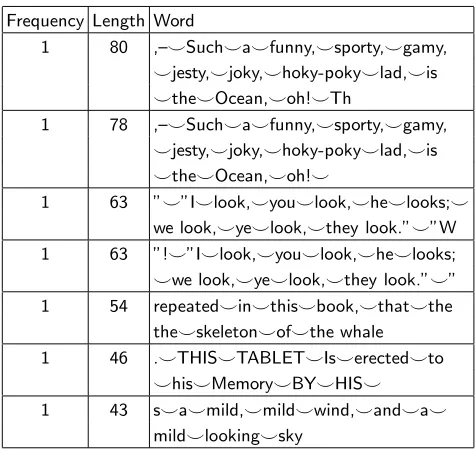
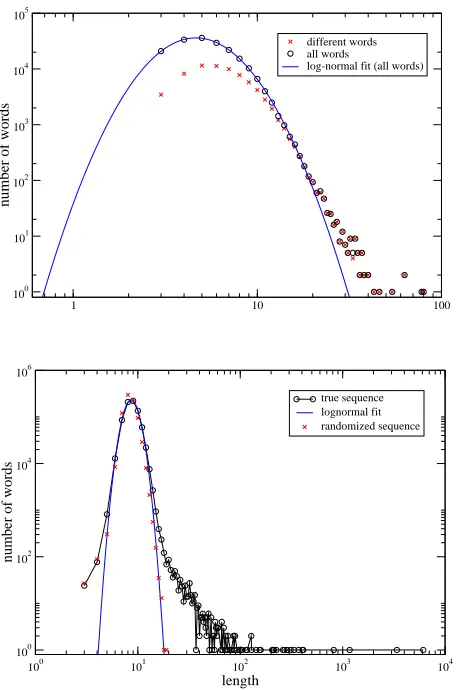
refer to these sequences as dictionary’s words. As it is evident from these definitions, a particular word can be present many times in the dictionary. Finally, we call root of a dictionary the sequence it has been extracted from. It is important to stress how this dictionary has in principle nothing to do with the ordinary dictionary of a given language. On the other hand there could be important similarities between the LZ77-dictionary of a written text and the dictionary of the Language in which the text is written. As an example we report in Table I and Table II the most frequent and the longest words found by LZ77 while zipping Melville’s Moby Dick text. Figure 2 reports an example of the frequency-length dis-tribution of the LZ77-words as a function of their length (for a very similar figure and similar but less complete dictionary analysis see [10]).
Beyond their utility for zipping purposes, the dictio-naries present an intrinsic interest since one can consider them as a source for the principal and more important syntactic structures present in the sequence/text from which the dictionary originates.
A straightforward application is the possibility to con-struct Artificial Texts. With this name we mean se-quences of characters build by concatenating words ran-domly extracted from a specific dictionary.
Each word has a probability of being extracted propor-tional to the number of its occurrences in the dictionary. Since typically LZ77 words already contains spaces, we do not include further spaces separating them. It should be stressed as the structure of a dictionary is affected by the size of LZ77 sliding window. In our case we have typically adopted windows of 32768 characters, and, in a few cases, of 65536 characters.
Below we present an excerpt of 400 characters taken from an artificial text (AT) having Melville’s Moby Dick text as root.
those boats round with at coneedallioundantic turneel-ing he had Queequeg, man .”Tisheed the o corevolvturneel-ing se were by their fAhab tcandle aed. Cthat the ive ing, head
Frequency Length Word
1 80 ,–⌣Such⌣a⌣funny,⌣sporty,⌣gamy,
⌣jesty,⌣joky,⌣hoky-poky⌣lad,⌣is
⌣the⌣Ocean,⌣oh!⌣Th
1 78 ,–⌣Such⌣a⌣funny,⌣sporty,⌣gamy,
⌣jesty,⌣joky,⌣hoky-poky⌣lad,⌣is
⌣the⌣Ocean,⌣oh!⌣
1 63 ”⌣”I⌣look,⌣you⌣look,⌣he⌣looks;⌣
we look,⌣ye⌣look,⌣they look.”⌣”W 1 63 ”!⌣”I⌣look,⌣you⌣look,⌣he⌣looks;
⌣we look,⌣ye⌣look,⌣they look.”⌣” 1 54 repeated⌣in⌣this⌣book,⌣that⌣the
the⌣skeleton⌣of⌣the whale 1 46 .⌣THIS⌣TABLET⌣Is⌣erected⌣to
⌣his⌣Memory⌣BY⌣HIS⌣
1 43 s⌣a⌣mild,⌣mild⌣wind,⌣and⌣a⌣
[image:8.612.112.240.50.160.2]mild⌣looking⌣sky
TABLE II:Longest words in Moby Dick: Here we present the longest words in the dictionary of Mody Dick. Each of these words appears only one time in the dictionary. The dic-tionary was extracted using a 32768 sliding window in LZ77.
upon that can onge Sirare ce more le in and for contrding to the nt him hat seemed ore, es; vacaknowt.” ” it seem-side delirirous from the gan . All ththe boats bedagain, brightflesh, yourselfhe blacksmith’s leg t. Mre?loft restoon
As it is evident the meaning is completely lost and the only feature of this text is to represent in a significant statistical way the typical structures found in the original root text (i.e. the typical subsequences of characters).
The case of sequences representing texts is interesting, and it is worth spending a few words about it, since a clear definition of word already exists in every language. In this case one could also definenatural artificial texts (NAT). A NAT is obtained by concatenating true words as extracted from a specific text written in a certain lan-guage. Also in this case each word would be chosen ac-cording to a probability proportional to the frequency of its occurrence in the text. Just for comparison with the previous AT we report an example of a natural artificial text built using real words from the English dictionary taken randomly with a probability proportional to their frequency of occurrence in Moby Dick’s text.
1 10 100
length
100 101 102 103 104 105
number of words
different words all words
log-normal fit (all words)
100 101 102 103 104
length
100 102 104 106
number of words
[image:9.612.63.291.49.394.2]true sequence lognormal fit randomized sequence
FIG. 2: LZ77-Word Distribution This figure illustrates the distribution of the LZ77-words found in different strings of characters. Above: results for the dictionary ofMoby Dickare shown. In the upper curve several findings of the same word are considered separately; in the lower curve each different word is counted only once. It can be shown that the peaks are well fitted by a log-normal distribution, while there are large deviations from it for large lengths. Below: words extracted from Mesorhizobium loti bacterium’s original and reshuffled DNA sequences are analyzed. The log-normal curve fits well the whole distribution of words extracted from the reshuffled string, but is unable to describe the presence of the long words of the true one.
We now describe how Artificial Texts can be effectively used for recognition and classification purposes. First of all AT present several positive features. They allow to define typical words for generic sequences (not only for texts). Moreover for each original text (or original sequence), one can construct an ensemble of AT. This opens the way to the possibility of performing statistical analysis by comparing the features of many AT all rep-resentative of the same original root text. In this way it is possible to overcome all the difficulties, discussed in the previous section, related to the length of the strings analyzed. In fact it seems very plausible that, once a certain “reasonable” AT size has been established, any string can be well represented by a number of AT
pro-ArtText A1
ArtText A1 ArtText A2
ArtText A2
ArtText B2
ArtText B1
ArtText B2 ArtText B1 ArtText A1
ArtText B2 ArtText A2
ArtText B1
.
Vs Text B 1)Text A
1) Dictionary Extraction
Text B LZ77
Dict A Dict B
Creation of Artificial Texts
Cross−entropy Estimation for Artificial Texts
Averaging Vs
Vs
Vs
Vs
+ − σC Text A
C
Dict A
Dict B
, ,
3) 2)
4)
C(A|B)
C(1|1) C(1|2)
C(2|1) C(2|2)
C(A|B) = < >
Cross−entropy Estimation for Original Sequences
Artificial Text Comparison
FIG. 3: Artificial Text Comparison (ATC) method:
This is the scheme of the Artificial Text Comparison method. Instead of comparing two original strings, several AT (two in figure) are created starting from the dictionaries extracted from the original strings, and the comparison is between pairs of AT. For each pair of AT coming from different roots a cross-entropy valueC(i|j) is measured and the cross-entropy between the root strings is obtained as the average< C >
of all theC(i|j). This method has the advantage of allowing for an estimation of an error, σ, on the obtained value of the cross-entropy < C >, as the standard deviation of the
C(i|j). From the point of view of the ATC computational demand, point 1) simply consists in the procedure of zipping the original files, that usually requires few seconds, points 2) and 4) are of course negligible, while point 3) is crucial. Obviously, in fact, the machine time requested for the cross-entropy estimation grows as the square power of the number of AT created (for fixed length of the AT).
portional to its length. On the other hand one can con-struct AT by merging dictionaries coming from different original texts: merging dictionaries extracted from differ-ent texts all about the same subject or all written by the same author. In this way the AT would play the role of an archetypal text of that specific subject or that specific author [63].
[image:9.612.319.492.100.275.2]in Figure 3, comparing many AT coming from the same two roots (or single root), we can estimate a statistical error on the value of the cross-entropy between the two roots.
With the help of AT we can then build a compari-son scheme (Artificial Text Comparicompari-son or ATC) (see fig-ure 3) between sequences whose validity will be checked in the following sections. This scheme is very general since it can be applied to any kind of sequence indepen-dently of the coding behind it. Moreover the generality of the scheme comes from the fact that, by means of a re-definition of the concept of word, we are able to ex-tract subsequences from a generic sequence using a deter-ministic algorithm (for instance LZ77) which eliminates every arbitrariness (at least once the algorithm for the dictionary extraction has been chosen). In the following sections we shall discuss in detail how one can use AT for recognition and classification purposes.
IV. RECOGNITION OF LINGUISTIC
FEATURES
Our first experiments are concerned with recognition of linguistic features. Here we consider those situations in which we have a corpus of known texts and one un-known textX. We are interested here in identifying the known textA closest (according to some rule) to theX
one. We then say thatX, being similar to A, belongs to the same group of A. This group can, for instance, be formed by all the works of an author, and in that case we say that our method attributed X to that author. We now present results obtained in experiments of language recognition and authorship attribution. After having ex-plained our experiments we will be able to make some more comments on the criterion we adopted to set recog-nition and/or attribution.
A. Language recognition
Suppose we are interested in the automatic recognition of the language in which a given textX is written. This case can be seen as a first benchmark for our recogni-tion technique. The procedure we use considers a collec-tion (a corpus), as large as possible, of texts in different (known) languages: English, French, Italian, Tagalog . . . . We take anX text to play the role of the unknown text whose language has to be recognized, and the remaining
Ai texts of our collection to form our background. We
then measure the cross entropy between ourX text and everyAiwith the procedure discussed in section II. The
text, among theAigroup, with the smallest cross entropy
with the X one, selects the language closest to the one of theX file, or exactly its language, if the collection of languages contains this language. In our experiment we have considered in particular a corpus of texts in 10 offi-cial languages of the European Union (UE) [64]: Danish,
Dutch, English, Finnish, French, German, Italian, Por-tuguese, Spanish and Swedish. Using 10 texts for each language we had a collection of 100 texts. We have ob-tained that for any single text the method has recognized the language. This means that the textAifor which the
cross entropy with the unknown X text was the small-est was a text written in the same language. We found out also that if we ranked for eachX text all the texts
Ai as a function of the cross entropy, all the texts
writ-ten in the same language of the unknown text were in the first positions. This means that the recall, defined in the framework of information retrieval as the ratio between the number of relevant documents retrieved (in-dependently of the position in the ranking) and the total number of existing relevant documents, is maximal, i.e. equal to one. The recognition of language works quite well for length of the X file as small as a few tens of characters.
B. Authorship attribution
Suppose now to be interested in the automatic recog-nition of the author of a given textX. We shall consider, as before, a collection, as large as possible, of texts of several (known) authors all written in the same language of the unknown text and we shall look for the text Ai
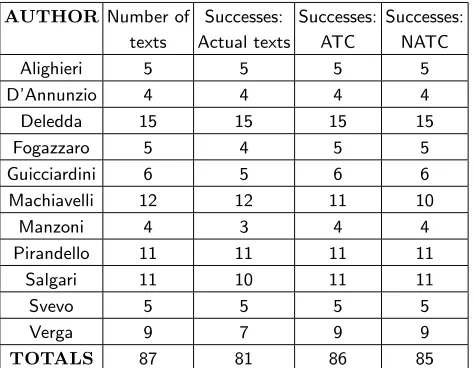
for which the cross entropy with theX text is minimum. In order to collect a certain statistics we have performed the experiment using a corpus of 87 different texts [65] of 11 Italian authors, using for each run one of the texts in the corpus as the unknownX text. In a first step we proceeded exactly as for language recognition, using the actual texts. The results, shown in Table III, feature a rate of success of roughly 93%. This rate is the ratio between the number of texts whose author has been rec-ognized (another text of the same author was ranked as first) and the total number of texts considered. There are of course fluctuations in the success rate for each au-thor and this has to be expected since the writing style is something difficult to grasp and define; moreover it can vary a lot in the production of a single author.
AUTHOR Number of Successes: Successes: Successes: texts Actual texts ATC NATC
Alighieri 5 5 5 5
D’Annunzio 4 4 4 4
Deledda 15 15 15 15
Fogazzaro 5 4 5 5
Guicciardini 6 5 6 6
Machiavelli 12 12 11 10
Manzoni 4 3 4 4
Pirandello 11 11 11 11
Salgari 11 10 11 11
Svevo 5 5 5 5
Verga 9 7 9 9
[image:11.612.58.295.51.235.2]TOTALS 87 81 86 85
TABLE III:Author recognition: This table illustrates the results for the experiments of author recognition. For each author we report the number of different texts considered and a measure of success for each of the three methods adopted. Labeled as successes are the numbers of times another text of the same author was ranked in the first position using the minimum cross-entropy criterion.
Commediarather than toIl Principe. A slightly different way to proceed is the following. Instead of extracting an artificial text from each actual text, we made a single ar-tificial text, which we call theauthor archetype, for each author. To do this we simply joined all the dictionar-ies of the author and then proceeded as before. In this case we used actual works as unknown texts and author archetypes as background. We obtained that 86 out of 87 unknown real texts matched the right artificial author text, the one missing being againL’Asino.
In order to investigate this mismatching further we ex-ploited one of the biggest advantages the ATC method can give if compared to the real text comparison. While in real text comparison only one trial can be made, ATC allows for creating an ensemble of different artificial texts, and so more than one trial is possible. In our specific case, however, 10 ATC different trials performed both with ar-tificial texts and with author archetypes gave the same result, attributingL’Asinoto Dante. This can probably confirm our supposition that the pattern of poetic regis-ter is very strong in this case. To be sure that our 98.8% rate of success was not due to a particular fortuitous ac-cident in our set of artificial texts, we repeated our exper-iment with a corpus formed by 5 artificial texts of each actual text. This means that our collection was formed by 435 texts. We then proceeded in the usual way. Hav-ing our cross entropies between the 5 Xn (n = 1, ...,5)
artificial texts coming from the same rootX, and the re-maining 430 ATs, we first joined all the rankings relative to theseXn. Thus we had 430×5 cross-entropies between
the AT extracted by the same rootX and the other AT of our ensemble. We then averaged, for each root Ai,
all the 25 cross entropies between an AT created from
X text and an AT extracted from that Ai. In this way
we obtained 86 cross entropy values, and we set author-ship attribution using the usual minimum-criterion. We found again that 86 texts over 87 were well attributed, L’Asinobeing again mis-attributed.
This result shows that ATC is a robust method since it does not seem to be strongly influenced by the par-ticular set of artificial texts. In parpar-ticular, as we have discussed before, ATC allows for a quantification of the error committed on the cross entropy estimation. De-fined asσmthe standard deviation estimated for themth
cross-entropy, in a ranking in which the smallest cross en-tropy value is the first one, we empirically observed these relations:
σ1
C1 ≃ σ2
C2 ≃ σ3
C3
≃0.5% (16)
(C2−C1)≃σ1≃σ2. (17)
The difference C2−C1 gives an indication of the level
of confidence of the results. When this difference is of the order of the standard deviation ofC1 and C2, this is an
indication that the result for the attribution has an high level of confidence (at least inside the corpus of reference files/texts considered).
Finally, in order to explore the possibility of using nat-ural words, we performed experiments with natnat-ural arti-ficial texts. We call this method Natural ATC or NATC. We built up 5 artificial texts for each actual one using italian words instead of words extracted by LZ77. Hav-ing these natural artificial texts we proceeded exactly as before. We obtained that 85 over 87 texts where rec-ognized. BesidesL’Asino, the other mismatch was the Istorie Fiorentine by Machiavelli that was set closest to Storie Fiorentine dal 1378 al 1509 by Guicciardini. It seems clear that the closeness of the subjects treated in the two texts played a fundamental role in the attribu-tion.
AUTHOR Number of Successes: Successes: Successes: texts Actual texts ATC NATC
Bacon 6 6 6 6
Brown 3 2 2 2
Chaucer 6 6 6 6
Marlowe 5 4 1 2
Milton 8 8 7 7
Shakespeare 37 37 37 37
Spencer 7 5 6 5
[image:12.612.57.294.51.186.2]TOTALS 72 68 65 65
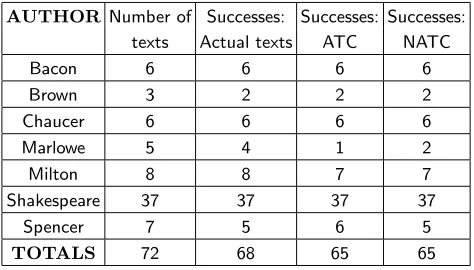
TABLE IV:Author recognition: This table illustrates the results for the experiments of author recognition. In this case ATC results were afflicted by the presence in the corpus of a few poetic texts that, as we have discussed, tend to recognize each others.
We have also performed some additional experiments on a corpus of English texts. Results are shown in Ta-ble IV. In this corpus there were a few poetic texts which, as we could expect, afflicted in some cases ATC. It is worth noting, in fact, that the number of ATC failures is 7, and in this case it’s higher than that of actual text comparisons, which is 4. However, if we look carefully we note that 4 of this 7 mismatches come from the 5 Marlowe works present in our corpus. Among Marlowe’s works only 1 is mis-attributed by actual text comparison, too. This peculiarity of Marlowe roused our interest and we analyzed carefully Marlowe’s results. We found that one of the 4 bad attributions was a poetic text, Hero, and was attributed to Spencer, while the remaining 3 unrecognized texts were all attributed to Shakespeare. Similar results were obtained using the NATC method which also does not allow for a clear distinction between Marlowe and Shakespeare. Just as a matter of curiosity, and without entering in the debate, we report here that, among the many thesis on the real identity of Shake-speare, there is one who claims Shakespeare was just a pseudonym used by Marlowe to sign some of its works. The Marlowe Society embraces this cause and has pre-sented many works which should prove this theory, or at least make it plausible (starting of course by confuting the official date of death of Marlowe, 1593).
Before concluding this section several remarks are in order concerning our minimum cross-entropy method used to perform authorship attribution. Our criterion has been that of saying that theX should be attributed to a given author if another work of this author is the clos-est (in the cross-entropy ranking) toX. It can happen, and sometimes this is the case, that the second-closest text to X belongs to another author, different from the first. Said in other words, in the ranking of relative en-tropies between theX text and all the other text of our corpus, works belonging to a given author are far from clustering in the same zone of the ranking. This fact can
be easily explained with the large variety of features that can be present in the production of an author. Dante, for instance, wrote both poetry and prose, this latter both in Italian and Latin. In order to take into account this non-homogeneity we decided to set authorship by watch-ing only at the closest text to the unknown one. In fact, for what we have said, averaging or taking into account all the texts of every author could introduce biases given to the heterogeneity in each author’s production. Our choice is then perfectly coherent with the purpose of au-thorship attribution which is not to determine anaverage author of the unknown text, but who wrote that partic-ular text. The limit of this method is the assumption that if an author wrote a text, then he is likely to have written a similar text, at least with regard to structural or syntactic aspects. From our experiments we can say, a posteriori, that this assumption does not seem to be unrealistic.
A further remark concerns the fact that our results for authorship attribution could only provide with some hints about the real paternity of a text. One cannot, in fact, never be sure that the reference corpus contains at least one text of the unknown author. If this is not the case we can only say that some works of a given author resembles to the unknown text. On the other hand the method could be highly effective when one has to decide among a limited and predefined set of candidate authors: see for instance theWright-Wrightproblem [66] and the Grunberg-Van der Jagtproblem in The Netherlands [67]. From a general point of view, finally, it is important to remark that the ATC method is of much greater interest than the NATC one. In fact, even though in linguistic re-lated problem the two methods give comparable results, ATC can be used with every set of generic sequences, while the NATC requires a precise definition of words in the original strings.
V. SELF-CONSISTENT CLASSIFICATION
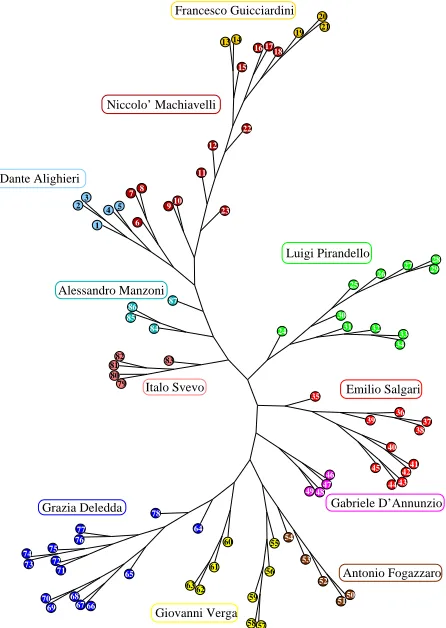
23 4 5 8 910 13 14 15 16 20 21 22 7 1 6 11 25 26 30 34 40 41 42 43 44 45 46 48 49 50 51 53 56 57 58 59 60 61 62 63 64 65 66 68 72 75 77 78 79 80 81 82 83 84 85 86 87 19 32 31 27 28 24 67 71 69 70 23 73 5554 39 29 47 35 74 76 33 37 38 36 12 Grazia Deledda Italo Svevo Alessandro Manzoni Dante Alighieri Niccolo’ Machiavelli Francesco Guicciardini Luigi Pirandello Emilio Salgari Antonio Fogazzaro 52 Giovanni Verga 17 18 Gabriele D’Annunzio
FIG. 4: Italian Authors’ tree: Tree obtained with Fitch-Margoliash algorithm using theP pseudo-distance built from ATC method for the corpus of Italian texts considered in sect.IV.b. For sake of clarity in the representation we have chosen a constant length for the distances between nodes and between nodes and leaves.
A. Author trees
In our applications we used the Fitch-Margoliash method [71] of the package PhylIP (Phylogeny Inference Package) [72] which basically constructs a tree by min-imizing the net disagreement between the matrix pair-wise distances and the distances measured on the tree. Similar results have been obtained with the Neighbor al-gorithm [73]. The first test for our method consisted in analyzing with the Fitch-Margoliash procedure the dis-tance matrix obtained by the corpus of italian texts used before for authorship attribution. Results are presented in Figure 4. As it can be seen works by the same author tend to cluster quite well in the presented tree.
B. Language trees
The next step was applying our method in a less ob-vious context: that of relationship between languages. Suppose to have a collection of texts written in
differ-1
Albanian [Albany] Romani Balkan [East Europe] Maltese [Malta]
Romanian [Romania] Romani Vlach [Macedonia]
Corsican [France] Sammarinese [Italy] Friulian [Italy] Italian [Italy] Rhaeto Romance [Switzerland]
French [France] Sardinian [Italy] Galician [Spain] Spanish [Spain] Asturian [Spain] Portuguese [Portugal] Wallon [Belique] Occitan Auvergnat [France]
Occitan [France] Catalan [Spain] English [UK] Latvian [Latvia] Sorbian [Germany] Serbian [Serbia] Croatian [Croatia] Bosnian [Bosnia] Slovenian [Slovenia] Slovak [Slovakia] Polish [Poland] Utzbek [Utzbekistan] Turkish [Turkey]
Irish Gaelic [Ireland] Scottish Gaelic [UK]
Welsh [UK] Hungarian [Hungary] Finnish [Finland] Lappish [Norway] Estonian [Estonia] Icelandic [Iceland] Faroese [Denmark] Swedish [Sweden] Norwegian Nynorsk [Norway] Norwegian Bokmal [Norway] Danish [Denmark] Afrikaans Dutch [Netherlands] Frisian [Netherlands] Luxembourgish [Luxembourg] German [Germany] Breton [france] Basque [Spain] ROMANCE SLAVIC CELTIC ALTAIC GERMANIC UGRO−FINNIC
FIG. 5: Indo-european family language tree: This fig-ure illustrates the phylogenetic-like tree constructed on the basis of more than 50 different versions of the “The Universal Declaration of Human Rights”. The tree is obtained using the Fitch-Margoliash method applied to the symmetrical dis-tance matrix based on the R distance defined in sect. II.b built from ATC method. This tree features essentially all the main linguistic groups of the Euro-Asiatic continent (Ro-mance, Celtic, Germanic, Ugro-Finnic, Slavic, Baltic, Altaic), as well as few isolated languages as the Maltese, typically con-sidered an Afro-Asiatic language, and the Basque, classified as a non-Indo-European language and whose origins and re-lationships with other languages are uncertain. The tree is unrooted, i.e. it does not require any hypothesis about com-mon ancestors for the languages and it can not be used to infer informations about common ancestors of the languages. For more details see the text.The lengths of the paths between pairs of documents measured along the tree branches are not proportional to the actual distance between the documents.
ent languages. More precisely, imagine to have a corpus containing several versions of the same text in different languages, and to be interested in a classification of this corpus. In order to have the largest possible corpus of texts in different languages we have used: “The Universal Declaration of Human Rights” [74] which sets the Guin-ness World Record for the most translated document.
[image:13.612.67.290.52.366.2]as the Maltese, typically considered a Semitic language because of its arabic base, and the Basque, a non-Indo-European language whose origins and relationships with other languages are uncertain. The results are also in good agreement with those obtained by true sequences comparison reported in [3] with a remarkable difference concerning the Ugro-Finnic group here fully recognized, while with true texts Hungarian was put a little apart.
After the publication of our tree in [3] a similar tree, using the same dataset, has been proposed in [52] using
N CD(x, y) (see Sect. IIB) estimated with gzip.
It is important to stress how these trees are not in-tended to reproduce the current trends in the recon-struction of genetic relations among languages. They are clearly biased by the fact of using entire modern texts for their construction. In the reconstruction of genetic rela-tionships among languages one is typically faced with the problem of distinguishing vertical (i.e. the passage of information from parent languages to child languages) from horizontal transmission (i.e. which includes all the other pathways in which two languages interact). This is the main problem of lexicostatistics and glottochronol-ogy [76] and the most widely used method is that of the so-called Swadesh 100-words lists [77]. The main idea is that of comparing languages by comparing lists of so-called basic words. These lists only include the so-so-called cognate words ignoring as much as possible horizontal borrowings of words between languages. It is clear now how an obvious source of bias in our results is repre-sented by the fact of non-having performed any selec-tion of words to be compared. It turns out then that in our trees English is closer to Romance languages sim-ply because almost 50% of English vocabulary has been borrowed from French. These borrowings should be ex-punged if one is interested in reconstructing the actual ge-netic relationships between languages. Work is presently in progress in order to merge Swadesh list techniques with our methods [78].
VI. DISCUSSION AND CONCLUSIONS
We have presented here a class of methods, based on the LZ77 compression algorithm, for information extrac-tion and automatic categorizaextrac-tion of generic sequences of characters. The essential ingredient of these methods is the definition and the measure of a remoteness and of a distance between pairs of sequences of characters. In this context we have introduced in particular the notion ofdictionaryof a sequence and ofArtificial Text(or Arti-ficial Sequence) and we have implemented these new tools in an information extraction scheme (ATC) that allows to overcome several difficulties arising in the comparison of sequences.
With these tools in our hands, we have focused our attention on several applications to textual corpora in
several languages, since in this context it is particularly easy to judge experimental results. We have at first shown that dictionaries are intrinsically interesting and that they contain relevant signatures of the texts they are extracted from. Then in a first series of experiments we have shown how we can determine, and then extract, some semantic attributes of an unknown text (its lan-guage, author or subject). We have also shown that com-paring artificial texts, instead of actual sequences, gives better results in most of these situations. In the linguistic context, moreover, we have been able to define natural artificial texts (NAT) exploiting the presence of natural language words in the analyzed texts. Results from ex-periments indicate that this additional information does not produce any advantage, i.e. the NAT comparison (NATC) and ATC yield to the same results. However, the question is not whether NATC performs better than ATC. From a general point of view, in fact, the ATC method is of much greater interest with respect to the NATC one. In fact, while in linguistic related problems the two methods equally perform, in many cases NATC are impossible to construct because outside linguistics there is no precise definition of word. On the other hand the fact that ATC and NATC perform at least equally well in linguistics motivated problems, is a good news because one can reasonably infer that the situation will not change drastically in situations where NATC will not be available anymore.
A slightly different application of our method is that of the self-consistent classification of a corpus of sequences. In this case we do not need any information about the corpus, but we are interested in observing the self orga-nization that arises from the knowledge of a matrix of distances between pairs of elements. A good way to rep-resent this structure can be obtained using phylogenetic algorithms to build a tree representation of the consid-ered corpus. In this paper we have shown how the self-organized structures observed in these trees are related to the semantic attributes of the considered texts.
Finally, it is worth stressing once again the high ver-satility and generality of our method that applies to any kind of corpora of character strings independently of the type of coding behind them: texts, symbolic dynamics of dynamical systems, time series, genetic sequences, etc. These features could be potentially very important for fields where the human intuition can fail: genomics, geo-logical time series, stock market data, medical monitor-ing, etc.
Acknowledgments
: The authors are indebted with[1] Shannon CE, A mathematical theory of communication, 1948The Bell System Technical Journal27379-423 and 623–656
[2] Zurek WH (ed.),Complexity, Entropy and Physics of In-formation(Addison-Wesley, Redwood City, 1990). [3] Benedetto D, Caglioti E and Loreto V, Language trees
and zipping, 2002 Physical Review Letters 88 048702-048705
[4] Lempel A and Ziv J, A Universal Algorithm for sequen-tial Data Compression, 1977IEEE Transactions on In-formation TheoryIT-23337-343
[5] Loewenstern D, Hirsh H, Yianilos P and Noordewieret M, DNA Sequence Classification using Compression-Based Induction, 1995 DIMACS Technical Report, 95-04 [6] Kukushkina OV, Polikarpov AA and Khmelev DV, Using
Literal and Grammatical Statistics for Authorship Attri-bution, 2000Problemy Peredachi Informatsii37 96-108 (in Russian). Translated in English 2001Problems of In-formation Transmission37172-184
[7] Juola P, Cross-entropy and linguistic typology, 1998 Pro-ceedings of New Methods in Language Processing 3, Sid-ney
[8] Teahan WJ, Text Classification and Segmentation Us-ing Minimum Cross-Entropy, 2000 ProceedUs-ings of the ternational Conference on Content-based Multimedia In-formation Access (RIAO), pp. 943-961. C.I.D.-C.A.S.I.S, Paris
[9] Thaper N, MS in Computer Science, MIT, Master thesis (2001).
[10] Baronchelli A, Caglioti E, Loreto V and Pizzi E, Dic-tionary based methods for information extraction, 2004
Physica A342294-300
[11] Puglisi A, Benedetto D, Caglioti E, Loreto V and Vulpi-ani A, Data compression and learning in time sequences analysis, 2003Physica D18092-107
[12] Fukuda K, Stanley H E and Nunes Amaral L A, Heuristic segmentation of a nonstationary time series, 2004Phys. Rev. E69041905
Galv´an P, Carpena P, Rom´an-Rold´an R, Oliver J, and Stanley H E, Analysis of symbolic sequences using the Jensen-Shannon divergence, 2002 Phys. Rev. E 65
041905
[13] Azad R K, Bernaola-Galv´an P, Ramaswamy R and Rao J S, Segmentation of genomic DNA through entropic di-vergence: Power laws and scaling, 2002Phys. Rev. E65
051909
[14] Mantegna R N, Buldyrev S V, Goldberger A L, Havlin S, Peng C K, Simons M and Stanley H E, Linguistic Features of Noncoding DNA Sequences, 1994Phys. Rev. Lett.733169
[15] Grosse I, Bernaola-Galvn P, Carpena P, Romn-Roldn R, Oliver J, and Stanley H E, Analysis of symbolic sequences using the Jensen-Shannon divergence, 2002Phys. Rev. E 65041905
[16] Kennel M B, Testing time symmetry in time series us-ing data compression dictionaries, 2004Phys. Rev. E69
056208
[17] Mertens S and Bauke H, Entropy of pseudo-random-number generators, 2004Phys. Rev. E69055702. [18] Falcioni M, Palatella L, Pigolotti S and Vulpiani A, What
properties make a chaotic system a good Pseudo Random
Number Generator? (2005) [cond-mat/0503xxx] [19] Grassberger P, Data Compression and Entropy
Esti-mates by Non-sequential Recursive Pair Substitution, 2002 [http://babbage.sissa.it/abs/physics/0207023] [20] Schuermann T and Grassberger P, Entropy estimation of
symbol sequences, 1996CHAOS6167-171
[21] Quiroga R Q, Arnhold J, Lehnertz K and Grassberger P, Kulback-Leibler and renormalized entropies: Applica-tions to electroencephalograms of epilepsy patients, 2000
Phys. Rev. E628380
[22] Kopitzki K, Warnke P C, Saparin P, Kurths J and Tim-mer J, Comment on ”Kullback-Leibler and renormal-ized entropies: Applications to electroencephalograms of epilepsy patients”, 2002Phys. Rev. E 66043902 [23] Quiroga R Q, Arnhold J, Lehnertz K and Grassberger P,
Reply to ”Comment on ‘Kullback-Leibler and renormal-ized entropies: Applications to electroencephalograms of epilepsy patients’ “, 2002Phys. Rev. E66043903 [24] Khinchin AI,Mathematical Foundations of Information
Theory(Dover, New York, 1957)
[25] Welsh D,Codes and Cryptography(Clarendon Press, Ox-ford, 1989)
[26] Chaitin GJ, On the length of programs for computing finite binary sequences, 1966 Journal of the Association
for Computer Machinery13547-569
[27] Chaitin GJ, Information, randomness and incomplete-ness (2nd ed.)(World Scientific, Singapore, 2002) [28] Kolmogorov AN, Three Approaches to the quantitative
definition of Information, 1965Problems of Information Transmission11-17
[29] Solomonov RJ, A formal theory of inductive inference, 1964Information and Control71-22 and 224-254 [30] Li M and Vit´anyi PMB,An introduction to Kolmogorov
complexity and its applications (2nd. ed.) (Springer, 1997)
[31] Wyner AD and Ziv J, The sliding-window Lempel-Ziv algorithm is asymptotically optimal, 1994Proceedings of the IEEE,82872-877
[32] Pierce JR,Introduction to information theory: Symbols, signals and noise (2nd ed.) (Dover Publications, Inc., New York, 1980)
[33] Farach M, Noordewier M, Savari S, Shepp L, Wyner A and Ziv J, On the entropy of DNA: algorithms and mea-surements based on memory and rapid convergence, 1995 Proceedings of the Sixth Annual ACM-SIAM Symposium on Discrete Algorithms, San Francisco, California, 22-24 January 1995. pp. 48-57
[34] Milosavljevi´c A, Discovering Dependencies via Algorith-mic Mutual Information: A Case Study in DNA Sequence Comparisons, 1995Machine Learning2135-50
[35] Wyner AD, 1994 Shannon Lecture, Typical sequences and all that: Entropy, Pattern Matching and Data Com-pression, 1994 ATeT Bell Laboratories
[36] Ziv J and Merhav N, A measure of relative entropy be-tween individual sequences with applications to universal classification, 1993 IEEE Transactions on Information Theory391280-1292
[37] Cai H, Kulkarni S and Verd´u S, 2002 Proc. of the 2002 IEEE Intern. Symp. Inform. Theory, p. 433, USA [38] Verd´u S, Fifty Years of Shannon Theory, 1998 IEEE