ARTICLE
Cite this: DOI: 10.1039/x0xx00000x
Received 00th January 2012, Accepted 00th January 2012
DOI: 10.1039/x0xx00000x
www.rsc.org/
A modular synthesis of functionalised phenols
enabled by controlled boron speciation†
John J. Molloy,
aRobert P. Law,
a,bJames W. B. Fyfe,
aCiaran P. Seath,
aDavid J.
Hirst,
band Allan J. B. Watson
aA modular synthesis of functionalised biaryl phenols from two boronic acid derivatives has been developed via one-pot Suzuki-Miyaura cross-coupling, chemoselective control of boron solution speciation to generate a reactive boronic ester in situ, and oxidation. The utility of this method has been further demonstrated by application in the synthesis of drug molecules and components of organic electronics, as well as within iterative cross-coupling.
Introduction
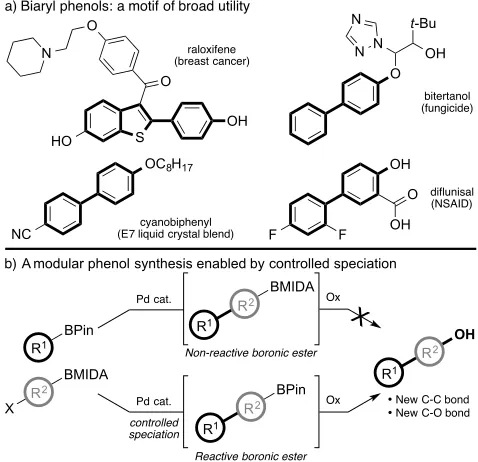
The main text of the article should go here with headings as appropriate.The biaryl phenol moiety is a privileged structure that has found wide-ranging applications within the pharmaceutical, agrochemical, and material industries (Figure 1a).1 For example, the basic biaryl phenol skeleton represents the principle architecture of (i) the breast cancer treatment raloxifene2 and the non-steroidal anti-inflammatory drug (NSAID) diflunisal,3 (ii) the fungicide bitertanol,4 and (iii) components of the E7 liquid crystal blend.5 Biaryl phenols are also of continued interest within academic research, particularly in total synthesis where many structurally unique natural products, such as (+)-Cavicularin6 and Biphenomycin A,7 feature this motif.
Of the methods available for the synthesis of biaryl phenols, Suzuki-Miyaura cross-coupling8 of, for example, halophenols with boronic acid derivatives is perhaps the most direct method. However, many of these processes can be problematic, with diminished yields due to issues with boronate formation from the free phenol.9 Use of a protected phenol or suitable latent hydroxyl may therefore be preferable in these cases.
We considered a novel approach towards the synthesis of biaryl phenols using two boron species in which a reactive boronic ester takes part in a Suzuki-Miyaura cross-coupling to establish the required C-C bond and a protected boronic ester acts as a latent hydroxyl unit (Figure 1b).10 We have previously demonstrated the formal homologation of aryl boronic acid pinacol esters (BPin) using boronic acid N-methyliminodiacetic acid (BMIDA) esters11 via chemoselective control of boron solution speciation.12 This method provides a one step synthesis of a new reactive BPin ester primed for further reaction, such as further Suzuki-Miyaura cross-coupling, while avoiding ancillary deprotection and isolation steps. Herein we show how this controlled speciation process can be smoothly coupled to
an oxidative event providing a one-pot, step-efficient, modular synthesis of functionalised biaryl phenols.
Figure 1. (a) Importance of biaryl phenols. (b) A modular biaryl phenol synthesis enabled by chemoselective boron speciation.
Results and discussion
To probe the appropriateness of controlled speciation in this context, we established the reactivity of aryl BPin and BMIDA esters towards oxidation using oxidants known to be effective for similar transformations (Table 1). BPin esters are very labile towards oxidation10 while BMIDA esters have previously been shown to withstand common neutral or acidic oxidative conditions such as
• New C-C bond • New C-O bond a) Biaryl phenols: a motif of broad utility
O N
t-Bu
OH N
N
bitertanol (fungicide) S
OH O
O N
OC8H17
NC
OH
F
F OH
O raloxifene
(breast cancer)
diflunisal (NSAID) HO
cyanobiphenyl (E7 liquid crystal blend)
BPin R2 R1
Pd cat. Ox
controlled speciation
BMIDA R2 R1
Ox BPin
BMIDA
X R1
R2
OH R2 R1 Pd cat.
Non-reactive boronic ester
Reactive boronic ester
b) A modular phenol synthesis enabled by controlled speciation
[image:1.595.303.542.331.562.2]Swern, TPAP/NMO, and DMP oxidations as well as the comparatively harsh Jones oxidation.13 However, tolerance of oxidation in basic media was anticipated to be low as BMIDA esters are readily hydrolysed to liberate the readily oxidisable parent boronic acid.14 As expected, biphenyl BPin 1, with available p orbital, was efficiently oxidized with peroxide (entries 1 and 3), however, little oxidation was observed with Oxone®, NaOCl, or NaBO3 (entries 5, 7, and 9). BMIDA 2 was surprisingly inert, even under basic reaction conditions and with the more nucleophilic peroxide oxidants due to the occupied p orbital (entries 2, 4, 6, 8, and 10). A small quantity of oxidation is observed if there is sufficient hydrolysis of the BMIDA to the parent oxidatively labile boronic acid (e.g., entry 2). These results further demonstrate the remarkable resilience of BMIDA esters towards oxidation as well as confirm the requirement for use of a more reactive boronic ester in the designed process.
Table 1. Selection and optimisation of oxidant.
Entry Boronic ester Oxidant 3a (%)a
1 1 30% aq. H2O2 98
2 2 30% aq. H2O2 10
3 1 UHPb 87
4 2 UHPb 2
5 1 sat. aq. Oxone® 9
6 2 sat. aq. Oxone® –
7 1 NaOCl –
8 2 NaOCl –
9 1 NaBO34H2O 18
10 2 NaBO34H2O 1
a Determined by HPLC analysis using an internal standard.15b UHP = urea-hydrogen peroxide.
With chemoselective boronic ester oxidation demonstrated, we sought to generate a one-pot protocol for the synthesis of biaryl phenols (Scheme 1). PhBPin (4) was reacted with haloaryl BMIDA 5 under conditions that promote chemoselective generation of a reactive BPin intermediate (6). Subsequent one-pot treatment with H2O2 generated the desired phenolic product 3a in 80% isolated yield.
Scheme 1. Modular biaryl phenol synthesis enabled by chemoselective boron speciation.
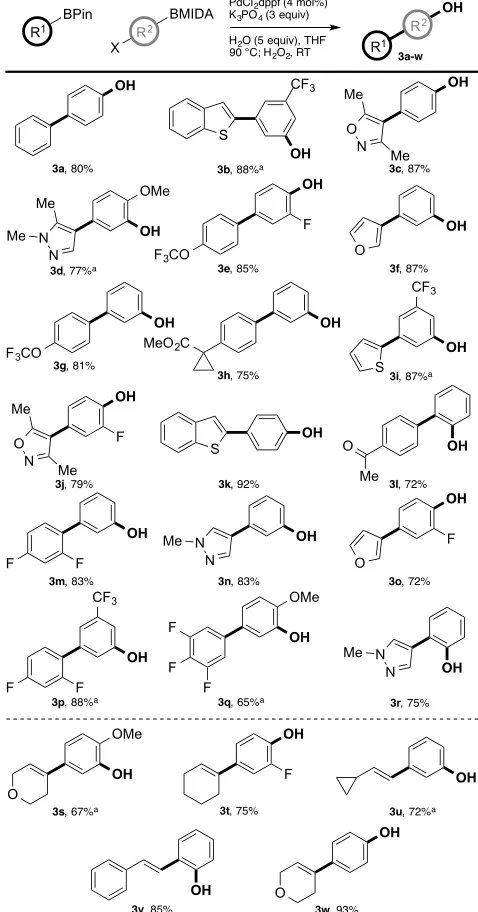
Having identified effective conditions for the modular phenol synthesis, we sought to ascertain the generality of our protocol through application to a diverse range of BPin and BMIDA components (Figure 2). A library of functionalised phenolic products was rapidly prepared from commercial building blocks and with typically high levels of synthetic efficiency, especially for BMIDA units with electron-withdrawing functionality. For those reactions in which the cross-coupling was found to be slow, use of a more active catalyst system (Pd(OAc)2/SPhos) was beneficial. In addition to the formation of biaryl phenols (3a-r), the synthesis of styrenyl phenols was similarly effective (3s-w).
Figure 2. Scope of the modular phenol synthesis. Yields are isolated yields of pure products. a Using Pd(OAc)
2 (4 mol%) and SPhos (8 mol%) as the catalyst.
Oxidant (10 equiv)
B(OR)2 OH
K3PO4 (3 equiv)
H2O, THF, RT, 3 h
B(OR)2 = BPin: 1
B(OR)2 = BMIDA: 2
3a
OH BMIDA
BPin
Br
PdCl2dppf (4 mol%) K3PO4 (3 equiv), H2O (5 equiv)
3a, 80% yield THF, 90 °C; H2O2 (10 equiv), RT
4 5
BPin
H2O2 Pd cat.
6 controlled
speciation
OH
O
OH
OH
O N
Me Me
OH
F3CO
N N
Me OH
O
OH
OH MeO2C
N N Me
OH
OH
S OH
S
CF3
OH 3b, 88%a
3k, 92% 3a, 80%
3w, 93%
3c, 87%
3f, 87%
3n, 83% 3g, 81%
3h, 75%
3v, 85%
3r, 75% OH
3l, 72% O
Me
OH
3m, 83% F F
OH
O N
Me Me
3j, 79% F
F
F3CO
3e, 85% OH
OH
3t, 75% F
O
F
3o, 72% OH
3u, 72%a OH OH
3p, 88%a F F
CF3
OH
3i, 87%a CF3
S
O
OMe
3s, 67%a OH
OMe
3q, 65%a OH
F F F OMe
3d, 77%a OH N
N Me
Me
BPin BMIDA
X
R1 R2
OH R2 R1
PdCl2dppf (4 mol%) K3PO4 (3 equiv)
H2O (5 equiv), THF
[image:2.595.34.286.266.445.2]In addition to the chemoselectivity control with regards to boron, this procedure also exhibits remarkable chemoselectivity for common functionality.16 The mildly basic reaction conditions preclude oxidations that proceed via an electrophilic H2O2 mechanism. Consequently, the in situ generated biaryl BPin intermediate is chemoselectively oxidised in the presence of oxidatively labile functionality including olefinic moieties such as styrenes (3s-u, w) and stilbenes (3v), electron-rich heterocycles such as furans (3f, 3o), and heteroatoms such as sp2-nitrogen (3c, 3d, 3j,
3n, 3r) and sulfur (3b, 3i, 3k). This latter aspect enables preparation of the biaryl phenolic core of raloxifene (3k).2 In addition, the reaction tolerates functional groups that are potentially labile via a nucleophilic H2O2 mechanism, such as esters and ketones (3h, 3l).
To further demonstrate the synthetic utility of our method, we have applied this protocol towards the preparation of commercialised products and within iterative synthesis (Scheme 2).
Scheme 2. (a) Synthesis of diflunisal 7. (b) Synthesis of E7 cyanobiphenyl 8. (c) Synthesis of triaryl phenol 9 via one-pot iterative cross-coupling and oxidation.
Diflunisal3,17 7 was prepared in 50% overall yield over two steps (Scheme 2a). The yield-limiting issue of this process was found to be the in situ generation of a protodeboronation-prone boronic acid intermediate.18 Additionally, 8, a component of the E7 liquid crystal blend,5 was isolated in 80% yield with no reaction observed at the oxidatively labile nitrile functionality (Scheme 2b). Furthermore, high levels of chemoselective control can be achieved in a one-pot iterative cross-coupling11,19 with three different boron species (Scheme 2c). Synthesis of the triaryl phenol 9 involves the formation of two C-C bonds, recycling of pinacol over multiple boron species, and chemoselective oxidation to provide the desired triaryl phenol product in 91% isolated yield.
Conclusions
In summary, chemoselective control of boron solution speciation provides expedient access to oxidatively labile
pinacol boronic esters, which enables a modular, iterative synthesis of phenolic frameworks. The reaction is tolerant of a diverse range of useful functionality: pH control renders electrophilic oxidations inactive while the mild reaction conditions prevent nucleophilic oxidation of any functionality other than BPin. This approach is highly applicable as shown through the preparation of commercialised drug molecules and materials as well as within iterative cross-coupling processes. This study further demonstrates the utility of speciation control as a method for chemoselective bond formation.
Experimental Section
Materials and methods
Purification of starting materials. All reagents and solvents were obtained from commercial suppliers and were used without further purification unless otherwise stated. Purification was carried out according to standard laboratory methods.20 Dry THF was obtained from a PureSolv SPS-400-5 solvent purification system. This solvent was transferred to and stored in a septum-sealed oven-dried flask over previously activated 4 Å molecular sieves and purged with and stored under N2. CH2Cl2, Et2O, EtOAc, MeCN, and petroleum ether 40-60° for purification purposes were used as obtained from suppliers without further purification. K3PO4 was dried in a Heraeus Vacutherm oven at 60 °C under vacuum for a minimum of 24 hours before use.
Experimental details. Reactions were carried out using conventional glassware (preparation of intermediates) or in capped 5 mL microwave vials (optimisation reactions and reactions for Table 1, Scheme 1, Figure 2, and Scheme 2). The glassware was oven-dried (150 °C) and purged with N2 before use. Purging refers to a vacuum/nitrogen-refilling procedure. Room temperature was generally 18 °C. Reactions were carried out at elevated temperatures using a temperature-regulated hotplate/stirrer.
Purification of products. Thin layer chromatography was carried out using Merck silica plates coated with fluorescent indicator UV254. These were analysed under 254 nm UV light or developed using potassium permanganate solution. Normal phase flash chromatography was carried out using ZEOprep 60 HYD 40-63 µm silica gel. Reverse phase flash chromatography was carried out using IST Isolute C18 cartridges.
Analysis. Fourier Transformed Infra-Red (FTIR) spectra were obtained on a Shimadzu IRAffinity-1 machine. 19F NMR spectra were obtained on a Bruker AV 400 spectrometer at 376 MHz. 11B NMR spectra were obtained on a Bruker AV 400 spectrometer at 128 MHz. 1H and 13C, NMR spectra were obtained on either a Bruker AV 400 at 400 MHz and 101 MHz, respectively, or Bruker DRX 500 at 500 MHz and 126 MHz, respectively. Chemical shifts are reported in ppm and coupling constants are reported in Hz: CDCl3 is referenced at 7.26 (1H) and 77.0 (13C), DMSO-d6 referenced at 2.50 (1H) and 39.5 (13C), and CD
3CN referenced at 1.94 (1H) and 118.3, 1.3 (13C). High-resolution mass spectra were obtained through analysis at
OH
F
F OH
O BMIDA
F F
OMe O BPin
Cl
i) Pd(OAc)2 (4 mol%) SPhos (8 mol%) K3PO4 (3 equiv)
H2O (5 equiv), THF 90 °C; H2O2, RT ii) aq. KOH, 80 °C
Diflunisal 7, 50% yield a)
OH
NC BMIDA
NC
BPin
Br
PdCl2dppf (4 mol%) K3PO4 (3 equiv)
H2O (5 equiv), THF 90 °C; H2O2, RT
8, 80% yield b)
c)
9, 91% yield i) PdCl2dppf (4 mol%)
K3PO4 (4 equiv) H2O (20 equiv) THF, 90 °C
ii)
iii) H2O2, RT
S
OH
OMe S BPin
BMIDA
Br
OMe
Br
the EPSRC UK National Mass Spectrometry Facility at Swansea University. Reversed phase HPLC data was obtained on an Agilent 1200 series HPLC using a Machery-Nagel Nucleodur C18 column, which was maintained at a constant temperature of 40 °C. Analysis was performed using a gradient method, eluting with 5 – 80% MeCN/H2O over 16 minutes at a flow rate of 2 mL/min. Samples for HPLC analysis were prepared through the addition of 2 mL of caffeine standard (to the completed reaction mixture, the resulting solution was then stirred before the removal of a 200 µL aliquot. The aliquot was diluted to 1 mL with MeCN, a 200 µL aliquot of the diluted solution was then filtered through cotton wool and further diluted with 800 µL MeCN and 500 µL H2O for HPLC analysis against established conversion factors.
Synthetic procedures
General procedure A. For example, synthesis of compound 3a. To an oven-dried 5 mL microwave vial was added 4-bromophenylboronic acid MIDA ester (70.6 mg, 0.226 mmol, 1 equiv), 4,4,5,5-tetramethyl-2-phenyl-1,3,2-dioxaborolane (69.3 mg, 0.339 mmol, 1.5 equiv), Pd(dppf)Cl2·DCM (7.4 mg, 0.009 mmol, 4 mol%), and K3PO4 (144 mg, 0.678 mmol, 3 equiv). The vial was then capped and purged with N2 before addition of THF (0.9 mL, 0.25 M) and H2O (20 µL, 1.13 mmol, 5 equiv). The reaction mixture was then heated to 90 °C in a sand bath for 24 h. The reaction mixture was allowed to cool to room temperature then decapped, cooled to 0 ˚C, and 30% wt. aq. H2O2 (177 µL, 2.26 mmol, 10 equiv) was added dropwise. The reaction mixture was then stirred at room temperature for 3 h. The reaction mixture was then cooled to 0 ˚C and quenched with sodium metabisulphite (176 mg, 0.904 mmol, 4 equiv) before being concentrated under vacuum. The residue was then dissolved in EtOAc (10 mL) and washed with sat. aq. NH4Cl (2x10 mL) and brine (10 mL). The aqueous washings were re-extracted with EtOAc (10 mL), the combined organics were filtered through a hydrophobic frit packed with Celite®, and concentrated under vacuum before being purified by column chromatography (C18 silica gel, 0-60% H2O in MeCN) to afford the title compound as a white solid (31 mg, 80%).
General procedure B. For example, synthesis of compound 3b. To an oven dried 5 mL microwave vial was added 3-bromo-5-(trifluoromethyl)phenylboronic acid MIDA ester (86 mg, 0.226 mmol, 1 equiv), benzo[b]thiophen-2-yl)-4,4,5,5-tetramethyl-1,3,2-dioxaborolane (88.2 mg, 0.339 mmol, 1.5 equiv), Pd(OAc)2 (2 mg, 0.009 mmol, 4 mol%), SPhos (7.4 mg, 0.018 mmol, 8 mol%), and K3PO4 (144 mg, 0.678 mmol, 3 equiv). The vial was then capped and purged with N2 before addition of THF (0.9 mL, 0.25 M) and H2O (20 µL, 1.13 mmol, 5 equiv). The reaction mixture was then heated to 90 °C in a sand bath for 24 h. The reaction mixture was allowed to cool to room temperature then decapped, cooled to 0 ˚C, and 30% wt. aq. H2O2 (177 µL, 2.26 mmol, 10 equiv) was added dropwise. The reaction mixture was then stirred at room temperature for 3 h. The reaction mixture was then cooled to 0 ˚C and quenched with sodium metabisulphite (176 mg, 0.904 mmol, 4 equiv) before being concentrated under vacuum. The residue was then
dissolved in EtOAc (10 mL) and washed with sat. aq. NH4Cl (2x10 mL) and brine (10 mL). The aqueous washings were re-extracted with EtOAc (10 mL), the combined organics filtered through a hydrophobic frit packed with Celite®, and concentrated under vacuum before being purified by column chromatography (silica gel, 0-30% Et2O in petroleum ether) to afford the title compound as an orange solid (58 mg, 88%).
Characterisation data
The main text of the article should go here with headings as appropriate.
3a: [1,1'-biphenyl]-4-ol. Prepared according to General Procedure A using 4-bromophenylboronic acid MIDA ester (70.6 mg, 0.226 mmol, 1 equiv), 4,4,5,5-tetramethyl-2-phenyl-1,3,2-dioxaborolane (69.3 mg, 0.339 mmol, 1.5 equiv), Pd(dppf)Cl2·DCM (7.4 mg, 0.009 mmol, 4 mol%), K3PO4 (144 mg, 0.678 mmol, 3 equiv), THF (0.9 mL, 0.25 M), H2O (20 µL, 1.13 mmol, 5 equiv) and 30% wt. aq. H2O2 (177 µL, 2.26 mmol, 10 equiv). After 27 h, the reaction mixture was subjected to the purification outlined in the General Procedure (C18 silica gel, 0-60% H2O in MeCN) to afford the title compound as a white solid (31 mg, 80%). υmax (solid): 3399, 3098, 3062, 1597, 1485 cm-1. 1H NMR (CD3CN, 500 MHz): δ 7.56-7.59 (m, 2H), 7.48-7.51 (m, 2H), 7.42 (t, J = 8.2 Hz, 2H), 7.30 (tt, J = 8.0, 2.0 Hz, 1H), 6.99 (s, 1H), 6.89 (d, J = 8.3 Hz, 2H). 13C NMR (DMSO-d6, 126 MHz): δ 157.1, 140.2, 130.9, 128.7, 127.7, 126.3, 125.9, 115.8. HRMS: exact mass calculated for [M-H] -(C12H9O) requires m/z 169.0659, found m/z 169.0658.
3b: 3-(Benzo[b]thiophen-2-yl)-5-(trifluoromethyl)phenol. Prepared according to General Procedure B using 3-bromo-5-(trifluoromethyl)phenylboronic acid MIDA ester (86 mg, 0.226 mmol, 1 equiv), benzo[b]thiophen-2-yl)-4,4,5,5-tetramethyl-1,3,2-dioxaborolane (88.2 mg, 0.339 mmol, 1.5 equiv), Pd(OAc)2 (2 mg, 0.01 mmol, 4 mol%), SPhos (7.4 mg, 0.02 mmol, 8 mol%), K3PO4 (144 mg, 0.678 mmol, 3 equiv), THF (0.9 mL, 0.25 M), H2O (20 µL, 1.13 mmol, 5 equiv) and 30% wt. aq. H2O2 (177 µL, 2.26 mmol, 10 equiv). After 27 h, the reaction mixture was subjected to the purification outlined in the General Procedure (silica gel, 0-30% Et2O in petroleum ether) to afford the title compound as an orange solid (58 mg, 88%). υmax (solid): 3305, 3067, 3052, 2923, 1610, 1450, 1439, 1351, 1327 cm-1. 1H NMR (CD3CN, 500 MHz): δ 7.93 (d, J = 7.5 Hz, 1H), 7.86 (dd, J = 6.9, 1.6 Hz, 1H), 7.77 (s, 1H), 7.64 (s, 1H), 7.56 (s, 1H), 7.37-7.46 (m, 3H), 7.10 (s, 1H). 13C NMR (CD3CN, 126 MHz): δ 157.9, 141.9, 140.5, 139.4, 136.6, 132.2 (d, 2JC-F = 32.4 Hz), 132.1 (d, 2JC-F = 32.4 Hz), 125.2, 125.0, 124.0, 123.9 (d, 1JC-F = 271.8 Hz) 122.3, 121.4, 116.6, 114.3 (d, 3J
C-F = 3.2 Hz) 111.9 (d, 3JC-F = 3.2 Hz). 19F NMR (CD3CN, 376 MHz): δ –64.2 (s, 3F). HRMS: exact mass calculated for [M-H]- (C15H8F3OS) requires m/z 293.0253, found m/z 293.0245.
mmol, 1.5 equiv), Pd(dppf)Cl2·DCM (7.4 mg, 0.009 mmol, 4 mol%), K3PO4 (144 mg, 0.678 mmol, 3 equiv), THF (0.9 mL, 0.25 M), H2O (20 µL, 1.13 mmol, 5 equiv), and 30% wt. aq. H2O2 (177 µL, 2.26 mmol, 10 equiv). After 27 h, the reaction mixture was subjected to the purification outlined in the General Procedure (silica gel, 0-30% Et2O in petroleum ether) to afford the title compound as a white solid (37 mg, 87%). υmax (solid): 3194, 3025, 2926, 1612, 1591, 1424 cm-1. 1H NMR (CD3CN, 500 MHz): δ 7.18 (d, J = 8.8 Hz, 2H), 7.05 (br. s., 1H), 6.90 (d, J = 8.8 Hz, 2H), 2.35 (s, 3H), 2.20 (s, 3H). 13C NMR (CDCl3, 126 MHz): δ 165.0, 158.9, 155.6, 130.4, 122.3, 116.4, 115.8, 11.5, 10.7. HRMS: exact mass calculated for [M+H]+ (C
11H12NO2) requires m/z 190.0863, found m/z 190.0861.
3d: 5-(1,5-Dimethyl-1H-pyrazol-4-yl)-2-methoxyphenol. Prepared according to General Procedure B using 5-bromo-2-methoxyphenylboronic acid MIDA ester (85 mg, 0.25 mmol, 1 equiv), 1,5-dimethyl-4-(4,4,5,5-tetramethyl-1,3,2-dioxaborolan-2-yl)-1H-pyrazole (83 mg, 0.375 mmol, 1.5 equiv), Pd(OAc)2 (2.3 mg, 0.01 mmol, 4 mol%), SPhos (8.2 mg, 0.02 mmol, 8 mol%), K3PO4 (159 mg, 0.75 mmol, 3 equiv), THF (1 mL, 0.25 M), H2O (22.5 µL, 1.25 mmol, 5 equiv), and 30% wt. aq. H2O2 (195 µL, 2.5 mmol, 10 equiv). After 27 h, the reaction mixture was subjected to the purification outlined in the General Procedure (silica gel, 20-70% EtOAc in petroleum ether) to afford the desired product as a white solid (42 mg, 77%). υmax (film): 3341, 3204, 2920, 2851, 1464, 1034 cm-1. 1H NMR (CDCl3,400 MHz): δ 7.53 (s, 1H), 6.96 (d, J = 2.0 Hz, 1H), 6.91 (d, J = 8.2 Hz, 1H), 6.85 (dd, J = 8.2, 2.0 Hz, 1H), 3.93 (s, 3H), 3.86 (s, 3H), 2.38 (s, 3H). 13C NMR (CDCl
3, 101 MHz): δ 145.3, 144.9, 136.4, 134.5, 126.8, 120.1, 118.9, 113.8, 110.6, 55.6, 35.9, 9.8. HRMS: exact mass calculated for [M+H]+ (C12H15N2O2) requires m/z 219.1128, found m/z 219.1126.
3e: 3-Fluoro-4'-(trifluoromethoxy)-[1,1'-biphenyl]-4-ol. Prepared according to General Procedure A using 4-bromo-2-fluorophenylboronic acid MIDA ester (82.5 mg, 0.25 mmol, 1 equiv), 4,4,5,5-tetramethyl-2-(4-(trifluoromethoxy)phenyl)-1,3,2-dioxaborolane (86 mg, 0.375 mmol, 1.5 equiv), Pd(dppf)Cl2·DCM (8.2 mg, 0.01 mmol, 4 mol%), K3PO4 (159 mg, 0.75 mmol, 3 equiv), THF (1 mL, 0.25 M), H2O (22.5 µL, 1.25 mmol, 5 equiv), and 30% wt. aq. H2O2 (195 µL, 2.5 mmol, 10 equiv). After 27 h, the reaction mixture was subjected to the purification outlined in the General Procedure (silica gel, 0-10% EtOAc in petroleum ether) to afford the title compound as a white solid (58 mg, 85%). υmax (film): 3395, 1503, 1256, 1200, 1159, 1117 cm-1. 1H NMR (CDCl
3,400 MHz): δ 7.50-7.58 (m, 2H), 7.23-7.35 (m, 4H), 7.10 (t, J = 8.5 Hz, 1H), 5.23 (br. s., 1H). 13C NMR (CDCl
3, 101 MHz): δ 151.2 (d, 1JC-F = 237.0 Hz), 148.6, 143.3 (d, 2J
C-F = 14.6 Hz), 138.5, 133.1 (d, 3J
C-F = 5.9 Hz), 128.0, 123.4 (d, 3JC-F = 5.9 Hz), 121.3, 120.5 (q, 1J
C-F = 257.5 Hz), 117.7, 114.2 (d, 2JC-F = 20.5 Hz). 19F NMR (CDCl3, 376 MHz): δ –57.8 (s, 3F), –140.4 (s, 1F). HRMS: exact mass calculated for [M]+ (C
13H8F4O2) requires m/z 272.0455, found m/z 272.0459.
3f: 3-(Furan-3-yl)phenol. Prepared according to General Procedure A using 3-bromophenylboronic acid MIDA ester
(70.6 mg, 0.226 mmol, 1 equiv), 2-(furan-3-yl)-4,4,5,5-tetramethyl-1,3,2-dioxaborolane (65.8 mg, 0.339 mmol, 1.5 equiv), Pd(dppf)Cl2·DCM (7.4 mg, 0.009 mmol, 4 mol%), K3PO4 (144 mg, 0.678 mmol, 3 equiv), THF (0.9 mL, 0.25 M), H2O (20 µL, 1.13 mmol, 5 equiv), and 30% wt. aq. H2O2 (177
µL, 2.26 mmol, 10 equiv). After 27 h, the reaction mixture was subjected to the purification outlined in the General Procedure (silica gel, 0-30% Et2O in petroleum ether) to afford the title compound as a white solid (32 mg, 87%). υmax (solid): 3477, 3401, 3150, 3127, 1591, 1513, 1457 cm-1. 1H NMR (CDCl
3, 500 MHz): δ 7.72 (s, 1H), 7.47-7.50 (m, 1H), 7.26 (t, J = 7.9 Hz, 1H), 7.09 (td, J = 7.8, 1.1 Hz, 1H), 6.97-6.99 (m, 1H), 6.72-6.79 (m, 1H), 6.65-6.71 (m, 1H), 4.88 (br. s., 1H). 13C NMR (CDCl3, 126 MHz): δ 155.9, 143.7, 138.7, 134.1, 130.1, 126.1, 118.6, 113.9, 112.8, 108.9. HRMS: exact mass calculated for [M-H]- (C
10H7O2) requires m/z 159.0452, found m/z 159.0448.
3g: 4'-(Trifluoromethoxy)-[1,1'-biphenyl]-3-ol. Prepared according to General Procedure A using 3-bromophenylboronic acid MIDA ester (70.6 mg, 0.226 mmol, 1 equiv), 4,4,5,5-
tetramethyl-2-(4-(trifluoromethoxy)phenyl)-1,3,2-dioxaborolane (97.7 mg, 0.339 mmol, 1.5 equiv), Pd(dppf)Cl2·DCM (7.4 mg, 0.009 mmol, 4 mol%), K3PO4 (144 mg, 0.678 mmol, 3 equiv), THF (0.9 mL, 0.25 M), H2O (20 µL, 1.13 mmol, 5 equiv), and 30% wt. aq. H2O2 (177 µL, 2.26 mmol, 10 equiv). After 27 h, the reaction mixture was subjected to the purification outlined in the General Procedure (C18 silica gel, 0-60% H2O in MeCN) to afford the title compound as a pale yellow solid (47 mg, 81%). υmax (solid): 3304, 3047, 2928, 1597, 1485, 1457 cm-1. 1H NMR (CD
3CN, 500 MHz): δ 7.72-7.68 (m, 2H), 7.37 (d, J = 8.8 Hz, 2H), 7.31 (t, J = 7.9 Hz, 1H), 7.15-7.12 (m, 1H), 7.09-7.07 (m, 2H), 6.89-6.83 (m, 1H). 13C NMR (CD3CN, 126 MHz): δ 157.4, 148.5, 141.0, 140.0, 130.2, 128.6, 121.3, 120.6 (d, 1J
C-F = 255.3 Hz), 118.6, 114.7, 113.8, 29.4. 19F NMR (CD
3CN, 376 MHz): δ –57.8 (s, 3F). HRMS: exact mass calculated for [M-H]- (C
13H8F3O) requires m/z 253.0482, found m/z 253.0482.
3h: Methyl 1-(3'-hydroxy-[1,1'-biphenyl]-4-yl)cyclopropane-1-carboxylate. Prepared according to General Procedure A using 3-bromophenylboronic acid MIDA ester (70.6 mg, 0.226 mmol, 1 equiv), methyl 1-(4-(4,4,5,5-tetramethyl-1,3,2-dioxaborolan-2-yl)phenyl)cyclopropane-1-carboxylate (102.4 mg, 0.339 mmol, 1.5 equiv), Pd(dppf)Cl2·DCM (7.4 mg, 0.009 mmol, 4 mol%), K3PO4 (144 mg, 0.678 mmol, 3 equiv), THF (0.9 mL, 0.25 M), H2O (20 µL, 1.13 mmol, 5 equiv), and 30% wt. aq. H2O2 (177 µL, 2.26 mmol, 10 equiv). After 27 h, the reaction mixture was subjected to the purification outlined in the General Procedure (silica gel, 0-30% Et2O in petroleum ether) to afford the title compound as a white solid (45 mg, 75%). υmax (solid): 3440, 3040, 2954, 2926, 2852 , 1698, 1590 cm-1. 1H NMR (CDCl3, 500 MHz) δ 7.51 (d, J = 8.5 Hz, 2H), 7.40 (d, J = 8.2 Hz, 2H), 7.27-7.32 (m, 1H), 7.15 (d, J = 7.9 Hz, 1H), 7.01-7.07 (m, 1H), 6.80 (dd, J = 8.0, 2.5 Hz, 1H), 3.66 (s, 3H), 1.63-1.66 (m, 2H), 1.22-1.25 (m, 2H). 13C NMR (CDCl
calculated for [M-H]- (C
17H15O3) requires m/z 267.1027, found
m/z 267.1019.
3i: 3-(Thiophen-2-yl)-5-(trifluoromethyl)phenol. Prepared according to General Procedure B using 3-bromo-5-(trifluoromethyl)phenylboronic acid MIDA ester (95 mg, 0.25 mmol, 1 equiv), 4,4,5,5-tetramethyl-2-(thiophen-2-yl)-1,3,2-dioxaborolane (79 mg, 0.375 mmol, 1.5 equiv), Pd(OAc)2 (2.3 mg, 0.01 mmol, 4 mol%), SPhos (8.2 mg, 0.02 mmol, 8 mol%), K3PO4 (159 mg, 0.75 mmol, 3 equiv), THF (1 mL, 0.25 M), H2O (22.5 µL, 1.25 mmol, 5 equiv), and 30% wt. aq. H2O2 (195
µL, 2.5 mmol, 10 equiv). After 27 h, the reaction mixture was subjected to the purification outlined in the General Procedure (silica gel, 0-15% Et2O in petroleum ether) to afford the title compound as a brown solid (53 mg, 87%). υmax (film): 3318, 1599, 1115, 1099 cm-1. 1H NMR (CDCl
3,400 MHz): δ 7.44-7.47 (m, 1H), 7.35-7.39 (m, 2H), 7.26 (t, J = 2.0 Hz, 1H), 7.13 (dd, J = 5.0, 3.5 Hz, 1H), 7.00-7.03 (m, 1H), 5.16 (s, 1H). 13C NMR (CDCl3, 101 MHz): δ 156.2, 142.3, 136.9, 132.7 (q, 2JC-F = 33.1 Hz), 128.2, 126.0, 124.4, 123.7 (q, 1J
C-F = 272.1 Hz), 116.0, 115.3, 111.2. 19F NMR (CDCl
3, 376 MHz): δ –62.9 (s, 3F). HRMS: exact mass calculated for [M-H]- (C
11H6F3OS) requires m/z 243.0097, found m/z 243.0097.
3j: 4-(3,5-Dimethylisoxazol-4-yl)-2-fluorophenol. Prepared according to General Procedure A using 4-bromo-2-fluorophenylboronic acid MIDA ester (82.5 mg, 0.25 mmol, 1 equiv), 4,4,5,5-tetramethyl-4-(3,5-dimethylisoxazol-4-yl)-1,3,2-dioxaborolane (84 mg, 0.375 mmol, 1.5 equiv), Pd(dppf)Cl2·DCM (8.2 mg, 0.01 mmol, 4 mol%), K3PO4 (159 mg, 0.75 mmol, 3 equiv), THF (1 mL, 0.25 M), H2O (22.5 µL, 1.25 mmol, 5 equiv), and 30% wt. aq. H2O2 (195 µL, 2.5 mmol, 10 equiv). After 27 h, the reaction mixture was subjected to the purification outlined in the General Procedure (silica gel, 10-20% Et2O in petroleum ether) to afford the title compound as a white solid (41 mg, 79%). υmax (film): 3075, 1460, 1410, 1308, 1244, 1213, 1121 cm-1. 1H NMR (CDCl
3,400 MHz): δ 7.13-7.08 (m, 1H), 7.00 (dd, J = 11.5, 2.0 Hz, 1H), 6.94 (ddd, J = 8.0, 2.0, 1.0 Hz, 1H), 5.98 (br. s., 1H), 2.42 (s, 3H), 2.28 (s, 3H). 13C NMR (CDCl
3, 101 MHz): δ 164.8, 158.2, 150.6 (d, 1J
C-F = 237.0 Hz), 142.8 (d, 2JC-F = 16.2 Hz), 125.2 (d, JC-F = 2.7 Hz), 122.4 (d, 3J
C-F = 8.1 Hz), 117.3 (d, 3JC-F = 5.4 Hz), 115.9 (d, 2J
C-F =18.8 Hz), 115.2, 11.0, 10.2. 19F NMR (CDCl3, 376 MHz): δ –139.3 (s, 1F). HRMS: exact mass calculated for [M+H]+ (C
11H11FNO2) requires m/z 208.0768, found m/z 208.0768.
3k: 4-(Benzo[b]thiophen-2-yl)phenol. Prepared according to General Procedure A using 4-bromophenylboronic acid MIDA ester (70.6 mg, 0.226 mmol, 1 equiv), 2-(benzo[b]thiophen-2-yl)-4,4,5,5-tetramethyl-1,3,2-dioxaborolane (88.2 mg, 0.339 mmol, 1.5 equiv), Pd(dppf)Cl2·DCM (7.4 mg, 0.009 mmol, 4 mol%), K3PO4 (144 mg, 0.678 mmol, 3 equiv), THF (0.9 mL, 0.25 M), H2O (20 µL, 1.13 mmol, 5 equiv), and 30% wt. aq. H2O2 (177 µL, 2.26 mmol, 10 equiv). After 27 h, the reaction mixture was subjected to the purification outlined in the General Procedure (silica gel, 0-30% Et2O in petroleum ether) to afford the title compound as an off-white solid (47 mg, 92%). υmax (solid): 3388, 3052, 3042, 2923, 1610, 1597, 1507
cm-1. 1H NMR (DMSO-d
6, 500 MHz): δ 9.78 (s, 1H), 7.91 (d, J = 7.9 Hz, 1H), 7.77 (d, J = 7.9 Hz, 1H), 7.63 (s, 1H), 7.57-7.61 (m, 2H), 7.35 (dt, J = 7.5, 1.3 Hz, 1H), 7.27-7.31 (m, 1H), 6.86 (d, J = 8.5 Hz, 2H). 13C NMR (DMSO-d
6, 126 MHz): δ 158.5, 144.3, 141.2, 138.5, 128.0, 125.1, 125.0, 124.5, 123.7, 122.7, 118.3, 116.4. HRMS: exact mass calculated for [M-H] -(C14H9OS) requires m/z 225.0380, found m/z 225.0385.
3l: 1-(2'-Hydroxy-[1,1'-biphenyl]-4-yl)ethanone. Prepared according to General Procedure A using 2-bromophenylboronic acid MIDA ester (92 mg, 0.25 mmol, 1 equiv), 1-(4-(4,4,5,5-tetramethyl-1,3,2-dioxaborolan-2-yl)phenyl)ethanone (92 mg, 0.375 mmol, 1.5 equiv), Pd(dppf)Cl2·DCM (8.2 mg, 0.01 mmol, 4 mol%), K3PO4 (159 mg, 0.75 mmol, 3 equiv), THF (1 mL, 0.25 M), H2O (22.5 µL, 1.25 mmol, 5 equiv), and 30% wt. aq. H2O2 (195 µL, 2.5 mmol, 10 equiv). After 27 h, the reaction mixture was subjected to the purification outlined in the General Procedure (silica gel, 5-20% EtOAc in petroleum ether) to afford the title compound as a white solid (38 mg, 72%). υmax (film): 3285, 1667, 1479, 1277, 1190, 1179, 1155 cm-1. 1H NMR (CDCl
3,400 MHz): δ 8.11-8.05 (m, 2H), 7.63-7.68 (m, 2H), 7.29-7.34 (m, 2H), 7.08-6.98 (m, 2H), 2.67 (s, 3H). 13C NMR (CDCl
3, 101 MHz): δ 197.4, 152.0, 142.1, 135.6, 129.9, 129.3, 128.9, 128.5, 126.7, 120.7, 115.8, 26.2. HRMS: exact mass calculated for [M+H]+ (C
14H13O2) requires
m/z 213.0910, found m/z 213.0909.
3m: 2',4'-Difluoro-[1,1'-biphenyl]-3-ol. Prepared according to General Procedure A using 3-bromophenylboronic acid MIDA ester (78 mg, 0.25 mmol, 1 equiv), 2-(2,4-difluorophenyl)-4,4,5,5-tetramethyl-1,3,2-dioxaborolane (90 mg, 0.375 mmol, 1.5 equiv), Pd(dppf)Cl2·DCM (8.2 mg, 0.01 mmol, 4 mol%), K3PO4 (159 mg, 0.75 mmol, 3 equiv), THF (1 mL, 0.25 M), H2O (22.5 µL, 1.25 mmol, 5 equiv), and 30% wt. aq. H2O2 (195
µL, 2.5 mmol, 10 equiv). After 27 h, the reaction mixture was subjected to the purification outlined in the General Procedure (silica gel, 0-10% Et2O in petroleum ether) to afford the title compound as a white solid (43 mg, 83%). υmax (film) 3260, 1597, 1479, 1306, 1265, 1229, 1192, 1140, 1099 cm-1. 1H NMR (CDCl3,400 MHz): δ 7.41 (td, J = 8.8, 6.5 Hz, 1H), 7.34 (t, J = 8.0 Hz, 1H), 7.10 (dq, J = 7.6, 1.5 Hz, 1H), 7.00-7.04 (m, 1H), 6.86-7.00 (m, 3H), 5.06 (s, 1H). 13C NMR (CDCl
3, 101 MHz):
δ 161.5 (dd, 1J
C-F = 250.4 Hz, 3JC-F = 5.4), 159.2 (dd, 1JC-F = 250.4 Hz, 3J
C-F = 5.4), 155.0, 136.1, 130.9 (dd, 3JC-F = 6.7, 5.4 Hz), 129.3, 124.4 (dd, 2J
C-F = 18.9 Hz, JC-F = 5.4 Hz), 121.0, 115.5, 114.3, 111.0 (dd, 2J
C-F = 21.5 Hz, JC-F = 2.7 Hz), 103.9 (dd, 2J
C-F = 24.2, 26.9 Hz). 19F NMR (CDCl3, 376 MHz): δ – 111.3 (d, J = 7.5 Hz, 1F), –113.2 (d, J = 7.5 Hz, 1F). HRMS: exact mass calculated for [M+H]+ (C
12H9F2O) requires m/z 207.0616, found m/z 207.0619.
reaction mixture was subjected to the purification outlined in the General Procedure (silica gel, 20-80% Et2O in petroleum ether) to afford the title compound as a yellow solid (33 mg, 83%). υmax (solid): 3107, 2926, 2855, 1616, 1569, 1588, 1374 cm-1. 1H NMR (CD
3CN, 500 MHz): δ 7.79 (s, 1H), 7.72 (s, 1H), 7.19 (t, J = 8.0 Hz, 1H), 7.03 (td, J = 7.6, 1.4 Hz, 1H), 6.98-6.96 (m, 1H), 6.94 (br. s., 1H), 6.74-6.61 (m, 1H), 3.87 (s, 3H). 13C NMR (DMSO-d
6, 126 MHz): δ 157.7, 135.9, 133.8, 129.7, 127.6, 122.0, 115.9, 113.0, 111.8, 38.6. HRMS: exact mass calculated for [M+H]+ (C
10H11N2O) requires m/z 175.0866, found m/z 175.0864.
3o: 2-Fluoro-4-(furan-3-yl)phenol. Prepared according to General Procedure A using 4-bromo-2-fluorophenylboronic acid MIDA ester (83 mg, 0.25 mmol, 1 equiv), 2-(furan-3-yl)-4,4,5,5-tetramethyl-1,3,2-dioxaborolane (73 mg, 0.375 mmol, 1.5 equiv), Pd(dppf)Cl2·DCM (8.2 mg, 0.01 mmol, 4 mol%), K3PO4 (159 mg, 0.75 mmol, 3 equiv), THF (1 mL, 0.25 M), H2O (22.5 µL, 1.25 mmol, 5 equiv), and 30% wt. aq. H2O2 (195
µL, 2.5 mmol, 10 equiv). After 27 h, the reaction mixture was subjected to the purification outlined in the General Procedure (silica gel, 0-10% EtOAc in petroleum ether) to afford the title compound as off-white solid (32 mg, 72%). υmax (film): 3362, 1520, 1497, 1279, 1250, 1231, 1155, 1117, 1086, 1049, 1016 cm-1. 1H NMR (CDCl
3,400 MHz): δ 7.67 (dd, J = 1.4, 1.0 Hz, 1H), 7.48 (t, J = 1.7 Hz, 1H), 7.22 (dd, J = 11.5, 2.0 Hz, 1H), 7.18 (ddd, J = 8.4, 2.1, 1.0 Hz, 1H), 7.07-6.99 (m, 1H), 6.64 (dd, J = 1.8, 0.9 Hz, 1H), 5.14 (br. s., 1H). 13C NMR (CDCl
3, 101 MHz): δ 150.7 (d, 1J
C-F = 237.0 Hz), 143.3, 141.9 (d, 2JC-F = 13.5 Hz), 137.6, 125.4 (d, 2J
C-F = 8.1 Hz), 124.9 (d, JC-F = 2.7 Hz), 121.8 (d, 3J
C-F = 5.4 Hz), 117.1, 112.6 (d, 3JC-F = 18.8 Hz), 108.3. 19F NMR (CDCl
3, 376 MHz): δ –140.7 (s, 1F). HRMS: exact mass calculated for [M+H]+ (C
10H8FO2) requires m/z 179.0503, found m/z 179.0502.
3p: 3-(2,4-Difluorophenyl)-5-(trifluoromethyl)phenol. Prepared according to General Procedure B using 3-bromo-5-(trifluoromethyl)phenylboronic acid MIDA ester (95 mg, 0.25 mmol, 1 equiv), 4,4,5,5-tetramethyl-2-(2,4-difluorophenyl)-1,3,2-dioxaborolane (90 mg, 0.375 mmol, 1.5 equiv), Pd(OAc)2 (2.3 mg, 0.01 mmol, 4 mol%), SPhos (8.2 mg, 0.02 mmol, 8 mol%), K3PO4 (159 mg, 0.75 mmol, 3 equiv), THF (1 mL, 0.25 M), H2O (22.5 µL, 1.25 mmol, 5 equiv), and 30% wt. aq. H2O2 (195 µL, 2.5 mmol, 10 equiv). After 27 h, the reaction mixture was subjected to the purification outlined in the General Procedure (silica gel, 0-20% Et2O in petroleum ether) to afford the title compound as a brown solid (60 mg, 88%). υmax (film): 3331, 1607, 1364, 1271, 1121, 1103 cm-1. 1H NMR (CDCl
3, 400 MHz): δ 7.43 (td, J = 8.7, 6.3 Hz, 1H), 7.34 (s, 1H), 7.19 (d, J = 1.5 Hz, 1H), 7.14-7.11 (m, 1H), 7.03-6.92 (m, 2H), 5.30 (br. s, 1H). 13C NMR (CDCl
3, 101 MHz): δ 162.8 (dd, 1JC-F = 250.0 Hz, 3J
C-F = 11.0 Hz), 159.7 (dd, 1JC-F = 250.0 Hz, 3JC-F = 11.0 Hz), 155.8, 137.4, 132.4 (q, 2J
C-F = 33.1 Hz), 131.4 (dd, 3J
C-F = 7.5, 7.5 Hz), 123.6 (dd, 2JC-F = 13.5 Hz, JC-F = 5.4 Hz), 123.7 (q, 1J
C-F = 272.1 Hz), 119.3, 118.2, 111.9 (dd, 2JC-F = 21.5 Hz, JC-F = 3.0 Hz), 111.7, 104.6 (dd, 2JC-F = 25.7, 25.7 Hz). 19F NMR (CDCl3, 376 MHz): δ –62.8 (s, 3F), –109.7 (d, J = 8.0 Hz, 1F), –113.1 (d, J = 8.0 Hz, 1F). HRMS: exact mass
calculated for [M+H]+ (C
13H8F5O) requires m/z 275.0490, found m/z 275.0490.
3q: 3',4',5'-Trifluoro-3-methoxy-[1,1'-biphenyl]-4-ol. Prepared according to General Procedure B using 5-bromo-2-methoxyphenylboronic acid MIDA ester (85 mg, 0.25 mmol, 1 equiv), 4,4,5,5-tetramethyl-2-(3,4,5-trifluorophenyl)-1,3,2-dioxaborolane (97 mg, 0.375 mmol, 1.5 equiv), Pd(OAc)2 (2.3 mg, 0.01 mmol, 4 mol%), SPhos (8.2 mg, 0.02 mmol, 8 mol%), K3PO4 (159 mg, 0.75 mmol, 3 equiv), THF (1 mL, 0.25 M), H2O (22.5 µL, 1.25 mmol, 5 equiv), and 30% wt. aq. H2O2 (195
µL, 2.5 mmol, 10 equiv). After 27 h, the reaction mixture was subjected to the purification outlined in the General Procedure (silica gel, 5-20% EtOAc in petroleum ether) to afford the title compound as an off-white solid (41 mg, 65%). υmax (film): 3530, 2941, 2361, 1503, 1263, 1231, 1211, 1136, 1038, 1022 cm-1. 1H NMR (CDCl
3, 400 MHz): δ 7.17-7.12 (m, 2H), 7.10 (d, J = 2.5 Hz, 1H), 7.01 (dd, J = 8.1, 2.5 Hz, 1H), 6.93 (d, J = 8.1 Hz, 1H), 5.73 (br. s., 1H), 3.96 (s, 3H). 13C NMR (CDCl
3, 101 MHz): δ 151.5 (ddd, 1J
C-F = 248.9 Hz, 2JC-F = 10.0 Hz, 3JC-F = 4.1 Hz), 147.1, 146.2, 139.0 (dt, 1J
C-F = 251.1 Hz, 2JC-F = 15.6 Hz), 137.1 (td, 3J
C-F = 8.0 Hz, JC-F = 4.3 Hz), 131.8, 118.7, 113.2, 111.1, 110.7 (dd, 2J
C-F = 15.8 Hz, 3JC-F = 6.0 Hz), 56.2. 19F NMR (CDCl
3, 376 MHz): δ –134.5 (d, J = 20.4 Hz, 2F), – 163.6 (t, J = 20.4 Hz, 1F). HRMS: exact mass calculated for [M-H]- (C
13H8F3O2) requires m/z 253.0482, found m/z 253.0477.
3r: 2-(1-Methyl-1H-pyrazol-4-yl)phenol. Prepared according to General Procedure A using 2-bromophenylboronic acid MIDA ester (70.6 mg, 0.226 mmol, 1 equiv), 1-methyl-4-(4,4,5,5-tetramethyl-1,3,2-dioxaborolan-2-yl)-1H-pyrazole (71.2 mg, 0.339 mmol, 1.5 equiv), Pd(dppf)Cl2·DCM (7.4 mg, 0.009 mmol, 4 mol%), K3PO4 (144 mg, 0.678 mmol, 3 equiv), THF (0.9 mL, 0.25 M), H2O (20 µL, 1.13 mmol, 5 equiv), and 30% wt. aq. H2O2 (177 µL, 2.26 mmol, 10 equiv). After 27 h, the reaction mixture was subjected to the purification outlined in the General Procedure (silica gel, 20-80% Et2O in petroleum ether) to afford the title compound as a yellow solid (30 mg, 75%). υmax (solid): 3060, 2928, 2852, 1566, 1457, 1355 cm-1. 1H NMR (CD
3CN, 500 MHz): δ 7.96 (s, 1H), 7.82 (s, 1H), 7.51 (dd, J = 7.7, 1.7 Hz, 1H), 7.20 (s, 1H), 7.05-7.11 (m, 1H), 6.87-6.93 (m, 2H), 3.89 (s, 3H). 13C NMR (CD
3CN, 126 MHz): δ 153.0, 137.3, 129.4, 127.4, 127.0, 120.2, 119.8, 118.3, 115.8, 38.3. HRMS: exact mass calculated for [M+H]+ (C
10H11N2O) requires m/z 175.0866, found m/z 175.0864.
υmax (film): 3302, 2916, 1510, 1276, 1118, 1028, 1014 cm-1. 1H NMR (CDCl3,400 MHz): δ 7.00 (d, J = 2.2 Hz, 1H), 6.89 (dd, J = 8.4, 2.2 Hz, 1H), 6.82 (d, J = 8.4 Hz, 1H), 6.03 (tt, J = 3.0, 1.5 Hz, 1H), 5.60 (br. s, 1H), 4.31 (q, J = 2.8 Hz, 2H), 3.92 (t, J
= 5.5 Hz, 2H), 3.89 (s, 3H), 2.45-2.50 (m, 2H). 13C NMR (CDCl3, 101 MHz): δ 145.5, 145.0, 133.5, 132.9, 120.6, 115.9, 110.6, 109.9, 65.4, 64.0, 55.5, 26.7. HRMS: exact mass calculated for [M+H]+ (C
12H15O3) requires m/z 207.1016, found
m/z 207.1012.
3t: 3-Fluoro-2',3',4',5'-tetrahydro-[1,1'-biphenyl]-4-ol. Prepared according to General Procedure A using 4-bromo-2-fluorophenylboronic acid MIDA ester (82.5 mg, 0.25 mmol, 1 equiv), 2-(cyclohex-1-en-1-yl)-4,4,5,5-tetramethyl-1,3,2-dioxaborolane (78 mg, 0.375 mmol, 1.5 equiv), Pd(dppf)Cl2·DCM (8.2 mg, 0.01 mmol, 4 mol%), K3PO4 (159 mg, 0.75 mmol, 3 equiv), THF (1 mL, 0.25 M), H2O (22.5 µL, 1.25 mmol, 5 equiv), and 30% wt. aq. H2O2 (195 µL, 2.5 mmol, 10 equiv). After 27 h, the reaction mixture was subjected to the purification outlined in the General Procedure (silica gel, 0-10% EtOAc in petroleum ether) to afford the title compound as an off-white solid (36 mg, 75%). υmax (film): 3314, 2928, 2859, 2359, 1593, 1516, 1431, 1290, 1267 cm-1. 1H NMR (CDCl
3, 400 MHz): δ 7.13 (dd, J = 12.5, 2.0 Hz, 1H), 7.08 (ddd, J = 8.0, 2.0, 1.0 Hz, 1H), 6.99-6.89 (m, 1H), 6.10-6.04 (m, 1H), 5.18 (d,
J = 3.5 Hz, 1H), 2.41-2.30 (m, 2H), 2.27-2.13 (m, 2H), 1.84-1.72 (m, 2H), 1.71-1.60 (m, 2H). 13C NMR (CDCl
3, 101 MHz):
δ 150.4 (d, 1J
C-F = 237.0 Hz), 141.5 (d, 2JC-F = 16.2 Hz), 135.7 (d, 3J
C-F = 8.1 Hz), 134.6 (d, JC-F = 2.7 Hz), 123.7, 120.6 (d, 3J C-F = 5.4 Hz), 116.2, 111.5 (d, 2JC-F = 18.8 Hz), 26.9, 25.3, 22.5, 21.6. 19F NMR (CDCl
3, 376 MHz): δ –141.4 (s, 1F). HRMS: exact mass calculated for [M+H]+ (C
12H14FO) requires m/z 193.1023, found m/z 193.1023.
3u: (E)-3-(2-Cyclopropylvinyl)phenol. Prepared according to General Procedure B using 3-bromophenylboronic acid MIDA ester (78 mg, 0.25 mmol, 1 equiv), (E )-2-(2-cyclopropylvinyl)-4,4,5,5-tetramethyl-1,3,2-dioxaborolane (73 mg, 0.375 mmol, 1.5 equiv), Pd(OAc)2 (2.3 mg, 0.01 mmol, 4 mol%), SPhos (8.2 mg, 0.02 mmol, 8 mol%), K3PO4 (159 mg, 0.75 mmol, 3 equiv), THF (1 mL, 0.25 M), H2O (22.5 µL, 1.25 mmol, 5 equiv), and 30% wt. aq. H2O2 (195 µL, 2.5 mmol, 10 equiv). After 27 h, the reaction mixture was subjected to the purification outlined in the General Procedure (silica gel, 0-15% EtOAc in petroleum ether) to afford the title compound as an off-white solid (29 mg, 72%). υmax (film): 3321, 3005, 2359, 1649, 1607, 1580, 1491, 1449, 1277, 1252, 1229, 1153 cm-1. 1H NMR (CDCl3,400 MHz): δ 7.17 (t, J = 8.0 Hz, 1H), 6.94-6.88 (m, 1H), 6.77-6.84 (m, 1H), 6.68 (ddd, J = 8.0, 2.5, 1.0 Hz, 1H), 6.43 (d, J = 15.7 Hz, 1H), 5.73 (dd, J = 15.7, 8.8 Hz, 1H), 4.99 (s, 1H), 1.64-1.52 (m, 1H), 0.89-0.81 (m, 2H), 0.57-0.49 (m, 2H). 13C NMR (CDCl
3, 101 MHz): δ 155.2, 139.1, 135.1, 129.2, 126.5, 118.0, 113.1, 111.7, 14.0, 6.8. HRMS: exact mass calculated for [M+H]+ (C
11H13O) requires m/z 161.0959, found
m/z 161.0959.
3v: (E)-2-Styrylphenol. Prepared according to General Procedure A using 2-bromophenylboronic acid MIDA ester (70.6 mg, 0.226 mmol, 1 equiv), (E
)-4,4,5,5-tetramethyl-2-styryl-1,3,2-dioxaborolane (78.0 mg, 0.339 mmol, 1.5 equiv), Pd(dppf)Cl2·DCM (7.4 mg, 0.009 mmol, 4 mol%), K3PO4 (144 mg, 0.678 mmol, 3 equiv), THF (0.9 mL, 0.25 M), H2O (20 µL, 1.13 mmol, 5 equiv), and 30% wt. aq. H2O2 (177 µL, 2.26 mmol, 10 equiv). After 27 h, the reaction mixture was subjected to the purification outlined in the General Procedure (silica gel, 0-30% Et2O in petroleum ether) to afford the title compound as a yellow solid (38 mg, 85%). υmax (solid): 3526, 3042, 2927, 1584, 1497, 1454, 1329 cm-1. 1H NMR (CDCl
3, 500 MHz): δ 7.52-7.57 (m, 3H), 7.35-7.41 (m, 3H), 7.28 (s, 1H), 7.11-7.19 (m, 2H), 6.97 (dt, J = 7.5, 0.8 Hz, 1H), 6.82 (dd, J = 8.2, 0.9 Hz, 1H), 4.97 (br. s., 1H). 13C NMR (CDCl
3, 126 MHz): δ 153.0, 137.6, 130.2, 128.7, 127.7, 127.3, 126.6, 124.7, 123.0, 121.2, 116.0. HRMS: exact mass calculated for [M-H] -(C14H11O) requires m/z 195.0815, found m/z 195.0821.
3w: 4-(3,6-Dihydro-2H-pyran-4-yl)phenol. Prepared according to General Procedure A using 4-bromophenylboronic acid MIDA ester (70.6 mg, 0.226 mmol, 1 equiv), 2-(3,6-dihydro-2H-pyran-4-yl)-4,4,5,5-tetramethyl-1,3,2-dioxaborolane (71.2 mg, 0.339 mmol, 1.5 equiv), Pd(dppf)Cl2·DCM (7.4 mg, 0.009 mmol, 4 mol%), K3PO4 (144 mg, 0.678 mmol, 3 equiv), THF (0.9 mL, 0.25 M), H2O (20 µL, 1.13 mmol, 5 equiv), and 30% wt. aq. H2O2 (177 µL, 2.26 mmol, 10 equiv). After 27 h, the reaction mixture was subjected to the purification outlined in the General Procedure (silica gel, 0-30% Et2O in petroleum ether) to afford the title compound as a white solid (48 mg, 93%). υmax (solid): 3271, 2924, 2872, 1610, 1588, 1515, 1442 cm-1. 1H NMR (CD
3CN, 500 MHz): δ 7.30 (d, J = 8.8 Hz, 2H), 6.91 (br. s., 1H), 6.79 (d, J = 8.8 Hz, 2H), 6.06 (tt, J = 2.9, 1.5 Hz, 1H), 4.23 (q, J = 2.8 Hz, 2H), 3.86 (t, J = 5.5 Hz, 2H), 2.47-2.42 (m, 2H). 13C NMR (CD
3CN, 126 MHz): δ 156.3, 133.3, 132.1, 125.8, 120.4, 115.1, 65.4, 64.0, 26.9. HRMS: exact mass calculated for [M+H]+ (C
11H13O2) requires m/z 177.0910, found m/z 177.0906.
7: 2',4'-Difluoro-4-hydroxy-[1,1'-biphenyl]-3-carboxylic acid (Diflunisal). To a solution of methyl 2',4'-difluoro-4-hydroxy-[1,1'-biphenyl]-3-carboxylate (13 mg, 0.049 mmol, 1 equiv) in THF (1 mL) and water (1 mL) was added KOH (3 mg, 0.054 mmol, 1.1 equiv). The reaction was heated to 80 ˚C for 3 h before being allowed to cool to room temperature and concentrated under vacuum. The residue was partitioned between EtOAc (10 mL) and 2 M HCl (5 mL) and the aqueous extracted with EtOAc (2x10 mL). The combined organics were dried through a hydrophobic frit and evaporated to dryness to afford the desired product (12 mg, 98%) as a white solid. υmax (film): 2961, 2614, 1668, 1618, 1587, 1483, 1449, 1300, 1267, 1236, 1209 cm-1. 1H NMR (DMSO-d
6, 400 MHz): δ 7.94-7.91 (m, 1H), 7.70-7.67 (m, 1H), 7.59 (td, J = 8.9, 6.6 Hz, 1H), 7.35 (ddd, J = 11.4, 9.1, 2.5 Hz, 1H), 7.21-7.16 (m, 1H), 7.08 (d, J = 8.5 Hz, 1H). Exchangeable protons were not observed. 13C NMR (DMSO-d6, 101 MHz): δ 171.5, 160.7, 160.1, 161.5 (dd, 1J
C-F = 250.0 Hz, 3JC-F = 11.0 Hz), 159.0 (dd, 1JC-F = 250.0 Hz, 3J
C-F = 11.0 Hz), 135.8, 131.5 (dd, 3JC-F = 5.4 Hz, 3JC-F = 8.8 Hz), 130.3, 125.1, 123.7 (dd, 2J
C-F = 17.6 Hz, JC-F = 2.7 Hz), 117.6, 113.2, 112.0 (dd, 2J
C-F = 20.5 Hz, JC-F = 2.7 Hz), 104.5 (dd, 2J
-111.40 (d, J = 8.2 Hz, 1F), -114.17 (d, J = 8.2 Hz, 1F). HRMS: exact mass calculated for [M-H]- (C
13H7F2O3) requires m/z 249.0369, found m/z 249.0370.
8: 4'-Hydroxy-[1,1'-biphenyl]-4-carbonitrile. Prepared according to General Procedure A using 4-bromophenylboronic acid MIDA ester (78 mg, 0.25 mmol, 1 equiv), 2-(4-cyanophenyl)-4,4,5,5-tetramethyl-1,3,2-dioxaborolane (86 mg, 0.375 mmol, 1.5 equiv), Pd(dppf)Cl2·DCM (8.2 mg, 0.01 mmol, 4 mol%), K3PO4 (159 mg, 0.75 mmol, 3 equiv), THF (1 mL, 0.25 M), H2O (22.5 µL, 1.25 mmol, 5 equiv), and 30% wt. aq. H2O2 (195 µL, 2.5 mmol, 10 equiv). After 27 h, the reaction mixture was subjected to the purification outlined in the General Procedure (silica gel, 0-15% Et2O in petroleum ether) to afford the desired product as a white solid (39 mg, 80%). υmax (film): 3375, 2228, 1601, 1587, 1491, 1204, 1179 cm-1. 1H NMR (DMSO-d6, 400 MHz) δ 9.79 (s, 1H), 7.85 (d, J = 8.5 Hz, 2H), 7.82 (dd, J = 22.4, 8.7 Hz, 4H), 6.89 (d, J = 8.5 Hz, 2H). 13C NMR (DMSO-d
6, 101 MHz): δ 158.3, 144.6, 132.7, 128.8, 128.3, 126.5, 119.1, 116.0, 108.7. HRMS: exact mass calculated for [M-H]- (C
13H8NO) requires m/z 194.0611, found
m/z 194.0606.
9: 4-Methoxy-4'-(thiophen-2-yl)-[1,1'-biphenyl]-3-ol. To an oven dried 5 mL microwave vial was added 4-bromophenylboronic acid MIDA ester (78 mg, 0.25 mmol, 1 equiv), 4,4,5,5-tetramethyl-2-(thiophen-2-yl)-1,3,2-dioxaborolane (79 mg, 0.375 mmol, 1.5 equiv), Pd(dppf)Cl2·DCM (8.2 mg, 0.01 mmol, 4 mol%), and K3PO4 (159 mg, 1 mmol, 4 equiv). The vial was then capped and purged with N2 before addition of THF (1 mL, 0.25 M) and H2O (90 µL, 5 mmol, 20 equiv). The reaction mixture was then heated to 90 °C in a sand bath for 24 h. The reaction mixture was allowed to cool to room temperature before adding (5-bromo-2-methoxyphenyl)boronic acid MIDA ester (85 mg, 0.25 mmol, 1 equiv). The vial was then recapped and purged again with N2 before being heated to 90 °C for a further 24 h. The reaction mixture was allowed to cool to room temperature then decapped, cooled to 0 ˚C and 30% wt. aq. H2O2 (195 µL, 2.5 mmol, 10 equiv) was added dropwise. The reaction mixture was then stirred at room temperature for 3 h. The reaction mixture was then cooled to 0 ˚C and quenched with sodium metabisulphite (190 mg, 1 mmol, 4 equiv) before being concentrated under vacuum. The residue was then dissolved in EtOAc (10 mL) and washed with sat. aq. NH4Cl (2x10 mL) and brine (10 mL). The aqueous extracts were extracted with EtOAc (10 mL), the combined organics filtered through a hydrophobic frit packed with Celite® and concentrated under vacuum before being purified by column chromatography (silica gel, 10-20% Et2O in petroleum ether) to afford the title compound as an off-white solid (64 mg, 91%). υmax (film): 3377, 2980, 1502, 1263, 1219 cm-1. 1H NMR (CDCl
3, 500 MHz): δ 7.55-7.49 (m, 2H), 7.23 (ddd, J = 4.8, 4.3, 1.1 Hz, 2H), 7.10-7.06 (m, 2H), 6.99 (dd, J = 8.6, 2.4 Hz, 1H), 6.89-6.85 (m, 2H), 6.74 (d, J = 8.6 Hz, 1H), 5.65 (br. s., 1H), 3.90 (s, 3H). 13C NMR (CDCl
3, 126 MHz): δ 154.6, 146.0, 145.4, 143.7, 127.4, 127.1, 127.0, 123.4, 122.3, 121.6, 117.4, 115.3,
112.8, 111.4, 55.6 HRMS: exact mass calculated for [M+H]+ (C17H15O2S) requires m/z 283.0787, found m/z 283.0788.
Acknowledgements
This work was supported by the EPSRC. We thank the EPSRC UK National Mass Spectrometry Facility at Swansea University for analyses and GlaxoSmithKline for financial support and chemical resources.
Notes and references
a WestCHEM, Department of Pure and Applied Chemistry, University of
Strathclyde, 295 Cathedral Street, Glasgow, G1 1XL, UK. Email: [email protected].
b GlaxoSmithKine, Medicines Research Centre, Gunnels Wood Road,
Stevenage, Hertfordshire, SG1 2NY, UK.
† Electronic Supplementary Information (ESI) available: Experimental procedures and characterisation data for all products. See DOI: 10.1039/c000000x/
1 For reviews, see: (a) H. Aldemir, R. Richarz and T. A. M. Gulder,
Angew. Chem. Int. Ed., 2014, 53, 8286–8293; (b) Synthetic and
Natural Phenols; J. H. P. Tyman, Ed., Elsevier: Amsterdam, 1996.
2 C. D. Jones, M. G. Jevnikar, A. J. Pike, M. K. Peters, L. J. Black, A. R. Thompson, J. F. Falcone and J. A. Clemens, J. Med. Chem., 1984,
27, 1057–1066.
3 J. Hannah, W. V. Ruyle, H. Jones, A. R. Matzuk, K. W. Kelly, B. E. Witzel, W. J. Holtz, R. W. Houser, T. Y. Shen, L. H. Sarett, Brit. J.
Clin. Pharmacol., 1977, 4, Suppl. 1, 7S–13S.
4 W. Brandes, H. Kaspers and W. Kraemer,
Pflanzenschutz-Nachrichten, 1979, 32, 1–16.
5 S. T. Wu and D. K. Yang, Reflective Liquid Crystal Displays; Wiley: New York, 2001.
6 M. Toyota, T. Yoshida, Y. Kan, S. Takaoka and Y. Asakawa,
Tetrahedron Lett., 1996, 37, 4745–4748.
7 I. Uchida, N. Shigematsu, M. Ezaki, M. Hashimoto, H. Aoki and H. Imanaka, J. Antibiot., 1985, 38, 1462–1468.
8 For reviews, see: (a) Science of Synthesis Cross Coupling and Heck-Type Reactions; G. A. Molander, J. P. Wolfe and M. Larhed, Eds., Thieme: New York, 2012; (b) N. Miyaura and A. Suzuki, Chem. Rev., 1995, 95, 2457–2483; (c) A. J. J. Lennox and G. C. Lloyd-Jones, Angew. Chem. Int. Ed., 2013, 52, 7362–7370; (d) A. J. J. Lennox and G. C. Lloyd-Jones, Chem. Soc. Rev., 2014, 43, 412–443. 9 B. Schmidt and M. Riemer, J. Org. Chem., 2014, 79, 4104–4118. 10 For examples of oxidation of boronic acids and derivatives, see: (a)
Boronic Acids: Preparation and Applications in Organic Synthesis
and Medicine; D. G. Hall, Ed., Wiley-VCH: Weinheim, 2005; (b) H.
C. Brown, Organic Synthesis via Organoboranes; Wiley Interscience: New York, 1975.
11 For a review, see: E. P. Gillis and M. D. Burke, Aldrichimica Acta, 2009, 42, 17–27.
12 J. W. B. Fyfe, C. P. Seath and A. J. B. Watson, Angew. Chem. Int. Ed., 2014, 53, 12077-12080.
14 For examples, see: (a) Gillis, E. P.; Burke, M. D. J. Am. Chem. Soc. 2007, 129, 6716–6717. (b) Dick, G. R.; Knapp, D. M.; Gillis, E. P.; Burke, M. D. Org. Lett.2010, 12, 2314–2317.
15 For full details, see the Supporting Information.
16 A. S. Rao, H. R. Mohan and J. Iskra, Hydrogen Peroxide In e-EROS
Encyclopedia of Reagents for Organic Synthesis; Wiley, 2013.
17 A one-pot synthesis of Diflunisal via Suzuki-Miyaura cross-coupling of a halophenol has also been reported, see: R. B. DeVasher, L. R. Moore and K. H. Shaughnessy, J. Org. Chem., 2004, 69, 7919-7927. 18 See J. Lozada, Z. Liu and D. M. Perrin, J. Org. Chem., 2014, 79,
5365–5368 and references therein.
19 For reviews on the use of protected boronic acids in iterative cross-coupling, see: (a) C. Wang and F. Glorius, Angew. Chem. Int. Ed., 2009, 48, 5240–5244; (b) M. Tobisu and N. Chatani, Angew. Chem. Int. Ed., 2009, 48, 3565–3568.