Reaching All Children:
Developing Inclusive Music Education
Dr. Lio Moscardini, Alastair Wilson, Jennifer Hollstein and Chiara Moscardini McKenna
Table of Contents
Executive summary ... 1
Project background ... 6
Policy context ... 6
Project aims ... 7
Research design ... 7
Mapping ... 8
Fieldwork ... 10
Interviews ... 10
Filming ... 11
Analytical process ... 11
Mapping provision ... 11
Third sector organisations ... 12
Flagship organisations ... 13
Instrumental music services ... 14
Findings from empirical work ... 26
What are the organisations’ aims in respect of inclusion? ... 26
What do they understand by inclusion? ... 27
What do the organisations do to be seen and be accessible?... 28
Realising inclusion - Affirmative action ... 28
Accessibility ... 29
Promotion online ... 30
Promotion through schools ... 32
How does the context of the North East inform attitudes towards music and disability? ... 33
Socioeconomic context ... 33
Young people’s voice ... 35
Territorial issues ... 36
Understanding disability ... 37
What shapes provision? ... 39
Funding ... 39
Working in partnership ... 42
Professional skills and abilities ... 47
Professional development ... 48
... 50
Networking event ... 51
Next steps ... 54
References ... 55
Acknowledgements ... 55
Appendix A Interview schedule for third sector organisations. ... 56
Appendix B Interview schedule for school pupils. ... 57
Appendix C ... 58
1
Executive summary
Section one
Project backgroundThe project builds on two recent related projects which the research team have been involved with. One study ‘Who gets to play?’, funded by SEMPRE (Society for Education, Music and Psychology Research), was an investigation of access to instrumental music instruction in Scottish primary schools (Moscardini, Barron & Wilson, 2013). This study led to the development of the Play On project funded by Creative Scotland and led by Paragon Music in collaboration with the University of Strathclyde and Enable Scotland. Play On was set up with the aim of providing instrumental music lessons to children with additional support needs. Lessons learned from these projects informed the focus of the current project.
Project aims
This research project had three primary aims:
• To undertake a scoping exercise of current provision of music education opportunities for under 25 year olds across Glasgow city, by investigating who is providing what, where and for whom and accurately collate an understanding of existing services, provision and practice.
• Explore the ways in which provision may be further developed to reach all children and young people, through an area-based approach (e.g. North East Glasgow).
• Develop networking opportunities for key stakeholders so that the findings of the scoping study can inform strategic responses.
Policy context
The Scottish Government Instrumental Music Group (IMG) has recognised that music "contributes greatly to children and young people’s mental, social, emotional and physical wellbeing", and has announced in their recent report published in February 2015 (Scottish Government, 2015) that amongst policy makers and teachers “there is a growing understanding and awareness” around the importance of instrumental music services with a commitment by Scottish Government of £1m of funding to invest in new instruments for musical tuition in schools. Similarly the Educational Institute of Scotland (EIS) disseminated a
2
‘Every school pupil in Scotland should have the opportunity to receive specialist tuition on a musical instrument or in voice as part of their school education’ (EIS 2010).
The 2013 Instrumental Music Group Report (Scottish Government, 2013) identified the limited access to instrumental tuition for children with additional support needs with recommendations to address this. While it is recognised that Instrumental Music Services play a vital role in the musical education of Scotland’s children and young people, it is also recognised that this is a service working within strict financial constraints. The present study looked beyond provision available from Instrumental Music Services and considered the scope of provision available through third sector and other organisations working beyond the boundaries of what might be considered to be regular provision afforded directly through Local Authorities.
Section two
Research designPhase 1: An initial mapping of current provision and practice of music education opportunities was undertaken across the city of Glasgow for young people under the age of 25 followed by an in depth mapping of the North East area.
Phase 2: Following the identification of key organisations and individuals through the mapping process, fieldwork was carried out. This involved: qualitative interviews with 17 key informants, knowledgeable in the extent and nature of current provision; filming of pupils in a school within the specified area.
Phase 3: Data were collated and analysed. Significant information and key themes were coded from the interview transcripts and ideas were generated by regular meetings of the research team.
Phase 4: A networking event with key stakeholders to share the findings and develop models for practice was organised.
Phase 5: The final report was produced. The data yielded was set out against a theoretical framework and suggestions for development in the sector were made.
Section three
Mapping results The landscape for music education opportunities in the North East appears as an undercurrent of smaller ‘grassroots’ organisations providing regular activities, punctuated by occasional events hosted by larger flagship organisations whose presence in more transitory.
3
One of these was identified as catering exclusively for children with additional support needs.
Instrumental provision in the North East’s schools allocated by GCC’s Instrumental Music Services team varies between schools but was found to be unavailable to some schools.
While there are music education opportunities in the North East, restricted in scope and limited in their capacity to provide inclusive provision.
Section four
Interview and observational results
Organisations recognise that they operate within a deprived area of the city, and as such aim to open their services up to everybody in the local community to access in order to improve their quality of life.
There is evidence that passion and commitment exist within organisations to this end. However, delivering a fully inclusive approach may be complex and has significant resource implications.
While organisations work with small numbers of young people from marginalised groups, significant affirmative action is limited and the organisations appear not to have the capacity to promote services and involve more young people from these groups.
The lack of online exposure through websites and social media of ‘grassroots’ organisations working in the North East prevents visibility from the outside. This raises questions about the visibility and accessibility of these organisations to parents and carers.
There is potential for more productive engagement between ‘grassroots’ organisations and schools.
The low socioeconomic status of the North East of Glasgow has an impact on how parents and carers may engage with and value music education.
There is evidence in this context that learning music is perceived as ‘elitist’ and ‘not for the likes of us’.
4
the lack of enquiries that organisations receive from these young people or their parents/carers.
Historical territorial issues are still prevalent in the North East making it a real problem for people to cross boundaries. This needs to be addressed in future planning for music provision.
Organisations expressed concern that the process of securing funding was problematic. There was limited discussion with funders; the process is lengthy and frustrating; and that there is a sense of being in competition with one another for the same funding.
Organisations felt that the specific strands of funding streams could at times be restrictive; requiring them to work with particular groups in particular areas and within restricted time frames. This appears to have stunted their development, and prevented building capacity.
Most organisations were positive about working in partnership and engaging in networked activity, recognising this both as helpful in their practice and essential in terms of securing funding.
However, working in partnership and engaging in networks was reported as resource intensive and there was anxiety about the capacity to engage sufficiently in these activities.
A combination of it being problematic to engage fully with networks and the existence of more than one network has further complicated the networking capacity of organisations.
Organisations expressed a frustration with some of the existing training that they felt it necessary to engage with.
5
Section five
Conclusions
It is important to remember that the focus of this project is specifically on how to nurture the development of more inclusive practice in music education.
The value that ‘everybody is welcome’ is widely held and shows evidence of a desire to encourage inclusive practice. A culture of inclusion is embodied in many of the organisations which bolsters a very positive setting for development.
While organisations do work with small numbers of young people from marginalised group it is still difficult for them to engage fully with more young people from these groups. A key explanation for this is the fragmented and uncertain nature of funding which appears to effectively constrain more long-term/innovative development opportunities.
While networks do exist in the area to help coordinate partnership working, these are still gathering momentum. In particular there is evidence of a need to better facilitate relationships between third sector organisations and schools. This would significantly increase the reach and nature of provision to more young people.
The diverse professional backgrounds that staff come from enrich the provision delivered. This could be further utilised in skill sharing with the emergence of stronger network activity.
Current provision of training does not necessarily support the development of inclusive practice. Experiences of traditional training courses focussed on inclusion/ additional support needs in the third sector, and the lack of action taken towards achieving CPD, support the need for a different approach towards professional development. An approach which recognises and builds on existing good practice which focuses on the development of inclusive practice may be more desirable than professional development which focusses on developing approaches based on additionality and difference.
In parallel with these issues the low socioeconomic context of the North East of Glasgow influences how parents/carers engage with music education. As a result music education struggles to maintain parity with perceived ‘practical’ subjects such as Maths and the Sciences. Stigma around learning music as ‘elitist’ and ‘not for the likes of us’ renders it superfluous in some people’s minds.
6
Project background
The project builds on two recent related projects which the research team have been involved with. One study ‘Who gets to play?’, funded by SEMPRE (Society for Education, Music and Psychology Research), was an investigation of access to instrumental music instruction in Scottish primary schools (Moscardini, Barron & Wilson, 2013). This study led to the development of the Play On project funded by Creative Scotland and led by Paragon Music in collaboration with the University of Strathclyde and Enable Scotland. Play On was set up with the aim of providing instrumental music lessons to children with additional support needs. Lessons learned from these projects informed the focus of the current project.
Policy context
The present study is situated within the context of a Scottish system that has applied the broad and inclusive concept of Additional Support Needs to its legislative and policy frameworks as provided by the Education (Additional Support for Learning) (Scotland) Act, 2004 as amended 2009, and Supporting Children’s Learning: A Code of Practice (Scottish Executive 2005, revised 2010). The concept of additional support needs refers to any child or young person who, for whatever reason, requires additional support for learning and this may be short-term. It includes disadvantaged children who would not necessarily have been recognised within the construct of Special Educational Needs.
In an educational context, legislation and policy guidance make clear that all children with additional support needs have an entitlement to having their needs met through appropriate support in all curricular areas. The Act stipulates that Local Authorities (LA) and thereby schools within those authorities have a duty towards all children to ensure ‘the development of personality, talents and mental and physical abilities of the child or young person to their fullest potential’. This is commensurate with principles set out in the United Nations Convention on the Rights of the Child which recognises that the right to access to artistic activity. Article 31 of the UNCRC states that there should be ‘appropriate and equal opportunities for children to participate in cultural, artistic, recreational and leisure activities’ (UN, 1989).
7
Charter for Instrumental Instruction in 2010 to every Scottish school outlining the value of the instrumental instruction stating that:
‘Every school pupil in Scotland should have the opportunity to receive specialist tuition on a musical instrument or in voice as part of their school education’ (EIS 2010).
The 2013 Instrumental Music Group Report (Scottish Government, 2013) identified the limited access to instrumental tuition for children with additional support needs with recommendations to address this. While it is recognised that Instrumental Music Services play a vital role in the musical education of Scotland’s children and young people, it is also recognised that this is a service working within strict financial constraints. The present study looked beyond provision available from Instrumental Music Services and considered the scope of provision available through third sector and other organisations working beyond the boundaries of what might be considered to be regular provision afforded directly through Local Authorities.
Project aims
This research project had three primary aims:
• To undertake a scoping exercise of current provision of music education opportunities for under 25 year olds across Glasgow city, by investigating who is providing what, where and for whom and accurately collate an understanding of existing services, provision and practice.
• Explore the ways in which provision may be further developed to reach all children and young people, through an area-based approach (e.g. North East Glasgow).
• Develop networking opportunities for key stakeholders so that the findings of the scoping study can inform strategic responses.
Research design
The research was structured into several phases, each of which contributed directly to the project aims, and was closely monitored and evaluated by the project team at each stage.
8
Phase 1: An initial mapping of current provision and practice of music education opportunities was undertaken across the city of Glasgow for young people under the age of 25 followed by an in depth mapping of the North East area.
Phase 2: Following the identification of key organisations and individuals through the mapping process, fieldwork was carried out. This involved: qualitative interviews with 17 key informants, knowledgeable in the extent and nature of current provision; filming of pupils in a school within the specified area.
Phase 3: Data were collated and analysed. Significant information and key themes were coded from the interview transcripts and ideas were generated by regular meetings of the research team.
Phase 4: A networking event with key stakeholders to share the findings and develop models for practice was organised.
Phase 5: Final report was produced. The data yielded was set out against a theoretical framework and suggestions for development in the sector were made.
While the research design on the whole assumed the linear format outlined below, phases 1 and 2 were iterative in their nature, being revisited when necessary as more information was revealed throughout the process. A timeline of each of the phases is presented in figure 1. Each phase of the research design is elaborated in relation to the following elements of the project: mapping, fieldwork and analytical process.
Figure 1: Timeline of the research activity.
Mapping
This section details the mapping process applied throughout the study.
The initial mapping phase of the research aimed to identify existing youth music provision in Glasgow city, fundamentally focussing on building a picture of who is providing what, where and for whom. In this preliminary phase, data were also gathered regarding the aims of the various organisations, funding providers of each programme, staff experience and training, and issues of accessibility and inclusive practice.
These initial data were obtained through the use of online search engines, online events listings, and promotional materials in local community and arts centres. This was followed
Phase 1 June - Oct '14
Phase 2 Oct '14 - Feb
'15
Phase 3 Feb - Apr '15
Phase 4 May '15
9
up by phone calls and emails to the various organisations and individuals to obtain further information around their service. This communication informed us of other relevant organisations which we followed up. A call and email log was kept during this phase in order to maintain clarity which noted attempts of contact, information discussed and future actions to be undertaken. A colour coded system was also created to record the various stages of contact between the researchers and the organisations, ranging from successfully completed to outstanding contact.
The information gathered during this phase was collated in Microsoft Excel under specific headings which included: a description of the service, location, participant numbers, funding providers. The location of each organisation was then visually pinpointed onto a geographical map of Glasgow City.
When this stage of the mapping was complete, the focus shifted to the North East of the city due to the locality’s situation in the top 5% on the Scottish Index of Multiple Deprivation. The boundaries for the geographical area relevant to the study were determined by the most recent Glasgow City Council ward maps produced in 2014. Ward 17: Springburn includes areas such as Springburn, Sighthill, and Royston. The research team extended the boundary slightly further East and West drawing from the maps for Ward 16: Canal and Ward 21: North East to include other areas of deprivation, namely Balornock, Barmulloch, Hogganfield and Robroyston to the East, and Milton, Parkhouse, Possilpark and Keppoch to the West. The organisations present in this area were then visually mapped in order to reveal the spacing of musical opportunities, and separated into three Excel worksheets entitled, ‘Organisations in the North East of Glasgow’, ‘Organisations out with the North East of Glasgow’, and ‘Organisations not relevant to research’. This process enabled efficient navigation and comparison between relevant and less relevant organisations.
A further visual map was generated to display the Glasgow City Council Learning Community for Springburn Academy, alongside the instrumental provision assigned to the various secondary and primary schools within this Learning Community. These schools are Springburn Academy, Milton School (SEN Secondary), Balornock Primary, Elmvale Primary, Miltonbank Primary, Chirnsyde Primary, Broomlea (St Teresa) ASN Primary, and Barmulloch Primary.
10
Fieldwork
This section details the process of interviewing and carrying out observational fieldwork, some of which was concurrent with the mapping process described above.
Interviews
With the mapping phase of the project well underway, a qualitative interview schedule was designed to more explore existing services, provision and practice in more depth. The interviews aimed to gather more information around service provision, the aims and ethos of the organisations, and matters related to funding, accessibility and inclusion, staff training and experience. Questions were carefully phrased so as to generate descriptive responses and to avoid leaving participants feeling criticised about the operational set up of the organisations they work for. The interviews were semi-structured, which allowed for a conversational flow whereby interviewees had the chance to expand with additional ideas and thoughts.
Invitations to be involved in the interviews were sent out to organisations across the city in order to generate feedback from a wider geographical and demographic range. Organisations who were invited for interview varied widely from youth arts clubs to music therapists and social service organisations.
14 out of 23 organisations working in the third sector across the city of Glasgow responded to the invitation to be involved in interview. These were carried out with staff members of such organisations in their workspaces. Interviews were also carried out with Glasgow City Council’s ‘Glasgow North East Strategic Youth Alliance’ team (GNESYA), GCC’s Instrumental Services, the Glasgow Youth Arts Hub, and a music teacher in a GCC school. (See Appendix A for full interview schedule).
Interviews were voice recorded with the consent of the participants. Confidentiality and anonymity were preserved.
The following information was sought:
Role of the participant.
A brief history of the organisation including the aims and ethos behind it. Structure of the organisation including staffing numbers.
Funding that is received.
How the participant would like to see the future of funding.
11
Attitudinal and structural barriers that exist preventing young people from accessing the service.
Conceptual understanding of inclusion.
Experience and continued professional development of staff. Number of young people with ASN who enquire about the service.
Evidence was also gathered through observational visits. This involved attending musical workshops to gain a fuller understanding of the existing services, provision and practice.
Filming
An initial visit was made to a secondary school in the North East of the city, to start a dialogue with several pupils studying music about their experiences of accessing music both in the school and local community through third sector organisations. These discussions informed the development of an interview schedule (see Appendix B) which was used on a following occasion where interviews with the pupils were filmed. The footage was then edited to highlight the most significant information. Pupils were given consent forms which were signed by their parents/carers and permission was granted by Glasgow City Council to undertake the filming in the school.
A similar filming session was also held with a young person with additional support needs who now works with one of the third sector organisations involved in the fieldwork stage of the research.
Analytical process
The analytical process involved the research team interrogating the data charted through the mapping process. All recorded interview data were transcribed, then read and re-read. Topics were identified and a coding system developed. These created a structured and coherent approach to determining the findings. Regular meetings with the research team to discuss and highlight any emergent issues supported the process of analysis by providing multiple perspectives through which to view the data.
Mapping provision
The findings are presented in two parts: The data gathered from the mapping phase is presented first, followed by the interview and observational data from the fieldwork phase.
12
research went beyond instrumental music provision in schools and included any opportunities for music education and instrumental tuition in the non-formal sector.
The data revealed that Glasgow has several non-formal sector services that provide music education. There are around 55 organisations that exist in numerous forms and sizes, and who run activities to varying frequencies (see Appendix C). These span active youth clubs with a large body of paid and voluntary staff, to irregular workshops held by freelancers or national flagship orchestras, and to groups with a focus on disability operating through positive discrimination, amongst others.
There was also evidence in the data of young people travelling further afield out with the North East area to access musical opportunities. For example, pupils from a North East school travelling to the Glasgow City Halls in the city centre on a Saturday morning to be involved in the Concert Band and Voice Factory choir.
An initial analysis of the broad data relating to this Glasgow-wide group of organisations suggested that their services reached only a small amount of young people on a regular basis. Where larger workshops were held in schools or community centres often reaching hundreds of young people in a day, the frequency of provision tended to be low.
Using an area-based approach to focus in depth on a clearly defined geographical area permitted a detailed picture of current provision and an exploration of the processes of participation, availability and reach. These are considered under the categories: third sector organisations (small, ‘grassroots’ organisations), flagship organisations (large, national organisations), and instrumental music services (through Glasgow City Council i.e. school-based).
Third sector organisations
There are 9 third sector organisations that provide musical educationopportunities who are based within the Glasgow North East. These are:
Milton Arts
New Rhythms for Glasgow (NRFG) Depot Arts
Beatroute Arts
Youth Access Project at Glasgow Kelvin College Disability After School Club (DASH)
13
In addition, there are other organisations based outside of this area that have a more occasional presence, for example, Drake Music, Limelight, Paragon.
These organisations are ‘grassroots’ charities that are youth or community-focussed and run activity programmes that tend to roll over in a weekly frequency, in the form of instrumental, vocal and digital music lessons and workshops, and drop-in sessions. The organisations typically have a small number of permanent staff members and employ a pool of freelance staff to deliver arts-based programmes. One organisation provides after school and holiday provision solely to those young people who are of secondary school age with complex additional support needs, and works closely with the pupils of Milton ASN School.
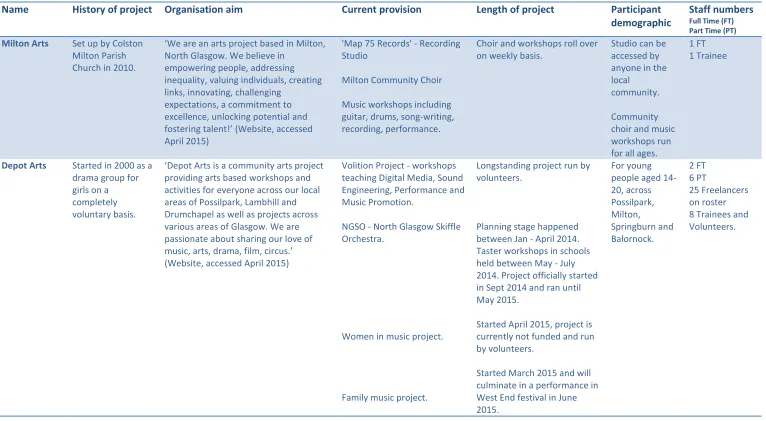
Table 1 outlines some basic information about the organisations. This includes a history of the organisation, the organisation’s aim, their current provision, the length of the projects, the participant demographic, and staff numbers.
Figure 2 shows the locations of these organisations on a map.
Flagship organisations
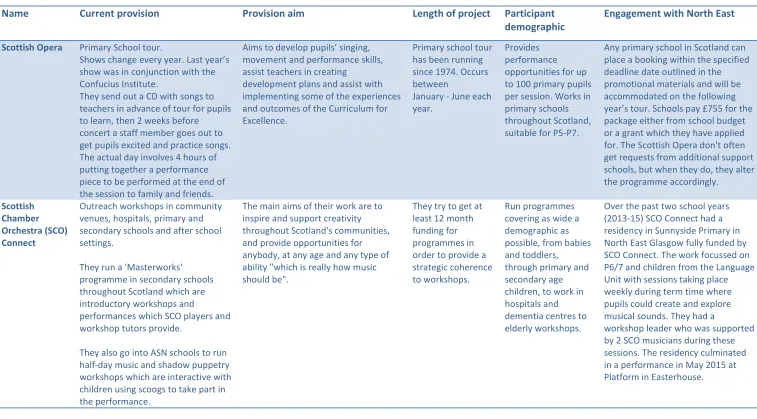
There are national or ‘flagship’ organisations which work with schools and community centres across Scotland to increase access to musical workshops and performances on a larger, often orchestral scale. These organisations include Scottish Opera, the RSNO, and the Scottish Chamber Orchestra. As these outreach events are part of national strategies to open access to musical opportunities, and often require the schools to initiate a booking with the organisation, the frequency of events across the North East of Glasgow is sporadic.
A further organisation which works to similar aims, Children’s Classic Concerts, collaborates with the RSNO in particular however it is an independent, charitable organisation.
14
Instrumental music services
Instrumental provision varies between schools, with instrumental instructors being allocated to each secondary school by Glasgow City Council’s Instrumental Music Services (IMS). In Glasgow the primary function of IMS is to support the Scottish Qualifications Authority (SQA) programme. Once instrumental instructors are allocated into secondary schools it is up to individual principal teachers and headteachers how instructors are deployed in their school and in associated primary schools.
The Learning Community under Springburn Academy is mapped out below alongside the instrumental tuition available in each school (see Figure 3).
Instrumental music service tuition was available in one of the five primary schools investigated within this learning community. It received both brass and woodwind instruction on a once a week basis, while two of the others have teachers who are able to offer recorder and singing workshops. All five primaries received provision through Creative Scotland’s Youth Music Initiative (YMI), this varies from once a week to once every two weeks for the primary 3 age group. Milton School, a secondary school for children with complex additional support needs, has not had music tuition for a number of years, though it is currently negotiating with a charitable music organisation, Drake Music Scotland, to organise some sessions. Discussion with the YMI officer for Glasgow revealed that there is an intention to increase service to ASN schools with YMI provision reverting back to weekly workshops and also to extend work with Nordoff Robbins.
The distribution of specific instrumental instruction to some secondary schools was based on historical examples of what previously had and had not worked:
15
There was no evidence of consideration as to how learn from this situation, or at least understand why certain instruments have not met with success in particular schools, leaving the instrumental distribution to remain as it is. Pupils coming from the feeder primary schools into Springburn Academy will not be able to access any string tuition until this situation is re-evaluated.
Key findings
The landscape for music education opportunities in the North East appears as an undercurrent of smaller ‘grassroots’ organisations providing regular activities, punctuated by occasional events hosted by larger organisations whose presence in more transitory.
The mapping results indicated a modest presence of ‘grassroots’ organisations in the North East employing less than 24 full time staff across all of these organisations.
One of these was identified as catering exclusively for children with additional support needs.
Instrumental provision in the North East’s schools allocated by GCC’s Instrumental Music Services team varies between schools but was found to be unavailable to some schools.
16
Table 1: Third sector organisations operating in North East Glasgow
Name History of project Organisation aim Current provision Length of project Participant demographic
Staff numbers
Full Time (FT) Part Time (PT)
Milton Arts Set up by Colston Milton Parish Church in 2010.
‘We are an arts project based in Milton, North Glasgow. We believe in
empowering people, addressing inequality, valuing individuals, creating links, innovating, challenging
expectations, a commitment to excellence, unlocking potential and fostering talent!’ (Website, accessed April 2015)
'Map 75 Records' - Recording Studio
Milton Community Choir
Music workshops including guitar, drums, song-writing, recording, performance.
Choir and workshops roll over on weekly basis.
Studio can be accessed by anyone in the local
community.
Community choir and music workshops run for all ages.
1 FT 1 Trainee
Depot Arts Started in 2000 as a drama group for girls on a completely voluntary basis.
‘Depot Arts is a community arts project providing arts based workshops and activities for everyone across our local areas of Possilpark, Lambhill and Drumchapel as well as projects across various areas of Glasgow. We are passionate about sharing our love of music, arts, drama, film, circus.’ (Website, accessed April 2015)
Volition Project - workshops teaching Digital Media, Sound Engineering, Performance and Music Promotion.
NGSO - North Glasgow Skiffle Orchestra.
Women in music project.
Family music project.
Longstanding project run by volunteers.
Planning stage happened between Jan - April 2014. Taster workshops in schools held between May - July 2014. Project officially started in Sept 2014 and ran until May 2015.
Started April 2015, project is currently not funded and run by volunteers.
Started March 2015 and will culminate in a performance in West End festival in June 2015.
17
Name History of project Organisation aim Current provision Length of project Participant demographic
Staff numbers
Full Time (FT) Part Time (PT)
Beatroute Arts
Initially set up as a Music project in 1990 through Urban Aid funding with Glasgow City Council Beatroute, in its current form, emerged in September 2004.
‘We are a youth project for 10 -25 years and our members make up the
management committee receiving guidance from experienced staff and support from other community partners. We are committed to providing
opportunities for creative learning and improving skills by developing a range of arts activities and programs that support, educate and inspire. Our vision is of a society in which people are inspired to make a positive difference and make positive choices in their lives and in their communities. A vibrant community deserves a strong voice and the best support. We aim to be effective in our approach and creative in our work with groups, individuals and other organisations.’ (Website, accessed April 2015)
Drop In Service includes informal, ad hoc instrumental tuition on Guitar, Drums, Violin, Keyboard, Saxophone and Mandolin.
Focused instrument tuition with small groups or one to one on requested
instruments.
‘Take a bow’ music tuition programme aimed at teaching violin, viola and cello
Community choir has recently been set up (April 2015)
Recording Studio
Drop in would originally run on indefinitely but Beatroute are trying a new structure of putting the sessions into four blocks on a yearly basis in line with school calendar, with supplementary school provision. Blocks will make it easier to evaluate and ‘shake up’ provision, and report back to funders.
Instrumental tuition staff see how long young people want to sign up for.
‘Take a bow’ doesn’t run in school holidays in order to stretch funding out for longer. Funding is from YMI for one year.
13 weeks funding.
Beatroute has received 3 years funding for 5 hours staff time per week for someone to learn how to use the studio and teach the young people.
Some participants have ASN.
1 FT 1 PT
18
Name History of project Organisation aim Current provision Length of project Participant demographic
Staff numbers
Full Time (FT) Part Time (PT)
Youth Access Project at Glasgow Kelvin College
Established in early 2000s.
‘The Youth Access programme supports young people in the evenings and at weekends, to gain access to the John Wheatley Learning Network and develop skills with creative technologies based on arts and cultural activities. The activities are designed to support the development of transferrable IT skills but also to support the development of social skills and the ability of young people to interact positively with adults in authority.’ (Website, accessed April 2015)
IT-based activities which engage young people in activities such as music creation, video editing, website creation, recreational use of the internet and networked games.
Music workshop led by a youth committee – provides instrumental tuition, arranges events and works with studio technician to record in studio.
Ongoing project on a yearly basis.
Young people up to age 25.
26 Youth Workers on Youth Access project. 1 Youth Worker and 1 Studio Technician support music workshop. New Rhythms for Glasgow (NRFG)
NRFG was set up in 1998 in Royston and previously called Northern Rock Festival Group. It was set up by a group of local people that wanted to set up a music festival.
‘We are a music and arts organisation based in North Glasgow providing creative opportunities that inspire, support and promote participation in music-making and the arts… We believe everyone has the capacity and the right to participate in community music-making whatever their background or ability. That’s why we want to make music experiences available to all and why our primary focus is to help those who have the least opportunity. Through our music education and outreach programmes, we help people to develop innovative minds, strengthen community wellbeing and support professional development within the arts.’ (Website, accessed May 2015)
NRFG 'Emerge' - Music workshops.
Access to Creative Industries Course.
Funding varies but for most youth programmes, NRFG have received 1 year funding.
Ongoing project on a yearly basis.
One workshop for 7-10 year olds, and another for 12+ age group. They target asylum seeker community too. "Children with disabilities would be welcome." Creative Industries course is for 16+ year olds who are unemployed or working less than 16 hrs per week.
19
Name History of project Organisation aim Current provision Length of project Participant demographic
Staff numbers
Full Time (FT) Part Time (PT)
St. Paul’s Youth Forum (Bolt FM - mobile radio)
‘The organisation was formed in 1997 from local people who have been providing youth work for over 40 years. In 2011, we became a Scottish Charitable Incorporated Organisation… Bolt FM has been established for over 10 years.’ (Website, accessed April 2015)
‘St Paul’s Youth Forum is a collection of youth groups working with young people 0-25. We are based in the Provanmill area of North East Glasgow. Our activities range from football through outdoor activities to radio and music.’ (Website, accessed April 2015)
Relaxed drop in sessions on Thursday, Friday and Saturday evenings where several activities take place and young people can relax with their friends.
Bolt FM has a training programme which teaches DJ skills, music performance and broadcast radio production.
Drop in sessions roll over on weekly basis.
Thursday nights are for P7s-S4s.
Friday nights are for 12-19 year olds.
Saturday nights are for P7s-S4s.
"Radio FOR young people BY young people."
Not available
The Disability After School Club (DASH)
Established in 1999. In 2010, the organisation became listed as a company with limited status.
‘The DASH Club (previously Milton Kids DASH Club) was constituted in 1999 to promote the welfare of the pupils of Milton School — a school for young people (11-18 years) with complex needs (sensory, physical and learning).’ (Website, accessed April 2015)
Currently working in North West of the city.
Provides after-school and holiday activities for
secondary-school aged young people with complex special needs. As of January 2015, it was found that no funding for musical activities had been found. Applied to Headley Foundation in early 2015 but application was unsuccessful. As of May 2015, there was still no funding secured for musical activities but staff are hoping to apply for funding to start activities in August 2015.
Each activity occurs in a block of six – eight weeks.
Children with complex ASN come from Milton school each night after school by use of NATA (North Area Transport Association) mini buses or school mini buses.
20
Name History of project Organisation aim Current provision Length of project Participant demographic
Staff numbers
Full Time (FT) Part Time (PT)
Fusion Youth Group and Junior Fusion Youth Group (Glasgow Life)
The Fusion Youth Groups have operated in Barmulloch Community Centre for the past two years. Previous to that, they were based in Gadburn Community Centre.
‘Come along, chill out and have fun taking part in a variety of activities including sports, arts and games consoles.’ (Website, accessed April 2015)
Drop In Service includes musical activities such as DJ workshops. Young people bring their own instruments to play.
Drop in sessions roll over on weekly basis.
Junior Fusion is for 9-11 year olds and the Fusion Youth Group is for 12-18 year olds. Currently nobody with ASN attending and no enquiries from young people with ASN have been made to join the group.
1 manager 5 delivery staff.
Royston Youth Action
It was established in October 1992 as a community response to the lack of
opportunities and facilities available to young people in the area.
‘Mission statement: The young people of Royston should have ready access to a full range of social, educational, recreational and volunteering opportunities in order to promote active, responsible citizenship and in order that young people should be enabled to fulfil their potential and play an active role in determining their own future and that of their community.’ (Website accessed April 2015)
Drop In Service includes musical activities.
21
Figure 2: Third sector music provision in North East Glasgow
(DASH Club) (Depot Arts activities)
(Fusion Youth Club) (Milton Arts)
(St. Paul’s Youth Forum and Bolt FM)
22
Table 2: Flagship organisations operating in North East Glasgow
Name Current provision Provision aim Length of project Participant demographic
Engagement with North East
Scottish Opera Primary School tour.
Shows change every year. Last year’s show was in conjunction with the Confucius Institute.
They send out a CD with songs to teachers in advance of tour for pupils to learn, then 2 weeks before concert a staff member goes out to get pupils excited and practice songs. The actual day involves 4 hours of putting together a performance piece to be performed at the end of the session to family and friends.
Aims to develop pupils’ singing, movement and performance skills, assist teachers in creating
development plans and assist with implementing some of the experiences and outcomes of the Curriculum for Excellence.
Primary school tour has been running since 1974. Occurs between
January - June each year.
Provides performance opportunities for up to 100 primary pupils per session. Works in primary schools throughout Scotland, suitable for P5-P7.
Any primary school in Scotland can place a booking within the specified deadline date outlined in the promotional materials and will be accommodated on the following year’s tour. Schools pay £755 for the package either from school budget or a grant which they have applied for. The Scottish Opera don't often get requests from additional support schools, but when they do, they alter the programme accordingly.
Scottish Chamber Orchestra (SCO) Connect
Outreach workshops in community venues, hospitals, primary and secondary schools and after school settings.
They run a 'Masterworks' programme in secondary schools throughout Scotland which are introductory workshops and
performances which SCO players and workshop tutors provide.
They also go into ASN schools to run half-day music and shadow puppetry workshops which are interactive with children using scoogs to take part in the performance.
The main aims of their work are to inspire and support creativity throughout Scotland's communities, and provide opportunities for anybody, at any age and any type of ability "which is really how music should be".
They try to get at least 12 month funding for programmes in order to provide a strategic coherence to workshops.
Run programmes covering as wide a demographic as possible, from babies and toddlers, through primary and secondary age children, to work in hospitals and dementia centres to elderly workshops.
Over the past two school years (2013-15) SCO Connect had a residency in Sunnyside Primary in North East Glasgow fully funded by SCO Connect. The work focussed on P6/7 and children from the Language Unit with sessions taking place weekly during term time where pupils could create and explore musical sounds. They had a
23
Name Current provision Provision aim Length of project Participant demographic
Engagement with North East
RSNO Provides full symphony orchestra concerts for school pupils, and chamber concerts for under 5 year olds.
Workshop programme includes hands-on performing workshops, listening workshops and composition workshops. They also offer
introductory conducting and improvisation sessions, and instrumental coaching.
RSNO can also support schools with their own choirs and school shows.
Adopt a Musician programme
Arts Awards accredited by Trinity College London.
Concerts introduce school pupils to a full scale orchestra, and chamber concerts encourage participation from budding young musicians.
Performing workshops give pupils the opportunity for hands-on experience of playing and hearing every
instrument in the orchestra. Listening workshops explore new music genres. They can also help identify concepts in preparation for the listening element of exams. The composition workshops help pupils produce a new piece of music which will be performed and recorded at the end of the day with a large orchestral ensemble.
By adopting a musician, schools receive termly letters about what the musician has been up to, behind the scenes footage and videos, and special visits and workshops from the
musician throughout the year. When the school attends an RSNO concert, pupils will be provided with VIP access to their adopted musician.
Offers a framework for learning new skills and sharing them; an opportunity to develop creativity and leadership skills; a link between young people and creative arts professionals.
Various lengths i.e. Composition workshops can take place as a one-off or as a series of 4–6 weeks.
Under 5s right through primary and secondary school age.
Workshops can be tailored to suit different levels. One listening workshop aims to work with pupils studying National 4/5 or Int. 2/Higher music.
Certain standards are required to take part in some workshops i.e. Viola workshops are for violin players above ABRSM Grade 4 standard and Improvisation workshops are for participants who play an instrument to equivalent ABRSM Grade 5 or higher.
24
Name Current provision Provision aim Length of project Participant demographic
Engagement with North East
Children’s Classic Concerts supported by RSNO
Orchestral flagship concerts and touring ensemble concerts supported by the RSNO.
Have previously run a tour in ASN schools, including Milton in the North East, but funding for this is not currently sufficient to go ahead.
Improve lives through exposure to musical experiences and build orchestral audiences for the future in the hope that young people will see concerts now and continue their love of music throughout their lives.
They have secured funding to work alongside RSNO for the rest of 2015 with concerts for Halloween and Christmas.
Suitable for children aged 4 – 12.
These concerts are mainly held in city centre venues and are fully accessible. Ticket prices are kept as low as possible, and ticket income is small compared to other commercial events feeding back into
organisation. CCC have found that schools are struggling to afford to take pupils to concerts.
26
Findings from empirical work
The fieldwork phase of the research began with interviews of key participants representing 14 third sector organisations from across Glasgow and also Glasgow City Council’s ‘Glasgow North East Strategic Youth Alliance’ team (GNESYA), GCC’s Instrumental Services, the Glasgow Youth Arts Hub, and a music teacher in a GCC school. These interviews aimed to explore: existing provision and practice in more depth, the aims and ethos of the organisations, matters related to funding, accessibility and inclusion, and staff training and experience. Data were also gathered through observational visits to musical workshops led by the various organisations.
What are the organisations’ aims in respect of inclusion?
Third sector organisations in the North East of Glasgow recognise that they are based in one of the most deprived areas in Glasgow, and consider the musical opportunities which they provide as something which might improve the quality of life for local residents who are at increased risk of being involved in violence, alcohol and drug abuse, mental ill health, unemployment and poor standards of living. The majority of projects are free to access.
“They are all completely free of charge, because we work in some of the most notoriously deprived areas of the city.”
“I think what we try and do is pitch everything at a level where it’s free, or accessible or affordable.”
Some organisations recognise this in terms of their social purpose and responsibility:
“Our responsibility is to provide arts based programming to improve quality of life for local residents.”
Sometimes this was expressed in quite aspirational terms:
“We’re passionate in that we believe the Arts can help to alleviate poverty which is a big grand statement, but also to give people a voice, and give skills to people.”
Many organisations have a strong youth focus but also provide activities to adults in the community as well, emphasising their aim to provide these opportunities to music education to everybody, regardless of particular identity markers:
27
What do they understand by inclusion?
Further discussion around the notion of inclusion highlighted that generally there is a strong understanding of the principles of inclusion as being about access and participation for everyone. They also considered it important to listen to individuals, and to respect and respond to their individual aspirations and capabilities:
“It’s music for all, despite your ability or your background or age… It was just to have everyone doing music and to remove barriers and for people not to think, ‘Oh I could never go into a studio’ or ‘I could never do that’ because everyone should be able to do it… It’s an inclusive project so there’s people with disabilities, mainstream people coming along as well.”
“I think not alienating or not allowing anyone to take part in any activity that we do unless they don’t want to in a very direct and obvious way.”
Very few organisations actively used the word ‘inclusive’ to identify their ethos and practice, and some that did describe their work as inclusive focussed specifically on provision for young people with additional support needs:
“[Organisation name] is an inclusive music organisation that uses music and the Arts… as a tool for helping people who are isolated, disadvantaged in some way, possibly disabled – people who have additional support needs who want to engage more effectively.”
One organisation demonstrated more inclusive practice in a school setting, bringing together young people from additional support need units with mainstream young people. However, there was a lack of shared understanding around what inclusion might mean and how it may be operationalised.
Key findings
Organisations recognise that they operate within a deprived area of the city, and as such aim to open their services up to everybody in the local community to access in order to improve their quality of life.
28
What do the organisations do to be seen and be accessible?
The research provided data around what organisations do to be visible from the outside, and how they make themselves accessible. Organisations told us that their services go beyond the mainstream, reaching young people from several disadvantaged groups across the North East and elsewhere, including young people with additional support needs, young people living in and leaving care, those living in socioeconomically deprived environments or from asylum seeker and refugee communities. The data are presented under the following themes that emerged: Realising inclusion - Affirmative action, promotional activity online
and promotion through schools.
Realising inclusion - Affirmative action
“Inclusion is most importantly seen as putting inclusive va lues into action. It is a commitment to particular values which accounts for a wish to overcome exclusion and promote participation. If it is not related to deeply held values then the pursuit of inclusion may represent conformity to a prevailing fashion…” (Booth & Ainscow, 2011)
The above quote from the Index for Inclusion outlines that to achieve inclusion as a reality in practice, the value system which supports it must be accompanied by affirmative action. This research generated data which showed that some organisations do actively promote their provision to young people from marginalised groups, and attempt to overcome barriers to their participation. One organisation based in the city centre told us that they “target people with additional support needs primarily”, while another told us that they “put the feelers out to them” to involve organisations working in social care to recruit disadvantaged young people into the project.
The following interview excerpt demonstrates the beginning of a dialogue around taking affirmative action:
“Children with quite severe disabilities is never actually something that's ever come to us… So I actually think that that's maybe something that would be kind of a good idea to look at because why are they not signing up for the project? Do they maybe feel as if they wouldn't be able to take part? Because obviously if they did send in their application forms, we would seriously consider having them coming along, we do want to have as many students and as open access as we possibly can… ”
29
“I’ve not really been offered services or helped in any way unless me and my mother have chased after it and made ourselves known. It’s always been like that for me. I’ve always been the one that’s slipped through the net as it were.”
Accessibility
Some organisations gave evidence of providing support with issues of physical access to the young people they work with, by arranging suitable transport to and from the programmes where possible, often by way of taxis, and using premises that are accessible:
“[He] sent me a few emails seeing how access was, transport was for me, and if I needed any help with that and all of a sudden I was here, causing some havoc!”
“I did go to one of these sort of awareness things, and when we’re planning workshops, became very aware of the venues that we use which have to be accessible for people.”
Despite genuine efforts to overcome these barriers, organisations face considerable costs when it comes to enabling young people with additional support needs in particular to access the same opportunities:
“We want one of our dancers to be able to go to Sweden and work with disabled people there and perform there - great! So how do we organise that? She needs personal care, she needs lifting in and out of bed. She's going to need two support workers to go with her – how much would we charge? Well £1000 per person. So that’s £2000. Then we have to get her over there and make sure she’s in the right place with a wet room, and all the necessary facilities, then she can function the same as us in a workshop setting. So just to take one person, that’s going to cost in the region of £3000. To take one non-disabled person it's going to cost about £400.”
“We could hire a coach for £150 that will take us from here to Dundee and back, or we could take people in wheelchairs which would mean hiring an accessible bus… the only accessible bus in Glasgow, based in Motherwell! £650. So there you are. Accessibility is expensive.”
“One thing that used to happen years ago would be that at a weekend concert we would have quite a large proportion would be school parties that were brought. That just doesn't happen anymore at all. Schools can't afford buses.”
There was evidence of some children with additional support needs having a family member or support worker who acted as a gatekeeper to them fulfilling opportunities in their lives. The attitudes and beliefs of these gatekeepers about the capabilities of individual children and young people can determine whether the person has access and opportunity to participate or not:
30
said 'oh no, I don't think they would be interested in music'. That's 100 kids that don't get that opportunity from one person deciding ‘don’t think so’. It’s trying to get through that.”
Promotion online
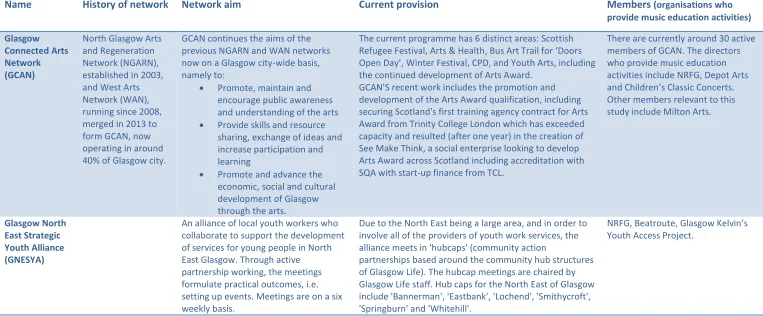
The data found a lack of clarity in the online exposure of the community arts networks that exist to serve the North of Glasgow alongside other areas. The Glasgow Connected Arts Network (GCAN) - a fusion of the North Glasgow Arts and Regeneration Network (NGARN) and the West Arts Network (WAN) - was established in 2013, but launched its website at the beginning of 2015. It was noted at the beginning of March 2015 that NGARN, despite no longer operating, still had web presence through their website and social media streams, although not recently updated.
The data showed concern for lack of citywide exposure of events in the North of the city:
"There seems to be a lot of exposure for events elsewhere in the city that are well published or well documented... but the North seems to never have that city-wide recognition of things that are... for instance, we've got this Winter Coat [festival]; nobody elsewhere out with Possilpark or whatever knows about it... I think that's maybe one issue that, a wider, long term issue that we need to address."
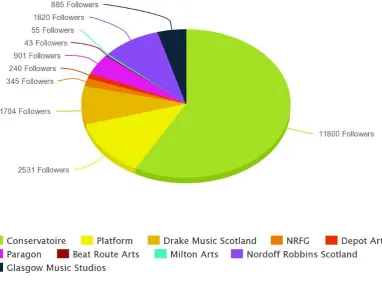
Two exercises were carried out in March 2015 to determine the online activity of the various organisations. Figures 4 and 5 show levels of promotional activity through the social media network Twitter by 12 organisations across the city that provide music education opportunities to young people.
Figure 4 represents the quantity of ‘tweets’, or posts, that the organisations have sent out to their followers. The results show that larger organisations with national and international reputations, a strong commercial presence, in receipt of city council funding, or operating out of large community hub buildings, post more regularly than the smaller, ‘grassroots’ organisations.
Figure 5 shows how many ‘followers’ each organisation has on Twitter. Again, the larger organisations score more highly in the reach of social media promotion.
31
[image:34.595.111.494.494.780.2]32 Promotion through schools
The research showed that many organisations aim to promote their services and recruit participants through taster sessions in local schools. The data illuminated that the development of relationships between ‘grassroots’ organisations and schools was at times problematic. Some organisations reported that it was difficult to establish connections with schools to increase their engagement with young people:
“I was naively under the impression that we would be able to get flyers printed and go into local schools and they would welcome us with open arms and say, 'Oh this is a brilliant opportunity, wouldn't it be lovely to get the kids involved?’ and find a way to do taster sessions… no, none of that, it was completely mental... We went up together with the flyers and said, 'Could we make an appointment to see Mr. so and so?' Nope. Never got back to us. So we got totally stone-walled.”
Larger organisations, including ‘flagship’ and local authority funded organisations, tend to have been able to establish better connections with schools and consider this partnership working “invaluable”. Some of these organisations go into schools regularly to offer taster sessions and also run ‘lunch-time info points’ where staff can “tie in with some students” to promote activities or events. It was recognised that these positive relationships between these organisations and schools are built when connections are made with “the right teacher” and by “expecting no support from them”.
From a school’s perspective, a music teacher in the North East expressed a strong positive attitude towards the idea of local organisations coming in to run taster workshops in order to promote their services to the pupils. The main issue for the teacher was the lack of time to respond to these requests and arrange suitable slots in the school day:
“I try really hard to work with them but school can be crazy! The job of a principal teacher of music is totally non-stop from the minute you arrive to the minute you go to sleep, and there’s pressures on you to do this, that and the next thing. So when I get someone… saying, ‘could we come in and do workshops?’ I want to scream, ‘YES! It would be brilliant… WHEN?!’ and then I feel guilty because I haven’t been able to either respond to them or arrange for them to come in because I’ve just not got the time or the facilities to do it.”
Key findings
While organisations work with small numbers of young people from marginalised groups, significant affirmative action is limited and the organisations appear not to have the capacity to promote services and involve more young people from these groups.
The lack of online exposure through websites and social media of ‘grassroots’ organisations working in the North East prevents visibility from the outside. This raises questions about the visibility and accessibility of these organisations to parents and carers.
33
How does the context of the North East inform attitudes
towards music and disability?
The research revealed that there are profound social, economic and cultural factors in the North East that shape understandings of disability and views of music education. This section explores the tensions and issues that are created through these understandings which affect the area’s young people when attempting to access musical opportunities. These are considered under the following headings: socioeconomic context, young people’s voice, territorial issues and understanding disability.
Socioeconomic context
Third sector organisations recognise that accessing private instrumental tuition is not a possibility for many families in the area due to the poor socioeconomic context. One organisation outlined this point by stating, “If you’ve got a kid, for instance, who you’re working with and their mum and dad are having to go to a food bank to get food, getting wee Jimmy to his guitar lesson is way down on their priorities.” As such, many organisations operating in the area strive to ensure that their programmes are free and that this is advertised clearly to prevent people from thinking otherwise.
“One of the boundaries for folk attending would be the fact that they think they would have to pay out any money to do something. All of the activities are free, and that’s something I’m quite passionate about.”
The data showed that some organisations do charge for their provision, demonstrating relative ideas of cost.
“Q: Do you think cost is a barrier for this particular group of school-leavers?
Well, I'm not sure. I mean when we did our drumming group we did it at £5 so I think £5 a week is not too bad to be honest.”
“It’s £4.50 a class but we ask parents to pay up for the full block, so for this block it’s £45.00, or if you were rebooking from Christmas, it’s £35.00… If you’ve got one or two kids and they’re wanting to do drums and guitar, people are then having to choose what’s affordable.”
In the above case where provision is charged up front for the full block, the organisation works closely with parents and carers who are unable to do so to put in place payment plans that make it more affordable: “I just wouldn’t want anyone not being able to take part because someone says they really can’t afford it.”
34
that require further investigation. It should be pointed out that this evidence came from teachers; further research would help to determine parents’ perspectives. A school teacher in a local secondary school highlighted the significantly low attendance rate of pupils and that where young people do attend school, they are encouraged by their parents and carers to focus on subjects like Maths and the Sciences. These subjects are believed to lead towards well-paid employment and increased career opportunities. Conversely, there is less encouragement from families to support young people’s ambitions in Arts subjects including Music, generating negative ideas that these subjects don’t lead to “a real career” or “a proper job, which is basically an office job in their eyes”. A music teacher from one of the North East’s schools was exasperated by the attitudes of local families, who would often tell her at parents’ night that they want their children to “concentrate on their real subjects” and as such would actively dissuade their children from focussing energy on music classes. Another interviewee from a local third sector organisation also recognised the necessity of a supportive environment when learning music, stating, “Most musicians I know got to the point they got to, and it’s pretty middle-class, because you had the support mechanism around you”.
There was evidence to suggest that attitudes towards music education within schools in the area may be problematic. There may be structural explanations for music coming low in the list of priorities. It was noted that if a particular Head Teacher is not aware of these benefits and has not experienced music education themselves, then for already heavily cut funding. In these cases, music is perceived as “an extra thing you can put on your UCAS form to show that you’re a more rounded person”. Other staff members can also hinder pupils’ involvement in musical activities, in that pupils are “pulled to supported study after school in every other direction and music’s not seen as a priority even though it’s a Higher.”