City, University of London Institutional Repository
Citation
:
Paul, M., Hennig-Thurau, T., Gremler, D. D., Gwinner, K. P. and Wiertz, C. (2009). Toward a theory of repeat purchase drivers for consumer services. Journal of the Academy of Marketing Science, 37(2), pp. 215-237. doi: 10.1007/s11747-008-0118-9This is the accepted version of the paper.
This version of the publication may differ from the final published
version.
Permanent repository link:
http://openaccess.city.ac.uk/5276/Link to published version
:
http://dx.doi.org/10.1007/s11747-008-0118-9Copyright and reuse:
City Research Online aims to make research
outputs of City, University of London available to a wider audience.
Copyright and Moral Rights remain with the author(s) and/or copyright
holders. URLs from City Research Online may be freely distributed and
linked to.
City Research Online: http://openaccess.city.ac.uk/ [email protected]
Toward a Theory of Repeat Purchase Drivers for Consumer Services
Michael Paul* and Thorsten Hennig-Thurau Department of Marketing and Media Research
Faculty of Media Bauhaus-University of Weimar
99423 Weimar, Germany Phone (+49) 3643 58 3793 / 3772
Fax (+49) 3643 58 3791
Email: [email protected] and [email protected]
Dwayne D. Gremler Department of Marketing College of Business Administration
Bowling Green State University Bowling Green, OH 43403
Phone (419) 372-2041 Fax (419) 372-8062 Email: [email protected]
Kevin P. Gwinner Department of Marketing College of Business Administration
Kansas State University
201 Calvin Hall, Manhattan, KS 66506-0506 Phone (785) 532-2783
Fax (785) 532-7024 Email: [email protected]
Caroline Wiertz Faculty of Management
Cass Business School City University
106 Bunhill Row, London EC1Y 8TZ, UK Phone (+44) 20 7040 5183
Fax (+44) 20 7040 8328 Email: [email protected]
* corresponding author
Conditionally accepted for publication in the Journal of the Academy of Marketing Science
Second revision
Toward a Theory of Repeat Purchase Drivers for Consumer Services
ABSTRACT
The marketing discipline’s knowledge about the drivers of service customers’ repeat purchase
behavior is highly fragmented. This research attempts to overcome that fragmented state of
knowledge by making major advances toward a theory of repeat purchase drivers for consumer
services. Drawing on means-end theory, the authors develop a hierarchical classification scheme
that organizes repeat purchase drivers into an integrative and comprehensive framework. We
then identify drivers on the basis of 188 face-to-face laddering interviews in two countries (U.S.
and Germany) and assess the drivers’ importance and interrelations through a national
probability sample survey of 618 service customers. In addition to presenting an exhaustive and
coherent set of hierarchical repeat-purchase drivers, the authors provide theoretical explanations
for how and why drivers relate to one another and to repeat purchase behavior. This research also
tests the boundary conditions of the proposed framework by accounting for different service
types. In addition to its theoretical contribution, the framework provides companies with specific
Toward a Theory of Repeat Purchase Drivers for Consumer Services
INTRODUCTION
For most service organizations, economic success depends on an ability to maintain
long-term relationships with customers who purchase their offerings repeatedly (Reinartz, Thomas,
and Kumar 2005; Rust, Lemon, and Zeithaml 2004). Understanding the reasons customers
repeatedly purchase from a service firm therefore represents an issue of essential importance.
Service research has identified a multitude of potential repeat purchase drivers; a literature
review of nine leading marketing journals between 1983 and 2005 reveals 65 studies that report
no fewer than 90 different repeat purchase drivers for consumer services.1
However, despite the proliferation of research on repeat purchase drivers for consumer
services, extant knowledge on this topic is highly fragmented, a concern for many marketing
researchers. Gupta and Zeithaml (2006, p. 733) observe conceptual overlap in the definition and
measurement of key variables influencing repeat purchase and warn “the pattern of relationships
among the variables is not clear.” Palmatier, Dant, Grewal, and Evans (2006, p. 137) find that
“many constructs [exist] with similar definitions that operate under different aliases and
constructs with similar names but different operationalizations.” Verhoef, van Doorn, and
Dorotic (2007, p. 115) state, “it is difficult to deduce generalizable findings [on antecedents of
customer retention], since the research is quite fragmented and results are mixed,” and Zeithaml
(2000, p. 76) deplores that “no studies have incorporated all or even most potential explanatory
variables to examine their relative importance in keeping customers.”
1 The nine marketing journals (in alphabetical order) are: International Journal of Research in Marketing, Journal of
We attempt to overcome this fragmented state of knowledge by making major advances
toward a theory of repeat purchase drivers for consumer services and thus contribute to
marketing research in two important ways. First, we develop an integrative and comprehensive
framework of repeat purchase drivers, using means-end theory and 188 laddering interviews. The
framework, for the first time, identifies an exhaustive and coherent set of repeat purchase drivers
which includes new drivers; provides means-end theoretical explanations for how and why
drivers relate to one another and to repeat purchase behavior; hierarchically organizes these
drivers; and systematically integrates extant research on repeat purchase drivers. Second, we use
the framework to assess empirically the relative importance of repeat purchase drivers and their
interrelationships, a task hitherto prevented by the fragmentation of extant research (MacKenzie
2003; Zeithaml 2000). We accomplish this assessment through a large, quantitative study based
on a nationwide probability sample. The inclusion of different service types enables us to test the
boundary conditions of our framework.
Scholars can use our framework to position themselves in this research field, make
informed choices about drivers for their own studies, and compare their findings with other
research. They further can use our findings about the importance of drivers to focus on key
concepts when designing their research. Marketing managers require both a comprehensive and
integrative framework of repeat purchase drivers and information about each driver’s relative
importance. With a coherent classification of all repeat purchase drivers at their disposal, they
can judge the drivers’ effectiveness, interactions, and restrictions. Our framework thus provides
managers with a natural starting point for developing relationship marketing strategies and
integrating their marketing efforts. The complete understanding of the scope of drivers also
of drivers. Finally, information about driver importance enables managers to exert an appropriate
emphasis and budget across all drivers.
The remainder of this article is organized as follows: We first introduce a hierarchical
framework of repeat purchase drivers in the context of consumer services based on means-end
theory, identify specific drivers by conducting qualitative research in two countries, and provide
a detailed discussion about the contributions of our framework. We then conduct a quantitative
national probability sample survey to analyze the different drivers’ importance for repeat
purchasing. We conclude by detailing the implications of our theory development for service
research and management practice.
A THEORETICAL FRAMEWORK OF REPEAT PURCHASE DRIVERS FOR CONSUMER SERVICES
Means-End Theory
Introduced by Gutman (1982), means-end theory posits that a customer’s knowledge about
products, stored in long-term memory, gets organized in three interlinked cognitive categories:
attributes, benefits, and motivational values. Customers connect their knowledge of the concrete
attributes of a product with more abstract ideas about functional and psychosocial consequences
(or benefits), which they associate with even more abstract motivational values (Olson and
Reynolds 1983; Walker and Olson 1991). Using a prominent example offered by Reynolds and
Gutman (1988), customers might consume wine coolers at parties because the coolers have less
alcohol than mixed drinks (attribute level), which enables them to socialize (they do not get
drunk; benefit level), which in turn gives them a sense of belonging (part of a social group;
motivational values level). Accordingly, because attributes represent means to achieve important
ends (i.e., benefits and values), means-end theory provides an explanation for why customers
buy certain products or services (Overby, Gardial, and Woodruff 2004; Pieters, Baumgartner,
Application of Means-End Theory to Repeat Purchase Behavior
We posit that a customer’s motivation to buy repeatedly from a service provider results
from the three general means-end categories of attributes, benefits, and motivational values.
Repeat purchase behavior reflects the behavioral dimension of customer loyalty (Dick and Basu
1994), which implies that we are interested in any kind of repeat purchase behavior, irrespective
of whether repeat purchases occur because of attitudinal loyalty. This focus is appropriate
because customers’ repeat purchases eventually generate revenues for a firm, whereas attitudes
link to revenues only indirectly.
We refer to the three fundamental means-end categories as service relationship attributes,
relationship-driving benefits, and motivational values. Service relationship attributes refer to a
customer’s knowledge of the characteristics of a specific service provider, which drive his or her
repeat purchases from that provider. Relationship-driving benefits describe a customer’s
knowledge of the advantages he or she receives from the service provider which prompt repeat
purchases, beyond the advantages derived from the core service. Finally, motivational values
refer to a customer’s knowledge of his or her desired end states, which transcend specific
situations and contexts and drive repeat purchases from the provider (Schwartz and Bilsky 1990).
Because benefits are more important for customer decision making than attributes and
values, we focus on benefits in our analysis of means-end chain linkages by investigating how
strongly attributes and motivational values relate to a given benefit, such that benefits influence
attribute choice and determine value achievement (Gutman 1991). Such a focus acknowledges
that motivational values, though connected to benefits, are not necessarily active driving forces
in every consumption decision (Cohen and Warlop 2001). The left portion of Figure 1 displays
the three general categories of repeat purchase drivers, interconnected according to our focus on
Hierarchical Classification of Repeat Purchase Drivers
To organize repeat purchase drivers systematically within each category of our framework
(i.e., service relationship attributes, relationship-driving benefits, and motivational values), we
suggest a hierarchical classification schema of drivers, ranging from general and abstract to
specific and concrete (Hunt 2002). The hierarchical classification accounts for the fact that
customers perceive repeat purchase drivers on different levels of abstraction (Cohen 2000; Klein,
Dansereau, and Hall 1994); it also reduces complexity by subsuming many second-order drivers
into fewer first-order drivers, thereby increasing the framework’s readability and managerial
usability. Specifically, we divide each general category into two hierarchical levels, first- and
second-order drivers, as illustrated in Figure 1. The first-order, general and abstract drivers
aggregate specific and concrete second-order drivers. For example, interaction quality is a
general and abstract concept that subsumes specific and concrete concepts such as an employee’s
behavior and expertise (Brady and Cronin 2001). We inductively identify specific drivers within
each general category using extensive laddering studies in two countries and then compare our
results with extant literature, a suitable procedure for demonstrating the ability of our means-end
theory-based framework to integrate new and extant knowledge about repeat purchase drivers.
Empirical Identification of First- and Second-Order Repeat Purchase Drivers
Data collection and coding of second-order drivers. To identify a comprehensive set of
repeat purchase drivers at different hierarchical levels, we conduct two laddering studies with
188 face-to-face in-depth interviews in two countries (i.e., U.S. and Germany). The laddering
method was created specifically to explore means-end chains by repeatedly asking respondents a
series of “Why is this important to you?” probes to establish the linkages among attributes,
benefits, and motivational values (Reynolds and Gutman 1988). In our first laddering study,
three trained interviewers conducted 100 face-to-face interviews in a mid-sized German city with
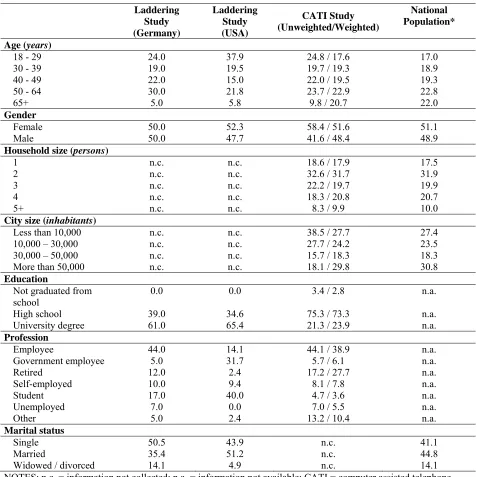
criteria (i.e., age and gender) to reflect the German population (see Table 1). Interviews lasted 33
minutes on average (12–63 minutes, σ = 10 minutes) and were tape-recorded and fully
transcribed. Customers had shopped with their service providers for 1–40 years, with an average
relationship length of 10 years.
-- INSERT TABLE 1 ABOUT HERE --
The interviewers first asked respondents to think about a specific service provider, from a
list of 34 service industries, from which they repeatedly bought services and whose offerings
they considered personally important. The latter condition helps respondents' access motivational
values during laddering (Pieters et al. 1995). Using the direct elicitation technique (Bech-Larsen
and Nielsen 1999), the interviewers then asked respondents to name those service relationship
attributes that provided the main reasons for their repeated purchase from the selected firm. For
each attribute mentioned by a respondent, they asked “Why is that important to you?” repeatedly,
until the respondent named a benefit and, eventually, a motivational value. Interviewers stopped
probing when a respondent could not name a benefit (or value) linked to an attribute (or benefit).
Each response to each question represents a statement that serves as the unit of analysis.
Three service marketing scholars content analyzed all 100 interviews. The first analyst
created a hierarchical value map for each interview (Reynolds and Gutman 1988). Using the
original tapes and transcripts, the second and third analysts then independently compared the
transcript with each map for completeness and semantic appropriateness. Statements identified
by the first analyst were 94.7% complete and 98.1% appropriately labeled. Using the constant
comparative method, the first analyst then decided to which general category each statement
should be assigned, while also creating initial second-order driver categories at the attribute and
benefit levels by comparing each statement’s similarities and differences with other statements
refined and redefined. Statements from at least two respondents were required to establish a
second-order driver category. The coding procedure differs for the values category, because the
nature of values allows us to apply extant values typologies to the repeat purchase context
(Schwartz and Bilsky 1990). We use Schwartz’s (1992) typology, which builds on extant
research (Rokeach 1973) and has been validated for more than 70 different cultural groups
(Schwartz and Rubel 2005), to classify repeat purchase drivers at the values level instead of
defining new categories.
The three analysts met regularly over the course of more than six months to discuss the
first analyst’s classifications (Holloway and Beatty 2008). Each time the analysts could not agree
on a coding decision or a category label, all three went back to the original tapes and transcripts
and reconsidered their own interpretations. Because several concepts emerging from the
interviews resembled drivers from extant research, the analysts also compared their concepts
with existing literature to ground their interpretations and distinguish between new and
established concepts. Then, building on their updated conclusions, the three analysts again made
an effort to reach a final decision. Consistent with classification research, this iterative process
continued until they reached a satisfying level of intercoder agreement (Holloway and Beatty
2008; Lincoln and Guba 1985). Prior to the last coding round in which all three analysts agreed
on a final set of second-order driver categories and the assignments of statements, overall
intercoder agreement reached 95.8%, with individual agreement rates of 97.3% (analysts 1 and
2), 96.4% (analysts 1 and 3), and 94.1% (analysts 2 and 3). When the number of categories and
coders are considered, agreement rates are close to 100% (Rust and Cooil 1994). During the
coding process, the analysts processed a total of 1,393 statements (average of 13.9 statements per
advantages derived from the core service. All other statements comply with our definitions of
general driver categories and therefore help develop repeat purchase driver categories.
We conducted a second laddering study to determine if (1) the list of repeat purchase
drivers from the first study is exhaustive and (2) attributes, benefits, or motivational values are
culturally specific (Harkness, Mohler, and Van de Vijver 2003). Three interviewers conducted
face-to-face laddering interviews with 88 service customers in a similarly-sized city in the
United States. The data collection procedure remained identical to that employed in the German
study, and the samples are similar with regard to respondents’ age and gender (see Table 1). Two
service marketing scholars not involved in the analysis of the German interviews analyzed the
U.S. interviews following the same procedure applied in Germany, processing a total of 857
statements (9.7 statements per respondent). Intercoder agreement was 92.0% (> 95% when
accounting for the number of categories and coders; Rust and Cooil 1994). After this step, all
five analysts compared and discussed the results of the two laddering studies with regard to
conceptual equivalence. All second-order drivers identified in the German interviews (except for
altruism benefits) emerged from the U.S. sample, and no additional drivers were identified. Also,
the content and meaning of the drivers do not differ across the two samples.
Identification of first-order drivers. We then again applied the constant comparative
method, this time to the set of second-order drivers. This enabled us to identify first-order driver
categories, with each second-order driver assigned to one first-order driver. When searching for
an adequate first-order representation of motivational values, we once more draw from Schwartz
(1992), who suggests that the ten second-order values we replicate in the context of service
relationships can be condensed into three abstract first-order values. To validate our assignments
of attributes and benefits, we asked 53 service marketing researchers (professors of all ranks and
experts with a questionnaire that contained our definitions of each second-order driver attribute
and benefit, as well as our definitions of all first-order drivers, then asked the experts to assign
each second-order driver to what they believed to be the most appropriate first-order driver. The
unadjusted overall intercoder agreement is 61.2% for attributes and 67.2% for benefits among
the 53 researchers. Adjusting these values for the number of categories and coders involved
results in agreement scores close to 100% for both levels (Rust and Cooil 1994). The final
assignments based on our own and the experts’ judgments appear in Table 2, along with first-
and second-order driver definitions and illustrative customer comments.2
-- INSERT TABLE 2 ABOUT HERE --
Results
Overall, across the three general categories, the analysis generated a total of 50
second-order drivers of repeat purchase behavior, condensed into 12 first-second-order drivers. At the service
relationship attributes level, we find 28 second-order drivers to assign to six first-order drivers.
Specifically, the first-order driver “service product” refers to a group of attributes that relate to
the service as it is designed to be delivered (e.g., reliability of the service outcome). “Service
delivery,” another first-order driver, contains attributes that pertain to the customer–employee
interaction that produces the service (e.g., employee empathy). The first-order driver “service
environment” represents attributes that define the ambience through which the service is
delivered (e.g., servicescape). The first-order driver “relationship characteristics” contains those
attributes that refer to ongoing relationships between service providers and customers (e.g.,
2 The majority of experts assigned 39 of 40 second-order attributes and benefits to the proposed first-order driver,
context-employee–customer connection), and the first-order driver “company characteristics” includes
those that refer to the company overall rather than the quality of the service it provides (e.g.,
service firm’s reputation). Finally, “service location,” the geographical location where the
service is delivered, constitutes a driver for which we identify no hierarchical structure.
On the relationship-driving benefits level, we identify 12 second-order drivers represented
by three first-order drivers. The first-order driver “functional benefits” refers to customer
benefits of a utilitarian nature. Such benefits include convenience, money savings, and
knowledge accumulation (i.e., information acquired during repeat purchases). The first-order
driver “psychological benefits” describes those customer benefits that satisfy important intrinsic,
self-oriented goals of the customer. Specifically, psychological benefits include the second-order
drivers of autonomy benefits, comfort benefits, confidence benefits, privilege benefits, and
welcomeness benefits. “Social benefits,” another first-order driver in the benefits category, make
people feel closer to one another or portray a desired image to others. This driver combines the
second-order drivers of communication and affiliation, as well as altruism benefits and
community benefits.
Finally, on the motivational values level, we find evidence for all second-order and
first-order driver values suggested by Schwartz (1992), with no additional motivational values
identified in either laddering sample. The first-order drivers are “individual motivational values”
(encompassing achievement, hedonism, power, self-direction, and stimulation), “collective
motivational values” (benevolence, conformity, and tradition), and “mixed motivational values”
(security and universalism).
Discussion: A Theoretical Framework of Repeat Purchase Drivers
Drivers of repeat purchase behavior. On the attribute level, the first-order drivers service
product, service delivery, and service environment correspond to Rust and Oliver’s (1994)
conceptualization of service quality. This aligns with the central role that researchers have
assigned to service quality to explain repeat purchase behavior and might help integrate extant
knowledge on those drivers (e.g., Boulding, Kalra, Staelin, and Zeithaml 1993; Zeithaml, Berry,
and Parasuraman 1996). Several second-order drivers (i.e., audience, cleanliness, empathy,
equipment and materials, expertise, motivation, quickness, reliability, servicescape, and temporal
availability) assigned to the three service quality drivers previously have been considered facets
of service quality (e.g., Brady and Cronin 2001). All other service product and service delivery
attributes have been studied in isolation only (e.g., authenticity, Hennig-Thurau, Groth, Paul, and
Gremler 2006; customization, Simonson 2005). The classification of these drivers as part of the
means-end framework links them to a higher conceptual level and enables their integration into
general marketing knowledge.
Regarding the other first-order attribute drivers, service location—though a
long-established determinant of patronage in a retailing context (e.g., Craig, Ghosh, and McLafferty
1984)—rarely has been considered a driver of repeat buying by service marketing scholars.
Another first-order driver, relationship characteristics, might serve as an umbrella for several
hitherto non-integrated second-order concepts (e.g., commercial friendships, Price and Arnould
1999; customer-employee similarity, Crosby, Evans, and Cowles 1990; significant others, Evans,
Christiansen, and Gill 1996). This research is the first to identify relations among these drivers,
opening the opportunity to synthesize knowledge from different research silos. Company
characteristics and the associated second-order constructs have not been considered determinants
of repeat purchase behavior in previous service research. Yet corporate social responsibility and
Beatty 2007), and consumer culture studies provide an understanding of why perceptions of
small, local companies are of concern to customers (e.g., Thompson and Arsel 2004).
On the benefits level, the identification of three first-order drivers of repeat purchase
behavior (i.e., functional, psychological, and social benefits) helps structure existing, but
non-integrated knowledge. These three primary driver benefits resemble similar classifications in the
means-end literature, which demonstrates their generalizability (e.g., Peter and Olson 2007).
Evidence for the integrative potential of our framework emerges from the functional benefits
category, which subsumes second-order convenience benefits (Berry, Seiders, and Grewal 2002);
knowledge benefits referring to customer expertise (Ratchford 2001); and money-saving benefits
corresponding to what Gwinner, Gremler, and Bitner (1998) label economic benefits.
Psychological benefits include established drivers such as confidence and special treatment
benefits (Hennig-Thurau, Gwinner, and Gremler 2002), but also the isolated concepts of
autonomy and comfort (Dholakia 2006; Spake, Beatty, Brockman, and Crutchfield 2003). Our
conceptualization of social benefits integrates affiliation and communication (e.g., Bhattacharya
1998; Duncan and Moriarty 1998), which have not referenced each other, leaving their
connection undetected to date.
We also identify new relationship-driving benefits. Assigned to the first-order driver of
psychological benefits, welcomeness is a second-order driver not previously acknowledged in
service relationship research. To ground this driver, one might link it to the concept of
relatedness, with which it shares the notion of a customer’s need for a sense of respect and being
cared for (e.g., Thomson 2006). Altruism and community benefits, both associated with social
benefits, also have not been considered repeat purchase drivers before. Altruism benefits accrue
when the customer, as a consequence of repeatedly purchasing from a service provider, can do
customer’s support of the community in which he or she lives. Both concepts appear in research
other than that on repeat purchase drivers. For example, an altruistic motivation explains why
consumers help charities (e.g., Bendapudi, Singh, and Bendapudi 1996), and community-like
social structures are a defining element of embedded markets (Frenzen and Davis 1990).
On the general driver category level, relationship-driving benefits extend the concept of
customer relational benefits discussed by Gwinner and colleagues (1998), which are restricted by
definition to those benefits that can be received exclusively by long-time customers. Unlike
customer relational benefits, relationship-driving benefits, as defined here, cover customer
benefits that can be received by both long-time and first-time customers (e.g., saving money
through low prices). This conceptualization notes that repeat purchase is largely the result of
benefits not provided exclusively to long-time customers.
On the motivational values level, our framework provides evidence that the full set of
human values suggested by Schwartz (1992) is relevant in the context of service relationships.
Although values represent a large part of human cognition and are important determinants of
customer behavior (e.g., Steenkamp, Ter Hofstede, and Wedel 1999), this research is the first to
consider motivational values as repeat purchase drivers for consumer services. As an element of
a person’s “core self,” motivational values “give a person a sense of unity and identity and
influence behavior across a wide variety of situations” (Walker and Olson 1991, p. 113).
Motivational values thus capture a customer’s general disposition to repeat purchase, which
remains constant over time and across different service contexts. They also differ from other
repeat purchase drivers; they are more stable and help explain why repeated purchase of a
service has personal importance for a customer.
The collection of data from two countries offers some additional insights. We find that the
generalizability of our framework. Altruism benefits, mentioned by 12% of the German
respondents but absent in the U.S. sample, represent an exception. However, extensive research
on altruism demonstrates the construct’s cross-cultural character (e.g., Paul, Miller, and Paul
1993), and we see no reason to assume that altruism is nonexistent in service relationships in the
United States. We also note that the laddering interviews in Germany produced more statements
per person than those in the United States. We are not aware of any studies that investigate
cross-cultural differences in the number of concepts elicited in laddering studies; it seems an
interesting avenue for further research.
Relationships between drivers and repeat purchase behavior. The framework adds to our
understanding of repeat purchase drivers by providing, for the first time, an integrative
theoretical explanation of how and why drivers relate to one another. The means-end theoretical
underpinning of our framework implies that all linkages between repeat purchase drivers
represent cognitive associations in customers’ long-term memory related in a means-end way
(Olson and Reynolds 1983). This theoretical explanation also offers links for an augmentation of
our framework by applying associative network models from memory research (Anderson
1983a). Following this logic, customers would acquire knowledge on repeat purchase drivers
through exemplar learning (i.e., passive and automatic creation of increasingly abstract
categories over time) or conceptual combinations (i.e., active manipulation of knowledge in
memory) (Barsalou 1991); the retrieval of existing driver knowledge would entail a process in
which activation spreads from node to node, depending on the strength of linkages between
driver categories (Collins and Loftus 1975).
The means-end theoretical underpinning of our framework also extends the literature by
providing the first general explanation for how and why drivers lead to service customers’ repeat
provider when they perceive attributes as means to achieve important ends (i.e., benefits and
values; Overby et al. 2004). This explanation mirrors expectancy-value models of motivation
research (Fishbein and Ajzen 1975), which tell us that a consumer’s propensity to act (here: visit
a certain service provider repeatedly) depends on (1) the strength of his or her expectancy that
the act will result in a consequence (here: that attributes are linked to benefits or values) and (2)
the value of that consequence (here: the desired benefits or values) (Cohen and Warlop 2001).
Accordingly, research might draw from the larger area of expectancy-value research to provide
deeper insights on the link between drivers and repeat purchase behavior.
Summary. Our framework provides evidence that repeat purchase drivers are multifaceted
phenomena that require many hierarchically related concepts to be captured adequately. Our
framework is comprehensive and coherent; it defines and delineates all drivers thoroughly from
one another, and the analysts found redundancies in additional customer statements after they
analyzed approximately half of the 188 laddering interviews. Prior research has not sufficiently
accounted for this complexity, causing a lack of agreement among researchers about which
drivers exist. We find that specific drivers can be grouped into general driver categories (i.e.,
service relationship attributes, relationship-driving benefits, motivational values) and organized
on different levels of abstraction. Our hierarchical framework enables the systematic comparison
and integration of drivers and thereby facilitates the future accumulation of knowledge in this
important research area. Furthermore, our discussion demonstrates that most of our empirically
identified drivers relate to drivers from previous research, providing additional support of the
power of our framework. This is also evidenced by the right-most column of Table 2, which
explicitly links each of the drivers to extant research. The redundancy among a substantial
number of associated drivers apparent in Table 2 also illustrates fragmentation and underscores
to repeat purchase drivers research by providing a general explanation of how and why drivers
relate to one another and to repeat purchase behavior.
ASSESSING THE IMPORTANCE OF REPEAT PURCHASE DRIVERS FOR CONSUMER SERVICES
General Remarks
We use our framework to assess empirically the relative importance of repeat purchase
drivers and the strength of their linkages, which is necessary for an efficient allocation of
resources among drivers (Zeithaml 2000). Although we refrain from offering formal hypotheses
about the differential importance of the drivers, the number of extant studies concerned with
drivers reveals something about the importance they assign to these drivers. We expect attributes
referring to service quality (i.e., service product, service delivery, and service environment) to
account for much of customers’ repeat purchase behavior (Gupta and Zeithaml 2006). With
regard to relationship-driving benefits, we assume that psychological benefits and social benefits
are most important for service customers’ repeat purchases (e.g., Gwinner et al. 1998; Spake et
al. 2003). We are not aware of any research on motivational values in a service relationship
context and therefore do not speculate about the relevance of different motivational values.
To test the boundary conditions of our findings about the importance of repeat purchase
drivers and the strength of linkages between them, we include different services to determine
whether the results remain stable. For the latter effort, we use the taxonomy developed by Bowen
(1990), one of the few comprehensive and empirically based service classifications applied by
service researchers (e.g., Gwinner et al. 1998). It distinguishes among three service types: those
directed at people and characterized by a high degree of customer contact with highly
customized service solutions (“type I” services); those directed at objects for which low
and those directed at people with standardized service solutions and moderate customer contact
(“type III” services).
Data Collection
We conducted a computer-assisted telephone interview study in cooperation with a
professional market research company, drawing a probability sample of households that
represent the German population using random digit dialing. To select individual respondents
randomly within households, we employ the last-birthday method (Sudman and Blair 1998). The
data collection occurred each day of the week (excluding Sundays), from 1:00 p.m. to 9:00 p.m.,
during a two-week period. Up to eight callbacks took place at different times and different days.
The final sample consists of 618 service consumers, a response rate of 38.1%, which is well
within the realms of similar studies (e.g., Council for Marketing and Opinion Research 2001).
We weight each respondent’s answers to account for deviations between the sample composition
and the national population on four demographic variables—age, gender, household size, and
city size—so we can generalize our results to the German population (Lehmann, Gupta, and
Steckel 1998). Demographic information is in Table 1.
Respondents were asked to think of a specific service provider from which they repeatedly
had purchased services in a randomly assigned choice set of three services, each representing one
of the three Bowen service types. Each service was randomly drawn from a list of four different
and widely used services (type I: full-service restaurant, hairdresser/barber, physician/dentist,
travel agency; type II: bank, car repair shop, shoe repair shop, veterinarian; type III: bar/coffee
shop, book store, drugstore, supermarket). If a respondent did not repeatedly buy from a service
provider in any of the service industries proposed, the interview ended.
After the respondent had selected a service provider, he or she rated the importance of each
of the 28 second-order driver attributes for repeat purchases (e.g., “For your repeated purchase at
ATTRIBUTE]?”; five-point scale, higher numbers indicate greater importance). The order of item presentation was fully randomized. Next, for the attribute that received the highest importance
rating, the respondent rated the extent to which its importance was related to each of the 12
relationship-driving benefits. For example, if “location” was chosen as the highest-rated
attribute, the respondent indicated agreement with the statement: “That [COMPANY NAME] is very
well located [= MOST IMPORTANT ATTRIBUTE] is important to me, because it helps me to save time and effort [= convenience as RELATIONSHIP-DRIVING BENEFIT]” (five-point scale). Again, the order in which the benefits were read to the respondent was fully randomized. If a respondent
believed an attribute was not linked to a specific benefit, the lowest score (1) on the scale was
recorded. If more than one service attribute received the highest rating, the respondent indicated
which was most important. The Appendix lists all items used to measure second-order drivers.
Finally, focusing on the benefit rated highest in the preceding 12 attribute–benefit linkages
(and, if necessary, using the same tiebreaking procedure as on the attribute level), we asked the
respondent to rate to what extent that benefit’s importance could be explained by its contribution
to each of the ten motivational values. For example, if “convenience” received the highest rating
on the benefits level, a representative follow-up question asked, “Saving time and effort [= MOST
IMPORTANT BENEFIT] is important to me, because it helps me to lead a safe or stable life [= security as MOTIVATIONAL VALUE]” (five-point agreement scale). The order of items was fully
randomized, and respondents could state that the benefit was not linked to a particular value.
This approach enabled us to identify the most important means-end chain for each respondent.
Measures and Sample Statistics
We used the definitions of the various drivers to develop a single-item measure for each
second-order driver (Ter Hofstede, Audenaert, Steenkamp, and Wedel 1998). A two-day pretest
with the service provider is 86% (σ = 20%). Thus, the sample adequately captures the
phenomenon of interest (i.e., customers who repeatedly purchase from the same service
provider). The randomization process provides similar coverage of the three service types (type I
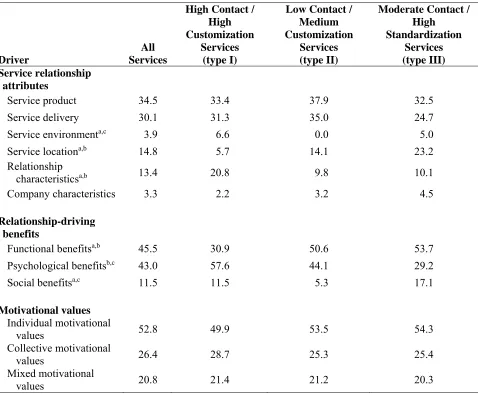
= 31.8%; type II = 31.7%; type III = 36.5%). We highlight the key results on the first-order level
in the next section and report them in detail in Table 3.
-- INSERT TABLE 3 ABOUT HERE --
Interlevel Analysis: Relationships among Means-End Categories
When analyzing the interlevel relationships between attributes and benefits and between
benefits and motivational values, we consider each means-end chain linkage a “probability
statement that one element will cause the occurrence of the other element” (Gutman 1991, p.
144), that is, an indicator of linkage strength. Consistent with our focus on relationship-driving
benefits, we assume the proportion of participants connecting a specific service attribute to a
given benefit provides a measure of the perceived importance of the attribute for gaining the
benefit and that the proportion of participants linking a given benefit to a specific motivational
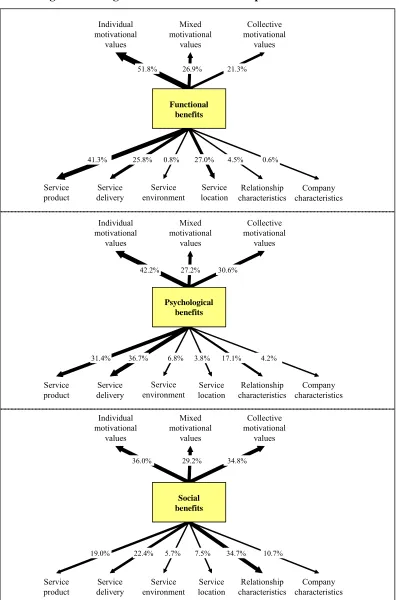
value explains why that benefit is desired by customers. Figure 2 displays the strength of both
attribute–benefit and benefit–value linkages for the three first-order driver benefits.
-- INSERT FIGURE 2 ABOUT HERE --
We find that 41.3% of the customers who repeatedly purchase from a service provider
because of the functional benefits they receive consider the service product the most effective
means for receiving such benefits. With regard to psychological benefits, service delivery is the
crucial attribute in 36.7% of the cases, and social benefits primarily result from relationship
characteristics for 34.7% of customers. Regarding benefits–values linkages, all three first-order
benefits associate more with individual motivational values than with collective or mixed
motivational values (functional benefits 51.8%; psychological benefits 42.2%; social benefits
We test whether linkage strength is stable across service types by conducting a set of χ2
tests. The strength of the attribute–benefit linkages is largely unaffected by the service type
involved; only 4 of the 18 attribute–benefit linkages differ significantly.3 The type of service
offered has no influence on the strength of benefit–value linkages, consistent with values’
context-overarching nature.
Intralevel Analysis: Driver Importance
The frequency of selection of a driver indicates its relative importance. On the service
relationship attributes level, we find that the service product is the most important first-order
driver of customers’ repeat purchases, selected by 34.5% of the respondents; service delivery is
the second most important (30.1%), followed by service location (14.8%), relationship
characteristics (13.4%), service environment (3.9%), and company characteristics (3.3%). A
series of χ2 tests to determine if the importance of first-order attributes remains stable across
service types indicates differences for three of the six attributes, namely, the service environment
(more important for service types I and III than type II), service location (more important for
service types II and III than type I), and relationship characteristics (more important for service
type I than types II and III).
On the relationship-driving benefits level, functional benefits are the most important
first-order drivers for repeat purchase behavior, named by 45.5% of the respondents. Psychological
benefits are almost as important (43.0%), whereas social benefits represent the least important
driver (11.5%). Applying χ2 tests, we find that the importance of all three benefits differs
between service types. Specifically, functional benefits are more important for service types II
3 We find significant differences for the following linkages: relationship characteristics–psychological benefits
and III than for type I, psychological benefits are more important for types I and II, and social
benefits are more important for types I and III.
Regarding the relative importance of motivational values, we note that individual
motivational values are most important for 52.8% of the respondents. Collective and mixed
motivational values are most important for only 26.4% and 20.8% customers, respectively. χ2
tests show no differences between service types at this level.
Discussion: Relationships among Categories and Driver Importance
The lack of an integrative and comprehensive framework of repeat purchase drivers for
services has hampered the accurate assessment of the relative importance of each driver, a major
drawback with regard to service managers’ desire to allocate resources efficiently among
different repeat purchase drivers (Zeithaml 2000). Similarly, researchers hope to know which
drivers are most important when designing studies about service relationships. We thus
contribute to the literature by providing the first comprehensive assessment of driver importance
and the strength of relationships among them. In the following, we compare our importance
findings with the attention that specific drivers have received previously and attempt to
determine in which areas future research attention is particularly worthwhile.
Relationships among repeat purchase drivers. By considering relationships among
attributes, benefits, and values, we determine why certain attributes are important and which
motivational values connect most strongly to a given benefit. The influence of several attributes
on relationship-driving benefits differs strongly across first-order benefits. As a basic principle,
service firms can use the service product and service delivery process to provide all three
benefits, though the service location primarily relates to functional benefits, and relationship
characteristics are of primary importance when customers desire social or psychological benefits.
Because extant research has almost completely neglected the interrelatedness of drivers, we
Our research establishes a systematic link between relationship-driving benefits and
customers’ motivational values and finds that the relevance of motivational values differs across
benefits. Although respondents did not always link all benefits to motivational values, they in
general had no difficulty moving up the ladder, and in all cases, a minimum of one benefit-value
linkage existed. Although means-end theory generally allows for differences in means-end chain
length, our findings suggest that, at least in the context of repeat purchase behavior, motivational
values are almost always involved.
Drivers of repeat purchase behavior. Our results show that the service product and service
delivery provide the dominant reasons for repeat purchases on the service relationship attributes
level for almost two-thirds of our representative random sample, consistent with their prominent
role in extant research. That is, these two drivers may be considered conditio sine qua non for
establishing long-term relationships in consumer service settings. Our results also stress the
relevance of the location of the service firm—a driver of repeat purchase that has received only
minimal attention from relationship marketing researchers—and relationship characteristics, both
of which are crucial for more than 10% of the respondents for all services and more than 20% of
customers of type I services. The marginal role of company characteristics (less than 5% for all
service types) matches the lack of attention these drivers have received.
On the relationship-driving benefits level, we learn that customers’ decision to purchase
from the same service provider derives predominantly from functional and psychological
benefits. Social benefits are the least important determinants, which contradicts an ongoing
research focus on interpersonal and relational drivers as prime success factors in a services
context (e.g., Price and Arnould 1999). Our findings suggest that service scholars should expend
more effort investigating functional and psychological benefits that have received little to no
Finally, our findings imply that individual motivational values are the most important
values for repeat purchases. In other words, most customers repeatedly purchase from service
providers to serve their own individual interests, such as values of hedonism or self-direction,
rather than any collective or social good. Extant research has ignored motivational values as
drivers of repeat purchase behavior; studies that address this driver category would be welcome.
Boundary conditions. Almost 75% of our results (i.e., 29 of 39 drivers and linkages) are
unaffected by the service type involved. In particular, due to their context-overarching nature, the
relative importance of motivational values remains the same for all service types (Schwartz and
Bilsky 1990). The same general results appear for attribute–benefit and benefit–value linkages;
only 4 of the 27 results are not stable. Yet the results also point to important boundary conditions
for our empirical findings and indicate the need to consider the service type as a context variable.
For highly customized services that require a high level of customer–employee interaction,
relationship characteristics are more important for repeat purchases than they are for other
services, whereas functional benefits are less salient. This finding reflects customers’ preference
for personal relationships when a high degree of employee interaction is required for service
provision. Social benefits and the service environment are more important for customers’ repeat
purchases of services directed at people than for services directed at objects, for which customers
spend less time with service employees. Finally, we find that psychological benefits are less
salient for repeat purchase behavior in the context of moderate contact, highly standardized
services. Without intense interactions with service employees and with less customized and
impersonal service offerings, the benefits referring to the self-oriented goals of the customer
FURTHER RESEARCH AND MANAGERIAL IMPLICATIONS
Research and Limitations
Fragmentation is not limited to repeat purchase but instead marks a widespread challenge
in marketing (Anderson 1983b; McAlister, Bolton, and Rizley 2006; Varadarajan 2003). As this
research shows, fragmentation can be overcome by theory-building research, which contrasts
with the dominant approach of borrowing theories from other disciplines—such as psychology or
economics—and testing them in a marketing context (Dubin 1978). Against this backdrop, we
join calls for more theories that primarily organize knowledge about important marketing
phenomena, not necessarily related to other disciplines, and urge marketing scholars to invest
more time and effort in such original theory development (Rust 2006; Stewart and Zinkhan
2006).
We acknowledge that unanswered questions and limitations leave room for additional
research, including the conditions in which different knowledge levels (i.e., attributes, benefits,
and motivational values) have greater importance. For example, the degree to which customers
make use of knowledge about their motivational values in decision making might depend on
their level of involvement (Pieters et al. 1995). Does customer knowledge about repeat purchase
drivers depend on the frequency of repeat purchases? Customers with higher purchase frequency
might have more knowledge about repeat purchase drivers and weigh the importance of certain
drivers differently (Alba and Hutchinson 1987). Furthermore, another issue that requires
exploration is the extent to which repeat purchase drivers influence attitudinal constructs
preceding behavioral loyalty (e.g., customer satisfaction and relationship commitment). We also
encourage researchers to apply our framework to contexts other than consumer services,
although we expect much of our framework may be usable in other contexts, noting the
development; further research should test our findings and determine additional boundary
conditions and the discriminant validity of the attributes and benefits constructs.
With regard to the importance of repeat purchase drivers and the strength of their
interrelationships, our findings are limited insofar as we concentrate on the most important
means-end chain per respondent. Additional studies might explore whether the results differ
when more than one means-end chain per respondent is elicited. However, methodological
limitations should be taken into account when considering alternative approaches for studying
the drivers of repeat purchase behavior. For example, the association pattern technique suggested
by Ter Hofstede and colleagues (1998) would require each respondent to answer a total of 456
questions in our case. We tested this method in advance and found it practically unusable due to
the extremely high defection rate (almost 100%). Also, it might be valuable to allow for more
than three means-end chain elements and examine interrelationships among drivers within the
same general driver category (i.e., attribute–attribute, benefit–benefit, and value–value), as well
as study interactions among drivers (e.g., interaction of two benefits might drive the importance
of an attribute).
Our analysis focuses on benefits, consistent with extant means-end research, but it might
be insightful to concentrate on attributes or values, which would require calculating the strength
of linkages with attributes or values as points of reference. Moreover, although we carefully
establish conceptual equivalence for two major economies (Germany and U.S.), we cannot claim
that the findings about the importance of repeat purchase drivers are valid for other countries.
Evidence indicates that culture frames means-end chains (Overby et al. 2004), so our research
should be replicated in other countries to assess the cross-cultural stability of our findings.
Finally, we concede that our results do not address potential temporal changes that might
example, a customer might consider functional benefits most important at the beginning of a
relationship, but then value social benefits more at a later stage. Additional research should
investigate such shifts in driver importance during an ongoing relationship. As is the case with
any survey research, our findings might be affected by common method bias (Podsakoff,
MacKenzie, Lee, and Podsakoff 2003), though we address several potential sources of such bias,
including a thorough item development process (to minimize item characteristic effects) and item
randomization throughout the survey (to minimize item context effects).
Implications for Service Managers
Our key contributions, namely the development of a theoretical framework and the
assessment of driver importance, are valuable for service managers. Our framework
demonstrates that many hierarchically related concepts drive repeat purchase behavior, which
provides managers with the first nonoverlapping, comprehensive classification of repeat
purchase drivers. One of the most prominent (and effective) unifying frameworks within
marketing, the 4Ps of the marketing mix, establish the general importance of classification
schemata for managers (McCarthy 1960). With regard to repeat purchase drivers, managers need
a clear classification to judge each driver`s effectiveness. The availability of such a classification
should reduce both confusion about which drivers exist and how they interrelate, as well as the
danger of overlooking powerful drivers.
Moreover, managers can use our empirical findings to allocate marketing investments
across relationship marketing strategies and thus achieve higher returns (Reinartz et al. 2005;
Rust et al. 2004). Whereas first-order driver categories on the attribute level can serve as
strategic investment categories, second-order drivers provide information about how to
implement such strategies. Specifically, we find that functional and psychological benefits are
money savings, as well as feelings of confidence and welcomeness. In addition, managers should
consider the differences among service types, because driver importance and strength of linkages
are not generalizable to all types. Specifically, services with a high degree of customer contact
and customization (e.g., hairdresser) should prioritize psychological rather than functional
benefits, whereas the opposite is true for services that offer standardized service solutions with
moderate contact (e.g., supermarkets). Yet all service managers need to recognize that social
benefits, such as enjoyable communication and feelings of affiliation, are not the main reasons
customers return. Social benefits may still serve to differentiate a provider when all competitors
adequately meet the customer’s needs for functional and psychological benefits.
The strength of the intercategory linkages can help companies better understand which
action is most effective for providing certain benefits to customers and thus indicate where to
allocate marketing resources. As in our framework, linking service relationship attributes to
customers’ desires (i.e., benefits and values) reflects a crucial marketing principle, namely, that
customers buy a product not for the product’s sake but for what the product can do for them
(Levitt 1960). The most effective way to provide customers of all service types with both
functional and psychological benefits is to invest in the first-order driver attributes of service
product and service delivery. Improving the perception of reliability, the price–quality ratio, and
the service employees’ expertise and quickness help create such benefits. In addition, functional
benefits can accrue by optimizing the service location, and psychological benefits can be
enhanced through relationship characteristics, especially a personal connection between
customers and service employees.
Intercategory linkages between benefits and values suggest why certain benefits are
important for their customers. On a general level, whereas customers’ valuation of service
and thus require service firms to adapt their relationship marketing activities, motivational values
represent stable aspects of customer knowledge and therefore provide the basis for more
long-term retention strategies. Our results show that both functional and psychological benefits
connect primarily to individual motivational values such as hedonism and self-direction.
Moreover, security values are strongly interrelated with focal functional and psychological
benefits, such as money savings and confidence benefits. These findings demonstrate that
customers repeatedly purchase from the same provider as a means to enjoy their life and attain a
sense of independence and security. Service firms that regularly contribute to the achievement of
these motivational values might be able to realize a competitive advantage in retaining their
customers that is difficult for competitors to imitate.
Finally, information about driver importance and the strength of linkages among drivers
can be used to segment customers and position the service offering. Ter Hofstede, Steenkamp,
and Wedel (1999) propose a segmentation method based on linkage strength that might apply to
identify different loyal customer segments. For example, segments could differ in terms of the
strength with which they connect service relationship attributes and motivational values to
functional, social, or psychological benefits. In addition, customers’ perceptions of different
service offerings and their links to benefits and motivational values might help a company refine
its positioning strategy (Reynolds and Olson 2001). Such refined positioning can provide the
basis from which to select attributes for new product development and formulate an adequate
communication strategy that focuses on those customer benefits and values most strongly
REFERENCES
Alba, Joseph W. and J. Wesley Hutchinson. 1987. “Dimensions of Consumer Expertise.”
Journal of Consumer Research 13 (March): 411-454.
Anderson, John R. 1983a. “A Spreading Activation Theory of Memory.” Journal of Verbal
Learning and Verbal Behavior 22 (3): 261-295.
Anderson, Paul F. 1983b. “Marketing, Scientific Progress, and Scientific Method.” Journal of
Marketing 47 (Fall): 18-31.
Barsalou, Lawrence W. 1991. “Deriving Categories to Achieve Goals.” in The Psychology of
Learning and Motivation. 27. Ed. Gordon H. Bower. New York, NY: Academic Press, 1-64.
Bech-Larsen, Tino and Niels Asger Nielsen. 1999. “A Comparison of Five Elicitation
Techniques for Elicitation of Attributes of Low Involvement Products.” Journal of Economic
Psychology 20 (3): 315-341.
Bendapudi, Neeli, Surendra N. Singh, and Venkat Bendapudi. 1996. “Enhancing Helping
Behavior: An Integrative Framework for Promotion Planning.” Journal of Marketing 60
(July): 33-49.
Berry, Leonard L. 1983. “Relationship Marketing.” In Emerging Perspectives on Services
Marketing. Eds. Leonard L. Berry, G. Lynn Shostack, and Gregory D. Upah. Chicago, IL:
American Marketing Association, 25-28.
Berry, Leonard L., Kathleen Seiders, and Dhruv Grewal. 2002. “Understanding Service
Convenience.” Journal of Marketing 66 (July): 1-17.
Bhattacharya, C. B. 1998. “When Customers Are Members: Customer Retention in Paid
Membership Contexts.” Journal of the Academy of Marketing Science 26 (Winter): 31-44.
Boulding, William, Ajay Kalra, Richard Staelin, and Valarie A. Zeithaml. 1993. “A Dynamic
Process Model of Service Quality: From Expectations to Behavioral Intentions.” Journal of
Marketing Research 30 (February): 7-27.
Bowen, John. 1990. “Development of a Taxonomy of Services to Gain Strategic Marketing
Brady, Michael K. and J. Joseph Cronin, Jr. 2001. “Some New Thoughts on Conceptualizing
Perceived Service Quality: A Hierarchical Approach.” Journal of Marketing 65 (July): 34-49.
Cohen, Gillian 2000. “Hierarchical Models in Cognition: Do They Have Psychological Reality.”
European Journal of Cognitive Psychology 12 (1): 1-36.
Cohen, Joel B. and Luk Warlop. 2001. “A Motivational Perspective on Means-End Chains.” In
Understanding Consumer Decision Making: A Means-End Approach to Advertising and
Marketing Strategy. Eds. Thomas J. Reynolds and Jerry C. Olson. Mahwah, NJ: Lawrence
Erlbaum Associates, 389-412.
Collins, Allan M. and Elisabeth F. Loftus 1975. “A Spreading-Activation Theory of Semantic
Processing.” Psychological Review 82 (November): 407-428.
Council for Marketing and Opinion Research. 2001. Respondent Cooperation and Industry
Image Study: Privacy and Survey Research. Glastonbury, CT.
Craig, C. Samuel, Avijit Ghosh, and Sara McLafferty. 1984. “Models of the Retail Location
Process: A Review.” Journal of Retailing 60 (Spring): 5-36.
Crosby, Lawrence A., Kenneth R. Evans, and Deborah Cowles. 1990. “Relationship Quality in
Services Selling: An Interpersonal Influence Perspective.” Journal of Marketing 54 (July):
68-81.
Dholakia, Utpal M. 2006. “How Customer Self-Determination Influences Relational Marketing
Outcomes: Evidence from Longitudinal Field Studies.” Journal of Marketing Research 43
(February): 109-120.
Dick, Alan S. and Kunal Basu. 1994. “Customer Loyalty: Toward an Integrated Conceptual
Framework.” Journal of the Academy of Marketing Science 22 (Spring): 99-113.
Dubin, Robert 1978. Theory Building. 2nd ed. New York, NY: Free Press.
Duncan, Tom and Sandra E. Moriarty. 1998. “A Communication-Based Marketing Model for
Managing Relationships.” Journal of Marketing 62 (April): 1-13.
Evans, Kenneth R., Tim Christiansen, and James D. Gill. 1996. “The Impact of Social Influence
and Role Expectations on Shopping Center Patronage Intentions.” Journal of the Academy of
Fishbein, Martin and Icek Ajzen. 1975. Belief, Attitude, Intention, and Behavior: An Introduction
to Theory and Research. Reading, MA: Addison-Wesley.
Frenzen, Jonathan K. and Harry L. Davis. 1990. “Purchasing Behavior in Embedded Markets.”
Journal of Consumer Research 17 (June): 1-12.
Gupta, Sunil and Valarie A. Zeithaml 2006. “Customer Metrics and Their Impact on Financial
Performance.” Marketing Science 25 (November-December): 718-739.
Gutman, Jonathan. 1982. “A Means-End Chain Model of Consumer Categorization Processes.”
Journal of Marketing 46 (Spring): 60-72.
Gutman, Jonathan. 1991. “Exploring the Nature of Linkages Between Consequences and
Values.” Journal of Business Research 22 (2): 143-148.
Gwinner, Kevin P., Dwayne D. Gremler, and Mary Jo Bitner. 1998. “Relational Benefits in
Service Industries: The Customer’s Perspective.” Journal of the Academy of Marketing
Science 26 (Spring): 101-114.
Harkness, Janet A., Peter Ph. Mohler, and Fons J. R. Van de Vijver. 2003. “Comparative
Research.” In Cross-Cultural Survey Methods. Eds. Janet A. Harkness, Fons J. R. Van de
Vijver, and Peter Ph. Mohler. Hoboken, NJ: John Wiley & Sons, Inc., 3-16.
Hennig-Thurau, Thorsten, Markus Groth, Michael Paul, and Dwayne D. Gremler. 2006. “Are All
Smiles Created Equal? How Emotional Contagion and Emotional Labor Affect Service
Relationships.” Journal of Marketing 70 (July): 58-73.
Hennig-Thurau, Thorsten, Kevin P. Gwinner, and Dwayne D. Gremler. 2002. “Understanding
Relationship Marketing Outcomes. An Integration of Relational Benefits and Relationship
Quality.” Journal of Service Research 4 (February): 230-247.
Holloway, Betsy Bugg and Sharon E. Beatty. 2008. “Satisfiers and Dissatisfiers in the Online
Environment. A Critical Incident Assessment.” Journal of Service Research 10 (May):
347-364.
Hunt, Shelby D. 2002. Foundations of Marketing Theory: Toward a General Theory of
Johnson, Michael D., Andreas Herrmann, and Frank Huber. 2006. “The Evolution of Loyalty
Intentions.” Journal of Marketing 70 (April): 122-132.
Klein, Katherine J., Fred Dansereau, and Rosalie J. Hall. 1994. “Levels Issues in Theory
Development, Data Collection, and Analysis.” Academy of Management Review 19 (April):
195-229.
Lehmann, Donald R., Sunil Gupta, and Joel H. Steckel. 1998. Marketing Research. Reading,
MA: Addison Wesley Longman Inc.
Levitt, Theodore. 1960. “Marketing Myopia.” Harvard Business Review 38 (July/August):
45-56.
Lincoln, Yvonna S. and Egon S. Guba. 1985. Naturalistic Inquiry. Newbury Park, CA: Sage
Publications.
MacKenzie, Scott B. 2003. “The Dangers of Poor Construct Conceptualization.” Journal of the
Academy of Marketing Science 31 (Summer): 323-326.
Maignan, Isabelle and O. C. Ferrell. 2004. “Corporate Social Responsibility and Marketing: An
Integrative Framework.” Journal of the Academy of Marketing Science 31 (Winter): 3-19.
McAlister, Leigh, Ruth N. Bolton, and Ross Rizley. Eds. 2006. Essential Readings in Marketing.
Cambridge, MA: Marketing Science Institute.
McCarthy, E. Jerome. 1960. Basic Marketing: A Managerial Approach. Homewood, Il: Irwin.
Olson, Jerry C. and Thomas J. Reynolds. 1983. “Understanding Consumers’ Cognitive
Structures: Implications for Advertising Strategy.” In Advertising and Consumer Psychology.
Eds. Larry Percy and Arch G. Woodside. Lexington, MA: Prentice Hall, 77-90.
Overby, Jeffrey W., Sarah Fisher Gardial, and Robert B. Woodruff. 2004. “French Versus
American Consumers’ Attachment of Value to a Product in a Common Consumption Context:
A Cross-National Comparison.” Journal of the Academy of Marketing Science 32 (Fall):
437-460.
Palmatier, Robert W., Rajiv P. Dant, Dhruv Grewal, and Kenneth R. Evans. 2006. “Factors
Influencing the Effectiveness of Relationship Marketing: A Meta-Analysis.” Journal of