Rochester Institute of Technology
RIT Scholar Works
Theses Thesis/Dissertation Collections
2-1-2010
Mashed
Adam Fisher
Follow this and additional works at:http://scholarworks.rit.edu/theses
This Thesis is brought to you for free and open access by the Thesis/Dissertation Collections at RIT Scholar Works. It has been accepted for inclusion in Theses by an authorized administrator of RIT Scholar Works. For more information, please [email protected].
Recommended Citation
“Mashed”
by
Adam Fisher
MFA: Imaging Arts/Animation
School of Film and Animation
Rochester Institute of Technology
Rochester, New York
Thesis Committee
Tom Gasek
Thesis Chair
Skip Battaglia
Committee Member
Brian Larson
Abstract
My thesis film, “Mashed”, was created with multiple purposes in mind. I wanted
to use and build on everything I learned at RIT, entertain both young and old audiences,
and support my belief that shooting mediums should be a choice tailored to fit the needs
and purposes of a character in a film. Popular trends in animation and visual effects
sometimes overshadow the fact that technological advancements benefit more than just
computer-generated graphics. Convincing stop-motion characters (and characters of
other mediums) can benefit from these same advancements, and even coexist with
multiple other styles within the same frame.
My film is framed in a situation familiar to nearly everyone. It uses three major
characters to tell its story, each of which is photographed separately using different
filmmaking techniques. I have a real boy shot on HD video, a mashed potato monster
brought to life with stop-motion animation, and a television super-hero created using
computer-generated images. This production required three very distinct pipelines, each
of which presented its own batch of challenges and adventures. The results were blended
together into a film that I hope will not stand out as an attempt to mix media, but rather as
a well-told story that was made using wise choices to create the strongest, most
When I set out to begin my thesis film, I had three primary goals in mind. First,
to create a story that would allow me to expand my animation skills by demanding high
quality character animation over a range character types. Second, to incorporate all the
skills I learned across various mediums while studying at RIT. Third, to tell a great story
that would appeal to both young and old audiences. The script I finally arrived at with
Mashed, allowed me the potential to achieve all of these goals. The story of a child
forced to sit at the table until finishing their dinner is one nearly everyone can identify
with. There was a wealth of dialogue and character interactions that would push my
animation skills, and it created a perfect stage for mixing mediums. It set me up with
three major characters. All were vastly different from one another, each one perfectly
suited to the medium that would bring them to life. The challenge of bringing all three
together to interact convincingly in the same frame was what really got me excited about
the project. I always respected films that attempted to merge mediums, and have watched
technology grow to the point where sometimes it is hard to even tell what is real. Willis
O’Brien and Ray Harryhausen were merging stop-motion characters with live-action film
decades before I was born with films like King Kong and The 7th Voyage of Sinbad.
Average people today tend to compare these films with something like Jurassic Park and
laugh at the “hokey” special effects of a bygone era. It is true that CG has pushed realism
a long way, but that doesn’t mean there isn’t a place for stop-motion effects and puppets
anymore. It’s a tricky thing to believably merge animated characters into a live-action
scene, and there are many recent films that have abused the potential of CG effects to the
point that they are no longer convincing. My belief is that we have gotten to a point
purpose. Any methods can be merged well, given the right project. This is the point I
sought to prove by making Mashed. I had Trevor, a real boy of 7 years, doomed to miss
his favorite television program if he could not force himself to choke down his meal.
Next, I had Big Mashy, the power hungry mashed potato monster who sprung to life in
order to avenge neglected vegetables everywhere. Finally, there was Captain Harvey, the
super hero from Trevor’s television program that arrives on the scene to aid him in his
time of need. Trevor and his surroundings would be captured in live-action HD. Big
Mashy would be made from plasticine and animated using stop-motion techniques.
Captain Harvey would be modeled and animated on the computer in Maya. My hope was
that the characters were so well-suited their respective mediums, that once composited
together, an audience would watch the film and accept them into the universe and story
without stopping to notice their differences. This would be my biggest challenge as
worked through the multi-headed pipeline that will describe now.
Storyboarding
I typically take a somewhat casual approach to my storyboards. In past projects, I
always knew I would likely be tweaking and changing things along the way, so I thought
of this stage as a rough sketch that would be smoothed out over the course of production.
Things always look a little different, and new ideas crop up once I start peering through a
camera. I knew this approach would be disastrous in the case of Mashed. Essentially,
the film I was setting out to create required three separate production pipelines. Each one
involved its own variety of camera and lens, not to mention unique characters, which
would not be feasible to initiate each shots production flow in the medium of the lead
character, leaving the backgrounds to fill in later. I needed careful planning, and angles
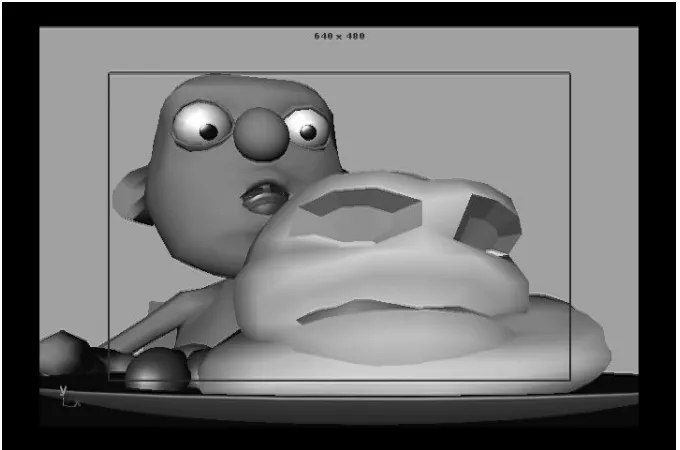
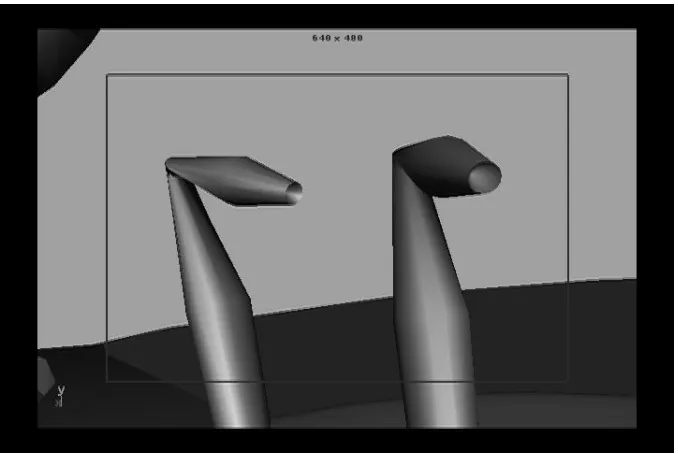
that I could lock down. My solution to this was to bypass thumbnails and hand drawn
index cards in favor of a CG simulation that would allow me to see the stand-ins with
their correct proportions through a simulated camera in the proper aspect ratio. I created
a roughly modeled scene in Maya that was scaled to the kitchen I’d be using. I imported
existing rigged characters to act as stand-ins, which I posed appropriately for each
“storyboard frame”. I then was able to track, pan and tilt around with the simulated
camera until I found just the right framing for each shot (see figures 1a and 1b for
examples). Once these angles were locked in, I was able to use them for reference in
shooting my live-action scenes and background plates, which then became the reference
[image:8.612.125.465.431.656.2]for matching up my stop-motion and cg cameras.
Figure 1b: CG storyboard from Mashed.
Live-Action
The most critical piece of the live-action portion of my film was finding the right
kid to play the role of Trevor. I put out some ads on craigslist, and contacted the few
potential actors I could find in the actor files in the cage. In the end, I found three kids to
audition. I had never really worked with child actors before, and none of these kids had
any experience. I asked my thesis advisor, Tom Gasek, for some advice. He suggested I
try to reach a professional, and gave Bob Ebel’s name. He is a director who is famous
among ad agencies for his skills in getting outstanding performances out of kids. I
contacted him via email and got some great advice in return. Among other suggestions,
he recommended looking for kids with energy and an ability to create. He said I needed
to have a casting session that would allow me to observe these abilities. This made a
not be terribly effective in evaluating a seven-year-olds acting potential. I decided to set
up my audition space in a way that would encourage play and creativity.
I began my sessions by giving the kids some clay to play with. I asked them to
sculpt a super hero and then asked them questions about it. Since I also needed to cast a
mother, I invited the mom’s to participate as well (one kid and his parent per session).
After that I had them begin some role-play exercises. I had them take turns pretending to
be monsters and let them chase each other around the room. I would join in eventually.
This helped loosen them up and get them comfortable around me. I felt the closer I
became to a play buddy, the easier it would be to get them to drop their shyness and
reveal their creativity. We then switched to an improvisation exercise that mimicked the
film a little closer. I put the kid at a table with some lumps of “food” (made from clay) in
front of him, and had the moms demand they clean their plates. I told the kids that they
should come up with any excuse imaginable to not eat it. After this, I had them switch
places and told the kids to impersonate their moms trying to get them to eat. In the end,
the kids seemed very comfortable, and I got a decent feel for how they might act. I
reviewed the tapes with Tom Gasek and we narrowed the choice to two kids. One was
extremely creative and loved acting up for the camera. He was a little on the old side, but
was easy to communicate with. The other was a bit quieter. He was harder to draw out,
but was also the youngest I had auditioned. He had a great look (was missing his front
teeth), and I decided he was worth the gamble. I invited him for a second audition and
had even more success in drawing him out. Also, his mom was a perfect fit, and they had
The second big piece of my live-action puzzle was finding a Director of
Photography. I spoke with Neal Dhand and Ali Vatansaver (friends in the live-action
MFA program) and came up with a short list of students I would be comfortable working
with. Doug Brantner was the first to leap at the idea. He had proved his skills on
numerous films, but had never shot anything quite like this. We met a few times to
discuss what I wanted the film to look like and what our strategy would be for getting all
the camera angles to match across mediums. I trusted him with the decision to shoot on
the Panasonic DVX100a, in the 720pn format. He made the equipment list for the shoot,
and recruited some of his friends as crew. We came up with a spreadsheet in which we
would record detailed measurements such as distance from camera to subject, distance to
the table and floor, angle of camera, distance of lights from subject, etc. During the
shoot, we kept track of these for every setup.
With Doug keeping his crew running smoothly, I had plenty of time to keep
Michael happy and entertained. We had rehearsed a handful of times, so he knew the
story well, and had proved he could pull off the more dramatic moments. I was a bit
worried about throwing him in with a crew of people he didn’t know, so I had invited
Doug to our last rehearsal. They got to know each other a bit, and Doug had a chance to
visualize the setups. Once we actually began filming, Michael was great. He had faces
planned out for different scenarios, and grew to love the taste of brussel sprouts. When
he grew restless, I let him take breaks to play games. By the end of day two, we had
worked through everything and wrapped.
Over the next several weeks I reviewed the footage and put together a rough edit.
screaming that required a stronger performance. We had to have a reshoot. Doug and I
decided we could keep the crew to just the two of us and setup in the studio at the school.
He nailed all the pickup shots with ease, but still stumbled on the scream. It wasn’t
coming out realistic. After trying a number of things, even having everyone scream to
ease his shyness, his mom finally said, “Why don’t you pretend there’s a snake crawling
up your leg?” Micheal thought for a second, then looked at me hesitantly and replied,
“You want me to scream like a girl?” He nailed the next take and we wrapped.
Voice Actors
Casting my voice actors was every bit as important to the film as casting Trevor.
I ended up with two fantastic talents in Ray Haingray Jr. (Big Mashy) and Erik Oehler
(Captain Harvey). Both were able to summon their characters with ease, never once
sounding like they were “putting on a voice.” In addition, both are fantastic with improv.
I had never included much dialogue in a film before, and was struggling a little bit to get
a believable banter going on paper. Once I had made my casting decisions, I decided to
get them both together and just improvise for a while. I told them about their characters
within the context of the film then interviewed them on camera about things in their
characters lives outside of this context. On the spot, they came up with brilliant
anecdotes about previous meetings, their true feelings about one another, their childhoods
and the names they were called… all of which really helped to flush out the motivation
behind their actions. I then had them run through the story of the film, but without seeing
scripts yet. I gave them the outline, and then let them know when to advance to the next
exchanged pun after pun. This is the point when I knew the characters of the film would
be strong, and be able to carry the story. I brought home the tape from that session, and
flushed out the dialogue in the script based on bits that I liked. I moved things around,
dropping the new dialogue in place of, or responding to old bits. Next, I sent them copies
and set up time to meet them in the recording room at school. We went through
everything in a single session.
Stop-Motion
The stop-motion production pipeline was the one I both looked forward to the
most, and feared the most. Its my favorite animation style to work in, but also involves a
host of very real problems that can’t be solved with digital trickery. The first big hurdle
was securing space for shooting. I would need a dedicated studio to hole up in for
months, and shooting at home was not an option. After much negotiation with facilities
and departmental authorities, I was allowed to claim the back half of stop-motion studio
A in the animation lab. People from the stop-motion classes would have access to the
front half of the room, but I could hide behind a curtain and work away all day and night.
The space was just big enough. I didn’t require a large set, just a kitchen table with a
dinner plate and some glasses and silverware scattered about. I mounted some bolts on
the back of a plate with plumber’s epoxy, drilled holes in my table (through the
tablecloth), and had my set finished. For the background, I would need to use a color key
to matte in my live-action plates. I chose to use red instead of blue or green, because I
knew I would have green vegetables on the plate, and the tablecloth was blue. Red
seemed like a good choice, since some of the most difficult compositing would involve
the plasticine that would be Big Mashy. Any bleed or spill from the red screen would
actually blend nicely. I found the perfect “screen” in a large four-foot container lid with
a smooth, red matte finish. It was large enough to fill the background of the frame, yet
very light and portable to allow me a great deal of flexibility in setting up my shots.
Matching the lighting proved to not be as difficult as I had anticipated. I have
Doug to thank for that. I had decided during the live-action shoot, that when the food
comes to life, the background should drop off into semi-darkness. This would focus the
attention on the table as a sort of arena for the action. We achieved this at the time by
switching the lights on dimmers from the main setup, to some overhead kinos as the key
source. This gave a sort of general soft light from above. Once in the stop-motion
studio, we matched this with a 1K in a big soft-box. I then would move some smaller
fresnels around from shot to shot in conjunction with some little mirrors or bounce cards
for any fill or rim-lights I wanted. Doug helped me get the general setup established and
gave it his stamp of approval, then left me to tweak things shot by shot as needed.
Designing and building my puppets was a little bit of an exploration. The brussel
sprout and asparagus minions I knew needed to be fairly realistic looking to blend in with
the table settings. I began trying to come up with ways of layering cloth leaves from fake
plants together around a core to make the sprouts. The result wasn’t terrible, but didn’t
blend well at all, and would not look very good when animated. I finally decided to try
experimenting with silicone. I made a set of molds from real vegetables, and cast my
puppets using DragonSkin around wooden cores with mounting points and wire
armatures inside. I colored the silicone small amounts of acrylic paint prior to filling the
eventually it worked. The resulting puppets not only looked realistic enough to blend in,
but they even had a somewhat shiny surface that had the look of recently steamed
veggies.
Big Mashy was a different sort of exploration. I had animated with soft clay a
little bit, but never an entire amorphous character. I went through a handful of sculpts
before settling on a design, then began to contemplate what the animation process would
be like. The puppet itself was solid plasticine, lumped onto the plate. It didn’t require an
armature. I decided instead, after several conversations with Tom, that perhaps the way
to go was using replacements. They would serve as subs that would tag in and out as I
closed in on their poses. I would swap one in, modify it to the exact position required in
the movement, and then animate it until it was close enough to another key pose to swap
in then next one. We thought this would help to keep me on model and simplify the
re-sculpting process a bit. I would later completely scrap this approach after my first shot,
but it seemed like the way to go at the time. Tom recommended a couple of students
from his stop-motion class, who I recruited to help me sculpt all these replacements. I
made a press-in rubber mold of the base potato shape and gave them drawings of the key
poses I wanted. The mold allowed them a rough starting point, and also made certain that
each sculpt would use the same volume of plasticine. They roughly formed each key,
and then passed them on to me for refining. This process saved me a great deal of time,
and in the end was beneficial despite the fact that I scrapped the replacement process. It
proved useful to have thirty or so extra Big Mashies handy to quickly get a clean model
in for a new shot. The trouble I had that led me to scrap the replacement method was a
different and things would pop. It was much smoother to simply continue the animation
with the original model.
The actual shooting of the stop-motion portion of Mashed brought a whole new
series of challenges and learning opportunities. As I had mentioned, I had never worked
with a completely clay puppet before… and Big Mashy was quite the lump to push
around. On one hand, it was painstaking to have to move and re-sculpt and smooth every
single frame. On the other hand, I wasn’t limited by any boundaries. Big Mashy was
free to move and transform any way I saw fit. There were several unique opportunities to
throw in just a little bit of unexpected solutions to how he would move or work around a
problem. One good example is when Captain Harvey first appears, and Big Mashy needs
to turn around to face him. Rather than have him twist his girth around 180 degrees, I
simply had him squash his face down into himself and reemerge on the other side. I think
these little details made the character seem more believable, as he was comfortable in his
own “skin”.
Matching the camera angles was a bit tricky. My first solution was to use a small
“boardcamera” that would peer through the lens of my D-SLR and send the live feed to
my computer via firewire where I could overlay a still my from live-action footage to
match the setup. These cameras look like tiny lenses mounted on a two-inch square
circuit board. I built a little rig that mounted it on my camera body. Similar setups are
used sometimes in stop-motion in order to get a low-resolution feed into frame-grabbing
software that lets the animator preview the frames they have shot and keep their work
smooth. However, for my purposes, the setup was shaky and unreliable. The images
using it as a starting point, aided by all the data we recorded in the live shoot, to get an
approximate camera setup. I then took stills from my D-SLR, imported them to the
computer, and overlaid the live-action frames to check the accuracy. It was a slower
process, but it was reliable. Unfortunately, this also meant I needed to setup a parallax
camera that would serve as my live-feed for the frame-grabber. It is less accurate than
getting a feed from the primary camera, but I found it did the job well enough.
As I progressed through shooting these stop-motion sequences, I knew the
trickiest part was still to come. The climax of Mashed would require Captain Harvey to
be literally on the plate wrestling with Big Mashy. A cg character in total contact with
plasticine as they struggle against each other. I had an idea that seemed like it should
work, but I hadn’t tested it yet. I built a stand-in Captain Harvey using plumber’s epoxy
and wire. It was basically a scaled armature that I painted completely red. The plan was
to place him in the mash, and animate him along with the potato monster. He would
displace potato as he was animated, and even give off a little bit of red reflected light that
would help sell the illusion when it came time to composite. As the potato monster
grabbed him, the mash would cover parts of the stand-in and leave other parts exposed.
In theory, I could just key him out along with the background, and drop Harvey in his
place. I was extremely pleased when the plan worked. I was able to load my
stop-motion shot into the background of the Maya interface as I animated the real Harvey.
The stand-in’s movements were basically rotoscoped as Harvey was animated on twos
using step-tangents. This prevented maya from tweening the poses, and instead presented
illusion. The compositing took some time, but once the shots left aftereffects it all looked
great.
Computer Animation
There were many stages in the computer animation pipeline, and it was easily the
most disjointed part of making the film. While in the midst of wading through the
stop-motion animation, I also got to work on modeling Captain Harvey. I had already come
up with some sketches of what I had in mind, but decided to enlist the help of my brother,
Josh, for the final design. He has an illustration background, and good eye for these
things. He took my ideas and came up with some character turnarounds that I could use
for the modeling process. By the time I had completed the stop-motion process, Harvey’s
model was finished. The spring quarter had just ended, and I decided I would move back
home to Maine to continue my work using my own computer. From this point on, I had
all the software I needed, so I could bring the project with me wherever I went. I spent
the summer modeling all the blend shapes for Harvey’s face animation, and sent the
model off to my classmate, Josh Huber, for rigging. Being that one of my primary goals
in this film was to create the best animation I was capable of, I wanted to be sure that I
had a rig I wouldn’t have to fight to get the motion I desired. Josh was the best rigger I
knew at RIT, and was happy to have another project to add to his reel.
By the end of summer, I was ready to move again… this time to Portland, OR for
a job. I drove west with my computer and hard drives in the back. Over the course of the
next 14 months, I made little progress on the film, personally. Josh finished the rig, and I
had another classmate, Joe Arcovitch model replicas of the asparagus, sprouts, and fork
Trevor and with Harvey (the asparagus tying Trevor’s arms to the chair, and the fork
Harvey wields while baseball-batting the sprouts, for example). I thought it would be
easier to sell these interactions using computer generated versions, than trying to use my
somewhat limited silicone puppets. He was the best modeler and texture artist I knew,
and he did a fantastic job.
When my job ended, I resumed my work on Mashed. Everything was ready to
begin animation. Lining up the cameras was much simpler in Maya. With the live and
stop-motion footage to load into the backgrounds, I could easily eyeball the correct
placements for Harvey, and manipulate directional lights to match the look. I decided to
use the step-tangent style of animating I mentioned earlier for all of his facial
expressions. This was a subtle way of making the difference between the CG and
stop-motion less obvious. People tend to watch the mouth as a character speaks, and by
having Harvey’s pop with gentle eases from expression to expression, he seemed to speak
in the same physical style as Big Mashy. I grew to like this method and its look, and
even used it for some of Harvey’s action scenes. Sometimes Maya’s interpolations can
do odd things to the rig and to the model’s natural deformations. I found in moving
between some extreme poses, I could use this step-tangent style to overcome some of
these issues by locking in the exact poses I wanted for each frame. I got cleaner and
more dynamic arcs of motion this way, and was able to hide some flaws in Harvey’s
model.
Compositing
This is the stage when the results of working through all three pipelines had to
frame. I was a little worried. I decided to load a couple of key shots onto a drive and get
some advice from a friend I had worked with, Chris Covel. He knew compositing, and
could tell me very quickly if what I wanted to do could be achieved with AfterEffects, or
if I needed to find more powerful software. Turns out, it could. He worked roughly
through a couple shots with me just far enough to show me some tricks and techniques
for layered masks and for getting good keys using Keylight, a plug-in for Aftereffects.
When I left his house, I knew it would be possible to make all my pieces fit together.
Some of the more complicated shots required dozens of layers, including several clean
plates tailored to specific frames. To get good keys, I would tweak the colors and levels
of a layer until it looked awful to the eye, but allowed me to remove exactly what I
wanted to remove. I would then hide the layer, and use its alpha channel as a track-matte
for a nice-looking layer to get the best of both worlds. The whole thing took much longer
than I had anticipated, nearly as long as the computer animation, but it was time well
spent. It had been the last uncertain stage I had to wade through. From that point on, it
was just a matter of putting in the finishing touches.
Sound Effects
Recording and editing the sound effects is one of my favorite stages in making an
animated film. Every detail of the sound-scape must be manufactured and placed in just
the right place. Done correctly, much of the work tends to go unnoticed, yet it greatly
enhances the quality of the final product. It is an interesting challenge.
I began by carefully working through the current cut and noting down every
could possibly use to recreate just the right noise. I needed lots of squishy, splatty
sounds, as well as crunches and squeaks. I gathered together a very odd collection of
items, ranging from a rubber egg, to a bowl of rice noodles, to stalks of celery and
carrots, to partially inflated balloons. I locked myself in my bedroom and assembled a
makeshift fort out of pillows and quilts to create as soundproof a space as I could. I
dragged in my DV camera, a shotgun microphone, and all my gathered items. Then, it
was time to play. I squeezed the noodles, crunched the celery, twisted the balloons, and
then smooshed it all together, pulled it all apart, and generally made a mess of my fort.
When the dust cleared, I had all the sounds I needed to build my track. From there, it was
just a matter of layering sound on top of sound to create the splats and crunches in final
cut pro that would let the audience believe in my universe.
Music
I found a great composer in another co-worker, Tim Yates. I had heard both his
bands perform, as well as his solo recordings and knew he was a very talented musician
with extremely diverse capabilities. He hadn’t done any scores before, but was eager to
give it a try. We exchanged a few ideas for the Captain Harvey theme first. I sent him
some links to some classic superhero themes to use as inspiration. He wrote some lyrics,
which we passed back and forth a few times until we really got to the essence of what
Harvey is all about… promoting healthy vegetables while trying to conceal his vanity.
The first recording was quite good, but a bit too serious. He decided to add some horns
to make it feel more heroic, and worried less about singing in a bassy voice. The next go
Composing the rest of the score was a similar process. I described what I had in
mind. I wanted some haunting atmospheric noise to accompany Big Mashy when he was
in control and subduing Trevor. Harvey would be accompanied by horns and more
heroic music. I didn’t want anything too distracting or grand. It was meant to
supplement and reinforce what was already there, not drown it out. He nailed the spooky
stuff straight off. The Harvey chunk, and the fighting music were very dramatic the first
time through. It was good, but sounded more like an epic film score than what I had in
mind. I explained this to Tim, and he got it quickly. The mood was lightened without
sacrificing excitement. Again, his second time through he hit it right on the head. From
there, we only had minor changes here and there to emphasize certain things. Finally, he
went back through to sweeten what he’d created.
Tying it all up
All the pieces were now in place. I made a color correction pass in final cut pro
just to make sure the tablecloth stayed the same color and everything seemed consistent
shot to shot. Little adjustments were made here and there, and before long, I had a
finished film. With a month left to go before screenings, I began the end credits. Given
the time I had left, I thought I’d draw them using templates and a light table. I figured I
might as well include a little bit of 2D animation in there just to round things out! I got
help from Sarah Hoopes, and together we scribbled over the text of the credits, creating
five-frame loops for each title. I photographed them individually, and then brought the
whole sequence into Aftereffects. I used the lumakey feature to key out the pencil and
The song I chose, Eat Your Veggies by Fezcat, was something that completely fell into
my lap. A friend from childhood that lives in New York City is engaged to woman who
sings for Fezcat. He knew about my film, and when he heard their new song about rogue
vegetables, he immediately put me in touch with Noah Manheimer, who writes their
music. He loved the idea of having the song in my film and agreed to let me use it in
exchange for a DVD and a credit.
Conclusions
As I look back now at the entire process, I am proud to say that I believe I
achieved all the goals I set for myself at the outset. My animation skills expanded as I
explored new methods and pushed my boundaries; I used everything I learned at RIT and
then some; and I ended up with a film I am proud of. The major challenge I presented of
merging multiple mediums was a difficult one to pull off, but one I think ultimately will
make my film stand out for the choices that were made. The process proved to be much
more elaborate in scope that I had originally imagined. When I began, I was aware of all
the steps involved for each pipeline, but I reasoned that in many ways I was simplifying
things. I thought that since I was shooting in a real kitchen all my sets and backgrounds
were already done. This meant I only had to built puppets and models to animate. In
hindsight, this doesn’t actually save much time or work. The work it creates on the
compositing end greatly outweighs the work of building sets and backgrounds. I’m not
suggesting I would do anything differently. In order to make this film and achieve my
mixed-media goal, this process was the way to go. I simply had underestimated my
compositing work was actually more like making three films. Perhaps this is the reason
we don’t see more commercial films choose a similar approach. Employing a puppet
department and a stop-motion crew on top of a CG division is likely to break any budget.
Still, I firmly believe each has their place not only in fully animated films, but in the
realm of visual effects as well. In today’s world, filmmakers are too quickly jumping
aboard the “cutting-edge computer graphics” bandwagon and in my opinion are ruining
their films. What would Alien look like if it were made today? I’m guessing the fleeting
glimpses of the mechanical puppet and rubber suits that we all feared because we
couldn’t quite see clearly would stand aside for flashy computer effects that fill the frame
and kill any tension that had been built up. When CG is used well, it can be
breathtaking… but so can stop-motion, and so can people in rubber suits! What it comes
Bibliography
King Kong. Screenplay by James Ashmore Creelman and Ruth Rose. Directed by Merian C. Cooper and Ernest B. Schoedsack. Animation by Willis O’Brien. Produced by David O. Selznick, RKO Radio Pictures, Inc. 1933.
The 7th Voyage of Sinbad. Screenplay by Ken Kolb. Directed by Nathan Juran. Visual
Effects by Ray Harryhausen. Produced by Ray Harryhausen and Charles H. Schneer, Columbia Pictures. 1958.
Jurassic Park. Screenplay by Michael Crichton. Directed by Steven Spielberg. Visual Effects by Industrial Light and Magic. Produced by Kathleen Kennedy and Gerald R. Molen, Amblin Entertainment, Universal Pictures. 1993.
Generi Rig. Created by Andrew Silke. 2003. Downloaded 12/05/2006. http://www.andrewsilke.com/generi_rig/generi_rig.html
Alien. Screenplay by Dan O’Bannon. Directed by Ridley Scott. Visual Effects Supervisor Nick Allder. Produced by Gordon Carroll, David Giler, Walter Hill, 20th
Appendix A
“Mashed”
Original Thesis Film Script
by Adam Fisher
Written 5/2/2006
Submitted 2/22/2010
Working Title: Mashed Start Date: June 2006
Producer: Adam Fisher End Date: May 2007
Budget: $765 Running Time: 5:00
Release Format: DVD/DVCam
Story:
Doomed to sit at the dinner table until his plate is clean, little Trevor draws on his
imagination to inspire him to overcome the dreaded potato monster and his evil minions.
Approach:
This film will involve live-action, 3D computer animation, and stop-motion
animation. One of my goals is to use what I have learned in each of these areas and tie
them together in a believable and interesting way. Trevor and all of his surroundings will
be shot in live-action on DVCam. The food that comes to life will be animated with
stop-motion techniques, and Captain Harvey (and possibly some of the vegetable animation)
will be created and animated on the computer using Maya. I will use to Shake to
composite these various layers together to create a film that brings a young boy’s
imagination to life.
Synopsis:
Trevor (8-10 years old) is sitting alone at the dinner table staring into a stirred up
plate of mashed potato, brussel sprouts, asparagus, and other vegetables. He has a look
of disgust on his face as he pushes the food around with his fork. In the background we
can hear the TV on and the sink running. The sink shuts off and Trevor’s mom enters
with a dishrag slung over her shoulder.
“Trevor,… stop playing with your food! I don’t care WHAT time Captain Harvey comes on…you’re going to sit right there at that table until you clean your plate!” Trevor
sulks down in his chair as his mother leaves him once again alone in the room.
“Rogue vegetables are running amuck in the city! Someone needs to whip these
a loud announcer voice booms from the TV in the other room. Trevor sighs deeply and
turns his attention directly on his plate.
“Disgusting…” he murmurs under his breath. Very suddenly the mashed potatoes
spring to life forming themselves into a blob of a head with peas for eyes and a gaping
mouth. Trevor is stunned, unsure if this is really cool or really scary. The potato monster
leans forward, smacking his lips…
“Disgusting eh? Well you look pretty tasty to me!!” The other veggies now join in. Asparagus stalks jump up in unison. They break into two groups in formation and
lash Trevor’s arms to his chair. He’s now made up his mind that this is indeed quite
scary! As he draws a deep breath to scream for his mother, a few of the sprouts leap
through the air and gag his mouth. He struggles, but is bound too tightly. The potato
monster laughs heartily. “Well, well! Guess who’s eatin’ who tonight boys?!” The sprouts laugh, including the one we can still see peeking out through Trevor’s lips.
Trevor’s eyes begin to tear up…
“NOT SO FAST!” A voice booms from the other end of the table. There stands
Captain Harvey, 6 inches tall with arms folded confidently across his chest; his cape
flowing out behind him. Trevor’s eyes get wide, though he still can’t speak or move
from his chair. The potato monster gasps then his mouth forms into an evil grin.
“Ah…. Captain Harvey! We meet again!”
“Well, you’re looking a little lumpy, I though you could use some extra
mashing!” Captain Harvey takes a threatening step forward.
“HA! Looks like we’re being treated to an appetizer…” The potato monster
narrows his eyes as three remaining sprouts zigzag across the table to engage Captain
Harvey. He picks up a salad fork and readies himself… the sprouts converge on him…
he takes a couple of mighty swings and bats the first two completely off the table. He
arches his back, lifts the fork high and brings it down hard into sprout number three,
staking it to the table. He looks alertly towards Trevor.
“WHAP!” A wad of potato smacks him in the face! He wipes it clean and dives
never cleared. He takes a breath and sprints for it. Potato strafes the ground just behind
him as he crosses the table, grabs the spoon and tumbles safely behind the teacup. He
peeks around the edge and sees Trevor, terrified in his chair with tears in his eyes.
Captain Harvey clenches the spoon and rushes the monster. He is again showered with a
raining assault of potato. He uses the spoon to shield himself as he leaps onto the plate
thrusts the spoon deep into the heart of the potato monsters bulk. It lets out a gargling
howl and looks down to see gravy begin to spew out onto the plate. Captain Harvey and
Trevor watch with amazement as the monster reaches down and grasps the spoon. There
is a tense pause before he gently begins to laugh. He yanks out the spoon, provoking an
increase in the gravy flow. After another chuckle he scoops up a glop of mash and
simply plugs the hole.
“Gulp!” Captain Harvey swallows hard and looks apologetically up to Trevor.
The potato monster swings at him, but Harvey rolls out of the way. He tries to make a
break for it, but the mash at his feet hangs on tight and he is brought to the ground. The
Monster grabs his head and thrusts it down into the mash. Harvey struggles to get his
head up where he can breath.
“TREV…mmbhphh….. Its up to you! Mmmaphhh…. You’ve… got to….
CHEW!!!” He is losing strength and can’t keep his head up any longer. Trevor’s eyes go
from scared to angry. The laughing sprout in his mouth stops laughing and utters a quick
“uh oh”. Trevor takes a quick resolute breath through his nose and bites down on the
brussel sprouts. He chews through the high-pitched screams as quickly as he can and
swallows. He only has time to shudder once at the taste, as he knows Captain Harvey
won’t last much longer. He leans down and chews through the asparagus with
determination. As soon as a hand is free he reaches out, grabs the fork out of the table
flinging the sprout (which lands and rolls under the fridge) and chops off the Potato
monster’s arm. Captain Harvey rolls free and gasps for breath. More gravy leaks out
over the mash causing Trevor to hesitate.
“Come on Trevor, you know you HATE GRAVY!” The potato monster bellows
“Do it Trev- WHAP!” Captain Harvey is hit with another wad of taters. Trevor
gathers his courage, closes his eyes, plugs his nose and digs in. He eats and eats, scarcely
taking a breath until he hears the sound of his fork scraping the plate. He opens his eyes.
“I’m proud of you, kid!” Captain Harvey is sprawled on the tablecloth exhausted.
The plate is clean as a whistle. He pulls himself up tenderly and sighs. “See ya on the
TV…” he says as he limps away. Harvey’s mom walks in.
“Mom, I’m done! Can I go watch Captain Harvey now?”
“I said not until you …. Oh. Ya…. Sure….” She is stunned to find the plate
clean. Trevor pads out of the room. We here the TV switch channels and the Captain
Harvey theme comes on. Trevor’s mom checks the floor around his seat, glances around
the room, and finally picks up the plate and looks underneath. A few stray bits of food
linger, but for the most part its all been eaten. She shrugs and carries the remaining
dishes out of the room.
As credits roll – Trevor is flexing and posing to see if he’s grown any new muscles as the