Copyright © 1998, American Society for Microbiology. All Rights Reserved.
Interactions of Soluble Recombinant Integrin
a
v
b
5 with
Human Adenoviruses
PATRICIA MATHIAS,
1MICHAEL GALLENO,
2ANDGLEN R. NEMEROW
1*
The Scripps Research Institute, La Jolla,
1and Invitrogen, Carlsbad,
2California
Received 11 June 1998/Accepted 7 August 1998
a
v integrins have been identified as coreceptors for adenovirus (Ad) internalization; however, direct
inter-actions of these molecules with Ad have not been demonstrated. We report here the expression of soluble
integrin
a
v
b
5, which retains the ability to recognize the Ad penton base as well as vitronectin, an Arg Gly Asp
(RGD)-containing extracellular matrix protein. Soluble integrin
a
v
b
5 reacted with seven different Ad
sero-types (subgroups A to E) in solid-phase binding assays. The soluble integrin exhibited different levels of
binding to each Ad serotype; however, binding to multiple Ad types required the presence of divalent metal
cations and was inhibited by a synthetic RGD peptide, indicating that RGD and cation-binding sequences
regulate Ad interactions with
a
v
b
5. Incubation of Ad particles with soluble
a
v
b
5 integrin also inhibited
subsequent Ad internalization into epithelial cells as well as virus attachment to monocytic cells. These
findings suggest that soluble
a
v integrins or antagonists of these coreceptors could be used to limit infection
by multiple Ad types. The generation of soluble
a
v integrins should also permit further detailed kinetic and
structural analysis of Ad interactions with its coreceptors.
Integrins are a large family of heterodimeric receptors which
mediate several important cell functions, including cell
adhe-sion, cell growth and differentiation, cell motility, wound repair
(16), and phagocytosis (29). Inappropriate or reduced
expres-sion of these receptors on certain cell types in vivo is also
associated with the development of tumor growth and
metas-tasis (9) and retinal degeneration (10). The pairing of different
a
and
b
integrins subunits determines the ligand binding
spec-ificity of each receptor (20). Several different integrins
recog-nize the Arg Gly Asp (RGD) sequence in different
extracellu-lar matrix proteins, such as fibronectin and vitronectin (28),
and also require the presence of divalent metal cations for
binding (21).
Integrins have also been subverted by a number of different
viral (5, 22, 27, 34, 36) and bacterial (6, 17, 18) pathogens in
order to gain entrance to host cells. In the majority of cases,
integrins mediate the initial attachment of the pathogen to the
host cell surface. However, human adenoviruses (Ad) use the
vitronectin binding integrins
avb3 and
avb5 to promote virus
internalization (3, 36) rather than virus attachment (4, 33). Ad
entry into hematopoietic cells is mediated by distinct integrin
receptors that facilitate both virus attachment (a
Mb2) and
internalization (avb3,
avb5) (14).
av integrins recognize an RGD sequence on the Ad penton
base, which is conserved among several different virus
sero-types (23). Recent structural studies have localized the
av
integrin binding site on intact Ad serotype 2 (Ad2) particles by
using cryoelectron microscopy and image reconstruction (31).
The integrin binding sites, identified by the use of an
RGD-specific monoclonal antibody (MAb) (designated DAV-1), are
located at the apex of exposed, highly mobile loops on the Ad2
penton base protein. More recent structural studies have
re-vealed that different Ad serotypes contain different-size RGD
protrusions on the penton base protein (5a); however, it is not
yet known how this influences integrin binding.
While integrins
avb3 and
avb5 both support Ad
internal-ization, integrin
avb5 selectively plays an important role in
subsequent steps in virus penetration (36). Binding of the
pen-ton base protein to integrin
avb5 at reduced pH promotes Ad
permeabilization of the cell membrane. Integrin
avb5 is
ex-pressed on human bronchial epithelial cells (25), a major site
of Ad infection in vivo. In contrast, primary epithelial cells
express little if any integrin
avb3. The level of
avb5 integrin
expression on human airway epithelial cells in vivo has also
been shown to be directly related to the efficiency of
Ad-mediated gene transfer (11, 12).
In order to gain a better understanding of Ad interactions
with its integrin coreceptors, we have produced the entire
ectodomain of integrin
avb5 as a secreted protein in insect
cells using baculovirus vectors. Direct interactions of the
se-creted integrin with multiple Ad serotypes, as well as host
cell-derived RGD ligands, were examined by solid-phase
bind-ing assays.
MATERIALS AND METHODS
Viruses, extracellular matrix proteins, and antibodies.Ad2, Ad3, Ad4, Ad12, Ad19, and Ad37 were purchased from the American Type Culture Collection (Manassas, Va.) and propagated in A549 cells. A recombinant Ad5 vector ex-pressing green fluorescent protein (Ad.GFP) was grown in 293 cells (15). Viruses were purified by CsCl density gradient ultracentrifugation, as previously de-scribed (8). For virus binding and internalization assays, purified Ad2 was labeled with125NaI (IODO-GEN; Pierce) to a specific activity of 3.53104cpm/ng.
Recombinant Ad2 penton base was produced in insect cells by using baculovirus, as previously described (36). Flockhouse virus (FHV), a nonenveloped insect virus, was kindly provided by A. Schneemann (Scripps Research Institute). Ex-tracellular matrix proteins vitronectin and fibronectin were purchased from Sigma (St. Louis, Mo.). A non-function-blocking anti-av MAb (LM142) and a function-blocking anti-avb5 MAb (P1F6) were kindly provided by D. Cheresh (Scripps Research Institute). MAbs directed against theav subunit (VNR139; Chemicon), theb5 subunit (1D11;D. Cheresh), oraMb2 (CP3; Z. Ruggeri,
Scripps Research Institute) were used for immunoblotting.
Construction of baculovirus vectors encoding solubleavFosandb5Junintegrin subunits.A 2,941-bp cDNA encoding the entireav integrin ectodomain (32) was PCR amplified (Pfu polymerase; Stratagene) from a plasmid [pGEM7zf(1)] encoding the full-length integrin subunit (kindly provided by D. Cheresh). An appropriate set of PCR primers (59-GCGCGGCTAGCGACGATGGCTT, 39-C ATGGTACCTGGCTGAATGCCC) was used to create NheI and KpnI restric-tion endonuclease cloning sites (underlined). Following sequencing, the 2.9-kb cDNA fragment was digested with NheI and KpnI and ligated into the baculo-virus transfer vector pBB4 (Invitrogen), using the same cloning sites. The 2.9-kb
* Corresponding author. Mailing address: Department of
Immunol-ogy, The Scripps Research Institute, 10550 N. Torrey Pines Rd., La
Jolla, CA 92037. Phone: (619) 784-8472. Fax: (619) 784-8472. E-mail:
[email protected].
8669
on November 9, 2019 by guest
http://jvi.asm.org/
av cDNA, as well as a 59KpnI and a 39stop codon and EcoRI cloning sites, was also inserted into pBB4 in frame with a 144-bp cDNA fragment encoding the Fos dimerization domain (pPIC9DraFOS) (19).
Using a similar cloning strategy, we PCR amplified a 2,154-bp cDNA fragment encoding the entire ectodomain of theb5 integrin subunit (26) (pCI/b5; D. Cheresh) with BamHI and XhoI restriction cloning sites and PCR primers (59 -AGGGGATCCACCATGCCGCGGG, 39-ATGGTCTCGAGGTTGGGGGTG TT). Following sequencing, the 2.1-kb fragment was digested with BamHI and
XhoI and ligated into the pBB4 baculovirus transfer vector with the same cloning
sites. A separate construct was also generated to produceb5 linked to the Jun dimerization domain. pBB4/b5 was digested with XhoI and EcoRI, and a 144-bp fragment containing a polyglycine linker sequence and the Jun dimerization domain (pPIC9DRbJun) was digested with SalI and EcoRI and then ligated in frame with the truncatedb5 cDNA in pBB4, which had been previously digested with XhoI and EcoRI.
To generate recombinant baculoviruses, Sf9 insect cells were cotransfected with 0.5mg of wild-type baculovirus DNA (Bac’n Blue DNA; Invitrogen) and 4
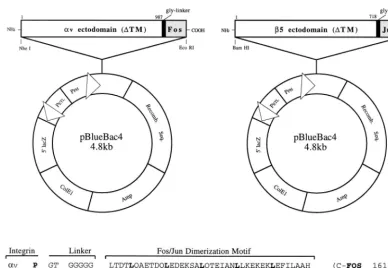
mg of either pBB4/av or pBB4/b5 or the same vectors containing the Fos and Jun forms of the integrin subunits (see Fig. 1). Following transfections, recombinant baculoviruses were isolated by plaque formation on Sf9 cells. Candidate recom-binant baculoviruses were then amplified by growth on Sf9 cells, and viral DNA was isolated and analyzed on a 0.8% agarose gel and subsequently sequenced (Baculo/PCR; Invitrogen). High-titered baculovirus stocks expressingav andb5 were generated by infection of Sf9 spinner cultures at a multiplicity of infection (MOI) of 0.3.
Immunoprecipitation, SDS-PAGE, and immunoblotting.For immunoprecipi-tation studies, 50% confluent monolayers of Tn5B cells in 24-well plastic tissue culture plates were infected with various ratios ofav andb5 recombinant bacu-loviruses or with each baculovirus alone. Eighteen hours postinfection, the cells were cultured for an additional 24 h in serum-free insect cell medium (Ex-Cell 400; JRH Biosciences, Lenexa, Kans.) containing 50mCi of [35S]methionine
(Amersham, Bedford, Mass.) per ml. The supernatants from infected or unin-fected control cells were then harvested and incubated for 90 min at 4°C with 50
ml of protein G-Sepharose beads (Pierce) containing 10mg of MAb P1F6. After a wash, the beads were boiled for 2 min in sodium dodecyl sulfate-polyacrylamide gel electrophoresis (SDS-PAGE) sample buffer and electrophoresed under non-reducing conditions on a 7% SDS gel (Tris-glycine; Novex). Following electro-phoresis, the gel was fixed, dried, and subjected to autoradiography. For immu-noblotting, soluble integrin was electrophoresed on an 8 to 16% SDS gel and then stained with Colloidal Coomassie blue (Novex) or transferred to a polyvi-nylidene difluoride membrane (Immobilon P; Amersham). The membrane was blocked by incubation in 10% nonfat dry milk in TBST (50 mM Tris-HCl [pH
7.6], 150 mM NaCl, 0.2% Tween 20). The blot was then probed with MAbs specific for theav subunit (VNR 139) or theb5 subunit (1D11) or with a control anti-aMb2 antibody (CP3). Following extensive washing in TBST, the blots were
incubated with a goat anti-mouse immunoglobulin G antibody linked to horse-radish peroxidase (Bio-Rad). After further washes, the blots were developed with an enhanced chemiluminescence system (SuperSignal; Pierce).
Purification and ligand binding properties of solubleavb5 integrin.Tn5B insect cells were grown to a density of 23106cells/ml in Ex-cell 400 medium in
2-liter shake flasks and then infected at an MOI of 1.0 with recombinant bacu-loviruses encodingav andb5 (1:1 ratio). Protease inhibitors (1mg of leupeptin per ml, 5mg of aprotinin per ml) and a final concentration of 2% fetal calf serum were added at 16 h postinfection, and the culture supernatants were harvested by centrifugation usually at 48 h postinfection, while the cells retained 90 to 100% viability. Culture supernatants were concentrated approximately 15-fold (Ultra-lab 2 concentrator; Pall Filtron) with a 30K membrane filter (Omega) and then adjusted to a final concentration of 0.002% sodium azide with additional pro-tease inhibitors. The concentrated culture supernatants were incubated over-night at 4°C with constant agitation with MAb P1F6 (22 mg) covalently linked to 5 ml of CNBr-Sepharose beads. The beads were then washed five times with 50 ml of 10 mM sodium phosphate buffer, pH 7.4, containing 0.6 M NaCl and 1 mM (each) MgCl2and CaCl2. The integrin was then eluted with 10 mM Na-acetate,
pH 3.1, containing 1 mM MgCl2and CaCl2and immediately neutralized with
1 M Tris-HCl, pH 8.1. The eluted integrin fractions were analyzed by SDS-PAGE and for binding to the Ad2 penton base in an enzyme-linked immunosor-bent assay (ELISA), as described below. Fractions containing the 155- and 100-kDa integrin heterodimer were pooled and concentrated (C-100 microcon-centrator; Amicon) to approximately 300mg/ml and stored at280°C.
Integrin binding to Ad serotypes and extracellular matrix proteins was quan-titated in an ELISA. Purified Ad serotypes, recombinant Ad2 penton base, or extracellular matrix proteins were used to coat 96-well plastic tissue culture plates (Immulon-4; Dynatech) at a concentration of 1mg of protein/well. Non-specific binding sites were quenched by incubation with a blocking agent (Su-perblock; Pierce), and then cell culture supernatants containing soluble integrin or immunoaffinity-purified integrin at 100 ng to 1mg/well were added to the plates and incubated at 22°C for 2 h. The wells were washed with phosphate-buffered saline containing a 1:50 dilution of Blocker Blotto (Pierce)–0.2% Tween 20 and then incubated for 1 h at 22°C with 100ml of 10mg of LM142 anti-av MAb per ml in blocking buffer. After further washes, the wells were incubated for 1 h with 100ml of a 1:10,000 dilution of goat anti-mouse immunoglobulin G linked to horseradish peroxidase (Kirkegaard and Perry Laboratories, Gaithers-burg, Md.) in blocking buffer. Following additional washing, the reactions were developed by addition of substrate (ABTS [2,29 -azinobis(3-ethylbenzthiazoline-FIG. 1. Diagram of baculovirus plasmid vectors used for the expression of solubleavb5. The cDNA fragments encoding the entire ectodomains of theav andb5 integrin subunits were inserted in frame with a glycine spacer and a Fos/Jun dimerization domain (as shown in the sequence alignment) into the pBlueBac4 baculovirus transfer vector.
on November 9, 2019 by guest
http://jvi.asm.org/
[image:2.612.104.493.66.334.2]sulfonic acid]; Kirkegaard and Perry Laboratories) and analyzed at 405 nm in a SpectraMax 250 ELISA plate reader (Molecular Devices, Sunnyvale, Calif.).
Ad binding, internalization, and gene delivery assays.125I-labeled Ad2 (125
ng, 500 virus particles per cell) was preincubated for 2 h at 4°C with 70mg/ml of a polyclonal antibody to the Ad2 fiber protein or the DAV-1 anti-penton base MAb (31) or with purifiedavFos/b5Junintegrin in 10 mM Tris-HCl buffer, pH 8.1,
containing 1 mM (each) MgCl2and CaCl2. The samples were then incubated for
1 h at 4°C with 13106SW480 epithelial cells or 23106THP-1 monocytic cells
in 20 mM HEPES-buffered saline (HBS), pH 7.4, containing 2% bovine serum albumin and 1 mM (each) MgCl2and CaCl2. The cells were then warmed to 37°C
for 0 to 15 min and then washed three times in cold HBS binding buffer. Cell samples maintained at 4°C were then counted to determine the level of virus attachment or were incubated with medium containing trypsin-EDTA at 37°C for 15 min to determine the amount of endocytosed virus particles. The amount of nonspecific Ad binding was determined by incubating cells with a 100-fold excess of unlabeled virus particles.
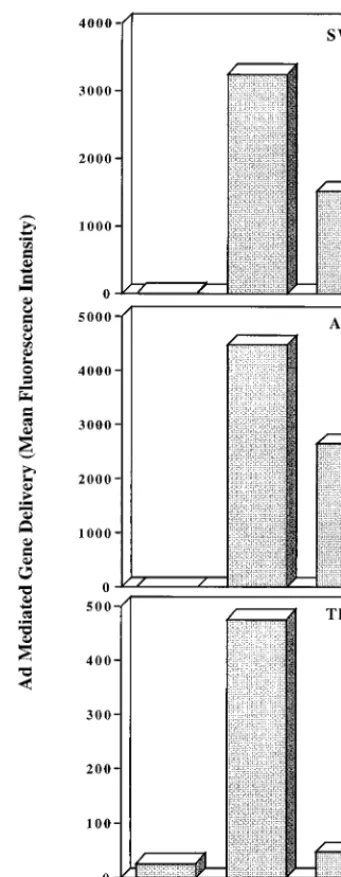
For gene delivery studies, 50 ng of Ad.GFP (MOI, 500) was incubated with 300 ng of soluble integrin in HBS binding buffer or in buffer alone for 2 h at 4°C. The samples were then added to 43105SW480, A549, or THP-1 cells and incubated
further for 1 h at 4°C. The cells were then warmed to 37°C for 15 min and washed and cultured in complete Dulbecco modified Eagle medium for 48 to 72 h at 37°C. GFP expression was then quantitated by flow cytometry (FACScan II), and the data were expressed as mean fluorescence intensities.
RESULTS
Baculovirus expression of soluble integrin
a
v
b
5.
In order to
study direct interactions of integrins with human Ad and host
cell ligands, we used recombinant baculovirus vectors to
ex-press a soluble form of
avb5 in Tn5B insect cells. To facilitate
assembly of the integrin heterodimer (19), we inserted a
gly-cine linker and Fos/Jun dimerization domain in frame with the
C terminus of the integrin ectodomains (Fig. 1). Baculovirus
transfer vectors containing these constructs were used to
pro-duce recombinant baculoviruses in Sf9 cells. Plaque-purified
recombinant baculoviruses were then tested for the ability to
produce a soluble
avb5 integrin heterodimer in Tn5B insect
cells by immunoprecipitation. Two proteins, of 155 and 100
kDa, similar to the expected size of the integrin ectodomains,
were immunoprecipitated by a function-blocking
avb5 MAb
(P1F6) from supernatants of cells infected with both the
av
Fosand
b5
Junbaculoviruses (Fig. 2). An infection ratio of 1:1
proved optimal for integrin expression (Fig. 2, lanes 1 to 3). As
expected, the integrin heterodimer was not detected in culture
supernatants from cells infected with a
av
Fosor
b5
Junbaculo-virus alone (lanes 5, 6). The
b5
Jun, but not the
av
Fos, integrin
subunit was immunoprecipitated by MAb P1F6 (lane 6), while
the
av
Fosintegrin subunit was capable of being
immunopre-cipitated by MAb LM142 (data not shown).
[image:3.612.111.227.68.180.2]Studies were next performed to assess the functional activity
FIG. 2. Immunoprecipitation analysis of soluble recombinantavb5 integrin.
35S-labeled insect cells were infected with a 1:1 (lane 1), 10:1 (lane 2), or 1:10
(lane 3) ratio (PFU) of theavFosandb5Junbaculoviruses, were left uninfected
(lane 4), or were infected withavFos(lane 5) orb5Jun(lane 6) baculovirus alone
[image:3.612.369.486.70.198.2]and then immunoprecipitated with MAb P1F6 and analyzed under nonreducing conditions on an SDS–7% polyacrylamide gel, followed by autoradiography.
[image:3.612.81.259.505.684.2]FIG. 3. Time course of expression and functional activity of solubleavb5 integrin. Culture supernatants derived from insect cells infected with a combi-nation of theavFosandb5Junbaculoviruses (1:1) or from cells infected with each baculovirus alone were assayed in an ELISA at various times after infection for binding to immobilized penton base.
FIG. 4. SDS-PAGE and Western blot of immunoaffinity-purifiedavb5 inte-grin. Five micrograms of isolatedavb5 were electrophoresed on an SDS–8 to 16% polyacrylamide gel under nonreducing conditions and then stained with Coomassie blue (lane 1) or transferred to a polyvinyidene difluoride membrane and reacted with an anti-av (lane 2), anti-b5 (lane 3), or anti-aM(lane 4)
anti-body in a Western blot.
FIG. 5. Interactions of solubleavb5 integrin with Ad ligands or extracellular matrix proteins. ELISA plates were coated with 1mg per well of penton base (PB), Ad2 particles, vitronectin (VN), fibronectin (FN), or bovine serum albumin (BSA). Following quenching of nonspecific binding sites, the plates were incu-bated with 6 ng of purifiedavb5 integrin in the presence (stippled bars) or absence (solid bars) of 20 mM EDTA. Integrin binding was detected with a non-function-blocking MAb (LM142), as described in Materials and Methods.
on November 9, 2019 by guest
http://jvi.asm.org/
[image:3.612.362.496.522.667.2]of soluble integrin molecules produced in insect cells. Culture
supernatants derived from cells infected with a combination of
av
Fosand
b5
Junbaculoviruses, but not those from cells infected
with the
av
Fosor
b5
Junbaculovirus alone, reacted with the
penton base protein in an ELISA (Fig. 3). Optimal expression
occurred at 3 to 4 days postinfection and declined thereafter.
These findings suggest that a functionally active integrin
het-erodimer was secreted from cells coinfected with
av and
b5
recombinant baculoviruses.
Purification and ligand binding analysis of soluble integrin
a
v
b
5.
In order to study further the ligand binding properties of
the Ad coreceptor, we isolated the soluble integrin by
immu-noaffinity chromatography. As expected, the purified integrin
was comprised of two subunits with relative mobilities of 155
and 100 kDa (Fig. 4). Each of the integrin subunits was also
recognized by the appropriate anti-av or anti-b5 MAb, as
detected by immunoblotting (Fig. 4). A minor protein of
ap-proximately 35 kDa, derived from proteolytic cleavage of the
b5 integrin subunit, was detected in some integrin
prepara-tions. Approximately 250 to 300
mg of soluble integrin per liter
of Tn5B insect cells was isolated.
Further studies examined the functional properties of the
purified
avb5 integrin. Purified
avb5 bound to immobilized
Ad2 penton base and virus particles as well as to vitronectin
but did not recognize another RGD-containing extracellular
matrix protein, fibronectin (Fig. 5). Binding to Ad2 and
vitro-nectin was blocked by 20 mM EDTA, indicating that these
interactions require the presence of divalent metal cations.
These results indicate that soluble recombinant integrin
avb5
possesses the ligand binding activity of the cell-associated
in-tegrin.
[image:4.612.64.276.66.452.2]Association of integrin
a
v
b
5 with different Ad serotypes.
The penton base proteins of multiple Ad serotypes contain
conserved RGD sequences (23), suggesting that different Ad
are capable of associating with cell integrins. Competition
stud-ies with synthetic RGD peptides or function-blocking integrin
MAbs also suggested that multiple Ad serotypes use integrins
for infection. However, direct interactions of integrins with
different Ad serotypes have not yet been examined. We
there-fore analyzed the association of soluble recombinant
avb5 with
seven different Ad serotypes representing five major Ad
sub-groups (A to E). Soluble
avb5 exhibited significant binding to
Ad serotypes belonging to subgroups B (Ad3), C (Ad2, Ad5),
D (Ad19, Ad37), and E (Ad4) but did not bind to a control,
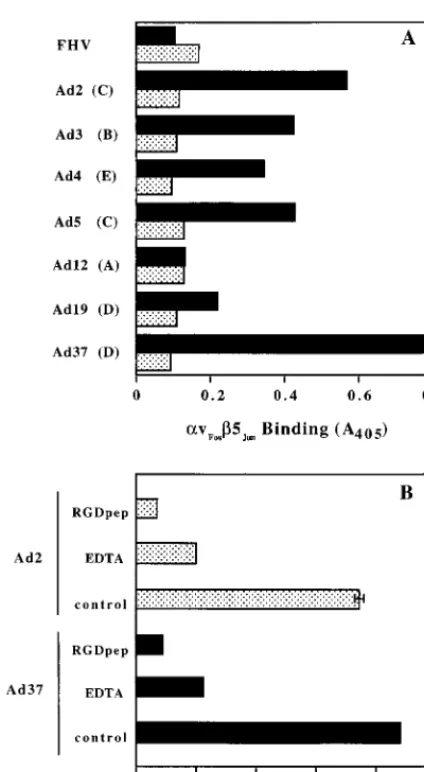
nonenveloped virus, FHV (Fig. 6A). Minimal binding of
avb5
to Ad12 was observed, consistent with the relatively short
RGD surface loop on this virus (23). Binding of the soluble
FIG. 6. Binding of solubleavb5 integrin to different Ad serotypes. (A) Direct interactions of soluble integrin with different Ad serotypes from subgroups A to E were quantitated in an ELISA in the presence (stippled bars) or absence (solid bars) of 20 mM EDTA. (B) Binding of soluble integrinavb5 to Ad2 and Ad37 was measured in the presence or absence (control) of 100mg of a synthetic RGD peptide (RGDpep) per ml or 20 mM EDTA.
FIG. 7. Effect of antifiber or anti-penton base antibodies or soluble integrinavb5 on Ad2 binding and internalization.125I-labeled Ad2 particles were preincubated with a polyclonal antifiber antibody with the DAV-1 anti-penton base MAb, or with solubleavb5 integrin prior to measurement of virus binding (A) and internalization into SW480 epithelial cells (B) or THP-1 monocytic cells (C).
on November 9, 2019 by guest
http://jvi.asm.org/
[image:4.612.55.547.570.698.2]integrin to different Ad required the presence of divalent metal
cations and was also inhibited by the presence of a synthetic
RGD peptide (Fig. 6B).
Effect of soluble integrin
a
v
b
5 on Ad binding and
internal-ization.
Previous studies had indicated that
av
integrin-defi-cient epithelial cells do not support effiintegrin-defi-cient Ad internalization
(36) and infection (12), whereas cells expressing these
recep-tors following transfection with
av integrin cDNA are
ren-dered susceptible to infection, suggesting that these receptors
play a crucial role in viral entry. In order to substantiate this
hypothesis, we preincubated purified virions with antibodies to
the Ad2 fiber or the penton base protein or with soluble
avb5
and then assayed virus binding and entry into host cells. Ad2
binding to SW480 epithelial cells was completely inhibited by
an antifiber antibody, whereas incubation of virus with the
DAV-1 penton base MAb or soluble
avb5 integrin had little
effect on binding (Fig. 7A). In contrast, soluble integrin
avb5,
as well as MAb DAV-1, significantly reduced (approximately
65%) Ad2 internalization (Fig. 7B). These findings are
consis-tent with a specific role of
av integrins in Ad internalization
into epithelial cells rather than in Ad attachment. In contrast
to epithelial cells, both binding and internalization of Ad to
monocytic cells has been reported to be mediated by penton
base interaction with cell integrins (14). We therefore
exam-ined whether soluble
avb5 was capable of interfering with Ad
interactions with THP-1 monocytic cells. Consistent with the
previous report, incubation of Ad2 with soluble integrin
avb5
blocked both virus attachment to and internalization into
THP-1 monocytic cells (Fig. 7C).
Inhibition of Ad-mediated gene delivery by soluble integrin
a
v
b
5.
Further studies were performed to determine whether
soluble integrin
avb5 was capable of inhibiting Ad infection.
For these studies we used a recombinant Ad5 vector encoding
GFP (15). Incubation of Ad5.GFP with soluble
avb5
signifi-cantly inhibited virus-mediated gene delivery to both SW480
and A549 epithelial cells (approximately 50%) and nearly
abol-ished delivery to THP-1 monocytic cells (Fig. 8). These results
further indicate that
av integrins promote Ad-mediated gene
delivery as well as virus internalization.
DISCUSSION
The inherent difficulties associated with isolating native
av
integrins from human tissues (30) has prevented an extensive
analysis of integrin structure and function. The extracellular
domains of integrins
avb6 (35) and
a
IIbb3 (24) have been
previously expressed in mammalian or insect cells as secreted
proteins. In each case, the expressed
a
and
b
integrin subunits
formed a stable heterodimer in the absence of the
transmem-brane or cytoplasmic domains and also retained antigenic
properties and ligand binding activity. We were therefore
en-couraged to examine whether integrin
avb5 could also be
expressed as a soluble protein, thereby facilitating analysis of
its interactions with human Ad. Unfortunately, only small
amounts of the
av and
b5 ectodomains were produced by
baculovirus vectors in Tn5B insect cells. However, the addition
of a Fos/Jun dimerization domain (Fig. 1) increased
produc-tion of the soluble
avb5 integrin approximately fourfold (data
not shown). This could be due to increased association of the
integrin subunits, as has been reported for other multimeric
cell surface receptors (19). The soluble
av and
b5 integrin
subunits formed a stable heterodimeric complex (Fig. 2), and
the assembled integrin was also capable of binding to the Ad
penton base protein (Fig. 3) as well as its natural
RGD-con-taining ligand, vitronectin (Fig. 5). The secreted
avb5 integrin
was also recognized by the function-blocking P1F6 MAb,
which enabled isolation of the receptor by immunoaffinity
chromatography (Fig. 4).
[image:5.612.347.518.71.510.2]Since distinct Ad serotypes have been shown to contain a
conserved integrin-binding motif (RGD) in their penton base
proteins, we examined whether soluble
avb5 integrin was
ca-pable of recognizing different Ad serotypes. While the level of
integrin binding to different Ad types varied (Fig. 6A),
com-petition studies indicated that the RGD sequence as well as the
presence of divalent metal cations were required for integrin
interactions with multiple Ad serotypes (Fig. 6B). The least
amount of integrin binding observed was to Ad12. It is worth
noting that the Ad12 penton base contains a relatively short
RGD loop (23) compared to other Ad serotypes, a structural
FIG. 8. Effect of soluble integrinavb5 on Ad-mediated gene delivery. A re-combinant Ad vector encoding GFP (Ad.GFP) was preincubated with medium alone or with a 20-fold excess (relative to the number of penton base RGD sites) of soluble integrinavb5 prior to infection of SW480 cells, A549 epithelial cells, or THP-1 monocytic cells. Gene delivery was measured by flow cytometry at 48 to 72 h postinfection and expressed as mean fluorescence intensity. The data are representative of four separate experiments.
on November 9, 2019 by guest
http://jvi.asm.org/
feature which could reduce integrin binding (1, 7). Previous
studies have also reported that the Ad12 penton base RGD
motif is capable of mediating cell adhesion and virus infection
(2). However, significant differences in Ad2- and
Ad12-medi-ated cell adhesion and infection were noted, indicating that the
integrin binding epitopes on these two proteins are not
func-tionally equivalent. One possibility which could explain
re-duced interactions of Ad12 with
avb5 in solid-phase binding
assays is that the Ad12 penton base has a low intrinsic affinity
for integrin
avb5. Recent structural studies have indicated that
a more extended flexible RGD loop may be important for
receptor interactions (1, 7). In vivo, high-affinity binding of
Ad12 via the fiber receptor (4, 33) could permit subsequent
low-affinity interactions of the penton base with the
avb5
in-tegrin. Further kinetic studies are needed to determine the
precise binding affinities and stoichiometries of
av integrin
interactions with different Ad penton base proteins.
The generation of a soluble integrin
avb5 molecule also
provided an opportunity to examine the requirements for this
coreceptor in Ad entry and infection of epithelial or monocytic
cells. Incubation of Ad2 particles with purified integrin had
little effect on virus binding to epithelial cells; however,
sub-stantial inhibition of virus attachment to monocytic cells was
observed (Fig. 7). We interpret this result as the ability of
sol-uble
avb5 to compete for Ad2 binding to cell surface
a
Mb2
integrins (14). The integrin also inhibited virus internalization
into both cell types. These results are consistent with a
previ-ous report (14), suggesting that integrins play distinct roles in
diverse cell types. Soluble integrin
avb5 was also capable of
blocking Ad-mediated gene delivery to both epithelial and
monocytic cells (Fig. 8). The more pronounced inhibition of
gene delivery to THP1 monocytic cells (Fig. 7B) is probably
due to the fact that integrins on these cells mediate both virus
attachment and virus internalization.
The findings reported here suggest that soluble integrins or
specific antagonists of these molecules may represent an
ap-proach to the inhibition of infection by multiple Ad serotypes.
To date, there are few antiviral agents capable of inhibiting Ad
infections. Although Ad infections do not generally cause
se-rious complications, fatal disseminated Ad infections have
been noted with increasing frequency in
immunocompro-mised and AIDS patients (13). Strategies based on
prevent-ing Ad interactions with its cellular coreceptor may provide an
approach to restricting cell entry by distinct Ad serotypes.
ACKNOWLEDGMENTS
We express our gratitude to Phoebe Stewart and Charles Chiu
(UCLA School of Medicine) and members of the Cheresh laboratory
(Scripps Research Institute) for helpful discussions and advice. We
also thank Bonnie Bradt for technical support and Catalina Hope and
Joan Gausepohl for preparation of the manuscript.
This work was supported by NIH grants EY11431 and HL54352.
REFERENCES
1. Akke, M., J. Liu, J. Cavanagh, H. P. Erickson, and A. G. Palmer III. 1998. Pervasive conformational fluctuations on microsecond time scales in a fi-bronectin type III domain. Nat. Struct. Biol. 5:55–59.
2. Bai, M., L. Campisi, and P. Freimuth. 1994. Vitronectin receptor antibodies inhibit infection of HeLa and A549 cells by adenovirus type 12 but not by adenovirus type 2. J. Virol. 68:5925–5932.
3. Bai, M., B. Harfe, and P. Freimuth. 1993. Mutations that alter an Arg-Gly-Asp (RGD) sequence in the adenovirus type 2 penton base protein abolish its cell-rounding activity and delay virus reproduction in flat cells. J. Virol.
67:5198–5205.
4. Bergelson, J. M., J. A. Cunningham, G. Droguett, E. A. Kurt-Jones, A.
Krithivas, J. S. Hong, M. S. Horwitz, R. L. Crowell, and R. W. Finberg.1997. Isolation of a common receptor for coxsackie B viruses and adenoviruses 2 and 5. Science 275:1320–1323.
5. Bergelson, J. M., M. P. Shepley, B. M. C. Chan, M. E. Hemler, and R. W.
Finberg.1992. Identification of the integrin VLA-2 as a receptor for echo-virus I. Science 255:1718–1720.
5a.Chiu, C., et al. Submitted for publication.
6. Coburn, J., S. W. Barthold, and J. M. Leong. 1994. Diverse Lyme disease spirochetes bind integrinaIIbb3on human platelets. Infect. Immun. 62:5559–
5567.
7. Copie, V., Y. Tomita, S. K. Akiyama, S. Aota, K. M. Yamada, R. M. Venable,
and R. W. Pastor. 1998. Solution structure and dynamics of linked cell attachment modules of mouse. J. Mol. Biol. 277:663–682.
8. Everitt, E., S. A. Meador, and A. S. Levine. 1977. Synthesis and processing of the precursor to the major core protein of adenovirus type 2. J. Virol. 21: 199–214.
9. Felding-Habermann, B., B. M. Mueller, C. A. Romerdahl, and D. A.
Cheresh.1992. Involvement of integrinav gene expression in human mela-noma tumorigenicity. J. Clin. Investig. 89:2018–2022.
10. Finnemann, S. C., V. L. Bonilha, A. D. Marmorstein, and E.
Rodriguez-Boulan.1997. Phagocytosis of rod outer segments by retinal pigment epi-thelial cells requiresavb5 integrin for binding but not for internalization. Proc. Natl. Acad. Sci. USA 94:12932–12937.
11. Goldman, M., Q. Su, and J. M. Wilson. 1996. Gradient of RGD-dependent entry of adenoviral vector in nasal and intrapulmonary epithelia: implica-tions for gene therapy of cystic fibrosis. Gene Ther. 3:811–818.
12. Goldman, M. J., and J. M. Wilson. 1995. Expression ofavb5 integrin is necessary for efficient adenovirus-mediated gene transfer in the human air-way. J. Virol. 69:5951–5958.
13. Hierholzer, J. C. 1992. Adenoviruses in the immunocompromised host. Clin. Microbiol. Rev. 5:262–274.
14. Huang, S., T. Kamata, Y. Takada, Z. M. Ruggeri, and G. R. Nemerow. 1996. Adenovirus interaction with distinct integrins mediates separate events in cell entry and gene delivery to hematopoietic cells. J. Virol. 70:4502– 4508.
15. Huang, S., D. G. Stupack, P. Mathias, Y. Wang, and G. Nemerow. 1997. Growth arrest of Epstein-Barr virus immortalized B lymphocytes by adeno-virus-delivered ribozymes. Proc. Natl. Acad. Sci. USA 94:8156–8161. 16. Hynes, R. O. 1992. Integrins: versatility, modulation, and signaling in cell
adhesion. Cell 69:11–25.
17. Isberg, R. R., and G. Tran Van Nhieu. 1995. The mechanism of phagocytic uptake promoted by invasin-integrin interaction. Trends Cell Biol. 120:120– 124.
18. Ishibashi, Y., S. Claus, and D. A. Relman. 1994. Bordeltella pertussis fila-mentous hemagglutinin interacts with a leukocyte signal transduction com-plex and stimulates bacterial adherence to monocyte CR3 (CD11b/CD18). J. Exp. Med. 180:1225–1233.
19. Kalandadze, A., M. Galleno, L. Foncerrada, J. L. Strominger, and K. W.
Wucherpfennig. 1996. Expression of recombinant HLA-DR2 molecules. J. Biol. Chem. 271:20156–20162.
20. Ku¨hn, K., and J. Eble. 1994. The structural bases of integrin-ligand interac-tions. Trends Cell Biol. 4:256–261.
21. Loftus, J. W., J. C. Smith, and M. H. Ginsberg. 1994. Integrin-mediated cell adhesion: the extracellular face. J. Biol. Chem. 269:25235–25238. 22. Mason, P. W., E. Rieder, and B. Baxt. 1994. RGD sequence of
foot-and-mouth disease virus is essential for infecting cells via the natural receptor but can be bypassed by an antibody-dependent enhancement pathway. Proc. Natl. Acad. Sci. USA 91:1932–1936.
23. Mathias, P., T. J. Wickham, M. Moore, and G. Nemerow. 1994. Multiple adenovirus serotypes useav integrins for infection. J. Virol. 68:6811–6814. 24. McKay, B. S., D. S. Annis, S. Honda, D. Christie, and T. J. Kunicki. 1996. Molecular requirements for assembly and function of a minimized human integrin. J. Biol. Chem. 271:30544–30547.
25. Mette, S. A., J. Pilewski, C. A. Buck, and S. M. Albelda. 1993. Distribution of integrin cell adhesion receptors on normal bronchial epithelial cells and lung cancer cells in vitro and in vivo. Am. J. Respir. Cell Mol. Biol. 8:562– 572.
26. Ramaswamy, H., and M. E. Hemler. 1990. Cloning, primary structure and properties of a novel human integrinbsubunit. EMBO J. 9:1561–1568. 27. Roivaninen, M., T. Hypia¨, L. Pirainen, N. Kalkkinen, G. Stanway, and T.
Hovi.1991. RGD-dependent entry of coxsackievirus A9 into host cells and its bypass after cleavage of VP1 protein by intestinal proteases. J. Virol. 65: 4735–4740.
28. Ruoslahti, E., and M. D. Pierschbacher. 1987. New perspectives in cell adhesion: RGD and integrins. Science 238:491–497.
29. Savill, J., I. Dransfield, N. Hogg, and C. Haslett. 1990. Vitronectin receptor-mediated phagocytosis of cells undergoing apoptosis. Nature 343:170–173. 30. Smith, J. W., D. J. Vestal, S. V. Irwin, T. A. Burke, and D. A. Cheresh. 1990.
Purification and functional characterization of integrinavb5: an adhesion receptor for vitronectin. J. Biol. Chem. 265:11008–11013.
31. Stewart, P. L., C. Chiu, S. Huang, T. Muir, Y. Zhao, B. Chait, P. Mathias,
and G. Nemerow.1997. Localization of an integrin binding motif (RGD) on adenovirus type 2 particles by cryo-electron microscopy. EMBO J. 16:1189– 1198.
32. Suzuki, S., W. S. Argraves, R. Pytela, H. Arai, T. Krusius, M. D.
Piersch-bacher, and E. Ruoslahti.1986. cDNA and amino acid sequences of the cell
on November 9, 2019 by guest
http://jvi.asm.org/
adhesion protein receptor recognizing vitronectin reveal a transmembrane domain and homologies with other adhesion protein receptors. Proc. Natl. Acad. Sci. USA 83:8614–8618.
33. Tomko, R. P., R. Xu, and L. Philipson. 1997. HCAR and MAR: the human and mouse cellular receptors for subgroup C adenoviruses and group B coxsackieviruses. Proc. Natl. Acad. Sci. USA 94:3352–3356.
34. Vogel, B. E., S.-J. Lee, A. Hildebrand, W. Craig, M. D. Pierschbacher, F.
Wong-Staal, and E. Ruoslahti.1993. A novel integrin specificity exemplified
by binding of theavb5integrin to the basic domain of the HIV tat protein
and vitronectin. J. Cell Biol. 121:461–468.
35. Weinacker, A., A. Chen, M. Agrez, R. I. Cone, S. Nishimura, E. Wayner, R.
Pytela, and D. Sheppard.1994. Role of the integrinavb6 in cell attachment to fibronectin. J. Biol. Chem. 269:1–9.
36. Wickham, T. J., P. Mathias, D. A. Cheresh, and G. R. Nemerow. 1993. Integrinsavb3andavb5promote adenovirus internalization but not virus
attachment. Cell 73:309–319.