This is a repository copy of
The Internal Validation of a National Model of Long Distance
Traffic.
.
White Rose Research Online URL for this paper:
http://eprints.whiterose.ac.uk/2375/
Monograph:
Gunn, H.F., Kirby, H.R. and Murchland, J.D. (1982) The Internal Validation of a National
Model of Long Distance Traffic. Working Paper. Institute of Transport Studies, University of
Leeds , Leeds, UK.
Working Paper 164
[email protected] https://eprints.whiterose.ac.uk/ Reuse
Unless indicated otherwise, fulltext items are protected by copyright with all rights reserved. The copyright exception in section 29 of the Copyright, Designs and Patents Act 1988 allows the making of a single copy solely for the purpose of non-commercial research or private study within the limits of fair dealing. The publisher or other rights-holder may allow further reproduction and re-use of this version - refer to the White Rose Research Online record for this item. Where records identify the publisher as the copyright holder, users can verify any specific terms of use on the publisher’s website.
Takedown
If you consider content in White Rose Research Online to be in breach of UK law, please notify us by
White Rose Research Online
http://eprints.whiterose.ac.uk/
Institute of Transport Studies
University of Leeds
This is an ITS Working Paper produced and published by the University of
Leeds. ITS Working Papers are intended to provide information and encourage
discussion on a topic in advance of formal publication. They represent only the
views of the authors, and do not necessarily reflect the views or approval of the
sponsors.
White Rose Repository URL for this paper:
http://eprints.whiterose.ac.uk/
2375/
Published paper
Gunn, H.F., Kirby, H.R., Murchland, J.D. (1982)
The Internal Validation of a
National Model of Long Distance Traffic.
Institute of Transport Studies, University
of Leeds, Working Paper 164
.*king
Paper 164
THE ImTEFax vz4L,IDATIm OF
A
NATICNALO E L OF
IDXG
DISPANCE TRAFFICH.F.
Gunn, H.R. Kirbyand
J.D.Wchland
Working Papers are intended t o provide information
and
encourage discussion on a topic i n advmzce of formal
publication.
They represent only the views o f the
authors and
do not necessarily r e f l e c t the view or
approval of the sponsors.
ABSTRACT
GUNN, H.F.,
H.R.
KIRBY and
J.D.
MURCHLAND (1982) The
internal validation of a national model of lona distance
traffic. Working Paper 164, Institute
-
for ?ransport
Studies, ~3iversity
of
Leeds, Leeds. (Unpublished.)
During 1980/81, the Department of Transport developed a
model for describing the distribution of private vehicle
trips between 642 districts in Great Britain, using data
from household and roadside interviews conducted in 1976
for the Regional Highways Traffic Model, and a new
formulation of the gravity model, called a composite
approach, in which shorter length movements were
described at a finer level of zonal detail than longer
movements. This report describes the results of an
independent validation exercise conducted for the
Department, in which the theoretical basis of the model
and its the quality of its fit to base year data were
examined. The report discusses model specification; input
data; calibration issues; and accuracy assessment. The
m a i n problems addressed included the treatment o f
intrazonal and terminal costs, which was thought to be
deficient; the trip-end estimates to which the model was
constrained, which were s h o w n to have substantial
variability and to be biassed (though the cause of the
latter could be readily removed), with some evidence of
geographical under-specification; and the differences
between roadside and household interview estimates. The
report includes a detailed examination of the composite
model specification and contains suggestions for
improving the way in which such models are fitted. The
main technical developments, for both theory and
practice, are the .methods developed for assessing the
accuracy of the fitted model and for examining the
quality of its fit with respect to the observed data,
taking account of the variances and covariances of
modelled and data values. Overall, the broad conclusion
was that, whilst there appeared to be broad compatibility
between modelled and onserved data in observed cells,
there w a s clear evidence o f inadequacy in certain
respects, such as for example underestimation o f
intradistr
ict trips.
This work was done in co-operation with Howard Humphreys
and Partners and Transportation Planning Associates, who
validated the model against independent external data;
their work is reported separately.
1. Summary and conclusions
1.1 Introduction 1.2 Main findings
Comments on model s p e c i f i c a t i o n Comments on input d a t a
Comments on c a l i b r a t i o n
Comments on accuracy assessment
1.3
Discussion 2. Model s p e c i f i c a t i o n2.1 Composite matrices
2.2 Composite model 2.3 Composite c o s t s
2.4 The d e f i n i t i o n of cost functions
2. $ I n t r a z o n a l model adjustments 3. Input data
3.1
I n t e r z o n a l c o s t s 3.2 Intrazonal c o s t s 3.3 Minor road t r a f f i c 3.4 Inactive households 3.5 Round t r i p s3.6 Cordon-crossings comparison 3.7 Seasonal c o r r e c t i o n f a c t o r s
3.8
Merging of estimates 3.9 Trip end estimates4.
Calibration4.1
Xethod 4.2 P r i n c i p l e s 4.3 Uniqueness4.4
Solution method4.5 Calculat i o n a l economy 4.6 Convergence
4.7 Smoothing
PAGE
-
1
1
3 3
4
7
7
5.
Accuracy assessment
5.1
The components of model accuracy
5.2
On distinguishing model error and data error
5.3
The accuracy of observed
0-Ddata
5.4
The accuracy of marginal totals
5.5
The accuracy of trip-end estimates
5.6
.The
accuracy of the fitted model's values
5.7
An overall view of model fit
5.8
The model fit in intra-district cells
5.9
The examination of residuals overall
6.
Acknowledgements
7.
References
8.
Appendix: Some descriptive statistics
8.1
Zone and cell statistics
8.2
Observed intradistrict trips
8.3
Modelled intradistrict trips
PAGE
-
55
56
58
59
60
61
65
67
70
72
Tables
Figures
. . . ..
'A&i&es
:.~t,pkifi~
'NO%&'prddticed
i n
tkie
' ~ O W S C'of
'*lie'project
. . .WN
51,.
Internal validation: some questions. KIRBY, H.R.
(1981, September
).
WN 2
Questions 'A'. KIRBY, H.R.
(1981,
September).
WN
3
The assessment of the likely accuracy of the National Model
on the basis of comparisons with calibration data sets.
GUNN,'
H.'F. '(1981,.
September).
.WN
4 '
Notes of a meeting at Leeds on 21 October.
1981.
KIRBY, H.R. (1981, October).
WN
5
The National Model Report: Initial reactions and requests for
further information.
(1981,
November
).
WN
6
Approximating RDMVAR calculations. KIRBY, H.R
.
(1981,
November
).
I
7
Predict.ion error in fitted modcls.
FfUrlCJILAIJD, J.1).(1981, November).
WN
8
Theoretical basis for multi-1evel.models. KIRBY,
H.R.
The National Cammercial Vehicle model: comments on c a l i b r a t i o n method. KIRBY, H.R. (1981, November).
The '3culo.h' matri:; n o b a s i s Tor conlpooitc modcl cxperimcntntion. GUiZ',
Il..
(1981, ~ e c e n b e r )The Correspondence between Observed and Modelled Trip- Ends. ( r e g i o n a l zone]. GUNN, H.F. (1981, ~ e c e m b e r )
.
Approximate accuracy of r e g i o n a l zone s y n t h e t i c trip-ends.
Gum,
H.F. (1982, January).~ ~ * r o x i m a t e accuracy of d i s t r i c t zone s y n t h e t i c trip-ends.
GUNN,. H.F. (1982, February).
I n t r a z o n a l and intra-town c o s t s . KIRBY, H.R. (1982, January).
Multiple d e t e r r e n c e f u n c t i o n s
-
d e f i n i t i o n s . KIRBY, H.R. (1982, February ).
I n t r a z o n a l and intra-town c o s t s
-
f u r t h e r information. KIRBY,, H.R. (1982, February).WN 1 7 Trips. KIRBY, H.R. @982, February).
WN 1 8 Simple versus c m p o s i t e treatment f o r a c e l l i n t h e National Model. MLIRCRLAND, J . D . (1982, February).
WN 1 9 How quasi-average c o s t s compare with simple average c o s t s f o r
a
s e l e c t i o n of d i s t r i c t p a i r s . KIRBY H.R. (1982, F e b r u a q ) . 20 Variance a d Covariance of t r i p c s t i m a t c s f r o n t h e splt5ct!.ct r i p end mcthod of E i t t i n r : t h c firnvity modcl. ?7mCRL.AHCI, J.'l>.
(1982, ~ e . r c h ) .
lfii 21 Comparison of modcllcd
v&&s:
'irith independent d a t a MURCHLAND, J.D. (1982, 'March)WN 22 Relationship between quasi-average and t r u e average c o s t s
f o r an exponential decay function. MURCHLAND, J.D. (1982, ~ a r c b ) .
WN 23 An examination of t h e r e s i d u a l s from t h e f i t t e d model
-
a l l purposes. GUNN, H.F. (1982, March).WN 24 Cordon-crossings comparisons; t h e e f f e c t of s c a l i n g t h e d a t a . MURCKLAND, J.D.
WN 25 Smoothing methods: some i s s u e s . (Correspondence, 1982)
WN 26 Observed and n a t i o n d model i n t r a d i s t r i c t t r i p s . MUXCRLAND, J . D . (1982. ~ ~ r i l ) .
LIST OF TABLES
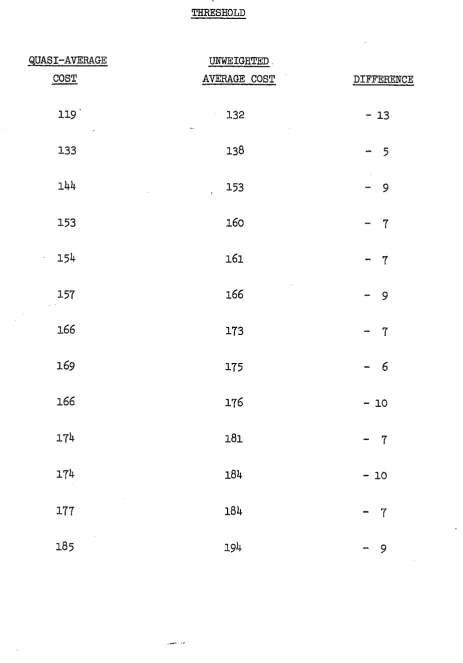
2.3(1)
Quasi-average and unweighted average costs near the
cost threshold.
2.3(2)
Proportional changes in cost function value for a
one-band shift in cost near the
100pence threshold.
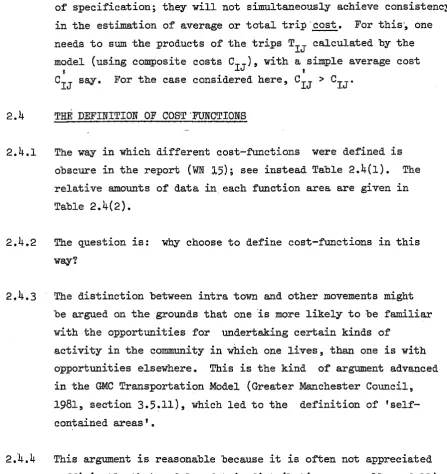
2.4(1)
The 'definition
of multiple deterrence functions.
2.4(2,)
The distribution of
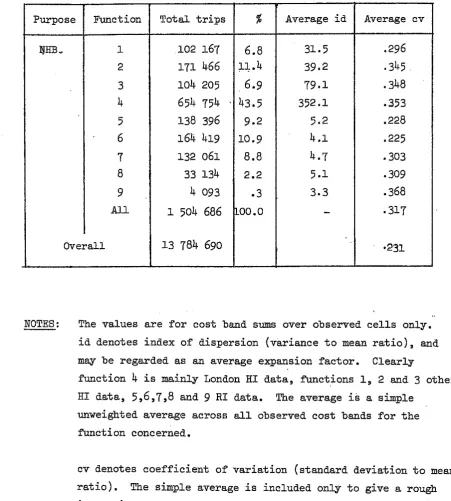
HBW trips and travel amongst the
nine function areas.
3.3
Flows on interviewed, counted and uncounted roads by
cordon.
3.6
Cordon crossings
for the used and intended
data sets
3.9
Mean trip rates, observed and synthesised.
4.1
Size of the trip adjustment factor
5.4(1)
Row and column sums
,of>observed
data and..their
accuracies
5.4(:2)
Cost band sums and accuracies.
5.5
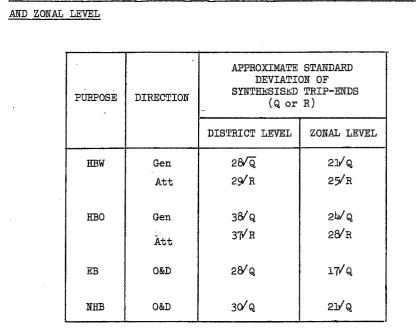
(1)Approximate standard deviations in synthetic trip end
estimates at district and zonal level.
5.5(2)
Approximate
95
percent confidence intervals about the mean
numbers of trip-ends in a regional zone.
5.7
(1) Illustrative values for non-zero observed and modelled
values and their accuracies.
5.7(2)
Modelled estimates and their errors for observed cells
with zero observation
(HBW).
5.8
Districts with the worst-fitting intra-district estimates
(HBW).
.-. ..PAGE
-
5.9(1) The mean r e s i d u a l and r e l a t i v e mean r e s i d u a l c a t e g o r i s e d by t r i p l e n g t h , and a r e a t y p e .
5.9(2)
The mean r e s i d u a l c a t e g o r i s e d by t r i p l e n g t h , a r e a t h e'&d exp&sion f a c t o r .
5.9(3) Estimates of s t a n a a r d i s e d mean r e s i d u a l s i n each category of t r i p l e n g t h , a r e a t y p e and expansion f a c t o r .
5.9(4) Numbers. of observed c e l l s i n each category of t r i p l e n g t h ,
a r e a type and expansion f a c t o r .
5.9(5) Residual s t a t i s t i c s f o r t h e
6
c a t e g o r i e s w i t h l a r g e s t numbers o f c e l l s .5.9('6) Residual s t a t i s t i c s f o r t h e 5 c a t e g o r i e s with l a r g e s t
numbers of t r i p s .
6.3
D i s t r i c t s with h i g h proportions of i n t r a d i s t r i c t movements.PAGE
-
LIST OF FIGURES
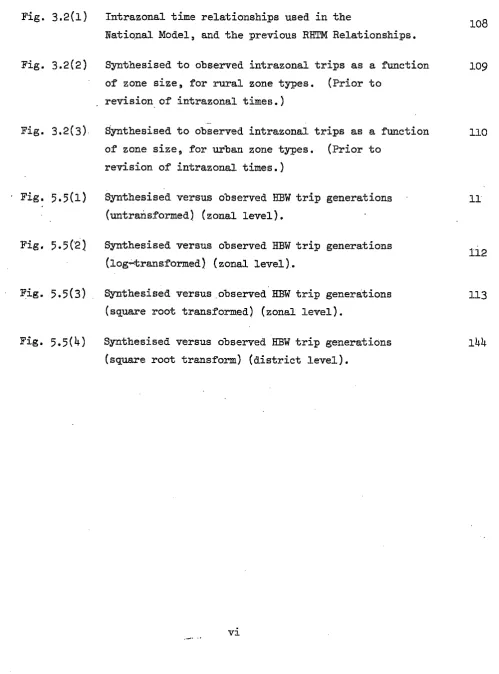
Fig. 3.2(1)
Intrazonal time relationships used in the
National Model, and the previous RRPM Relationships.
Fig. 3.2(2)
Synthesised to observed intrazonal trips as a function
of zone size, for rural zone types. (Prior to
.
revision of intrazonal times.)
Fig. 3.2(3)
Synthesised to observed intrazonal trips as a function
of zone size, for urban zone types. (Prior to
revision of intrazonal times.
)Fig.
5.5(1)
Synthesised versus observed
HBW
trip generations
(untransformed) (zonal level).
Fig. 5.5(2)
Synthesised versus observed HBW trip generations
(log-transformed) (zonal level).
Fig. 5.5(3)
Synthesised versus observed
HEW trip generations
(square root transformed) (zonal level).
Fig. 5.5(4)
Synthesised versus observed HBW trip generations
(square root transform) (district level).
PAGE
-
[image:10.595.67.567.111.786.2]THE INTEEWAL VALIDATION OF A NATIONAL
MODE& OFLONG-DISTANCE TRAFFIC
1. SUMMARY AND CONCLUSIONS
1.1 INTRODUCTION
1.1.1 This r e p o r t summarises t h e work c a r r i e d out a t t h e I n s t i t u t e f o r
Transport Studies o f t h e University of Leeds t o a s s e s s t h e v a l i d i t y
of t h e Department of T r a n s p o r t ' s National Model
(NM)
of LongDistance T r a f f i c . Because t h e commercial v e h i c l e model was not
ready f o r v a l i d a t i o n , t h e work was concerned almost e x c l u s i v e l y
with t h e p r i v a t e v e h i c l e model, a s described i n t h e first draft of Outram (1982).
The Leeds work was p r i m a r i l y concerned with t h e i n t e r n a l v a l i d a t i o n
of t h e model, t h a t i s , t h e performance of t h e model a s s t r u c t u r e d ,
and judged a g a i n s t t h e d a t a t o which it was f i t t e d . Judgements of model performance a g a i n s t independent d a t a s e t s ( i . e . ones
t o which t h e model was not f i t t e d ) , c o n s t i t u t e d t h e e x t e r n a l
v a l i d a t i o n , which was t h e r e s p o n s i b i l i t y of Howard Humphreys and
P a r t n e r s (HH&P), working with Transportation Planning Associates
(TPA). These consultants a l s o undertook those a s p e c t s o f t h e
i n t e r n a l v a l i d a t i o n which were most a p p r o p r i a t e l y handled by
t h e Department of T r a n s p o r t ' s ' v a l i d a t i o n and comparison' s u i t e
of computer programs, which t h e y had p r e v i o u s l y developed; t h e
Leeds team provided mathematical and s t a t i s t i c a l advice t o t h i s
work, with t h e l i n k s between t h e two geographically well-separated
teams being mainly maintained a s
a
r e s u l t of D r . Murchland being based i n London.1.1.2 The i n t e r n a l v d i d a t i o n r e p o r t e d h e r e covers f o u r a s p e c t s ,
discussed i n succeeding s e c t i o n s of t h e r e p o r t , a s follows.
1.1.3
('a) Judgements on MODEL SPECIFICATION, including t h e d e f i n i t i o n of a composite matrix, composite model, composite c o s t s ,m u l t i p l e d e t e r r e n c e f u n c t i o n s , and t h e e f f e c t s o f changes
i n i n t r a z o n a l cost s p e c i f i c a t i o n . a. .
1.1.4 ( b ) Comments on INPUT DATA and i t s adequacy, covering t h e i n t e r - zonal and i n t r a z o n a l cost d e f i n i t i o n s , t h e treatment o f minor road t r a f f i c , t h e correction f o r i n a c t i v e households,
s t a t i s t i c a l t e s t s f o r a cordon-crossings comparison of
household and roadside interview d a t a , t h e method of merging s e v e r a l t r i p estimates, and t h e trip-end estimates.
. . .
Section3.
1.1.5 ( c ) Comments on t h e CALIBRATION method, including questions of p r i n c i p l e , uniqueness, s o l u t i o n method, c a l c u l a t i o n a l econow and t h e smoothing of t h e cost functions.
. . .
Section4.
1.1.6
( 6 ) The making o f an ACCURACY ASSESSMENT of t h e f i t t e d model,including showing how judgements about t h e extent of appreciable model mis-specification may b e made, t a k i n g
i n t o account t h e accuracies of t h e input d a t a ; t h e assessment of t h e accuracy of t h e trip-end estimates; t h e approximate a n a l y t i c formula f o r t h e accuracy of t h e f i t t e d model; t h e i n t e r p r e t a t i o n of t h e goodness of f i t of t h e model i n i n t r a d i s t r i c t c e l l s , and o v e r a l l .
. . .
Section 5.1.1.7
The i n t e r n a l v a l i d a t i o n undertaken herei s
complementary t o t h a tundertaken by Howard Rumphreys and TPA, whose f i n a l r e p o r t should a l s o be r e f e r r e d t o . ( ~ o w a r d Humphreys and P a r t n e r s , 1982.)
1 . 1 . 8 I n t h e r e s t o f t h i s s e c t i o n we summarise t h e main findings of our stuqy, and consolidate t h e conslusions here r a t h e r than a t t h e end of t h e r e p o r t .
1.1.9
. An Appendix contains some s t a t i s t i c a l summaries of data t h a t a r e p e r t i n e n t t o our r e p o r t (see Section8 ) .
1.1.10 For f u r t h e r t e c h n i c a l d e t a i l s , t h e reader i s r e f e r r e d t o t h e Working Notes ( W N ) produced o n . t h i s p r o j e c t . These a r e l i s t e d i n t h e
1 . 2
MAIN FINDINGS
Comments on model s p e c i f i c a t i o n
1 . 2 . 1 Given t h e choice of a g r a v i t y model t o describe t h e d i s t r i b u t i o n of t r i p s , and t h e existence of t h e RHTM d a t a base a t t h e 3613 regional zone l e v e l s of information, t h e procedures used t o determine t h e composite- approach and d e f i n e composite c o s t seem reasonable.' (2.1.1)
1.2.2 The composite model i t s e l f
mv
be described most simply a s a model a t t h e l e v e l of a 642 d i s t r i c t system*, which d i f f e r s fromconventional models only by having s e v e r a l c o s t values f o r nearby d i s t r i c t p a i r s i n s t e a d of t h e u s u a l one. (2.2.14)
The model has been s t r u c t u r e d i n such a way as t o enable
it
t o proxy t h e e f f e c t s of a model constructed a t t h e 3613 r e g i o n a lzone l e v e l , but some of t h e assumptions used in s o doing have not been t e s t e d . (2.2.k)
1.2.3 The p r i v a t e v e h i c l e and commercial v e h i c l e models represent
d i f f e r e n t ways o f attempting t o achieve t h e same goal, o f
a
model f i t t e d at t h e 642 d i s t r i c t l e v e l being c o n s i s t e n t with t h a t which would have been obtained by aggregation of one f i t t e d at t h e 3613 zone l e v e l . We would expect t h e p r i v a t e v e h i c l e model t o give r a t h e r more r e f i n e d estimates of t h e c o s t f a c t o r s than t h e commercial v e h i c l e model but have no evidence f o r a s s e s s i n g how d i f f e r e n t t h e two approaches are. (2.3.11, 1 2 )1.2.4 We have no d e f i n i t e evidence f o r b e l i e v i n g t h a t t h e r e i s any important b i a s introduced by t h e use of RHTM r a t h e r t h a n
NM
c o s t functions f o r d e f i n i n g composite c o s t s f o r remote d i s t r i c t p a i r s , b u t a number of p o s s i b l e problems have been i d e n t i f i e d , i n which perhaps t h e main one i s t h a t due t o using t h e RHTM HBW c o s t..
'
Bate: However, a s 2 d i s t r i c t s had v i r t u a l l y no t r i p s it was v i r t u a l l y a7 .
h c t i o n s t o define' composite cost f o r all t r i p purposes. (2.3.14 e t seq.)
1.2.5 The d e f i n i t i o n o f d i f f e r e n t deterrent functions f o r within-tom movements from those elsewhere may be argued on behavioural grounds (2.4.3) and t h e f u r t h e r d i s t i n c t i o n between r u r a l l u r b a n l metropolitan and London d i s t r i b u t i o n s was introduced t o r e f l e c t differences i n t h e s t r e n g t h of t h e public t r a n s p o r t a l t e r n a t i v e . We a r e however r a t h e r doubtful t h a t t h i s choice has been
s u b s t a n t i a t e d because t h e t e s t bed demonstration was pathological. (2.4.6) Guidelines on how b e s t t o define areas i n t h e matrix t o which d i f f e r e n t cost flmctions apply should b e developed
(2.4.10)
1.2.5 The adjustments made t o i n t r a z o n a l c o s t s , t o make them such a s t o make t h e model give b e t t e r agreement with observed i n t r a z o n a l t r i p s , complicates t h e model s p e c i f i c a t i o n , making
it
more d i f f i c u l t t o analyse t h e e r r o r p r o p e r t i e s i n t h e f i t t e d model,'C&MmtB '-03 'tddut; 'data
1.2.7 The c a l c u l a t i o n o f 0-D generalised c o s t on t h e b a s i s of minimum time paths
i s
u n l i k e l y t o have an adverse influence on model f i t(3.1.2). Any adverse e f f e c t s due t o t h e use of t h e same value of time f o r a l l t r i p purposes and regions, i r r e s p e c t i v e of r e g i o n a l v a r i a t i o n s i n income, w i l l be reduced a s a consequence of f i t t i n g multiple deterrence functions. ( 3 .l. 3 )
1.2.8 The reasons f o r t h e adjustments made t o i n t r a z o n a l c o s t s and t h e use of terminal cost corrections f o r movements between zones w i t B towis a r e oljscurely presented and t h e empirical evidence presented unconvincing. (3.2.3) However, t h e r e a r e sound
t h e o r e t i c a l reasons f o r making such changes (2.5.5
-
2.5.7; 3.1.5)1.2.9 The b a s i s f o r a l l o c a t i n g purpose and t r i p l e n g t h c h a r a c t e r i s t i c s t o uninterviewed t r a f f i c on minor roads
i s
an improvement on t h e previous use of c o r r i d o r f a c t o r s (3.3.1-
3.3.5) b u t , having been c a r r i e d out on a cordon-wide b a s i s , t h e r e may be d i r e c t i o n a l b i a s e s i n t h eNM
observed flows which should be taken i n t o account when making comparisons with t h e f i t t e d model (whose parametersshould not be a f f e c t e d by t h e s e d i r e c t i o n a l b i a s e s ) o r with
independent d a t a (3.3.6
-
3.3.9). The assumed magnitude of flows onnon-countedroads should be substantiated. (3.3.4)No comparisons were p o s s i b l e with t h e a l t e r n a t i v e more sophisticated c o r r i d o r expansion procedures developed by Martin and Voorhees
Associates (MVA), but
it
i s suggested t h a t t h e Department consider advising on t h e use of t h e MVA procedures i n any new 0-D t r a v e l surveys. (3.3.9-
3.3.10)1.2.10 The i n a c t i v e household c o r r e c t i o n f a c t o r , which was abandoned when providing trip-end estimates, was r e t a i n e d i n t h e observed d a t a s e t t o which t h e model was f i t t e d , and i s a major cause of discrepancies subsequently discovered. (3.4)
1.2.11 The i n v e s t i g a t i o n of round t r i p s c a r r i e d out i n t h e development of t h e National Model has p o t e n t i a l l y important implications f o r d a t a c o l l e c t i o n and model building s t r a t e g i e s , and deserves Rrrther i n v e s t i g a t i o n . The differences t h a t occur i n t h e
proportions and t r i p - l e n g t h s of single-leg t r i p s i n t h e outbound and inbound d i r e c t i o n s could have a s i g n i f i c a n t influence on t h e
R I t r i p l e n g t h c h a r a c t e r i s t i c s f o r a p a r t i c u l a r t r i p purpose even a t t h e n a t i o n a l l e v e l , s i n c e most roadside interviews were i n t h e outbound d i r e c t i o n . (3.5)
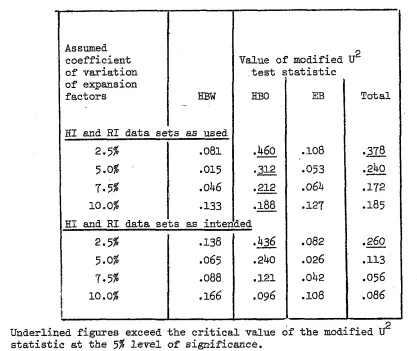
1.2.12 S t a t i s t i c a l comparisons of t h e household and roadside interview estimates of cordon crossing t r i p s d i d not r e v e a l a s i g n i f i c a n t difference between t h e d a t a s e t s f o r
HBW
and RBEB t r i p s ; but HBO- 7 -
Comments on c a l i b r a t i o n
1.2.17 The p r i n c i p l e of f i t t i n g t h e model t o b e s t e s t i m a t e s of important
aggregate q u a n t i t i e s
-
h e r e , t r i p ends from t h e t r i p end modeland observed c o s t band sums
-
l a c k s t h e m e r i t s of a b e s t fitmethod. Methods for t h e l a t t e r should continue t o b e developed. ( 4 . 2 )
1.2.18 Whilst
it
i s not known on t h e o r e t i c a l grounds whether t h e s o l u t i o n t o a. s y n t h e t i c trip-end model must be unique, empirical evidence, : g a i n e d from r e p e a t e druns
i n a demonstration d a t a s e t , have notgiven evidence of non-uniqueness.
1.2.19 The composite model s t r u c t u r e could have been invoked more, t o
provide
a
more e f f i c i e n t c a l c u l a t i o n a l procedure.(4.5)
1.2.20 E r r o r s due t o non-convergence t o t h e d e s i r e d row and column and
c o s t band c o n s t r a i n t s a r e n e g l i g i b l e compared t o t h e e r r o r s i n
t h e t r i p end e s t i m a t e s .
(4.6,3),
1.2.21 It i s not recommended t h a t t h e method of smoothing t h e c o s t
f u n c t i o n s i n t h e National Model be adopted f o r g e n e r a l use.
( 4 . 7 )
' " CdMeritg
' o ~
1.2.22) .The e r r o r i n t h e f i t t e d model value f o r a c e l l h a s two p a r t s : t h e
e r r o r a r i s i n g f r o m t h e u n c e r t a i n t y i n t h e d a t a t o which t h e model
i s f i t t e d , and inherent model b i a s ( 0 r ' m i s s p e c i f i c a t i o n e r r o r ' ) . The former i s c a l c u l a b l e ,
at
l e a s t approximately, from t h e known d a t a accuracy and t h e method of f i t t i n g . The b i a s , which i s t h ee r r o r t h a t would s t i l l be present if t h e model were f i t t e d t o p e r f e c t l y accurate d a t a , i s harder t o get a t . Each r e s i d u a l i s an e s t i m a t e of
it. For most c e l l s t h e r e s i d u a l has a v e r y . l a r g e v a r i a n c e , because t h e observed value depends on such a
small
o r zero count. To a s s e s s b i a s e s f u r t h e rit
seems necessary t o suppose a simple s t a t i s t i c a l d e s c r i p t i o n of them-
i n p a r t i c u l a r , t h a t t h e y behave as i f t h e y were an independent random m u l t i p l i e r i n each c e l l-
and attemptt o f i t t h i s b i a s model, t a k i n g account of t h e d a t a and model
'
u n c e r t a i n t y .1.2.23 The accuracy of t h e observed 0-D d a t a was c a l c u l a t e d i n d e t a i l
f o r each c e l l assuming t h a t t h e r e were no e r r o r s i n t h e v a r i o u s
expansion factors applied subsequently. (5.3) These were used
to provide accuracies for row, column and cost band sums. (5.4)
The coefficients of variation were about
3percent for district
totals and (on average) 26 percent for cost band sums.
1.2.24
The inaccuracy of the synthetic trip end estimates (after
allowing for the bias between these and the observed row and
column sums) was found to be much better than was thought to be
the case towards the end of the
RIITMproject, but still substantial,
the coefficient of variation being of the order of
~ O O O / Kpercent, where
Q
is the synthesised trip end value. (5.5)
In practice this gives a range of coefficient of variation from
about 15 to about 50 percent.
(5.8.6)
1.2.25
The errors in district level trip ends are, surprisingly, greater
than those for zonal level trip ends, implying.that the trip end
models are underspecified, with some variable or variables
omitted which take similar values in nearby zones. This raises
doubts about the extrapolation of the trip end models to the
unobserved areas. (5.3.14
-
5.5.16)
1.2.26
An
approximate formula has been derived for the accuracy of a
gravity model fitted with the
NM
synthetic trip end technique.
(5.61
1.2.27 Modelled and observed values for a sample of observed cells (all
purposes combined) have been examined, together with their
accuracies, and the broad conclusion reached that, overal1,the
modelled values show a strong resemblance to the observed values,
with occasional big discrepancies. (5.7
)1.2.28
Similar comparisons for intradistrid cells suggest that the
modelled values are lower than the observed values, %y about
7
1.2.29 The v a r i a t i o n i n t h e p a t t e r n of r e s i d u a l s over t h e matrix was examined by categorising them by t r i p l e n g t h , s i z e of expansion f a c t o r and by t y p e of movement (and by s i z e of modelled value, when appropriate). Neglecting v a r i a t i o n with expansion f a c t o r , t h e differences between modelled and observed values a r e more pronounced f o r t r i p s l e s s than 25 km, but were not judged t o b e important, t a k i n g i n t o account an approximate standard deviation of t h e r e s i d u a l . But t h e differences appear t o b e s t a t i s t i c a l l y s i g n i f i c a n t f o r all a r e a and t r i p l e n g t h c a t e g o r i e s with low
( < 1 0 ) expansion f a c t o r . Moreover, t h e r e a r e i n d i c a t i o n s t h a t , f o r t r i p s out of London-or between o t h e r Areas, t h e model i s performing d i f f e r e n t l y a s between c e l l s of low ( < 1 0 ) expansion f a c t o r (where t h e r e s i d u a l s a r e always n e g a t i v e ) and those of high (> 100) expansion f a c t o r , where t h e y a r e almost always p o s i t i v e . See s e c t i o n 1.3.3 f o r a comment on t h e a n a l y s i s and i t s implications. (See 5.9; t h e conclusions a r e more f u l l y described i n 5.9.22.
)
1.2.30 The simplest possible d e s c r i p t i o n s of t h e b i a s e s o r misspecification i n t h e d i s t r i b u t i o n model a r e t h a t t h e squared.biases a r e haphazard over t h e c e l l s of t h e matrix, with an average value which i s a constant, o r e l s e proportional t o t h e model value, o r t o i t s square. These t h r e e models of squared b i a s were f i t t e d t o t h e National Model. No s i g n i f i c a n t b i a s e s i n t h e s e simple o v e r a l l senses were found,
apparently because of t h e overwhelming number of c e l l s f o r which t h e r e s i d u a l was e i t h e r small o r very inaccurate.
1.3 'DISCUSSION
1.3.1 Clearly, t h e d a t a problems a f f e c t much o f t h e comparisons, r a t h e r than t h e model s p e c i f i c a t i o n . Much of t h i s can b e corrected e a s i l y
-
f o r example, t h e omission of t h e i n a c t i v e household correction f a c t o r from t h e 0-D d a t a , t h e r e v i s i o n of NHB t r i p end models t o exclude t r i p s by non-residents.could, f o r example, be i n t r a z o n a l t r i p models o r ; more simply,
a model of long d i s t a n c e movements could be developed, i n which
t h e synthesised t r i p ends were t h o s e of longer d i s t a n c e
movements only.
1.3.3.
Concerning our assessment of t h e adequacy of t h e f i t t e d model, using t h e techniques described i n Sections5.7
and 5.9, t h r e e p o i n t s may be made. The f i r s t p o i n t i s t h a t t h e techniques go w e l l beyond t h e c a p a b i l i t i e s of t h e Department's RDCOSM program,i n s o f a r as ( i ) t h e y e&e account of v a r i a n c e s of b o t h model and d a t a , and t h e i r covariances; and (ii) t h e y allow p a t t e r n s i n t h e r e s i d u a l s t o be examined by segmenting t h e matrix according t o t h e
c h a r a c t e r i s t i c s of t h e o r i g i n - d e s t i n a t i o n p a i r s . Thus,
we
hope t h a t t h e Departmentw i l l
consider providing enhanced software t o enable o t h e r p r a c t i t i o n e r s t o do t h e s e s o r t s of i n v e s t i g a t i o n s .The second p o i n t i s t h a t t h e time s c a l e of t h e p r o j e c t d i d not
permit u s t o go a s f a r a s we should have l i k e d i n developing t h e s e
techniques. Having received t h e a p p r o p r i a t e d a t a with only about
t h r e e weeks t o go before t h e end of t h e c o n t r a c t , we were a b l e t o
i n v e s t i g a t e t h e r e s i d u a l s , t a k i n g account of t h e i r a c c u r a c i e s , f o r
o n l y a sample of c e l l s (Section 5.7) and a b l e t o i n v e s t i g a t e t h e
v a r i a t i o n s i n t h e r e s i d u a l s over a l l c e l l s , i n i t i a l l y only by
neglecting information on t h e i r a c c u r a c i e s (Section 5.9). The
t h i r d point a r i a e s from t h e second: because we were not a b l e i n
t h e time-scale t o i n t e g r a t e t h e s e two approaches t o examining
t h e r e s i d u a l s , nor t o c a r r y out f u r t h e r computer runs on t h e b a s i c
d a t a , we were f a c e d with some problems over i n t e r p r e t i n g t h e
evidence f r o m t h e s e two s e t s of analyses
.
I n i t i a l l y , t h e evidence from t h e two methods of examining t h e
r e s i d u a l s appeared t o c o n f l i c t , s o we s c r u t i n i s e d t h e a n a l y s i s more
fully subsequently, (including t a k i n g i n t o account a rough measure
of t h e accuracy of t h e r e s i d u a l s when examining t h e i r v a r i a t i o n
over a l l c e l l s . Our conclusions, summarised i n 1.2.29, and given
more f u l l y i n 5.9.22 mean t h a t though t h e evidence i s not a s
and high
(>loo)
expansion f a c t o r ( f o r t r i p s out of London o rbetween o t h e r a r e a s ) , and t h i s gives r i s e t o t h e suspicion t h a t
t h i s
i s
i n p a r t a t t r i b u t a b l e t o d i f f e r e n c e s i n t h e H I and R I d a t a s e t s . To r e s o l v e t h i s adequately would r e q u i r e further d e t a i l e di n v e s t i g a t i o n o f t h e d a t a s e t s , and of t h e i r e r r o r s t r u c t u r e .
1.3.4. The main t h r u s t of our a n a l y s i s was d i r e c t e d
at
t h e e s t i m a t e s of t r i p s , not of t r a v e l . (= t r i p sx
c o s t ) o r t r i p length. The f i n a l r e p o r t by HH&P, which includes analyses of observed andmodelled t r i p l e n g t h estimates, should be read i n conjunction
with t h i s r e p o r t f o r a f u l l a p p r e c i a t i o n of t h e National Model
c a l i b r a t i o n . (Howard Humphreys and P a r t n e r s , 1982)
1.3.5. Whilst t h e evidence f o r t h e accuracy o f t h e input d a t a and of
t h e f i t t e d model may appear alarming a t first s i g h t , t h i s may
be something one has t o g e t used t o i n t r a n s p o r t a t i o n modelling.
No s i m i l a r t r a n s p o r t a t i o n study i n t h i s country (and we suspect
anywhere e l s e i n t h e world) has been s u b j e c t t o such d e t a i l e d
s c r u t i n y a s has t h e National Model and i t s predecessor, t h e Regional Highways T r a f f i c Model. Transportation planning w i l l
have t o recognise t h a t t h e kinds and magnitudes of e r r o r s
presented i n t h i s r e p o r t a r e l i k e l y t o a r i s e i n very many
a p p l i c a t i o n s
-
and g r e a t e r a t t e n t i o nw i l l
have t o be p a i d t o g e t t i n g clean d a t a and an appropriate model s p e c i f i c a t i o n .2.0.1. The c h a r a c t e r i s t i c f e a t u r e of t h e composite approach t o d e s c r i b i n g
origin-destination movements
i s
t h a t s h o r t e r movements a r e t r e a t e dat a f i n e r l e v e l of aggregation t h a n longer movements.
2.0.2. If t h e origin-destination d a t a
i s
s p e c i f i e d i n a composite way, a p o s s i b l e advantage over an e n t i r e l y f i n e - l e v e l s p e c i f i c a t i o n i s t h a tsmall
amounts
of d a t a a r e grouped t o g e t h e r , thereby reducing t h e effects- of sampling v a r i a b i l i t y on t h e accuracy o f t h e parameterestimates of a t r i p d i s t r i b u t i o n model.
2.0.3. If t h e t r i p d i s t r i b u t i o n model i s s p e c i f i e d i n a composite way, t h e main advantage i s a reduction i n computing c o s t s , compared with an e n t i r e l y fine-zone l e v e l of model s p e c i f i c a t i o n .
It i s not necessary t o specify both model and d a t a i n a composite
way. For example, Gunn (1977) showed how a conventional g r a v i t y model, s p e c i f i e d a t a f i n e zone l e v e l of d e t a i l , could be f i t t e d t o d a t a grouped i n a composite way.
2.0.4. The National Model s p e c i f i e s both d a t a and model i n a composite way. Since, i n t r a n s p o r t planning, t h i s i s pioneering new techniques, t h i s s e c t i o n seeks t o c l a r i f y t h e p r i n c i p l e s and procedures a s w e l l a s commenting upon t h e p a r t i c u l a r formulation adopted.
2.0.5. The d e f i n i t i o n s and s p e c i f i c a t i o n s o f , f o r example, composite matrices, a r e given i n Section 2.1; t h e model s p e c i f i c a t i o n i s given i n Section 2.2; and t h e cost s p e c i f i c a t i o n i s i n Section 2.3.
Note however t h a t both t h e cost and t h e model s p e c i f i c a t i o n have been adjusted i n t h e course o f t h e f i t t i n g procedure (discussed i n Section
41,
s o t h a t i n Sections 2.2 and 2.3 t h e r e i s some a n t i c i p a t i o n o f p o i n t s t h a t a r i s e l a t e r .2.1.1 The various ways
in
which s h o r t e r movem~nts could be t r e a t e dat
a f i n e r l e v e l of zonal aggregation t h a n longer movements were reviewed i n Kirby (1978). The method used i n t h e National Model i s probably t h e simplest and e a s i e s t t o implement. It has a two l e v e l hierarchy o f f i n e zones ( t h e so-called r e g i o n a l zones of
RHTM) and coarse zones ( c a l l e d d i s t r i c t s * ) i n which t r i p s a r e represented a s occurring a t e i t h e r t h e fine-zonelfine zone l e v e l o r coarse zone/coarse zone l e v e l . This avoids t h e f u r t h e r
complexity of representing coarse zonejfine zone i n t e r a c t i o n s e x p l i c i t l y .
/
2.1.2. Thus, i f I i s a d i s t r i c t of o r i g i n ( o r g e n e r a t i o n ) , and J i s a d i s t r i c t of d e s t i n a t i o n ( o r a t t r a c t i o n ) , and i f i?
j
a r e r e g i o n a l zones t h a t l i e r e s p e c t i v e l y i n I and J ( t h e shorthandf o r which i s i E I , j E
J),
t h e multi-level system of zone-zonemovements may be presented roughly i n t h e following form
(supposing t h a t t h e nearby d i s t r i c t s have s i m i l a r numbers).
I7rorn
d i s t r i c t o r zone I
2.1.3. Some c e l l s of t h e d i s t r i c t - d i s t r i c t
-
(14) l e v e l o f i n t e r a c t i o n a r e subdivided i n t h e above t a b l e , i n t o what we c a l l sub-cells,r e p r e s e n t i n g t h e zone-zone ( i - j ) l e v e l of i n t e r a c t i o n . A c e l l
t h a t i s not subdivided we s h a l l c a l l a simple c e l l ; a c e l l t h a t i s subdivided we s h a l l c a l l a com@oslte c e l l . An o r i g i n - d e s t i n a t i o n
matrix t h a t contains only simple c e l l s we c a l l a simple matrix:
one t h a t contains
a
mixture of simple and composite c e l l s we c a l l a ~omporiitematrix.
For each of t h e c e l l s o r sub-cells t h e r e i s aknown journey c o s t . See t h e Appendix (Section
8)
f o r t h e numbersof such c e l l s .
2.1.4. I n t h e National Model ( s e c t i o n 2.1) a d i s t r i c t t o d i s t r i c t (I-J)
p a i r was r e p r e s e n t e d a s a simple c e l l i f t h e c o s t of t r a v e l between
any r e g i o n a l zone p a i r included i n
it
exceeded a c e r t a i n t h r e s h o l d value. Thus, simple c e l l s connect remote d i s t r i c t p a i r s , compositec e l l s connect nearby d i s t r i c t p a i r s . The d e c i s i o n on t h e c o s t
t h r e s h o l d
i s
a m a t t e r of judgement; t h e value o f 100 c o s t u n i t s (assuming an average speed of 60 km/h, t h i s corresponds t o ad i s t a n c e of 37 km) was chosen on t h e grounds t h a t
it
reduced t h e t o t a l number of ( c e l l s and sub-cells) t o l e s s t h a n a m i l l i o n(compared with t h e t h i r t e e n m i l l i o n i n t h e
RHTM simple matrix of
3613
x 3613 c e l l s ) . We do not know whether t h e fit of t h e model i s s e n s i t i v e t o t h e t h r e s h o l d value, but t h i n k it u n l i k e l y .2.2. COMPOSITE 'MODEL
2.2.1. With observed zone-to-zone movements represented a t d i f f e r e n t l e v e l s
of s p a t i a l d e t a i l , t h e model s p e c i f i c a t i o n should i d e a l l y be such
t h a t e s t i m a t e s a t one l e v e l of d e t a i l a r e c o n s i s t e n t i n some sense
with those a t another. The key t o t h e t r a n s i t i o n i s having some information a v a i l a b l e a t t h e f i n e l e v e l of d e t a i l ; i n t h e case of
t h e National Model, both s y n t h e t i c trip-end e s t i m a t e s and zone-zone
c o s t s were a v a i l a b l e a t t h e f i n e l e v e l .
2.2.2. If
a
g r a v i t y model form i s required a t both f i n e and coarse l e v e l s of d e t a i l , t h e n t h e two forms m a y be represented as:f o r c e l l s , i . e . remote d i s t r i c t s , and
t . .
=
a . bi%
( c . .)1 J 1
=
J
f o r sub-cells
,
i.
e . r e g i o n a l zone-regional zone i n t e r a c t i o n s , i n nearby d i s t r i c t s , where:ai, AI
=
generation f a c t o r s a t t h e f i n e and coarse l e v e l sP
and f ( c . .)
,
'
F
(CIJ) 5 e f f e c t s of s u b k e l l c o s t s c i j , o r c e l l13
c o s t s C on t h e i n t e r a c t i o n s between
IJ'
zone p a i r s i j o r d i s t r i c t p a i r s , IJ,
where t h e s u p e r s c r i p t P denotes t h e appropriate d e t e r r e n t function f o r t h a t p a r t of t h e matrix i n which IJ ( o r i j ) l i e s .
2.2.3 The consistency question
i s
one of r e l a t i n g ai t o AI, B. t o BJ, Jf P ( c .
. I
t o F ~ I C ~ ~ I .1 J
For a f u l l y c o n s i s t e n t f i n e zone/coarse zone s p e c i f i c a t i o n of t r i p s , one would r e q u i r e t h a t :
I n t h e National Model, t h e first requirement t h a t t h i s l e d t o was t h a t t h e zonal parameters a t t h e f i n e zone l e v e l were r e l a t e d t o those a t t h e coarse l e v e l (which a r e t h e ones t o be estimated) by:
"i
=
-.%
A, f o r i i n I (2:4)Q1.
and
r b
=
j
-
B~ f o r j i n J (2:5)R~
where qi, QI
=
t r i p generations synthesised i n f i n e zone i, coarse zone I , and a r e such t h a t C qi=
i i n I Q~
r R
=
t r i p a t t r a c t i o n s synthesised i n f i n e zonej,
coarse J - 0zone J , and a r e such t h a t
C
r=
RJ j i n Jj
2.2.4. Many o t h e r v a r i a n t s could have been taken. Whilst we have no evidence t o suggest t h a t t h e r e l a t i o n s h i p s (2:4; 2:5) a r e inadequate, we
should point out t h a t , so f a r a s we know, no-one has demonstrated t h a t , f o r a model f i t t e d t o f i n e zones, t h e parameters ( a i ) , ( b . )
.-. . J
ai/qi constant f o r nearby zones
and bj/rj
=
constant f o r nearby zonesThe RHTM parameter estimates f o r t h e 3613 zone system could have been used t o demonstrate t h i s .
P
2.2.5. Any r e l a t i o n s h i p between F (CIJ) and f p ( c .
. I
may be e n t i r e l y1 J
subsumed within t h e r e l a t i o n s h i p between coarse zone c o s t s CIJ
and f i n e zone c o s t s c . . ( f o r i j i n
IJ,
assuming only one cost1 J
function i s included) by s e t t i n g :
f ( x ) = F(X) (2.6) ( s e e Note
*).
Further discussion of t h e cost r e l a t i o n s h i p s needed t o s a t i s f y (2.3) i s i n Section 2.3
2.2.6 I n f a c t , t h e r e l a t i o n s h i p (2.6) i s fundamental, r a t h e r than a supposition, s i n c e t h e d i s t r i c t - d i s t r i c t c o s t s were not a v a i l a b l e from a coarse zone network, but have had t o b e constructed from t h e zone t o zone c o s t s . T h i s i s discussed i n s e c t i o n 2.3.
2.2.7 If t h e r e i s no f u r t h e r requirement imposed t o meet t h e condition (2:3), then, f o r &'.*,array of c o s t s , t h e model may be
represented as:
f o r simple c e l l s
LM
( i . e . remote d i s t r i c t s )-
f o r s u b c e l l s i j 'witnfri ' a 60fipositt;e '6911
IJ
(This assumes t h e c o s t s C t o be given; a c t u a l l y t h e y a r e
LM
constructed, a s i n s e c t i o n 2.3)
2.2.8 The s u b s c r i p t s LM a r e introduced here t o r e i n f o r c e t h e d i s t i n c t i o n between simple and composite c e l l s , but l a t e r we use I3 throughout.
2.2.9 ' 'A 'simpler 'mat;lien@t:ical . . . ' I t ~ s c r i p t i 6 r i 'of 'We @avit:y 'model The
. , . . . . . . .
mathematical form of t h e model given i n Section 2.2 of t h e
NMLDTM
r e p o r t reduces t o t h e expressions i n (2:7) and (2:8). However, a s Murchland ( i n a note dated 24th Feb. 1981) and Gunn ( i n
WN
1 0 ) have pointed out, it i s p o s s i b l e t o express it even more simply. Before doing so however it i s b e s t t o express t h e separation function i n(2:7,
8 )
i n a d i f f e r e n t way.P
2.2.10. Since t h e separation function F
(C)
i s defined d i f f e r e n t l y i n d i f f e r e n t p a r t s o f t h e matrix buti s
such t h a t , i n each p a r t , a parameter i s estimated f o r a given i n t e r v a l of c o s t , i n t e r v a l s kcan be defined corresonding t o both t h e c o s t - i n t e r v a l
-
functionP
d e f i n i t i o n such t h a t F (C)
=
F if c o s t C and p a r t P correspond K2.2 .
I
1
For
'relbdte
'dlStrl6tS
'LM
where
=
1
if Cmlies in interval
K
=
0otherwise.
and (2:8) becomes
:2.2.12
''For
'SuW6lT$
'ij
'in
'fi@&?by'd2Str2&%
'IJ
. . . , . . ~ . .
where d.
.
=
1if c.
.
lies in the k"intemra1
I J ~ 1 J
=
0otherwise.
2.2.13 The main simplification arises by adding the models estimates
for the composite cell as a whole.
Thus,for (2:lO) for
'.rleBrby
'diStf%cts (cells
1
. .
which is the same form as (2:9),
but here
Obviously
0 <DIJk
and
CD
IJk
iI1.
k
Note that since all the quantities on the right hand side of (2:12)
are dependent only on the trip-end estimates and costs, the value
Of
is known in advance of and is unaffected by the fitting
.-. ..-
1 9-
2.2.14 Summary : The model form may be most simply represented a s providing d i s t r i c t - d i s t r i c t estimal~es everywhere. These a l l have t h e form
For remote d i s t r i c t s t h e r e i s only one non-zero DIJk value. For nearby d i s t r i c t s t h e r e a r e s e v e r a l
DIJk
values (given by (2:12) ).2.2.15 This r e p r e s e n t a t i o n of t h e model
w i l l
be used i n t h e r e s t of t h i s r e p o r t . I n both cases t h e summation n o t a t i o n=
t
TIJk T ~ ~ +a p p l i e s , although it must be remembered t h a t i f t h e c e l l IJ i s composite, t h e t r i p s
TIJ+
a r e associated with s e v e r a l c o s t bands.2.2.16 Note t h a t , so far, t h e condition (2:3) f o r consistency i n t h e two l e v e l s of modelling
i s
not f u l l y met. The way i n which c o s t s were defined i n order t o achieve t h i s i n c e r t a i n r e s p e c t si s
discussed i n 2.3.
2.2.17 Note a l s o t h a t , f o r convenience, t h e functions w i l l be described a s having a categorised form
(F
r a t h e r than'
F
( C . . ) ) throughout,k 1 J
d e s p i t e t h e f a c t t h a t t h e functions were eventually smoothed. A s
already noted, t h e categorised notation conveniently i n d i c a t e s not only t h e c o s t value but a l s o t h e function type.
2.3 COMPOSITE 'COSTS
2.3.1. The National Model introduces a f u r t h e r r e l a t i o n s h i p between t h e
f i n e and coarse l e v e l s of modelling through t h e c o s t s c i j and
CIJ. This i s done i n two q u i t e d i s t i n c t ways.
2.3.2. (a]" 'For r e m o t e ' d i s t r l c t s , ' ' ' ' f o r both p r i v a t e and commercial
v e h i c l e models, t h e p r i n c i p l e i s e s s e n t i a l l y t h a t t h e c o s t s between remote d i s t r i c t s should be such t h a t t h e t r i p s given by
t h e coarse model would be equal t o t h a t given by a f i n e model (were
t h a t t o be applied t o such c e l l s ] .
That i s , i n a simple c e l l (LM), where (2:7) a p p l i e s , if (2:8) applied t h e r e t o o t h e n one would have
By t h e d e f i n i t i o n s i n s e c t i o n 2.4, one f u n c t i o n F a p p l i e s t o
all
p a i r s l m w i t h i n a given d i s t r i c t p a i r LM. Hence i s defined t h e doMpdgit6 d d s t f o r remote c e l l s :(The term composite c o s t , and i t s d e f i n i t i o n , a r e equivalent t o t h o s e i n t h e modal s p l i t l i t e r a t u r e ) . The operation ( 2 ~ 1 4 ) i s
a l s o c a l l e d B quBsi--average.
2.3.3. The r i g h t hand s i d e of ( ~ 1 4 ) contains known q u a n t i t i e s , but a l s o
t h e Punction F(C], which
i s
t o be estimated. I n p r i n c i p l e , t h i s implies an i t e r a t i v e procedure. I n p r a c t i c e , t h e q u a n t i t i e s F(C)were not t h o s e estimated i n t h e National Model c a l i b r a t i o n , b u t
t h o s e previously estimated i n t h e RFiTM c a l i b r a t i o n s , denoted by
Fo(C). say.
2.3.4. Whether t h e use of RHTM c o s t functions a s opposed t o National
Model c o s t f u n c t i o n s makes much d i f f e r e n c e i s discussed i n 2.3.14
e t seq. (The t h r e e RRI'M cost f u n c t i o n s f o r HBW were used t o
produce t h e composite c o s t s by [2:14), and t h e s e same c o s t s were
a l s o used f o r t h e o t h e r t h r e e purposes).
2.3.5. ( b ) For nearby d i s t r i c t s t h e p r i v a t e v e h i c l e and commercial
v e h i c l e models have taken d i f f e r e n t approaches s o f a r a s t h e use
of composite c o s t s a r e concerned.
2.3.6. I n t h e p r i v a t e v e h i c l e model, each nearby d i s t r i c t - d i s t r i c t p a i r
IJ i s t r e a t e d as a composite c e l l : t h e c o s t s between r e g i o n a l zone p a i r s i j w i t h i n IJ
ard
represented e x p l i c i t l y , a s shown i n Section 2.2.2.3.7. I n t h e commercial v e h i c l e mode, nearby d i s t r i c t - d i s t r i c t p a i r s
IJ a r e t r e a t e d a s simple c e l l s , but w i t h a composite c o s t t h a t r e p r e s e n t s i m p l i c i t l y t h e s e v e r a l r e g i o n a l zone p a i r c o s t s w i t h i n
IJ. The composite c o s t i s defined a s
-
F-l'IJ
-
Z.-
qi2
F ( c . . ) (2:16) i j i nIJ
%
R~ 1 Jand, i n t h i s c a s e , t h e function 'F'
-
i s t h a t being f i t t e d t o t h e National Model, and t h u s CIJ i s updated a s p a r t of t h e i t e r a t i v eprocedure t h a t e s t i m a t e s (AI),
( B ~ )
and (Fk). I n c o n t r a s t t o t h e non-iterative use of t h e RHTM c o s t f u n c t i o n Fo(C) i nc a l c u l a t i n g composite c o s t s f o r remote d i s t r i c t s , i t e r a t i v e
c a l c u l a t i o n s of composite cost f o r nearby d i s t r i c t s m a y be
a p p r o p r i a t e
.
2.3.8 The questions a r e , whether one method i s p r e f e r a b l e t o another; and would t h e y give very d i f f e r e n t r e s u l t s ?
the
AI,
B and F values) to a model of the private vehicle kind,
J
K
it is possible torepresent that solution in the form of a
model of the commercial vehicle kind, by appropriate choice of
composite costs for nearby districts. Thus there is an
equivalence between the two forms.
2.3.10 However, this does not mean to say that the
( A I ) ,( B ~ )
and (FK)
values derived by fitting the model of the private vehicle kind
are the same as those derived by fitting the model of the commercial
vehicle kind. The former, as it represents fine zone-zone
movements explicitly, includes 0-D data at this finer level; the
latter includes
0-D
data only at the coarser level. For a given
observed district-district cell, the commercial vehicle model will
allocate all the trips to a single interval of trip cost (that
corresponding to the composite C
),whereas the private vehicle
IJ
model will allocate the trips to several intervals of cost (those
corresponding to the ci
).
2.3.U
Hence one would expect the private vehicle model to give rather
more refined
(Fk) estimates than the commercial vehicle model,
essentially for costs below the
100pence threshold, for the same
fitting method (i.e. synthetic trip end or partial matrix method).
2.3.12
There has however been no direct evaluation of the two model
forms, so there is no quantitative evidence for how different the
two approaches are.
2.3.13
(Note that the fitting methods used in the two cases were
different
-
that for the private vehicle model constrained the
model's row and column totals to synthesised trip-ends, that for
the commercial vehicle model did not. Since the private vehicle
model is the main concern of this study, there will be little
further discussion of the different approaches.
)were used t o d e r i v e t h e c o s t s used f o r all f o u r purposes. The
RHTM f u n c t i o n s had been manually smoothed, and were monotonically
decreasing, s o t h a t t h e r e w a s no ambiguity a s t o what t h e i n v e r s e f u n c t i o n value was i n t a k i n g t h e quasi-average.
2.3.15 The question discussed i s , does
it
m a t t e r t h a t t h e o l d RHTM c o s t f u n c t i o n s ( o r r a t h e r , time functions a d j u s t e d t o a c o s t b a s i s )were used i n (2:15) f o r remote c e l l s , a s opposed t o using c o s t
f u n c t i o n s obtained i n t h e National Model? The questions i s
p a r t i c u l a r l y a p p o s i t e f o r c e l l s near t h e 100 pence c o s t t h r e s h o l d ,
because, below t h i s t h r e s h o l d , t r i p s a r e estimated i n a way which
corresponds t o u s i n g t h e National Model f u n c t i o n t o define a
composite c o s t , a s i n 2:14 o r 2:16, and above it t o t h e use of RHTM f u n c t i o n v a l u e s , a s i n 2:15.
2.3.16 Although
we
have no evidence, t h i s ma~r not m a t t e r , d e s p i t e t h e f a c t t h a t t h e o l d f u n c t i o n s were obtained f o r3
d i f f e r e n t ' a r e a s ' of t h e RBW matrix, as opposed t o9
i n t h e National Model f o r each purpose ( s e e Section 2 . 4 ) . The reason i s t h a t t h e averaging represented by 2:15 i s being done f o r d i s t r i c t s t h a t a r e f a r a p a r t . A l l t h e c o s t s clm f o r remote d i s t r i c t sLM
w i l l
(byd e f i n i t i o n of t h e simple c e l l ) exceed t h e c o s t t h r e s h o l d of 100
pence. It seems u n l i k e l y t h a t t h e r e l a t i v e v a r i a t i o n of F(cl,)
over a l l t h e s u b c e l l s w i t h i n a given
LM w i l l make t h e quasi-
average given by (2:15) very d i f f e r e n t from a more s t r a i g h t f o r w a r d average c o s t ,
and
henceit i s
u n l i k e l y t h a t i n a c c u r a c i e s i n t h e r e l a t i v e values of Fow i l l
have much e f f e c t on t h e quasi-average.(By r e l a t i v e v a r i a t i o n , we mean t h a t due t o t h e s l o p e . )
2.3.17 Moreover, t h e main d i f f e r e n c e between t h e t h r e e f u n c t i o n t y p e s
used i n RHTM (urban, r u r a l , London) and t h e nine used i n t h e
National Model ( s e e S e c t i o n 2 . 4 ) , i s t h a t t h e l a t t e r distinguished
intra-town movements from t h e r e s t ; b u t t h e r e l a t i v e values f o r F(C) curves f o r t h e s e two types of movements f o r each o f t h e
National Model suburban/rural/metropolit an/London c a t e g o r i e s were broadly s i m i l a r .
2.3.18
The fact that the trip-ends used in forming the quasi-average
with the RHTM function (in 2:15) were not the same as those used
in fitting the National Model (and so appropriate to 2:16) is
likely. tohave only a negligible effect.
2.3.19
The main inconsistencies that are likely to arise are for journeys
other than home-based work. This is because only the
HBW RHTM
cost function was used to define composite costs for remote cells.
2.3.20 For a few cells, there may be inconsistencies due to the various
sub-cells within it having different
RHTM cost functions applied
to them (i.e., a mixture say of urban and rural). Note that the
situation does not arise with the National Model function, which
is of the same type for all sub-cells within a given district-
district cell.
2.3.21
Eknpirical evidence for the differences that are likely is
available from NATDEF output (reproduced in
WN
19).
This shows
that the quasi-averages given by (2:15) are almost always less
than the simple unweighted average cost. (Theory given in
WN
22 confirm that, for a convex cost function, the quasi-average
2:15 will always be less than the corresponding simple weighted
average. For a rapidly decreasing function, Fo, the quasi-average
will be close to the least of the costs in the sub-cells.) Most
of the quasi-averages are within 10 pence of the unweighted
average.
2.3.22
For the important region near the
100pence threshold, Table
2.3(1) surnmarises some of the
WN19
data. It is unlikely that
the use of National Model function values rather than RHTM function
would change the value of the quasi-average by as much as the
2.3.23 If one ignores t h e e f f e c t of any change t o t h e c a l i b r a t e d values
of t h e c o s t f u n c t i o n Fk, t h e n a change i n c o s t i n a p a r t i c u l a r
c e l l IJ t h a t implies a change from F t o F
+
aF i n t h e d e t e r r e n t
f u n c t i o n valuew i l l
generate a p r o p o r t i o n a l change i n t h e model's e s t i m a t e s of t r i p s i n t h a t c e l l given by, approximately,where aIJ talres account of t h e row and column c o n s t r a i n t s , and
i s given approximately by
( ~ i r b ~ , 1973). I n many cases, a
w i l l
be n e g l i g i b l e near t h e IJ100 pence t h r e s h o l d . The p r o p o r t i o n a l changes i n t h e numbers of
t r i p s f o r
a
one-band s h i f t i n c o s t a t t h e 100 pence t h r e s h o l d a r e given i n Table 2.3(2).2.3.24 A s a general p o i n t , we n o t e t h a t , s i n c e t h e composite c o s t s f o r remote d i s t r i c t s a r e s o c l o s e t o t h e simple unweighted
average zone-zone c o s t s ( s e e
WN
l g ) , it seems p o s s i b l e t h a t a simple c o s t , from d i s t r i c t c e n t r o i d t o d i s t r i c t c e n t r o i d ,mqr
have been adequate f o r t h e s e d i s t r i c t s . I n p r a c t i c e though,
s i n c e d i s t r i c t c e n t r o i d s were undefined and zone-zone c o s t s had
t o be used t o c a l c u l a t e an average c o s t between d i s t r i c t s , t h e r e
i s v i r t u e , and very l i t t l e e x t r a computational e f f o r t , i n c a l c u l a t i n g t h e composite c o s t s ( r a t h e r than s a y t h e average
c o s t ) f o r a l l d i s t r i c t p a i r s .
2.3.25 The main v i r t u e of c a l c u l a t i n g composite c o s t s f o r remote d i s t r i c t s
i s t h a t it reduces t h e r i s k of d i s c o n t i n u i t y a r i s i n g i n t h e treatment of c e l l s near t h e 100 pence t h r e s h o l d .
2.3.26 The c a l c u l a t i o n of average c o s t s It must be s t r e s s e d i n