CIRTL Reports
Graduate College
2016
Peer Evaluations Do Not Improve TA Self-Efficacy
Over Self-Reflection
Brent D. Mortensen
Iowa State University, [email protected]
Monica Cox
Iowa State University, [email protected]
Sean Satterlee
Iowa State University, [email protected]
Follow this and additional works at:
http://lib.dr.iastate.edu/cirtl_reports
Part of the
Biology Commons,
Educational Assessment, Evaluation, and Research Commons,
Educational Methods Commons,
Higher Education and Teaching Commons, and the
Science and
Mathematics Education Commons
This Article is brought to you for free and open access by the Graduate College at Iowa State University Digital Repository. It has been accepted for inclusion in CIRTL Reports by an authorized administrator of Iowa State University Digital Repository. For more information, please contact
Recommended Citation
Mortensen, Brent D.; Cox, Monica; and Satterlee, Sean, "Peer Evaluations Do Not Improve TA Self-Efficacy Over Self-Reflection" (2016).CIRTL Reports. 2.
Peer Evaluations Do Not Improve TA Self-Efficacy Over Self-Reflection
Abstract
Graduate teaching assistants (TAs) receive little to no formal training in pedagogy before entering the classroom. Such deficiencies may contribute to increase anxiety and poor self-efficacy for TAs, potentially hindering opportunities to train future faculty. We tested the effects of a previously established, low investment, method of TA training through making and receiving peer-evaluations on TA self-efficacy compared to performing self-assessments and reflection of teaching experiences in three introductory biology courses at a large, Mid-western university. While peer-evaluations did not affect quantitative measures of self-efficacy, we did observe greater increases in self-efficacy among TAs with more experience. We suggest that future studies on the effects of peer-evaluations may be most effective when conducted by experienced TAs.
Keywords
graduate teaching, teaching assistant, peer evaluation, peer observation, self-efficacy
Disciplines
Biology | Educational Assessment, Evaluation, and Research | Educational Methods | Higher Education and Teaching | Science and Mathematics Education
PEER EVALUATIONS DO NOT IMPROVE TA SELF-EFFICACY OVER SELF-REFLECTION
Brent Mortensen, Monica Cox, Sean Satterlee
ABSTRACT
Graduate teaching assistants (TAs) receive little to no formal training in pedagogy before entering the classroom. Such deficiencies may contribute to increase anxiety and poor self-efficacy for TAs, potentially hindering opportunities to train future faculty. We tested the effects of a previously established, low investment, method of TA training through making and receiving peer-evaluations on TA self-efficacy compared to performing self-assessments and reflection of teaching experiences in three introductory biology courses at a large, Mid-western university. While peer-evaluations did not affect quantitative measures of self-efficacy, we did observe greater increases in self-efficacy among TAs with more experience. We suggest that future studies on the effects of peer-evaluations may be most effective when conducted by experienced TAs.
INTRODUCTION
The graduate teaching assistants (TAs) span a diverse background of pedagogical preparation, research ability, motivation, and confidence. Indeed, TAs range from accomplished teachers with substantial experience and interest in teaching to new graduate students that may have taken the course they are now teaching within the last year. Although extensive training is often available for TAs, this training traditionally focuses on the details of the material and administrative topics related to the class rather than pedagogical methods (e.g., Wyse et al. 2014). This relatively inadequate preparation can cause TAs to respond with over-confidence (e.g., Kruger and Dunning 1999) or anxiety (Pelton 2014) over their teaching abilities and responsibilities. However, TAs are often unable to develop the pedagogical skills necessary to overcoming these challenges due to other responsibilities in their own classes and research. Indeed, without some degree of formal training, not only do graduate students miss out on opportunities to develop much needed skills in the academic job market, but the undergraduates for whom they serve as educational trustees. Moreover, sending untrained and unconfident TAs into the classroom may be counter-effective if these experiences turn TAs away from teaching.
met with positive feedback by participants, improvement in teaching ultimately requires a personal dedication to do so that may not be affected by outside feedback. Thus, while the TA evaluation is effective, it may not produce greater results than self-reflection and meta-cognition by TAs. If so, the process may be streamlined by removing the evaluator from the process and providing TAs a structured method by which they may reflect on their teaching. Moreover, it is not well understood how feedback and reflection on teaching affects TA confidence. Such confidence may be measured through previously developed teacher efficacy metrics (Tschannen-Moran and Hoy 2001).
We suggest that self-reflection and assessment can improve TA confidence as well as peer evaluations. We compared the effects of both receiving and providing peer-evaluations as described by Miller et al. (2014) to using the same tools for self-assessment for biology TAs in three classes at a large, Mid-West university on TA self-efficacy. We predicted that TA self-efficacy would not differ between these treatments.
METHODS
Participants in our study taught as graduate TAs in three biology laboratories at a large, Mid-West university: Introductory Biology I (n = 9), Introductory Biology II (n = 5), and General Ecology (n = 2). All participants completed a survey at the beginning and end of the study. These surveys included the Teachers’ Sense of Efficacy Scale (TSES) questionnaire (Tschannen-Moran and Hoy, 2001) as well as questions about teaching and experience. As the TSES was developed for K-12, not all questions in this survey necessarily apply to a university setting. Therefore, we asked faculty members at this same university to also complete the TSES. Using their responses (n = 19), we removed those questions that scored abnormally low (<6 or half way between "Some influence" and "Quite a bit") from the TA survey responses.
We randomly assigned participants to the peer-observation (n = 8) and the self-evaluation groups (n = 8). Based on schedule availability, we paired TAs in the peer-observation group for two reciprocal, peer evaluations. During each observation, the observing TA completes the Teaching Assistant - Inquiry Observation Protocol (TA-IOP) (Miller et al. 2014). Evaluations occurred no sooner than three weeks into the semester and no later than four weeks before the end of the semester with at least five weeks between evaluations. TA were put into different pairs for each reciprocal evaluation to increase diversity in feedback. In the self-evaluation group, TAs performed self-evaluations by filling out the same evaluation form used by the peer observers.
We calculated changes in TSES scores by averaging response values by category as suggested by Tschannen-Moran and Hoy (2001), producing values for TA self-efficacy in relation to student
engagement, instructional strategies, and classroom management. Questions 1, 4, and 22, all occurring in the student engagement category, scored below the threshold value of six in faculty surveys and were consequently removed before averaging. Differences in average values for each category were
faculty responses to individual questions using ANOVA. All models were run in R 3.2.3 (R Core Team 2015) using the lmerTest (Kuznetsova et al. 2016) and lme4 packages (Bates et al. 2015) for mixed effect models. Our study was conducted following ethical standards approved by our Institutional Review Board (IRB Exemption #15-434).
RESULTS
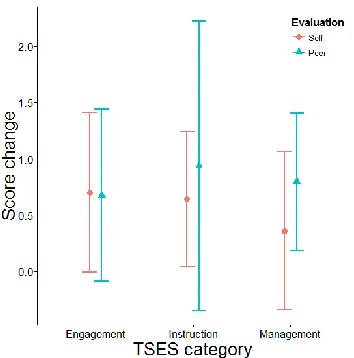
Changes in self-efficacy from the beginning to the end of the study were not statistically different between the peer and self-evaluation groups regardless of efficacy category considered (fig. 1, table 1). Self-efficacy significantly improved with TA experience regardless of treatment group. Average
[image:5.612.219.396.281.460.2]responses between TAs and faculty to the self-efficacy questions retained in our study were not significantly different (P < 0.05, data not shown).
Fig. 1—Changes in teacher efficacy values for graduate TAs in biology in response to peer and self-evaluations. Values are based off of the Teachers’ Sense of Efficacy Scale (TSES), categorizing responses into mean values as suggested by Tschannen-Moran and Hoy (2001). Points represent means adjusted for TA experience and course taught. Error bars represent 95% confidence intervals.
Table 1—Effects of the peer vs. self-evaluation and number of semesters a TA had previously taught on changes in teacher self-efficacy.
Student
engagement
Instructional
strategies
Classroom management
Num DF Den DF F P Den DF F P Den DF F P
Peer evaluation 1 12.0 1.3 0.274 10.5 3.6 0.085 10.7 1.8 0.213
TA experience 1 12.0 10.8 0.006 10.1 6.6 0.028 6.6 7.2 0.033
[image:5.612.55.557.613.705.2]DISCUSSION
We found that changes in TA confidence, measured as self-efficacy, were not affected by whether TAs engaged in peer or self-evaluations. However, our study was limited as we did not interview
participants to determine why their responses to the survey did (or did not) change. It is possible that TAs entered the study with over-confidence in their teaching ability. Indeed, people tend to over rate their abilities to perform a task when they are relatively inexperienced (Kruger and Dunning 1999). If, for example, participants in the peer-evaluation group gained greater insight to their teaching based on feedback and the opportunity to observe their peers, they may have simultaneously increased in their abilities to teach and accurately self-assess these abilities. Consequently, their self-efficacy may not have changed through the course of the study despite having improved in their abilities. Future research incorporating qualitative analyses of interview or similar data (as in Miller et al. 2014) will be necessary to determine the relationships between peer and self-evaluations with TA self-efficacy.
Despite the lack of any treatment effect, TAs with greater experience did show greater improvements in self-efficacy over the course of the study regardless of treatment. This result suggests that as TAs gain more experience, their self-efficacy increases non-linearly. Such results may come as experienced TAs are able to refine their abilities based on previous mistakes or achievements, producing greater self-confidence. Therefore, we suggest that future studies of peer-evaluations may be most effective when pairing experienced with less-experienced TAs in a mentor/mentee relationship. However, we offer the caution that even this may provide limited results was we found no difference in self-efficacy values for experienced faculty and graduate TAs. Indeed, teaching experience may not be an appropriate measure of teaching ability so that mentor/mentee pairing should also consider this latter metric.
LITERATURE CITED
Bell, A., and R. Mladenovic. 2008. The benefits of peer observation of teaching for tutor development. Higher Education 55:735-752.
Blouin, D. D., and A. R. Moss. 2015. Graduate Student Teacher Training: Still Relevant (and Missing?) 20 Years Later. Teaching Sociology 43:126-136.
Kruger, J., and D. Dunning. 1999. Unskilled and Unaware of It: How Difficulties in Recognizing One's Own Incompetence Lead to Inflated Self-Assessments. Journal of Personality and Social Psychology 77.
Linenberger, K., M. C. Slade, E. A. Addis, E. R. Elliott, G. Mynhardt, and J. R. Raker. 2014. Training the Foot Soldiers of Inquiry: Development and Evaluation of a Graduate Teaching Assistant Learning Community. Journal of College Science Teaching 44:97-107.
Parker, M. A., D. Ashe, J. Boersma, R. Hicks, and V. Bennett. 2015. Good Teaching Starts Here: Applied Learning at the Graduate Teaching Assistant Institute. Canadian Journal of Higher Education 45:84-110.
Pelton, J. A. 2014. Assessing Graduate Teacher Training Programs: Can a Teaching Seminar Reduce Anxiety and Increase Confidence? Teaching Sociology 42:40-49.
Siddiqui, Z. S., D. Jonas-Dwyer, and S. E. Carr. 2007. Twelve tips for peer observation of teaching. Medical teacher 29:297-300.
Tschannen-Moran, M., and A. W. Hoy. 2001. Teacher efficacy: capturing an elusive construct. Teaching and Teacher Education 17:783-805.