Intergalactic Medium
Thesis by George D. Becker
In Partial Fulfillment of the Requirements for the Degree of
Doctor of Philosophy
California Institute of Technology Pasadena, California
2007
c
2007
George D. Becker
For my family,
who have supported me at every step,
and for Molly,
Acknowledgements
It is a pleasure to thank some of the many people from whom I have received support, although there are far too many to be listed here. I received early support from my un-dergraduate advisor, Bob O’Connell, who introduced me to research and encouraged me to
do my graduate work at Caltech, and from Ray Ohl, whose enthusiasm helped many in my class at UVa to pursue the sciences. While at Indiana, I was fortunate to receive additional
encouragement and direction from Mike Pierce.
Nearly all of the observations presented here were performed at the Keck telescopes in
Hawaii, and I am deeply indebted to the Keck staff for their patient assistance through many nights of observing. Closer to home, I am thankful to the staff in Robinson, particularly
Gina Armas, Gita Patel, and Diane Fujitani for making all of the practical aspects of life at Caltech easy. I am especially grateful to our systems administration team of Patrick
Shopbell, Anu Mahabal, and Cheryl Southard. Their tremendous expertise and hard work make all scientific progress in the department possible.
My thanks to Judith Mack for opening her home on many occasions - and for the flan. It has been a great pleasure to be part of an exceptional community of grad students.
Their talents are remarkable, both in astronomy and far beyond, and I have leaned a great deal from each of them. Lunches were one of the best times to reflect and relax, and I was
privileged to enjoyed the regular company of David Kaplan, Dawn Erb, Micol Christopher, Jackie Kessler-Silacci, and Naveen Reddy, as well as most of the other grad students at
different times.
Many thanks to my enjoyable and accommodating office mates: Anu Mahabal, Pranjal
Trivedi, Edo Berger, Matt Hunt, Bryan Jacoby, Laura Hainline, and Stuartt Corder. I am also grateful to the fun and always tolerant people with whom I shared a roof: Noah
Robin-son, Jon Sievers, Milan Bogosavljevic, Francis O’Donovan, Jennifer Carron, Dan Stark, and Adam Krauss.
The astronomy department’s soccer, basketball, and softball teams have been a welcome outlet, and I thank Mike Santos, Rob Simcoe, Micol Christopher, and Larry Weintraub for
organizing these. Opportunities to make music have been indispensable, and I am grateful to the Angeles Chorale and the Caltech Thursday Jazz Band for the chance to perform with
time and talent to lead the Caltech Bands. Bill is an invaluable resource for the Caltech community.
My thanks to Rob Simcoe for showing me the ropes of quasar absorption line research as I was beginning at Caltech. I am also grateful to Michael Rauch, who has been a great
source of encouragement and a reliable sounding board. I have greatly enjoyed the trips with Michael to observe in Chile, even if we had to spend hours deciding who would go first
down the mountain.
Finally, I could not have asked for a better thesis advisor than Wal Sargent. Wal
possesses an astounding wealth of knowledge, astronomical and otherwise, and I have greatly enjoyed our many conversations. I have been particularly pleased to share with Wal a love
of music. On observing runs, we seemed to agree the most on Baroque composers, but could also entertain a rare moment of jazz (when he was willing). Dinners at Merriman’s were
always a favorite (thanks, Ira). Most importantly, though, Wal provided me with every opportunity to do good science, and allowed me to find my own way with only a gentle
Abstract
We measure the spatial coherence of filamentary structures in the intergalactic medium (IGM) at z ∼ 4. The transmitted flux in the Lyα forest is significantly cross-correlated in the spectra of two pairs of QSOs at z ∼ 4 with angular separation ∆θ ∼ 30′′. This strongly suggests that some fraction of the absorbing structures span the ∼ 1 comoving Mpc separation between paired sightlines.
We further present measurements of the ionization state of the high-redshift IGM using three approaches: a search for low-ionization metal lines atz >5, a study of the evolution of
Lyα optical depths over 2.z.6, and a measurement of the UV background at 4.z.5 using the quasar proximity effect. We identify six Oisystems in the HIRES spectra of nine
QSOs with redshifts 4.9≤zQSO≤6.4. Four of these systems lie towards SDSS J1148+5251
(zQSO = 6.4). This excess at z ∼6, however, is unlikely to indicate a significantly neutral
IGM suggestive of the end of reionization, since the Oifalls over a redshift interval that also
shows transmission in Lyαand Lyβ. In contrast, we find no Oitowards SDSS J1030+0524
(zQSO= 6.30), whose spectrum shows a broad Gunn-Peterson trough. That sightline must
also be highly ionized, therefore, or else chemically pristine. The relative abundances of O,
Si, and C in the systems we detect are consistent with enrichment from Type II supernovae, with an upper limit of 30% on the amount of metals contributed by supermassive stars.
We examine the evolution of Lyα optical depth using the transmitted flux probability distribution function (PDF) in the spectra of 63 QSOs spanning absorption redshifts 1.7<
z < 5.8 to predictions from two theoretical τ distributions. For an isothermal IGM and a
uniform UV background, the optical depth distribution computed from a density model that
has been used to make claims of late reionization produces poor fits to the observed flux PDF unless significant corrections to the QSO continua are applied. In contrast, a lognormal τ
distribution fits the data at all redshifts with only minor changes in the continua. A simple linear fit to the redshift evolution of the lognormal parameters at z < 5.4 reproduces the
observed mean Lyα and Lyβ transmitted fluxes over 1.6 < z <6.2. Assuming the density field, temperature, and UV background vary slowly atz <5, this suggests that no sudden
change in the IGM due to late reionization is necessary to explain the lack of transmitted flux atz&6.
proximity effect in a sample of 16 QSOs. Accurate redshifts were obtained from Mg ii
emission lines, supplemented by estimates from the start of the Lyαforest and CO emission.
We use a new method for directly estimating the size of a QSO’s proximity region based on the observed transmitted flux distribution. The relative sizes of the proximity regions
are consistent with the expected trend in QSO luminosity, although the proximity regions around faint QSOs may be disproportionately small. Our estimate of the background H i
ionization rate, Γbg = (1.4+1.6−0.7)×10−12s−1, is consistent with no evolution fromz&2 based on other measurements using the proximity effect, the mean opacity of the Lyα forest, and
Contents
1 Introduction 1
1.1 Overview . . . 1
1.2 Scientific Background . . . 2
1.2.1 The Metagalactic Ionizing Background . . . 3
1.2.2 Reionization . . . 5
1.3 Thesis Outline . . . 6
2 Large-Scale Correlations in the Lyα Forest at z= 3−4 10 2.1 Introduction . . . 11
2.2 The Data . . . 13
2.3 Comparison of Sightlines . . . 18
2.3.1 Correlation Functions . . . 18
2.3.2 Flux Distributions . . . 21
2.4 Effects of Photon Noise and Instrumental Resolution . . . 25
2.5 Metal Systems . . . 31
2.5.1 Q1424+2255 . . . 31
2.5.2 Q1439−0034A & B . . . 33
2.6 Conclusions . . . 36
3 Discovery of excess O i absorption towards the z= 6.42 QSO SDSS J1148+5251 41 3.1 Introduction . . . 42
3.2 The Data . . . 43
3.3 Oi Search . . . 45
3.4 Overabundance of Oi systems towards SDSS J1148+5251 . . . 56
3.4.1 Comparison with Lower-Redshift Sightlines . . . 60
3.4.2 Comparison with Damped Lyα and Lyman Limit System Populations 61 3.5 Metal Abundances . . . 62
3.6 Discussion . . . 67
3.7 Summary . . . 70
4 The Evolution of Optical Depth in the Lyα Forest: Evidence Against Reionization at z∼6 72 4.1 Introduction . . . 73
4.2 The Data . . . 75
4.3 Flux Probability Distribution Functions . . . 79
4.3.1 Observed PDFs . . . 79
4.3.2 Theoretical PDFs . . . 80
4.3.3 Fitting the observed PDFs . . . 83
4.4 Redshift Evolution of Optical Depth . . . 92
4.4.1 Lognormal Parameters . . . 92
4.4.2 Mean transmitted flux . . . 96
4.4.3 UV background . . . 102
4.5 An inverse temperature-density relation? . . . 104
4.6 Conclusions . . . 105
5 The Metagalactic UV Background atz= 4−5Measured Using the Quasar Proximity Effect 120 5.1 Introduction . . . 121
5.2 The Data . . . 124
5.2.1 Optical Spectra . . . 124
5.2.2 IR Spectra . . . 124
5.2.3 Redshifts . . . 126
5.2.4 QSO Luminosities . . . 130
5.3 Proximity Effect Model . . . 136
5.3.2 Maximum Likelihood Method . . . 138
5.4 Results . . . 140
5.4.1 Maximum Likelihood Estimates of Γbg . . . 140
5.4.2 Luminosity Dependence of Proximity Region Size . . . 141
5.4.3 Median Transmitted Flux . . . 142
5.5 Comparison with Previous Results . . . 147
5.6 Conclusions . . . 148
6 Epilogue 152
List of Figures
1.1 The HIRES high-z sample . . . 8
2.1 Keck/ESI spectra of Q1422+2309 and Q1422+2255 . . . 15
2.2 Keck/ESI spectra of Q1439−0034A and Q1439−0034B . . . 15
2.3 Lyα forest in Q1422+2309 and Q1422+2255 . . . 17
2.4 Lyα forest in Q1439−0034A and Q1439−0034B . . . 17
2.5 Flux correlation functions . . . 20
2.6 Distribution of pixel fluxes in Q1422+2309 and Q1422+2255 . . . 23
2.7 Distribution of pixel fluxes in Q1439−0034A and Q1439−0034B . . . 24
2.8 Effects of noise on the autocorrelation function . . . 27
2.9 Effects of resolution on the autocorrelation function . . . 28
2.10 Relative effects of resolution on the auto- and cross-correlation functions . 30 2.11 The z≈3.1 C ivsystems in Q1422+2309 and Q1422+2255 . . . 34
2.12 The z≈3.4 C ivsystems in Q1439−0034B . . . 35
2.13 The z≈1.7 Mgii systems in Q1439−0034A and Q1439−0034B . . . 38
3.1 The z= 5.3364 Oi system in SDSS J0231−0728 . . . 49
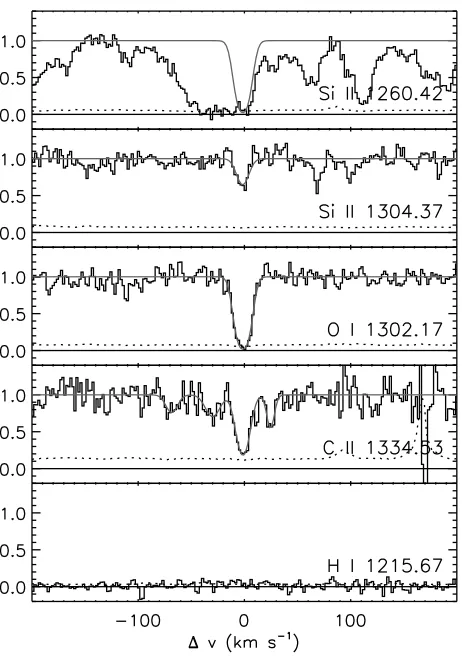
3.2 The z= 5.8408 Oi system in SDSS J1623+3112 . . . 51
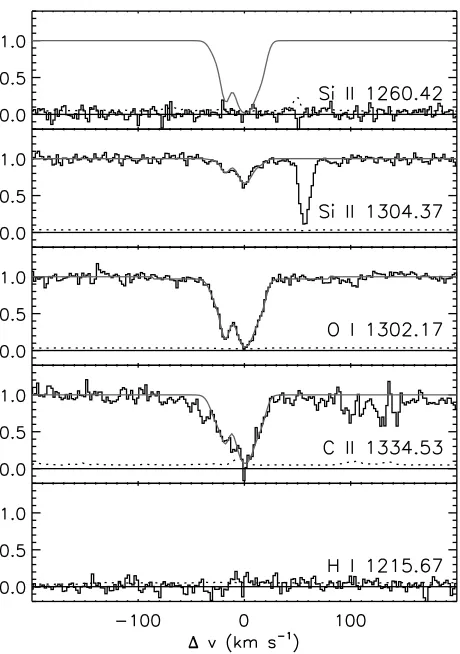
3.3 The z= 6.0097 Oi system in SDSS J1148+5251 . . . 52
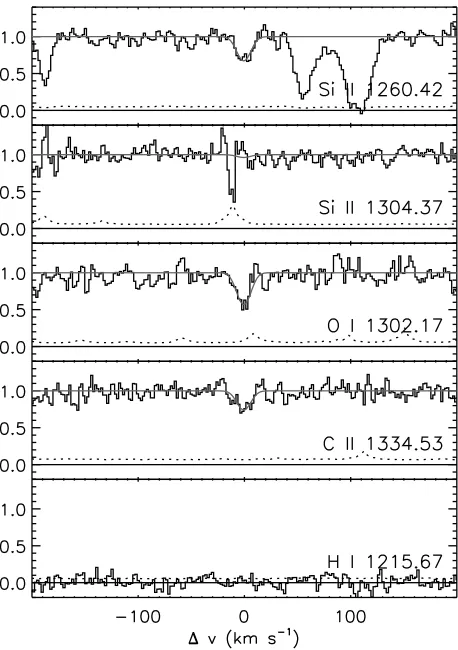
3.4 The z= 6.1293 Oi system in SDSS J1148+5251 . . . 53
3.5 The z= 6.1968 Oi system in SDSS J1148+5251 . . . 54
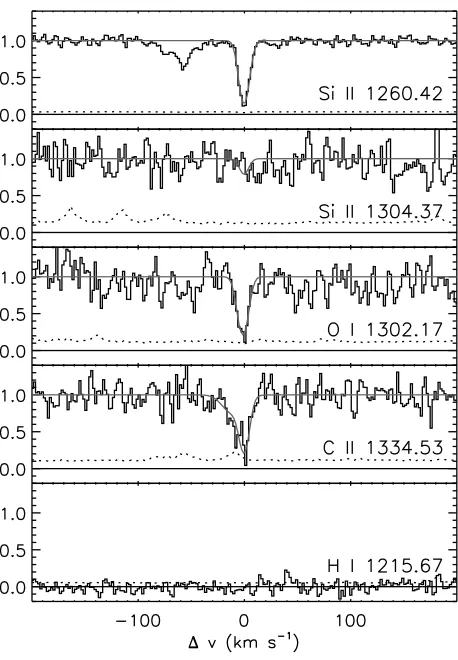
3.6 The z= 6.2555 Oi system in SDSS J1148+5251 . . . 55
3.7 Sensitivity curves for O i detection . . . 58
3.8 Effective O iabsorption pathlength interval . . . 59
3.10 Upper limit on NHI for thez= 5.3364 Oisystems in SDSS J0231−0728 . 66
3.11 Upper limit on NHI for thez= 6.0097 Oisystems in SDSS J1148+5251 . 66
4.1 Fits to the Lyα flux PDFs at 4.254≤ hzi ≤5.614 . . . 85
4.2 Fits to the Lyα flux PDFs at 3.126≤ hzi ≤4.234 . . . 86
4.3 Fits to the Lyα flux PDFs at 2.652≤ hzi ≤3.061 . . . 87
4.4 Fits to the Lyα flux PDFs at 2.374≤ hzi ≤2.643 . . . 88
4.5 Fits to the Lyα flux PDFs at 1.797≤ hzi ≤2.370 . . . 89
4.6 Reduced χ2 values for PDF fits: continuum and zero point fixed . . . . 90
4.7 Reduced χ2 values for PDF fits: continuum and zero point allowed to vary 91 4.8 Continuum adjustments for PDF fits as a function of redshift . . . 93
4.9 Examples of continuum adjustments overlaid on spectra . . . 94
4.10 Lognormalτ distribution parameters . . . 95
4.11 Redshift evolution of theoreticalτ and flux distributions . . . 97
4.12 Evolution of τeffα over 3≤z≤6.2 (linear) . . . 99
4.13 Evolution of τeffα over 1.6≤z≤6.2 (logarithmic) . . . 100
4.14 Evolution of τeffβ over 3≤z≤6.2 (linear) . . . 101
4.15 H iionization rates determined from flux PDFs . . . 103
4.16 Example fits to Lyα flux PDFs using a non-isothermal MHR00 model . . . 106
5.1 NIRSPEC H-band spectra of QSO Mg ii emission lines . . . 128
5.2 Proximity regions in QSO with 1h <RA<3h . . . 131
5.3 Proximity regions in QSO with 3h <RA<8h . . . . 132
5.4 Proximity regions in QSO with 8h <RA<11h. . . 133
5.5 Proximity regions in QSO with 12h <RA<23h . . . . 134
5.6 Theoretical flux PDFs in a QSO proximity region . . . 139
5.7 Proximity region size as a function of QSO luminosity . . . 144
5.8 Median flux in QSO proximity regions . . . 146
List of Tables
2.1 Summary of QSO Pairs Observations . . . 14
2.2 Lyα Forest Cross-Correlation Values . . . 21
2.3 Q1424+2255 Metal Systems . . . 32
2.4 Q1439−0034A Metal Systems . . . 36
2.5 Q1439−0034B Metal Systems . . . 37
3.1 Summary of Observations for Oi Search . . . 44
3.2 Measured Properties of Oi Systems . . . 46
3.2 Measured Properties of Oi Systems . . . 47
3.2 Measured Properties of Oi Systems . . . 48
3.3 Abundance Measurements . . . 63
3.4 Comoving Mass Densities . . . 67
4.1 Fitted Lyα Forest Regions . . . 76
4.1 Fitted Lyα Forest Regions . . . 77
4.1 Fitted Lyα Forest Regions . . . 78
4.2 Best-Fit MHR00 Model Parameters (Isothermal) . . . 108
4.2 Best-Fit MHR00 Model Parameters (Isothermal) . . . 109
4.2 Best-Fit MHR00 Model Parameters (Isothermal) . . . 110
4.2 Best-Fit MHR00 Model Parameters (Isothermal) . . . 111
4.3 Best-Fit Lognormal Parameters . . . 112
4.3 Best-Fit Lognormal Parameters . . . 113
4.3 Best-Fit Lognormal Parameters . . . 114
4.3 Best-Fit Lognormal Parameters . . . 115
4.4 Best-Fit MHR00 Model Parameters (Non-Isothermal) . . . 117
4.4 Best-Fit MHR00 Model Parameters (Non-Isothermal) . . . 118
4.4 Best-Fit MHR00 Model Parameters (Non-Isothermal) . . . 119
5.1 Summary of Proximity Effect Observations . . . 125
5.2 QSO Redshifts . . . 127
5.3 QSO Continuum Properties . . . 135
5.4 UV Background Measurements . . . 141
Chapter 1
Introduction
1.1
Overview
The past two decades have witnessed tremendous advances in the study of the high-redshift intergalactic medium (IGM). Sky surveys have made the detection of quasars out to z∼6 nearly routine. At the same time, numerical simulations of large-scale structure are able to reproduce many of the observed properties of quasar absorption lines, particularly the
complex patter of H i absorption known as the Lyα forest. This concordance between
observations and simulations has secured the “cosmic web”, a self-gravitating network of
filaments, sheets, and voids, as the standard model for the IGM. The scaffolding for the web is provided by dark matter, whose evolution from a set of initial conditions can be
realistically simulated for an assumed set of cosmological parameters, given the limits set by the resolution and size of the simulation box. Baryons will tend to follow the dark
mat-ter, but are further subject to hydrodynamics, ionization, heating, and other complicating factors such as chemical and mechanical feedback from galaxies. Many properties of the
IGM are therefore difficult to determine from first principles and must be constrained ob-servationally. These include the size of absorbing structures, the intensity of the ionizing
radiation field, and the composition and distribution of heavy elements. Perhaps the largest unknowns concern the timing and mechanisms of cosmic reionization. The fact that Lyα
photons reach us from quasars out to z ∼ 6 implies that the hydrogen in the IGM was already ionized by that epoch, but how much further back reionization occurred and what
This work aims to shed light on several aspects of the evolution of the high-redshift IGM using multiple unique observations of quasars at z >4. In Chapter 2 (reprinted from the
Astrophysical Journal, v. 613, p. 61, written with W. Sargent and M. Rauch), we use two
widely spaced pairs ofz∼4 quasars to demonstrate that absorbing structures are correlated out to at least 1 comoving Mpc. Chapters 3 and 4 utilize the first high-resolution spectra of quasars at 4.9 ≤z ≤6.4 to examine the evolution of the Lyα forest and metal lines at these epochs, and to test the plausibility of reionization atz∼6.2. In Chapter 3 (reprinted from the Astrophysical Journal, v. 640, p. 69, written with W. Sargent, M. Rauch, and
R. Simcoe), we conduct a search for Oias a potential tracer of chemically enriched, neutral
gas. In Chapter 4 (submitted to the Astrophysical Journal, written with M. Rauch and
W. Sargent), we test the ability of two models for the distribution of Lyα optical depths to produce the observed transmitted flux distribution. The evolution of the optical depths is
then used to explain the disappearance of transmitted flux atz >6. Finally, in Chapter 5, we employ a large set of quasars with accurate Mg ii redshifts to measure the intensity of
the metagalactic ionizing background at 4.z.5 using the quasar proximity effect.
1.2
Scientific Background
Many of the basic properties of the IGM have been established since the late 1970’s and early
1980’s, when sensitive detectors became available for use on 4-5m telescopes. Sargent et al. (1980) demonstrated that the numerous Lyα absorption lines seen in quasar spectra are
associated with weakly clustered, low density, photoionized parcels of intergalactic gas with temperatures ofT ∼104 K. More recently, high-resolution spectrographs on 8-10m
ground-based telescopes (in particular, HIRES on Keck and UVES on the VLT) have allowed the
z > 2 Lyα forest to be studied with great sensitivity (e.g., Hu et al. 1995). Ultraviolet
spectrographs on board the space-based telescopes have, meanwhile, opened up the IGM down to z = 0 (e.g., Penton et al. 2000). With a long baseline over which to study the
evolution of the Lyα forest, statistics such as the distributions of H icolumn densities, the
distribution of Doppler widths, and the flux power spectrum are now established out to
z∼5.
During the 1980s, Lyα absorbers were primarily thought of as isolated clouds that
simulations capable of following the growth of large-scale structure (e.g., Cen et al. 1993), an interconnected network of dark matter and baryons formed from the gravitational collapse of
density perturbations left over from the Big Bang has become the standard paradigm. The “cosmic web” (Bond & Wadsley 1997) model of the IGM has proven remarkably successful
in reproducing the observed properties of the Lyα forest, such that synthetic spectra from simulations are, in many (though not all) ways, indistinguishable from real data. This
agreement has been one of the great successes in the study of the high-redshift Universe. The gravitational collapse model has been the backdrop for a number of experiments
that use the IGM as a cosmic laboratory. The opacity of the forest can be used to set limits on the baryon density (Rauch et al. 1997). The temperature-density relation of the
IGM can be measured from the distribution of observed line widths (Schaye et al. 2000; McDonald et al. 2001). Correlations in the Lyα forest probe density fluctuations down to
scales of . 1 comoving Mpc. When combined with measurements out to horizon scales from the cosmic microwave background (CMB), these correlations place tight constraints
on the amplitude and slope of the matter power spectrum (e.g., Spergel et al. 2003; Viel et al. 2006). The better we understand the fundamental properties and evolution of the
IGM, the more reliably such tests can be performed.
1.2.1 The Metagalactic Ionizing Background
Most of the evolution of the Lyαforest can be explained by the expansion of the Universe, the gravitational collapse of large-scale structures, and the evolution of the ionizing
back-ground (e.g., Dav´e et al. 1999). Among these factors, the ionizing backback-ground is the most difficult to constrain theoretically, as it depends not only on the rates of star formation
and quasar activity, which are highly non-linear processes, but on the fraction of ultraviolet photons that escape from ionizing sources into the IGM (e.g., Steidel et al. 2001). Much of
the integrated UV output of star-forming galaxies and quasars will come from faint sources, which require deep observations to detect at high redshift (e.g., Hunt et al. 2004; Yan &
Windhorst 2004). Furthermore, in a highly ionized Universe, the mean free path of ionizing photons will be set by the number density of optically thick Lyman limit systems (absorbers
with H i column densities NHI ≥ 1017.2 cm−2). Numerical simulations are generally not
Given these factors, independent estimates of the UV background are valuable both for de-termining the ionization state of the IGM and for constraining models of galaxy and quasar
formation.
In principle, the intensity of the UV background can be determined from the mean level
of transmitted flux in the Lyαforest. In creating artificial quasar spectra from simulations, the background level is typically ‘tuned” such that the optical depths in the simulation
produce transmitted flux levels that match the real data. However, the hydrogen neutral fraction, and hence the Lyα optical depth, also depends on the density and temperature
of the gas. The non-linear relationship between optical depth and transmitted flux further means that the mean transmitted flux will depend on thedistributionof optical depths (e.g.,
Songaila & Cowie 2002). For a given simulation, this will depend not only on the density distribution, which is sensitive to the cosmological parameters, but also on assumptions
about the thermal state of the gas. It is common to assume either a uniform temperature or a simple monotonic relationship between temperature and density. Radiative transfer
effects, however, may complicate the temperature distribution considerably (Bolton et al. 2004).
In order to disentangle the ionization rate from the density and temperature of the gas, independent measurements of the ionizing background must be made. At z ≈ 0 the UV background can be estimated from the truncation of Hidisks in spiral galaxies (e.g., Sunyaev
1969; Dove & Shull 1994). Ratios of metal species with different ionization potentials can be used to constrain the strength and shape of the radiation field, assuming that the
species populations are set by photoionization (e.g., Songaila 1998). However, strong metal absorption systems are typically associated with galaxies. (e.g., Boksenberg et al. 2003).
Their ionization state may therefore depend more on the local ionizing output of the galaxy than on a truly metagalactic background.
The quasar proximity effect offers an alternate means of measuring the ionizing back-ground using the Lyα forest. The amount of absorption in the forest generally increases
with redshift. However, near a quasar, the absorption tends to decrease. This is generally attributed to locally enhanced photoionization by the quasar itself. Knowing the
Bajtlik et al. 1988). The most successful applications of the proximity effect have been
at z < 4, where individual Lyα lines can be easily identified and large samples of quasar
spectra can be used to overcome the variance in the forest (e.g., Scott et al. 2000, 2002). At higher redshifts the measurements have been more sparse. In addition, previous studies
have not demonstrated that the extent of the proximity region depends correctly on the luminosity of the quasar, and hence that the values obtained for the UV background are
accurate. Proximity effect measurements would be particularly valuable atz >4, where the ionizing output of galaxies and quasars becomes increasingly difficult to measure directly.
A consensus between galaxy/quasar counts, the mean transmitted flux in the Lyα forest, and the proximity effect would imply a genuine understanding of the ionization state of the
high-redshift IGM.
1.2.2 Reionization
As pointed out by Gunn & Peterson (1965), Scheuer (1965), and Shklovskii (1965), an expanding Universe filled with neutral hydrogen would produce a tremendous Lyα optical
depth (τLyα ∼105). The fact that we observe transmitted flux in the Lyα forest, therefore,
implies that the IGM must now be highly ionized. Following recombination at z ≈ 1100, when the Universe transitioned from being predominantly ionized to being predominantly neutral, the IGM would have remained opaque to UV photons until enough luminous sources
were formed that were able to reionize the vast majority of the hydrogen (and later helium). Determining when and how reionization occurred is one of the primary challenges of modern
cosmology, with implications both for the nature of the first luminous sources and for the subsequent growth of small-scale structure.
Observations of the cosmic microwave background (CMB) provide an upper limit on the redshift of reionization. Thomson scattering by free electrons produces linear polarization
in the CMB, which can be used to infer the total electron optical depth to the surface of last scattering. A higher τe would mean that CMB photons had encountered greater
numbers of free electrons, which would require an earlier reionization. The most recent CMB measurements indicate that τe ∼0.09 (Spergel et al. 2006). If reionization occurred
all at once, than this would imply a reionization redshift of zreion∼11. A more prolonged
High-redshift quasar can be used as a second probe of reionization. In the past seven years, the Sloan Digital Sky Survey has uncovered significant numbers of quasars out to
z= 6.4 (Fan et al. 2006b, and references therein). The absence of complete Lyαabsorption (so-called “Gunn-Peterson troughs”) at z <6 implies that the Universe was already highly
ionized one billion years after the Big Bang. However, the discovery of extended absorption troughs in the spectra of the highest-redshift objects has led to claims that reionization
may have ended as late asz∼6 (Djorgovski et al. 2001; Becker et al. 2001; Fan et al. 2002, 2006a). As noted above, a trace amount of neutral hydrogen is sufficient to produce a large
Lyα optical depth. Therefore, the rapid evolution of transmitted flux at z > 5.7, rather than the mere appearance of Gunn-Peterson troughs, has been the primary evidence for
reionization lasting until z∼6 (e.g., Fan et al. 2006a).
Late reionization remains strongly debated, however. Perhaps the best evidence against
a significantly neutral IGM at z ∼ 6 is the transmitted Lyα, Lyβ, and Lyγ flux seen towards the highest-redshift known quasar, SDSS J1148+5251 (z= 6.42) (Oh & Furlanetto
2005; White et al. 2005). In addition, no large change is seen in the luminosity function or emission line profiles of Lyα-emitting galaxies between z ∼5.7 and z ∼6.5 that would suggest absorption by a highly-neutral IGM atz >6 (e.g., Malhotra & Rhoads 2004; Hu & Cowie 2006). Theoretically, late reionization remains a flexible issue. A combination of the
clustering of ionizing sources, the uneven growth of ionized bubbles, and the inhomogeneity of the IGM can be invoked to accommodate nearly all of the current observations, either in support of or against late reionization (e.g., Wyithe & Loeb 2004a; Lidz et al. 2006b;
Furlanetto et al. 2006). New types of observations are therefore needed to clarify whether dramatic changes in the IGM are occuring atz∼6.
1.3
Thesis Outline
To address these issues, we have obtained a variety of unique moderate- and high-resolution
spectra of quasars at z & 4. In Chapter 2, we examine ESI spectra of two sets of quasar pairs at z ∼ 4 with angular separation ∆θ ≈ 30′′. We demonstrate that the transmitted flux is significantly correlated between paired sightlines, which implies that filaments in the IGM are coherent on scales of > 1 comoving Mpc. We further investigate the effects
cross-correlation functions, a measurement that can be used to determine the cosmological constant. We conclude that spectral resolution must be carefully accounted for when making
this comparison.
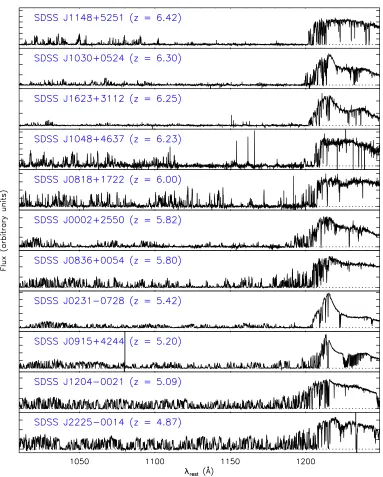
Much of this work utilizes a new set of HIRES spectra of 11 quasars at 4.9 ≤z ≤6.4 (Figure 1.1). These are the first high-resolution spectra of any quasars atz >4.8, giving us an unprecedented view of the Lyαforest and metal absorption lines at these redshifts. The
observations were made possible due largely to the recently upgraded detector on HIRES. Even so, many of these objects are at the sensitivity limits of current instruments, and the
total sample represents over 100 hours of integration.
In Chapter 3, we use the HIRES high-z sample to search for Oi absorption as a probe
of neutral gas at z > 5. We uncover six systems, four of which lie towards our highest-redshift objects, SDSS J1148+5251 (z= 6.42). We demonstrate that this is a statistically
significant excess, but that it is unlikely to indicate a highly-neutral IGM since this sightline also shows Lyα and Lyβ transmission over the same redshift interval as the O i. We use
the lack of Oi detected towards SDSS J1030+0524 (z= 6.30) to argue that that sightline
must be highly ionized, despite the presence of an extended Gunn-Peterson trough, or else
chemically pristine. We further show that the relative metal abundances in the six O i
systems are consistent with enrichment from Type II supernovae, rather than hypothetical
supermassive stars.
In Chapter 4, we combine our high-z sample with HIRES data for a large number of quasars at 2.0 ≤ z ≤ 4.7 to study the evolution of Lyα optical depth from z ∼ 2 to the proposed epoch of reionization. We compare the observed flux probability distribution function (PDF) to predictions from an IGM model that has been used to infer a drop in
the Hi ionization rate atz∼6. We find that the agreement is generally poor unless large
corrections to the quasar continua are made. In constant, we show that a simple lognormal
optical depth distribution provides a good fit to the observed flux PDF at all redshifts. We further show that a steady evolution in the lognormal τ distribution reproduces the
evolution in the mean transmitted flux over 1.6< z < 6.2. We use this fact to argue that if the evolution of transmitted flux at z <5 reflects slowly-varying conditions in the IGM,
Figure 1.1 The HIRES high-zsample. Spectra are plotted as a function of rest wavelength.
In Chapter 5, we use the quasar proximity effect to measure the UV background at 4.z.5. These are the first proximity effect measurements atz >4 using a large number of quasars. We measure accurate systemic redshifts using infrared spectra of Mgiiemission
lines. In order to deal with line blending in the Lyα forest at z > 4, we present a new
method for determining the size of a quasar’s proximity region based on the distribution of transmitted fluxes near the quasar redshift. We also test the photoionization model
of the proximity effect by comparing the proximity regions sizes of quasars with different luminosities. We find that proximity region size has roughly the correct dependence on
quasar luminosity, but with a large scatter. We further show that our value for the H i
ionization rate is consistent with no evolution in the UV background over 2. z. 5, and that proximity effect measurements at high redshift are consistent with the opacity of the Lyα forest and the combined ionizing output of star forming galaxies and quasars.
Chapter 2
Large-Scale Correlations in the Ly
α
Forest at
z
= 3
−
4
1Abstract
We present a study of the spatial coherence of the intergalactic medium toward two pairs of
high-redshift quasars with moderate angular separations observed with Keck/ESI, Q1422 +2309A & Q1424+2255 (zem ≈3.63, ∆θ= 39′′) and Q1439−0034A & B (zem ≈4.25, ∆θ
= 33′′). The cross-correlation of transmitted flux in the Lyα forest shows a 5−7σ peak at zero velocity lag for both pairs. This strongly suggests that at least some of the absorbing
structures span the 230−300h−701 proper kpc transverse separation between sightlines. We also statistically examine the similarity between paired spectra as a function of transmitted
flux, a measure which may be useful for comparison with numerical simulations. In investi-gating the dependence of the correlation functions on spectral characteristics, we find that
photon noise has little effect for S/N & 10 per resolution element. However, the agree-ment between the autocorrelation along the line sight and the cross-correlation between sightlines, a potential test of cosmological geometry, depends significantly on instrumental
resolution. Finally, we present an inventory of metal lines. These include a a pair of strong Civsystems atz≈3.4 appearing only toward Q1439B, and a Mgii+ Feiisystem present
toward Q1439 A and B atz≈1.68.
1Originally published in The Astrophysical Journal, v. 613, p. 61; written with W. L. W. Sargent and
2.1
Introduction
Multiply-imaged lensed quasars and close quasar pairs provide valuable probes of structure in the intergalactic medium. By comparing the absorption patterns in the spectra of ad-jacent quasar images one can gauge the similarity in the underlying matter distributions
along the lines of sight and hence constrain the sizes of absorbing structures. Previous studies at small separations (∆θ.10′′) have typically provided lower limits to the scale of Lyα absorbers over a wide range in redshift, with weak upper constraints of∼400 comov-ing kpc derived by assumcomov-ing spherical clouds (Weymann & Foltz 1983; Foltz et al. 1984;
McGill 1990; Smette et al. 1992; Dinshaw et al. 1994; Bechtold et al. 1994; Bechtold & Yee 1995; Smette et al. 1995; Fang et al. 1996). Observations of pairs at wider separations
(∆θ ≈ 0.5′ −3′) have shown evidence that some Lyα absorbers span & 1 comoving Mpc (Petitjean et al. 1998; Crotts & Fang 1998; D’Odorico et al. 1998, 2002; Young et al. 2001;
Aracil et al. 2002) and possibly up to 30 comoving Mpc (Williger et al. 2000).
The majority of studies on lensed quasars and quasar pairs have relied on matching
individual absorption lines between spectra. High-resolution spectra (FWHM.20 km s−1) are required to completely resolve these features, however. In addition, the crowding of lines
in the high-redshift Lyα forest often prevents the identification of single absorbers. Liske et al. (2000) instead used transmitted flux statistics as a function of smoothing length to
identify significantly underdense or overdense regions. Their analysis of paired sightlines at z∼2−3 suggests that absorbing structures may span&3 comoving Mpc. An alternate ap-proach reflecting the continuity of the underlying density field is to compute the correlation of transmitted flux along parallel lines of sight. This robust statistic is quickly computed
and can be easily compared to numerical simulations of large-scale structure (e.g., Viel et al. 2002).
As an extension to studying the matter distribution, correlations in the Lyαforest have been proposed as a tool for constraining the cosmological constant through a variant of
the Alcock-Paczy´nski test (Alcock & Paczynski 1979). The Alcock-Paczy´nski test takes advantage of the fact that, for a homogeneous sample of objects, the characteristic radial
and transverse sizes should be equal. In the case of the Lyα forest, one can compare the correlation length of absorbing structures along the line of sight to the correlation length
sight is simply given by their redshifts,
∆vk = ∆z
1 +zc . (2.1)
In contrast, the transverse velocity separation, ∆v⊥, between objects at redshift z with
angular separation ∆θdepends on the cosmological parameters implicit in the Hubble con-stant,H(z), and angular diameter distance,DA(z), as
∆v⊥=H(z)∆l=H(z)DA(z)∆θ , (2.2)
where ∆lis the proper linear separation. One approach to exploiting the difference between
∆vkand ∆v⊥is to directly compare the autocorrelation of transmitted flux along single lines of sight to the cross-correlation between spectra of sources at a variety of angular separations
(Hui et al. 1999; Lidz et al. 2003). An alternate method compares observed cross-correlations to those determined from linear theory (McDonald & Miralda-Escud´e 1999) or from artificial
spectra drawn from numerical simulations (Lin & Norman 2002). Recently, Rollinde et al. (2003) found agreement between the cross-correlations and autocorrelations among spectra
of severalz ∼2 quasar pairs over a wide range in separation (although see the discussion on spectral resolution below). In the future, large surveys such as the Sloan Digital Sky
Survey (York et al. 2000) should greatly increase the number of quasar pairs available for such studies.
We present results for two pairs of quasars at a novel combination of high redshift and moderate separation. The closely separated A and C images (∆θ = 1.′′3) of the bright
z = 3.63 lensed system Q1422+2309 (Patnaik et al. 1992) have been previously exam-ined by Rauch et al. (1999, 2001a) and Rauch et al. (2001b). Adelberger et al. (2003)
recently discovered an additional faint source, Q1424+2255 (z = 3.62) (therein referred to as Q1422b), at a separation ∆θ= 38.′′5 from the lensed system. In this study, we compare
the sightlines toward Q1422+2309A (herein referred to as Q1422) and Q1424+2255 (herein referred to as Q1424 to avoid confusion with the B image of Q1422). We additionally
us to study the transverse properties of the Lyα forest and intervening metal systems over a large pathlength. Our results should provide a valuable resource for comparison with
numerical simulations of large-scale structure.
The remainder of the paper is organized as follows: In§2.2 we present our observations together with a general overview of the data. We compute the flux correlation functions in the Lyαforest in§2.3 and statistically examine the similarity between sightlines as a function of flux. In §2.4 we analyze the effects of photon noise and instrumental resolution on the correlation functions. Finally, we present an inventory of unpublished metal absorption
systems presented in§2.5. Our results are summarized in §2.6.
Throughout this paper we adopt Ωm= 0.3, ΩΛ= 0.7, andH0 = 70 km s−1 Mpc−1.
2.2
The Data
Our observations are summarized in Table 2.1. We observed all four quasars under good to excellent seeing conditions over the period 2000 March to 2002 June using the Keck
Echel-lette Spectrograph and Imager (ESI) (Sheinis et al. 2002) in echelEchel-lette mode. Additional observations of Q1424 were provided by C. Steidel while additional observations of Q1439A
were provided by L. Hillenbrand. All exposures were taken at the parallactic angle except for one exposure of Q1439B at an airmass near 1.0, where chromatic atmospheric dispersion
is only a minor concern.
The raw CCD frames for Q1422, Q1439A, and Q1439B were processed and the 2-D
echelle spectra extracted using the MAKEE software package. Reduction of Q1424 data was performed using a suite of IRAF scripts, as described in Adelberger et al. (2003). For each
night we used the extracted orders from at least one standard star (Feige 34, BD+284211, and/or HZ 44) to determine an instrumental response function with which to derive relative
flux calibrations. The calibrated orders of all exposures from all nights were then converted to vacuum heliocentric wavelengths and combined to produce a single continuous spectrum
per object (Figures 2.1 and 2.2). We use a binned pixel size of 20 km s−1. Normalized spectra were produced by fitting continua to the final reduced versions.
The majority of observations were made using a 0.′′75 slit. However, inspection of the spectra extracted from exposures taken with different slits widths revealed very little
Table 2.1. Summary of QSO Pairs Observations
Object Datea Exp. time FWHMb
(s) (km s−1)
Keck/ESI
Q1422+2309A 2000 Mar 03-04 1200c ∼55
Q1424+2255 2000 Mar 03 – 2001 Apr 21 44900d ∼55
Q1439−0034A 2001 Jan 26 – 2002 Jun 10 8000e ∼55
Q1439−0034B 2001 Apr 19 – 2002 Jun 10 42400f ∼55
Keck/HIRES
Q1422+2309A 1998 Jan 30 – 1998 Apr 15 31600g 4.4
aInterval over which observations were made. bSpectral resolution.
c600 s with 0.′′75 slit, 600 s with 1.′′0 slit.
d43100 s with 0.′′75 slit (including 20900 s by C. Steidel), 1800 s with
1.′′0 slit.
e5000 s with 0.′′75 slit, 3000 s with 0.′′5 slit (L. Hillenbrand).
f0.′′75 slit.
Figure 2.1 Keck/ESI spectra covering the rest wavelength region from Lyβ to Civin Q1422
(top) and Q1424 (bottom). Spectra have been binned in wavelength using 40 km s−1 pixels for display. Contamination from the [O i] λ5577 skyline can be seen in the spectrum of
[image:29.612.129.521.455.675.2]Q1424.
a measured spectral resolution FWHM = 55 km s−1. The final ESI spectra for Q1424, Q1439A, and Q1439B have typicalS/N ≈13−30 per resolution element in the Lyα forest, while Q1422 has S/N ≈150.
We restrict our analysis of the Lyα forest to the the wavelength region between each
quasar’s Lyα and O vi emission lines. To avoid a proximity effect from the quasar, we
include only those pixels at least 10,000 km s−1 blueward of the quasar’s Lyαemission. We
further include only pixels at least 1,000 km s−1 redward of Lyβ and Oviemission to avoid
any confusion with the Lyβ forest or intrinsic O vi absorption. For Q1422 and Q1424 this
yields a redshift interval ∆z = 0.50 with mean redshift hzi = 3.22. For Q1439 A and B, ∆z= 0.58 and hzi= 3.79. Due to the high redshift of Q1439 A and B, the Lyα forest in the spectra of these sources extends over the strong night sky lines [O i] λ5577 and Na i
λ5890,5896. In our analysis, we exclude the narrow (2−3 ˚A) regions around these lines.
A visual comparison of the Lyα forest in the paired spectra suggests that the most striking similarity occurs among the strongest absorption features (see Figures 2.3 and
2.4). These regions often appear to be similar along adjacent lines of sight, as do regions where the absorption is nearly zero (possible “voids” relatively free of absorbing material).
Matches among intermediate strength features are less obvious, which suggests that the structures giving rise to those lines may not be as coherent over the separation between
sightlines. Many strong lines and regions of nearly zero absorption that do not coincide between spectra, however, can also be identified. The alignment of a subset of features may occur purely by chance.
Our spectral coverage also allows us to investigate the extent to which metal systems span parallel lines of sight. Two strong C iv systems appear toward Q1439B at z ≈ 3.4,
separated by 1700 km s−1. Each system has a large rest equivalent width,Wrest(1548)∼1.5
˚
A. No Civappears at this redshift toward Q1439A, however. In contrast, a low-ionization
system containing Mgii and Feii does appear along both sightlines atz≈1.68, separated
by only ∼ 400 km s−1. A single, extended absorber responsible for the low-ionization
features would have a linear size&280h−701 proper kpc. These lines may alternatively arise from the chance intersection of separate, clustered absorbers. Weaker C ivsystems appear
Figure 2.3 A representative section of the Lyα forest in the normalized spectra of Q1422 (grey line) and Q1424 (black line).
systems in the appendix.
In order to assess the effect of spectral characteristics on our Lyα forest results, we
additionally employed a deep, high-resolution spectrum of Q1422+2309A. Observations were made with the Keck High Resolution Echelle Spectrometer (HIRES) (Vogt et al. 1994)
using a 0.′′574 slit. This yields a spectral resolution FWHM = 4.4 km s−1. Reductions were performed as described Rauch et al. (2001a). In addition to the data from that work,
which used the red cross-disperser only, we include subsequent exposures taken with the UV-blazed cross-disperser installed to provide additional coverage of the Lyα forest. The
final spectrum was binned to give a constant velocity width for each pixel of 2.1 km s−1, with a typical S/N per resolution element of 50−90.
2.3
Comparison of Sightlines
2.3.1 Correlation Functions
The correlation of transmitted flux in the spectra of closely separated quasars provides a simple means of quantifying the degree of similarity in the matter distribution along
adjacent sightlines. We define the un-normalized correlation,ξ, of the spectra of two sources separated on the sky by an angle ∆θas
ξ(∆θ,∆vk) = 1
N
X h
F(∆θ, vk+ ∆vk)−F¯(∆θ)i hF(0, vk)−F¯(0)i, (2.3)
whereF is the continuum-normalized flux, ¯F(∆θ) and ¯F(0) are the mean fluxes along the two sightlines, vk is the line-of-sight velocity, ∆vk is the longitudinal velocity lag, and N
is the total number of pixels in each spectrum within the region of interest. The sum is performed over all available pixels at a given velocity lag, of which there will be
npix(∆vk) =N −
∆vk δvpix
(2.4)
for a pixel sizeδvpix. The normalized correlation value can be computed by dividing
equa-tion (2.3) by the standard deviaequa-tion in each input spectrum.
We have chosen a pixel size for the combined spectra to give roughly 3 pixels/resolution
the correlation will be insensitive to pixel size so long as the spectrum is well sampled. The increase in the sum created by using a larger number of smaller pixels will be offset by the
increase in N so long as there are &2 pixels/resolution element. Using pixels larger than the spectral resolution will introduce smoothing effects (see§2.4).
In order to assess the coherence of absorbing structures across adjacent sightlines, we compute the cross-correlation of transmitted flux in the Lyα forest in the spectra of our
quasar pairs. As a reference, we also determine the autocorrelation, ξ(0,∆vk), along lines of sight toward individual objects. At these high redshifts, HiLyα absorption will strongly
dominate over contaminating absorption from lower-redshift metals such as Civand Mgii.
The correlation functions should therefore accurately reflect the distribution of neutral
hy-drogen to within the present measurement errors. All correlations are computed in single-pixel steps, which are 20 km s−1 for the ESI data. Figure 2.5 displays the autocorrelation
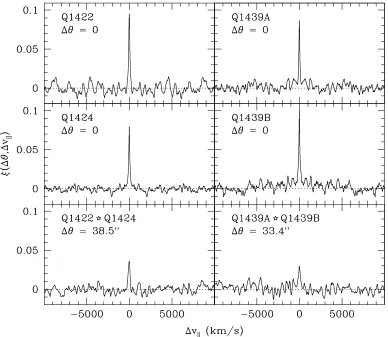
function for each quasar along with the cross-correlation functions between adjacent sight-lines. Both in the case of Q1422/Q1424 and Q1439A/B, a clear peak in the cross-correlation
at zero lag indicates a genuine similarity between sightlines.
Undulations in the correlation functions arising from the chance superposition of
unre-lated lines constitute the dominant source of uncertainty in the peak values (see discussion on photon noise below). Pixel-to-pixel variations in the correlations are themselves clearly
correlated. We find, however, that the overall distributions of values away from the central peaks are very nearly Gaussian. We therefore take the standard deviation of pixels in the “noise” region, which we define to be where 2000 km s−1 ≤ |∆v
k| ≤ 18000 km s−1, as the 1σ error in a correlation peak value. In this region we expect no underlying signal, however the correlation is still computed from at least half of the available pixels. Since the
sum in equation (2.3) is computed over fewer pixels as the velocity lag increases, yet the factor 1/N remains constant, the amplitude of the noise features will tend to diminish as
q
npix(∆vk), wherenpix(∆vk) is the number of pixels included in the sum in equation (2.3) at lag ∆vk. Therefore, in order to match the amplitude of the noise at ∆vk = 0, we
multi-ply the correlation at each lag by a scale factorsbefore computing the standard deviation, where
s=
s
npix(0)
npix(∆vk) =
s
N
N−∆vk/δvpix
. (2.5)
Figure 2.5 Flux correlation functions computed from the Lyαforest plotted vs. longitudinal velocity lag. Top four panels: Autocorrelation functions for Q1422 (top left), Q1424 (middle
left), Q1439A (top right), and Q1439B (middle right). Negative velocity lags have been
included for consistency. Bottom panels: Cross-Correlation functions for Q1422/Q1424
Table 2.2. Lyα Forest Cross-Correlation Values
QSO Pair ∆θa z Lyα
b ∆lc ∆v
⊥d ξ(∆θ,0)
h−701 proper kpc km s−1 Un-normalizede Normalizedf
Q1422/Q1424 38.′′5 2.965−3.466 283−298 97.8 0.0358±0.0049 0.412±0.057
Q1439A/B 33.′′4 3.496−4.075 230−245 96.3 0.0296±0.0057 0.319±0.062
aAngular separation of the QSO pair.
bRedshift interval used in computing the correlation values for the Lyαforest.
cLinear separation between the lines of sight for the given redshift interval, computed for Ω
m = 0.3,
ΩΛ= 0.7, andH0= 70 km s−1Mpc−1.
dTransverse velocity separation between the lines of sight for our adopted cosmology at the mean redshift
in the given interval.
eCross-Correlation at zero lag computed from equation (2.3).
fCross-Correlation at zero lag computed from equation (2.3) divided by the standard deviation of the Lyα
forest flux in each input spectrum.
where at least half of the ∼1800 Lyα pixels in each spectrum overlap limits sto at most
√
2. For the range in velocity lag shown in Figure 2.5,s <1.2.
Our results for the cross-correlations are summarized in Table 2.2. Using the above estimate for the error, the peak in the cross-correlation for Q1422/Q1424 (Q1439A/B) is
significant at the 7σ(5σ) level. This strongly suggests coherence in the absorbing structures on the scale of the 230−300 h−701 proper kpc transverse separation between sightlines. The marginal consistency of the peak values with one another likely reflects the similarity in sightline separation and redshift for the two quasar pairs. The zero-lag values of the
autocorrelations, which give the variance in the flux for these sections of the Lyα forest, are 0.0950 for Q1422, 0.0796 for Q1424, 0.0862 for Q1439A, and 0.1000 for Q1439B. Thus,
the normalized cross-correlation peaks are 41.2±5.7% for Q1422/Q1424 and 31.9±6.2% for Q1439A/B.
2.3.2 Flux Distributions
The flux cross-correlations demonstrate that at least some Lyα absorbers span the separa-tion between our paired lines of sight. It does not, however, indicate whether the similarity
Lyα forest at z∼4, together with the present spectral resolution, greatly inhibits a study of individual lines. We are, however, able to look at the agreement between absorption
features on a pixel-by-pixel basis.
Our goal is to determine whether the similarity in flux between paired spectra depends
on the amount of absorption for an individual pixel. First, we first select those Lyα forest pixels in one spectrum (Q1422 or Q1439A) whose flux falls within a specified range. We
then identify the pixels in the companion spectrum with matching wavelengths and compute their flux distribution. Comparing the distribution in this subsample to that in all Lyα
forest pixels in the companion spectrum allows us to evaluate whether there exists an overabundance of pixels in the specified flux range relative to that expected on random
chance.
The results for Q1422/Q1424 and Q1439A/B are shown in Figures 2.6 and 2.7,
respec-tively. Each panel shows the normalized distribution of Q1424 or Q1439B pixels in the indi-cated subsample along with the distribution of all Lyα forest pixels in that spectrum. The
range of flux in Q1422 or Q1439A for each subsample is chosen to be significantly larger than the typical flux uncertainty. In each case, we compute the two-sided Kolmogorov-Smirnov
statistic, which is the maximum difference between the cumulative fractions of pixels in the subsample and of all pixels in the forest, along with the associated likelihood of randomly
obtaining a smaller statistic than the one observed. The number of pixels in each subsample is also shown.
The clearest results occur at extreme levels of absorption. Pixels in Q1422 (Q1439A)
either near saturation,F <0.2, or near the continuum,F >0.8, tend to strongly coincide with pixels of similar flux in Q1424 (Q1439B). Intermediate flux pixels appear to be less
strictly matched, with the exception of pixels in Q1422 with 0.4 < F < 0.6. For certain subsamples, namely 0.6< F <0.8 in Q1422 and 0.4< F <0.6 in Q1439A, the distribution
of fluxes in the companion spectrum is consistent with a random selection. This seems to confirm the visual appraisal that strong absorbers and regions relatively free of absorbing
material tend to span adjacent lines of sight more readily than do absorbers of intermediate strength.
Figure 2.6 Distributions of continuum-normalized pixel fluxes in the Lyαregion of Q1424 as a function of the flux in Q1422. Unshaded histograms show the flux probability distribution
for the subsample of pixels in Q1424 corresponding in wavelength to those pixels in Q1422 that have fluxes in the indicated range. Shaded histograms show the probability distribution
for all Q1424 pixels in the Lyα region. For each range of flux in Q1422, the two-sided Kolmogorov-Smirnov statistic for the subsample and full sample of Q1424 flux values is
presented along with the associated likelihood, expressed as a percent, of obtaining a higher value if the the two samples were drawn from the same distribution. The number of pixels
create clusters of pixels with low absorption near the same wavelength in pairs of spectra. Similarly, errors in sky-subtraction that are repeated between spectra might create false
coincidences of pixels near zero flux. Multiple independent continuum fits resulted in typ-ical differences of ∼ 10% in flux on scales of ∼ 100 ˚A. We likewise find no evidence for large systematic errors in the sky subtraction. Given that the resulting uncertainties are significantly smaller than the range in flux used to define a subsample in Figures 2.6 & 2.7,
these effects should only be a minor concern.
We stress that comparing transmitted fluxes does not strictly yield a clear physical
interpretation. Pixels of intermediate flux commonly occur along the wings of strong fea-tures. They will therefore tend to cluster less readily than pixels near the continuum or
near saturation, especially if the strong lines shift in velocity between spectra. Moreover, agreement in flux does not necessarily indicate agreement in optical depth. Since
trans-mitted flux decreases exponentially with optical depth, τ, the difference in flux for a given fractional change inτ will depend on the value ofτ itself. For a small characteristic change
between sightlines, ∆τ /τ ≪ 1, the greatest scatter in flux is expected for τ ∼ 1, with the scatter decreasing as τ → 0 or as τ → ∞. It is, therefore, unclear whether the enhanced agreement in flux among pixels with flux near the continuum or near saturation indicates that the corresponding gas is more homogeneous on these scales than the gas giving rise to
intermediate absorption features. More specific insights may be drawn by comparing our measured flux distributions to those derived from numerical simulations.
2.4
Effects of Photon Noise and Instrumental Resolution
Comparing the longitudinal and transverse flux correlation functions (or power spectra, equivalently) in the Lyα forest has been been explored by several authors as a means
of measuring the cosmological geometry via the Alcock-Paczy´nski test. This application primarily requires a sample of sightlines large enough to overcome cosmic variance. Some
question remains, however, regarding the dependence of the correlation functions on data characteristics such as signal-to-noise ratio and resolution. It is particularly important to
know to what extent the autocorrelation measures the physical correlation length along the line of sight rather than the instrumental resolution. For additional discussion on the effects
In the preceding analysis we assumed that the chance alignment of unrelated absorption features dominated over photon noise in producing uncertainty in the flux correlations.
To justify this, we recomputed the autocorrelation for the ESI spectrum of Q1422 after adding increasing levels of Gaussian random noise. The results appear nearly identical
for S/N & 10 per resolution element (Figure 2.8). A spike at ∆vk = 0 appears in the autocorrelation function as the S/N decreases because the variance in the noise becomes
comparable to the intrinsic variance in the absorption features. No such jump is expected to occur, however, in the cross-correlation since the photon noise in the two spectra should
be uncorrelated. Large sets of moderate S/N spectra may therefore be more useful than smaller sets of highS/N for this type of work.
To address the effects of spectral resolution on the autocorrelation we have synthesized moderate- and low-resolution spectra from a high-quality Keck HIRES spectrum of Q1422
(resolution FWHM = 4.4 km s−1). In each test case we first tune the spectral resolution by convolving the HIRES data with a Gaussian kernel and then compute the resulting
auto-correlation function. The results for spectra with resolution FWHM = 4.4 (unsmoothed), 15, 55, and 200 km s−1 are plotted in Figure 2.9. Very little difference exists between the autocorrelation functions computed from the unsmoothed HIRES data and from the data smoothed to FWHM = 15 km s−1. Thus, we may conclude that the correlation in the unsmoothed HIRES data is an accurate measure of the intrinsic correlation in the Lyα for-est (subject to cosmic variance and redshift-space distortions). The Lyα lines are already smoothed by their thermal width and easily resolved with HIRES. However, when the
spec-trum is degraded to FWHM = 55 km s−1, similar to ESI data, the autocorrelation is clearly broadened and diminished in amplitude. (We note that the autocorrelation measured from
this “synthetic” ESI spectrum is nearly identical to that computed from the real ESI data.) At even lower resolution, comparable to Keck/LRIS or VLT/FORS2, the spectral resolution
dominates over the intrinsic correlation length.
As the spectral resolution decreases, the peak of the autocorrelation also incorporates
more of the outlying noise (random undulations in the correlation function at ∆v ≫ 0). At large velocity lags (∆vk ≫ 200 km s−1), disagreement between the high-resolution and
Figure 2.8 The effects of photon noise on the shape of the autocorrelation function. The solid line shows the autocorrelation computed from our original ESI spectrum of Q1422
(FWHM = 55 km s−1, S/N = 150 per resolution element). Additional lines show the autocorrelation recomputed after adding random Gaussian noise to the original spectrum
such that the resulting S/N per resolution element is 20 (dash-dotted line), 10 (dashed line), and 5 (dotted line). Autocorrelation functions were computed in longitudinal velocity
Figure 2.9 The effects of spectral resolution on the shape of the autocorrelation function. The solid line shows the autocorrelation computed from our original HIRES spectrum of
A more subtle issue is how spectral resolution affects the agreement between autocor-relation and cross-corautocor-relation functions. To address this, we degraded the resolution of our
ESI data to mimic observations using a lower resolution instrument (FWHM = 200 km s−1) and then recomputed the correlations. Figure 2.10 contrasts the results from the original
spectra with those from the smoothed versions. In each case we plot the autocorrelation functions computed from single sightlines and overplot the peak of the corresponding
cross-correlation at a velocity lag equal to the transverse velocity separation between the lines of sight (∆v⊥= 98 km s−1 for Q1422/Q1424, ∆v⊥= 96 km s−1 for Q1439A/B for the case of Ωm= 0.3, ΩΛ= 0.7, and H0 = 70 km s−1 Mpc−1).
The differences shown in Figure 2.10 between the ESI and low-resolution cases suggest
a significant dependence on spectral resolution. At ESI resolution the concordance between auto- and cross-correlations appears to be very good for both pairs of sightlines. At low
res-olution, however, the peaks of the cross-correlation functions fall well below the values of the autocorrelation functions at the same total velocity separation. While part of this effect may
be due to noise in the correlations, the general dependence on resolution can be understood in regions where the intrinsic correlation function is non-linear on scales smaller than the
width of the smoothing kernel. (This includes the region around the peak at zero lag, since the correlation is expected to be symmetric about ∆vk = 0.) Convolving the input spectra
with a smoothing kernel produces a correlation function that has been convolved twice with the same kernel, once for each spectrum. The resulting un-normalized autocorrelation func-tion may therefore be higher or lower at a particular velocity lag, depending on the shape
of the correlation function at that point. Since the peak of the cross-correlation function is already a maximum, however, it can only decrease as a result of smoothing (apart from the
effects of noise). Thus, if we adjust our cosmology such that, at high spectral resolution, the composite cross-correlation function built up from pairs at many different separations
agrees with the mean autocorrelation function (ignoring redshift-space distortions), this agreement may not hold with low-resolution data. Spectral resolution must therefore be
Figure 2.10 The relative effects of spectral resolution on auto- and cross-correlations. Top
panels: Autocorrelation functions computed from the Lyα regions in the indicated
un-smoothed ESI spectra (FWHM = 55 km s−1) (solid and dotted lines) overlaid with the peak value of the cross-correlation computed between those spectra (filled circles). The peak of
the cross-correlation is plotted at a velocity lag equal to the transverse separation between the two lines of sight for the case of Ωm = 0.3, ΩΛ = 0.7, and H0 = 70 km s−1 Mpc−1.
Bottom panels: Same as the top panels, here after smoothing the ESI spectra to a resolution
2.5
Metal Systems
Previous studies using quasar pairs and multiply-imaged lensed quasars have demonstrated spatial coherence in metal systems over a variety of length scales. Differences between metal systems in narrowly-separated lines of sight suggest that the absorbers giving rise
to individual lines seen in high-resolution spectra span at most a few kiloparsecs, both for high-ionization systems seen in C iv and for low-ionization systems seen in Mg ii(Lopez
et al. 1999; Petitjean et al. 2000; Rauch et al. 2001a, 2002; Churchill et al. 2003; Tzanavaris & Carswell 2003; Ellison et al. 2004). However, these absorbers may be part of larger
structures extending &20 h−701 kpc (Smette et al. 1995) and even&100h−701 kpc for highly ionized material (Petitjean et al. 1998; Lopez et al. 1999, 2000).
The present data afford us a unique opportunity to probe the coherence of metal systems on scales of ∼ 300 h−701 proper kpc. Unfortunately, modest signal-to-noise and significant contamination from skylines in the red part of our spectra greatly limit our sensitivity and hinder completeness estimates. Our detections are limited to relatively strong lines and
lines that fall in regions of unusually highS/N.
Line lists for Q1424, Q1439A, and Q1439B are presented in Tables 2.3, 2.4, and 2.5,
respectively. In the following sections we briefly comment on some of the more interesting systems. Results for Q1422 are presented in detail elsewhere (Rauch et al. 2001a; Bechtold
& Yee 1995; Petry et al. 1998). For each line we measure the wavelength centroid and equivalent width. Weighted mean redshifts are given where multiple lines are measured for
a single ion. In the case of blended lines we attempt to alleviate the overlap by fitting Voigt profiles to any unblended transitions of the same ions using VPFIT and then dividing by the
inferred model profiles. This typically allows us to obtain values for at least the strongest blended components.
2.5.1 Q1424+2255
Strong associated broad absorption lines (BALs) atz= 3.62 are seen in Civand Nvalong
with weaker associated absorption in Si iv (although the Si ivappears affected by skyline
contamination). Isolated components of Civand Nv appear up to 1000 km s−1 blueward
Table 2.3. Q1424+2255 Metal Systems
λobs Line ID zobsa Wrest
(˚A) (˚A)
Intervening
5692.34±0.12 Siivλ1394 3.08417±0.00009 0.29±0.02
6323.34±0.14 Civλ1548 3.08433±0.00007 0.50±0.03
6333.93±0.17 Civλ1550 3.08433±0.00007 0.37±0.03
Associated
5704.76±0.08 Nvλ1239 3.60499±0.00007 0.34±0.01
5709.70±0.11 Nvλ1239 3.60898±0.00009 0.11±0.01
5724.81±0.08 Nvλ1239 3.62118±0.00005 0.96±0.02
5743.22±0.09 Nvλ1243 3.62118±0.00005 0.75±0.02
6437.34±0.17 Siivλ1394 3.61865±0.00009 0.24±0.03
6478.79±0.21 Siivλ1403 3.61865±0.00009 0.16±0.02
7129.64±0.08 Civλ1548 3.60511±0.00005b 0.36±0.01
7135.69±0.16 Civλ1548 3.60902±0.00010 0.10±0.01
7141.28±0.08 Civλ1550 3.60511±0.00005b .0.37c
7144.70±0.13 Civλ1548 3.61484±0.00008 0.08±0.01
7153.99±0.07 Civλ1548 3.62085±0.00004 1.82±0.03
7165.96±0.11 Civλ1550 3.62085±0.00004 1.44±0.06
aWeighted mean redshift from all available transitions. bCivdoublet redshift computed from theλ1548 line only.
c3σupper limit (possible blend).
z= 3.62 toward Q1422A. (Rauch et al. 2001a). Since the absorption is associated with the quasar in both cases, however, these features are unlikely to be related.
An intervening C ivsystem appears at z= 3.084. We additionally identify the line at
5692.3 ˚A to be Si iv λ1394 at the same redshift, where Si iv λ1403 is blended with N v
λ1239 at z = 3.621. A C iv complex with possible Si iv appears at z = 3.090 toward
both the A and C images of Q1422 (Rauch et al. 2001a; Boksenberg et al. 2003), implying a transverse size & 290 h−701 proper kpc for a single structure spanning all three lines of sight. Figure 2.11 shows the C iv absorption at this redshift in Q1424 and Q1422. The