This is a repository copy of
Nuclear spin switch in semiconductor quantum dots
.
White Rose Research Online URL for this paper:
http://eprints.whiterose.ac.uk/120583/
Version: Submitted Version
Article:
Tartakovskii, A.I., Wright, T., Russell, A. et al. (10 more authors) (2007) Nuclear spin switch
in semiconductor quantum dots. Physical Review Letters , 98 (2). 026806. ISSN
0031-9007
https://doi.org/10.1103/PhysRevLett.98.026806
[email protected] https://eprints.whiterose.ac.uk/
Reuse
Unless indicated otherwise, fulltext items are protected by copyright with all rights reserved. The copyright exception in section 29 of the Copyright, Designs and Patents Act 1988 allows the making of a single copy solely for the purpose of non-commercial research or private study within the limits of fair dealing. The publisher or other rights-holder may allow further reproduction and re-use of this version - refer to the White Rose Research Online record for this item. Where records identify the publisher as the copyright holder, users can verify any specific terms of use on the publisher’s website.
Takedown
If you consider content in White Rose Research Online to be in breach of UK law, please notify us by
arXiv:cond-mat/0609371v1 [cond-mat.mes-hall] 15 Sep 2006
Nuclear Spin Switch in Semiconductor Quantum Dots
A.I. Tartakovskii1, T. Wright1, A. Russell2, V.I. Fal’ko2, A. B. Van’kov1, J. Skiba-Szymanska1, I. Drouzas1, R.S. Kolodka1, M.S. Skolnick1, P.W. Fry3, A. Tahraoui3, H.-Y. Liu3, M. Hopkinson3
1
Department of Physics and Astronomy, University of Sheffield, S3 7RH,UK
2
Department of Physics, University of Lancaster, Lancaster LA1 4YB, UK
3
Department of Electronic and Electrical Engineering, University of Sheffield, Sheffield S1 3JD, UK
(Dated: February 6, 2008)
We show that by illuminating an InGaAs/GaAs self-assembled quantum dot with circularly polarized light, the nuclei of atoms constituting the dot can be driven into a bistable regime, in which either a threshold-like enhancement or reduction of the local nuclear field by up to 3 Tesla can be generated by varying the intensity of light. The excitation power threshold for such a nuclear spin ”switch” is found to depend on both external magnetic and electric fields. The switch is shown to arise from the strong feedback of the nuclear spin polarization on the dynamics of spin transfer from electrons to the nuclei of the dot.
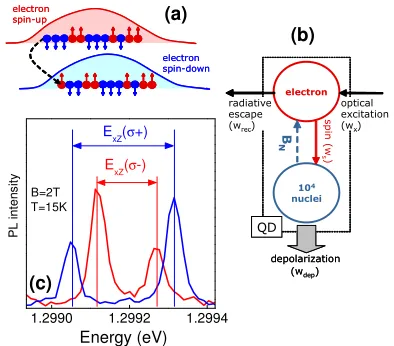
The hyperfine interaction in solids [1] arises from the coupling between the magnetic dipole moments of nuclear and electron spins. It produces two dynamical effects: (i) inelastic relaxation of electron spin via the ”flip-flop” process (Fig.1a) and (ii) the Overhauser shift of the elec-tron energy [2]. Recently, the hyperfine interaction in semiconductor quantum dots (QDs) has attracted close attention [3, 4, 5, 6, 7, 8, 9, 10, 11, 12, 13, 14] fuelled by proposals for QD implementation in quantum infor-mation applications [15]. The full quantization of the electron states in QDs is beneficial for removing decoher-ence mechanisms present in extended systems [16, 17]. However, the electron localization results in a stronger (than in a bulk material) overlap of its wave-function with a large number of nuclei (N ∼ 104 in small self-assembled InGaAs/GaAs dots and up to 105
÷106 in electrostatically-defined GaAs QDs), and the resulting hyperfine interaction with nuclear spins has been found to dominate the decoherence [3, 4, 5, 12, 13, 14] and life-time [9] of the electron spin at low temperatures.
In this Letter, we report the observation of a pro-nounced bistable behaviour of nuclear spin polarisation, S, in optically pumped self-assembled InGaAs/GaAs dots. In our experiments, spin-polarized electrons are introduced one-by-one into an individual InGaAs dot at a ratewx (see Fig.1b) by the circularly polarized optical
excitation of electron-hole pairs 120 meV above the low-est QD energy states. Due to hole spin-flip during its en-ergy relaxation, both bright and dark excitons can form in the dot ground state. The former will quickly recom-bine radiatively with a rate wrec ≈ 109 sec−1, whereas
the dark exciton can recombine with simultaneous spin transfer to a nucleus via a spin ”flip-flop” process (as in Fig.1a) at the rate wrecN phf [12, 18]. Here N is the
number of nuclei interacting with the electron andphf is
the probability of a ”flip-flop” process, which from our perturbation theory treatment is given by:
phf =|hhf|2/(EeZ2 +
1 4γ
2). (1)
1.2990 1.2992 1.2994
Energy (eV) (c)
(b) (a)
E xZ(σ-)
E
xZ(σ+)
B=2T T=15K
P
L
i
n
te
n
s
it
y
FIG. 1: (a) Schematic representation of the electron-nuclear spin ”flip-flop” process. (b) The steps involved in nuclear polarization of a quantum dot (see text for detail). (c)X0 photoluminescence spectra recorded for an individual InGaAs QD in an external magnetic fieldB = 2T at T = 15K. The spectrum excited withσ+
(σ−) light resonant with the
wet-ting layer is plotted in blue (red). The horizontal arrows show the corresponding exciton Zeeman splittings.
Here γ is the exciton life-time broadening, hhf is the
strength of the hyperfine interaction of the electron with a single nucleus andEeZis the electron Zeeman splitting.
EeZ is strongly dependent on the effective nuclear
mag-netic field BN generated by the nuclei. This provides a
feedback mechanism between the spin transfer rate and the degree of nuclear polarization (BN ∝S) in the dot
[19]. The feedback gives rise to bistability in the nuclear polarization and threshold-like transitions between the spin states of 104nuclei leading to abrupt changes ofB
N
by up to 3T in few nanometre sized QDs.
[image:2.612.343.540.252.425.2]2
0 10 20
150 200 250
4 8
1.3180 1.3182 1.3184
B=2T
B=2.5T Photon energy (eV)
(b)
(a)
ExZ(σσσσ-)
In
c
id
e
n
t
p
o
w
e
r
(a
rb
.u
n
it
s
)
σ
-σ+
Ex
Z
(
µ
e
V
)
Incident power (arb. units)
FIG. 2: (a) Grey-scale plot showing exciton PL spectra recorded for an individual InGaAs dot. The spectra are recorded atB=2.5T using unpolarized detection andσ−
exci-tation into the wetting layer. The spectra are displaced along the vertical axis according to the excitation power at which they are measured. (b)ExZ power dependences measured at B= 2T forσ+andσ−excitation polarizations.
∼3x20x20 nm size. Below, we present results obtained at a temperature of 15K for two GaAs/AlGaAs Schottky diodes, where the dots are grown in the intrinsic region of the device. In these structures a bias can be applied per-mitting control of the vertical electric field, F [20]. For photoluminescence (PL) experiments, individual dots are isolated using 800 nm apertures in a gold shadow mask on the sample surface.
Fig.1c shows time-averaged (60s) PL spectra recorded for a neutral exciton in a single QD in an external mag-netic field of 2T. Circularly polarized laser excitation in the low energy tail of the wetting layer (at 1.425eV) is em-ployed and unpolarized PL from the dot is detected using a double spectrometer and a CCD. For each excitation polarization a spectrum consisting of an exciton Zeeman doublet is measured with the high (low) energy compo-nent dominating when σ+
(σ−
) polarization is used. A strong dependence of the exciton Zeeman splitting (ExZ)
on the polarization of the excitation is observed in Fig.1c: ExZ(σ+) = 260µeV andExZ(σ−) = 150µeV. Such a
de-pendence is a signature of dynamic nuclear polarization [6, 7, 8, 10, 11], which gives rise to the Overhauser field BN aligned parallel or anti-parallel to B for σ+ or σ−
excitation, respectively.
The dependence of exciton PL at B = 2.5T on the power, P ∝wx, ofσ− excitation is shown in the
grey-100 200 300 400
1 2 3
50 100
1 2 3 0
10 20 30
∆EN
E x
Z
(
µ
e
V
)
∆
EN
(
µ
e
V
)
Magnetic field, B (T)
high power low power difference
T
h
re
s
h
o
ld
p
o
w
e
r
B(T)
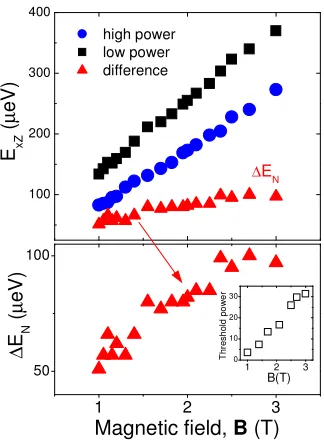
FIG. 3: Dependence of the QD exciton Zeeman splitting
ExZ(σ−) on the external magnetic field. Squares and circles
show high and low power data, respectively, and triangles show their difference, ∆EN. For all B shown in the figure
the nuclear switch threshold was observed with the threshold power shown in the inset as a function ofB.
scale plot in Fig.2a. At low P the Zeeman splitting ExZ = 310µeV. As the power is increased, a
threshold-like decrease ofExZ to 225µeV is observed at P =Pup
indicating the sudden appearance of a large nuclear field. Fig.2b shows the power dependence ofExZ measured at
B= 2T for both circular polarizations of incident light. Forσ−excitation,E
xZdecreases below the threshold
fol-lowed by a weak power dependence above the threshold. Theσ−behaviour contrasts the weak monotonic increase
of ExZ seen for σ+ excitation over the whole range of
powers similar to that reported in Ref.[21].
The variation of the Zeeman splitting in Fig.2 re-flects the change in the nuclear field BN: ExZ(σ±) =
|ge +gh|µBB ± |ge|µBBN(σ±) (where ge is the
elec-tron g-factor [22], µB is the Bohr magneton). BN in
its turn depends on the external field B. Triangles in Fig.3 show the difference between ExZ(σ−) at low and
high powers (squares and circles in Fig.3a, respectively), ∆EN = |ge|µBBN(σ−), as a function of B. ∆EN
in-creases linearly withBat low fields and then saturates at B≈2.5÷3T. The inset in Fig.3 shows that the threshold-power for the switch also increases nearly linearly with B. No switch could be observed atB >3T in the range of powers employed in our studies.
For B < 3T, when the excitation power was grad-ually reduced from powers above the switch, ExZ was
[image:3.612.358.520.50.272.2] [image:3.612.104.251.51.286.2]splitting abruptly increased (atP =Pdown), as shown in
Fig.4. This increase ofExZcorresponds to depolarization
of the nuclei and hence reduction ofBN. The observed
hysteresis of nuclear polarization shows that two signif-icantly different and stable nuclear spin configurations can exist for the same external parameters of magnetic field and excitation power. We find that high nuclear polarization persists at low excitation powers for more than 15 min, this time most likely being determined by the stability of the experimental set-up.
We also show in Figs.4a,b that the size of the hysteresis loop depends on the external magnetic or electric fields (the electric field is given byF = (Vrev+ 0.7V)/d, where
Vrev is the applied reverse bias and d = 230nm is the
width of the undoped region of the device). The inset in Fig.4b shows the Pup reverse bias-dependence. In
gen-eral, both Pup and Pdown increase with B and reverse
bias, but also the difference between the two thresholds increases, leading to a broader range of incident powers in which the bistability occurs. The threshold bias de-pendence arises from the influence of the electric field on the charge state of the dot [20], and will be discussed elsewhere.
In order to explain the nuclear switching and bista-bility, we employ a model based on spin-flip assisted e-h recombination [12, 18]. We assume that the electron spin is defined by the sign of the circularly polarized excita-tion (σ±
), whereas the hole spin is partially randomized during the energy relaxation. Thus, dark and bright ex-citons can be formed in the dot ground state, with the rates αwx and (1−α)wx, respectively. A bright
exci-ton recombines with the rate wrec without spin transfer
to the nuclei. In contrast, a dark exciton can recombine with the electron simultaneously flipping its spin due to the hyperfine interaction: the electron virtually occupies an optically active state with the opposite spin and the same energy [12, 18] transferring spin to nuclei and, then, recombines with the hole with the ratewrecN phf, where
phf (given by Eq.(1) depends on the electron Zeeman
splitting,EeZ=|ge|µB[B±BN(σ±)]. For the case ofσ−
excitation, polarization of the nuclei leads to a decrease ofEeZ, and thus a positive feedback and speeding up of
the spin transfer process: the more spin is transferred to the nuclear system the faster becomes the spin transfer rate. By contrast for σ+ excitation, spin transfer leads to an increase ofEeZ, leading to the saturation ofS(and
BN) at high power.
The spin transfer to nuclei at a rate ws ∝ αwxN phf
competes with nuclear depolarization, ˙S =−wdepS (see
Fig.1b) due to spin diffusion away from the dot into the surrounding GaAs [23, 24], at a ratewdep∼1÷10s−1. At
high power ofσ−excitationw
smay exceedwdepand then
a stimulated nuclear polarization will take place due to the positive feedback mechanism described above leading to an abrupt increase of the nuclear spin (atP =Pup).
To achieve the conditionws=wdep a higherwx(power)
100 150 200 250
0 10 20 30
150 200 250
0.4 0.6 0.8 4 8 B=2.0T (b) (c) Pu p Pd o w n
Incident power (arb. units)
B=1.15T E x c it o n Z e e m a n s p lit ti n g ( µ e V ) B=2.0T 0.4V 0.8V Pu p Bias (V) ∆ EN ~ S Pd o w n Pu p E x c it o n Z e e m a n s p lit ti n g E xZ Incident power (d) (a) a min a max f( S ,b ) S x
FIG. 4: (a) Power dependence ofExZ(σ−) measured atB=
2T and 1.15T. The arrows show the direction in which the hys-teresis loop is measured with two thresholdsPup andPdown.
(b)ExZ(σ−) power dependence measured atB = 2.0T. The
two hysteresis loops are measured at 0.4 and 0.8V applied bias. The inset shows thePupdependence on the reverse bias
applied to the diode. (c) The full line shows the function
f(S, b) from Eq.2. Arrows show how the hysteresis loop is formed when the parametera(∝wx) is varied for a fixedb.
(d) Hysteresis loop of the exciton Zeeman splitting as a func-tion of incident power calculated using Eq.2 forx= 0.7 and
θ= 0.1.
will be required at higherB in agreement with observa-tion in the inset of Fig.3. The stimulaobserva-tion at P ≈ Pup
stops when either (i)|EeZ|starts increasing again since
BN > B, causing reduction ofws or (ii) the maximum
achievableBN =BmaxN in the given dot is reached. This
explains the dependence in Fig.3, where ∆EN, and hence
the nuclear field, increases at lowBand saturates at high fields, from which we estimateBmax
N ≈2.5-3T [25].
When the power is reduced from beyond the threshold Pup, and the condition ws < wdep is reached at
suffi-ciently low wx, a strong negative feedback is expected:
further nuclear depolarization will lead to even lowerws
due to the increase in the electron Zeeman energyEeZ.
Thus, an abrupt nuclear depolarization will take place (at the threshold Pdown). This explains the observed
hysteresis behavior in Fig.4, and also accounts for the existence of a bistable state in the nuclear polarization at intermediate powers,Pdown< P < Pup.
To model this bistability, we solve the rate equations for the nuclear spin polarizationS, and populations of bright and dark excitons,nb and nd, (1−nb−nd is the
probability that the dot is empty):
˙
S = ndwrecphf(1−S)−wdepS,
˙
4
˙
nd = αwx[1−nb−nd]−
1
2(1−S)N wrecphfnd.
In the limit γ ≪ |ge|µBBNmax we obtain the following
equation for a steady state polarisation induced by the σ± excitation:
f(S, b)≡S
1 +b(x±S)
2
1−S
=a, x= B
Bmax N
, (2)
where forwx≪wrec (low occupancy of the dot)
a= 2αwx/N wdep , b= 2αN wx/wrec. (3)
In Eq.(3), bothaandbare proportional to the excita-tion power. For low excitaexcita-tion powers such that b≪1, for bothσ+ and σ−
excitation, Eq.(2) has a single solu-tion for the degree of nuclear polarizasolu-tion, namelyS≈a. In theσ+excitation case,f(S, b) is a monotonic function and for allaandba single solution to Eq.(3) is obtained. On the other hand, for σ−
excitation, for higher powers such that b >∼ 1, f(S, b) acquires an N-shape, as illus-trated in Fig.4c. As shown in the diagram, an abrupt transition toS > x(S ≈a) will be obtained whenamax
(amin) is reached at the local maximum (minimum) of
f(S, b). The transitions at amax and amin correspond
to the Pup and Pdown thresholds in Fig.4, respectively,
whereas foramin< a < amax, the polarization degreeS
enters a regime of bistability in which the cubic Eq.(2) has three solutions, two of which are stable with an un-stable one in between.
We find that the occurrence of the switch to S > x depends on the dimensionless ratio θ = a/b = wrec/N2wdep, since at small θ, a will grow more slowly
withwxthan the magnitude off(S, b) at the local
max-imum. θ is determined by the dot parameters only, and can be estimated for the dots studied in our ex-periment: we obtain θexp ∼ 1÷10 from wrec ∼ 109
sec−1
, wdep ∼1÷10 sec−1 and N ∼104. Using Eq.(2)
we find that for x≤ 0.8 the spin switch is possible for any θexp > θc, where θc = 161(3−√9−8x)(4x−3 +
√
9−8x)2/(1 +√9
−8x)≤0.1, consistent with our ob-servations. A hysteresis loop calculated using Eq.(2) for x = 0.7 (with θc ≈0.07) and θ = 0.1 (close to critical
θc), is shown in Fig.4d.
To summarize, we have observed a strong optically in-duced bistability of the nuclear spin polarization in self-assembled InGaAs QDs. We show that nuclear magnetic fields up to 3T can be switched on and off in individual dots by varying one of three external controlling param-eters: electric and magnetic fields and intensity of circu-larly polarized excitation. We have found that the nu-clear spin switch effect is a general phenomenon and has been observed in several different InGaAs/GaAs quan-tum dot samples at temperaturesT = 15−30K and in the range of external magnetic fields B = 1÷3T. The
effect arises due to the strong feedback of the nuclear spin polarization on the dynamics of the electron-nuclear spin interaction accompanying the radiative recombina-tion process, which is enhanced when the Overhauser and external magnetic fields cancel each other.
We thank R. Oulton, A. Imamoglu, C. Marcus, D. Loss, and S. Tarucha for discussions. This work has been supported by the Sheffield EPSRC Programme grant GR/S76076, the Lancaster-EPSRC Portfolio Partnership EP/C511743, the EPSRC IRC for Quantum Information Processing, ESF-EPSRC network EP/D062918, and by the Royal Society. AIT acknowledges support from the EPSRC Advanced Research Fellowship EP/C54563X/1 and research grant EP/C545648/1.
[1] A. W. Overhauser, Phys. Rev.92, 411 (1953).
[2] Optical Orientation, edited by F. Meier and B. P. Za-karchenya (Elsevier, New York, 1984).
[3] A. C. Johnsonet al., Nature435, 925 (2005).
[4] J. R. Petta et al., Science309, 2180 (2005).
[5] F. H. L. Koppenset al., Science309, 1346, (2005).
[6] D. Gammonet al., Science277, 85 (1997).
[7] A. S. Brackeret al., Phys. Rev. Lett.94, 047402 (2005).
[8] T. Yokoiet al., Phys. Rev.B 71, 041307(R) (2005).
[9] P.-F. Braunet al., Phys. Rev. Lett.94, 116601 (2005).
[10] C. W. Laiet al., Phys. Rev. Lett.96, 167403 (2006).
[11] B. Ebleet al., to be published in Phys. Rev.B.
[12] S. I. Erlingsson, Y. V. Nazarov, V. I. Fal’ko, Phys. Rev.
B 64, 195306 (2001).
[13] A. V. Khaetskii, D. Loss, L. Glazman, Phys. Rev. Lett.
88, 186802 (2002).
[14] A. Imamogluet al., Phys. Rev. Lett.91, 017402 (2003).
[15] D. Loss, D. P. DiVincenzo,Phys. Rev. A57, 120 (1998).
[16] M. Kroutvaret al., Nature432, 81 (2004).
[17] A. Greilichet al., Phys. Rev. Lett.96, 227401 (2006).
[18] D. Gammonet al., Phys. Rev. Lett.86, 5176 (2001).
[19] It is possible that a similar feedback mechanism is respon-sible for instabilities seen in the vertical transport stud-ies of resonant tunneling in QDs in K. Ono, S. Tarucha, Phys. Rev. Lett.92, 256803 (2004).
[20] Both n- and p-type Schottky devices were employed sim-ilar to those reported in R. J. Warburtonet al., Nature
405926 (2000) and R. Oultonet al., Phys. Rev.B 66,
045313 (2002).
[21] S. W. Brownet al., Phys. Rev.B 54, R17339 (1996).
[22] The hyperfine interaction is negligible for holes due to the p-like nature of the Bloch functions.
[23] D. Paget, Phys. Rev.B 25, 4444 (1982).
[24] For a dot with the radiusr∼5nm we estimatedwdep∼
DN/r2∼µ2n/(¯har
2
)∼1÷10s−1, whereD
N∼µ2n/¯hais
the coefficient of polarization diffusion due to the dipole-dipole interaction (∼µ2
n/a
3
) between magnetic moments
µn of neighbouring nuclei anda= 0.56nm - lattice
con-stant.
[25] Note that a close value of BN was deduced from the