Data
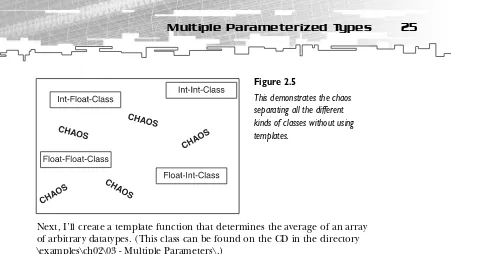
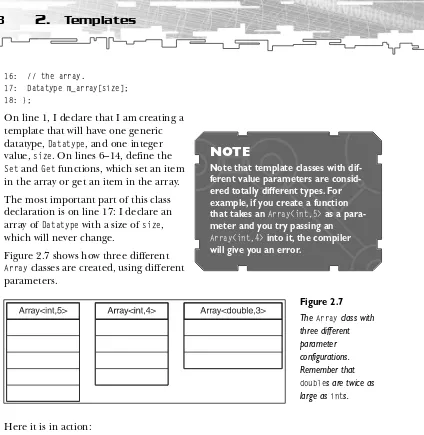
Structures
for Game
Data
Structures
Ron Penton
TM
for Game
© 2003 by Premier Press, a division of Course Technology. All rights reserved. No part of this book may be reproduced or transmitted in any form or by any means, electronic or mechanical, including photocopying, recording, or by any information storage or retrieval system without written permission from Premier Press, except for the inclusion of brief quotations in a review.
The Premier Press logo and related trade dress are trademarks of Premier Press and may not be used without written permission.
TM
Publisher: Stacy L. Hiquet
Marketing Manager: Heather Hurley
Acquisitions Editor: Emi Smith
Project Editor: Karen A. Gill
Technical Reviewer: André LaMothe
Copyeditor: Stephanie Koutek
Interior Layout: LJ Graphics, Susan Honeywell
Cover Design: Mike Tanamachi
Indexer: Kelly Talbot
Proofreader: Jenny Davidson
Microsoft, Windows, and Visual C++ are trademarks of Microsoft Corporation.Wolfenstein, Doom, and Quake are trademarks of Id Software, Inc. Warcraft and Starcraft are trademarks of Blizzard
Entertainment.
The artwork used in this book is copyrighted by its respective owners, and you may not use it in your own commercial works.
All other trademarks are the property of their respective owners.
Important: Premier Press cannot provide software support. Please contact the appropriate software manufacturer’s technical support line or Web site for assistance.
Premier Press and the author have attempted throughout this book to distinguish proprietary trade-marks from descriptive terms by following the capitalization style used by the manufacturer. Information contained in this book has been obtained by Premier Press from sources believed to be reliable. However, because of the possibility of human or mechanical error by our sources, Premier Press, or others, the Publisher does not guarantee the accuracy, adequacy, or completeness of any information and is not responsible for any errors or omissions or the results obtained from use of such information. Readers should be particularly aware of the fact that the Internet is an ever-chang-ing entity. Some facts may have changed since this book went to press.
ISBN: 1-931841-94-2
Library of Congress Catalog Card Number: 2002111226 Printed in the United States of America
03 04 05 06 07 BH 10 9 8 7 6 5 4 3 2 1
Premier Press, a division of Course Technology 2645 Erie Avenue, Suite 41
Acknowledgments
I
would first like to thank my family for putting up with me for the past nine months. Yes, yes, I’ll start cleaning the house now.I would like to thank all of my friends at school: Jim, James, Dan, Scott, Kevin, and Kelvin, for helping me get through all of those boring classes without falling asleep. I would like to thank everyone at work for supporting me through this endeavor. I especially want to thank Ernest Pazera, André LaMothe, and everyone else at Premier Press for giving me this tremendous opportunity and believing in me. I would like to thank Bruno Sousa for opening the door to writing for me. I want to thank the pioneers of Gamedev.net, Kevin Hawkins and Dave Astle, for paving the road for me and making a book such as this possible.
I would like to thank all of you in the #gamedev crew, specifically (in no particular order) Trent Polack, Evan Pipho, April Gould, Joseph Fernald, Andrew Vehlies, Andrew Nguyen, John Hattan, Ken Kinnison, Seth Robinson, Denis Lukianov, Sean Kent, Nicholas Cooper, Ian Overgard, Greg Rosenblatt, Yannick Loitière, Henrik Stuart, Chris Hargrove, Richard Benson, Mat Noguchi, and everyone else! I would like to thank my artists, Steven Seator and Ari Feldman, who made this book’s demos look so much better than they would have been.
About the Author
Ron Penton’s lifelong dream has always been to be a game programmer. From the age of 11, when his parents bought him his first game programming book on how to make adventure games, he has always striven to learn the most about how games work and how to create them.
Contents at a Glance
Introduction
. . . xxxii
Part One
Concepts. . . 1
Chapter 1
Basic Algorithm Analysis
. . . 3
Chapter 2
Templates . . . 13
Part Two
The Basics. . . 37
Chapter 3
Arrays . . . 39
Chapter 4
Bitvectors. . . 83
Chapter 5
Multi-Dimensional Arrays . . . 107
Chapter 6
Linked Lists . . . 147
Chapter 7
Stacks and Queues . . . 189
Chapter 8
Hash Tables . . . 217
Chapter 9
Tying It Together: The Basics. . . 241
Part Three
Recursion and Trees . . . 315
Chapter 10
Recursion
. . . 317
Chapter 11
Trees . . . 329
Chapter 12
Binary Trees . . . 359
Chapter 13
Binary Search Trees. . . 389
ix
Contents at a Glance
Chapter 15
Game Trees and Minimax Trees
. . . 431
Chapter 16
Tying It Together: Trees . . . 463
Part Four
Graphs . . . 477
Chapter 17
Graphs . . . 479
Chapter 18
Using Graphs for AI: Finite State
Machines. . . 529
Chapter 19
Tying It Together: Graphs . . . 563
Part Five
Algorithms . . . 597
Chapter 20
Sorting Data . . . 599
Chapter 21
Data Compression
. . . 645
Chapter 22
Random Numbers . . . 697
Chapter 23
Pathfinding . . . 715
Chapter 24
Tying It Together: Algorithms . . . 769
Conclusion
. . . 793
Part Six
Appendixes . . . 799
Appendix A
A C++ Primer . . . 801
Appendix B
The Memory Layout of a Computer
Program . . . 835
Appendix C
Introduction to SDL. . . 847
Appendix D
Introduction to the Standard Template
Library . . . 879
Contents
Letter from the Series Editor . . . xxx
Introduction . . . xxxii
Part One
Concepts. . . 1
Chapter 1
Basic Algorithm Analysis . . . 3
A Quick Lesson on Algorithm Analysis . . . 4
Big-O Notation . . . 4
Comparing the Various Complexities. . . 9
Graphical Demonstration: Algorithm Complexity . . . 10
Conclusion . . . 11
Chapter 2
Templates . . . 13
What Are Templates?. . . 14
Template Functions . . . 15
Doing It the Old Way . . . 15
Doing It with Templates . . . 17
Template Classes . . . 19
Multiple Parameterized Types . . . 24
Using Values as Template Parameters . . . 27
Using Values of a Specific Datatype . . . 27
xi
Contents
Problems with Templates. . . 32
Visual C++ and Templates . . . 34
Under the Hood. . . 34
Conclusion . . . 35
Part Two
The Basics. . . 37
Chapter 3
Arrays . . . 39
What Is an Array? . . . 40
Graphical Demonstration: Arrays . . . 41
Increasing or Decreasing Array Size . . . 43
Inserting or Removing an Item . . . 43
Native C Arrays and Pointers . . . 43
Static Arrays . . . 43
Dynamic Arrays . . . 49
An Array Class and Useful Algorithms . . . 59
The Data . . . 59
The Constructor . . . 59
The Destructor . . . 60
The Resize Algorithm . . . 60
The Access Operator . . . 62
The Conversion Operator. . . 63
Inserting an Item Between Two Existing Items . . . 64
Removing an Item from the Array . . . 65
A Faster Removal Method . . . 66
Retrieving the Size of an Array . . . 67
Example 3-3. . . 67
Storing/Loading Arrays on Disk . . . 68
Writing an Array to Disk . . . 69
Reading an Array from Disk. . . 70
Application: Using Arrays to Store Game Data . . . 71
The Monster Class . . . 72
Declaring a Monster Array. . . 72
Adding a Monster to the Game. . . 72
Making a Better Insertion Algorithm . . . 73
Removing a Monster from the Game . . . 74
Checking for Monster Removal . . . 75
Playing the Game . . . 76
Analysis of Arrays in Games . . . 77
Cache Issues . . . 77
Resizing Arrays . . . 80
Inserting/Removing Cells . . . 80
Conclusion . . . 80
Chapter 4
Bitvectors . . . 83
What Is a Bitvector? . . . 84
Graphical Demonstration: Bitvectors . . . 85
The Main Screen . . . 86
Using the Buttons . . . 86
Creating a Bitvector Class. . . 86
The Data . . . 87
The Constructor . . . 87
The Destructor . . . 87
The Resize Algorithm . . . 88
The Access Operator . . . 89
The Set Function . . . 91
The ClearAll Function . . . 93
The SetAll Function . . . 93
The WriteFile Function . . . 94
The ReadFile Function . . . 94
xiii
Contents
Application:The Quicksave . . . 96
Creating a Player Class . . . 97
Storing the Players in the Game . . . 98
Initializing the Data Structures. . . 98
Modifying Player Attributes . . . 99
Saving the Player Array to Disk . . . 100
Playing the Game . . . 102
Bitfields. . . 102
Declaring a Bitfield . . . 103
Using a Bitfield. . . 103
Analysis of Bitvectors and Bitfields in Games . . . 105
Conclusion . . . 106
Chapter 5
Multi-Dimensional Arrays
. . . 107
What Is a Multi-Dimensional Array? . . . 108
Graphical Demonstration . . . 111
Native Multi-Dimensional Arrays. . . 112
Declaring a Multi-Dimensional Array . . . 112
Accessing a Multi-Dimensional Array . . . 115
Inside a Multi-Dimensional Array . . . 116
Dynamic Multi-Dimensional Arrays . . . 121
The Array2D Class . . . 121
The Array3D Class . . . 127
Application: Using 2D Arrays as Tilemaps . . . 131
Storing the Tilemap . . . 133
Generating the Tilemap . . . 134
Drawing the Tilemap . . . 135
Playing the Game . . . 136
Application: Layered Tilemaps. . . 136
Redefining the Tilemap. . . 138
Reinitializing the Tilemap . . . 139
Playing the Game . . . 141
Comparing Performance . . . 142
Comparing Size . . . 144
Analysis of Multi-Dimensional Arrays in Games. . . 144
Conclusion . . . 145
Chapter 6
Linked Lists . . . 147
What Is a Linked List? . . . 148
Singly Linked Lists . . . 149
Graphical Demonstration: Singly Linked Lists. . . 149
Structure . . . 150
Example 6-4. . . 168
Final Thoughts on Singly Linked Lists . . . 169
Doubly Linked Lists . . . 169
Graphical Demonstration: Doubly Linked Lists . . . 170
Creating a Doubly Linked List . . . 171
Doubly Linked List Algorithms . . . 172
Reading and Writing Lists to Disk . . . 174
Writing a Linked List . . . 174
Reading a Linked List . . . 175
Application: Game Inventories . . . 176
The Player Class . . . 177
The Item Class . . . 177
Adding an Item to the Inventory . . . 178
Removing an Item from the Inventory . . . 178
Playing the Demo . . . 179
Application: Layered Tilemaps Revisited . . . 180
Declaring the Tilemap . . . 181
Creating the Tilemap . . . 182
Drawing the Tilemap . . . 182
Analysis and Comparison of Linked Lists . . . 184
xv
Contents
Size Comparisons . . . 185
Real-World Issues . . . 187
Conclusion . . . 188
Chapter 7
Stacks and Queues . . . 189
Stacks . . . 190
What Is a Stack? . . . 190
Graphical Demonstration: Stacks . . . 192
The Stack Functions . . . 193
Implementing a Stack . . . 193
Application: Game Menus . . . 199
Queues . . . 204
Graphical Demonstration: Queues. . . 204
The Queue Functions . . . 206
Implementing a Queue . . . 206
Application: Command Queues . . . 212
Conclusion . . . 216
Chapter 8
Hash Tables
. . . 217
What Is Sparse Data? . . . 218
The Basic Hash Table . . . 219
Collisions. . . 221
Hashing Functions . . . 221
Enhancing the Hash Table Structure . . . 224
Linear Overflow . . . 224
Quadratic Overflow . . . 225
Linked Overflow . . . 225
Graphical Demonstration: Hash Tables . . . 226
The HashEntry Class . . . 228
The HashTable Class . . . 229
Example 8-1: Using the Hash Table. . . 233
Application: Using Hash Tables to Store Resources . . . 235
The String Class . . . 236
Using the Table . . . 237
How the Demo Loads Resources . . . 237
Playing the Demo . . . 238
Conclusion . . . 239
Chapter 9
Tying It Together: The Basics . . . 241
Why Classes Are Good . . . 242
Storing Data in a Class . . . 243
Hiding Data . . . 245
Inheritance. . . 248
Using the Classes in a Game . . . 260
Making a Game . . . 265
Adventure:Version One . . . 266
Game 2—The Map Editor . . . 310
Conclusion . . . 314
Part Three
Recursion and Trees . . . 315
Chapter 10
Recursion . . . 317
What Is Recursion? . . . 318
A Simple Example: Powers . . . 319
The Towers of Hanoi . . . 320
The Rules . . . 321
xvii
Contents
Solving the Puzzle with a Computer . . . 323
Terminating Conditions . . . 325
Example 10-1: Coding the Algorithm for Real . . . 325
Graphical Demonstration:Towers of Hanoi. . . 327
Conclusion . . . 328
Chapter 11
Trees
. . . 329
What Is a Tree? . . . 330
The Recursive Nature of Trees . . . 332
Common Structure of Trees . . . 332
Graphical Demonstration:Trees . . . 333
Tutorial . . . 336
Building the Tree Class. . . 338
The Structure . . . 339
The Constructor . . . 340
The Destructor . . . 340
The Destroy Function . . . 341
The Count Function . . . 342
The Tree Iterator . . . 342
The Structure . . . 343
The Basic Iterator Functions . . . 343
The Vertical Iterator Functions . . . 345
The Horizontal Iterator Functions . . . .346
The Other Functions . . . 346
Building a Tree . . . 347
Top Down . . . 347
Bottom Up . . . 347
Traversing a Tree . . . 347
The Preorder Traversal . . . 348
The Postorder Traversal. . . 350
Game Demo 11-1: Plotlines . . . 352
Using Trees to Store Plotlines . . . 354
Playing the Game . . . 356
Conclusion . . . 358
Chapter 12
Binary Trees
. . . 359
What Is a Binary Tree?. . . 360
Fullness . . . 361
Denseness . . . 361
Balance . . . 362
Structure of Binary Trees. . . 362
Linked Binary Trees . . . 362
Arrayed Binary Trees . . . 363
Graphical Demonstration: Binary Trees . . . 366
Coding a Binary Tree . . . 368
The Structure . . . 368
The Constructor . . . 369
The Destructor and the Destroy Function . . . 369
The Count Function . . . 370
Using the BinaryTree Class . . . 370
Traversing the Binary Tree. . . 371
The Preorder Traversal . . . 372
The Postorder Traversal. . . 372
The Inorder Traversal. . . 372
Graphical Demonstration: Binary Tree Traversals . . . 373
Application: Parsing . . . 374
Arithmetic Expressions . . . 376
Parsing an Arithmetic Expression . . . 376
Recursive Descent Parsing. . . 377
Playing the Demo . . . 386
xix
Contents
Chapter 13
Binary Search Trees . . . 389
What Is a BST? . . . 390
Inserting Data into a BST . . . 391
Finding Data in a BST . . . 394
Removing Data from a BST . . . 394
The BST Rules . . . 394
Sub-Optimal Trees . . . 395
Graphical Demonstration: BSTs . . . 395
Coding a BST . . . 397
The Structure . . . 397
Comparison Functions. . . 397
The Constructor . . . 398
The Destructor . . . 398
The Insert Function . . . 399
The Find Function . . . 400
Example 13-1: Using the BST Class . . . 401
Application: Storing Resources, Revisited . . . 402
The Resource Class. . . 402
The Comparison Function . . . 403
Inserting Resources . . . 403
Finding Resources . . . 403
Playing the Demo . . . 404
Conclusion . . . 405
Chapter 14
Priority Queues and Heaps . . . 407
What Is a Priority Queue? . . . 408
What Is a Heap?. . . 410
Why Can a Heap Be a Priority Queue? . . . 411
Graphical Demonstration: Heaps . . . 417
The Structure . . . 419 The Constructor . . . 419 The Enqueue Function . . . 420 The WalkUp Function . . . 420 The Dequeue Function . . . 422 The WalkDown Function . . . 422
Application: Building Queues. . . 424
The Units . . . 426 Creating a Factory . . . 426 The Heap . . . 427 Enqueuing a Unit . . . 427 Starting Construction . . . 428 Completing Construction . . . 428 Playing the Demo . . . 429
Conclusion . . . 430
Chapter 15
Game Trees and Minimax Trees . . . 431
What Is a Game Tree? . . . 432 What Is a Minimax Tree? . . . 434 Graphical Demonstration: Minimax Trees . . . 437 Game States. . . 439 More Complex Games. . . 442 Application: Rock Piles. . . 442The Game State . . . 443 The Global Variables . . . 445 Generating the Game Tree . . . 446 Simulating Play . . . 452 Playing the Game . . . 454
More Complex Games. . . 456
xxi
Contents
Limited Depth Games . . . 460
Conclusion . . . 460
Chapter 16
Tying It Together: Trees . . . 463
Expanding the Game . . . 464Altering the Map Format . . . 465 Game Demo 16-1: Altering the Game . . . 466 The Map Editor . . . 473
Further Enhancements . . . 475 Conclusion . . . 475
Part Four
Graphs . . . 477
Chapter 17
Graphs . . . 479
What Is a Graph? . . . 480Linked Lists and Trees . . . 480 Graphs. . . 482 Parts of a Graph . . . 482
Types of Graphs . . . 482
Bi-Directional Graphs . . . 483 Uni-Directional Graphs . . . 483 Weighted Graphs. . . 484 Tilemaps . . . 485
Implementing a Graph. . . 486
Adjacency Tables . . . 486 Direction Tables . . . 488 General-Purpose Linked Graphs . . . 489
The Depth-First Search . . . 493 The Breadth-First Search . . . 495 A Final Word on Graph Traversals . . . 499 Graphical Demonstration: Graph Traversals . . . 500
The Graph Class . . . 501
The GraphArc Class . . . 501 The GraphNode Classes . . . 502 The Graph Class . . . 504
Application: Making a Direction-Table Dungeon . . . 512
The Map . . . 512 Creating the Map. . . 513 Drawing the Map . . . 514 Moving Around the Map . . . 516 Playing the Demo . . . 517
Application: Portal Engines . . . 518
Sectors . . . 519 Determining Sector Visibility . . . 521 Coding the Demo . . . 522 Playing the Demo . . . 527
Conclusion . . . 528
Chapter 18
Using Graphs for AI: Finite State
Machines . . . 529
What Is a Finite State Machine? . . . 530 Complex Finite State Machines. . . 533 Implementing a Finite State Machine . . . 535 Graphical Demonstration: Finite State Machines . . . 537 Even More Complex Finite State Machines . . . 538xxiii
Contents
Graphical Demonstration: Conditional Events . . . 546 Game Demo 18-1: Intruder . . . 547
The Code . . . 550 Playing the Demo . . . 559
Conclusion . . . 560
Chapter 19
Tying It Together: Graphs . . . 563
The New Map Format . . . 564The New Room Entry Structure . . . 565 The File Format . . . 566
Game Demonstration 19-1: Adding the New Map Format . . . 567
The DirectionMap . . . 568 Changes to the Game Logic . . . 580 Playing the Game . . . 582
Converting Old Maps . . . 583 The Directionmap Map Editor. . . 584
The Initial Map. . . 585 Setting and Clearing Tiles. . . 586 Loading a Map . . . 588 Saving a Map . . . 590 Using the Editor . . . 593
Upgrading the Tilemap Editor . . . 594
The Save Function . . . 594 The Load Function . . . 595
Part Five
Algorithms . . . 597
Chapter 20
Sorting Data . . . 599
The Simplest Sort: Bubble Sort. . . 600Worst-Case Bubble Sort . . . 601 Graphical Demonstration: Bubble Sort . . . 602 Coding the Bubble Sort . . . 604
The Hacked Sort: Heap Sort . . . 609
Graphical Demonstration: Heap Sort. . . 611 Coding the Heap Sort . . . 613
The Fastest Sort: Quicksort . . . 616
Picking the Pivot . . . 616 Performing the Quicksort . . . 618 Graphical Demonstration: Quicksort . . . 621 Coding the Quicksort . . . 623
Graphical Demonstration: Race. . . 627 The Clever Sort: Radix Sort . . . 630
Graphical Demonstration: Radix Sorts. . . 631 Coding the Radix Sort . . . 633
Other Sorts . . . 637 Application: Depth-Based Games . . . 638
The Player Class . . . 639 The Globals . . . 640 The Player Comparison Function. . . 640 Initializing the Players. . . 640 Sorting the Players. . . 641 Drawing the Players. . . 641 Playing the Game . . . 642
xxv
Contents
Chapter 21
Data Compression. . . 645
Why Compress Data? . . . 646Data Busses . . . 647 The Internet . . . 649
Run Length Encoding . . . 649
What Kinds of Data Can Be Used for RLE?. . . 650 Graphical Demonstration: RLEs . . . 651 Coding an RLE Compressor and Decompressor . . . 656
Huffman Trees . . . 665
Huffman Decoding. . . 665 Creating a Huffman Tree . . . 667 Coding a Huffman Tree Class. . . 676 Example 21-3. . . 691 Test Files . . . 692 Example 21-4. . . 693
Data Encryption . . . 693 Further Topics in Compression . . . 694 Conclusion . . . 694
Chapter 22
Random Numbers . . . 697
Generating Random Integers . . . 698Generating Random Numbers in a Program . . . 699 Using rand and srand. . . 700 Using a Non-Constant Seed Value . . . 702 Generating a Random Number Within a Range . . . 702
Generating Random Percents . . . 705 Generating Random Floats . . . 706 Generating Non-Linear Random Numbers. . . 707
Adding Three Random Numbers . . . 711 Graphical Demonstration: Random Distribution Graphs . . . 712
Conclusion . . . 714
Chapter 23
Pathfinding. . . 715
Basic Pathfinding . . . 716Random Bouncing . . . 718 Object Tracing . . . 719
Robust Pathfinding . . . 721
The Breadth-First Search . . . 721 Making a Smarter Pathfinder . . . 739 Making a Better Heuristic . . . 746 The A* Pathfinder . . . 750 Graphical Demonstration: Path Comparisons . . . 753
Weighted Maps . . . 754
Application: Stealth . . . 756
Thinking Beyond Tile-Based Pathfinding . . . 762
Line-Based Pathfinding . . . 762 Quadtrees . . . 764 Waypoints . . . 765
Conclusion . . . 767
Chapter 24
Tying It Together: Algorithms
. . . 769
Making the Enemies Smarter with Pathfinding . . . 770xxvii
Contents
Conclusion
. . . 793
Extra Topics . . . 794 Further Reading and References . . . 795Data Structure Books . . . 795 C++ Books . . . 796 Game Programming Books . . . 797 Web Sites . . . 798
Conclusion . . . 798
Part Six
Appendixes . . . 799
Appendix A
A C++ Primer . . . 801
Basic Bit Math . . . 802Binary Numbers . . . 802 Computer Storage. . . 805 Bitwise Math . . . 807 Bitwise Math in C++ . . . 807 Bitshifting. . . 809
Standard C/C++ Functions Used in This Book . . . 811
Basic Input/Output . . . 811 File I/O . . . 814 Math Functions . . . 817 The Time Function. . . 818 The Random Functions . . . 819
Exceptions and Error Handling . . . 820
Assertions . . . 820 Return Codes . . . 820 Exceptions . . . 821
Class Topics. . . 824
Constructors . . . 824 Destructors . . . 826 Operator Overloads . . . 827 Conversion Operators . . . 829 The This Pointer . . . 830 Inline Functions . . . 830 Function Pointers . . . 832
Conclusion . . . 833
Appendix B
The Memory Layout of a
Computer Program . . . 835
The Memory Sections . . . 836 The Code Memory. . . 837 The Global Memory. . . 838Global Variables . . . 838 Static Variables . . . 839
The Stack . . . 840
Local Variables . . . 840 Parameters . . . 842 Return Values. . . 843
The Free Store. . . 844 Conclusion . . . 845
Appendix C
Introduction to SDL . . . 847
The Licensing . . . 848 Setting Up SDL . . . 849xxix
Contents
Setting Up SDL_TTF . . . 856 Distributing Your Programs . . . 858 Using SDL . . . 858
SDL_Video . . . 858 SDL Event Handling . . . 861 SDL_Timer . . . 863 SDL_TTF . . . 863
The SDLHelpers Library . . . 865 The SDLFrame . . . 867 The SDLGUI Library . . . 869
The SDLGUI Class . . . 869 The SDLGUIItem Class . . . 874 The SDLGUI Items . . . 876 The SDLGUIFrame . . . 876
Conclusion . . . 878
Appendix D
Introduction to the Standard
Template Library . . . 879
STLPort . . . 880 STL Versus This Book. . . 882 Namespaces . . . 883 The Organization of STL . . . 885 Containers . . . 889Sequence Containers . . . 890 Associative Containers . . . 896 Container Adaptors . . . 896 The Miscellaneous Containers . . . 898
Conclusion . . . 899
Letter from the
Series Editor
Dear reader,
I’ve always wanted to write a book on data structures. However, there is simply no way to do the job right unless you use graphics and animation, and that means a lot of work. I personally think that all computer books will be animated, annotated, and interactive within 10 years—they have to be. There is simply too much information these days to convey with text alone; we need to use graphics, color, sound, animation—anything and everything to try to make the complex computer science subjects under-standable these days.
With that in mind, I wanted a data structures book that was like no
other—a book using today’s technology that could live up to my high stan-dards. So I set out to find the perfect author and finally Ron Penton came along to take on the challenge. Ron, too, had my same vision for a data structures book. We couldn’t do something that had been done—there are a zillion boring data structure books—but if we could apply gaming tech-nology and graphics to teach the subject, we would have something unique. Moreover, this book is for anyone who wants to learn data struc-tures and related important algorithms. Sure, if you’re a game program-mer then you will feel at home, but if you’re not, then believe me, put down that hardbound college text and pick this book up because not only will you absolutely know this stuff inside and out by the time you’re done, but you will have an image in your mind like you have never had before. All right, now I want to talk about what you’re going to find inside.
xxxi
xxxi
xxxi
xxxi
Letter from the Series Editor
pull this off. On the other hand, if you are a game programmer, then you will greatly appreciate Ron’s insight into applications of various data struc-tures and algorithms for game-related programs. In fact, he came up with some pretty cool applications I hadn’t thought of!
So what’s inside? Well, the book starts off with an introduction, gets you warmed up with arrays, bit vectors, and simple stuff like that, and talks about the use of SDL (the simple direct media layer) used for the demos. Then the book drives a steak through the heart of the data structure drag-on and covers asymptotic analysis, linked lists, queues, heaps, binary trees, graphs, hash tables, and the list goes on and on. After Ron has made you a believer that hash tables are the key to the universe, he switches gears to algorithms and covers many of the classic algorithms in computer science, such as sorting, searching, compression, and more. Of course, no book like this would be complete without coverage of recursion, and that’s in here, too—but you will love it because for once, you will be able to see the recursion! Finally, the book ends with primers on C++, SDL, and the stan-dard template library, so basically you will be a data structure god when you’re done!
In conclusion, this book is for the person who is looking for both a practi-cal and a theoretipracti-cal base in data structures and algorithms. I guarantee that it will get you farther from ground zero than anything else.
Introduction
What is a computer program? When you get down to the lowest level, you can sepa-rate a program into two main sections: the data and the instructions that opesepa-rate on the data. These two sections of a program are commonly called the data struc-tures and the algorithms.
This book will teach you how to create many data structures, ranging from the very simple to the moderately complex.
Understanding data structures and algorithms is an essential part of game pro-gramming. Knowing the most efficient way to store data and work with the data is an important part of game programming; you want your games to run as quickly as possible so you can pack as many cool features into them as you can.
I have a few goals with this book:
■ Teach you how the most popular data structures and algorithms work ■ Teach you how to make the structures and algorithms
■ Teach you how to use the data structures in computer games
Mark Twain once said this:
It is a good thing, perhaps, to write for the amusement of the public. But it is a far higher and nobler thing to write for their instruction.
xxxiii
Introduction
Who Is This Book For?
If you’re standing in the bookstore reading this Introduction and wondering, “Is this book good for me?”, then read this section. If you’ve already bought the book, thank you! I am going to assume that you’re reading this book because you want to learn more (unless some diabolical person is forcing you to read this as an arcane form of torture...).
This is a somewhat complex book because it deals with lots of concepts. However, I feel that I have included ample introductory material as well. Therefore, this book is for the game programmer who is just starting out at an intermediate level. So what do I expect you to know?
I expect you to know basic C++, but don’t feel confused if you don’t feel like an expert. Pretty much every complex topic I use in C++ is covered in Appendix A, so if you’re unfamiliar with a concept or just forget how something works, take a few minutes to read that appendix.
The most complex feature of C++ that I use is templates, but you don’t need to know about them before you read this book. Chapter 2 is an extensive introduction to templates, so don’t worry if you don’t know what they are just yet.
One advanced concept I use often in the later parts of the book is recursion, but you don’t have to know about that, either. Chapter 10 is a small introduction to recursion.
This book is for anyone who wants to learn more about how a computer works, how to store data, and how to efficiently work on that data. All of this material is essential to game programming, so take a glance at the Table of Contents. If there is anything there that you don’t already know about, this book is for you. Even if you know a little about the topics, this book is still good for you because every chapter goes in depth about these subjects.
Topics Covered in This Book
In this book, I cover many data structures and how to use them in games, ranging from the simple (arrays) to the complex (graphs and trees).
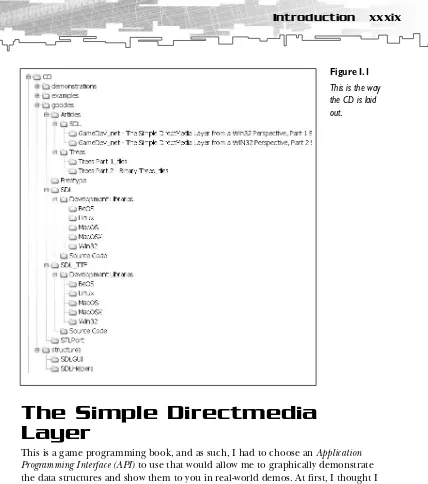
understand how it works. These demonstrations all use the Simple DirectMedia Layer (SDL) multimedia library, which I go more into depth on in just a little bit. All of these demonstrations are located in the \demonstrations\ directory on the CD. After that, I show you how to actually code the structure or algorithm in C++. The code for these sections is mostly platform free, so it will usually compile on any compiler. I mention any sections that are platform-specific in the book. All of the code for the data structures and algorithms can be found on the CD in the directory \structures\ for your convenience. Copies of the files have also been placed in the directories of every demo that uses them. Whenever necessary, I have included console mode Examples on how these structures work in the \examples\ directory on the CD. All of the examples use pure C/C++, with no extra SDKs or APIs needed, so they use input and output to the text console window on your computer.
CAUTION
You are free to use any of the data structures included on the CD in any projects you use. However, be warned; they were designed to demonstrate the structures and are not super-optimized. Many functions can be made faster, particularly the small functions that can be inlined (see Appendix A).You cannot copy any of the structures because none of them implements proper copy constructors.
Whenever you pass a structure into a function as a parameter, make absolutely certain that you pass-by-reference or use a pointer; otherwise, it will mess up your structure. If you don’t know what this means just yet, look at the functions that use the data structures; they demonstrate how to use them correctly.
Finally, I show you an interactive Game Demonstration, which highlights the usage of the structure or algorithm in a game-like atmosphere. Most of these games are sim-ple, but they prove a point. These demonstrations also use the SDL multimedia library and are located on the CD in the directory \demonstrations\ .
Some chapters might deviate from the format to show you different versions of the structures.
xxxv
Introduction
■ Concepts ■ The Basics
■ Recursion and Trees ■ Graphs
■ Algorithms ■ Appendixes
Concepts
In this part, I introduce you to some of the concepts used when dealing with data structures and algorithms. You might know some of them, or you might not.
■ Basic Algorithm Analysis—This chapter is a little on the theoretical side, and
it deals with topics that are usually taught in school. This chapter shows you how algorithms are rated for speed so that you can see how to choose the best algorithm for your needs.
■ Templates—This is a somewhat advanced C++ concept. Some C++ books
don’t cover templates well, and because this book uses them extensively, I feel that it is a good idea to include a chapter on how to use them. You can safely skip this section if you already know the material.
The Basics
In this part, I show you many of the basic data structures used within games and how to use them. These include
■ Arrays—This chapter teaches you everything you ever needed to know about
arrays. You might not think arrays need this much explaining, but they are an important structure in computing.
■ Bitvectors—Bitvectors are an important part of space optimization. This
chapter shows you how to store data in as small of a place as possible.
■ Multi-Dimensional Arrays—This chapter expands on the array chapter and
shows you how to use arrays with more than one dimension.
■ Linked Lists—This chapter introduces you to the concept of linked data,
■ Stacks and Queues—This is the first chapter that doesn’t introduce you to a
new structure. Instead, it shows you how to access data in certain ways.
■ Hash Tables—This chapter shows you an advanced method of storing data by
using both arrays and linked lists. It is the last structure covered in this part of the book.
In addition to those, the last chapter in this part (Chapter 9) is the first of the “Tying It Together” chapters. There are four of these chapters throughout the book, one at the end of Parts Two, Three, Four, and Five. In Chapter 9, I introduce you to the ideas of learning how to store custom game data and designing your own classes. After that, I show you how to design a basic game using many of the structures from this part of the book.
Recursion and Trees
In this Part, I introduce you to the ideas of recursion, recursive algorithms, and recursive data structures, namely trees. This Part includes the following chapters:
■ Recursion—This is a small chapter introducing you to the idea of recursion
and how it works. Recursion is a tough subject and isn’t covered well in most C++ books, so I felt that I needed to include an introduction to the concept.
■ Trees—This chapter introduces you to the idea of a linked tree data
struc-ture and how it is used.
■ Binary Trees—This chapter shows you a specific subset of trees. Binary trees
are the most frequently used tree structures in computing.
■ Binary Search Trees—This chapter shows you how to store data in a recursive
manner so that you can access it quickly later.
■ Priority Queues and Heaps—Heaps are another variation of the binary tree.
This chapter shows you how to use a binary tree to implement an efficient queue variation called the priority queue.
■ Game Trees and Minimax Trees—Game Trees are a different kind of tree
used to store state information about turn-based games.
xxxvii
Introduction
Graphs
In this part, I introduce you to the graph data structure, which is another linked data structure that is somewhat like trees. This part of the book is broken down into the following chapters:
■ Graphs—This chapter introduces you to the idea of the graph structure and
its many derivatives. Graphs are used all over in game programming.
■ Using Graphs for AI: Finite State Machines—This is an application of the
graph data structure to the field of artificial intelligence—a way to make your games smarter.
Chapter 19 applies some concepts from the graph chapter and adds them to the game from Chapter 16.
Algorithms
Originally, I had planned to include these topics in the previous three parts, but they really fit better in a section of their own. Some of the topics use concepts from all three of the previous parts, and others don’t. This part is composed of the fol-lowing chapters:
■ Sorting Data—This chapter covers four different sorting algorithms. ■ Data Compression—This chapter shows you two ways to compress data. ■ Random Numbers—This chapter shows you how to use the random number
generator built into the C standard library and how to use some algorithms to get impressive results from generating random numbers.
■ Pathfinding—This chapter shows you four different pathfinding algorithms
to use on the maps you create in your games.
The final chapter, Chapter 24, expands on the game from Chapters 9, 16, and 19 by adding pathfinding support to the AIs in the game.
Appendixes
Finally, there are four appendixes in the book that cover a variety of topics:
■ A C++ Primer—This appendix attempts to cover the features of C++ that are
■ The Memory Layout of a Computer Program—To understand how to use a
computer to its fullest extent, you must know about how it structures its memory. This appendix tells you this information.
■ Introduction to SDL—This is a basic introduction to the Simple DirectMedia
Layer library, which the book uses for all of the demonstrations. It also goes over the two SDL libraries I’ve developed to make the demonstrations in the book.
■ Introduction to the Standard Template Library—This appendix introduces
you to the C++ Standard Template Library, which is a built-in structure and algorithm library that should come with every compiler.
What’s on the CD?
The CD for this book contains every Example, Game Demonstration, and Graphical Demonstration for the book. There are 33 Examples, 26 Game Demonstrations, and 34 Graphical Demonstrations. That is 93 examples and demonstrations! That should be enough to keep you busy for a while.
Just in case you end up wanting more, however, there’s even more stuff on the CD. There are 19 code files full of the data structures and algorithms in this book, con-veniently located in the directory \structures\, as well as the two SDL libraries I’ve developed for the book (see Appendix C).
In the \goodies\ directory, there are four articles—two dealing with trees and two dealing with SDL. They expand on the topics covered in this book.
In addition, the SDL, SDL_TTF, STLPort, and FreeType libraries (see Appendixes C and D for more information) are in that directory.
xxxix
Introduction
[image:41.513.29.457.20.504.2]the CD is laid out.
Figure I.1
This is the way
The Simple Directmedia
Layer
A friend of mine recently introduced me to a very simple API called SDL: The Simple Directmedia Layer. I think that the S part of the title should be emphasized because the API is simple. I was able to make a working SDL program (no, it wasn’t “Hello World”. It’s the Array Demonstration from Chapter 3) in less than an hour after first looking at the header files. It truly is that simple.
Therefore, I decided that SDL was the API I wanted to use to demonstrate the con-cepts in this book. It’s simple enough so that it will not get in the way of the theory, and I am confident that you will be able to pick it up in almost no time at all. I’ve provided a simple primer for SDL in Appendix C to get you started with it. So if you get confused by the graphics code, just take a peek at Appendix C. I promise, the book won’t go anywhere until you return.
Coding Conventions Used in
This Book
Although the point of this book is to demonstrate how to effectively organize your data, organizing your code is still somewhat important. Because of this, I will be adopting a simple coding standard.
In an effort to emphasize the scope of the different variables within the book, I have used a simple mutation of the popular Hungarian Notation:
■ Global variables will be prefixed with g_.
Examples: g_name, g_state
■ Class/Structure member variables will be prefixed with m_.
Examples: m_name, m_state
■ Parameter variables will be prefixed with p_.
Examples: p_name, p_state
■ Local function variables have no prefix.
Examples: name, state
Besides the prefix, all variables will be lowercase.
Class and function names will be title-cased, with each major word in the name
capitalized.
xli
Introduction
Artwork
Two people provided the artwork used for the demos in this book. First and fore-most, I would like to thank Steve Seator for making all of the person sprites and weapon icons in the game demos. He has an excellent Web site at http://www.spritedomain.net. If you’re interested in his artwork, I urge you to visit the site.
The other artist is Ari Feldman, who provided most of the other sprites in the demos. His Web site is http://www.arifeldman.com.
I would like to thank both of them, because without them, my game demos would be even cheesier than they already are.
All of the artwork is copyrighted by them, so you cannot use it in your own game projects.
Are You Ready?
PART ONE
1 Basic Algorithm Analysis
CHAPTER 1
Basic
Algorithm
A
lmost any computer science teacher would probably kill me for including this topic as such a small chapter. After all, entire books are dedicated to this subject. But we’re not computer science professors—we’re game programmers! We don’t care about all of this highly mathematical stuff, right? Well, that’s only half right. We should at least pay some attention to the algorithms we write. In this chapter, you will learn■ How algorithms are rated for growth ■ The most common complexity classes
■ How each of the complexity classes compares to the others
A Quick Lesson on
Algorithm Analysis
Some people spend their careers studying algorithms and data structures, and you should be thankful for them. These are the people who invented some of the nifty things you’ll be using in this book. These things are used because people have proven that they work. For those of us who don’t want to spend years proving that the efficiency of algorithm 1 is better than algorithm 2, this is a godsend.
However, I still think that at least some knowledge of how algorithms are analyzed is required. This section is meant to introduce you to the very basics of these con-cepts so that you can understand why some of the data structures and algorithms we use are better than others. Throughout the book, I refer to some of the termi-nology I’ve introduced here, so unless you already know a little about algorithm analysis, I beg you to please read this section.
Big-O Notation
Big-O notation is a helpful tool that computer scientists often use to help define the complexity of a function. Simply put, the Big-O of an algorithm is a function that roughly estimates how the algorithm scales when it is used on different sized datasets. Big-O notation is shown like this:
5
A Quick Lesson on Algorithm Analysis
The function is usually a mathematical formula based on the letters n and c, where
n represents the number of data elements in the algorithm and c represents a con-stant number.
Imagine having a huge collection of action figures—at least 1,000 of them. But you’re a very sloppy person, and you don’t have them organized in any manner at all. (Okay, maybe you’re not so sloppy, but just pretend.) Now, one of your friends comes over and wants to look at your exclusive Boba Fett action figure—the really rare one. In the worst-case scenario, you need to search through every single one of your figures because Boba Fett might be the 1000th figure in your collection. In this example, the Big-O of the search would be O(n), because the number of items to search is 1,000, and in the worst-case scenario, you have to search through every figure in the collection. (Technically, the worst case would be not finding him at all because your mom sold him for grocery money.) Of course, Boba Fett might be the first figure you look at or he might be the 500th, but when analyzing an algorithm, you don’t (usually) care about the best case because the best case only occurs in optimal conditions, which almost never occur.
A number of different functions are typically used to examine the complexity of an algorithm, and these are (listed in order from the lowest complexity to the highest complexity) constant, log2n, n, nlog2n, n2, n3, and 2
n
. It’s okay if you don’t know exactly what these functions do. Just look at the graphs that follow; they will show you visually how the function looks as the number of data items increases.
O(
c
)
[image:49.513.55.248.527.629.2]As I stated before, the C in a Big-O expression is a constant. Figure 1.1 illustrates the constant function. The graphs produced by the constant function are all hori-zontal, meaning that no matter how large the dataset is, the algorithm will take the same amount of time to complete. These functions are usually considered the fastest. Some of the structures in this book have algorithms associated with them that approach O(c) as a best-case scenario.
Figure 1.1
O(Log
2n
)
Figure 1.2 shows the logarithm base 2 function. In case you don’t know, a loga-rithm function is the inverse of an exponential function. The best way to describe it is this: In a base 2 logarithm, the vertical component is increased by 1 whenever the dataset size is doubled. The log of 1 is 0, the log of 2 is 1, the log of 4 is 3, the log of 8 is 4, and so on. Logarithm-based algorithms are generally considered the most efficient algorithms in existence that depend on the size of the data.
(Remember: O(c) algorithms don’t depend on the size of the data.)
Figure 1.2
The Log2n function varies with the size of
the data, but becomes more efficient as more data is added.
O(
n
)
O(n) is called the linear function. Figure 1.3 illustrates what this function looks like. Basically, an O(n) algorithm grows at a constant rate with the data size. This growth rate means that if an O(n) algorithm takes 20 seconds to operate on 1,000 data items, it would take roughly 40 seconds to operate on 2,000 data items. The scenario of trying to find the Boba Fett action figure is an example of an O(n) algorithm.
Figure 1.3
The linear function varies directly with the size of the data.Twice as much data will take twice as long to compute.
O(
n
log
2n
)
7
A Quick Lesson on Algorithm Analysis
previous graphs, but compared to some of the more complex functions I discuss next, it is also considered a fairly efficient algorithm class.
Figure 1.4
The n log2n function varies with
the size of the data, but has a relatively shallow curve, which makes functions that fall into this category seem efficient.
O(
n
2)
This is where the more complex functions begin. An n2 function (shown in Figure
1.5) is typically considered inefficient for most tasks because the function grows at an enormously high rate. For example, if it took 20 seconds to perform an algo-rithm on 1,000 data items, it would take 80 seconds for 2,000 items—4 times as long! In general, you should stay away from O(n2) algorithms unless you have no
other choice. An example of an O(n2) function would be a for-loop with another
for-loop nested inside.
Figure 1.5
The n2 function has a steep incline,
O(
n
3)
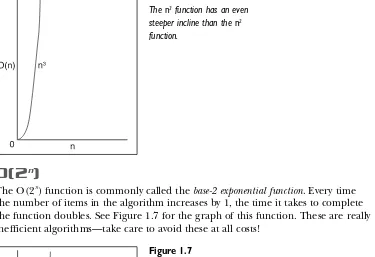
If you thought O(n2) was bad, O(n3) is even worse! Even though the graph looks
almost identical to O(n2) (see Figures 1.5 and 1.6), it shoots up at a much higher
[image:52.513.56.431.183.440.2]rate. If it took 20 seconds to perform an algorithm on 1,000 items, it would take 160 seconds for 2,000 items! That’s 8 times longer!
Figure 1.6
The n3 function has an even
steeper incline than the n2
function.
O(2
n)
The O(2n
) function is commonly called the base-2 exponential function. Every time the number of items in the algorithm increases by 1, the time it takes to complete the function doubles. See Figure 1.7 for the graph of this function. These are really inefficient algorithms—take care to avoid these at all costs!
Figure 1.7
[image:52.513.55.206.459.635.2]9
A Quick Lesson on Algorithm Analysis
O(2n
n3
n
n
n
) is faster than O(n3).
NOTE
) algorithms are actually faster than O( ) algorithms for very small
datasets.This has to do with the way an O(2 ) algorithm slopes: It starts out slow, but shoots up quicker than all the other algorithms. For values of that are less than 10, O(2
Comparing the Various
Complexities
The following table is a comparison of the various functions that gives you a better understanding of how the complexity functions affect the running time of an algo-rithm. (This is a generic algorithm prediction that assumes it takes exactly 1 second to process each item.)
T
ABLE16 Items 32 Items 64 Items 128 Items
O(log2n) 4 seconds 5 seconds 6 seconds 7 seconds
O(n) 16 seconds 32 seconds 64 seconds 128 seconds
O(nlog2n) 64 seconds 160 seconds 384 seconds 896 seconds
O(n2) 256 seconds
O(n3) 73 hours
O(2n
) 18 hours 500,000 millennia —————-*
1.1 Running Time Comparisons
Complexity
17 minutes 68 minutes 273 minutes
68 minutes 546 minutes 24 days
136 years
* My calculator doesn’t go this high.
As you can see, this table puts things in a better perspective. Even if you were to speed up a 2n
algorithm so that it spends a millisecond per item, it would still take millions of years to complete for 128 items. Isn’t that insane? I hope you under-stand now why algorithms should be analyzed carefully for their complexity. You could accidentally create an algorithm that takes too much time to complete—and not even realize it!
single loop on the same number of items. What would the complexity of this algo-rithm be? It is natural to assume that it would be O(n2+ n), but that is incorrect.
Remember, when you measure the complexity of an algorithm, you really care only about how it grows as the data size increases. Eventually, the single n term will be overpowered by the much larger n2 term and become insignificant. So the correct
complexity of the algorithm is actually O(n2).
Also, keep in mind that dividing or multiplying by a constant has no effect on the complexity of an algorithm. If you had an algorithm consisting of a single for-loop and it only processed half of the items, the algorithm would not be O(n/2). It would still be O(n) because the growth of the algorithm is still linear; doubling the number of items that the algorithm works on still doubles the amount of time taken to complete the algorithm.
I’m sorry to lay down so much mathematical buzz-speak so early in the book, but I feel that it’s important. If you walk away from this chapter having learned one thing, it should be the knowledge of which algorithm classes are generally faster than others.
Graphical Demonstration:
Algorithm Complexity
I’ve included a demonstration of the different complexity graphs on the CD-ROM that comes with this book. It’s a really simple program, and I encourage you to play around with it to gain an understanding of how the graphs of the functions look. The program is quite simple to understand, and you can find it in the \demonstra-tions\ch01\Demo01 - Algorithm Complexity\ directory on the CD.
Compiling the Demo
This demonstration uses the SDLGUI library that I have developed for the book. For more information about this library, see Appendix B, “The Memory Layout of a Computer Program.”
11
Conclusion
When you start the program, as shown in Figure 1.8, you see a graph, six check boxes, and four arrows.
Figure 1.8
This is a screenshot of the demonstration in action.
You can click on any of the check boxes to make a graph appear. You can click any combination at the same time, which enables you to compare the different graphs. The arrows adjust the graph axes. The up and down arrows increase and decrease the Y axis within a range of 10–5,000. The left and right arrows decrease and increase the X axis, also within a range of 10–5,000.
Conclusion
CHAPTER 2
I
n this chapter, you learn about templates. Templates are a fairly important con-cept in computer programming when you are dealing with data structures because they allow you to easily maintain your code. If you already know about templates, you can safely skip this chapter, but if you are not very good at them (or have never even heard of them), I’d advise you to read on. In this chapter, you will learn■ What a template is
■ How to create template functions ■ How to create template classes
■ How to use multiple template parameters ■ How to use values as a template parameter ■ The limitations and problems of templates ■ How templates work under the hood
What Are Templates?
Templates are a relatively new concept in computer languages. A template is a soft-ware engineering tool that enables a programmer to reuse code on many different datatypes.
The best way to describe a template is as a pattern, or a mold, which will be reused over and over again. A real-world example would be the procedures of a company that manufactures figurines. First, the company produces a mold of the figure they want to produce. After that, they choose which material they want the figures made of, and then they use the mold to create the figure. With the same mold, they can make a figure out of plastic, pewter, iron, or even gold and silver.
15
Template Functions
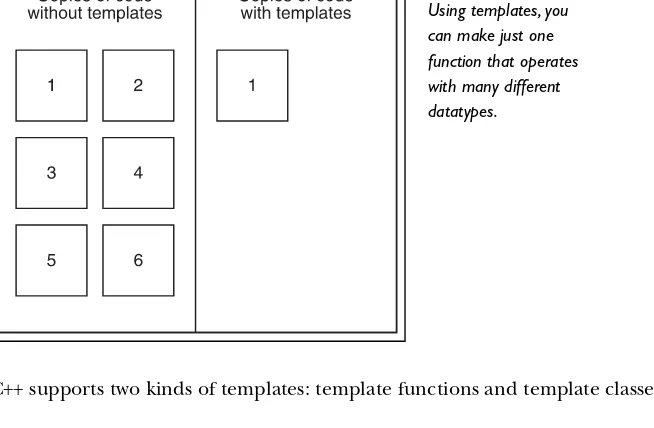
[image:59.513.55.382.186.400.2]Say you want a specific algorithm to work on six different types of datatypes. Without templates, you would have to copy and paste the algorithm six times and manually change the datatypes in each copy! With templates, it is possible to make only one copy of the code and use that one copy over and over again. The algo-rithm on the right-hand side of Figure 2.1 is your mold, which allows you to make figurines of any type you want.
Figure 2.1
Using templates, you can make just one function that operates with many different datatypes.
C++ supports two kinds of templates: template functions and template classes.
Template Functions
A template function is a function that can operate on a generic datatype, which will allow you to use the same function on many different types of data.
Doing It the Old Way
NOTE
Although Chapter 3, “Arrays,” discusses arrays, I am introducing them a little bit earlier here. If you’re reading this book, you should probably know a little bit about arrays already. However, if you don’t know about them, you may want to skip ahead and read the first part of Chapter 3 and then come back here.
1: int SumIntegers( int* p_array, int p_count ) 2: {
3: int index; 4: int sum = 0;
5: for( index = 0; index < p_count; index++ ) 6: sum += p_array[index];
7: return sum; 8: }
Line 3 defines the index variable, which will be used to access each item in p_array. On line 4, I define the sum variable, which is initially empty, and on lines 5 and 6, we loop through the array, adding each index to the sum. Lastly, on line 7, the sum is returned.
A little further down the line, you might want to do the same thing, but with floats. Without templates, you would probably just copy the code and replace the ints with floats, like this:
1: float SumFloats( float* p_array, int p_count ) 2: {
3: int index; 4: float sum = 0;
5: for( index = 0; index < p_count; index++ ) 6: sum += p_array[index];
7: return sum; 8: }
17
Template Functions
Doing It with Templates
C++ comes to the rescue by allowing us to create template functions, which use the same algorithm but operate on different datatypes. The syntax for a template func-tion is such:
template< class T >
returntype functionname( parameter list )
You first declare that you are creating a template by putting in the template key-word. You then put the class keyword and the name of the generic datatype after that, contained within the <> brackets. In the preceding example, T (which stands for “Template”) is the name of the generic datatype, and whenever I want to use the class in the function, I refer to it as T. After that, you write the function declara-tion the same way you normally would. In my examples, I separate the template declaration and the function
declara-tion into two lines, but you aren’t required to do that. Technically, they can be on the same line, but I prefer separating them because it makes the code more readable.
Let’s look at an example of a template
function by condensing the two sum functions into one template function called
sum:
T is called a in the
NOTE
parameterized type
world of software engineering.
1: template< class T >
2: T Sum( T* p_array, int p_count ) 3: {
4: int index; 5: T sum = 0;
6: for( index = 0; index < p_count; index++ ) 7: sum += p_array[index];
8: return sum; 9: }
On line 1, I use the template keyword to tell the compiler that I am creating a tem-plate function that will have one generic datatype as a parameter, henceforth
a template function that calls its
foo foo
CAUTION
It is essential, upon choosing a name for your generic datatype within the template, that you choose one that does not conflict with an existing class name. For example, if you have generic class , but you also have a regular class named , the compil-er won’t like this and will barf compil-error messages all over you.
On line 2, I declare the function signa-ture. It will return an instance of type T, and it takes a pointer of type T as a para-meter, which will be the array. Note how the count variable is an integer; there is no need to use a generic counting type because arrays are always indexed on discrete integer boundaries.
On line 4, I declare an integer index
variable, which will be used to access the appropriate items in the array. On line 5, I declare the sum variable to be of type T, meaning that the sum will be the same datatype as the items in the array. I also initialize it to the value ‘0’, which is important because the datatype T must have an overloaded assignment operator that takes a parameter of type int
(because the compiler treats the constant ‘0’ as an integer). If you are unfamiliar with operator overloads, please read about them in Appendix A, “A C++ Primer.” On line 6 and 7, I loop through the array and add every item in the array to the sum variable. Please note, however, that in order for line 7 to operate correctly, type T must have a working += operator. I go over the limitations of parameterized types in more detail in a later section.
On line 8, I simply return the sum variable.
Let’s see this new function in action! Let’s test it out on two different types of arrays!
1: void main() 2: {
3: int intarray[10] = { 1, 2, 3, 4, 5, 6, 7, 8, 9, 10 }; 4: float floatarray[9] = { 1.1f, 2.2f, 3.3f, 4.4f, 5.5f,
5: 6.6f, 7.7f, 8.8f, 9.9f };
6:
7: // first sum the two arrays using the non-templated functions. 8: cout << “Using SumIntegers, the sum of intarray is: “;
9: cout << SumIntegers( intarray, 10 ) << endl;
10: cout << “Using SumFloats, the sum of floatarray is: “; 11: cout << SumFloats( floatarray, 9 ) << endl;
19
Template Classes
13: // now sum the two arrays using the templated function. 14: cout << “Using Sum, the sum of intarray is: “;
15: cout << Sum( intarray, 10 ) << endl;
16: cout << “Using Sum, the sum of floatarray is: “; 17: cout << Sum( floatarray, 9 ) << endl;
18: }
On lines 3 and 4, I declare the two arrays, one of type int and one of type float. On lines 8 through 11, I call the two non-templated sum functions SumIntegers and
SumFloats and output the results to the console.
Lastly, on lines 13 through 17, instead of using the two separate sum functions, I use the templated Sum function on each array, even though they are of two totally differ-ent datatypes! Magic? Nope, it’s one of C++’s niftier features.
Figure 2.2 shows Example 2-1 in action.
Figure 2.2
Screenshot for Example 2-1.The
Sum function was used on two different arrays with no problems.