An investigation into the issues
of Multi-Agent Data Mining
Thesis submitted in accordance with the requirements of
the University of Liverpool for the degree of Doctor in
Philosophy
by
Kamal Ali Albashiri
Dedication
Preface
This thesis is submitted to the University of Liverpool in support of my applica-tion for admission to the degree of Doctor of Philosophy. No part of it has been submitted in support of an application for another degree or qualification of this or any other institution of learning. This thesis is predominantly my own work and the sources from which material is drawn are identified within. Some parts of this thesis have appeared in the following publications:
Refereed Conferences:
[1] K.A. Albashiri, F. Coenen, R. Sanderson, and P. Leng. Frequent Set Meta Mining: Towards Multi-Agent Data Mining. Research and Development in Intel-ligent Systems XXIII, Proceedings AI’2007, Springer, London, pages (139-151), 2007.
[2] K. A. Albashiri, F. Coenen, and P. Leng. Agent Based Frequent Set Meta Mining: Introducing EMADS. Artificial Intelligence in Theory and Practice II, Proceedings IFIP’2008, Springer, pages (23-32), 2008.
[3] K. A. Albashiri, F. Coenen, and P. Leng. EMADS: An Extendible Multi-Agent Data Miner. Research and Development in Intelligent Systems XXIII, Springer, London, Proceedings AI’2008, Springer, London, pages (263-276), 2008. Winner of The 2008 British Computer Society Specialist Group on AI (BCS-SGAI) Prize for Best Paper with Student as the First Author.
[4] K. A. Albashiri, and F. Coenen. Agent-Enriched Data Mining Using an Ex-tendible Framework. International Workshop on Agents and Data Mining In-teraction, Proceedings ADMI’2009, collocated with AMAS’09, pages (89-106), 2009.
Systems, Proceedings HAIS’2009, Springer LNAI 5572, pages (203-210), 2009.
Journal papers:
[6] K. A. Albashiri, F. Coenen, and P. Leng. EMADS: An Extendible Multi-Agent Data Miner. Volume 22, Issue 7, pages (523-528). Knowledge-Based Systems (KBS) journal, 2009.
Book chapter contributions:
[7] K. A. Albashiri, and F. Coenen. The EMADS Extendible Multi-Agent Data Mining Framework. In Cao, Longbing (Ed.), Data Mining and Multi-agent Inte-gration, Springer, ISBN: 978-1-4419-0521-5, pages (189-200), 2009.
Abstract
Very often data relevant to one search is not located at a single site, it may be widely-distributed and in many different forms. Similarly there may be a number of algorithms that may be applied to a single Knowledge Discovery in Databases (KDD) task with no obvious “best” algorithm. There is a clear advantage to be gained from a software organisation that can locate, evaluate, consolidate and mine data from diverse sources and/or apply a diverse number of algorithms.
Multi-agent systems (MAS) often deal with complex applications that require distributed problem solving. Since MAS are often distributed and agents have proactive and reactive features, combining Data Mining (DM) with MAS for Data Mining (DM) intensive applications is therefore appealing.
This thesis discusses a number of research issues concerned with the viability of Multi-Agent systems for Data Mining (MADM). The problem addressed by this thesis is that of investigating the usefulness of MAS in the context of DM. This thesis also examines the issues affecting the design and implementation of a generic and extendible agent-based data mining framework.
Contents
Preface ii
Abstract iv
Contents ix
List of Figures xii
List of Tables xii
Acknowledgement xiii
1 Introduction 1
1.1 Motivation . . . 2
1.2 Objectives . . . 4
1.3 Programme of Work . . . 6
1.4 Evaluation . . . 7
1.5 Overview of Selected MADM Scenarios . . . 9
1.5.1 Meta Association Rule Mining (ARM) . . . 9
1.5.2 Data Partitioning and Parallel ARM . . . 10
1.5.3 Generation of Classifiers . . . 10
1.6 Thesis Organisation . . . 11
1.7 Summary . . . 11
2 Background and literature review 13 2.1 Data Mining . . . 13
2.1.1 Association Rule Mining . . . 14
2.1.2 Classification Rule Mining . . . 21
2.2 Agents and Multi-Agent Systems . . . 29
2.2.1 Agents . . . 29
2.2.2 Multi-Agent Systems . . . 29
2.2.3 FIPA . . . 30
2.2.4 MAS Development Platforms . . . 32
2.3 Multi-Agent Data Mining (MADM) . . . 35
2.3.1 Central-learning Strategy . . . 36
2.3.2 Meta-learning Strategy . . . 37
2.3.3 Hybrid-learning Strategy . . . 37
2.4 Generic MADM . . . 38
2.5 Summary . . . 39
3 MADM: Requirement Analysis, Design, and Implementation 40 3.1 MADM Design . . . 41
3.1.1 Issues to be Considered . . . 41
3.1.2 Structural Analysis . . . 43
3.1.3 Operational Analysis . . . 44
3.2 EMADS Agents and Users . . . 45
3.2.1 User Agent . . . 47
3.2.2 Registration Agent . . . 48
3.2.3 Facilitator Agent (or Broker Agent) . . . 49
3.2.4 Task Agent (or Management Agent) . . . 49
3.2.5 Data Mining (DM) Agent . . . 50
3.2.6 Data Agent (or Resource Agent) . . . 51
3.2.7 EMADS End User Categories . . . 52
3.3 Defining Interaction Protocols . . . 53
3.3.1 Find Other Agents Protocol . . . 55
3.3.2 Agent Registration Protocol . . . 56
3.3.3 User DM Request Protocol . . . 56
3.3.4 Start Data Mining Task Protocol . . . 57
3.3.5 Advertise Agent Capabilities Protocol . . . 58
3.3.6 Perform Data Mining Protocol . . . 59
3.3.7 Data Retrieval Protocol . . . 60
3.5 The Agent Development Toolkit . . . 61
3.5.1 JADE . . . 63
3.5.2 JADE Agent Interaction . . . 66
3.6 EMADS Architecture as Implemented in JADE . . . 66
3.6.1 Mapping EMADS Protocols to JADE Behaviours . . . 70
3.6.2 Agent Interactions . . . 71
3.6.3 Mechanisms of Cooperation . . . 72
3.6.4 User Request Handling . . . 73
3.7 Discussion . . . 74
3.8 Summary . . . 75
4 MADM Extendibility 76 4.1 Extendibility . . . 77
4.2 Extendibility in EMADS . . . 79
4.3 Wrappers . . . 79
4.3.1 Data Wrappers . . . 81
4.3.2 DM Wrappers . . . 82
4.3.3 Task Wrappers . . . 82
4.4 Realisation . . . 82
4.4.1 Task Agents . . . 83
4.4.2 DM Agents . . . 84
4.4.3 Data Agents . . . 87
4.5 Summary . . . 89
5 Frequent Set Meta Mining: Meta ARM 91 5.1 Motivation . . . 92
5.2 Background and Previous Work . . . 96
5.3 Note on P- and T-Trees . . . 98
5.4 Proposed Meta ARM Algorithms . . . 100
5.4.1 Bench Mark Algorithm . . . 101
5.4.2 Brute Force Meta ARM Algorithm . . . 102
5.4.3 Apriori Meta ARM Algorithm . . . 103
5.5 Meta ARM EMADS Model . . . 104
5.6 Note on Datasets . . . 106
5.7 Extendibility Consideration . . . 106
5.7.1 Incorporating New Data Source . . . 106
5.7.2 Incorporating New DM algorithms . . . 107
5.7.3 Incorporating New DM Tasks . . . 107
5.7.4 Registering New Agents . . . 108
5.8 Experimentation and Analysis . . . 109
5.9 Discussion . . . 113
5.10 Summary . . . 116
6 Data Partitioning and Parallel ARM 118 6.1 Motivation . . . 119
6.2 Data Segmentation and Partitioning . . . 121
6.3 The Parallel Task with Horizontal Segmentation (DATA-HS) Al-gorithm . . . 123
6.4 The Apriori-T Algorithm . . . 124
6.5 The Parallel Task with Vertical Partitioning (DATA-VP) Algorithm125 6.6 DATA-VP Task Architecture and Network Configuration . . . 128
6.6.1 Messaging . . . 128
6.7 Experimentation and Analysis . . . 129
6.8 Discussion . . . 130
6.9 Summary . . . 131
7 Classifier Generation 132 7.1 Motivation . . . 132
7.2 Background . . . 133
7.3 Classifier Generation Operation . . . 134
7.3.1 Employed Classifier Generators . . . 136
7.3.2 Dynamic Behaviour of Agents . . . 137
7.4 Extendibility Consideration . . . 138
7.5 Experimentation and Analysis . . . 140
8 Conclusion 142
8.1 Summary . . . 143
8.2 Main Findings and Contributions . . . 144
8.3 Future Work . . . 147
A EMADS Class Diagrams (UML representation) 149 A.1 Main EMADS Packages Class Diagrams . . . 149
A.2 Meta ARM Application Class Diagram . . . 150
A.3 Parallel ARM Application Class Diagram . . . 151
A.4 Classifier Generation Application Class Diagram . . . 152
B EMADS Tutorial 153 B.1 Testing EMADS using Meta ARM . . . 153
B.2 Testing EMADS using Data Vertical Partitioning . . . 154
B.3 Testing EMADS using Data Horizontal Segmentation . . . 155
B.4 Testing EMADS using Best Classifier Generation . . . 155
Bibliography 172
List of Figures
2.1 Decision Tree Example . . . 25
2.2 FIPA Agent Management Reference Model [37] . . . 31
3.1 Main Domain Components . . . 44
3.2 System General Architecture . . . 46
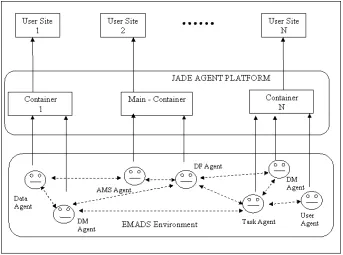
3.3 High Level View of EMADS Conceptual Framework . . . 52
3.4 JADE Architecture (Bellifemine et al., 2007) [16] . . . 64
3.5 ACL message Example . . . 65
3.6 EMADS Architecture as Implemented in JADE . . . 69
4.1 EMADS Wrappers . . . 81
4.2 Data Agent GUI . . . 88
4.3 Data Normalisation GUI . . . 89
5.1 P-tree Example . . . 99
5.2 T-tree Example (support = 35%) . . . 100
5.3 Meta ARM Model . . . 105
5.4 User Agent GUI: Meta ARM Example . . . 110
5.5 Effect of Number of Data Sources . . . 111
5.6 Effect of Increasing Number of Records . . . 112
5.7 Effect of Increasing Number of Items (attributes) . . . 114
6.1 Vertical Partitioning of a T-tree Example [29] . . . 127
6.2 Parallel ARM Model for DATA-VP Task Architecture . . . 128
6.3 Average of Execution Time for Dataset T20.D100K.N250.num . . 129
6.4 Average of Execution Time for Dataset T20.D500K.N500.num . . 130
7.1 Classifier Generation EMADS Model Architecture . . . 135
A.1 Main Packages Class Diagrams . . . 149
A.2 Meta ARM Class Diagram . . . 150
A.3 Parallel ARM Class Diagram . . . 151
List of Tables
2.1 Apriori Algorithm . . . 16
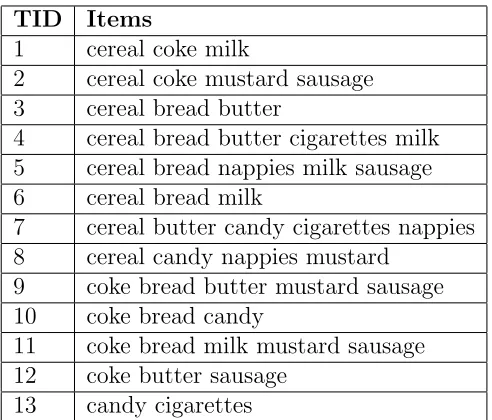
2.2 Market Basket Transaction Data . . . 19
2.3 Training set of examples on weather attributes . . . 23
2.4 ID3 Algorithm . . . 24
3.1 FIPA Communicative Acts (pre-defined message types) . . . 67
3.2 FIPA pre-defined message parameters . . . 68
4.1 Prototype of the Task Agent Abstract Class . . . 84
4.2 Prototype of the DM Agent Wrapper Class . . . 86
4.3 DM Abstract Interface . . . 87
5.1 I-ARM itemset comparison options (relative support) . . . 96
5.2 Bench Mark Meta ARM Algorithm . . . 101
5.3 Brute Force Meta ARM itemset comparison options . . . 102
5.4 Apriori Meta ARM Algorithm . . . 104
6.1 Dataset Example . . . 126
7.1 Classification Results . . . 140
Acknowledgement
Thanks to God, my creator, who helped me in the creation of this dissertation.
I would like to especially thank my main supervisor, Dr. Frans Coenen, for his continued support and guidance throughout the past four years. His enthusiasm, constructive criticism, research ideas and always making time for discussions have made the completion of my Ph.D. possible and highly enjoyable. I also would like to express my gratitude to my second supervisor, Prof. Paul Leng, for his assistance, suggestions and valuable comments.
The Department of Computer Science in general at the University of Liverpool has been an excellent place in which to conduct research, and all members of staff and colleagues have been encouraging and helpful whenever needed.
I wish to kindly thank the Libyan’s Secretariat of Higher Education for spon-soring my postgraduate studies and living expenses. I also wish to thank my sister and brothers for their encouragement and support.
Chapter 1
Introduction
Knowledge Discovery in Databases (KDD) has evolved to become a well estab-lished technology that has many commercial applications. It encompasses sub-fields such as classification, clustering, and rule mining. However, it still poses many challenges to the research community. New methodologies are needed in order to mine more interesting and specific information from larger datasets. New frameworks are needed to harmonise more effectively the steps of the KDD process. New solutions are required to manage the complex and heterogeneous sources of information that are today available for the analysis.
KDD is concerned with the extraction of hidden knowledge from data. Very often data relevant to a particular application of KDD is not located at a single site, it may be widely-distributed and in many different forms. Similarly the so-lution to a specific single KDD task may be achieved using a variety of algorithms with no obvious advanced indication of which is the most appropriate (“best”). There is therefore a clear advantage to be gained from a software organisation that can (in an automated manner) locate, evaluate, consolidate and mine data from diverse sources and/or apply a diverse number of algorithms.
Research work in KDD continues to develop ideas, generate new algorithms and modify/extend existing algorithms. A diverse body of work therefore ex-ists. KDD research groups and commercial enterprises are prepared (at least to some extent) to share their expertise. In addition, many KDD research groups have made software freely available for download 1. This all serves to promote and enhance the current “state of the art” in KDD. However, although the free
1
availability of data mining software is of a considerable benefit to the KDD com-munity, it still requires users to have programming knowledge; this means that for many potential end users the use of such free software is not a viable option. Multi-Agent Systems (MASs) often deal with complex applications that re-quire distributed problem solving. In many applications the individual and col-lective behaviour of the agents depends on the observed data from distributed sources. The field of Distributed Data Mining (DDM) deals with the challenge of analysing distributed data and offers many algorithmic solutions to perform different data analysis and mining operations in a fundamentally distributed man-ner.
This thesis addresses a number of research issues concerned with the use of Multi-Agent systems for Data Mining (MADM). The thesis also examines the issues affecting the design and implementation of an extendible framework for achieving the desired MADM. To evaluate the ideas promoted in this thesis a generic MADM framework was established, the Extendible Multi-Agent Data mining System (EMADS) framework. EMADS was developed primarily as a vehicle for promoting the ideas espoused in this thesis, but has also proved to be a useful MADM tool in its own right.
The rest of this chapter is organised as follows. The motivation for the work is presented in Section 1.1. The research objectives of the work are presented in Section 1.2, and the programme of work in Section 1.3. The evaluation strategy is described in Section 1.4. To act as a focus for the research described in this thesis a number of MADM scenarios were considered; these are listed in Section 1.5. The thesis organisation is described in Section 1.6.
1.1
Motivation
extensive and increasing rapidly year by year. One potential solution to the scal-ability issue is parallel or distributed DM, although this often entails a significant “communication” overhead.
Multi-Agent Systems (MAS) are communities of software entities, operating under decentralised control, designed to address (often complex) applications in a distributed problem solving manner. MAS offer a number of general advantages with respect to computer supported cooperative working, distributed computa-tion and resource sharing. Well documented advantages include:
1. Autonomy.
2. Decentralised control.
3. Robustness.
4. Simple extendibility.
5. Sharing of expertise.
6. Sharing of resources.
Autonomy and decentralised control are, arguably, the most significant features of MAS that serve to distinguish such systems from distributed or parallel ap-proaches to computation. Autonomy and decentralised control imply that in-dividual agents, within MAS, operate in an autonomous manner and are (in some sense) self deterministic [126]. Robustness, in turn, is a feature of the de-centralised control, where the overall system continues to operate even though a number of individual agents have disconnected (“crashed”). Decentralised control also supports extendibility, in that additional functionality can be added simply by including further agents. The advantages of sharing expertise and resources are self evident.
The advantages offered by MAS are entirely applicable to KDD where a con-siderable collection of tools and techniques are current. There are many specific areas where MASs can be seen to offer benefits with respect to DM, and by ex-tension KDD. Some examples, of specific relevance to this thesis, are as follows:
many different forms. MASs can be seen as offering a potential solution to mining such data.
• Sensitivity of Data. By its nature DM is often applied to sensitive data. Usage of MAS Technology may allow the remote mining of such data with-out compromising data privacy or security.
• Protection of Property rights. MASs can provide a means whereby DM software can be made available to practitioners while at the same time maintaining the intellectual property rights in the software.
• Diversity of DM Algorithms. There are a great many DM algorithms available. From the reported research it is clear that there is no single “best” algorithm for any specific DM application. An approach to DM, such as that facilitated by MASs, that can make use of numbers of such algorithms and compare and extract the “best” result, seems desirable.
• Distributed and Parallel Processing. Much work on distributed and parallel DM has been conducted. It is suggested that the use of MAS can provide an alternative mechanism for facilitating distributed and parallel DM in a manner that avoids some of the associated overheads of the latter.
The broad motivation for the work described in this thesis is, thus the potential advantages that MAS can offer in the context of DM. The use of MAS will also provide a radical alternative approach to DM where collections of data mining agents (of various types) can be used to address traditional DM problems under decentralised control.
The MADM vision that the work espouses is that of an “anarchic” and dy-namic agent community, where agents interact with one another to address DM problems posted by users and where data sources, and DM algorithms can be made available by individuals as desired by those individuals. The research is-sues that this entails are identified in the following section.
1.2
Objectives
to be addressed is therefore: “Does MADM provide the KDD community with any desirable advantage that would make the global establishment of such a system of genuine significance?” For example would it solve the scalability problem? Does it address privacy and security issues? Does it allow for simple extendibility and sharing of expertise?
There are many research challenges to be met if we are to realise the full implementation of the MADM vision. This is, of course, a significant task and the work presented in this thesis can not find the answers to all of the stated issues for all possible cases. Instead, the aim is to identify and study cases where the answer to such issues would benefit answering the research question the most. The above research question encompasses a number of specific research issues:
1. The negotiation and communication mechanism to be adopted to allow the envisaged agents to “talk” to one another.
2. The nature of the framework/platform in/on which the agents might oper-ate.
3. The nature of individual DM algorithms that would gain full advantage of operating in a multi-agent setting.
4. The usage of such a system and the mechanisms for adding/removing agents.
5. The mechanisms for achieving extendibility to provide the means to easily accept and incorporate new data sources and new DM techniques.
6. The techniques required to support the sharing of resources and expertise.
7. The mechanisms required to ensure the protection of privacy and intellec-tual property rights.
8. How best to deal with scalability and efficiency concerns.
Each of the identified research issues was investigated using a number of DM sce-narios, and applications commonly found in the domain of DM, and implemented in EMADS.
1.3
Programme of Work
To address the above research objective and associated issues a four phase pro-gramme of work was implemented.
1. Investigation into the nature of the agent framework/platform to be used and the establishment of a multi-agent framework to test and evaluate ideas concerning the operation of the envisaged MADM.
2. Research, analysis and evaluation of MADM approaches to address a num-ber of traditional DM activities (scenarios) starting with an agent based approach to Association Rule Mining (ARM), followed by a number of further investigations of DM activities where MADM may have specific benefits. The considered approaches may be itemised as follows:
(a) Investigation of the operation and benefits of meta Data Mining (meta DM), a process for combining local DM results into a global result.
(b) Investigations of the usage of MAS to achieve parallel DM.
(c) Investigation of a mechanism whereby results from a number of DM algorithms can be compared (and the “best” selected).
The aim of these studies was to evaluate the effectiveness of the MADM approach in various DM contexts, and to identify and assess issues arising in this realisation in a MADM context.
3. Investigation of the issues associated with the extendibility of MADM with respect to the addition of further functionality, and the adding of additional agents.
1.4
Evaluation
This section itemises the criteria used to critically evaluate the work presented in later chapters. The principal aim of the evaluation was to establish whether the MADM proposed vision answered the research question described in Section 1.2. For this to be so, any generic MADM framework will be evaluated according to the following requirements:
• Generality and Re-usability. In order to be generic, the framework tasks need to be coordinated. The number of tasks is not known a priori, and may evolve over time. The framework should also be reactive since it must accommodate new tasks as they are created in the environment. Thus the framework should provide for generality. Furthermore, The framework should promote the opportunistic reuse of agent services by other agents. To this end, it has to provide mechanisms by which agents may advertise their capabilities, and ways whereby agents can find other agents support-ing certain capabilities. It is difficult to define a measure of generality or re-usability. Therefore, in this thesis, generality will be measured by considering the applicability of the proposed MADM solution to a diverse collection of DM scenarios. If the MADM can effectively be applied to these selected scenarios, then it can be argued that the requirement of “gener-ality” has been achieved. In the case of “re-usability” a similar approach will be adopted. A number of scenarios will be considered and observa-tions made of how existing agents from previous scenarios can be used. If the functionality of a reasonable number of existing agents can be re-used to resolve a new DM task that the requirement of “re-usability” can be considered to be fulfilled.
• Scalability. The scalability of a data mining system refers to the ability of the system to operate effectively and without a substantial or discernible reduction in performance as the number of data sites increases. Scalability can be evaluated by considering the following questions:
2. Can DM agents interact with each other at run-time with ease? note that in other non-agent based systems, these interactions must be de-termined at design-time (this is discussed further in Chapter 3).
• Extendibility. Extendibility is one of the principal issues of MADM. In general, extendibility can be defined as the ease with which software can be modified to adapt to new requirements or changes in existing requirements; for example, adding a new data source or DM techniques by a simple pro-cess. Therefore, extendibility requires the provision of a framework that can easily accept new data sources and new DM techniques. Extendibility can be evaluated by considering the following questions:
– Is the framework compliant with the standard agent communication language i.e. FIPA ACL [37]?
– Can new DM techniques be added to the system and out-of-date tech-niques be deleted from the system dynamically? Ease of use and ex-tendibility is evaluated by considering the simplicity where by new agents can be included (and removed) in MADM (this is discussed further in Chapter 4).
It is suggested in this thesis that the desired extendibility can be achieved using a system of wrappers. An agent wrapper “agentifies” an existing application (i.e. an implementation of a DM algorithm) by encapsulating its implementation to become a MADM agent. In other words, MADM wrappers are used to “wrap” up data mining artefacts so that they become agents that can be incorporated into a MADM framework and consequently can communicate with other agents held in the framework [7].
Three broad categories of wrapper are identified in this thesis: (i) data wrappers, (ii) task wrappers, and (iii) DM wrappers. These are discussed in more detail in Chapter 5.
the EMADS framework. EMADS is essentially a realisation of the MADM vision promoted in this thesis, and is referred to throughout the rest of this work. More details on the scenarios that were considered are given in Section 1.5. Chapter 4 provides a detailed description of the desired MADM extendibility feature in terms of its requirements, design and implementation.
1.5
Overview of Selected MADM Scenarios
As indicated above, the aim of the demonstration scenarios was to evaluate the effectiveness of the proposed MADM approach in various DM contexts, while at the same time acting as a focus for the research. These scenarios, referred to throughout this thesis, are introduced in this section.
1.5.1
Meta Association Rule Mining (ARM)
The standard, centralised, approach to data mining is to collate data into a single location. In this central location, a model is then computed from the data. Although this process is easy to understand, and the data mining software design is straightforward, there are a number of drawbacks to this centralised approach as descried in Section 1.1. The main objective, in the context of this scenario, is to take advantage of the inherent parallelism and distributed nature of MADM to design and implement a powerful and practical distributed DM system. The scenario assumes several data sites interconnected through an intranet or internet; the goal is then to provide the means for data owners to utilise their own local data and, at the same time, benefit from the data that is available at other data sites without transferring or directly accessing that data (thus maintaining privacy and security). This is realised in the context of MADM, by agents that execute at remote data sites and generate DM models that can subsequently be transferred and merged into one global model.
of communication, efficiency and scalability, and data privacy protection.
The scenario comprises a novel extension of ARM where a “meta set” of frequent itemsets are constructed from a collection of component sets which have been generated in an autonomous manner without centralised control. This type of conglomerate has been termed meta ARM to distinguish it from a number of other related approaches such as incremental and distributed ARM. A number of MADM meta ARM algorithms were considered. This scenario is discussed in more detail in Chapter 5.
1.5.2
Data Partitioning and Parallel ARM
Data sources measured in gigabytes or terabytes are quite common in DM. This has called for fast DM algorithms that can mine very large databases in a rea-sonable amount of time. However, despite the many algorithmic improvements proposed in many serial algorithms, the large size and dimensionality of many databases makes the DM of such databases too slow and too big to be processed using a single process. There is therefore a growing need to develop efficient parallel DM algorithms that can run on distributed systems.
The second demonstration scenario was selected to demonstrate that the MADM vision is capable of exploiting the benefits of parallel computing; par-ticularly parallel query processing, parallel data accessing, namely parallel ARM and horizontal/vertical data partitioning. In addition the scenario provides a vehicle for demonstrating how re-usability can be achieved. This was seen as significant in the context of the scalability and efficiency issues.
The scenario comprises an approach to parallel ARM, which makes use of a vertical/horizontal data partitioning approach to distributing the input data as described in [29]. Using this approach each partition can be mined in isolation by individual agents while at the same time taking into account the possibility of the existence of large itemsets dispersed across two or more partitions (agents). This scenario is discussed in more detail in Chapter 6.
1.5.3
Generation of Classifiers
that the MADM approach provides the possibility of greater end user access to DM techniques. MADM can make use of algorithms without necessitating their transfer to users, thus contributing to the preservation of any intellectual property rights over the algorithms.
The third demonstration scenario was chosen to investigate the advantage of MAS with respect to KDD in the context of sharing resources and expertise. The scenario demonstrates that the MAS approach provides greater end user access to DM techniques and can select between such techniques to identify a “best” technique for the considered task. The scenario also demonstrates that MAS can make use of algorithms without necessitating their transfer to users, thus contributing to the preservation of intellectual property rights.
The scenario illustrates the operation of MADM in the context of a classifier generation task where a number of classification algorithms are available. The scenario is thus that of an end user who wishes to obtain a “best” classifier founded on a given, pre-labelled, data set; which can then be applied to further unlabelled data. This scenario is discussed in more detail in Chapter 7.
1.6
Thesis Organisation
The organisation of this thesis is as follows. Chapter 2 provides an overview of the field of MADM. The concepts of association rules are presented in detail as this is central to the three scenarios considered. Other techniques, such as decision tree induction and classification are also covered briefly. Chapter 3 gives an overview of the requirements, design and implementation of EMADS. Chapter 4 provides a detailed description of the desired MADM extendibility feature in terms of its requirements, design and implementation. The three evaluation scenarios are considered in Chapters 5, 6, and 7 respectively. The last chapter presents some conclusions and directions for future work.
1.7
Summary
Chapter 2
Background and literature review
This chapter presents a discussion and critical review of the current research re-lating to Multi-Agent Data Mining (MADM). It provides an overview of the theo-retical background of the research discipline, identifying the approaches adopted, and discusses the benefits and challenges posed. It also highlights the principal areas in which current solutions display significant shortcomings.
The organisation of this chapter is as follows. An overview of Data Mining (DM) and Distributed Data Mining (DDM) is presented in Section 2.1 along with three specific DM techniques: Association Rule Mining (ARM), Classification Rule Mining (CRM), and Decision Tree (DT) generation; which are used for demonstration purposes later in this thesis. In Section 2.2 a general description of agent and agent systems is provided together with a review of current multi-agent system platforms. Finally, the use of multi-agent and multi-multi-agent systems for DM, as an emerging field of DM, is reviewed in Section 2.3, where current research in this field is summarised and some established approaches are presented.
2.1
Data Mining
In other words DM [48, 52, 53, 125] deals with the problem of analysing data in a scalable manner.
A considerable number of algorithms have been developed to perform DM tasks, from many fields of science [127]. Typical DM tasks are classification (the generation of classifiers which can be used to assign each record of a database to one of a predefined set of classes), clustering (finding groups of database records that are similar according to some user defined metrics) or ARM (determining implication rules for a subset of database record attributes).
The next two subsections review two data mining techniques, ARM and Clas-sification, which have been used to drive and focus the research reported in this thesis, and to evaluate the solutions to the research issues identified in Chapter 1.
2.1.1
Association Rule Mining
The most popular task of DM is to find patterns in data that show associations between domain elements. This is generally focused on transactional data, such as a database of purchases at a store. This task is known as Association Rule Mining (ARM), and was first introduced in Agrawal et al. [1]. Association Rules (ARs) identify collections of data attributes that are statistically related in the underlying data.
An association rule is of the form X⇒Y where X and Y are disjoint conjunc-tions of attribute-value pairs. The most commonly used mechanism for deter-mining the relevance of identified ARs is the support and confidence framework. The confidence of the rule is the conditional probability of Y given X, Pr(Y|X), and thesupportof the rule is the prior probability of X and Y, Pr(X and Y). Here probability is taken to be the observed frequency in the data set. The support and confidence of a rule are defined as follows:
• supp(X ⇒Y ) = supp(X S Y )
• conf(X⇒ Y ) = supp(X S Y ) / supp(X)
threshold and a minimal support threshold, find all association rules whose con-fidence and support are above the corresponding thresholds.
The most computationally demanding aspect of ARM is identifying the fre-quent sets of attribute-values, or items, whose support (occurrence in the data) exceeds some threshold. The desired ARs are then generated from the identified frequent itemsets. The issue here is that the number of possible sets is exponen-tial in the number of items. For this reason, almost all methods attempt to count the support only of candidate itemsets that are identified as possible frequent sets. It is, of course, not possible to completely determine the candidate itemsets in advance, so it will be necessary to consider many itemsets that are not in fact frequent.
Most algorithms involve several passes of the source data, in each of which the support for some set of candidate itemsets is counted. The performance of these methods, clearly, depends both on the size of the original database and on the number of candidates being considered. The number of possible candidates increases with increasing density of data (greater number of items present in a record) and with decreasing support thresholds. In applications such as medical epidemiology, where we may be searching for rules that associate rather rare items within quite densely populated data, the low support-thresholds required may lead to very large candidate sets. These factors motivate a continuing search for efficient algorithms. Some of these algorithms are reviewed in the following subsection.
2.1.1.1 Basic ARM Algorithms
There have been many algorithms developed for mining frequent patterns, which can be classified into two categories:
1. Candidate-generation-and-test, and
2. Pattern-growth methods.
Since its introduction in 1994, the Apriori algorithm, developed by Agrawal and Srikant [5], has been the basis of many subsequent ARM and/or ARM-related algorithms. In [5], it was observed that ARs can be straightforwardly generated from a set of frequent itemsets (FIs). Thus, efficiently and effectively mining FIs from data is the key to ARM. The Apriori algorithm iteratively identifies FIs in data by employing the “downward closure property” of itemsets in the generation of candidate itemsets, where a candidate (possibly frequent) itemset is confirmed as frequent only when all its subsets are identified as frequent in the previous pass. The Apriori algorithm is shown in Table 2.1.
Algorithm: Apriori
function Apriori(Dt: a transactional database, s: a support threshold), returns a set of frequent itemsets S;
1: begin: 2: k ← 1;
3: S ← an empty set for holding the identified frequent itemsets; 4: generate all candidate k-itemsets fromDt;
5: while (candidate k-itemsets exist) do
6: determine support for candidate k-itemsets fromDt; 7: add frequentk-itemsets into S;
8: remove all candidate k-itemsets that are not sufficiently supported to give frequent k-itemsets;
9: generate candidate (k + 1)-itemsets from frequent k-itemsets using “downward closure property”;
10: k ← k + 1; 11: end while 12: return (S); 13: end Algorithm
Note: A k-itemset represents a set of k items.
Table 2.1: Apriori Algorithm
candidate-generation-and-test approach iteratively generates the set of candidate patterns of length (k+ 1) from the set of frequent patterns of length kand checks their corresponding occurrence frequencies in the database.
The Apriori algorithm achieves good reduction on the size of candidate sets. However, when there exist a large number of frequent patterns and/or long pat-terns, candidate generation-and-test methods tend to produce very large numbers of candidates and require many scans of the database for frequency checking. Since, the number of database passes of the Apriori algorithm equals the size of the maximal frequent itemset, it scans the database k times even when only one k-frequent itemset exists. If the dataset is very large, the required multiple database scans can be one of the limiting factors of the Apriori algorithm.
Many algorithms have been proposed, directed at improving the performance of the Apriori algorithm, using different types of approaches. An analysis of the best known algorithms can be found in [54].
A second, more recent, category of methods, pattern-growth methods, such as FP-growth [49] and Apriori-TFP [30], have been proposed. These algorithms typically operate by recursively processing a tree structure into which the input data has been encoded.
respect to dense data sets.
Apriori-TFP (Total From Partial) also uses two data structures: a P-tree (Partial support tree) and a T-tree (Total support tree). The input data is first translated into the P-tree; this is a set enumeration tree structure that holds partial support counts for itemsets (unlike the FP-tree). Apriori-TFP then processes the P-tree to produce a T-tree. The T-tree is a “trie” data structure that combines the processing advantages of tree structures with the fast “look-up” (indexing) offered by array structures. The computational efficiency of Apriori-TFP is similar to FP-growth for sparse data sets, and outperforms FP-growth with respect to dense data sets. Apriori-TFP also facilitates simple distribution which offers advantages with respect to MADM as will be demonstrated in later chapters of this thesis.
Overall, no single ARM algorithm has been identified to fit all types of data. Real data sets can be sparse and/or dense according to their applications. For example, for telecommunication data analysis, calling patterns for home users vs. business users can be very different: some are frequent and dense (e.g. to family members and close friends), while others are large and sparse. Similar situations arise for market basket analysis, census data analysis, etc. It is hard to select an appropriate ARM method (on the fly) when no algorithm fits all.
Finally, large applications need more scalability. Many existing methods are efficient when the data set is not very large. Otherwise, their core data structures (such as FP-tree) or the intermediate results (e.g., the set of candidates in Apriori or the recursively generated sub-trees in FP-growth) may not fit in main memory and may cause “thrashing”.
2.1.1.2 ARM Example
opposite to bread may help to increase the sales of both of these items.
TID Items
1 cereal coke milk
2 cereal coke mustard sausage 3 cereal bread butter
4 cereal bread butter cigarettes milk 5 cereal bread nappies milk sausage 6 cereal bread milk
7 cereal butter candy cigarettes nappies 8 cereal candy nappies mustard
9 coke bread butter mustard sausage 10 coke bread candy
11 coke bread milk mustard sausage 12 coke butter sausage
[image:33.612.198.444.75.285.2]13 candy cigarettes
Table 2.2: Market Basket Transaction Data
Table 2.2 illustrates a small database of market basket transactions, labelled with their Transaction ID (TID). The following describes the actual steps of applying the Apriori algorithm to the data shown in Table 2.2 to generate Asso-ciation Rules (ARs). The support threshold has been set to 0.2 (i.e. for an item to be considered frequent it must appear in at least 20% of the records). Note that each identified frequent itemset is delimited by round brackets, and that the support for each itemset is given.
• Limit: support threshold ≥ 0.2
• 1st iteration: frequent 1-itemsets
– (cereal):0.62, (coke):0.46, (mustard):0.31, (bread):0.54, (butter):0.38, (candy):0.31, (cigarettes):0.23, (nappies):0.23, (milk):0.38, (sausage):0.38
• 2nd iteration: frequent 2-itemsets
– Frequent: (cereal, bread):0.31, (cereal, nappies):0.23, (cereal, milk):0.31, (coke, bread):0.23, (coke, mustard):0.23, (coke, sausage):0.31, (bread, butter):0.23, (bread, milk):0.31, (bread, sausage):0.23, (mustard, sausage):0.23
• 3rd iteration: frequent 3-itemsets
– Candidates: (cereal, bread, milk), (coke, bread, sausage), (coke, mus-tard, sausage)
– Frequent: (cereal, bread, milk):0.23, (coke, mustard, sausage):0.23
• 4th iteration: frequent 4-itemsets
– No more candidates
After the Apriori algorithm has discovered all the frequent itemsets, ARs can be derived from those itemsets; for example:
• Sets (coke, mustard, sausage):0.23 and (coke, sausage):0.31
• Rule (coke, sausage) → mustard
– Support: 0.23
– Confidence: 0.23/0.31 = 70%
• Sets (cereal, nappies):0.23 and (nappies):0.23
• Rule nappies→ cereal
– Support: 0.23
– Confidence: 0.23/0.23 = 100%
The above gives a sample of some of the ARs that exist in the input input data. The numbers show the support (the number of occurrences of the item set in the data divided by the total number of records) and the confidence (accuracy) of the rule.
antecedent of this rule (X) consists of coke and sausage and the consequent (Y) is mustard. The 70% represents the confidence factor of this rule and the 23% is the support for the rule. The rule can then be specified as coke ∪ sausage → mustard. Both the antecedent and consequent can comprise sets of items, or can be a single item.
2.1.2
Classification Rule Mining
Classification is a well established data mining task, with roots in machine learn-ing. In this task the goal is to predict the value (the class) of a user-specified goal attribute based on the values of other attributes, called the predicting attributes. For instance, the goal attribute might be the credit of a bank customer, taking on the value (class) “good” or “bad”, while the predicting attributes might be the customer’s Age, Salary, Account Balance, whether or not the customer has an unpaid loan, etc.
The aim of the classification algorithms is to generate classifiers. The classifier may be expressed in a number of different ways; one method is as a set of Clas-sification Rules (CRs). ClasClas-sification Rule Mining (CRM) [98] is a well-known classification technique for the extraction of hidden CRs. Classification rules can be considered as a particular kind of prediction rule where the rule antecedent (“IF part”) contains a combination - typically, a conjunction of conditions on predicting attribute values, and the rule consequent (“THEN part”) contains a predicted value for the goal attribute. Examples of classification rules are:
IF (paid-loan? = “yes”) and (Account-balance >£3,000)
THEN (Credit = “good”)
IF (paid-loan? = “no”) THEN (Credit = “bad”)
seen during training). For a comprehensive discussion about how to measure the predictive accuracy of classification rules readers should refer to [51].
In the following two subsections two specific classifier generation techniques, which are of particular relevance to this thesis, are described: classification asso-ciation rule mining and decision tree based methods.
2.1.2.1 Classification Association Rule Mining
An overlap between ARM and CRM is CARM (Classification Association Rule Mining), which strategically solves the traditional CRM problem by applying ARM techniques. The idea of CARM, first introduced in [8], is to extract a set of Classification Association Rules (CARs) from a class-transactional database, where all database attributes and the class attribute are valued in a binary man-ner. A CAR is a special form of AR that describes an implicative co-occurring relationship between a set of binary-valued data attributes and a pre-defined class. As such the consequent part of the ARs is restricted (typically) to a single value of a given class attribute.
As suggested in [32], CARM offers a number of advantages over other CRM approaches with respect to performance efficiency. Coenen et al. [32] indicate:
• “Training of the classifier is generally much faster using CARM techniques than other classification generation techniques such as decision tree (in-duction) and Support Vector Machine (SVM) [58] approaches (particularly when handling multi-class problems as opposed to binary problems)”.
• “Training sets with high dimensionality can be handled very effectively”.
• “The resulting classifier is expressed as a set of rules which are easily un-derstandable and simple to apply to unseen data (an advantage also shared by some other techniques, e.g. decision tree classifiers)”.
2.1.2.2 Classification Rule Generation Using Decision Trees
the root to a leaf) to classify new examples given their attribute values. Because of their structure, it is natural to transform decision trees into classification rules that can be easily inserted into a reasoning framework. Notice that some machine learning tools, such as C4.5 [98], already include a class ruleset generator.
Let us consider a very well known example, taken from [98]. Given a training set of examples which represent some situations, in terms of weather conditions, in which it is or it is not the case that playing tennis is a good idea, a decision tree is built which can be used to classify further examples as good candidates for playing tennis (class Yes) and bad candidates to play tennis (class No). Table 2.3 shows the original training set, given as a relational table over the attributes Outlook, Temperature, Humidity, and Wind. The last column (class or target attribute) of the table represents the classification of each row.
Outlook Temperature Humidity Wind Class
Sunny Hot High Weak No
Sunny Hot High Strong No
Overcast Hot High Weak Yes
Rainy Mild High Weak Yes
Rainy Cool Low Weak Yes
Rainy Cool Low Strong No
Overcast Cool Low Strong Yes
Sunny Mild High Weak No
Sunny Cool Low Weak Yes
Rainy Mild Low Weak Yes
Sunny Mild Low Strong Yes
Overcast Mild High Strong Yes
Overcast Hot Low Weak Yes
Rainy Mild High Strong No
Table 2.3: Training set of examples on weather attributes
Algorithm: ID3
function ID3 (R: a set of non-categorical attributes,
C: the categorical attribute,S: a training set), returns a decision tree; 1: begin
2: If S is empty, return a single node with value Failure;
3: If S consists of records all with the same value for the categorical attribute, 4: Return a single node with that value;
5: If R is empty, then
6: Return a single node with as value the most frequent of the values of the categorical attribute that are found in records of S; (note that then there will be errors, that is, records that will be improperly classified)
7: Let D be the attribute that best classifies S; 8: Let {dj| j=1,2, .., m} be the values of attribute D;
9: Let {Sj| j=1,2, .., m} be the subsets of S consisting respectively of records with value dj for attribute D;
10: Return a tree with root labelled D and arcs labelled d1, d2, .., dm going respectively to the trees
11: ID3(R-D, C, S1), ID3(R-D, C, S2), .., ID3(R-D, C, Sm); 12: end ID3;
Table 2.4: ID3 Algorithm
Differences between decision tree algorithms are usually in the splitting criteria used to identify the (local) best attribute for a node. Using a standard decision tree inductive algorithm, we may obtain the decision tree in Figure. 2.1 from the training set in Table 2.3. Recall that, each internal node represents a test on a single attribute and each branch represents the outcome of the test.
A path in the decision tree represents the set of attribute/value pairs that an example should exhibit in order to be classified as an example of the class labelled by the leaf node. For instance, given the above tree, the example Outlook = Sunny, Humidity = Low is classified as Yes, whereas the example Outlook = Sunny, Humidity = High is classified as No.
Figure 2.1: Decision Tree Example
is also worth noticing that the decision tree may not consider all the attributes given in the training set. For instance, the attribute Temperature is not taken into account at all in this decision tree.
2.1.2.3 Classification Rule Generation Examples
Assume that the data shown in Table 2.3 is a record of the weather conditions dur-ing a two-week period, along with the decisions (class) of a tennis player whether or not to play tennis on each particular day. Thus tuples have been generated (or examples, instances) consisting of values of four independent variables (outlook, temperature, humidity, windy) and one dependent variable (class) play.
By applying various DM techniques, ARs and CARs can be found to extract knowledge in the forms of rules, decision trees etc., or just predict the value of the dependent variable (play) in new situations (tuples). Some examples (all produced by Weka [124]) are presented in this section demonstrating the classi-fication generation process using: (i) CARM (Example 1) and (ii) decision tree mining (Example 2). Both examples use the dataset given in Table 2.3.
Example 1: Mining Classification Association Rules (CARs)
two (high, low) and substitute the values in data with the corresponding names. Then an ARM algorithm can be applied to generate the following ARs:
1. humidity=low, windy=weak →play=yes (0.29, 100%)
2. outlook=overcast → play=yes (0.29, 100%)
3. outlook=rainy, windy=weak → play=yes (0.21, 100%)
4. temperature=cool, windy=weak, humidity=low → play=yes (0.14, 100%)
5. temperature=cool, humidity=low, windy=weak → play=yes (0.14, 100%)
The rules show relationships within attribute value sets (the so called item-sets) that appear frequently in the data. The numbers after each rule show the support (the number of occurrences of the item set in the data divided by the total number of records) and the confidence of the rule.
Example 2: Classification by Decision Trees and Rules (CARs)
Using the ID3 algorithm, the following decision tree can be produced (shown in Figure. 2.1):
• outlook = sunny
– humidity = high: no
– humidity = low: yes
• outlook = overcast: yes
• outlook = rainy
– windy = strong: no
– windy = weak: yes
(not used to generate the tree). For example, according to the above tree the tuple {sunny, mild, low, weak} will be classified under play=yes.
A decision tree can be represented as a set of rules, where each rule repre-sents a path through the tree from the root to a leaf. Given the decision tree presented in Figure 2.1 the following classification rules can be generated. Other DM techniques can produce rules directly.
1. outlook = overcast → yes
2. outlook = rainy, windy = weak → yes
3. outlook = rainy, windy = strong → no
4. outlook = sunny, humidity = low →yes
5. outlook = sunny, humidity = high → no
2.1.3
Distributed Data Mining
A basic approach for DM is to move all of the data to a central data repository (data warehouse) and then to analyse this with a single DM system. Even though this approach allows the production of a global model using all the data, it might be infeasible in many cases [96]. The cost of transferring large blocks of data may be prohibitive and result in very inefficient implementations. An alternative approach is the in-place strategy, as exemplified by DDM systems in which all the data can be locally analysed (local model), and the local results at their local sites combined at the central site to obtain the final result (global data model). This approach is less expensive but may produce ambiguous and incorrect global results.
Some methods also attempt to load-balance across sites to prevent performance from being dominated by the time and space usage of any individual site.
Surveys [64] and [90] provide a broad, up-to-date, overview of DDM, touching on DM tasks such as: clustering, ARM, basic statistics computation, Bayesian network learning, classification, and the historical roots of DDM. The collection of papers in Kargupta and Chan [61] describes a variety of DDM algorithms (ARM, clustering, classification, pre-processing, etc.), systems issues in DDM (security, architecture, etc.), and some topics in parallel DM. Survey [129] discusses parallel and distributed ARM in DDM. Survey [130] discusses a broad spectrum of issues in DDM and parallel DM and provides a survey of distributed and parallel ARM and clustering. Other DDM applications [103, 60] deal with continuous data streams. An overview of the data stream mining literature can be found in [11].
The bulk of DDM methods in the literature operate over an abstract archi-tecture which includes multiple sites having independent computing power and storage capability. Local computation is done on each of the sites; and either a central site communicates with each distributed site to compute the global models, or a peer-to-peer architecture is used [101]. In the latter case, individual nodes might communicate with a resource rich centralised node, but they perform most of the tasks by communicating with neighbouring nodes by message passing over an asynchronous network. For example, the sites may represent independent sensor nodes which connect to each other in an ad-hoc fashion.
The main problems that challenge any approach to DDM are concerned not only with scalability, but also with issues of autonomy and privacy. For example, when data can be viewed from many different perspectives and at different levels of abstraction, it may threaten the goal of protecting individual data and guarding against the invasion of privacy.
The ever growing amount of data that is stored in a distributed form, over networks of heterogeneous and autonomous sources, poses several problems for knowledge discovery and DM, such as: communication minimisation, autonomy preservation, scalability, and privacy protection.
2.2
Agents and Multi-Agent Systems
Agents and multi-agent systems are an emergent technology that is expected to have a significant impact in realising the vision of a global and information rich services network to support dynamic discovery and interaction of digital enterprises. Significant work on multi-agent systems has already been done for more than a decade since agents were first claimed to be the next breakthrough in software development, resulting in powerful multi-agent platforms and innovative e-business applications. The rest of this section gives a brief overview of agent and multi-agent systems and then describes some of the most common multi-agent system development platforms in the literature.
2.2.1
Agents
Agents are defined by Wooldridge [126] as computer systems that are situated in some environment and are capable of autonomous action in this environment in order to meet their design objectives. Intelligent agents [100, 126] are defined as agents that can react to changes in their environment, have social ability (communication) and the ability to use computational intelligence to reach their goals by being proactive. Agents are active, task-oriented, modelled to perform specific tasks and capable of autonomous action and decision making. The agent modelling paradigm can be looked upon as a stronger encapsulation of localised computational units that perform specific tasks. This can be paraphrased as follows: an object, i.e. a software component in (say) a distributed system, does things because it has to; an agent does things because it decides it wants to (i.e. it does not have to).
2.2.2
Multi-Agent Systems
solving [119]. For example, MAS have been used in stock market prediction [77], industrial automation [123] and e-learning [40].
In general, MAS adhere to the following three characteristics. First, MAS must specify appropriate communication and interaction protocols. Despite agents being the building blocks of the problem solving architecture, no individual prob-lem can be effectively solved if no common communication ground and no action protocol exists. Secondly, MAS must be open and decentralised; with no prior knowledge of, for example, the number of participants or behaviours. In a running MAS, new agents may join at any time having only to conform to the communica-tion protocol, being able to act in the way they choose, often in an unpredictable manner. Finally, MAS may consist of possibly heterogeneous agents that are scattered around the environment and act autonomously or in collaboration.
2.2.3
FIPA
The Foundation for Intelligent Physical Agents, FIPA [37] is a non-profit making international organisation established in 1996 and registered in Geneva, Switzer-land. It is dedicated to promoting the industry of intelligent agents by openly developing specifications to support interoperability amongst agents and agent-based systems. FIPA defines a number of standards and specifications that in-clude architectures to support inter-agent communication, and interaction proto-cols between agents, as well as communication and content languages to express the messages of these interactions. With the use of these standards, any FIPA-compliant platforms, and their agents, are able to seamlessly interact with any other FIPA-compliant platform.
Figure 2.2: FIPA Agent Management Reference Model [37]
The FIPA agent reference model (Figure 2.2) currently provides the norma-tive framework within which FIPA Agents exist and operate. Combined with the Agent Life cycle, it establishes the logical and temporal contexts for the creation, operation and dispatching of Agents. The model comprises a number of com-ponents. The Directory Facilitator (DF), Agent Management System (AMS), Agent Communication Channel (ACC) and Internal Platform Message Trans-port (IPMT) form what is termed the Agent Platform (AP). The DF provides a “yellow pages” services to other agents. The AMS provides a “white-pages” services and life-cycle management services for agents, and the ACC supports inter-agent communication. The ACC supports interoperability both within and across different platforms. The Internal Platform Message Transport (IPMT) provides a message forwarding service for agents on a particular platform. These are mandatory, normative components of the model. The ACC, AMS and DF are capability sets, they may be performed by one agent or by three different agents this is left to the agent platform developer.
2.2.4
MAS Development Platforms
To develop a MAS effectively, the developers have to address issues such as: agent characteristics, agent functionalities, protocols, communication, coordination and co-operation. Furthermore agent-based systems need to be robust, scalable and secure. To achieve this, the development of open, stable, scalable, and reliable architectures that allow agents to locate one another, communicate and offer services to one another, are required.
To date several agent development platforms and toolkits have been produced [19]. Examples include: AgentBuilder, AgentTool, ASL, Bee-gent, Grasshopper-2, MOLE, Open Agent Architecture, RETSINA, Zeus, FIPA-OS, and JADE. Each is briefly reviewed below.
AgentBuilder [114] is a tool for building Java agent systems based on two com-ponents: the Toolkit and the Run-Time System. The Toolkit includes tools for managing the agent software development process; while the Run-Time System provides an agent engine, namely an interpreter, used as the execution environ-ment for agent software. AgentBuilder agents are based on a model derived by the Agent-0 [106] and PLACA [116] agent models.
AgentTool [34] is a graphical environment to build heterogeneous multi-agent systems. It is a kind of CASE (Computer Assisted Software Engineering) tool, specifically oriented towards agent-oriented software engineering, whose major advantages are: (i) the complete support for the MaSE methodology [33] (de-veloped by the same authors together with the tool), and (ii) the independence from agent internal architecture (with MaSE and agentTool it is possible to build multi-agent systems made of agents with different internal architectures).
ASL [68] is an agent platform that supports development in C/C++, Java, JESS, CLIPS and Prolog. ASL is built upon the OMG’s CORBA 2.0 specifi-cations. The use of CORBA technology facilitates seamless agent distribution and allows usage of the language bindings supported by the used CORBA imple-mentations. Initially, ASL agents communicated through KQML messages. The platform is FIPA-compliant supporting FIPA ACL.
medi-ation agents supporting the wrappers coordinmedi-ation by handling all their commu-nications. Bee-gent also offers a graphic RAD tool to describe agents through state transition diagrams; and a directory facility to locate agents, databases and applications.
Grasshopper-2 [15] is a pure Java based Mobile Agent platform, conformant to existing agent standards, as defined by the OMG - MASIF (Mobile Agent System Interoperability Facility) [84] and FIPA specifications. Grasshopper-2 is an open platform, enabling maximum interoperability and easy integration with other mobile and intelligent agent systems. The Grasshopper-2 environ-ment consists of several agents and a Region Registry, remotely connected via a selectable communication protocol. Several interfaces are specified to enable re-mote interactions between the distinguished distributed components. Moreover, Grasshopper-2 provides a Graphical User Interface (GUI) for user-friendly access to all the functionality of an agent system.
MOLE [14] is an agent development system developed in Java. MOLE agents do not have a sufficient set of features to be considered to be truly agents [41, 108]. However, MOLE is important because it offers one of the best supports for agent mobility. MOLE agents are multi-thread entities identified by a globally unique agent identifier. Agents interact through two types of communication: through RMI for client/server interactions and through message exchanges for peer-to-peer interactions.
The Open Agent Architecture [78] is a truly open architecture intended to realise distributed agent systems in a number of languages, namely C, Java, Prolog, Lisp, Visual Basic and Delphi. Its main feature is its powerful facilitator that coordinates all the other agents. The facilitator can receive tasks from agents, decompose them and award them to other agents.
RETSINA [112] offers reusable agents to realise specific applications. Each agent has four modules for communicating, planning, scheduling and monitor-ing the execution of tasks and requests from other agents. RETSINA agents communicate through KQML messages.
agent code generator, and (iii) a collection of classes that form the building blocks of individual agents. Agents are composed of five layers: API layer, definition layer, organisational layer, coordination layer and communication layer. The API layer facilitates the interaction with the non-agentised world.
JATLite (Java Agent Template, Lite) [56] is a MAS development toolkit writ-ten in the Java programming language. JATLite is a package of Java classes and programs that allow users to create new systems of software agents that commu-nicate over the Internet in order to perform distributed computation. The agents may be newly created software or legacy software “wrapped” with software that generates and receives agent messages as an integration mechanism. JATLite allows agent communications through its message routing scheme which operates over a networked environment, however it is not a FIPA-compliant platform.
FIPA-OS (FIPA Open Source) [94] is an open source implementation of the mandatory elements contained within the FIPA specification for agent interoper-ability. In addition to supporting the FIPA interoperability concepts, FIPA-OS provides a component based architecture to enable the development of domain specific agents which can utilise the services of the FIPA Platform agents. The primary aim of FIPA-OS is to reduce the current barriers in the adoption of FIPA technology by supplementing the technical specification documents with managed open source code.
JADE (Java Agent Development Environment) [17], is a middle-ware that enables development of applications based on the agent paradigm. JADE is fully implemented in the Java programming language. JADE simplifies the implemen-tation of multi-agent systems through a middle-ware that complies with the FIPA specifications and through a set of graphical tools that supports the debugging and deployment phases. A JADE agent platform can be distributed across ma-chines (which do not even need to share the same OS) and the configuration can be controlled via a remote GUI.
efficient environment; they were able to run experiments with thousands of agents effectively migrating among eight machines and communicating by exchanging tens of thousands of ACL messages.
Consequently the research described in this thesis has made use of the JADE platform to engineer a real world multi-agent data mining system (EMADS) for evaluation purposes. JADE was also chosen because it is open source, popular, easy to use and FIPA-compliant. JADE is described in further detail in Chapter 3.
2.3
Multi-Agent Data Mining (MADM)
There are two themes of agent and DM interaction and integration in the litera-ture [23]: DM for agents, referred to as mining-driven agents [113]; and agents for DM, referred to as agent-driven DM, commonly known as Multi-Agent Data Min-ing (MADM). The former concerns issues of transformMin-ing the discovered knowl-edge, extracted by DM, into the inference mechanisms or simply the behaviours of agents and multi-agent systems; as well as the arguable challenge of generating intelligence from data while transferring it to a separate, possibly autonomous, software entity. A FIPA-compliant multi-agent platform based on mining-driven agents (Agent Academy) that offers facilities for design, implementation and de-ployment of multi-agent systems is proposed in [113]. The authors describe the Agent Academy as an attempt to develop a framework through which users can create an agent community having the ability to train and retrain its own agents using DM techniques.
MADM, rather than mining-driven agent systems, is the focus of this thesis. It is concerned with the use of agent and MAS to perform DM activities. The contribution of this section is to provide a broad review of prominent MADM approaches in the literature and a discussion of the benefits that individual agent-based DM architectures can provide. This section is not concerned with particular DM techniques. It is however concerned with the collaborative work of distributed software in the design of multi-agent systems directed at DM.
Several systems have been developed for MADM. These systems can be cat-egorised, according to their strategy of learning, into three types:
2. Meta-learning
3. Hybrid-learning
Each is described in some further detail in the following subsections.
2.3.1
Central-learning Strategy
A central learning strategy is when all the data can be gathered at a central site and a single model built. The only requirement is to be able to move the data to the central location in order to merge it and then apply sequential DM algorithms.
This strategy is appropriate when the quantity of geographically distributed data is small and there are no issues of privacy and security that would prohibit the movement of the data. For large volumes of data, the strategy is generally very expensive but also more accurate in its DM results [13, 20] when compared to alternative approaches. The process of gathering data in general is not simply a merging step; it depends on the original distribution. For example, different records may be placed in different sites, different attributes of the same records may be distributed across different sites, or different tables can be placed at differ-ent sites; therefore when gathering data it is necessary to adopt some appropriate merging strategy. However, as noted previously, in many cases this strategy is infeasible because of security and privacy of data requirements and for the reasons outlined in [96].
One of the earliest references to MADM that adopted a central-learning strat-egy can be found in Kargupta et al. [62] who describe a parallel DM system (PADMA) that uses software agents for local data accessing and analysis, and a web based interface for interactive data visualisation. PADMA has been used in medical applications.

![Figure 2.2: FIPA Agent Management Reference Model [37]](https://thumb-us.123doks.com/thumbv2/123dok_us/8058198.225319/45.612.148.492.46.235/figure-fipa-agent-management-reference-model.webp)