promoting access to White Rose research papers
White Rose Research Online
Universities of Leeds, Sheffield and York
http://eprints.whiterose.ac.uk/
This is an author produced version of the published paper.
White Rose Research Online URL for this paper:
http://eprints.whiterose.ac.uk/4553/
Published paper
Joho, H., Sanderson, M. and Beaulieu, M. (2004)
A study of user interaction with
a concept-based interactive query expansion support tool.
In: Advances in
Information Retrieval : 26th European Conference on IR Research, ECIR 2004,
Sunderland, UK, April 5-7, 2004. Proceedings. Lecture Notes in Computer
Science (2997). Springer , Berlin / Heidelberg, pp. 42-56.
A Study of User Interaction with a Concept-based
Interactive Query Expansion Support Tool
Hideo Joho, Mark Sanderson, and Micheline Beaulieu
Department of Information Studies, University of Sheffield, Regent Court, 211 Portobello Street, Sheffield, S1 4DP.
{H.Joho|M.Sanderson|M.Beaulieu}@sheffield.ac.uk
Abstract. A medium-scale user study was carried out to investigate the usability
of a concept-based query expansion support tool. The tool was fully integrated into the interface of an IR system, and designed to support the user by offering automatically generated concept hierarchies. Two types of hierarchies were com-pared with a baseline. Several observations were made as a result of the study: 1) the hierarchy is often accessed after an examination of the first page of search results; 2) accessing the hierarchies reduces the number of iterations and paging actions; 3) accessing the hierarchies increases the chance of finding relevant items more accurately than the baseline; 4) the hierarchical structure helps the users to handle a large number of concepts; and finally, 5) subjects were not aware of the difference between two types of hierarchies.
1
Introduction
In interactive query expansion (IQE), users often find it difficult to select expansion terms from a suggested list [1, 2]. Possible reasons for this is that the statistical weight-ing tends to generate low frequency, specific, or unfamiliar terms, and the list does not provide the context for the suggested terms. However, our previous study and others suggest that the hierarchical organisation of candidate expansion terms can offer better both context and greater efficiency in the query expansion process [3, 4]. This paper presents a user study of a concept-based approach to IQE.
CiQuest (Concept-based Interactive QUery Expansion Support Tool) is a support system for interactive searches. It provides an overview of a set of retrieved documents which allows the user to focus on a particular subset of the search results. It also pro-vides a set of candidate terms that can be used to replace or expand a user’s initial query. The CiQuest system is designed to achieve these two facilities through concept hierar-chies. A concept hierarchy is dynamically generated from a set of retrieved documents and visualised by cascading menus. More general terms are placed at a higher level followed by related but more specific terms at a lower level.
Our overall research aim is to study the use of a concept-based system to support information retrieval. The specific objectives are to:
– evaluate the retrieval effectiveness of document derived concept structures for
– evaluate the retrieval effectiveness of incorporating concept structures to assist
users in selecting candidate terms for interactive query expansion; and
– assess how searchers make use of concept structures to bridge the gap between the
query space and the document space in interactive searching.
The next section will discuss our experimental methodology including the details of our system and experimental design. The results and analysis of our experiments will then be presented. The paper concludes with an overall discussion of our findings and future work.
2
Experimental Design
The Interactive Track of TREC (Text REtrieval Conference1) has been developing a test
collection for research into interactive information retrieval. We used the test collection from TREC-8 Interactive Track [5] as well as the Ad-hoc task as the basis of our ex-periments. It consists of six topics, relevance information, and a collection of 210,158 articles (564MB of texts) from the Financial Times 1991-1994. Each topic contains a title, description, and definition of instances as shown in Fig. 1.
The task defined by the TREC-8 Interactive Track is referred to as an instance
find-ing task. In this task the subjects are asked to find as many different instances or answers
to the query as possible, as opposed to finding as many relevant documents as possible as in the Ad-hoc task. For example, Topic 408i is designed to find the instances of the tropical storms that have caused property damage or loss of life. The subjects are also asked to save at least one document for each of the different aspects or answers of the topic.
Fig. 1. TREC-8 Interactive Track Sample Topic (408i)
Number: 408i Topic: tropical storms
Description: What tropical storms (hurricanes and typhoon) have caused
property damage and/or loss of life?
Instances: In the time alloted, please find as many DIFFERENT storms of the
sort described above as you can. Please save at least one document for EACH such DIFFERENT storm. If one document discusses several such storms, then you need not save other documents that repeat those, since your goal is to identify as many DIFFERENT storms of the sort described above as possible.
2.1 Participants
Twelve participants were recruited from Department of Information Studies and Com-puter Science, and included two females and ten males who were either research
dents or research assistants. Their educational qualification included one with a PhD, eight with a Master, and three with a Bachelor. Of the twelve, two had participated a TREC experiment before but neither had experience of seeing the topics and tasks used in our experiment.
2.2 System and Interface Development
The CiQuest system is a tool designed to support information access through two basic functionalities: multi-document summarisation and interactive query expansion. Words and noun phrases (i.e. concepts) are extracted from the retrieved documents and used to form a hierarchical structure which, as a whole, can be seen as a summary of search results. Individual concepts that are organised in a general to specific manner and can also be seen as candidate terms to expand or reformulate initial queries.
The core technology of the system is to determine the semantic specificity of con-cepts with little human involvement or knowledge resources. Our overall aim is to find a pair of related concepts and determine which is more general (or specific). A hierarchy is, thus, formed as a result of the cumulation of such a process. For our experiment we have implemented two different approaches for the generation of the hierarchies.
Generating hierarchies The first approach is based on the statistical analysis of
doc-ument frequency and co-occurrence information between concepts, and called the sub-sumption approach which was originally developed by Sanderson and Croft [6]. In this approach, conceptCiis said to subsume conceptCjwhen a set of documents in which
Cjoccurs is a subset of the documents in whichCioccurs, or more specifically, when the following two conditions are held:P(Cj |Ci)≥0.82andP(C
i|Cj)<1. The assumption is thatCiis likely to be more general thanCjbecause, first, the for-mer appears more frequently than the latter, and second, the forfor-mer subsumes a large part ofCj’s document set. Also they are likely to be related since they co-occur fre-quently within documents. A similar assumption has been made by other researchers (e.g. [7, 8]. A sample hierarchy using this approach can be found in Fig. 2.
The second approach is called the trigger phrase approach, and is based on the lexical and syntactic analysis of noun phrases which have been found to be useful for query expansion [9]. A trigger phrase is a phrase that matches a fragment of text that contains a parent-child description. Words and phrases found in the description are used to formulate the hierarchy. Our trigger phrases are based on Hearst [10] who originally used them to find additional lexical relations in WordNet [11]. Examples of the phrase patterns are:
– SUCH AS: ... international organisations such as WHO, NATO, and ... – AND OTHER: ... WHO, NATO, and other international organisations are ... – INCLUDING: ... international organisations, including WHO, NATO, and ...
In the above example, when one of the patterns is matched, the concept
interna-tional organisations is set as a superordinate of WHO and NATO in the above example.
Fig. 2. Sample hierarchy generated by the subsumption approach with the top 200 documents
retrieved in response to the query tropical storm. The number next to the term indicates the fre-quency of occurrence. You can see the phrase ”tropical storm” is subsumed by the term ”storm”. Also several instances of storms or hurricanes such as george, allison, or klaus are successfully organised under ”tropical storm”.
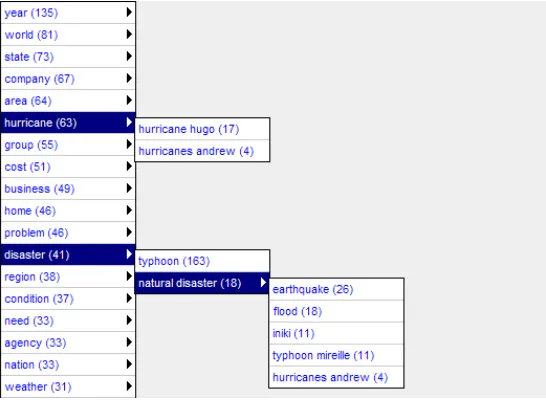
Fig. 3. Sample hierarchy generated by the trigger phrase approach with the top 200 documents
retrieved in response to the query typhoon hurricane. Noun phrases such as hurricane hugo and
hurricane andrew can be found under the head noun ”hurricane” at the top level of the hierarchy.
[image:5.612.171.444.333.533.2]Furthermore, the head noun of phrases is identified and set as a superordinate of the phrases (similar to [12]). For example, organisations (head noun) is set as a superordi-nate of international organisations. This head noun extraction also helps the hierarchy to include more phrases that contains the same head noun. In other words, this approach attempts to generate a hierarchy of noun phrases using the lexical evidence and the head nouns. A sample hierarchy using this approach can be found in Fig. 3.
CiQuest system in use Once a hierarchical structure of related concepts is generated,
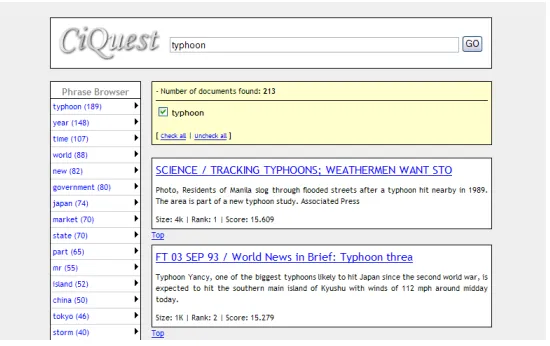
[image:6.612.172.447.255.428.2]the system visualises it using cascading menus. The top level of hierarchies are shown in the left side of the main result page (See Fig 4). Our principle regarding the integration of the hierarchy into an IR system’s interface is to provide the functionality without disturbing the default search process. The default search process is to submit a query, look through the hitlist, and open a page to access the fulltext.
Fig. 4. CiQuest system: Top level of menu is shown along with the search result
Backend IR system: CiQuest system in the current paper was integrated into the
Okapi system [13]. The best passage identified by the weighting scheme was displayed in every record of search results.
Browsing the hierarchy: When a mouse pointer is placed on a concept in the menu,
a list of its subordinate concepts is displayed. The presence of subordinates is indicated by a small triangle arrow at the right-side of each entry.
Focusing on a subset: When a concept in the menu is clicked, a set of documents in
Refreshing the hierarchy: When another query is submitted, the hierarchy is
auto-matically refreshed based on a set of documents retrieved in response to the new query.
2.3 Experimental Procedures
Experiments were based on the CiQuest system, but three different versions were de-vised for the test. The first was a baseline system which offered no support function. The second and third versions each incorporated the subsumption and the trigger phrase approaches respectively. Although the underlying functionality was different, subjects were not made aware of this as they searched through a common web-based interface.
Each test subject undertook searches on three TREC-8 topics, one to test each ver-sion of the system. The allocation of topics and test system was done randomly so that each topic was, thus, searched by six subjects. Participants were briefed on two tasks: the first was the instance finding tasks as described above. The second task, query
opti-mising, required searchers to generate a so-called optimal or best query based on their
search experience of the topic. The optimising task made it possible to compare the effectiveness of the optimal query with that of the initial query based on precision and recall for document relevance as used for the TREC Ad-hoc task, as opposed to the instance relevance used in the Interactive task.
The first exeriment, therefore, is the true interactive searching task, and the second experiment is a black-box input/output approach which does not take account of user interaction.
After the demonstration of the system, subjects were given several minutes to use the system with a sample topic. The subjects were then given 10 minutes for the instance finding task, but were allowed to take as long as they wish for the query optimising task. However, they tended to complete the task within a couple of minutes. Subjects also completed questionnaires at the beginning of the test session, after each search, and on completing the whole experiment. The questionnaires were based on the instruments developed for the TREC Interactive Track. The procedure took 60 to 90 minutes in total for each subject.
3
Results and Analysis
The results and analysis of our experiments using the precision/recall measures3, log
analysis, questionnaire, and manual observation are as follows. Three groups of the system settings as described above will be referred to as the Baseline, Subsump menu, and Trigger menu in this section.
3.1 Instance finding task
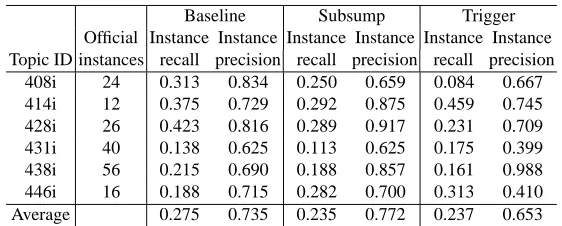
Instance recall and precision The instance recall is calculated based on the number
of instances correctly identified by the subjects divided by the total number of instances 3
identified by the NIST assessors (called official instances). The instance precision is calculated based on the number of correctly identified instances divided by the total number of instances identified by the subjects.
Table 1. Instance recall and precision
Baseline Subsump Trigger Official Instance Instance Instance Instance Instance Instance Topic ID instances recall precision recall precision recall precision 408i 24 0.313 0.834 0.250 0.659 0.084 0.667 414i 12 0.375 0.729 0.292 0.875 0.459 0.745 428i 26 0.423 0.816 0.289 0.917 0.231 0.709 431i 40 0.138 0.625 0.113 0.625 0.175 0.399 438i 56 0.215 0.690 0.188 0.857 0.161 0.988 446i 16 0.188 0.715 0.282 0.700 0.313 0.410 Average 0.275 0.735 0.235 0.772 0.237 0.653
Table 1 shows the instance recall and precision of the three groups. Each topic was used by two subjects in all groups. Although the difference among the groups are generally small, the result shows that the Baseline’s recall is higher than the menu groups while the Subsump achieved the highest precision among them.
As for the higher recall with the Baseline, two reasons can be possible. One is that the Okapi back-end IR system performed well [14], thus, the subjects could find relevant instances without support. Another is that the Baseline group could spent more time to examine a greater number of documents while the menu groups were spending the time browsing the hierarchies. However, the higher precision with the Subsump suggests that the accuracy of identifying relevant instances can be improved by the hierarchies.
Document access rate The subjects were asked to save a document in which they
found one or more instances. Table 2 shows the number of documents in which subjects selected and viewed the full-text (called seen documents) and documents that were actually saved as relevant.
As can be seen, the subjects viewed more documents in the Baseline than the Sub-sump or Trigger but saved less frequently. With the menus the seen documents were more often saved. Here, with the previous table’s result, we can see a trend of improv-ing the accuracy of identifyimprov-ing relevant documents and instances when the hierarchies were used.
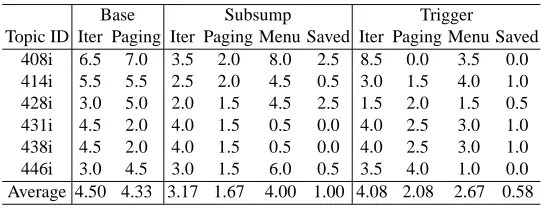
Interaction, paging, and access to the menu Table 3 shows the data about the
Table 2. Document access rate (%)
Base Subsump Trigger Topic ID Seen doc Saved doc Rate Seen doc Saved doc Rate Seen doc Saved doc Rate
408i 18.5 9.0 52.58 16.5 8.0 47.98 10.5 2.5 26.44 414i 11.0 4.5 40.00 6.0 2.5 41.43 10.5 3.5 36.12 428i 14.0 11.0 80.75 13.5 9.0 66.49 9.0 7.0 77.78 431i 17.5 8.5 49.02 11.5 7.5 67.50 8.0 4.5 73.08 438i 23.5 17.0 72.64 12.0 11.0 92.86 11.0 9.0 83.04 446i 13.5 5.0 38.93 12.5 6.0 47.73 12.0 10.5 87.77 Average 16.3 9.17 55.65 12.0 7.3 60.66 10.2 6.2 64.04
Table 3. Iteration, paging, and access to the menu
Base Subsump Trigger Topic ID Iter Paging Iter Paging Menu Saved Iter Paging Menu Saved
408i 6.5 7.0 3.5 2.0 8.0 2.5 8.5 0.0 3.5 0.0 414i 5.5 5.5 2.5 2.0 4.5 0.5 3.0 1.5 4.0 1.0 428i 3.0 5.0 2.0 1.5 4.5 2.5 1.5 2.0 1.5 0.5 431i 4.5 2.0 4.0 1.5 0.5 0.0 4.0 2.5 3.0 1.0 438i 4.5 2.0 4.0 1.5 0.5 0.0 4.0 2.5 3.0 1.0 446i 3.0 4.5 3.0 1.5 6.0 0.5 3.5 4.0 1.0 0.0 Average 4.50 4.33 3.17 1.67 4.00 1.00 4.08 2.08 2.67 0.58
First, the number of iterations shows that the subjects submitted fewer queries with the menu groups than the Baseline. Also, the frequency of going to the next page in the Baseline is higher than the menu groups. Both, along with Menu access information, indicate that the menus were used to focus on a subset of documents as opposed to submitting a new query or going to the next pages. Saved access is the number of accesses to the menus which lead to save any documents (i.e. find an instance). In this regard, it appears that the Subsump performed marginally better than the Trigger menu.
Summary Overall, the results from the instance finding task suggests that the menus
can be useful to accurately identity relevant information from search results, and reduce the number of iterations and paging actions (i.e. takes less effort).
3.2 Query optimising task
The query optimising task was evaluated using the relevance judgements of the TREC-8 Ad-hoc task. The purpose of this task was to compare the effectiveness of the optimal query with that of the initial query based on precision and recall for the full retrieved document sets, as opposed to the documents viewed and judged by the subjects.
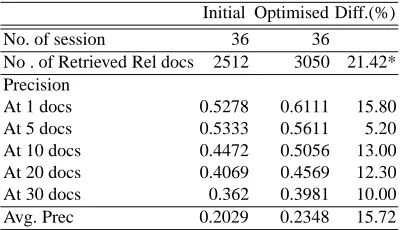
Overall Table 4 shows the retrieval effectiveness of initial queries, which are the first
after searching each topic. This result confirmed that the subjects could improve their initial queries after 10 minutes of search experience.
Table 4. Overall performance of query optimisation
Initial Optimised Diff.(%) No. of session 36 36 No . of Retrieved Rel docs 2512 3050 21.42* Precision
At 1 docs 0.5278 0.6111 15.80 At 5 docs 0.5333 0.5611 5.20 At 10 docs 0.4472 0.5056 13.00 At 20 docs 0.4069 0.4569 12.30 At 30 docs 0.362 0.3981 10.00 Avg. Prec 0.2029 0.2348 15.72 * indicates statistical significance atp <0.05
Out of 36 sessions, 32 initial queries were modified and four were unchanged. Out of 32 changed queries, 20 had an increase of terms, 6 had a decrease, and 6 had no difference in number. The number of increased terms varies between one and three with the average of 1.45 terms. Although the overall changes against the initial queries were small, As can be seen in Table 4, these small changes contributed to the retrieval of a significantly larger number of relevant documents.
Table 5. Query optimisation across the systems
Baseline Subsump Trigger Initial Opt. Diff.(%) Initial Opt. Diff.(%) Initial Opt. Diff.(%) No. of session 12 12 12 12 12 12
Retrieved Rel 781 979 25.35 923 1033 11.92 808 1038 28.47 Precision
At 1 docs 0.500 0.583 16.70 0.583 0.667 14.30 0.500 0.583 16.70 At 5 docs 0.517 0.550 6.50 0.517 0.533 3.20 0.567 0.600 5.90 At 10 docs 0.450 0.450 0.00 0.425 0.492 15.70 0.467 0.575 23.20 At 20 docs 0.396 0.425 7.40 0.400 0.454 13.50 0.425 0.492 15.70 At 30 docs 0.347 0.361 4.00 0.381 0.408 7.30 0.358 0.425 18.60 Avg. Prec. 0.195 0.224 14.97 0.208 0.228 10.01 0.206 0.252 22.17
Across the system setting Table 5 shows the comparison of initial and optimised
[image:10.612.163.456.401.529.2]queries. However, based on the previous task, we did not expect the Trigger menue session to outperform others. From the average precision we can see the Trigger menu contributed most in generating a better query, followed by the Baseline, and Subsump.
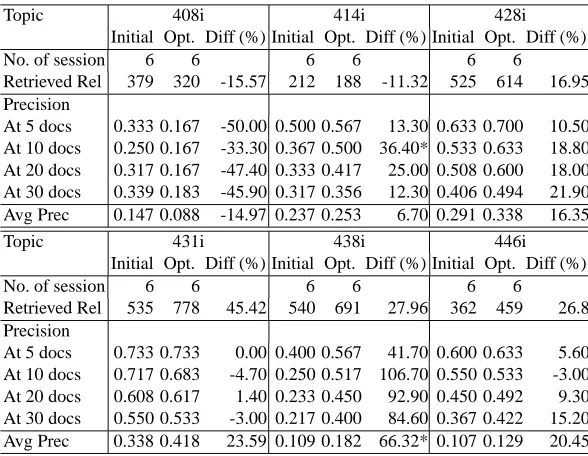
Across the topics Table 6 shows the retrieval effectiveness of both types of queries
over six topics used in our experiment. Overall, the optimised queries outperformed the initial ones in all topics with the exception of Topic 408i.
[image:11.612.160.454.255.483.2]An interesting point is that the improvement achieved by the optimised queries seems to be reasonably consistent across topics which had varied performances of the initial queries (e.g. from 0.1070 to 0.3383 in Average Precision). Although more data would be required to draw any conclusive comments, it seems that the optimised queries could improve the retrieval effectiveness regardless of the performance of initial results.
Table 6. Query optimisation across the topic
Topic 408i 414i 428i
Initial Opt. Diff (%) Initial Opt. Diff (%) Initial Opt. Diff (%) No. of session 6 6 6 6 6 6 Retrieved Rel 379 320 -15.57 212 188 -11.32 525 614 16.95 Precision
At 5 docs 0.333 0.167 -50.00 0.500 0.567 13.30 0.633 0.700 10.50 At 10 docs 0.250 0.167 -33.30 0.367 0.500 36.40* 0.533 0.633 18.80 At 20 docs 0.317 0.167 -47.40 0.333 0.417 25.00 0.508 0.600 18.00 At 30 docs 0.339 0.183 -45.90 0.317 0.356 12.30 0.406 0.494 21.90 Avg Prec 0.147 0.088 -14.97 0.237 0.253 6.70 0.291 0.338 16.35
Topic 431i 438i 446i
Initial Opt. Diff (%) Initial Opt. Diff (%) Initial Opt. Diff (%) No. of session 6 6 6 6 6 6
Retrieved Rel 535 778 45.42 540 691 27.96 362 459 26.8 Precision
At 5 docs 0.733 0.733 0.00 0.400 0.567 41.70 0.600 0.633 5.60 At 10 docs 0.717 0.683 -4.70 0.250 0.517 106.70 0.550 0.533 -3.00 At 20 docs 0.608 0.617 1.40 0.233 0.450 92.90 0.450 0.492 9.30 At 30 docs 0.550 0.533 -3.00 0.217 0.400 84.60 0.367 0.422 15.20 Avg Prec 0.338 0.418 23.59 0.109 0.182 66.32* 0.107 0.129 20.45 * indicates the statistical significance atp <0.05.
Summary The results from the query optimising task shows that the learning curve
This suggests two points. One is that the optimised queries generated by the menu groups could be based on the selection of the relevant documents from a wider range of rankings than the Baseline. Another possibility is that such optimised queries should stand a better chance to bring up the rankings of a wider range of relevant documents.
3.3 User perception
Now that the results based on the recall/precision and log analysis have been discussed, following two sections will present the results from the questionnaires and manual ob-servations.
Subjects were asked to fill in a short questionnaire after each session. The following aspects of the CiQuest system were investigated by the questionnaire:
1. Ease of use of the system
2. Size of menus (Too long or too many?)
3. The menus as a tool to help predicting the contents of linked documents 4. The menus as a tool to help relevance judgement of documents
5. The menus as a tool to help focusing on important terms
6. The menus as a tool to help understanding the contents of documents
7. The menus as a tool to help having a better idea of a set of retrieved documents 8. Preference of system settings
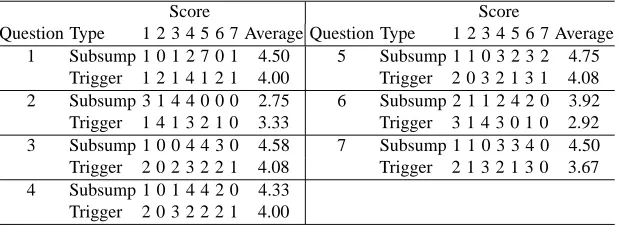
[image:12.612.155.464.358.471.2]The result of Question 1 to 7 is shown in Table 7.
Table 7. User perception (Score 1: Not at all, 4: Sometimes, 7: Always)
Score Score
Question Type 1 2 3 4 5 6 7 Average Question Type 1 2 3 4 5 6 7 Average 1 Subsump 1 0 1 2 7 0 1 4.50 5 Subsump 1 1 0 3 2 3 2 4.75
Trigger 1 2 1 4 1 2 1 4.00 Trigger 2 0 3 2 1 3 1 4.08 2 Subsump 3 1 4 4 0 0 0 2.75 6 Subsump 2 1 1 2 4 2 0 3.92 Trigger 1 4 1 3 2 1 0 3.33 Trigger 3 1 4 3 0 1 0 2.92 3 Subsump 1 0 0 4 4 3 0 4.58 7 Subsump 1 1 0 3 3 4 0 4.50 Trigger 2 0 2 3 2 2 1 4.08 Trigger 2 1 3 2 1 3 0 3.67 4 Subsump 1 0 1 4 4 2 0 4.33
Trigger 2 0 3 2 2 2 1 4.00
Use of system Question 1 asked the subjects how easy it was to use the system, rated
between 1 (Not at all) and 7 (Always). The table shows that the Trigger menu’s score is distributed across the scale, whereas the majority scored the Subsump menu at 5.
Size of menu Question 2 sought to establish to what extent the menus were considered
Predicting contents Question 3 asked how useful a menu was to predict the contents
of documents linked to the terms in a menu. The menu was designed to show a set of documents linked to each term in the menu when a user clicked it. As can be seen, the majority of subjects (11) gave a score between 4 and 7 for the Subsump menu. Although there were fewer subjects (8) for the Trigger menu who gave a score in this range, it appears that both types of menus succeeded in predicting the contents of linked documents.
Relevance judgement Question 4 asked how useful a menu was for judging the
rele-vance of documents during the sessions. Although the instance finding task was not to find a relevant document, the task latently involved the assessment of relevance (i.e. no instance would be found in a non-relevant document). The table shows that more subjects with the Subsump menu gave a score between 4 and 7 than with the Trigger menu.
Focusing on important terms Question 5 asked how useful a menus was for focusing
on terms of interest. As described before, the hierarchy provided a means of narrowing down to a subset of retrieved documents regardless of its ranked position. The scores of both types of menus were well distributed in the range above 4. The Subsump menu seemed to gain a slightly higher overall score than the Trigger menu.
Understanding contents Question 6 asked how useful a menu was to understand the
contents of documents. The table shows that the scores for the Subsump menu are gen-erally high with the score 5 as the peak while the Trigger menu has the peak at the score 3.
Better idea of retrieved documents Question 7 asked if a menu provided a better idea
of a set of retrieved documents as opposed to individual documents. Similar to the previous question the Subsump menu seemed to gain a higher overall score than the Trigger menu.
Preference of system setting After the completion of all sessions the subjects were
asked their preference among the three settings with the overall feedback against the system. Two points became clear from the final questionnaire. First, more than half of the subjects showed their preference for the Baseline system because of its simplicity and familiarity. Second, most subjects except two did not clearly notice the difference between the two types of menus in terms of how to organise terms. This point will be discussed further in a later section.
Summary The subjective evaluation of the hierarchies was presented through the
3.4 Other user behaviour
In addition to the precision/recall evaluation, analysis of system logs, and question-naires, observations were made and recorded manually during the sessions, the follow-ing describe some typical user behaviours.
Accessing the hierarchies The most commong approach for accessing the hierarchy
was:
1. Submit a query;
2. Examine several records in the first page of the results; then 3. Browse the hierarchy.
This route seems to show that the primary concern in the search process is on the documents. However it was found that many subjects decided to browse the menus after the first-page examination, as opposed to going on to the next page. This also seems to be influenced by the results of the first-page examination. When a subject found a reasonable amount of relevant documents in the first page, they tended to go to the next page. The hierarchy seemed to be accessed more frequently when the subjects were less satisfied with the first page.
Using the hierarchies It was observed that there were two typical ways of using the
hierarchy. One was to focus on a subset of documents. This was the most popular way to use the menus as described above. However, another way was to assess the potential usefulness of terms. In other words, some subjects selected a term, examined the title and best paragraph of the top linked documents, selected another term, examined the list, and repeated this process.
Browsing the hierarchies The top level terms of the menu seem to be very important
for the subjects in using the hierarchy. In particular it was observed that the absence of query terms at the top level seemed to discourage browsing through the hierarchy. This happened more often in the Trigger menu than in the Subsump menu. Hence, the top level terms were regarded as a starting point.
Another observation is that the subjects tended to go back to the same parent term when one of its children was found to be useful, and try another child term.
A final comment is that users’ browsing action (i.e. movement from one concept to another) tended to be carried out easily and speedly. Although the subjects com-mented that they were aware of some irrelevant concepts included in the hierarchies, they seemed to be capable of filtering out those concepts during their tasks.
4
Conclusion and future work
4.1 Conclusive discussion
the system as well as the standard precision/recall measures. From the instance finding task, it was found that the Baseline was also effective due to the good performance of our IR system, but the precision can be improved with the hierarchies. The query optimising task indicated that the hierarchies could help improve the precision at the higher document levels (i.e. 5 to 30) more significantly than the Baseline.
Questionnaires and manual observation revealed that the hierarchical structures can be easily used and be useful to support the information accessing process. Also several interesting user behaviours that can be characteristic in the use of concept hierarchies were identified and discussed. The main highlights of our findings are:
1. the hierarchy is often accessed after an examination of the first page of search re-sults;
2. accessing the hierarchies reduces the number of iterations and paging actions; 3. accessing the hierarchies increases the chance of finding relevant items more
accu-rately than the Baseline;
4. the hierarchical structure helps the users to handle a large number of concepts; and finally,
5. subjects were not aware of the difference between two types of hierarchies.
4.2 Future work
In the query optimising task the Trigger hierarchy seems to slightly outperform the Subsump hierarchy. However the questionnaire indicated that the Subsump hierarchy was preferable. This suggests both approaches have can be beneficial as a means of generating a concept hierarchy to support information retrieval. Therefore an integration of two approaches is worthy a further investigation.
Exploring other techniques to determine the hierarchical relations between concepts should also be examined. For example, we came across the research by Bookstein [15] during the development of our system. Their analysis of symmetric and asymmetric relations between terms by measuring clumping strength could also be of interest.
5
Acknowledgements
The authors thank to the participants of our experiments from Department of Informa-tion Studies and Computer Science at the University of Sheffield. This work was carried out as a part of the CiQuest project, which was funded by the Library and Information Commission (now re:source, the Council for Museums, Archives and Libraries). Any opinions, findings, and conclusions described here are the authors and do not necessar-ily reflect those of the sponsor.
References
2. Ruthven, I.: Re-examining the potential effectiveness of interactive query expansion. In Callan, J., Cormack, G., Clarke, C., Hawking, D., Smeaton, A., eds.: Proceedings of the 26th Annual International ACM SIGIR Conference on Research and Development in Information Retrieval, Tronto, Canada, ACM (2003) 213–220
3. Pollitt, S.: Interactive information retrieval based on faceted classification using views. In: Proceedings of the 6th International Study Conference on Classifica-tion (FID/CR), London, UK, University College of London (1997) Available from http://scom.hud.ac.uk/external/research/CeDAR/dorking.htm [Accessed: 08/01/2004]. 4. Joho, H., Coverson, C., Sanderson, M., Beaulieu, M.: Hierarchical presentation of expansion
terms. In: Proceedings of the 17th ACM Symposium on Applied Computing (SAC’02), Madrid, Spain, ACM (2002) 645–649
5. Hersh, W., Over, P.: Trec-8 interactive track report. In Voorheer, E.M., Harman, D.K., eds.: NIST Special Publication 500-246: The Eighth Text REtrieval Conference (TREC-8), Gaithersburg, ML, NIST (2000) 57–64
6. Sanderson, M., Croft, B.: Deriving concept hierarchies from text. In Hearst, M., Gey, G., Tong, R., eds.: Proceedings of the 22nd Annual International ACM SIGIR Conference on Research and Development in Information Retrieval, Berkeley, CA, ACM (1999) 206–213 7. Niwa, Y., Nishioka, S., Iwayama, M., Takano, A.: Topic graph generation for query
naviga-tion: Use of frequency classes for topic extraction. In: Proceedings of the Natural Language Processing Pacific Rim Symposium (NLPRS’97), Phuket, Thailand (1997) 95–100 8. Nanas, N., Uren, V., De Roeck, A.: Building and applying a concept hierarchy
represen-tation of a user profile. In Callan, J., Cormack, G., Clarke, C., Hawking, D., Smeaton, A., eds.: Proceedings of the 26th Annual International ACM SIGIR Conference on Research and Development in Information Retrieval, Tronto, Canada, ACM (2003) 198–204
9. Anick, P.G., Tipirneni, S.: The paraphrase search assistant: Terminological feedback for iterative information seeking. In Hearst, M., Gey, G., Tong, R., eds.: Proceedings of the 22nd Annual International ACM SIGIR Conference on Research and Development in Information Retrieval, Berkeley, CA, ACM (1999) 153–161
10. Hearst, M.A.: Automatic acquisition of hyponyms from large text corpora. In: Proceedings of the Fourteenth International Conference on Computational Linguistics, Nantes, France (1992) 539–545
11. Miller, G.A.: Wordnet: A lexical database for english. Communications of the ACM 38 (1995) 39–41
12. Wacholder, N., Evans, D.K., Klavans, J.L.: Automatic identification and organization of index terms for interactive browsing. In: Proceedings of the first ACM/IEEE-CS joint con-ference on Digital libraries, Roanoke, VA, ACM (2001) 126–134
13. Robertson, S., Walker, S., Hancock-Beaulieu, M.: Large test collection experiments on an operational, interactive system: Okapi at trec. Information Processing & Management 31 (1995) 345–360
14. Fowkes, H., Beaulieu, M.: Interactive searching behaviour: Okapi experiment for trec 8. In Robertson, S., Ayse, G., eds.: Proceedings of the BCS-IRSG 22nd Annual Colloquium on Information Retrieval Research, Cambridge, UK, BSC-IRSG (2000) 47–56