OSA Annual Report
2010
Office of the Schools AdjudicatorMowden Hall Staindrop Road Darlington
PMS ??? PMS ??? PMS ??? PMS ???
Non-print 1 Non-print 2
JOB LOCATION:
PRINERGY 3
Section Page
1. Introduction ...4
2. Executive summary ...5
3. Background ...7
4. Review of the 2009 Report Recommendations ...9
5. Review of the year 2009/2010 ...12
6. LA Reports ...25
Fair Access Protocols ... 25
Infant Class Size ... 26
Admission Appeals ... 26
Specific Groups ... 27
Effectiveness of Co-ordination ... 28
Compliance... 28
Admission Forums ... 28
Free School Meals ... 29
Other Matters Affecting Fairness ... 30
Choice Advice ... 31
Transport ... 31
School Uniform ... 31
Other issues ... 32
7. OSA Compliance Exercise ...33
LA Arrangements for Primary Schools ... 34
LA Arrangements for Secondary Schools ... 34
Own Admission Authorities (OAAs) ... 34
Primary OAAs ... 34
Secondary OAAs ... 35
Other issues ... 36
8. Fraudulent and misleading applications ...37
9. Concluding comments ...38
10. Recommendations ...40
11. Appendices ...41
1. Case details 2009/2010 and 2008/2009 ... 41
Section Page
1. Introduction ...4
2. Executive summary ...5
3. Background ...7
4. Review of the 2009 Report Recommendations ...9
5. Review of the year 2009/2010 ...12
6. LA Reports ...25
Fair Access Protocols ... 25
Infant Class Size ... 26
Admission Appeals ... 26
Specific Groups ... 27
Effectiveness of Co-ordination ... 28
Compliance... 28
Admission Forums ... 28
Free School Meals ... 29
Other Matters Affecting Fairness ... 30
Choice Advice ... 31
Transport ... 31
School Uniform ... 31
Other issues ... 32
7. OSA Compliance Exercise ...33
LA Arrangements for Primary Schools ... 34
LA Arrangements for Secondary Schools ... 34
Own Admission Authorities (OAAs) ... 34
Primary OAAs ... 34
Secondary OAAs ... 35
Other issues ... 36
8. Fraudulent and misleading applications ...37
9. Concluding comments ...38
10. Recommendations ...40
11. Appendices ...41
1. Case details 2009/2010 and 2008/2009 ... 41
4 www.schoolsadjudicator.gov.uk www.schoolsadjudicator.gov.uk 5
Introduction
I am pleased to be able to present my report on the work of the Office of the Schools Adjudicator for the year 1 September 2009 – 31 August 2010.
This is the eleventh Annual Report of the Chief Schools Adjudicator for England and my second in that role. When I reported last year I had only been in the post for five months, so much of what I reported had been overseen by my predecessor, Sir Philip Hunter, and by Dr Elizabeth Passmore OBE who had acted as interim Chief Adjudicator for three months pending my arrival.
My first complete year has been a busy and interesting one spanning the change of Government in May, and one that has seen a considerable increase in parental interest and challenge, particularly in the area of admissions.
The report generally follows the format of last year’s document, but has responded to feedback by aiming to be more ‘printer friendly’ and easier to read by, amongst other things, the omission of coloured pages and photographs.
I hope that the Secretary of State finds this report useful. Feedback suggested that last year’s report was also considered to be useful by admission authorities and others (especially parents) with an interest in our work. I hope that this year’s report is also of interest to a similarly wide audience.
Ian Craig
Chief Schools Adjudicator
Office of the Schools Adjudicator Mowden Hall
Staindrop Road Darlington DL3 9BG
Tel: 01325 735303
Email: [email protected]
Executive summary
The period covered by this report has been very busy, the office dealing with 539 referrals this year compared to 399 last year, with a considerable increase over the year in parental interest and challenge. Although a significant increase, many cases involved multiple challenges to the same school or Local Authority (LA). This increase also needs to be put within the context of 152 LAs and over 5,000 Own Admission Authority (OAA) state funded schools in England that could be referred.
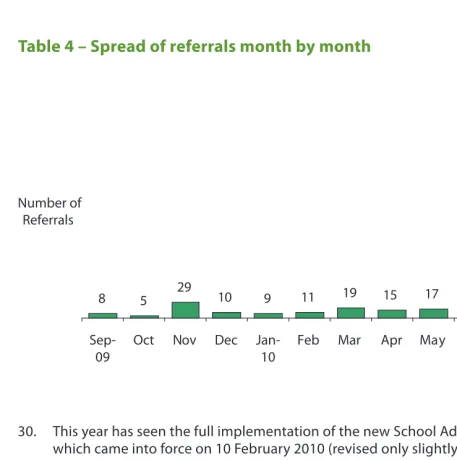
The largest increase was in Admission referrals which almost doubled. Over two-thirds of these referrals took place in July leaving little time to resolve them in time for the start of the new school year. 92% of admission referrals this year were from parents.
In general adjudicators consider that arrangements are getting better, with most challenges no longer about obvious errors and omissions, but usually relating to the interpretation of the School Admissions Code (The Code) in the local context.
Issues that have been notable this year relate to separating aptitude and ability testing, admission arrangements for sixth forms, and points systems used in oversubscription criteria.
Of the admission objections determined and published during the year, approximately half were upheld.
More than two-thirds of the Variations requested this year related to in-year changes to Published Admission Numbers (PANs), which can only be requested due to ‘significant and unforeseen changes in circumstances’. In some cases applications were considered by adjudicators neither to be significant nor unforeseen, and in others it was considered that they could reasonably wait for the next annual round of consultation.
Statutory Proposals referred this year were similar in number to last year, and most came to an adjudicator because regulation required them to do so, rather than because of local disputes. Many still came to us because the LA failed to determine them within the regulatory timescale.
For the third year running, the number of Pupil Directions referred to us have reduced – only ten for the whole year. This is excellent news, confirming that local arrangements for hard to place pupils are now working well. There is however still evidence that incorrect procedures are being used that often delay (but not prevent) access for these pupils, with consequent loss of their education.
Land Transfers remain a minor, but very time-consuming, activity for us.
Introduction
I am pleased to be able to present my report on the work of the Office of the Schools Adjudicator for the year 1 September 2009 – 31 August 2010.
This is the eleventh Annual Report of the Chief Schools Adjudicator for England and my second in that role. When I reported last year I had only been in the post for five months, so much of what I reported had been overseen by my predecessor, Sir Philip Hunter, and by Dr Elizabeth Passmore OBE who had acted as interim Chief Adjudicator for three months pending my arrival.
My first complete year has been a busy and interesting one spanning the change of Government in May, and one that has seen a considerable increase in parental interest and challenge, particularly in the area of admissions.
The report generally follows the format of last year’s document, but has responded to feedback by aiming to be more ‘printer friendly’ and easier to read by, amongst other things, the omission of coloured pages and photographs.
I hope that the Secretary of State finds this report useful. Feedback suggested that last year’s report was also considered to be useful by admission authorities and others (especially parents) with an interest in our work. I hope that this year’s report is also of interest to a similarly wide audience.
Ian Craig
Chief Schools Adjudicator
Office of the Schools Adjudicator Mowden Hall
Staindrop Road Darlington DL3 9BG
Tel: 01325 735303
Email: [email protected]
Executive summary
The period covered by this report has been very busy, the office dealing with 539 referrals this year compared to 399 last year, with a considerable increase over the year in parental interest and challenge. Although a significant increase, many cases involved multiple challenges to the same school or Local Authority (LA). This increase also needs to be put within the context of 152 LAs and over 5,000 Own Admission Authority (OAA) state funded schools in England that could be referred.
The largest increase was in Admission referrals which almost doubled. Over two-thirds of these referrals took place in July leaving little time to resolve them in time for the start of the new school year. 92% of admission referrals this year were from parents.
In general adjudicators consider that arrangements are getting better, with most challenges no longer about obvious errors and omissions, but usually relating to the interpretation of the School Admissions Code (The Code) in the local context.
Issues that have been notable this year relate to separating aptitude and ability testing, admission arrangements for sixth forms, and points systems used in oversubscription criteria.
Of the admission objections determined and published during the year, approximately half were upheld.
More than two-thirds of the Variations requested this year related to in-year changes to Published Admission Numbers (PANs), which can only be requested due to ‘significant and unforeseen changes in circumstances’. In some cases applications were considered by adjudicators neither to be significant nor unforeseen, and in others it was considered that they could reasonably wait for the next annual round of consultation.
Statutory Proposals referred this year were similar in number to last year, and most came to an adjudicator because regulation required them to do so, rather than because of local disputes. Many still came to us because the LA failed to determine them within the regulatory timescale.
For the third year running, the number of Pupil Directions referred to us have reduced – only ten for the whole year. This is excellent news, confirming that local arrangements for hard to place pupils are now working well. There is however still evidence that incorrect procedures are being used that often delay (but not prevent) access for these pupils, with consequent loss of their education.
Land Transfers remain a minor, but very time-consuming, activity for us.
6 www.schoolsadjudicator.gov.uk www.schoolsadjudicator.gov.uk 7 independent admission appeals panels in their areas were working effectively, although
a large minority were unsure about how compliant panels for OAA schools were with the School Admission Appeals Code, and had no way of checking. There were concerns expressed about the new requirement to coordinate in-year applications.
It was disappointing only to have received seven Admission Forum reports by 30 June, and equally disappointing that only 39% of LAs had shared their LA Report with their Admission Forum before it was sent to the OSA.
Choice Advice now seems to be well established, but proposals for expansion of the service by a number of LAs next year may now be in doubt.
Adjudicators carried out a more limited Compliance exercise this year, looking in detail at only 17 LAs. This showed improvements in most areas adjudicators examined, but there remain significant gaps, particularly in the arrangements and processes of OAAs. The picture of compliance in the Adjudicator sample provided a significantly less positive picture than that provided by LAs in their own reports.
The Chief Adjudicator was only asked by the Secretary of State to make one specific report during the year covered by this report, on Fraudulent and Misleading Applications to schools. This report was delivered at the end of February 2010 and published on the OSA website. It received wide media coverage at the time, so is only mentioned in this report for completeness.
Inevitably a report of this kind identifies areas that can be further improved. That is one of its functions. However, this should not obscure the very positive messages that it also contains.
The report ends with five recommendations. They are:
Recommendation 1 – There should be one consistent, independent route through which all interested parties can object to the admission arrangements of all state schools for determination.
Recommendation 2 – The annual LA Report should have fewer prescribed headings, allowing for its focus to change year by year, to give a better national picture of the issues that are particularly pertinent at the time.
Recommendation 3 – There should be a requirement on LAs to have their annual reports discussed/reviewed (or possibly approved) by their Admission Forums prior to submission, leaving open the ability of the Forum to submit its own report, or supplementary comments, if it wished to do so.
Recommendation 4 – There should be a requirement for LAs to confirm to the DfE, by mid May each year, that their arrangements and those of all own admission
authorities (OAAs) in their areas (including sixth form arrangements and supplementary information forms), are published on their websites in accordance with the Code.
Recommendation 5 – The annual compliance exercise carried out by adjudicators should be discontinued and alternative arrangements put in place.
Background
1. The Office of the Schools Adjudicator (OSA) was formed in 1999 as a consequence of the School Standards and Framework Act 1998. The Office has a remit across the whole of England, but not for other parts of the United Kingdom.
2. Adjudicators resolve differences over the interpretation and application of legislation and guidance on admissions and the provision of school places. The five main functions of Schools Adjudicators are to:
• determine objections to school admission arrangements;
• decide on requests to vary determined admission arrangements;
• resolve disputes relating to school reorganisation proposals (including the
provision of new schools);• resolve disputes on the transfer and disposal of non playing field land and
assets; and• determine appeals from schools against a direction from a LA to admit a
particular pupil.3. The Chief Schools Adjudicator can also be asked by the Secretary of State to undertake other relevant tasks as appropriate.
4. There are currently ten Schools Adjudicators, including the Chief Adjudicator. Adjudicators are appointed for their knowledge of the school system and their ability to act impartially, independently and objectively. Their role is to look afresh at all cases referred to them and consider each case on its merits in the light of legislation, Statutory Guidance for Decision Makers on Statutory Proposals and the School Admissions Code (the Code). They evaluate and determine cases taking account of the reasons for disagreement at local level and the views of interested parties. In the case of school reorganisation proposals it is usual practice for adjudicators to hold public meetings. For other cases adjudicators hold meetings if they consider it to be helpful to them as they investigate a case.
5. Adjudicators are independent of the Department for Education (DfE), and from each other. They work alone in considering a referral to them unless the Chief Adjudicator assigns a particular case or cases to a panel of two or more adjudicators, in which case the panel will consider the case(s) together.
independent admission appeals panels in their areas were working effectively, although a large minority were unsure about how compliant panels for OAA schools were with the School Admission Appeals Code, and had no way of checking. There were concerns expressed about the new requirement to coordinate in-year applications.
It was disappointing only to have received seven Admission Forum reports by 30 June, and equally disappointing that only 39% of LAs had shared their LA Report with their Admission Forum before it was sent to the OSA.
Choice Advice now seems to be well established, but proposals for expansion of the service by a number of LAs next year may now be in doubt.
Adjudicators carried out a more limited Compliance exercise this year, looking in detail at only 17 LAs. This showed improvements in most areas adjudicators examined, but there remain significant gaps, particularly in the arrangements and processes of OAAs. The picture of compliance in the Adjudicator sample provided a significantly less positive picture than that provided by LAs in their own reports.
The Chief Adjudicator was only asked by the Secretary of State to make one specific report during the year covered by this report, on Fraudulent and Misleading Applications to schools. This report was delivered at the end of February 2010 and published on the OSA website. It received wide media coverage at the time, so is only mentioned in this report for completeness.
Inevitably a report of this kind identifies areas that can be further improved. That is one of its functions. However, this should not obscure the very positive messages that it also contains.
The report ends with five recommendations. They are:
Recommendation 1 – There should be one consistent, independent route through which all interested parties can object to the admission arrangements of all state schools for determination.
Recommendation 2 – The annual LA Report should have fewer prescribed headings, allowing for its focus to change year by year, to give a better national picture of the issues that are particularly pertinent at the time.
Recommendation 3 – There should be a requirement on LAs to have their annual reports discussed/reviewed (or possibly approved) by their Admission Forums prior to submission, leaving open the ability of the Forum to submit its own report, or supplementary comments, if it wished to do so.
Recommendation 4 – There should be a requirement for LAs to confirm to the DfE, by mid May each year, that their arrangements and those of all own admission
authorities (OAAs) in their areas (including sixth form arrangements and supplementary information forms), are published on their websites in accordance with the Code.
Recommendation 5 – The annual compliance exercise carried out by adjudicators should be discontinued and alternative arrangements put in place.
Background
1. The Office of the Schools Adjudicator (OSA) was formed in 1999 as a consequence of the School Standards and Framework Act 1998. The Office has a remit across the whole of England, but not for other parts of the United Kingdom.
2. Adjudicators resolve differences over the interpretation and application of legislation and guidance on admissions and the provision of school places. The five main functions of Schools Adjudicators are to:
• determine objections to school admission arrangements;
• decide on requests to vary determined admission arrangements;
• resolve disputes relating to school reorganisation proposals (including the
provision of new schools);• resolve disputes on the transfer and disposal of non playing field land and
assets; and• determine appeals from schools against a direction from a LA to admit a
particular pupil.3. The Chief Schools Adjudicator can also be asked by the Secretary of State to undertake other relevant tasks as appropriate.
4. There are currently ten Schools Adjudicators, including the Chief Adjudicator. Adjudicators are appointed for their knowledge of the school system and their ability to act impartially, independently and objectively. Their role is to look afresh at all cases referred to them and consider each case on its merits in the light of legislation, Statutory Guidance for Decision Makers on Statutory Proposals and the School Admissions Code (the Code). They evaluate and determine cases taking account of the reasons for disagreement at local level and the views of interested parties. In the case of school reorganisation proposals it is usual practice for adjudicators to hold public meetings. For other cases adjudicators hold meetings if they consider it to be helpful to them as they investigate a case.
5. Adjudicators are independent of the Department for Education (DfE), and from each other. They work alone in considering a referral to them unless the Chief Adjudicator assigns a particular case or cases to a panel of two or more adjudicators, in which case the panel will consider the case(s) together.
8 www.schoolsadjudicator.gov.uk www.schoolsadjudicator.gov.uk 9 6. Adjudicators are supervised by the Administrative Justice and Tribunals Council
(AJTC). They adhere to a strict Code of Conduct and do not normally take cases in LAs where they have worked in a substantial capacity during the last ten years or where they currently live. Adjudicators will not act where they have previously worked closely with individuals involved in a case of for any other reason if they feel that their objectivity might be compromised.
7. The OSA is a tribunal, and all adjudicators work within tribunal legislation and procedures. Decisions, once published, cannot be challenged other than through the Courts.
8. Determinations are legally binding on LAs and other admission authorities, therefore all are checked before publication by lawyers for their legal accuracy, and by the Chief Adjudicator for consistency. Adjudicators have regard to similar previous cases and determinations, but are not bound by them, as they are required to take the specific features and context of each new case into account.
Review of the 2009
Report recommendations
9. My last Annual Report (2009) concluded with eleven recommendations – twooutstanding from the previous year, four general recommendations arising from the Report, and five relating to the three specific reports commissioned during the year by the then Secretary of State, on Twins and Multiple Births, Random Allocation and Fraudulent Applications.
10. In November 2009, immediately following the submission of last year’s report to the Secretary of State, I received a letter from him in which he accepted ‘in principle’ all my recommendations, saying that he was asking officials to consider how they could be implemented. The subsequent change of Government in May this year has meant that most of the recommendations, which needed either a change of legislation, or changes to the Code, were put into abeyance pending consideration by new Ministers. Consequently, but understandably, many have not yet been implemented.
11. The recommendations, and their progress to date are as follows.
Recommendation 1 – To avoid continued confusion and mixed practice, definitions are still required in the Code (or until a new Code is published,
on the Guidance on Admissions section of the DCSF website) for key terms such as ‘parents’, ‘siblings’, distance’ and ‘home address’.
12. Although this recommendation, which has been outstanding since 2008, could be dealt with via the DfE website, officials were asked by the previous Secretary of State to consider how it could be met through an extension of the Glossary in the Code. It is therefore pending decisions by Ministers on how any revisions to the Code should be taken forward.
Recommendation 2 – Faith groups nationally should take responsibility for drawing up some model Supplementary Information Forms (SIFs) for use when determining the 2011 arrangements.
13. This recommendation has also been outstanding since 2008. Although this has been discussed by representatives of the faith groups, as yet it has not been acted upon by them.
6. Adjudicators are supervised by the Administrative Justice and Tribunals Council (AJTC). They adhere to a strict Code of Conduct and do not normally take cases in LAs where they have worked in a substantial capacity during the last ten years or where they currently live. Adjudicators will not act where they have previously worked closely with individuals involved in a case of for any other reason if they feel that their objectivity might be compromised.
7. The OSA is a tribunal, and all adjudicators work within tribunal legislation and procedures. Decisions, once published, cannot be challenged other than through the Courts.
8. Determinations are legally binding on LAs and other admission authorities, therefore all are checked before publication by lawyers for their legal accuracy, and by the Chief Adjudicator for consistency. Adjudicators have regard to similar previous cases and determinations, but are not bound by them, as they are required to take the specific features and context of each new case into account.
Review of the 2009
Report recommendations
9. My last Annual Report (2009) concluded with eleven recommendations – twooutstanding from the previous year, four general recommendations arising from the Report, and five relating to the three specific reports commissioned during the year by the then Secretary of State, on Twins and Multiple Births, Random Allocation and Fraudulent Applications.
10. In November 2009, immediately following the submission of last year’s report to the Secretary of State, I received a letter from him in which he accepted ‘in principle’ all my recommendations, saying that he was asking officials to consider how they could be implemented. The subsequent change of Government in May this year has meant that most of the recommendations, which needed either a change of legislation, or changes to the Code, were put into abeyance pending consideration by new Ministers. Consequently, but understandably, many have not yet been implemented.
11. The recommendations, and their progress to date are as follows.
Recommendation 1 – To avoid continued confusion and mixed practice, definitions are still required in the Code (or until a new Code is published,
on the Guidance on Admissions section of the DCSF website) for key terms such as ‘parents’, ‘siblings’, distance’ and ‘home address’.
12. Although this recommendation, which has been outstanding since 2008, could be dealt with via the DfE website, officials were asked by the previous Secretary of State to consider how it could be met through an extension of the Glossary in the Code. It is therefore pending decisions by Ministers on how any revisions to the Code should be taken forward.
Recommendation 2 – Faith groups nationally should take responsibility for drawing up some model Supplementary Information Forms (SIFs) for use when determining the 2011 arrangements.
13. This recommendation has also been outstanding since 2008. Although this has been discussed by representatives of the faith groups, as yet it has not been acted upon by them.
10 www.schoolsadjudicator.gov.uk www.schoolsadjudicator.gov.uk 11 14. This recommendation was accepted alongside a similar recommendation made by
Sir Jim Rose in his review of the primary curriculum, and was clarified in the revised Code that came into force on 10 February 2010. Paragraph 2.69 of the Code now says that ‘Admission authorities must allow parents of children who are offered a place at the school before they are of compulsory school age to defer their child’s entry until later in the school year’.
Recommendation 4 – Objections to the admission arrangements of Academies should be treated in the same way as other state funded schools and ‘determined’ by the Adjudicator.
15. It was accepted by the then Secretary of State that Academies’ admission arrangements being dealt with differently to other state funded schools was confusing to parents and others, as well as potentially being regarded as unfair. This recommendation was made at the same time as proposals to move admissions decisions from the Secretary of State to the Young People’s Learning Agency
(YPLA), acting on his behalf. It was agreed that as from 1 May 2010 an ‘interim’ position was put in place, whereby Academies’ objections could be received by either the YPLA or the OSA, and investigated by adjudicators who would write a draft determination, which would be sent to the YPLA to send out under their signature, on behalf of the Secretary of State. Should the YPLA disagree with the draft determination it would be referred to the Secretary of State for a decision. This is obviously a more sensible approach than before, but still not wholly satisfactory, as it still does not provide a consistent mechanism for dealing with all objections.
Recommendation 5 – An earlier date should be considered for submitting objections to the OSA against determined admission arrangements.
16. The then Secretary of State confirmed that he would ‘ask…officials to consider further how …concerns might be addressed’. Subsequent discussions have centred on a wish not to reduce the length of time that parents, particularly, have to object to arrangements. Currently arrangements do not have to be published until 1 May, with a cut off for objections three months later on 31 July. Because of the summer holiday period, with most schools closed (at least for part of that time), objections that arrive at the OSA towards the end of July cannot often be dealt with until the beginning of the autumn term – sometimes too late to have a decision publicised for the beginning of the following year’s admissions round. This remains a
serious concern.
Recommendation 6 – Due to pressure on the OSA over the summer months, the ‘compliance exercise’ should in future years be spread over the whole year.
17. It was agreed that there should be some flexibility in the way this exercise is conducted in future years, and is reflected by the smaller sample used for this exercise in 2010.
18. The following five recommendations (7-11), which were the result of specific
exercises commissioned by the then Secretary of State, are subject to consideration by new Ministers as part of their discussions on revisions of admissions legislation and the Code.
Recommendation 7 – To improve clarity for parents, all admission authorities should be required to consult on, and publish arrangements for the admission of twins and children from multiple births. This should include specific mention within oversubscription criteria for primary schools.
Recommendation 8 – To meet the Code’s advice about enabling twins and children from multiple births to be allocated places together at primary schools, the list of ‘excepted pupils’ in the ‘class size regulations’ should be extended to include them.
Recommendation 9 – The current legislation and guidance on Random Allocation of school places in the Code is appropriate, and does not currently need to change.
Recommendation 10 – Consider further actions that could be employed beyond ‘withdrawal of places’ where it can be proved that parents have knowingly used deception to gain a school place.
14. This recommendation was accepted alongside a similar recommendation made by Sir Jim Rose in his review of the primary curriculum, and was clarified in the revised Code that came into force on 10 February 2010. Paragraph 2.69 of the Code now says that ‘Admission authorities must allow parents of children who are offered a place at the school before they are of compulsory school age to defer their child’s entry until later in the school year’.
Recommendation 4 – Objections to the admission arrangements of Academies should be treated in the same way as other state funded schools and ‘determined’ by the Adjudicator.
15. It was accepted by the then Secretary of State that Academies’ admission arrangements being dealt with differently to other state funded schools was confusing to parents and others, as well as potentially being regarded as unfair. This recommendation was made at the same time as proposals to move admissions decisions from the Secretary of State to the Young People’s Learning Agency
(YPLA), acting on his behalf. It was agreed that as from 1 May 2010 an ‘interim’ position was put in place, whereby Academies’ objections could be received by either the YPLA or the OSA, and investigated by adjudicators who would write a draft determination, which would be sent to the YPLA to send out under their signature, on behalf of the Secretary of State. Should the YPLA disagree with the draft determination it would be referred to the Secretary of State for a decision. This is obviously a more sensible approach than before, but still not wholly satisfactory, as it still does not provide a consistent mechanism for dealing with all objections.
Recommendation 5 – An earlier date should be considered for submitting objections to the OSA against determined admission arrangements.
16. The then Secretary of State confirmed that he would ‘ask…officials to consider further how …concerns might be addressed’. Subsequent discussions have centred on a wish not to reduce the length of time that parents, particularly, have to object to arrangements. Currently arrangements do not have to be published until 1 May, with a cut off for objections three months later on 31 July. Because of the summer holiday period, with most schools closed (at least for part of that time), objections that arrive at the OSA towards the end of July cannot often be dealt with until the beginning of the autumn term – sometimes too late to have a decision publicised for the beginning of the following year’s admissions round. This remains a
serious concern.
Recommendation 6 – Due to pressure on the OSA over the summer months, the ‘compliance exercise’ should in future years be spread over the whole year.
17. It was agreed that there should be some flexibility in the way this exercise is conducted in future years, and is reflected by the smaller sample used for this exercise in 2010.
18. The following five recommendations (7-11), which were the result of specific
exercises commissioned by the then Secretary of State, are subject to consideration by new Ministers as part of their discussions on revisions of admissions legislation and the Code.
Recommendation 7 – To improve clarity for parents, all admission authorities should be required to consult on, and publish arrangements for the admission of twins and children from multiple births. This should include specific mention within oversubscription criteria for primary schools.
Recommendation 8 – To meet the Code’s advice about enabling twins and children from multiple births to be allocated places together at primary schools, the list of ‘excepted pupils’ in the ‘class size regulations’ should be extended to include them.
Recommendation 9 – The current legislation and guidance on Random Allocation of school places in the Code is appropriate, and does not currently need to change.
Recommendation 10 – Consider further actions that could be employed beyond ‘withdrawal of places’ where it can be proved that parents have knowingly used deception to gain a school place.
12 www.schoolsadjudicator.gov.uk www.schoolsadjudicator.gov.uk 13 24. The qualifications and backgrounds of all Adjudicators can be found on our website
at www.schoolsadjudicator.gov.uk
25. Although at one time there were sixteen adjudicators, at a time when the number of cases being dealt with was far fewer than now, I believe that the number of adjudicators we have now is about right.
26. The team of ten adjudicators (including the Chief Adjudicator) is supported by 5.8 full time equivalent staff in our Darlington office who double up as both administrators and case workers. Although our workload has increased this year, in order to be cost effective, this is one fewer full time equivalent support officer than we had last year. We also receive excellent ‘call-off’ support from two Treasury Solicitors (TSols) who ensure that our determinations are legally sound.
27. I believe with this small staff we provide excellent value for money in ensuring dispute resolution, equity and fairness in the provision of, and access to, school places across England.
28. Overall we dealt with 539 cases this year compared to 399 last year. The number of schools involved is of course much fewer as often a number of referrals relate to the same school. With the ‘potential market’ for our work being all state funded schools in England (approximately 23,000) adjudications still take place in a small proportion of the total.
Review of the year
2009/2010
19. The period 1 September 2009 – 31 August 2010 has been very busy for the OSA. There has been a considerable increase over the year in parental interest, and challenge, particularly in the area of admissions. This year has also seen a change of Government with a consequent re-focusing of interest in our work.
20. I am grateful to both Secretaries of State, Ed Balls and Michael Gove, and to their Ministers, for putting time aside in their very busy diaries for regular meetings with me. I am also grateful to senior officials at the DfE for their willingness to find time, often at short notice, to discuss issues of mutual importance. Although adjudicators are independent of the DfE it is crucial that we retain a good
working relationship.
21. I have also met during the year with individuals and groups that share an interest in our work, and have requested meetings, and I have sought out such meetings when it seemed to be appropriate.
22. At the time of writing last year’s report there were nine adjudicators in post (including myself). Currently there are ten. At the end of March this year, Dr Peter Matthews OBE, who had been an adjudicator for five years, retired. At the same time two new adjudicators, Dr Stephen Venner and Mrs Carol Parsons, took up their posts. The increase of one adjudicator adds only marginal additional costs to the OSA, as apart from bi-monthly team meetings that all adjudicators are expected to attend, fees are related to the number of cases received by the office, not the number of adjudicators.
23. Adjudicators are only paid for the time actually spent on cases and related work. Fee rates have not been increased since 2007, and all adjudicators work hard to restrict their travel and other costs. Using figures in the expenditure table in Appendix 2, a simple sum dividing the total fees paid out by the number of cases would provide an average cost per case, but this would be misleading, as every case is different and requires a hugely variable amount of time to be spent on it. However, I do believe that our costs compare favourably with other tribunals, and that adjudicators provide good value for money.
Dr Ian Craig Chief Adjudicator
Andrew Baxter
Canon Richard Lindley
Dr Peter Matthews OBE (until 31.3.2010)
Janet Mokades Alan Parker
Carol Parsons (from 1.4.2010)
Dr Elizabeth Passmore OBE John Simpson
Dr Bryan Slater
24. The qualifications and backgrounds of all Adjudicators can be found on our website at www.schoolsadjudicator.gov.uk
25. Although at one time there were sixteen adjudicators, at a time when the number of cases being dealt with was far fewer than now, I believe that the number of adjudicators we have now is about right.
26. The team of ten adjudicators (including the Chief Adjudicator) is supported by 5.8 full time equivalent staff in our Darlington office who double up as both administrators and case workers. Although our workload has increased this year, in order to be cost effective, this is one fewer full time equivalent support officer than we had last year. We also receive excellent ‘call-off’ support from two Treasury Solicitors (TSols) who ensure that our determinations are legally sound.
27. I believe with this small staff we provide excellent value for money in ensuring dispute resolution, equity and fairness in the provision of, and access to, school places across England.
28. Overall we dealt with 539 cases this year compared to 399 last year. The number of schools involved is of course much fewer as often a number of referrals relate to the same school. With the ‘potential market’ for our work being all state funded schools in England (approximately 23,000) adjudications still take place in a small proportion of the total.
Review of the year
2009/2010
19. The period 1 September 2009 – 31 August 2010 has been very busy for the OSA. There has been a considerable increase over the year in parental interest, and challenge, particularly in the area of admissions. This year has also seen a change of Government with a consequent re-focusing of interest in our work.
20. I am grateful to both Secretaries of State, Ed Balls and Michael Gove, and to their Ministers, for putting time aside in their very busy diaries for regular meetings with me. I am also grateful to senior officials at the DfE for their willingness to find time, often at short notice, to discuss issues of mutual importance. Although adjudicators are independent of the DfE it is crucial that we retain a good
working relationship.
21. I have also met during the year with individuals and groups that share an interest in our work, and have requested meetings, and I have sought out such meetings when it seemed to be appropriate.
22. At the time of writing last year’s report there were nine adjudicators in post (including myself). Currently there are ten. At the end of March this year, Dr Peter Matthews OBE, who had been an adjudicator for five years, retired. At the same time two new adjudicators, Dr Stephen Venner and Mrs Carol Parsons, took up their posts. The increase of one adjudicator adds only marginal additional costs to the OSA, as apart from bi-monthly team meetings that all adjudicators are expected to attend, fees are related to the number of cases received by the office, not the number of adjudicators.
[image:13.737.68.524.135.356.2]23. Adjudicators are only paid for the time actually spent on cases and related work. Fee rates have not been increased since 2007, and all adjudicators work hard to restrict their travel and other costs. Using figures in the expenditure table in Appendix 2, a simple sum dividing the total fees paid out by the number of cases would provide an average cost per case, but this would be misleading, as every case is different and requires a hugely variable amount of time to be spent on it. However, I do believe that our costs compare favourably with other tribunals, and that adjudicators provide good value for money.
Table 1 – Schools Adjudicators 2009/10
Dr Ian Craig Chief Adjudicator
Andrew Baxter
Canon Richard Lindley
Dr Peter Matthews OBE (until 31.3.2010)
Janet Mokades Alan Parker
Carol Parsons (from 1.4.2010)
Dr Elizabeth Passmore OBE John Simpson
Dr Bryan Slater
14 www.schoolsadjudicator.gov.uk www.schoolsadjudicator.gov.uk 15 30. This year has seen the full implementation of the new School Admissions Code
which came into force on 10 February 2010 (revised only slightly from the 2009 Code). Although we were beginning to see the implications of the changes made in 2009 at the time of my last report, this has been the first full year. The changes were generally well received by admission authorities. A recent independent report (NFER, 2010)1 found that 82% of LAs found the new Code to be ‘helpful’ or ‘very
helpful’, with only 7% being critical of it (the remainder were neutral).
31. The increase in parental challenges over the past year is, I believe, a testament to the breadth of the revised Code, and the guidance on appropriate practice contained within it.
Admission arrangements
32. Objections to admission arrangements have increased significantly this year to 387 referrals (201 last year). The vast majority received this year were from parents, which is to be welcomed, and is a significant difference from last year. This may be accounted for by increased parental awareness in objection processes brought about by publicity relating to the Code and by the work of the OSA.
33. The 356 parental referrals do not relate to 356 separate sets of school or LA arrangements objected to. In many cases one parent submits an objection, and in others several will work together to object. In others a number of parents will submit separate objections to the same school’s or LA’s arrangements.
[image:14.737.66.470.152.361.2]29. Pressure on the team is mainly in the summer months, and this is particularly related to objections to admission arrangements. This pressure arises at a time when schools are closed and LA staff are often away on their summer holidays, thus delaying many adjudications until the autumn.
Table 2 – Referrals by type 2008/09 and 2009/10
Table 3 – Percentages of total referrals by type 2009/10
201
56
113
19 10
387
57 74
11 10
Admission
Objections Variations ProposalsStatutory Directions TransferLand Number of
Referrals 2008/092009/10
71% 11%
2% 2%
14%
Admission Objections – 71%
Variations – 11%
Statutory Proposals – 14%
Directions – 2%
Land Transfer – 2%
8 5 29 10 9 11 19 15 17 34
369
13
Sep-09 Oct Nov Dec Jan-10 Feb Mar Apr May Jun Jul Aug Number of
Referrals
[image:14.737.75.481.481.650.2]30. This year has seen the full implementation of the new School Admissions Code which came into force on 10 February 2010 (revised only slightly from the 2009 Code). Although we were beginning to see the implications of the changes made in 2009 at the time of my last report, this has been the first full year. The changes were generally well received by admission authorities. A recent independent report (NFER, 2010)1 found that 82% of LAs found the new Code to be ‘helpful’ or ‘very
helpful’, with only 7% being critical of it (the remainder were neutral).
31. The increase in parental challenges over the past year is, I believe, a testament to the breadth of the revised Code, and the guidance on appropriate practice contained within it.
Admission arrangements
32. Objections to admission arrangements have increased significantly this year to 387 referrals (201 last year). The vast majority received this year were from parents, which is to be welcomed, and is a significant difference from last year. This may be accounted for by increased parental awareness in objection processes brought about by publicity relating to the Code and by the work of the OSA.
33. The 356 parental referrals do not relate to 356 separate sets of school or LA arrangements objected to. In many cases one parent submits an objection, and in others several will work together to object. In others a number of parents will submit separate objections to the same school’s or LA’s arrangements.
29. Pressure on the team is mainly in the summer months, and this is particularly related to objections to admission arrangements. This pressure arises at a time when schools are closed and LA staff are often away on their summer holidays, thus delaying many adjudications until the autumn.
Table 2 – Referrals by type 2008/09 and 2009/10
[image:15.737.70.528.91.551.2]Table 3 – Percentages of total referrals by type 2009/10
Table 4 – Spread of referrals month by month
201
56
113
19 10
387
57 74
11 10
Admission
Objections Variations ProposalsStatutory Directions TransferLand Number of
Referrals 2008/092009/10
71% 11%
2% 2%
14%
Admission Objections – 71%
Variations – 11%
Statutory Proposals – 14%
Directions – 2%
Land Transfer – 2%
8 5 29 10 9 11 19 15 17 34
369
13
Sep-09 Oct Nov Dec Jan-10 Feb Mar Apr May Jun Jul Aug Number of
Referrals
16 www.schoolsadjudicator.gov.uk www.schoolsadjudicator.gov.uk 17 37. Adjudicators have been concerned on a number of occasions this year that many
secondary schools with sixth forms seem ignorant of the fact that they must consult on, and determine arrangements for sixth forms as well as for the normal point of entry to the school (usually Year 7). Where they accept students from other schools into their sixth forms they are also required to consult on, and set, a separate Published Admission Number (PAN). Some also appeared to be unaware that academic requirements, where used, must apply equally to both internal and external candidates.
38. Faith schools are permitted by the Code (paragraph 2.46) to give higher priority in their admissions to ‘children who are members of, or who practise, their faith or denomination’. Issues have arisen again this year involving Voluntary Aided schools and diocesan authorities that are using faith criteria and associated points systems that fall outside this description, for example relating to involvement in activities that are beyond those that could reasonably be expected as part of religious membership or practise.
39. It has already been reported that changes have been made during the last year to involve the OSA in determining objections to Academy admission arrangements. However, the changes have provided only a partial solution to the problem, with ultimate responsibility for agreeing and issuing Academy determinations being retained by the YPLA, or by the Secretary of State. From a parental point of view, it would seem sensible to have one independent route through which they can object for all state funded schools rather than the mixed solution we now have. This is a particular issue as we are about to see more Academies (including Free School Academies) being created. There is an added issue that if different routes are being applied for different types of school, there could at some point in the future be a legal challenge relating to equity of treatment.
40. Some concern has been expressed during the year by some admission authorities about the Adjudicator’s powers under s88I(5) of the School Standards and
Framework Act 1998 (SSFA) (amended) to consider admissions arrangements that come to his/her attention ‘by any means other than those in s88I(4)’, for example, considering admission arrangements that come by way of comments from
parents, or where the Adjudicator becomes concerned about arrangements when considering some other matter that is referred.
41. Adjudicators should not be expected to ‘police’ the admissions system, seeking out contraventions as a matter of course. They should only act on referrals where the referrer perceives there to be inappropriate application of legislation or the Code. However, once having had a set of arrangements referred to them, adjudicators must be allowed to continue to rule on other contraventions of legislation or of the Code that come to their notice during the course of their investigation. It would be a retrograde step to prevent adjudicators from taking action in these circumstances.
42. Referring to the School Admissions Code as a ‘Code of Practice’ is still widespread, even amongst LA officers. The School Admissions Code contains both regulation (which is compulsory for all admission authorities) and guidance, but the
widespread use of the term Code of Practice gives the impression to schools, governors, parents and others that it need not necessarily be adhered to. 34. Adjudicators are again of a view (as they were last year) that in general
arrangements are getting better, and most challenges are not the obvious errors and omissions that were found previously, but often relate to interpretation of the Code in the local context. These in consequence tend to be complex issues to deal with.
35. Once more we have seen the trend noticed last year of the same, or very similar, objections coming forward for the same schools when arrangements or local circumstances have not changed since the previous adjudication. This tends to waste adjudicator time and resources, and it would be helpful if this could be prevented in the future. Unless published arrangements or local circumstances have changed, then a determination should be valid for the lifetime of
those arrangements.
36. Objections to aptitude testing have been forthcoming again this year, with some schools still employing tests that seem to be more related to ability testing (which is not generally allowed by the Code) than to aptitude. Adjudicators
[image:16.737.82.505.127.434.2]recognise that there is a fine line to be drawn between aptitude and ability testing, and this is often difficult to determine, even by experts in the field who we have in the past consulted.
Table 5 – Origins of admission referrals
92% 3%
3%
2% Parents – 92% (356)
Schools – 2% (8)
LAs – 3% (11)
37. Adjudicators have been concerned on a number of occasions this year that many secondary schools with sixth forms seem ignorant of the fact that they must consult on, and determine arrangements for sixth forms as well as for the normal point of entry to the school (usually Year 7). Where they accept students from other schools into their sixth forms they are also required to consult on, and set, a separate Published Admission Number (PAN). Some also appeared to be unaware that academic requirements, where used, must apply equally to both internal and external candidates.
38. Faith schools are permitted by the Code (paragraph 2.46) to give higher priority in their admissions to ‘children who are members of, or who practise, their faith or denomination’. Issues have arisen again this year involving Voluntary Aided schools and diocesan authorities that are using faith criteria and associated points systems that fall outside this description, for example relating to involvement in activities that are beyond those that could reasonably be expected as part of religious membership or practise.
39. It has already been reported that changes have been made during the last year to involve the OSA in determining objections to Academy admission arrangements. However, the changes have provided only a partial solution to the problem, with ultimate responsibility for agreeing and issuing Academy determinations being retained by the YPLA, or by the Secretary of State. From a parental point of view, it would seem sensible to have one independent route through which they can object for all state funded schools rather than the mixed solution we now have. This is a particular issue as we are about to see more Academies (including Free School Academies) being created. There is an added issue that if different routes are being applied for different types of school, there could at some point in the future be a legal challenge relating to equity of treatment.
40. Some concern has been expressed during the year by some admission authorities about the Adjudicator’s powers under s88I(5) of the School Standards and
Framework Act 1998 (SSFA) (amended) to consider admissions arrangements that come to his/her attention ‘by any means other than those in s88I(4)’, for example, considering admission arrangements that come by way of comments from
parents, or where the Adjudicator becomes concerned about arrangements when considering some other matter that is referred.
41. Adjudicators should not be expected to ‘police’ the admissions system, seeking out contraventions as a matter of course. They should only act on referrals where the referrer perceives there to be inappropriate application of legislation or the Code. However, once having had a set of arrangements referred to them, adjudicators must be allowed to continue to rule on other contraventions of legislation or of the Code that come to their notice during the course of their investigation. It would be a retrograde step to prevent adjudicators from taking action in these circumstances.
42. Referring to the School Admissions Code as a ‘Code of Practice’ is still widespread, even amongst LA officers. The School Admissions Code contains both regulation (which is compulsory for all admission authorities) and guidance, but the
widespread use of the term Code of Practice gives the impression to schools, 34. Adjudicators are again of a view (as they were last year) that in general
arrangements are getting better, and most challenges are not the obvious errors and omissions that were found previously, but often relate to interpretation of the Code in the local context. These in consequence tend to be complex issues to deal with.
35. Once more we have seen the trend noticed last year of the same, or very similar, objections coming forward for the same schools when arrangements or local circumstances have not changed since the previous adjudication. This tends to waste adjudicator time and resources, and it would be helpful if this could be prevented in the future. Unless published arrangements or local circumstances have changed, then a determination should be valid for the lifetime of
those arrangements.
36. Objections to aptitude testing have been forthcoming again this year, with some schools still employing tests that seem to be more related to ability testing (which is not generally allowed by the Code) than to aptitude. Adjudicators
recognise that there is a fine line to be drawn between aptitude and ability testing, and this is often difficult to determine, even by experts in the field who we have in the past consulted.
18 www.schoolsadjudicator.gov.uk www.schoolsadjudicator.gov.uk 19
Variations
45. During the period covered by this report Adjudicators have dealt with 57 requests to vary admission arrangements, almost exactly the same as the 56 requests in the previous year.
46. Variation requests fall into two distinct categories (i) to vary the arrangements themselves, and (ii) to change a PAN. The arrangements, including the PAN, should only be set following consultation for a particular year, and a Variation is only allowed due to a significant change in circumstances.
47. Of the 57 variation referrals received this year 40 (70%) have related to changes in PANs and only 17 (30%) to the arrangements themselves.
43. As shown by the LA reports, the majority of LAs (87.5%) believed that the
admission arrangements of all schools in their areas (including Academies where they exist) are compliant with the mandatory aspects of the Code and admissions legislation. This is not totally borne out by the (albeit limited) compliance exercise reported later in this Report. Only 14 LAs (9%) in their LA reports indicated that they had either already referred, or were considering referring, schools to the OSA during the year.
44. During the period covered by this report, 151 admission objections were
[image:18.737.68.530.119.760.2]determined and published. Of these, 45 were fully upheld, 27 partially upheld and in 79 cases the objection was not upheld.
Table 6 – Decisions by origin of referral
Upheld Part Upheld Not Upheld Totals
Parents 20 7 47 74
Schools 5 4 19 28
LAs 12 13 4 29
Other 8 3 9 20
[image:18.737.83.527.512.718.2]Totals 45 27 79 151
Table 7 – Admissions cases 1999/2010
48. Many of the cases this year have been related to unforeseen pressure on primary school places due to increases in primary cohorts. As last year there have been some that should have been foreseen by admission authorities, and could have been consulted on through the normal processes, and others that were not so critical that they could not wait until the following year for full consultation.
49. During the period covered by this report 59 Variation referrals were determined and published. Of these 41 were fully approved, three were either partially approved or approved with modifications, and 15 were not approved. 59
32 31
165 171
140
245
173
369
201
387
1999 /00
2000 /01
2001 /02
2002 /03
2003 /04
2004 /05
2005 /06
2006 /07
2007 /08
2008 /09
2009 /10
Number of referrals
30%
70%
Changes to arrangements – 30% (17)
Variations
45. During the period covered by this report Adjudicators have dealt with 57 requests to vary admission arrangements, almost exactly the same as the 56 requests in the previous year.
46. Variation requests fall into two distinct categories (i) to vary the arrangements themselves, and (ii) to change a PAN. The arrangements, including the PAN, should only be set following consultation for a particular year, and a Variation is only allowed due to a significant change in circumstances.
47. Of the 57 variation referrals received this year 40 (70%) have related to changes in PANs and only 17 (30%) to the arrangements themselves.
43. As shown by the LA reports, the majority of LAs (87.5%) believed that the
admission arrangements of all schools in their areas (including Academies where they exist) are compliant with the mandatory aspects of the Code and admissions legislation. This is not totally borne out by the (albeit limited) compliance exercise reported later in this Report. Only 14 LAs (9%) in their LA reports indicated that they had either already referred, or were considering referring, schools to the OSA during the year.
44. During the period covered by this report, 151 admission objections were
determined and published. Of these, 45 were fully upheld, 27 partially upheld and in 79 cases the objection was not upheld.
Table 6 – Decisions by origin of referral
Upheld Part Upheld Not Upheld Totals
Parents 20 7 47 74
Schools 5 4 19 28
LAs 12 13 4 29
Other 8 3 9 20
Totals 45 27 79 151
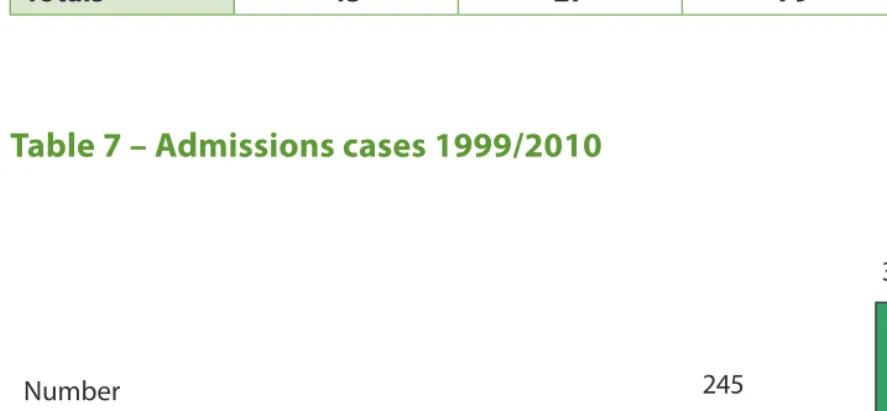
Table 7 – Admissions cases 1999/2010
Table 8 – Breakdown of Variation cases 2009/10
48. Many of the cases this year have been related to unforeseen pressure on primary school places due to increases in primary cohorts. As last year there have been some that should have been foreseen by admission authorities, and could have been consulted on through the normal processes, and others that were not so critical that they could not wait until the following year for full consultation.
49. During the period covered by this report 59 Variation referrals were determined and published. Of these 41 were fully approved, three were either partially approved or approved with modifications, and 15 were not approved. 59
32 31
165 171
140
245
173
369
201
387
1999 /00
2000 /01
2001 /02
2002 /03
2003 /04
2004 /05
2005 /06
2006 /07
2007 /08
2008 /09
2009 /10
Number of referrals
30%
70%
Changes to arrangements – 30% (17)
20 www.schoolsadjudicator.gov.uk www.schoolsadjudicator.gov.uk 21 54. Competitions involving LAs and other bidders are still very few – we have only had
five referred in the last three years since the introduction of the regulation (one in the period covered by this report), and in three of the five cases (one this year) the competition has been awarded to the outside bidder. Competitions are always decided impartially on the merits of the bids.
[image:20.737.112.525.157.379.2]55. During the period covered by this report, 73 statutory proposal referrals were determined and published. Of these 64 were fully approved, two approved with modifications and seven rejected.
Table 9 – Variation cases 1999/2010
Pupil directions
56. Under Sections 96 and 97 of the School Standards and Framework Act 1998, as amended by Section 49 of the Education and Inspections Act 1996, in certain circumstances, schools may appeal to the Schools Adjudicator if they are directed to take a pupil and they do not want to do so. This aspect of our work only has a three year history.
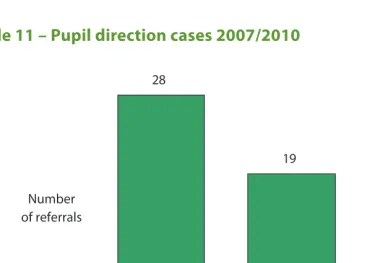
57. During the period covered by this report the Office has only had 11 referrals, down from 19 last year, and 28 the previous year. This is excellent news. Last year my report linked the reduction to the wider use of FAPs across LAs. This year’s LA reports show that FAPs are now well established which would account for this further reduction.
58. There is, however, evidence through referrals that direction procedures are not fully understood by some LAs and OAAs, and are consequently at times not applied correctly. This is unfortunate as incorrect procedures often waste time at the
Statutory proposals
50. After a major increase in statutory proposals referred to the Office last year, with 74 referrals this year we seem to have returned to a level similar to that seen for the previous two years. Many of the proposals this year have once more been related to increased pressure on primary provision, and again referrals have come to us usually because of regulation rather than because of local disputes.
51. One of the reasons for the large number last year was reported to be delays on the building of new schools related to new housing developments, requiring revised opening dates for proposals that had already been agreed. We have seen fewer of this type of referral this year.
52. Some LAs are still failing to determine ‘difficult’ proposals within the two months required by regulation following the end of the consultation period. There is still evidence that although this is sometimes for understandable reasons (for example extended local political processes), at other times it seems to be to ‘pass over’ a difficult decision to an outside body, thus saving the LA from taking a difficult decision.
53. Several cases have been referred to the OSA this year involving LAs having committed themselves to major building projects before having completed their full consultation processes. In two cases adjudicators did not subsequently approve proposals that had been committed to. LAs and schools should not
assume that determinations will go in their favour just because such commitments have been made.
15 9
19
33
47
58 60 59
66
56 57
1999/00 2000/01 2001/02 2002 /03 2003 /04 2004 /05 2005 /06 2006 /07 2007 /08 2008 /09 2009 /10 Number of referrals 10
28 28 35
54. Competitions involving LAs and other bidders are still very few – we have only had five referred in the last three years since the introduction of the regulation (one in the period covered by this report), and in three of the five cases (one this year) the competition has been awarded to the outside bidder. Competitions are always decided impartially on the merits of the bids.
55. During the period covered by this report, 73 statutory proposal referrals were determined and published. Of these 64 were fully approved, two approved with modifications and seven rejected.
[image:21.737.72.526.300.537.2]Table 9 – Variation cases 1999/2010
Table 10 – Statutory proposal cases 1999/2010
Pupil directions
56. Under Sections 96 and 97 of the School Standards and Framework Act 1998, as amended by Section 49 of the Education and Inspections Act 1996, in certain circumstances, schools may appeal to the Schools Adjudicator if they are directed to take a pupil and they do not want to do so. This aspect of our work only has a three year history.
57. During the period covered by this report the Office has only had 11 referrals, down from 19 last year, and 28 the previous year. This is excellent news. Last year my report linked the reduction to the wider use of FAPs across LAs. This year’s LA reports show that FAPs are now well established which would account for this further reduction.
58. There is, however, evidence through referrals that direction procedures are not fully understood by some LAs and OAAs, and are consequently at times not applied
Statutory proposals
50. After a major increase in statutory proposals referred to the Office last year, with 74 referrals this year we seem to have returned to a level similar to that seen for the previous two years. Many of the proposals this year have once more been related to increased pressure on primary provision, and again referrals have come to us usually because of regulation rather than because of local disputes.
51. One of the reasons for the large number last year was reported to be delays on the building of new schools related to new housing developments, requiring revised opening dates for proposals that had already been agreed. We have seen fewer of this type of referral this year.
52. Some LAs are still failing to determine ‘difficult’ proposals within the two months required by regulation following the end of the consultation period. There is still evidence that although this is sometimes for understandable reasons (for example extended local political processes), at other times it seems to be to ‘pass over’ a difficult decision to an outside body, thus saving the LA from taking a difficult decision.
53. Several cases have been referred to the OSA this year involving LAs having committed themselves to major building projects before having completed their full consultation processes. In two cases adjudicators did not subsequently approve proposals that had been committed to. LAs and schools should not
assume that determinations will go in their favour just because such commitments have been made.
15 9
19
33
47
58 60 59
66
56 57
1999/00 2000/01 2001/02 2002 /03 2003 /04 2004 /05 2005 /06 2006 /07 2007 /08 2008 /09 2009 /10 Number of referrals 10
28 28 35
22 www.schoolsadjudicator.gov.uk www.schoolsadjudicator.gov.uk 23
Table 11 – Pupil direction cases 2007/2010
Other issues
64. The OSA team (both adjudicators and office based staff) have worked hard this year to deal with referrals quickly as parents, children, schools and LAs need to know the outcome of cases as soon as possible. Where decisions have been delayed it has usually been because required information was not forthcoming due to school holidays.
65. The percentage of time spent by adjudicators on different types of case (Table 13 below) is very different to the percentage of total referrals shown in Table 3.
This is accounted for by (i) admission objections sometimes coming from multiple sources (often parents), which are capable of being dealt with together and (ii) high demands on time made by Statutory Proposals and Land Transfers. expense of the child involved. There is a need for LAs to more securely link their
FAPs to be consistent with the legislation relating to directions.
59. Once more I would like to use this report to remind those who use their right of appeal against direction that with the needs of the child in mind, adjudicators will interpret the statutory timescales rigorously, and will deal with the referral as speedily as possible.
60. During the period covered by this report five Pupil Direction referrals were determined and published. Of these, two were upheld and three not upheld.
Land Transfers
61. Land transfers remain a minor, but extremely time-consuming activity for adjudicators. Although the actual time spent working on such cases is not
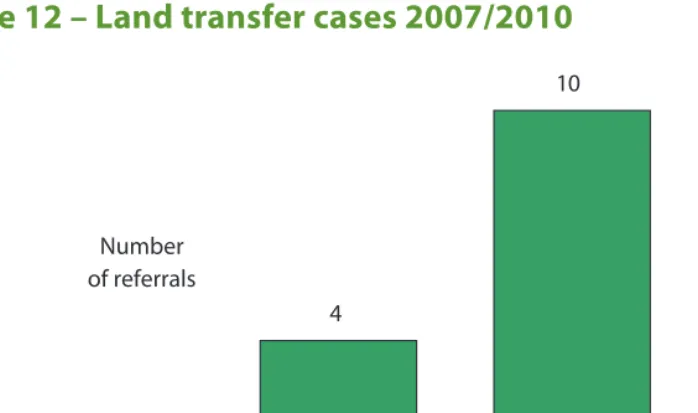
excessive, a great deal of information is usually required from a variety of sources which often takes weeks, or even months, to obtain. The numbers of referrals to the Office has remained stable this year at 10.
62. It is the nature of these disputes that by the time the Adjudicator gets involved, relationships between the parties have become very poor. However, a number of cases have arisen this year where the Adjudicator has been able to persuade the parties to reconsider their positions, and the case has been withdrawn without the need for a determination being made.
63. During the period covered by this report five land transfer referrals were
determined and published. Of these, two were fully upheld, two partially upheld and one not upheld.
28
19
11
2007/08 2008/09 2009/10
Number of referrals
45%
9% 37%
3% 6% Admission Objections – 45%
Variations – 9%
Statutory Proposals – 37%
Directions – 3%
Table 12 – Land transfer cases 2007/2010
[image:23.737.68.522.599.770.2]Table 13 – Percentage of adjudicator time by case type 2009/10
Table 11 – Pupil direction cases 2007/2010
Other issues
64. The OSA team (both adjudicators and office based staff) have worked hard this year to deal with referrals quickly as parents, children, schools and LA