0022-538X/05/$08.00⫹0 doi:10.1128/JVI.79.21.13239–13249.2005
Copyright © 2005, American Society for Microbiology. All Rights Reserved.
Selective Escape from CD8
⫹
T-Cell Responses Represents a Major
Driving Force of Human Immunodeficiency Virus Type 1 (HIV-1)
Sequence Diversity and Reveals Constraints on HIV-1 Evolution†
Todd M. Allen,
1Marcus Altfeld,
1Shaun C. Geer,
1Elizabeth T. Kalife,
1Corey Moore,
2Kristin M. O’Sullivan,
1Ivna DeSouza,
1Margaret E. Feeney,
1Robert L. Eldridge,
1Erica L. Maier,
1Daniel E. Kaufmann,
1Matthew P. Lahaie,
1Laura Reyor,
1Giancarlo Tanzi,
1Mary N. Johnston,
1Christian Brander,
1Rika Draenert,
1Jurgen K. Rockstroh,
3Heiko Jessen,
4Eric S. Rosenberg,
1Simon A. Mallal,
2and Bruce D. Walker
1*
Howard Hughes Medical Institute, Partners AIDS Research Center, and Infectious Disease Division, Massachusetts General
Hospital, and Division of AIDS, Harvard Medical School, Boston, Massachusetts1; Centre for Clinical Immunology
and Biomedical Statistics, Royal Perth Hospital, Wellington Street, Perth, WA 6000, Australia2; and Department of
Internal Medicine, University of Bonn, Bonn,3and Jessen Praxis, Berlin,4Germany
Received 7 March 2005/Accepted 22 July 2005
The sequence diversity of human immunodeficiency virus type 1 (HIV-1) represents a major obstacle to the development of an effective vaccine, yet the forces impacting the evolution of this pathogen remain unclear. To address this issue we assessed the relationship between genome-wide viral evolution and adaptive CD8ⴙT-cell responses in four clade B virus-infected patients studied longitudinally for as long as 5 years after acute infection. Of the 98 amino acid mutations identified in nonenvelope antigens, 53% were associated with detectable CD8ⴙ T-cell responses, indicative of positive selective immune pressures. An additional 18% of amino acid mutations represented substitutions toward common clade B consensus sequence residues, nine of which were strongly associated with HLA class I alleles not expressed by the subjects and thus indicative of reversions of transmitted CD8 escape mutations. Thus, nearly two-thirds of all mutations were attributable to CD8ⴙ T-cell selective pressures. A closer examination of CD8 escape mutations in additional persons with chronic disease indicated that not only did immune pressures frequently result in selection of identical amino acid substitutions in mutating epitopes, but mutating residues also correlated with highly polymorphic sites in both clade B and C viruses. These data indicate a dominant role for cellular immune selective pressures in driving both individual and global HIV-1 evolution. The stereotypic nature of acquired mutations provides support for biochemical constraints limiting HIV-1 evolution and for the impact of CD8 escape mutations on viral fitness.
One of the greatest challenges facing the design of an effec-tive human immunodeficiency virus type 1 (HIV-1) vaccine is the extensive global sequence diversity of this pathogen. Nu-merous clades of HIV-1 predominate worldwide (22, 41), and even within individual clades there is sufficient sequence diver-sity to make selection of optimal antigens for vaccine design extremely difficult. These issues are compounded by the in-creasing emergence of recombinant viruses, especially in re-gions of Southeast Asia and Central Africa (24, 52, 53), likely arising through dual infection or superinfection of individuals with different strains (8, 18). This sequence diversity of HIV-1 is thought to result from random errors introduced during reverse transcription (47) as well as host immune selection pressures (44).
Equally challenging to vaccine development is the ability of HIV-1 to evolve within an individual during the course of infection. Viral escape from both CD8⫹T-cell responses (4, 10, 11, 27, 39, 44, 45) and neutralizing antibodies (2, 9, 12, 36,
46, 55) in HIV-1 and simian immunodeficiency virus (SIV) infection is well documented. However, while evolution within the envelope protein is clearly associated with strong autolo-gous neutralizing antibody responses (46, 55), the contribution of immune selection pressure to viral evolution in nonenvelope proteins of HIV-1 is less clear. With few exceptions (39, 40), most studies have focused on examining viral evolution within only a single or a few epitopes, although there is now strong evidence for adaptation of HIV-1 to host CD8⫹ T-cell re-sponses at the population level (37), suggesting a role for escape from immune responses in driving global HIV-1 se-quence diversity. Therefore, the extent to which HIV-1 evolves over the course of infection remains unclear, as does the de-gree to which these changes are specifically driven by CD8⫹ T-cell-associated selective pressures.
Conversely, recent reports of reversion of CD8 escape mu-tations upon transmission of HIV-1 and SIV to a new host (3, 20, 30), and of the impact of some SIV CD8 escape mutations on viral fitness (20, 21, 43), imply structural or functional constraints on evolving mutations (20, 21, 32, 51). However, little is known still regarding the extent to which biochemical sequence constraints impact the accumulation of mutations arising from immune selection pressures, or the relationship
* Corresponding author. Mailing address: MGH-East, CNY 5212, 149 13th Street, Charlestown, MA 02129. Phone: (617) 724-8332. Fax: (617) 726-4691. E-mail: [email protected].
† Supplemental material for this article may be found at http://jvi .asm.org/.
13239
on November 8, 2019 by guest
http://jvi.asm.org/
between immune selection pressures and global HIV-1 diver-sity.
MATERIALS AND METHODS
Subjects.The four acutely HIV-1 infected subjects were enrolled from the Boston Acute Infection Cohort and identified during primary HIV-1 infection. Subjects AC-04 and AC-16 were enrolled in a structured treatment interruption protocol described previously (48). Chronically infected subjects were enrolled from the Massachusetts General and Shattuck Hospitals in Boston, Queen Elisa-beth Hospital in Bridgetown, Barbados (19), Praxis Heiko Jessen, Berlin, Ger-many, and Department of Internal Medicine, University of Bonn, Germany. HLA class I typing of the four acute-phase study subjects was as follows: for AC-38, A01, A03, B07, B57, C06, and C07; for AC-59, A02, B07, B44, C05, and C07; for AC-04, A02, A11, B18, B44, C05, and C12; and for AC-16, A28, A29, B14, B44, and C08. HLA class II typing was as follows: for AC-38, DR7/15, DRw51/53, and DQ6/9; for AC-59, DR8/13, DRw52, and DQ4/6; for AC-04, DR4/15, DRw51/53, and DQ1/7; and for AC-16, DR7/13, DRw52/53, and DQ2/7. Time points for each subject, defined from the day of presentation with symptomatic acute HIV-1 infection, are as follows: for AC-38, days 64, 408, 1,073, 1,213, and 1,510; for AC-59, days 41 and 111; for AC-04, days 0 and 1,650; and for AC-16, days 0 and 1,934.
IFN-␥ELISPOT assay.HIV-1-specific CD8⫹T-cell responses were quantified
by a gamma interferon (IFN-␥) enzyme-linked immunospot (ELISPOT) assay as
described previously (57), using overlapping peptides (15- to 18-mer peptides overlapping by 10 amino acids) spanning the entire expressed HIV-1 clade B 2001 consensus sequence, as well as peptides corresponding to optimal described clade B cytotoxic T-lymphocyte (CTL) epitopes (13) and autologous virus
se-quences. IFN-␥-secreting T cells were counted by an automated reader and
expressed as spot-forming cells (SFC) per 106
input cells after subtraction of the
negative control. A response was considered positive if there wereⱖ50 SFC per
106
cells and this level was least 3 times greater than mean background activity. Sequencing of autologous virus.Viral DNA was isolated from peripheral
blood mononuclear cells (5⫻106
cells), and viral RNA was extracted from plasma samples and reverse transcribed as described previously (8). A set of 49 primary and nested PCR primer pairs amplified the entire HIV-1 genome as described previously (8). When necessary, PCR fragments were gel purified, and PCR products were then population sequenced bidirectionally on an ABI 3100 PRISM automated sequencer. Sequencher (Gene Codes Corp., Ann Arbor, MI)
and MacVector 4.1 (Oxford Molecular) software were used to edit and align sequences.
Identification of HLA-associated sequence polymorphisms.HLA-associated sequence polymorphisms were identified using the customized software program Epipop, as described previously (37). The Epipop analysis utilized partial or
whole-genome sequences (⬎75% from clade B) derived from 230 subjects HLA
typed to 4 digits by using high-resolution HLA-A, -B, and -C typing. Statistical analysis.Wilcoxon rank sum tests and Fisher exact tests were conducted using Prism 4.0 (GraphPad, San Diego, CA).
Nucleotide sequence accession numbers.Sequence data for autologous virus are available from GenBank under accession no. DQ127534 to DQ127551. Data for HLA-associated sequence polymorphisms are listed under GenBank acces-sion no. AY856956 to AY857186.
RESULTS
In vivo sequence evolution is strongly associated with virus-specific CD8ⴙT-cell responses.To determine the relationship between immune selection pressure and intrahost viral evolu-tion, we performed whole-genome sequencing together with assessment of CD8⫹T-cell responses for four HIV-1-infected subjects identified during acute infection, two of whom were transiently treated with antiretroviral drugs (Fig. 1). For this analysis, we excluded the envelope gene, which is known to be under dominant humoral immune selection pressure (46, 55). Population sequencing of virus circulating in plasma, per-formed at the time of acute infection, showed a relatively homogeneous virus population in each person, with the infect-ing clade B viruses differinfect-ing from one another by 8.7% to 10.8% (data not shown).
[image:2.585.88.497.69.308.2]Longitudinal viral sequence data indicated a progressive ac-cumulation of amino acid mutations that occurred in a step-wise fashion. Representative data are presented in Fig. 2A for subject AC-38, in whom a total of 52 amino acid mutations arose sequentially over the 4 years of follow-up. Nearly half of
FIG. 1. Clinical course of HIV-1 infection in four study subjects. Viral loads and CD4⫹T-cell counts are shown for four subjects identified during acute HIV-1 infection and followed longitudinally. Arrows indicate time points from which viral sequences were derived. Shaded regions, time under treatment with highly active antiretroviral therapy.
on November 8, 2019 by guest
http://jvi.asm.org/
FIG. 2. Sites of sequence variation and associated CD8 T-cell responses. Longitudinal whole-genome sequencing, excluding Env, was con-ducted on four subjects. (A) Mutations accumulating in subject AC-38 over 4 years of follow-up (E). (B) Mutations developing in each subject over 0.3 to 5.3 years of follow-up (E).F, mutations associated with detectable IFN-␥ELISPOT CD8⫹T-cell responses. Numbers corresponding to mutations associated with reversions are boxed in black. (C) Summary of mutations associated with detectable CD8⫹T-cell responses in either defined or newly identified epitopes or with reversions. Mutations strongly associated with HLA alleles at the population level are indicated separately.
on November 8, 2019 by guest
http://jvi.asm.org/
these mutations occurred in the first year after infection, be-fore viral loads rose above 5,000 copies/ml; all but one muta-tion remained stable subsequently. Similar analyses were per-formed for all four persons, ranging from 0.3 to 5.3 years of follow-up, and showed evolution of 7 to 52 mutations per individual (Fig. 2B). Of note, there were an additional 82 silent nucleotide mutations in these subjects which did not code for amino acid substitutions (data not shown).
Peripheral blood mononuclear cells from subjects were also screened by an IFN-␥ELISPOT assay to determine the spec-ificity of the CD8⫹ T-cell response against all nonenvelope proteins (8, 57). Where indicated, peptides corresponding to autologous virus sequences were also tested when the autolo-gous virus differed from the clade B consensus sequence in a region undergoing evolution (see Table S1 in the supplemental material). Of the 98 amino acid mutations defined in these subjects, 29 resided within previously defined CD8 epitopes restricted by HLA alleles expressed in the individual subjects, and in each case a CD8⫹T-cell response was detected against the optimally defined CD8 epitope or the autologous variant (Fig. 2B). An additional 23 mutations were also targeted by circulating CD8⫹ T cells in these individuals, representing previously undescribed novel epitopes (Fig. 2B; see also Fig. S1 and Table S1 in the supplemental material). Thus, 52 of the 98 mutations (53% overall; range, 48% to 60%) arising from the time of acute infection were linked to CD8⫹T-cell selection pressures documented to be present in vivo.
We next compared these evolving mutations to an extensive HIV-1 clade B sequence database in which allele-specific poly-morphisms have been defined for the most frequently ex-pressed alleles and statistically linked to immune selection pressure, but for which direct immunologic evidence has been lacking (37). Allele-specific polymorphisms were identified us-ing the customized software program Epipop, as previously described (37). Eleven mutations were strongly associated at the population level in subjects expressing the respective re-stricting HLA class I alleles (Table 1), providing direct exper-imental support for the notion that these population sequence polymorphisms are linked to host CD8⫹T-cell responses.
We also addressed the proportion of CD8⫹T-cell epitopes that remained invariant despite documented selection pressure in the three subjects monitored for more than 1 year. In addi-tion to the 21, 6, and 13 CD8⫹T-cell responses against evolv-ing regions in subjects AC-38, AC-04, and AC-16, another 22, 16, and 16 responses, respectively, that never varied despite the persistence of responses were detected in each subject (see Table S2 in the supplemental material). Thus, a majority of the CD8⫹ T-cell responses in these subjects (51% to 73%) tar-geted regions that remained invariant over time. Including those epitopes that were associated with variation and those that remained stable, 9% to 18% of the non-Env residues in the viral genomes of these subjects were exposed to CD8⫹ T-cell selective pressures, and mutations were⬎7-fold more likely to occur within CD8⫹T-cell-targeted regions of the virus than in nontargeted regions (P⬍0.0001), indicating that viral evolution was not random but rather was due to specific selec-tion pressures.
HIV evolution following acute infection is also influenced by reversion of transmitted CD8-associated mutations.In addi-tion to mutaaddi-tions arising under CD8⫹T-cell selection
pres-sure, other mutations arose in regions with no detectable CD8⫹ T-cell response. A possible cause of these sequence changes is reversion of transmitted mutations selected by CD8⫹T-cell responses in the prior host, which occurs in the absence of the original selection pressure (3, 20, 30). Of the 46 mutations not associated with CD8⫹ T-cell responses, 18 (39%) represented evolution toward the more common HIV-1 clade B consensus sequence, and most of these represented highly conserved residues in the database, consistent with mu-tations that are intrinsically unstable in the absence of selection pressure (see Table S1 in the supplemental material). Notably, in Fig. 2A, of the 11 mutations representing reversions in subject AC-38, 8 (72%) were evident at the earliest time point, while only 15/41 (36%) of forward mutations had arisen within a similar time frame. This observation may suggest that rever-sions preferentially occur early after infection, perhaps repre-senting a driving force for early evolution of HIV. Again, by use of the Epipop program (37), 9 of the 18 mutations were found to be associated with allele-specific polymorphisms at the population level, and in each case the associated allele was not expressed by the respective acutely infected subject (Table 1). Therefore, in addition to the 52 mutations associated with detectable CD8⫹T-cell responses in the host, at least 9 and as many as 18 additional mutations are consistent with adapta-tions due to previous CD8⫹T-cell selective pressures. These data suggest that reversion of HLA class I-associated muta-tions following transmission is a common event. Thus, together with mutations associated with detectable CD8 responses, 62% to 71% of all nonenvelope mutations in these subjects were associated with cellular immune pressures (Fig. 2C).
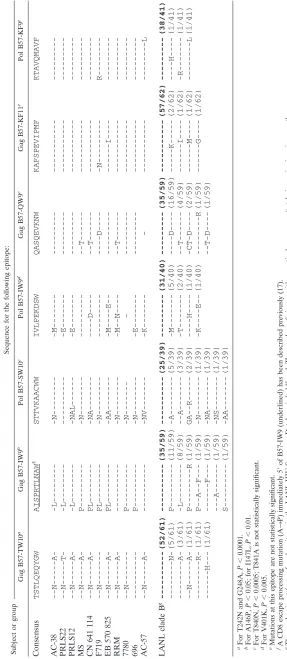
Evidence of selective escape in CD8 T-cell epitopes. The above data suggest that the majority of mutations arising dur-ing HIV-1 infection do not simply reflect random variation but rather arise in response to specific selection pressures. To further address the predictability of mutations, we examined whether precise sites in evolving epitopes are reproducibly selected in the context of specific class I alleles. We focused on HLA-B57, an allele known to be associated with enhanced immune control following acute infection (6, 35) and therefore likely exerting substantial selective pressures (34). Each of the 12 previously defined HLA-B57-restricted CD8 epitopes (13) was targeted in the untreated subject AC-38, and viral evolu-tion was observed in 8 of these (see Table S1 in the supple-mental material). We focused on the seven HLA-B57 epitopes residing in Gag and Pol, since these conserved proteins were most likely to reveal clear evolutionary patterns. Viral evolu-tion within these seven Gag and Pol epitopes was examined in 10 additional HLA-B57 subjects exhibiting high levels of viral replication, which are clinically linked to disease progression (33). Four of these epitopes exhibited strikingly similar muta-tions at seven residues, with six out of seven residues signifi-cantly more variable in persons expressing HLA-B57 than in the Los Alamos National Laboratory (LANL) database overall (Table 2; range,P⬍0.05 toP⬍0.0001). A fifth epitope, QW9, exhibited only a low frequency of mutations at positions 3 and 5 (P3 and P5), whereas the remaining two epitopes, KF11 and KF9, were rarely observed to exhibit any sequence variation and were similarly highly conserved in the LANL database (Table 2). For some of these CD8 epitopes in Gag, similar patterns of viral evolution have also been observed previously
on November 8, 2019 by guest
http://jvi.asm.org/
(30, 34). These data provide support for the concept of pre-dictable viral evolutionary dynamics in persons sharing the same HLA allele, and they reveal that viral evolution within CD8 epitopes may be stereotypic in nature.
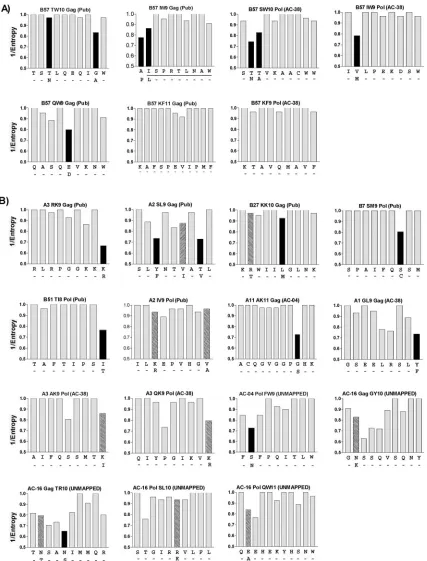
The reproducibility of mutations in the HLA-B57 epitopes suggested that a relationship may exist between the mutations induced by immune pressures and highly polymorphic residues of HIV-1 at the population level. We therefore determined the degree to which mutating and nonmutating residues within each CD8 epitope were associated with sequence polymor-phisms at the population level. Using sequences reported in the LANL HIV Sequence Database (www.hiv.lanl.gov), nor-malized Shannon entropy scores (50) were determined for each residue of HIV-1 clade B, providing an overall assessment of the sequence diversity present at each residue in circulating HIV-1 clade B strains (58). Figure 3A illustrates the relative
conservation (1/entropy) of each residue within the seven HLA-B57-restricted CD8 epitopes studied and the position where mutations reproducibly arose. This analysis showed not only that the residues commonly mutating in a subject reflected the most polymorphic residues in each epitope at the popula-tion level but also that the majority of nonmutating residues within these CD8 epitopes remained highly conserved at the population level.
[image:5.585.53.542.81.498.2]The analysis was then broadened to examine the additional CD8 epitopes defined in the four longitudinally followed sub-jects as well as published epitopes with documented CD8 es-cape mutations (3, 17, 23, 25, 26, 28, 30, 34), again focusing on responses to the more conserved structural proteins Gag and Pol. Here, 18 of the 28 mutations (64%) in these epitopes were found to lie within the most variable residue in the epitope (Fig. 3). Therefore, within the epitopes demonstrating escape,
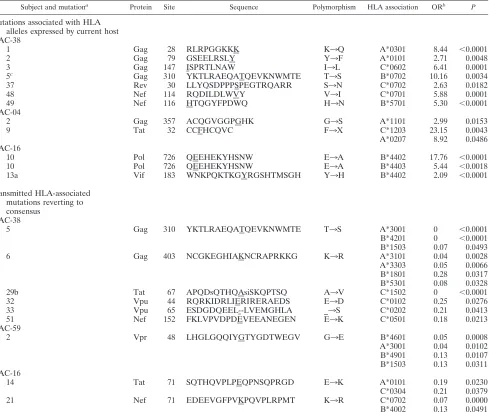
TABLE 1. HIV-1 mutations
Subject and mutationa Protein Site Sequence Polymorphism HLA association ORb P
Mutations associated with HLA alleles expressed by current host AC-38
1 Gag 28 RLRPGGKKK K3Q A*0301 8.44 ⬍0.0001
2 Gag 79 GSEELRSLY Y3F A*0101 2.71 0.0048
3 Gag 147 ISPRTLNAW I3L C*0602 6.41 0.0001
5c Gag 310 YKTLRAEQATQEVKNWMTE T3S B*0702 10.16 0.0034
37 Rev 30 LLYQSDPPPSPEGTRQARR S3N C*0702 2.63 0.0182
48 Nef 114 RQDILDLWVY V3I C*0701 5.88 0.0001
49 Nef 116 HTQGYFPDWQ H3N B*5701 5.30 ⬍0.0001
AC-04
2 Gag 357 ACQGVGGPGHK G3S A*1101 2.99 0.0153
9 Tat 32 CCFHCQVC F3X C*1203 23.15 0.0043
A*0207 8.92 0.0486 AC-16
10 Pol 726 QEEHEKYHSNW E3A B*4402 17.76 ⬍0.0001
10 Pol 726 QEEHEKYHSNW E3A B*4403 5.44 ⬍0.0018
13a Vif 183 WNKPQKTKGYRGSHTMSGH Y3H B*4402 2.09 ⬍0.0001
Transmitted HLA-associated mutations reverting to consensus
AC-38
5 Gag 310 YKTLRAEQATQEVKNWMTE T3S A*3001 0 ⬍0.0001
B*4201 0 ⬍0.0001 B*1503 0.07 0.0493
6 Gag 403 NCGKEGHIAKNCRAPRKKG K3R A*3101 0.04 0.0028
A*3303 0.05 0.0066 B*1801 0.28 0.0317 B*5301 0.08 0.0328
29b Tat 67 APQDsQTHQAsiSKQPTSQ A3V C*1502 0 ⬍0.0001
32 Vpu 44 RQRKIDRLIERIRERAEDS E3D C*0102 0.25 0.0276
33 Vpu 65 ESDGDQEEL--LVEMGHLA _3S C*0202 0.21 0.0413
51 Nef 152 FKLVPVDPDEVEEANEGEN E3K C*0501 0.18 0.0213
AC-59
2 Vpr 48 LHGLGQQIYGTYGDTWEGV G3E B*4601 0.05 0.0008
A*3001 0.04 0.0102 B*4901 0.13 0.0107 B*1503 0.13 0.0311 AC-16
14 Tat 71 SQTHQVPLPEQPNSQPRGD E3K A*0101 0.19 0.0230
C*0304 0.21 0.0379
21 Nef 71 EDEEVGFPVKPQVPLRPMT K3R C*0702 0.07 0.0000
B*4002 0.13 0.0491
aMutation numbers correspond to Fig. 2A and to Fig. S1 and Table S1 in the supplemental material.
bOR, odds ratio.
cAssociations observed for both forward and reverse mutations.
on November 8, 2019 by guest
http://jvi.asm.org/
TABLE 2. Selective CD8 escape mutations observed in chronic Gag and Pol HLA-B57 epitopes Subject or group Sequence for the following epitope: Gag B57-TW10 a Gag B57-IW9 b Pol B57-SW10 c Pol B57-IW9 d Gag B57-QW9 e Gag B57-KF11 e Pol B57-KF9 e Consensus TSTLQEQYGW AISPRTLNAW f STTVKAACWW IVLPEKDSW QASQEVKNW KAFSPEVIPMF KTAVQMAVF AC-38 --N---A- -L--- -N--- -M--- --- -- ---PRLS22 --N---T- -L--- --- -E--- --- -- ---PRLS12 --N---A- -L--- -NAL--- -E--- --- -- ---MS --N---A- P--- -N--- --- --T--- -- ---CN 641 114 --N---A- PL--- -NA--- ----D---- --T--- -- ---F719 --N--- PL--- -N--- --- ----D---- -N--- R---EB 570 825 --N---A- PL--- -AA--- -M----E-- --- ---I---- ---RRM --N---A- --- -N--- -M--N---- --T--- -- ---7780 --N--- P--- N - --- -- ---696 --- P--- -N--- -E--- --- -- ---AC-57 --N---A- --- -NV--- K - ---L LANL clade B g ---(52/61) ---(35/59) ---(25/39) ---(31/40) ---(35/59) ---(57/62) ---(38/41) ---N-(5/61) P---(11/59) -A---(5/39) -M---(5/40) ----D----(16/59) ---K---(2/62) ----H----(1/41) ---A-(3/61) -L---(8/59) --A---(3/39) -T---(2/40) --T---(4/59) ---I----(1/62) -R---(1/41) --N---A-(1/61) P---R (1/59) GA--R---(2/39) ----H----(1/40) -CT-D----(2/59) ---M----(1/62) ---L (1/41) ---R-(1/61) P--A--F---(1/59) -N---(1/39) -K----E--(1/40) ---R (1/59) ---G----(1/62) ---H---(1/61) ---F---(1/59) -NA---(1/39) --T-D----(1/59) ---A---(1/59) -NS---(1/39) S---(1/59) -AA---(1/39) aFor T242N and G248A, P ⬍ 0.0001. bFor A146P, P ⬍ 0.05; for I147L, P ⬍ 0.01. cFor T840N, P ⬍ 0.0005; T841A is not statistically significant. dFor V401K, P ⬍ 0.005. eMutations at this epitope are not statistically significant. fA CD8 escape processing mutation (A 3 P) immediately 5 ⬘ of B57-IW9 (underlined) has been described previously (17). gThe predominant form of each epitope in the LANL HIV Sequence Database is boldfaced. The number of viruses with a particular sequence/total viruses is given in parentheses.
on November 8, 2019 by guest
http://jvi.asm.org/
[image:6.585.153.440.69.728.2]FIG. 3. Escape mutations in Gag and Pol occur at highly variable residues in the population. The degrees of variability of Gag and Pol residues were assessed by plotting normalized Shannon entropy scores. The residue observed to arise during sequence evolution in a subject is shown below each epitope. Solid bars, escape mutations corresponding to the most polymorphic residue in each epitope; hatched bars, escaping residues not corresponding to the most polymorphic residue in each epitope. CD8-targeted regions include (A) B57 epitopes and (B) published epitopes (Pub), epitopes in study subjects (with subject designation given above the bar graph, e.g., AC-38), and partially mapped epitopes in study subjects (UNMAPPED).
on November 8, 2019 by guest
http://jvi.asm.org/
the most variable residue was significantly more likely to un-dergo an amino acid change in a subject than all other residues (P ⬍ 0.00005). One exception was the A3-AK9 Pol epitope (AIFQSSMTK) (Fig. 3B), in which viral escape was observed at P9 rather than at the most polymorphic residue (P5). No-tably, a second epitope, B7-SM9 (SPAIFQSSM) (Fig. 3B), with an escape mutation at the same residue, overlaps A3-AK9 and may account for this increased variability at P5 in the A3-AK9 epitope. Therefore, within these highly conserved proteins of HIV-1, the same residues are repeatedly selected for sequence variation, both in an individual and at the popu-lation level. These data suggest that selection against deleteri-ous mutations (purifying selection) (38, 51) may be functioning to conserve important residues in clade B while allowing se-quence variation only at precise residues to facilitate evasion of host immune pressures.
As a result of these strong relationships, we conducted a similar analysis of the remaining more variable accessory and regulatory proteins of HIV-1. By combining previously de-scribed CD8 escape mutations in Tat and Nef (14, 45), as well as evolving targeted CD8 epitopes in our study subjects, a total of 23 epitopes were examined. In this analysis, however, only 8/26 mutations correlated with the most variable residue in each epitope (see Fig. S2 in the supplemental material). The inability to draw similar correlations between host CD8 escape mutations and sequence diversity in these proteins is likely due to the greater overall sequence variability within these pro-teins. This increased variability may reflect either a more in-tense targeting of these regions of HIV-1 by host CD8⫹T-cell responses (1, 5, 7, 31, 58) or a reduced requirement to maintain such sequence conservation in these nonstructural proteins (20).
In order to determine whether the inherent variability of a region of HIV-1 containing a CD8 epitope was predictive of epitopes undergoing sequence variation in a subject, we com-pared the average entropy scores of mutating epitopes with those of epitopes refractory to sequence changes, again using sequences from the LANL database. A comprehensive analysis of the 57 evolving and nonevolving minimally defined CD8 epitopes in this study, including those from the regulatory and accessory genes, demonstrated that epitopes exhibiting evolu-tion in a subject were significantly more variable in the popu-lation than epitopes that remained unchanged in the subjects (P ⬍ 0.0005). Evolving epitopes exhibited average entropy scores of 90.5% per residue, versus 94.8% per residue for nonevolving epitopes. However, this finding may have been influenced by a trend for mutating epitopes to reside within the more variable nonstructural proteins while nonmutating epitopes reside within the more conserved structural proteins (P ⫽ 0.0531). Indeed, those proteins that accumulated the most mutations in these subjects, after adjustment for protein length (Rev⬎ Tat ⬎Vpr ⬎ Vpu⬎ Nef ⬎ others), closely reflect the relative variability of each of the HIV-1 proteins (Vpu ⬎ Tat ⬎ Rev ⬎ Nef ⬎ others) (58). Therefore, the inherent variability of a targeted CD8 epitope, or protein, appears to influence whether sequence variation is likely to occur in response to CD8⫹T-cell selective pressures.
Polymorphic residues are shared across different HIV-1 clades. The above data suggest that within HIV-1 there are restrictions influencing which residues within an
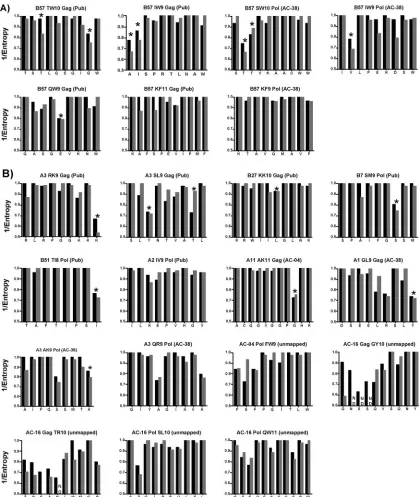
immune-tar-geted region are able to mutate. If purifying selective pressures are indeed playing a role in dictating these restrictions, then similar patterns of conserved and variable residues would be expected to exist within other clades of HIV-1. Seventeen of the 19 mutations in the clade B CD8 epitopes in Gag and Pol which correlated with the most polymorphic residue at the population level (Fig. 3) also reflected the most polymorphic residue in clade C (Fig. 4). In fact, for the majority of residues in these epitopes, very similar patterns of conserved and vari-able residues were observed between clades B and C, even at highly polymorphic residues (Fig. 4).
An analysis of CD8⫹T-cell-associated mutations in the ac-cessory and regulatory proteins again did not exhibit any strong associations, although similar patterns of conserved and vari-able residues were still evident. Therefore, we broadened the analysis to all 2,299 amino acid residues of HIV-1 (excluding Env). In total, 84% of residues exhibited similar entropy scores (difference within 10%) between clades B and C, indicating similar conserved and variable residues between these clades. This was despite the fact that as many as one-third of all residues exhibited some degree of variability (⬎10%) in one clade or the other (data not shown). These data suggest that purifying selective pressures are at work to maintain the overall structure and function of HIV-1 proteins across multiple clades, while certain residues preferentially support sequence variation in the presence of host immune selective pressures.
DISCUSSION
These data assessing the impact of CD8⫹ T-cell selective pressures on HIV-1 evolution suggest that nearly two-thirds of all mutations arising in nonenvelope proteins during the tran-sition from acute to chronic infection can be attributed to either CD8⫹ T-cell-associated selective pressures in the in-fected individual or reversion of HLA class I-associated mu-tations selected in a previous host. These data are in surpris-ingly close agreement with data recently derived from the SIV-infected rhesus macaque model (40), in which⬎60% of sequence variation outside of the envelope occurs within rec-ognized CD8 T-cell epitopes. Similarly, a recent study by Jones et al. analyzing responses to Gag, Env, and Tat in four HIV-infected subjects observed similar extensive escape from CD8 T-cell responses very soon after infection (27). Viral evolution following acute HIV-1 infection is thus not a random process but rather is substantially influenced by adaptive CD8⫹T-cell selection pressures. The preferential selection of individual residues for mutation and the repeated selection for identical mutations suggest that there are significant biochemical con-straints on viral evolution and explain the ability to repeatedly link certain sequence polymorphisms in HIV-1 with various HLA alleles (37). Moreover, these data, showing selective mu-tation of specific residues within epitopes in concordance with highly variable sites among different clades, provide support for the idea that immune selection pressures contribute to global HIV-1 sequence diversity.
These studies also indicate that while a substantial propor-tion of the HIV proteome is under immune selecpropor-tion pressure, with as many as 20% of all residues being targeted in a given individual, a majority of CD8⫹T-cell responses do not result in sequence evolution. Since the nonmutating residues are more
on November 8, 2019 by guest
http://jvi.asm.org/
highly conserved at a population level, these data indicate substantial constraints on HIV evolution. Indeed, comparison of the entropy values of clade B and clade C sequences indi-cated very similar patterns of conserved and variable residues, suggesting that viral escape in different HIV-1 clades may occur at similar residues despite unique distributions of HLA alleles present in infected populations. This implies that the same purifying selection pressures contribute to maintaining specific residues and preserving the basic structure of HIV-1
[image:9.585.82.502.67.564.2]proteins in different HIV-1 clades, while routinely allowing other residues to fluctuate. Indeed, the same residues observed to mutate in CD8 epitopes in clades B and C reflect those consistently capable of supporting alternative amino acids in many other HIV-1 clades, including clades O and CPZ (data not shown), whereas conserved residues are maintained across different HIV-1 clades. Similar findings have recently been reported in the analysis of HIV-1 Env sequences (15, 22, 54). Although the majority of viral mutations in these subjects
FIG. 4. Shared polymorphic residues in Gag and Pol in clades B and C. The degrees of variability of clade C sequences are plotted against clade B Gag and Pol epitopes shown in Fig. 3. Black bars, clade B sequences; gray bars, clade C sequences. Asterisks indicate highly polymorphic residues shown to mutate in Fig. 3 which are shared across clade B and clade C. (A) B57 epitopes; (B) published epitopes (Pub), optimal epitopes in study subjects (with subject designation given above the bar graph, e.g., AC-38), and partially mapped epitopes in study subjects (unmapped).
on November 8, 2019 by guest
http://jvi.asm.org/
were associated with adaptive immunity to HIV-1, a substantial number of mutations remain to be explained. The methods used to detect CD8⫹ T-cell responses relied on measuring IFN-␥production and did not include in vitro expansion or alternative measurements of CD8⫹ T-cell immune function such as cytolytic capacity, production of other cytokines, or HLA class I tetramers (29, 49). It is noteworthy that four of the mutations not associated with CD8⫹ T-cell responses are within regions exhibiting CD4⫹T-cell proliferative responses (data not shown), and viral escape from CD4 responses has been described in murine models of viral infection (16). Fi-nally, compensatory mutations accommodating CD8 escape mutations (21, 28, 30, 42) and antigen processing mutations (3, 17) are likely to account for additional sequence polymor-phisms. Although our findings are in close agreement with data recently derived from the SIV-infected rhesus macaque model (40), they contrast with those of Yang et al., who previously reported a strong association between sites undergoing posi-tive selection in HIV and CD4 T-helper epitopes, but not CD8 T-cell epitopes (56). This discrepancy is likely due to different approaches used in these studies to address this issue.
Together these data indicate predictability within individual subjects and across multiple clades in the evolution of HIV-1, and linking of CD8 escape mutations in the host with highly variable residues in the HIV-1 population as a whole supports host immune pressures as playing a major role in driving the global diversity of HIV-1. The striking reproducibility of many escape mutations, their predominance at highly polymorphic sites across different HIV-1 clades, and the observed reversion of HLA-associated polymorphisms together suggest that struc-tural or biochemical constraints limit which residues within a targeted HIV-1 CD8 epitope are likely to mutate in response to CD8⫹T-cell selective pressures. These results are consistent with the hypothesis that some mutations induced by immune-mediated selective pressures have an impact on viral replica-tion capacity (3, 20, 21, 27, 30, 43), especially mutareplica-tions devel-oping within more conserved regions of the virus. Targeting of highly conserved regions and identification of ways to exploit the limitations of the sequence evolution of HIV-1 may hold promise for the rational design of vaccines against such highly polymorphic chronic viral pathogens.
ACKNOWLEDGMENTS
We thank the subjects participating in this study.
This study was supported by the Doris Duke Charitable Foundation (M.A., E.S.R., B.D.W.), the National Institutes of Health (T.M.A., M.A., E.S.R., B.D.W.), NIH contract N01-A1-15442 (C.B., B.D.W.), the Howard Hughes Medical Institute (B.D.W.), and the Partners/ Fenway/Shattuck Center for AIDS Research (T.M.A., M.A.). B.D.W. is the recipient of a Doris Duke Distinguished Clinical Scientist Award.
REFERENCES
1.Addo, M. M., M. Altfeld, E. S. Rosenberg, R. L. Eldridge, M. N. Philips, K. Habeeb, A. Khatri, C. Brander, G. K. Robbins, G. P. Mazzara, P. J. Goulder, and B. D. Walker.2001. The HIV-1 regulatory proteins Tat and Rev are frequently targeted by cytotoxic T lymphocytes derived from HIV-1-infected
individuals. Proc. Natl. Acad. Sci. USA98:1781–1786.
2.Albert, J., B. Abrahamsson, K. Nagy, E. Aurelius, H. Gaines, G. Nystrom, and E. M. Fenyo.1990. Rapid development of isolate-specific neutralizing antibodies after primary HIV-1 infection and consequent emergence of virus
variants which resist neutralization by autologous sera. AIDS4:107–112.
3.Allen, T. M., M. Altfeld, X. G. Yu, K. M. O’Sullivan, M. Lichterfeld, S. Le Gall, M. John, B. R. Mothe, P. K. Lee, E. T. Kalife, D. E. Cohen, K. A.
Freedberg, D. A. Strick, M. N. Johnston, A. Sette, E. S. Rosenberg, S. A. Mallal, P. J. Goulder, C. Brander, and B. D. Walker.2004. Selection, trans-mission, and reversion of an antigen-processing cytotoxic T-lymphocyte es-cape mutation in human immunodeficiency virus type 1 infection. J. Virol.
78:7069–7078.
4.Allen, T. M., D. H. O’Connor, P. Jing, J. L. Dzuris, B. R. Mothe, T. U. Vogel, E. Dunphy, M. E. Liebl, C. Emerson, N. Wilson, K. J. Kunstman, X. Wang, D. B. Allison, A. L. Hughes, R. C. Desrosiers, J. D. Altman, S. M. Wolinsky, A. Sette, and D. I. Watkins.2000. Tat-specific cytotoxic T lymphocytes select
for SIV escape variants during resolution of primary viraemia. Nature407:
386–390.
5.Altfeld, M., M. M. Addo, R. L. Eldridge, X. G. Yu, S. Thomas, A. Khatri, D. Strick, M. N. Phillips, G. B. Cohen, S. A. Islam, S. A. Kalams, C. Brander, P. J. Goulder, E. S. Rosenberg, and B. D. Walker.2001. Vpr is preferentially
targeted by CTL during HIV-1 infection. J. Immunol.167:2743–2752.
6.Altfeld, M., M. M. Addo, E. S. Rosenberg, F. M. Hecht, P. K. Lee, M. Vogel, X. G. Yu, R. Draenert, M. N. Johnston, D. Strick, T. M. Allen, M. E. Feeney, J. O. Kahn, R. P. Sekaly, J. A. Levy, J. K. Rockstroh, P. J. Goulder, and B. D. Walker.2003. Influence of HLA-B57 on clinical presentation and viral
con-trol during acute HIV-1 infection. AIDS17:2581–2591.
7.Altfeld, M., M. M. Addo, R. Shankarappa, P. K. Lee, T. M. Allen, X. G. Yu, A. Rathod, J. Harlow, K. O’Sullivan, M. N. Johnston, P. J. Goulder, J. I. Mullins, E. S. Rosenberg, C. Brander, B. Korber, and B. D. Walker.2003. Enhanced detection of human immunodeficiency virus type 1-specific T-cell responses to highly variable regions by using peptides based on autologous
virus sequences. J. Virol.77:7330–7340.
8.Altfeld, M., T. M. Allen, X. G. Yu, M. N. Johnston, D. Agrawal, B. T. Korber, D. C. Montefiori, D. H. O’Connor, B. T. Davis, P. K. Lee, E. L. Maier, J. Harlow, P. J. Goulder, C. Brander, E. S. Rosenberg, and B. D. Walker.2002.
HIV-1 superinfection despite broad CD8⫹T-cell responses containing
rep-lication of the primary virus. Nature420:434–439.
9.Arendrup, M., C. Nielsen, J. E. Hansen, C. Pedersen, L. Mathiesen, and J. O. Nielsen.1992. Autologous HIV-1 neutralizing antibodies: emergence of neutralization-resistant escape virus and subsequent development of escape
virus neutralizing antibodies. J. Acquir. Immune Defic. Syndr.5:303–307.
10.Barouch, D. H., J. Kunstman, M. J. Kuroda, J. E. Schmitz, S. Santra, F. W. Peyerl, G. R. Krivulka, K. Beaudry, M. A. Lifton, D. A. Gorgone, D. C. Montefiori, M. G. Lewis, S. M. Wolinsky, and N. L. Letvin.2002. Eventual AIDS vaccine failure in a rhesus monkey by viral escape from cytotoxic T
lymphocytes. Nature415:335–339.
11.Borrow, P., H. Lewicki, X. P. Wei, M. S. Horwitz, N. Peffer, H. Meyers, J. A. Nelson, J. E. Gairin, B. H. Hahn, M. B. A. Oldstone, and G. M. Shaw.1997. Antiviral pressure exerted by HIV-1-specific cytotoxic T lymphocytes (CTLs) during primary infection demonstrated by rapid selection of CTL escape
virus. Nat. Med.3:205–211.
12.Bradney, A. P., S. Scheer, J. M. Crawford, S. P. Buchbinder, and D. C. Montefiori.1999. Neutralization escape in human immunodeficiency virus
type 1-infected long-term nonprogressors. J. Infect. Dis.179:1264–1267.
13.Brander, C., and P. J. R. Goulder.2000. The evolving field of HIV CTL epitope mapping: new approaches to the identification of novel epitopes, p.
I1–I19.InB. Korber (ed.), HIV Molecular Immunology Database 2000. Los
Alamos National Laboratory, Los Alamos, N.Mex.
14.Cao, J., J. McNevin, U. Malhotra, and M. J. McElrath.2003. Evolution of
CD8⫹T cell immunity and viral escape following acute HIV-1 infection.
J. Immunol.171:3837–3846.
15.Choisy, M., C. H. Woelk, J. F. Guegan, and D. L. Robertson.2004. Com-parative study of adaptive molecular evolution in different human
immuno-deficiency virus groups and subtypes. J. Virol.78:1962–1970.
16.Ciurea, A., L. Hunziker, M. M. Martinic, A. Oxenius, H. Hengartner, and R. M. Zinkernagel.2001. CD4⫹T-cell-epitope escape mutant virus selected
in vivo. Nat. Med.7:795–800.
17.Draenert, R., S. Le Gall, K. J. Pfafferott, A. J. Leslie, P. Chetty, C. Brander, E. C. Holmes, S. C. Chang, M. E. Feeney, M. M. Addo, L. Ruiz, D. Ramduth, P. Jeena, M. Altfeld, S. Thomas, Y. Tang, C. L. Verrill, C. Dixon, J. G. Prado, P. Kiepiela, J. Martinez-Picado, B. D. Walker, and P. J. Goulder.2004. Immune selection for altered antigen processing leads to cytotoxic T
lym-phocyte escape in chronic HIV-1 infection. J. Exp. Med.199:905–915.
18.Fang, G., B. Weiser, C. Kuiken, S. M. Philpott, S. Rowland-Jones, F. Plum-mer, J. Kimani, B. Shi, R. Kaul, J. Bwayo, O. Anzala, and H. Burger.2004.
Recombination following superinfection by HIV-1. AIDS18:153–159.
19.Frahm, N., B. T. Korber, C. M. Adams, J. J. Szinger, R. Draenert, M. M. Addo, M. E. Feeney, K. Yusim, K. Sango, N. V. Brown, D. SenGupta, A. Piechocka-Trocha, T. Simonis, F. M. Marincola, A. G. Wurcel, D. R. Stone, C. J. Russell, P. Adolf, D. Cohen, T. Roach, A. St John, A. Khatri, K. Davis, J. Mullins, P. J. Goulder, B. D. Walker, and C. Brander.2004. Consistent cytotoxic-T-lymphocyte targeting of immunodominant regions in human
im-munodeficiency virus across multiple ethnicities. J. Virol.78:2187–2200.
20.Friedrich, T. C., E. J. Dodds, L. J. Yant, L. Vojnov, R. Rudersdorf, C. Cullen, D. T. Evans, R. C. Desrosiers, B. R. Mothe, J. Sidney, A. Sette, K. Kunstman, S. Wolinsky, M. Piatak, J. Lifson, A. L. Hughes, N. Wilson, D. H. O’Connor, and D. I. Watkins.2004. Reversion of CTL escape-variant immunodeficiency
viruses in vivo. Nat. Med.10:275–281.
on November 8, 2019 by guest
http://jvi.asm.org/
21.Friedrich, T. C., C. A. Frye, L. J. Yant, D. H. O’Connor, N. A. Kriewaldt, M. Benson, L. Vojnov, E. J. Dodds, C. Cullen, R. Rudersdorf, A. L. Hughes, N. Wilson, and D. I. Watkins.2004. Extraepitopic compensatory substitutions partially restore fitness to simian immunodeficiency virus variants that es-cape from an immunodominant cytotoxic-T-lymphocyte response. J. Virol.
78:2581–2585.
22.Gaschen, B., J. Taylor, K. Yusim, B. Foley, F. Gao, D. Lang, V. Novitsky, B. Haynes, B. H. Hahn, T. Bhattacharya, and B. Korber.2002. Diversity
con-siderations in HIV-1 vaccine selection. Science296:2354–2360.
23.Geels, M. J., M. Cornelissen, H. Schuitemaker, K. Anderson, D. Kwa, J. Maas, J. T. Dekker, E. Baan, F. Zorgdrager, R. van den Burg, M. van Beelen, V. V. Lukashov, T. M. Fu, W. A. Paxton, L. van der Hoek, S. A. Dubey, J. W. Shiver, and J. Goudsmit. 2003. Identification of sequential viral escape mutants associated with altered T-cell responses in a human
immunodefi-ciency virus type 1-infected individual. J. Virol.77:12430–12440.
24.Harris, M. E., D. Serwadda, N. Sewankambo, B. Kim, G. Kigozi, N. Ki-wanuka, J. B. Phillips, F. Wabwire, M. Meehen, T. Lutalo, J. R. Lane, R. Merling, R. Gray, M. Wawer, D. L. Birx, M. L. Robb, and F. E. McCutchan. 2002. Among 46 near full length HIV type 1 genome sequences from Rakai District, Uganda, subtype D and AD recombinants predominate. AIDS Res.
Hum Retrovir.18:1281–1290.
25.Hay, C. M., D. J. Ruhl, N. O. Basgoz, C. C. Wilson, J. M. Billingsley, M. P. DePasquale, R. T. D’Aquila, S. M. Wolinsky, J. M. Crawford, D. C. Monte-fiori, and B. D. Walker.1999. Lack of viral escape and defective in vivo activation of human immunodeficiency virus type 1-specific cytotoxic T
lym-phocytes in rapidly progressive infection. J. Virol.73:5509–5519.
26.Jamieson, B. D., O. O. Yang, L. Hultin, M. A. Hausner, P. Hultin, J. Matud, K. Kunstman, S. Killian, J. Altman, K. Kommander, B. Korber, J. Giorgi, and S. Wolinsky.2003. Epitope escape mutation and decay of human
im-munodeficiency virus type 1-specific CTL responses. J. Immunol.171:5372–
5379.
27.Jones, N. A., X. Wei, D. R. Flower, M. Wong, F. Michor, M. S. Saag, B. H. Hahn, M. A. Nowak, G. M. Shaw, and P. Borrow.2004. Determinants of
human immunodeficiency virus type 1 escape from the primary CD8⫹
cyto-toxic T lymphocyte response. J. Exp. Med.200:1243–1256.
28.Kelleher, A. D., C. Long, E. C. Holmes, R. L. Allen, J. Wilson, C. Conlon, C. Workman, S. Shaunak, K. Olson, P. Goulder, C. Brander, G. Ogg, J. S. Sullivan, W. Dyer, I. Jones, A. J. McMichael, S. Rowland-Jones, and R. E. Phillips.2001. Clustered mutations in HIV-1 gag are consistently required for escape from HLA-B27-restricted cytotoxic T lymphocyte responses. J.
Exp. Med.193:375–386.
29.Kostense, S., K. Vandenberghe, J. Joling, D. Van Baarle, N. Nanlohy, E. Manting, and F. Miedema.2002. Persistent numbers of tetramer⫹CD8⫹T
cells, but loss of interferon-gamma⫹HIV-specific T cells during progression
to AIDS. Blood99:2505–2511.
30.Leslie, A. J., K. J. Pfafferott, P. Chetty, R. Draenert, M. M. Addo, M. Feeney, Y. Tang, E. C. Holmes, T. Allen, J. G. Prado, M. Altfeld, C. Brander, C. Dixon, D. Ramduth, P. Jeena, S. A. Thomas, A. St John, T. A. Roach, B. Kupfer, G. Luzzi, A. Edwards, G. Taylor, H. Lyall, G. Tudor-Williams, V. Novelli, J. Martinez-Picado, P. Kiepiela, B. D. Walker, and P. J. Goulder. 2004. HIV evolution: CTL escape mutation and reversion after transmission.
Nat. Med.10:282–289.
31.Lichterfeld, M., X. G. Yu, D. Cohen, M. M. Addo, J. Malenfant, B. Perkins, E. Pae, M. N. Johnston, D. Strick, T. M. Allen, E. S. Rosenberg, B. Korber, B. D. Walker, and M. Altfeld.2004. HIV-1 Nef is preferentially recognized by CD8 T cells in primary HIV-1 infection despite a relatively high degree of
genetic diversity. AIDS18:1383–1392.
32.Matano, T., M. Kobayashi, H. Igarashi, A. Takeda, H. Nakamura, M. Kano, C. Sugimoto, K. Mori, A. Iida, T. Hirata, M. Hasegawa, T. Yuasa, M. Miyazawa, Y. Takahashi, M. Yasunami, A. Kimura, D. H. O’Connor, D. I. Watkins, and Y. Nagai.2004. Cytotoxic T lymphocyte-based control of sim-ian immunodeficiency virus replication in a preclinical AIDS vaccine trial. J.
Exp. Med.199:1709–1718.
33.Mellors, J. W., C. R. Rinaldo, Jr., P. Gupta, R. M. White, J. A. Todd, and L. A. Kingsley.1996. Prognosis in HIV-1 infection predicted by the quantity
of virus in plasma. Science272:1167–1170.
34.Migueles, S. A., A. C. Laborico, H. Imamichi, W. L. Shupert, C. Royce, M. McLaughlin, L. Ehler, J. Metcalf, S. Liu, C. W. Hallahan, and M. Connors.
2003. The differential ability of HLA B*5701⫹long-term nonprogressors and
progressors to restrict human immunodeficiency virus replication is not
caused by loss of recognition of autologous viralgagsequences. J. Virol.
77:6889–6898.
35.Migueles, S. A., M. S. Sabbaghian, W. L. Shupert, M. P. Bettinotti, F. M. Marincola, L. Martino, C. W. Hallahan, S. M. Selig, D. Schwartz, J. Sulli-van, and M. Connors.2000. HLA B*5701 is highly associated with restriction of virus replication in a subgroup of HIV-infected long term nonprogressors.
Proc. Natl. Acad. Sci. USA97:2709–2714.
36.Montefiori, D. C., I. Y. Zhou, B. Barnes, D. Lake, E. M. Hersh, Y. Masuho, and L. B. Lefkowitz, Jr.1991. Homotypic antibody responses to fresh clinical
isolates of human immunodeficiency virus. Virology182:635–643.
37.Moore, C. B., M. John, I. R. James, F. T. Christiansen, C. S. Witt, and S. A.
Mallal.2002. Evidence of HIV-1 adaptation to HLA-restricted immune
responses at a population level. Science296:1439–1443.
38.Nei, M.1987. Molecular evolutionary genetics. Columbia University Press, New York, N.Y.
39.O’Connor, D. H., T. M. Allen, T. U. Vogel, P. Jing, I. P. DeSouza, E. Doods, E. Dunphy, C. Melsaether, B. Mothe, H. Horton, A. L. Hughes, and D. I. Watkins.2002. Acute phase CTL escape is a hallmark of SIV infection. Nat.
Med.8:493–499.
40.O’Connor, D. H., A. B. McDermott, K. C. Krebs, E. J. Dodds, J. E. Miller, E. J. Gonzalez, T. J. Jacoby, L. Yant, H. Piontkivska, R. Pantophlet, D. R. Burton, W. M. Rehrauer, N. Wilson, A. L. Hughes, and D. I. Watkins.2004.
A dominant role for CD8⫹T-lymphocyte selection in simian
immunodefi-ciency virus sequence variation. J. Virol.78:14012–14022.
41.Peeters, M., and P. M. Sharp.2000. Genetic diversity of HIV-1: the moving
target. AIDS14(Suppl. 3):S129–S140.
42.Peyerl, F. W., D. H. Barouch, W. W. Yeh, H. S. Bazick, J. Kunstman, K. J. Kunstman, S. M. Wolinsky, and N. L. Letvin.2003. Simian-human immu-nodeficiency virus escape from cytotoxic T-lymphocyte recognition at a
struc-turally constrained epitope. J. Virol.77:12572–12578.
43.Peyerl, F. W., H. S. Bazick, M. H. Newberg, D. H. Barouch, J. Sodroski, and N. L. Letvin.2004. Fitness costs limit viral escape from cytotoxic T
lympho-cytes at a structurally constrained epitope. J. Virol.78:13901–13910.
44.Phillips, R. E., S. Rowland-Jones, D. F. Nixon, F. M. Gotch, J. P. Edwards, A. O. Ogunlesi, J. G. Elvin, J. A. Rothbard, C. R. Bangham, C. R. Rizza, et
al.1991. Human immunodeficiency virus genetic variation that can escape
cytotoxic T cell recognition. Nature354:453–459.
45.Price, D. A., P. J. Goulder, P. Klenerman, A. K. Sewell, P. J. Easterbrook, M. Troop, C. R. Bangham, and R. E. Phillips.1997. Positive selection of HIV-1 cytotoxic T lymphocyte escape variants during primary infection. Proc. Natl.
Acad. Sci. USA94:1890–1895.
46.Richman, D. D., T. Wrin, S. J. Little, and C. J. Petropoulos.2003. Rapid evolution of the neutralizing antibody response to HIV type 1 infection.
Proc. Natl. Acad. Sci. USA100:4144–4149.
47.Roberts, J. D., K. Bebenek, and T. A. Kunkel.1988. The accuracy of reverse
transcriptase from HIV-1. Science242:1171–1173.
48.Rosenberg, E. S., M. Altfeld, S. H. Poon, M. N. Phillips, B. M. Wilkes, R. L. Eldridge, G. K. Robbins, R. T. D’Aquila, P. J. Goulder, and B. D. Walker. 2000. Immune control of HIV-1 after early treatment of acute infection.
Nature407:523–526.
49.Shankar, P., M. Russo, B. Harnisch, M. Patterson, P. Skolnik, and J. Lieberman.2000. Impaired function of circulating HIV-specific CD8⫹T
cells in chronic human immunodeficiency virus infection. Blood96:3094–
3101.
50.Shannon, C. E.1948. A mathematical theory of communication. Bell Syst.
Tech. J.27:623–656.
51.Smith, R. A., D. J. Anderson, and B. D. Preston.2004. Purifying selection masks the mutational flexibility of HIV-1 reverse transcriptase. J. Biol.
Chem.279:26726–26734.
52.Songok, E. M., R. M. Lwembe, R. Kibaya, K. Kobayashi, N. Ndembi, K. Kita, J. Vulule, I. Oishi, F. Okoth, S. Kageyama, and H. Ichimura.2004. Active generation and selection for HIV intersubtype A/D recombinant forms in a
coinfected patient in Kenya. AIDS Res. Hum. Retrovir.20:255–258.
53.Tovanabutra, S., V. Watanaveeradej, K. Viputtikul, M. De Souza, M. H. Razak, V. Suriyanon, J. Jittiwutikarn, S. Sriplienchan, S. Nitayaphan, M. W. Benenson, N. Sirisopana, P. O. Renzullo, A. E. Brown, M. L. Robb, C. Beyrer, D. D. Celentano, J. G. McNeil, D. L. Birx, J. K. Carr, and F. E. McCutchan.2003. A new circulating recombinant form, CRF15_01B, rein-forces the linkage between IDU and heterosexual epidemics in Thailand.
AIDS Res. Hum. Retrovir.19:561–567.
54.Travers, S. A., M. J. O’Connell, G. P. McCormack, and J. O. McInerney. 2005. Evidence for heterogeneous selective pressures in the evolution of the
envgene in different human immunodeficiency virus type 1 subtypes. J. Virol.
79:1836–1841.
55.Wei, X., J. M. Decker, S. Wang, H. Hui, J. C. Kappes, X. Wu, J. F. Salazar-Gonzalez, M. G. Salazar, J. M. Kilby, M. S. Saag, N. L. Komarova, M. A. Nowak, B. H. Hahn, P. D. Kwong, and G. M. Shaw.2003. Antibody
neutral-ization and escape by HIV-1. Nature422:307–312.
56.Yang, W., J. P. Bielawski, and Z. Yang.2003. Widespread adaptive evolution
in the human immunodeficiency virus type 1 genome. J. Mol. Evol.57:212–
221.
57.Yu, X. G., M. M. Addo, E. S. Rosenberg, W. R. Rodriguez, P. K. Lee, C. A. Fitzpatrick, M. N. Johnston, D. Strick, P. J. Goulder, B. D. Walker, and M. Altfeld.2002. Consistent patterns in the development and
immunodomi-nance of human immunodeficiency virus type 1 (HIV-1)-specific CD8⫹
T-cell responses following acute HIV-1 infection. J. Virol.76:8690–8701.
58.Yusim, K., C. Kesmir, B. Gaschen, M. M. Addo, M. Altfeld, S. Brunak, A. Chigaev, V. Detours, and B. T. Korber.2002. Clustering patterns of cytotoxic T-lymphocyte epitopes in human immunodeficiency virus type 1 (HIV-1) proteins reveal imprints of immune evasion on HIV-1 global variation. J.
Vi-rol.76:8757–8768.