Ordered to be printed 13 March 2017 and published 21 March 2017
Published by the Authority of the House of Lords
Select Committee on Communications
2nd Report of Session 2016–17
“to investigate public policy areas related to the media, communications and the creative industries”.
Membership
The Members of the Select Committee on Communications are:
Lord Allen of Kensington Lord Hart of Chilton
Baroness Benjamin Baroness Kidron
Lord Best (Chairman) Baroness McIntosh of Hudnall
Baroness Bonham-Carter of Yarnbury Baroness Quin
Earl of Caithness Lord Sheikh
Bishop of Chelmsford Lord Sherbourne of Didsbury
Lord Gilbert of Panteg
Declaration of interests
See Appendix 1.
A full list of Members’ interests can be found in the Register of Lords’ Interests:
http://www.parliament.uk/mps-lords-and-offices/standards-and-interests/register-of-lords-interests
Publications
All publications of the Committee are available at:
http://www.parliament.uk/hlcommunications
Parliament Live
Live coverage of debates and public sessions of the Committee’s meetings are available at:
http://www.parliamentlive.tv
Further information
Further information about the House of Lords and its Committees, including guidance to witnesses, details of current inquiries and forthcoming meetings is available at:
http://www.parliament.uk/business/lords
Committee staff
The staff who worked on this inquiry were Theodore Pembroke (Clerk), Helena Peacock (Policy Analyst) and Rita Logan (Committee Assistant).
Contact details
All correspondence should be addressed to the Select Committee on Communications, Committee Office, House of Lords, London SW1A 0PW. Telephone 020 7219 6076. Email
Summary 3 Summary of Conclusions and recommendations 5
Chapter 1: Introduction 11
Our inquiry 11
Background 11
Figure 1: Time online 12
Box 1: The United Nations Convention on the Rights of the
Child (UNCRC) 14
Stages of childhood 14
Devices and services used by children 16
Figure 2: Devices used by children 17
Chapter 2: The anatomy of the internet 21
Figure 3: Internet value chain 22
Chapter 3: Interactions with the digital world 25 Introduction 25
Digital Literacy 25
Box 2: Behavioural barriers preventing children from
developing tech literacy skills and considering tech careers 26
Time online 28
Box 3: Too much screen time? 31
Time out function? 33
Distressing interactions and resilience 33
Online abuse and cyberbullying 33
Content 34
Child sexual abuse 36
Body image 37
Importance as a support network 38
Digital resilience 40
Children’s rights and commercialisation 41
Children’s rights 41
Privacy and data protection 42
Box 4: Selection of provisions under the GDPR to enhance the protection of children’s personal data online 43 Box 5: Clearly written Terms and Conditions 45 Advertising 46 Piracy 47 Figure 4: Categories of adverts found on unauthorised sites 47 Chapter 4: Responsibilities and recommendations 49
Parents and carers 49
Regulators, law enforcement and civil society 54 Industry 56
Moderating and taking down content 56
Filtering 58 Age verification and the Digital Economy Bill 60
Child-friendly design 61
Schools’ duty of care 69
Children as users 71
Self-regulation 72
The Government 74
Appendix 1: List of Members and declarations of interest 78
Appendix 2: List of witnesses 80
Appendix 3: Call for evidence 85
Appendix 4: Development of children 88
Appendix 5: The United Nations Convention on the Rights
of the Child 90
Appendix 6: The online and offline worlds 92
Appendix 7: Mumsnet forum, Committee visit and meeting
with children 94
Appendix 8: Instagram Terms 96
Evidence is published online at www.parliament.uk/children-and-the-internet and available for inspection at the Parliamentary Archives (020 7129 3074).
SUMMARY
Children inhabit a world in which every aspect of their lives is mediated through technology: from health to education, from socialising to entertainment. Yet the recognition that children have different needs to those of adults has not yet been fully accepted in the online world.
There is well documented public concern about risks to children from the internet such as easy access to inappropriate content, loss of privacy, commercial exploitation and cyberbullying. Our inquiry sought to understand what issues and opportunities children face as they grow up surrounded by, and interacting with, internet technologies.
At the heart of our recommendations we call for sustained leadership from the Government at the highest level, an ambitious programme of digital literacy, minimum standards for those providing internet services and content (‘the internet value chain’), and a commitment to child-centred design. We also believe that children must be treated online with the same rights, respect and care that has been established through regulation in offline settings such as television and gambling.
Although there is widespread agreement that the internet should do more to promote children’s best interests, we found that Government responsibility for this was fragmented both between and within departments resulting in a lack of coordinated policy and joined-up action. We found a similar lack of coordination in the voluntary sector. In addition, self-regulation by industry is failing. And making progress is made still more difficult by public ignorance of how the internet works.
We noted that the current regime of self-regulation very often puts commercial considerations first. The Government has a duty to hold ‘the best interests of the child’ as a primary consideration in any action which concerns a child under the Un Convention on the Rights of the Child. We note that the upcoming EU General Data Protection Regulation (GDPR) will give children more rights, including the right to erasure (the so-called ‘right to be forgotten’). We ask for a commitment from the Government that the rights provided to children by the GDPR will be enshrined as a minimum standard in UK law.
We call on industry to implement minimum standards of child-friendly design, filtering, privacy, data collection, and report and response mechanisms for complaints. The standards should encompass consideration of children’s rights and should be built early into the process of design so that the needs of children are considered preventatively rather than reactively.
We welcome the commitment by the four major Internet Service Providers (ISPs) to provide child-friendly filters, and believe it is necessary for all ISPs do the same. We also recognise the work in this area by the major mobile operators. We recommend that there should be minimum standards for online filters, including a system to manage the over-blocking of websites, and crucially we recommend that filters be required to be ‘on’ by default.
that digital literacy sit alongside reading, writing and mathematics as the fourth pillar of a child’s education; and that no child should leave school without a well-rounded understanding of the digital world. Schools should teach online responsibilities, social norms and risks as part of mandatory, Ofsted-inspected Personal, Social, Health and Economic (PSHE) education, designed to look broadly at the issues that children face online.
We heard of a worrying rise in unhappy and anxious children emerging alongside the upward trend of childhood internet use. We call for more robust research in respect of the possible causal relationship in this regard, while also supporting immediate action to prevent children being adversely affected in the meantime. Ensuring children’s online opportunities and wellbeing are optimised is a shared responsibility. Each group of stakeholders, the Government, the internet value chain, voluntary sector and civil society, schools, parents and children, are interdependent, and each has a vital role to play. Efforts to meet these responsibilities need to be continually assessed and sustained to respond to the fast-changing developments of the digital world. At each point of the internet value chain we support an approach that requires minimum standards that uphold the best interests of the child.
We support the recommendation of the Children’s Commissioner to extend her data gathering powers to include social media and internet services. We further recommend that there is an independent mechanism to arbitrate complaints from children who wish content about themselves to be taken down.
We welcome the recent announcement by the Government that round-table meetings with industry representatives are to be held and an Internet Safety Strategy is to be introduced. But there have been meetings and reviews in the past without sufficient progress on digital literacy, prevention of risks and child-centred design. We therefore make two central recommendations. First, we recommend that a permanent role of Children’s Digital Champion be established within the Cabinet Office with the power to seek coordinated and sustained action from Ministers across all departments, and to present robust advocacy on behalf of children to industry. We note the current role of the United Kingdom Council for Children’s Internet Safety (UKCCIS) and recommend that this is extended and overseen by the new Children’s Digital Champion.
Secondly, we recommend that in convening an industry summit, the Prime Minister should seek to establish minimum standards and a code of conduct based on the desires of children, teachers and parents as well as the commercial needs of the companies. The Government should apply existing legal measures rigorously and be prepared to propose new legislation in the face of non-compliance with the new code of conduct.
SUMMARY OF CONCLUSIONS AND RECOMMENDATIONS
Key recommendations are in bold. Responsibility
1. Children of all age groups inhabit a world that seamlessly flows between on and offline. In order to thrive in both they need the protections and privileges that they enjoy offline. Digital technologies are the present and the future of these 21st century children. They will define their opportunities as workers and as citizens. These opportunities need to be upheld and shaped by many different stakeholders. (Paragraph 192)
2. Any future policy should be based on principles which firmly place children’s rights, wellbeing and needs as the preeminent considerations at all points of the internet value chain where the end user is a child. This shared responsibility requires all stakeholders to play their part, and all parties to sustain their commitment to children’s wellbeing in what is a rapidly changing landscape that will include on the near horizon the Internet of Things and Artificial Intelligence. (Paragraph 353)
3. The Government has a key role in providing an appropriate framework for stakeholders to act in a concerted, joined-up way. It has a particular obligation to comply with the Un Convention on the Rights of the Child to ensure that children’s wellbeing is protected, to promote children’s right to be heard in matters that affect them, and to act in the best interests of the child in all cases. (Paragraph 360)
The Government
4. We recommend that the Government should establish the post of Children’s Digital Champion at the centre of the Government within the Cabinet Office, with a remit to advocate on behalf of children to industry, regulators and at ministerial level across all Government departments. (Paragraph 364)
5. The remit of the Children’s Digital Champion should include:
•
establishing and overseeing the implementation of minimum standards of design and practice across the entire internet value chain,•
working with the Department for Education to set the standard of digital literacy and PSHE in all UK schools,•
commissioning research, and•
ensuring existing rights and legislation are implemented in online settings.(Paragraph 365)
7. The standards should be set out in a code of conduct, which should also seek to promote digital literacy. If industry fails to implement the recommendations, then the Government should take action. The UK must be an exemplar in raising standards. (Paragraph 367)
8. We further recommend that the Government should commission a version of the code of conduct which is written by children for children and that it builds on ‘in depth’ contributions of young people from existing research. (Paragraph 368) 9. We note the NSPCC’s suggestion for creating a user generated age rating system. We
recommend that the Children’s Digital Champion work with others to investigate the potential of such a scheme. (Paragraph 397)
10. The Committee feels that the role of the UK Council for Children’s Internet Safety in research and convening stakeholders should continue but in order to enhance its effectivness it should report to the Children’s Digital Champion who has the independence from industry and access at a ministerial level. Its remit and membership should be extended to support a broader delivery that includes children’s rights, digital literacy, industry codes, as well as safety. (Paragraph 370)
11. The Government should also involve further education providers as well as universities and encourage them to incorporate the standards and the code of practice in relevant courses. (Paragraph 371)
12. Parents and carers need clearly communicated information about the digital world. We recommend that the Government and industry should invest in regular public campaigns to promote information and tools that help parents and carers. In particular, a campaign with a short memorable message, similar to the Green Cross Code, should be developed. It should focus on creating confidence in online parenting. (Paragraph 216)
13. We recommend that specific training modules be developed and made compulsory as part of qualifying in frontline public service roles, including but not limited to, police, social workers, general practitioners, accident and emergency practitioners, mental healthcare workers and teachers. (Paragraph 217)
14. We call on the Government to give an undertaking that, irrespective of its membership of the EU, the UK should maintain legislation which incorporates the standards set by the General Data Protection Regulation in respect of children, including the right to be forgotten, as a minimum. (Paragraph 245)
15. We support the age verification provision of the Digital Economy Bill. We hope that the Government will provide greater clarity about the powers of the regulator, and will include social media companies within the definition of ‘ancillary service providers’. (Paragraph 265)
Minimum standards for industry
innapropriate content that concerns a child is reported by third parties, similar processes should be followed. (Paragraph 240)
17. Minimum standards should be adopted that specify maximum timeframes for report and response. Companies should publish both targets and data concerning complaint resolution. (Paragraph 241) 18. All platforms and businesses operating online should proactively remove content
which does not comply with their own published standards. (Paragraph 242)
19. We recommend that, as suggested by the Children’s Commissioner,
her power to request information from public bodies should be expanded to include aggregated data from social media companies and online platforms. (Paragraph 243)
20. We further recommend that there should be a mechanism for independently handling requests from children for social media companies to take down content. This might take the form of an Ombudsman, as suggested by the Children’s Commissioner, or a commitment from industry to build and fund an arbitration service for young people. (Paragraph 244)
21. We recommend that all ISPs and mobile network operators should be required not only to offer child-friendly content control filters, but also for those filters to be ‘on’ by default for all customers. Adult customers should be able to switch off such filters.
(Paragraph 258)
22. Those responsible for providing filtering and blocking services need to be transparent about which sites they block and why, and be open to complaints from websites to review their decisions within an agreed timeframe. Filter systems should be designed to an agreed minimum standard. (Paragraph 259)
23. We welcome the development of internet services which are specifically designed for very young children but regret that there are no such services for children as they grow older. We have found that there is resistance to providing services which incorporate the support and respect for rights that would enable a better internet experience for all children as they explore the wider internet. (Paragraph 298)
24. We recommend that the Government should establish minimum standards of design in the best interests of the child for internet products. For the avoidance of doubt this is for all products that might reasonably be expected to attract a large proportion of children, not only those designed with children in mind. (Paragraph 299)
25. The minimum standards should require that the strictest privacy settings should be ‘on’ by default, geolocation should be switched off until activated, and privacy and geolocation settings must not change during either manual or automatic system upgrades. (Paragraph 300) 26. Minimum standards should incorporate the child’s best interests as a primary
consideration, and in doing so require companies to forgo some of their current design norms to meet the needs of children. (Paragraph 301)
28. All platforms and businesses operating online must not seek to commercially benefit or exploit value from the sharing or transfer of data gained from a child’s activities online, including data transferred between services that are owned by the same parent company. They should uphold a principle of minimum data gathering necessary for the delivery of a service when the end user is a child. (Paragraph 303)
29. All platforms and businesses operating online which large numbers of children use should incorporate a ‘time out’ function into their design even if it is not in their best commercial interests. It is the view of the Committee that the wellbeing of the child is of paramount importance, and in our view there is sufficient evidence that time-outs or breaks contribute positively to the mental health and wellbeing of children.
(Paragraph 304) Digital Literacy
30. We agree with the Digital Skills Committee that no child should leave school without an adequate standard of digital literacy. It is the view of this Committee that digital literacy should be the fourth pillar of a child’s education alongside reading, writing and mathematics, and be resourced and taught accordingly.(Paragraph 317)
31. We recommend that the Government should make PSHE a statutory subject, inspected by Ofsted. The Committee further recommends that PSHE be mandatory in all schools whatever their status. The PSHE curriculum must be designed to look broadly at the issues young people are concerned about online, including compulsive use, data gathering, body image— rather than the current e-safety agenda of risk. Children need support in developing their critical thinking and understanding the veracity of online information. This should form part of the curriculum. We also note Ofcom’s duty under the Communications Act 2003 to promote media literacy. (Paragraph 318)
32. It is the Government’s responsibility to reassess the resources needed to deliver computer science and PSHE in all UK schools and to ensure that teachers are adequately trained and resourced. But we note with interest that graduates currently entering teacher training are the first group of teachers who might be considered ‘digital natives’. We recommend that the Government harness and further upgrade the skills of this new generation in the course of teacher training so that UK schools are at the forefront of the digital revolution. (Paragraph 319)
33. We commend the work of the voluntary sector and industry in delivering information and resources about online safety and digital literacy for parents and children, but note that it is currently fragmented and insufficient to meet the needs of all children. Once a truly rounded computer science education and fully resourced Personal, Social Health and Economic education is established in schools, we believe that there will be a clearer role for the voluntary sector and industry. (Paragraph 320)
34. The Government should ensure that schools are sufficiently resourced and directed to meet their obligations of child protection, including the ability to train their teachers and to develop digital policies which are right for them and to discern what sort of filtering and monitoring systems are appropriate, together with pastoral care, education and supporting parents. (Paragraph 331)
should require schools to obtain the informed consent of parents and students, and they should have the opportunity to opt out. (Paragraph 332)
Research
36. Children are often first to encounter problems online because they are digitally active, but often not consulted about the nature of those problems. We recommend that the Government should commission research based on in depth consultation with children. We note that because of the rapid nature of technological change public policy may on occasion have to anticipate the conclusion of long-term research. Such research should include:
•
the relationship between age and vulnerability, taking account of the differences of ethnic and socioeconomic backgrounds;•
the impact of screen time on social and cognitive development;•
the effect of watching online pornography upon children’sattitudes and sexual development. (Paragraph 338)
Toward a better internet for children
37. We find that the current regime of self–regulation is underperforming and believe it will take a step change from the highest level of the Government to represent the needs of children online. (Paragraph 352)
CHAPTER 1: INTRODUCTION
Our inquiry
1. We live in a digital age. The internet is not just something children access when they want certain bits of information, it is an essential and intrinsic part of the world they inhabit—it is not an exaggeration to say that to take away a young person’s phone feels to them like removing a limb. We rejoice at the new opportunities for knowledge, creativity and community that this brings, but we yearn for the wisdom that will enable the internet to be a safe and fairly regulated place where all users, and especially children and young people can flourish.
2. The internet has a ubiquitous influence in our lives. United nations (Un) research has estimated that 3.5 billion people (47 per cent of the world population)1 use the internet globally. One third are under 18. As a society we
need to embrace innovations that are exciting and can transform children’s opportunities. At the same time, we have a duty to consider children’s best interests in this rapidly changing world.
3. The question of children and the internet cannot be viewed in isolation from the changing nature of society and the future workplace where automation and ‘digital by default’ are increasingly the new norm. It will be essential for every child in the UK to participate in society, and to have the necessary skills to be fully 21st century citizens.
4. Our inquiry did not set out to identify and weigh up the relative advantages and disadvantages of the internet. Rather, we considered what skills they might need and what impact the internet has on children’s development, wellbeing and mental health. We also considered what rights children enjoy online, and what impediments there are to these. To this end, we consulted with a broad group of stakeholders and sought the views of young people.2
5. We are grateful to all those who contributed to this report. We are also especially grateful to Professor Marina Jirotka of the University of Oxford and Professor Sonia Livingstone of the London School of Economics and Political Science for their expert advice throughout the course of our inquiry. Background
6. Those born from around 2000 onwards are often referred to as ‘digital natives’. They have grown up in a world where user-friendly digital technology surrounds them, which they can learn to use intuitively.3
7. Vicki Shotbolt of the charity Parent Zone told us that the use of devices by young children was so commonplace that she had seen an increase in queries from parents “about tech tantrums: about much younger children for whom
1 ‘nearly 47 per cent of global population now online - Un report’, UN News Centre (15 September 2016): http://www.un.org/apps/news/story.asp?newsID=54931#.WLlbn8pXUpE [accessed 3 March 2017]
2 See Appendix 7.
the device has become the thing that causes the big arguments. It used to be vegetables but not anymore; it is taking the device away.”4
8. Baroness Shields, the Parliamentary Under Secretary of State for Internet Safety and Security, told the Committee that:
[image:14.595.96.507.221.413.2]“Society is evolving in a way in which it has never evolved before. It is almost the largest social experiment in history. We have never had this much change in such a short period of time”.5
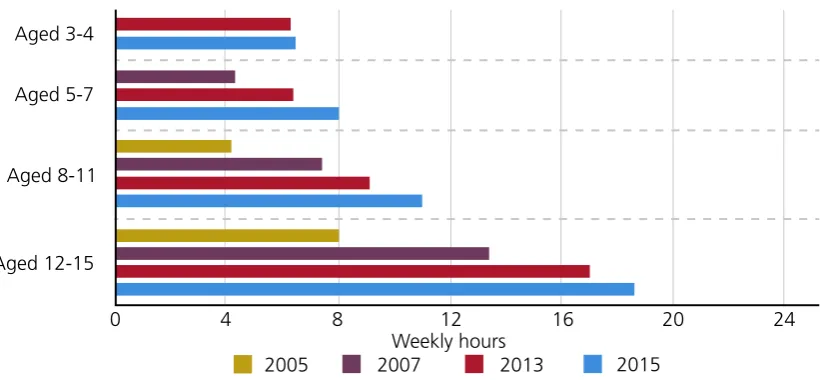
Figure 1: Time online
Aged 3-4
Aged 5-7
Aged 8-11
Aged 12-15
2005 2007 2013 2015
0 4 8 12 16 20
Weekly hours 24
Ofcom, Children and parents media use and attitudes report (16 November 2016)
Base: Parents of children aged 3-7 who use the internet at home or elsewhere and children aged 8-15 who use the internet at home or elsewhere (VARIABLE BASE) - Significance testing shows any change between 2015 and 2016
9. The Children’s Commissioner told the Committee that “For most children there is no longer a clear distinction between their online and offline lives.”6
10. Barnardo’s, a children’s charity, agreed that the “sheer scope of the internet and its ubiquity means … that today’s children increasingly may not even distinguish ‘the internet’ as one holistic defined arena that can contrast to physical life.” It believed that many young people are “conceptualising individual platforms such as Facebook, Whatsapp, or Snapchat as different spaces in their life in the way previous generations might have identified ‘school’, ‘scouts’ or ‘dance class’.”7
11. Evidence provided to the Committee from a child’s perspective demonstrated the wide range of activities that children do online:
“We can use the internet not only for educational purposes but for finding out new words. Occasionally playing games. You can get answers almost instantly without having to give yourself numerous papercuts flipping
4 Q 23 (Vicki Shotbolt)
5 Q 133 (Baroness Shields OBE)
through heavy books. You can communicate with other people and send pictures of something funny your pet did.”8
12. In this environment children are adopting recently innovated technology before policy makers, schools or parents consider or understand the implications of such technology.
13. Vicki Shotbolt criticised the use of the term “digital natives” because “it makes parents feel immediately disempowered.”9 This term could also
be contributing to a sense of inevitability in which policy makers feel that nothing can or should be done to address the situation.
14. Over recent years, concerns about children’s use of the internet have centred on areas such as cyberbullying and access to unsuitable content, but there are other emerging areas of concern. 10 Parent Zone told us that parents regularly
worry about “the commercialisation of childhood, the wholesale capturing of children’s data and excessive screen time”.11 Our witnesses also highlighted
concern about the lack of regulation, the need to protect children’s rights and the importance of encouraging online parenting.
15. Some witnesses believed that, fundamentally, the internet does not take sufficient account of children and the fact that their needs are different to those of adults.12 Still less does the internet recognise differences among
children according to their age and maturity, life circumstances and resources.
16. Barnardo’s told us that a failure to consult childhood experts when developing technology “can lead to a narrow perception of children as ‘rational consumers’ rather than emerging human beings whose understanding may lead them to misuse internet technology.”13
17. In other areas of life there are laws and regulations in place to protect children. Witnesses suggested that this is not the case with the internet. John Carr, Chair of the Children’s Charities Coalition on Internet Safety, told the Committee:
“Young people are easily the biggest single distinguishable or definable constituent group of internet users. You would not know that if you looked at the internet governance institutions. They are pretty much massively overlooked and disregarded, and it is a fault of governance institutions, fundamentally.”14
18. The adoption of the Un Convention on the Rights of the Child in 1989 marked an important milestone in the development of an international framework of rights for children and young people. It is the most widely adopted multilateral treaty in history15 (see Box 1).
8 Written evidence from Poppy Morgan (CHI0035) 9 Q 25 (Vicki Shotbolt)
10 Content may take the form of text, images, music or sound, games, video, or animation. 11 Written evidence from Parent Zone (CHI0011)
12 For example, written evidence from Children’s Media Foundation (CHI0027). 13 Written evidence from Barnardo’s (CHI0013)
14 Q 5 (John Carr). See Appendix 3 for a table of policy responses which vary depending on whether the child is online or offline.
15 Un news Centre, UN lauds Somalia as country ratifies landmark children’s rights treaty (4 May 2015)
http://www.un.org/apps/news/story.asp?newsID=50759#.WMfxcSlXXct [date accessed 1 March
Box 1: The United Nations Convention on the Rights of the Child (UNCRC)
The United nations (Un) Convention on the Rights of the Child is based on the principle that every child has rights, whatever their ethnicity, gender, religion, language, abilities or any other status. The Convention has 54 articles that cover all aspects of a child’s life and set out the civil, political, economic, social and cultural rights that all children everywhere are entitled to. It also explains how adults and governments must work together to make sure all children can enjoy all their rights. The UK signed it in 1990, and it came into UK law in 1992. Four articles in the Convention, known as the “General Principles”, have a special role in helping to interpret all the other articles and play a fundamental role in realising all the rights in the Convention for all children. They are:
(1) non-discrimination (article 2) (2) Best interest of the child (article 3)
(3) Right to life survival and development (article 6) (4) Right to be heard (article 12)
A further list of Articles that are relevant to digital media are listed in Appendix 5.
Source: UNConvention on the Rights of the Child
19. However, some have criticised the lack of the implementation of the UnCRC in respect of the internet. For example, 5Rights, an organisation which campaigns to promote children’s rights online, said:
“Age makes children and young people vulnerable … [yet] we do not observe children’s rights in the digital world. Rights that protect them from commercial exploitation, offer the highest standards in wellbeing and education. Rights that protect them from violence and harm, and give them privacy.”16
20. Some of our witnesses also pointed out that improvements in the design of technology will be the key to improving the internet for children. As Baroness Shields told us: “Technology is what got us here. I believe that it is also what can help to solve these problems, but it takes co-operation and Governments raising the issue.”17
Stages of childhood
21. The Children’s Online Privacy Protection Act (COPPA) is a US federal law which was designed primarily with the data protection of the under–13s in mind. John Carr explained that, as most of the social media platforms are American companies, “they are required to make a distinction between persons below the age of 13 and persons above the age of 13, and then up to 18”.18
16 5Rights, http://5rightsframework.com/ [accessed 24 January 2017]
17 Q 133 (Baroness ShieldsOBE)
22. But, as the BBC observed, using the term ‘children’ suggests “a single group of users with similar needs. However … children’s developmental, emotional and social needs change dramatically as they get older.”19
23. Ofcom research shows clear differences in the devices that age groups use: “When asked which device they would miss the most if it was taken away, 12-15s are most likely to say their phone, while 8-11s are most likely to nominate the TV set (30%), although the number of 8-11s opting for their mobile has nearly doubled since 2015 (16% vs. 9%).”20
24. There are also differences in the type of content that children consume. Ofcom research shows that in the case of YouTube:
“Younger children (3-7) are most likely to watch TV programmes, films, cartoons, mini-movies, animations or songs, with parents saying this is their child’s favourite type of YouTube content. As children get older this makes way for music videos, funny videos/ pranks and content posted by vloggers, with the qualitative research finding that vloggers in particular are an important source of teen orientated content.”21
25. This development through the age groups is also reflected in the way that parents manage their children’s internet use.22
26. Google said that it recognised that teenagers have a different status, saying: “We … make sure that we respect people’s data related to different age groups. We have different priorities for people aged 13 to 18 who use our services and a different approach to advertisement in the way their data is held. We make sure that all data, whatever the age of the user, is never sold or passed to third parties; it always stays within Google.”23 It is not clear, however,
to what extent such policies are reflected in practice, not least because the difficulty—or lack of effort taken—in identifying users as children.24
27. Moreover, some witnesses were concerned that there were not sufficiently granular policies in place to protect those above 13. John Carr noted that:
“In so far as we have laws around these things, people under the age of 13 are regarded as children, and there would be a whole raft of things that you would expect to apply in respect of them. But between the ages of 13 and 18 they are all lumped together in one chunk, and, again, similar policies would be applied to them. I am not sure that is a very good approach, because between the ages of, essentially, 12 and 18 children do a lot of growing up.”25
28. BT argued that more research was needed: “There is a need for ongoing research to understand how children of different age groups, e.g., five-year
19 Written evidence from the BBC (CHI0053)
20 Ofcom, Children’s and parents media use and attitudes: executive summary (16 november 2016) https://
www.ofcom.org.uk/__data/assets/pdf_file/0020/94025/Childrens-and-Parents-Media-Use-and-Attitudes-2016-Executive-summary.pdf [accessed 24 January 2017]
21 Ofcom, Children’s and parents media use and attitudes: executive summary (16 november 2016) https://
www.ofcom.org.uk/__data/assets/pdf_file/0020/94025/Childrens-and-Parents-Media-Use-and-Attitudes-2016-Executive-summary.pdf [accessed 24 January 2017]
22 Written evidence from Children’s Media Foundation (CHI0027)
23 Q 118 (Katie O’Donovan)
olds as opposed to fifteen-year olds, are using the internet in order to develop evidence-based policy.”26
29. Dr nihara Krause, a clinical psychologist and founder of stem4,27 provided
an overview of the different stages of childhood:
“When children are very little, you would be working on issues around attachment and trust. As they get a little older, you would expect issues around emotional regulation, learning about give and take in relationships, learning about boundaries and, through that, how they might place boundaries on their own behaviour. That is up to about the age of five.”28
30. Alice Webb observed the progression as children get older:
“At about five to seven they are moving on into the next level of interaction and are playing slightly more complex games. Children at that stage want to start to learn things, to repeat things. With that we see that the learning side of things gets more complicated as they move up, because they move from learning a skill to mastering a skill.”29
31. Dr Krause described the development from the age of six to 12. She said: “There is a very rapid change in children’s understanding of themselves and the world. They start to think more about morals: for example, what is good and bad; they start to separate what is real and unreal; and they start to think more about cause and effect, so the consequences of their behaviour start to become more apparent to them. Of course, there will be the beginnings of very strong identity formation, and that will happen through testing out a variety of different types of identity.”30
32. Dr Krause told the Committee that it is in:
“Adolescence when there is the most rapid growth in becoming independent, autonomous, starting to think very clearly about what roles they might like to take, what sort of person they might be and how they connect socially, and their responses to other people and how other people in turn affect them. That enables them to think clearly about how they relate to peers and adults.”31
Dr Marc Bush also asked us to recognise “the impulsive nature of later childhood and early adulthood.”32
Devices and services used by children
33. The devices we use to access the internet have changed dramatically in the last few years, from a single family PC, often in a communal area of the house, to individual portable devices such as smart phones and tablets that children can carry with them at all times. As the BBC told the Committee, “Children use multiple devices [used] to access digital services and can
26 Written evidence from BT (CHI0020)
27 A charity set up to increase awareness and reduce stigma around mental ill health in teenagers. 28 Q 98 (Dr nihara Krause)
connect from their home network, school, friends’ houses, or by using public Wi-Fi and mobile networks.”33
34. Publicly accessible Wi-Fi has increased to cover places such as cafes, libraries and other public places. The European Commission has now proposed “to equip every European village and every city with free wireless internet access around the main centres of public life by 2020.”34
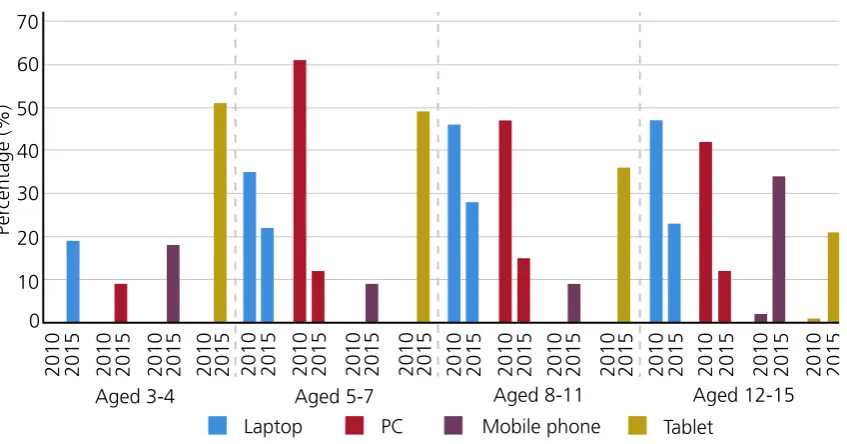
Figure 2: Devices used by children
Aged 3-4 Aged 5-7 Aged 8-11 Aged 12-15
2010 2015 2010 2015 2010 2015 2010 2015 2010 2015 2010 2015 2010 2015 2010 2015 2010 2015 2010 2015 2010 2015 2010 2015 2010 2015 2010 2015 2010 2015 2010 2015
Laptop PC Mobile phone Tablet
0 10 20 30 40 50 60 70
Per
centage (%)
Source: Ofcom, Children and parents media use and attitudes report (16 November 2016)
Base: Parents whose child ever goes online aged 3-4 (272) or 5-15 (1172 aged 5-15, 264 aged 5-7, 445 aged 8-11, 463 aged 12-15). Significance testing shows any change between 2015 and 2016.
35. Ofcom said that:
“Since 2015 there have been increases in the numbers of 5-15s who say that a tablet or a mobile phone is the device they use most often to go online (39% vs. 33% for tablets and 28% vs. 19% for mobile phones). As a result, the mobile phone is now the second most popular device to go online (after tablets), overtaking laptops which were the second most popular device in 2015.”
36. Furthermore, children at increasingly young ages are accessing portable devices, which can make it harder for parents or carers to monitor activity. 37. With respect to online services, Parent Zone claimed that children used “all
of the internet”:
“This includes familiar names like Facebook, Snapchat and Instagram, but it also includes places that fewer adults understand, including services like Putlocker, a site that facilitates free streaming of movies and TV programmes, and VPns (Virtual Private networks) that facilitate
33 Written evidence from the BBC (CHI0053)
34 BBC news, European Commission plans free Wi-Fi in public spaces (14 September 2016) http://www.bbc.
[image:19.595.88.512.193.415.2]anonymous surfing and, more crucially for young people, the ability to bypass filters.”35
38. Group chat services that are used to connect with family and friends, including Snapchat, WhatsApp, Facebook Messenger and Instagram, have increased in popularity. Facebook is the most popular main social media profile with 8-11s and 12-15s. This is unchanged since 2015 but has fallen considerably since 2013, when 87% of 12-15s considered Facebook their main site.36 Snapchat has seen an increase from the 12-15 age groups to
51%, up from 43% in 2015, while use of Twitter has fallen by 7% to 20%.37
The BBC told the Committee that “Snapchat is for their friends and they don’t have large networks on here, it is fast paced and funny. Instagram is where they curate their online personas and they can spend hours creating the perfect selfie.”38
39. It is increasingly a norm for a child to have a social media presence and the likelihood of having a social media profile increases with age. Ofcom research states that:
“0% of 3-4s, 3% of 5-7s, 23% of 8-11s and 72% of 12-15s have a profile … The biggest increase comes between ages 10 and 11, when the number with a profile doubles from 21% to 43%, and there is another sharp increase between 12 and 13, from 50% to 74%.”
40. The increase at age 11 corresponds to the start of secondary school. This has led some to observe a change in some of the ways in which children interact with their peers in comparison with previous generations. Research has “found that ‘likes’ on social media were important ‘social currency’, with children saying they would remove posts if they didn’t quickly receive what they considered to be an acceptable number.”39
41. Playing games online is also now a norm in a child’s life. Internet Matters cited research from the Childwise Monitor which shows that gaming apps are the “most used by 7–16 year olds, with Minecraft being popular amongst 7–10s.”40
42. Ofcom noted that some games “offered considerable scope for creativity, particularly Minecraft which many of the children played in ‘creative mode’, engaging in extensive design and construction.”41
43. The launch of Pokémon Go in 2015 has been credited with inspiring many to take to the streets. This ‘Augmented Reality’ (AR) which “effectively
35 Written evidence from Parent Zone (CHI0011)
36 Ofcom, Children and parents media use and attitudes report (16 november 2016) https://www.ofcom.
org.uk/__data/assets/pdf_file/0020/94025/Childrens-and-Parents-Media-Use-and-Attitudes-2016-Executive-summary.pdf [accessed 24 January 2017]
37 Ofcom, Children and parents media use and attitudes report (16 november 2016) https://www.ofcom.
org.uk/__data/assets/pdf_file/0020/94025/Childrens-and-Parents-Media-Use-and-Attitudes-2016-Executive-summary.pdf [accessed 24 January 2017]
38 Written evidence from the BBC (CHI0053)
39 Ofcom, Children and parents media use and attitudes report (16 november 2016) https://www.ofcom.
org.uk/__data/assets/pdf_file/0020/94025/Childrens-and-Parents-Media-Use-and-Attitudes-2016-Executive-summary.pdf [accessed 24 January 2017]
merge(s) the real world with the digital world”42 primarily for gaming
purposes, is seen as the future of gaming.
44. We also noted that there is a difference in the types of games played by boys and girls. Dr Bush told the Committee:
“Boys tend to use massively multiplayer online games—MMOs—or first-person shooter games, which are very much about participating in questing, adventures or military operations. Girls tend to be involved in role-playing games, which are more about fantasy and sci-fi, and are more likely to use games on their mobile phones.”43
45. Children also use the internet as a source of information. 78% of all 8-11s and 88% of all 12-15s who go online said that they used search engines, according to Ofcom research:
“While the BBC website remains the preferred source of ‘true and accurate information about things that are going on in the world’ for 12-15s who go online (35%), this has declined substantially since 2015 (52%). Instead, children are more likely to say they would turn to Google for this (30% vs. 17% in 2015).”44
46. The internet not only provides an unprecedented range of information, but also interactive experiences for children to learn.45 Ofcom gives the example
of a 10-year-old girl learning Arabic via Skype.46 Will Gardner of Childnet
emphasised the advantage of being able to communicate within social groups. He also suggested that it can be “a great source of support and advice even for young people for a range of different topics with information that they might not want to ask trusted adults about”.47
47. The internet allows children to explore intimate aspects of life. A 2013 survey found that, “while the majority of girls and young women aged 11 to 21 still get information about relationships and sex from talking to friends (63%) and from sex education lessons at school, 35% turned to the internet as a source of information and advice. For older girls aged 16 to 21 the internet was even more important, with 49% getting information about sex and relationships online.”48
48. Some of our witnesses highlighted the potential for the internet to be an avenue for political engagement for children. In particular, YouthLink Scotland told us: “Social media provides a platform for young people to express their opinions and be heard. It is narrowing the traditional generational gap of whose voices are heard in decision making.”49
42 Written evidence from Internet Matters (CHI0040)
43 Q 101 (Dr Marc Bush)
44 Ofcom, Children’s and parents’ media use and attitudes: executive summary (3 February 2017):https://
www.ofcom.org.uk/__data/assets/pdf_file/0020/94025/Childrens-and-Parents-Media-Use-and-Attitudes-2016-Executive-summary.pdf [accessed 2 March 2017]
45 Q 2 (John Carr OBE)
46 Written evidence from Ofcom (CHI0051), (CHI0060) 47 Q 2 (Will Gardner)
48 Written evidence from Girlguiding (CHI0026)
49. A 2015 survey conducted by Girlguiding UK supported this. It found that “of girls aged 11 to 21, 25% say they share campaigns they care about on social media and 30% sign online petitions.”50
50. However, Ofcom also told the Committee that the children who participated in their qualitative research “had limited understanding of how search engines work, with most assuming that the results they saw were selected by some kind of authoritative figure, possibly employed by Google, who selected the ones which were most accurate.”51
50 Written evidence from Girlguiding (CHI0026)
51 Ofcom, Children and parents media use and attitudes report (16 november 2016) https://www.ofcom.
CHAPTER 2: THE ANATOMY OF THE INTERNET
51. The digital sector is still young and rapidly changing. Since the World Wide Web became accessible to the public 26 years ago, the internet has grown to dominate the developed world. In this Chapter we briefly consider the development and function of the internet at a simplified level for the purposes of understanding certain terms and principles in this report. This is a complex and contested area of inquiry, and one which is subject to change as the internet develops.
52. Initially delivered through the existing system of telephone cables, the internet developed into a ‘network of networks’ incorporating tens of thousands of interconnected computer networks, run by individual companies, universities, governments and others.52 It was designed to be a non-hierarchal structure
with no one in overall control. The technical interoperability between the individual networks is coordinated by non-profit organisations, such as the Internet Corporation for Assigned names and numbers (ICAnn), working on principles of openness and independence from any national governments. It is transnational, operating across legal jurisdictions with a culture of self-regulation or where possible no self-regulation at all.
53. Since the 1980s the internet’s development has been characterised by “the creative anarchy of small start-ups that succeed by creating a market for new products and services or disrupting old business models”.53 Innovations
continue to develop and to gain prominence among users. However, over time the internet has come to be dominated by a handful of giants.54
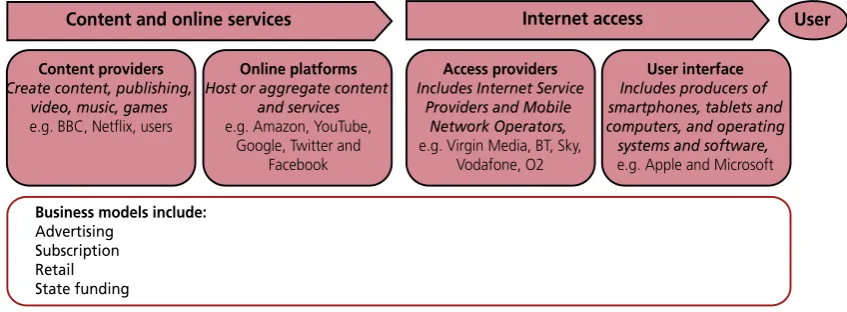
54. In the UK, almost every aspect of life is now in some way mediated through the internet. It is used by governments, public bodies and services, educators, healthcare professional, businesses and families to communicate. While it is difficult therefore to speak of a single internet sector, a number of different types of businesses play a specific role in contributing to the internet’s ‘value chain’. The internet value chain denotes the structure of different groups of stakeholders who contribute to a user’s ability to access ‘content’ or online services. It is a complex matrix of individuals and organisations performing different functions according to various business models, but one simple way is to divide it into the following components.
52 Internet Society, ‘How it works’: http://www.internetsociety.org/internet/how-it-works [accessed 3 March 2017]
53 Livingstone, Carr and Byrne, One in Three: Internet Governance and Children’s Rights (2 november 2015): https://www.ourinternet.org/research/one-three-internet-governance-and-childrens-rights
[accessed 3 March 2017]
54 Digital Trends, How the father of the World Wide Web plans to reclaim it from Facebook and Google (10 August 2016): http://www.digitaltrends.com/web/ways-to-decentralize-the-web/#ixzz4aGmUYmxj
Figure 3: Internet value chain
Internet access User
Content providers
Create content, publishing, video, music, games
e.g. BBC, Netflix, users
Business models include:
Advertising Subscription Retail State funding
Online platforms
Host or aggregate content and services
e.g.Amazon, YouTube, Google, Twitter and
Access providers
Includes Internet Service Providers and Mobile
Network Operators,
e.g. Virgin Media, BT, Sky, Vodafone, O2
User interface
Includes producers of smartphones, tablets and computers, and operating systems and software,
e.g. Apple and Microsoft
Content and online services
55. The first group of those contributing to the value chain are the ‘content providers’. These may be businesses which produce content themselves, for example by commissioning the production of television programmes, or businesses which aggregate the content of others, including those whose main content is from users (‘user-generated content’).
56. Content providers may have their own websites or services, for example BBC news or netflix. Alternatively content may be hosted through multi-sided sites which connect different groups of users and businesses, ‘online platforms’, for example Amazon, YouTube and Facebook. The European Commission describes such platforms as covering “a wide-ranging set of activities including online advertising platforms, marketplaces, search engines, social media and creative content outlets, application distribution platforms, communications services, payment systems, and platforms for the collaborative economy.”55
57. Search engines are an important example of a platform as they provide a conduit to other websites. Katie O’Donovan of Google explained that the search engine used automated algorithms to return results “based on a number of different indicators … to understand what would be the most relevant search”.56 These indicators could include indicators of the quality of
the website, based on how many people link to the site and whether it is linked to by other reputable sites. Information filters (such as. Google’s Ads and Facebook’s newsfeed) select and present information such as advertisements or news stories using automated algorithms in the same way.
58. However, without human intervention, such automated processes can return some perverse outcomes. It has been reported that Google’s autocomplete function returned the word “evil” when a user inputs the phrase “are women”. The same word was autocompleted when certain ethnic and religious groups were entered. Google have since corrected this and issued a statement saying “Autocomplete predictions are algorithmically generated based on users’ search activity and interests. Users search for such a wide range of material on the web—15% of searches we see every day are new. Because of this, terms that appear in autocomplete may be unexpected or unpleasant.
55 Communication from the Commission to the European Parliament, the Council, the European Economic and Social Committee and Committee of the Regions on Online Platforms and the Digital Single Market Opportunities and Challenges for Europe. COM(2016) 288 final
We do our best to prevent offensive terms, like porn and hate speech, from appearing, but we acknowledge that autocomplete isn’t an exact science and we’re always working to improve our algorithms.”57
59. Whatever the specific problems in that case, a more fundamental problem highlighted by some was the lack of transparency in how this algorithmic processing works.58
60. Search engine services like many others are indirectly paid for through advertising, not least through contextual advertising and sponsored links which are given priority among search results.
61. Internet Service Providers (ISPs) are businesses which provide users with access to the internet through fixed access such as through broadband. They in turn are clients of the Tier 1 network companies that own the transnational underwater cables. In the UK, Virgin Media, BT, Sky and TalkTalk are described as the ‘big four’ (ISP’s) and together they account for 90% of home broadband provision.59 Increasingly a number of these companies are
beginning to provide public Wi-Fi hotspots and free Wi-Fi in public places. 62. Mobile network Operators (MnOs) provide another source of internet
access through mobile data. In the UK, the largest four by market share are Vodafone, O2, EE (owned by BT) and Three.60
63. The final level of the value chain is the user interface in the form of both hardware, such as smartphones, tablets, computers and smart TVs, and software such as operating systems and app stores. Some of these may be produced by the same companies; for example Apple makes both devices and the operating systems that make them work. Increasingly, household objects and wearables are being added to the list of devices which access the internet.
64. The business models of different companies vary greatly. Hardware can be bought outright or free with subscription services. Users pay for a mixture of broadband connectivity and content services. Some content providers and hosts are state-funded or funded through donations, such as the BBC and Wikipedia respectively. Many platforms exchange online content and services for users’ data, in effect selling access to the user, as a consumer, to a third party to target advertising. Google and Facebook are prominent examples of advertising-funded services. Like other online platforms, they have benefited from ‘networks effects’, “where, broadly speaking, the value of the service increases with the number of users”61 to take a large share of
the online advertising market. According to a recent report by a consultancy firm, by 2020 these two companies will take 71% of the income from all
57 The Guardian,‘Google alters search autocomplete to remove ‘are Jews evil’ suggestion,’ (5 December 2016):
https://www.theguardian.com/technology/2016/dec/05/google-alters-search-autocomplete-remove-are-jews-evil-suggestion [accessed 2 March 2017]
58 Web Foundation, Three challenges for the web, according to its inventor (12 March 2017):
http://webfoundation.org/2017/03/web-turns-28-letter/ [accessed 15 March 2017]
59 Written evidence from the Children’s Charities Coalition on Internet Safety (CHI0001)
60 Ofcom, Communications Market Report 2016 (4 August 2016), p. 152: https://www.ofcom.org.uk/__data/
assets/pdf_file/0024/26826/cmr_uk_2016.pdf [accessed 13 March 2017]
online display advertising in the UK.62 They have begun to monetise the
analysis of so-called “big data”—that is, huge datasets of information about their users—in ways that are little understood and not open to scrutiny. 65. While the internet may be dominated by a handful of companies, it remains
open for businesses and organisations of all sizes. Small businesses play an important role in generating innovation. But increasingly, they are developed in order that they might be bought up by the dominant players.
66. The Dark Web is the part of the World Wide Web that is only accessible by means of special, albeit easily accessible, software, allowing users and website operators to remain anonymous or untraceable. Some argue that it is “vital for people living in countries where you can be arrested, tortured, and killed for the things you do online.”63 However it is also used for illegal
transactions, drug selling and child pornography. As a former cyber-crime professional stated with “no possibility to penetrate it, criminals can continue their crimes on a global network. It’s very, very difficult for the police to penetrate, so it’s risk-free crime.” The specific dangers to children were noted by the former Prime Minister, David Cameron, saying it is “where paedophiles and perverts are sharing images, not using the normal parts of the internet that we all use.”64
67. A number of our witnesses highlighted that seismic technological changes, which will change the nature of society, work and enterprise, present additional risks and opportunities for children. Many witnesses felt that it is imperative therefore that principles and good practice are established now to minimise future risks and hazards from these innovative uses of the internet. 68. Emerging trends include the ‘Internet of Things’, whereby every-day
appliances collect and transmit information, artificial intelligence (AI) and machine learning—in each case, they have increased the capacity for automated decision making to provide goods and services. The value of these innovations is not yet established, but they are considered the future of the digital economy.
62 Jasper Jackson, ‘Google and Facebook to take 71% of UK online ad revenue by 2020’, The Guardian
(15 December 2016):
https://www.theguardian.com/media/2016/dec/15/google-facebook-uk-online-ad-revenue [accessed 13 March 2017]
63 BBC, What is the dark web and is it a threat?http://www.bbc.co.uk/guides/z9j6nbk [accessed 23 February 2017]
CHAPTER 3: INTERACTIONS WITH THE DIGITAL WORLD
Introduction
69. In this Chapter we investigate the main issues which affect how children interact with the internet. First, we look at the skills required for children to navigate the digital world, what sort of content children can access, and how they interact with it and other people. We then consider what impact time spent online can have on children’s development, wellbeing and mental health. Finally, we consider what rights children enjoy online, and what impediments there are to these.
Digital Literacy
70. There is no agreed definition of the term ‘digital literacy’ and it is sometimes taken to mean the minimum level of skills and knowledge needed for using computers and technology. However, in the 5Rights Framework the term encompasses “the skills to use, create and critique digital technologies” and the knowledge “to critically understand the structures and syntax of the digital world, and to be confident in managing new social norms”.65 We
consider this usage to be particularly instructive and useful.
71. Learning digital skills, including but not exclusively the writing of computer code, will be crucial as technology continues to develop. 66 Parent Zone cited
a 2013 study which suggested that “47% of all jobs in the US are susceptible to automation”. 67
72. This view is in line with the conclusions of the House of Lords Digital Skills Committee, which advocated greater digital literacy in the UK to address “seismic changes brought about by changing technologies”.68 It found that
the need for digital literacy is not only for careers in IT, but is also “an essential tool that underpins other subjects and almost all jobs”.69
73. Digital skills and literacy are not only necessary for a child’s future career. Research by Parent Zone and the Oxford Internet Institute found that a child’s level of digital skills and confidence was one of two factors that were positively correlated to building online resilience.70 Such skills underpin a
child’s ability to navigate the online world.71
74. However, research by BT identified “behavioural barriers preventing children from developing tech literacy skills and considering tech careers.”72
These are set out in Box 2.
65 5Rights, The right to digital literacy
http://5rightsframework.com/the-5-rights/the-right-to-digital-literacy.html [accessed 2 March 2017]
66 Written evidence from Samsung Electronics UK (CHI0029)
67 Written evidence from Parent Zone (CHI0011) citing Carl Benedikt Frey and Michael A. Osborne, ‘The future of employment: how susceptible are jobs to computerisation?’ (17 September 2013):http://www. oxfordmartin.ox.ac.uk/downloads/academic/The_Future_of_Employment.pdf
68 Select Committee on Digital Skills, Make or Break: The UK’s Digital Future (Report of Session 2014– 15, HL Paper 111)
69 Ibid.
70 Written evidence from Parent Zone (CHI0011). The other factor is parenting. 71 Q 93 (Dr Marc Bush and Dr nihara Krause)
Box 2: Behavioural barriers preventing children from developing tech literacy skills and considering tech careers
Children have mixed feelings about technology and are getting conflicting and confusing messages about its use. At school they are told they need strong computational thinking skills but at home told to spend less time on their devices. The slicker the technology gets, the more it erodes children’s curiosity and, unlike analogue devices, it is not designed to be tinkered with.
The language used and emphasis on coding makes it appear dull and ‘nerdy’ instead of dynamic.
Source: Written evidence from BT (CHI0020)
75. In BT’s view it was essential for these barriers to be overcome:
“It is important that children grow up as knowledgeable, practical and empowered digital citizens so that they understand social norms in a digital world and can manage risks for themselves … For young people to be empowered, they need to understand how technology impacts their lives. With digital technology developing at such a fast rate and many adults not keeping pace or being tech literate, children need to learn about the realities of the digital world and be confident in managing the new social norms and their reputation online.”73
76. ‘Critical understanding’ is a key aspect of digital literacy. It was defined by Ofcom as a “way of describing the skills and knowledge children need to understand, question and manage their media environment.” These are essential skills for children to develop as they enable them to “get the benefits it [the internet] has to offer, and avoid the risks.”74
77. However Ofcom noted that the “complexity of the online environment makes it more difficult for children to develop critical understanding.”75
78. Vicki Shotbolt of Parent Zone told us that children “are on the receiving end of a tsunami of information—there is a vast amount of information—and helping them to navigate their way through it and develop critical reasoning skills is really challenging.”76 She added:
“There is a real gap in the area of more reliable information. You used to be able to watch the BBC and would pretty much know that what you saw was true. now, they are getting their newsfeeds from Facebook, and they have no skilled editors to make sure that what they receive is truthful.”77
79. The Personal, Social, Health and Education Association believed that it is imperative that “children are taught skills to think critically about the information that they encounter online.”78 YouthLink Scotland suggested
that “Digital literacy education should also include teaching children and
73 Written evidence from BT (CHI0020)
74 Ofcom, Children and parents media use and attitudes report (16 november 2015) https://www.ofcom.org.
uk/__data/assets/pdf_file/0024/78513/childrens_parents_nov2015.pdf [accessed 24 January 2017]
75 Ofcom, Children and parents media use and attitudes report (16 november 2015) https://www.ofcom.org.
uk/__data/assets/pdf_file/0024/78513/childrens_parents_nov2015.pdf [accessed 24 January 2017]
76 Q 24 (Vicki Shotbolt)
77 Q 24 (Vicki Shotbolt)
young people to be critical consumers in order to understand how and why content is created.”79
80. The BBC told the Committee that “Children’s levels of critical awareness– about advertising messages, about how services are funded (and therefore whether they are being sold to) and about the extent to which they can trust information–are relatively low, given the ubiquity of internet use.”80
Ofcom research demonstrated that less than half of 12-15s who go online in 2015 were aware of paid endorsements by vloggers (47%) or personalised advertising (45%).81
81. A small but significant proportion of children believe that certain kinds of online information are “always true”, according to Ofcom. However, this proportion grew between 2014 and 2015. The proportion of 8-11s and 12-15s who visit news websites or apps and who answered that all the information on these sites is true increased (23% vs. 12% for 8-11s and 14% vs. 8% for 12-15s). There was also an increase in the proportion of 8-11s who say this for sites used for school work or homework (28% vs. 20%) and among 12-15s, who say this for social media sites or apps (9% vs. 4%). Ofcom links this poor critical understanding to a failure to understand the reasons behind online safety messages.82
82. The question of critical understanding became topical in the light of the large numbers of fake news stories during and after the US presidential elections.83
83. Simon Milner of Facebook assured us that “much less than 1% of the content on Facebook may be inauthentic, a hoax, fake or whatever words you use”. 84 However, it was not clear from this what proportion of content
which appeared to be news was fake. At any rate, he argued that there was “no evidence to suggest that the sharing of fake news in relation to the US election made a significant difference to the outcome of it”, but conceded that this had not provided a “good user experience”.85
84. Fake news presented an additional problem for children as a result of their necessarily limited life experience. The problem was compounded by search engines and social media platforms using algorithms to prioritise stories according to a user’s past online activity.86 This created a loop of similar
information, often referred to as a ‘filter bubble’.
85. The lack of transparency with regard to these algorithms compounds the problem further. According to Horizon Digital Economy Research, based at the University of nottingham, “Without transparency it is very difficult to identify what kind of bias these systems put on the information flows that children are exposed to.”87
79 Written evidence from YouthLink Scotland (CHI0006) 80 Written evidence from the BBC (CHI0053)
81 Ofcom, Children and parents media use and attitudes report (16 november 2015) https://www.ofcom.org.
uk/__data/assets/pdf_file/0024/78513/childrens_parents_nov2015.pdf [accessed 24 January 2017]
82 Written evidence from Ofcom (CHI0060) 83 Written evidence from Alex Burchill (CHI0065)
84 Q 107 (Simon Milner)
85 Ibid.
86 Written evidence from Alex Burchill (CHI0065)
Time online
86. Witnesses stated that there were varied outcomes to children’s wellbeing from the time they spend online. The findings of a study by the Chief Medical Officer in 2013 were “increased physiological arousal, decreased attention, hyperactivity, aggression, antisocial or fearful behaviour, social isolation and excessive use or ‘technological addiction”.88 YouthLink Scotland members
raised concerns about excessive use which could “manifest as social isolation, sleep deprivation and dependency.”89
87. Young Scot observed that the “impact of increased internet use on emotional development is different for each young person and depends entirely on their experience and circumstances.”90 A report conducted by Parent Zone found
that young people did not regard the internet as ‘separate’ or even ‘a thing’. Rather it was woven through their lives as a utility and its impact linked to mood, resilience and maturity.”91 Therefore it is difficult to isolate use of the
internet as a cause.
88. Young Scot remarked that some found the internet a good source of support: “For some, the internet is comforting, as they realise that th