ALGEBRAIC REASONING IN LAMBDA
CALCULI
by
Edmund A Kazmierczak, BSc (ions) Department of Computer Science
Submitted in fulfilment of the requirements for the Degree of
Doctor of Philosophy
UNIVERSITY OF TASMANIA HOBART
T his thesis contains no material which has been accepted for the award of any
other higher degree or graduate diploma in any tertiary institution. To the best
of my knowledge and belief, this thesis contains no material previously published
or written by another person, except where due reference has been made in the
text of the thesis.
Abstract
This dissertation examines some aspects of the relationship between A calculus and universal algebra. Motivated by the desire to understand the implementation of abstract data types in functional languages we use A algebras, or models of the pure Ai3 calculus, as a universe in which models for specifications are to be constructed. Given an arbitrary A algebra M we construct from it a cartesian closed category with sum objects which we call C(M) . The objects of C(M) are interpreted as types while the arrows can be thought of as effective functions. Unlike set theory where the semantics of an abstract data type is often chosen to be the (isomorphism) class of initial models the simple model of types and functions presented here contains no initial object. This means more care is required when choosing the semantics of an abstract data type. In particular the category C(M) , which is an extension of the cartesian closed monoids of [Koy82, LS86, Bar84] is cartesian closed (4.1.6) and so the basic properties of functional languages such as currying and higher order functions can be modelled.
the word problem (4.3.14).
Secondly a calculus, AEE, is given for reasoning about these models. )EE is a simply typed A calculus augmented with the operations and equations of the original specification. It is shown that this calculus is a conservative extension of the usual equational calculus if a strongly normalising and Church-Rosser set of rewrite rules can be generated from the original equations (5.2.10).
Acknowledgements
There are many people to whom I owe thanks for both their help and their gen-erosity of time and spirit.
Firstly to my supervisors, Phil Collier and Clem Finch. To Clem Baker-Finch for listening to and reading through many half baked ideas, setting me straight when I needed setting straight and for his patience with a sometimes "difficult" student, to Phil Collier for putting up with all my continuing requests of him even after I had moved to Edinburgh and to both for their encouragement and faith at all times. Also to the staff at the CS Dept. at the University of Tasmania for the many fruitful and enjoyable years spent there.
Secondly to the G.C.S.B, that is, Andrew Partridge, David Wright, Bernard Gunther, Ben Lian, Tony Dekker and James Coleman for their comradeship and for making my days at the University of Tasmania special. I would, however, especially like to thank David Wright for his assistance with the LaTeX'ing of parts of this dissertation, James Coleman for all his friendship and good humour (especially when I was without mine) and Tony Dekker for all the time we spent discussing our ideas, relevant or not.
Contents
Abstract iii
Acknowledgements vi
1 Introduction 1
1
.1
Background
and
Re
la
ted
Work
4
1
.2
Overv
iew
9
2 Algebraic Preliminaries 12
2
.1
Deduc
t
ion
,
Compu
ta
t
ion
and
the
Word
Prob
lem
13
2
.2
S
Sor
ted
Theor
ies
20
2
.3
A
lgebras
for
S
Sor
ted
Theor
ies
26
3
A
Calculus 313
.1
A
A
lgebras
33
3
.2
Car
tes
ian
C
losed
Ca
tegor
ies
and
A
Ca
lcu
lus
39
4 Models of Equational Theories In Lambda Algebras 48
4
.1
The
Ca
tegory
C(M)
49
4
.2
Anarch
ic
A
lgebras
in
C(M)
58
4
.3
A
lgebras
Sa
t
isfy
ing
Equa
t
ions
in
C(M)
66
4
.4
Examples
78
4
.5
Summary
86
5 Extending Equational Theories To Higher Order Equational
5
.1
A
S
imp
ly
Typed
A
Ca
lcu
lus
w
i
th
Equa
t
iona
l
ly
Def
ined
Opera
t
ions
90
5
.2
Reduc
t
ion
Proper
t
ies
o
f
A
EE
100
5
.3
Examp
les
108
5
.4
S
imp
le
Ex
tens
ions
to
AEE
111
5
.5
Compar
ison
w
i
th
O
ther
Work
114
6 Soundness and Free Higher Order Theories 115
6
.1
Soundness
o
f
AEE
Deduc
t
ion
in
C
(M
)
116
6
.2
The
Un
iversa
l
Proper
ty
of
C
(M
)
121
List
of
Figures
1
The
Un
iversa
l
Proper
ty
of
TE(X
)
14
2
Med
ia
t
ing
morph
isms
28
3
Ru
les
for
the
S
imp
ly
Typed
AT
43
4
Sums
and
Produc
ts
in
C
(M
)
57
5
The
Def
in
i
t
ion
of
an
Opera
t
ion
in
C
(M
)
74
6
Def
in
i
t
ion
of
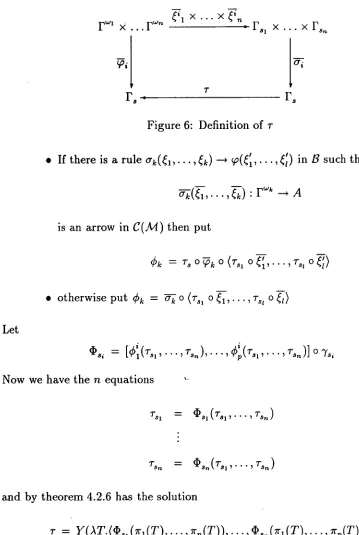
T75
7
Ru
les
to
Dec
ide
the
Word
Prob
lem
for
Free
Groups
83
Chapter 1
Introduction
The universal algebra approach to the design and specification of programs has led to a number of important and fundamental concepts in computer science. In this approach programs can be equated to algebras and program specifications with a set of axioms describing the behaviour of a program that is to solve a particular problem. Such a view allows for a rigorous treatment of both programs and specifications as well as the relation between them within one unified framework and this in turn has facilitated a number of other developments. Thus in software engineering one may begin the design of programs by first writing a specification of the various functions required to solve the problem, their domains and ranges and a set of axioms specifying their behaviour. Such a program specification may be explored for various logical properties such as consistency, or perhaps it may be shown to possess some property inherent to the problem domain and thus some measure of confidence in the specification is gained. From the specification one must now construct one particular algebra, that is, give a program meeting the specification.
refinement.
One aspect of the theory of algebraic specifications which remains unsatis-factory is the formal definition of
implementation
and how this should take into account an actual programming language. What is usual in the initial algebra approach [JAGW78, EM85] is to consider the actual language as a particular specification itself, say a collection of abstract data types as in [JAGW78]. With such an assumption one can define what it means for a program to meet its spec-ification and so show that any program written in this (abstract) programming language will meet its specification. The final coding step, however, must still be done outside the algebraic framework.Almost in parallel with the development of the theory of algebraic specifica-tions came the development of higher order functional programming languages such as Miranda [Tur] and Standard ML [HMT90, MT90]. Functional program-ming languages offer a simpler alternative than imperative programprogram-ming languages for studying the interactions between algebraic specifications and programs be-cause their view of programs is much simpler. If we are to use a higher order functional language as a target language for the implementation of algebraic spec-ifications and again consider the formalisations of software engineering ideas, such as stepwise refinement and
implementation,
then we require that the latter take into account the fact that a program may use higher order functions to realize a (potentially first order) specification.Functional languages are still too complex' to deal with directly and so we choose to simplify the task by considering A calculus as a simple functional pro-gramming language. Viewed another way, A calculus is a simple abstraction for higher order functional programming languages and thus, we have the basis for studying in more detail the interaction between algebraic specifications and func-tional programming languages.
We wish to understand the logical relationships between equational specifica-tions and functional programming languages better for two main reasons: (1) such
an understanding may allow us to improve the facilities offered by functional pro-gramming languages , for example, to allow mixtures of executable specification and the more usual style of higher order function definition within one language; (2) if the relation between implementation and language can be formalised then we may perform proofs of correctness of the program code against its specifi-cation within one unified framework. We are not yet at such a point and still must rely upon a suitable abstraction of programming languages . In the case of higher order functional languages this abstraction can be made more precise than the (simpler) assumptions usually found in definitions of implementations of equational specifications2 .
In this dissertation we examine the problem of constructing implementations of equational specifications3 in A calculus. In particular we will be concerned with two questions:
1. under what conditions can algebras in the A calculus be constructed;
2. is there a sound and complete inference system for reasoning about algebras in the A calculus.
An answer to the first question would enable two things: (1) it would allow us to devise a test to check if a specification is realizable (in the A calculus) and (2) it would allow an extension of the usual function definition facilities in functional languages to include abstract data types. An answer to the second question would enable us to develop a theory of an implementation in a functional language. To answer these questions we view the A calculus as a universe in which abstract implementations may be made.
Rewrite rules are a means of computing with equations [H080, O'D77[ and since we wish to construct algebras within the A calculus their operations will, in some sense, be computable. For the A calculus this means (0) reduction, that is, the value of an expression is computed by trying to reduce it to a
(#)
normal form. For rewrite rules the same ideas apply and we show how (#) reduction can2see section 2.1
be used to "simulate" the result of rewriting a term to normal form. If (E,
E)
is a signature and a set of E equations then we show that under the assumptions that each sort inS is non-void
and that a set of Church-Rosser rewrite rules can be obtained from the equations inE
then an algebra may be constructed from (E, E).If A is an algebra in the A calculus satisfying a set of first order equations then the theory of A may well contain equations which equate terms involving higher order subterms with first order terms. We show that a simply typed A calculus extending the algebraic theory together with the usual rules (a) and (#) as well as the rules of deduction (C) and () [Bar84] and some
(S)
rules for surjective pairing is sound for such algebras. We also examine the possibility of some extensions to this calculus and show that it gives rise to a cartesian closed category, in the manner of [LS86], which is the free cartesian closed category on the algebraic theory presented by (E, E).1.1 Background and Related Work
Since the papers of [JAGW78] the concepts of
data refinement
andabstract
im-plementations
have figured quite prominently in algebraic specifications. Given an abstract specification of a data type, or program, the problem was to choose a representation for the data and code for the functions in actual programming lan-guage so that all the abstract properties of these functions were preserved. Within each of the major schools of thought in the semantics of algebraic specifications these two concepts have been studied.into the set of derived operations of this (concrete) algebra. The implementation is correct if the image of the derivor is a isomorphic to the initial algebra of the abstract specification. In the work of [HEP80b, HEP80a, EK83, EM85, EM9O] the concrete data types are characterised by an equational presentation with initial algebra semantics. An implementation is then an extension of the signature of the concrete specification by the sorts and operations of the abstract signature together with some equations relating the "new" operations back to the original ones (called an implementation specification). Using this framework the concept of program development by stepwise refinement can be formalised. Perhaps the dis-tinguishing feature of this work, from that of [JACW78] is that specifications are not considered separately from their semantics and so abstract implementations also have a semantics. This is expressed as the composition of two functors: syn-thesis and restriction. Synthesis takes each algebra of the concrete specification to a model of the implementation specification while restriction essentially forgets the sorts and operations of the concrete data type and restricts the resulting models to those reachable from the initial algebra of the abstract specification.
simply confined to theinitial models asin the work above. The assumptionis made that programs are to be modelled as algebras and under this assumption a specificationimplements another specificationif each model of theformeris also a model of the latter. How does this differ from the related notions above? In the work of[JAGW78, Nou80] animplementation takes the theory of an abstract specificationinto that of one more closely related to an actual programming lan-guage. In theframework of[SW81, ST86] abstractimplementations make design choices by simply rejecting certain programs.
Other notions ofimplementation also exist,for example,[KA84, Hup80, BV85, Foo85, GM82] and particularly[PV85]. Thislast notion ofimplementationis of interest because of the view of programminglanguage thatis taken.
In[PV85] a programminglanguage Ais definedin which the basic type struc-ture of thelanguage mayinclude solutions of recursive equations between the sorts which are,in effect, domain equations. Thus we mayinclude solutions to recursive equationslike:
List 1 + Nat x List Tree Bool + Tree x Tree
over the basics sortsNatandBoa Thelanguage A of[PV85] alsoincludes higher orderfunctions. If we are given an(abstract) specification theimplementation in Ais given by a pair of maps taking each sort of the specification to atypein thelanguage and each operationin the specification to term of the appropriate arity in A which satisfies the equations. The language A of [PV85] is a simple functional programminglanguagein which data type definitions may be defined byinduction.
considered to be a collection of abstract data types, perhaps organised into a hier-archy. Implementations are consequently translations between operations specified in one abstract data type (the abstract specification) and those of another (the concrete data types of the language).
While these approaches can in theory be extended to higher order functional languages that has not been not explicitly. Higher order specifications have been investigated [PG81, Poi86] but it is not yet clear how the theory of initial algebra semantics that these two approaches rely on extends to the higher order case.
If the purely syntactic approach is adopted as in [Ehr78, Ehr82] then for higher order functional programming languages this requires a notion of higher order theories in which implementations may be made. This we feel, is a possible avenue and it is one of our goals in this dissertation to introduce such theories. Where we differ from a purely syntactic approach is perhaps the assumption that a higher order theory is actually itself a specification of a program while the program is a model of that theory.
The approach of [ST86] has the advantage of being applicable to algebras of a very general nature and so naturally includes higher order algebras within the gen-eral framework. Despite this there is still some benefit to be gained from studying the way in which programs relate back to their specifications. One benefit which stems from a precise formulation of the relation between (functional) programs and their specifications is that the ability to reason about specifications, programs and data refinement is possible within a single framework.
reason about the behaviour of higher order functions [Sto77, Bar84], define suit-able notions of data type [Sco76, LS81, SP82] and understand type polymorphism [Mi177, BM84, CW85, MPS86, Rey85, Co187].
An early formalisation of data types in domain theory, and particularly in the A calculus, can be found in [Sco76] further elaborated in [Sco80]. In this simple theory a given model of the pure A calculus always contains a single "type" U which plays the role of the universe of all "types", that is
U is a type and all other
types are subtypes of U. A parallel may be seen in some set theories where each member of a set is drawn from a universe, but the analogy is only a weak one since the simple models of types that we consider here have only some of the properties of sets.An important feature of the domains discussed above is that they contain solutions to recursive domain equations. Indeed there is an alternative character-isation of the algebras within a domain which arises from the category theoretic approach to algebra [LS81, SP82, MA86]. Algebras do not have to be specified axiomatically, as is done in universal algebra, but can be specified as the solutions to recursive domain equations involving functors. This necessitates the view that the data types which can be defined in a domain form a category preferably with a certain structure which allows the solution of recursive domain equations 5 .
In a simple type theory two essential features thus co-exist: (1) the ability to define data by solving recursive domain equations (provided that the category of "types" has enough structure to do this) and (2) the denotations of recursive functions (because domains are simply models of the A calculus in which the number theoretic recursive functions may be represented [JRHS72, Cut80, Bar84]). If there exists a domain in which types and functions can be constructed in a purely syntactic way, as in [Sco80, Koy82], then that domain would be a very suitable universe in which to study implementations. The reason is that programs would be actual syntactic entities which can be treated operationally as well as being the elements of an algebra satisfying the algebraic specification.
To construct an implementation in such a universe we need to do two things: (1) give a type for each sort which will be the carrier of that sort and (2) give a (A definable) function for each (abstract) operation in the signature. Since A calculus, and functional programming languages, are both languages for expressing computations we conjecture (and later show) that if the equations in an equational specification can be turned into a suitable set of rewrite rules then a special algebra may be constructed in models of the A calculus (see [Bar84, Mey82]).
Since the implementation is essentially an algebra within the A calculus we may have equations between functions definable in the A calculus and those of the implementation which are not deducible using just equational reasoning, for example, in the theory of lists and natural numbers we may have the equation
fold 0 + [1,2,3] = 6
where "fold" for lists of natural numbers is defined by the usual recursion equa-tions:
fold x f nil
folds f cons(y,ys) = f(y, fold x f ys)
It is important therefore to provide a system of reasoning about both the model and the specification in order to be able to prove facts about the algebras in the A calculus and to verify that specifications are met. One such a system has been proposed in [PG81] based upon the equational calculus of [Bir35] (see also [GM81, EM85]). We adopt the approach of combining simply typed A with algebraic operations because we feel that for A calculus it is a more natural approach. The same approach has been taken in [BT88] where A calculus is combined with equations between terms over some signature. We compare our results with [BT88] in more detail at the end of chapter 5 where such a comparison is perhaps more relevant.
1.2 Overview
In chapter 2 we review some universal algebra and some of the theory of term rewriting. We also discuss the transition from the usual proof theoretic notions of term rewriting to the equivalent concept for algebras. The remainder of this chapter then goes on to deal with algebraic theories and the construction of al-gebras as fixed points of certain polynomial functors [Mac71]. The aim here is to lay the algebraic foundations for the work in the sequel. In chapter 3 we outline the correspondence between A calculus and
cartesian closed categories
by review-ing firstly A algebras and models, and secondly the construction of free cartesian closed categories over a simply typed A calculus. A algebras are to be theuniverses
in which algebras are constructed while the use of cartesian closed categories will be to show two particular theorems about the calculus AEE which we consider in chapter 5.In chapter 4 we give a category which is our abstraction of a programming lan-guage and then go on to examine the structure of algebras within this category. In section 4.1 we define the category
C(M)
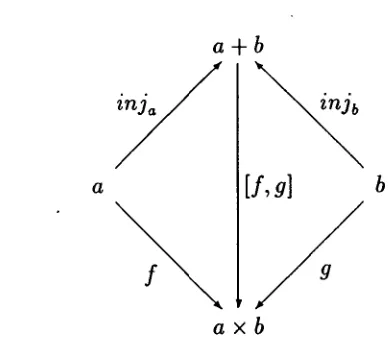
and examine some of its structure. In particular it is a simple extension of the categories of [Koy82], cartesian closed (theorem 4.1.6) but not bicartesian closed [LS86], but essentially there is enough structure to deal with the inductively defined data types which we are consider-ing. In section 4.2 we look at the structure of anarchic algebras inC(M)
where operations are given by the obvious injections (4.2.5). In section 4.3 we look at the construction of algebras based on confluent and terminating sets of rewrite rules. Given a set of such rewrite rules we can construct their solution as a recursive function (4.3.4 but see also [KS81]). The free algebra together with this solution constitutes an algebra in the sense of 2.3.1 (see 4.3.14). In section 4.4 we look at some examples while in 4.5 we summarise the chapter.considered as a weak axiomatisation of the models of (E, E) in C(M) . In section 5.2 we look at some of the reduction properties of the calculus defined in section 1 and via reduction show that the extension in section 1 is conservative (theorem 5.2.10).
In chapter 6 we return to semantics again and show that the calculus A EE of chapter 5 is sound with respect to any algebra in C(M) of a presentation (E, E). This is done by extending the proof that any cartesian closed category is a A algebra given in [Koy82, Bar84]. We give a cartesian closed category CE,E which is obtained by the correspondence between A calculus and cartesian closed categories [LS86] and show that it is the free cartesian closed category on an algebraic theory TE,E . Also we show that the canonical 7,E algebra in C(M) can be uniquely extended to a CE,E algebra and that the construction is general enough so that any 7,E can be extended in this way.
Chapter 2
Algebraic Preliminaries
If the assumption regarding programs as algebras and program specifications as presentations of equational theories is adopted then for a program to satisfy its specification a program must provide at least those functions and types required by the signature of the specification. Naturally the operations making up the program must satisfy the axioms but if the axioms themselves can be used for computation, say as a set of rewrite rules, then the axioms may be used to specify computations as well. All that is needed is a means of choosing, or constructing, the data types over which we are to compute. This has been done in the case of rewrite rules [O'D77, H082] where the value of a computation is simply the normal form of the term specifying that computation. Assume now that the axioms are simple equations. lithe equations are in the form of recursion equations then it is easy to see what the "values" of computations should be, but if they are true equations then it is not so obvious.
2.1 Deduction, Computation and the Word
Prob-lem
We begin by a brief review of some universal algebra. The reader is referred to[Coh81, MB67, Bou86]forfurther details regarding universal algebra, general algebra and the set theory, and to[JAGW78, EM85, ST89]for the use of thesein algebraic specifications.
Let S be a set of sorts, 5* be the set of stringsformedfrom elements of S and It an S* x S indexedfamily of operation symbols (called an S sorted operator domain in [JAGW78]). A Signature Eis a pair (5, Si) wheref2is an S sorted operator domain. In the sequel we will write E the set of operation symbols Si,,,sin E = (5,1)) and e to denote the empty string.
Definition 2.1.1 ([GM87]) A signature E is called non-void if for every s c S either Es.,8is not empty or thereis a function symbol o-: s1 x x s s uc h that every Si, 1 <i < n,is non-void. Otherwise the sortis called void.
A E algebrais an S indexed family of sets {A,}ses together with an S* x S indexedfamily of maps:
-rws -4 A:w
interpreting each operator symbolin E as an actual operationin A. We use the pair(A, -y) to denote the algebra with carrier A and operations defined by 7. Here andin the sequel we use.Aw where cy = sl, ,s, to denote the product of sets Asi x x Asn. Also we write o-A as a shorthand for 7(a).
One algebra of particularinterestis thefree algebra generated by a set of variables X whichis defined asfollows.
Definition 2.1.2 ([JAGW78]) The set of E terms TE(X) generated by a set of variables Xis theleast setinductively defined by the following rules:
1.X C TE(X)
TE(X)
A
Figure 1: The Universal Property of
TE(X)
3
.
i
f
w
=
s1.
.
.s„
,
aEand
ti
ETEsi(X)
for
a
l
l
1
<
i
<
n
,
then
ti,) E
TE(X)
The
Ea
lgebra
s
truc
ture
on
TE(X)
is
g
iven
by
in
terpre
t
ing
each
a
E Ewsas
the
func
t
ion
g
iven
by
CIT((ill• • • tn)) = Cr(t1) • • • tn)
Ifthe set of generators
X
is emptythen definition 2.1.2 defines another E algebra which,ifitis non-trivial,is calledthe EWord
A
lgebra
and consists simply ofthe thoseterms built from constants and function symbols only. If Eis nonvoidthen TE(0)3is non-empty for each sorts
.
Let A be a E algebra and
X
a set of variables. Anass
ignmen
t
of valuesin A to variablesinX
is a mapp
:
X
—>
A
.
p
can be extendedto a homomorphismp
whichinterprets everyterm of T(X)in A asin figure 1. Moreoverthis extension is unique PAGW78, EM85kA E equationis atriple
(X
,ti,t2)
,
whereX
is a set of variables andt1,t2 ETE(X)
with var(t1) CX
and var(t2) CX
.
Theideaisthat each equation(X
,
t1,
t
2)
is un i-versally quantified overthe variablesinX
.
Thisis often written as VX
.ti
= t2 to makethis quantification explicit. An algebra Asa
t
is
f
ies
the equation VX
.ti
= t2 if for every assignmentp:
X
—>
A
,
=
P
(
t2
)
[image:23.559.216.349.97.186.2]1
ti
if x
=
xo
hi(x) =otherwise
LetE be a set of equations andMod[E] the set of all E algebras which satisfy E. Birkhoff's nowfamiliar equational calculus[Bir35] was originally proposed to derive equations which will be validin every algebra ofMod[E]. The original equational calculus of[Bir35] wasintendedfor the single sorted case but when this calculusis naively generalised to the many sorted case the problem of un-sound deduction occurs[GM81](but see also[GM86, GM87]). Below we present a modified equational calculus due to[EM85].
Def
in
it
ion
2
.1
.3
([EM85])
Given a set ofEequations E,a Many Sorted Equa-tional Calculusis given by the following deduction rules:Substitution
V
X
,
t1
=
t2V
X
U
Y
,
h
(t1
)
=
h(
t2
)
where h: X —> TE(Y) andiiis the homomorphic extension of h to TE(X). Replacement
V
X
,
t1 = t2V
X
U
Y
,
(t
)
=
h2(
t)
wheret
E
TE(X) and hi: X —> TE(Y) such that for some xo EX,Variables if X0 CX
V
X
,
t1 = t2V
Xo,
ti = t2 providedthat1. t1, t2ETE(Xo)
2.Vs
E
S
,
Xs
0
0
imp
lies TE(X0) 0 0and alsoTransitivity, ReflexivityandSymmetryl.
Definition 2.1.4 A Derivation
o
f
a
theorem
e
from
a
se
t
o
f
Eequa
t
ions
E
is
a
sequence
e1
,.,
e
n
such
tha
t
el
EE
and
en
=
e
and
each
ei
is
ob
ta
inab
le
from
ei_1by
app
l
ica
t
ion
o
f
one
o
f
the
ru
les
in
2
.1
.3
or
ei EE
.
We
use
E
HEe
to
say
tha
t
e
fo
l
lows
from
E
by
such
a
der
iva
t
ion
and
deno
te
by
E*
,
the set of all equations e
such
tha
t
E
HE
e
.
Definition 2.1.5 ([EM85])
Let
E
be
a
set
of
Eequa
t
ions
.
The
Econgruence
on
an
a
lgebra
A
genera
ted
by
E
,
wh
ich
we
deno
te
by
EE,
is
de
f
ined
as
fo
l
lows:
I
.
i
f
V
X
.
L
=REE
is
an
equat
ion
then
for
a
l
l
ass
ignments
h:
X
A
,
h(L)
EE
h(R)
(Closure under substitution).
2
.V
a
EA
.
a
-EE
a
3
.i
f
a
aEb
then
b
a
4. if a EE
b
and
b
=E c then a
-..7=E C5
.for
each
opera
t
ion
symbo
l
a
:
si
X... Xsn
—>
s
o
f
E,i
f
ai
and
b•
are
e
lemen
ts
o
f
sor
t
si
and
a Eb
i
for
each
1
<
i
<
n
then
(Compatibility).
A congruence relation on a E algebra Ais an equivalence relation on A which is also compatible (as in 2.1.5(5)) with the E structure. E congruences also arisein another manner. The
Kerne
l
of a homomorphismf:
A
—>
B
is the set 1(a, a')If
(a)
=
f
(a
')}
whichis given by the pullback diagramK
er
f
A
If A is a E algebra and f : TE(X) —> A then ker f will be a E congruence on TE(X) [Coh81]. The smallest such congruence on TE(X) is the E congruence generated by E in definition 2.1.5 [Coh81].
Definition 2.1.6 ([EM85, Coh81])
Given an E algebra A and congruence re-lation q the Quotient of A by q, denoted by Al q, is defined as follows:1. The carrier of sort s is Hall a E A.} where [a] = la' I (a, a') E q}, that is, the q equivalence class of a.
2. For each operation symbol a E Ews the corresponding operation in Al q is given by
Crg ( al 1 • • - I an) = [a Ah(al) • • • ) an)]
The following theorem from [EM85] summarises the relationship between the equational theory, the congruence E E and the free and quotient algebras.
Theorem 2.1.7 (Soundness and Completeness [EM85])
Let (E, E) be a pre-sentation, X an S indexed set of variables and t and t' two terms in TE(X). Then the following are equivalent;1. EI-E V X, t = t'
2. V X. t = t' is valid in all algebras satisfying E.
S. V X. t = t' is valid in TE(X)/ --1-E
4.
t:_---E.
E
t'Is there a way of deciding if an equation is valid in a particular algebra A? This question is often referred to as the word problem for A and can be restated as follows:
Given terms t and t' and an algebra A, find an algorithm to decide if I and t' both denote the same value in A.
Definition 2.1.8 ([Coh81], [H080])
The
word problemfor
an
a
lgebra
A
is
to
f
ind
an
a
lgor
i
thm
to
dec
ide
i
f
A
=e
for
some
Eequa
t
ion
e
.
In general the word problemis undecidable[Coh81], butfrom theorem 2.1.7if there is an algorithm to solve the word problemfor
TE(X)
then the relationE HEe
is also decidable. It can be shown[Coh811 that the problem offinding a solution to the word problem,for a given algebra A, can be reduced to that offinding a homomorphismfromTE(X)
to a special subalgebra ofitself. Thisis essentially what we describe now.Definition 2.1.9 Le
t
q
be
a Econgruence
on
a EA
lgebra
A
,
and
R
CA
.
Ifeach
r
ER
is
in
exac
t
ly
one
q
congruence
c
lass
such
tha
t
UrER[r] =A
then
R
is
a Transversalfor
q
in
A
.
2
If
q
is an equivalence relation andR
a transversalforq
in a E algebra A then there is afunctionT
:
A
—>
R
which takes any elementin
A
toits representativeinR
.
MoreoverR
can be supplied with a E algebra structure asfollows:R(r
i
,
,rn)
=
T(ciA(ri, • • •,rn))where
o
-
EE each riis an element ofAs
,
.
If Tis recursivethenthis gives us a way of computingin A. We consider thisfor the case when Ais thefree E algebraTE(X)
.
Thefollowing can befoundin[O'D77, H080, K1o80].
Definition 2.1.10
A
se
t
o
f
rewr
i
te
ru
les
over
a
s
igna
ture
Eis
a
se
t
o
f
ordered
pa
irs
o
f
terms
8 = {(t,t1)1t,t1 E
TE(X)
and
var(e)
var(t)}where
aga
in
var(
t)
deno
tes
the
se
t
o
f
var
iab
les
o
f
a
term
t
.
The
Reduction Relation -46is
the
leas
t
se
t
con
ta
in
ing
B
and
c
losed
under
the
fo
l
low
ing
two
ru
les:
/. Substitution:
i
f
t
,
E TE(X), t-45t
'
and
:
X
—>
T
E(Y)
is
any
subs
t
i
tu-tion then(t)
B
7(tiS );2
.
Replacement:if
ti,
t2
E TE(X), t1->Bt2, tE
TE(Y)
and
(pi,
co2
are
two
subs
t
i
t
ions
such
tha
t
for
some
yo E Y, pi(yo) = t1and
(
,o2
(Yo
)
= t2and
for
a
l
l
y
yo E Y(pi(y) = P2(Y) = ythen
(
t
)
—
>B TO).The transitive and reflexive closure of —>8is denoted by —.
A
Redex
int
is
a subtermt
'
such thatfor some rule(ti,t2)EB
,
and some substitution cp,co
(
t1)
=t
'
.
A termt
is said to beinNorma
l
Form
ifit contains no redexes. The reduction relation also gives rise to a pre-order relation on the set of E terms. Lett
<5t
'
ift
'
t
.
By the substitution and replacement conditions it follows that if t1 <6 and t2 <6 1'2 thent1[t2/ X] <5 tli[ti2/ X].The symmetric, transitive and reflexive closure of —>L3is called theEqu
iva
lence
Re
la
t
ion
generated byB
.
Definition 2.1.11
I
.
8
is
Confluenti
f
for
any Eterm
t
such
tha
t
t
—>*
5
t1
and
t
—>
8
t2
then
there
is
a
t
'
such
tha
t
t1
t
and
t2
—>*
B
.
2
.
13
is
Strongly Normalisingif
for
all
terms
in
T
E(X)
,
there
is
no
in
f
in
i
te
sequence
o
f
reduc
t
ion
s
teps
s
tar
t
ing
a
t
t
,
i
.e
a
l
l
terms
reduce
to
norma
l
form
a
long
any
reduc
t
ion
pa
th
.
Itis a well knownfact[H080] thatif a set of rewrite rulesis Church-Rosser then itis also confluent.
We can now state a theorem, due to Newman[New42], which gives sufficient conditionsfor a set of rewrite rules to be confluent. Say that a set of rewrite rules is
Loca
l
ly
Con
f
luen
t
ift
—>8
t1
andt
t2 then thereis at
such that t1—>*
5
t
'
and t2t
'
.
Theorem 2.1.12 (Newman)
I
f
8
is
loca
l
ly
con
f
luen
t
and
s
trong
ly
norma
l
is
ing
then
B
is
a
lso
con
f
luen
t
.
with sets of rewrite rules confluenceisimportantfor the reason that normalforms constitute the results of computation and confluenceimplies that these results are unique.
For the sequel welet
t[u
4-t
']
denote the term which resultsfromt
by replacing the subterm u byt
'
.
Definition 2.1.13
Le
t
Ai —› piand
)12 p2be
two
rewr
i
te
rules
.
Let
u
be
a
sub
term
o
f
Aiand
c
,o
a
subs
t
i
tu
t
ion
such
tha
t
u
=
c
,o(A2)
.
Then
the
derived pairresu
l
t
ing
from
the
superpos
i
t
ion
o
f
A2 -> p2on
Ai
pi
is
the
pa
ir
(700[7(u)
<—
7(P
2)]
,7(91
)
)
The theorem below is due to Knuth and Bendix [KB70] and coupled with the Newman theorem gives a testfor the confluence of a set of rewrite rules.
Theorem 2.1.14 (Knuth - Bendix Theorem)
The
se
t
o
f
rewr
i
te
ru
les
B isloca
l
ly
con
f
luen
t
i
f
f
for
every
cr
i
t
ica
l
pa
ir
(P
,
Q)
resu
l
t
ing
from
superpos
i
t
ions
in
B, thereex
is
ts
a
term
R
such
tha
t
P—
>*R and Q R
The Knuth Bendix algorithm derives a set of rewrite rulesfrom a set of equa-tions which solve the word problemfor the quotient of the algebra TE(X)i To decideif an equation
t
=
t
'
is
truein this algebra, botht
andt
'
are rewritten to normalform and compared. Normalforms can also be considered as the results of computations performed using the rewrite rules and thisleads usfinally to the theorem of[KS81]linking properties of reduction to those of recursivefunctions: Theorem 2.1.15 ([KS81])I
f
E
is
a
se
t
o
f
equa
t
ions
such
tha
t
the
word
prob
lem
for
T
E(X)I
EE isso
lvab
le
,
then
the
re
trac
t
ion
Tis
apar
t
ia
l
recurs
ive
func
t
ion
.
2
.2
S
Sorted Theories
study classes of algebras. While our ultimate aimin chapters 4 and 5is to study algebrasin a particular cartesian closed category we start here bylooking at the general theory. The bulk of the material of this section may be found in [LG85, JAG75, KR89, Law63] andis not original. We assume the definitions of category,functor, natural transformation,limit and colimit which may befound in standard textslike[Mac71, AM75, HS79].
Let S be a set of sorts. S may be viewed as a discrete category byletting the objects of S be the elements of S and the morphisms of S be defined asfollows:
1.for any s E S, Hom(s,$) = ids
2.for any s, s' such that s s', Hom(s, sl) = 0.
The category of all(small) sets andfunctionsis here called SET and so thefunctor category SETsis the category of all S sorted sets and S indexedfamilies of maps between them.
More precisely, if A and B are twofunctorsin SETS then a map between themis a natural transformation h : A B with components h(s) : A(s) B(s) for every sES. Note also that we use the notation -4for natural transformations. Since Sis small then SETsis a topos and sois both complete and cocomplete (see[Mac71, LS86]).
De
f
in
it
ion
2
.2
.1
([LG851)
Let S be a set of sorts. An S sorted theory Tis a category defined bythefollowing data:1. The objects of Tare the stringsin S*.
2.Let u = u1...un and w = wn, be any two objects of T, thatis, u and w are stringsin 5*. An S sorted operation in Tis a map a: s —> wfor some sE S. A tuple of S sorted operatorsis a map(al, ,an): u —> win which each criis a ui sorted operationin T with codomain w. Thus the elements of Hom(u,w) are tuples of S sorted operators with codomain w. For each w there are n distinguished morphisms : w, —> w suchthat
We callthe mapsirw w-arywi variables.
Each of the operations a: s w can be thought of as an operation of sort s whose arguments are of the sortsin w. It thenfollows that the mapsin Hom(s, e) are the constants of sort s.
Example 2.2.2 ([LG85]) Let S be any non-empty set. The theory To consists simply ofthe w-ary variables closed under composition and tupling.If u = ul. un and w = w1...tv then thereis a morphism u —> wif and onlyif every ui oc-curringin u also occursin w. Tc, also contains coproducts.If u and w are two objects of To(stringsin S*) then their coproduct is given by the concatenation uw with injections in = (r:iw ,r7) and in = (r,. . . , ruwWrn ). Every algebraic theory contains a copy of To(see ILG85.1).
The algebraic theory presented by(E, E) is defined to be thefree algebraic the-ory generated by an S* x S indexed collection of sets. To make this construction explicit wefirst need the notion of S sorted theory morphism.
Definition 2.2.3 Let T and r be two S sorted algebraic theories. A theory mor -phism:T —> T'is a functor which preserves objects and w-ary variables,that is, for any wEObj(T), 1(w) = w and Tee ) = rwwi w, in T'
The category of S sorted theories, TflS, can now be defined. The objects of THs are S sorted theories and the morphisms of Tlis are S sorted theory morphisms. If A, B and C are S sorted theories and I : A —> B and g : B C are two S sorted theory morphisms then their compositionis defined such that
g
0
.7-
(w
)
=
w andg
0
.7-(7rww,) = rw.Definition 2.2.4 A functor
T :THs —> SET
Thefree algebraic theory can now be defined asfollows3.
Definition 2.2.5 ([Law63, LG85])
Le
t
E bea
s
igna
ture
,
tha
t
is
,
an
S*
x
S
sor
ted
se
t
o
f
opera
tor
symbo
ls
.
The
free categoryon
E, FE,
is
de
f
ined
as
fo
l
lows:
(I)
the
ob
jec
ts
o
f
FEare
the
s
tr
ings
in
S*
and
(2)
the
morph
isms
o
f
.TE(u
,v)
are
the
morph
isms
o
f
T
o(u
,v)
(o
f
examp
le
2
.2
.2)
toge
ther
w
i
th
an
arrow
for
every
o-
E
E
,3.
The
arrows
in FEare
c
losed
under
tup
l
ing
,
tha
t
is
,
i
f
(pi
:
,
1
<
i
<n
are
arrows
in
FEthen
so
is
(pi,
,
(p
n)
:
u
--+
w
,
and
compos
i
t
ion
.
The
arrows
in
FEare
a
lso
sub
jec
t
to
the
fo
l
low
ing
three
ax
ioms
[Law63]:
Projection
if
(4)1, 41n):
w
u
then
,
(1
)
n)
o
s
t
u
,
=
(Di;
Identity
i
f
(I)
:u
—>
w
,u
=
u1...un
and
w
=
w1...wm
.
then
(
I
)
o
(7cu
i,...,ru
un)
=
and
(rW , , 7rwwn) o = 4);Uniqueness
if
4):
u
w
then
(43
o
ru
o
)
Un=
(1)
.
We then have thefollowing theoremfrom[LG85]:
Theorem 2.2.6 FE
has
the
fo
l
low
ing
un
iversa
l
proper
ty:
i
f
T
is
any
S
sor
ted
theory
,
y
the
inclusion
of
the
S*
x
S
sorted
set
into
T(FE)
and
f:
E —›T(T)
then
there
is
a
un
ique
f*
wh
ich
make
the
fo
l
low
ing
d
iagram
commu
te
,
T(FE)
T(T)
Theorem 2.2.6 expresses thefact that FE is the
free
algebraic theory over a given signature.Examp
le
2
.2
.7
Cons
ider
the
s
igna
ture
for
groups
g
iven
by
a
s
ing
le
sor
t
G
,
and
opera
t
ions
e
:—>
G
,
:
GxG—>G
and
—
:
G—+
G
.
The
ob
jec
ts
o
f
.7"
- Grp aree
lemen
ts
o
f
the
free
mono
id
genera
ted
by
the
symbo
l
{G}
.
Some
typ
ica
l
opera
t
ions
o
f
FGrpare
g
iven
be
low:
G1G2G3 •
(7G17G3)
GiG3
(— o 7r ,— o 7rG2)
G4G5
+
We use subscripts to denote the particular copy of
G
that a variableis referring to and useii-G, as a shorthand for 7rGGI—Gn.An algebraic theory satisfies a set of equationsif certain other diagrams com-mutein the category. For examplein a theory of groups,like that of example 2.2.7, the associativity of +is expressed by saying that the diagram:
(7rG1 7 rG2 + 7
G3)
G1G2G3 1G
G
(7rG1 + 7G2 , 7 G3) +
GG3
G
+
commutes. Equations areimposed onfree algebraic theories by giving a con-gruence relation on the arrows of that theory toforce the diagrams, expressing equations, to commute.
Def
in
it
ion
2
.2
.8
aLaw631
,
PAG751)
A Theory Congruence,R
over
an
a
lge-bra
ic
theory
7
,
is
an
S*
xS*
indexed
fam
i
ly
o
f
equ
iva
lence
re
la
t
ions
such
tha
t
I
.
R(v
,w)
c
T
(v
,w)
x
T
(v
,w)
2
.i
f
(
(p
,
(p
'
)
ER(v
,w)
and
(0
,0
')
ER(w
,
p)
then
(0
o o ER(v
,
p)
3
.i
f
(01,0)
ER(si,w)
for
a
l
l
i
E {1,...,n},si
ES
and
w
ES*,
then
The Theory Congruence, RE, generated by a set of equations Eis defined as follows;
4. If EE. then(t, t')E
RE(s
,w)
5. RE istheleast equivalence relation closed under(4) and rules(2) and(3) above.
Definition 2.2.9 ([JAG75]) If Ris a theory congruence and T an algebraic theorythenthe factor theory, T R, of T by Ris defined as follows: the objects of T R are the same as those of T and the arrows are equivalence classes of arrows in T such that coi,co2: u —> w are equivalentin TI Riff(cpi,c,o2) E R.
The theory presented by a signature and set of S sorted equations(diagrams)is defined to be the factor theory (see PAG75J) TE/RE of thefree algebraic theory presented by E by the theory congruence generated by E.
In the free concrete theory of[JAG75] each operation a : s —> wis defined as a term t in TE(X) in which thereis at most onefree variablesin t for each wi in w. For this reason we blur the distinction between termsin TE(X) and arrowsin TE and by abusing notation we write t' < t if t —*13 t' using a set of rewrite B and t and t' are arrows in J.
A reduction relation(see 2.1.10) may be translatedinto thelanguage ofS sorted theories by considering the pre-order defined by such a relation(asin section section 2.1). Let t = a o , and t' be two morphismsin the algebraic theory presented by(E, E). If t —>1* t3' and
t = °(el, • • •, en)
then (t, t') ETE/RE(s,w) for some sES and wE
S*
and so the diagrammust commute with
t
>
t
'
.
The reduction pre-order can be extended to arbitrary u-tuples of operators , C,): u tv by defining(el, • • •,> 5- •••,
if and only if each < This ordering of the arrowsin.FEis also preserved by composition.
2.3 Algebras for
S
Sorted Theories
There are a number of ways of describing the algebrasfor an
S
sorted algebraic theory. For single sorted theories Lawvere[Law63] describes algebras of a theoryT
as thosefunctorsinSETT
°P
which preserve products4. In[LG85] three equivalent ways of describing algebras are givenincluding theinterpretation of Lawvere's. We would not onlylike to describe the algebras of anS
sorted theoryT
as pairs(A,-y
)
asin section 2.1 but also to have the constructionsindependent of the underlying category because of our desire to study algebrasin A calculus.For the presentfix a category C and consider an endofunctor W: C C.
Definition 2.3.1 ([SP82])
Le
t
C
be
ca
tegory
and
T
:
C
C
an
endo
func
tor
.
I
.
A
kIf Algebrais
apa
ir
(A
,7)
such
tha
t
7
is
a
C
morph
ism
-y
:
T
A
A.Du-a
l
ly
a JI CoAlgebrais
apa
ir
(7
,
B)
such
tha
t
-y
is
aC
morph
ism
y
:
B
–
'I
/B
.
2
.
A
T
a
lgebra
(A
,7)
is
a Fixed Pointo
f
T
i
f
-y
is
an
isomorph
ism
in
C
.
The algebraic structure of a W algebra Ais given by the map7
:
—>A. Definition 2.3.2 A Homomorphismis
amorph
ism
in
C
such
tha
t
the
d
iagram
f
WA B
-YA
A
commu
tes
.
The kli algebras and 41 homomorphisms form a category with composition defined as follows: if f: (A1 ,71 ) -4 (A2 ,72 ) and f: (A2 ,72 ) —* (A3 ,73 ) then their com-position is defined by the comcom-position of f and
g
in the underlying categoryC.
Denote the category of kIi algebras and kli homomorphisms by kIf _ mg. In this way each endofunctor ill defined on C specifies a category of algebras in C much the same as a signature and set of equations specify a category of algebras in universal algebra.An
initial fixed point is simply a fixed point of kIf which is initial in the
subcat-egory of fixed points of W (dually the terminal fixed point is a terminal object in . the category of fixed points and homomorphisms). Initial W algebras and initialfixed points of kli are related by the following lemma.
Lemma 2.3.3 ([SP82])
The initial xli algebra, if it exists, is also the initial fixed
point of W.
The proof of this lemma may be found in either [SP82] or [MA86]. If C satisfies some additional properties then there is a canonical way to construct initial (and therefore by duality terminal) fixed points. The construction is given in the proof of the
Basic Lemma
of [SP82]. To formulate the basic lemma of [SP82] let co be the category with the natural numbers as objects and morphisms all pairs (i,j) of natural numbers i and j. If (i,j) and (j,k) are any two morphisms in w their composition is given by (i,k) and the identity for i is (i,i). An co diagram A in a category C is a functor A : coC.
Definition 2.3.4 ([LS81])
C is
an co Categoryif C has an initial object and all
c,.., diagrams have a colimit in C. Dually, C is an w"
Categoryif C has a terminal
object and all co
op diagrams have a limit in C
5
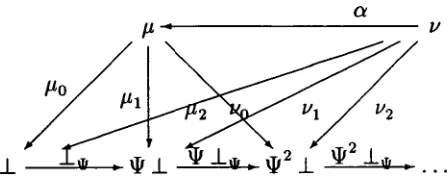
.Let C be an w category and _l_ be the initial object of C. For each object A, let _LA : 1 —> A be the unique arrow in
C
given by the initiality ofI. A Mediating
Morphism a : p —> v is
the unique arrow from the limiting coneit
of the diagram A to any other conev
for A (see [Mac71]).Figure 2: Mediating morphisms
Now suppose that Ais the w chain
fo
Do
in a category C. Define A- to be the chain
f2
D1
•
D2in C and it- to be the colimit of A. If
F
is afunctorfrom the w category C to the w categoryD
then FAis the chainF( fo) F(
r, ) „F
(f2)1_/
F
(Do)
) 2)in D andif p : A —> Ais a colimitfor Ain C then F(p) : FA —> F(A) in
D
.
Lemma 2.3.5 (The Basic Lemma [SP82]) Let C be anCVcategory and: C— > C. Alsolet A bethe diagram given by
A = (Tn1, Tn1 1)
If p : A —> A and p : WA —> TA are both colimiting cones for Ain C then the initialIII algebra exists andis(A,a), where a is the map a: .
The morefamiliar kinds of universal algebras can be definedin SET as a special case of the more general definition given above. Let E be an arbitrary signature.
Definition 2.3.6 ([MA86]) The functor XE: SETS —> SETs corresponding to a signature E is defined as follows: XE(A) =
A
where A is the functorin SETs such that for each s E S [image:37.559.192.416.95.187.2]The notation
A(s) = DA' I a EE„,s and wE
S*1
is from [MAK and means the disjoint union of the family of sets A' where for every ceE
S*,
if E not empty then for every operator a EE,„ thereis a copy of At"in the disjoint union.An XE algebrais then a pair(A, 7) consisting of an S-sorted set(functorin SETS)A and a map-yinterpreting the algebraic structure on A. Sincefor each SES Asis a coproduct ofSsorted sets the structure mapfor sortsmay be given by case analysis asfollows:
= [7ai, 'Yon]
where each y. Asinterprets the operator symbolaiin A.
The categorySETsis an c.i.) category(see[MA86]) withinitial object 0 and so we can apply the basiclemma 2.3.5 to construct theinitial XE algebrainSETS. If (T,'y)is anXE algebra then we have thefollowingSsortedfamily of mapsin SET .where 7is thefamily of maps:
XE (Tsi ) .14 Ts,
XE (Ts.) Tsn
If (T,-y)is theinitialXEalgebra then each of the-ysi above areisomorphisms and so we obtain the equations:
XE(Tsi) es Ts,
XE(Tsn) Tsn
Lemma 2.3.7 Let E = (S, 12) and TE (0) be the E term algebra on the empty set of generators as defined in 2.1.2. Then (TE (0),7) is the initial XE algebra, where each s E S and each operation of sort s in E
7a((tsi ,• • •,t3„)) = 6(ti,• • •, tn)
Chapter 3
A Calculus
In the previous chapter we introduced some fundamentals of algebraic specifi-cation, term rewriting and algebraic theories. The point made is that there is a correspondence between equational theories in universal algebra and the alge-braic theories of Lawvere [Law63]. In recent years such connections have also been studied between the simply typed A calculus and cartesian closed categories, for example, [Sco80, Lam80a, LS86, Poi86]. For A calculus and cartesian closed categories the connection has been formalised more strongly than in the case of equational theories by stating that simply typed A calculi are the internal lan-guages of cartesian closed categories [LS86] (but see also [Lam74] and [Lam80b]). The pure A calculus also gives rise to a cartesian closed category [Sco80, Koy82], perhaps best described as its internal cartesian closed category, but it is of quite a different nature to those arising from simply typed A calculi. In the case of the simply typed A calculi one takes the types and terms to be the objects and arrows respectively of a cartesian closed category while in the case of the pure A calculus the types and arrows of a cartesian closed category are embedded within the terms of the calculus.
in form of the exponential transpose of functions. It is the case for those languages (like Standard ML [HMT90, MT90]) using the Milner-Hindley type inference sys-tem [Mi178, DM82] that expressions are first type checked and then evaluated using untyped expressions. By taking the pure A calculus (or its models) and imposing a type discipline (in the form of a cartesian closed category) we hope to recapture some of the properties of this paradigm.
3.1 A Algebras
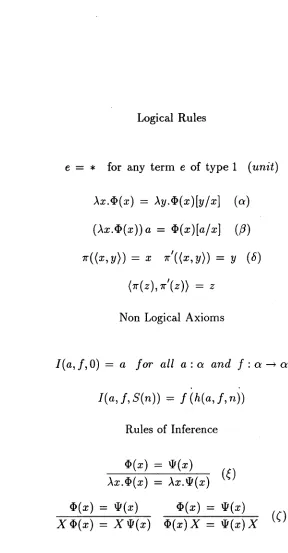
The pure A calculus is given by the following set of terms, axioms and rules of deduction [Bar84]. The set A of terms is defined to be the least set satisfying the following:
Variables X E A where X is a countable set of variables. Abstraction If M E A and x E X then Ax.M E A. Application If M, N E A then (M N) E A.
If a set of constants C is included in the definition then the set of A terms with constants C is denoted by A(C) otherwise the set of pure A terms is denoted A.
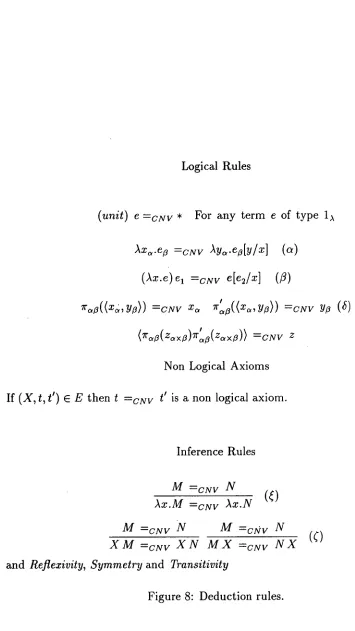
A calculus is an equality theory where equality between A terms is written as M =Gwv N and called Conversion. A calculus is called an equality theory in [HS86] to distinguish it from equational theories in which equality is "first order". Conversion is formally defined by the following axioms and rules of inference: Definition 3.1.1 (a) Ax.M =CNV Ay.M[y I x] if y is not free in M
(@) (Ax.M) N =cNv M[Nlx]
(() If M =cwv N then (X M) =cwv (X N) and (MX) =cwv (N X)
() If M =cwv N then Ax.M =CNV Ax.N for some variable x E X.
The notation M[Nix] means that N is substituted for every free occurrence of x in M. Formally it is defined as follows:
Definition 3.1.2 ([Bar84])
X [N/X]
E NY[NlYi E
y, if
x
y(Ax.M)[Nly] E Ax.M[Nly] provided x y (Ax.M)[Nly] E- Ax.M if x y
If M 7--CNV - N then we say that M and N are convertible. In the sequel we adopt
the conventionin[Bar84] that all(a) convertible terms areidentified. Turning now to models we now have thefollowing.
Definition 3.1.3 ([Mey82, Bar84]) A Combinatory Algebra isa set M together with a binary operation •(called application) and distinguished constants k and s satisfying the following two equations:
(k • x) • y = x for all x,y E M
((s •
x
)
•y) - z = (x • z) • (y - z) for all x,y,z E MThetheory presented by k and sis called combinatorylogic andis denoted by CL.
Note that •isleft associative and so some parentheses can be omittedinfuture. Combinatory algebras are combinatory complete which is to say that for every polynomial P with variablesin{x1,..., xn} over a combinatory algebra M there is an element f EM such that
Val ...an E M f al ...an =
Thereis a natural way to handle abstraction and application within such algebras. Suppose Mis a combinatory algebra. Define the set of terms over M asfollows:
•Variables X0, X1, ... ET( M)
•If a EM then ca E T(A4)
• If A ET( M), B E T( M) then(A • B) E
T(M)
We can now define an abstraction operator asfollows:
Definition 3.1.4 ([Bar84]) Define the operation of variable abstraction, A* by;
A*x.x = s•k•k (or I for Identity)
A*x.P = (k • P) if x does not occur in P A*x.(M N) = s • (A* x.M) • (A* x.N)