A Self-Help
OrganizationJOSEF INA MEDRANO DE LA PAZ
Bachelor of Science in Elementary Education Philippine Normal College, Manila, 1969
Master of Arts in Psychology Pamantasan ng Lungsod ng Mayni la (University of the City of Manila) 1977
Being a report of an investigation submitted as a partial requirement for the degree of Master of Psychology in the Department of Psychology at the University of Tasmania.
TABLE OF CONTENTS
Page No.
CHAPTER I INTRODUCTION TO THE INVESTIGATION 1.1 Overview
1.2 Aims 4
CHAPTER II REVIEW OF THE LITERATURE
2.1 The Traditional Mental Health System 5 2.2 Emergence of Community Based Treatment 6
Programmes
2.3 Non-Professionals and Self-Help Groups 9 2.4 Emergence of the Self-Help Group Grow 14 2.5 Social Network and Psychiatric 16
Symptomato logy
2.6 Methodological Problems in Relation to 18 SHG
2.7 Statement of the Problem and Hypotheses 19
CHAPTER III METHOD
3.1 Subjects 21
3.2 Materials 23
3.3 Procedure 28
CHAPTER IV RESULTS
4.1 Introduction to the Analysis 31 4.2 Demographic, Personal and Social 32
Characteristics of Grow Attenders
4.3 Psychiatric/Psychological Adjustment, 37 Social Support and Perceived Efficacy of
Grow
4.4 Demographic and Personal Characteristics 40 as a Function of Psychiatric/Psychological
Adjustment, Social Support and Perceived Efficacy
4.5 Psychiatric/ Psychological Adjustment, 48 Social Support and Perceived Efficacy as
CHAPTER V DISCUSSION
5.1 Demographic, Psychiatric/Psychological 51 Adjustment and Social Characteristics of
Grow Attenders
5.2 Group Climate and Group Processes • 53 5.3 Possible Effects of Grow as a Function of 57
Time and Attendance
5.4 Methodological Issues 59
5.5 Implications for Future Research 60
REFERENCES
Page No,
Table 1 Demographic, Personal and Social Characteristics 33 of Grow Attenders
Table 2 Classification of the Subjects According to 38 Scores in GHQ, HQ and PSNAS
Table 3 Percentage of Subjects Responses in Categories 39 of Visual Analogue Scales
Table 4 Demographic, Personal and Social Characteristics 41 as a Function of GHQ, SEQ and PSNAS
Table 5 Demographic, Personal and Social Characteristics 44 as a Function of the Visual Analogue Scales
Table 6 Mean Change Over Time (From 1st to Last Session) 48 In Adjustment and Visual Analogue Scales.
LIST OF APPENDICES
Appendix A Front Sheet to the Questionnaires
Appendix B General Health Questionnaire (GHQ)
Appendix C Social Environment Questionnaire (SEQ)
Appendix D Personality and Social Network Adjustment Scale (Adjustment Scale) PSNAS
I declare that this thesis, contains no material which has been accepted for the award of any other higher degree on graduate diploma in any university and to the best of my knowledge and belief contains no material previously published or written by another person, except when due reference is made in the text of the thesis.
ACKNOWLEDGEMENTS
I wish to express my appreciation to all those who have been of great help during this investigation. In particular, I am grateful to Jim Young whose enthusiasm and assistance made the study possible and to all Grow members for their cooperation and participation in the study.
I wish to thank James Alexander for his advice and assistance with statistics, Heather Williams for her help in the data processing and Sue Duncombe for her continued support and assistance in my being an overseas student, In particular, I am deeply indebted to Dr. Christopher Williams for his valued advice, overwhelming support and enduring assistance throughout this study.
ABSTRACT
The changing perspectives in mental health care have paved the way for the emergence and proliferation of self-help groups (SHGs) in the delivery of mental health care. Studies of the efficacy of such groups have been limited and have led to conflicting results. The present preliminary investigation focused upon Grow, a prominent self-help organization. The project aimed to describe the demographic, personal and psychiatric characteristics of Grow attenders, and to investigate possible changes in symptomatology and social network as a function of time and attendance.
The subjects were 62 Grow attenders who were representative of the state population of Grow members. The General Health Questionnaire (Goldberg, 1967), the Social Environment Questionnaire (Winefield, 1979), the Personality and Social Network Adjustment Scale (Clark, 1968) and a number of visual analogue scales related to issues such as perceived efficacy of Grow were administered weekly over a six week period.
The goal of the treatment of the mentally disturbed may be stated as the preparation of patients to function adequately in the community (Bachrach, 1978; Leigh, 1968).
From the admission of a patient to a hospital or clinic, through assessment and treatment to discharge and aftercare, this one goal is adhered to. However, as a result of the growing complexity of the mental health system and demands upon it, there are reported problems frustrating the achievement of this goal: doubt concerning the efficacy-of treatment, service delivery, accessibility, availability of services, professional capabilities and accountability, and financial difficulties (Coleman & Broen 1972; Kaswan, 1979; Rappaport, 1977; Rosenhan, 1973). The result has often been that patients have been discharged from psychiatric hospitals inadequately prepared for community living (Anthony, Buell, Sharratt & Althoff, 1972; Carpenter, 1978; Ellsworth,
1978; Heller & Monahan, 1977; Lamb, 1979; Salem, 1984; Torrey, 1987; Ullman & Krasner, 1975).
The origin of these programmes is also diverse, but an increasing number have been established by former mental patients and have evolved from a long history of self and mutual help organisations.
The self-help movement in mental health care can be traced from the middle ages through to the industrial revolution when loosely organized mutual-aid groups were formed to help cope with the stresses of industrialisation (Katz, Eugene & Bender, 1976). Members grouped together with an emphasis on self-protection and to a lesser degree, personal change. Self-help groups grew in number during the stressful times of the great depression of the 1930s and World War II (Brenner, 1973; Tracy & Gussow, 1976). Specific purpose groups were formed to help victims of the war cope with physical and mental problems and although philosophies varied from need to need and from group to group, the one common trend was the linking of those who faced similar difficulties to share discovered solutions and to offer understanding and accepting support (Back & Taylor, 1976; Hurvitz, 1976; Katz et al., 1976).
Grow, then called Recovery, was founded in 1957 by a group of former mental patients. Although it has become a large. and widespread organisation, it has retained its non-professional character. The organisation's structure involves provision for the continuing self-evaluation and subsequent modification of programme material. However, changes result only from the pooling of the experience of Grow
leaders and there has
not been any independent empirical evaluation of any aspect of Grow's functioning or effectiveness.With the spread of Grow's activity throughout Australia and overseas, it is increasingly important that such evaluation be undertaken to establish what aspects, if any, of the Grow programme are of particular use; to assess how effective or otherwise it is relative to the more traditional mental health service delivery programmes; to identify if it is of particular use to specific groups of patients; to evaluate if it is effective as a preventive programme, and if so, among what population. Such an evaluation could be expected to be of value to Grow in that aspects of its programme might be modified or enhanced. Professional helpers and others directly involved in the care of the mentally ill might also be helped by such an evaluation to assess appropriate referrals to Grow.
An additional consideration underlying the proposed investigation relates to issues such as cost effectiveness and public accountability. Grow has developed into an extensive organisation with more than 300 groups in Australia alone, with a budget from the commonwealth and state governments in excess of
$ 1.5
million per annum (1985-1986). Any information relative to its effectiveness would be of immediate relevancelarge number of isolated and distressed individuals, and it would be useful to have information concerning effectiveness or otherwise of such networks in contributing to rehabilitation from, and prevention of, mental illness. A second catalyst to the consideration of this issue comes from the considerable research attention currently being paid to the role of
social
support in the maintenance of mental health. Propositions generated to date, include the possibility that social support provides a buffer against adversity, and that social support may play a therapeutic role following the onset of particular disorders (Henderson, 1984),1.2 General Aims
In the light of these considerations, the general aims of this preliminary investigation are as follows:
1 To describe the demographic, personal and social characteristics of Grow attenders.
- To describe the Grow attenders psychiatric/psychological adjustment, social support and perceived efficacy of Grow.
To investigate any possible effects of attendance at Grow meetings on members' current psychiatric symptomatology and psychological adjustment.
2.1 The Traditional Mental Health System
2.2 Emergence of Community Based Treatment Programmes 2.3 Non-Professionals and Self-Help Groups
2.4 Emergence of Self-Help Group Grow
2.1 The Traditional Mental Health System
In the history of the treatment of mental disorders, there have been three significant movements toward change and improvement (Heller & Monahan, 1977; Hobbs, 1964; Korchin, 1976). Each movement presented its own conceptualization of mental illness upon which the approaches and techniques of the mental health services were generally based.
The first movement described the mentally disturbed as physically ill and in need of humane attention. Pioneered by Pinel, the movement drew attention to the fact that the mentally ill were neglected by their families, friends, professionals and the society in general. Therefore, central to Pinel's thesis was a move towards increasing humane concern for, and management of, the mentally disturbed.
The second movement, pioneered by Freud, claimed that there was a psychological basis to mental disturbance and therefore it was amenable to psychological management. The introduction of the concept of psychic determinism led to the preoccupation with the intra-psychic life of man (Hobbs, 1964). As a consequence of this conceptualization the treatment of the mentally disturbed was pursued purely within a professional context and was usually undertaken within a hospital or clinic setting.
While the psychotherapeutic approaches broadened and became more complex, they attracted harsh criticism from Eysenck (1952) who argued that they were time consuming, costly and uncertain in terms of outcome (Gottesfeld, 1979; Guerney, 1969; Heller & Monahan, 1977). Although •Eysenck's initial findings were described by Bergin (1971) as ambiguous
Presidential Commission on Mental Health in 1978 reported a general consensus of findings many of which supported the views of Eysenck. The report contained criticisms including the following: that traditional mental health treatment approaches were lengthy and time consuming; that the techniques employed were based on the medical model of disease which provided ineffective and expensive treatment for much emotional and psychological disturbance; that reliance on purely professional skills led to manpower shortages; that the costly approaches made the mental health services available only to a selected often privileged few; and that the medical model of mental illness gave minimal consideration to other external influences which may be casual factors in the development and maintenance of mental health problems. As a result of such criticisms of traditional mental health philosophy and practise, an alternative approach to mental health has emerged (Bender, 1976; Gottesfeld, 1979; Guerney,
1969; Heller & Monahan, 1977; Korchin, 1976; Rapoport, 1960).
2.2 Emergence of Community Based Treatment Programmes
On the basis of the documented inadequacies of the first and second mental health movements, many commentators have concluded that it is no longer tenable to view mental disorder as either solely psychologically or biologically determined. Rather, it is argued that a symbiotic relationship exists between the person and social/environmental factors (Heller & Monahan, 1977; Krasner & Ullman, 1973). These factors and other societal problems such as those attributed by war catastrophe (Rothman, 1971), unemployment and economic instability, contributed to the shift from a purely medical .model approach to a consideration of social environment • and economic constraints that may exacerbate ,,mental illness
Consequently, because of the above views and factors, an approach emerged emphasizing the role of societal and community factors in the development, maintenance, treatment and prevention of mental disorders. Otherwise known as the third mental health movement, it gained in
impetus in the 1960s. Within this movement attempts have been made to view mental health from a new perspective and consequently perceived new methods for dealing with individual problems (Zax & Cowen, 1976). Patients were considered as part of the family and community in general (Rothman, 1971). The goal was to equip them with skills and to develop their capabilities for community living (Heller & Monahan, 1977). Therapeutic approaches such as milieu therapy (Bender, 1971; Coleman & Broen, 1972; Martin, 1970; Rothman, 1971), family therapy, network therapy and other group therapies were employed in addition to the traditional mental health approaches (Gottesfeld, 1979). To achieve this, hospital environments were often restructured into therapeutic communities where patients were prepared for independent living outside the hospital setting. New community mental health services were created to provide immediate assistance to both the patient and the family to avoid feelings of rejection and/or alienation in the disabled. Free clinics were expanded to make services more accessible and available to all. Additional innovations included more provision for after care, half-way houses, board care homes and preventive interventions (Fenton, Tessier & Struening, 1979; Marx, Test & Stein, 1973; Mosher & Men, 1977; Polak & Kirby, 1976; Stein, Test & Marx, 1975).
psychological and emotional being of a person, and how people can be helped to adjust and cope with the social situations have been increasingly emphasized.
While community based treatment programmes proliferated and were enthusiastically endorsed, few were evaluated adequately or were subjected to evaluations resulting in equivocal or negative findings (Elland, 1980; Lipton, 1980; Lounsbury, Leader, Meares & Cook, 1980). In some studies, board care homes were observed to be a mere extension of an institution in the community (Lamb, 1979) and often, treatment programmes were found to be no more effective than hospital based programmes (Ellsworth, 1978). Additionally, the reported survey on the use of transitional houses, although found to be cost-effective (Carpenter,
1978), did not actually help independent functioning (Anthony et al., 1972; Carpenter, 1978; Cometa, Morrizon & Ziskoven, 1979). Most commentators would contend that the question of the efficacy or otherwise of community based programmes is far from being answered and recommendations for future evaluation strategies have been outlined (McLure, Cannon, Allen, Belton, Connor, D'Ascoti, Stone, Sullivan & McLure, 1980).
Nevertheless, the movement has continued to develop innovative approaches to a wide range of personal and societal problems employing community intervention programmes, consultation, education and attitude change, with most of these features being found in community centres. In parallel with the community based approach to public health issues, increasing emphasis was placed on the use of non professionals. (Brofenbrenner, 1974; Guerney, 1969; Korchin, 1976; Miller & Miller, 1970; -Rappaport. & Chinsky, 1974; Rioch, Elkes, Flint, Udansky,•Newman & Silber,
2.3 Non-Professionals and Self -Help Groups
The anti-poverty campaign of 1960s, the Community Mental Health Act of 1963, the establishment of National Institute for Mental Health, and the emergence of community-based approaches to mental health broadened the scope of mental health service delivery and required a wide range of manpower skills in order to carry out its objectives. Related to this, expansion in the range and number of problems and needs delineated as requiring attention, necessitated more comprehensive mental health services.
As a result, adjunctive fields of psychiatry including clinical psychology, social work, and socio-political planning became more actively involved in mental health service. It was also apparent that with the emergence of the comprehensive public health approach, there was an increased need for the involvement of non professionals as complimentary and/or alternative resources (Blum, 1966; Goldberg, 1969; Lavoie, 1981; Rodolfa & Hungerford, 1982; Smith & Hobbs, 1966; Zax & Specter, 1974). The valuable man-power resource of the non-professionals with limited training soon became recognised (Briscoe, Hoffman & -Bailey, 1975; Guerney, 1969; Korchin, 1976; Rioch et al., 1963).
•
severely disturbed patients. Further, some argued that non -professionals have considerable potential to facilitate the psychic growth and social competence of mentally disturbed persons, especially those in economically deprived circumstances (Guerney, 1969; Heller & Monahan, 1977; Korchin, 1976; Nietzel, Winnot, MacDonald & Davidson, 1977). Indeed, Durlak (1979) compared the effectiveness of professionals and
para
-
professional helpers,
concluding that the latter achieved clinical outcomes equal to or better than those obtained by the professionals. He proposed that professional training and experience in mental health were not necessary prerequisites for an effective helping person.The increased emphasis on the creation of community based organisations for the poor in particular, represented an additional impetus to the involvement of non-professionals and self-help groups (51-10s). Included in the wide range of non-professionals were the patients themselves. They formed self-help groups bound together by common problems, by similar experiences, situations and difficulties and by their common purposes or goals in life. They had been formed largely without any professional help (Lieberman & Bond, 1978), and although in some cases specialists and professionals were involved (Borkman, 1977; Borman & Drodge, 1979; Caplan, 1974; Lavoie, 1981; Levy, 1976, 1978), the members essentially control and decide on the methods of intervention they will use (Knight et al., 1980, Lieberman & Bond, 1978). The type of assistance offered by the group is based on the natural ability of group members in helping one another (Lieberman & Bond, 1978).
SHGs proliferated after World War II and the depression of 1930s
psychologically disturbed, and Alcoholics Anonymous for alcoholics. These and other types of SHGs such as Make Today Count, Encounter Groups and Gamblers Anonymous, were viewed either as complimentary or alternative services to the professional workers (Borman & Drodge, 1979; Dean, 1970-71; Glasser, 1976; Jacques & Patterson, 1974; Katz et a)., 1976; Katz & Rolde, 1981; Knight et al., 1980; Levy, 1976; Rodolfa & Hungerford,
1982; Wollert, Knight & Levy, 1980; Wright, 1971),
The self-help movement has continued to develop and expand. Problems and interest groups addressed by SHGs have included not only former mental patients and alcoholics but drug addicts, gay groups (Dean, 1970-71; Stern, 1975; Van Stone & Gilbert 1972), prison inmates, parolees and deliquents (Burdman, 1974; Reissman, 1965), depressed and isolated women (Bankoff; 1979; Buck & Dabrowska, 1981; West, 1981), gamblers (Cromer, 1978), obese individuals, the disabled and those with serious chronic physical illness (Borkman, 1977; Mantel], Alexander & Kleiman, 1976; Wagonfeld & Wolowitz, 1968; Wollert et al., 1980), Family related problems such as communication problems, problems for parents of children with learning disabilities, autistic children, breakdown of the family unit, the bereaved and single parents seeking mutual support have also been managed by SHGs (Romeder, 1981).
While the methodological sophistication and adequacy of studies have varied greatly, a wide range of positive changes has been noted following SHG attendance among the following; schizophrenics (Garison,
1978; Hammer, 1981; Hatfield, 1979; Levy, 1981; 5nowdown, 1980; Tolsdorff, 1976), agoraphobics (Sinnot, Jones, Scott-Fordham & Woodward,
(Stern, 1975, Van Stone & Gilbert, 1972). Further, there is some evidence to indicate more effective rehabilitation and lower recidivism rates for inmates, parolees and delinquents who attend SHGs (Burdman, 1974; Reissman, 1965). And finally, a more stable adjustment and improved mental health state was noted among mental patients, elderly groups, and women in consciousness raising groups following SHG attendance (Dean, 1971; FrOland, Brodsky, Olson & Stewart, 1979; Lieberman & Gourash, 1979; Lieberman, Solow & Reibstein, 1979).
In discussing effective outcomes as a result of SHG attendance, a range of personal experiences, group processes and behaviour change procedures have been delineated as potentially effective ingredients of positive outcomes. Some SHG practices that were reported to be effective in behaviour change are behavioural and cognitive procedures (Hirsch,
1980; Levy, 1976) social support and reinforcement (Miller & Miller, 1970; Panyan, Boozer & Morris, 1970), listening and focusing techniques (Glaser,
1976) and modeling and directing behaviour in learning new tasks (Jacques & Patterson, 1974; Levy, 1976). Peer counselling (Gartner & Reisman, 1977; Stern, 1975; Van-Stone & Gilbert, 1972; West, 1981), self-concept enhancement (Hurvitz, 1974; Mantel et al., 1976) the use of counselling skills such as empathy, sharing and self-disclosure (Borkman, 1977; Dean, 1971; Levy, 1976; Wollert et al., 1982), use of persuasion (Junk, 1987) and some psychodynamic group processes (Freyberger, 1979) were also reported as helpful. Finally, group structure and group climate factors including flexible and informal groups (Stern, 1975), group cohesiveness (Levy, 1976), and positive group support have been related to positive outcomes (Dean, 1971; Froland et al., 1979; Hirsch, 1980; Knight et al.,
As with the traditional professional help, SHGs and non-professional types of help are not without critics. First, they have sometimes been seen to be anti professional (Back & Taylor, 1976) even though professionals may have been involved in the group's evaluation (Knight et al., 1980; Lieberman & Bond, 1978; Wollert et al., 1980). Secondly, psychological casualties have been reported, particularly among encounter groups and SHGs devoted to consciousness raising (Lieberman & Bond, 1976; Lieberman, Yalom & Miles, 1973). Thirdly, attempts to identify and assess outcomes have been frustrated by SHGs informal and
•
often variable nature of functioning and long range goals which often obscure immediate beneficial effects (Miller & Miller, 1970). Fourthly, lack of knowledge and exposure of non-professionals to the processes of planning and -decision making tend to make SHGs inefficient at an administrative and organisational level (Briscoe et a)., 1975). Fifthly, potential problems have been recognized where a helper and a person being helped have similar difficulties and where some SHOs do not embody treatment models common to therapy groups. Such situations may result in ineffective behaviour change (Guerney, 1969; Hurvitz, 1970). Finally, it has been suggested that the social and therapeutic processes utilized in SHOs may encourage dependency, enmeshing members indefinitely and merely creating an illusion that problems are being solved (Dean, 1971; Froland et al., 1979; Henry, 1978; Lavoie, 1981; Omark, 1979).
In summary, a survey of the studies on SHGs presents a situation of conflicting evidence in terms of effectiveness. One viewpoint suggests that SHGs often produce beneficial results in relation to a wide range of psychiatric/psychological problems; that group membership provides a supportive environment which facilitates recovery (Burdman, 1974; Dean,
Bond, 1976; Lieberman & Gourash, 1979; Wolert et al., 1982); that group cohesiveness contributes to rapid symptomatic improvement (Levy, 1976) and that socialisation within SHGs enhances self-esteem (Hirsch, 1980). The contrary viewpoint claims that SHG facilitators lack training and knowledge of accepted therapeutic techniques (Guerney, 1969; Hurvitz, 1970), utilize authoritative and forceful approaches that pose risk and danger (Dean, 1971; Henry, 1978) and develop dependency rather than rehabilitate members (Collins & Pancoast, 1976; Froland et al., 1979; Lavoie, 1981; Omark, 1979).
With the conflicting results of the outcome studies on SHGs, little can be concluded about their efficacy. It should be noted however, that despite the criticisms and methodological shortcomings, SFIGs continue to Increase in number (Bloom, 1984, Mowrer, 1964; Tracy & Gussow, 1976). Because of this proliferation coupled with the paucity of adequate outcome studies and claims made for their efficacy, it is argued that further empirical work on the structure, processes and efficacy of SHGs is urgently needed (Back & Taylor, 1976; Borman & Drodge, 1979; Dean, 1971; Glaser, 1976; Hermalin, 1979; Jacques & Patterson, 1974; Katz, 1978; Katz & Rolde, 1981; Knight et a)., 1980).
24 Emergence of Self-Help Grow
The present investigation will focus on the Australian self help mental health organisation, Grow.
for the accepting companionship which was offered. Some of them were still confused and disoriented. They were unable to take up their lives and friendships which they had had before their hospitalisation and they were lonely and without help for their rehabilitation.
The A.A. meetings, though they provided friendship, did not provide a programme central to the needs of these former patients. Consequently, they started meeting each week between A.A. meetings to share information about the ways they were coping with day-to-day problems and to devise a programme of action suited to their own recovery. The first meeting was of a group of six but it was not long before more people with similar problems were attracted to attend, and the group, when it reached about 15, split into two. The relationship with A.A. was severed and the new organisation, called Recovery, became independent.
With minimal professional involvement, only in the nature of organisational advice and assistance, the movement grew rapidly and by the late 1960s there were more than 100 groups meeting in Sydney and in most other Australian states.
cope with emotional problems or stressful events and were not as such "recovering" from a specific disorder. This led to the decision to change the name of the organisation from Recovery to Grow (Rappaport, Siedman, Toro, McFadden, Reisch, Roberts, Salem, Stein & Zimmerman, 1985).
In 1984, there were approximately 350 groups in Australia with groups established also in New Zealand, Ireland, Hawaii, Mainland U.S. and Canada. Although a Recovery group had operated briefly in Tasmania in
1965, the first Grow groups were started in 1974 and at the time of the study there were 15 groups throughout the state.
2.5 Social Support and Psychiatric Symptomatology
A central focus of the community mental health movement is the prevention of emotional disorder through social and community intervention programmes. The shift from the traditional model to social-ecological models of human maladjustment has led to increased emphasis on the interrelationship of a range of social factors and on-going behaviour.
It is apparent from recent reviews that the nature of the relationship between social support and psychiatric morbidity is far from understood (Henderson, 1984; Monroe, 1983). While cross sectional studies have often reported a positive relationship between low levels of social support and the presence of psychiatric symptoms, longitudinal studies have presented conflicting results. Blazer (1983) observed a relationship between late onset depression and social support and Hart and Williams (1987, 1988) noted a relationship between the adequacy of social support and on-going suicidal ideation in some classes of suicide attempters. Henderson and Moran (1983), on the other hand, could find no relationship between -social support measures and the onset and remission of neurotic symptoms. In an overview of the social support literature, Henderson (1984) concluded that social support could not be shown to contribute to the onset of psychiatric disorder, but it may have important effects on the course of disorders.
The significance of the concept of social support in relation to the present investigation is underscrored by reviews of studies concerning the efficacy of SHGs. These indicate that SHGs generally report the existence of a supportive social environment as being their prevailing facilitative feature. While there are considerable variations in the definition of social support and the methods employed to facilitate more adaptive networks, there is substantial consensus of opinion among SHG organizations that there is a strong relationship between the provision of appropriate social support and the alleviation of psychological distress in individuals (Froland et al., 1979; Hirsch, 1980; Levy, 1976).
psychiatric disorder). It is apparent from the Grow programme (1982) that a central aspect of the aim is the provision of adequate social support within an accepting group climate, as well as during day to day functioning.
Given the literature relating to social network and psychological adjustment and the emphasis placed on the provision of social support in SHG programmes, social support variables will be assessed during the present investigation.
2.6 Methodological Problems in Relation to 5116
Attempts to assess the efficacy of SHGs involve at least as many methodological problems as are encountered in traditional outcome studies of any formal therapy. Logistical, if not methodological, problems ensue from the facts that Shies are generally loosely organized, lack formal structure, often have no clear theoretical framework and are generally voluntary organizations run by non-professionals. Many of these characteristics are present in the Grow organization.
Lieberman & Bond (1978) outlined several problem areas common to attempts to study SHGs. The first relates to the selection of outcome measures. As SHGs vary in terms of factors such as the presenting problems, demographic and personal characteristics of members, group goals and number of participants, standardized instruments used in assessing traditional psychotherapy may be inappropriate.
alterations in psychological adjustment may be confounded by SHG members conceptualization of adjustment which may vary markedly across both persons and groups (Levy, 1979).
A third issue which poses. difficulty for researchers in this area relates to the tremendous variability in time members spend in the group. Traditional outcome studies of more structured therapy can more easily set start and end points of a therapy. This therefore facilitates the establishment of a casual link between the therapeutic procedure and any behaviour change.
Fourth, SHG members are often multiple help seekers. In such instances, it is difficult, if not impossible, to assess the relative contributions that a number of sources of help may make to any behaviour change that occurs.
The final problem relates to the fact that investigators have approached the area from widely differing philosophies, perspectives and methods. This has resulted in considerable difficulties in evaluating findings across studies.
2.7 Statement of the Problem and Hypotheses
Specifically, the following hypotheses will be tested:
1 That positive changes in psychiatric and psychological adjustment will be observed among Grow attenders over the period of study.
2. That positive changes in social support network will be observed among Grow attenders over time.
That a significant improvement in psychiatric and psychological adjustment will be apparent in Grow members who attend meetings regularly as compared to members who attend irregularly.
3.1 Subjects: Grow Attenders and Grow Procedure
The sample consisted of 62 Grow members from SHGs operating In Hobart, New Norfolk, Devonport, George Town, Burnie and Launceston in Tasmania. As noted, it is a voluntary organization of people with varying degrees of socio-psychological maladjustment and it is based largely on the premise that through shared learning and support, members should be able to achieve some improvement in personal adjustment.
The historical development of Grow in Australia and overseas was reviewed earlier. The Grow organization began operating in Tasmania in
1965 as Recovery Group and officially began as Grow in 1974. There were fifteen groups functioning at the time of the study. Ten groups were included in the study. The groups were selected to represent the geographical distribution of all groups throughout the state. All members who attended the meetings completed the series of questionaires. The groups varied in size from three to fifteen members. Also, because attendance was not compulsory, and new members were accepted at anytime, group size varied from week to week.
Weekly meetings are held in public venues such as schools, churches, clinics and community centres. Most meetings take place in the evenings. The Hobart City, Launceston and Burnie groups meet during the day. Meetings usually last from one and a half to two hours. They are followed by refreshments and informal discussion and socialization.
1982). This printed material contains detailed instructions concerning Grow's principles, maxims and strategies for change. Community observers are accepted and are encouraged to participate.
Group activities are of two types, one section involving recitation in unison of printed material, and the other involving open discussion. The group process is divided into five sections. Each meeting opens with a routine which includes a recitation of the basic premises of the Grow programme and a commitment to principles of honesty and confidentiality. Honesty and confidentiality are the only imposed conditions for Grow attendance. The second section allows for the discussion of group problems, personal histories, recommendations of a problem solving nature and a review of member's progress. The next section involves a didactic consideration of some of the movement's written programme material and a direct discussion of commentaries on that programme. The fourth section is an extension of the second part (discussion of group problems and a consideration of possible solutions) with more time for discussion of pressing individual problems and group interaction. The final section allows for a consideration of plans for future social activities, group "housekeeping", evaluation of the meeting just held and a closing which involves a re-emphasis of their commitment to the principles of honesty and confidentiality.
solution of the problem. All members are encouraged to offer .problem solving strategies. Each individual is free to accept any which he or she considers appropriate (Grow Inc., 1981).
32
Materials
Front Sheet to the Questionnaires.
A short questionnaire was constructed along similar lines to that employed by Knight and his associates (Knight et al., 1980) in their research on the member's perception of the efficacy of self-help groups including Emotions Anonymous, Parents Anonymous and Make Today Count (See Appendix A). The questions were constructed to elicit information relating to the basic demographic characteristics of the members, their sources of referral, reasons for joining the group, previous sources of help and reasons why they felt Grow was effective.
An introductory paragraph was included to explain the purpose of the questionnaires. No degree of compulsion was implied. A statement of encouragement for their cooperation was included.
General Health Questionnaire (GHQ)
General Health Questionnaire (GHQ) is a self-administered psychiatric screening instrument originally developed to detect psychiatric morbidity in a general practice population (See Appendix B). It was developed by Goldberg in 1967 (Goldberg, 1972) and is reported to be suitable for either community outpatients or hospitalized psychiatric patients. The instrument covers questions about social activities, some psychological and somatic symptoms of depression and anxiety, as well as aspects of social inadequacy. The questionnaire was employed to assess the presence and intensity of psychiatric symptomatology.
This screening measure was selected as appropriate given its satisfactory psychometric properties (Goldberg, 1972), the preliminary nature of this investigation and its brevity. Given the repeated measures design, care was taken to select measures which were less likely to be intrusive.
There are four versions of the test each containing a different number of items. The relatively short 28 item version was employed in the present investigation. Each item has four options ranging from extremely positive to extremely negative responses. They are scored 0, 1, 2 and 3. A threshold score of 41/42 was employed to determine the subjects' probable level of disturbance. The lower the score the lesser the degree of psychiatric disturbance (Goldberg, 1978).
adequate concurrent validity, and apart from the demonstrated utility of the test in identifying clinical from non-clinical cases, the instrument was found to be useful in indicating the severity of impairment. Its concurrent validity was found to be satisfactorily correlated with the Hopkins Symptom Checklist - HSCL - 36 (Goldberg, Rickets, Downing & Hesbacher, 1976). Further, Goldberg and his associates found it to more adequately identify individuals with psychiatric symptomatology than the HSC - 90.
Social Environment Questionnaire (SEQ)
The Social Environment Questionnaire (SEQ) was developed by Winefield (1979, 1982) and is designed to assess a number of parameters of the subjects social support network (see Appendix C). Aspects include the people with whom the subjects currently reside, the number of close friends, general acquaintances and social contacts in the past week, and the perceived adequacy of social relationships in general. This short, eight-item self-report questionnaire produces a global score (the Social Support Index - 551) indicative of the extent and adequacy of social support.
network. Cut off scores of 16 and more are considered to be indicative of satisfactory social support, 12 or less being indicative of disturbed, inadequate social support.
These cut-off scores were based on Winefield's (1979, 1982) studies which compared the social support network of depressed women, men following myocardial infarction (MI) and healthy controls. The mean 551 was 12.0 for depressed women and 16,1 for the healthy controls. No differences was noted between MI patients and healthy male controls.
The psychometric properties of the scale have not as yet been fully evaluated. In a follow up of MI patients, the mean number of close supportive social contacts was 4.81 for those with satisfactory rehabilitation compared to 2.88 for those requiring rehospitalization. While the measure requires further psychometric evaluation, it was utilized in this study as it is one of the briefest measures of social support.
Adjustment Scale (Personality and Social Network Adjustment Scale - PSNAS)
The instrument consists of nine items related to the level of adjustment in intra-personal, personal, familial and social functioning. Subjects are asked to check on a five point scale, statements that best describe their current adjustment. Particular points on each scale attract a score of 1 (See Appendix D) and the total score for all items is considered indicative of current adjustment. A score of 7.8 or more Was employed to identify healthy subjects and 4.4 or less, disturbed subjects. The normative data was based on a study by Clark (1967) where a psychotic, psychoneurotic and severely personality disordered sample obtained a mean score of 4.39 compared to 7.88 for normal controls.
The PSNAS has been found to be as effective as the Cornell Index in distinguishing psychiatric patients from controls (Clark, 1968). Test-retest reliability of .70 has been reported with 62 psychotic patients over a period of between four and six weeks (Hirschfield, 1965).
As the instrument contains few items and has been reported to be useful in evaluating patient change in community based treatment programmes (Clark, 1968; Hirschfield, 1965), it was employed in the present investigation.
The Visual Analogue Scales
Each scale consisted of a 100 millimetre horizontal line where extreme feelings (completely contented and completely discontented) were noted on each extreme pole. The subjects were instructed to mark a point on the line which they considered best represented their current feelings. The point marked on each of the scales represented the subjects' score. The higher the score (0-100) the higher the perceived degree of discontentment or maladjustment.
The instrument had the advantages of being simple to comprehend, easy to administer, answer and score. It has been reported to be valid and reliable in finely discriminating subjects current feelings. Clark and Spear (1964) who asked subjects to self-rate several times in rapid succession reported that marks were accurately placed where intended. Over series of spaced assessments, scores changed in response to variations in the factor being rated. The VAS procedure has also been found to be useful in the assessment of psychopathology. In an assessment of depressed patients, Zeally and Aitkeen (1969) report satisfactory correlations (r = .79) with the Hamilton Depression Rating Scale and psychiatric interview ratings. Further, Goldney, (1979) reported that VAS ratings of suicidal intent correlated significantly (r = 4- .57) with scores on the validated Beck Suicidal Intent Scale. Finally, evaluated test-retest reliability using observer rather than self-ratings, noted a close correlation between the repeated ratings of individuals over several months (Hayes & Patterson, 1921).
3.3 Procedure
organization in Tasmania. The aims of the proposed investigation were outlined and questionnaires were presented for approval.
In turn, the Chairman outlined the study and the nature and form of the questionnaires to the Grow leaders and organizers. Considerable care was taken to plan the study so that it in no way altered the essential qualities of the organization - a community based, voluntary and confidential self-help organization for people with a wide range of perceived difficulties. Clearly, traditional outcome designs would not have been appropriate for this preliminary investigation. Additional care was taken to select measures which were brief, easy to complete and unlikely to intrude upon the Grow group programme. The researcher was mindful of earlier attempts to evaluate Grow which were rejected by the organization because the proposed designs may have altered the structure and functioning of the programme.
Upon gaining the group leaders', approval for the study, the data collection process began. Because each group met at different times and on different days, the start and end data collection points varied from group to group. However, each group was evaluated weekly over a six week period, At the initial stage of data collection, all groups in Hobart area and at New Norfolk had personal contact with the researcher. Due to distance and time constraints, Northern groups were contacted by the Grow Chairman or through telephone and mail.
4.1 Introduction to the Analysis
4.2 Demographic, Person& and Social Characteristics of Grow Attenders
4.3 Psychiatric/Psychological Adjustment Social Support and Perceived Efficacy of Grow
4.4 Demographic and Personal Characteristics as a Function of Psychiatric/Psychological Adjustment, Social Support and Perceived Efficacy
4.1 Introduction to the Analysis
The data gathered were analysed in order to: first, describe the demographic, personal and social characteristics of Grow attenders; second, describe the subjects' psychiatric/psychological adjustment, social support and their perceived efficacy of Grow; third, evaluate possible relationships between the subjects' demographic and personal characteristics and their psychiatric/psychological adjustment, social support and perceived efficacy of Grow; and, fourth, to investigate possible changes in psychiatric/psychological adjustment, social support and perceived efficacy as a function of attendance.
The demographic and personal characteristics included:
1) age 2) sex 3) occupation 4) marital status 5) source of referral 6) attendance 7) reasons for joining Grow 8) reasons why Grow works 9) sought help before joining Grow 10) previous source of help 1 1) currently seeking help outside Grow 12) current source of help outside Grow. Responses were coded for analysis by SPSSX.
Responses in the VAS were classified positive 'if close to the positive label and negative if close to the negative label. Percentages were computed and chi-square tests were employed in order to determine the demographic characteristics that could be related to the measures used.
To analyse the effects of attendance, subjects who completed one to three questionnaires were classified as irregular attenders while subjects who completed four to six questionnaires were classified as regular attenders. In order to evaluate any differential effects between regular and irregular attendance and to investigate changes over time, results on all measures were analysed by t-test. A .05 level of significance was used in this preliminary investigation to identify effects warranting further consideration despite the problems of multiple significance tests.
4,2 Demographic. Personal and Social Characteristics of Grow Attenders
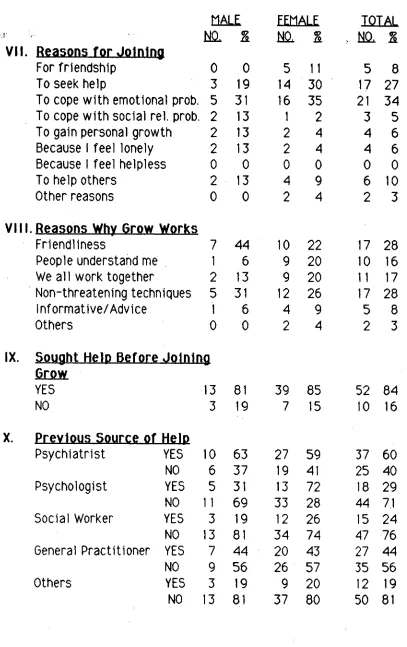
The questionnaire constructed to extract the Grow attenders' demographic characteristics is presented in Appendix A. The subjects' demographic, personal and social characteristics are presented in Table 1.
Sex and Age
TABLE I
Demographic, Personal and Social Characteristics of Grow Attenders
Age Group
MALE FEMALE TOTAL
NO,
a al
aa
1(18-30) 2 13 10 22 12 19
2 (31-45) 6 38 16 35 22 36
3 (46-60) 8 50 20 43 28 45
II.
agii. 16 26 46 74 62 100III.
Occupation
Housewife 0 0 18 39 18 29
Low Income 3 19 7 15 10 16
Middle 9 56 13 28 22 36
High 4 25 8 18 12 19
IV.
Marital Status
Single 3 19 9 20 12 19
Married 8 50 23 50 31 50
Divorced 2 13 5 11 7 11
Separated 3 19 6 13 9 15
Widowed 0 0 3 7 3 5
V.
Source of Referr.1
Doctor/Clinic 9 56 8 47 17 27
Advertisement 2 13 8 17 10 16
Friend 5 31 25 55 30 49
Others 0 0 5 11 5 8
VI.
Attendance
Irregular 10 63 25 54 35 56
Regular 6 37 21 46 27 44
VII. Reasons for Joining
MALE
FEMALE TOTALNI X
NQ1
For friendship 0 0 5 11 5 8
To seek help 3 19 14 30 17 27
To cope with emotional prob. 5 31 16 35 21 34 To cope with social rel. prob. 2 13 1 2 3 5 To gain personal growth 2 13 2 4 4 6 Because I feel lonely 2 13 2 4 4 6 Because I feel helpless 0 0 0 0 0 0
To help others 2 13 4 9 6 10
Other reasons 0 0 2 4 2 3
VIII. Reasons Why Grow Works
Friendliness 7 44 10 22 17 28
People understand me 1 6 9 20 10 16 We all work together 2 13 9 20 11 17 Non-threatening techniques 5 31 12 26 17 28
I nformative/Advice 1 6 4 9 5 8
Others 0 0 2 4 2 3
IX. Sought Help Before Joining
Grow
YES 13 81 39 85 52 84
NO 3 19 7 15 10 16
X. Previous Source of Help
10 63 27 59 37 60 Psychiatrist YES
NO 6 37 19 41 25 40 Psychologist YES 5 31 13 72 18 29 NO 11 69 33 28 44 71 Social Worker YES 3 19 12 26 15 24
NO 13 81 34 74 47 76 General Practitioner YES 7 44 20 43 27 44 NO 9 56 26 57 35 56
Others YES 3 19 9 20 12 19
[image:48.554.65.472.66.713.2]XI. Currently Seeking Help
MALE NO,
Outside Grow
YES 9 56 NO 7 44
XII. Current Source of Help Outside Grow
Psychiatrist 6 67
Psychologist 1 11
Social Worker 0 0
General Practitioner 2 22
Others 0 0
TOTAL 9 100
FEMALE TOTAL NO,
21 46 30 48 25 54 32 52
8 38 14 47 4 19 5 17
1 5 1 3
4 19 6 20 4 19 4 13
21 100 30 100
Occupational Classification and Marital Status
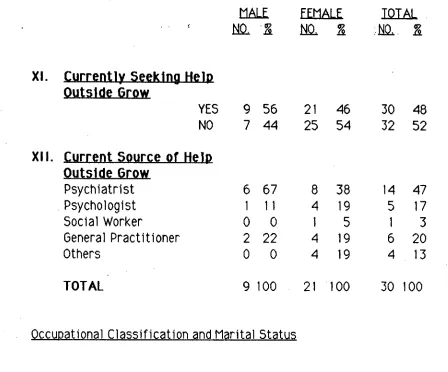
The occupational classification of the sample was based on Congalton and Daniel's Occupational Status Classification (1976), with subjects being grouped as low, middle and high. Housewife was accepted as an occupational group. As indicated in Table 1 most male attenders were from the middle occupational status group, while female attenders were mostly housewives.
[image:49.557.39.487.76.448.2]Grow Membership
Nearly half of the Grow attenders, mostly females, were referred by friends. Most of the males were referred by a doctor or a clinic. Others learned of Grow through advertisements or through other sources such as social workers and priests.
Attendance was generally irregular in nature. More than half of both males and females attended Grow one to three times in the six week period under investigation.
Section VII of Table 1 shows the subjects' reasons for joining Grow in terms of the frequency with which members endorsed them as their first priority. Most joined Grow primarily to cope with emotional problems. Other reasons were to seek help, to help others, to seek friendship (which was reported by females only), to gain personal growth, as a consequence of feelings of loneliness, and to cope with social relationship problems. None of the subjects reported feelings of helplessness as their primary reason for joining Grow.
The reasons most frequently endorsed for Grow's perceived efficacy were that Grow works because of its friendly atmosphere and the use of non-threatening techniques. The next most commonly reported reasons were "people understand me", and "we all work together". The proposition that Grow works because "it gives advice and information" was the least endorsed reason.
priests and community workers. Forty eight percent were currently seeking help, mostly from psychiatrists.
In summary, Grow attenders were mostly female, between 46 to 60 years old, married and from the middle occupational status group. Most were referred to Grow by a friend, were irregular attenders, joined Grow to cope with emotional problems, and believed Grow worked because of its friendly atmosphere and non-threatening techniques. Most had sought help before joining Grow, usually from a psychiatrist, and nearly half were still seeking help, predominantly from psychiatrists.
4.3 Psychiatric/Psychological Adjustment. Social Support and Perceived Efficacy of Grow
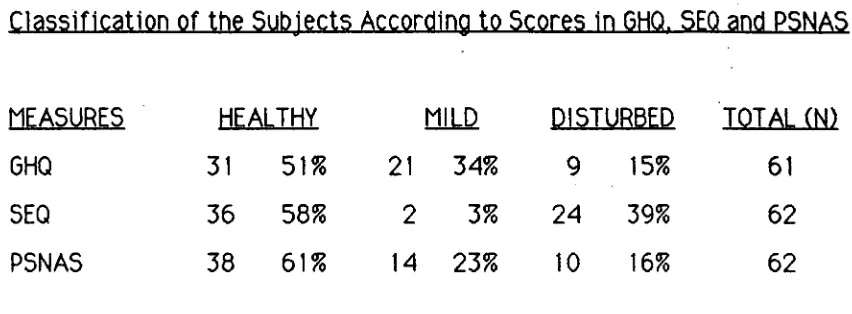
The subjects description of psychiatric symptomatology (GHQ), social support network (SECA psychological adjustment (PSNAS) and perceived adequacy of Grow (VAS) was based on the scores of all the measures used.
TABLE 2
Classification of the Subjects According to Scores in GHQ, SE0 and PSNAS
MEASURES HEALTHY MILD DISTURBED TOTAL (N)
GHQ 31 51% 21 34% 9 15% 61
SEQ 36 58% 2 3% 24 39% 62
PSNAS 38 61% 14 23% 10 16% 62
Fifty one percent of the Grow attenders were classified healthily adjusted (GHQ) whereas most of the remaining half were mildly disturbed, with only 15% evidencing major psychiatric disturbance, Individuals with mild disturbance have been reported to often remit in time without treatment while those with major disturbance tended to improve only if they were offered treatment (Johnstone & Goldberg, 1976).
In terms of the subjects' social support as measured by the SEQ, most Grow attenders reported adequate, healthy social support networks. A significant number (39%) evidenced disrupted and inadequate social support. These individuals reported few available close acquaintances, limited contact with such support and dissatisfaction when contact occurred.
TABLE 3
Percentage of Subjects' Responses in Categories of Visual Analogue Scales
Visual Analogue Scales Positive Negative
VAS2 (Grow in general) 73 27
VAS3 (Help received from Grow) 80 20
VAS4 (Social relations outside Grow) 63 37
VAS5 (Ability to cope with feelings) 59 41
VAS6 (Previous help outside Grow) 17 83
VAS7 (Current help outside Grow) 28 72
Visual Analogue Scales measured the subjects' perception of factors including the efficacy of Grow and of present and previous help. The scales assessed the following: a) how Grow works in general, VAS2, b)
help received from Grow, VAS3, c) • social relations outside Grow VA54, d)
ability to cope with feelings VA55, e) previous help outside Grow VAS6, f) current help outside Grow VA57.
Most subjects' perceived as positive the following aspects: how Grow works in general, the help received from Grow, relationships outside Grow and ability to cope with feelings. A perceived dissatisfaction was shown towards the previous and current help outside Grow.
reported an adequate social support system, a substantial number showed an inadequate support system with few sources of support and few (generally unsatisfactory) social contacts. As with social support, similar numbers reported satisfactory psychological adjustment in intrapersonal, personal, familial and societal contexts.
4.4 Demographic and Personal Characteristics as a Function of Psychiatric/Psychological Adjustment. Social Support and Perceived Efficacy
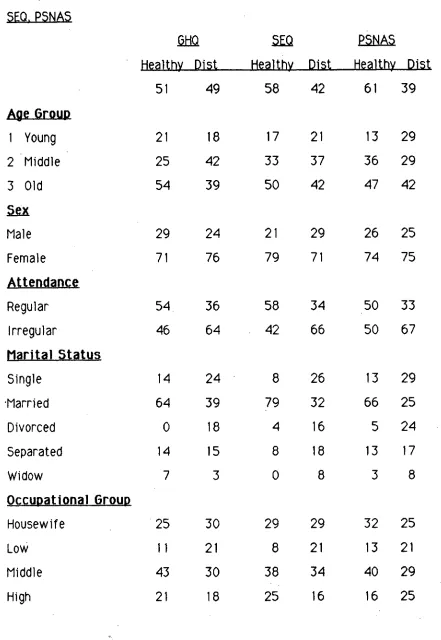
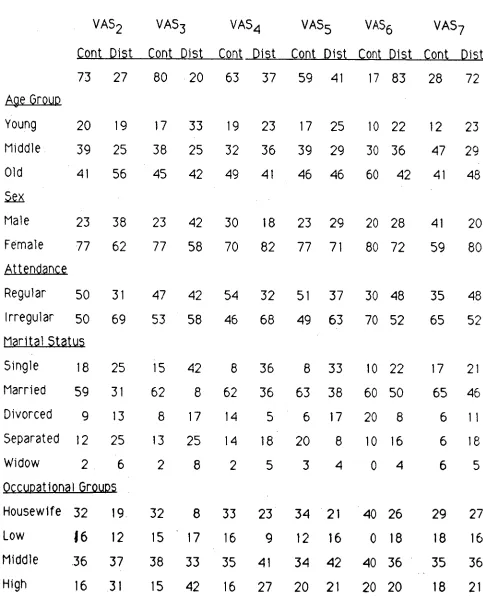
The second phase of data analysis was to examine the relationships between the measures used, (GHQ, SEQ, PSNAS, and VAS) and some aspects of the subjects' demographic characteristics. In Table 2, the subjects were classified as healthy, mild and disturbed in psychiatric/psychological adjustment and social support. For further analysis only two categories, healthy and disturbed (mild and disturbed), were studied in relation to demographic variables. Results are shown in Table 4 in the form of percentages.
TABLE 4
•Demographic, Personal and Social Characteristic's as a Function of GHQ, SEQ. PSNAS
Healthy
GHQ
.5 F. _Q
Healthy Dist
PSNAS
Dist
Dist Healthy
51 49 58 42 61 39
Age
Group1 Young 21 18 17 21 13 29
2 Middle 25 42 33 37 36 29
3 Old
lex
54 39 50 42 47 42
Male 29 24 21 29 26 25
Female 71 76 79 71 74 75
Attendance
Regular 54 36 58 34 50 33
Irregular 46 64 42 66 50 67
Marital Status
Single 14 24 • 8 26 13 29
'Married 64 39 79 32 66 25
Divorced 0 18 4 16 5 24
Separated 14 15 8 18 13 17
Widow 7 3 0 8 3 8
Occupational Group
Housewife • 25 30 29 29 32 25
Low 11 21 8 21 13 21
Middle 43 30 38 34 40 29
TABLE 4 (Cont'd)
Source of Referral
Healthy
GHQ 5E0
Dist
PSNAS
Dist Dist Healthy Healthy
Doctor/Clinic 25 30 21 32 24 33
Advertisement 22 12 21 13 24 4
Friend 46 49 54 45 50 46
Others 7 9 4 11 3 17
Reasons Why Grow Works
Friendliness 29 24 25 29 32 21
Understand 14 18 17 16 16 17
Work Together 7 27 17 18 16 21
Non-Threatening 32 24 25 29 24 33
Advice/Information 11 6 8 8 8 8
Others 7 0 8 0 5 0
Reasons for Joining Grow
Friendship 4 9 4 11 5 13
Seek Help 18 36 17 34 24 33
Cope with Emotional Prob.36 33 42 29 34 33
Cope with Social Rel. Prob.11 0 8 3 8 0
Seek Growth 7 6 8 5 5 8
Lonely 4 9 0 11 5 8
Helpless 0 0 0 0 0 0
Help Others 14 6 13 8 13 5
[image:56.554.55.490.57.797.2]There was a non significant trend for married Grow attenders to have a more satisfactory psychiatric adjustment than single, divorced, separated and widowed (X2 = 8.23, df = 1, p = .08).
The SEQ results identified a group with disturbed social support among Grow attenders. These included more of the following: the middle to older age group, females, single, divorced, separated and widowed individuals, irregular attenders, of lower occupational status, referred to Grow by doctor/clinic, who believed that Grow worked as a consequence of friendliness and the use of non-threatening techniques, and who joined Grow to seek help for emotional problems and feelings of loneliness.
The variables that were found to have a significant relationship with SEO results were marital status (X2 = 13.81, df = 1, p < .001) and current help X2 = 5.55, df = 1, .02 > p > .01. These findings indicate that a disturbed social support characterized current help seekers and the single, divorced, separated and widowed.
PSNAS results identified some subjects as disturbed in terms of psychological adjustment. Those identified as disturbed were commonly observed to have the following demographic characteristics: either young or from the elderly age group, irregular attenders, single, divorced, separated and widowed, from the low and high occupational status groups, to be referred to Grow by a doctor or clinic, to believe Grow worked because of the use of non-threatening techniques, and to have joined Grow to seek help and friendship.
Demographic. Personal and Social Characteristics as a Function of the Visual Analogue Scales (%)
VAS2
Cont Dist
VAS3
Cont Dist
VAS4
Cont Dist
VA55
Cont Dist
VAS6
Cont Dist
VAS7
Cont Dist
73 27 80 20 63 37 59 41 17 83 28 72
Age Group
Young 20 19 17 33 19 23 17 25 10 22 12 23
Middle 39 25 38 25 32 36 39 29 30 36 47 29
Old 41 56 45 42 49 41 46 46 60 42 41 48
Sex
Male 23 38 23 42 30 18 23 29 20 28 41 20
Female 77 62 77 58 70 82 77 71 80 72 59 80
Attendance
Regular 50 31 47 42 54 32 51 37 30 48 35 48
Irregular 50 69 53 58 46 68 49 63 70 52 65 52
Marital Status
Single 18 25 15 42 8 36 8 33 10 22 17 21 Married 59 31 62 8 62 36 63 38 60 50 65 46
Divorced 9 13 8 17 14 5 6 17 20 8 6 11
Separated 12 25 13 25 14 18 20 8 10 16 6 18
Widow 2 6 2 8 2 5 3 4 04 6 5
Occuoationai Groups
Housewife 32 19 32 8 33 23 34 21 40 26 29 27
Low
16
12
15
17
16 9 12 16 0 18 18 16Middle 36 37 38 33 35 41 34 42 40 36 35 36
[image:58.557.47.530.177.778.2]TABLE 5 (cont'd)
Source of Referral
VA52
Cont Dist
VA53
Cont Dist
VA54
Cont Dist
VA55 VAS6
Cont Dist Cont Dist
VA57
Cont Dist
Doctor/Clinic 25 38 26 42 27 27 20 38 10 32 53 18
Advertisement 18 12 17 8 19 14 17 16 10 18 23 14
Friend 50 38 51 33 51 41 54 38 70 42 18 59
Others 7 12 6 17 3 18 9 8 10 8 6 9
Reasons Why Grow Works
Friendliness 30 19 28 28 30 23 26 29 20 26 17 30
Understand 16 19 17 8 13 23 14 21 10 18 18 16
Work Together 16 25 15 33 19 18 23 13 20 18 18 18
Non -Threatening 27 31 30 25 27 27 26 29 40 26 4 23
Advice/ I nfo. 7 6 6 8 8 5 8 4 0 8 16 9
Others 4 0 4 0 3 5 3 4 0 4 0 4
Reasons for Joining Grow
Friendship 7 6 6 8 5 9 3 13 0 8 12 5
Seek Help 30 25 28 25 24 36 23 38 10 32 17 32
Emotional Pro. 34 37 36 33 41 27 37 33 50 32 29 36
Social Rel. Pro. 2 13 4 8 3 9 6 4 10 4 12 2
Seek Growth 9 0 9 0 8 5 8 4 10 6 6 7
Lonely 2 13 2 7 3 5 3 4 10 4 12 5
Helpless 0 0 0 0 0 _O 0 0 0 0 0 0
Help Others 11 6 11 8 11 9 14 4 10 10 6 11
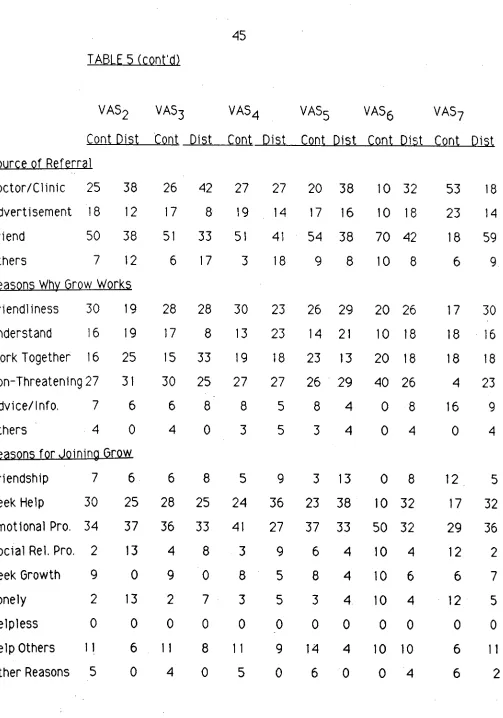
[image:59.559.26.529.56.774.2]Visual Analogue Scales show. most Grow attenders contented with Grow in general (VAS2) and with the help received from it (VA53). The majority were satisfied with their social relationships outside Grow (VA54) and felt able to cope with their feelings (VAS5). Most were dissatisfied with the previous (VAS6) and current help (VAS7) they received outside Grow.
Those who perceived Grow as inadequate (VAS2) and felt discontented with help received from it (VAS3) were predominantly male, unmarried (single, divorced, separated and widowed), irregular attenders, from the high occupational status groups, who were referred to Grow by doctor/clinic. They tended to believe that Grow worked because people worked together and they joined Grow as a consequence of loneliness and problems with social relationships. In terms of age, the older age group perceived Grow as inadequate and the younger age group felt discontented with the help received from Grow.
Subjects who were discontented with previous help outside Grow (VAS6) and with the current help outside Grow (VAS7) tended to be the
young, regular attenders, single and separated, who joined Grow to seek help. Other subjects who perceived previous help outside Grow as Inadequate were the male, widowed, from the low occupational status group, referred by doctor or clinic, who learned about Grow through advertisements and joined Grow for friendship. An additional subject group discontented with the current help outside Grow comprised divorced females, referred to Grow by friends. They considered that Grow worked as a consequence of its friendly atmosphere and the use of non-threatening techniques and they joined Grow to cope with emotional problems.
Married subjects typically indicated positive perceptions of the help received from Grow (VAS5 : X2 = 11.37, df = 1, p < .001), were satisfied
with their social relationships outside Grow (VA54 X2 = 9.08, df = 1, p <
.01) and felt able to cope with their feelings (VAS5 : X 2 = 9.45, df = 1, p <
.01).
4.5 Psychiatric/Psychological Adjustment. Social Support and Perceived Efficacy as a Function of Attendance
An analysis of the overall changes over time on each of the measures used is shown in Table 6. Results related to the differences in effects of attendance on the measures used are shown in Table 7.
TABLE 6
Mean Change Over Time (From 1st to Last Session) in Adjustment and Visual Analogue Scales
12
DI
1.
SIGGHQ 4.48 43 2.4150 *
SEQ .31 41 .3206 NS
PSNAS .86 41 2.3078 *
VAS2 1.025 39 .3797 NS
VAS3 .76 40 .2796 NS
VAS4 6.93 40 .1244 NS
VAS5 6.075 39 .3667 NS
VAS6 1.88 33 .5289 NS
VAS7 3.185 27 .6872 NS
* p < .05, ** p <.02
It is apparent from Table 6 that over the period of study, there was
TABLE 7
Mean Change From 1st to Last Session in Relation to Attendance
ATTENDANCE
N
LEAN
512
SI GA=1 - 3 WKS B=4- 6 WKS
GHQ 1-3 15 -5.68 12.91 NS
4-6 27 -3.56 11.63
SE0 1-3 16 -2.0 5.53 *
4-6 26 1.73 6.13
PSNAS 1-3 19 .86 1.86 NS
4-6 25 .85 2.67
VA - 2 1-3 13 -5.76 15.06 NS
4-6 27 4.29 17.04
VA - 3 1-3 14 3.21 20.04 NS
4-6 27 .52 15.2
VA - 4 1-3 15 3.26 21.87 NS
4-6 26 9.03 18.13
VA - 5 1-3 13 2.3 22.43 NS
4-6 27 7.2 17.04
VA - 6 1-3 16 3.18 24.75 NS
4-6 18 .72 15.54
VA - 7 1-3 9 2.77 4.44 NS
4-6 18 3.38 28.77
Although social support did not improve over time, Table 7 indicates a significant improvement in social support among regular attenders as compared to irregular attenders (t = 2.03, df. = 40, .05 > p > , .02). Contrary to SEQ results, no difference in improvement was observed in psychiatric/psychological adjustment between regular and irregular attenders.
5.1 Demographic, Psychiatric/Psychological Adjustment and Social Characteristics of Grow Attenders
5.2 Group Climate and Group Processes
5.3 Possible Effects of Grow as a Function of Time and Attendance 5.4 Methodological Issues
Discussion
Despite the limitations of this preliminary investigation, it is proposed that some of the findings will be of value in the design and implementation of more complex and ambitious studies. This project has provided some information on the demographic characteristics of Grow attenders, their level of psychiatric and psychological adjustment, the nature of their social support systems, their motivation for attending Grow and their perceptions concerning the efficacy of Grow and alternative sources of help and possible processess operating within Grow groups. This information may have some implications for the Grow organization in particular and self-help groups in general.
5.1 Demographic, Psychiatric/Psychological Adjustment and Social