Plant biomass nitrogen and effects on the risk of nitrate leaching of intercrops under organic farming in Eastern Austria
Farthofer R.1, Friedel J.K.2, Pietsch G.3, Rinnofner,T.4, W. Loiskandl5, Freyer B.6 1, 3, 4, 6 Institute of Organic Farming, Department of Sustainable Agricultural Systems, University of Natural Resources and Applied Life Sciences, Vienna, Gregor-Mendel-Str. 33, A-1180 Vienna
2 Institute of Organic Farming, Department of Sustainable Agricultural Systems,
University of Natural Resources and Applied Life Sciences, Vienna, Gregor-Mendel-Str. 33, A-1180 Vienna, [email protected]
5 Institute of Hydraulics and Rural Water Management, Department of Water, Atmosphere, Environment, University of Natural Resources and Applied Life Sciences, Vienna, Gregor-Mendel-Str. 33, A-1180 Vienna
Abstract
Data on the potential of intercrops to reduce soil nitrate contents, on their N accumulation and biological nitrogen fixation (BNF) are lacking for organic farming in the dry, pannonic region of Eastern Austria. The effect of legumes, non-legumes, and legumes + non-legumes used as intercrops on inorganic soil nitrogen, crop yield and biomass N, and BNF were tested in comparison to bare fallow. Non-legumes and legumes + non-legumes were more efficient than legumes in reducing inorganic soil N contents in autumn and nitrate contents in soil solution from the subsoil in winter. This reduction in inorganic soil N did not last until March of the following year due to an N mineralisation from the mulch. The legume + non-legume mixture contained a larger amount of crop N than both legumes and non-legumes. This was due to the combined effect of soil-N uptake by the non-legumes and BNF by the legumes in the mixture.
Introduction
1997; Miersch und Vetter, 2000) and on succeeding crops (Jensen, 1989; Biederbeck et al., 1996; Reents et al., 1997) have been conducted in regions with higher precipitation. Respective results are not available for organic farming in the pannonic region.
The aim of this study was to optimise the use of intercrops with respect to soil inorganic N contents in autumn and winter, crop biomass nitrogen (N), and effects on yield and quality of subsequent crops. The objectives were to test (i) if legumes + non-legumes are equivalent to non-legumes in reducing soil inorganic N contents in autumn and (ii) if crop biomass N in legumes + non-legumes surpasses the amount of N in non-legumes.
Material and Methods
The experimental fields, part of an experimental farm of the University of Natural Resources and Applied Life Sciences, Vienna, were converted to organic farming in 1998. Soils are Calcaric Phaeozems from Loess (silty loam, 2.2 % TOC, pH 7.6). Mean annual precipitation is 550 mm, mean temperature 9.8°C.
Crop rotation was winter wheat / intercrop (2002) – potato (2003) – winter rye / intercrop (2004) – summer barley (2005). Four variants, including three different types of intercrops were tested in a randomised complete block design.
Variant 1: Legumes + non-legumes: all mentioned legumes and non-legume species; Variant 2: Legumes: chickling vetch, common vetch, field pea;
Variant 3: Non-legumes: oil radish, turnip, phacelia; Variant 4: Bare fallow.
In 2002, intercrops were sown after harvest of winter wheat in early August and were mulched in late October. The soil was chiselled at the end of October. Potatoes were planted in the mid of April of the following year.
Starting in August 2002, inorganic N (Nin) contents were monitored in 0 – 120 cm depth every year in spring, summer and autumn. Soil solution was collected by suction cups from 140 cm depth and analysed for nitrate contents.
Above-ground and below-ground (0 – 60 cm) biomass production of the intercrops were determined. Below-ground crop biomass was derived from samples taken with a soil corer (10 cm diam.) and washing roots out of the soil. Plant nitrogen contents were analysed by dry combustion and gas chromatography in a LECO CN-Analyzer.
contents were taken into account (Equation 1). The non-legumes (var. 2) served as reference crop.
Equation 1: Calculation of biological N fixation (kg ha-1) by the extended difference method.
BNF = [(Shoot-NLeg + Stubble-NLeg + Root-NLeg) – (Shoot-NRef + Stubble-NRef +Root-NRef)] +
[Nin(Leg) – Nin(Ref)]
Leg: legumes; Ref: reference crop = non-legumes
Variant effects were analysed by a two-way analysis of variance (factor 1: intercrop variant, factor 2: block) and comparisons of the means with a Tukey test.
Results and Discussion Weather conditions
Precipitation was approx. 80% above the long-term average in summer and autumn 2002. February to April and June 2003, however, were extremely dry.
Crop biomass and nitrogen
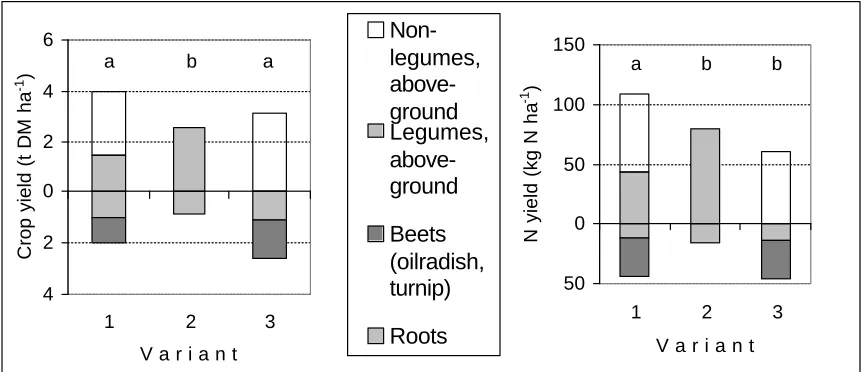
At incorporation of the intercrops in late October, the legumes + non-legumes yielded the largest above-ground biomass (4.0 t ha-1), followed by the non-legumes (3.0 t ha-1) and the legumes (2.5 t ha-1). Root biomass production was greatest in the non-legumes (2.6 t ha-1), less in the legumes + non-legumes (2.0 t ha-1) and least in the legumes (1.0 t ha-1). Total biomass production was significantly higher in the legumes + non-legumes and non-legumes than in the legumes (Fig. 1). The amount of total crop N reached 150 kg N ha-1 in the legumes + non-legumes. The total amount of N in this variant was higher than in the other two intercrop variants, mainly due to additional N derived from the air by BNF (Fig. 1). Plant biomass and N contents were negligible in the bare fallow treatment (data not shown).
50 0 50 100 150
1 2 3
V a r i a n t
N yield (kg N ha
-1 )
Non-legumes, above-ground Legumes, above-ground
Beets (oilradish, turnip)
Roots
4 2 0 2 4 6
1 2 3
V a r i a n t
Crop yield (t DM ha
-1 )
a b a a b b
[image:4.595.71.503.93.279.2]Legend: Var. 1: Legumes + non-legumes; Var. 2: Legumes; Var. 3: Non-legumes Mean values with the same letter are not significantly different (Tukey, P < 0.05). Fig. 1: Biomass and nitrogen yield of intercrops in late October 2002.
Biological N fixation and N uptake from the soil
BNF amounted to 48 kg N ha-1 in the legumes + non-legumes and to 34 kg N ha-1 in the legume variant. This means that all of the legume-N in the legumes + non-legumes and about 35 % of the legume-N in the legume variant was derived from the air by BNF. The N derived from the soil thus amounted to approx. 105 kg N ha-1 in the legumes + non-legumes, to 62 kg N ha-1 in the legume variant and to 107 kg N ha-1 in the non-legumes.
Müller and Thorup-Kristensen (2000, Denmark) found a BNF of legume intercrops in organic farming of 30 to 80 kg N ha-1. They concluded that this is a considerable contribution to N turnover.
Inorganic N in soil and in soil solution
Inorganic N contents in the soil profile were reduced in all intercrop variants, but mainly in the non-legumes and the legumes + non-legumes compared to bare fallow in autumn 2002 (Fig. 2). The two variants containing non-legumes reduced Nin contents by almost 80 kg N ha-1 within the observed soil depth of 120 cm. The effect of the legumes amounted to approx. 40 kg N ha-1 only. In all intercrop variants, the reduction in Nin was about 20 to 25 kg N ha-1 less than the crop N uptake from the soil. This difference indicates that nitrate was leached below 120 cm in the bare fallow treatment, since plant N uptake was negligible here.
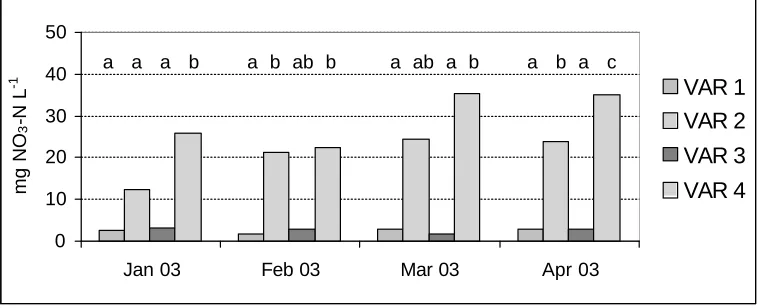
topsoil. The additional increase in Nin contents in the intercrop variants most probably was due to a mineralisation of N from the green manure. Topsoils were moist (approx. 50 – 65 % of water holding capacity), thus enabling the decomposition of the mulch during winter. Nitrate leaching may also have been larger in bare fallow than in the intercrop treatments. Nitrate contents in soil solution from 140 cm depth were strongly reduced in intercrop variants containing non-legumes (i.e. legumes + non-legumes and non-legumes) compared to bare fallow (Fig. 3). The legume variant only had a minor potential to reduce nitrate contents in soil solution.
Legend: see Fig. 1.
[image:5.595.75.522.242.591.2]Mean values of one date with the same letter are not significantly different (Tukey, P < 0.05).
Fig. 2: Inorganic soil N contents during growth and after incorporating intercrops into the soil.
Reents et al. (1997) compared the effect of white clover and mustard intercrops on soil nitrate contents in organic farming (7.8°C, 833 mm, sandy to loamy soils). Mustard reduced nitrate contents whereas white clover had a negligible effect. In accordance, nitrate contents were mostly lower in non-legume intercrop variants than with legume intercrops in the above mentioned study of Reents und Möller (2000). A bare fallow treatment, however, was not included. Soil nitrate contents after dying off of intercrops in organic farming were larger for
0 20 40 60 80 100 120 140 160 180 a 1 a 2 a 3 a 4 a 1 b 2 a 3 c 4 a 1 a 2 a 3 a 4 a 1 a 2 a 3 a 4 a 1 a 2 a 3 a 4 a 1 a 2 a 3 a 4
Aug 02 Oct 02 Mar 03 Aug 03 Oct 03 Apr 04
kg N
in ha
-1
90 -120 cm
60 -90 cm
30 - 60 cm
0 - 30 cm
faba beans than for non-legumes (Miersch and Vetter, 2000, SW Germany and NO France). At a site with low water holding capacity included in this study, nitrate leaching was lower following faba bean than bare fallow, but still larger than following non-legumes. In a literature review, Miersch and Vetter (2000) also found a general difference in Nin contents before winter in the order legumes > mixtures > non-legumes used as intercrops.
0 10 20 30 40 50
Jan 03 Feb 03 Mar 03 Apr 03
mg NO
3
-N L
-1 VAR 1
VAR 2 VAR 3 VAR 4
a a a b a b ab b a ab a b a b a c
Legend: see Fig. 1.
[image:6.595.74.454.197.351.2]Mean values of one date with the same letter are not significantly different (Tukey, P < 0.05).
Fig. 3: Nitrate contents in soil solution from 140 cm depth after incorporating intercrops into the soil.
Conclusions and outlook
• Non-legumes and legumes + non-legumes showed an equally great reduction of Nin
contents in autumn and of nitrate contents in solution from the subsoil in winter compared to black fallow. The legume intercrop was less effective.
• The amount of N mineralised during winter was very high for all intercrop variants, presumably due to unusually wet conditions in autumn. Therefore, the reducing effect of the intercrops on Nin contents was only transient and did not last until March of the following year. Soil water balances and nitrate leaching rates are currently calculated to clarify the efficacy of the intercrop treatments on reducing leaching losses.
• Total biomass N in legumes + non-legumes exceeded the amount of crop N in non-legume intercrops due to additional N from biological N fixation by the legumes. A higher pre-crop effect in terms of N can be expected for legumes + legumes than for non-legumes.
References
Biederbeck, V., Bouman, O., Campbell, C., Bailey, L. und Winkleman, G. (1996): Nitrogen benefits from four green-manure legumes in dryland cropping systems. Canadian Journal of Plant Science, 76: 2, 307-315.
Jensen, E. S. (1989): The role of pea cultivation in the nitrogen economy of soils and succeeding crops. Legumes in farming systems [edited by Plancquaert, P 3-15; 20 ref. Dordrecht, Netherlands; Kluwer Academic Publishers, Netherlands.
Miersch, M. and Vetter, R. (2000): Stickstoffversorgung und -dynamik in Fruchtfolgen vieharmer Betriebe des ökologischen Landbaus. ITADA. Müllheim, Institut für umweltgerechte Landbewirtschaftung. Abschlußbericht zum Projekt A 1.5 des Grenzüberschreitenden Instituts zur rentablen umweltgerechten Landbewirtschaftung.
Müller, T. and Thorup-Kristensen, K. (2001): N-fixation of selected green manure plants -- a contribution to the N-turnover in soils under organic crop rotations. Mitt. Dtsch. Bodenkundl. Gesellsch. 95, 79-80.
Reents, H. J. and Möller, D. (2000): Effects of different green manure catch crops grown after peas on nitrate dynamics in soils and on yield and quality of subsequent potatoes and wheat. Proceedings 13th International IFOAM Scientific Conference. T. Alföldi, W. Lockeretz, and U. Niggli (Eds.). IFOAM, Zürich. p.73-75.
Reents, H. J., Möller, K., and Maidl, F. X. (1997): Use of soil nitrate through differentiated growing strategies of cereals following potatoes. Köpke, U. and Eisele, J.-A. (Eds.) Contributions to the 4th Scientific Meeting on Ecological Agriculture 4, p. 129-135. Berlin, Verlag Dr. Köster.
Sorensen, N. (1992): Effect of catch crops on the content of soil mineral nitrogen before and after winter leaching. Z. Pflanzenern. Bodenk. 155, 61-66.