Rochester Institute of Technology
RIT Scholar Works
Theses
Thesis/Dissertation Collections
1998
Implementation of the Wavelet-Galerkin method
for boundary value problems
Adam Scheider
Follow this and additional works at:
http://scholarworks.rit.edu/theses
This Thesis is brought to you for free and open access by the Thesis/Dissertation Collections at RIT Scholar Works. It has been accepted for inclusion
in Theses by an authorized administrator of RIT Scholar Works. For more information, please contact
.
Recommended Citation
Implementation of the Wavelet-Galerkin Method
for Boundary Value Problems
by
Adam K. Scheider
A Thesis Submitted In
Partial Fulfillment of the
Requirement for the
Master of Science
In
Mechanical Engineering
Approved
by:
Professor
_
Josef S. Torok
Thesis Advisor
Professor
_
H. Ghoneim
Professor
_
K. Kochersberger
Professor
_
Charles Haines
Department Head
DEPARTMENT OF MECHANICAL ENGINEERING
COLLEGE OF ENGINEERING
ROCHESTER INSTITUTE OF TECHNOLOGY
Implementation of the Wavelet-Galerkin Method
for Boundary Value Problems
I, Adam K. Scheider, hereby grant permission to the Wallace Library of the
Rochester Institute of Technology to reproduce my thesis in whole or in part.
Any reproduction will not be for commercial profit.
DEDICATION
I dedicate this thesis first
and
foremost
in
loving
memory
of
Scott Crouch
and
in
living
recognition of
Thomas Haralson. These
two
men
have
touched
my
life in
such a special
way
that
I know I
will never meet anyone else
like
them.
I
believe
you can
only
meet
very few
people so
very
special.
Without
them
I
would
not
have
grown
to
be
the
man
that
I
am
today. And
I
would
not
have
completed
my
college career at
RIT in
the
manner
in
which
I have if I had
not
worked so
hard
to
make
them
so proud.
My family
took
no
small part
in
this
act.
If I
could give
any
piece
of advice
to
any
person,
it
would
be
to
not
take
your
family
for
granted.
The
prayers of
family
and
friends have
not gone
unnoticed,
especially
those
of
Sr.
Grace,
Sr.
Anne,
and
Fr.
Gentile.
I hold
the
Domes
and
the
Denicks
in
a
distinguished
place as well.
Finally,
I
would
like to
acknowledge
Dr.
Torok
and
the
rest of
the
Mechanical
Engineering
faculty. Without
them,
this
would
not
have been
TABLE OF CONTENTS
Abstract
...1.
Introduction
to
Wavelets
2.
Example
-Haar
Approximation
Table
2.1,
Subspaces
of
Haar Approximation
3.
Daubechies Wavelets.
4.
Variational Formulation
5.
Approximation
Methods to the
Variational
Form
6.
Galerkin Method
7.
Wavelet
-Galerkin Method
.8.
Example
-Analytical
.9.
Example Wavelet
-Galerkin.10. Example
Galerkin
-Quadratic
11. Conclusions
....Bibliography
....Appendix
A (Matlab
Programs)
.11
15
16
20
24
26
30
32
34
42
48
50
[image:5.556.59.483.66.482.2]Abstract
The
objective of
this
work
is
to
develop
a systematic method of
implementing
the
Wavelet-Galerkin
method
for approximating
solutions of
differential
equations.
The
beginning
of
this
project
included
understanding
what
a wavelet
is,
and
then
becoming
familiar
with
some of
the
applications.
The
Wavelet-Galerkin
method,
as applied
in
this paper,
does
not
use a wavelet
at
all.
In
actuality,
it
uses
the
wavelet's
scaling function. The distinction between
the
two
will
be
given
in
the
following
sections of
this
paper.
The
sections of
this thesis
will
include
defining
wavelets
and
their
scaling
functions.
This
will give
the
reader
valued
insight
to
wavelets
and
Discrete
Wavelet Transforms (DWT).
Following
this
will
be
a section
defining
the
Galerkin
method.
The
purpose
of
this
section will
be
to
give
the
reader an
understanding
of
how
weighted
residual
methods
work,
in
particular, the
Galerkin
Method.
Next
will
be
a
section
on
how
Scaling
functions
will
be implemented in
the
Galerkin
method,
forming
the
Wavelet-Galerkin Method.
The focus
of
this
investigation
will
deal
with
solutions
to
a
basic
homogeneous differential
equation.
The
solution of
this
basic
equation will
be
analyzed
using
three separate,
distinct
methods,
and
then the
results will
be
compared.
These
methods
include
the
Wavelet-Galerkin
Method,
the
Galerkin
Method using
quadratic
shape
functions,
and standard analytical means.
Factors
to
be
studied
include
computational
time,
effort, accuracy,
and ease of
After
a
thorough
comparison
has been
made, there
will
be
a section
to talk
about possible applications of
the
Wavelet-Galerkin
method and
recommendations
for future
work.
Predictions
of
what avenues
to
pursue
in
refining
the
Wavelet-Galerkin
method will
also
be
stated.
And
suggestionson
CHAPTER
1
Introduction
to
Wavelets
A
wave
is usually defined
as
disturbance in
time
or
space.
Periodic
waves,
such as a
sinusoid,
repeat after a
finite interval.
Fourier
analysis
is
wave
analysis.
It
expands signals or
functions in
terms
of
sinusoids
(or,
equivalents,
complex
exponentials)
which
has
proven
to
be extremely
valuable
in
mathematics, science,
and
engineering,
especially for
periodic,
time-invariant,
or
stationary
phenomena.
A
wavelet
is
a
"small
wave",
which
has its energy
concentrated
in
time
to
give
a
tool
for
analysis of
transient,
nonstationary,
or
time-varying
phenomena.
It
still
has
the
oscillating
wavelike characteristic
but
also
has the
ability
to
allow
simultaneous
time
and
frequency
analysis
with
a
flexible
mathematical
foundation.
This is illustrated
below
with
the
wave
(sinusoid)
oscillating
with
equal amplitude over
-oo<t<ooand,
therefore,
having
infinite
energy
and with
the
wavelet
having
its
finite
energy
concentrated around a point or
instant
of
time.
(a)
A Sine Wave
(b)
Daubechies'
Wavelet
Voao
We
will
take the
wavelets and use
them
in
a series expansion of signals or
CHAPTER
1
represent a signal or
function. The
signals are
functions
of a
continuous
variable,
which
often represents
time
or
distance.
A
signal or
function
can often
be better
analyzed or
described
or
processed
by
decomposing
it into
a series or summation.
An
example
of
this
would
be digital
signal
processing (dsp).
Say
whatever
object
that
is
supposed
to
pick
up
the signal,
a
microphone, accelerometer,
guitar
pickup,
etc...
is too
sensitive
and
the
signal
has
a
significant
amount of static or
interference.
By
expressing
the
signal
a
summation of
terms,
it
would
be
possible
to throw
out
the
terms that
are
causing
the
unwanted
noise,
leaving
only
the
clear
portion of
the
signal.
Therefore,
the
first
step is
to
express
the
signal as a
series expressed
by
linear decomposition
by
/(/>=
2X^(0
(1.1)
k
where
k
is
an
integer
index for
the
finite
or
infinite
sum.
The
coefficients
ai<
are
real-valued expansion coefficients and
Tk(t)
are a
set
of
real-valued
functions
of
t
called
the
expansion
set.
If the
expansion set
is
unique,
it is
called a
basis.
A
basis
is
orthogonal
if its inner
product
of
distinct
basis functions is zero, that
is
(%(t)X(t))
=\X(0%
(t)dt
=0
h*l
If
the
basis is
orthogonal, then the
coefficients
in
(1.1)
may be
calculated
by
multiplying both
sides
by
the
generic
function
TkO)
and
taking
the
inner
product:
ak=(f(t),%(t))
=\f(tm(k)dt
CHAPTER
1
For
a
Fourier
series, the
orthogonal
basis functions
are
sin(kQ0t)
and
cos(kcoot)
with
frequencies
of
kco0.
For
a
Taylor's
series, the
nonorthogonalbasis
functions
are simple monomials
tk,
and
for many
other
expansions
they
are
various polynomials.
There
are expansions
that
use splines
and
even
fractals.
For
the
wavelet
expansion,
a
two
parameter system
is
constructed such
that the
linear decomposition is
of
the
form
/(0
=IZA(o
(1.3)
k 1
where
bothy
and
k
are
integer indices
and
the
^(t)
are
the
wavelet expansion
functions
that
usually form
an orthogonal
basis.
The
set
of expansion
coefficients
ajik
are called
the
discrete
wavelet
transform
(DWT)
of
f(t)
and
the
linear decomposition
expression
is
the
inverse transform.
Wavelet Systems
Wavelet
expansions are
not
unique.
That
is,
there
may be
more
than
one
wavelet system
that
may successfully
represent
a signal or
function.
However,
all
of
them
seem
to
have
three
basic
characteristics:
1
.A
wavelet system
is
a
set
of
building
blocks
to
construct or represent
a
signal
or
function.
It is
a
two-dimensional
expansion
set
(
usually
a
basis,
which
means
it is unique) for
some
class
of
one-(or
higher)
dimensional
signals.
In
other
words,
if
the
wavelet
set
is
given
by
^(tjfor indices
of
j,k
=CHAPTER
I
for
some set of coefficients aj,k.
2.
The
wavelet expansion gives a
time-frequency
localization
of
the
signal.
This
means most of
the
energy
of
the
signal
is
well-represented
by
the
discrete
expansion
coefficients,
a-^.
3.
The
calculation of coefficients
from
the
signal
may be done
efficiently.
Many
wavelet
transforms
may
be
calculated
with
O(N)
number
of
operations.
This
means
the
number
of
floating-point
multiplications
and
additions
increase
linearly
with
the
length
of
the
signal.
More
general wavelet
transforms
require
0(Nlog(N))
operations,
essentially
the
same as
the
Fast Fourier Transform (FFT).
A
Fourier
series maps
a one-dimensional
function
of a continuous
variable
into
a
one-dimensional sequence
of
coefficients.
Whereas
the
wavelet
expansion
maps
it into
a
two-dimensional
representation
that
allows
localizing
the
signal
in
both
time
and
frequency. A
wavelet
representation will
give
location in both
time
and
frequency
simultaneously.
By
this explanation,
a
wavelet
representation
resembles
a
musical score
in
a
way,
where
the
location
of
the
notes
tells
when
the tones
occur and
what
their
frequencies
are.
There
are
three
more
additional
characteristics,
which
are more specific
to
wavelet expansions.
These
are not
so much
characteristics
but
properties
that
CHAPTER
I
1
.All
first-generation
wavelet systems are
generated
from
a
single
scaling
function
or
wavelet
by
simple
scaling
and
translation.
The
two-dimensional
parameterization
is
attained
from
the function
Tj,k(t)=2j/2vF(2jt-k)
where
j
and
k
are elements of
Z,
the
set
of
all
integers.
This
equation
is
sometimes
referred
to
as
the
"mother
wavelet".
The factor
2j/2maintains
a
constant
norm
independent
scale
of
j.
This
parameterization
of
the time
or
space
location
by
k
and
the
frequency
or
scale
by j (really
the
log
of
the
scale)
is
extremely
effective.
2.
In addition,
almost
all
useful
wavelet
systems
satisfy
multiresolution
conditions.
This
means
that
if
a set of
signals
can
be
represented
by
a
weighted
sum of
cb(t-k),
then
a
larger
set
(which includes
the
original)
can
be
represented
by
a
weighted
sum
of
<j>(2t-k).Basically,
if
the
basic
expansion
signals are made
half
as
wide
and
translated
in
steps
half
as
wide,
they
will
represent a
larger
class of
signals
exactly
or give
a
better
approximation of
any
signal.
This
last
statement
is in
essence
what makes wavelets work!
3.
Lower
resolution
coefficients
may
be
calculated
from higher
resolution
coefficients
(via
a
filter bank).
This
allows a
very
efficient calculation of
the
expansion
coefficients
and
relates wavelet
transforms to
a
known
CHAPTER
1
Multiresolution
formulation
requires
two
closely
related
functions,
which
are
the
wavelet
*P(t)
and
the
scaling
function
<f>(t).Together,
these
functions
allow a
large
class of
functions
to
be
expressed
by
the
form
f(t)
=Z
cJ(<-*)+
Z
Y,d.kV(2>t-k)
(1.4)
<T=-C0 *T=-00 j=QAnother form
of
this
equation
is
given
below.
It is
created
by
substituting
the
mother wavelet expression
into
the
above
equation.
g(t)
=ZS0
(k)2i0,2^(2Ju-k)
+
YdJ:dj(k)2^^(21t-k)
(1.5)
k k
j=j0
A very
interesting
fact
should
be
noted
here,
before
we
go
any farther.
Each
j
term
of
the
summation represents
its
own
subspace
of
the
approximation.
The
terms
^(t)
actually
span
the
differences between
the
approximations spanned
by
the
various scales of
the
scaling function.
To
describe this
better,
a more general view should
be
taken.
The
goal
of
the discrete
wavelet
transform
(DWT),
eqn
(1
.5),is
to
approximate a
function
or
signal
over
an
interval
in L2(R). This is
the
space of
functions
f(t)
with a
well
defined integral
of
the
square
of
the
modulus of
the
function.
L2(R)
is
also
known
as
the
space
of
finite-energy
signals.
The
"L"signifies a
Lebesque
integral,
the
"2"
denotes the integral
of
the
square of
the
modulus of
the
function,
and
R
states
that the independent
variable
of
integration t is
a number over
the
whole real
line.
For
a
function
g(t)
to be
a member of
that space,
it is denoted by: g
e
L2(R)
or
simply
g
e
L2Although
most
of
the
definitions
and
derivations
are
in terms
of
CHAPTER
1
example,
polynomials
are
not
in
L2,
but
can
be
expanded over
any
finite domain
by
most wavelet systems.
Anyway,
if
the
j's
reached
to
infinity,
the
approximation would
span all of
L2
Since
all of
the
j's
represent
the
difference between
the subspaces, the
symbolic representation
would
look like
this:
L2
=VQW0W,W2...
It is important
to
note
that the
scale of
the
initial
space
is
arbitrary
and could
be
chosen at a
higher,
or
lower,
resolution.
That is to
say
that
jo
could
take
on
any
positive
or negative
integer
value we want
to
assign
it.
This
also
includes
negative
infinity.
Let's
take
a closer
look
at equation
(1
.5),the
DWT formula. The first
summation, the
single
summation,
represents
only
one subspace.
It only
represents
one
term.
It is
the
initial
subspace.
The
value
of
c(k)
is
found,
almost
instinctually,
by finding
the
dot
product of
the
basic scaling function
{t)
and
the
function
we wish
to
approximate
g(t).
c(k)
=c0(k)
=(g(t)Mt))
=\g{tyt>k(t)dt
(1
.6)The
dj(k)
coefficients
are
found in
a similar
way
by dotting
the
function g(t)
with
the
wavelet
Tj,k(t),
not
the
scaling function
<f>(t).d}(k)
=d(j,k)
=teCO^O)
=\g(tyJk(t)dt
(1
.7)The
coefficient
d(j,k)
is
sometimes
written as
dj(k)
to
emphasize
the
difference
CHAPTER
I
c(k)
is
also sometimes written as
q(k)
or
c(j,k)
if
a
more general
"starting
scale"
other
than
j=0 is
used
for
the
lower limit.
These formulas may
be
used
so
long
as
the
wavelet system
being
used
is
orthogonal.
This is
no minor
point
to
overlook.
Although,
most wavelet systems are orthogonal
in
nature.
This is
one
of
the
mathematical requirements
that
the
wavelets are
subjected
to
when
being
constructed.
We
shall now
define
the
scaling function
<(>(t)
and
the
wavelet
^(t).
Both
of
these
functions
are
based
upon recursion.
I
will
simply
state
the
definitions.
^(0
=Z/2(")^(2^-)
neZ
(1.8)
n
T(0
=][>i(")V2<zK2/-h)
neZ(1.9)
n
In
these equations,
Z is
the
set
of all
integers. The
coefficients
h(n)
are
a
sequence
of real
or
perhaps complex numbers
called
scaling functions
and
the
V2
maintains
the
norm of
the
scaling function
with
the
scale
of
two.
The
coefficients
h^n)
are related
to the
scaling function
coefficients.
Due
to the
requirement
that the
wavelets
span
the
"difference"between
the
subspaces and
the
orthogonality
prerequisite,
hi(n)
is
related
to
h(n) by
hi(n)
=(-1)nh(1-n).
I
will
demonstrate how to
perform a
discrete
wavelet
transform
on a simple
CHAPTER
2
Example
-Haar Approximation
This
example
demonstrates how
to
use
a
discrete
wavelet
transform
(DWT)
to
approximate a given
function. The
function,
chosen
at
random,
is
defined
as
g(t)
= 5t2-3t
+
1
.
The
wavelet
to
be
used
is the
simplest
wavelet
known.
It is
called
the
Haar
wavelet.
The Haar scaling function is
what
is
commonly known
as
the
unit
step function.
However,
if
the
formula
that is
given
for
the
scaling function
is
referred
to,
the
scaling function
has
coefficients
/2(0)
=1/V2
and
/z(1)
=1/V2.
>
t
Haar
Scaling
Function
<|>(t)
"?
t
Haar Wavelet
T(t)
The
initial scale,
j0,
was
chosen
to
be
zero.
As
stated
in
the
earlier
section,
it
could
be
chosen at random.
Zero
was
picked
because it
seemed
logical.
Also,
the
interval
on which
we want
the
approximation was picked
to
be
from
zero
to
one
because
it
seemed
logical.
The first step
was
to integrate the
function
times the
scaling function
over
the
internal. The scaling function is simply
the
unit
step function
from
zero
to
one.
c(k)
=$
(5t
2-3r
+
1)(1)a&
=1
.
1 66667
CHAPTER
2
This
becomes
our
V0
subspace.
The
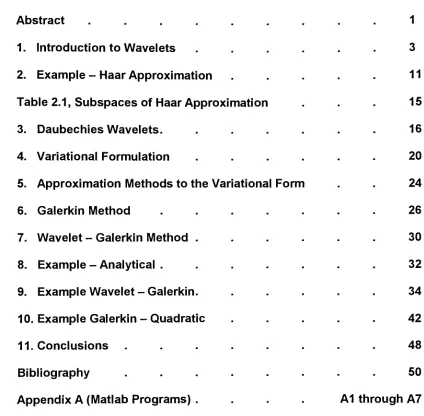
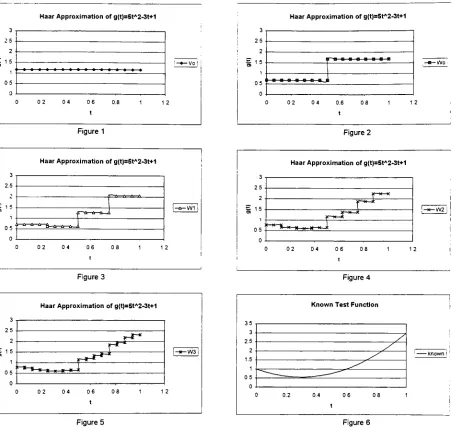
plot
is
shown on
the
following
page.
The
next subspace
is
approximated
by finding
d0(0). This
means
finding
the
value
of
the
integral
of
the
wavelet
times the test
function
over
the
interval.
05
d0(0)=
J(5f2
-3f+
1)(1)df+
j(5t2
-3t
+
1)(-1)df
= -0.50000005
This
spans
the
subspace
W0
which
is
the
difference between
the
adjacent
subspaces.
If
the
spreadsheet
is
referred
to,
look
at
the
W0
column.
It
shows
a
negative
0.5
value
halfway down,
and
then
a
positive
0.5 the
rest of
the
way.
This is due
to the
DWT formula. The
coefficient must
be
multiplied
by
its
wavelet.
In
this case, the
wavelet
simply
flops
from
positive
one, to
negative one.
The
next
step is
finding di(0)
and
di(1 ).
This
is
what
the
associated
wavelets
look like.
*i
0.5
0.5
These
graphs
show
how
the
scaling
and
translation
principles work.
The
wavelets
still
have the
same
height,
only
they
are
in different
places and scaled.
Both
of
these
wavelets
have
magnitudes
of
1
everywhere.
The
coefficients are
calculated
using the
following
formulas.
025 0.5
d,(0)
=J(5f2-3f
+
1)(1)rf/
+
J(5r2
-3/
+
1)(-1)df
=0.031 2500
CHAPTER
2
075
d,
(1)
=|(5r2
-3t+
1)(1)<#
+
J(5r2
-3/
+
1)(-1)dSf
=-0.2812500
0.5 0.75
These
coefficients
may
then
be
used
to
calculate
the
values
in
column
W1
.They
must
be
multiplied
by
V2
and
by
the wavelet,
of course.
This
can
be
found in the
formula. The
approximation
to
g(t) may
be
found
by
summing
all
the
previous
subspaces,
including
V0.
At any
rate,
it
should
be
clear now
how
each
successive subspace
is
approximated.
The
graphs show a
few
more approximations.
It
can
be
seen
that
the
last
approximation
is
not a
very
good one.
However,
it does
serve
the
purpose
to
demonstrate how
the
DWT
works.
Also,
this
example
clearly
shows
how
coarse
the
Haar
wavelet
really is. The
challenge
is
to
find
smoother
wavelets
which are
still
orthogonal.
Ingrid Daubechies has done
a
lot
of work
in
this
area.
She
really
is
considered
to
be
one of
the
leaders in
wavelet
technology.
Haar Approximationof g(t)=5tA2-3t+1 Haar Approximationof g(t)=5tA2-3t+1 3 2 5 2
I
15 0 5 00 2 0 4 06 0.8 1
t
Figure
1 3 25 2 15 n 05 00 2 0 4 0.6 0
Figure 2
Haar Approximationofg(t)=5tA2-3t+1
02 04 06 08
[image:19.556.48.267.58.487.2] [image:19.556.59.513.59.488.2] [image:19.556.292.517.61.489.2]Haar Approximationofg(t)=5tA2-3t+1 25 2 - 15-i -05
|-*-W2J
0 02 04 06 08 1 12
Figure 3 Figure 4
Haar Approximationof g(t)=5tA2-3t+1
r** r*^
|--W3|
cn
}
! C 02 04 06 08 1 1
t 2 35 -3 -2.5 -2 -1.5 -1 05 0J
Known Test Function
/
/
/
' known!'^-^
~^~-~^^__
___) 0.2 0.4 0 6 08
t
|
,_ ,_
m in ,_ T ^_ ^_
in in ^_ T_ ^_ T_
in in T_ ^_ .^ ,_
in m ,- ,-c CO CO CM CM 00 00 m in 00 00 CM CM CO CO CO CO CM CM 00 00 in in 00 00 CM CM CO CO
5
o
o o T T
CN CN CM CM Is- Is- in in in in m in r- r- CM CM CM CM ^~
T-o o
T CN CN CO CO CO CO CO CO o o oo 00 sr sr r~- r^- sr sr CO 00 o o CO CD CO CO CO CO CM
>!
m CO CO o o ^T-in in in m r^ r^ sr sr
d d
CD CD r-- r-~ o o in in CO CD o o CO oo .* 00 00r- Is- co co o
o in in m m CO co CO CO o
q
CO CO ^ 00 00 CM CM in in Od d d d d
d d d d d d
d d
T TCN CM C\i CM
in in CO CO in ID CM CN oo 00 sr sr CD CD CO CO CD CD CN CM CD CD CM
in o in CO CM in o in CO Is-CM Is-CD CD CO r-- Is-CN r--co CD CO CD CD CO CO m in in m CO CO CN CN CD CD sr sr sr sr r-- r~- CO CO in m T T
sr sr CD CD
CD CO o o CD CD Is- Is- CD CD o o CM CM h- r^- ^ ^ o O 00 oo r-- r-- CD CD T T
00 00 00 00 CM cm CO CO CO CO co CO 00 00 t
sr sr CD CD CO CO sr sr CM CM CD CO CO OO o o o o sr sr in in T ^ ^ o o m in m m CD CD CD CD o O CO CO CD Is- Is- CO CO co co Is- r- CD CO
5
t h- r^ CO CO CO CO r^ r- CM CM T T in inT T
CD CD 00 00 CO CO Is- Is- o o o O T T
00 CO CD CD CN CN CO CO 00 00
5
CD5
CDsj--sr CD CD CO CO CO CO sr sr CD CD o o CO CO CD CD CO CO CD CD CO CO T ^ CM CM t ^~
Is- r- Is- Is- co CO CD CO in m CO CD CO CD CD CO t T- T~ T
^j ^_; sr sr 00 00 CO CO o o
d d d d d d d d d d d d d d
^ ^ ^ ^ T '- *~ ^ *T~
CM CM CM CM
.,- ,_
CD CD ,-
,-T T~ Is- Is- OO 00 in in r~-
r-CO CO r-- c- T ^_ CO CD
CD CD in m CD CO in in CD CD CN CM T~ x
CD co o o CO CD r^ t-~ sr sr TT sr CM CM T T o O r~- t-- 00 00 sr sr CO CD CN CN o o CO CD CD CD o o r- r^ CN CM sr sr CO CO T T
co co r
r--sr sr sr ^r O O sr sr CD CD CN CN 00 CO ^
T-CD CD T- ^^ o O CM CM T CO CO CM CM CO CO CO CO sr sr CO sT f CN CN CN CN sr sf CO CO 00 00 CD CD o o o o 00 OO T~
T-CD co CM CM sr sr CO CO
5
CN CN CD CO sT sr CN CN CO CO in in t TCD CD o o CN CM 00 00 CO CO CD CD o o sr sr CD CO CN CN CN CM T
o o T
T-T in in CM CM CD CD sr sr CM CN in in CD co Is- r- o o CN CM o O T T
O o o o o o o o ^ T O O CN CM o o sr sr o o in in o o Is-
Is-O O
d d
o od d d d
o od d
o od d
o od d
o CDd d q q d d
o oc O
d
1 1
d d
1 id d
id d
1 1d d
i id
d
id d
i 1d d
o
CO 00 00 00 CO CO CO CO in in in in r~- r-- r- r-- CN CM CM CM r- r- Is- Is- CM CM CN CM
To
sT sr sT sr Is- Is- Is- Is- CO CO CO CO CD in sr CD CD in ^r CD CD in sr CO CD m sr com m m m 00 00 CO 00 CM CN CN CN O O o o
E
in m m m T T^ ^ o o o o CO CO CO CO sr sr sr sr t- Is- r- r- t t ^ t
CD in in in in CD CD CD CD CD CD CD CD r- r~~ r- r- o o o o sr sr sr sr ^r sr ^ sr X CD CD CO CD in in in in CD CD CD CD co CD co CD h- r- r~- r- 00 CO oo 00 sr sr sr -sr
2
Is- r~- Is- r^ co co CO co in in m in CO 00 00 CO 00 00 COcq
CM CM CM CMQ.
d d d d d d d d d d d d d d d d
CM CM CM CM<
m m m m00 00 00 OO 00 OO CO 00 in m m m CO CO CO CO m in m in OO 00 00 00 in in in in CO
CO
X
Is- Is- Is- Is- 00 00 00 00 CO CO CO CO r- r~- h- r^
CD CD CD CD CM CM CM CM 00 00 oo 00 Is- Is- Is- Is-00 oo 00 00 co co co co sr sr sr sr co co CO CO in in in in CD CD CD CD co co CD CO 00 00 00 00 CN CD CD CD CD *r sr sr sr CO CO CO CO sr sr sr
"a-in in in in CD CD CD CD CD CO CO CD
^
sT sr srsi-in in in in CN CM CM CN CO CO CO CO o o o o T- T T-
T-r- Is- r-- Is- CD CD CD CD
*? ^ m in in in o o o o o O O o CN CM CM CN T T o o o o Is- Is- h-
Is-o o o o o
d d d d d d d d
o o o Od d d d
T_ T- T_ T_
d d d d
"-;
,_^ ^
If)CD
d
d d d
i 1 1 i
d d
d d
i i i od
o o 1 1 o o o o OCO CM CN CN CN CN CM CM CM CD CD CD CD CD O) CD CD sr sr sr sr sr sr sr -sr Q_ CD CD CD CO co CD co CO Is- Is- Is- I-- r^- r~- r-- r^- ^ ^ ^ ^ ^ T*~ T~* ^ t T~" T T
V T T~" T"~
in CO OO 00 00 00 00 00 00 sr sr sr sr sr sr sr sr CD CD CD CD CD CD CD CD sr sr sr sr sr sr sr sr .0 CT)o o o o o o o o CN CN CM CM CM CM CM CN CO 00 00 00 00 OO 00 00 sr sr sr sr sr sr ^r -sr
3 t
^ ^ ^ T ^ t
V-CM CM CN CM CM CM CM CM CO CD CD CO CD CO CD CO CD CO CD CD co CD co co
CO Is- r- Is- Is- r- Is- r- r- CO CD co CD co CD CD CO CM CM CM CM CM CM CM CN o o O o o o o o
d d d d d d d d d d d d d d d d
CM CM CN CN cn CM CM CNCM
*T Tf
Tj-sr sr sr sr sr sr sr sr sr sr sr "J"
sr 00 00 00 00 00 00 00 00 CO 00 00 00 00 00 CO 00 CD CD CD CD CD CD CD CD CD CD CD CD CD CD CD CD CD sr sr sr sr t sr sr sr sr sr sr sr sr sr sr -sr
25
i
TT ^r -3TJ-sr sr sr
5 5 ^
sr5
5 5 5
r~- r- r~- r-Is- r~- r-r~- Is-Is- Is-n. Is-Is- Is-r- Is-CO r- "ST o sr o sr o sT O sr o sr o sr o sr o sr o sr o sr o sr o sr o sr o sr o sr o CO CD CO CD CO CD CO CD CO CD CO CD CO CD CO CDCO
CD CO CD CO CD CO CD CO CD CO CD CD CO CO
d d d d d d d d d
id
d d d
id d d d
id d d
1d
i
d d
1d
1d d d d d d d d
Is- Is- Is- Is- Is- Is- Is- Is- r Is- r-- r-- r^ r~- r^ r^ r^. r- r- r^ r- r-- r- r- r- Is- Is- Is- Is- Is- Is- r--CO CD co CO CD CD CO CD CD CO CD co CO co CD CD CD CD CD CD CO co CD CD CD CO CD co CD CD co co CD CO CD CO CO CO co CD CO CD CD CD CO CD CD CO CD CO CD co CD CD co CD CD co co CD co CD co co O) CD co CO co CO CD CD co CD CD CD CO co co CO CO co CO co co CD CD CO CO co CD co co CD CD co co CD CD CO co CO CD CO co CD CD CD CO CO CO CO CD CO CD co co CD co CD CO co CD CO CO CD CD CO CO CO CD co co CD CO co CD CD CD CO co co co CO CD CD CD co CO CD CD co co CD
cq
cocq
co CO CO CO cid d d d d d d d d d d d d d d
o in in in in m in in in in in in in m in in in in in in in in in in m in in in U^ in m in in
5
oi
d
id d
id
i
d d
id
d d
id
id d
id
id
i
d
i
d d d d d d d d d d d d d d d d
Is- t^ r- r- r-- r- r Is- Is- Is- r- h- r-~ r^ r~- r- t- r-^ r^ r^ r~- r r- r- r- Is- Is- Is- Is- Is- Is- Is-co co co CD co co co CO co CD co co co CO CD co CD CD CD co co co co co co co co CD co co co CO CD co CD co CD CO CD CD CO co CO CD CD CD CD CD CD CD CD CO co CD CD CD CD CD CO co co CO co co CO co CD co CD CD CO CD CO CO CO co CO CD co CD CO co co co co co CD CD CO co CD CD co co CO CO o co co co co CD CD CD CO CO co CO CO co CO co CO co CO CD CD CO co co CO co CO CD CD co CD co co
>
co co co CD CO CD CD CO co CO CO CO CO CO CD CD CD CO CD CD CD CD co CO CO CO CO CD CD CD CD CO CO CO CO co co co CO CD co CO co co co CO co CO co CO CO CO CD CO co co co co CD co CD CD co co-* o in CN CD O in CN CO o in CM m CN in Is-00 in r-co in CM
d
in CNd
in CM CO in CM CO in r-CO in CO in CO sr in CO sr ind
ind
in CM co in in CM co in m CM CO in CM co in r~-00 co in 00 CO inr--d
ind
m CM 00 tfj CN 00 in t-CD m Is-00 in r--co CD m Is-CDd d d
d d d
d d d d d d
d d d d d d
d d d d d d
CHAPTER
3
Daubechies Wavelets
The
family
of
compactly
supported
wavelets
constructed
by
Daubechies in
1988
opened
the
door
to
a
whole new
territory
in
mathematics.
Compactly
supported means
being
defined
over a
finite,
usually small, domain.
In
fact,
the
impact
of
her
work
is
so powerful
that the
Wavelet-Galerkin
method should
be
renamed
the
Daubechies-Galerkin
method.
The
fundamental
aspect
is
that the Daubechies
set of
wavelets provide
an
orthogonal
basis
with which
to
approximate
functions.
As
with
all
wavelets,
the
basic recursion,
or
dyadic,
or multi-resolutional equation
takes the form
q>{x)^ak(p(2x-k).
(3.1)
k
The
ak's
are
a
collection of
coefficients
that
categorize
the
specific
wavelet
basis.
The
mother wavelet also
takes the
conventional
form
^(x)
=(-1)V^(2*-*)
(3.2)
k
These formulas
are
standard
for
all
the
wavelets encountered
in
practice.
Daubechies
work
begins
when
she
sets
the
rules
on
how
to
define the
coefficients
ak.
First,
the
scaling
function
must
be
normalized
so
that
j<pdx
=1
.
This
provides
for
the
normalization condition.
Nfak=2
(3.3)
k=0
Hence,
we refer
to
<p(x)
and
y/{x)
of
this
form
as a multiplier
2
system.
This
also
is
gives
the
2j/2CHAPTER
3
one
can generalize
wavelet systems
to
any arbitrary
nonnegative
integer.
The
translates
of
<p
are required
to
be orthonormal, that
is
j<p(x-k)<p(x-m)
=Skm
(3.4)
From the
scaling
relation
this
implies
the
condition
Z^ak_2m=S0m
form=0,
1,
...,(N/2)-1.
(3.5)
k=0where
5V
is
the
Kronecker delta
symbol.
This
is the
orthonormal
condition.
For
coefficients
satisfying
these two conditions, the
functions consisting
of
translates
and
dilations
of
the
wavelet
function,
y/(2]x-k),
form
a
complete,
orthogonal
basis for
square
integrable
functions
on
the
real
line,
L2(R).
"L"signifies a
Lebesque
integral,
the
"2"denotes
the
integral
of
the
square of
the
modulus
of
the
function,
and
R
means
that the
independent
variable of
integration is
a
number
over
the
whole
real
line.
In
other
words, this
is
the
space of
all
functions
with
a
well
defined integral
of
the
square of
the
modulus of
the
function.
Daubechies
also states
that
if
only
a
finite
number of
the
ak
are
nonzero,
then <p
will
have
compact
support.
Thus,
\<p(x)y/{x-m)dx
=(-1)V*a*-2
=k
allows
the translates
of
the
scaling function
and
wavelet
to
define
summable
orthogonal subspaces!
This
will
be
a significant aspect.
Smooth scaling functions
arise
as a consequence of
the
degree
of
approximation
of
the individual translates.
The
conditions
that the
monomials
CHAPTER
3
1
,x,...,
xp"1
be
expressed as
a
linear
combination
of
the translates
of
tp(x-k)
is
implied
by
the
condition
JV-1
(-1)**X=0
form=0,
1,
...,(N/2)-1.(3.6)
k=0The
above equation
is
referred
to
as
the
moment zero condition.
Throughout
these equations,
j
is
the
dilation
parameter or
simply
the
scale.
In
the
approximation
to
solutions
of
differential
equations,
j
is
also
called
the
approximation
level.
For
a
certain
value of
j
and
N,
the
support
of
the
scaling
function
(p(2Jx-k)\s
given as
follows:
~k
N+k-i
supp(<p(2}
x-k))
2
These
three
conditions make
it
possible
to
express
equations
in
the
now
familiar
form:
f(x)
=Y,2j/2ck<p(2Jx-k)
(3.7)
k
Here it is
worth
emphasizing
that there
are
two
convergence properties used
in
the
above
expansion.
One
is the
uniform
convergence
for
the
level
of
approximation
in
relation
to the
scale
j
and
the
other
is
the
rapid convergence
for
smoother
scaling functions
which
relate
to the
variable
N. These
properties are
not shared at
the
same
time
by
the
usual
classical orthogonal
functions.
The
trade
off
for
the
N
and
j
is very important. The bigger
j
and
N
gives
higher
accuracy
and
faster convergence;
it
also gives a
larger
system of equations and
a
larger
number
of
connection
coefficients needed
to
be
calculated.
A
proper
CHAPTER
3
For
a
better
understanding
of
this,
please
refer
to the
paper
by
Qian
and
Weiss(6)
This
paper goes
into
more
detail
about
this
aspect.
The
authors states
that
a value
greater
than
N=20
should not
be
considered.
By
looking
at
the
error
graphs
in
this
paper
(page
165),
one should not
use
a
Daubechies
wavelet with
N>12.
However,
on page
160,
Qian
and
Weiss(6)state
that
for
N=6,
the
Daubechies-Galerkin
method
actually
solves
the
Helmholtz
equation
in fewer
operations
than the
dealiased FFT
algorithm
(which
uses shifted grids
to
eliminate
aliasing
terms).
Also,
considering
that
reputable
sources
have
published values
for N=6 Daubechies
wavelet
(or simply
D6)
connection
coefficients
and
moments, I have
chosen
to
perform all
operations
using D6.
CHAPTER
4
Variational Formulation
This
process
begins
with a
differential
equation.
Suppose
you are given
a
differential
equation
defined
over some
boundary
or
interval. We
let the
differential
equation
take the
form
Au
=f
within
the
boundary
or
interval
where
A is
the
differential
operator
and
the
form
Bu
=g
on
the
boundary
or
interval
where
B
is
the
boundary
operator.
Let
us
consider
the
problem of
the
following
differential
equation:
d_
dx
a(x)
dx
=
q{x)
for 0<x<L
with
the
following boundary
conditions:
u(0)=u0
and
a=Q0
\
dxj^
In
these expressions,
a
and
q
are
functions
of
x,
and
u0
and
Q0
are
specified values.
L
is
the
length
of
the
one-dimensional
domain,
u
is
the
dependent
variable.
We
will
take this
problem
to
have
nonhomogeneous
boundary
values,
which means
the
specified values
u0
and
Q0
are not equal
to
zero,
for
arguments sake.
This
type
of equation
may
be
commonly
found in
the
areas
of
heat
transfer
and
fluid
flow,
to
name
only
two
applications.
To
start
the
variational
formulation,
all
the terms
must
be
moved
to
one
side
of
the
equation.
Then,
the
equation
is
multiplied
by
a
function
w called a
test
CHAPTER
4
0=f
Jo
wdx
f
du~^a
V
dxj
-q dx
The resulting
equation above
is
called
the
weighted-integral
or
weighted-residualstatement.
The
expression within
the
brackets may be
called
the
residual.
Since
the
function
w
is
called
the
weight
function,
it is easy
to
see
where
the
term
"weighted-residual"
came
from. The
residual
does
not equal
zero when replaced
by
its
approximation.
The
weight
function is any function
that
is
zero on
the differential
boundary
and such
that the
integral
makes
sense.
In
essence,
it
can
be any
nonzero,
integrable function.
The
second
important step is
to
integrate
the
first
term
of
the
expression
by
parts.
Recall
that
integrating by
parts
is simply
using the
equivalent
expressions
below.
rb
p rb wdv =
\wv\
-vdw
rL
At any
rate, the
expression
0=
\
wdx
(
du^a
v.
dxj
-q dx
becomes
rf
dw
du
\
. awq
ax-i\dxdx
J
wa-
du
~dx
=
0
Notice
that
the
weight
function
is
required
to
be differentiable
at
least once,
ruling
out
constants
as
valid
weight
functions.
Of
special
note, this
is
called
the
weak
form
of
the
original
differential
equation.
"Weak"
refers
to the
reduced
(i.e.,
CHAPTER
4
weakened)
continuity
of
u,
which
is
required
to
be
twice-differentiable
in
the
weighted
integral
form,
but only
once-differentiable
in
the
weak
form.
Boundary
conditions should
be
given
some
attention now.
Boundary
conditions are of
two types:
natural
or
Neumann
and
essential or
Dirichlet
conditions.
The
following
rule
is
used
to
identify
the
natural
boundary
conditions
and
their
form. After
completing
the
integration
by
parts,
examine
all
boundary
terms
of
the
integral
statement.
The
boundary
terms
will
involve both
the
weight
function
and
the
dependent
variable.
Coefficients
of
the
weight
function
and
its
derivatives in
the
boundary
expressions
are
termed the
secondary
variables
(SV).
Specification
of
secondary
variables on
the
boundary
constitutes
the
natural
boundary
conditions
(NBC).
For
this example, the
boundary
term
is
w(a
du/dx). The
coefficient of
the
weight
function is
a
du/dx.
Therefore,
the
secondary
variable
is
of
the
form
a
du/dx. The secondary
variables
always
have
physical
meaning,
and are often quantities of
interest.
The
dependent
variable
of
the problem,
expressed
in
the
same
form
as
the
weight
function
appearing in
the
boundary
term,
is
called
the
primary
variable
(PV),
and
its
specification
on
the
boundary
constitutes
the
essential
boundary
conditions
(EBC).
Above,
the
weight
function
appears
in
the
boundary
expression
as w.
Therefore,
the
dependent
variable u
is
the
primary
variable,
and
the
EBC involves specifying
u
at
the
boundary
points.
It
should
be
noted
that the
number and
form
of
the
primary
and
secondary
variables
depend
on
the
order of
the
differential
equation.
The
number of
CHAPTER
4
variable
there
is
an associated
secondary
variable.
However,
only
one
of
the
pair
may be
specified at a point on
the
boundary!
The
third
and
last step is
to
incorporate
the
boundary
conditions.
We
require
the
weight
function
w
to
vanish at
the
boundary
points where
the
essential or
Dirichlet
conditions occur.
Accordingly,
the
weight
function
w
is
required
to
satisfy
the
following
conditions
W(0)
=0,
because u(0)
=u0
This leaves
our equation of
the
form:
0=f
a-wq
\dx-w(L)QQ
where
Qt
iiOdu
a
V
dxjx=L
J0\dx
dx
J
This
completes
the
development
of
the
weak or
variational
form
of a
differential
equation.
CHAPTER
5
Approximation
Methods to the
Variational
Form
To
solve
the
variational
form,
we will
use
an
approximation.
This
will
be
done
out
of
necessity
basically.
For large
or
hard
problems,
an exact
solution
may be overly difficult. On
a
Global
level,
the
variational
form may be
solved
using
the
Rayleigh-Ritz
method.
It
also
may be
solved
on
a
local level using
what
is
called a weighted residual method.
These
methods
include the
Galerkin,
Least
Squares,
and
Collocation
methods.
This
paper will
focus
on
the
Galerkin
method.
In any
case,
we will
make
the
following
assumption:
ii=
*
=
,<:,
(5.1)
n
This
says
that the
exact solution
u
is
approximated
by
u*which
is
equal
to
the
summation of
approximation
functions
OF)
multiplied
by
constants
(c). This
summation
may
now
be
substituted
into
the
variational
form.
Since
u*
is only
an
approximation
of
u, the
resulting Residual
equation
is
not equivalent
to the
equation
into
which
it
was
substituted.
That is why
the
Residual does
not equal
zero,
as
mentioned
in
the
earlier section.
In
order
for
an
approximation
technique to
be
considered
Galerkin,
the
weight
function
w
in
the
variational
form
must
be
exchanged
with
W. *F is
sometimes referred
to
as
a shape
function.
This
simple
fact that vF=w is
what
separates
the
Galerkin
method
from
other methods.
The
solution
to the
Galerkin
method
is found
by
solving
the
CHAPTER
5
the
exact
solution,
at
the
points where a solution
is found. With
this
knowledge,
it
is
easy
to
see
why
the
Galerkin
method
has
gained
so much
popularity
over
the
past
fifty
years.
As
stated
above,
shape
functions
are
function
approximations.
In
variational
methods,
the
shape
function
must
fulfill
certain requirements
in
order
for
the
approximation solution
u*to
be
convergent
to the
actual
solution u as
the
number of elements
increase. These
are:
1
.The
approximate solution should
be
continuous over
the element,
and
differentiable.
2.
It
should
be
a complete
polynomial,
i.e.,
include
all
lower-order
terms
up
to
the
highest
order
used.
3.
It
should
be
an
interpolant
of
the
primary
variables
at
the
nodes of
the
finite
element.
CHAPTER 6
Galerkin
Method
The Galerkin
Method
is
a
weighted
residual
method
of
approximating
solutions
to
differential
equations.
The Least Squares
Method
and
Collocation
are
also
weighted
residual
methods,
however,
we
will
be
focusing
on
the
Galerkin
method.
It is
an
incredibly
accurate method
that
has
gained
popularity
during
the
past
fifty
years.
The
actual
variables
that
will
be
solved
for
(displacement for
a structural
problem, temperature
for
a
thermal
problem,
etc..)
are
pinpoint accurate
with zero percent
difference!
It
is this
aspect which makes
the
Galerkin Method
so
well received.
As
stated
above, the
Galerkin Method is
a
weighted residual method.
The
first step
of
the
method
is to
make
a
substitution
for
whatever
variable
the
functional
is
in
terms
of.
For
instance,
if the functional
is in
terms
of
u,
and
f is
a
function
of
x,
L(u)
+
f=0
(6.1)
We
must make
a
substitution
for
all u's
as
follows:
I/ =* =
2^W-(eqn5.1)
where
u*
is
an
approximation
of
u,
%
is
called
the
shape
functions
and
Uiare
the
values
of
the
solution.
Shape functions
are
function
approximations.
Now,
the
Residual,
R,
is
as
follows:
R
=CHAPTER
6
To
get
a
solution
to the
problem,
we
must
multiply R
by
a
weighting
function,
Wj(x),
and
integrate
over
the
element
size,
h,
and
set
this
equal
to
zero.
h
\w,(x)Rdx
=0
i=l,2,3,...,n
(6.4)
0
However,
for
Galerkin
Method, Wj(x)
=%{x).
Now,
Integrate
n
times
per
element.
The
number n
will
be determined
by
the type
of
shape
function
used.
The
resulting
equations will need
to
be
assembled
in
a master
equation which
will
take the
form
[A](U0
=(F)
The
matrix
A
will
be
a
square
matrix.
The
solution
vector
(Ui)
may be
found
now
using
standard
Linear Algebra
techniques
and whatever
Boundary
Conditions
exist
in
the
problem.
Take
as an example
the
differential
equation:
3U"+4U'-5x
=0
0<x<L
The
primes
that follow the
variable
denote the
derivative
with
respect
to
displacement.
ir=du_tU,t=(dir
dx
dx\dx
jTherefore,
tf
=(34Vc7J+(42X<y,)-5x
*
0
Following
the
procedure,
\WlRdx
=r),W]
=XJ
This is
what
distinguishes
the
Galerkin
method
from
other
weighted-residual
methods.
CHAPTER
6
\W]3(Yd%'Uiydx
+
\^j4(^l'Ui)dx
=]^j5xdx
0 0 0
Now,
the
equation
is ready
to
be
solved.
The first
term
on
the left
side of
the
equation
must
be
integrated
by
parts.
The
term
on
the
right
must
be
evaluated at x
=xk
+
x,
where
xk
is
a constant.
This
means
that the
constant
term
will
change as
the
elements progress.
In
other
words,
xk
will
equal
the
previous
xk
plus element size
h.
Each
element
will
have its
own set
of equations.
A
Global
equation must
be formed
by
assembly
of
the
element
equations.
As
stated
earlier,
standard
Linear Algebra
techniques
may be
used
to
solve
for
the
values
of
U.
The
requirements
for
shape
functions may be found
on page
25
in
Chapter Four. There
are
three
common
types
of
shape
functions
which
satisfy
these
requirements.
They
are
linear,
quadratic,
and
cubic
hermite.
Linear
elements
have
two
equations
per element
(n=2)
and are affected
only
by
two
nodes.
The
nodes
are on opposite
sides
of
the
element.
This
makes
straight-line
approximations.
The quality
of
the
results
will
be
more
dependent
on
the
number
of
elements
(the
more elements
the
better). The
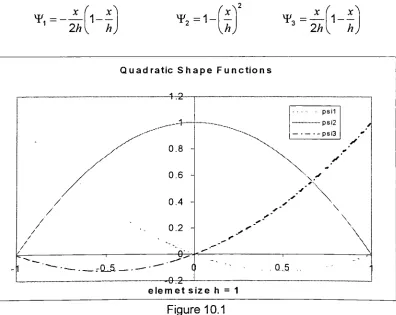
Quadratic
elements
make
use
of
three
nodes
(n=3).
The
nodes are
located
at
the
beginning,
middle,
and end
of
the
element.
The
three
nodes provide
for
smoother
fitting
of
the
approximation.
Cubic
Hermite
uses
four
equations
(n=4).
However,
there
are
two
nodes
located
at
the
beginning
and
the
end
of
the
element.
At
each node
there
are
two equations,
one
for
position
and one
for
slope.
This
makes
for
a
CHAPTER
6
elements will
give
the
same
precise values at
the nodes,
but
the different types
will give
progressively better
results
between
the
node